
The Impact of the Virulence of Pseudomonas aeruginosa Isolated from Dogs
by
 , , , , , , and
Telma de Sousa
1,2,3,4 ,
,
Andreia Garcês
5,6 ,
,
Augusto Silva
7 ,
,
Ricardo Lopes
7 ,
,
Nuno Alegria
8,
Michel Hébraud
9,
Gilberto Igrejas
1,3,4 and
and
Patricia Poeta
2,4,10,11,*
1
Department of Genetics and Biotechnology, University of Trás-os-Montes and Alto Douro (UTAD), 5000-801 Vila Real, Portugal
2
Microbiology and Antibiotic Resistance Team (MicroART), Department of Veterinary Sciences, University of Trás-os-Montes and Alto Douro (UTAD), 5000-801 Vila Real, Portugal
3
Functional Genomics and Proteomics Unit, University of Trás-os-Montes and Alto Douro (UTAD), 5000-801 Vila Real, Portugal
4
Associate Laboratory for Green Chemistry (LAQV), Chemistry Department, Faculty of Science and Technology, University Nova of Lisbon, 2829-516 Lisbon, Portugal
5
CRL-CESPU, Cooperativa de Ensino Superior Politécnico e Universitário, R. Central Dada Gandra, 1317, 4585-116 Gandra, Portugal
6
CITAB, University of Trás-os-Montes and Alto Douro (UTAD), 5000-801 Vila Real, Portugal
7
INNO—Veterinary Laboratory, R. Cândido de Sousa 15, 4710-503 Braga, Portugal
8
Department of Veterinary Sciences, School of Agrarian and Veterinary Sciences, University of Trás-os-Montes and Alto Douro (UTAD), 5000-801 Vila Real, Portugal
9
UMR Microbiologie Environnement Digestif Santé (MEDiS), INRAE, Université Clermont Auvergne, 60122 Saint-Genès-Champanelle, France
10
Veterinary and Animal Research Centre (CECAV), University of Trás-os-Montes and Alto Douro (UTAD), 5000-801 Vila Real, Portugal
11
Associate Laboratory for Animal and Veterinary Sciences (AL4AnimalS), University of Trás-os-Montes and Alto Douro (UTAD), 5000-801 Vila Real, Portugal
*
Author to whom correspondence should be addressed.
Vet. Sci. 2023, 10(5), 343; https://doi.org/10.3390/vetsci10050343
Submission received: 29 March 2023
/
Revised: 9 May 2023
/
Accepted: 10 May 2023
/
Published: 11 May 2023
(This article belongs to the Special Issue One Health Challenges and Opportunities—Animals, Humans and Their Interconnected Ecosystems)
Simple Summary
This study aimed to evaluate the antimicrobial resistance patterns and biofilm production of clinical isolates of Pseudomonas aeruginosa which is a pathogenic bacterium that can cause infections in dogs. The results showed widespread resistance to various β-lactam antimicrobials, with amikacin and tobramycin being the only effective aminoglycosides. All isolates carried the oprD gene, which is essential in governing the entry of antibiotics into bacterial cells, and all isolates also carried virulence genes. The study emphasizes the importance of continued monitoring of antimicrobial resistance in veterinary medicine and responsible antibiotic use to prevent multi-drug resistance from emerging. The findings of this study have significant implications for the treatment and prevention of P. aeruginosa infections in dogs and highlight the need for further research to better understand the mechanisms underlying the emergence of multi-drug resistance.
Abstract
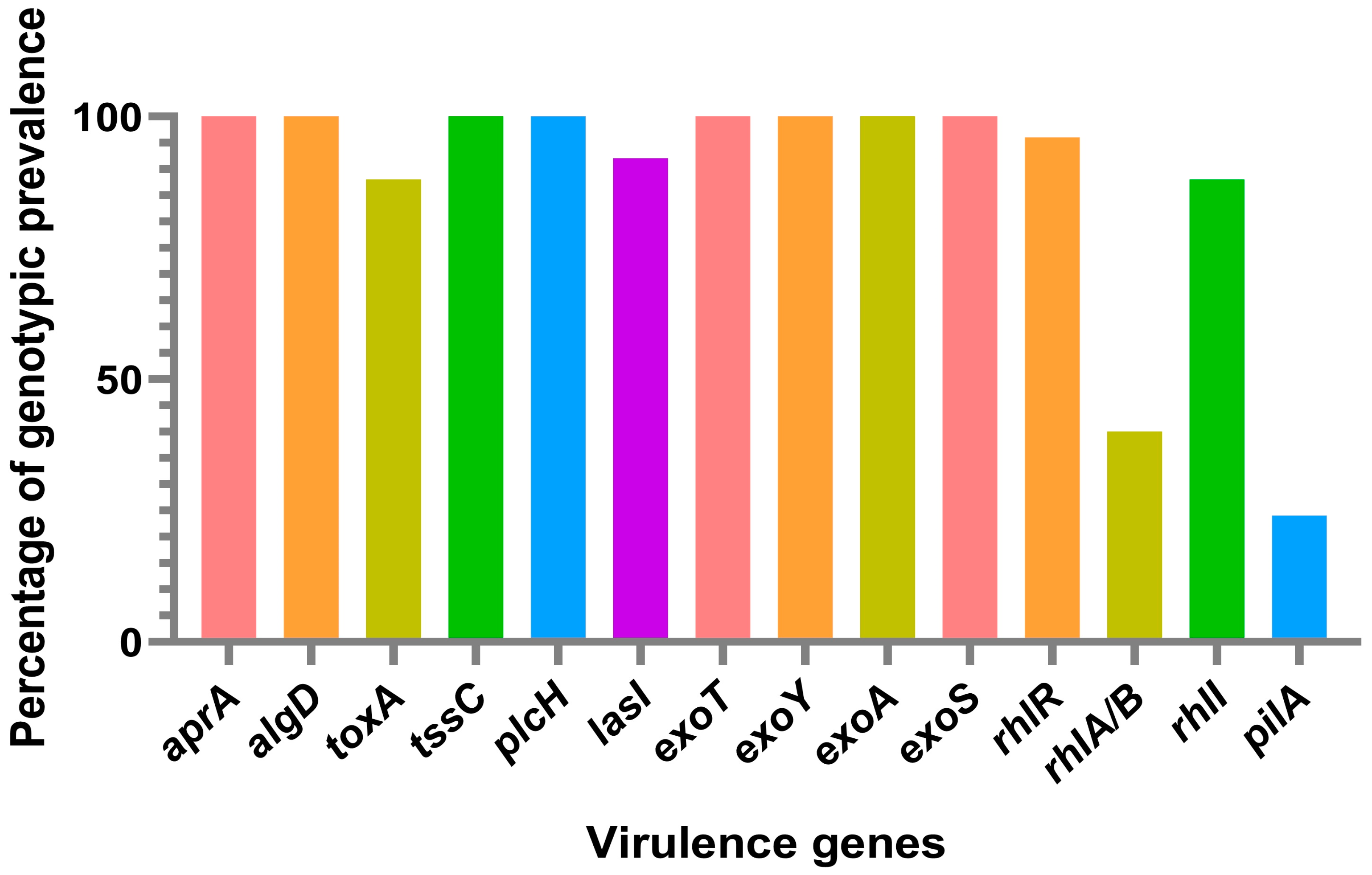
Pseudomonas aeruginosa is a pathogenic bacterium that can cause serious infections in both humans and animals, including dogs. Treatment of this bacterium is challenging because some strains have developed multi-drug resistance. This study aimed to evaluate the antimicrobial resistance patterns and biofilm production of clinical isolates of P. aeruginosa obtained from dogs. The study found that resistance to various β-lactam antimicrobials was widespread, with cefovecin and ceftiofur showing resistance in 74% and 59% of the isolates tested, respectively. Among the aminoglycosides, all strains showed susceptibility to amikacin and tobramycin, while gentamicin resistance was observed in 7% of the tested isolates. Furthermore, all isolates carried the oprD gene, which is essential in governing the entry of antibiotics into bacterial cells. The study also investigated the presence of virulence genes and found that all isolates carried exoS, exoA, exoT, exoY, aprA, algD, and plcH genes. This study compared P. aeruginosa resistance patterns worldwide, emphasizing regional understanding and responsible antibiotic use to prevent multi-drug resistance from emerging. In general, the results of this study emphasize the importance of the continued monitoring of antimicrobial resistance in veterinary medicine.
Keywords:
Pseudomonas aeruginosa; dogs; antibiotic resistance