1. Summary
Dental anxiety affects around 10–20% of people worldwide, with severe cases affecting around 3–5%. The prevalence and severity of dental anxiety vary according to several sociodemographic factors, particularly gender, age and educational level [
1,
2]. Dental anxiety has been demonstrated to be associated with a variety of individual outcomes, including—but not limited to—pronounced avoidance of dental care, deterioration of oral health, increased caries, periodontal disease and reduced quality of life [
3,
4].
A number of standardized tools have been developed for the purpose of measuring dental anxiety. The Dental Anxiety Scale (DAS), first introduced by Corah in 1969 [
5], remains one of the most widely utilized instruments in this field [
6]. It comprises four items, each targeting patient responses to specific situations encountered both before and during dental treatment. It has been demonstrated in a considerable number of studies that the DAS is both valid and reliable [
7].
The questionnaire on current stress (KAB, ‘Kurzfragebogen zur aktuellen Beanspruchung’) was developed to assess individuals’ current experience of stress in a structured way using a questionnaire. With just six questions, it provides a quick and reliable assessment of current stress levels [
8,
9].
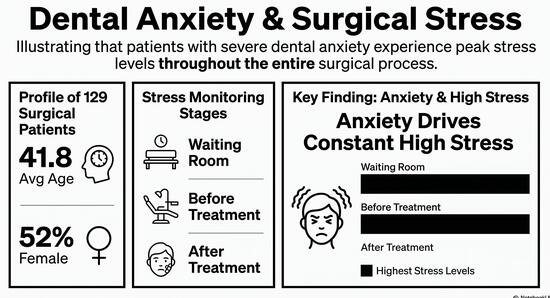
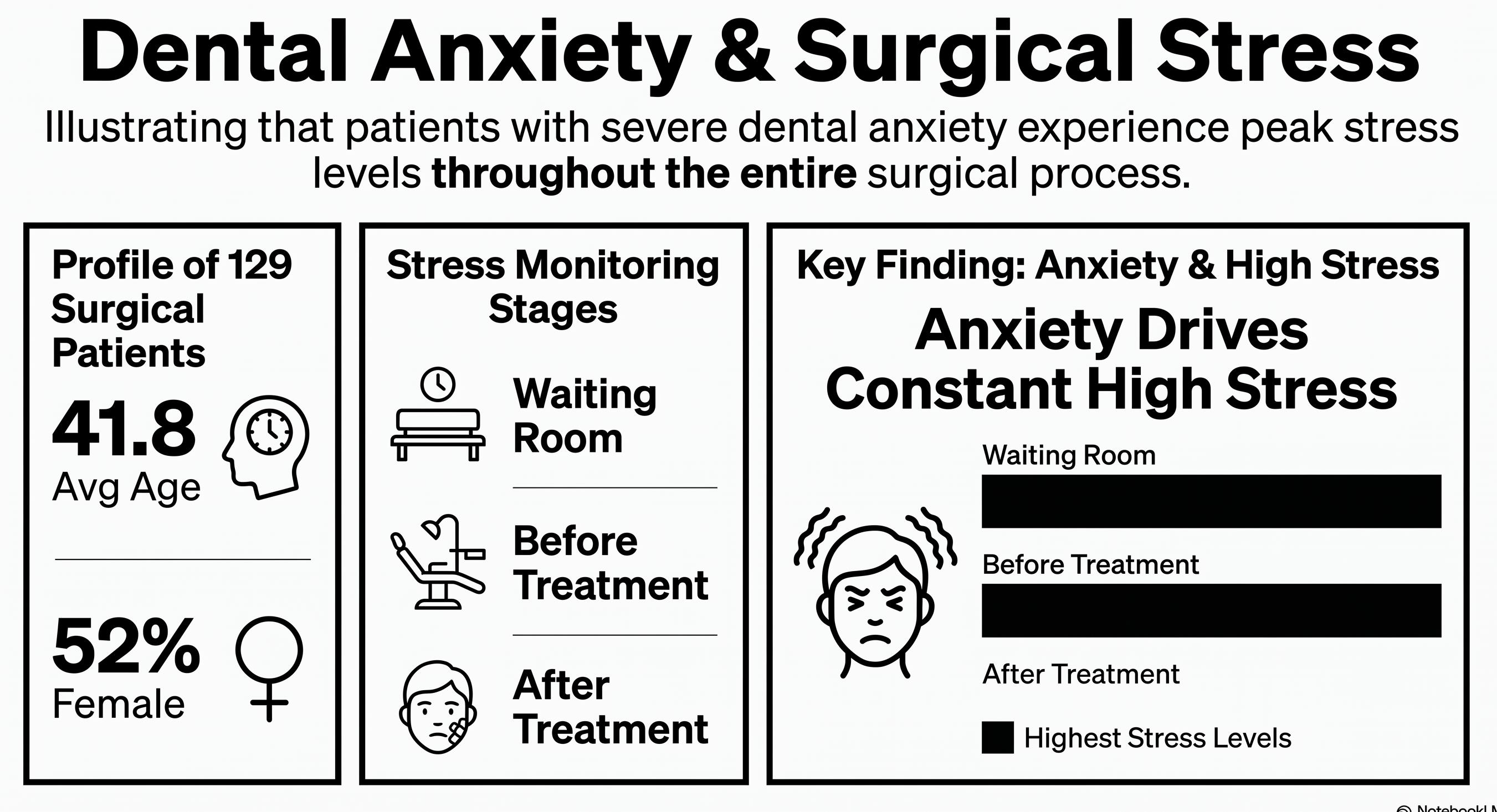
In this study, patients’ dental anxiety was measured one time using the DAS. Their current stress levels (measured using the KAB) were assessed at three different points in time in the waiting room, as well as before and after treatment in the treatment room. When divided into three groups based on varying levels of dental anxiety (low, moderate, and severe), different stress levels were also observed throughout the course of treatment. Patients with the highest levels of dental anxiety reported the highest levels of current stress at all points in time [
10].
2. Data Description
Information on specific characteristics and access to the dataset is presented in
Table 1.
Table 2 provides an overview of the contents of the columns in the data table. The dataset [
11] contains questionnaire data from
N = 129 patients. The patients (
n = 62 males (48.1%) and
N = 67 females (51.9%), mean age 41.8 years, SD 18.3 years) visited an oral surgical clinic in Wissen (Rhineland-Palatinate, Germany) for different oral surgical treatments in July and August 2013.
Patients aged 18 and over took part in the study voluntarily after signing a written consent form. The study included patients who had a sufficient command of spoken and written German language and were able to complete the questionnaire independently. Dental anxiety or a high level of dental anxiety were not exclusion criteria.
The questionnaire contains the Dental Anxiety Scale (DAS) [
5,
6,
7] and the questionnaire on current stress (KAB, ‘Kurzfragebogen zur aktuellen Beanspruchung’) [
8,
9]. The DAS questionnaire was handed to patients by their dentists on a one-off basis prior to treatment and completed in the waiting room. The KAB questionnaire was handed to patients by their dentists on three separate occasions: (t1) together with the DAS in the waiting room prior to treatment, (t2) in the treatment room before treatment, and (t3) in the treatment room after treatment. Depending on the surgical procedure, the interval between the three measurement points ranged from 5 to 90 min for each patient. Information on gender and age was also collected.
3. Methods
3.1. Dental Anxiety Scale (DAS)
The Dental Anxiety Scale (DAS) [
5,
6,
7] comprises four questions. The items are scored from 1 to 5, where ‘1’ indicates no discomfort, while ‘5’ indicates extreme fear. Questions 1 and 2 assess situations prior to treatment (1. ‘If you had to go to the dentist tomorrow, how would you feel about it?’; 2. ‘When you are waiting in the dentist’s office for your turn in the chair, how do you feel?’). Questions 3 and 4 focus on experiences during treatment (3. ‘When you are in the dentist’s chair waiting while he gets the drill ready to begin working on your teeth, how do you feel?’; 4. ‘You are in the dentist’s chair to have your teeth cleaned. While you are waiting and the dentist is getting out the instruments which he will use to scrape your teeth around the gums, how do you feel?’). Dental anxiety is calculated using the sum of the four items. One missing item is permitted when calculating the sum score [
5,
6]. The scale’s range of values is from 4 to 20. Higher values indicate a greater degree of dental anxiety. A score of 4 to 10 indicates no/low anxiety; scores of 11 to 15 indicate moderate anxiety; and scores above 16 indicate severe anxiety [
6]. In the present study the internal consistency of the scale was excellent, with a Cronbach’s alpha of 0.904 and a McDonald’s omega of 0.905.
3.2. Questionnaire on Current Stress (KAB)
The well-established questionnaire on current stress (KAB, ‘Kurzfragebogen zur aktuellen Beanspruchung’ [
8,
9]) was used to briefly assess the level of stress currently being experienced in the current treatment situation. The instruction is: ‘Please describe how you are feeling right now.’ The items are [
12]:
- (1)
‘Relaxed’ … ‘tense’;
- (2)
‘Dissolved’ … ‘anxious’;
- (3)
‘Unconcerned’ … ‘worried’;
- (4)
‘Relaxed’ … ‘restless’;
- (5)
‘Confident’ … ‘skeptical’;
- (6)
‘Comfortable’ …’uncomfortable’.
Patients were asked to rate their feelings on a six-point Likert scale ranging from 1 to 6 (e.g., for item 6: 1—very comfortable; 2—rather comfortable; 3—slightly comfortable; 4—slightly uncomfortable; 5—rather uncomfortable; 6—very uncomfortable). The scores for the six items were added together and divided by 6. As with the DAS, when calculating the total score, it is permissible for one point to be missing [
8]. The KAB total score ranges from 1 to 6, with higher scores indicating a higher level of current stress. The internal consistency of the KAB in this study is as follows: t1: Cronbach’s Alpha = 0.901, McDonald’s Omega = 0.912; t2: Cronbach’s Alpha = 0.925, McDonald’s Omega = 0.929; t3: Cronbach’s Alpha = 0.896, and McDonald’s Omega = 0.898.
3.3. Validation of the Data
Missing data may have been caused by participants forgetting or deliberately avoiding answering individual items. These are coded as ‘-999.00’ in the dataset and are therefore easily identifiable. The entire dataset (129 participants, 28 variables, and 3.612 fields) contains N = 6 missing values (0.17%). There are no missing values in the overall scores for DAS and KAB (all time points). No participants had to be excluded due to having too many missing values. Descriptive statistics were used to check the data set for anomalies or inconsistencies in all variables. For example, individual DAS items must be between 1 and 5 (not 6 or any other value), and the total score for the dental anxiety scale must be 4 or above but not above 20.
This study was conducted in accordance with the principles of the Declaration of Helsinki. The present study was approved by the Ethics Committee of the Technische Universität Dresden, Germany (EK211062013 from 13 June 2013). Written informed consent was obtained from all subjects included in the study. The study presented is an observational study without intervention.
4. User Notes
The dataset [
11] consists of two files. The first is the dataset itself: an Excel spreadsheet named ‘stress_oral_surgery.xlsx’. This file can easily be converted into other formats, such as .csv. The file can also be easily imported into various statistical analysis software programs, such as IBM SPSS 31. The second file is a help file in Portable Document Format (PDF) named ‘data_description.pdf’. It describes each field in the data file, including its name, content, and possible response categories.
5. Limitations
This data set has several limitations. Generally, it should be emphasized that the present investigation represents a small-scale study, comprising only N = 129 patients from a single oral surgery practice in a rural area. Due to the limited sample size and the restricted setting, the findings cannot be generalized. Only patients aged 18 years and older were included, since an additional declaration of consent from parents or legal guardians would have been required for children and adolescents for legal reasons. Furthermore, no validation data for the questionnaires is available for children and adolescents.
The data were collected via patient self-assessments using standardized questionnaires. It must be acknowledged that self-reported information is subject to potential bias; some participants may have provided inaccurate or minimized responses to avoid being identified as anxious. Furthermore, individuals with severe dental anxiety are likely underrepresented in the dataset, as such patients often refrain from seeking dental treatment altogether.
Only brief self-assessment instruments were employed. While efficient, these short screening tools may insufficiently capture the complexity of the constructs under investigation and thus introduce measurement bias. Objective oral health indices, such as the Periodontal Screening Index (PSI) or the DMF-T Index, could not be applied due to time and resource constraints. Likewise, relevant socioeconomic variables (e.g., income, employment status, insurance coverage), which may influence the understanding of dental anxiety, were not assessed. A key limiting factor is that, due to the anonymous nature of the study, it was not possible to record the type of condition or the dental surgery treatment. The type, extent and duration of the surgical procedure can have a significant impact on stress levels.
Finally, although data collection took place between July and August 2013, the study results were not published until 2022 [
10]. Accordingly, data processing and repository upload were considerably delayed.
Author Contributions
Conceptualization, P.R. and H.B.; methodology, H.B.; validation, L.I.; formal analysis, L.I.; investigation, P.R.; data curation, H.B.; writing—original draft preparation, H.B.; writing—review and editing, L.I. and P.R.; project administration, H.B. All authors have read and agreed to the published version of the manuscript.
Funding
This research received no external funding.
Institutional Review Board Statement
This study was conducted in accordance with the principles of the Declaration of Helsinki. The present study was approved by the Ethics Committee of the Technische Universität Dresden, Germany (EK211062013 from 13 June 2013).
Informed Consent Statement
Written informed consent was obtained from all subjects included in the study. The study presented is an observational study without intervention.
Data Availability Statement
The data described in this article can be freely and openly accessed on OpARA—Research Data Repository of Saxon Universities under
http://doi.org/10.25532/OPARA-163.
Conflicts of Interest
The authors declare no conflicts of interest.
Abbreviations
The following abbreviations are used in this manuscript:
| DAS | Dental Anxiety Scale |
| DMF-T | Decayed, Missing, Filled Teeth Index |
| KAB | Questionnaire on current stress (‘Kurzfragebogen zur aktuellen Beanspruchung’) |
| PSI | Periodontal Screening Index |
| SD | Standard deviation |
References
- Silveira, E.R.; Cademartori, M.G.; Schuch, H.S.; Armfield, J.A.; Demarco, F.F. Estimated prevalence of dental fear in adults: A systematic review and meta-analysis. J. Dent. 2021, 108, 103632. [Google Scholar] [CrossRef] [Scilit] [PubMed]
- Halonen, H.; Nissinen, J.; Lehtiniemi, H.; Salo, T.; Riipinen, P.; Miettunen, J. The Association Between Dental Anxiety and Psychiatric Disorders and Symptoms: A Systematic Review. Clin. Pract. Epidemiol. Ment. Health 2018, 14, 207–222. [Google Scholar] [CrossRef] [Scilit] [PubMed]
- Sürücü, H.A.; Durgu, N.; Ozan, E. A multi-layered barrier to oral health: A mixed methods exploration of dental anxiety. BMC Oral Health 2026, 26, 904. [Google Scholar] [CrossRef] [Scilit] [PubMed]
- Lenk, M.; Rose, C.; Weidner, K.; Rietschel, J.; Hannig, C.; Lorenz, K. Dental and periodontal health, oral health-related quality of life and life satisfaction in patients with severe dental phobia. Sci. Rep. 2025, 15, 35047. [Google Scholar] [CrossRef] [Scilit] [PubMed]
- Corah, N.L. Development of a dental anxiety scale. J. Dent. Res. 1969, 48, 596. [Google Scholar] [CrossRef] [Scilit] [PubMed]
- Tönnies, S.; Mehrstedt, M.; Eisentraut, I. Die Dental Anxiety Scale (DAS) und das Dental Fear Survey (DFS)–Zwei Messinstrumente zur Erfassung von Zahnbehandlungsängsten. Z. Med. Psychol. 2002, 11, 63–72. [Google Scholar] [CrossRef] [Scilit] [PubMed]
- Bantel, D.; Chmielewski, W.X.; Brähler, E.; Stöbel-Richter, Y.; Zenger, M.; Weil, K.M.; Berth, H. The dental anxiety scale (DAS)–Psychometric properties and longitudinal findings among middle- aged adults. BMC Psychol. 2025, 13, 953. [Google Scholar] [CrossRef] [Scilit] [PubMed]
- Müller, B.; Basler, H. Kurzfragebogen zur Aktuellen Beanspruchung (KAB); Beltz: Weinheim, Germany, 1993. [Google Scholar]
- Hinz, A. Kurzfragebogen zur aktuellen Beanspruchung (KAB). In Brickenkamp Handbuch Psychologischer und Pädagogischer Tests. Bands 2; Brähler, E., Holling, H., Leutner, D., Petermann, F., Eds.; Hogrefe: Göttingen, Germany, 2002; pp. 1010–1011. [Google Scholar]
- Richter, P.; Bohl, C.; Berth, H. Dental anxiety and stress in patients during different types of oral surgery. Oral 2022, 2, 88–94. [Google Scholar] [CrossRef] [Scilit]
- Berth, H. Current Stress and Dental Anxiety in a Sample of 129 Oral Surgical Patients. OpARA-Research Data Repository of Saxon Universities. 2022. Available online: https://opara.zih.tu-dresden.de/handle/123456789/2603 (accessed on 22 July 2026).
- Canazei, M.; Glenzer, L.; Staggl, S.; Dresen, V.; Weninger, J.; Weiss, E.M. Breathing environment: Exploring the feasibility and efficacy of personalized, light-guided slow breathing while performing two computer tasks in a simulated office environment. Comput. Hum. Behav. Rep. 2025, 18, 100661. [Google Scholar] [CrossRef] [Scilit]
Table 1.
Characteristics of the data set.
Table 1.
Characteristics of the data set.
| Subject Area | Health Sciences, Medical Sciences |
|---|
| Specific subject area | Dental anxiety; current stress |
| Type of data | Raw data and calculated scores for DAS and KAB |
| Data format | MS Excel spreadsheet |
| Data collection | Patients who visited an oral surgery clinic in Wissen (Rhineland-Palatinate, Germany) between July and August 2013 to undergo various oral surgical procedures were invited to take part in a survey |
| Data type | Cross-sectional survey dataset (paper-based questionnaire); data collection at a single measurement point, with the KAB administered three times before and after treatment |
| Research institution | Country: Germany, Technische Universität Dresden |
| Subjects | N = 129 patients, N = 67 females (51.9%), N = 62 male (48.1%), mean age 41.8 years (SD = 18.3, Range 18–89 years) |
| Methods | Dental Anxiety Scale (DAS) [5,6,7]
Questionnaire on current stress (KAB) [8,9] |
| Number of variables | 28 |
| Repository institution | Repository name: OPARA Open Access Repository and Archive for Research Data of Saxon Universities
Data identification number: DOI 10.25532/OPARA-163
URL: https://opara.zih.tu-dresden.de/handle/123456789/2603 (accessed on 22 July 2026) |
Table 2.
Content of each column in the data set (MS Excel spreadsheet ‘stress_oral_surgery.xlsx’).
Table 2.
Content of each column in the data set (MS Excel spreadsheet ‘stress_oral_surgery.xlsx’).
| Column | Content |
|---|
| A | Sex (1 = male, 2 = female) |
| B | Age (in years) |
| C–F | Dental Anxiety Scale (DAS), single items |
| G | Dental Anxiety Scale (DAS), sum score |
| H–M | Questionnaire on current stress (KAB) at t1, single items |
| N–S | Questionnaire on current stress (KAB) at t2, single items |
| T–Y | Questionnaire on current stress (KAB) at t3, single items |
| Z | Questionnaire on current stress (KAB) at t1, total score |
| AA | Questionnaire on current stress (KAB) at t2, total score |
| AB | Questionnaire on current stress (KAB) at t3, total score |
| Disclaimer/Publisher’s Note: The statements, opinions and data contained in all publications are solely those of the individual author(s) and contributor(s) and not of MDPI and/or the editor(s). MDPI and/or the editor(s) disclaim responsibility for any injury to people or property resulting from any ideas, methods, instructions or products referred to in the content. |