
Article

BART-IL: Behavior-Aware Impermanent Loss Optimization for Liquidity Pool-Based Data Trading
The College of Information Engineering, China Jiliang University, Hangzhou 310018, China
*
Author to whom correspondence should be addressed.
Data 2026, 11(6), 137; https://doi.org/10.3390/data11060137
Submission received: 3 April 2026 / Revised: 4 June 2026 / Accepted: 5 June 2026 / Published: 9 June 2026
(This article belongs to the Special Issue Artificial Intelligence and Data Science for Fintech)

Abstract

The blockchain-based Automated Market Maker (AMM) mechanism establishes a multilateral trading market for multi-source homogeneous data assets. Its advantage lies in realizing algorithmic dynamic pricing and automated circulation through decentralized liquidity pools, effectively avoiding the single-point failure issues and pricing inefficiencies associated with traditional centralized platforms, while significantly improving the trading efficiency and value conversion potential of data assets. However, in high-frequency, large-scale, multilateral data trading scenarios, these AMM liquidity pools face intensified Impermanent Loss (IL) that cannot be easily addressed by conventional risk mitigation approaches, necessitating domain-specific tailored solutions. To address this issue, our study proposes a blockchain on-chain liquidity pool-based data trading market model. Through mathematical modeling and simulation experiments, we quantify how trader behavioral characteristics, including price sensitivity differentials, heterogeneous trading frequencies, and trading size variations, impact the value of AMM liquidity pool. On this basis, we propose a Behavior-Aware Real-time Trading-driven Impermanent Loss optimization method (BART-IL), which uses multi-factor scoring to dynamically sequence trades, generating low-impermanent-loss execution paths to mitigate risks for Liquidity Providers (LPs). Experimental results demonstrate that BART-IL reduces IL for LPs, capping maximum loss at 25.6% in large-scale trading scenarios and achieving over 40% loss reduction in high-frequency-dominant markets. Accordingly, the method substantially lowers the overall risk of data trading. This research addresses the adaptability bottleneck of AMM mechanisms for non-standard assets. By integrating innovations in mechanism design and algorithm optimization, we construct a low-cost blockchain-based decentralized data trading framework with enhanced fairness, offering important implications for ensuring the robustness and attractiveness of data trading platforms.

1. Introduction

Currently, data has become a strategic resource driving socioeconomic development, and its efficient circulation and market-based allocation are pivotal to fully unlock the value of data assets [1]. Existing data trading platforms primarily adopt centralized structures, providing supply–demand matching services for data buyers and sellers to facilitate data flow across different sectors of society [2]. However, these centralized trading models exhibit systemic vulnerabilities [3]. On the one hand, single points of failure may cause market-wide trading interruptions when central nodes fail; on the other hand, manual negotiation and pricing mechanisms between parties incur significant efficiency losses, manifesting as unreasonable pricing and trading delays. These dual constraints jointly inhibit the liquidity scale and cross-domain trading potential of data assets, substantially undermining the depth and breadth of value realization.
In data trading markets, multi-source homogeneous data, characterized by unified data structures, consistent type systems, and standardized semantic specifications (e.g., supermarket shopping records), is naturally compatible with the blockchain-based Automated Market Maker (AMM) mechanism, enabling many-to-many trading markets. The homogeneous nature of such data facilitates standardized interactions in trading scenarios, laying a foundation for both on-chain liquidity pool construction and algorithmic pricing within the AMM mechanism. In addition, its uniform value density and structural standardization allow it to be abstracted as homogeneous liquidity pool assets, supporting real-time responsiveness and elastic scalability for many-to-many high-frequency trading scenarios. Consequently, multi-source homogeneous data supports the feasibility of blockchain liquidity pool-based data trading models. Such models adopt decentralized liquidity pools with automated pricing mechanisms, effectively mitigating single-point failure issues and pricing inefficiencies inherent in traditional centralized platforms, thereby significantly enhancing data trading efficiency and value conversion potential. In recent years, with the expansion of the crypto asset market and the significant growth in demand for Decentralized Exchanges (DEXs), AMMs have enabled a trading paradigm shift from traditional centralized order book models through their liquidity pool mechanisms and mathematical pricing algorithms, garnering substantial attention from academia and industry [4]. This model achieves automatic asset pricing through liquidity pools in the blockchain environment, where Liquidity Providers (LPs) deposit single or multiple types of tokens into designated on-chain liquidity pools. Traders then execute swaps through direct interactions with smart contracts, eliminating reliance on order matching [5]. Adopting the AMM mechanism to construct liquidity pools provides infrastructural support for the free exchange and price discovery of data assets, thereby addressing the inherent limitations of traditional trading platforms. However, within on-chain liquidity pool-driven data trading mechanisms, the inherent Impermanent Loss (IL) risk poses not only a primary threat to the returns of LPs [6], but also a structural bottleneck to the development of decentralized data markets. This risk fundamentally stems from the inherent conflict between price volatility and the rebalancing mechanisms of AMMs. IL refers to the reduction in the value of assets deposited by LPs into an AMM pool (consisting of two or more assets) compared with a simple holding strategy, resulting from market price fluctuations [7]. Currently, researchers have explored a series of approaches aimed at optimizing the algorithmic layer of AMMs. For example, some studies have introduced methods such as dynamic fee models [8], fee rebate mechanisms [9], and oracle integration schemes [10], aiming to mitigate IL risks in cryptocurrency trading scenarios. These efforts seek to restructure the risk hedging logic of AMMs through mechanism design innovations, thereby providing algorithmic optimization pathways for addressing the asset value volatility faced by LPs.
Although substantial research has accumulated on IL mitigation in traditional cryptocurrency trading scenarios, it exhibits distinctly more complex behavior in data asset trading environments [11,12]. The inherent attributes of data assets, such as non-competitiveness, time-sensitive value, and ambiguous ownership definitions, increase the complexity of the mechanisms and transmission pathways through which IL arises, compared with traditional cryptocurrency contexts. This necessitates targeted research that incorporates the specific characteristics of data assets. Furthermore, when data trading is characterized by high-frequency/small-amounts and high-value-density, existing mechanisms have significant limitations in terms of asset rebalancing efficiency and real-time price protection. There is an urgent need to develop a dynamic IL optimization framework tailored to the unique properties of data assets.
To address the IL risk faced by AMMs within data trading scenarios, this study first constructs a blockchain-based on-chain liquidity pool data trading model. Subsequently, through mathematical modeling and simulation experiments, we systematically quantify the impact of trader behavioral characteristics on AMM pool value and explore the underlying mechanisms that affect LP returns. Based on this, we propose a Behavior-Aware Real-time Trading-driven Impermanent Loss Optimization Method (BART-IL). This method relies on a multi-factor composite scoring mechanism to dynamically adjust trade execution order, aiming to effectively reduce the IL risk faced by LPs while improving the stability and operational efficiency of data asset trading markets. Furthermore, by facilitating efficient data circulation, such markets can provide abundant and diversified data resources for the training of deep learning models [13]. The main contributions of this paper are summarized as follows:
  • Constructing a blockchain liquidity pool-based data trading mechanism for non-standard assets and analyzing its IL: This work introduces IL analysis into on-chain liquidity pool-based data trading scenarios, establishing a liquidity optimization framework tailored for high-frequency, small-amount trading and high-value-density data assets. When applied to non-standard assets, this framework addresses the adaptation limitations of traditional AMMs.
  • Revealing the causal mechanisms between data trading behavioral characteristics and IL: Through mathematical modeling and simulation experiments, this study systematically quantifies the impact of traders’ behavioral characteristics on the rebalancing efficiency of on-chain AMM pools. This approach further deconstructs the formation mechanisms of IL in data trading under blockchain environments.
  • Proposing the BART-IL that dynamically regulates trade execution sequences using a multi-factor composite scoring mechanism. By incorporating behavioral signals into execution ordering, BART-IL mitigates IL accumulation for liquidity providers while preserving decentralized trading autonomy.
The blockchain liquidity pool-based IL optimization method proposed in this paper significantly reduces IL for LPs in high-frequency, large-scale, multilateral trading environments. Experimental results demonstrate that BART-IL limits the maximum loss rate to 25.6% in large-scale trading scenarios, with loss reduction exceeding 40% in high-frequency-dominant markets. These improvements enhance the predictability, operational fairness, and capital efficiency of data trading. By integrating mechanism design with algorithm optimization, this framework helps improve the robustness and attractiveness of data trading platforms.
The rest of the paper is organized as follows: Section 2 introduces and discusses related work. Section 3 provides a detailed introduction to the IL mechanism and specifically analyzes the factors that affect IL. In Section 4, we propose an IL optimization method for liquidity pool-based data trading based on trader behavioral characteristics, and Section 5 fully evaluates the performance of this method. Finally, we present our conclusions in Section 6.

2. Related Work

2.1. Traditional and Blockchain-Based Data Trading Mechanisms

As an emerging factor of production, the design of data trading mechanisms is pivotal to realizing the circulation of its value. Existing data trading models are broadly classified into two categories: traditional centralized platforms and blockchain-based decentralized platforms. Traditional data trading models rely on centralized platforms as trusted intermediaries, typically employing fixed pricing, auctions, or negotiated pricing mechanisms [14]. The process is as follows: data sellers upload datasets to the platform; buyers purchase the target data through retrieval and negotiation procedures; and the platform charges a commission [15]. To mitigate trust risks arising from data caching, some platforms adopt API-based matching models that facilitate data access rights trading without storing raw data [16]. Such platforms play critical roles in data rights authentication, privacy preservation, trust establishment, and the resolution of data silos [17]. However, they generally face fundamental contradictions such as liquidity fragmentation caused by discrete pricing and value dissipation caused by intermediary commissions. These issues lead to inefficient matching in high-frequency, small-amount data trading, while their centralized architecture creates risks of single points of failure and pricing opacity, continuously suppressing the market-based allocation efficiency of data assets.
Blockchain-based solutions, such as peer-to-peer smart contract data trading [18], subscription-based data trading models [19], and privacy-protected trading using cryptographic techniques such as zero-knowledge proofs [20], have made progress in improving transparency and security. For example, AlSkaif et al. [21] developed a decentralized P2P energy data trading model and implemented it on a licensed blockchain smart contract platform. Yao et al. [22] focused on data pricing design in a decentralized privacy-protection scenario, constructed a data trading model, studied the interaction among data providers, collectors and potential users, and maximized the gross profit of operators’ customized services by jointly optimizing privacy data rewards and subscription fees. Liu et al. [23] proposed a novel Secure Power Data Trading Scheme (SPDTS), which uses zero-knowledge proofs to ensure data availability and consistency, leverages blockchain technology to guarantee trading reliability, employs smart contracts to enhance processing efficiency, adopts a trusted execution environment to safeguard data security, and applies differential privacy to protect data privacy, thereby providing a secure and reliable solution for power data trading. In addition, ensuring the quality of data itself is another critical dimension of trustworthy data trading. Recent advances in self-supervised learning, such as image denoising techniques [24], offer promising directions for data verification and quality enhancement in decentralized data markets.
The above methods mainly focus on improving trading transparency, security, privacy protection, and incentive mechanisms in the data trading process. These approaches partially alleviate problems such as trust deficits, single-point failures, privacy leakage and low trading efficiency in specific fields. However, these schemes still exhibit significant limitations in enhancing market liquidity and enabling data asset trading characterized by high-frequency, small-amount and high-value-density transactions. Existing research has yet to fully consider the impact of data assets with unique attributes such as non-competitiveness, time-sensitive value, and ambiguous ownership definitions on market liquidity and participant behavioral characteristics. For multilateral trading of multi-source homogeneous data assets, there is an urgent need for a decentralized trading mechanism capable of fundamentally resolving the problem of insufficient liquidity and achieving automatic pricing and continuous matching. The AMM mechanism provides a novel pathway to address these challenges and build an efficient continuous trading market, as it naturally fits many-to-many trading scenarios.

2.2. AMM Mechanism and Liquidity Provision

AMM is a blockchain-based liquidity protocol that disrupts the traditional order book model. It relies on algorithmic pricing functions and decentralized settlement to redefine the liquidity supply paradigm in data asset markets. Its core functionality lies in automatically calculating asset prices through predefined constant functions and providing real-time trading [25,26,27].
A typical example is Uniswap V2 [28], which pioneered the constant product formula, as shown in Equation (1):
x × y = k ,
where x is the number of one token in the pool, y is the number of another token, and k is a constant.
Uniswap V2 replaces traditional order books with algorithmic pricing, enables permissionless asset exchange, and eliminates the reliance on immediate counterparties in traditional market making, thereby significantly reducing trading friction and improving market efficiency. The Bancor Protocol [29] was the first to implement an AMM mechanism based on the Bonding Curve, aiming to provide continuous on-chain liquidity for a single token. In this model, token price is dynamically determined by its current total supply through a predefined mathematical function. Buying and selling activities slide along the curve to achieve automatic pricing. This mechanism maintains liquidity by responding to changes in supply and demand, theoretically supporting uninterrupted trading execution. Subsequently, the AMM model has continuously evolved to accommodate diverse requirements. In the stablecoin trading scenario, Curve [30] innovatively combined the advantages of the Constant Sum and the Constant Product formulas, significantly reducing slippage and IL between stablecoin pairs. Balancer [31] introduced the Constant Geometric Mean formula, breaking through the limitations of traditional two-token pools to become the first AMM protocol supporting multi-token liquidity pools, greatly enhancing the flexibility of capital utilization. Although the AMM mechanism reduces the dependence of traditional trading on intermediaries through the algorithmic pricing functions, its sustainability depends largely on the adequacy and stability of liquidity supply. To optimize capital efficiency, Uniswap V3 [32] introduced the concept of concentrated liquidity, allowing liquidity providers to provide funds within a specific price range [ P a , P b ] , significantly improving capital efficiency. Balancer extended the flexibility of portfolio management through multi-asset weighted pools. Zeller et al. [33] transformed the issues of liquidity concentration and interval adjustment into a manageable stochastic optimization problem. Their model considers the relationship among liquidity rewards, spread losses, and reallocation costs to help LPs find the optimal interval.
Beyond pricing mechanisms, the order in which transactions are executed within a block can significantly affect market outcomes. Recent studies have shown that transaction reordering can lead to extractable value for validators, known as Maximal Extractable Value (MEV), which poses fairness and stability concerns for AMM-based exchanges [34]. To mitigate these risks, several execution optimization strategies have been proposed. For instance, McLaughlin et al. [35] proposed a Clever Look-ahead Volatility Reduction (CLVR) algorithm that constructs transaction orderings to approximately minimize price volatility with low computational cost. Their experimental results show that CLVR reduces price volatility by up to 85% in empirical data, and is compatible with splitting larger trades into smaller ones.
In the field of Decentralized Finance (DeFi), AMMs have been widely used in scenarios such as token exchange, successfully addressing liquidity shortages in cryptocurrencies [36]. However, data assets have distinct characteristics compared with financial assets, and the migration of AMM mechanisms to data trading scenarios faces dual challenges: insufficient research on key mechanism adaptability and dynamic risk control.

2.3. Impermanent Loss Mechanism and Optimization Method

IL is the core risk faced by LPs in the AMM model. It refers to the loss of portfolio value caused by market price fluctuations, meaning that the value of an LPs’ portfolio in the AMM pool is lower than the value of simply holding the same assets. The fundamental reason is that AMMs rely on arbitrageurs to keep the price in the pool consistent with the external market price, and arbitrage behavior itself changes the proportion of assets held by LPs, causing it to deviate from the initial state [37]. Mathematically, Angeris et al. [38] proved the global liquidity feasibility of AMMs through convex optimization theory and derived the classic IL expression, which relates LP losses to changes in the relative price of the pooled assets. This formulation has become a fundamental tool for quantifying LP risk in AMM-based markets.
This model reveals that the essence of IL is a risk premium that LPs bear for providing market liquidity, and it has become a fundamental tool for quantifying LP risk. In order to mitigate the negative impact of IL on the LP participation incentives, current research has proposed a variety of optimization strategies. Milionis et al. [39] pointed out the trading cost compensation effect, whereby IL can be hedged by fee income, with the break-even condition satisfying γ > σ 2 / 8 . Aigner et al. [40] were the first to quantify the risk of IL. They indicated that high asset volatility is the primary source of risk for LPs, while positive correlations between assets are a key factor in reducing risk. Tanaka et al. [41] pointed out that rebalancing strategies can mitigate IL. Hafner et al. [6] constructed an agent-based model simulating the dynamic interactions among LPs, traders, and arbitrageurs. They incorporated trading costs into the profit function of LPs and employed Monte Carlo simulation to analyze the impact of trading activity, liquidity pool size, market price changes, and arbitrageurs’ trading costs on the profits of LPs. Their studies reveal that price changes do not necessarily lead to losses, and increased arbitrageur activity can increase LP profits. Deng et al. [42] proposed two static replication formulas that can hedge IL through European options and provide an effective method for liquidity providers to manage risks. Wen et al. [43] analyzed liquidity pool price impacts by using historical Uniswap data and proposed a stable price formula, VERP, which dynamically adjusts the size of liquidity pools and balances slippage and arbitrage rates, outperforming existing solutions in price stability. Yan et al. [44] proposed a dual-mechanism framework for the challenges of liquidity retention and user participation in decentralized exchanges. The framework includes a Better Market Maker (BMM) based on power-law invariants and a Dynamic Rebate System (DRS). BMM reduces the IL and retains more liquidity when the price fluctuates; DRS adjusts the rebate ratio according to market conditions and encourages traders to participate. This framework demonstrates significant advantages in initial trades with small trade amounts, reducing IL, improving liquidity retention, and increasing trading activities, and maintaining reasonable slippage levels. Im et al. [45] proposed a new algorithm called UBET AMM (UAMM), which calculates prices by considering external and internal market prices, and determines appropriate slippage based on target balances to reduce LPs’ IL. Fritsch et al. [46] compared the trading fee revenues and arbitrage losses of Uniswap V2 and V3 liquidity pools using historical data. They found that most large AMM liquidity pools generate insufficient fees to offset arbitrage losses and that the Uniswap V2 pool was more profitable for passive LPs. They also examined the relationship between arbitrage losses and block time, revealing that reducing block time decreases arbitrage losses. However, the extent and speed of the reduction vary significantly across different trading pairs. Recent empirical studies further confirm that IL is highly sensitive to market volatility and trading activity. Using daily data from Uniswap V2, Del Monte et al. [47] show that IL responds asymmetrically to market volatility and exhibits an autoregressive structure, highlighting the importance of cumulative IL exposure when developing hedging strategies for LPs. Chu et al. [48] find that IL risk is significantly positively associated with active trading activity, with both relative price fluctuations and trading volume exerting a strong positive effect on IL.
Although these solutions have achieved some success in traditional cryptocurrency trading scenarios, they are primarily designed to address the price volatility characteristics of financial assets. The value formation mechanism, supply-demand dynamics, and participant behavior patterns of data assets are fundamentally different from those of financial assets. Therefore, IL manifests in more complex ways in data asset trading scenarios, making it difficult to directly apply standardized mitigation methods developed for digital currencies. This highlights the need for targeted research based on the characteristics of data assets and for a data-specific dynamic IL optimization framework.

2.4. Research Gaps and Our Contribution

Compared to existing studies that primarily focus on cryptocurrencies, this paper addresses the critical challenges of controlling IL in data asset trading. Existing IL mitigation methods in AMM or DeFi mainly fall into four categories: (1) pricing function modifications, for instance concentrated liquidity in Uniswap V3 and power-law invariants in BMM; (2) financial hedging instruments like options-based static replication; (3) dynamic fee or rebate mechanisms; and (4) oracle-assisted rebalancing. While effective for financial tokens, these approaches either change the core AMM logic or introduce additional financial complexity, and they do not explicitly consider trader behavioral heterogeneity. From a theoretical perspective, the present study fills this gap by introducing behavioral heterogeneity, namely price sensitivity, trading frequency, and trade amount, as a causal factor of IL, thereby extending AMM theory from homogeneous financial tokens to heterogeneous data assets.
For multilateral trading of multi-source homogeneous data assets, we propose BART-IL, a behavior-aware mechanism for mitigating IL. This paper proposes a trading method that dynamically sequences orders based on traders’ real-time behavioral characteristics. It turns execution order into a proactive risk management tool and achieves a paradigm shift from static, rule-based price adjustment to adaptive, behavior-sensitive execution. This shift matters especially for data asset markets, where participants behave very differently from one another, data value decays quickly, and conventional risk hedging tools are often missing. More generally, behavior-aware sequencing offers a new principle for building decentralized trading systems that are fairer and more resilient. It complements existing pricing-oriented approaches and points toward a new research direction at the intersection of behavioral economics and decentralized finance. Ultimately, this paradigm helps to efficiently aggregate multi-source homogeneous data, ensure compliant circulation, and realize value growth in complex trading networks.

3. Impermanent Loss Mechanism and Mathematical Modeling

3.1. AMM Data Trading Pool Model

In our previous research [49], we proposed dividing the data trading process into three stages: data assetization, asset certification, and entitlement transactionalization. Building upon this concept, we construct an AMM data trading pool model centered on data warrants, which are tokenized digital certificates that separate data ownership from raw data and enable the homogeneous trading of heterogeneous data assets in liquidity pools. This model is designed to achieve counterparty isolation by enabling data buyers and sellers to trade indirectly through the liquidity pool, thereby facilitating the indirect circulation of data assets. In this trading model, the data trading process mainly involves three roles: LPs, data sellers, and data buyers. Data sellers convert data assets into tradable data warrants and inject them into liquidity pools for sale. Data buyers purchase data warrants of the corresponding categories from the pool based on their needs to obtain data. Meanwhile, LPs act as market makers for specific data warrants by depositing both data warrants and tokens into the pool, earning trading fees as their return.
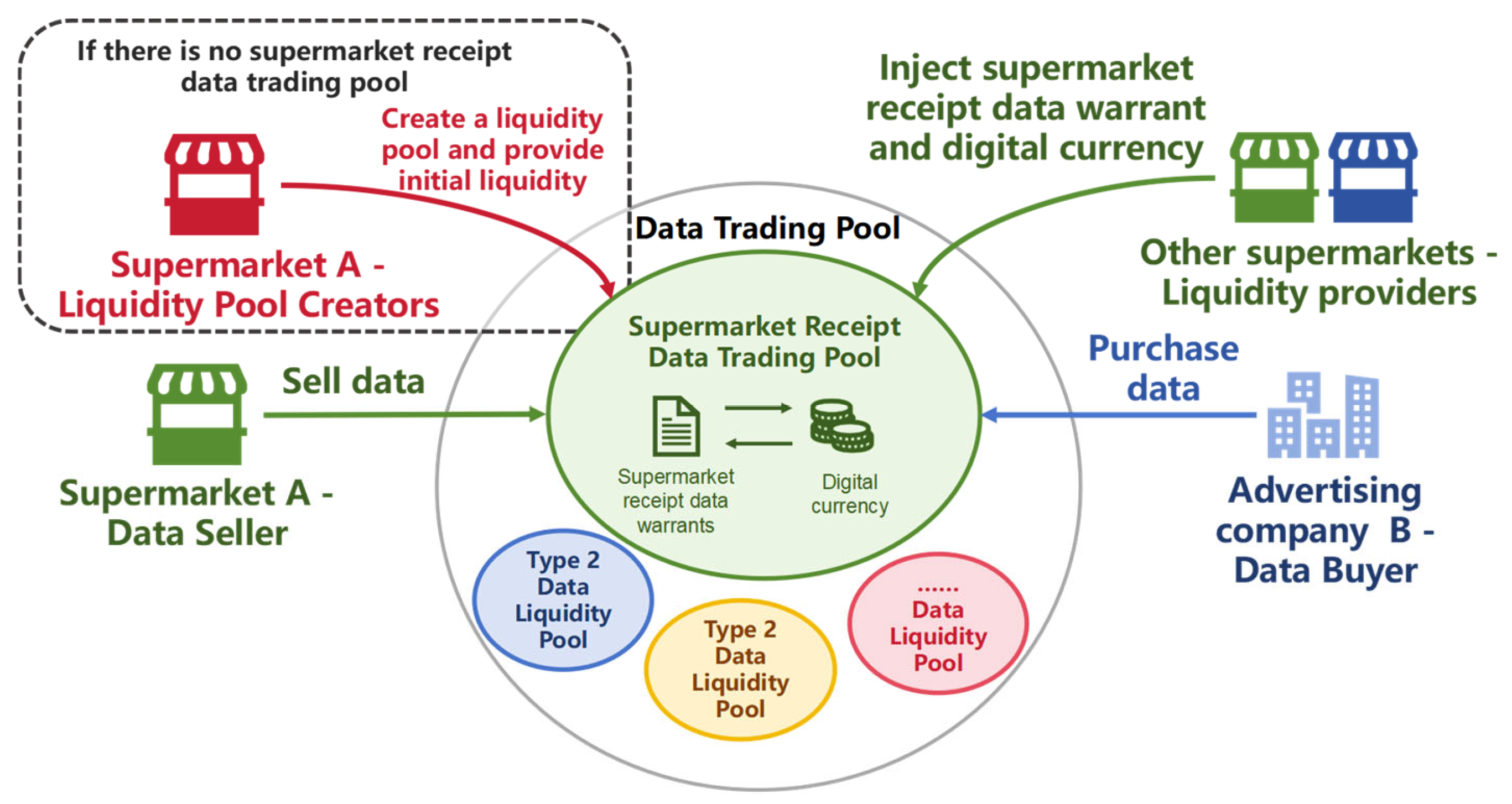
To describe this model more clearly, we assume a supermarket receipt data trading pool in this paper. Supermarket A, as the data seller, aims to sell a customer shopping receipt dataset containing N purchase records. First, a data meta-certificate is constructed for it, and a set of data warrants is automatically generated. Supermarket A deposits the supermarket receipt data warrants into the supermarket receipt-type liquidity pool. If no matching liquidity pool exists, Supermarket A acts as the liquidity pool creator to initialize the supermarket receipt data warrants liquidity pool and inject two types of assets: supermarket receipt data warrants and digital currency, thereby forming the market maker for supermarket shopping receipt data warrants. An advertising company B requiring such data acts as a data buyer, entering the trading pool to purchase data warrants according to its needs, thereby completing the data trading. Other supermarkets act as LPs by depositing additional assets into the pool and earning trading fees. The specific process is illustrated in Figure 1.
Therefore, the trading pool consists of an asset pair comprising supermarket receipt data warrants and digital currency. According to the Constant Product Automated Market Maker (CPAMM) model, its pricing function is shown in Equation (2):
X d × Y t = k ,
where X d is the total amount of supermarket receipt data warrants, and Y t is the total amount of digital currency.
For the AMM curve given by Equation (2), the price of supermarket receipt data warrants can be derived as shown in Equation (3):
P X ( X d , Y t ) = d y d x ,
where d x denotes the small variation of X d in the liquidity pool. d y represents the small variation of Y t in the liquidity pool.
In this model, users holding supermarket receipt data warrants can inject X d and an equivalent value of Y t into the liquidity pool to become LPs, thereby earning trading fees through pool trading activities. Data sellers can convert their supermarket receipt data assets into tradable data warrants, generate the corresponding number of X d , and inject them into the pool, so as to sell them in the market in exchange for Y t , thereby realizing the monetary value of their data. Data buyers obtain the corresponding number of X d by paying Y t to the trading pool and obtain the supermarket receipt data asset by using X d as the access certificate.
In the process of automatic exchange between X d and Y t , data trading is matched through the AMM mechanism. When users purchase data assets, the amount of Y t paid and the amount of X d obtained conform to the pricing function of AMM, as shown in Equation (4):
Δ X d = X d k Y t + Δ Y t ,
where Δ X d represents the supermarket receipt data warrants purchased, Δ Y t represents the quantity of digital currency recovered.
When a user sells X d and reclaims Y t , the funds obtained can be calculated by Equation (5):
Δ Y t = Y t k X d + Δ X d .
The above process is automatically executed by smart contracts, ensuring the on-chain verifiability of transactions and the dynamic adaptability of prices.
In practical applications, if the demand for data warrants increases unexpectedly, the system automatically raises their price to balance supply and demand. Data buyers interact with the data pool through smart contracts, exchanging cryptocurrency for the required data warrants to complete the data transaction. This mechanism effectively achieves trading pair isolation and automatic liquidity supply, significantly lowering the matching threshold for buyers and sellers while improving the immediacy and stability of data trading.

3.2. IL Mechanism

In the AMM mechanism, the liquidity pool maintains asset pricing through a constant function. The core risk for LPs is IL caused by arbitrage behavior. The essence of IL is the risk premium associated with price fluctuations borne by LPs for absorbing price fluctuations while providing market liquidity. When the external market price deviates from the pool price, arbitrageurs profit by buying undervalued assets or selling overvalued ones, forcing the pool asset ratio to adjust to a new equilibrium.
Assume that at the initial moment, an LP invests an asset portfolio ( x 0 , y 0 ) into the pool, and the corresponding value is:
V P o o l ( 0 ) = x 0 P x + y 0 P y ,
where P x denotes the external market price of one asset at the initial time, and P y denotes the external market price of another asset at the initial time.
If the LP chooses to simply hold rather than provide liquidity, its asset value is:
V h o l d ( t ) = x 0 P x ( t ) + y 0 P y ( t ) ,
where P x ( t ) denotes the external market price of one asset at time t , and P y ( t ) denotes the external market price of another asset at time t .
At the initial time, the external relative price between the two assets is defined as r ( 0 ) = P x ( 0 ) / P y ( 0 ) . When the price ratio changes to r ( t ) = P x ( t ) / P y ( t ) , according to the constant product constraint, the value of LP’s assets in the pool becomes:
V h o l d ( t ) = 2 k × P x ( t ) × P y ( t ) .
At this time, the portfolio value V p o o l of the LPs will be lower than the value V h o l d of the simply held assets, and the difference will constitute an IL. The IL rate can be quantified as:
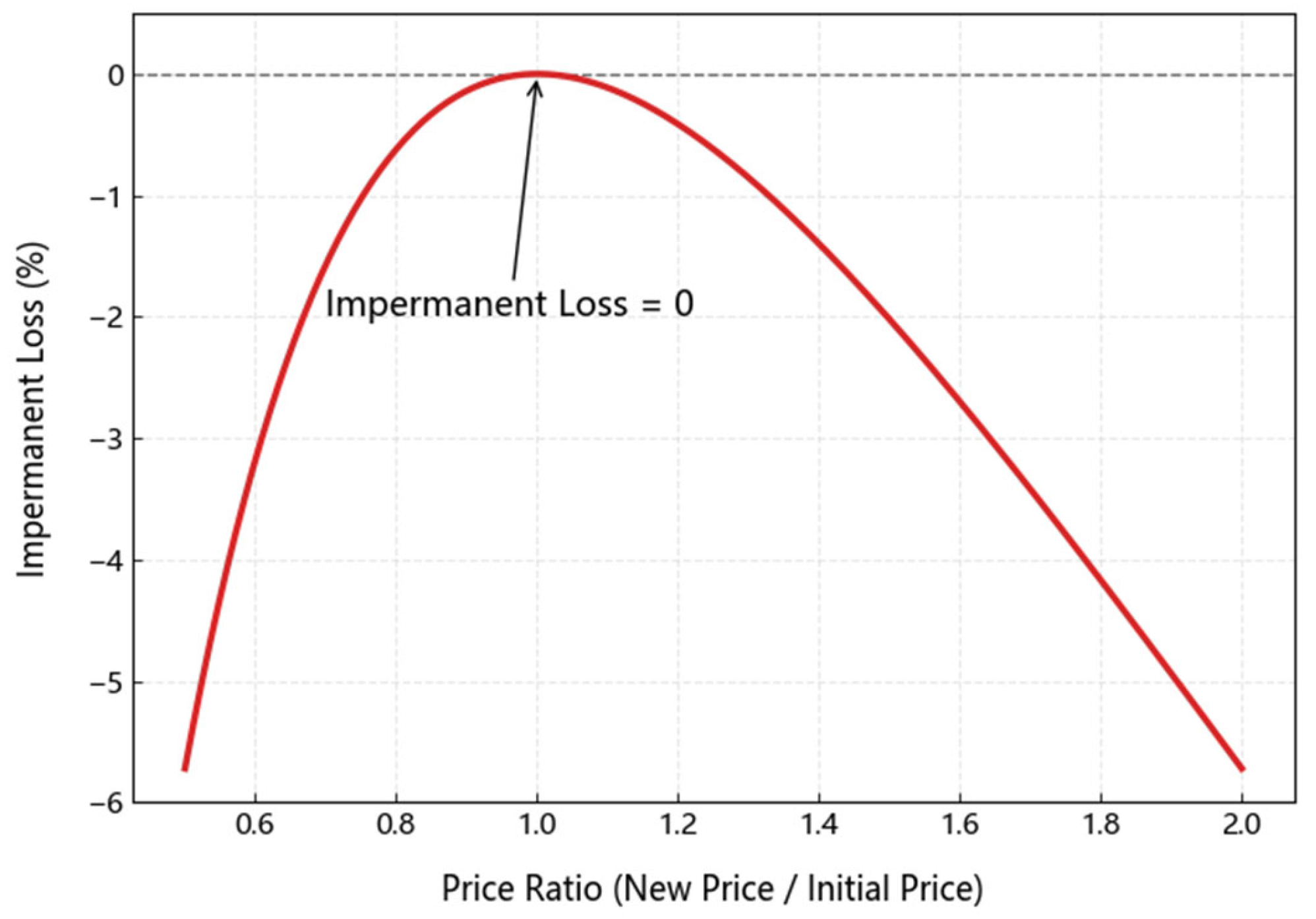
I L = V h o l d V p o o l V h o l d = 1 2 ρ 1 + ρ ,
where ρ = r ( t ) / r ( 0 ) is the ratio of the current price to the initial price. The model indicates that the strength of IL is dominant by a convex function relationship with price deviation ρ , as shown in Figure 2. When ρ = 1 , I L = 0 ; when ρ 0 or ρ , I L 100 % .

3.3. Analysis of Influencing Factors of IL

IL represents a critical risk for LPs within AMM mechanisms. In data trading scenarios, IL risk is amplified by data characteristics, exhibits more complex manifestations, and is significantly influenced by trader behavioral characteristics. To systematically understand and quantify these influencing factors, this section conducts a quantitative analysis from three dimensions: traders’ price sensitivity, trading frequency, and trade amount.
The simulation implements a data trading pool based on AMM. The trading pool adopts a constant product pricing mechanism, dynamically reflecting price movements in response to changes in trading demands. The experiments run on a Hardhat local blockchain with the MTK and cUSDT pair. A liquidity provider initially supplies 1000 MTK and 1000 cUSDT, setting the initial price to 1.0. External market prices are generated by a bilateral data trading market model with mean reversion, where the demand rate and supply rate are both set to 2 and a price floor of 0.5 is applied. Prices are updated every 10 s over a 10-min simulation window. The same random seed is used across all runs to ensure consistency.
Trading behaviors are simulated with multiple traders, each starting with initial capital and following predefined behavioral parameters, including trading triggers, trading frequency, and single trade amounts. Users’ trading directions are driven by price trends, which better reflect real market trading behavior. Each trade is characterized by three behavioral parameters: price sensitivity α varied from 0.01 to 0.30, trading frequency f capped at 1 to 10 trades per minute, and trade amount. The arbitrageur monitors price deviations periodically every 10 s; once the relative deviation exceeds a threshold determined by the parameter set for each experiment, a sequence of swaps is triggered. The system records key trading data in real time throughout the simulation and conducts statistical analyses of the levels of IL under different parameter settings.

3.3.1. Impact of Price Sensitivity on IL

The price sensitivity of traders refers to their responsiveness to deviations between the pool trading price and the external market price. In the decentralized trading environment, traders with higher price sensitivity tend to execute trades quickly when prices deviate slightly; conversely, traders with lower sensitivity typically wait until deviations are significant before acting, thereby tolerating greater price volatility.
In this study, the trading trigger mechanism is set as follows: when the price deviation satisfies Equation (10), the trader executes the trade.
P P o o l P M a r k e t P M a r k e t α ,
where P P o o l is the price of the asset in the pool, P M a r k e t is the price of the asset in the external market, and α is the trading trigger which measures the degree of tolerance of traders to price deviations. Therefore, the larger α is, the less sensitive the trader is to price, and their trading behavior is more cautious, trading only when there is enough profit space; conversely, the smaller α is, the more the trader will execute trades even with small price deviations, and their trading behavior is more active.
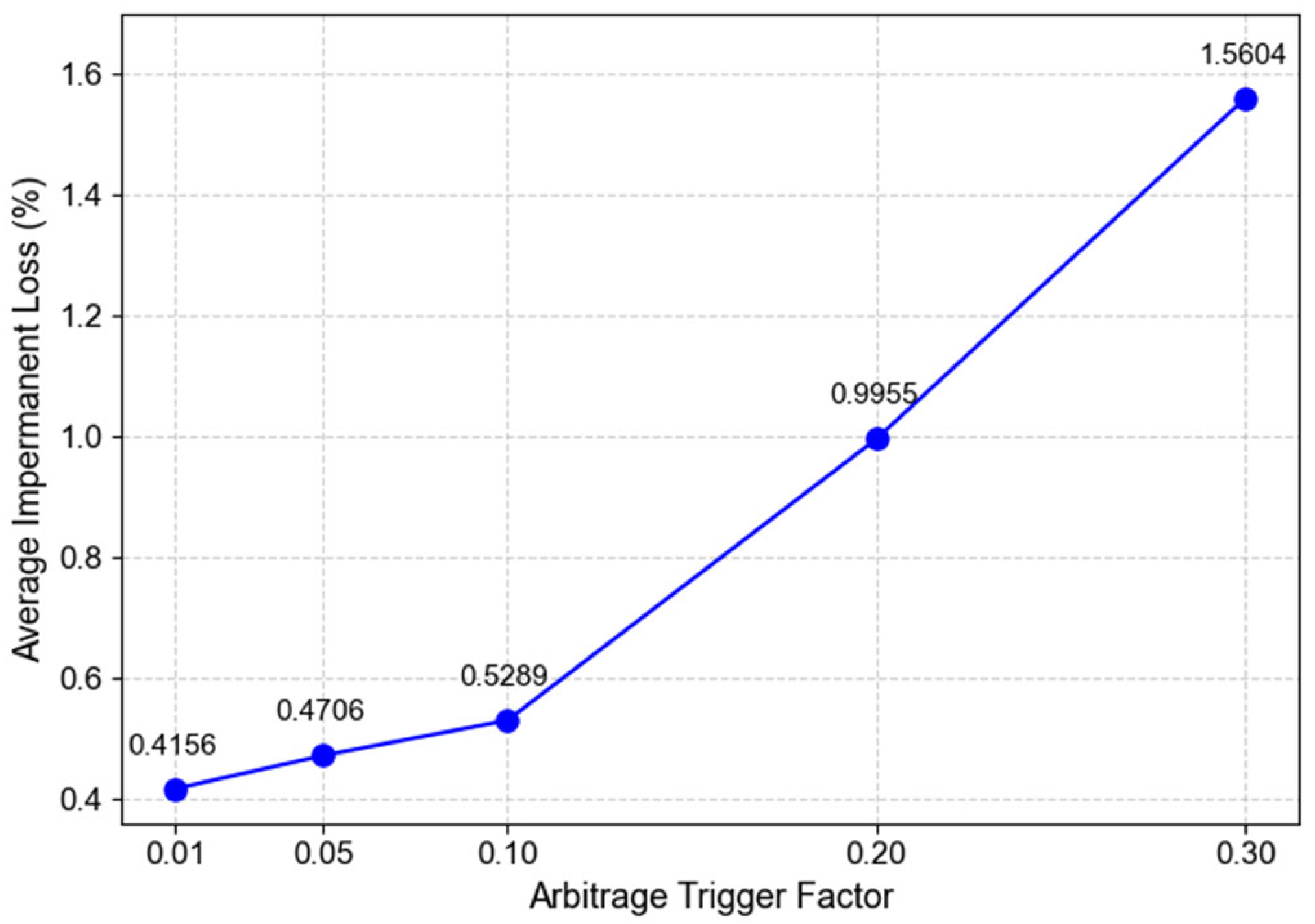
As shown in Figure 3, as the trading trigger factor α increases, the average IL shows a significant upward trend. When the trading trigger factor increases from 0.01 to 0.30, the average IL rises from 0.4156% to 1.5604%. The results indicate that traders with lower price sensitivity tend to allow significant price deviations to persist, and the subsequent price reversion process triggers more severe IL. Specifically, a higher arbitrage threshold leads to fewer arbitrage trades and causes the pool price to deviate from the market price for a longer period. This extended misalignment ultimately leads to higher IL.

3.3.2. Impact of Trading Frequency on IL

Trading frequency f is used to quantify the number of trades executed per unit time, reflecting the intensity of market operations.
In this study, the expression of f is shown in Equation (11):
f = N T ,
where N represents the total number of trading per unit time, and T is the length of the selected time unit. Higher trading frequency usually means more intense market volatility and more rapid price changes, which may have a more frequent price adjustment impact on LPs.
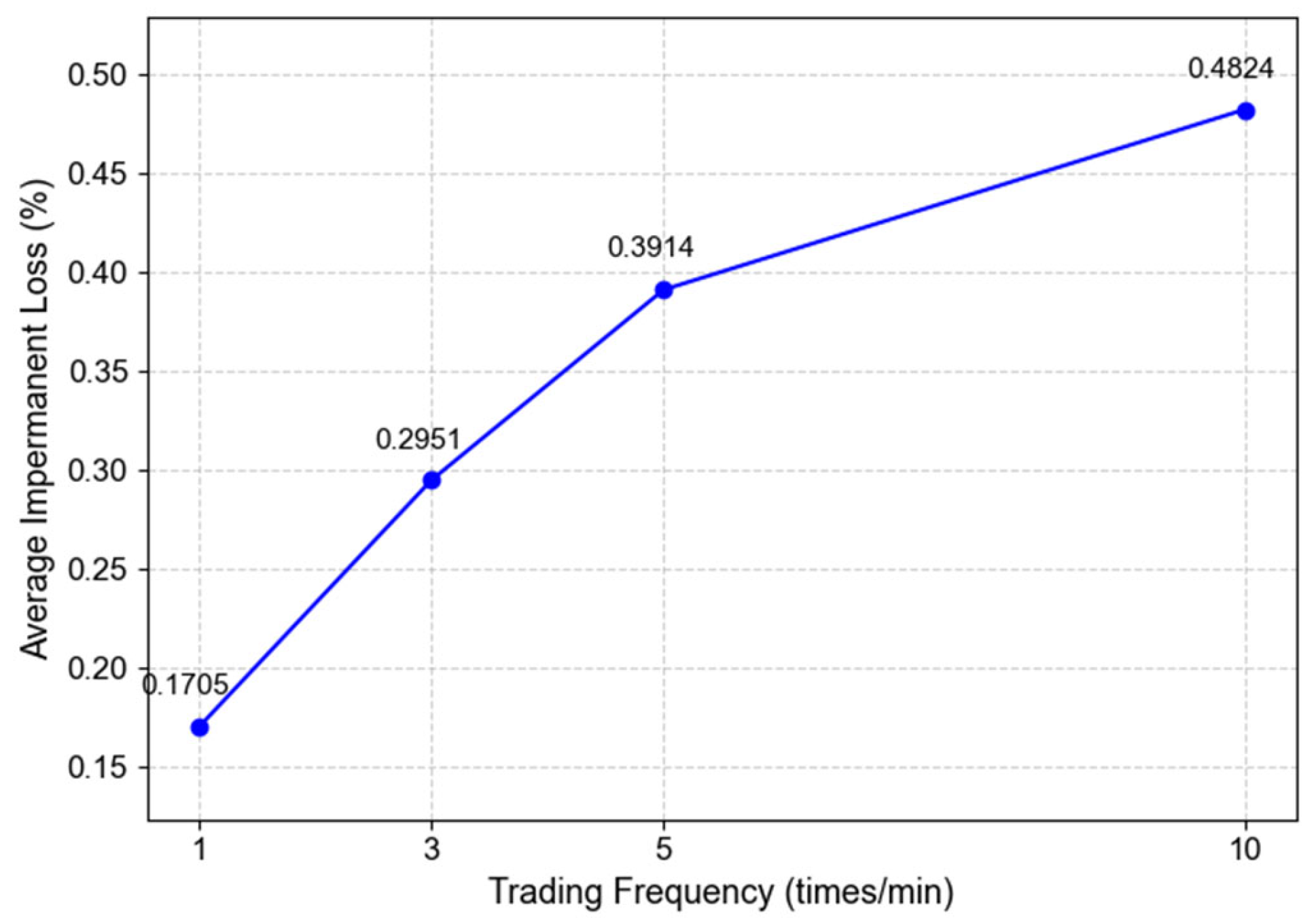
Figure 4 shows the average IL under different trading frequencies. The results reveal a positive correlation between trading frequency and IL: when the trading frequency increases from 1 to 10 trades per minute, the average IL rises from 0.1705% to 0.4824%. This indicates that higher trading frequency leads to more significant average IL. In a high-frequency trading environment, although price deviations can be corrected faster, frequent price changes force the liquidity pool to continuously adjust the asset proportions, thereby accumulating higher IL. In addition, high-frequency trading may enhance “arbitrage-driven” market behavior, increase short-term asset price volatility, and make LPs more passive in capital allocation.

3.3.3. Impact of Trade Amount on IL

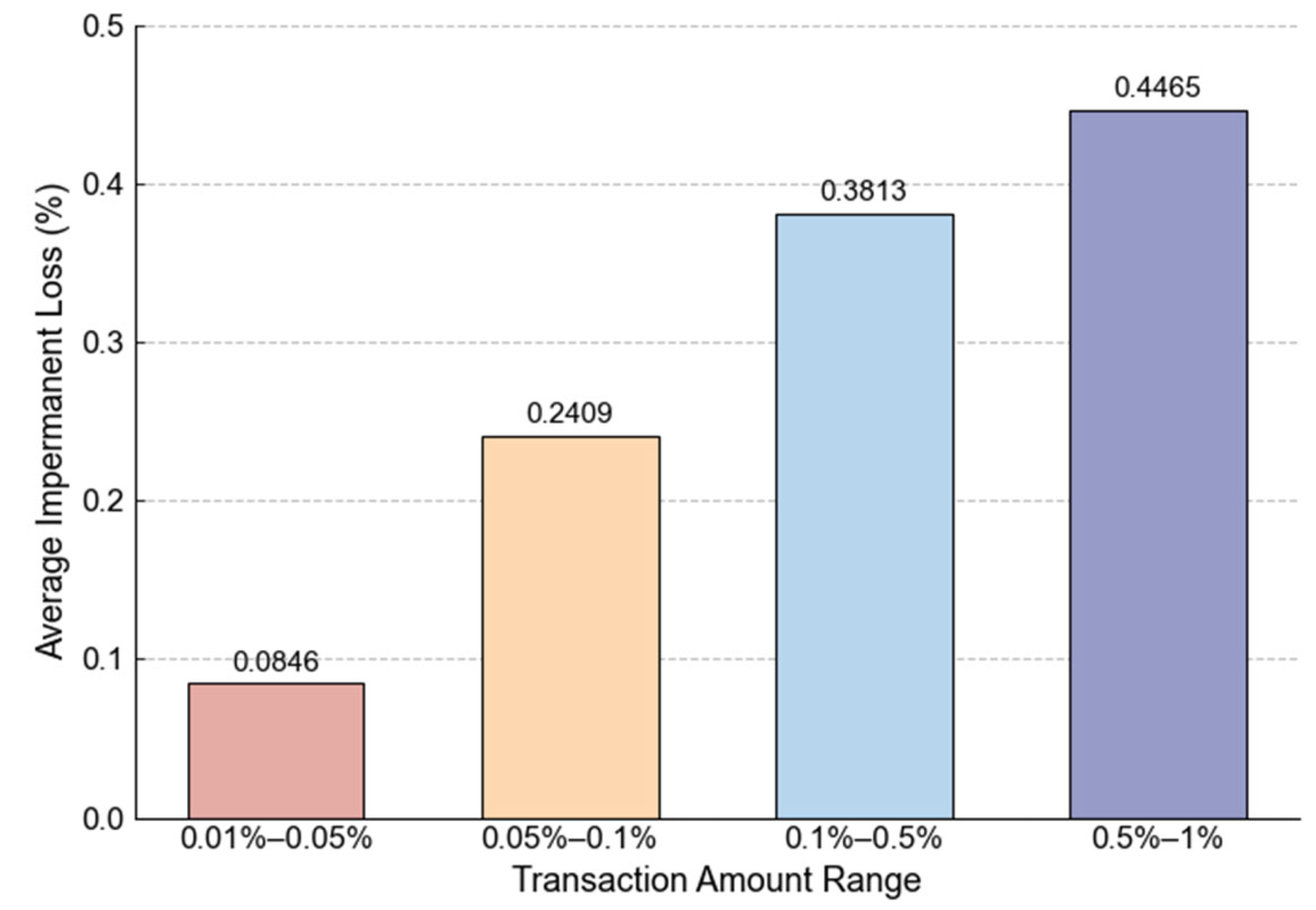
In addition, to gain a deeper understanding of the impact of large trades on IL, we designed experiments to observe the effects of different trade amount intervals on IL. We quantified four different trade amount intervals ranging from 0.01% to 1% of the number of tokens in the liquidity pool, as shown in Table 1.
Figure 5 illustrates the relationship between trade amount and IL, revealing that the larger the trade amount, the more pronounced the impact on IL. Specifically, when trade amounts fall within the liquidity range of 0.01% to 0.05%, the average IL is only 0.0846%. However, when trade amounts increase to the 0.5% to 1% range, IL rises to 0.4465%. Larger trade amounts are more likely to trigger significant price fluctuations under the constant product AMM mechanism, leading to more severe losses.
In summary, price sensitivity, trading frequency, and trade amount all have a significant impact on IL faced by LPs. The modeling and management of these behavioral characteristics provide a basis for optimizing IL mitigation strategies for liquidity pools, thereby improving the robustness and efficiency of the AMM mechanism in data trading scenarios.

4. Design and Implementation of IL Optimization Algorithm

Building upon the experimental analysis presented earlier, we quantitatively evaluate the effects of traders’ behavioral characteristics on the value of on-chain AMM pools, identifying the significant influence of traders’ price sensitivity, trading frequency, and trade amount on IL. Based on this, we propose the BART-IL method. In contrast to existing IL mitigation methods that modify pricing functions or introduce financial derivatives, BART-IL reduces IL solely by reordering trades based on real-time behavioral scoring, leaving the underlying AMM mechanism unchanged. This method utilizes on-chain execution logic to optimize the trade execution sequence through a multi-factor composite scoring mechanism and generate a low-IL on-chain execution sequence, achieving dynamic mitigation of IL risk in the on-chain liquidity pool.
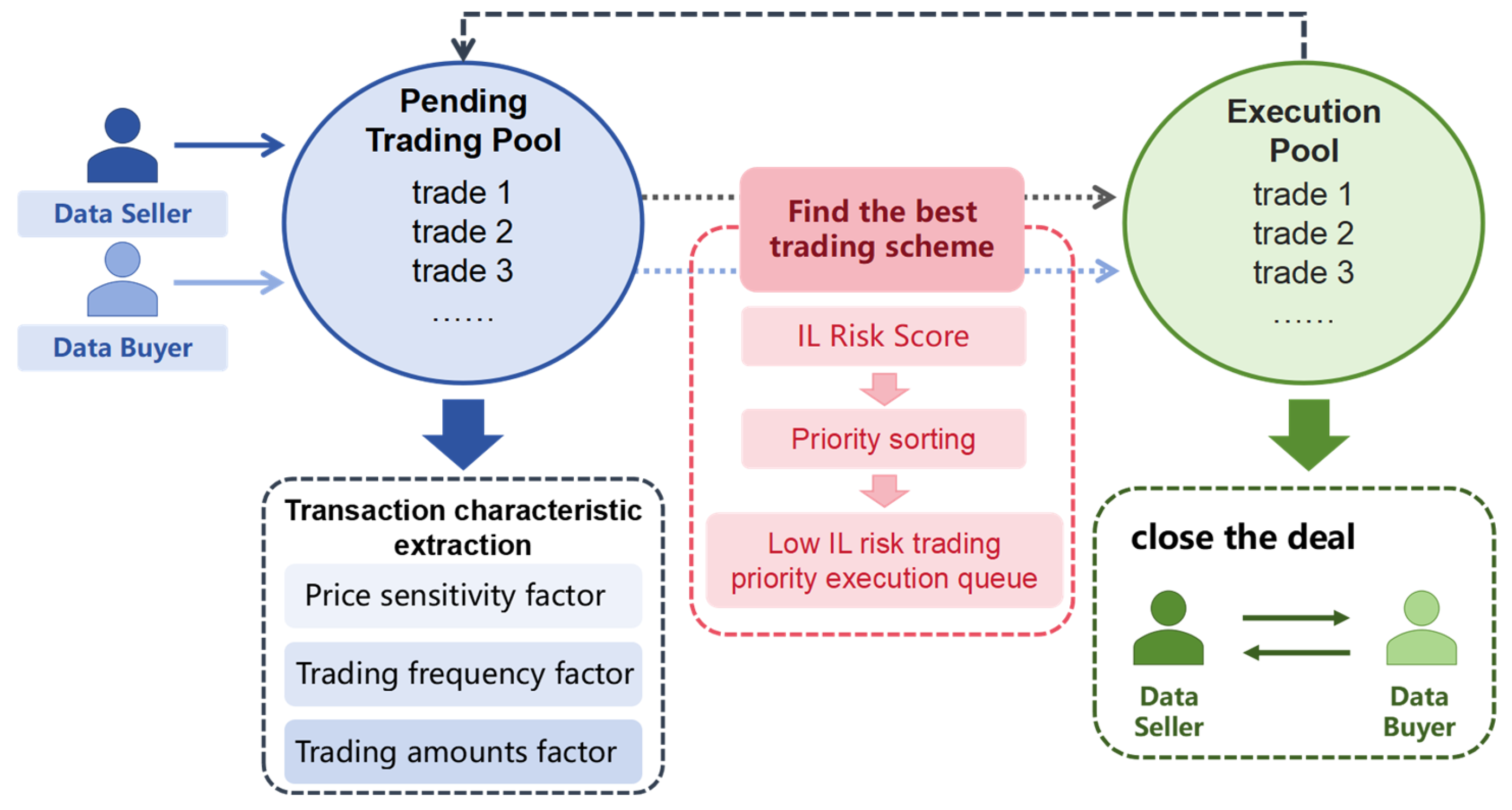
As shown in Figure 6, this method employs a dual-pool collaborative architecture to execute trades: data trading requests first enter the pending trade pool, where the system performs window-based scoring and sorting of all pending trades within a sliding time window; the sorted trading batches then enter the execution pool to achieve optimized execution through smart contracts. The pending trade pool and execution pool operate in an alternating loop to form a closed-loop system.
At the implementation level, BART-IL can be enforced through a contract-level batching model. Traders do not directly interact with the AMM swap function during a sequencing window; instead, they submit trade requests to the BART-IL contract, which records the trade direction, amount, and submission time, and retrieves or updates the observable behavioral variables required for scoring from on-chain records. When the current sliding window reaches its cutoff condition, any participant can trigger the execution function. The contract then computes the score of each pending trade according to the public scoring rule, sorts the requests deterministically, and forwards them to the AMM execution pool in the resulting order. Trades submitted after the cutoff are assigned to the next window. Validators only include calls to the BART-IL contract in blocks; once a batch is finalized, they cannot choose or modify the intra-batch execution order computed by the contract. Ties can be resolved using a deterministic rule, such as submission timestamp or transaction hash, to avoid discretionary ordering. Since the scoring rule, weights, window length, and tie-breaking rule are predefined and publicly verifiable, the execution process does not require per-trade governance intervention or validator discretion.
This paper focuses on improving the trade scoring and sorting mechanism of the pending trade pool, which includes the following key steps:
  • Trading request collection: Newly arrived trading requests first enter the pending trading pool. The system processes requests in batches using a sliding time window to ensure timely sorting.
  • Behavioral characteristics extraction: Extract three core characteristics for each trade within the window: price sensitivity factor S i = 1 / α , trading frequency factor F i , and trade amount factor A i .
  • Multi-factor composite of IL risk scoring: A positively oriented scoring model is constructed to generate a comprehensive risk score for each trade by integrating its three characteristic factors, as specified in Equation (12).
    S c o r e ( T i ) = W 1 × S i + W 2 × 1 F i + W 3 × 1 A i ,
    where W 1 , W 2 and W 3 are configurable weights for price sensitivity, trading frequency, and trade amount respectively. Equation (12) evaluates each pending trade according to its expected IL impact. The price-sensitivity term reflects the timeliness of price-deviation correction, the frequency term captures the cumulative churning effect of repeated trades, and the trade-amount term represents the direct price impact of the swap size. After normalization and weighting, higher-score trades are interpreted as lower-risk trades for the liquidity pool and are executed earlier, thereby smoothing the pool price path and reducing cumulative rebalancing losses without changing the original AMM pricing rule. This paper sets the parameters according to the trading size n , and the specific parameter configuration is shown in Table 2 to balance the three factors across different window sizes.
    Table 2. Dynamic weight function parameters.
    Table 2. Dynamic weight function parameters.
    ParameterExpression
    Price sensitivity weighting W 1 = 2 + 0.15 n
    Frequency control weighting W 2 = max ( 1 , 10 0.1 × n )
    Scale suppression weight W 3 = max ( 1 , 8 0.1 × n )
    Although the proposed scoring function is heuristic and therefore cannot yield a closed-form optimal solution or provide rigorous optimality guarantees, it is not an arbitrary empirical rule. Rather, it is designed as an optimization-guided greedy surrogate for mitigating cumulative IL within each sliding window. Ideally, the execution sequence of pending trades should be selected to reduce the cumulative IL generated during the window. However, exhaustively evaluating all possible execution orders is computationally infeasible for real-time on-chain deployment. Therefore, BART-IL approximates this low-IL execution objective by estimating the IL-related risk of each pending trade using observable behavioral factors. The three scoring factors are selected according to the analysis in Section 3.3, where price sensitivity, trading frequency, and trade amount are shown to have significant effects on IL formation. Since IL grows super linearly with price deviation, trades that correct deviation earlier, occur less frequently, or involve smaller amounts generally cause less loss. Accordingly, the proposed scoring function prioritizes trades with higher price sensitivity, lower trading frequency, and smaller trade amount, thereby generating a lower-risk execution sequence without changing the original AMM pricing rule.
  • Dynamic sorting and execution: All trades in the pending trade pool are sorted in descending order according to their scores, forming an execution queue that prioritizes trades with lower IL risk. After completing the execution of each trade within a time window, the system enters the next time window and recalculates the scores of trades in the pending trade pool based on the latest liquidity status, thereby achieving closed-loop optimization.

Algorithm 1 presents the IL risk scoring algorithm of BART-IL.
Algorithm 1: BART-IL dynamic trading sorting algorithm
1:Input: Tx1, Tx2,, Txn, n
2:Output:  Ordered_T
3:function GET_WEIGHTS(n):
4:  W 1 2 + 0.15 n
5:  W 2 max ( 1 , 10 0.1 × n )
6:  W 3 max ( 1 , 8 0.1 × n )
7:  return   ( W 1 ,   W 2 ,   W 3 )
8: Scored_List ← ϕ
9:  for each Tx in T do:
10   Si←Tx.α
11   Fi←Tx.f
12   Ai←Tx.a
13    S c o r e ( T i ) = W 1 × S i + W 2 × 1 F i + W 1 × 1 A i ,
14   Scored_List←Scored_List∪{(Tx, score)}
15  end for
16Ordered_T←{Tx|(Tx, score)∈Scored_List}
17return Ordered_T
In Algorithm 1, S i , F i , and A i denote the extracted sensitivity, frequency, and amount factors of transaction i , respectively, while S c o r e ( T i ) denotes the final composite score used for ordering.

5. Method Evaluation

5.1. Experimental Setting

To validate the efficacy of BART-IL, the experiment reproduces the data trading environment consistent with the setting described in Section 3 using a blockchain environment based on the Hardhat framework. One user acted as an LP to inject initial liquidity into the pool, while multiple other traders conducted trades within a given time window according to predefined behavioral parameters. Additionally, a bilateral trading market was simulated to obtain data trading market prices. Users’ trading directions were driven by price trends, which better reflect real market trading conditions.
The trading mechanism is divided into two groups: one group is the control group, which trades according to the original chronological order without any optimization strategy; the other group is the experimental group, which introduces the proposed BART-IL optimization mechanism, including scoring and sorting based on trader behavior characteristics. In the experimental group, a pending trade pool collects incoming trades within a sliding time window. For each trade, the system extracts its three behavioral features, namely, price sensitivity, trading frequency, and trade amount, and then computes a composite risk score using dynamic weights. Trades in the pool are sorted in descending order of score and executed via the AMM smart contract. This real-time reordering is applied repeatedly for each time window.
This paper evaluates the optimization effect using the Cumulative Impermanent Loss Rate (CILR) and the Average Impermanent Loss Rate (AILR). CILR measures the cumulative IL over the entire experimental period, whereas AILR evaluates the IL effect at the level of a single trade. The expressions are shown in Equations (13) and (14):
C I L R = k = 0 M I L k ,
A I L R = 1 M k = 0 M I L k ,
where I L k = ( V h o l d , k V p o o l , k ) / V h o l d , k refers to the instantaneous IL after the kth trading is executed, M represents the number of trading.

5.2. Comparative IL Results

To verify the effectiveness of the proposed IL optimization mechanism, this paper compares cumulative IL before and after optimization across different trading scales under a unified on-chain trading environment and consistent simulation parameters. It also simulates four distinct market types and compares the average IL before and after optimization under the same trading scale. The results demonstrate the comprehensive performance of the optimization algorithm in improving trading stability and reducing trading costs.

5.2.1. Comparison of IL Under Different Trading Scales

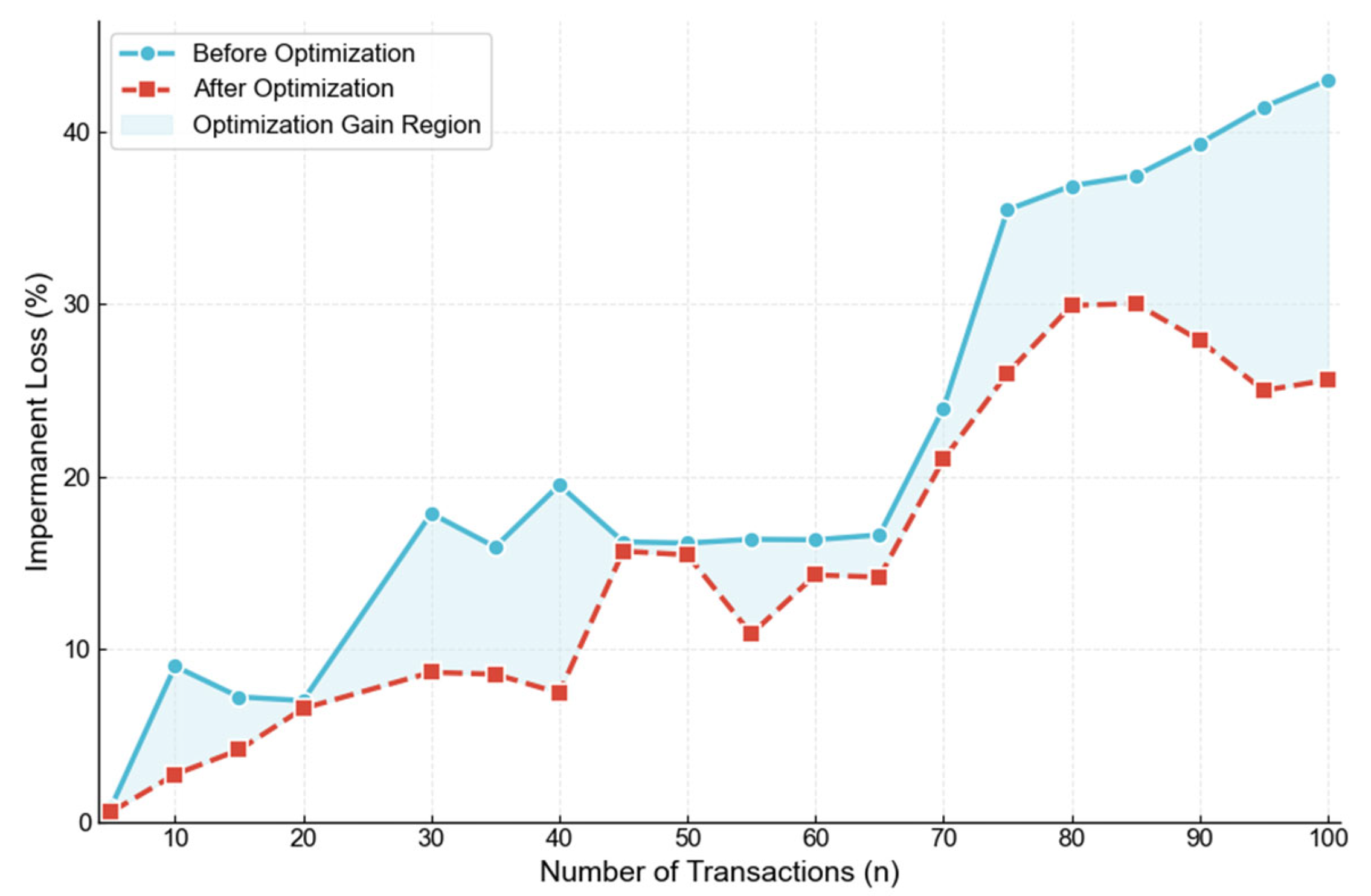
Figure 7 shows the trend of cumulative IL in the control and experimental groups as the number of trades changes under different trading scales. The results demonstrate a clear positive correlation between IL and trading scale, with IL increasing as the number of transactions rises. Under the unoptimized mechanism, IL surpasses 20% when trades exceed 60 and peak at 43.0% at 100 trades; such severe losses expose LPs to substantial asset value diminution risks in data trading. In contrast, the proposed optimized mechanism effectively suppresses IL, keeping loss rates below 40% across all trading scales and reducing the maximum IL to 25.6% at 100 trades. The blue optimization zone further shows that BART-IL is more effective at larger trading scales, achieving up to 17.4% IL reduction and substantially enhancing LPs’ capital efficiency. Consequently, this mechanism consistently mitigates IL exposure across all trading scales, reinforcing operational fairness while enhancing the stability and operational efficiency of data asset markets.
To further examine whether the IL reduction shown in Figure 7 is dependent on a single random trading sequence, we conducted repeated-run experiments under three representative trading scales: n = 20, n = 60, and n = 100. For each scale, three independent trade plans were generated using different random seeds, while the market price trajectory was kept fixed to ensure controlled comparisons. For each run, the baseline AMM and BART-IL were evaluated using the same trade plan.
As shown in Table 3, BART-IL reduces the mean cumulative IL across all three trading scales. Specifically, the mean cumulative IL decreases from 8.37% to 6.81% when n = 20, from 14.04% to 12.02% when n = 60, and from 35.32% to 28.22% when n = 100, corresponding to relative reductions of 18.6%, 14.3%, and 20.1%, respectively. Although the number of repetitions is limited, these results provide preliminary robustness evidence that the IL reduction achieved by BART-IL is not merely caused by a single random trading sequence.

5.2.2. Comparison of IL Under Different Market Types

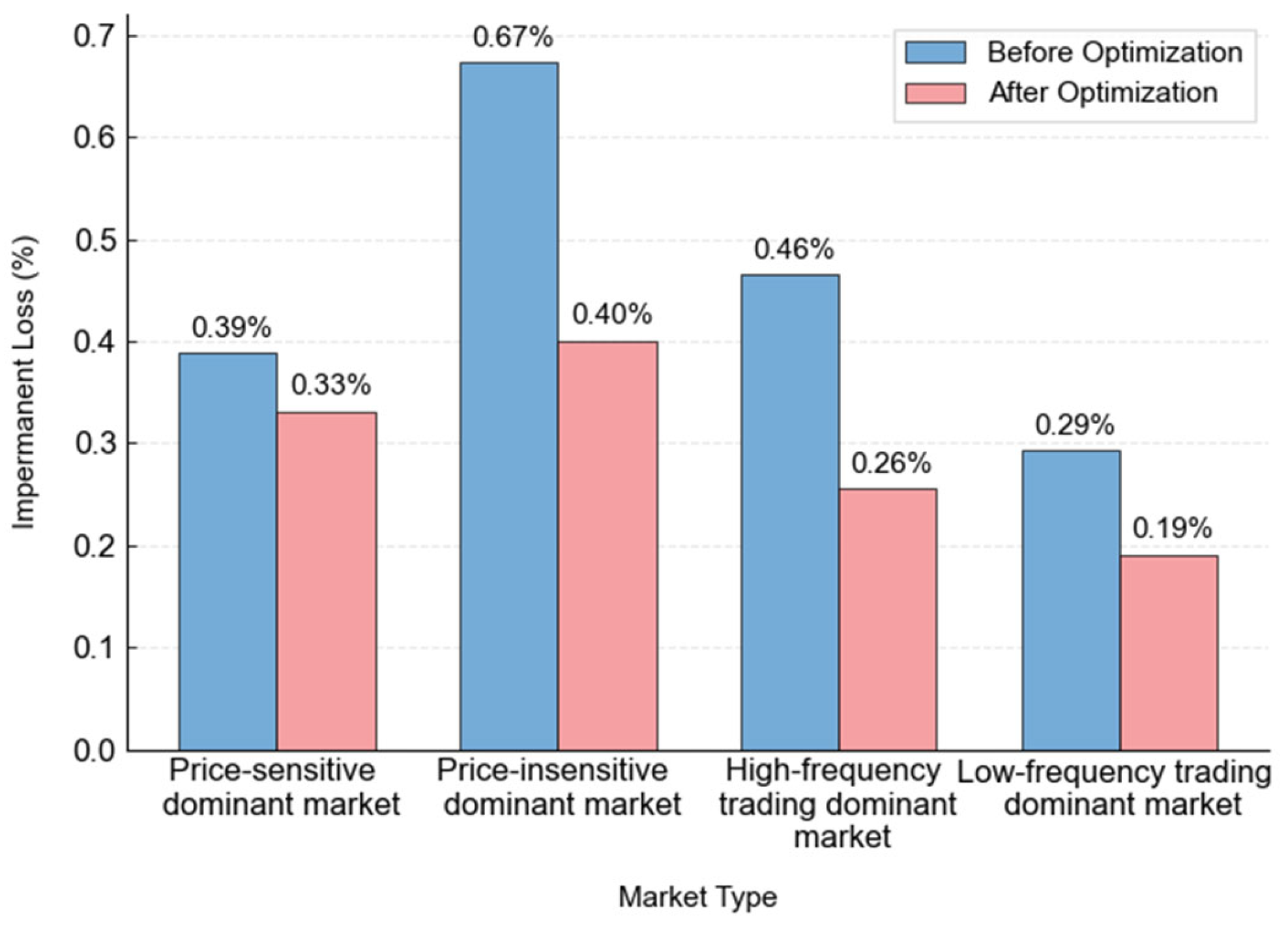
Figure 8 compares the average IL between the control and experimental groups across four simulated data trading markets: price-sensitive-dominant, price-insensitive-dominant, high-frequency-dominant, and low-frequency-dominant markets.
Before optimization, the average IL exceeded 0.20% across all markets, reaching 0.46% in high-frequency markets and peaking at 0.67% in price-insensitive markets. This indicates that LPs face considerable IL risks, particularly in price-insensitive and high-frequency data trading markets. After adopting the dynamic ranking optimization mechanism proposed in this paper, IL is effectively reduced in all four markets, with decreases exceeding 15% in all cases. Specifically, the average IL decreases from 0.67% to 0.4% in price-insensitive-dominant markets and from 0.46% to 0.26% in high-frequency-dominant markets, with reductions of over 40% in both cases. These results demonstrate that the proposed optimization strategy consistently mitigates IL risk across diverse market conditions, thereby enhancing the operational fairness and attractiveness of the data trading market for LPs.
Further statistical results are shown in Table 4. In price-sensitive-dominant markets, the average IL decreases from 0.39% before optimization to 0.33% after optimization, representing a reduction of 15.4%. In price-insensitive-dominant markets, it decreases from 0.67% to 0.40%, achieving a reduction rate of 40.3%. In high-frequency-dominant markets, it decreases from 0.46% to 0.26%, representing a reduction of 43.5%; in low-frequency-dominant markets, it decreases from 0.29% to 0.19%, corresponding to a reduction of 34.5%. These results confirm that the optimization algorithm achieves substantial improvements across all types of markets.
The observed variation in improvement across market types can be primarily explained by the interplay between trader behavior and BART-IL’s reordering mechanism.
In high-frequency markets, a large number of small arbitrage trades occur in rapid succession. Under the constant product AMM, each trade incurs a small IL, and the cumulative effect becomes significant. BART-IL reorders trades within each sliding window, prioritizing trades with lower frequency or smaller size. This reduces the churning effect and yields the highest relative improvement.
In price-insensitive markets, traders have a high price sensitivity threshold, meaning a large α . They tolerate large price deviations before arbitraging, causing the pool price to drift far from the external market. When arbitrage eventually occurs, large-size swaps induce severe IL. BART-IL identifies these high- α , large trades and postpones them within the window, allowing smaller, more frequent corrections from other traders to occur first. This directly reduces the peak price deviation and the resulting IL, achieving a substantial relative improvement of 40.3%, although the absolute IL after optimization at 0.40% remains higher than that of price-sensitive markets at 0.33% due to the inherently higher risk of the market itself.
In price-sensitive markets where α is small, traders react quickly to even small price deviations, so the pool price rarely diverges significantly. The natural arrival order of trades is already near optimal, and BART-IL has limited room to further reduce IL. Hence the improvement is modest at 15.4%.
In low-frequency markets, trading activity is sparse, but each trade may still cause notable IL due to the lack of frequent corrections. Although the absolute IL before optimization is already low at 0.29%, BART-IL can still reorder the limited number of trades within the window, achieving a 34.5% relative reduction.
These observations confirm that BART-IL is most effective in markets where the natural trading sequence contains either large, infrequent price-insensitive deviations or high-frequency churning, which are precisely the scenarios where traditional AMMs suffer the most.
However, these results also suggest potential limitations of BART-IL. When the number of pending trades in the sliding window is small, or when traders show highly homogeneous behavioral patterns, the room for effective reordering becomes limited. In addition, under extreme market conditions, such as sudden price shocks, massive single transactions, one-sided market trends, or highly synchronized large trades, IL may be mainly driven by abrupt market movements rather than execution order. In such cases, execution reordering alone may be insufficient, and complementary mechanisms such as dynamic fees, external price protection, or liquidity adjustment may be required.

5.3. Evaluation Conclusions

The experimental results demonstrate that the proposed BART-IL mechanism effectively reduces IL for LPs in diverse market environments and trading scales, significantly improving the predictability, operational fairness, and capital efficiency of the data trading environment. In particular, in high-frequency trading scenarios, traditional AMM mechanisms not only sustain elevated IL but also trigger a sharp rise in cumulative loss rates when trading scales increase. The optimized algorithm dynamically adjusts trading prioritization through behavior awareness and a multi-factor composite scoring mechanism, mitigating the cumulative effects of IL and average IL across different market environments: in the representative single-run large-scale experiment, BART-IL reduces the CILR to 25.6%. The additional repeated-run results further show that BART-IL reduces the mean CILR from 35.32% to 28.22% at n = 100. Moreover, it achieves a reduction of over 40% in high-frequency-dominant markets. Such improvements are crucial for ensuring the robustness and attractiveness of blockchain-based data trading platforms. The performance gains reported above should be interpreted within the simulated market settings considered in this study. Since AMM trade sequencing is online and path-dependent, with dynamically arriving orders and evolving pool states, establishing general optimality or near-optimality guarantees remains challenging. Formal approximation bounds under restricted market assumptions will be investigated in future work.
In addition to the above findings, we also discuss several practical issues for deploying BART-IL in practice. As described in the contract-level execution model in Section 4, BART-IL is intended to be implemented as a smart-contract-based batching mechanism, where intra-batch ordering is computed and enforced by contract logic rather than by validators. The current experiments are conducted in a Hardhat local blockchain environment, which provides a prototype-level execution setting for validating AMM swaps and IL calculation. Full public-chain deployment, including gas consumption, mempool exposure, block congestion, and confirmation latency, remains an important direction for future work. Within this deployment model, sorting pending trades within a sliding window incurs additional computation and gas costs. However, the window size is bounded, and the scoring function involves only a few arithmetic operations, making the overhead comparable to executing a few extra swaps. Gas costs can be amortized by batching multiple trades within the same block or by processing trades in larger windows. This introduces a latency-throughput trade-off: larger windows improve batching efficiency and throughput but increase waiting latency, whereas smaller windows reduce latency but provide less room for IL-oriented ordering optimization.
Reordering transactions may raise fairness concerns similar to MEV. BART-IL mitigates this by using a deterministic, publicly verifiable scoring function that depends only on trade-specific parameters and fixed weights, with no miner or sequencer discretion involved. The sliding window length is a known system parameter, ensuring transparency. BART-IL intentionally prioritizes low-risk trades, which may delay high-risk trades. This is a conscious risk management choice, and the deterministic scoring rule ensures that all participants are treated equally based on observable behavior. Another concern is that traders might attempt to manipulate their behavioral signals to receive a higher score and earlier execution. In practice, these behavioral parameters are derived from observable on-chain trading patterns, such as the price deviation at which a trader acts, the inter-trade interval, and swap volume. Manipulating them would require persistent changes in actual trading behavior, which would directly affect the trader’s own execution price, transaction cost, and slippage exposure, as well as the IL pressure imposed on the liquidity pool. Therefore, manipulation is profitable only when the priority gain from a higher score exceeds the additional costs caused by delayed execution, order splitting, gas consumption, slippage changes, and opportunity loss. Under cost-aware trading conditions, if these additional costs outweigh the priority gain, trading according to genuine demand becomes the rational strategy, providing a basic incentive-alignment argument for BART-IL. A full game-theoretic analysis of such strategic behavior is left for future work.
Furthermore, we conduct sensitivity analysis by adjusting the weight W 1 within ±30%. The results reveal that the fluctuation range of impermanent loss reduction is approximately 7 percentage points, which demonstrates that the proposed method is robust to minor variations in weight values.
In summary, the proposed optimization mechanism consistently reduces the risk of IL across diverse market environments and trading scales, demonstrating strong adaptability in data trading contexts. Moreover, BART-IL offers a practical balance between IL reduction for LPs and implementation feasibility, with acceptable overhead and transparent ordering rules. These findings lay the foundation for constructing a low-loss, high-efficiency automated pricing system for high-frequency data trading.

6. Conclusions and the Future Work

Blockchain-based Automated Market Maker mechanisms provide an appealing decentralized infrastructure for consumer-oriented multilateral data trading by enabling automated pricing and continuous liquidity provisioning. However, in large-scale and high-frequency data trading environments, IL emerges as a critical structural risk that undermines the incentives of liquidity providers and threatens the long-term sustainability of the trading ecosystem. In this work, we formulate liquidity pool-based data trading and systematically analyze how collective trading behaviors drive IL dynamics. Our results reveal that price-insensitive and high-frequency trading behaviors disproportionately amplify IL accumulation, leading to uneven risk redistribution among participants. These findings bridge an important knowledge gap by uncovering the behavioral origins of IL in decentralized data markets. Building upon this analysis, we propose BART-IL, a behavior-aware IL optimization method that dynamically regulates trade execution paths through multi-factor behavioral scoring. By incorporating behavioral signals into real-time trading decisions, BART-IL effectively mitigates IL accumulation while maintaining decentralized market operation. Extensive experiments demonstrate that the proposed method improves system robustness, reducing IL by up to 43.5% in high-frequency, large-scale trading environments and enhancing operational fairness and capital efficiency for liquidity providers.
In future work, we will focus on extending the proposed framework in several directions. First, we plan to incorporate discrete and heterogeneous data asset characteristics, enabling liquidity pool modeling for irregular and semi-homogeneous data sets. Second, we will explore game-theoretic and learning-based agent models to capture adaptive trading behaviors and long-term strategic interactions. Third, we aim to validate BART-IL on real-world decentralized exchange data and, when possible, on emerging data trading platforms. We also plan to conduct systematic ablation studies to quantify the individual contributions of the behavioral factors incorporated in BART-IL, and to perform more extensive repeated-run experiments to further strengthen the robustness and statistical reliability of the observed performance gains. In parallel, we will explore the integration of BART-IL with cross-platform data markets and regulatory-aware mechanisms to support scalable, compliant, and sustainable trading infrastructures. Finally, another promising direction is to replace the heuristic weights with a data-driven or learning-based tuning mechanism, such as Bayesian optimization or reinforcement learning, to adapt the scoring function to dynamic market conditions automatically.

Author Contributions

The authors confirm contribution to the paper as follows: Writing—Original Draft, M.L.; Writing—Review & Editing, H.S., Y.Q., W.C. and Z.G.; Funding acquisition, H.S.; Conceptualization, H.S. and Y.Q.; Methodology, M.L. and Y.Q.; Validation, M.L. All authors have read and agreed to the published version of the manuscript.

Funding

This study was supported by the Zhejiang Province “JianBingLingYan+X” Research and Development Plan of China under Grant No. 2025C02028.

Institutional Review Board Statement

Not applicable.

Informed Consent Statement

Not applicable.

Data Availability Statement

The original contributions presented in this study are included in the article. Further inquiries can be directed to the corresponding author.

Conflicts of Interest

The authors declare no conflicts of interest.

References

  1. Rong, C.; Seo, J.; Zhao, Z.; Catak, F.O.; Geng, J.; Jaatun, M.G. Federated Large Domain Model System. Blockchain Res. Appl. 2025, 6, 100277. [Google Scholar] [CrossRef] [Scilit]
  2. Wu, J.; Yuan, Y.; He, C.; Qian, L.; Du, L.; Miao, J. Research on Multilat-eral Platform for Data Element Transactions: Current Status, Approaches, and Framework. J. Inf. Resour. Manag. 2024, 14, 4–20. [Google Scholar] [CrossRef]
  3. Chen, C.; Kui, R.; Yang, X.; Wu, X. Blockchain and scientific data governance. Chin. Sci. Bull. 2024, 69, 1137–1141. [Google Scholar] [CrossRef] [Scilit]
  4. Tran, T.; Tran, D.A.; Nguyen, T. Order Book Inspired Automated Market Making. IEEE Access 2024, 12, 36743–36763. [Google Scholar] [CrossRef] [Scilit]
  5. Bitterli, T.; Schär, F. Decentralized Exchanges: The Profitability Frontier of Constant Product Market Makers. In Proceedings of the 2023 IEEE International Conference on Blockchain and Cryptocurrency (ICBC), Dubai, United Arab Emirates, 1–5 May 2023; pp. 1–7. [Google Scholar] [CrossRef] [Scilit]
  6. Hafner, M.; Dietl, H. Impermanent loss conditions: An analysis of decentralized exchange platforms. arXiv 2024, arXiv:2401.07689. [Google Scholar] [CrossRef] [Scilit]
  7. Kim, H.J.; Lee, G.M.; Lee, J.; Kang, S.; Chae, S.W.; Park, J.S. A Comparison of Impermant Loss for Various CFMMs. In Proceedings of the 2024 IEEE International Conference on Blockchain (Blockchain), Copenhagen, Denmark, 19–22 August 2024; pp. 542–548. [Google Scholar] [CrossRef] [Scilit]
  8. Jiang, S.; Chen, J.; Li, F.; Geng, H.; Chi, H. DCAMM: Dynamic Curve-Based Automated Market Maker. In Proceedings of the GLOBECOM 2023–2023 IEEE Global Communications Conference, Kuala Lumpur, Malaysia, 4–8 December 2023; pp. 4491–4496. [Google Scholar] [CrossRef] [Scilit]
  9. Martinelli, F.; Mushegian, N. Balancer: A Non-Custodial Portfolio Manager, Liquidity Provider, and Price Sensor. Available online: https://docs.balancer.fi/whitepaper.pdf (accessed on 4 June 2026).
  10. Guillermo, A.; Tarun, C. Improved Price Oracles: Constant Function Market Makers. arXiv 2020, arXiv:2003.10001. [Google Scholar] [CrossRef] [Scilit]
  11. Yu, J.; Zhao, P.; Li, S.; Wang, H. Distributed Data Trading Model Based on Blockchain. In Proceedings of the 2020 IEEE 6th International Conference on Computer and Communications (ICCC), Chengdu, China, 11–14 December 2020; pp. 1721–1727. [Google Scholar]
  12. Shen, X.; Yi, B.; Liu, H.; Zhang, W.; Zhang, Z.; Liu, S.; Xiong, N. Deep Variational Matrix Factorization with Knowledge Embedding for ecommendation System. IEEE Trans. Knowl. Data Eng. 2021, 33, 1906–1918. [Google Scholar]
  13. Zhang, D.; Zhou, F.F.; Albu, F.; Wei, Y.Z.; Yang, X.; Gu, Y.; Li, Q. Unleashing the power of self-supervised image denoising: A comprehensive review. arXiv 2023, arXiv:2308.00247. [Google Scholar] [CrossRef] [Scilit]
  14. Zhao, Z. Research on Pricing of Big Data. Trans. Inf. Secur. Commun. Confid. 2017, 5, 61–67. [Google Scholar]
  15. Chen, H.; Xiong, H.; Xu, L.; Yang, Y.; Zhao, X. Analysis of data trading model and characteristics based on platform perspective. Big Data Res. 2023, 9, 56–66. [Google Scholar]
  16. API Marketplace. Available online: https://rapidapi.com/ (accessed on 4 June 2026).
  17. Wang, W.; Zhang, M.; Wang, J. Research and Analysis of Big Data rading Platforms at Home and Abroad. J. Intell. 2019, 38, 181–186. [Google Scholar]
  18. Jiang, Y.; Zhong, Y.; Ge, X. Smart Contract-Based Data Commodity ransactions for Industrial Internet of Things. IEEE Access 2019, 7, 180856–180866. [Google Scholar] [CrossRef] [Scilit]
  19. Lin, C.H.; Huang, C.J.; Yuan, Y.H.; Yuan, Z.S. A Fully Decentralized Infrastructure for Subscription-based IoT Data Trading. In Proceedings of the 2020 IEEE International Conference on Blockchain (Blockchain), Rhodes, Greece, 2–6 November 2020; pp. 162–169. [Google Scholar] [CrossRef] [Scilit]
  20. Liu, J.; Wan, W.; Long, C.; Li, J.; Yang, F.; Fu, Y. ZKFDT: A Fair Exchange Scheme for Data Trading Based on Efficient Zero-Knowledge Proofs. In Proceedings of the 2024 IEEE 23rd International Conference on Trust, Security and Privacy in Computing and Communications (TrustCom), Sanya, China, 17–21 December 2024; pp. 2197–2206. [Google Scholar] [CrossRef] [Scilit]
  21. AlSkaif, T.; Vazquez, J.L.C.; Sekuloski, M.; Leeuwen, G.; Catalão, J.P.S. Blockchain-Based Fully Peer-to-Peer Energy Trading Strategies for Residential Energy Systems. IEEE Trans. Ind. Inform. 2022, 18, 231–241. [Google Scholar] [CrossRef] [Scilit]
  22. Yao, L.; Jia, Y.; Zhang, H.; Long, K.; Pan, M.; Yu, S. A decentralized private data transaction pricing and quality control method. In Proceedings of the ICC 2019—2019 IEEE International Conference on Communications (ICC), Shanghai, China, 20–24 May 2019; pp. 1–5. [Google Scholar] [CrossRef] [Scilit]
  23. Liu, Z.; Hu, C.; Xia, H.; Xiang, T.; Wang, B.; Chen, J. SPDTS: A differential privacy-based blockchain scheme for secure power data trading. IEEE Trans. Netw. Serv. Manag. 2022, 19, 5196–5207. [Google Scholar] [CrossRef] [Scilit]
  24. Zhang, D.; Zhou, F.F.; Jiang, Y.W.; Fu, Z.M. MM-BSN: Self-supervised image denoising for real-world with multi-mask based on blind-spot network. arXiv 2023, arXiv:2304.01598. [Google Scholar]
  25. Cartea, Á.; Drissi, F.; Monga, M. Execution and Statistical Arbitrage with Signals in Multiple Automated Market Makers. In Proceedings of the 2023 IEEE 43rd International Conference on Distributed Computing Systems Workshops (ICDCSW), Hong Kong, China, 18–21 July 2023; pp. 37–42. [Google Scholar] [CrossRef] [Scilit]
  26. Xu, J.H.; Paruch, K.; Cousaert, S.; Feng, Y.B. SoK: Decentralized Exchanges (DEX) with Automated Market Maker (AMM) Protocols. ACM Comput. Surv. 2023, 55, 238. [Google Scholar] [CrossRef] [Scilit]
  27. Dodmane, R.; Raghunandan, K.R.; Rao, K.N.S.; Kallapu, B.; Shetty, S.; Aslam, M.; Jilani, S.F. Blockchain-Based Automated Market Makers for a Decentralized Stock Exchange. Information 2023, 14, 280. [Google Scholar] [CrossRef] [Scilit]
  28. Adams, H.; Zinsmeister, N.; Robinson, D. Uniswap v2 Core. Available online: https://github.com/Uniswap/v2-core (accessed on 4 June 2026).
  29. Hertzog, E.; Benartzi, G. Bancor Protocol: Continuous Liquidity for Cryptographic Tokens Through Their Smart Contracts. Available online: https://cryptopapers.info/assets/pdf/bancor.pdf (accessed on 4 June 2026).
  30. Egorov, M. Stableswap: Efficient Mechanism for Stablecoin Liquidity. Available online: https://classic.curve.finance/files/stableswap-paper.pdf (accessed on 4 June 2026).
  31. Finance, B. Balancer. Available online: http://balancer.fi (accessed on 4 June 2026).
  32. Adams, H.; Zinsmeister, N.; Salem, M.; Keefer, R.; Robinson, D. Uniswap v3 Core. Available online: https://github.com/Uniswap/v3-core (accessed on 4 June 2026).
  33. Zeller, S.C.; Kandora, P.N.; Kirste, D.; Kannengießer, N.; Rebennack, S.; Sunyaev, A. Automated market makers: A stochastic optimization approach for profitable liquidity concentration. arXiv 2025, arXiv:2504.16542. [Google Scholar] [CrossRef] [Scilit]
  34. Materwala, H.; Naik, S.M.; Taha, A.; Abed, T.A.; Svetinovic, D. Maximal Extractable Value in Decentralized Finance: Taxonomy, Detection, and Mitigation. arXiv 2025, arXiv:2411.03327v2. [Google Scholar] [CrossRef] [Scilit]
  35. McLaughlin, R.; Chemaya, N.; Liu, D.Y.; Malkhi, D. CLVR Ordering of Transactions on AMMs. arXiv 2025, arXiv:2408.02634v2. [Google Scholar] [CrossRef] [Scilit]
  36. Singh, S.F.; Michalopoulos, P.; Veneris, A. DEEPER: Enhancing liquidity in concentrated liquidity AMM DEX via sharing. In Proceedings of the 2023 IEEE International Conference on Blockchain and Cryptocurrency (ICBC), Dubai, United Arab Emirates, 1–3 May 2023; pp. 1–7. [Google Scholar] [CrossRef] [Scilit]
  37. Tangri, R.; Yatsyshin, P.; Duijnstee, E.A.; Mandic, D. Generalizing impermanent loss on decentralized exchanges with constant function market makers. arXiv 2023, arXiv:2301.06831. [Google Scholar] [CrossRef] [Scilit]
  38. Angeris, G.; Evans, A.; Chitra, T. Replicating market makers. arXiv 2021, arXiv:2103.14769. [Google Scholar] [CrossRef] [Scilit]
  39. Milionis, J.; Moallemi, C.C.; Roughgarden, T.; Zhang, A.L. Automated market making and loss-versus-rebalancing. arXiv 2024, arXiv:2208.06046v5. [Google Scholar]
  40. Aigner, A.A.; Dhaliwal, G. UNISWAP: Impermanent loss and risk profile of a liquidity provider. arXiv 2021, arXiv:2106.14404. [Google Scholar] [CrossRef] [Scilit]
  41. Tanaka, S.; Alcalde, B. Rebalancing threshold strategy with trend following against impermanent loss. In Proceedings of the 2024 IEEE International Conference on Decentralized Applications and Infrastructures (DAPPS), Shanghai, China, 15–18 July 2024; pp. 33–34. [Google Scholar] [CrossRef] [Scilit]
  42. Deng, J.; Zong, H.; Wang, Y. Static replication of impermanent loss for concentrated liquidity provision in decentralised markets. Oper. Res. Lett. 2023, 51, 206–211. [Google Scholar] [CrossRef] [Scilit]
  43. Wen, Y.F.; Huang, C.M. Stability analysis of market-making mechanisms for decentralized cryptocurrency exchanges. In Proceedings of the 2024 IEEE International Conference on Blockchain and Cryptocurrency (ICBC), Dublin, Ireland, 27–31 May 2024; pp. 299–301. [Google Scholar] [CrossRef] [Scilit]
  44. Yan, C.; Keol, S.; Co, X.; Leung, N. Better market maker algorithm to save impermanent loss with high liquidity retention. arXiv 2025, arXiv:2502.20001. [Google Scholar] [CrossRef] [Scilit]
  45. Im, D.J.; Kondratskiy, A.; Harvey, V.; Fu, H.W. UAMM: Price-oracle based automated market maker. arXiv 2024, arXiv:2308.06375v2. [Google Scholar] [CrossRef] [Scilit]
  46. Fritsch, R.; Canidio, A. Measuring arbitrage losses and profitability of AMM liquidity. arXiv 2024, arXiv:2404.05803v2. [Google Scholar] [CrossRef] [Scilit]
  47. Del Monte, I.A.; de Lucio, J.; Sicilia, M.A. The Impact of Volatility Buffering in the Transition to Impermanent Loss Risk. Comput. Econ. 2026. [Google Scholar] [CrossRef] [Scilit]
  48. Chu, G.; Dowling, M.; Li, X. Impermanent loss in cryptocurrency. J. Int. Money Financ. 2026, 160, 103476. [Google Scholar] [CrossRef] [Scilit]
  49. Si, H.; Wang, S.; Zhao, Y.; Chen, W.; Xiong, N.; Qi, Y.; Yared, R.; Li, M. HES: An Effective Homomorphic Encryption-Based Scheme for Data Quality Verification in Data Trading. IEEE Internet Things J. 2025, 12, 33579–33591. [Google Scholar] [CrossRef] [Scilit]
Figure 1. Supermarket receipt data trading pool model.
Data 11 00137 g001
Figure 2. Theory model of Impermanent loss.
Data 11 00137 g002
Figure 3. The impact of traders’ price sensitivity on IL.
Data 11 00137 g003
Figure 4. The impact of traders’ trading frequency on IL.
Data 11 00137 g004
Figure 5. The impact of traders’ trade amount on IL.
Data 11 00137 g005
Figure 6. The execution process of the BART-IL mechanism. The arrows indicate the flow of trade requests, scoring and sorting, optimized execution, and feedback between the pending trade pool and execution pool.
Data 11 00137 g006
Figure 7. Cumulative impermanent loss before and after BART-IL optimization under different trading scales.
Data 11 00137 g007
Figure 8. Average impermanent loss before and after BART-IL optimization across different market environments.
Data 11 00137 g008
Table 1. Intervals of trade amount.
Serial NumberTrade Amount Intervals
10.01–0.05%
20.05–0.1%
30.1–0.5%
40.5–1%
Table 3. Repeated-run comparison of CILR under different trading scales.
Trading ScaleMean Baseline AMM CILRMean BART-IL CILRRelative Reduction
n = 208.37%6.81%18.6%
n = 6014.04%12.02%14.3%
n = 10035.32%28.22%20.1%
Table 4. Comparison of IL in different market environments.
Market TypeBefore OptimizationAfter OptimizationLevel of Improvement
Price-Sensitive0.390.33↑15.4%
Price-Insensitive0.670.40↑40.3%
High-Frequency0.460.26↑43.5%
Low-Frequency0.290.19↑34.5%
Note: The upward arrows indicate the percentage improvement after optimization.
Disclaimer/Publisher’s Note: The statements, opinions and data contained in all publications are solely those of the individual author(s) and contributor(s) and not of MDPI and/or the editor(s). MDPI and/or the editor(s) disclaim responsibility for any injury to people or property resulting from any ideas, methods, instructions or products referred to in the content.