Article

Fast and Non-Invasive Evaluation of Yeast Viability in Fermentation Processes Using Raman Spectroscopy and Machine Learning


1
Fraunhofer Institute for Industrial Mathematics ITWM, Fraunhofer-Platz 1, 67663 Kaiserslautern, Germany
2
Fraunhofer Institute for Interfacial Engineering and Biotechnology IGB, Nobelstraße 12, 70569 Stuttgart, Germany
3
Institute for Interfacial Engineering and Plasma Technology IGVP, University of Stuttgart, Pfaffenwaldring 31, 70569 Stuttgart, Germany
*
Author to whom correspondence should be addressed.
These authors contributed equally to this work.
Beverages 2023, 9(3), 68; https://doi.org/10.3390/beverages9030068

Submission received: 29 June 2023 / Revised: 3 August 2023 / Accepted: 14 August 2023 / Published: 18 August 2023
(This article belongs to the Collection Wine and Beverage: Fermentation and Conservation Technologies)

Abstract

Fermentation processes used for producing alcoholic beverages such as beer, wine, and cider have a long history, having been developed early on across different civilizations. In most instances, yeast strains are used for fermentation processes, e.g., at breweries and wineries. Monitoring of yeast viability, cell count, and growth behavior is essential to ensure a controlled fermentation process. However, classical microbiological techniques to monitor fermentation process parameters are time-consuming and require sampling, along with the risk of contamination. Nowadays, industries are moving toward automation and digitalization. This necessitates state-of-the-art process analytical technologies to ensure an efficient and controlled process to obtain high-quality product outputs. Hence, there is a strong need for a fast, non-invasive, and generally applicable method to evaluate the viability of yeast cells during fermentation to warrant the standardization and purity of produced products in industrial applications. The aim of our study is to discriminate between viable and non-viable yeast in various culture media using Raman spectroscopy (RS) followed by data analysis with machine learning (ML) tools. These techniques allow for rapid, non-invasive analysis addressing the limitations of traditional methods. The present work primarily focuses on the evaluation of RS combined with predictive ML models in a non-real-time setting. Our goal is to adapt these techniques for future application in real-time monitoring and determination of yeast viability in biotechnological processes. We demonstrate that RS, in combination with ML, is a promising tool for non-invasive inline monitoring of fermentation processes.
Keywords: process analytical technology (PAT); yeast viability; fermentation process; Raman spectroscopy; machine learning process analytical technology (PAT); yeast viability; fermentation process; Raman spectroscopy; machine learning
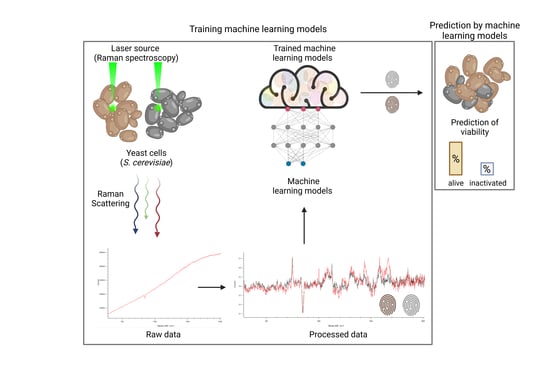
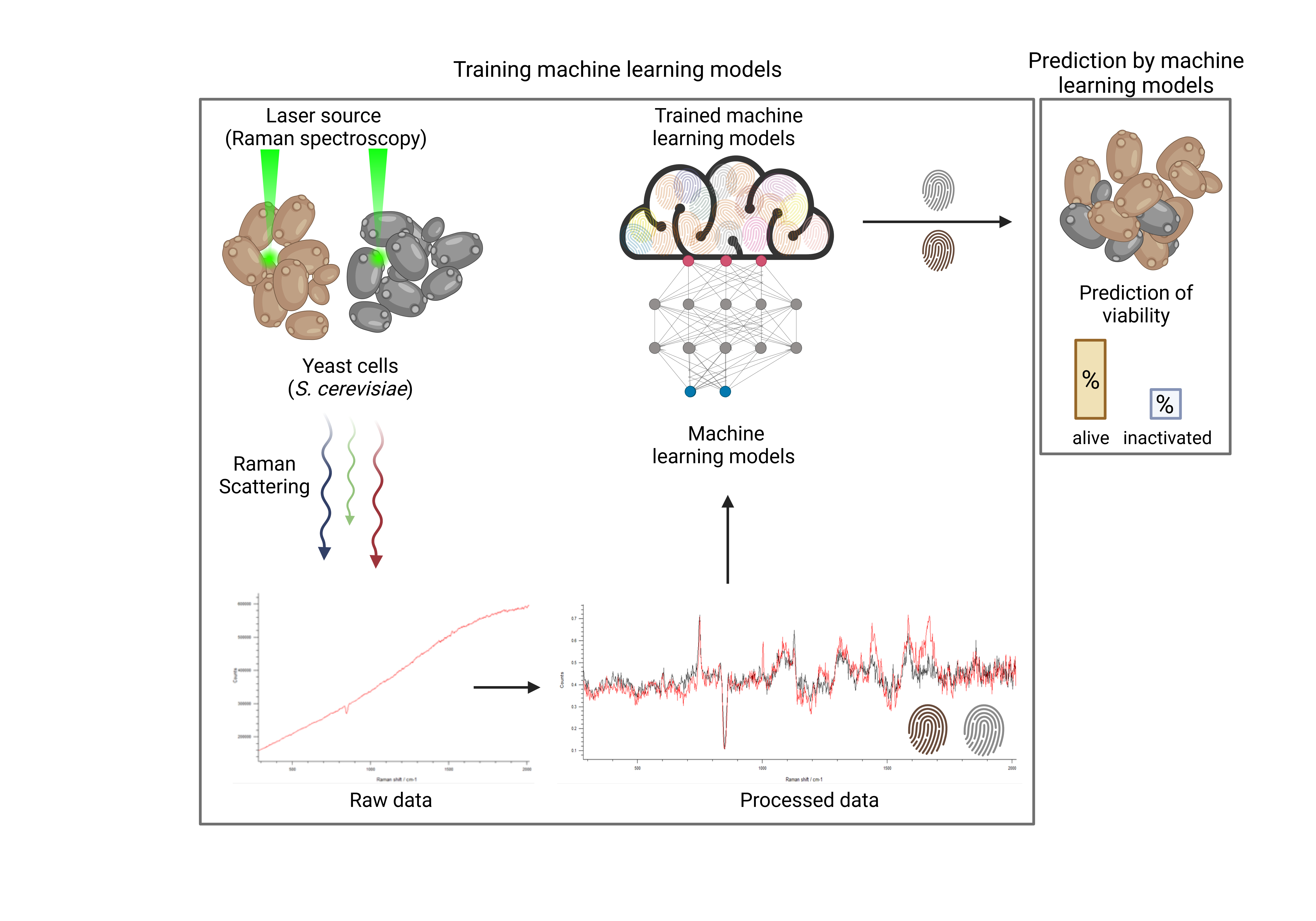
Graphical Abstract