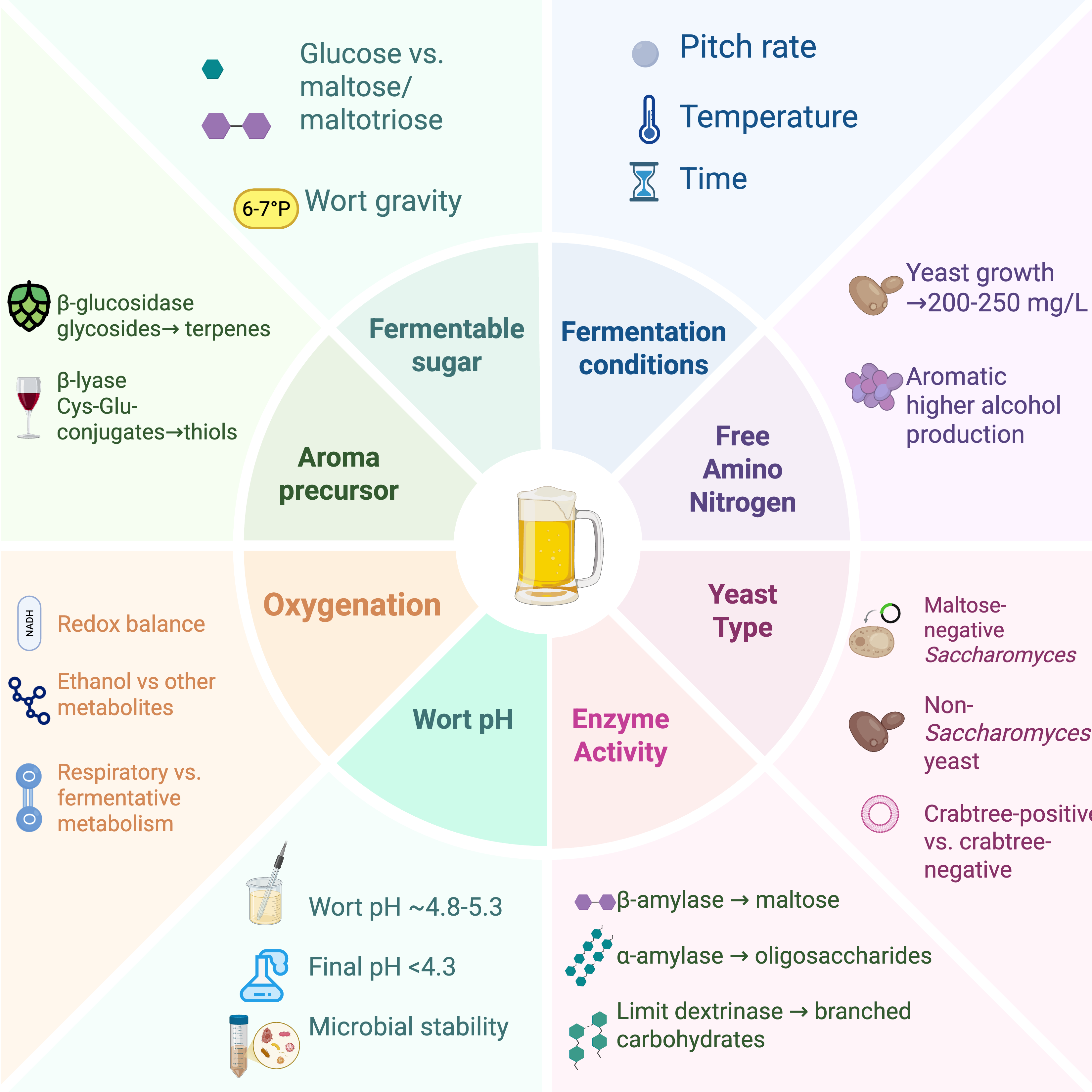
Influence of Wort Composition and Fermentation Parameters on Metabolic Activity of Non-Saccharomyces Yeast in Non-Alcoholic and Low-Alcohol Brewing


Abstract
1. Introduction
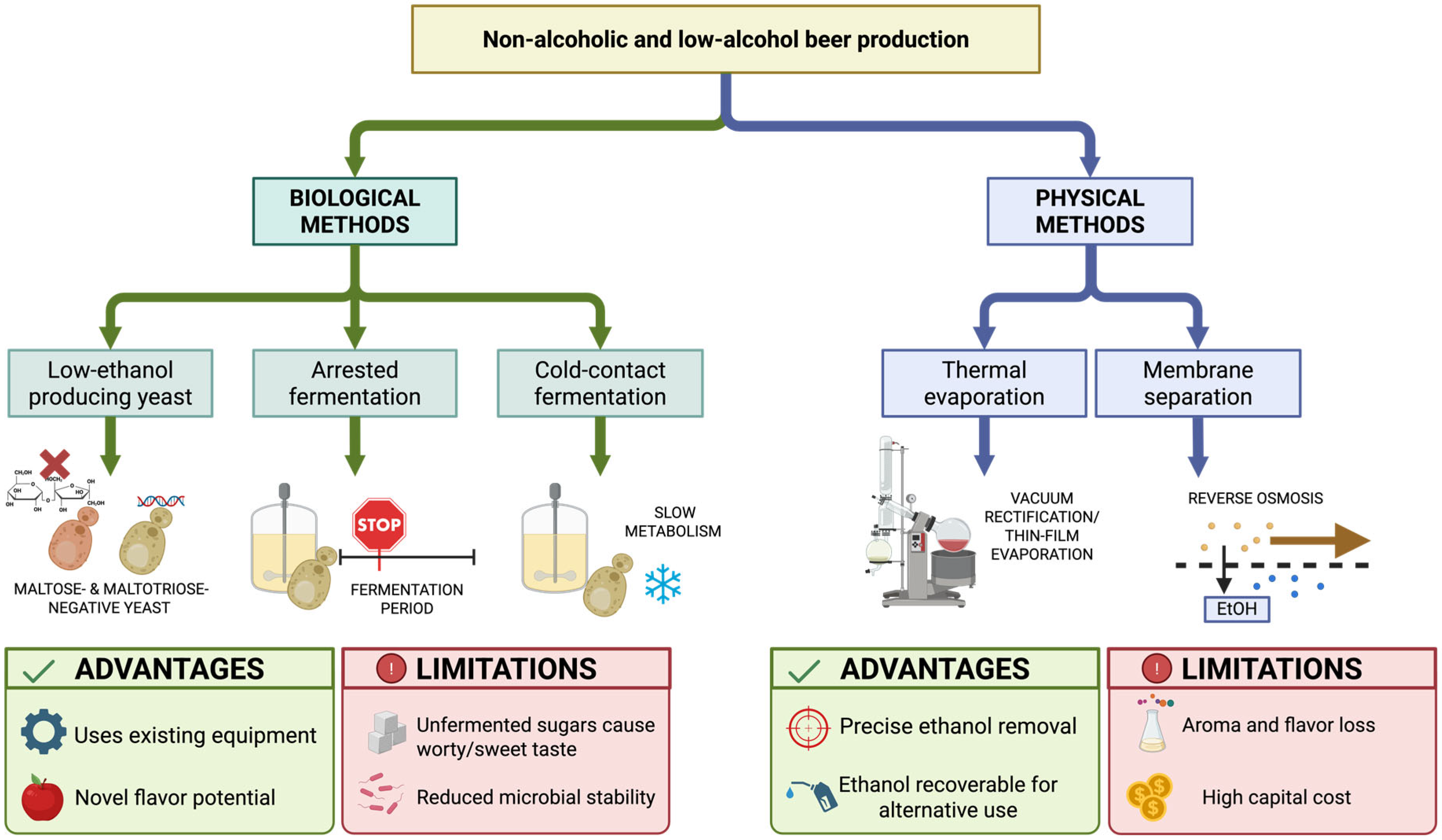
2. NABLAB Production Methods
2.1. Physical Methods: Post-Fermentation Ethanol Removal
2.2. Biological Methods: Controlling Ethanol Formation
3. Advantages and Disadvantages of Non-Saccharomyces Yeasts in NABLAB
4. Yeast Metabolism in the Context of Barley Wort Composition
4.1. Carbohydrate Utilization by Saccharomyces vs. Non-Saccharomyces Yeast
4.2. Yeast Behavior as a Response to Oxygen
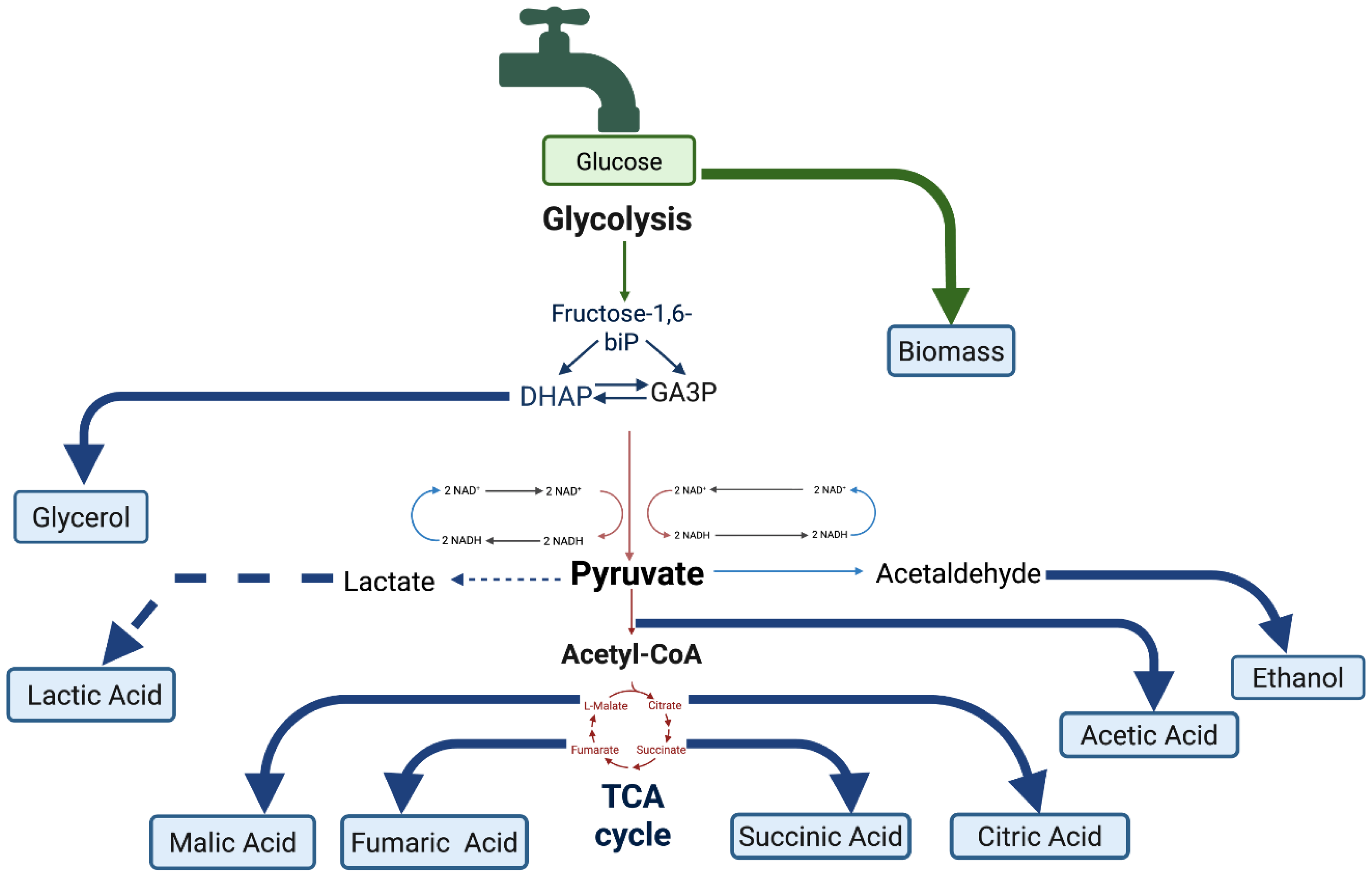
4.3. Alternate Carbon Sinks in Yeast Metabolism in the Context of Barley Wort Composition
4.3.1. Glycerol Production
4.3.2. Organic Acid Production
5. Wort Composition Effects on NSY Fermentation
5.1. Role of Fermentable Sugars in Wort in NABLAB Production
5.2. Mashing Strategies for Modifying Fermentable Sugar Profile of Wort
5.3. Free Amino Nitrogen and Yeast Nutrition in Low Gravity Wort
5.4. Effect of Dissolved Oxygen in Wort
5.5. Fermentation Parameters
6. Sensory Outcomes and Flavor Balance
6.1. Sweetness Drivers and Mitigation Strategies
6.2. Aroma- and Flavor-Active Compounds from Non-Saccharomyces Yeast
7. Conclusions
Author Contributions
Funding
Institutional Review Board Statement
Informed Consent Statement
Data Availability Statement
Conflicts of Interest
Abbreviations
| NABLAB | Non-alcoholic beer and low-alcohol beer |
| FS | Fermentable sugar |
| SG | Specific gravity |
| NSY | Non-Saccharomyces yeast |
| ABV | Alcohol by Volume (% v/v) |
| IBU | International bitterness unit |
| FAN | Free amino nitrogen |
| OG | Original gravity |
| EBU | European bitterness unit |
| CFU | Colony forming unit |
| AMG | Amyloglucosidase |
| VDK | Vicinal diketones |
| biP | Bisphosphate |
| DHAP | Dihydroxyacetone phosphate |
| GA3P | Glyceraldehyde-3-phosphate |
| NAD | Nicotinamide adenine dinucleotide |
| NADH | Nicotinamide adenine dinucleotide+hydrogen(H) |
References
- Salanță, L.C.; Coldea, T.E.; Ignat, M.V.; Pop, C.R.; Tofană, M.; Mudura, E.; Borșa, A.; Pasqualone, A.; Zhao, H. Non-Alcoholic and Craft Beer Production and Challenges. Processes 2020, 8, 1382. [Google Scholar] [CrossRef] [Scilit]
- Taylor, J.E.; Poelmans, E.; Hayne, E. The entrepreneurial response to beer legalisation in 1933 prior to the end of Prohibition. Bus. Hist. 2024, 66, 1834–1861. [Google Scholar] [CrossRef] [Scilit]
- Okaru, A.O.; Lachenmeier, D.W. Defining No and Low (NoLo) Alcohol Products. Nutrients 2022, 14, 3873. [Google Scholar] [CrossRef] [Scilit]
- Pater, A.; Januszek, M.; Satora, P. Comparison of the Chemical and Aroma Composition of Low-Alcohol Beers Produced by Saccharomyces cerevisiae var. chevalieri and Different Mashing Profiles. Appl. Sci. 2024, 14, 4979. [Google Scholar] [CrossRef] [Scilit]
- Montanari, L.; Marconi, O.; Mayer, H.; Fantozzi, P. 6—Production of Alcohol-Free Beer. In Beer in Health and Disease Prevention; Preedy, V.R., Ed.; Academic Press: San Diego, CA, USA, 2009; pp. 61–75. [Google Scholar]
- Rettberg, N.; Lafontaine, S.; Schubert, C.; Dennenlöhr, J.; Knoke, L.; Fischer, P.D.; Fuchs, J.; Thörner, S. Effect of Production Technique on Pilsner-Style Non-Alcoholic Beer (NAB) Chemistry and Flavor. Beverages 2022, 8, 4. [Google Scholar] [CrossRef] [Scilit]
- Ivanov, K.; Petelkov, I.; Shopska, V.; Denkova, R.; Gochev, V.; Kostov, G. Investigation of mashing regimes for low-alcohol beer production. J. Inst. Brew. 2016, 122, 508–516. [Google Scholar] [CrossRef] [Scilit]
- Perpète, P.; Collin, S. Contribution of 3-Methylthiopropionaldehyde to the Worty Flavor of Alcohol-Free Beers. J. Agric. Food Chem. 1999, 47, 2374–2378. [Google Scholar] [CrossRef] [Scilit]
- Piornos, J.A.; Koussissi, E.; Balagiannis, D.P.; Brouwer, E.; Parker, J.K. Alcohol-free and low-alcohol beers: Aroma chemistry and sensory characteristics. Compr. Rev. Food Sci. Food Saf. 2023, 22, 233–259. [Google Scholar] [CrossRef] [Scilit]
- Myncke, E.; Vanderputten, D.; Laureys, D.; Huys, J.; Schlich, J.; Van Opstaele, F.; Schouteten, J.J.; De Clippeleer, J. Navigating yeast selection for NABLAB production: Comparative study of commercial maltose- and maltotriose-negative strains. Food Chem. 2025, 477, 143486. [Google Scholar] [CrossRef] [Scilit] [PubMed]
- Karaoğlan, S.Y.; Jung, R.; Jelínek, L.; Karabín, M.; Kinčl, T.; Dostálek, P. Aroma Potential of a New Maltose-Negative Yeast Isolate. Foods 2025, 14, 3357. [Google Scholar] [CrossRef] [Scilit]
- Brányik, T.; Silva, D.; Baszczyňski, M.; Lehnert, R.; Silva, J. A review of methods of low alcohol and alcohol-free beer production. J. Food Eng. 2012, 108, 493–506. [Google Scholar] [CrossRef] [Scilit]
- Yabaci Karaoglan, S.; Jung, R.; Gauthier, M.; Kinčl, T.; Dostálek, P. Maltose-Negative Yeast in Non-Alcoholic and Low-Alcoholic Beer Production. Fermentation 2022, 8, 273. [Google Scholar] [CrossRef] [Scilit]
- Muller, C.; Neves, L.E.; Gomes, L.; Guimarães, M.; Ghesti, G. Processes for alcohol-free beer production: A review. Food Sci. Technol. 2020, 40, 273–281. [Google Scholar] [CrossRef] [Scilit]
- Andrés-Iglesias, C.; García-Serna, J.; Montero, O.; Blanco, C.A. Simulation and flavor compound analysis of dealcoholized beer via one-step vacuum distillation. Food Res. Int. 2015, 76, 751–760. [Google Scholar] [CrossRef] [Scilit]
- Kavanagh, T.; Clarke, B.; Gee, P.; Miles, M.; Nicholson, B. Volatile flavor compounds in low alcohol beers. Tech. Q.–Master Brew. Assoc. Am. 1991, 28, 111–118. [Google Scholar]
- De Francesco, G.; Marconi, O.; Sileoni, V.; Freeman, G.; Lee, E.G.; Floridi, S.; Perretti, G. Influence of the dealcoholisation by osmotic distillation on the sensory properties of different beer types. J. Food Sci. Technol. 2021, 58, 1488–1498. [Google Scholar] [CrossRef] [Scilit]
- Ramsey, I.; Dinu, V.; Linforth, R.; Yakubov, G.E.; Harding, S.E.; Yang, Q.; Ford, R.; Fisk, I. Understanding the lost functionality of ethanol in non-alcoholic beer using sensory evaluation, aroma release and molecular hydrodynamics. Sci. Rep. 2020, 10, 20855. [Google Scholar] [CrossRef] [Scilit]
- Pilarski, D.W.; Gerogiorgis, D.I. Progress and modelling of cold contact fermentation for alcohol-free beer production: A review. J. Food Eng. 2020, 273, 109804. [Google Scholar] [CrossRef] [Scilit]
- Bellut, K.; Arendt, E.K. Chance and Challenge: Non-Saccharomyces Yeasts in Nonalcoholic and Low Alcohol Beer Brewing—A Review. J. Am. Soc. Brew. Chem. 2019, 77, 77–91. [Google Scholar] [CrossRef] [Scilit]
- Bellut, K.; Krogerus, K.; Arendt, E.K. Lachancea fermentati Strains Isolated From Kombucha: Fundamental Insights, and Practical Application in Low Alcohol Beer Brewing. Front. Microbiol. 2020, 11, 273–281. [Google Scholar] [CrossRef] [Scilit]
- De Francesco, G.; Turchetti, B.; Sileoni, V.; Marconi, O.; Perretti, G. Screening of new strains of Saccharomycodes ludwigii and Zygosaccharomyces rouxii to produce low-alcohol beer. J. Inst. Brew. 2015, 121, 113–121. [Google Scholar] [CrossRef] [Scilit]
- Bellut, K.; Michel, M.; Zarnkow, M.; Hutzler, M.; Jacob, F.; Atzler, J.J.; Hoehnel, A.; Lynch, K.M.; Arendt, E.K. Screening and Application of Cyberlindnera Yeasts to Produce a Fruity, Non-Alcoholic Beer. Fermentation 2019, 5, 103. [Google Scholar] [CrossRef] [Scilit]
- Canonico, L.; Agarbati, A.; Comitini, F.; Ciani, M. Unravelling the potential of non-conventional yeasts and recycled brewers spent grains (BSG) for non-alcoholic and low alcohol beer (NABLAB). LWT 2023, 190, 115528. [Google Scholar] [CrossRef] [Scilit]
- Laus, A.; Zarnkow, M.; Gastl, M.; Jacob, F. Review on Recent Advances and Novel Approaches in Milling and Mashing. Compr. Rev. Food Sci. Food Saf. 2025, 24, e70239. [Google Scholar] [CrossRef] [Scilit]
- Methner, Y.; Magalhães, F.; Raihofer, L.; Zarnkow, M.; Jacob, F.; Hutzler, M. Beer fermentation performance and sugar uptake of Saccharomycopsis fibuligera—A novel option for low-alcohol beer. Front. Microbiol. 2022, 13, 1011155. [Google Scholar] [CrossRef] [Scilit] [PubMed]
- De Francesco, G.; Sannino, C.; Sileoni, V.; Marconi, O.; Filippucci, S.; Tasselli, G.; Turchetti, B. Mrakia gelida in brewing process: An innovative production of low alcohol beer using a psychrophilic yeast strain. Food Microbiol. 2018, 76, 354–362. [Google Scholar] [CrossRef] [Scilit]
- Johansson, L.; Nikulin, J.; Juvonen, R.; Krogerus, K.; Magalhães, F.; Mikkelson, A.; Nuppunen-Puputti, M.; Sohlberg, E.; de Francesco, G.; Perretti, G.; et al. Sourdough cultures as reservoirs of maltose-negative yeasts for low-alcohol beer brewing. Food Microbiol. 2021, 94, 103629. [Google Scholar] [CrossRef] [Scilit]
- Gernat, D.C.; Brouwer, E.; Ottens, M. Aldehydes as Wort Off-Flavours in Alcohol-Free Beers—Origin and Control. Food Bioprocess Technol. 2020, 13, 195–216. [Google Scholar] [CrossRef] [Scilit]
- Krogerus, K.; Eerikäinen, R.; Aisala, H.; Gibson, B. Repurposing brewery contaminant yeast as production strains for low-alcohol beer fermentation. Yeast 2021, 39, 156–169. [Google Scholar] [CrossRef] [Scilit] [PubMed]
- Bellut, K.; Michel, M.; Zarnkow, M.; Hutzler, M.; Jacob, F.; De Schutter, D.; Daenen, L.; Lynch, K.; Zannini, E.; Arendt, E. Application of Non-Saccharomyces Yeasts Isolated from Kombucha in the Production of Alcohol-Free Beer. Fermentation 2018, 4, 66. [Google Scholar] [CrossRef] [Scilit]
- Vaštík, P.; Rosenbergová, Z.; Furdíková, K.; Klempová, T.; Šišmiš, M.; Šmogrovičová, D. Potential of non-Saccharomyces yeast to produce non-alcoholic beer. FEMS Yeast Res. 2022, 22, foac039. [Google Scholar] [CrossRef] [Scilit]
- Lafontaine, S.; Senn, K.; Dennenlöhr, J.; Schubert, C.; Knoke, L.; Maxminer, J.; Cantu, A.; Rettberg, N.; Heymann, H. Characterizing Volatile and Nonvolatile Factors Influencing Flavor and American Consumer Preference toward Nonalcoholic Beer. ACS Omega 2020, 5, 23308–23321. [Google Scholar] [CrossRef] [Scilit]
- Schmelzle, A.; Lindemann, B.; Methner, F.-J. Sensory descriptive analysis and consumer acceptance of non-alcoholic beer. BrewingScience 2013, 66, 144–153. [Google Scholar]
- Jolly, N.P.; Varela, C.; Pretorius, I.S. Not your ordinary yeast: Non-Saccharomyces yeasts in wine production uncovered. FEMS Yeast Res. 2014, 14, 215–237. [Google Scholar] [CrossRef] [Scilit] [PubMed]
- Borren, E.; Tian, B. The Important Contribution of Non-Saccharomyces Yeasts to the Aroma Complexity of Wine: A Review. Foods 2020, 10, 13. [Google Scholar] [CrossRef] [Scilit]
- Contreras, A.; Hidalgo, C.; Henschke, P.A.; Chambers, P.J.; Curtin, C.; Varela, C. Evaluation of non-Saccharomyces yeasts for the reduction of alcohol content in wine. Appl. Environ. Microbiol. 2014, 80, 1670–1678. [Google Scholar] [CrossRef] [Scilit]
- Ivit, N.N.; Longo, R.; Kemp, B. The Effect of Non-Saccharomyces and Saccharomyces Non-Cerevisiae Yeasts on Ethanol and Glycerol Levels in Wine. Fermentation 2020, 6, 77. [Google Scholar] [CrossRef] [Scilit]
- Simões, J.; Coelho, E.; Magalhães, P.; Brandão, T.; Rodrigues, P.; Teixeira, J.A.; Domingues, L. Exploiting Non-Conventional Yeasts for Low-Alcohol Beer Production. Microorganisms 2023, 11, 316. [Google Scholar] [CrossRef] [Scilit] [PubMed]
- Vicente, J.; Navascués, E.; Calderón, F.; Santos, A.; Marquina, D.; Benito, S. An Integrative View of the Role of Lachancea thermotolerans in Wine Technology. Foods 2021, 10, 2878. [Google Scholar] [CrossRef] [Scilit] [PubMed]
- Valera, M.J.; Olivera, V.; Boido, E.; Dellacassa, E.; Carrau, F. Wine Aroma Characterization of the Two Main Fermentation Yeast Species of the Apiculate Genus Hanseniaspora. Fermentation 2021, 7, 162. [Google Scholar] [CrossRef] [Scilit]
- Sharp, D.C.; Steensels, J.; Shellhammer, T.H. The effect of hopping regime, cultivar and β-glucosidase activity on monoterpene alcohol concentrations in wort and beer. J. Inst. Brew. 2017, 123, 185–191. [Google Scholar] [CrossRef] [Scilit]
- Klimczak, K.; Cioch-Skoneczny, M.; Poreda, A. Evaluation of Non-Saccharomyces Yeast for Low-Alcohol Beer Production. Appl. Sci. 2024, 14, 6755. [Google Scholar] [CrossRef] [Scilit]
- Matraxia, M.; Alfonzo, A.; Prestianni, R.; Francesca, N.; Gaglio, R.; Todaro, A.; Alfeo, V.; Perretti, G.; Columba, P.; Settanni, L.; et al. Non-conventional yeasts from fermented honey by-products: Focus on Hanseniaspora uvarum strains for craft beer production. Food Microbiol. 2021, 99, 103806. [Google Scholar] [CrossRef] [Scilit] [PubMed]
- Barrajón, N.; Capece, A.; Arévalo-Villena, M.; Briones, A.; Romano, P. Co-inoculation of different Saccharomyces cerevisiae strains and influence on volatile composition of wines. Food Microbiol. 2011, 28, 1080–1086. [Google Scholar] [CrossRef] [Scilit] [PubMed]
- Sola, I.M.; Evers, L.D.; Wojeicchowski, J.P.; Assis, T.M.; Marinho, M.T.; Demiate, I.M.; Alberti, A.; Nogueira, A. Impact of Pure, Co-, and Sequential Fermentations with Hanseniaspora sp. and Saccharomyces cerevisiae on the Volatile Compounds of Ciders. Fermentation 2024, 10, 177. [Google Scholar] [CrossRef] [Scilit]
- Wei, Y.; Mou, J.; Zhang, H.; Gao, A.; Qin, Y. Impact of Co-Inoculation Patterns of Wickerhamomyces anomalus and Saccharomyces cerevisiae on Cider Quality and Aromatic Profiles. Molecules 2025, 30, 1620. [Google Scholar] [CrossRef] [Scilit]
- Methner, Y.; Hutzler, M.; Zarnkow, M.; Prowald, A.; Endres, F.; Jacob, F. Investigation of Non-Saccharomyces Yeast Strains for Their Suitability for the Production of Non-Alcoholic Beers with Novel Flavor Profiles. J. Am. Soc. Brew. Chem. 2022, 80, 341–355. [Google Scholar] [CrossRef] [Scilit]
- Huang, P.H.; Lin, Y.C.; Lin, Y.W.; Zhang, Y.W.; Huang, D.W. The Potential of Co-Fermentation with Pichia kluyveri and Saccharomyces cerevisiae for the Production of Low-Alcohol Craft Beer. Foods 2024, 13, 3794. [Google Scholar] [CrossRef] [Scilit]
- Moreira, N.; Mendes, F.; de Pinho, P.G.; Hogg, T.; Vasconcelos, I. Heavy sulphur compounds, higher alcohols and esters production profile of Hanseniaspora uvarum and Hanseniaspora guilliermondii grown as pure and mixed cultures in grape must. Int. J. Food Microbiol. 2008, 124, 231–238. [Google Scholar] [CrossRef] [Scilit]
- Langstaff, S.A.; Guinard, J.X.; Lewis, M.J. Instrumental evaluation of the mouthfeel of beer and correlation with sensory evaluation. J. Inst. Brew. J. Inst. Brew. 1991, 97, 427–433. [Google Scholar] [CrossRef] [Scilit]
- Svedlund, N.; Evering, S.; Gibson, B.; Krogerus, K. Fruits of their labour: Biotransformation reactions of yeasts during brewery fermentation. Appl. Microbiol. Biotechnol. 2022, 106, 4929–4944. [Google Scholar] [CrossRef] [Scilit]
- Buiatti, S.; Tat, L.; Natolino, A.; Passaghe, P. Biotransformations Performed by Yeasts on Aromatic Compounds Provided by Hop—A Review. Fermentation 2023, 9, 327. [Google Scholar] [CrossRef] [Scilit]
- Iorizzo, M.; Coppola, F.; Letizia, F.; Testa, B.; Sorrentino, E. Role of Yeasts in the Brewing Process: Tradition and Innovation. Processes 2021, 9, 839. [Google Scholar] [CrossRef] [Scilit]
- Han, X.; Qin, Q.; Li, C.; Zhao, X.; Song, F.; An, M.; Chen, Y.; Wang, X.; Huang, W.; Zhan, J.; et al. Application of non-Saccharomyces yeasts with high β-glucosidase activity to enhance terpene-related floral flavor in craft beer. Food Chem. 2023, 404, 134726. [Google Scholar] [CrossRef] [Scilit]
- Miguel, G.A.; Carlsen, S.; Arneborg, N.; Saerens, S.M.G.; Laulund, S.; Knudsen, G.M. Non-Saccharomyces yeasts for beer production: Insights into safety aspects and considerations. Int. J. Food Microbiol. 2022, 383, 109951. [Google Scholar] [CrossRef] [Scilit]
- Britton, S.J.; Hill, A.E. Microbiological Quality Control in Non- and Low-Alcoholic Beer Manufacturing: A Comprehensive Review of Microbial Contaminants and Strategies for Spoilage Prevention. J. Am. Soc. Brew. Chem. 2025, 83, 365–382. [Google Scholar] [CrossRef] [Scilit]
- Michel, M.; Kopecká, J.; Meier-Dörnberg, T.; Zarnkow, M.; Jacob, F.; Hutzler, M. Screening for new brewing yeasts in the non-Saccharomyces sector with Torulaspora delbrueckii as model. Yeast 2016, 33, 129–144. [Google Scholar] [CrossRef] [Scilit] [PubMed]
- Qin, X.; Li, F.; Bo, W.; Li, W.; Dong, X. The non-Saccharomyces yeasts as novel starter cultures to innovate beer brewing. CyTA—J. Food 2025, 23, 2459819. [Google Scholar] [CrossRef] [Scilit]
- Postigo, V.; O’Sullivan, T.; Schuurman, T.E.; Arroyo, T. Non-Conventional Yeast: Behavior under Pure Culture, Sequential and Aeration Conditions in Beer Fermentation. Foods 2022, 11, 3717. [Google Scholar] [CrossRef] [Scilit]
- Holt, S.; Mukherjee, V.; Lievens, B.; Verstrepen, K.J.; Thevelein, J.M. Bioflavoring by non-conventional yeasts in sequential beer fermentations. Food Microbiol. 2018, 72, 55–66. [Google Scholar] [CrossRef] [Scilit] [PubMed]
- Méndez-Zamora, A.; Gutiérrez-Avendaño, D.O.; Arellano-Plaza, M.; De la Torre González, F.J.; Barrera-Martínez, I.; Mathis, A.G.; Casas-Godoy, L. The non-Saccharomyces yeast Pichia kluyveri for the production of aromatic volatile compounds in alcoholic fermentation. FEMS Yeast Res. 2020, 20, foaa067. [Google Scholar] [CrossRef] [Scilit]
- Canonico, L.; Zannini, E.; Ciani, M.; Comitini, F. Assessment of non-conventional yeasts with potential probiotic for protein-fortified craft beer production. LWT 2021, 145, 111361. [Google Scholar] [CrossRef] [Scilit]
- Sampaolesi, S.; Pérez-Través, L.; Pérez, D.; Roldán-López, D.; Briand, L.E.; Pérez-Torrado, R.; Querol, A. Identification and assessment of non-conventional yeasts in mixed fermentations for brewing bioflavored beer. Int. J. Food Microbiol. 2023, 399, 110254. [Google Scholar] [CrossRef] [Scilit] [PubMed]
- Stewart, G.G. Saccharomyces species in the Production of Beer. Beverages 2016, 2, 34. [Google Scholar] [CrossRef] [Scilit]
- Wang, R.; Sun, J.; Lassabliere, B.; Yu, B.; Liu, S.Q. β-Glucosidase activity of Cyberlindnera (Williopsis) saturnus var. mrakii NCYC 2251 and its fermentation effect on green tea aroma compounds. LWT 2021, 151, 112184. [Google Scholar] [CrossRef] [Scilit]
- Lodolo, E.J.; Kock, J.L.F.; Axcell, B.C.; Brooks, M. The yeast Saccharomyces cerevisiae: The main character in beer brewing. FEMS Yeast Res. 2008, 8, 1018–1036. [Google Scholar] [CrossRef] [Scilit] [PubMed]
- Olivares-Marin, I.K.; González-Hernández, J.C.; Regalado-Gonzalez, C.; Madrigal-Perez, L.A. Saccharomyces cerevisiae Exponential Growth Kinetics in Batch Culture to Analyze Respiratory and Fermentative Metabolism. J. Vis. Exp. 2018, 30, 58192. [Google Scholar]
- Alsammar, H.; Delneri, D. An update on the diversity, ecology and biogeography of the Saccharomyces genus. FEMS Yeast Res. 2020, 20, foaa013. [Google Scholar] [CrossRef] [Scilit]
- Ernandes, J.R.; Williams, J.W.; Russell, I.; Stewart, G.G. Effect of yeast adaptation to maltose utilization on sugar uptake during the fermentation of brewer’s wort. J. Inst. Brew. 1993, 99, 67–71. [Google Scholar] [CrossRef] [Scilit]
- Pires, E.J.; Teixeira, J.A.; Brányik, T.; Vicente, A.A. Yeast: The soul of beer’s aroma—A review of flavour-active esters and higher alcohols produced by the brewing yeast. Appl. Microbiol. Biotechnol. 2014, 98, 1937–1949. [Google Scholar] [CrossRef] [Scilit]
- Roth, W.G.; Leckie, M.P.; Dietzler, D.N. Osmotic stress drastically inhibits active transport of carbohydrates by Escherichia coli. Biochem. Biophys. Res. Commun. 1985, 126, 434–441. [Google Scholar] [CrossRef] [Scilit]
- Carbon, H.N.; Aplin, J.J.; Jiang, G.Z.; Gibney, P.A.; Edwards, C.G. Fate of carbon in synthetic media fermentations containing Metschnikowia pulcherrima or Meyerozyma guilliermondii in the presence and absence of Saccharomyces cerevisiae. Food Microbiol. 2023, 114, 104308. [Google Scholar] [CrossRef] [Scilit]
- Visser, W.; Scheffers, W.A.; der Vegte, W.H.B.-V.; van Dijken, J.P. Oxygen requirements of yeasts. Appl. Environ. Microbiol. 1990, 56, 3785–3792. [Google Scholar] [CrossRef] [Scilit] [PubMed]
- Alves Sergio, L.; Ricardo, A.H.; Hollatz, C.; Trichez, D.; Luiz, C.M.; de Araujo Pedro, S.; Boris, U.S. Molecular Analysis of Maltotriose Active Transport and Fermentation by Saccharomyces cerevisiae Reveals a Determinant Role for the AGT1 Permease. Appl. Environ. Microbiol. 2008, 74, 1494–1501. [Google Scholar] [CrossRef] [Scilit]
- Vermeersch, L.; Perez-Samper, G.; Cerulus, B.; Jariani, A.; Gallone, B.; Voordeckers, K.; Steensels, J.; Verstrepen, K.J. On the duration of the microbial lag phase. Curr. Genet. 2019, 65, 721–727. [Google Scholar] [CrossRef] [Scilit]
- Jackowski, M.; Czepiela, W.; Hampf, L.; Żuczkowski, W.; Dymkowski, T.; Trusek, A. Comparison of Two Commercially Available Strains, Saccharomycodes ludwigii and Torulaspora delbrueckii, for the Production of Low-Alcohol Beer. Beverages 2023, 9, 66. [Google Scholar] [CrossRef] [Scilit]
- Paszkot, J.; Gasiński, A.; Kawa-Rygielska, J. Evaluation of volatile compound profiles and sensory properties of dark and pale beers fermented by different strains of brewing yeast. Sci. Rep. 2023, 13, 6725. [Google Scholar] [CrossRef] [Scilit] [PubMed]
- Gancedo, J.M. Yeast Carbon Catabolite Repression. Microbiol. Mol. Biol. Rev. 1998, 62, 334–361. [Google Scholar] [CrossRef] [Scilit] [PubMed]
- Faz-Cortez, O.A.; García-García, J.H.; Carrizales-Sánchez, A.K.; Fonseca-Peralta, H.M.; Herrera-Gamboa, J.G.; Perez-Ortega, E.R.; Hernández-Vásquez, C.I.; Pereyra-Alférez, B. Maltose and Maltotriose Transporters in Brewer’s Saccharomyces Yeasts: Polymorphic and Key Residues in Their Activity. Int. J. Mol. Sci. 2025, 26, 5943. [Google Scholar] [CrossRef] [Scilit]
- Mateus, D.; Sousa, S.; Coimbra, C.; Rogerson, F.S.; Simões, J. Identification and Characterization of Non-Saccharomyces Species Isolated from Port Wine Spontaneous Fermentations. Foods 2020, 9, 120. [Google Scholar] [CrossRef] [Scilit]
- Fukuhara, H. The Kluyver effect revisited. FEMS Yeast Res. 2003, 3, 327–331. [Google Scholar] [CrossRef] [Scilit]
- Stewart, G.G. The Production of Secondary Metabolites with Flavour Potential during Brewing and Distilling Wort Fermentations. Fermentation 2017, 3, 63. [Google Scholar] [CrossRef] [Scilit]
- Moutsoglou, M.E.; Dearden, A.C. Effect of the respiro-fermentative balance during yeast propagation on fermentation and wort attenuation. J. Inst. Brew. 2020, 126, 289–297. [Google Scholar] [CrossRef] [Scilit]
- Magalhães, F.; Vidgren, V.; Ruohonen, L.; Gibson, B. Maltose and maltotriose utilisation by group I strains of the hybrid lager yeast Saccharomyces pastorianus. FEMS Yeast Res. 2016, 16, fow053. [Google Scholar] [CrossRef] [Scilit] [PubMed]
- Hernández-Vásquez César, I.; García-García Jorge, H.; Pérez-Ortega Esmeralda, R.; Martínez-Segundo Adriana, G.; Damas-Buenrostro Luis, C.; Pereyra-Alférez, B. Expression patterns of Mal genes and association with differential maltose and maltotriose transport rate of two Saccharomyces pastorianus yeasts. Appl. Environ. Microbiol. 2024, 90, e00397-24. [Google Scholar] [CrossRef] [Scilit] [PubMed]
- Alves-Araújo, C.; Hernandez-Lopez, M.J.; Sousa, M.J.; Prieto, J.A.; Randez-Gil, F. Cloning and characterization of the MAL11 gene encoding a high-affinity maltose transporter from Torulaspora delbrueckii. FEMS Yeast Res. 2004, 4, 467–476. [Google Scholar] [CrossRef] [Scilit]
- Bruner, J.; Marcus, A.; Fox, G. Brewing Efficacy of Non-Conventional Saccharomyces Non-cerevisiae Yeasts. Beverages 2021, 7, 68. [Google Scholar] [CrossRef] [Scilit]
- Pfeiffer, T.; Morley, A. An evolutionary perspective on the Crabtree effect. Front. Mol. Biosci. 2014, 1, 17. [Google Scholar] [CrossRef] [Scilit]
- Hagman, A.; Piškur, J. A study on the fundamental mechanism and the evolutionary driving forces behind aerobic fermentation in yeast. PLoS ONE 2015, 10, e0116942. [Google Scholar] [CrossRef] [Scilit]
- Postma, E.; Verduyn, C.; Scheffers, W.A.; Van Dijken, J.P. Enzymic analysis of the crabtree effect in glucose-limited chemostat cultures of Saccharomyces cerevisiae. Appl. Environ. Microbiol. 1989, 55, 468–477. [Google Scholar] [CrossRef] [Scilit]
- Otterstedt, K.; Larsson, C.; Bill, R.M.; Ståhlberg, A.; Boles, E.; Hohmann, S.; Gustafsson, L. Switching the mode of metabolism in the yeast Saccharomyces cerevisiae. EMBO Rep. 2004, 5, 532–537. [Google Scholar] [CrossRef] [Scilit]
- de Alteriis, E.; Cartenì, F.; Parascandola, P.; Serpa, J.; Mazzoleni, S. Revisiting the Crabtree/Warburg effect in a dynamic perspective: A fitness advantage against sugar-induced cell death. Cell Cycle 2018, 17, 688–701. [Google Scholar] [CrossRef] [Scilit]
- González-Hernández, Y.; Michiels, E.; Perré, P. A Comprehensive Mechanistic Yeast Model Able to Switch Metabolism According to Growth Conditions. Fermentation 2022, 8, 710. [Google Scholar] [CrossRef] [Scilit]
- Morales, P.; Rojas, V.; Quirós, M.; Gonzalez, R. The impact of oxygen on the final alcohol content of wine fermented by a mixed starter culture. Appl. Microbiol. Biotechnol. 2015, 99, 3993–4003. [Google Scholar] [CrossRef] [Scilit] [PubMed]
- Rodrigues, F.; Ludovico, P. Sugar Metabolism in Yeasts: An Overview of Aerobic and Anaerobic Glucose Catabolism. In Biodiversity and Ecophysiology of Yeasts; Springer: Berlin/Heidelberg, Germany, 2006; pp. 101–121. [Google Scholar]
- Rivera Flores, V.K.; DeMarsh, T.A.; Gibney, P.A.; Alcaine, S.D. Fermentation of Dairy-Relevant Sugars by Saccharomyces, Kluyveromyces, and Brettanomyces: An Exploratory Study with Implications for the Utilization of Acid Whey, Part II. Fermentation 2022, 8, 257. [Google Scholar] [CrossRef] [Scilit]
- Wijsman, M.R.; van Dijken, J.P.; van Kleeff, B.H.; Scheffers, W.A. Inhibition of fermentation and growth in batch cultures of the yeast Brettanomyces intermedius upon a shift from aerobic to anaerobic conditions (Custers effect). Antonie Van Leeuwenhoek 1984, 50, 183–192. [Google Scholar] [CrossRef] [Scilit]
- Aguilar Uscanga, M.G.; Délia, M.L.; Strehaiano, P. Brettanomyces bruxellensis: Effect of oxygen on growth and acetic acid production. Appl. Microbiol. Biotechnol. 2003, 61, 157–162. [Google Scholar] [CrossRef] [Scilit]
- Jouhten, P.; Rintala, E.; Huuskonen, A.; Tamminen, A.; Toivari, M.; Wiebe, M.; Ruohonen, L.; Penttilä, M.; Maaheimo, H. Oxygen dependence of metabolic fluxes and energy generation of Saccharomyces cerevisiae CEN.PK113-1A. BMC Syst. Biol. 2008, 2, 60. [Google Scholar] [CrossRef] [Scilit]
- Hubmann, G.; Guillouet, S.; Nevoigt, E. Gpd1 and Gpd2 fine-tuning for sustainable reduction of glycerol formation in Saccharomyces cerevisiae. Appl. Environ. Microbiol. 2011, 77, 5857–5867. [Google Scholar] [CrossRef] [Scilit]
- Bakker, B.M.; Overkamp, K.M.; van Maris, A.J.A.; Kötter, P.; Luttik, M.A.H.; van Dijken, J.P.; Pronk, J.T. Stoichiometry and compartmentation of NADH metabolism in Saccharomyces cerevisiae. FEMS Microbiol. Rev. 2001, 25, 15–37. [Google Scholar] [CrossRef]
- Pagliardini, J.; Hubmann, G.; Bideaux, C.; Alfenore, S.; Nevoigt, E.; Guillouet, S.E. Quantitative evaluation of yeast’s requirement for glycerol formation in very high ethanol performance fed-batch process. Microb. Cell Fact. 2010, 9, 36. [Google Scholar] [CrossRef] [Scilit]
- Duncan, J.D.; Setati, M.E.; Divol, B. The cellular symphony of redox cofactor management by yeasts in wine fermentation. Int. J. Food Microbiol. 2025, 427, 110966. [Google Scholar] [CrossRef] [Scilit]
- Blanco, C.A.; Andrés-Iglesias, C.; Montero, O. Low-alcohol Beers: Flavor Compounds, Defects, and Improvement Strategies. Crit. Rev. Food Sci. Nutr. 2016, 56, 1379–1388. [Google Scholar] [CrossRef] [Scilit]
- Påhlman, A.-K.; Granath, K.; Ansell, R.; Hohmann, S.; Adler, L. The Yeast Glycerol 3-Phosphatases Gpp1p and Gpp2p Are Required for Glycerol Biosynthesis and Differentially Involved in the Cellular Responses to Osmotic, Anaerobic, and Oxidative Stress. J. Biol. Chem. 2001, 276, 3555–3563. [Google Scholar] [CrossRef] [Scilit] [PubMed]
- Ansell, R.; Granath, K.; Hohmann, S.; Thevelein, J.M.; Adler, L. The two isoenzymes for yeast NAD+-dependent glycerol 3-phosphate dehydrogenase encoded by GPD1 and GPD2 have distinct roles in osmoadaptation and redox regulation. Embo J. 1997, 16, 2179–2187. [Google Scholar] [CrossRef] [Scilit] [PubMed]
- Goold, H.D.; Kroukamp, H.; Williams, T.C.; Paulsen, I.T.; Varela, C.; Pretorius, I.S. Yeast’s balancing act between ethanol and glycerol production in low-alcohol wines. Microb. Biotechnol. 2017, 10, 264–278. [Google Scholar] [CrossRef] [Scilit] [PubMed]
- Shekhawat, K.; Porter, T.; Bauer, F.; Setati, M. Employing oxygen pulses to modulate Lachancea thermotolerans–Saccharomyces cerevisiae Chardonnay fermentations. Ann. Microbiol. 2017, 68, 93–102. [Google Scholar] [CrossRef] [Scilit]
- Gutiérrez, A.; Boekhout, T.; Gojkovic, Z.; Katz, M. Evaluation of non-Saccharomyces yeasts in the fermentation of wine, beer and cider for the development of new beverages. J. Inst. Brew. 2018, 124, 389–402. [Google Scholar] [CrossRef] [Scilit]
- Benito, Á.; Calderón, F.; Benito, S. New Trends in Schizosaccharomyces Use for Winemaking. In Grape and Wine Biotechnology; IntechOpen: London, UK, 2016. [Google Scholar]
- Li, J.; Hong, M.; Qi, B. Impact of Torulaspora delbrueckii During Fermentation on Aromatic Profile of Vidal Blanc Icewine. Front. Microbiol. 2022, 13, 860128. [Google Scholar] [CrossRef] [Scilit]
- Orjuela, A.; Orjuela, A.; Lira, C.T.; Miller, D.J. A novel process for recovery of fermentation-derived succinic acid: Process design and economic analysis. Bioresour. Technol. 2013, 139, 235–241. [Google Scholar] [CrossRef] [Scilit]
- Li, H.; Liu, F. Changes in Organic Acids During Beer Fermentation. J. Am. Soc. Brew. Chem. 2015, 73, 275–279. [Google Scholar] [CrossRef] [Scilit]
- Balmaseda, A.; Rozès, N.; Bordons, A.; Reguant, C. The use of Torulaspora delbrueckii to improve malolactic fermentation. Microb. Biotechnol. 2024, 17, e14302. [Google Scholar] [CrossRef] [Scilit]
- Postigo, V.; Esteban, S.; Arroyo, T. Lachancea thermotolerans, an Innovative Alternative for Sour Beer Production. Beverages 2023, 9, 20. [Google Scholar] [CrossRef] [Scilit]
- Alexa, L.; Csoma, H.; Ungai, D.; Kovács, B.; Czipa, N.; Miklós, I.; Kállai, Z.; Papp, L.A.; Takács, S. Alternative Yeast Strains in Beer Production: Impacts on Quality and Nutritional Value. Beverages 2025, 11, 142. [Google Scholar] [CrossRef] [Scilit]
- Yang, F.; Heit, C.; Inglis, D.L. Cytosolic Redox Status of Wine Yeast (Saccharomyces Cerevisiae) under Hyperosmotic Stress during Icewine Fermentation. Fermentation 2017, 3, 61. [Google Scholar] [CrossRef] [Scilit]
- Coote, N.; Kirsop, B. The content of some organic acids in beer and other fermented media. J. Inst. Brew. 1974, 80, 474–483. [Google Scholar] [CrossRef] [Scilit]
- Oldham, R.C.; Held, M.A. Methods for detection and identification of beer-spoilage microbes. Front. Microbiol. 2023, 14, 1217704. [Google Scholar] [CrossRef] [Scilit] [PubMed]
- Zendeboodi, F.; Jannat, B.; Sohrabvandi, S.; Khanniri, E.; Mortazavian, A.M.; Khosravi, K.; Gholian, M.M.; Sarmadi, B.; Javadi, N.H.S. Detection of Non-Alcoholic Beer Spoilage Microorganisms at Critical Points of Production by Polymerase Chain Reaction. Biointerface Res. Appl. Chem. 2021, 11, 9658–9668. [Google Scholar]
- Fejzullahu, F.; Kiss, Z.; Kun-Farkas, G.; Kun, S. Influence of Non-Saccharomyces Strains on Chemical Characteristics and Sensory Quality of Fruit Spirit. Foods 2021, 10, 1336. [Google Scholar] [CrossRef] [Scilit]
- Domizio, P.; House, J.F.; Joseph, C.M.L.; Bisson, L.F.; Bamforth, C.W. Lachancea thermotolerans as an alternative yeast for the production of beer. J. Inst. Brew. 2016, 122, 599–604. [Google Scholar] [CrossRef] [Scilit]
- Puyo, M.; Mas, P.; Roullier-Gall, C.; Romanet, R.; Lebleux, M.; Klein, G.; Alexandre, H.; Tourdot-Maréchal, R. Bioprotection Efficiency of Metschnikowia Strains in Synthetic Must: Comparative Study and Metabolomic Investigation of the Mechanisms Involved. Foods 2023, 12, 3927. [Google Scholar] [CrossRef] [Scilit]
- Pirrone, A.; Naselli, V.; Gugino, I.M.; Porrello, A.; Viola, E.; Craparo, V.; Vella, A.; Alongi, D.; Seminerio, V.; Carusi, M.; et al. Use of non-conventional yeasts for enhancing the sensory quality of craft beer. Food Res. Int. 2025, 208, 116164. [Google Scholar] [CrossRef] [Scilit]
- Vicente, J.; Ruiz, J.; Belda, I.; Benito-Vázquez, I.; Marquina, D.; Calderón, F.; Santos, A.; Benito, S. The Genus Metschnikowia in Enology. Microorganisms 2020, 8, 1038. [Google Scholar] [CrossRef] [Scilit]
- Hranilovic, A.; Gambetta, J.M.; Jeffery, D.W.; Grbin, P.R.; Jiranek, V. Lower-alcohol wines produced by Metschnikowia pulcherrima and Saccharomyces cerevisiae co-fermentations: The effect of sequential inoculation timing. Int. J. Food Microbiol. 2020, 329, 108651. [Google Scholar] [CrossRef] [Scilit]
- Drosou, F.; Mamma, D.; Tataridis, P.; Dourtoglou, V.; Oreopoulou, V. Metschnikowia pulcherrima in mono or co-fermentations in brewing. BrewingScience 2022, 75, 69–78. [Google Scholar]
- Fernández-Vázquez, D.; Rozès, N.; Canals, J.-M.; Bordons, A.; Reguant, C.; Zamora, F. New enzymatic method for estimating fumaric acid in wines. OENO One 2021, 55, 273–281. [Google Scholar] [CrossRef] [Scilit]
- Basu, M.; Voloshchuk, N.; Simmons, J.; Wee, J.; Elias, R.J.; Cockburn, D.W. Control of residual maltose in low-alcohol beer produced by non-Saccharomyces yeast with enzymatic treatment. Food Microbiol. 2026, 137, 105036. [Google Scholar] [CrossRef] [Scilit] [PubMed]
- Guadalupe Medina, V.; Almering, M.J.; van Maris, A.J.; Pronk, J.T. Elimination of glycerol production in anaerobic cultures of a Saccharomyces cerevisiae strain engineered to use acetic acid as an electron acceptor. Appl. Environ. Microbiol. 2010, 76, 190–195. [Google Scholar] [CrossRef] [Scilit]
- Torres-Guardado, R.; Rozès, N.; Esteve-Zarzoso, B.; Reguant, C.; Bordons, A. Succinic acid production by wine yeasts and the influence of GABA and glutamic acid. Int. Microbiol. 2024, 27, 505–512. [Google Scholar] [CrossRef] [Scilit] [PubMed]
- Jiang, X.; Lu, Y.; Liu, S.Q. Effects of Different Yeasts on Physicochemical and Oenological Properties of Red Dragon Fruit Wine Fermented with Saccharomyces cerevisiae, Torulaspora delbrueckii and Lachancea thermotolerans. Microorganisms 2020, 8, 315. [Google Scholar] [CrossRef] [Scilit]
- De Schepper, C.F.; Buvé, C.; Van Loey, A.M.; Courtin, C.M. A kinetic study on the thermal inactivation of barley malt α-amylase and β-amylase during the mashing process. Food Res. Int. 2022, 157, 111201. [Google Scholar] [CrossRef] [Scilit] [PubMed]
- Endres, F.; Prowald, A.; Fittschen, U.E.A.; Hampel, S.; Oppermann, S.; Jacob, F.; Hutzler, M.; Laus, A.; Methner, Y.; Zarnkow, M. Constant temperature mashing at 72 °C for the production of beers with a reduced alcohol content in micro brewing systems. Eur. Food Res. Technol. 2022, 248, 1457–1468. [Google Scholar] [CrossRef] [Scilit]
- Bamforth, C.W.; Chemists, A.S.O.B. Scientific Principles of Malting and Brewing; American Society of Brewing Chemists: Saint Paul, MN, USA, 2006. [Google Scholar]
- Fritzsche, B.; Prowald, A.; Brass, L.; Zarnkow, M.; Endres, F. Mashing Isothermally at High Temperature Compared to Infusion Mashing for the Production of Full-Bodied, Alcohol-Reduced Beer. J. Am. Soc. Brew. Chem. 2025, 83, 69–79. [Google Scholar] [CrossRef] [Scilit]
- Fox, G.; Staunton, M.; Agnew, E.; D’Arcy, B. Effect of varying starch properties and mashing conditions on wort sugar profiles. J. Inst. Brew. 2019, 125, 412–421. [Google Scholar] [CrossRef] [Scilit]
- Dalberto, G.; Niemes, J.; Rosa, M. Cold mash in brewer wort with low carbohydrate content: A study of the mashing step. Braz. J. Food Technol. 2023, 26, e2023008. [Google Scholar] [CrossRef] [Scilit]
- Aguiar-Cervera, J.; Visinoni, F.; Zhang, P.; Hollywood, K.; Vrhovsek, U.; Severn, O.; Delneri, D. Effect of Hanseniaspora vineae and Saccharomyces cerevisiae co-fermentations on aroma compound production in beer. Food Microbiol. 2024, 123, 104585. [Google Scholar] [CrossRef] [Scilit]
- Pozo-Insfran, D.; Urias-Lugo, D.; Hernandez-Brenes, C.; Saldivar, S.O.S. Effect of Amyloglucosidase on Wort Composition and Fermentable Carbohydrate Depletion in Sorghum Lager Beers. J. Inst. Brew. 2004, 110, 124–132. [Google Scholar] [CrossRef] [Scilit]
- Okolo, B.N.; Amadi, O.C.; Moneke, A.N.; Nwagu, T.N.; Nnamchi, C.I. Influence of malted barley and exogenous enzymes on the glucose/maltose balance of worts with sorghum or barley as an adjunct. J. Inst. Brew. 2020, 126, 46–52. [Google Scholar] [CrossRef] [Scilit]
- Kihara, M.; Okada, Y.; Iimure, T.; Ito, K. Accumulation and degradation of two functional constituents, GABA and β-glucan, and their varietal differences in germinated barley grains. Breed. Sci. 2007, 57, 85–89. [Google Scholar] [CrossRef] [Scilit]
- Depraetere, S.A.; Delvaux, F.; Schutter, D.D.; Williams, I.S.; Winderickx, J.; Delvaux, F.R. The influence of wort aeration and yeast preoxygenation on beer staling processes. Food Chem. 2008, 107, 242–249. [Google Scholar] [CrossRef] [Scilit]
- Verbelen, P.J.; Dekoninck, T.M.; Saerens, S.M.; Van Mulders, S.E.; Thevelein, J.M.; Delvaux, F.R. Impact of pitching rate on yeast fermentation performance and beer flavour. Appl. Microbiol. Biotechnol. 2009, 82, 155–167. [Google Scholar] [CrossRef] [Scilit]
- Kucharczyk, K.; Tuszyński, T. The effect of temperature on fermentation and beer volatiles at an industrial scale. J. Inst. Brew. 2018, 124, 230–235. [Google Scholar] [CrossRef] [Scilit]
- Kucharczyk, K.; Żyła, K.; Tuszyński, T. Volatile Esters and Fusel Alcohol Concentrations in Beer Optimized by Modulation of Main Fermentation Parameters in an Industrial Plant. Processes 2020, 8, 769. [Google Scholar] [CrossRef] [Scilit]
- Padilla, B.; Gil, J.V.; Manzanares, P. Past and Future of Non-Saccharomyces Yeasts: From Spoilage Microorganisms to Biotechnological Tools for Improving Wine Aroma Complexity. Front. Microbiol. 2016, 7, 411. [Google Scholar] [CrossRef] [Scilit]
- Holt, S.; Miks, M.H.; de Carvalho, B.T.; Foulquié-Moreno, M.R.; Thevelein, J.M. The molecular biology of fruity and floral aromas in beer and other alcoholic beverages. FEMS Microbiol. Rev. 2019, 43, 193–222. [Google Scholar] [CrossRef] [Scilit] [PubMed]
- Meier-Dörnberg, T.; Schneiderbanger, H.; Jacob, F.; Hutzler, M. Alcohol-Free Wheat Beer with Maltose Negative Yeast Strain Saccharomycodes ludwigii. In Proceedings of the Young Scientistts Symposium on Malting, Brewing and Distilling, Ghent, Belgium, 28–30 October 2014. [Google Scholar]
- Michel, M.; Meier-Dörnberg, T.; Jacob, F.; Methner, F.J.; Wagner, R.S.; Hutzler, M. Review: Pure non-Saccharomyces starter cultures for beer fermentation with a focus on secondary metabolites and practical applications. J. Inst. Brew. 2016, 122, 569–587. [Google Scholar] [CrossRef] [Scilit]
- Menz, G.; Aldred, P.; Vriesekoop, F. Growth and Survival of Foodborne Pathogens in Beer. J. Food Prot. 2011, 74, 1670–1675. [Google Scholar] [CrossRef] [Scilit]
- Hill, A.E. Brewing Microbiology: Managing Microbes, Ensuring Quality and Valorising Waste; Woodhead Publishing: Cambridge, UK, 2015; pp. 1–479. [Google Scholar]
- Erten, H.; Tangüler, H.; Cakıroz, H. The Effect of Pitching Rate on Fermentation and Flavour Compounds in High Gravity Brewing. J. Inst. Brew. 2007, 113, 75–79. [Google Scholar] [CrossRef] [Scilit]
- Bellut, K.; Michel, M.; Hutzler, M.; Zarnkow, M.; Jacob, F.; De Schutter, D.P.; Daenen, L.; Lynch, K.M.; Zannini, E.; Arendt, E.K. Investigation into the Potential of Lachancea fermentati Strain KBI 12.1 for Low Alcohol Beer Brewing. J. Am. Soc. Brew. Chem. 2019, 77, 157–169. [Google Scholar] [CrossRef] [Scilit]
- Piornos, J.A.; Balagiannis, D.P.; Methven, L.; Koussissi, E.; Brouwer, E.; Parker, J.K. Elucidating the Odor-Active Aroma Compounds in Alcohol-Free Beer and Their Contribution to the Worty Flavor. J. Agric. Food Chem. 2020, 68, 10088–10096. [Google Scholar] [CrossRef] [Scilit]
- Mortazavian, A.; Razavi, S.; Mousavi, M.; Malganji, S.; Sohrabvandi, S. The effect of Saccharomyces strain and fermentation conditions on quality prameters of non-alcoholic beer. J. Paramed. Sci. 2014, 5, 109–114. [Google Scholar]
- Ramsey, I.; Yang, Q.; Fisk, I.; Ford, R. Understanding the sensory and physiochemical differences between commercially produced non-alcoholic lagers, and their influence on consumer liking. Food Chem. X 2021, 9, 100114. [Google Scholar] [CrossRef] [Scilit]
- Mao, Y.; Tian, S.; Qin, Y.; Han, J. A new sensory sweetness definition and sweetness conversion method of five natural sugars, based on the Weber-Fechner Law. Food Chem. 2019, 281, 78–84. [Google Scholar] [CrossRef] [Scilit]
- Brouns, F. Saccharide Characteristics and Their Potential Health Effects in Perspective. Front. Nutr. 2020, 7, 2020. [Google Scholar] [CrossRef] [Scilit]
- Timmermans, E.; Bautil, A.; Brijs, K.; Scheirlinck, I.; Van der Meulen, R.; Courtin, C.M. Sugar Levels Determine Fermentation Dynamics during Yeast Pastry Making and Its Impact on Dough and Product Characteristics. Foods 2022, 11, 1388. [Google Scholar] [CrossRef] [Scilit]
- Green, B.G.; Lim, J.; Osterhoff, F.; Blacher, K.; Nachtigal, D. Taste mixture interactions: Suppression, additivity, and the predominance of sweetness. Physiol. Behav. 2010, 101, 731–737. [Google Scholar] [CrossRef] [Scilit]
- Osburn, K.; Amaral, J.; Metcalf, S.R.; Nickens, D.M.; Rogers, C.M.; Sausen, C.; Caputo, R.; Miller, J.; Li, H.; Tennessen, J.M.; et al. Primary souring: A novel bacteria-free method for sour beer production. Food Microbiol. 2018, 70, 76–84. [Google Scholar] [CrossRef] [Scilit]
- Zdaniewicz, M.; Satora, P.; Pater, A.; Bogacz, S. Low Lactic Acid-Producing Strain of Lachancea thermotolerans as a New Starter for Beer Production. Biomolecules 2020, 10, 256. [Google Scholar] [CrossRef] [Scilit] [PubMed]
- Zhao, X.; Procopio, S.; Becker, T. Flavor impacts of glycerol in the processing of yeast fermented beverages: A review. J. Food Sci. Technol. 2015, 52, 7588–7598. [Google Scholar] [CrossRef] [Scilit] [PubMed]
- Villarreal-Soto, S.A.; Beaufort, S.; Bouajila, J.; Souchard, J.-P.; Taillandier, P. Understanding Kombucha Tea Fermentation: A Review. J. Food Sci. 2018, 83, 580–588. [Google Scholar] [CrossRef] [Scilit]
- Grijalva, N.; Krogerus, K.; Nikulin, J.; Magalhães, F.; Aranda, A.; Matallana, E.; Gibson, B. Potential application of yeasts from Ecuadorian chichas in controlled beer and chicha production. Food Microbiol. 2020, 98, 103644. [Google Scholar] [CrossRef] [Scilit]
- Francesca, N.; Pirrone, A.; Gugino, I.; Prestianni, R.; Naselli, V.; Settanni, L.; Todaro, A.; Guzzon, R.; Maggio, A.; Porrello, A.; et al. A novel microbiological approach to impact the aromatic composition of sour loquat beer. Food Biosci. 2023, 55, 103011. [Google Scholar] [CrossRef] [Scilit]
- Song, L.; Han, D.-Y.; Luo, L.-J.; Wei, Y.-H.; Yu, Y.-J.; Wen, Z.; Zhu, H.-Y.; Bai, M.; Wang, J.-W.; Bai, F.-Y.; et al. Exploring Non-Saccharomyces yeasts from Daqu for beer production. LWT 2024, 209, 116803. [Google Scholar] [CrossRef] [Scilit]
- Imre, A.; Crook, N. The emerging roles of non-Saccharomyces yeasts in fermented foods and human health. FEMS Yeast Res. 2025, 25, foaf056. [Google Scholar] [CrossRef] [Scilit]
- Vong, W.C.; Cerny, C.; Bodnar, I.; Azario, M.L.O.; de Boer, P.; Julsing, M.; Hugenholtz, J.; Xiang, W.-J.; Ding, Y.-C.; Roland, W.S.U. High-throughput screening for aroma production in food fermentations. Food Res. Int. 2024, 177, 113902. [Google Scholar] [CrossRef] [Scilit] [PubMed]
- King, A.; Dickinson, J.R. Biotransformation of monoterpene alcohols by Saccharomyces cerevisiae, Torulaspora delbrueckii and Kluyveromyces lactis. Yeast 2000, 16, 499–506. [Google Scholar] [CrossRef]



| Non-Saccharomyces Yeast | Unique Features | Experimental Approach | Parameters Measured | Potential Carbon Sinks | Source |
|---|---|---|---|---|---|
| Lachancea fermentati | Acidification increases sourness and lowers pH to 3.61 | Pilsner barley malt mash: 20 min-50 °C, 60 min-65 °C, 5 min-78 °C; O.G. ~6.6 °P; Magnum hop pellet at 10.4 IBU; pitch rate ~8 × 10⁶ cells/mL; pH 5.44 Fermentation temperature: 25 ± 1 °C (uncontrolled); duration: 36 h | ABV%, residual sugars, pH, organic acids, FAN, volatile compounds, sensory analysis | 2.1% ABV, lactic acid, glycerol | [21] |
| Pichia kluyveri | Esters (Ethyl butyrate; isoamyl acetate) + glycerol, aroma and mouthfeel; restricted sugar use | Two-row spring barley malt mash 60 min: 72 °C-10 min-78 °C; O.G. 6.5 °P; Magnum hop pellets type 90; 20 EBU; pitch rate ~2 × 10⁵ CFU/mL; pH 6.17; fermentation temperature: 20 °C Duration: 6 days | ABV%, residual sugars, pH, glycerol, organic acids, FAN, volatile compounds, dimethyl sulfide, sensory analysis, dimethyl sulfide | 0.12–0.26% ABV, glycerol, esters | [10] |
| Saccharomycodes ludwigii | Low-alcohol due to restricted maltose use; esters and higher alcohol significant but variable with strong strain-to-strain differences | Pilsner barley malt high-temperature mash: 76 °C for 90 min; O.G. 12 °P; pitch rate ~106 cells/mL; fermentation temperature: 20 °C; pH ~5.4; duration: 10 days | ABV%, residual sugars, pH, volatile compounds | 0.93–3.32% ABV, high-residual sugars, esters | [22] |
| Cyberlindera saturnus | “fruity”, pear, maracuja, mango, aroma; (Ethyl acetate, Isoamyl acetate); glycosidic precursor (E)-β-damascenone | Spray-dried barley malt extract; O.G. 6.97 °P; unhopped; pitch rate ~5 × 10⁶ cells/mL; fermentation temperature: 16.1 °C; pH 5.2; duration: based on CO2 production | ABV%, attenuation, residual sugars, pH, organic acids, volatile compounds, sensory analysis | ~0.60% ABV; high-residual sugar, esters | [23] |
| Metschnikowia pulcherrima | Moderate production of polyphenol; no ethyl acetate | Brewers spent grain from PILS wort at 78 °C; O.G. 3.3 °P; cascade hops at 20 IBU; pitch rate ~3 × 10⁶ cells/mL; fermentation temperature: 20 °C; pH 5.5; duration: based on CO2 production | ABV%, attenuation, residual sugars, pH, FAN, volatile compounds, sensory analysis | ~0.23% ABV; lactic acid | [24] |
| Hanseniaspora uvarum | high glycerol production | Pale ale malted barley: AMG added + glucose-dominant wort; O.G. 7 °P; iso-alpha acid extract; pitch rate ~107 cells/mL; fermentation temperature: 25 °C; pH 5.3; duration: 7 days | ABV%, residual sugars, pH, glycerol, organic acids, biomass | High-residual sugars, glycerol | [25] |
| Saccharomycopsis fibuligera | Plum/berry, dried fruit, maltose transporter present | Sterilized barley malt extract; O.G. 10.2 °P; unhopped wort; pitch rate ~107 cells/mL; fermentation temperature: 20 °C; pH 5.3; duration: 20 days | ABV%, attenuation, residual sugars, pH, sensory analysis | ~0.83–1.20% ABV, high-residual sugars | [26] |
| Mrakia gelida | VDK control, apricot, grape and litchi | Pale malt step mash: 68 °C-60 min, 71 °C-10 min, 78 °C-10 min; O.G. 12 °P; Hallertau Magnum hops at 25 IBU; pitch rate ~107 cells/mL; fermentation temperature: 10 °C; pH 5.44; primary fermentation duration: 22 days | ABV%, attenuation, residual sugars, pH, FAN, volatile compounds, sensory analysis | ~1.40% ABV, high-residual sugars | [27] |
| Kazachstania servazzii | Pear, apple notes; 3-methylbutyl acetate | Pilsner malt step mash: Mashing-in at 48 °C; temperature steps: 48 °C 30 min-63 °C 30 min-72 °C 30 min-78 °C 10 min; O.G. 12 °P+ dilution 8 °P; Magnum hops at 40 IBU; pitch rate ~107 CFU/mL; fermentation temperature: 25 °C; pH 5.1; duration: 6 days | ABV%, attenuation, pH, volatile compounds, sensory analysis | ~0.73% ABV, high-residual sugars, esters | [28] |
Disclaimer/Publisher’s Note: The statements, opinions and data contained in all publications are solely those of the individual author(s) and contributor(s) and not of MDPI and/or the editor(s). MDPI and/or the editor(s) disclaim responsibility for any injury to people or property resulting from any ideas, methods, instructions or products referred to in the content. |
© 2026 by the authors. Licensee MDPI, Basel, Switzerland. This article is an open access article distributed under the terms and conditions of the Creative Commons Attribution (CC BY) license.
Share and Cite
Basu, M.; Elias, R.J.; Cockburn, D.W. Influence of Wort Composition and Fermentation Parameters on Metabolic Activity of Non-Saccharomyces Yeast in Non-Alcoholic and Low-Alcohol Brewing. Beverages 2026, 12, 33. https://doi.org/10.3390/beverages12030033
Basu M, Elias RJ, Cockburn DW. Influence of Wort Composition and Fermentation Parameters on Metabolic Activity of Non-Saccharomyces Yeast in Non-Alcoholic and Low-Alcohol Brewing. Beverages. 2026; 12(3):33. https://doi.org/10.3390/beverages12030033
Chicago/Turabian StyleBasu, Mohini, Ryan J. Elias, and Darrell W. Cockburn. 2026. "Influence of Wort Composition and Fermentation Parameters on Metabolic Activity of Non-Saccharomyces Yeast in Non-Alcoholic and Low-Alcohol Brewing" Beverages 12, no. 3: 33. https://doi.org/10.3390/beverages12030033
APA StyleBasu, M., Elias, R. J., & Cockburn, D. W. (2026). Influence of Wort Composition and Fermentation Parameters on Metabolic Activity of Non-Saccharomyces Yeast in Non-Alcoholic and Low-Alcohol Brewing. Beverages, 12(3), 33. https://doi.org/10.3390/beverages12030033