
Article

Multivariate Characterization of Maratheftiko Wines (2019–2024): Physicochemical, Phenolic, Antioxidant, Chromatic and Volatile Profiles

by
Artemis Toulaki
1,
Dimitrios Kalompatsios
2,
Martha Mantiniotou
2,
Vassilis Athanasiadis
2,
Kosmas Roufas
2 and
Stavros I. Lalas
2,*
1
Department of Agriculture, University of Western Macedonia, Terma Kontopoulou, 53100 Florina, Greece
2
Department of Food Science & Nutrition, University of Thessaly, Terma N. Temponera Street, 43100 Karditsa, Greece
*
Author to whom correspondence should be addressed.
Beverages 2026, 12(3), 34; https://doi.org/10.3390/beverages12030034
Submission received: 17 December 2025 / Revised: 28 February 2026 / Accepted: 4 March 2026 / Published: 6 March 2026

Abstract

This study examined the evolution of volatile and non-volatile compounds of a Cypriot monovarietal cultivar Maratheftiko red wine over a span of six years (2019–2024). Several physicochemical properties of the wines were evaluated. Alcohol content and volatile acidity remained stable; acidity and malic acid are the main differentiating factors among vintages. In addition, bioactive molecules in the wines showed a distinct vintage effect, with the 2024 vintage exhibiting significantly higher concentrations. For instance, the high concentration of polyphenols (3877.86 mg gallic acid equivalents per L), tannins (688.43 mg of catechin equivalents per L), flavonoids (506.90 mg of rutin equivalents per L), and anthocyanins (413.74 mg of cyanidin equivalents per L) contributed to the high antioxidant capacity of the specific vintage, as FRAP and DPPH assays were measured at 44.60 and 29.91 mmol of ascorbic acid equivalents per L, respectively. Furthermore, the intense crimson color of this red wine could be attributed to the high concentration of the abundant anthocyanin malvidin-3-O-glucoside in this vintage (21.62 mg/L). On the other hand, it was observed that the latest vintage showed high polyphenol concentration but low volatile compound concentration. This pattern was ascertained through correlation analyses and could be attributed to an unsatisfactory level of the aging process. Correlation analysis (Pearson’s r) confirmed inverse relationships between polyphenol concentration and volatile compounds (r = −0.62, p < 0.05). Principal component analysis (PCA) further highlighted the 2024 as an outlier vintage, distinguished by elevated phenolic and antioxidant profiles.

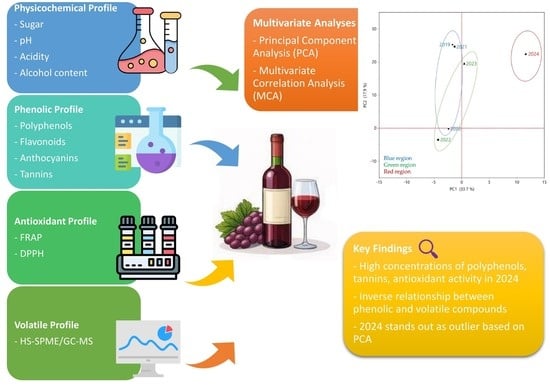
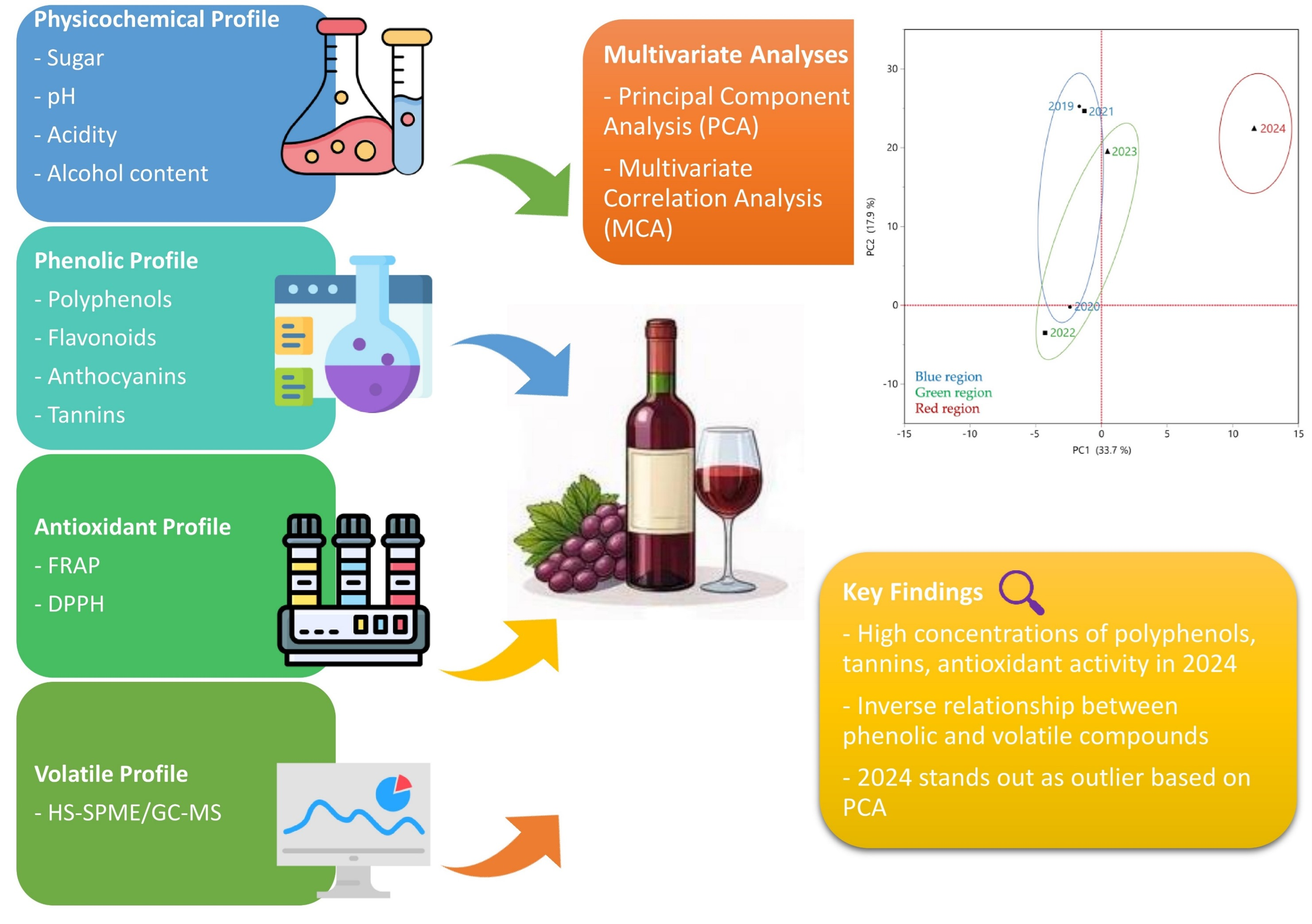
Graphical Abstract

1. Introduction

Viticulture constitutes a vital sector within the agri-food economy for numerous nations worldwide, with a substantial diversity of Vitis vinifera cultivars presently employed in the production of an extensive array of wines [1]. Even while vinification methods have a significant impact on wine characteristics, the selection of grape variety is equally crucial in winemaking as it determines the style and quality of the final product [2].
Alcohol concentration, sugar content, pH, acidity, and the composition of volatile and non-volatile molecules are among the numerous physicochemical characteristics that collectively influence wine quality [3]. The potential sensory implications, stability, and maturation potential of a wine are all influenced by these and other factors, which consequently impact its marketability [4,5]. Given the complexity of wine as a beverage, consumer preference heavily relies on the taste, flavor, and color of wines, which are attributed to intrinsic grape characteristics and winemaking procedures [6,7].
Grapes contain several bioactive chemical compounds that have severe antioxidant capacities. These compounds, especially those included in polyphenol group, have been associated with numerous health benefits. Cardiovascular protection, anti-inflammatory, and potentially anti-cancer activities are some examples [8]. The evolution of both volatile and non-volatile molecules could be affected by several parameters. It was highlighted that the location of grapes within the vineyard and the aging procedure contribute significantly to the organoleptic qualities of red wines [9]. The latter process is predominantly conducted in oak barrels and could last from six months to two years [10]. It has a significant impact on the final product, including its texture, color, flavor, and polyphenol profile [11].
Organoleptic qualities and chemical composition undergo several transformations as a result of chemical reactions observed throughout aging [12]. Condensation and oxidation of anthocyanins and tannins, along with the transfer of molecules from wood to wine are the dominant chemical processes that occur during wine aging [13]. Consequently, the rich flavor and taste of wines are the result of all these molecules interacting with the fragrant terpenoids and polyphenols that are already present in the wine [14]. The presence and interaction of all the volatile and non-volatile molecules present at the end of the aging process clarify the aromatic profile of each wine [15].
A native Cypriot red wine grape cultivar called Maratheftiko has been a subject in several previous studies. Viticulture-driven studies involving different irrigation regimes [16] and alternative growing media under the same fertigation scheme [17] had been recently conducted. Studies on the impact of prefermentation techniques [18], changes in bioactive molecules during the ripening stage [19] and barrel-aged Maratheftiko wines [20] have also been conducted. This study aimed to conduct a comprehensive analysis of this Cypriot monovarietal cultivar wine from 2019 to 2024. This study covers a broad approach across multiple vintages and addresses the gap in research concerning the volatile and non-volatile compounds of Maratheftiko wine over time (using also correlation analyses), despite prior studies focusing on specific cultivars. The findings may offer valuable real-world insights into the composition of bioactive compounds and the distinctive aroma of Maratheftiko wines.

2. Materials and Methods

2.1. Chemicals and Solvents

Acetonitrile was purchased from Labkem (Barcelona, Spain). Aluminum chloride, iron (III) chloride, sodium chloride, hydrochloric acid, L-ascorbic acid, 2-octanol, 2,4,6-tris(2-pyridyl)-s-triazine (TPTZ), 2,2-diphenyl-1-picrylhydrazyl (DPPH), methanol, and all chemicals of HPLC purity for the quantification of individual polyphenols were purchased from Sigma-Aldrich (Darmstadt, Germany). Anhydrous sodium carbonate and formic acid (98%) were purchased from Penta (Prague, Czech Republic). Folin–Ciocalteu reagent, ethanol, and gallic acid were from Panreac Co. (Barcelona, Spain).

2.2. Maratheftiko Wine Samples

2.2.1. Viticulture Details

Maratheftiko is the only grape variety grown in this 0.51-hectare vineyard located in Limassol, Cyprus. The vineyard was cultivated in 1950 and is located in the Omodos area of Limassol District (32.49° E, 34°50 N) at an altitude of 795 m. Details about the climatic data, as provided by the Cyprus Department of Meteorology, are given in Table 1. We conducted identical vineyard management across years regarding irrigation regime, as the vineyard was non-irrigated. We collected grapes randomly from plants at different locations in the vineyard, in different clusters and in varied positions within the clusters (sun-exposed and shaded) to obtain the most representative sample possible. The vineyard underwent consistent pruning, training, and leaf-removal practices to improve harvest yield, which was measured approximately at 1500–1550 kg/hectare (600–620 kg/acre). It should be addressed as a limitation that a relatively low wine yield was observed (<1 ton/acre). This consistently low yield reflects the combined effect of the vineyard’s challenging conditions, including high altitude (795 m) with intense UV exposure, pronounced diurnal temperature variation, and dry-farming practices. These factors are known to reduce berry size and cluster weight while increasing phenolic concentration and aromatic intensity, as reported [21,22,23]. The vines are also trained in a goblet-style system under dry-farming conditions, which further contributes to reduced yield but enhances berry concentration. The persistently low productivity over multiple years has prompted ongoing efforts to evaluate irrigation strategies, given the limited economic viability of the current cultivation system. Table 2 displays the canopy management and harvest dates, along with grape maturity parameters of each vintage.
The yield was calculated as the total harvested grape mass (kg) divided by the vineyard area (ha), based on full-plot harvest records. No unit conversion or sampling bias was involved. This extremely low productivity reflects the unique, site-specific conditions of this vineyard and should not be generalized as representative of Maratheftiko as a cultivar. Accordingly, the compositional results reflect both the intrinsic characteristics of the variety and the influence of this particular high-altitude, dry-farmed vineyard system.

2.2.2. Vinification Procedure

The vinification process began with the hand-harvest of each corresponding year and lasted for two weeks for all vintages. The destemming procedure was conducted without crushing. Cold soak skin contact was performed in 2-ton stainless steel containers for 72 h at 10–12 °C. The total time of the cold maceration process was 10 d, wherein cap management practices involved punch downs every 8 h for 10 min and pump overs every 2 h for 10 min for the first 2 d. Then punch downs were employed with the same frequency and duration until the 10th day, while pump overs were conducted every 4 h for 10 min.
The evolution of the fermentation process was conducted under controlled, gradually increasing temperatures and was constantly supervised by means of daily density measurements. Surveillance of the fermentation kinetics was accomplished through routine measurements (density, sugar consumption and temperature). Commercial winemaking yeast strain (Vitilevure® SYRAH Yseo Saccharomyces cerevisiae) from Martin Vialatte (Magenta, France) was employed in the fermentation process, selected for its well-established ability to convey the desired sensory characteristics to the final product. Direct yeast inoculation was performed on the third day of cryo-maceration, after the tank reached 14 °C. The initial temperature was 12 °C and reached 25 °C at the end of fermentation after 18 d. Regarding yeast assimilable nitrogen (YAN), the initial content of the must ranged from 68 to 73 mg N/L across vintages. YAN was quantified using the NOPA + ammonia enzymatic method in triplicate, and the must was subsequently supplemented with Actiferm 1 (200 g/ton), provided by Martin Vialatte (Magenta, France), to ensure adequate nitrogen availability for fermentation. The same quantity from Actiferm 2 was subsequently added after a 30-unit decrease in density.
Sodium metabisulfite (60 g/ton of wine) was used as an antimicrobial agent to preserve wine stability. Details about free and total sulphur dioxide (SO2) are given in Table 3. Furthermore, the vinification procedure was improved through the integration of pectinolytic enzymes derived from Aspergillus niger. LAFASE™ HE GRAND CRU purified enzymes were provided by Laffort (Bordeaux, France) since we focused on the production of full-bodied, aged red wines. The enzymatic breakdown of pectin compounds enhanced the optical clarity of the fluid, improved the overall stability of the wine, and promoted pigment extraction.
Malolactic fermentation was spontaneous and incomplete in all vintages, as confirmed by the quantification of residual malic acid (vide infra). In addition, the aging process (12 months) was performed for all vintages using 225 L French oak barrels. For all vintages, the wine was aged in oak barrels under the following conditions: new barrels were used to store 20% of the wine, 30% of the wine was stored in barrels that had been used for one year, and the remaining 50% was stored in barrels that had been used for two years. This procedure was selected due to the substantial influence of barrel utilization on wine aging. After the process was completed, the wines were blended to produce an even end product [24]. It should be noted that the barrels were thoroughly rinsed with water after each aging cycle.

2.2.3. Maratheftiko Wines

The study used red wine from monovarietal Maratheftiko grapes sourced from Limassol, Cyprus. All wines were bottled using a 49 mm × 24 mm natural cork and were stored at 14 °C and 70% humidity. All vintages were analyzed in November 2025, immediately after opening. For each vintage, vinification began immediately after harvest and lasted approximately two weeks, followed by 12 months of aging in French oak barrels. Thus, the 2024 vintage, harvested in late September 2024, completed its full barrel-aging period in October 2025 and was bottled in November 2025. Accordingly, all wines were evaluated at the same enological stage (post-fermentation, post-MLF, post-barrel aging), differing only in bottle-residence time: vintages 2019–2023 had 5 to 1 years of bottle storage, respectively, whereas the 2024 vintage had one month of bottle storage. The technological attributes of the wines were determined using conventional enological analyses in accordance with the International Organization of Vine and Wine (OIV) procedures [25], and the same analytical workflow was applied to all six vintages.

2.3. Instruments and Software

A magnetic stirrer set at a constant speed of 250 rpm from Heidolph Instruments GmbH & Co. KG (Schwabach, Germany) was used for the recovery of volatile compounds. All spectrophotometric analyses were performed using a double-beam Shimadzu UV-1900i PharmaSpec Spectrophotometer (Kyoto, Japan). Individual polyphenols were analyzed through High-Performance Liquid Chromatography (HPLC) equipment from Shimadzu Europa GmbH (Duisburg, Germany). Specifically, the CBM-20A compartment was connected to an SPD-M20A diode array detector (DAD). The separation of the identified compounds was performed on a Luna C18(2) chromatographic column (100 Å, 5 μm, 4.6 mm × 250 mm) from Phenomenex Inc. (Torrance, CA, USA).
The Headspace-Solid Phase Microextraction (HS-SPME) procedure was conducted using a fiber coated with divinylbenzene/carboxene/polydimethylsiloxane from Supelco (Bellefonte, PA, USA). Gas chromatography–mass spectrometry (GC-MS) equipment was used for volatile compounds analysis. Specifically, a 7890A gas chromatograph was linked to a 5975C mass selective detector (MSD) with an employed capillary column model J&W DB-1 (30 m × 320 μm × 0.25 μm); they were all purchased from Agilent Technologies (Santa Clara, CA, USA). The identification of each compound was done through MSD Chemstation software (ver. E.02.00.493); the obtained peaks were compared with the electron impact mass spectrum libraries, namely W8N08 (John Wiley & Sons, Inc., Hoboken, NJ, USA) and NIST11 (NIST, Gaithersburg, MD, USA). A minimum spectral-match similarity index of ≥80% was used to evaluate the match quality of identified compounds. Regarding color coordinates measurement of each wine sample, a Lovibond CAM-System 500 colorimeter from The Tintometer Ltd. (Amesbury, UK) was employed.
Statistical processing of the obtained results required the use of IBM SPSS Statistics (Version 29.0) statistical software from SPSS Inc. (Chicago, IL, USA) and JMP® Pro 16 software (SAS Institute, Cary, NC, USA). Geographic coordinates of vineyards were determined using Google Earth (version 9.185.0.0).

2.4. Bioactive Compounds Determination

2.4.1. Total Polyphenols

Wine total polyphenol content (TPC) was determined through a modified methodology of the renowned Folin–Ciocalteu (F-C) procedure [26], wherein polyphenolic compounds were oxidized by the yellowish F-C reagent, forming a stable blue-colored mixture. Properly diluted (100-fold) wine samples were mixed with the same volume of the F-C reagent (0.5 mL), and the redox reaction was left to progress for 2 min. After equilibration, an aqueous solution of sodium carbonate (5% w/v) filled the 5 mL volumetric flask, whereas the final mixture was incubated at 40 °C in a water bath. The absorbance at 740 nm was recorded after the 20 min incubation, and the TPC was calculated through a calibration curve (Table A1). The results were expressed as mg of gallic acid equivalents (GAE) per L of wine.

2.4.2. Total Flavonoids

Wine total flavonoid content (TFC) was determined using an established methodology [27] involving the formation of a yellow-colored complex through a chelation reaction. An accurate volume of properly diluted wine sample (0.5 mL) was mixed with 0.2 mL of the chelating agent mixture (0.5 M sodium acetate and 5% w/v aluminum chloride). The final volume of a 5 mL volumetric flask was filled with hydroethanolic solution (35% v/v), and the mixture was left to equilibrate in the absence of light. The absorbance at 415 nm was recorded after 30 min. A blank solution using the wine sample devoid of a chelating agent was also prepared to subtract the possible absorbance of polyphenols in this wavelength. The calculation of TFC was done through a calibration curve, as shown in Table A1, the results of which were expressed as mg rutin equivalents (RtE)/L wine.

2.4.3. Total Anthocyanins

Wine total anthocyanin content (TAC) was determined using an established procedure [28]. An exact volume of wine (0.335 mL) was combined with an ethanolic solution of hydrochloric acid (0.25 M) to fill a 5 mL volumetric flask. The absorbance at 520 nm was measured after 10 min of equilibration in the absence of light. The concentration of TAC (CTAC) was calculated using the Lambert–Beer law, and the results were expressed in cyanidin-3-O-glucoside equivalents (CyE) per L of wine. The equation involved the absorbance (A), dilution factor (FD) of the wine sample, and data of cyanidin-3-O-glucoside, such as molecular weight (MW) and molecular absorption (E), which were 449.2 and 26,900, respectively.
C TAC   ( mg   CyE / L ) =   A   ×   MW   ×   F D E   × 10 3

2.4.4. Total Tannins

Wine total tannin content (TTC) was determined by the vanillin assay, as previously discussed by Sun et al. [29]. This procedure includes the reaction of condensed tannins with vanillin to generate a stable red-colored mixture. A volume of 10-fold diluted wine samples (0.2 mL) was mixed with a mixture containing the same volumes of mixture A (1% methanolic vanillin solution) and mixture B (25% methanolic sulfuric acid solution) to fill a 5 mL volumetric flask. The absorbance at 500 nm was recorded after 15 min incubation of the mixture at 30 °C, and the results were expressed as mg of catechin equivalents (CtE) per L of wine using a calibration curve (Table A1).

2.4.5. Individual Polyphenol Quantification

Further evaluation of individual polyphenolic compounds was determined through liquid chromatography, as previously established [20]. The compound separation was feasible in a separation column at a stable temperature (40 °C). The mobile phase consisted of two solutions: 0.5% w/v formic acid in water (mixture A) and 0.5% w/v formic acid in acetonitrile (mixture B). The gradient program was as follows: 0–40% B for 10 min, then an increase to 50% B for 10 min, and 70% B for 10 min. The final mixture composition was kept constant at 70% for 10 min. The individual polyphenols were identified through comparison of retention times with chemical standards and quantified using calibration curves (0–50 mg/L), as shown in Table A2. The results were expressed in mg/L of wine. Anthocyanin quantification was performed using cyanidin-3-glucoside chloride, and the results were given as cyanin equivalents. trans-Caftaric acid was measured as caffeic acid. Derivatives of p-coumaric acid and ferulic acid were determined as p-coumaric acid and ferulic acid, respectively.

2.5. Antioxidant Capacity Assays

2.5.1. Electron Transfer Activity

The ion-reducing capacity of the wine sample was examined through a ferric-reducing antioxidant power (FRAP) assay, as discussed elsewhere [27]. The principle of this method lies in the reduction of ferric (III)-TPTZ complex to a stable ferric (II)-TPTZ after electron transfer of antioxidant molecules in acidic conditions. This complex had a peak wavelength of 620 nm. To this end, a volume of 0.5 mL of properly diluted wine sample was mixed with the same volume of iron (III) chloride solution (in 0.05 M HCl) in a 5 mL volumetric flask. The mixture was equilibrated at 37 °C using a water bath, and the volume was filled with TPTZ ligand (1 mM dissolved in 0.05 M HCl) after 30 min. The ion-reducing capacity of wine samples was calculated using a calibration curve and the results were expressed as mmol of ascorbic acid equivalents (AAE) per L of wine, as shown in Table A1.

2.5.2. Radical Scavenging Activity

The DPPH assay was used to determine the antioxidant activity of the wine samples, which is a measure of their radical-scavenging capabilities [27]. The reduction of the purple DPPH solution is the principle of this assay. As antioxidant molecules donate hydrogen atoms to stabilize the radical, the solution decolorizes. Briefly, a 5 mL volumetric flask was used to combine 0.125 mL of each diluted sample with a methanolic DPPH solution. After the reaction equilibrated for 30 min in darkness, the spectrophotometric measurement of the decrease in absorbance at 515 nm was recorded. The antiradical activity was measured using a calibration curve for ascorbic acid and represented as mmol of AAE per L of wine, as shown in Table A1.

2.6. Volatile Compounds (VCs) Determination by HS-SPME/GC-MS

Determination of VCs was conducted using a previously established methodology [26] involving the HS-SPME procedure. Initially, the fiber was instructed by the manufacturer to be conditioned for 30 min at 270 °C. The HS-SPME extraction involved the insertion of 10 mL of wine into a 25 mL glass vial, 3 g of sodium chloride, and 2 mg/L of 2-octanol (internal standard). The vial was air-tightly closed with a polytetrafluoroethylene/silicone septum. The fiber was positioned in the headspace of the vial without touching the wine’s surface. The vial was left to equilibrate for 10 min, and the microextraction process progressed for 40 min at 40 °C in an oil bath. Upon completion of the microextraction process, the SPME fiber was inserted into a GC-MS injector.
The GC-MS analysis was carried out utilizing an adapted method that has been previously documented [26]. The injector was set in splitless mode at 240 °C. Helium was the carrier gas, with a constant flow rate of 1.5 mL/min. After 5 min at 40 °C, the column was gradually heated to 140 °C, with a rate of 2 °C/min. The last step was to heat it to 240 °C for 10 min, incrementing by 10 °C each min, and the whole program was 75 min. Specifications of the MSD included m/z range of 29–350, source temperature of 230 °C, quadrupole temperature of 150 °C, and electron impact acquisition mode of 69.9 eV. For the GC peak regions without correction factors, the sample composition was determined using the normalization procedure. Results were expressed as milligrams of 2-octanol equivalents per liter of wine, with VCs being determined using the average values from multiple GC-MS studies. A minimum spectral match similarity index of ≥80% was used for compound identification, which is a commonly accepted threshold in wine-volatile research. Compounds below this threshold were not reported to ensure analytical reliability. Volatile compounds in this study were quantified as mg 2-octanol equivalents per liter, reflecting semi-quantitative HS-SPME/GC-MS responses based on an internal standard. Because different analytical protocols in the literature use non-equivalent units (e.g., external calibration in μg/L), comparisons with previous studies were made on the basis of relative abundance patterns rather than absolute concentrations. This approach avoids unit-conversion artifacts and ensures methodologically consistent interpretation.

2.7. Color Analysis

The CIE 1976 L* a* b* coordinates (L*, a*, and b*) were measured in order to determine the color of Maratheftiko wine samples, following a previously described procedure [26]. The L* value indicates the brightness of a color and ranges from 0 (black) to 100 (white). The a* value describes greenness (negative values) or redness (positive values) of samples. Colors can also be quantified by their b* values, which show the yellowness (positive values) or blueness (negative values). The representation of hue, saturation, or lightness of each color was done with the Cab or C* parameter. The following formulae were used to measure the psychological coordinate chroma ( C a b ) and hue angle ( h a b o ):
C a b = ( a ) 2 + ( b ) 2
h a b o = arctan b a

2.8. Statistical Processing

The results of each assay are expressed as mean ± standard deviation (SD) of three independent technical replicates. Statistical significance among vintages was assessed using one-way ANOVA followed by Tukey’s HSD post hoc test (p < 0.05). Normality and homogeneity of variance were verified prior to analysis. Multivariate analyses, including principal component analysis (PCA) and Multivariate Correlation Analysis (MCA), were performed using JMP® Pro 16 software (SAS Institute, Cary, NC, USA) to visualize relationships among physicochemical, phenolic, antioxidant, chromatic, and volatile parameters. Sensory data were descriptive only and not subjected to statistical testing. All replicates were technical replicates derived from the same bottle for each vintage. The modest standard deviations observed in parameters such as alcohol, pH, and titratable acidity reflect instrumental sensitivity and the inherent heterogeneity of complex wine matrices rather than biological variability. No bottle-level or sample-level replication was involved.

3. Results and Discussion

3.1. Physicochemical Profile

The physicochemical characteristics of Maratheftiko wines changed with each vintage, as illustrated in Table 4. With no significant variations (p > 0.05), the alcohol concentration remained high (13–15% v/v) in all years, reflecting the stable fermentation output and sugar levels in the grapes. This result revealed that late sugar ripeness reached high levels. This wine exhibited excellent microbiological stability, as its volatile acidity remained consistently low (0.51–0.58 g acetic acid/L) across all vintages. A gradual decrease in total acidity was observed across vintages, partly associated with spontaneous but incomplete malolactic fermentation, as confirmed by the presence of residual malic acid. The malolactic fermentation started spontaneously and was assisted with a constant temperature at 20 °C; however, it was not targeted or completed in any vintage. Regarding the low pH value (2.77–3.19), several factors could be related to this pattern. To start with, tartaric acid is the main acid that contributes to wine acidity given that it has lower pKa values compared to malic acid. In addition, the low precipitation in the vineyard along with the low metabolic rate and high stability of tartaric acid could also be key to this finding. It has been previously documented [30,31,32] that increased temperature and prolonged water deficit have been shown to induce small grape berry size, which includes higher tartaric acid content and, consequently, lower pH values. In addition, high temperature swings (warm days and cool nights) have also been shown to provide low-pH wines. The end product is also characterized by potent antimicrobial stability. A future study could be conducted involving these parameters to provide a clearer picture of the climatological impact, from the vineyard to the final product.
Overall, the data revealed consistency with previous studies [33,34,35]. For instance, Copper et al. [36] also examined physicochemical characteristics of Maratheftiko red wine aged in French oak barrels. The authors investigated two wine samples: a 2015 vintage and one from a 2013 vintage. They measured pH levels (3.43–3.62), TA (5.45–5.88 mg/L), and alcohol level (13.2–14.8%), where distinctive differences could be observed mainly in pH levels. A previous study by Roufas et al. [18] involving Maratheftiko red wine also reported unusually low pH values (even below 2.80), supporting the acidity patterns observed in the present work. These patterns are consistent with vineyard-specific climatic and viticultural conditions. At the same time, both the alcohol concentration and the volatile acidity stayed the same. These unusually low pH values were analytically verified through triplicate technical measurements using a calibrated pH meter, ensuring measurement reliability. Similar pH ranges have been reported for Maratheftiko wines produced under high-altitude, water-limited conditions [18], confirming that this cultivar can exhibit exceptionally high tartaric acid retention and limited potassium precipitation. The combination of strong diurnal temperature variation, dry-farming, and reduced potassium availability likely contributed to the pronounced acidity observed in our samples. The key differences between vintages are acidity and malic acid, with 2024 featuring the most acidic and malic-rich fruit. These results highlight a clear vintage effect on the physicochemical composition of Maratheftiko, which may influence perceived freshness and aging potential.

3.2. Phenolic and Antioxidant Profile

The antioxidant capacity and phenolic profile of Maratheftiko wines showed significant variation according to the vintage (Table 5). In the 2021 vintage, the total polyphenols were 2599 mg GAE/L, and in the 2024, they increased to 3878 mg GAE/L, a statistically significant increase that showcased the extraordinary richness of the specific vintage. The same pattern was observed for tannins, which increased from 300 mg CtE/L in 2021 to over 690 mg CtE/L in the 2024, indicating greater structural complexity and enhanced aging potential. Flavonoids and pigments also increased markedly in the 2024 vintage (506.9 mg RtE/L and 413.74 mg CyE/L, respectively), compared to much lower levels in earlier vintages (e.g., 279.58 mg RtE/L and 122.6 mg CyE/L in 2021). This indicates a strong contribution of anthocyanins and flavonoids to the distinctive color and bioactivity of the 2024 wine.
For comparability with previous studies, total anthocyanins were expressed in cyanidin-3-O-glucoside equivalents (CyE). It should be noted, however, that malvidin 3-O-glucoside is the dominant anthocyanin in Maratheftiko wines [20]. Consequently, values expressed in malvidin equivalents (MvE) would be approximately 10% higher than those in CyE, but this adjustment does not substantially affect the interpretation of the results. This is consistent with the findings of Sommer and Cohen [37], who reported similar ranges in French and French-American red wines. The authors expressed the results as malvidin-3-glucoside equivalents, which was the major anthocyanin in these wines, which ranged from 0.19 to 1.61 g/L; a figure that aligned with our results. Our results are consistent to other Maratheftiko wines, as per the study of Galanakis et al. [38]. The authors examined several Cypriot wines bioactive compounds and revealed that Maratheftiko cultivars total anthocyanins ranged from 75 to 559 mg cyanidin chloride/L of wine.
Antioxidant assays (FRAP and DPPH) mirrored these trends; FRAP values rose from 31.9 mmol AAE/L (2021) to 44.6 mmol AAE/L (2024), while DPPH increased from 21.2 mmol AAE/L (2021) to 29.9 mmol AAE/L (2024). These results confirm that the antioxidant potential is tightly linked to the phenolic concentration, with 2024 again standing out as the most potent vintage. Concerning the previous study from Ofoedu et al. [33], the authors quantified lower yields in TPC when examining foreign red wines (French and Spanish), along with domestic red wines from Nigeria (i.e., cultivars Aba and Owerri). Specifically, TPC ranged from 216.73 to 412.75 mg GAE/L wine, whereas the antioxidant capacity assay followed a similar trend wherein FRAP ranged from 2.38 to 4.92 mmol AAE/L wine. Such differences in TPC and antioxidant capacity could be a matter of different cultivars.
While the data indicated slight heterogeneity in the intermediate vintages (2019–2023), the outlier in terms of phenolic content, pigment concentration, and antioxidant activity was the 2024 vintage. This suggests a strong vintage effect, potentially influenced by grape ripeness and environmental conditions, although climatic data were not available for confirmation. Polyphenolic content is also affected by water deficit, as it up-regulates genes for the biosynthesis of secondary polyphenolic compounds (i.e., anthocyanins and tannins), thus also enhancing sensory qualities (color) and polyphenolic profile [39,40,41]. Ultimately, the climatological conditions lead to smaller grape berries with higher acidity values, lower yield, whereas the final product is characterized by deep, intense color due to the high content of secondary polyphenolic compounds.

3.3. Chromatic Parameters

Significant variations depending on the vintage are shown in Table 6, which displays the chromatic profile of Maratheftiko wines. These differences arise due to aging, during which polymerization and copigmentation phenomena occur, leading to gradual changes in color intensity and hue. The darkest wine was observed in the 2024 vintage, with a lightness (L*) ranging from 33.7 to 40.5 in the 2021. In vintages from 2019 to 2023, redness (a*) was generally high (19–24), but it significantly decreased in the 2024 wine (5.6), reflecting a shift toward a bluish-purple hue rather than a loss of color intensity. Similarly, the b* values (yellow/blue axis) were negative in the 2024 vintage (−2.5), indicating a trend toward bluish tones, after being positive in earlier vintages (2–6).
A less vibrant and duller hue was confirmed in the 2024 vintage by a precipitous drop to 6.4 for chroma (C*), which indicated color saturation, which remained constant and high (19–24) from the 2019 to 2023 wines. The change was further illustrated by color alone; red-purple wines from prior vintages typically had a value between 5 and 14°, but the 2024 had a value of 336°, which corresponds to a bluish-purple hue. To support this evidence and provide a clearer picture of wine color, HEX codes were incorporated alongside chromatic data.
In summary, the data revealed that vintages 2019–2023 had a consistent reddish-purple color identity, whereas the 2024 vintage had a darker, less saturated, and bluish-purple hue. This remarkable shift aligns with the exceptionally high pigment concentrations reported in Table 5, particularly the dominance of malvidin derivatives. In the prior study from Ofoedu et al. [33], the four analyzed wines widely ranged in L* (39.12–52.02), a* (22.37–54.23), b* (19.76–27.20), C* (29.85–67.01), and Hue (27.68–41.46°).

3.4. Analysis of Non-Pigment and Pigment Polyphenols

Analysis of non-pigment and pigment polyphenols in Maratheftiko wines revealed significant vintage-dependent variation, highlighting the dynamic nature of the cultivar’s phenolic content [42]. The results of this analysis are shown in Table 7. There were significant variations across vintages in non-pigment molecules like quercetin derivatives, caftaric acid, and catechin. In the 2021 vintage, catechin levels reached their maximum level (42 mg/L), whereas caftaric acid and quercetin 3-O-glucuronide levels peaked in the 2024 vintage, indicating that the accumulation of these compounds was highly impacted by both vineyard conditions and winemaking procedures. Both rutin and hyperoside exhibited considerable variation, with the 2024 once again proving to be the most abundant vintage. Various components, including flavonols and hydroxycinnamic acids, contribute to the antioxidant capacity and structural complexity of the wines. The total discovered non-pigments varied from 135 mg/L in the 2023 to 283 mg/L in the 2021.
Earlier vintages (2019–2020) had negligible quantities of pigment components (anthocyanins), while in later vintages (2021–2023), small increases were observed. The 2024 vintage, however, exhibited exceptionally high anthocyanin concentrations, especially malvidin 3-O-glucoside (21.6 mg/L) and its acylated derivatives, with lower amounts of peonidin and petunidin also present. Thus, a total pigment content of 38 mg/L was achieved. The prominent bluish-purple hue seen in the chromatic analysis is explained by the large proportion of malvidin derivatives, which confirms that anthocyanin enrichment was the main cause of the noticeable change in color in the 2024. The 2024 vintage stands out with its outstanding phenolic richness, thanks to the highest total polyphenol content (293 mg/L) caused by the simultaneous increase in both pigments and non-pigments. The specific polyphenols were also identified elsewhere [43]. It should be noted that similar values were observed in catechin, rutin, and p-coumaric acid derivatives in the 2021 and 2022 vintages, as per the recent study of Roufas et al. [20]. In addition, Maratheftiko wine’s identified polyphenols were revealed to be consistent with the study of Tsiakkas et al. [44], who also identified several derivatives of malvidin, petunidin, and peonidin. However, the authors conducted a wine tasting session with expert panelists, a session that could be included in a future study.
The results showed that Maratheftiko wines were strongly affected by the vintage, with the 2021 showing significant levels of non-pigment polyphenols and the 2024 showing extraordinary amounts of pigment accumulation. In addition to determining the sensory qualities of Maratheftiko wine, such as color intensity and hue, the interaction between pigments and non-pigments determines their antioxidant capacity. These results also highlight the importance of multivariate approaches in capturing the complexity of vintage differentiation and provide valuable insights into the phenolic drivers of quality in Maratheftiko wines. This observed interplay between pigments and polyphenol concentration in red wines during aging was also highlighted in similar approaches [45,46]. The authors have underlined the significance of the aging process in oak barrels in up-regulating the chromatic and aromatic profile of wines, with a concurrent down-regulation of polyphenolic compounds, a trend similar to our findings. It has also been highlighted that these compounds can be degraded by oxidation while the wine is matured and already bottled [47,48]. Ultimately, it can be deduced that bottling storage time may affect the concentration of polyphenols; however, the climatic conditions of the vineyard could also affect this outcome. Such an examination could be conducted in a future study in order to provide a clearer picture of this pattern.
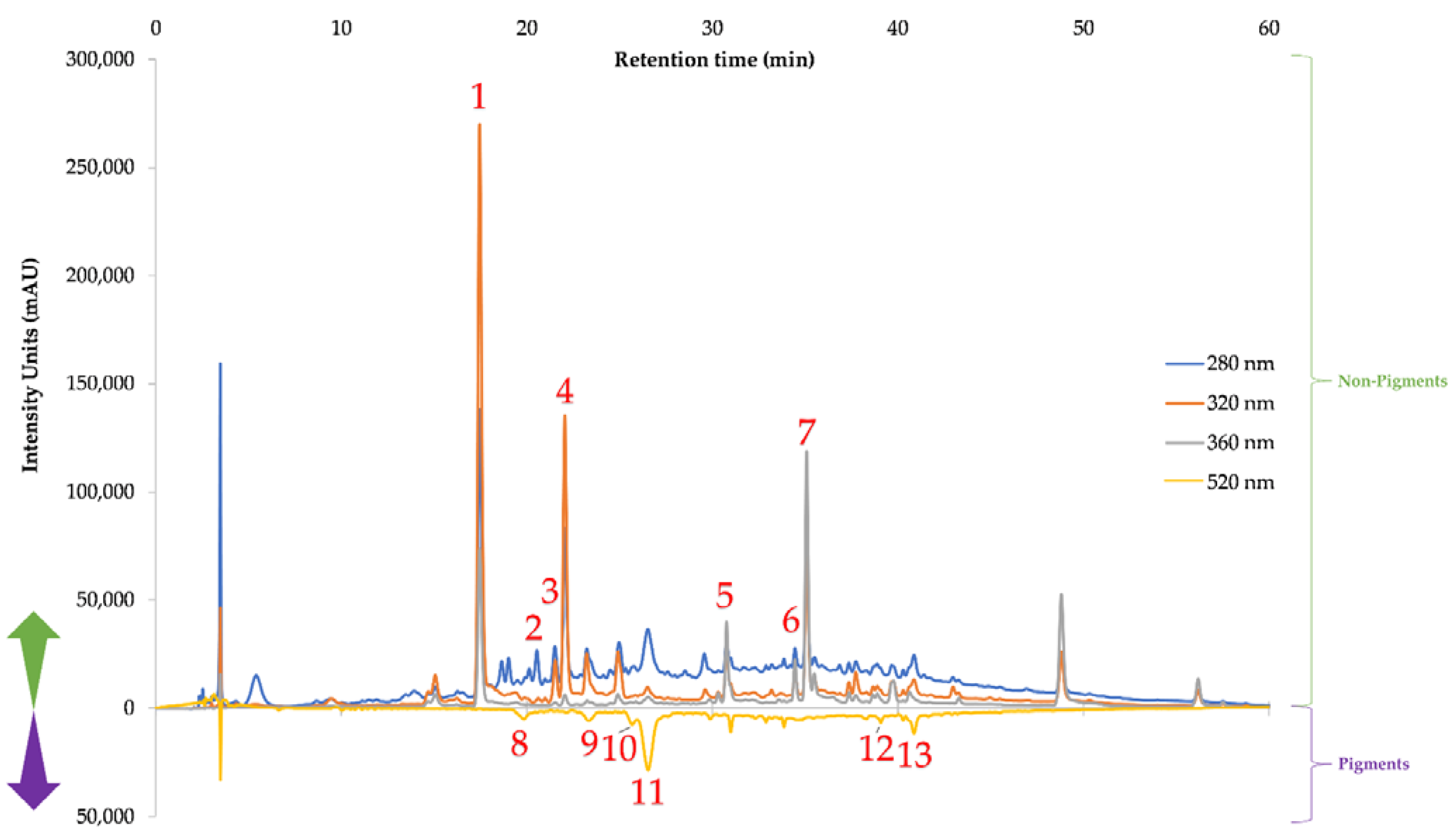
The chromatographic profile of Maratheftiko wine from 2024 (Figure 1) highlights the compound-specific intensity patterns across four detection wavelengths (280, 320, 360, and 520 nm). Signals at 280, 320, and 360 nm correspond to non-pigmented phenolic compounds such as flavonols and hydroxycinnamic acids, whereas the 520 nm trace captures anthocyanin pigments. The compounds listed in Table 4 correlate to the numbered peaks (1–13), which allows for the direct identification of both pigments and non-pigments.
Due to the significant increase in malvidin derivatives and other anthocyanins, the 2024 vintage showed abnormally high absorbance at 520 nm. The distinctive pigment content of this vintage was confirmed by this molecule, which also clarifies the bluish-purple hue seen in the chromatic analysis. The elevated levels of non-pigment molecules, such as caftaric acid and quercetin derivatives, further support the hypothesis that flavonols and anthocyanins both contribute to the phenolic richness of the wine.
The chromatographic profile showed that the 2024 vintage was chemically different, with stronger pigment signals and higher levels of non-pigment phenolics. The exceptional composition of the 2024 vintage was visually confirmed by this dual improvement, which places it as an outlier in terms of phenolic complexity and chromatic intensity.

3.5. Volatile Composition

Both metabolic routes during fermentation and potential climate influences on grape precursors were reflected in Maratheftiko wine VC, which showed considerable vintage-dependent variation, as shown in Table 8. Heavy, solvent-like notes were contributed by rather high quantities of fusel alcohols, such as isoamyl-alcohol (8–11 mg/L), in the early vintages (2019–2021). These molecules showed a significant decrease in the 2023 (4.2 mg/L) and were not present in the 2024 vintage, indicating a trend toward a less intense aromatic profile in recent vintages.
It is known that bottling storage time significantly affects the volatile composition of wines due to several reactions. Some compounds may increase over time; others may decrease [42]. There were also noticeable differences in the esters, which are responsible for the fruity scents. The quantities of dominant esters such ethyl hexanoate, ethyl octanoate, and ethyl caprate were highest in the 2019 and 2020 vintages, and they gradually dropped until they were almost nonexistent in the 2024 vintage. The decrease suggests less ester production, which could explain why subsequent vintages lacked fruitiness. These molecules, which have a major impact on the flavor and taste of red wines, have previously been highlighted [47,49,50].
On the other hand, when fruity essences were lost, floral complexity was enhanced by 2-phenylethanol, an alcohol that increased progressively until it peaked in the 2024 at 2.28 mg/L. The trend towards floral aromatic dominance, rather than fruity aromatic dominance, could be further supported by the late emergence of 2-phenylethyl acetate in the 2023–2024 vintage.
Additional differences were observed in acids and succinates. Diethyl succinate was found in all vintages; however, it was more concentrated in the 2020 and 2022 vintages. Octanoic acid, on the other hand, was much more stable. In the 2022 vintage, 3-methylbutyl ethyl succinate was found in high concentrations (1.95 mg/L), indicating that year was unique in ester formation.
Furthermore, the total VCs were 19.3 mg/L in the 2022 but decreased to 4.4 mg/L in the 2024 vintage. Although 2024 exhibited exceptionally high phenolic and pigment concentrations, its volatile abundance was markedly lower, resulting in a wine that was structurally intense and chromatically distinctive but showed a more restrained aromatic profile (Table 2 and Table 4). The reduced volatile content in the 2024 may be partly related to its shorter bottle-residence time, as bottle aging influences both the formation and degradation of aroma-active compounds; therefore, the 2024 wine may not have reached the equilibrium observed in older vintages. This pattern has also been noted in previous investigations [51,52]. A recent study by Copper et al. [53] examining Maratheftiko red wines from the 2013 and 2015 vintages reported comparable concentrations of key ethyl esters, including ethyl hexanoate (0.79–2.89 mg/L), ethyl octanoate (0.76–2.74 mg/L), and ethyl decanoate (0.07–0.46 mg/L), which aligns with the ester profile observed in our study. To further enhance comparability with other studies, future work should incorporate calibration with authentic chemical standards rather than relying solely on internal-standard quantification.
Volatile compounds in this study were quantified as mg 2-octanol equivalents per liter, reflecting semi-quantitative HS-SPME/GC-MS responses. Comparisons with previous studies were therefore based on relative abundance patterns rather than absolute concentrations, as different analytical protocols (e.g., external calibration vs. internal standardization) yield values in non-equivalent units.
Ultimately, these results revealed that Maratheftiko wines were significantly impacted by vintage in terms of VC composition, phenolic and chromatic characteristics. Among these vintages, the 2022 emerged as the most aromatically rich, whereas the 2024 was an outlier with minimal volatile content but very high phenolic richness; this highlighted the complex nature of vintage separation in this wine cultivar.

3.6. Multivariate Analyses

3.6.1. Principal Component Analysis (PCA)

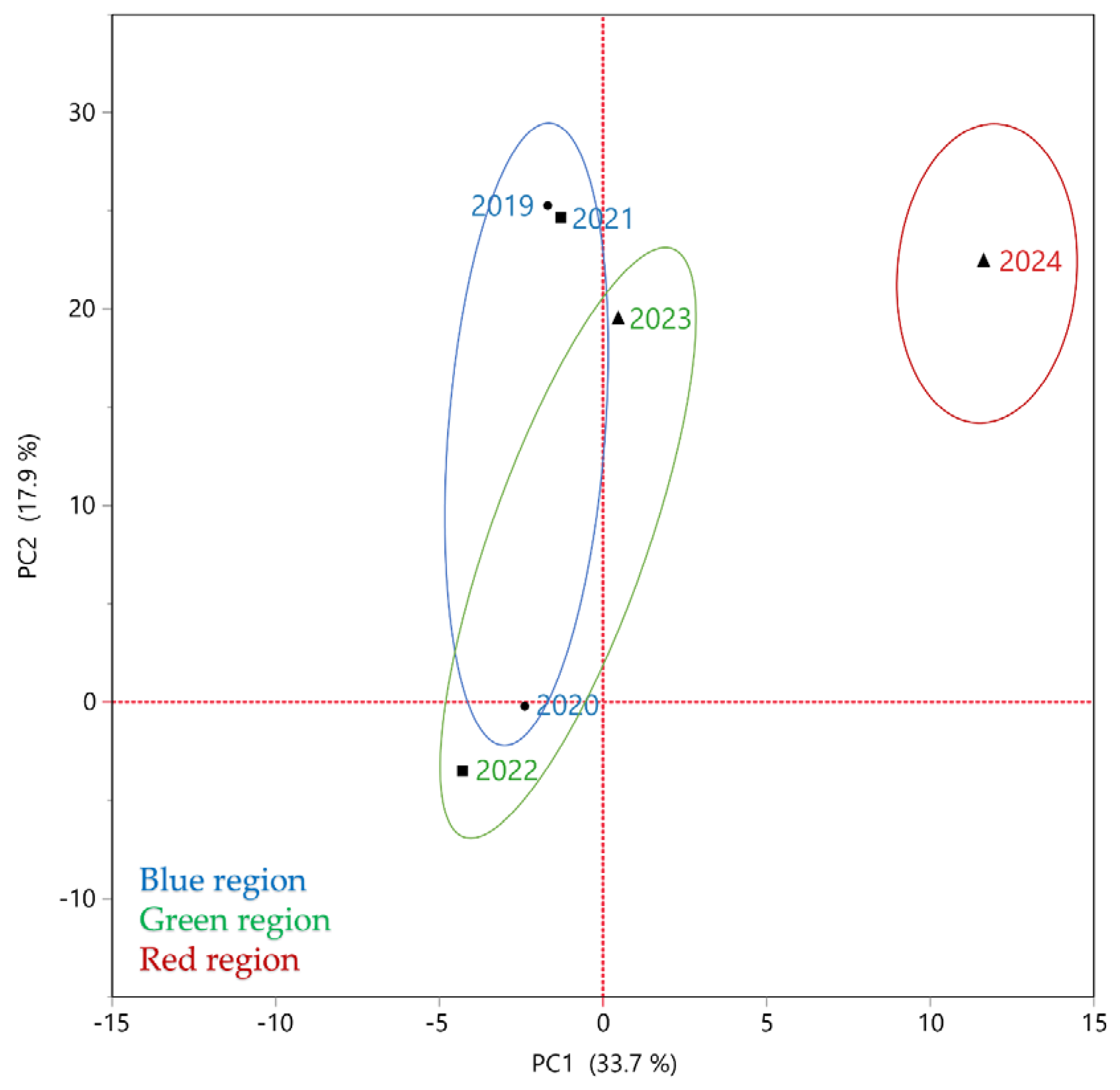
The six vintages of Maratheftiko wines (2019–2024) were analyzed using principal component analysis (PCA) to determine the multivariate interactions among various factors. Two of the principal components, PC1 and PC2, accounted for more than half of the dataset’s variability; PC1 explained 33.7% of the overall variance, while PC2 explained 17.9%. It should be noted that in multivariate wine-chemistry datasets that integrate physicochemical, phenolic, chromatic, antioxidant and volatile variables, it is common for the first two principal components to explain 40–60% of the total variance. This is due to the high dimensionality and heterogeneity of the dataset. Therefore, the 51.6% cumulative variance observed here is consistent with similar enological studies and still allows meaningful visualization of vintage-related clustering. In this context, PCA was used as an exploratory multivariate tool to visualize relationships among vintages and chemical variables, rather than as a predictive or classification model requiring a predefined variance threshold. The primary objective of the analysis was to identify dominant patterns and groupings in the dataset, not to maximize explained variance in the first two components.
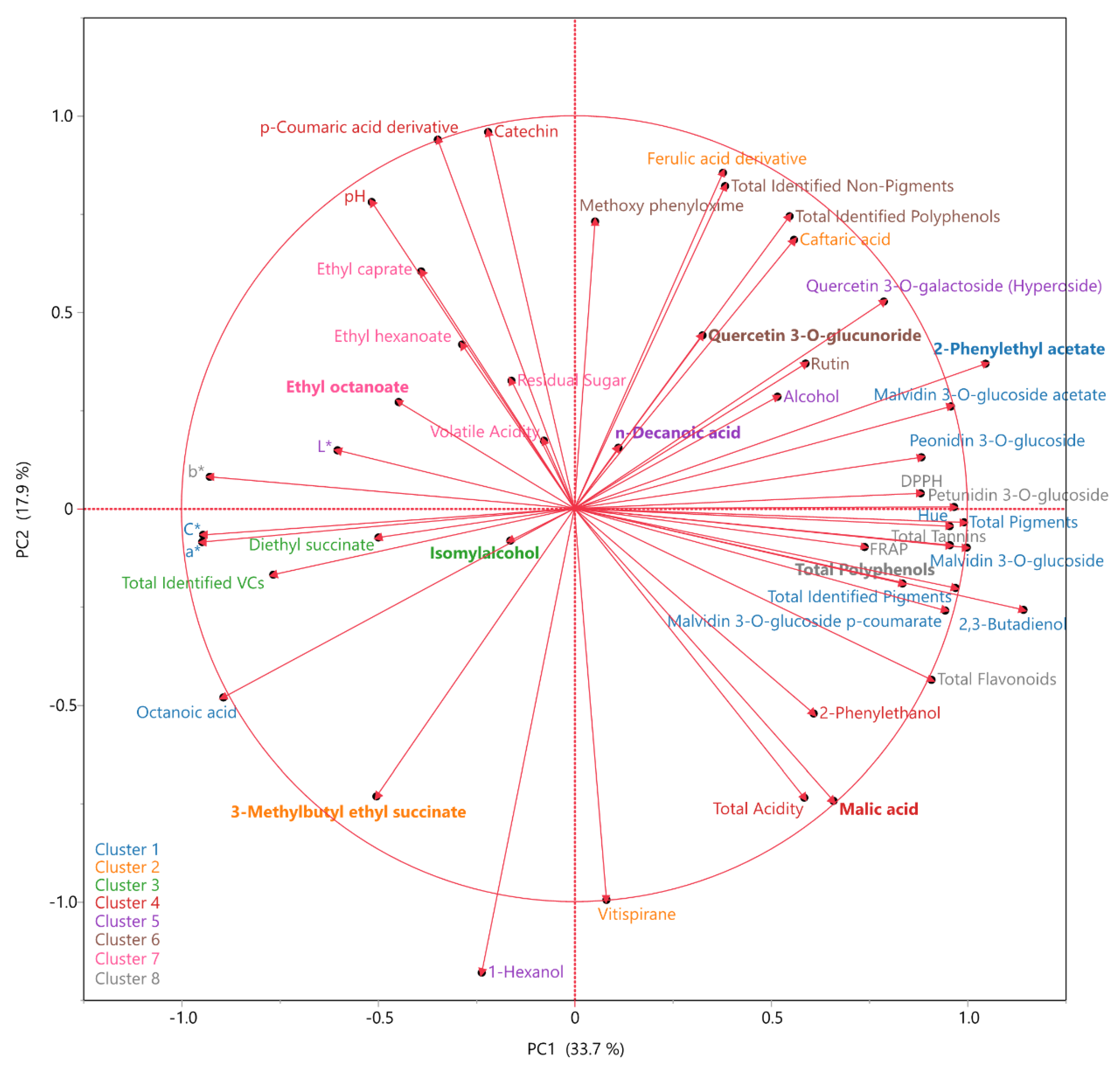
Physicochemical parameters (pH, alcohol, total and volatile acidity, residual sugar, malic acid), antioxidant activity (FRAP, DPPH), chromatic attributes (L*, a*, b*, C*, Hue), phenolic composition (total polyphenols, flavonoids, tannins, pigments, catechin, quercetin derivatives), and volatile/aromatic profile (fusel alcohols, esters, acids, aromatic compounds) were identified during the initial loading examination. PC1 was primarily influenced by phenolic and chromatic variables, while PC2 captured variation in volatile compounds and acidity. Pigment-related variables (e.g., malvidin 3-O-glucoside, peonidin 3-O-glucoside) and flavonoids loaded strongly on PC1, aligning with the unique profile of the 2024 vintage, whereas volatile esters and alcohols (e.g., ethyl hexanoate, 2-phenylethanol) contributed more to PC2, reflecting the aromatic richness of earlier vintages. Cyanidin 3-O-glucoside was not detected, which is consistent with the dominance of malvidin derivatives in Maratheftiko wines.
Climatic variation across vintages provides a mechanistic explanation for several of the multivariate patterns observed in the PCA. Increased temperature and prolonged water deficit are known to reduce berry size and enhance tartaric acid retention, resulting in lower pH values and higher total acidity—variables that contributed strongly to the positioning of the 2024 vintage along the acidity-related axis of PC2. Strong diurnal temperature variation (warm days and cool nights) further promotes acidity preservation and limits potassium precipitation, reinforcing the exceptionally low pH values observed. Heat and drought stress also up-regulate the biosynthesis of anthocyanins, tannins, and flavonols, which aligns with the high phenolic and chromatic loadings on PC1 and the distinct placement of the 2024 vintage. These climatic drivers therefore interact with the physicochemical, phenolic, and chromatic parameters captured in the PCA, shaping the multidimensional differentiation among vintages.
The multivariate structure indicates that phenolic, chromatic, and volatile parameters contribute jointly to vintage differentiation. Similar approaches that involve varietal classification have been conducted previously [54,55]. However, the comprehensive analysis of Maratheftiko wines across six vintages (2019–2024) revealed multidimensional differentiation driven by physicochemical, phenolic, chromatic, antioxidant, and volatile parameters.
In recent years, a gradual shift toward more acidic profiles in physicochemical features of wines has been observed, including total acidity and pH, whereas residual sugar and alcohol have been relatively constant, as per Table 1. An increase in antioxidant activity was observed in the 2024 vintage due to the highest quantities of total polyphenols, flavonoids, and pigments (Table 2). According to CIE 1976 L* a* b* parameters and HEX codes shown in Table 3, the 2024 vintage showed a bluish-purple hue and lower saturation, which was accompanied by a substantial shift in chromatic characteristics. A spike in phenolic content was also noticeable.
Table 4 illustrates how the antioxidant power and chromatic intensity of the 2024 vintage were explained by its unique combination of elevated flavonols (such as quercetin derivatives) and high anthocyanin content (such as peonidin and malvidin derivatives). Alternatively, volatile compounds, which play a significant role in wine scent, reached their highest point in the 2022 vintage and then dropped dramatically in the 2024 vintage, indicating that volatile and phenolic parameters evolved independently across vintages (Table 5).
By combining the two sets of data, principal component analysis (PCA) showed that chromatic and phenolic factors drove PC1, while volatile and acidity variables drove PC2. The PCA biplot (Figure 2) revealed three color-coded regions that represent visual grouping tendencies among the six vintages. These regions were not generated through any clustering algorithm but reflect natural proximities based on sample positioning along PC1 and PC2. Despite the moderate cumulative variance, the PCA effectively visualizes vintage-related differentiation, particularly highlighting 2024 as an outlier with elevated phenolic and antioxidant profiles.
The PCA plot provides meaningful insight into vintage-related compositional shifts, especially the separation of the 2024 vintage due to its distinct phenolic and antioxidant characteristics. The visual groupings observed reflect shared chemical tendencies rather than strict categorical boundaries.
Unlike Figure 2, which groups wine samples, Figure 3 presents clustering of variables (loadings), not vintages. Therefore, the number of clusters differs, as it reflects chemical domains rather than sample grouping. Figure 3 depicts the PCA biplot, which shows that there are 45 chemical, chromatic, phenolic, antioxidant, and volatile variables distributed among two main components (PC1: 33.7%, PC2: 17.9%). On purpose, ellipses were left out to maintain clarity; instead, different colors were employed to denote cluster membership. Considering the abundance of clusters, this decision enabled clear visual separation without masking vector orientation. The bolded variable within the biplot represents each cluster and was chosen using the highest within-cluster R2 and 1-RSquare Ratio.
The clustering model explained 90.1% of the total variation, with the first three clusters contributing the most (Cluster 1: 0.239, Cluster 2: 0.139, Cluster 3: 0.107). These clusters are anchored by 2-Phenylethyl acetate, total polyphenols, and Malic acid, respectively, and correspond to dominant chemical domains: volatile esters, phenolic richness, and acidity. Later clusters, such as those represented by Quercetin 3-O-glucuronide, n-Decanoic acid, and 3-Methylbutyl ethyl succinate, explain smaller proportions of variation but capture specific aspects of wine complexity, including flavonol-driven antioxidant activity, fatty acid contributions to mouthfeel, and fermentation-derived volatiles.

3.6.2. Multivariate Correlation Analysis (MCA)

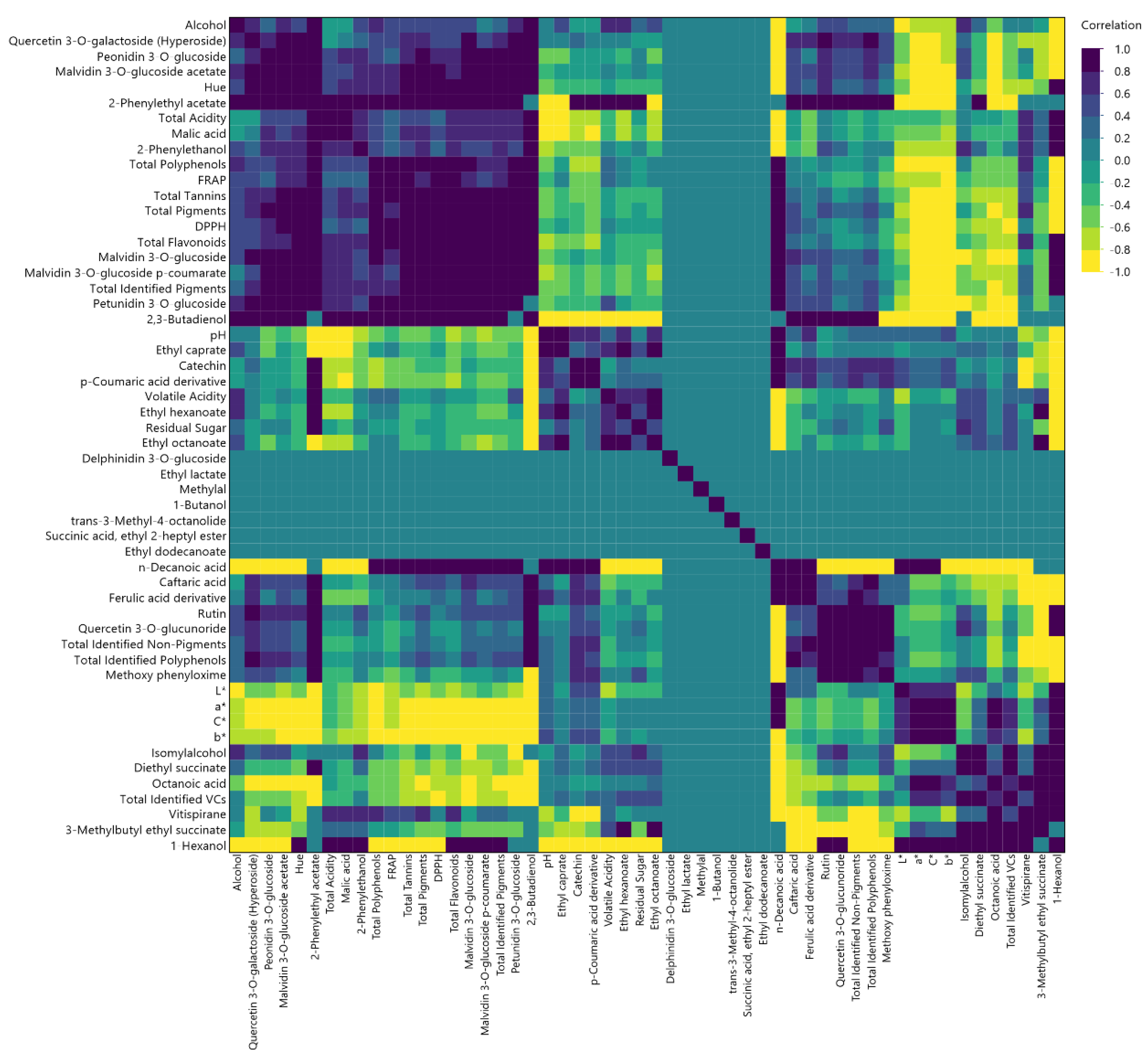
Figure 4 shows the MCA, which adds credibility to the PCA structure by showing that there are highly significant positive connections (correlation coefficients surpassing 0.90) among phenolic compounds. The fact that these variables show consistent vector directions and cluster closely in the biplot indicates that they all contributed to PC1. Similarly, a separate aromatic domain forms along PC2 for volatile compounds such as 2-phenylethanol, ethyl octanoate, and diethyl succinate, which exhibit moderate to significant correlations (r > 0.70). Results from the MCA matrix showed substantial correlations (r > 0.85) between acidic parameters (total acidity, Malic acid) and pigment and flavonoid vectors, further supporting the idea that these characteristics evolved together with phenolic intensity. It should be noted that pH showed low correlation with chromatic parameters.
The most important variable in summarizing the multivariate structure is 2-phenylethyl acetate, which is the most representative variable of Cluster 1. It displays perfect correlations (r = 1.000) with numerous volatiles and polyphenols. As a crucial integrative signature of wine identity, this molecule not only anchors the largest cluster (12 members), but also links the aromatic to antioxidant domains.
Correlation analysis revealed strong positive associations between total polyphenols and antioxidant capacity (FRAP: r = 0.88, DPPH: r = 0.84, p < 0.01). Conversely, volatile compound concentration was negatively correlated with polyphenols (r = −0.62, p < 0.05), indicating that volatile abundance and phenolic intensity followed different developmental trajectories across vintages rather than a direct suppressive relationship.
The PCA clustering framework was substantiated by MCA correlations, confirming that Maratheftiko wines exhibit unique molecular characteristics that evolve independently across vintages. This multidimensional approach enabled targeted interpretation of sensory qualities, clearer vintage distinction, and the identification of quality optimization strategies. By integrating phenolic, chromatic, and volatile markers, PCA and MCA provided a comprehensive understanding of wine composition and highlighted the distinctive profile of the 2024 vintage.

4. Limitations and Future Perspectives

This study provides a comprehensive multivariate characterization of Maratheftiko wines across six vintages. However, several limitations should be acknowledged. First, no sensory evaluation was performed, and future work should integrate trained panels to correlate chemical composition with sensory perception. Second, climatic data (temperature, rainfall, and sunlight hours) were not systematically recorded using our own climate station, limiting interpretation of vintage effects. These effects may impact the sensory qualities of wine and could be a subject of a future study; such environmental parameters may substantially influence grape composition and should be incorporated in future studies. Third, the exclusive use of French oak barrels introduces an additional enological variable, and future studies could involve the aging process in other types of barrels, given that oak barrels significantly affect the aromatic profile of wine. Fourth, some low molecular weight volatile compounds (e.g., 1-propanol, isobutanol, hexanoic acid, methionol, monoethyl succinate) may not have been detected due to co-elution with the large ethanol peak or matrix suppression inherent to HS-SPME/GC-MS. This analytical limitation is well-documented for early-eluting volatiles in high-ethanol matrices. Future studies should employ Programmed Temperature Vaporizing (PVT) injection or Cryogenic Oven Trapping to improve chromatographic resolution and enhance the detection of low-molecular-weight compounds. Fifth, wines differed in bottle-residence time (from 5 years to 1 month), which may influence volatile equilibrium, ester degradation, and phenolic polymerization. Although all vintages underwent identical vinification and 12-month barrel aging, differences in bottle age represent an important interpretative limitation. Nevertheless, this design provides a realistic snapshot of the chemical profile that consumers encounter, integrating both vintage effect and bottle-aging evolution. Finally, future research should also compare Maratheftiko with other Mediterranean cultivars (e.g., Yiannoudi, Agiorgitiko) to contextualize its unique phenolic and chromatic profile. These directions will strengthen understanding of how viticultural and enological factors shape the bioactivity, stability, and sensory identity of Cypriot wines.

5. Conclusions

This study investigated the effects of aging on a Cypriot monovarietal red wine (Maratheftiko) across six vintages (2019–2024). Physicochemical properties, volatile and non-volatile compounds, phenolic composition, antioxidant capacity, and chromatic parameters were comprehensively analyzed. Wines matured in French oak barrels exhibited clear vintage-linked differences, with older vintages showing more vibrant color and aromatic complexity, while newer vintages, particularly the 2024 vintage, displayed markedly higher polyphenol concentrations and antioxidant activity. These patterns may be partly related to differences in bottle-residence time and the progression of micro-oxygenation reactions during storage. Correlation analyses confirmed anthocyanins as critical contributors to both color development and aromatic profile. These findings highlight the importance of anthocyanin preservation and color stability in winemaking and storage management, as they directly influence wine quality and consumer perception.
The ultimate goal of our research was to examine changes in the bioactive compounds and the volatile compounds that contribute to aroma in real-world conditions, as they would be observed by consumers. The practical implications are significant since wineries can leverage chemical fingerprints to strengthen branding and marketing strategies for native grape varietals, meeting consumer demand for vintage-linked authenticity. While this study advances understanding of Maratheftiko’s aging trajectory, further research is needed to clarify unexplored mechanisms, including the impact of climatic variation, extended barrel maturation, and sensory validation, to optimize quality management and ensure consistency across vintages.

Author Contributions

Conceptualization, V.A. and S.I.L.; methodology, A.T., D.K. and V.A.; software, V.A.; validation, A.T., D.K. and V.A.; formal analysis, A.T., K.R. and V.A.; investigation, A.T. and V.A.; resources, A.T., K.R. and S.I.L.; data curation, A.T., D.K. and V.A.; writing—original draft preparation, V.A., M.M. and D.K.; writing—review and editing, A.T., V.A., M.M., D.K., K.R. and S.I.L.; visualization, V.A.; supervision, S.I.L.; project administration, S.I.L.; funding acquisition, S.I.L. All authors have read and agreed to the published version of the manuscript.

Funding

This research received no external funding.

Institutional Review Board Statement

Not applicable.

Informed Consent Statement

Not applicable.

Data Availability Statement

The original contributions presented in the study are included in the article. Further inquiries can be directed to the corresponding author.

Conflicts of Interest

The authors declare no conflicts of interest.

Abbreviations

The following abbreviations are used in this manuscript:
AAbsorbance
AAEAscorbic acid equivalents
CtECatechin equivalents
CyECyanidin 3-O-glucoside equivalents
DPPH2,2-Diphenyl-1-picrylhydrazyl
EMolecular absorption
F-CFolin–Ciocalteu
FDDilution factor
FRAPFerric-Reducing Antioxidant Power
GAEGallic acid equivalents
GC–MSGas Chromatography–Mass Spectrometry
HPLCHigh-Performance Liquid Chromatography
HS-SPMEHeadspace-Solid Phase Microextraction
m/zMass-to-charge ratio
MCAMultivariate Correlation Analysis
MSDMass selective detector
MvEMalvidin equivalents
MWMolecular weight
OIVInternational Organization of Vine and Wine
PCAPrincipal component analysis
RtERutin equivalents
TACTotal anthocyanin content
TFCTotal flavonoid content
TPCTotal polyphenol content
TPTZ2,4,6-tris(2-pyridyl)-s-triazine
TTCTotal tannin content
VCVolatile compounds

Appendix A

Table A1. Linear equation details for each assay.
AssaySubstanceLinear EquationR2RangeLODLOQ
TPC (mg GAE/L)Gallic acidy = 0.0138x − 0.00440.999610–1001.755.29
TFC (mg RtE/L)Rutiny = 0.0029x + 0.00530.996630–3004.4214.58
TTC (mg CtE/L)Catechiny = 0.0064x + 0.00050.998610–2005.6116.99
FRAP (mmol AAE/L)Ascorbic acidy = 0.0013x − 0.02270.99530.05–0.50.0280.086
DPPH (mmol AAE/L)Ascorbic acidy = 0.0625x − 0.31650.99940.1–0.60.0220.066
Table A2. Polyphenolic compounds quantification details.
PolyphenolLinear EquationR2RT (min)LOD (mg/L)LOQ (mg/L)λmax
(nm)
Catechiny = 11,920.79x − 128.190.99720.9332.547.71278
Cyanidin-3-O-glucoside chloridey = 46,680.57x − 10.630.99921.3120.972.94516
Caffeic acidy = 937,658.95x + 12,216.240.99924.7690.752.29322
p-Coumaric acidy = 120,568.59x + 1059.040.99930.0820.501.51309
Quercetin 3-O-galactoside
(Hyperoside)
y = 47,407.24x + 20,150.160.99831.5181.985.99256
Ferulic acidy = 108,553.73x − 25,916.430.99933.6621.404.24322
Rutiny = 46,365.62x − 31,562.740.99733.7772.658.03254

References

  1. Montalvo-Falcón, J.V.; Sánchez-García, E.; Marco-Lajara, B.; Martínez-Falcó, J. Sustainability Research in the Wine Industry: A Bibliometric Approach. Agronomy 2023, 13, 871. [Google Scholar] [CrossRef]
  2. Gutiérrez-Escobar, R.; Aliaño-González, M.J.; Cantos-Villar, E. Wine Polyphenol Content and Its Influence on Wine Quality and Properties: A Review. Molecules 2021, 26, 718. [Google Scholar] [CrossRef]
  3. Abudureheman, B.; Guo, M.; Zhang, J.; Chen, L.; Li, Q.; Long, T.; Lv, Z.; Huang, J.; Fang, D.; Jiang, L.; et al. Thermal Modulation of Musalais Wine Characteristics: Volatile Profiles and Chemical Composition at Different Brix Levels. Foods 2025, 14, 2956. [Google Scholar] [CrossRef] [PubMed]
  4. Pittari, E.; Moio, L.; Piombino, P. Interactions between Polyphenols and Volatile Compounds in Wine: A Literature Review on Physicochemical and Sensory Insights. Appl. Sci. 2021, 11, 1157. [Google Scholar] [CrossRef]
  5. Merkytė, V.; Longo, E.; Windisch, G.; Boselli, E. Phenolic Compounds as Markers of Wine Quality and Authenticity. Foods 2020, 9, 1785. [Google Scholar] [CrossRef] [PubMed]
  6. Tempere, S.; Pérès, S.; Espinoza, A.F.; Darriet, P.; Giraud-Héraud, E.; Pons, A. Consumer Preferences for Different Red Wine Styles and Repeated Exposure Effects. Food Qual. Prefer. 2019, 73, 110–116. [Google Scholar] [CrossRef]
  7. Xie, Q.; Tang, Y.; Wu, X.; Luo, Q.; Zhang, W.; Liu, H.; Fang, Y.; Yue, X.; Ju, Y. Combined Ultrasound and Low Temperature Pretreatment Improve the Content of Anthocyanins, Phenols and Volatile Substance of Merlot Red Wine. Ultrason. Sonochem. 2023, 100, 106636. [Google Scholar] [CrossRef] [PubMed]
  8. Wang, H. Medical Benefits and Polymer Applications of Grapes. Polymers 2025, 17, 750. [Google Scholar] [CrossRef] [PubMed]
  9. Carpena, M.; Pereira, A.G.; Prieto, M.A.; Simal-Gandara, J. Wine Aging Technology: Fundamental Role of Wood Barrels. Foods 2020, 9, 1160. [Google Scholar] [CrossRef]
  10. Uysal, R.S. Effects of Aging in Wood Casks on Anthocyanins Compositions, Volatile Compounds, Colorimetric Properties, and Sensory Profile of Jerez Vinegars. Fermentation 2024, 10, 469. [Google Scholar] [CrossRef]
  11. Lv, Y.; Wang, J.-N.; Jiang, Y.; Ma, X.-M.; Ma, F.-L.; Ma, X.-L.; Zhang, Y.; Tang, L.-H.; Wang, W.-X.; Ma, G.-M.; et al. Identification of Oak-Barrel and Stainless Steel Tanks with Oak Chips Aged Wines in Ningxia Based on Three-Dimensional Fluorescence Spectroscopy Combined with Chemometrics. Molecules 2023, 28, 3688. [Google Scholar] [CrossRef] [PubMed]
  12. Souza, T.F.C.d.; Melo Miranda, B.; Colivet Briceno, J.C.; Gómez-Estaca, J.; Alves da Silva, F. The Science of Aging: Understanding Phenolic and Flavor Compounds and Their Influence on Alcoholic Beverages Aged with Alternative Woods. Foods 2025, 14, 2739. [Google Scholar] [CrossRef]
  13. Berrueta, L.A.; Rasines-Perea, Z.; Prieto-Perea, N.; Asensio-Regalado, C.; Alonso-Salces, R.M.; Sánchez-Ilárduya, M.B.; Gallo, B. Formation and Evolution Profiles of Anthocyanin Derivatives and Tannins during Fermentations and Aging of Red Wines. Eur. Food Res. Technol. 2020, 246, 149–165. [Google Scholar] [CrossRef]
  14. Black, C.A.; Parker, M.; Siebert, T.E.; Capone, D.L.; Francis, I.L. Terpenoids and Their Role in Wine Flavour: Recent Advances. Aust. J. Grape Wine Res. 2015, 21, 582–600. [Google Scholar] [CrossRef]
  15. Garde-Cerdán, T.; Sáenz de Urturi, I.; Murillo-Peña, R.; Iribarren, M.; Marín-San Román, S.; Rubio-Bretón, P.; Pérez-Álvarez, E.P. Bottle Aging Affected Aromatic and Phenolic Wine Composition More than Yeast Starter Strains. Appl. Sci. 2022, 12, 4478. [Google Scholar] [CrossRef]
  16. Copper, A.W.; Koundouras, S.; Bastian, S.E.P.; Johnson, T.E.; Collins, C. Assessing the Response of Vitis vinifera L. Cv. Xynisteri to Different Irrigation Regimes and Its Comparison to Cvs. Maratheftiko, Shiraz and Sauvignon Blanc. Agronomy 2022, 12, 634. [Google Scholar] [CrossRef]
  17. Tzortzakis, N.; Chrysargyris, A. Alternative Growing Media Under the Same Fertigation Scheme Affected Mineral Accumulation and Physiological Parameters in Grapevine Cultivars. Horticulturae 2025, 11, 479. [Google Scholar] [CrossRef]
  18. Roufas, K.; Athanasiadis, V.; Chatzimitakos, T.; Lalas, S.I.; Toulaki, A.; Makris, D.P. Impact of Various Prefermentation Treatments on the Pigment, Polyphenol, and Volatile Composition of Industrial Red Wines Made from Vitis vinifera Cv Maratheftiko. Beverages 2024, 10, 39. [Google Scholar] [CrossRef]
  19. Roufas, K.; Chatzimitakos, T.; Athanasiadis, V.; Lalas, S.I.; Makris, D.P. Changes in Polyphenols and Anthocyanin Pigments during Ripening of Vitis vinifera Cv Maratheftiko: A Two-Year Study. Beverages 2023, 9, 39. [Google Scholar] [CrossRef]
  20. Roufas, K.; Chatzimitakos, T.; Athanasiadis, V.; Lalas, S.I.; Toulaki, A.; Makris, D.P. Polyphenolic, Anthocyanin, and Volatile Profile of Barrel-Aged Industrial Red Wines Made from Vitis vinifera Cv Maratheftiko. Beverages 2025, 11, 36. [Google Scholar] [CrossRef]
  21. Arias, L.A.; Berli, F.; Fontana, A.; Bottini, R.; Piccoli, P. Climate Change Effects on Grapevine Physiology and Biochemistry: Benefits and Challenges of High Altitude as an Adaptation Strategy. Front. Plant Sci. 2022, 13, 835425. [Google Scholar] [CrossRef]
  22. Mansour, G.; Ghanem, C.; Mercenaro, L.; Nassif, N.; Hassoun, G.; Caro, A.D. Effects of Altitude on the Chemical Composition of Grapes and Wine: A Review. OENO One 2022, 56, 227–239. [Google Scholar] [CrossRef]
  23. Jin, X.; Wu, X.; Liu, X. Phenolic Characteristics and Antioxidant Activity of Merlot and Cabernet Sauvignon Wines Increase with Vineyard Altitude in a High-Altitude Region. S. Afr. J. Enol. Vitic. 2017, 38, 132–143. [Google Scholar] [CrossRef]
  24. Valcárcel-Muñoz, M.J.; Guerrero-Chanivet, M.; García-Moreno, M.V.; Rodríguez-Dodero, M.C.; Guillén-Sánchez, D.A. Comparative Evaluation of Brandy de Jerez Aged in American Oak Barrels with Different Times of Use. Foods 2021, 10, 288. [Google Scholar] [CrossRef] [PubMed]
  25. International Code of Oenological Practices; OIV-35; International Organisation of Vine and Wine: Paris, France, 2022; ISBN 978-2-85038-059-4.
  26. Toulaki, A.K.; Athanasiadis, V.; Chatzimitakos, T.; Kalompatsios, D.; Bozinou, E.; Roufas, K.; Mantanis, G.I.; Dourtoglou, V.G.; Lalas, S.I. Investigation of Xinomavro Red Wine Aging with Various Wood Chips Using Pulsed Electric Field. Beverages 2024, 10, 13. [Google Scholar] [CrossRef]
  27. Mantiniotou, M.; Athanasiadis, V.; Kalompatsios, D.; Bozinou, E.; Ntourtoglou, G.; Dourtoglou, V.G.; Lalas, S.I. Atmospheric Room Temperature Plasma as a Green Pretreatment Strategy for Enhanced Phytochemical Extraction from Moringa oleifera Leaves. Foods 2025, 14, 3233. [Google Scholar] [CrossRef]
  28. Mantiniotou, M.; Athanasiadis, V.; Liakos, K.G.; Bozinou, E.; Lalas, S.I. Ultrasound-Assisted Extraction of Antioxidant Compounds from Pomegranate Peels and Simultaneous Machine Learning Optimization Study. Processes 2025, 13, 3700. [Google Scholar] [CrossRef]
  29. Sun, B.; Ricardo-da-Silva, J.M.; Spranger, I. Critical Factors of Vanillin Assay for Catechins and Proanthocyanidins. J. Agric. Food Chem. 1998, 46, 4267–4274. [Google Scholar] [CrossRef]
  30. Losciale, P.; Conti, L.; Seripierri, S.; Alba, V.; Mazzone, F.; Rustioni, L.; di Leo, G.; Tarricone, F.; Tarricone, L. Effect of Different Deficit Irrigation Regimes on Vine Performance, Grape Composition and Wine Quality of the “Primitivo” Variety under Mediterranean Conditions. Irrig. Sci. 2024, 42, 877–890. [Google Scholar] [CrossRef]
  31. Aru, V.; Nittnaus, A.P.; Sørensen, K.M.; Engelsen, S.B.; Toldam-Andersen, T.B. Effects of Water Stress, Defoliation and Crop Thinning on Vitis vinifera L. Cv. Solaris: Part I: Plant Responses, Fruit Development and Fruit Quality. Metabolites 2022, 12, 363. [Google Scholar] [CrossRef] [PubMed]
  32. Bonada, M.; Jeffery, D.W.; Petrie, P.R.; Moran, M.A.; Sadras, V.O. Impact of Elevated Temperature and Water Deficit on the Chemical and Sensory Profiles of Barossa Shiraz Grapes and Wines. Aust. J. Grape Wine Res. 2015, 21, 240–253. [Google Scholar] [CrossRef]
  33. Ofoedu, C.E.; Ofoedu, E.O.; Chacha, J.S.; Owuamanam, C.I.; Efekalam, I.S.; Awuchi, C.G. Comparative Evaluation of Physicochemical, Antioxidant, and Sensory Properties of Red Wine as Markers of Its Quality and Authenticity. Int. J. Food Sci. 2022, 2022, 8368992. [Google Scholar] [CrossRef]
  34. Qian, M.; Ruan, F.; Zhao, W.; Dong, H.; Bai, W.; Li, X.; Huang, X.; Li, Y. The Dynamics of Physicochemical Properties, Microbial Community, and Flavor Metabolites during the Fermentation of Semi-Dry Hakka Rice Wine and Traditional Sweet Rice Wine. Food Chem. 2023, 416, 135844. [Google Scholar] [CrossRef] [PubMed]
  35. Leng, X.; Li, J.; Miao, W.; Liu, Y.; Haider, M.S.; Song, M.; Fang, J.; Li, Q. Comparison of Physicochemical Characteristics, Antioxidant and Immunomodulatory Activities of Polysaccharides from Wine Grapes. Int. J. Biol. Macromol. 2023, 239, 124164. [Google Scholar] [CrossRef]
  36. Copper, A.W.; Collins, C.; Bastian, S.E.P.; Johnson, T.E.; Capone, D.L. Preliminary Investigation of Potent Thiols in Cypriot Wines Made from Indigenous Grape Varieties Xynisteri, Maratheftiko and Giannoudhi. OENO One 2021, 55, 223–234. [Google Scholar] [CrossRef]
  37. Sommer, S.; Cohen, S.D. Comparison of Different Extraction Methods to Predict Anthocyanin Concentration and Color Characteristics of Red Wines. Fermentation 2018, 4, 39. [Google Scholar] [CrossRef]
  38. Galanakis, C.M.; Kotanidis, A.; Dianellou, M.; Gekas, V. Phenolic Content and Antioxidant Capacity of Cypriot Wines. Czech J. Food Sci. 2015, 33, 126–136. [Google Scholar] [CrossRef]
  39. Zhan, X.; Valls-Fonayet, J.; Lecourieux, F.; Hilbert-Masson, G.; Daudin, A.; Renaud, C.; Pétriacq, P.; Lecourieux, D. Polyphenol Profiling Unveils Time-Dependent Responses of Grape Berries to High Temperature. Sci. Hortic. 2026, 356, 114599. [Google Scholar] [CrossRef]
  40. Pou, A.; Balda, P.; Cifre, J.; Ochogavia, J.M.; Ayestaran, B.; Guadalupe, Z.; Llompart, M.; Bota, J.; Martínez, L. Influence of Non-Irrigation and Seasonality on Wine Colour, Phenolic Composition and Sensory Quality of a Grapevine (Vitis vinifera Cv. Callet) in a Mediterranean Climate. OENO One 2023, 57, 217–233. [Google Scholar] [CrossRef]
  41. Pérez-Álvarez, E.P.; Intrigliolo, D.S.; Almajano, M.P.; Rubio-Bretón, P.; Garde-Cerdán, T. Effects of Water Deficit Irrigation on Phenolic Composition and Antioxidant Activity of Monastrell Grapes under Semiarid Conditions. Antioxidants 2021, 10, 1301. [Google Scholar] [CrossRef]
  42. Echave, J.; Barral, M.; Fraga-Corral, M.; Prieto, M.A.; Simal-Gandara, J. Bottle Aging and Storage of Wines: A Review. Molecules 2021, 26, 713. [Google Scholar] [CrossRef] [PubMed]
  43. Wang, C.; Wang, C.; Tang, K.; Rao, Z.; Chen, J. Effects of Different Aging Methods on the Phenolic Compounds and Antioxidant Activity of Red Wine. Fermentation 2022, 8, 592. [Google Scholar] [CrossRef]
  44. Tsiakkas, O.; Escott, C.; Loira, I.; Morata, A.; Rauhut, D.; Suárez-Lepe, J.A. Determination of Anthocyanin and Volatile Profile of Wines from Varieties Yiannoudi and Maratheftiko from the Island of Cyprus. Beverages 2020, 6, 4. [Google Scholar] [CrossRef]
  45. Ćurko, N.; Ganić, K.K.; Tomašević, M.; Gracin, L.; Jourdes, M.; Teissedre, P.-L. Effect of Enological Treatments on Phenolic and Sensory Characteristics of Red Wine during Aging: Micro-Oxygenation, Sulfur Dioxide, Iron with Copper and Gelatin Fining. Food Chem. 2021, 339, 127848. [Google Scholar] [CrossRef]
  46. Garcia, L.; Deshaies, S.; Constantin, T.; Garcia, F.; Saucier, C. Impact of Phenolic Composition and Antioxidant Parameters on the Ageing Potential of Syrah Red Wines Measured by Accelerated Ageing Tests. Food Chem. 2023, 426, 136613. [Google Scholar] [CrossRef]
  47. Zagrodzki, P.; Jancik, M.; Piątek, W.; Fołta, M.; Dobrowolska-Iwanek, J. Changes in Selected Chemical and Sensory Parameters during Aging of Red Wines Produced in Poland. Eur. Food Res. Technol. 2023, 249, 1915–1924. [Google Scholar] [CrossRef]
  48. Avizcuri, J.-M.; Sáenz-Navajas, M.-P.; Echávarri, J.-F.; Ferreira, V.; Fernández-Zurbano, P. Evaluation of the Impact of Initial Red Wine Composition on Changes in Color and Anthocyanin Content during Bottle Storage. Food Chem. 2016, 213, 123–134. [Google Scholar] [CrossRef]
  49. Zhang, L.; Liu, Q.; Li, Y.; Liu, S.; Tu, Q.; Yuan, C. Characterization of Wine Volatile Compounds from Different Regions and Varieties by HS-SPME/GC-MS Coupled with Chemometrics. Curr. Res. Food Sci. 2022, 6, 100418. [Google Scholar] [CrossRef] [PubMed]
  50. Zang, X.; Du, Q.; Qu, R.; Ye, D.; Lu, Y.; Liu, Y. Analysis of Volatile Aroma Compounds and Sensory Characteristics Contributing to Regional Style of Red Wines from Hexi Corridor Based on Sixteen Grape Varieties/Clones. Fermentation 2022, 8, 501. [Google Scholar] [CrossRef]
  51. Dumitriu, G.-D.; López de Lerma, N.; Zamfir, C.-I.; Cotea, V.V.; Peinado, R.A. Volatile and Phenolic Composition of Red Wines Subjected to Aging in Oak Cask of Different Toast Degree during Two Periods of Time. Lebensm. Wiss. Technol. 2017, 86, 643–651. [Google Scholar] [CrossRef]
  52. Venturi, F.; Sanmartin, C.; Taglieri, I.; Xiaoguo, Y.; Quartacci, M.F.; Sgherri, C.; Andrich, G.; Zinnai, A. A Kinetic Approach to Describe the Time Evolution of Red Wine as a Function of Packaging Conditions Adopted: Influence of Closure and Storage Position. Food Packag. Shelf Life 2017, 13, 44–48. [Google Scholar] [CrossRef]
  53. Copper, A.W.; Johnson, T.E.; Danner, L.; Bastian, S.E.P.; Collins, C. Preliminary Sensory and Chemical Profiling of Cypriot Wines Made from Indigenous Grape Varieties Xynisteri, Maratheftiko and Giannoudhi and Acceptability to Australian Consumers. In Proceedings of the 21th GIESCO International Meeting, Thessaloniki, Greece, 23–28 June 2019; p. 53. [Google Scholar] [CrossRef]
  54. Đurđić, S.; Pantelić, M.; Trifković, J.; Vukojević, V.; Natić, M.; Tešić, Ž.; Mutić, J. Elemental Composition as a Tool for the Assessment of Type, Seasonal Variability, and Geographical Origin of Wine and Its Contribution to Daily Elemental Intake. RSC Adv. 2017, 7, 2151–2162. [Google Scholar] [CrossRef]
  55. del Barrio Galán, R.; Bueno-Herrera, M.; de la Cuesta, P.L.; Pérez-Magariño, S. Volatile Composition of Spanish Red Wines: Effect of Origin and Aging Time. Eur. Food Res. Technol. 2022, 248, 1903–1916. [Google Scholar] [CrossRef]
Figure 1. Maratheftiko wine chromatographic profiles were obtained using four different detection wavelengths (280, 320, 360, and 520 nm) for the 2024 vintage. Compounds eluted throughout a 60 min retention time are shown by the graph’s absorbance intensity. Anthocyanin pigments were detected by the 520 nm peak in the UV spectrum, whereas non-pigmented phenolic substances (such as flavonols and hydroxycinnamic acids) were corresponding to the 280, 320, and 360 nm UV spectra. The peaks numbered from 1 to 13 corresponded to the molecules mentioned in Table 4. The intensity range for pigments was indicated by the purple arrow and for non-pigments by the green one.
Beverages 12 00034 g001
Figure 2. Principal component analysis (PCA) score plot of Maratheftiko vintages (2019–2024) based on physicochemical, phenolic, antioxidant, chromatic, and volatile parameters. PC1 and PC2 explain 33.7% and 17.9% of the total variance, respectively. The three color-coded regions represent visual grouping tendencies based on the relative positioning of samples along the two principal components and do not reflect algorithmic or statistical clustering. Ellipses represent 95% confidence regions. Different geometry symbols (circles, squares, triangles) are used only to distinguish vintages by year, while the red dashed lines indicate the PC1–PC2 axes to facilitate quadrant-based visual interpretation. Minor overlaps between ellipses do not affect scientific understanding, as PCA is used solely as an exploratory visualization tool and sample separation remains clearly interpretable.
Beverages 12 00034 g002
Figure 3. PCA biplot of 45 physicochemical, phenolic, antioxidant, chromatic, and volatile variables in Maratheftiko wines. Variables are grouped into eight clusters, each color-coded for clarity. Ellipses were intentionally omitted to avoid visual overload; instead, color differentiation highlights clusters structure. Bolded variables represent the most representative compounds of each cluster, based on loading strength and internal R2 values. PC1 and PC2 explain 33.7% and 17.9% of the total variance, respectively. Red dashed lines indicate the PC1–PC2 axes and are included solely to facilitate quadrant-based visual interpretation. Minor overlaps among vectors or cluster boundaries do not affect scientific understanding, as the relative orientation and loading magnitude of variables remain clearly interpretable within the exploratory nature of PCA.
Beverages 12 00034 g003
Figure 4. Physicochemical, phenolic, antioxidant, chromatic, and volatile compounds factors of Maratheftiko wines are represented by a multivariate correlation heatmap. The heatmap displays the Pearson correlations between 55 compositional characteristics, with positive links shown in purple and negative associations in yellow.
Beverages 12 00034 g004
Table 1. Climatological conditions of grape-harvesting periods of 2019–2024.
YearMonthTemperature
(°C)
Precipitation
(mm)
MinMaxMinMax
2019September16.136.20.00.1
October13.335.00.043.7
2020September17.838.10.00.0
October14.433.30.00.0
2021September15.233.50.00.0
October13.630.00.00.3
2022September15.432.80.00.0
October14.034.30.033.7
2023September17.033.00.00.4
October14.832.30.08.4
2024September17.533.70.00.2
October9.930.00.00.0
Table 2. Grape maturity parameters of each vintage.
Maratheftiko Wine VintageCanopy
Management
Harvest DateBrixpHTartaric Acid (v/v)
201917/06/201916/10/201924.6 ± 1.3 a2.81 ± 0.19 a7.3 ± 0.4 b,c
202010/06/202012/10/202025.4 ± 0.5 a2.74 ± 0.19 a7.9 ± 0.3 a,b
20217/06/202123/09/202123.2 ± 1.2 a2.93 ± 0.17 a7.1 ± 0.2 b,c
20222/06/202201/10/202224.2 ± 1.1 a2.63 ± 0.14 a7.9 ± 0.4 a,b
202312/06/202323/10/202322.4 ± 1.4 a2.77 ± 0.08 a6.9 ± 0.5 c
202418/06/202421/09/202425.6 ± 1.6 a2.71 ± 0.06 a8.6 ± 0.2 a
Values represent the mean of triplicate determinations ± standard deviation. Different superscript letters within the same column indicate statistically significant differences (p < 0.05) among vintages.
Table 3. Free and total sulphur dioxide (SO2) of each vintage during vinification process.
Maratheftiko Wine VintageFree SO2 Level (mg/L)Total SO2 Level (mg/L)
201923 ± 1.2 c54 ± 2.6 c
202027 ± 1.2 a,b65 ± 1.8 a
202124 ± 0.9 b,c58 ± 3.2 b,c
202227 ± 1.2 a,b63 ± 1.6 a,b
202322 ± 1.6 c52 ± 1.5 c
202428 ± 1.5 a62 ± 2.8 a,b
Values represent the mean of triplicate determinations ± standard deviation (SD). Different superscript letters within the same column indicate statistically significant differences (p < 0.05) among vintages.
Table 4. Physicochemical parameters of Maratheftiko wines across six vintages (2019–2024).
Maratheftiko WineAlcohol
(% v/v)
pHTotal Acidity
(g Tartaric Acid/L)
Volatile Acidity
(g Acetic Acid/L)
Residual Sugar (g/L)Malic Acid
(g/L)
201915 ± 1.11 a3.19 ± 0.14 a5.3 ± 0.12 c0.55 ± 0.02 a1.6 ± 0.09 c0.9 ± 0.03 e
202014.9 ± 0.54 a2.92 ± 0.12 a,b6.8 ± 0.31 b0.58 ± 0.04 a3.7 ± 0.07 a1.4 ± 0.04 d
202113.4 ± 0.96 a2.97 ± 0.11 a,b6.7 ± 0.46 b0.51 ± 0.03 a2 ± 0.12 b1.3 ± 0.06 d
202214.3 ± 0.49 a2.77 ± 0.09 b7.6 ± 0.24 a,b0.53 ± 0.03 a1.5 ± 0.11 c1.9 ± 0.06 b
202313 ± 0.91 a2.87 ± 0.12 a,b7.3 ± 0.31 a,b0.52 ± 0.02 a1 ± 0.04 d1.7 ± 0.13 c
202415.2 ± 0.93 a2.77 ± 0.12 b7.9 ± 0.57 a0.53 ± 0.03 a1.5 ± 0.03 c2.1 ± 0.05 a
Values are shown as mean ± standard deviation (SD). Different superscript letters within the same column indicate statistically significant differences (p < 0.05) among vintages.
Table 5. Total polyphenolic composition, pigments and antioxidant activity of Maratheftiko wines across six vintages (2019–2024).
Maratheftiko WineTotal Polyphenols (mg GAE/L)Total Tannins (mg CtE/L)Total Flavonoids (mg RtE/L)Total Pigments
(mg CyE/L)
FRAP (mmol AAE/L)DPPH (mmol AAE/L)
20193158.66 ± 55.78 c379.3 ± 3.46 c,d322.28 ± 7.71 d128.66 ± 4.57 c,d39.86 ± 0.94 b24.04 ± 2.46 b
20203299.93 ± 28.81 b390.87 ± 1.98 c342.24 ± 18.78 c,d172.67 ± 5.8 b39.83 ± 1.17 b24.65 ± 1.83 a,b
20212599.51 ± 73.5 d300.46 ± 3.93 e279.58 ± 12.02 e122.6 ± 5.1 d31.93 ± 0.41 d21.24 ± 1.78 b
20223153.34 ± 57.16 c367.21 ± 8.96 d359.07 ± 7.34 b,c141.69 ± 4.52 c36.82 ± 0.48 c21.34 ± 1.59 b
20233243.31 ± 39.76 b,c458.35 ± 6.28 b377.8 ± 5.52 b168.76 ± 6 b40.29 ± 0.63 b25.67 ± 2.07 a,b
20243877.86 ± 38.35 a688.43 ± 5.76 a506.9 ± 12.55 a413.74 ± 11.36 a44.6 ± 0.08 a29.91 ± 2.69 a
Values are shown as mean ± standard deviation (SD). Different superscript letters within the same column indicate statistically significant differences (p < 0.05) among vintages.
Table 6. Color coordinates of Maratheftiko wines across six vintages (2019–2024).
Maratheftiko WineL*a*b*C*Hue (°)HEX CodeColor
201937.2 ± 0.2 a,b,c19.2 ± 1.4 a4.3 ± 2.1 a19.7 ± 1.8 a12.3 ± 4.9 b774C51
202034.5 ± 2 b,c20.2 ± 1.8 a2 ± 0.8 a20.3 ± 1.8 a5.5 ± 1.8 b70454F
202140.5 ± 0.8 a23.7 ± 1.6 a5.9 ± 0.8 a24.4 ± 1.8 a14 ± 1 b875057
202235.7 ± 0.4 a,b,c21 ± 2.5 a4.1 ± 1.8 a21.5 ± 2.6 a10.9 ± 4.7 b75474E
202339.3 ± 2.1 a,b22.6 ± 1.6 a3.8 ± 1.2 a22.9 ± 1.7 a9.4 ± 2.7 b814E57
202433.7 ± 3.7 c5.6 ± 0.9 b−2.5 ± 2 b6.4 ± 0.5 b336.2 ± 18.7 a574C53
Values are shown as mean ± standard deviation (SD). Different superscript letters within the same column indicate statistically significant differences among vintages (p < 0.05). L* = lightness; a* = red/green coordinate; b* = yellow/blue coordinate; C* = chroma; Hue = hue angle (°). HEX codes represent approximate RGB color rendering.
Table 7. Non-pigment and pigment polyphenols (in mg/L) of Maratheftiko wines across six vintages (2019–2024).
A/APolyphenolic CompoundsMaratheftiko Wine
201920202021202220232024
Non-Pigments
1Caftaric acid79.9 ± 4.23 b,c52.88 ± 1.22 d90.05 ± 5.85 a,b45.11 ± 3.11 d70.6 ± 4.73 c92.85 ± 6.22 a
2Catechin35.85 ± 1.47 b20.09 ± 0.94 c42.08 ± 1.52 a11.46 ± 0.7 e15.73 ± 0.42 d18.63 ± 0.89 c,d
3p-Coumaric acid derivative7.16 ± 0.35 a,b6.32 ± 0.46 b7.62 ± 0.43 a5.04 ± 0.18 c5.15 ± 0.26 c5.27 ± 0.23 c
4Ferulic acid derivative23.31 ± 0.58 a14.05 ± 0.41 c,d20.92 ± 1.34 a,b12.15 ± 0.41 d15.99 ± 1.2 c20.66 ± 0.45 b
5Quercetin 3-O-galactoside (Hyperoside)8.68 ± 0.24 b6.31 ± 0.27 d7.31 ± 0.38 c6.1 ± 0.15 d4.57 ± 0.11 e11.33 ± 0.61 a
6Rutin3.9 ± 0.23 c3.52 ± 0.19 c5.44 ± 0.35 b3.59 ± 0.2 c1.41 ± 0.09 d6.17 ± 0.31 a
7Quercetin 3-O-glucunoride83.32 ± 2 b75.79 ± 4.32 b109.36 ± 5.58 a78.56 ± 4.32 b21.5 ± 0.9 c99.56 ± 4.88 a
Total Identified Non-Pigments242.13 ± 9.93 b178.97 ± 7.77 c282.79 ± 15.2 a162.01 ± 8.98 c,d134.95 ± 7.2 d254.47 ± 14.43 a,b
Pigments
8Delphinidin 3-O-glucosiden.d.n.d.n.d.n.d.n.d.3.28 ± 0.19 a
9Petunidin 3-O-glucosiden.d.n.d.0.2 ± 0.01 c0.19 ± 0 c0.87 ± 0.06 b3.08 ± 0.22 a
10Peonidin 3-O-glucoside0.45 ± 0.02 d0.98 ± 0.05 b1.07 ± 0.05 b0.77 ± 0.02 c0.55 ± 0.01 d1.9 ± 0.13 a
11Malvidin 3-O-glucosiden.d.2.05 ± 0.07 c2.58 ± 0.16 c2.43 ± 0.16 c5.79 ± 0.2 b21.62 ± 0.84 a
12Malvidin 3-O-glucoside acetaten.d.0.62 ± 0.03 b0.52 ± 0.03 c0.4 ± 0.02 d0.37 ± 0.02 d1.27 ± 0.03 a
13Malvidin 3-O-glucoside p-coumarate0.2 ± 0 f0.72 ± 0.04 e1.07 ± 0.06 c0.91 ± 0.02 d1.62 ± 0.06 b3.99 ± 0.09 a
Total Identified Pigments0.65 ± 0.03 d4.37 ± 0.2 c5.43 ± 0.31 c4.71 ± 0.22 c9.2 ± 0.34 b35.15 ± 1.42 a
Total Identified Polyphenols242.78 ± 9.96 b183.33 ± 7.97 c288.22 ± 15.51 a166.71 ± 9.21 c,d144.16 ± 7.54 d289.62 ± 15.85 a
Values are expressed as mean ± standard deviation (SD). Different superscript letters within the same row indicate statistically significant differences among vintages (p < 0.05). n.d. = not detected.
Table 8. Volatile compounds were calculated as mg 2-octanol equivalents/L in Maratheftiko wines across six vintages (2019–2024).
Volatile CompoundCAS NumberRT (min)Maratheftiko Wine
201920202021202220232024
Isomylalcohol123-51-33.1598.19 ± 0.6 b10.64 ± 0.44 a8.27 ± 0.41 b10.89 ± 0.37 a4.17 ± 0.09 cn.d.
2,3-Butadienol513-85-94.243n.d.0.19 ± 0.01 bn.d.n.d.n.d.0.23 ± 0.01 a
Ethyl lactate97-64-34.660.21 ± 0.01 an.d.n.d.n.d.n.d.n.d.
Methylal109-87-55.033n.d.n.d.0.55 ± 0.01 an.d.n.d.n.d.
1-Hexanol111-27-36.959n.d.0.27 ± 0.01 an.d.0.27 ± 0.01 an.d.n.d.
1-Butanol71-36-37.077n.d.n.d.0.23 ± 0.01 an.d.n.d.n.d.
Methoxy phenyloxime1000222-86-610.090.06 ± 0 c0.07 ± 0 b0.1 ± 0.01 a0.05 ± 0 d0.02 ± 0 e0.07 ± 0 b,c
Ethyl hexanoate123-66-013.7370.18 ± 0.01 a0.15 ± 0 b0.07 ± 0.01 d,e0.11 ± 0 c0.06 ± 0 e0.08 ± 0 d
2-Phenylethanol60-12-820.3091.14 ± 0.06 c1.81 ± 0.11 b1.41 ± 0.08 c2.16 ± 0.16 a1.24 ± 0.06 c2.28 ± 0.13 a
Diethyl succinate123-25-125.4051.36 ± 0.06 b1.86 ± 0.11 a1.47 ± 0.1 b2.01 ± 0.04 a0.59 ± 0.03 c0.77 ± 0.05 c
Ethyl octanoate106-32-127.240.72 ± 0.05 a0.62 ± 0.03 b0.22 ± 0.01 d0.4 ± 0.03 c0.29 ± 0.01 d0.26 ± 0.01 d
Octanoic acid124-07-228.6160.39 ± 0.03 b0.42 ± 0.01 b0.39 ± 0.03 b0.49 ± 0.02 a0.44 ± 0.02 a,b0.24 ± 0.01 c
2-Phenylethyl acetate103-45-729.706n.d.n.d.n.d.n.d.0.07 ± 0 b0.11 ± 0.01 a
Vitispirane65416-59-331.8490.03 ± 0 c0.04 ± 0 a,b0.02 ± 0 c0.05 ± 0 a0.04 ± 0 bn.d.
trans-3-Methyl-4-octanolide39638-67-033.0450.02 ± 0 an.d.n.d.n.d.n.d.n.d.
Succinic acid, ethyl 2-heptyl ester1000349-46-235.211n.d.n.d.n.d.0.03 ± 0 an.d.n.d.
Ethyl caprate110-38-340.2090.45 ± 0.02 a0.38 ± 0.02 b0.12 ± 0 c0.06 ± 0 e0.09 ± 0.01 c,d0.07 ± 0 d,e
n-Decanoic acid334-48-540.529n.d.n.d.n.d.0.08 ± 0 b0.14 ± 0 an.d.
3-Methylbutyl ethyl succinate28024-16-041.439n.d.n.d.0.13 ± 0.01 b1.95 ± 0.13 an.d.0.07 ± 0 b
Ethyl dodecanoate106-33-252.2680.04 ± 0 an.d.n.d.n.d.n.d.n.d.
Total Identified VCs 13.63 ± 0.84 c17.19 ± 0.75 b13.65 ± 0.69 c19.33 ± 0.77 a7.39 ± 0.24 d4.4 ± 0.23 e
Values are shown as mean ± standard deviation (SD). Different superscript letters within the same row indicate statistically significant differences (p < 0.05) among vintages. n.d. = not detected.
Disclaimer/Publisher’s Note: The statements, opinions and data contained in all publications are solely those of the individual author(s) and contributor(s) and not of MDPI and/or the editor(s). MDPI and/or the editor(s) disclaim responsibility for any injury to people or property resulting from any ideas, methods, instructions or products referred to in the content.