Review

Can Plant-Based Milk Alternatives Fully Replicate UHT Cow Milk? A Review of Sensory and Physicochemical Attributes


1
CASS, Food Research Centre, School of Exercise and Nutrition Sciences, Deakin University, Melbourne, VIC 3125, Australia
2
CSIRO, Food Innovation Centre, 671 Sneydes Road, Melbourne, VIC 3030, Australia
3
School of Environmental and Life Sciences, College of Engineering, Science and Environment, University of Newcastle, Brush Road, Newcastle, NSW 2258, Australia
4
Noumi Limited, 8A Williamson Road, Sydney, NSW 2565, Australia
*
Authors to whom correspondence should be addressed.
Beverages 2025, 11(6), 171; https://doi.org/10.3390/beverages11060171
Submission received: 30 October 2025 / Revised: 20 November 2025 / Accepted: 25 November 2025 / Published: 1 December 2025

Abstract

Plant-based milk alternatives (PBMA) have emerged as popular substitutes for cow milk, driven by health, environmental, and ethical considerations. However, their ability to replicate the sensory and physicochemical properties of dairy remains a critical challenge for industry. This review critically examines the extent to which almond, soy, and oat PBMA replicate key sensory attributes of ultra-high temperature (UHT) full cream cow milk, focusing on appearance, texture, and flavour. Furthermore, it explores the relationship between these sensory attributes and the physicochemical properties of PBMA to elucidate the underlying reasons for the observed differences. A comparative analysis of compositional differences reveals fundamental limitations linked to plant protein functionality, carbohydrate structure, fat composition, and mineral fortification, all of which contribute to disparities in creaminess, mouthfeel, colour, and flavour. Technological strategies such as particle size reduction, enzymatic hydrolysis, and flavour masking have improved specific attributes, yet no PBMA fully replicates the holistic sensory experience of dairy. Emerging approaches, including blended formulations, precision fermentation, and artificial intelligence (AI)-driven optimisation, show promise in narrowing these gaps. Nonetheless, a complete replication of UHT cow milk remains elusive, highlighting the need for continued research and innovation to either approximate dairy properties more closely or enhance PBMA’s unique qualities to drive consumer acceptance.

1. Introduction

Plant-based milk alternatives (PBMA) have seen a significant rise in consumption, driven by motivations including health concerns, environmental sustainability, and animal welfare [1]. As of 2025, the PBMA market revenue is estimated at US$27 bn and is projected to grow by 8.63% annually until 2030 [2]. To date, the PBMA industry has expanded to offer a diverse array of products, which can be broadly classified into nut-, cereal-, seed-, legume-, and pseudo-cereal-based categories [3]. Research shows that the rise in PBMA consumption is inversely related to a decline in cow milk consumption [4,5], implying that consumers are likely replacing dairy milk with PBMA in some functional applications, such as coffee creamers or beverages [6]. Although dairy is nutritionally irreplaceable, mimicking its sensory attributes may help satisfy PBMA consumers who specifically seek a sensory experience that closely resembles dairy [7,8]. Meeting consumer sensory satisfaction is paramount, as consumer acceptance ultimately drives market success [9,10].
PBMA are typically formulated using a single predominant plant ingredient such as soybeans for soy milk or almonds for almond milk; therefore, their physicochemical and sensory properties often mirror the distinctive characteristics of the main ingredient [11], thereby deviating further from the characteristics of dairy milk. For instance, almond milk has a distinct almond aroma due to the presence of benzaldehyde, a key volatile compound naturally found in almonds [12]. Similarly, soy milk is rich in protein and polyphenols (isoflavone), which contribute to an astringent aftertaste [13]. Additionally, unlike cow milk, PBMA is a colloid dispersion containing solid particles, including protein aggregates, fibre, and other insoluble carbohydrates that result in PBMA grittiness [14,15].
These intrinsic traits differentiate PBMA from dairy in terms of their organoleptic profile, including flavour, mouthfeel, and aroma. As such, the divergence in sensory and physicochemical properties between PBMA and cow milk presents a challenge for individuals who cannot or choose not to consume dairy but desire comparable sensory attributes. Despite numerous studies examining individual PBMA, such as those by McCarron et al. [16], Zhou et al. [17], and De et al. [18], there remains a lack of comprehensive synthesis evaluating the extent to which PBMA replicate cow milk in both the physicochemical and sensory aspects. Existing research (e.g., Sharma et al. [19] and Torres-Penaranda et al. [20]) primarily focuses on isolated aspects, such as characterising the physicochemical and sensory properties of individual PBMA or examining the contribution of protein to these properties, without adequately contextualising the findings in relation to the attributes of cow milk.
Cow milk can be classified based on the heat treatment method used such as ultra-high temperature (UHT), extended shelf life (ESL), and pasteurised milk. These methods primarily differ in the intensity and duration of heat treatment applied to the raw milk in order to reduce microbial load and extend shelf life [21]. However, as most PBMA undergo UHT processing to achieve shelf stability, comparing them specifically to UHT cow milk is methodologically appropriate due to the equivalent thermal treatment applied. This is important because different heat treatment conditions generate distinct compounds and concentrations that influence the aroma profile of the final milk product [22]. Therefore, this review aims to answer the research question: Can PBMA fully replicate the sensory and physicochemical attributes of UHT full cream cow milk? This study focuses on oat, soy, and almond PBMA, as they are the most widely consumed and produced globally [23]. These also represent the cereal-, legume-, and nut-based categories, respectively. The review examines how their compositional differences influence appearance, texture, flavour, and other key physicochemical properties in comparison to cow milk. For this narrative review, over 200 articles were screened and searched using online databases such as Science Direct, Google Scholar, and PubMed. The literature search employed a wide range of keywords, including plant-based milk alternatives, UHT cow milk, soy milk, oat milk, almond milk, physicochemical properties, nutritional composition, and sensory characteristics of milk. Each article was critically evaluated to extract relevant findings and key insights. The selected studies were then logically organised to develop comprehensive and evidence-based conclusions. This analysis draws on peer-reviewed studies to inform future formulation strategies and guide product development.

2. PBMA and Cow Milk Production Process

2.1. UHT Full Cream Cow Milk Production

UHT full cream cow milk (hereafter referred to as UHT milk) is a nutrient-rich liquid comprising water, proteins, carbohydrates, fat, minerals, and vitamins, produced by the mammary glands of cows to provide nourishment to their young [24]. Humans have also incorporated cow milk into their diet to serve as a source of essential nutrients. To ensure its safety and suitability for human consumption, raw cow milk undergoes a series of processing steps before reaching the consumer. As explained in Section 1, cow milk can be classified into three categories based on the heat treatment conditions it is subjected to. These are namely pasteurisation (72–80 °C for 15–20 s), ESL (120–130 °C for 2–5 s), and lastly UHT (135–150 °C for 1–10 s) [21,25].
Figure 1 illustrates the UHT milk production process, which begins with raw milk sourced from cows. The raw milk is defatted and standardised, during which milk fat is reintroduced to reach the desired level, which typically ranges between 3.2 and 3.5% for full cream milk [26]. The milk is then typically subjected to homogenisation, a mechanical process that reduces the milk fat globule from their initial size range of around 1–8 μm to 0.3–0.8 μm to enhance emulsion stability and prevent creaming [27]. To ensure microbial safety, the milk is subjected to UHT treatment, where it is rapidly heated to ultra-high temperatures (above 135–150 °C for 1–10 s) [21]. The UHT process aims to maximise microorganism destruction, without causing much chemical changes to the food [28]. Finally, the product is filled and sealed in sterile containers through aseptic packaging, preserving its shelf stability [29,30].

2.2. PBMA Production

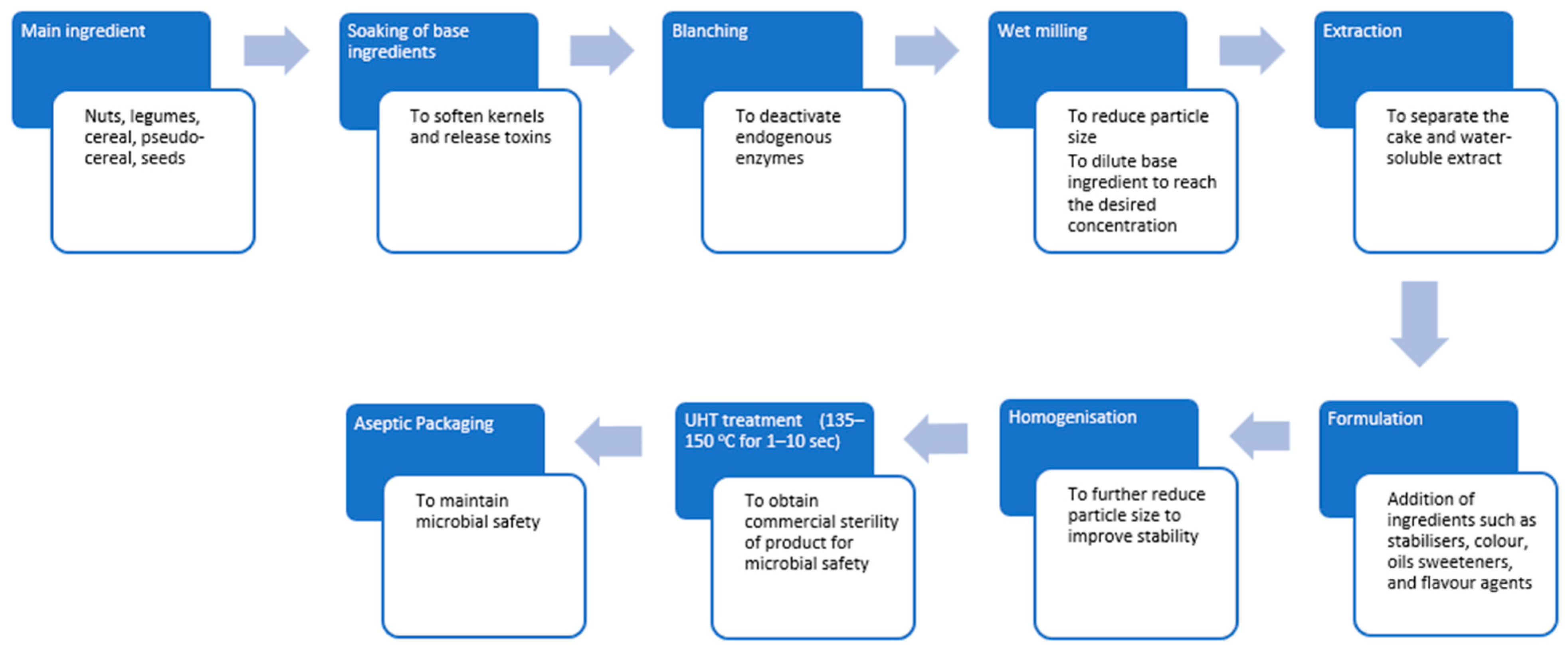
Plant-based milk is a colloidal emulsion derived from plant ingredients, blended with water and homogenised to resemble the appearance and texture of cow milk [3,7,32]. The production of PBMA generally involves either a dry milling or wet milling process to reduce the size of solid particles, including protein aggregates and fibre. This review will focus on the wet milling method, as it is more commonly preferred in the industry due to several advantages, including reduced production time and lower energy consumption [33].
The wet milling production process, illustrated in Figure 2, begins with the addition of the main ingredient (e.g., soybeans, oats or almonds), which is soaked in water to rehydrate and soften. The mix is then subjected to blanching and milling to deactivate endogenous enzymes and reduce particle size, respectively, after which the liquid phase is separated from the cake. Flavouring agents, colour, stabilisers, and sweeteners are added to the liquid phase to achieve the desired sensory and functional properties, followed by homogenisation and UHT treatment to ensure product uniformity and stability [3,14,34]. Thereafter, the PBMA is aseptically packaged, similar to that described above for UHT milk.

3. Chemical and Nutritional Composition

UHT milk and PBMA exhibit notable differences in their chemical composition (Table 1). For example, UHT milk generally contains more proteins than most PBMA. Soy milk (3.2–3.6 g/100 g) is an exception, with a protein content comparable to that of UHT milk (3.2–3.4 g/100 g) that is attributed to the naturally high protein content of soybeans (35–40% of dry matter) [36]. The lower protein content of almond and oat milk compared to soy milk reflects the naturally lower protein levels in their main ingredients, with almonds containing approximately 16–20% protein and oats around 14–20% dry matter [37,38]. In contrast, oat milk has a higher carbohydrate content (6.1–6.7 g/100 g) than cow milk, aligning with the high carbohydrate composition of oats, which make up about 51–65% of the grain’s dry matter [39].
Further compositional differences can be seen in sugar, fat, and calcium content. UHT milk contains the highest levels of total sugars (4.8–5.0 g/100 g), primarily due to its naturally occurring lactose, whereas almond and soy milk contain lower sugar levels (1.3–2.2 g/100 g), which are attributed to naturally present monosaccharides such as glucose and fructose, as well as sugars like sucrose [45], that are added to PBMA typically for taste and flavour. Oat milk contains intermediate sugar levels (1.8–2.7 g/100 g) that are higher than soy and almond because some of the sugar in oat milk is derived from starch hydrolysis during processing [3]. Additionally, the industry adds various carbohydrates and sugars to PBMA, such as sucrose, fructose, maltose, sorbitol, gums and inulin, which act as sweeteners and texturizing agents [45]. These different carbohydrates and sugars vary in their sweetness potency, possibly producing a higher sweet taste than sucrose (as in fructose) or a lower sweet taste than sucrose (as in sorbitol) [46]. Fat content is highest in UHT milk (3.4–3.5 g/100 g), followed by soy, oat, and almond milk, which ranges from 1.8 to 3.0 g/100 g, reflecting both the inherent fat content of the raw materials and oils added during processing to improve emulsification and to achieve a desirable mouthfeel which will be discussed in Section 4.2.
In terms of micronutrients, UHT milk provides the highest calcium content (112 mg/100 g) followed by soy milk (84.2 mg/100 g), almond milk (65.6 mg/100 g), and lastly oat milk (49.9 mg/100 g). Only UHT milk naturally contains calcium, whereas other PBMA rely on added calcium from sources such as calcium carbonate and tri-calcium phosphate [47]. Therefore, the calcium content in PBMA reflects different levels of fortification applied by different manufacturers.
Collectively, these compositional differences underpin the distinct sensory and physicochemical properties observed across the milk types. Proteins and fat play significant roles in sensory attributes and functionality as they directly affect colour, texture, stability, and flavour of milk [48]. Understanding these roles will aid in guiding formulation strategies aimed at mimicking the sensory qualities of UHT milk.
Although PBMA are formulated to resemble cow milk, variations in nutrient composition, particularly in calcium and protein quality, may influence human health and nutritional status. For example, the bioavailability of calcium derived from cow milk is significantly higher than that of fortified calcium sources in PBMA, a factor that plays a critical role in maintaining bone strength and supporting bone health development [49]. Calcium absorption in the body occurs mainly through passive diffusion in the small intestine, a process enhanced by naturally occurring components in cow milk such as casein and whey phosphopeptides, lactose, and phosphorus [50]. In addition to the absence of the aforementioned components, PBMA is derived from legumes, cereals, and nuts such as oat, almond, and soy that contain calcium-binding phytates. These compounds reduce calcium bioavailability, leading to an inverse relationship between calcium content and its absorption in these milk types [14,51]. Additionally, calcium salts can precipitate out of solution during processing or storage, reducing the fraction of calcium that remains in a soluble, absorbable form, thereby further diminishing its nutritional efficacy [51]. However, comparative studies evaluating calcium bioavailability between PBMA and cow milk remain limited. Muleya et al. [51] reported that calcium absorption from fortified PBMA was five to nine times lower than that from cow milk, highlighting the significant role of matrix components in determining mineral bioavailability. Similarly, when comparing protein quality, dairy milk demonstrates superior nutritional value owing to its complete amino acid profile, encompassing all nine essential amino acids in adequate proportions [52]. The protein quality can be assessed using the Digestible Indispensable Amino Acid Score (DIAAS) or the Protein Digestibility-Corrected Amino Acid Score (PDCAAS) which evaluates the digestibility and bioavailability of individual essential amino acids in a given food. A higher DIAAS or PDCAAS value indicates that a protein source more effectively meets human amino acid requirements, with DIAAS values above 100 considered excellent (high quality), between 75 and 100 considered good, and below 75 considered poor [53,54]. Among the three types of PBMA discussed herein, soy milk exhibits a higher DIAAS value of the limiting amino acid lysine (124%) compared to oat (73%) and almond (34%) milk, although it remains lower than that of cow milk (160%) [55]. This indicates that while some PBMA, particularly soy, provide relatively balanced amino acid profiles, they still fall short of the amino acid digestibility and bioavailability found in dairy milk, underscoring the nutritional advantage of animal-derived proteins in meeting human amino acid needs [53].

4. Sensory Attributes

The quality attributes of PBMA have been assessed in the literature using different sensory techniques. Among these, descriptive analysis is one of the methods that has been recently used in PBMA assessments, providing detailed quantitative information on attributes such as appearance, flavour, and mouthfeel [16,32,41,56]. In this method, a trained sensory panel develops specific descriptors/lexicons and reference standards to objectively evaluate product characteristics, either individually or comparatively among several samples [57]. Descriptive analysis allows panellists to select and apply descriptors that are relevant to a particular product, such as soy milk or oat milk, implying that some descriptors are more applicable to certain products than others. This was demonstrated by a study conducted by Chambers IV et al. [58], in which the panel identified 28 sensory descriptors/lexicons for soy milk. However, the authors refined this list by removing redundant terms such as “cooked oats” and “cooked wheat,” retaining only the most relevant descriptors. Similarly, N’Kouka et al. [56] conducted a descriptive analysis in which panellists selected 31 terms to characterise soy milk and replaced the common term “beany” with “green” and “raw soy,” as they considered “beany” to be ambiguous. However, the term beany has been used in other soy milk studies including Torres-Penaranda and Reitmeier [20], Chung et al. [59], and Xia et al. [60]. As the definition and selection of lexicons depend on the trained panel, the description of sensory attributes can vary from panel to panel and, consequently, from study to study. Therefore, to enhance comparability and reproducibility across PBMA studies, it is essential to establish standardised lexicons and evaluation protocols [61]. In this review, the authors have also incorporated complementary measures of quality such as physicochemical parameters including particle size and colorimetric values alongside sensory attributes to provide a more holistic understanding of product quality under standardised conditions.

4.1. Appearance

Visual appearance is a primary quality attribute for consumers when assessing fresh produce such as fruits and vegetables [62]. It is reasonable to assume that similar visual cues influence the perceived quality of other food products, including milk. However, appearance differs notably between UHT milk and PBMA, with PBMA often exhibiting greater variation in colour, surface uniformity, and oiliness due to natural pigments, genetic differences, ingredients used, and processing conditions. Therefore, appearance is essential to consider when evaluating and improving PBMA to meet consumer expectations.
The assessment of milk appearance typically involves rating colour attributes (such as whiteness, darkness, greenness, and redness), homogeneity (referring to the smoothness and even distribution of particles on the surface), and surface oiliness [6,12,63]. However, the literature largely focuses on evaluating the hue of milk, with Hunter L values (measuring the degree of whiteness) generally reported between 81 and 91 [64,65], often using UHT milk as the benchmark for comparison. In comparison to UHT milk, oat milk presents as an off-white PBMA (L values ranging 70–80) with a subtle greenish hue attributable to riboflavin content, soy milk (L values ranging 69–84) exhibits a yellowish coloration due to the presence of carotenoids, while almond milk (L values ranging 70–82) displays a distinctly white appearance [16,64,65,66].
However, these described hues are not consistent for each PBMA type and may vary depending on processing conditions and genetic variation within the same raw plant material. According to hedonic scaling conducted by Zhou et al. [17], assessors noted that the whiteness of oat milk varied depending on the oat cultivar (variety) used. Similarly, Poinke et al. [32] reported that assessors identified significant colour differences among different brands of almond, oat, and soy PBMA, despite these products being derived from the same type of plant material. This could all be attributed to differences in the concentration and types of chromophores, some of which may be naturally occurring pigments [7].
Research by McCarron et al. [16] demonstrated that particle size also significantly influences the perceived whiteness of PBMA milk, with samples containing smaller particles in oat milk being rated as whiter by assessors. In addition to natural genetic variation and particle size, extended heat treatment times may also result in PBMA appearing darker due to the formation of Maillard reaction products. For example, a study by Kwok et al. [67], reported that assessors observed increased browning in soy milk with increasing temperatures (80–140 °C) and prolonged heating times (30–180 mins), attributed to Maillard browning. Currently, most PBMA in the market are darker than UHT milk or exhibit distinct green or yellow hues, which are absent in dairy; thus, increased whiteness is essential for enhancing visual similarity. Additionally, white milk is perceived by consumers as an indicator of minimal processing, thereby contributing to product acceptance [68] and further stressing the importance of whiteness in PMBA.
Appearance evaluation also involves assessing the homogeneity of the milk. UHT milk, being an animal-derived product, contains only simple sugars (lactose), whereas PBMA contain complex carbohydrates, including fibre (Table 1). If this insoluble matter is not efficiently reduced or filtered during production, it will result in an uneven surface appearance, differing from the smooth appearance of UHT milk and sedimentation. Additionally, PBMA is commonly associated with an oily appearance, which reduces consumer liking [63]. The oiliness is caused by the migration of formulation oils, such as seed oil, from the emulsion to the surface, leading to an oily appearance [69].

4.2. Texture and Mouthfeel

PBMA, being derived from plant ingredients, exhibit variations in particle size (d4,3 ranging 0.7–81 µm) and composition, which result in texture variations such as increased grittiness and chalkiness [11,70]. These textural attributes are often perceived as unpleasant by consumers and reduce overall product acceptance, particularly when particle size deviates from cow milk’s range of 0.3–0.8 µm [63,71,72]. To address this, particle size reduction processes such as milling and efficient homogenisation are applied to improve texture and mouthfeel [73]. Another reduction process commonly applied to oat ingredients, due to their high starch content, is enzymatic hydrolysis. This process breaks down starch and fibre to improve solubility, as the high starch content in oats tends to gelatinise, resulting in thicker milk that reduces functionality and consumer acceptability [3,74]. The effectiveness of this process was proved by Tan et al. [75], who showed that beverages developed using hydrolysed oat bran exhibited improved texture and achieved higher likability.
A commonly reported negative attribute of PBMA by consumers is their undesirable watery mouthfeel [71]. Thinness is particularly undesirable when PBMA is used as a UHT milk substitute in applications that require creaminess and thickness, such as barista beverages and cooking [3,63]. In some formulations, thickness is adjusted by incorporating thickening agents such as gums [76], making it difficult to compare this attribute amongst the three PBMA types in discussion. For instance, in a study by Pointke et al. [32], assessors described oat PBMA as the most watery compared to soy and almond PBMA. However, a separate study reported that it exhibited the most desirable mouthfeel properties, including thickness [43]. Viscosity measurements have also confirmed these variances, with authors reporting the viscosity of almond milk ranging from 3.87 to 26.32 mPa·s, oat milk from 1.54 to 6.77 mPa·s, and soy milk from 2.57 to 7.58 mPa·s, compared to UHT cow milk at 3.49 mPa·s [11,16].
Despite ongoing industrial efforts to improve the sensory attributes of PBMA, UHT milk remains the preferred option for many consumers, where its naturally creamy mouthfeel and smooth texture remain key drivers of consumer preference [63]. While processes such as particle size reduction, enzymatic hydrolysis, and the addition of thickening agents have improved the texture and mouthfeel of PBMA, these products often still fall short of replicating the desirable creaminess and consistency of UHT milk, particularly in applications like barista beverages and cooking, where texture plays a critical role in product acceptance.

4.3. Flavour

Almond, oat, and soy PBMA are consistently reported in the literature to exhibit distinct flavour profiles that reflect their primary ingredients. Odour-active compounds identified in Table 2 significantly influence the characteristic flavour profile of each milk type. Almond milk flavour is associated with aromas such as nutty, sweet, and roasted [12]. A PBMA gas chromatography–mass spectrometry (GC-MS) study by Pointke et al. [32] revealed that almond milk contained high levels of aldehydes, ketones, and pyrazines, as well as acids, alcohols, and aromatic compounds. Vaikma et al. [12] also identified similar compound groups, along with esters, lactones, and sulphur compounds. These compounds are known to contribute to nutty (pyrazine, 2,3-dimethyl-), almond sweet (1-hexanol, 2-ethyl-; benzaldehyde), oily (1-hexanol, 2-ethyl-), and roasted aromas (pyrazine) [12,77].
Processing conditions are one of the factors that determine the extent to which these compounds affect the flavour profile of almond milk. In almond milk production, almonds typically undergo heat treatments resulting in the generation of volatiles via lipid oxidation, Maillard reactions, and sugar pyrolysis [78]. One heat treatment used in the production process is roasting, which enhances the stability of the milk emulsion and improves protein solubility [14]. The effect of roasting on almond flavour was investigated by Agila and Barringer [79] and they found that it significantly increased the concentration of volatiles, particularly alcohols, aldehydes, and pyrazines, which are known to give sweet, nutty, and roasted aromas [12]. Similarly, sensory analysis conducted by Vázquez-Araújo et al. [80] revealed a positive correlation between the panellist’s perception of roasted almond aromas and the concentration of pyrazines and furans compounds.
The flavour profile of oat milk is primarily characterised by its cereal and nutty notes [32]. McGorrin [32] demonstrated that these flavours in heat-treated products originate through a dual pathway. This pathway involves the oxidation of unsaturated fatty acids, leading to the formation of aldehydes and ketones, as well as the generation of Maillard reaction products like furans and pyrazines. These findings align with those of Vaikma et al. [12] who noted that consumers described cereal-based milk, including oat milk, as having a cereal taste and aroma. In their study, consumers also associated oat milk with a strong astringency intensity, which the researchers attributed to the presence of dimethyl sulphide. Bitterness and astringency notes in oat milk could also be explained as inherent traits, as oats contain phenolic compounds such as p-coumaric acid, which are typically related to these attributes [81,82]. Another explanation could be related to the processing conditions of the oats, whether they are dehulled or hulled. Molteberg et al. [83] found that heat-treating hulled oats resulted in the transfer of flavour components present within the hulls, such as phenolics, thereby increasing the bitterness intensity of the oats.
Klensporf and Jeleń [84] and Bai et al. [85] also reported the emergence of a nutty flavour after heat-treating oats. In both publications, they attributed this to the volatiles formed as a result of heating through Maillard reactions and the oxidation of unsaturated fatty acids. Hrdlčka and Janíček [86] identified carbonyls, including furfural, 2-methyl butanal, and 3-methyl butanal, as possible sources of the nutty flavour in oats, whilst McGorrin [87] found a positive correlation between the pyrazine and thiazole compounds and the nutty flavour.
According to Wang et al. [88], the emergence of the beany off-flavour in soy milk is a result of compounds produced through the lipid oxidation of polyunsaturated fatty acids, catalysed by lipoxygenase activity. This process leads to the formation of hydroperoxyl derivatives, which subsequently degrade into alcohols, aldehydes, ketones, acids, amines, and various volatile compounds. Hexanal is the predominant volatile compound formed during lipid oxidation and although its main descriptor is “grassy/green”, it can contribute to the appearance of beany off-flavours, when present in conjunction with 2-pentylfuran, 1-octen-3-one, and 3-methyl-1-butanol [89,90,91]. A sensory study conducted by Bott and Chambers IV [89] revealed that the beany flavour is not solely dependent on one compound but rather a combination of compounds. In their study, they categorised compounds as either beany or non-beany and employed three strategies for combining them, namely, non-beany with non-beany, non-beany with beany, and beany with beany. Combinations involving beany compounds resulted in beany off-flavours, while combinations of beany and non-beany compounds also produced beany odours. Interestingly, some purely non-beany combinations, such as trans-2-octenal and trans-2-hexenal, also emitted a beany odour. One suggested reason for this phenomenon was that these chemicals interacted complementarily, releasing a beany odour only when combined. Similar observations were made for some combinations, such as 1-octen-3-one with 3-methyl-1-butanol, which produced a sour flavour, while 1-octen-3-one with hexanal resulted in a nutty flavour. The authors also demonstrated that the odour detection threshold could also influence the beany perception, as higher or lower volatile concentrations alter the perceived intensity of beany notes. This aligns with the findings of Vara-Ubol et al. [90], who reported that compounds responsible for the beany aroma were present at concentrations ranging from 1 to 10 ppm, with higher concentrations imparting different sensory characteristics. Thermal processing during UHT treatment leads to the formation of heat-induced flavour compounds, resulting in deviations from the milk’s natural bland and sweet flavour profile [92,93]. Heat treatment induces the denaturation of whey proteins, which contributes to the development of a cooked flavour in milk [94]. The cooked flavours found in UHT milk also arise from Maillard reaction products such as maltol, various aldehydes including benzaldehyde, and furfural, and compounds derived from lipid oxidation, such as 2-heptanone [22,95]. The UHT process also generates sulphide compounds, such as hydrogen sulphide and dimethyl sulphide, which contribute to the characteristic eggy flavour of UHT milk [22].
There is very little research on the addition of flavour agents that mimic UHT milk and despite ongoing formulation and processing efforts, a clear flavour disparity persists between PBMA and UHT milk. Currently, a few masking agents have been reported in the literature, such as vanilla, cinnamon, and cocoa. Another masking approach involves blending different plant-based milk alternatives, such as almond and rice milk, to create a more natural flavour profile [96]. This gap is particularly significant, as flavour plays a decisive role in consumer preference and acceptance, outweighing other attributes such as texture and appearance [97]. Flavour replication therefore remains a critical challenge for PBMA manufacturers striving to more closely emulate the sensory appeal of UHT milk.
Based on the methods summarised in Table 2, the identification and quantification of milk volatile compounds are most commonly performed using GC-MS coupled with solid-phase microextraction (SPME). Compared with other extraction techniques such as solid-phase extraction and liquid–liquid extraction, SPME offers advantages, including faster sample preparation and minimal solvent use during extraction, which reduce the risks of solvent contamination and disposal issues [98,99].
Furthermore, most studies discussed in this section, identified in Table 2, reported semi-quantitative rather than fully quantitative data. Semi-quantification involves adding a known amount of an internal standard and expressing the relative abundance of each eluted compound as a ratio to this standard [32,100]. In contrast, true quantitative analysis determines the absolute concentration of each compound, which requires calibration curves prepared with standards of known concentration [101].
While the identification of key aroma-active compounds is essential for understanding flavour development in milk, the actual concentration of these volatiles is equally important. Even when a compound is identified as dominant, its quantity can substantially influence its perceived character, meaning that shifts in concentration can alter the aroma profile and, consequently, the overall flavour perception. For example, volatile sulphides contribute to characteristic flavour at low concentrations, but at higher concentrations (<1 µg/kg), they produce an unpleasant sulphurous aroma [102].
Table 2. Key volatile compounds in UHT cow milk, almond, oat, and soy plant-based milk alternatives.
Milk TypesVolatile CompoundsAroma DescriptionVolatile Extraction and Quantification MethodReferences
Almond milkPyrazine, 2,3-dimethylNuttyHS-SPME GC–MS; semi-quantitative[77,103]
1-hexanol, 2-ethyl-Oily, sweet, floralHS-SPME GC–MS; semi-quantitative[12]
BenzaldehydeAlmond, malt, woody, sweetHS-SPME GC–MS; semi-quantitative[12,32]
Pyrazine, 2,6-dimethylNutty HS-SPME GC–MS; n/a[32]
Oat milkHexanalGreen, grassyHS-SPME GC–MS; semi-quantitative[41,87,91]
Dimethyl sulphideCabbage, sulphur, gasolineHS-SPME GC–MS; semi-quantitative[12]
FurfuralBready HS-SPME GC–MS; semi-quantitative[16]
2-methyl butanalCocoaHS-SPME GC–MS; semi-quantitative[16]
3-methyl butanalFruityHS-SPME GC–MS; semi-quantitative[16]
OctanalSoapy, citrusyHS-SPME GC–MS; semi-quantitative[84,87]
2-Pentyl furanFruity, fruity, green, beany, floralHS-SPME GC–MS; semi-quantitative[16,32]
Soy milkHexanalGreen, grass, tallow, fatHS-SPME GC–MS; semi-quantitative[32,41,91]
3-methyl-1-butanolBanana, floral, fruity, malt, wheatHS-SPME GC–MS; n/a[32]
2-pentylfuranFruity, greenHS-SPME GC–MS; n/a[32]
NonanalFat, citrus, greenHS-SPME GC–MS; semi-quantitative[91,104]
1-octen-3-olMushroomHS-SPME GC–MS; semi-quantitative[105]
Acetic acid Sour, fruity, vinegarHS-SPME GC–MS; n/a[32]
UHT cow milk2-heptanoneFruity, creamyHS-SPME GC–MS; quantitative and semi-quantitative[106]
Hydrogen sulphideEggy/ sulphur HS-SPME GC–MS; quantitative[22]
Dimethyl sulphideCabbage, sulphur, gasolineHS-SPME GC–MS; quantitative[22,91]
BenzaldehydeAlmond, burnt sugar, cooked,HS-SPME GC–MS; quantitative[22,91]
MaltolSweetHS-SPME GC–MS; quantitative[22]
2-NonanoneSweetHS-SPME GC–MS; quantitative and semi-quantitative[106]
FurfuralBarny/brothyHS-SPME GC–MS; quantitative[22]
1-Octen-3-olMushroomHS-SPME GC–MS; quantitative and semi-quantitative[106]

5. Challenges in Replicating the Sensory Properties of UHT Milk

Despite ongoing advances in formulation and processing, replicating the sensory properties of UHT milk in PBMA remains a considerable challenge. While substantial progress has been made in improving individual attributes such as appearance, texture, and flavour, achieving a product that delivers the same overall sensory experience as UHT milk continues to be elusive. These sensory differences are closely linked to the underlying physicochemical properties of PBMA emulsions, which play a critical role and will be discussed in this section.

5.1. Emulsion Dynamics

Both PBMA and UHT milk are classified as oil-in-water emulsions, consisting of insoluble oil droplets dispersed within an aqueous phase and stabilised by proteins adsorbed to the droplet surface, in the case of PBMA, or the native milk fat globule membrane and absorbed serum proteins, in the case of UHT milk. These proteins, due to their amphiphilic nature, are able to reduce interfacial tension, thereby enhancing emulsion stability [107,108,109]. However, despite both adhering to the same emulsion principle, PBMA and UHT milk differ in the specific components involved in emulsion formation and stabilisation. In UHT milk, the naturally present polar lipids and proteins contribute to emulsion stability, including components of the milk fat globule membrane and casein proteins [110]. In PBMA, the protein source may be intrinsic, as in soy milk, or derived from external plant sources such as lentil, pea, or soy protein isolates [111].

5.1.1. Plant Protein

Plant proteins are fundamental to the development of PBMA; however, their physiochemical properties often give rise to sensory challenges. For instance, Tang et al. [112] demonstrated that protein isolates such as soy (whiteness index of 81), lentil (50), and pea (73) exhibit noticeably darker colours compared to UHT milk proteins like whey and casein caseinate, both of which have a high whiteness index of 89. The presence of inherent colours in plant protein sources contributes to this darker appearance, ultimately reducing the whiteness and visual appeal of PBMA relative to UHT milk.
Additionally, some plant proteins, such as pea and soy protein, can mimic the amphiphilic nature of dairy proteins [113,114], potentially making them ideal replacements for cow proteins. As such, these plant proteins can be used to improve emulsion stability and increase thickness [115], hence addressing common shortcomings of PBMA. This potential of plant protein was demonstrated in a study by Roesch and Corredig [116], which showed that incorporating soy protein isolate at concentrations above 4% enhances viscosity and stability by promoting the formation of a protein network that entraps oil droplets. However, as shown in Table 1, PBMA products except for soy are low in protein content, containing a maximum of around 1% protein, limiting their ability to stabilise emulsions. Moreover, the PBMA are typically formulated to contain a low protein content, as higher protein levels are often linked to undesirable sensory attributes, including increased astringency and grittiness which lower sensory acceptance [19]. These findings underscore the inherent challenge in formulating PBMA, where enhancing physical stability often compromises the sensory properties necessary to achieve a product profile comparable to UHT milk and acceptable to consumers.
Plant proteins have also been linked to playing a role in the off-flavours in PBMA. Soy protein isolate contains precursors of off-flavours, such as phospholipids and polyphenols, which contribute to undesirable beany, grassy, earthy, green, or oxidised odours through lipid oxidation and polyphenol–protein interactions [117]. These differing protein sources and structures induce an inevitable difference in the sensory properties of the final milk product, influencing characteristics such as mouthfeel, appearance, and overall sensory experience.

5.1.2. Carbohydrates

PBMA contain various sources of carbohydrates, including both naturally occurring sugars and added sweeteners [14]. Added sweeteners such as saccharin and acesulfame K are commonly incorporated into food to enhance sweetness and improve palatability; however, they are often associated with bitter aftertaste [118]. In addition, cereal-based PBMA, such as oat milk, naturally contain high levels of carbohydrates, which, if not properly hydrolysed, can lead to gelation of the product after heat treatment, rendering the milk unsuitable for use [119].

5.1.3. Calcium

In PBMA, calcium carbonate is added for calcium fortification and to enhance whiteness [120,121]. It is incorporated in colloidal form to improve chemical stability against pH and ionic changes. However, this colloidal form renders it insoluble, resulting in sedimentation and the formation of a visible layer at the bottom that requires shaking before use, along with a chalky and gritty mouthfeel [76]. Additionally, due to its high density (attributed to high molecular weight), calcium carbonate tends to settle at the bottom of the emulsion [69].

5.1.4. Fat

Monounsaturated and polyunsaturated fatty acids have lower melting points and viscosity compared to saturated fatty acids [122,123] which influence the solid fat content of milks when held under refrigeration temperatures and contribute to perceived creaminess. As such, the saturated fatty acid component of milk fat contribute significantly to the creamy mouthfeel of milk, accounting for around 70% of the total milk fatty acid profile of UHT milk [124]. Whereas, Antunes et al. [125] reported that oat, soy, and almond PBMA predominantly contain monounsaturated and polyunsaturated fatty acids, with only around 11–16% of saturated fatty acids.
The oxidative degradation of these fatty acids leads to the development of off-flavours in PBMA. The linear-chain saturated fatty acids and unsaturated fatty acids oxidise to form flavour compounds such as methyl ketones, alcohols, aldehydes, esters, and lactones [126]. A study by Klensporf and Jeleń [127] showed that heat treatment of oat flakes led to the formation of several volatile compounds derived from the oxidation and degradation of unsaturated fatty acids. Specifically, 2-pentylfuran and hexanal were produced from linoleic acid, 2-heptanone originated from octanoic acid, while heptanal and octanal were formed from the oxidation of oleic acid and other unsaturated fatty acids. In soy milk, the beany characteristic is strongly correlated with lipid oxidation, as it is linked to beany-causing compounds such as pentanol, hexanol, and hexanal [128]. Poliseli-Scopel et al. [129] reported that pentanol, hexanol, and hexanal are formed in soy milk as a result of fatty acid oxidation induced by heat treatment, with hexanal being the most abundant compound. Similar to oat and soy, almond is also prone to lipid oxidation due to the high presence of polyunsaturated fatty acids [121]. The occurrence of oxidation in PBMA leads to the formation of off-flavours, including green notes (hexanal), grassy notes (2-pentylfuran), and beany notes caused by compounds such as pentanol, hexanol, and hexanal [126,128]. These ingredient-related challenges highlight the complex trade-offs involved in PBMA formulation. Achieving a dairy-like product requires balancing functionality, stability, and sensory quality, often necessitating innovative technological approaches to overcome the inherent limitations of plant-derived proteins, carbohydrates, minerals, and fats. Continued research and ingredient innovation remain essential to close the gap between PBMA and dairy in terms of both consumer acceptance and functionality.

6. Bridging the Gap

Addressing the sensory and physicochemical limitations of PBMA requires the application of targeted innovations. One promising approach is the use of blended formulations, combining different PBMA to achieve desirable sensory attributes. For example, coconut milk is known to contribute creaminess, dairy-like flavour, and whiteness, and blending it with almond milk could enhance nutty aroma notes commonly associated with UHT milk [41]. As an example, Danone developed Silk Nextmilk, a PBMA formulated by blending coconut, soy, and oat to closely replicate the sensory experience of dairy [130].
Precision fermentation provides a way of producing proteins that are molecularly identical to cow milk’s whey and casein proteins. Proteins produced through precision fermentation would contribute essential structural and functional properties, such as creaminess and foaming, which are otherwise difficult to achieve in plant-based formulations [131]. Precision fermentation could enhance these properties while also addressing key consumer motivations, including lowering carbon footprints and reducing perceived notions of animal cruelty that some associate with animal agriculture [132,133].
Enzymes have also shown promise in enhancing the nutritional and sensory properties of PBMA. Li et al. [134] found that hydrolysing oleosomes (intracellular organelles rich in lipids that are natural oil and fat storage structures in the seeds of plants) with papain improved shear-thinning behaviour, which was correlated with creaminess, fattiness, and thickness [135]. Additionally, the authors found that the hydrolysed oleosomes had a low fiction coefficient (µ = 0.03), compared to the non-hydrolysed oleosomes (µ = 0.15) at 50 mm/s sliding speed. These attributes are crucial to dairy creaminess, a multifaceted sensory component encompassing the aforementioned characteristics [136]. Furthermore, research conducted by Hu et al. [137] demonstrated that the addition of α-amylase and its composite with glutaminase improved the stability of oat milk mainly by reducing creaming. The authors attributed this effect to several mechanisms. Firstly, the enzymatic treatment hydrolysed oat starch and proteins, leading to the formation of smaller particles (reduced from 12.6 µm to <9 µm), which contributed to a more stable suspension. As a secondary effect, the enzymes facilitated protein deamidation, increasing electrostatic repulsion and thereby reducing aggregation. The overall effect also included an increase in apparent viscosity and sweetness, a desirable improvement given that plant-based milks often exhibit a thin or watery texture and usually require additional sweeteners. Tangyu et al. [138] reported that fermenting PBMA with lactic acid bacteria reduced the concentrations of certain ketones and aldehydes (such as 1-heptanal and 1-hexanal) in PBMA, while increasing their corresponding alcohols, 1-heptanol and 1-hexanol, which are associated with fruity flavours. In addition, fermentation also increased the sour/cheesy and buttery/fatty notes that were not present in the unfermented samples. Similarly, Blagden et al. [139] found that soy milk fermented using L. acidophilus did not contain any hexanal, acetaldehyde, and methanol. They also found that S. thermophilus strains were also capable of completely removing hexanal from milk. The removal of these compounds is significant, as it eliminates contributors to the undesirable beany flavour in soy milk. An additional benefit of using enzymes is the reduction in antinutritional factors present in milk. Rekha et al. [140] demonstrated that lactic acid bacteria, namely Lactobacillus acidophilus B4496, Lactobacillus bulgaricus CFR2028, Lactobacillus casei B1922, Lactobacillus plantarum B4495, and Lactobacillus fermentum B4655, in the presence of Saccharomyces boulardii, were able to enhance the bioavailability of calcium and magnesium as well as increase riboflavin content.
Other mechanical approaches can be employed to achieve a particle size distribution in PBMA comparable to that of cow milk, thereby enhancing both palatability and emulsion stability. Techniques such as ultra-high-pressure homogenisation and ultrasound processing are particularly effective, as they generate smaller and more uniform particles through intense shear forces, turbulence, and cavitation phenomena [141]. Vela et al. [142] demonstrated that ultrasound treatment markedly reduced particle sizes to be predominantly below 10 µm. This reduction contributed to improved emulsion stability in almond and coconut milk, as smaller particles enhance interparticle interactions and reduce gravitational separation [143]. Similarly, Cruz et al. [144] and Poliseli-Scopel et al. [129] reported that ultra-high-pressure homogenisation at 200 MPa effectively decreased the particle size in soy milk. These smaller particle sizes would aid in enhancing the resemblance of PBMA to cow milk by minimising gritty mouthfeel and improving smoothness, thereby achieving a texture profile closer to that of cow milk.
Predictive modelling in artificial intelligence further holds promise in accelerating this progress by enabling rapid, data-driven formulation optimisation and more precise alignment of PBMA properties with the complex sensory and functional expectations of dairy consumers. The company NotCo uses an AI platform called Giuseppe, which analyses vast combinations of plant ingredients to replicate the sensory experience of animal-derived products [145].
However, some researchers argue that PBMA should not be viewed as direct substitutes for cow milk but rather as distinct products in their own right. From this perspective, innovations should focus on enhancing the unique qualities of PBMA to make them appealing based on their inherent characteristics rather than replicating cow milk [146].

7. Conclusions

In conclusion, while significant progress has been made in enhancing the sensory and physicochemical properties of PBMA, fully replicating the sensory experience and functionality of UHT milk remains a complex challenge. The intrinsic compositional differences between plant-based ingredients and dairy, particularly in protein structure, fat composition, and mineral functionality, contribute to gaps in nutrition, mouthfeel, flavour, appearance, and emulsion stability. Innovative approaches such as protein modification, targeted fat structuring, and advanced flavour-masking strategies offer potential pathways to narrow these gaps. However, based on current evidence, PBMA can approximate certain attributes of cow milk but still fall short of fully replicating the comprehensive sensory and physicochemical profile of dairy. Continued research and technological innovation are essential to move PBMA closer to true dairy equivalence, particularly in applications demanding high sensory fidelity, such as barista beverages and culinary uses. Additionally, future studies should also consider PBMA heat treatments that also mimic pasteurised and ESL-processed cow milk to reflect the full range of processing methods used for real cow milk.

Author Contributions

Conceptualisation, A.A.M. and R.K.; writing—original draft preparation, A.A.M.; writing—review and editing, A.A.M., R.K., A.L., J.M.G., S.G. and S.K.; supervision, R.K., A.L., S.G. and S.K. All authors have read and agreed to the published version of the manuscript.

Funding

This research received no external funding.

Institutional Review Board Statement

Not applicable.

Informed Consent Statement

Not applicable.

Data Availability Statement

No new data were created or analyzed in this study. Data sharing is not applicable to this article.

Acknowledgments

We would like to acknowledge Deakin University, Noumi Limited and CSIROs AI for Missions Next Generation Graduate Program for their support. GenAI (ChatGPT version 4o) was used in this review to assist with improving the language and overall clarity and flow of the text. The authors have reviewed and edited the output and take full responsibility for the content of this publication.

Conflicts of Interest

Author Sonja Kukuljan is employed by the company Noumi Limited. The remaining authors declare that the research was conducted in the absence of any commercial or financial relationships that could be construed as a potential conflict of interest.

References

  1. Mekanna, A.N.; Issa, A.; Bogueva, D.; Bou-Mitri, C. Consumer perception of plant-based milk alternatives: Systematic review. Int. J. Food Sci. Tech. 2024, 59, 8796–8805. [Google Scholar] [CrossRef]
  2. Statista. Milk Substitutes—Worldwide. Available online: https://www.statista.com/outlook/cmo/food/dairy-products-eggs/milk-substitutes/worldwide (accessed on 10 June 2025).
  3. Sethi, S.; Tyagi, S.K.; Anurag, R.K. Plant-based milk alternatives an emerging segment of functional beverages: A review. J. Food Sci. Technol. 2016, 53, 3408–3423. [Google Scholar] [CrossRef]
  4. Stewart, H.; Kuchler, F.; Cessna, J.; Hahn, W. Are Plant-Based Analogues Replacing Cow’s Milk in the American Diet? J. Agric. Appl. Econ. 2020, 52, 562–579. [Google Scholar] [CrossRef]
  5. Slade, P. Does plant-based milk reduce sales of dairy milk? Evidence from the almond milk craze. Agric. Resour. Econ. Rev. 2023, 52, 112–131. [Google Scholar] [CrossRef]
  6. Tong, S.C.; Siow, L.F.; Lee, Y.Y. Identification of Sensory Drivers of Liking of Plant-Based Milk Using a Novel Palm Kernel Milk—The Effect of Reformulation and Flavors Addition Through CATA and PCA Analysis. Food Sci. Nutr. Curr. Issues Answ. 2025, 13, e4719. [Google Scholar] [CrossRef]
  7. Reyes-Jurado, F.; Soto-Reyes, N.; Dávila-Rodríguez, M.; Lorenzo-Leal, A.; Jiménez-Munguía, M.; Mani-López, E.; López-Malo, A. Plant-Based Milk Alternatives: Types, Processes, Benefits, and Characteristics. Food Rev. Int. 2023, 39, 2320–2351. [Google Scholar] [CrossRef]
  8. Ramsing, R.; Santo, R.; Kim, B.F.; Altema-Johnson, D.; Wooden, A.; Chang, K.B.; Semba, R.D.; Love, D.C. Dairy and Plant-Based Milks: Implications for Nutrition and Planetary Health. Curr. Environ. Health Rep. 2023, 10, 291–302. [Google Scholar] [CrossRef]
  9. Guiné, R.P.F.; Florença, S.G.; Barroca, M.J.; Anjos, O. The Link between the Consumer and the Innovations in Food Product Development. Foods 2020, 9, 1317. [Google Scholar] [CrossRef]
  10. Nazzaro, C.; Stanco, M.; Uliano, A.; Marotta, G. Consumers’ acceptance and willingness to pay for enriched foods: Evidence from a choice experiment in Italy. Future Foods 2024, 10, 100405. [Google Scholar] [CrossRef]
  11. Jeske, S.; Zannini, E.; Arendt, E.K. Evaluation of Physicochemical and Glycaemic Properties of Commercial Plant-Based Milk Substitutes. Plant Foods Hum. Nutr. 2017, 72, 26–33. [Google Scholar] [CrossRef] [PubMed]
  12. Vaikma, H.; Kaleda, A.; Rosend, J.; Rosenvald, S. Market mapping of plant-based milk alternatives by using sensory (RATA) and GC analysis. Future Foods 2021, 4, 100049. [Google Scholar] [CrossRef]
  13. Drewnowski, A. The Science and Complexity of Bitter Taste. Nutr. Rev. 2001, 59, 163–169. [Google Scholar] [CrossRef]
  14. Aydar, E.F.; Tutuncu, S.; Ozcelik, B. Plant-based milk substitutes: Bioactive compounds, conventional and novel processes, bioavailability studies, and health effects. J. Funct. Foods 2020, 70, 103975. [Google Scholar] [CrossRef]
  15. Moss, R.; LeBlanc, J.; Gorman, M.; Ritchie, C.; Duizer, L.; McSweeney, M.B. A Prospective Review of the Sensory Properties of Plant-Based Dairy and Meat Alternatives with a Focus on Texture. Foods 2023, 12, 1709. [Google Scholar] [CrossRef] [PubMed]
  16. McCarron, R.; Methven, L.; Grahl, S.; Elliott, R.; Lignou, S. Oat-based milk alternatives: The influence of physical and chemical properties on the sensory profile. Front. Nutr. 2024, 11, 1345371. [Google Scholar] [CrossRef] [PubMed]
  17. Zhou, S.; Jia, Q.; Cui, L.; Dai, Y.; Li, R.; Tang, J.; Lu, J. Physical-Chemical and Sensory Quality of Oat Milk Produced Using Different Cultivars. Foods 2023, 12, 1165. [Google Scholar] [CrossRef]
  18. De, B.; Shrivastav, A.; Das, T.; Goswami, T.K. Physicochemical and nutritional assessment of soy milk and soymilk products and comparative evaluation of their effects on blood gluco-lipid profile. Appl. Food Res. 2022, 2, 100146. [Google Scholar] [CrossRef]
  19. Sharma, B.; Keast, R.; Liem, D.G.; Nolvachai, Y.; Costanzo, A. Impact of protein on sensory attributes and liking of plant-based Milk alternatives. Food Qual. Prefer. 2025, 133, 105617. [Google Scholar] [CrossRef]
  20. Torres-Penaranda, A.V.; Reitmeier, C.A. Sensory Descriptive Analysis of Soymilk. J. Food Sci. 2001, 66, 352–356. [Google Scholar] [CrossRef]
  21. Fatih, M.; Barnett, M.P.G.; Gillies, N.A.; Milan, A.M. Heat Treatment of Milk: A Rapid Review of the Impacts on Postprandial Protein and Lipid Kinetics in Human Adults. Front. Nutr. 2021, 8, 643350. [Google Scholar] [CrossRef]
  22. Jo, Y.; Benoist, D.M.; Barbano, D.M.; Drake, M.A. Flavor and flavor chemistry differences among milks processed by high-temperature, short-time pasteurization or ultra-pasteurization. J. Dairy Sci. 2018, 101, 3812–3828. [Google Scholar] [CrossRef]
  23. Gupta, A.; Keast, R.; Liem, D.G.; Jadhav, S.R.; Mahato, D.K.; Gamlath, S. Barista-Quality Plant-Based Milk for Coffee: A Comprehensive Review of Sensory and Physicochemical Characteristics. Beverages 2025, 11, 24. [Google Scholar] [CrossRef]
  24. Mezzetti, M.; Passamonti, M.M.; Dall’Asta, M.; Bertoni, G.; Trevisi, E.; Ajmone Marsan, P. Emerging Parameters Justifying a Revised Quality Concept for Cow Milk. Foods 2024, 13, 1650. [Google Scholar] [CrossRef]
  25. Deeth, H.C. Heat Treatment of Milk: Extended Shelf-Life (ESL) and Ultra-High Temperature (UHT) Treatments. In Encyclopedia of Dairy Sciences, 3rd ed.; McSweeney, P.L.H., McNamara, J.P., Eds.; Academic Press: Oxford, UK, 2022; pp. 618–631. [Google Scholar] [CrossRef]
  26. Food Standards Australia New Zealand. Australian Food Composition Database—Release 2.0. Available online: https://www.foodstandards.gov.au/science-data/food-nutrient-databases/afcd (accessed on 7 July 2025).
  27. Ren, Q.; Li, Q.; Liu, H.; Ma, Y. Thermal and storage properties of milk fat globules treated with different homogenisation pressures. Int. Dairy J. 2020, 110, 104725. [Google Scholar] [CrossRef]
  28. Tetra, P. UHT Treatment. Available online: https://www.tetrapak.com/en-anz/solutions/integrated-solutions-equipment/processing-equipment/uht-treatment (accessed on 6 July 2025).
  29. Hummel, D.; Atamer, Z.; Butz, L.; Hinrichs, J. Reproducing high mechanical load during industrial processing of ultra-high-terature milk: Effect on frothing capacity. J. Dairy Sci. 2024, 107, 10452–10461. [Google Scholar] [CrossRef]
  30. Karlsson, M.A.; Langton, M.; Innings, F.; Malmgren, B.; Höjer, A.; Wikström, M.; Lundh, Å. Changes in stability and shelf-life of ultra-high temperature treated milk during long term storage at different temperatures. Heliyon 2019, 5, e02431. [Google Scholar] [CrossRef]
  31. Datta, N.; Deeth, H.C. Age Gelation of UHT Milk—A Review. Food Bioprod. Process. 2001, 79, 197–210. [Google Scholar] [CrossRef]
  32. Pointke, M.; Albrecht, E.H.; Geburt, K.; Gerken, M.; Traulsen, I.; Pawelzik, E. A Comparative Analysis of Plant-Based Milk Alternatives Part 1: Composition, Sensory, and Nutritional Value. Sustainability 2022, 14, 7996. [Google Scholar] [CrossRef]
  33. Bocker, R.; Silva, E.K. Innovative technologies for manufacturing plant-based non-dairy alternative milk and their impact on nutritional, sensory and safety aspects. Future Foods 2022, 5, 100098. [Google Scholar] [CrossRef]
  34. Jeske, S.; Bez, J.; Arendt, E.K.; Zannini, E. Formation, stability, and sensory characteristics of a lentil-based milk substitute as affected by homogenisation and pasteurisation. Eur. Food Res. Technol. 2019, 245, 1519–1531. [Google Scholar] [CrossRef]
  35. Romulo, A. Food Processing Technologies Aspects on Plant-Based Milk Manufacturing: Review. In Proceedings of the 4th International Conference on Sustainability Agriculture and Biosystem, Online, 24 November 2021; Volume 1059, p. 012064. [Google Scholar] [CrossRef]
  36. Qin, P.; Wang, T.; Luo, Y. A review on plant-based proteins from soybean: Health benefits and soy product development. J. Agric. Food Res. 2022, 7, 100265. [Google Scholar] [CrossRef]
  37. Tian, L.; You, X.; Zhang, S.; Zhu, Z.; Yi, J.; Jin, G. Enhancing Functional Properties and Protein Structure of Almond Protein Isolate Using High-Power Ultrasound Treatment. Molecules 2024, 29, 3590. [Google Scholar] [CrossRef]
  38. Holopainen-Mantila, U.; Vanhatalo, S.; Lehtinen, P.; Sozer, N. Oats as a source of nutritious alternative protein. J. Cereal Sci. 2024, 116, 103862. [Google Scholar] [CrossRef]
  39. Zhang, K.; Dong, R.; Hu, X.; Ren, C.; Li, Y. Oat-Based Foods: Chemical Constituents, Glycemic Index, and the Effect of Processing. Foods 2021, 10, 1304. [Google Scholar] [CrossRef]
  40. Harmer, I.; Craddock, J.C.; Charlton, K.E. How do plant-based milks compare to cow’s milk nutritionally? An audit of the plant-based milk products available in Australia. Nutr. Diet. 2025, 82, 76–85. [Google Scholar] [CrossRef] [PubMed]
  41. Magwere, A.A.; Keast, R.; Gamlath, S.; Nandorfy, D.E.; Pematilleke, N.; Gambetta, J.M. A Comparative Study of the Sensory and Physicochemical Properties of Cow Milk and Plant-Based Milk Alternatives. J. Food Sci. 2025, 90, e70370. [Google Scholar] [CrossRef] [PubMed]
  42. Smith, N.W.; Dave, A.C.; Hill, J.P.; McNabb, W.C. Nutritional assessment of plant-based beverages in comparison to bovine milk. Front. Nutr. 2022, 9, 957486. [Google Scholar] [CrossRef] [PubMed]
  43. Vashisht, P.; Sharma, A.; Awasti, N.; Wason, S.; Singh, L.; Sharma, S.; Charles, A.P.R.; Sharma, S.; Gill, A.; Khattra, A.K. Comparative review of nutri-functional and sensorial properties, health benefits and environmental impact of dairy (bovine milk) and plant-based milk (soy, almond, and oat milk). Food Humanit. 2024, 2, 100301. [Google Scholar] [CrossRef]
  44. Walther, B.; Guggisberg, D.; Badertscher, R.; Egger, L.; Portmann, R.; Dubois, S.; Haldimann, M.; Kopf-Bolanz, K.; Rhyn, P.; Zoller, O.; et al. Comparison of nutritional composition between plant-based drinks and cow’s milk. Front. Nutr. 2022, 9, 988707. [Google Scholar] [CrossRef]
  45. Antunes, I.C.; Roseiro, C.; Bexiga, R.; Pinto, C.; Lageiro, M.; Gonçalves, H.; Quaresma, M.A.G. Carbohydrate composition of cow milk and plant-based milk alternatives. J. Dairy Sci. 2025, 108, 164–172. [Google Scholar] [CrossRef]
  46. Starkey, D.E.; Wang, Z.; Brunt, K.; Dreyfuss, L.; Haselberger, P.A.; Holroyd, S.E.; Janakiraman, K.; Kasturi, P.; Konings, E.J.M.; Labbe, D.; et al. The Challenge of Measuring Sweet Taste in Food Ingredients and Products for Regulatory Compliance: A Scientific Opinion. J. AOAC Int. 2022, 105, 333–345. [Google Scholar] [CrossRef]
  47. Chaiwanon, P.; Puwastien, P.; Nitithamyong, A.; Sirichakwal, P.P. Calcium Fortification in Soybean Milk and In Vitro Bioavailability. J. Food Compos. Anal. 2000, 13, 319–327. [Google Scholar] [CrossRef]
  48. Pua, A.; Tang, V.C.Y.; Goh, R.M.V.; Sun, J.; Lassabliere, B.; Liu, S.Q. Ingredients, Processing, and Fermentation: Addressing the Organoleptic Boundaries of Plant-Based Dairy Analogues. Foods 2022, 11, 875. [Google Scholar] [CrossRef]
  49. Vannucci, L.; Fossi, C.; Quattrini, S.; Guasti, L.; Pampaloni, B.; Gronchi, G.; Giusti, F.; Romagnoli, C.; Cianferotti, L.; Marcucci, G.; et al. Calcium Intake in Bone Health: A Focus on Calcium-Rich Mineral Waters. Nutrients 2018, 10, 1930. [Google Scholar] [CrossRef]
  50. Melse-Boonstra, A. Bioavailability of Micronutrients From Nutrient-Dense Whole Foods: Zooming in on Dairy, Vegetables, and Fruits. Front. Nutr. 2020, 7, 101. [Google Scholar] [CrossRef]
  51. Muleya, M.; Bailey, E.F.; Bailey, E.H. A comparison of the bioaccessible calcium supplies of various plant-based products relative to bovine milk. Food Res. Int. 2024, 175, 113795. [Google Scholar] [CrossRef]
  52. Davoodi, S.H.; Shahbazi, R.; Esmaeili, S.; Sohrabvandi, S.; Mortazavian, A.; Jazayeri, S.; Taslimi, A. Health-Related Aspects of Milk Proteins. Iran J. Pharm. Res. 2016, 15, 573–591. [Google Scholar]
  53. Manary, M.J.; Wegner, D.R.; Maleta, K. Protein quality malnutrition. Front. Nutr. 2024, 11, 1428810. [Google Scholar] [CrossRef]
  54. Mathai, J.K.; Liu, Y.; Stein, H.H. Values for digestible indispensable amino acid scores (DIAAS) for some dairy and plant proteins may better describe protein quality than values calculated using the concept for protein digestibility-corrected amino acid scores (PDCAAS). Br. J. Nutr. 2017, 117, 490–499. [Google Scholar] [CrossRef] [PubMed]
  55. Karoui, R.; Bouaicha, I. A review on nutritional quality of animal and plant-based milk alternatives: A focus on protein. Front. Nutr. 2024, 11, 1378556. [Google Scholar] [CrossRef] [PubMed]
  56. N’Kouka, K.D.; Klein, B.P.; Lee, S.Y. Developing a Lexicon for Descriptive Analysis of Soymilks. J. Food Sci. 2004, 69, 259–263. [Google Scholar] [CrossRef]
  57. Lawless, H.T.; Heymann, H. Preference Testing. In Sensory Evaluation of Food: Principles and Practices; Lawless, H.T., Heymann, H., Eds.; Springer New York: New York, NY, USA, 2010; pp. 303–324. [Google Scholar] [CrossRef]
  58. Chambers, E., IV; Jenkins, A.; Mcguire, B.H. Flavor properties of plain soymilk. J. Sens. Stud. 2006, 21, 165–179. [Google Scholar] [CrossRef]
  59. Chung, Y.L.; Kuo, W.Y.; Liou, B.K.; Chen, P.C.; Tseng, Y.C.; Huang, R.Y.; Tsai, M.C. Identifying sensory drivers of liking for plant-based milk coffees: Implications for product development and application. J. Food Sci. 2022, 87, 5418–5429. [Google Scholar] [CrossRef]
  60. Xia, Y.; Zhong, F.; Chang, Y.; Li, Y. An Aromatic Lexicon Development for Soymilks. Int. J. Food Prop. 2015, 18, 125–136. [Google Scholar] [CrossRef]
  61. Grossmann, L.; Kinchla, A.J.; Nolden, A.; McClements, D.J. Standardized methods for testing the quality attributes of plant-based foods: Milk and cream alternatives. Compr. Rev. Food Sci. Food Saf. 2021, 20, 2206–2233. [Google Scholar] [CrossRef]
  62. Lawless, H.T.; Heymann, H. Sensory Evaluation of Food: Principles and Practices; Springer Science & Business Media: Berlin, Germany, 2010. [Google Scholar]
  63. Jaeger, S.R.; Dupas de Matos, A.; Frempomaa Oduro, A.; Hort, J. Sensory characteristics of plant-based milk alternatives: Product characterisation by consumers and drivers of liking. Food Res. Int. 2024, 180, 114093. [Google Scholar] [CrossRef]
  64. Milovanovic, B.; Djekic, I.; Miocinovic, J.; Djordjevic, V.; Lorenzo, J.M.; Barba, F.J.; Mörlein, D.; Tomasevic, I. What Is the Color of Milk and Dairy Products and How Is It Measured? Foods 2020, 9, 1629. [Google Scholar] [CrossRef]
  65. Daszkiewicz, T.; Florek, M.; Murawska, D.; Jabłońska, A. A comparison of the quality of UHT milk and its plant-based analogs. J. Dairy Sci. 2024, 107, 10299–10309. [Google Scholar] [CrossRef] [PubMed]
  66. Alozie, Y.; Yetunde, A.; Udofia, E. Nutritional and Sensory Properties of Almond (Prunus amygdalu Var. Dulcis) Seed Milk. World J. Dairy Food Sci. 2015, 10, 117–121. [Google Scholar]
  67. Kwok, K.C.; MacDougall, D.B.; Niranjan, K. Reaction kinetics of heat-induced colour changes in soymilk. J. Food Eng. 1999, 40, 15–20. [Google Scholar] [CrossRef]
  68. Tobolková, B.; Durec, J. Colour descriptors for plant-based milk alternatives discrimination. J. Food Sci. Technol. 2023, 60, 2497–2501. [Google Scholar] [CrossRef]
  69. Suryamiharja, A.; Gong, X.; Zhou, H. Towards more sustainable, nutritious, and affordable plant-based milk alternatives: A critical review. Sustain. Food Proteins 2024, 2, 250–267. [Google Scholar] [CrossRef]
  70. Durand, A.; Franks, G.V.; Hosken, R.W. Particle sizes and stability of UHT bovine, cereal and grain milks. Food Hydrocoll. 2003, 17, 671–678. [Google Scholar] [CrossRef]
  71. Moss, R.; Barker, S.; Falkeisen, A.; Gorman, M.; Knowles, S.; McSweeney, M.B. An investigation into consumer perception and attitudes towards plant-based alternatives to milk. Food Res. Int. 2022, 159, 111648. [Google Scholar] [CrossRef]
  72. Thiebaud, M.; Dumay, E.; Picart, L.; Guiraud, J.P.; Cheftel, J.C. High-pressure homogenisation of raw bovine milk. Effects on fat globule size distribution and microbial inactivation. Int. Dairy J. 2003, 13, 427–439. [Google Scholar] [CrossRef]
  73. Köhlera, K.; Schuchmann, H.P. Homogenisation in the dairy process—Conventional processes and novel techniques. Procedia Food Sci. 2011, 1, 1367–1373. [Google Scholar] [CrossRef]
  74. McClements, D.J.; Newman, E.; McClements, I.F. Plant-based Milks: A Review of the Science Underpinning Their Design, Fabrication, and Performance. Compr. Rev. Food Sci. Food Saf. 2019, 18, 2047–2067. [Google Scholar] [CrossRef] [PubMed]
  75. Tan, D.; Lin, J.W.X.; Zhou, Y.; Yao, Y.; Chan, R.X.; Lê, K.A.; Kim, J.E. Enzymatic hydrolysis preserves nutritional properties of oat bran and improves sensory and physiochemical properties for powdered beverage application. LWT 2023, 181, 114729. [Google Scholar] [CrossRef]
  76. McClements, D.J. Development of Next-Generation Nutritionally Fortified Plant-Based Milk Substitutes: Structural Design Principles. Foods 2020, 9, 421. [Google Scholar] [CrossRef]
  77. Xiao, L.; Lee, J.; Zhang, G.; Ebeler, S.E.; Wickramasinghe, N.; Seiber, J.; Mitchell, A.E. HS-SPME GC/MS characterization of volatiles in raw and dry-roasted almonds (Prunus dulcis). Food Chem. 2014, 151, 31–39. [Google Scholar] [CrossRef]
  78. Franklin, L.M.; Mitchell, A.E. Review of the Sensory and Chemical Characteristics of Almond (Prunus dulcis) Flavor. J. Agric. Food. Chem. 2019, 67, 2743–2753. [Google Scholar] [CrossRef] [PubMed]
  79. Agila, A.; Barringer, S. Effect of Roasting Conditions on Color and Volatile Profile Including HMF Level in Sweet Almonds (Prunus dulcis). J. Food Sci. 2012, 77, C461–C468. [Google Scholar] [CrossRef] [PubMed]
  80. Vázquez-Araújo, L.; Verdú, A.; Navarro, P.; Martínez-Sánchez, F.; Carbonell-Barrachina, Á.A. Changes in volatile compounds and sensory quality during toasting of Spanish almonds. Int. J. Food Sci. Technol. 2009, 44, 2225–2233. [Google Scholar] [CrossRef]
  81. Salmenkallio-Marttila, M.; Heiniö, R.L.; Kaukovirta-Norja, A.; Poutanen, K. Flavor and Texture in Processing of New Oat Foods. In Oats, 2nd ed.; Webster, F.H., Wood, P.J., Eds.; AACC International Press: St. Paul, MN, USA, 2011; Chapter 16; pp. 333–346. Available online: https://www.cerealsgrains.org/publications/plexus/cfwplexus/Documents/2013/OatsChemCh16.pdf (accessed on 7 July 2025).
  82. Huang, C.J.; Zayas, J.F. Phenolic Acid Contributions to Taste Characteristics of Corn Germ Protein Flour Products. J. Food Sci. 1991, 56, 1308–1310. [Google Scholar] [CrossRef]
  83. Molteberg, E.L.; Solheim, R.; Dimberg, L.H.; Frølich, W. Variation in Oat Groats Due to Variety, Storage and Heat Treatment. II: Sensory Quality. J. Cereal Sci. 1996, 24, 273–282. [Google Scholar] [CrossRef]
  84. Klensporf, D.; Jeleń, H.H. Effect of heat treatment on the flavor of oat flakes. J. Cereal Sci. 2008, 48, 656–661. [Google Scholar] [CrossRef]
  85. Bai, X.; Zhang, M.; Zhang, Y.; Zhang, Y.; Guo, X.; Huo, R. Effects of Pretreatment on the Volatile Composition, Amino Acid, and Fatty Acid Content of Oat Bran. Foods 2022, 11, 3070. [Google Scholar] [CrossRef]
  86. Hrdlčka, J.; Janíček, G. Carbonyl Compounds in Toasted Oat Flakes. Nature 1964, 201, 1223. [Google Scholar] [CrossRef]
  87. McGorrin, R.J. Key Aroma Compounds in Oats and Oat Cereals. J. Agric. Food. Chem. 2019, 67, 13778–13789. [Google Scholar] [CrossRef]
  88. Wang, B.; Zhang, Q.; Zhang, N.; Bak, K.H.; Soladoye, O.P.; Aluko, R.E.; Fu, Y.; Zhang, Y. Insights into formation, detection and removal of the beany flavor in soybean protein. Trends Food Sci. Technol. 2021, 112, 336–347. [Google Scholar] [CrossRef]
  89. Bott, L.; Chambers, E., IV. Sensory characteristics of combinations of chemicals potentially associated with beany aroma in foods. J. Sens. Stud. 2006, 21, 308–321. [Google Scholar] [CrossRef]
  90. Vara-Ubol, S.; Chambers, E.; Chambers, D.H. Sensory characteristics of chemical compounds potentially associated with beany aroma in foods. J. Sens. Stud. 2004, 19, 15–26. [Google Scholar] [CrossRef]
  91. Flavornet and Human Odor Space. Available online: https://www.flavornet.org/index.html (accessed on 24 November 2024).
  92. Duncan, S.E.; Webster, J.B. 4—Oxidation and protection of milk and dairy products. In Oxidation in Foods and Beverages and Antioxidant Applications; Decker, E.A., Elias, R.J., Julian McClements, D., Eds.; Woodhead Publishing: Sawston, UK, 2010; pp. 121–155. [Google Scholar] [CrossRef]
  93. Lee, A.P.; Barbano, D.M.; Drake, M.A. The influence of ultra-pasteurization by indirect heating versus direct steam injection on skim and 2% fat milks. J. Dairy Sci. 2017, 100, 1688–1701. [Google Scholar] [CrossRef]
  94. Al-Attabi, Z.; D’Arcy, B.R.; Deeth, H.C. Volatile sulfur compounds in pasteurised and UHT milk during storage. Dairy Sci. Technol. 2014, 94, 241–253. [Google Scholar] [CrossRef]
  95. Zhang, Y.; Yi, S.; Lu, J.; Pang, X.; Xu, X.; Lv, J.; Zhang, S. Effect of different heat treatments on the Maillard reaction products, volatile compounds and glycation level of milk. Int. Dairy J. 2021, 123, 105182. [Google Scholar] [CrossRef]
  96. Akkaya Öner, G. Use of Innovative Plant-Based Protein Sources in the Beverage Industry: Developments and Applications. Food Rev. Int. 2025, 41, 1–23. [Google Scholar] [CrossRef]
  97. Andersen, B.V.; Brockhoff, P.B.; Hyldig, G. The importance of liking of appearance, -odour, -taste and -texture in the evaluation of overall liking. A comparison with the evaluation of sensory satisfaction. Food Qual. Prefer. 2019, 71, 228–232. [Google Scholar] [CrossRef]
  98. Nolvachai, Y.; Amaral, M.S.S.; Herron, R.; Marriott, P.J. Solid phase microextraction for quantitative analysis – Expectations beyond design? Green Anal. Chem. 2023, 4, 100048. [Google Scholar] [CrossRef]
  99. Qian, M.C.; Peterson, D.G.; Reineccius, G.A. Gas Chromatography. In Food Analysis; Nielsen, S.S., Ed.; Springer International Publishing: Cham, Switzerland, 2017; pp. 227–253. [Google Scholar] [CrossRef]
  100. Xi, Y.; Ikram, S.; Zhao, T.; Shao, Y.; Liu, R.; Song, F.; Sun, B.; Ai, N. 2-Heptanone, 2-nonanone, and 2-undecanone confer oxidation off-flavor in cow milk storage. J. Dairy Sci. 2023, 106, 8538–8550. [Google Scholar] [CrossRef]
  101. Onuska, F.I.; Karasek, F.W. Quantitative Analysis. In Open Tubular Column Gas Chromatography in Environmental Sciences; Springer US: Boston, MA, USA, 1984; pp. 161–179. [Google Scholar] [CrossRef]
  102. McGorrin, R.J. The Significance of Volatile Sulfur Compounds in Food Flavors. In Volatile Sulfur Compounds in Food; American Chemical Society: Washington, DC, USA, 2011; Volume 1068, pp. 3–31. [Google Scholar]
  103. Zhogoleva, A.; Alas, M.; Rosenvald, S. Characterization of odor-active compounds of various pea preparations by GC-MS, GC-O, and their correlation with sensory attributes. Future Foods 2023, 8, 100243. [Google Scholar] [CrossRef]
  104. Wan, J.; Ningtyas, D.W.; Bhandari, B.; Liu, C.; Prakash, S. Oral perception of the textural and flavor characteristics of soy-cow blended emulsions. J. Texture Stud. 2022, 53, 108–121. [Google Scholar] [CrossRef]
  105. Lv, Y.C.; Song, H.L.; Li, X.; Wu, L.; Guo, S.T. Influence of Blanching and Grinding Process with Hot Water on Beany and Non-Beany Flavor in Soymilk. J. Food Sci. 2011, 76, S20–S25. [Google Scholar] [CrossRef]
  106. Jiang, K.; Yang, A.; Zhang, Z.; Xu, K.; Kuang, H.; Meng, F.; Wang, B. Identification of aroma-active compounds in milk by 2-dimensional gas chromatography-olfactometry-time-of-flight mass spectrometry combined with check-all-that-apply questions. J. Dairy Sci. 2024, 107, 9124–9134. [Google Scholar] [CrossRef]
  107. Azarhoushang, B. 17—Process fluids for abrasive machining. In Tribology and Fundamentals of Abrasive Machining Processes, 3rd ed.; Azarhoushang, B., Marinescu, I.D., Brian Rowe, W., Dimitrov, B., Ohmori, H., Eds.; William Andrew Publishing: Norwich, NY, USA, 2022; pp. 615–652. [Google Scholar] [CrossRef]
  108. Brauss, M.S.; Linforth, R.S.; Cayeux, I.; Harvey, B.; Taylor, A.J. Altering the fat content affects flavor release in a model yogurt system. J. Agric. Food Chem. 1999, 47, 2055–2059. [Google Scholar] [CrossRef]
  109. Dickinson, E. Properties of Emulsions Stabilized with Milk Proteins: Overview of Some Recent Developments. J. Dairy Sci. 1997, 80, 2607–2619. [Google Scholar] [CrossRef]
  110. Nie, C.; Zhao, Y.; Wang, X.; Li, Y.; Fang, B.; Wang, R.; Wang, X.; Liao, H.; Li, G.; Wang, P.; et al. Structure, Biological Functions, Separation, Properties, and Potential Applications of Milk Fat Globule Membrane (MFGM): A Review. Nutrients 2024, 16, 587. [Google Scholar] [CrossRef] [PubMed]
  111. Chang, C.; Tu, S.; Ghosh, S.; Nickerson, M.T. Effect of pH on the inter-relationships between the physicochemical, interfacial and emulsifying properties for pea, soy, lentil and canola protein isolates. Food Res. Int. 2015, 77, 360–367. [Google Scholar] [CrossRef]
  112. Tang, Q.; Roos, Y.H.; Miao, S. Structure, gelation mechanism of plant proteins versus dairy proteins and evolving modification strategies. Trends Food Sci. Technol. 2024, 147, 104464. [Google Scholar] [CrossRef]
  113. Burger, T.G.; Zhang, Y. Recent progress in the utilization of pea protein as an emulsifier for food applications. Trends Food Sci. Technol. 2019, 86, 25–33. [Google Scholar] [CrossRef]
  114. Castro-Criado, D.; Jiménez-Rosado, M.; Perez-Puyana, V.; Romero, A. Soy Protein Isolate as Emulsifier of Nanoemulsified Beverages: Rheological and Physical Evaluation. Foods 2023, 12, 507. [Google Scholar] [CrossRef] [PubMed]
  115. Delahaije, R.J.B.M.; Gruppen, H.; Giuseppin, M.L.F.; Wierenga, P.A. Towards predicting the stability of protein-stabilized emulsions. Adv. Colloid Interface Sci. 2015, 219, 1–9. [Google Scholar] [CrossRef]
  116. Roesch, R.R.; Corredig, M. Characterization of Oil-in-Water Emulsions Prepared with Commercial Soy Protein Concentrate. J. Food Sci. 2002, 67, 2837–2842. [Google Scholar] [CrossRef]
  117. Damodaran, S.; Arora, A. Off-Flavor Precursors in Soy Protein Isolate and Novel Strategies for their Removal. Annu. Rev. Food Sci. Technol. 2013, 4, 327–346. [Google Scholar] [CrossRef] [PubMed]
  118. Kuhn, C.; Bufe, B.; Winnig, M.; Hofmann, T.; Frank, O.; Behrens, M.; Lewtschenko, T.; Slack, J.P.; Ward, C.D.; Meyerhof, W. Bitter taste receptors for saccharin and acesulfame K. J. Neurosci. 2004, 24, 10260–10265. [Google Scholar] [CrossRef] [PubMed]
  119. Silventoinen-Veijalainen, P.; Sneck, A.M.; Nordlund, E.; Rosa-Sibakov, N. Influence of oat flour characteristics on the physicochemical properties of oat-based milk substitutes. Food Hydrocoll. 2024, 147, 109402. [Google Scholar] [CrossRef]
  120. EFSA Panel on Food Additives and Flavourings (FAF); Younes, M.; Aquilina, G.; Castle, L.; Degen, G.; Engel, K.H.; Fowler, P.J.; Frutos Fernandez, M.J.; Fürst, P.; Gürtler, R.; et al. Re-evaluation of calcium carbonate (E 170) as a food additive in foods for infants below 16 weeks of age and follow-up of its re-evaluation as food additive for uses in foods for all population groups. EFSA J. 2023, 21, e08106. [Google Scholar] [CrossRef]
  121. Silva, A.R.A.; Silva, M.M.N.; Ribeiro, B.D. Health issues and technological aspects of plant-based alternative milk. Food Res. Int. 2020, 131, 108972. [Google Scholar] [CrossRef]
  122. Ortiz Gonzalez, G.; Jimenez Flores, R.; Bremmer, D.R.; Clark, J.H.; DePeters, E.J.; Schmidt, S.J.; Drackley, J.K. Functional properties of cream from dairy cows with experimentally altered milk fat composition. J. Dairy Sci. 2022, 105, 3861–3870. [Google Scholar] [CrossRef]
  123. Devi, A.; Khatkar, B.S. Physicochemical, rheological and functional properties of fats and oils in relation to cookie quality: A review. J. Food Sci. Technol. 2016, 53, 3633–3641. [Google Scholar] [CrossRef]
  124. Ajmal, M.; Nadeem, M.; Imran, M.; Junaid, M. Lipid compositional changes and oxidation status of ultra-high temperature treated Milk. Lipids Health Dis. 2018, 17, 227. [Google Scholar] [CrossRef]
  125. Antunes, I.; Bexiga, R.; Pinto, C.; Gonçalves, H.; Roseiro, C.; Bessa, R.; Alves, S.; Quaresma, M. Lipid Profile of Plant-Based Milk Alternatives (PBMAs) and Cow’s Milk: A Comparison. J. Agric. Food. Chem. 2024, 72, 18110–18120. [Google Scholar] [CrossRef] [PubMed]
  126. Xie, A.; Dong, Y.; Liu, Z.; Li, Z.; Shao, J.; Li, M.; Yue, X. A Review of Plant-Based Drinks Addressing Nutrients, Flavor, and Processing Technologies. Foods 2023, 12, 3952. [Google Scholar] [CrossRef]
  127. Klensporf, D.; Jeleń, H.H. Analysis of Volatile Aldehydes in Oat Flakes by SPME-GC/MS. Pol. J. Food Nutr. Sci. 2005, 14/55, 389–395. [Google Scholar]
  128. Yoo, S.H.; Chang, Y.H. Volatile Compound, Physicochemical, and Antioxidant Properties of Beany Flavor-Removed Soy Protein Isolate Hydrolyzates Obtained from Combined High Temperature Pre-Treatment and Enzymatic Hydrolysis. Prev. Nutr. Food Sci. 2016, 21, 338–347. [Google Scholar] [CrossRef]
  129. Poliseli-Scopel, F.H.; Hernández-Herrero, M.; Guamis, B.; Ferragut, V. Comparison of ultra high pressure homogenization and conventional thermal treatments on the microbiological, physical and chemical quality of soymilk. LWT Food Sci. Technol. 2012, 46, 42–48. [Google Scholar] [CrossRef]
  130. Silk Canada. Available online: https://www.silkcanada.ca/products/plant-based-beverage/nextmilk/ (accessed on 22 August 2025).
  131. CSIRO. Animal-Free Dairy. Available online: https://www.csiro.au/en/research/production/food/eden-brew (accessed on 5 July 2025).
  132. Knychala, M.M.; Boing, L.A.; Ienczak, J.L.; Trichez, D.; Stambuk, B.U. Precision Fermentation as an Alternative to Animal Protein, a Review. Fermentation 2024, 10, 315. [Google Scholar] [CrossRef]
  133. Eisner, M.D. Milk without animals—A dairy science perspective. Int. Dairy J. 2024, 156, 105978. [Google Scholar] [CrossRef]
  134. Li, B.; Han, C.; Feng, G.; Guo, J.; Wan, Z.; Yang, X. Enhanced creaminess of plant-based milk via enrichment of papain hydrolyzed oleosomes. Food Res. Int. 2024, 198, 115322. [Google Scholar] [CrossRef]
  135. Trapp, L.; Schacht, H.; Nirschl, H.; Guthausen, G. Oleosomes in almonds and hazelnuts: Structural investigations by NMR. Front. Phys. 2025, 13, 1494052. [Google Scholar] [CrossRef]
  136. Richardson-Harman, N.J.; Stevens, R.; Walker, S.; Gamble, J.; Miller, M.; Wong, M.; McPherson, A. Mapping consumer perceptions of creaminess and liking for liquid dairy products. Food Qual. Prefer. 2000, 11, 239–246. [Google Scholar] [CrossRef]
  137. Hu, Y.; Li, Z.; Cao, X.; Duan, J.; Shi, X.; Wu, C.; Cui, B.; Zhou, B. Improvement of physicochemical properties and stabilization of oat milk by composite enzymatic hydrolysis. Food Res. Int. 2025, 219, 117146. [Google Scholar] [CrossRef] [PubMed]
  138. Tangyu, M.; Fritz, M.; Tan, J.P.; Ye, L.; Bolten, C.J.; Bogicevic, B.; Wittmann, C. Flavour by design: Food-grade lactic acid bacteria improve the volatile aroma spectrum of oat milk, sunflower seed milk, pea milk, and faba milk towards improved flavour and sensory perception. Microb. Cell Factories 2023, 22, 133. [Google Scholar] [CrossRef]
  139. Blagden, T.D.; Gilliland, S.E. Reduction of Levels of Volatile Components Associated with the “Beany” Flavor in Soymilk by Lactobacilli and Streptococci. J. Food Sci. 2005, 70, M186–M189. [Google Scholar] [CrossRef]
  140. Rekha, C.R.; Vijayalakshmi, G. Bioconversion of isoflavone glycosides to aglycones, mineral bioavailability and vitamin B complex in fermented soymilk by probiotic bacteria and yeast. J. Appl. Microbiol. 2010, 109, 1198–1208. [Google Scholar] [CrossRef]
  141. Zamora, A.; Guamis, B. Opportunities for Ultra-High-Pressure Homogenisation (UHPH) for the Food Industry. Food Eng. Rev. 2015, 7, 130–142. [Google Scholar] [CrossRef]
  142. Vela, A.J.; Villanueva, M.; Solaesa, Á.G.; Ronda, F. Impact of high-intensity ultrasound waves on structural, functional, thermal and rheological properties of rice flour and its biopolymers structural features. Food Hydrocoll. 2021, 113, 106480. [Google Scholar] [CrossRef]
  143. Sarangapany, A.K.; Murugesan, A.; Annamalai, A.S.; Balasubramanian, A.; Shanmugam, A. An overview on ultrasonically treated plant-based milk and its properties—A Review. Appl. Food Res. 2022, 2, 100130. [Google Scholar] [CrossRef]
  144. Cruz, N.; Capellas, M.; Hernández, M.; Trujillo, A.J.; Guamis, B.; Ferragut, V. Ultra high pressure homogenization of soymilk: Microbiological, physicochemical and microstructural characteristics. Food Res. Int. 2007, 40, 725–732. [Google Scholar] [CrossRef]
  145. NotCo. Giuseppe AI. Available online: https://tech.notco.com/giuseppeai (accessed on 14 June 2025).
  146. Lee, P.Y.; Leong, S.Y.; Oey, I. The role of protein blends in plant-based milk alternative: A review through the consumer lens. Trends Food Sci. Technol. 2024, 143, 104268. [Google Scholar] [CrossRef]
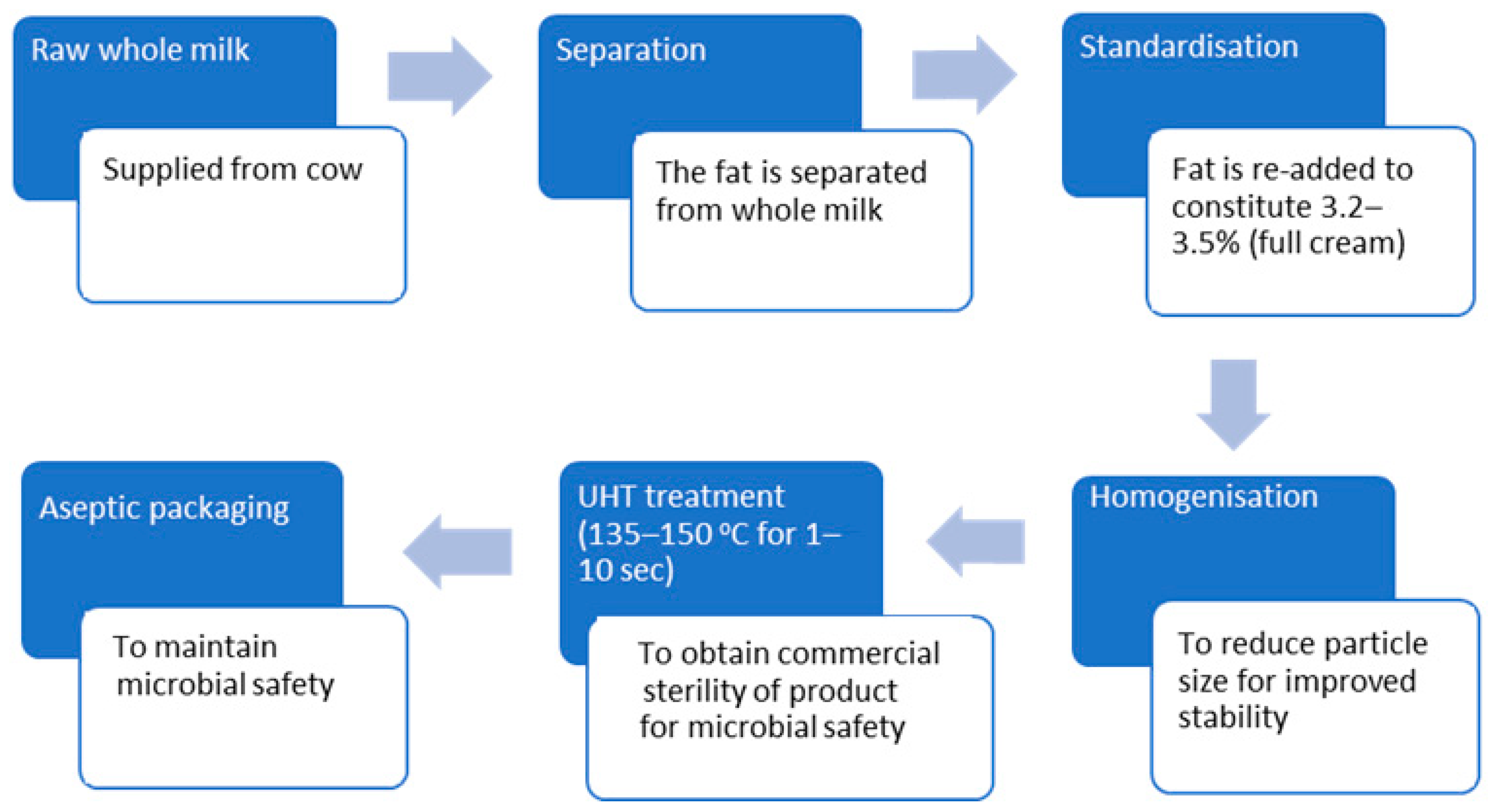
Figure 1. UHT milk production process. Adapted from Hummel et al. 2024 [29] and Datta et al. 2001 [31].
Beverages 11 00171 g001
Figure 2. A typical plant-based milk alternatives’ wet milling production process. Adapted from Fatih et al. 2021 [21] and Romuolo et al. 2021 [35].
Beverages 11 00171 g002
Table 1. Main macro- and micronutrients present in almond, oat, soy plant-based milk alternatives and UHT full cream cow milk.
ComponentAlmondOatSoyUHT Cow milkReferences
Macronutrients (g/100 g)
Carbohydrates including sugars1.7–2.86.1–6.74.8–5.54.8–5.0[40,41]
Total sugars1.3–1.71.8–2.71.8–2.24.8–5.0[40,41]
Dietary Fibre0.3–0.40.9–1.30.4–0.80.0[32,42,43]
Proteins0.6–0.71.1–1.23.2–3.63.2–3.4[32,40,44]
Fat1.8–2.52.0–3.02.2–3.03.4–3.5[40,41,44]
Micronutrients (mg/100 g)
Calcium65.649.984.2112[44]
Values sourced from Walther et al. 2022 [44] represent the mean of analyses conducted using the Kjeldahl method for protein, the Weibull–Stoldt method for fat, and enzymatic assays for starch and sugars. Values extracted from Magwere et al. 2025 [41], Harmer et al. 2025 [40], Vashisht et al. 2024 [43], and Smith et al. 2022 [42] were obtained from nutrition information panels on packaging labels and manufacturer websites, except for fibre values from Smith et al. 2022 [42], which was analysed using a Megazyme kit. Values from Pointke et al. 2022 [32] were collated from multiple nutritional databases, including FSANZ, Fineli, USDA FoodData Central, and the Max Rubner-Institut.
Disclaimer/Publisher’s Note: The statements, opinions and data contained in all publications are solely those of the individual author(s) and contributor(s) and not of MDPI and/or the editor(s). MDPI and/or the editor(s) disclaim responsibility for any injury to people or property resulting from any ideas, methods, instructions or products referred to in the content.