Article

Analytical and Chemometric Evaluation of Yerba Mate (Ilex paraguariensis A.St.-Hil.) in Terms of Mineral Composition


by
Justyna Ośko
*,
Aleksandra Bojarowska
,
Wiktoria Orłowska
and
Małgorzata Grembecka
*
Department of Bromatology, Faculty of Pharmacy, Medical University of Gdańsk, Gen. J. Hallera Avenue 107, 80-416 Gdańsk, Poland
*
Authors to whom correspondence should be addressed.
Beverages 2025, 11(6), 172; https://doi.org/10.3390/beverages11060172
Submission received: 29 September 2025 / Revised: 5 November 2025 / Accepted: 26 November 2025 / Published: 1 December 2025

Abstract

Yerba mate is a popular infusion originating in South America (Brazil, Argentina, Paraguay, and Uruguay). The leaves and shoots of the Paraguayan holly (Ilex paraguariensis A.St.-Hil.), which are used to prepare the drink, contain numerous macro- and microelements. Their content in the plant depends on a number of factors, such as soil mineral composition, cultivation methods, and climatic conditions. The aim of this study was to assess the elemental composition of yerba mate products with respect to their geographical origin. The dried plant and infusions were analysed using flame atomic absorption spectrometry and UV-Vis spectrophotometry for the content of 14 elements (Ca, Na, K, Mg, Cu, Cd, Co, Ni, Mn, Zn, Fe, Cr, Pb, and P). The most abundant macroelement in all analysed products was potassium (K) (1350 ± 167 mg/100 g). Yerba mate from Uruguay contained the highest levels of the analysed macroelements. The highest concentration among microelements was determined for Mn (135 ± 18.4 mg/100 g), for which the highest percentage of the daily requirement was also achieved as a result of consuming 200 mL of the infusion Products originating from Brazil and Paraguay exceeded the maximum permissible level of cadmium (Cd, 0.04 mg/100 g) in dried yerba mate, as specified by the Brazilian Health Regulatory Agency (ANVISA). Multivariate chemometric techniques enabled the differentiation of yerba mate samples according to their geographical origin.

Graphical Abstract

1. Introduction

Yerba mate is a product that originates from South American countries, where it is also most popular. The main countries where this plant is grown are Brazil, Argentina, Paraguay, and Uruguay [1]. Today, it is increasingly popular in Europe and North America [2,3]. Imports of yerba mate have also been rising in Poland [4]. As studies increasingly demonstrate its health benefits, demand continues to grow [5,6]. Analyses predict that the yerba mate market will continue to grow over the next few years [7,8]. Such rapid growth in popularity calls for detailed research into its chemical composition and mineral content. We currently know that yerba mate contains, among other things, purine alkaloids, flavonoids, saponins, and carotenoids [1]. It is also a source of macro- and microelements [9]. Existing research suggests that element concentrations depend on origin, soil type, cultivation method, and harvest period [10,11,12,13]. Analysing the mineral composition of products is important for assessing food quality, ensuring compliance with safety standards, and selecting appropriate products for the diet, which in turn affects overall health [14]. It also allows verification of individual ingredient content and the identification of potentially toxic components, such as heavy metals. Given the impact of yerba mate on health, analysing its composition is important to assess its quality and safety for consumption [9,15].
The infusion is traditionally prepared in a calabash gourd (cuia) and drunk through a filtered metal straw called a bombilla. The dried leaves are repeatedly infused with water, up to 5–7 times, until they lose their flavour. As a result, South Americans may consume up to 4 litres of mate per day. The highest consumption is reported in Uruguay, Argentina, and southern Brazil, with annual intake of 8–10 kg, 5–6 kg, and 3–5 kg per person, respectively [5].
Yerba mate infusion is valued primarily for its stimulating properties. It also has strong antioxidant and anti-inflammatory properties, mainly due to high levels of chlorogenic acid and its derivatives, which help neutralise free radicals that damage cells and disrupt physiological processes [16]. In addition, it has hypocholesterolaemic [17] and anti-diabetic [18] effects and may support weight loss [19].
Taking into account the richness of yerba mate in the mineral ingredients [9], it is an infusion that can supplement the diet with many important elements. Therefore, assessing its mineral composition may be helpful in adjusting the diet for people who need to supplement it with essential elements. Assessment of yerba mate composition also helps evaluate potential synergistic or antagonistic interactions with the diet already in use. Elements are known to play numerous important roles in the human body. They are building blocks of bones, teeth, and hair, and are components of molecules essential for proper metabolic processes and for maintaining water and electrolyte balance [20]. Elements such as potassium (K), magnesium (Mg), and manganese (Mn) are activators of numerous enzymes [21,22,23,24]. Potassium and Mg also participate in maintaining normal blood pressure [22,23,25]. Changes in the concentration of elements such as sodium (Na), K, and chlorine (Cl) cause disturbances in the water and electrolyte balance in our body [23]. Copper (Cu), on the other hand, is essential for the proper metabolism of Fe [23,26]. However, yerba mate may also contain elements toxic to humans, such as cadmium (Cd), arsenic (As), and lead (Pb), highlighting the importance of assessing its safety for consumption. The concentrations of Pb, Cd, and chromium (Cr) are higher in plants grown near roads or industrial areas. Elements found in polluted air accumulate in leaves [10,27]. The Brazilian Health Regulatory Agency (ANVISA) specifies maximum permissible levels of toxic elements, such as Pb (0.06 mg/100 g) and Cd (0.04 mg/100 g), in yerba mate [28]. Elemental analysis of toxic metals enables assessment of the safety of yerba mate for consumption.
Nowadays, food research commonly generates large, multivariate datasets using analytical methods. Food quality, which is highly important to consumers, and its variations result from the complex interactions of multiple factors and reactions [10]. To comprehensively extract information from these datasets, appropriate analytical tools must be employed. To comprehensively extract information from these datasets, appropriate analytical tools must be employed. Multivariate chemometric techniques are particularly useful, as they enable the extraction of relevant qualitative or quantitative information [29], verification of authenticity [30], species identification [31], or determination of the geographical origin of analysed foods [32,33]. Given the limited information in the scientific literature regarding elemental and heavy metal content in yerba mate, as well as the assessment of its geographical origin and authenticity, combining analytical methods with multivariate chemometric techniques provides an excellent approach for in-depth data analysis.
This study analysed samples of yerba mate, including dried leaves and stems from Argentina, Brazil, Paraguay, and Uruguay, as well as infusions prepared from them according to traditional methods. The aim was to evaluate dried material and infusions for 14 elements (Ca, Na, K, Mg, Cu, Cd, Co, Ni, Mn, Zn, Fe, Cr, Pb, and P) using flame atomic absorption spectrometry (FAAS) and UV-Vis spectrophotometry after dry mineralisation. Elemental data for dried yerba mate were subjected to chemometric analysis to assess geographical variation. The analysis of toxic metals (Cd, Pb) also enabled assessment of compliance with ANVISA safety requirements.

2. Materials and Methods

2.1. Samples

The study was conducted on 30 commercially available yerba mate products. All samples were purchased online from various retailers. The samples were analysed for 14 elements (Ca, Na, K, Mg, Cu, Cd, Co, Ni, Mn, Zn, Fe, Cr, Pb, and P) using FAAS and UV-Vis spectrophotometry. The analysed products were in loose-leaf form and contained pure yerba mate without additives. They originated from Brazil, Argentina, Paraguay, and Uruguay. The products varied in their proportions of leaves and stems (Table 1).

2.2. Preparation of Samples

Three 10.0 g portions of each product were weighed (±0.0001 g) on an analytical balance (Ohaus Corporation, Florham Park, model no. AP110S, Greifensee, Switzerland) into quartz crucibles. The crucibles were subjected to dry mineralisation in an electric furnace (Lindberg/Blue M, model no. BF51828C, Asheville, NC, USA) at temperatures up to 540 °C. Each residue was moistened with 1.5 mL of 36% hydrochloric acid (HCl, Tracepure, Merck, Darmstadt, Germany) and two drops of 63% nitric acid(V) (HNO3, Tracepure, Merck, Darmstadt, Germany). The contents of the crucibles were evaporated to dryness in a water bath. Then, 1.5 mL of concentrated HCl was added, the crucibles were covered with watch glasses, and placed on a boiling water bath for 1 min. The contents of each crucible were quantitatively transferred to a 25 mL volumetric flask and filled to the mark with Milli-Q water (18 MΩ·cm, Millipore, MA, USA).
For the infusions, three 30.0 g (±0.0001) samples of each yerba mate product were weighed into a 250 mL beaker. The samples were then treated with 200 mL of Milli-Q water (18 MΩ/cm, Millipore, MA, USA) at a temperature of 80 °C. The prepared infusions were covered with a watch glass and allowed to infuse for approximately 5 min. After this time, the infusions were filtered under reduced pressure to separate the leaves from the solution. The filtrates were transferred to quartz crucibles and evaporated to dryness on a boiling water bath. The residues were mineralised using the same dry mineralisation procedure as described above.
A blank was included in each measurement series and was prepared following the same procedure as the samples.

2.3. Elemental Analysis

The concentrations of Na, K, Mg, Ca, Zn, Cu, Fe, Co, Cr, Mn, Ni, Pb, and Cd were determined using FAAS. Measurements were performed using a Thermo Scientific iCE 3000 series spectrometer (Waltham, MA, USA).
All determinations were performed using stock solutions or appropriate dilutions. For Ca and Mg determinations, a 0.4% lanthanum oxide (Merck, Darmstadt, Germany) solution was used as a buffer, while for Na and K measurements, a 0.2% caesium chloride (Merck, Darmstadt, Germany) solution served as an ionisation buffer. The conditions of the AAS analysis used are presented in Table A1 (Appendix A).
Phosphorus (P) content was determined by spectrophotometry using an iron(II)–molybdenum(VI) reagent and a Genesys 10S UV–Vis spectrophotometer (Thermo Scientific, Waltham, MA, USA). A series of standard solutions was prepared in 25 mL volumetric flasks to construct the calibration curve. Volumes of 0 to 2.0 mL of KH2PO4 standard solution (Merck, Darmstadt, Germany) were placed in 25 mL volumetric flasks (14 points). Then, 10 mL of iron(II)–molybdate(VI) solution was added to each flask, and the flasks were made up to the mark with Milli-Q water. The iron(II)–molybdenum(VI) solution was freshly prepared by weighing 25 g of FeSO4 × 7H2O (Tracepure, Merck, Darmstadt, Germany) into a measuring flask, adding 50 mL of a 10% ammonium molybdate solution (99.98% trace metals basis; Merck, Darmstadt, Germany), and making up to the mark with Milli-Q water.
The absorbance of the prepared samples was measured using a spectrophotometer at a wavelength of 650 nm. The calibration curve for phosphorus was described by the equation: y = 0.0036x + 0.0053, with R2 = 0.9993. This method is consistent with the procedure described in [34].

2.4. Method Validation

The limits of detection (LOD) and quantification (LOQ) were determined from analyses of blank samples (Table 2). The procedure followed the method of Konieczka and Namieśnik [35]. The LOD was calculated as the mean of the blank plus three times its standard deviation (SD), with both parameters obtained from replicate blank measurements. The LOQ was set at three times the LOD. Accuracy and precision were assessed using the certified reference material Oriental Basma Tobacco Leaves (INCT-OBTL-5). Element recoveries ranged from 89 to 112% of the certified values, and precision varied between 0.02 and 10.2% (Table 2).

2.5. Statistical Analysis

Statistical analyses were performed using Statistica 13.3 (StatSoft®, TIBCO Software Inc., San Ramon, CA, USA). The normality of the variables was assessed using the Shapiro–Wilk test. Since the data did not follow a normal distribution, non-parametric tests were applied. Prior to analysis, the dataset was standardised. A data matrix was then constructed with elements as columns and yerba mate samples as rows. Spearman’s rank correlation, the Kruskal–Wallis test, factor analysis (FA), and cluster analysis (CA) were then conducted. Cluster analysis was performed using Ward’s method with Euclidean distance.

3. Results and Discussion

3.1. Macroelements

The analysed yerba mate samples from Argentina, Brazil, Paraguay, and Uruguay exhibited varying concentrations of the studied elements. The predominant macroelements were K, Ca, Mg, and P (Table 3). Brazilian yerba mate contained the highest K levels (1475 mg/100 g). By contrast, Pozebon et al. [36] reported the highest K concentration in Paraguayan samples (1365 mg/100 g), while Marcelo et al. [10] obtained comparable values (1231 mg/100 g). Overall, the average K content ranged from 1197 mg/100 g in Argentinean products to 1475 mg/100 g in Brazilian products.
Uruguayan samples contained the highest levels of Na (3.01 mg/100 g), Ca (814 mg/100 g), Mg (603 mg/100 g), and P (182 mg/100 g) (Table 4). Pozebon et al. [36] reported similar trends for Ca and Mg (766 and 557 mg/100 g, respectively), although their P values were higher (366 mg/100 g). In the present study, Ca concentrations ranged from 719 mg/100 g (Brazil) to 814 mg/100 g (Uruguay) (Table 4). However, Olivari et al. [9] reported lower Ca values: 266 mg/100 g in Brazilian products and 617 mg/100 g in Paraguayan products. The Mg levels in our products (441–603 mg/100 g) also exceeded those reported by Olivari et al. [9] (196–383 mg/100 g). Phosphorus concentrations in our samples (111–182 mg/100 g) were lower than those reported by Marcelo et al. [10] (341 mg/100 g). By contrast, Malik et al. [37] reported P values (88–139 mg/100 g) consistent with our findings.
Among the macroelements, extraction efficiency was highest for Na (23.6–75.3%) and Ca (21.3–29.0%), with maximum values observed in Argentinean (Na) and Brazilian/Uruguayan (Ca) samples. Proch et al. [38] similarly noted the highest extraction rates for Na (63%) across different brewing methods. However, extraction percentages and the sequence of element release can vary depending on the brewing method, water composition, and infusion temperature [38,39].

3.2. Microelements

Manganese (Mn) was the most abundant microelement in the analysed samples (Table 4), consistent with reports by Pozebon et al. [36] and Proch et al. [40]. Its concentrations varied with geographic origin, ranging from 100 mg/100 g in Paraguayan samples to 153 mg/100 g in Argentinean samples. Pozebon et al. [36] reported similar Mn levels, from 73 mg/100 g (Paraguay) to 145 mg/100 g (Uruguay).
Iron and Zn were also notable in our samples. Iron was highest in Paraguayan samples (24 mg/100 g), similar to the 23 mg/100 g reported by Proch et al. [40]. Its concentrations across all samples ranged from 12.6 to 51.9 mg/100 g, whereas Olivari et al. [9] reported a wider range (0.9–807 mg/100 g). Zinc levels in the analysed yerba mate samples ranged from 7.60 to 11.0 mg/100 g, with Paraguayan samples containing the highest levels (11 mg/100 g), exceeding the literature values reported by Pozebon et al. [36] (7.73–7.94 mg/100 g).
Cobalt was below the detection limit (LOD = 0.012 mg/100 g) in two Brazilian samples. Literature reports an average of 0.034 mg/100 g in Brazilian raw material [40]. Samples from Paraguay, Uruguay, and Argentina showed similar Co concentrations (Table 4).
Nickel levels were lowest in Brazilian samples (0.19 mg/100 g) and higher in samples from Paraguay (0.4 mg/100 g), Uruguay (0.31 mg/100 g), and Argentina (0.46 mg/100 g). Proch et al. [40] reported 0.4 mg/100 g in Brazilian samples, while Argentinean yerba mate had the highest Ni content in both studies (0.58 mg/100 g in our analysis). Chromium concentrations in the analysed products ranged from 0.06 mg/100 g in Uruguayan samples to 0.09 mg/100 g in Paraguayan samples. Similar values were reported by Proch et al. [40], who found Cr levels of 0.05 mg/100 g in Paraguayan, 0.06 mg/100 g in Brazilian, and 0.06 mg/100 g in Argentinean yerba mate.
Table 4. Concentration of bioelements and toxic metals in yerba mate samples in mg/100 g (average ± SD, range) and percentage of leaching (%).
Na
[mg/100 g]
K
[mg/100 g]
Ca
[mg/100 g]
Mg
[mg/100 g]
P
[mg/100 g]
Co
[mg/100 g]
Cd
[mg/100 g]
Cr
[mg/100 g]
Cu
[mg/100 g]
Fe
[mg/100 g]
Mn
[mg/100 g]
Zn
[mg/100 g]
Ni
[mg/100 g]
Argentina 11x31.49 ± 0.43
(0.95–2.22)
75.3 ± 38.8%
1197 ± 199
(569–1516)
31.5 ± 13.9%
767 ± 67.4
(667–912)
22.5 ± 4.59%
448 ± 69.3
(319–554)
12.3 ± 6.04%
158 ± 3.61
(73.7–198)
13.1 ± 2.38%
0.04 ± 0.01
(0.03–0.06)
9.71 ± 1.65%
0.03 ± 0.01
(0.02–0.05)
22.4 ± 4.80%
0.08 ± 0.01
(0.07–0.09)
6.64 ± 1.04%
0.80 ± 0.05
(0.73–0.92)
8.93 ± 1.15%
19.4 ± 3.60
(13.6–25.0)
3.94 ± 0.94%
153 ± 23.5
(112–197)
6.58 ± 1.03%
8.67 ± 2.03
(5.25–11.2)
6.88 ± 1.30%
0.46 ± 0.12
(0.32–0.80)
16.2 ± 4.96%
Brazil
4 × 3
2.92 ± 0.74
(1.69–3.62)
23.6 ± 14.1%
1475 ± 239
(1175–1702)
12.9 ± 2.32%
719 ± 45.8
(663–788)
29.0 ± 3.71%
493 ± 84.5
(403–627)
12.0 ± 2.03%
111 ± 2.82
(64–166)
12.5 ± 4.84%
0.02 ± 0.01
(0.02–0.02)
< LOD
0.05 ± 0.01
(0.04–0.06)
16.1 ± 1.50%
0.08 ± 0.03
(0.04–0.13)
5.18 ± 1.20%
0.98 ± 0.11
(0.79–1.07)
9.80 ± 1.62%
15.5 ± 1.84
(12.6–17.1)
5.44 ± 0.82%
141 ± 26.4
(106–178)
6.73 ± 0.96%
7.60 ± 0.82
(6.28–8.35)
6.64 ± 0.58%
0.19 ± 0.04
(0.15–0.26)
21.3 ± 4.23%
Paraguay
10 × 3
1.76 ± 1.25
(0.59–5.11)
52.9 ± 43.6%
1381 ± 171
(1228–1452)
16.6 ± 1.65%
793 ± 29.7
(750–854)
21.3 ± 5.84%
441 ± 34.0
(386–508)
15.3 ± 3.94%
133 ± 5.93
(36.2–188)
15.1 ± 5.47%
0.03 ± 0.01
(0.01–0.05)
10.6 ± 1.47%
0.05 ± 0.01
(0.03–0.07)
20.3 ± 3.53%
0.09 ± 0.05
(0.04–0.21)
8.96 ± 6.55%
0.82 ± 0.06
(0.71–0.93)
10.2 ± 0.99%
24.0 ± 10.3
(14.5–51.9)
5.61 ± 2.46%
100 ± 16.8
(66.5–132)
7.94 ± 1.44%
11.0 ± 2.21
(5.99–13.3)
6.45 ± 0.86%
0.40 ± 0.15
(0.25–0.80)
19.7 ± 6.55%
Uruguay
5 × 3
3.01 ± 0.32
(2.72–3.58)
49.0 ± 34.2%
1349 ± 92.3
(1247–1429)
16.3 ± 1.67%
814 ± 45.3
(729–851)
29.0 ± 6.14%
603 ± 11.2
(522–824)
14.2 ± 3.39%
182 ± 1.75
(111–222)
11.6 ± 1.53%
0.03 ± 0.01
(0.02–0.04)
14.9 ± 1.56%
0.04 ± 0.01
(0.03–0.05)
24.8 ± 7.72%
0.06 ± 0.01
(0.05–0.08)
7.49 ± 1.97%
1.01 ± 0.05
(0.93–1.09)
11.5 ± 1.91%
21.4 ± 4.39
(16.1–27.6)
5.51 ± 1.05%
146 ± 6.98
(136–155)
7.57 ± 0.55%
7.63 ± 0.94
(6.54–9.26)
8.17 ± 2.00%
0.31 ± 0.06
(0.27–0.42)
17.6 ± 5.18%
LOD for Co = 0.012 mg/100 g.
Among the microelements, Ni exhibited the highest leaching into the infusion, particularly in Brazilian samples (21.3%). Other elements, including Co, Cr, Cu, Fe, Mn, and Zn, leached at rates of no more than 11%. Olivari et al. [9] reported similar leaching for Cr (7.0%), Cu (11.1%), Mn (7.3%), and Zn (6.9%) in warm infusions (70–75 °C), highlighting statistically significant differences depending on brewing conditions, particularly water temperature. Additionally, variations in element leaching may result from factors such as soil composition, harvest season, and the geographic origin of the raw material [41]. The low degree of microelement extraction may also be influenced by other leaf constituents, such as caffeine, theobromine, or other nutrients [41].

3.3. Toxic Elements

The Pb content in all analysed products, including both raw material and infusions, was below the limit of detection (LOD = 0.02 mg/100 g). The maximum permissible concentration of Pb in yerba mate (0.06 mg/100 g), as specified by ANVISA, was not exceeded [28]. Milani et al. [42] reported Pb levels of 0.04 mg/100 g in yerba mate samples. In turn, Proch et al. [40] found the highest Pb concentration in Argentinean samples, reaching 0.09 mg/100 g.
In our study, the highest Cd contents were observed in samples from Brazil and Paraguay (Table 4), consistent with the 0.04 mg/100 g reported by Proch et al. [40] for the same countries. The average Cd concentrations in Brazilian and Paraguayan samples exceeded the ANVISA maximum limit (0.04 mg/100 g). Specifically, 75% of Brazilian products and 60% of Paraguayan products surpassed the permitted Cd levels. Among products from Uruguay and Argentina, 20% exceeded the maximum Cd limit. The elevated Cd content in some Brazilian and Paraguayan samples may result from industrial activities located near the plantations. Contaminants like Cd can enter the air, soil, and water, and accumulate in plants [12].
The average Cd leaching rate into yerba mate infusions was 20.9% (Table 4). The highest Cd extraction was observed in Uruguayan products (24.8%), followed by Argentinean (22.4%), Paraguayan (20.3%), and Brazilian samples (16.1%). Given the relatively high transfer of Cd from leaves to infusions compared with other microelements, monitoring of yerba mate leaves for toxic metal content by ANVISA is justified.

3.4. Kruskal–Wallis Test

The Kruskal–Wallis test indicated that the concentrations of several elements varied according to the geographical origin of yerba mate, including Na (H = 12.626; p = 0.005), K (H = 9.253; p = 0.026), Ca (H = 7.516; p = 0.057), Mg (H = 10.165; p = 0.017), P (H = 11.448; p = 0.009), Co (H = 12.655; p = 0.005), Cd (H = 9.266; p = 0.026), Cr (H = 4.436; p = 0.022), Cu (H = 15.034; p = 0.002), Fe (H = 5.179; p = 0.159), Mn (H = 18.150; p = 0.004), Zn (H = 9.271; p = 0.026), and Ni (H = 16.957; p = 0.001). Differences were particularly significant for Na, Mg, P, Co, Cu, Mn, and Ni. According to the literature [43], factors influencing such variation among elements include soil properties (pH, soil composition), plant genetics, plant age, leaf position, agricultural practices (fertilisers), solar deposition, and other environmental factors. Low soil pH can affect the dynamics of soil elements, notably increasing the availability of Cu, Fe, Mn, Ni, Zn, Al, Pb, and Cd, while decreasing the availability of Mo and P [44]. In general, yerba mate is characterised by low P content due to its occurrence in low-fertility soils. However, as a result of the application of high doses of P-containing fertilisers, Ceconi et al. [45] and Santin et al. [46] reported an increased uptake of P by the plant. In addition, when assessing the impact of this macroelement on the elemental composition of Paraguayan holly leaves, Santin et al. [46] observed changes in the contents of N, K, Ca, Mg, Fe, Mn, Cu, and Zn.

3.5. Dunn’s Test

The Dunn test was performed to confirm the results of the Kruskal–Wallis test and to identify which groups differed significantly from one another. Significant differences were found for Mn and Ni (p < 0.001) among yerba mate samples from Argentina, Brazil, and Paraguay. These elements may reflect the characteristics of the soils in these regions, suggesting a similar elemental composition of yerba mate from these three countries (Table 5).

3.6. Correlation Analysis

A non-parametric Spearman’s rank test was performed at three significance levels (p = 0.05, p = 0.01, p = 0.001). The analysis revealed both positive and negative relationships between the elements studied. The strongest positive correlation (p < 0.001) was observed between K and Cu. Highly significant positive correlations (p < 0.01) were found for the following pairs of elements: Ca-Mg, Co-Ni, Cd-Zn, and Cr-Fe. In contrast, highly significant negative relationships (p < 0.01) were identified between Cd-Ni and Mn-Zn. According to Kabata-Pendias and Szteke, the Cd–Zn relationship typically exhibits a synergistic effect. This process results in increased uptake of both elements at elevated concentrations. This effect is particularly pronounced at low pH values. In the case of the Cd–Ni correlation, Cd may be displaced during uptake processes, which could explain the negative correlation observed between these elements in our analysis.

3.7. Factor Analysis

Factor analysis was applied to all yerba mate samples with respect to their geographical origin. The samples were distinguished by the concentrations of Na, K, Ca, Mg, P, Co, Cd, Cr, Cu, Fe, Mn, Zn, and Ni. The results of the factor analysis are shown in Figure 1a,b. Factor F1 explained 24.3% of the variance, whereas factor F2 accounted for 18.4%. Together, these two factors explained 42.7% of the variance, with eigenvalues of 3.16 and 2.4, respectively.
As shown in Figure 1a, factor F1 separated samples from Uruguay and Brazil from those originating in Argentina and Paraguay. High F1 scores were associated with Na, Mg, Cu, K, Cd, and Zn. Low F1 scores, characterised by Mn, P, Fe, Cr, Ni, and Co, distinguished samples from Argentina and Paraguay (Figure 1a,b).
In contrast, high F2 scores distinguished samples from Uruguay, while Paraguayan products exhibited low F2 values. Uruguayan material contained higher levels of Mg, Na, and Cu, whereas Paraguayan yerba mate was primarily characterised by Zn (Figure 1b).
Elevated K and Cd levels in Brazilian yerba mate allowed their separation from material originating in the other two countries. Argentinian products were characterised by elements such as Mn, P, Fe, Cr, Ni, and Co.
The clear distinction of Uruguayan samples, alongside only partial separation of Brazilian, Paraguayan, and Argentinian ones, may result from the geographical location of plantations. Some plantations in Brazil, Paraguay, and Argentina are located in close proximity to one another. According to data obtained from producers, Paraguayan yerba mate grown in the province of Itapúa was not clearly distinguishable from raw material originating from the Argentine province of Misiones. This is attributed to the close proximity of these two regions. Consequently, the mineral composition of the soils in these regions is similar. According to the literature, this factor significantly influences the elemental composition of the plant [1].

3.8. Cluster Analysis

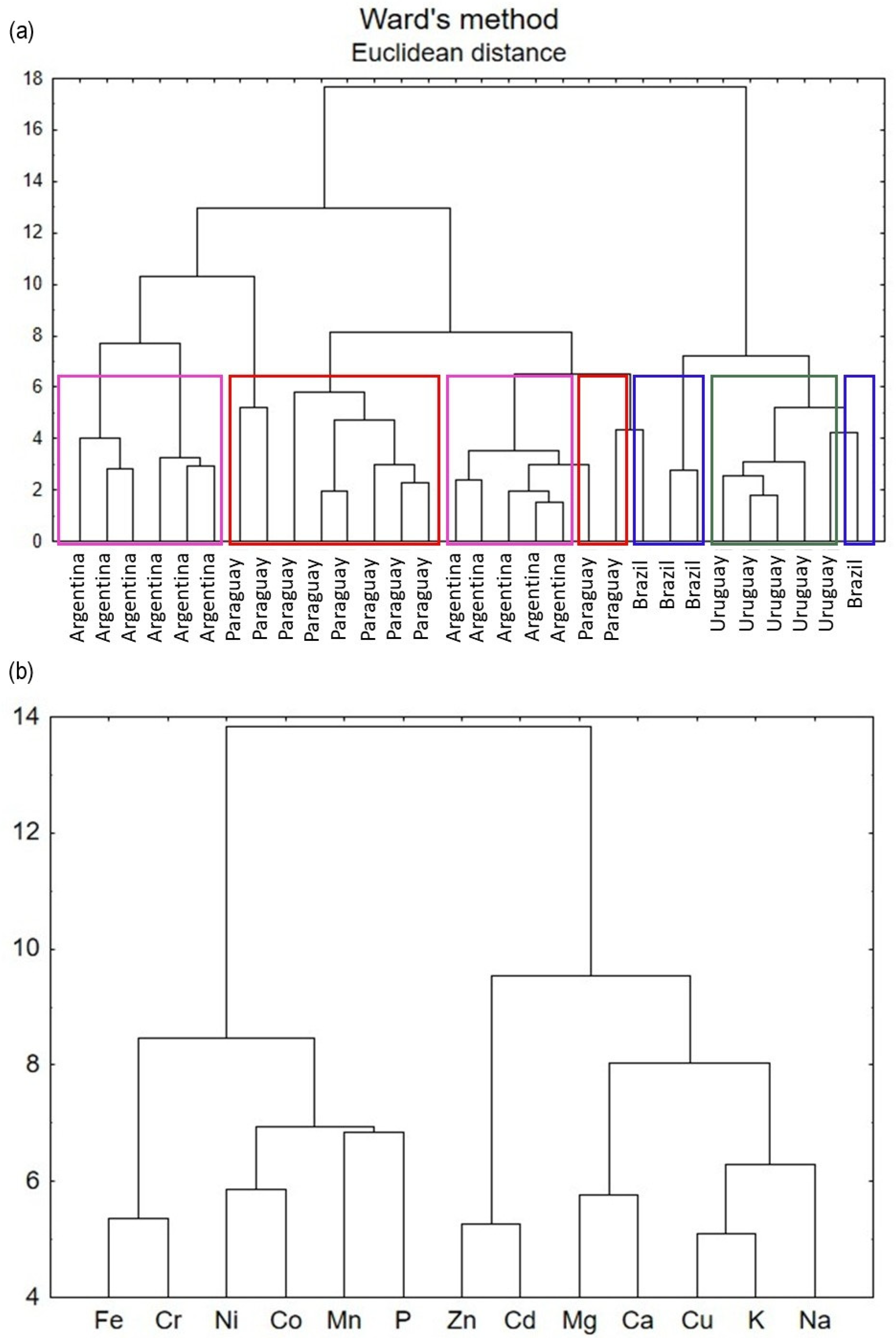
Cluster analysis was conducted using Ward’s method with Euclidean distance (Figure 2). This approach enabled the grouping of samples based on their geographical origin.
The dendrogram shows that yerba mate from Argentina and Paraguay clustered together, characterised by Fe, Ni, Cr, Co, Mn, P, and Zn, whereas samples from Brazil and Uruguay were characterised by Cd, Mg, Ca, Cu, K, and Na. Within this grouping, Uruguayan yerba mate was clearly distinguished from products from the other countries.
Similar to the FA, no clear separation was obtained between Argentinian, Paraguayan, and Brazilian samples. Overall, the CA confirmed the relationships identified in the factor analysis.

3.9. Assessment of Mineral Compounds Intake and Safety of Yerba Mate Infusions

3.9.1. Recommended Dietary Intake of Elements

According to dietary standards for the Polish population [23], the daily or adequate intake of the analysed elements was calculated based on the consumption of 200 mL of yerba mate infusion prepared from 30 g of dried leaves. For Ca, Mg, P, Fe, Zn, and Cu, estimates were related to the Recommended Dietary Allowance (RDA), whereas for Na, K, and Mn, the adequate intake (AI) was applied.
Among the macroelements, Mg contributed most significantly to the daily requirement from a 200 mL infusion (Table 5). The estimated intake covered 18.9% of the daily Mg requirement for women and 14.4% for men. By contrast, the contribution of Ca, P, Na, and K was minimal (<2% RDA and <6% AI).
Yerba mate infusions, however, may contribute to the daily intake of microelements such as Mn, Cu, and Zn. A 200 mL infusion (prepared from 30 g of leaves) provides 9.52% of the daily requirement for Cu, and 6.96% and 5.06% of Zn requirements for women and men, respectively (Table 5). The highest percentage of AI was observed for Mn, as a 200 mL infusion exceeded 100% of the recommended intake for this element. Specifically, the estimated intake covered 476% of AI for women and 372% for men. This exceptionally high level is due to the elevated Mn concentration in the raw material used for infusion preparation. The infusions were prepared using a standard procedure with 30 g of dried leaves, which may have contributed to the elevated levels of individual elements. However, it should be noted that Mn from the infusion is not fully absorbed. According to Powell et al. [47], simulations of intestinal conditions indicate that Mn bioavailability from tea is approximately 40%. Applying this factor to yerba mate suggests that 200 mL of infusion provides about 190% of AI for women and 149% for men. Thus, even a single 200 mL serving is sufficient to meet, and in some cases exceed, the recommended AI for Mn. However, chronic intake of Mn above recommended levels may cause adverse health effects [48].

3.9.2. Assessment of Exposure to Toxic Metals

According to the FAO/WHO Expert Committee on Food Additives, the amount of heavy metals ingested through food over time is critical for human health and safety [49]. Therefore, a provisional tolerable monthly intake (PTMI) of Cd from food has been established at 0.025 mg/kg body weight [49]. In 8 of the 30 prepared yerba mate infusions, Cd content was below the LOD (0.002 mg/100 g), preventing estimation of the PTMI contribution (1.75 mg/kg body weight for a person weighing 70 kg). In the remaining samples, Cd content was close to the detection limit. Only one sample, originating from Uruguay, exhibited a higher Cd concentration (0.011 mg/100 g), corresponding to 18.4% of the PTMI. Thus, daily consumption of 200 mL does not pose a health risk; however, yerba mate is frequently consumed in substantially larger quantities. It is estimated that about 30% of South Americans consume more than one litre of yerba mate per day [50]. At this intake level, the body could accumulate excessive Cd, as one litre of infusion per day would correspond to 92% of the PTMI. Prolonged intake at such levels could, therefore, lead to adverse health effects. For the remaining products, exposure to heavy metals was not found to pose any significant health risk.

4. Conclusions

Based on the analysis of 30 yerba mate products (dried leaves and infusions) from Brazil, Argentina, Paraguay, and Uruguay, significant differences in their mineral composition were observed. These variations highlight the influence of geographical origin and cultivation practices on the elemental profile of yerba mate. Potassium was the predominant macroelement across all samples, irrespective of geographical origin. Samples from Uruguay contained the highest levels of the analysed macroelements (Ca, Na, Mg, and P) compared to products from Paraguay, Brazil, and Argentina. Among the microelements, Mn exhibited the highest concentration in yerba mate. Samples from Paraguay had the highest concentrations of Cr, Fe, and Zn among the microelements. Such differences in microelement content may affect both the nutritional value and potential health benefits of yerba mate infusions.
Lead levels were below the detection limit (LOD = 0.02 mg/100 g) in all samples, and therefore did not exceed the AN-VISA maximum permissible concentration (0.06 mg/100 g). The highest Cd concentrations were observed in products originating from Brazil and Paraguay. Yerba mate products from Brazil (75%) and Paraguay (60%) exceeded the maximum permissible concentration of Cd in yerba mate specified by ANVISA.
Regarding daily nutritional requirements, Mg contributed the highest percentage of the RDA among macroelements. By contrast, the infusions provided only a minor contribution to daily requirements for Ca, K, Na, P, and Fe. Consumption of 200 mL of yerba mate infusion resulted in a substantial exceedance of the adequate intake for Mn.
Considering the tolerable monthly intake for Cd, daily consumption of 200 mL of yerba mate infusion does not pose a health risk. However, caution is warranted, as higher intakes may result in an excessive Cd dose. This emphasises the importance of monitoring heavy metal content in commercially available yerba mate products to ensure consumer safety. Multivariate techniques, combined with the analytical methods applied, proved to be effective tools for differentiating yerba mate samples according to their geographical origin. Overall, the combination of chemical analysis and statistical techniques provides a reliable approach for assessing both the quality and geographical traceability of yerba mate.

Author Contributions

Conceptualisation, J.O. and M.G.; methodology, J.O. and M.G.; software, M.G.; validation. J.O.; formal analysis, J.O., A.B. and W.O.; investigation, J.O., A.B. and W.O.; resources, M.G.; data curation, J.O., A.B. and W.O.; writing—original draft preparation, J.O.; writing—review and editing, M.G.; visualization, J.O.; supervision, M.G.; project administration, J.O. and M.G.; funding acquisition, M.G. All authors have read and agreed to the published version of the manuscript.

Funding

This research received financial support within the Statutory Research Funding of the Medical University of Gdańsk, number 02-0010/07/504.

Institutional Review Board Statement

Not applicable.

Informed Consent Statement

Not applicable.

Data Availability Statement

All data are contained within the article.

Conflicts of Interest

The authors declare no conflicts of interest.

Abbreviations

The following abbreviations are used in this manuscript:
ANIVISABrazilian Health Regulatory Agency
FAASFlame Atomic Absorption Spectrometry
LODLimit Of Detection
LOQLimit Of Quantification
RDARecommended Dietary Allowances
AIAdequate Intake
PTMIProvisional Tolerable Monthly Intake
FAFactor Analysis
CACluster Analysis
FAO/WHOUnited Nations Food and Agriculture Organization (FAO) and the World Health Organization (WHO)

Appendix A

Table A1. Conditions for determining elements using the AAS method.
ElementWavelength (nm)Slot (nm)Fuel Flow (L/min)Burner Height (mm)Background Correction
Na5890.20.86.8
K766.50.50.97
Ca422.70.50.96.8
Mg285.20.50.86.5
Co240.70.20.99+
Cd228.80.50.87.5+
Cr357.90.51.19.2+
Cu324.80.50.87.3+
Fe248.30.20.98+
Mn279.50.20.87+
Zn213.90.21.27+
Ni2320.10.97+
Pb2170.50.85.3+

References

  1. Heck, C.I.; De Mejia, E.G. Yerba Mate Tea (Ilex paraguariensis): A Comprehensive Review on Chemistry, Health Implications, and Technological Considerations. J. Food Sci. 2007, 72, R138–R151. [Google Scholar] [CrossRef] [PubMed]
  2. Bracesco, N.; Sanchez, A.G.; Contreras, V.; Menini, T.; Gugliucci, A. Recent Advances on Ilex paraguariensis Research: Minireview. J. Ethnopharmacol. 2011, 136, 378–384. [Google Scholar] [CrossRef] [PubMed]
  3. Alkhatib, A.; Atcheson, R. Yerba Maté (Ilex paraguariensis) Metabolic, Satiety, and Mood State Effects at Rest and during Prolonged Exercise. Nutrients 2017, 9, 882. [Google Scholar] [CrossRef] [PubMed]
  4. Dmowski, P.; Post, L. Influence of the Multiplicity Yerba Mate Brewing on the Antioxidant Activity of the Beverages. Sci. J. Gdyn. Marit. Univ. 2018, 104, 9–18. [Google Scholar] [CrossRef]
  5. Gawron-Gzella, A.; Chanaj-Kaczmarek, J.; Cielecka-Piontek, J. Yerba Mate—A Long but Current History. Nutrients 2021, 13, 3706. [Google Scholar] [CrossRef]
  6. Lutomski, P.; Goździewska, M.; Florek-Łuszczki, M. Health Properties of Yerba Mate. Ann. Agric. Environ. Med. 2020, 27, 310–313. [Google Scholar] [CrossRef]
  7. Maximize Market Research. Available online: https://www.maximizemarketresearch.com/market-report/global-yerba-mate-market/23486 (accessed on 1 September 2025).
  8. Pawan, G. Yerba Mate Market Size, Share, Trends, Analysis, Growth, & Forecast by 2029; Data Bridge Market Research Private Ltd.: Pune, India, 2025. [Google Scholar]
  9. Olivari, I.; Paz, S.; Gutiérrez, Á.J.; González-Weller, D.; Hardisson, A.; Sagratini, G.; Rubio, C. Macroelement, Trace Element, and Toxic Metal Levels in Leaves and Infusions of Yerba Mate (Ilex paraguariensis). Environ. Sci. Pollut. Res. 2020, 27, 21341–21352. [Google Scholar] [CrossRef]
  10. Marcelo, M.C.A.; Martins, C.A.; Pozebon, D.; Dressler, V.L.; Ferrão, M.F. Classification of Yerba Mate (Ilex paraguariensis) According to the Country of Origin Based on Element Concentrations. Microchem. J. 2014, 117, 164–171. [Google Scholar] [CrossRef]
  11. Toppel, F.V.; Junior, A.M.; Motta, A.C.V.; Frigo, C.; Magri, E.; Barbosa, J.Z. Soil Chemical Attributes and Their Influence on Elemental Composition of Yerba Mate Leaves. Floresta 2018, 48, 425–434. [Google Scholar] [CrossRef]
  12. Magri, E.; Valduga, A.T.; Gonçalves, I.L.; Barbosa, J.Z.; Rabel, D.D.O.; Menezes, I.M.N.R.; Nascimento, P.D.A.; Oliveira, A.; Corrêa, R.S.; Motta, A.C.V. Cadmium and Lead Concentrations in Yerba Mate Leaves from Agroforestry and Plantation Systems: An International Survey in South America. J. Food Compos. Anal. 2021, 96, 103702. [Google Scholar] [CrossRef]
  13. Camotti Bastos, M.; Cherobim, V.F.; Reissmann, C.B.; Fernandes Kaseker, J.; Gaiad, S. Yerba Mate: Nutrient Levels and Quality of the Beverage Depending on the Harvest Season. J. Food Compos. Anal. 2018, 69, 1–6. [Google Scholar] [CrossRef]
  14. Ibourki, M.; Hallouch, O.; Devkota, K.; Guillaume, D.; Hirich, A.; Gharby, S. Elemental Analysis in Food: An Overview. J. Food Compos. Anal. 2023, 120, 105330. [Google Scholar] [CrossRef]
  15. Ulbrich, N.C.M.; Do Prado, L.L.; Barbosa, J.Z.; Araujo, E.M.; Poggere, G.; Motta, A.C.V.; Prior, S.A.; Magri, E.; Young, S.D.; Broadley, M.R. Multi-Elemental Analysis and Health Risk Assessment of Commercial Yerba Mate from Brazil. Biol. Trace Elem. Res. 2022, 200, 1455–1463. [Google Scholar] [CrossRef] [PubMed]
  16. Berté, K.; Rodriguez–Amaya, D.B.; Hoffmann-Ribani, R.; Junior, A.M. Antioxidant Activity of Maté Tea and Effects of Processing. In Processing and Impact on Antioxidants in Beverages; Elsevier: Amsterdam, The Netherlands, 2014; pp. 145–153. ISBN 978-0-12-404738-9. [Google Scholar]
  17. De Morais, E.C.; Stefanuto, A.; Klein, G.A.; Boaventura, B.C.B.; De Andrade, F.; Wazlawik, E.; Di Pietro, P.F.; Maraschin, M.; Da Silva, E.L. Consumption of Yerba Mate (Ilex paraguariensis) Improves Serum Lipid Parameters in Healthy Dyslipidemic Subjects and Provides an Additional LDL-Cholesterol Reduction in Individuals on Statin Therapy. J. Agric. Food Chem. 2009, 57, 8316–8324. [Google Scholar] [CrossRef] [PubMed]
  18. Arçari, D.P.; Bartchewsky, W.; dos Santos, T.W.; Oliveira, K.A.; DeOliveira, C.C.; Gotardo, É.M.; Pedrazzoli, J.; Gambero, A.; Ferraz, L.F.C.; Carvalho, P.d.O.; et al. Anti-Inflammatory Effects of Yerba Maté Extract (Ilex paraguariensis) Ameliorate Insulin Resistance in Mice with High Fat Diet-Induced Obesity. Mol. Cell. Endocrinol. 2011, 335, 110–115. [Google Scholar] [CrossRef] [PubMed]
  19. Kim, S.-Y.; Oh, M.-R.; Kim, M.-G.; Chae, H.-J.; Chae, S.-W. Anti-Obesity Effects of Yerba Mate (Ilex paraguariensis): A Randomized, Double-Blind, Placebo-Controlled Clinical Trial. BMC Complement. Altern. Med. 2015, 15, 338. [Google Scholar] [CrossRef]
  20. Jomova, K.; Makova, M.; Alomar, S.Y.; Alwasel, S.H.; Nepovimova, E.; Kuca, K.; Rhodes, C.J.; Valko, M. Essential Metals in Health and Disease. Chem. Biol. Interact. 2022, 367, 110173. [Google Scholar] [CrossRef]
  21. Aschner, J.L.; Aschner, M. Nutritional Aspects of Manganese Homeostasis. Mol. Aspects Med. 2005, 26, 353–362. [Google Scholar] [CrossRef]
  22. Fijorek, K.; Püsküllüoğlu, M.; Tomaszewska, D.; Tomaszewski, R.; Glinka, A.; Polak, S. Serum Potassium, Sodium and Calcium Levels in Healthy Individuals—Literature Review and Data Analysis. Folia Med. Cracov. 2014, 54, 53–70. [Google Scholar]
  23. Rychlik, E.; Stoś, K.; Woźniak, A.; Mojska, H. Normy Żywienia dla Populacji Polski; Narodowy Instytut Zdrowia Publicznego PZH—Państwowy Instytut Badawczy: Warszawa, Poland, 2024; ISBN 978-83-65870-78-0.
  24. Wołonciej, M.; Milewska, E.; Roszkowska-Jakimiec, W. Trace Elements as an Activator of Antioxidant Enzymes. Postęp. Hig. Med. Dośw. 2016, 70, 1483–1498. [Google Scholar] [CrossRef]
  25. Filippini, T.; Violi, F.; D’Amico, R.; Vinceti, M. The Effect of Potassium Supplementation on Blood Pressure in Hypertensive Subjects: A Systematic Review and Meta-Analysis. Int. J. Cardiol. 2017, 230, 127–135. [Google Scholar] [CrossRef]
  26. Dietary Reference Values for Iron | EFSA. Available online: https://www.efsa.europa.eu/en/efsajournal/pub/4254 (accessed on 1 September 2025).
  27. Harrison, R.M.; Chirgawi, M.B. The Assessment of Air and Soil as Contributors of Some Trace Metals to Vegetable Plants I. Use of a Filtered Air Growth Cabinet. Sci. Total Environ. 1989, 83, 13–34. [Google Scholar] [CrossRef] [PubMed]
  28. Ministro de Estado da Saúde. Available online: https://bvsms.saude.gov.br/bvs/saudelegis/anvisa/2013/rdc0042_29_08_2013.html (accessed on 1 September 2025).
  29. Ośko, J.; Szewczyk, A.; Berk, P.; Prokopowicz, M.; Grembecka, M. Assessment of the Mineral Composition and the Selected Physicochemical Parameters of Dietary Supplements Containing Green Tea Extracts. Foods 2022, 11, 3580. [Google Scholar] [CrossRef] [PubMed]
  30. Rodionova, O.Y.; Oliveri, P.; Malegori, C.; Pomerantsev, A.L. Chemometrics as an Efficient Tool for Food Authentication: Golden Pillars for Building Reliable Models. Trends Food Sci. Technol. 2024, 147, 104429. [Google Scholar] [CrossRef]
  31. Adamczuk, N.; Krauze-Baranowska, M.; Ośko, J.; Grembecka, M.; Migas, P. Comparison of Antioxidant Properties of Fruit from Some Cultivated Varieties and Hybrids of Rubus Idaeus and Rubus occidentalis. Antioxidants 2025, 14, 86. [Google Scholar] [CrossRef]
  32. Rocha, W.F.D.C.; Prado, C.B.D.; Blonder, N. Comparison of Chemometric Problems in Food Analysis Using Non-Linear Methods. Molecules 2020, 25, 3025. [Google Scholar] [CrossRef]
  33. Reinholds, I.; Bartkevics, V.; Silvis, I.C.J.; Van Ruth, S.M.; Esslinger, S. Analytical Techniques Combined with Chemometrics for Authentication and Determination of Contaminants in Condiments: A Review. J. Food Compos. Anal. 2015, 44, 56–72. [Google Scholar] [CrossRef]
  34. Official Methods of Analysis of AOAC International. Official Method 991.25. Calcium, Magnesium, and Phosphorus in Cheese—Atomic Absorption Spectrophotometric and Colorimetric Method, 17th ed.; AOAC International: Gaithersburg, MD, USA, 2002. [Google Scholar]
  35. Konieczka, P.; Namieśnik, J. Quality Assurance and Quality Control in the Analytical Chemical Laboratory: A Practical Approach; CRC Press–Taylor & Francis Group: Boca Raton, FL, USA, 2009. [Google Scholar]
  36. Pozebon, D.; Dressler, V.L.; Marcelo, M.C.A.; De Oliveira, T.C.; Ferrão, M.F. Toxic and Nutrient Elements in Yerba Mate (Ilex paraguariensis). Food Addit. Contam. Part B 2015, 8, 215–220. [Google Scholar] [CrossRef]
  37. Malik, J.; Szakova, J.; Drabek, O.; Balik, J.; Kokoska, L. Determination of Certain Micro and Macroelements in Plant Stimulants and Their Infusions. Food Chem. 2008, 111, 520–525. [Google Scholar] [CrossRef]
  38. Proch, J.; Różewska, A.; Orłowska, A.; Niedzielski, P. Influence of Brewing Method on the Content of Selected Elements in Yerba Mate (Ilex paraguarensis) Infusions. Foods 2023, 12, 1072. [Google Scholar] [CrossRef]
  39. Różewska, A.; Proch, J.; Niedzielski, P. Leaves, Infusion, and Grounds—A Three–Stage Assessment of Element Content in Yerba Mate (Ilex paraguariensis) Based on the Dynamic Extraction and Mineralization of Residues. Foods 2024, 13, 509. [Google Scholar] [CrossRef] [PubMed]
  40. Proch, J.; Orłowska, A.; Niedzielski, P. Elemental and Speciation Analyses of Different Brands of Yerba Mate (Ilex paraguariensis). Foods 2021, 10, 2925. [Google Scholar] [CrossRef] [PubMed]
  41. Barbosa, J.Z.; Zambon, L.M.; Motta, A.C.V.; Wendling, I. Composition, Hot-Water Solubility of Elements and Nutritional Value of Fruits and Leaves of Yerba Mate. Ciênc. Agrotecnol. 2015, 39, 593–603. [Google Scholar] [CrossRef]
  42. Milani, R.F.; Silvestre, L.K.; Morgano, M.A.; Cadore, S. Investigation of Twelve Trace Elements in Herbal Tea Commercialized in Brazil. J. Trace Elem. Med. Biol. 2019, 52, 111–117. [Google Scholar] [CrossRef]
  43. Barbosa, J.Z.; Motta, A.C.V.; Consalter, R.; Poggere, G.C.; Santin, D.; Wendling, I. Plant Growth, Nutrients and Potentially Toxic Elements in Leaves of Yerba Mate Clones in Response to Phosphorus in Acid Soils. An. Acad. Bras. Ciênc. 2018, 90, 557–571. [Google Scholar] [CrossRef]
  44. Kabata-Pendias, A.; Szteke, B. Trace Elements in Abiotic and Biotic Environments, 1st ed.; CRC Press: Boca Raton, FL, USA, 2015; ISBN 978-0-429-16151-3. [Google Scholar]
  45. Ceconi, D.E.; Poletto, I.; Lovato, T.; Muniz, M.F.B. Exigência Nutricional de Mudas de Erva-Mate (Ilex paraguariensis A. St.-Hil.) à Adubação Fosfatada. Ciênc. Florest. 2007, 17, 25–32. [Google Scholar] [CrossRef]
  46. Santin, D.; Benedetti, E.L.; Bastos, M.C.; Kaseker, J.F.; Reissmann, C.B.; Brondani, G.E.; Barros, N.F.D. Crescimento e Nutrição de Erva-Mate Influenciados Pela Adubação Nitrogenada, Fosfatada e Potássica. Ciênc. Florest. 2013, 23, 363–375. [Google Scholar] [CrossRef]
  47. Powell, J.J.; Burden, T.J.; Thompson, R.P.H. In Vitro Mineral Availability from Digested Tea: A Rich Dietary Source of Manganese. Analyst 1998, 123, 1721–1724. [Google Scholar] [CrossRef]
  48. Kulshreshtha, D.; Ganguly, J.; Jog, M. Manganese and Movement Disorders: A Review. J. Mov. Disord. 2021, 14, 93–102. [Google Scholar] [CrossRef]
  49. Evaluation of Certain Food Additives and Contaminants: Seventy-Third Report of the Joint FAO/WHO Expert Committee on Food Additives. Available online: https://www.who.int/publications/i/item/9789241209601 (accessed on 30 August 2025).
  50. Filip, K.; Grynkiewicz, G.; Gruza, M.; Jatczak, K.; Zagrodzki, B. Comparison of Ultraviolet Detection and Charged Aerosol Detection Methods for Liquid-Chromatographic Determination of Protoescigenin. Acta Pol. Pharm. 2014, 71, 933–940. [Google Scholar]
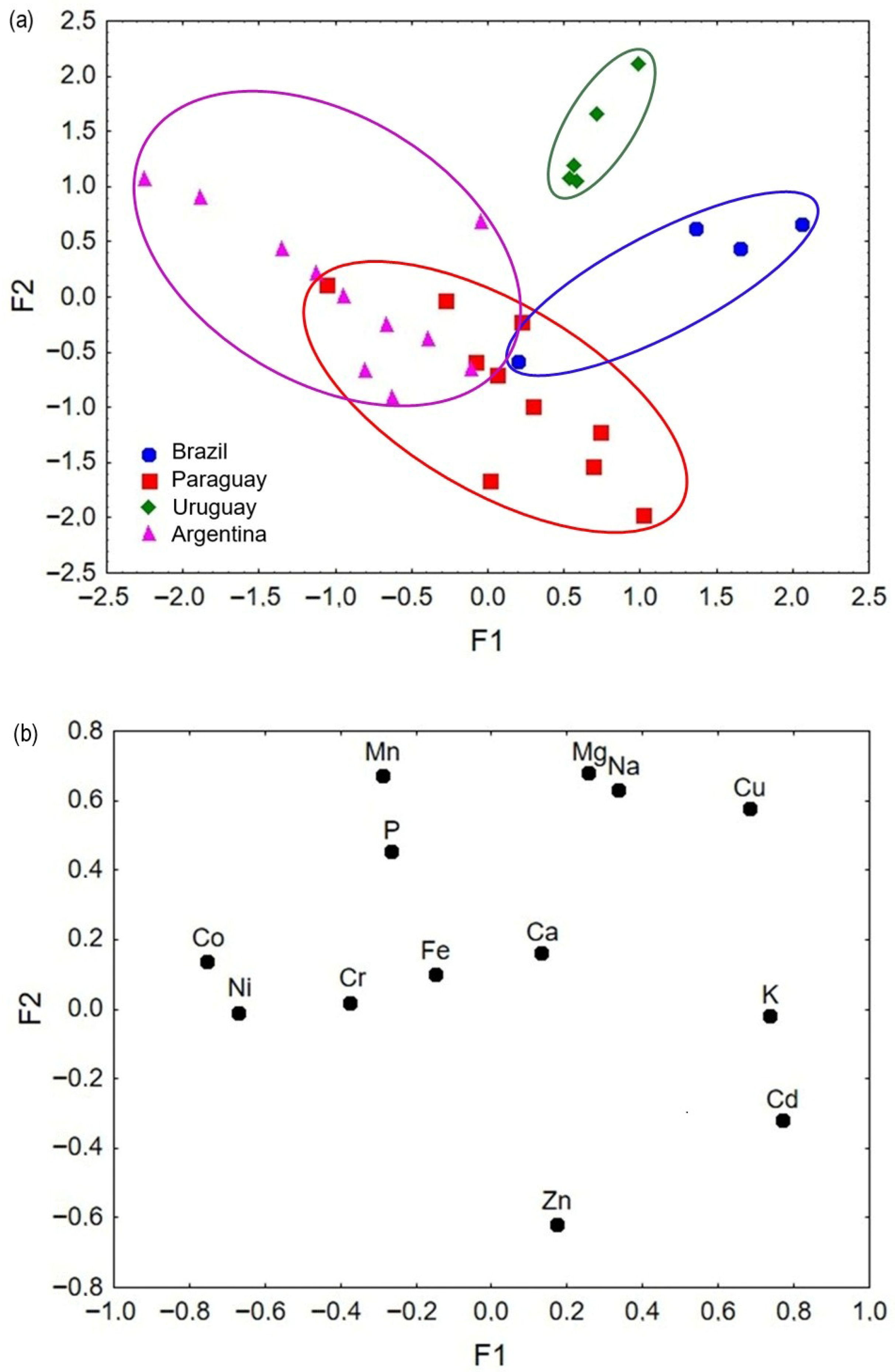
Figure 1. (a) Scatter plot of factors distinguishing yerba mate products by geographical origin. (b) Factor loadings for elements determined in yerba mate.
Beverages 11 00172 g001
Figure 2. (a) Hierarchical dendrogram for analysed yerba mate samples of different geographical origin. (b) Hierarchical dendrogram for analysed elements in yerba mate samples of different geographical origin.
Beverages 11 00172 g002
Table 1. Characteristics of the analysed material.
No.ProductCountry of Origin
1Verde Mate Green DespaladaBrazil
2Yaguar ElaboradaBrazil
3Barao De Cotegipe NativaBrazil
4Barao De Cotegipe PremiumBrazil
5La RubiaParaguay
6Colon TraditionalParaguay
7La BombilaParaguay
8Pajarito SuaveParaguay
9Pajarito Premium DespaladaParaguay
10Pajarito Elaborada Con Palo TradicionalParaguay
11Indega Selection EspecialParaguay
12Selecta Elaborada Con PaloParaguay
13Kurupi TraditionalParaguay
14Campesino ClasicaParaguay
15ContigoUruguay
16Yerba mate elaborada CanariasUruguay
17Armino SuaveUruguay
18Sara Roja TraditionalUruguay
19La Selva es cosa buena traditionalUruguay
20Union SuaveArgentina
21Rosamate Sabor SuaveArgentina
22TaraguiArgentina
23Pipore elaborada con PaloArgentina
24Cruz de MaltaArgentina
25Yerba mate Andresito Elaborada TradicionalArgentina
26Yerba mate Aguantadora Elaborada TradicionalArgentina
27Sinceridad SauveArgentina
28RosamonteArgentina
29Yerba mate Amanda Elaborada TradicionalArgentina
30Yerba mate Amanda DespaladaArgentina
Table 2. Element concentrations, RSD, and recovery data for the certified reference material Oriental Basma Tobacco Leaves (INCT-OBTL-5).
ElementCertified Values
[mg/100 g]
Determined
Values
[mg/100 g]
Recovery
[%]
RSD
[%]
LOD [mg/100 g]LOQ [mg/100 g]LinearityR2
Ca3859 ± 1423566 ± 149924.170.0120.036y = 0.00004x − 0.00050.9999
Co0.10 ± 0.0070.09 ± 0.005905.650.0140.042y = 0.00006x + 0.00410.9989
Cu1.01 ± 0.041.00 ± 0.01991.420.0030.009y = 0.0001x + 0.00060.9998
Cd0.26 ± 0.010.28 ± 0.011053.480.0020.006y = 0.0003x + 0.00830.9996
Cr0.63 *0.56 ± 0.0001890.020.0010.003y = 0.00004x + 0.00090.9997
Mg853 ± 34845 ± 4.96990.590.0010.003y = 0.001x + 0.01860.9998
Mn18.0 ± 0.620.2 ± 0.341121.670.0020.006y = 0.0001x + 0.00190.9996
Zn5.24 ± 0.185.59 ± 0.241074.310.0120.036y = 0.00003x + 0.00330.9988
K2271 ± 762449 ± 50.31082.060.0010.003y = 0.0003x + 0.00160.9997
Na90 ± 1088.0 ± 9.009810.20.0070.021y = 0.0006x − 0.00110.9999
Pb0.20 ± 0.030.19 ± 0.01955.600.0200.060y = 0.00003x − 0.000050.9996
P170 ± 2170 ± 0.411000.242.6988.094y = 0.0036x + 0.00530.9993
Ni0.85 ± 0.050.80 ± 0.08949.800.0860.258y = 0.00006x + 0.00020.9999
Fe149 *160 ± 1.011070.630.0080.024y = 0.00005x + 0.00290.9988
* Informative value.
Table 3. Results of the Dunn test performed on the analysed data matrix for yerba mate samples from Brazil, Paraguay, Uruguay, and Argentina.
BrazilParaguayUruguayArgentina
Brazil- PaCo a,b, Ni a,b,c
Paraguay -Mg a, Cu a, Mn aMn a,b,c
UruguayP aMg a, Cu a, Mn a-Mg a Cu a,b, Na a
ArgentinaCo a,b, Ni a,b,cMn a,b,cMg a, Cu a,b, Na a-
a p < 0.05; b p < 0.01; c p < 0.001.
Table 5. Comparison of the recommended dietary allowance and adequate intake of 200 mL of yerba mate.
ElementRecommended Daily
Allowance/Adequate Intake (RDA/AI) [mg/day/person]
Average Content
(mg/200 mL)
Realisation of RDA Through
Consumption of 200 mL
of Infusion [%]
Males
(31–50 Years)
Females
(31–50 Years)
Males
(31–50 Years)
Females
(31–50 Years)
Ca1000100018.6 ± 4.67
(9.69–29.4)
1.861.86
K *35003500193 ± 26.7
(139–234)
5.545.54
Mg42032060.5 ± 14.0
(41.6–85.1)
14.418.9
Na *150015000.86 ± 0.69
(<LOD-2.61)
0.060.06
P70070012.3 ± 2.77
(6.26–16.0)
1.751.75
Mn *2.31.88.57 ± 2.16
(4.89–13.1)
372476
Fe10180.09 ± 0.03
(0.04–0.15)
0.870.48
Zn1180.56 ± 0.13
(0.32–0.81)
5.066.96
Cu0.90.90.09 ± 0.02
(0.05–0.13)
9.529.52
* AI—adequate intake.
Disclaimer/Publisher’s Note: The statements, opinions and data contained in all publications are solely those of the individual author(s) and contributor(s) and not of MDPI and/or the editor(s). MDPI and/or the editor(s) disclaim responsibility for any injury to people or property resulting from any ideas, methods, instructions or products referred to in the content.