
Mechatronic Design and Development of a Lower-Limb Exoskeleton System Based on Knee Joint Biomechanical Principles Using Electro-Pneumatic Actuation with an Embedded EMG Controller for Experimental Validation in Elderly Gait Rehabilitation Support

 ,
,  , , ,
, , ,  , ,
, ,
Abstract
1. Introduction
2. Materials and Methods
2.1. Mechatronics Design and Simulation
2.1.1. Mechanics
2.1.2. Geometric, Kinematic and Dynamic Model
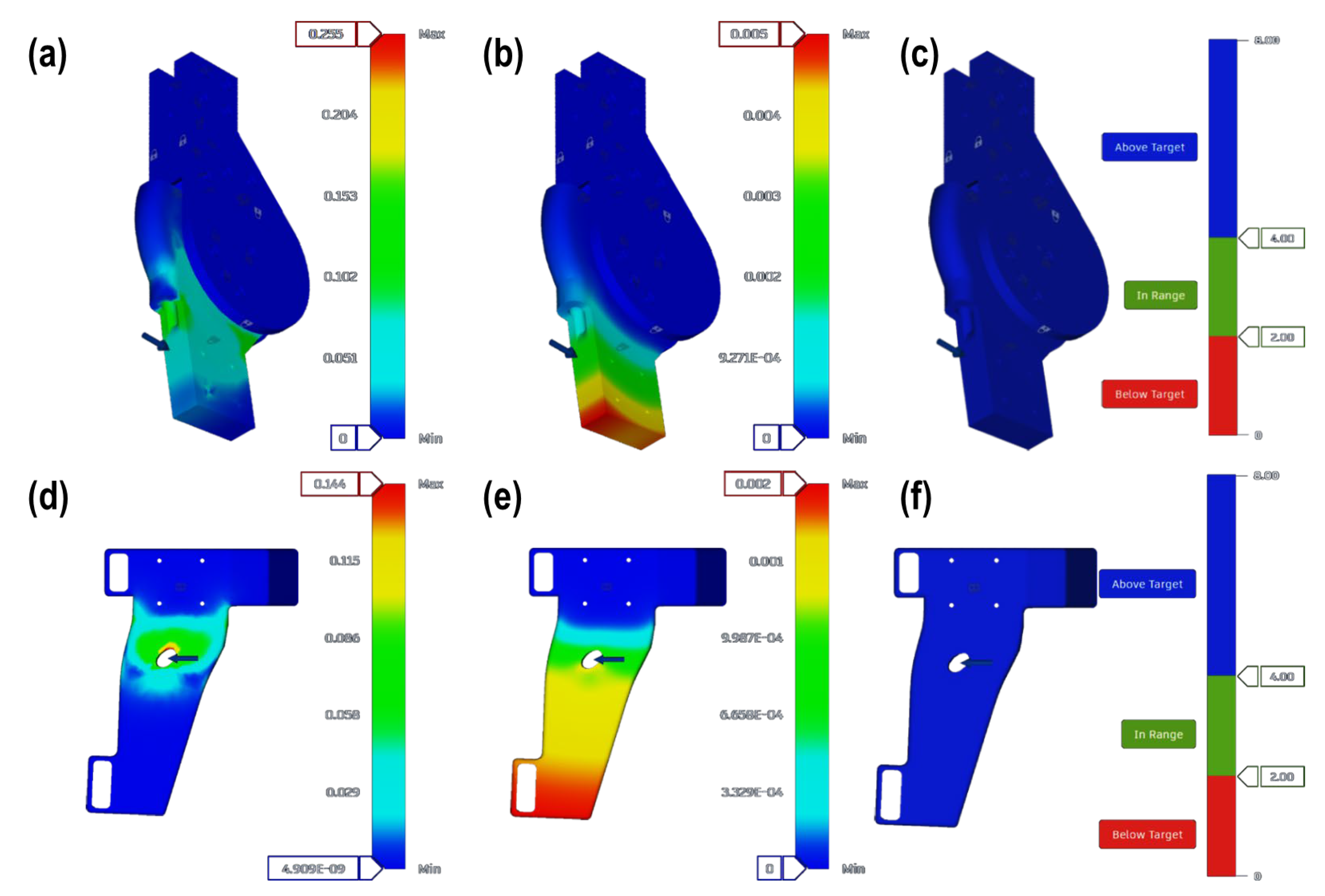
2.1.3. Finite Element Analysis
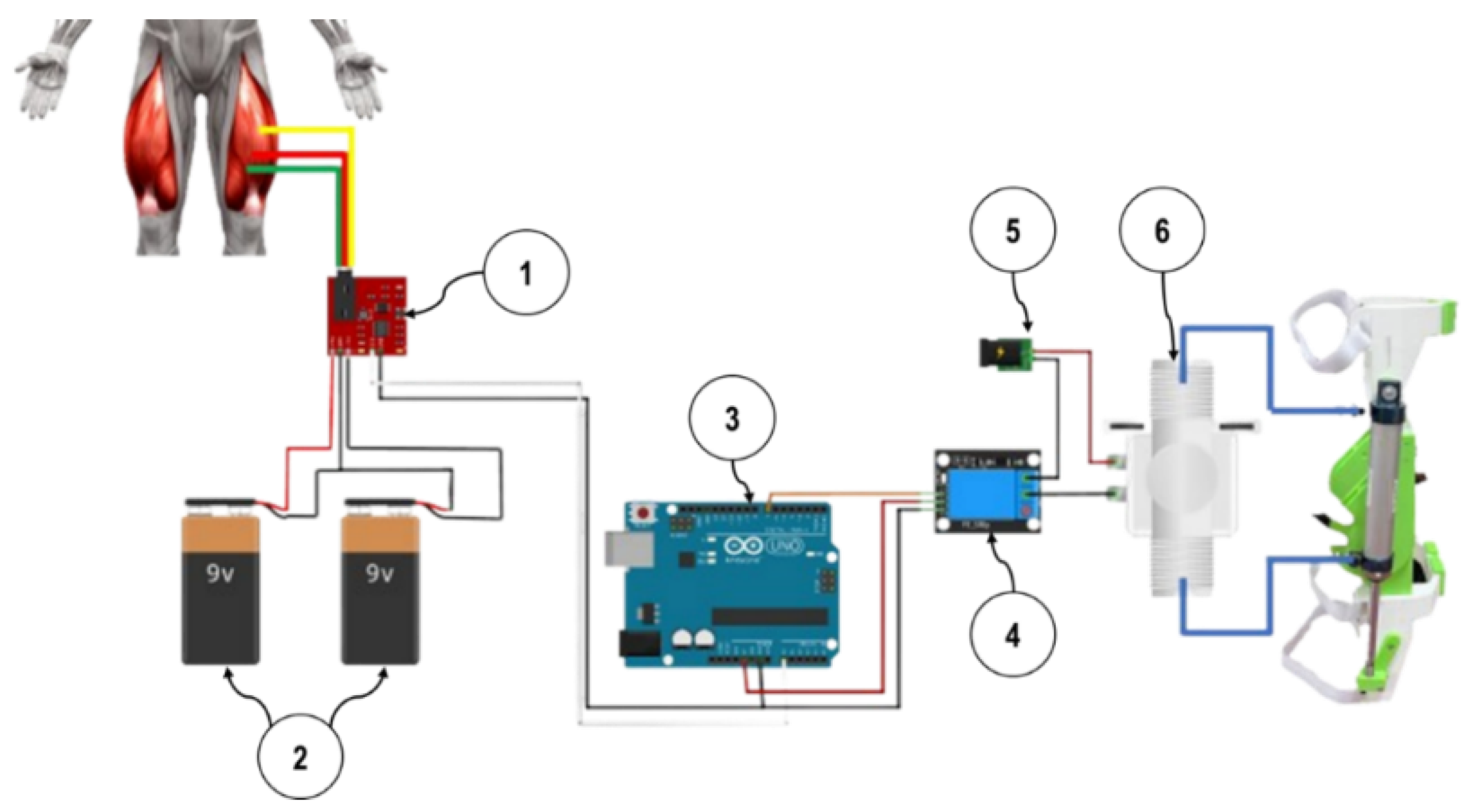
2.1.4. Electronics Design and Control System
3. Results
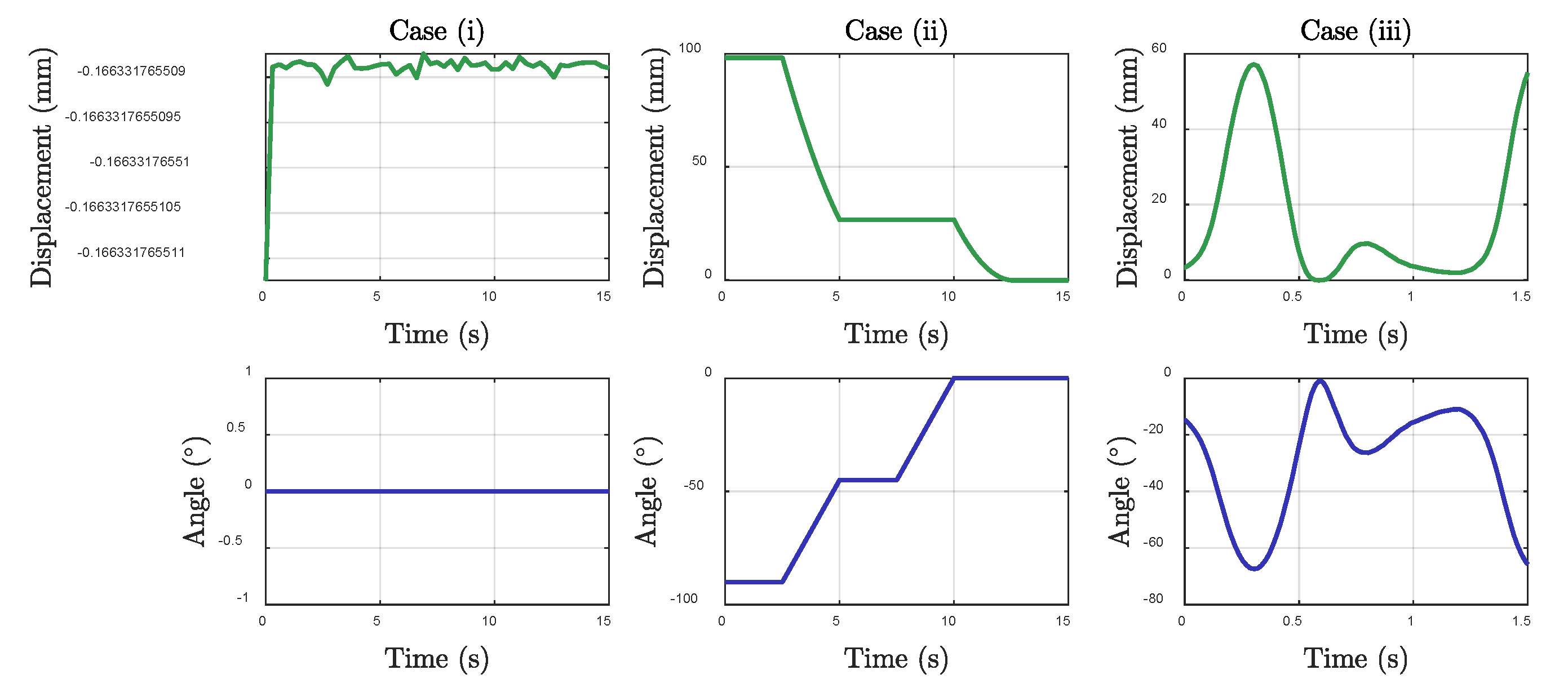
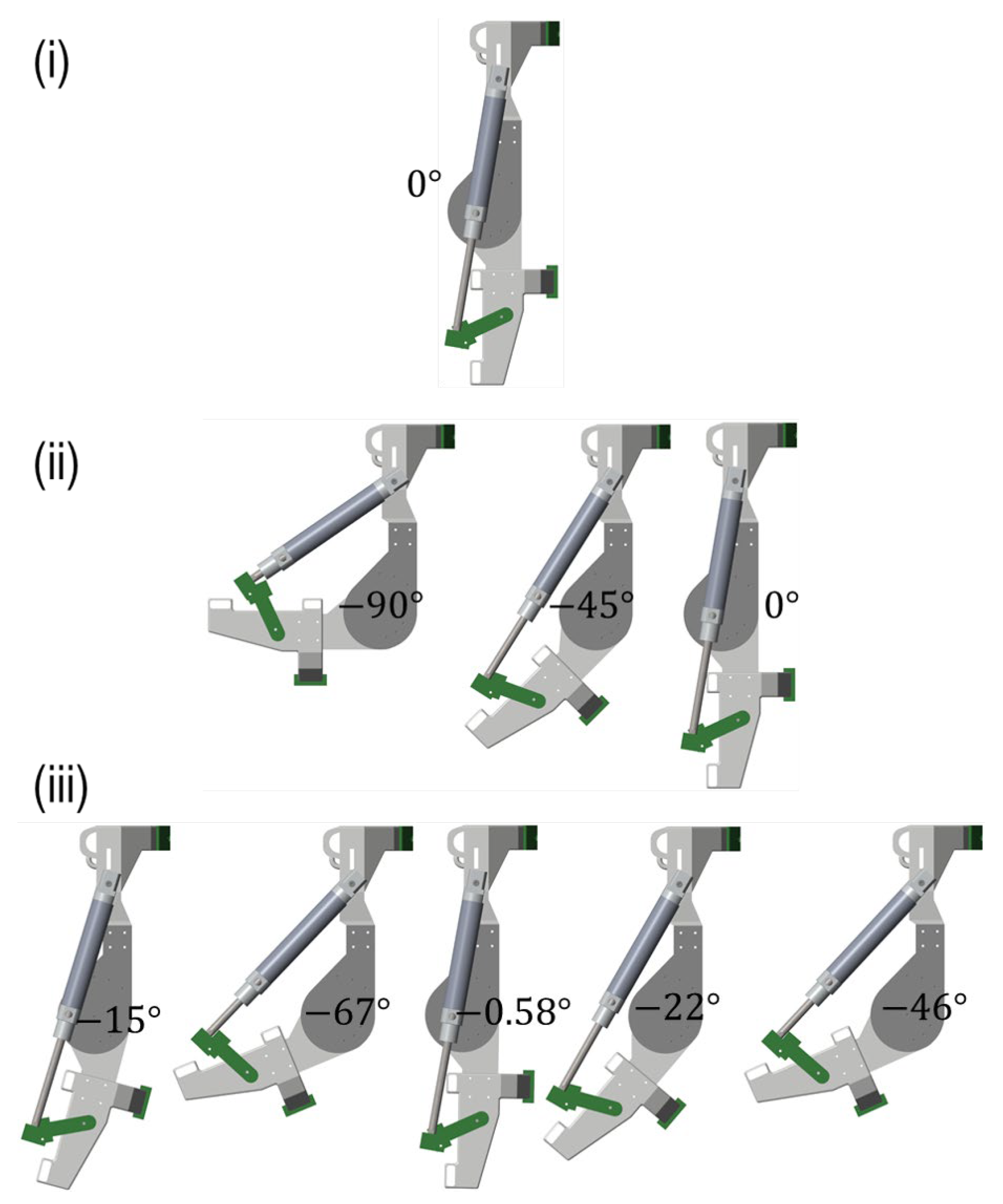
3.1. Kinematics and Dynamics Analysis in a Therapy Routine
3.2. Expert Validation Assessment
4. Discussion
5. Conclusions
Author Contributions
Funding
Data Availability Statement
Acknowledgments
Conflicts of Interest
Appendix A
ExoKnee Mathematical Modeling Control Law
Appendix B
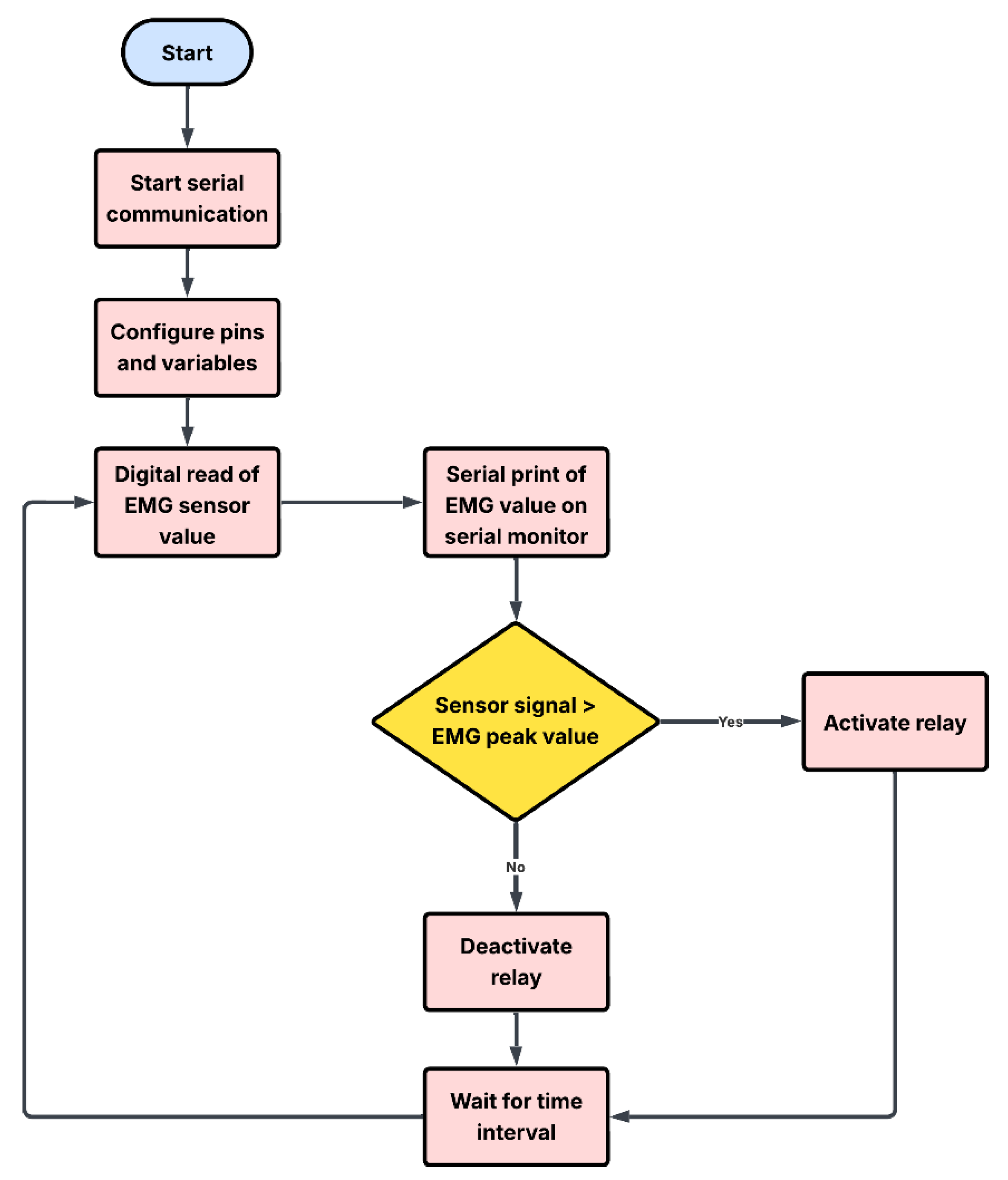
ExoKnee Programming
| Parameter | Symbol | Value |
| Parameter definition | const int emgPin = A0; const int relayPin = 8; const int filterWindow = 15; const int emgThreshold = 500; | Definition of the analog input used for EMG acquisition, the digital output for relay control, the size of the moving average window, and the activation threshold. |
| Signal buffer declaration | int emgSamples[filterWindow]; int sampleIndex = 0; int sampleSum = 0; int emgFiltered = 0; | Declaration of variables required for implementing a moving average filter using a circular buffer approach. |
| Hardware initialization | Serial.begin(115200); pinMode(emgPin,INPUT); pinMode(relayPin, OUTPUT); | Initialization of serial communication for monitoring and configuration of microcontroller pins for sensor input and actuator output. |
| Buffer initialization | for (int i = 0; i < filterWindow; i++) { emgSamples[i] = 0; } | Initialization of the signal buffer to zero in order to avoid transient artifacts during system startup. |
| Removal of oldest sample | sampleSum -= emgSamples[sampleIndex]; | The oldest EMG sample is removed from the accumulated sum to maintain a constant window size. |
| EMG acquisition | emgSamples[sampleIndex] = analogRead(emgPin); | Acquisition of a new EMG sample using the analog-to-digital converter of the microcontroller. |
| Buffer update | sampleSum += emgSamples[sampleIndex]; sampleIndex++; if (sampleIndex >= filterWindow) { sampleIndex = 0; } | Update of the circular buffer index and inclusion of the new EMG sample in the accumulated sum. |
| Signal smoothing | emgFiltered = sampleSum/filterWindow; | Computation of the moving average to obtain a smoothed representation of the EMG signal. |
| Signal monitoring | Serial.print(“Filtered EMG:”); Serial.println(emgFiltered); | Transmission of the filtered EMG value through serial communication for real-time monitoring and debugging. |
| Decision logic | if (emgFiltered >= emgThreshold){ | Comparison of the filtered EMG signal with a predefined threshold representing sufficient muscle activation. |
| Relay activation | digitalWrite(relayPin, HIGH); | Activation of the relay when the EMG activation threshold is exceeded. |
| Relay deactivation | digitalWrite(relayPin, LOW); | Deactivation of the relay when the EMG signal remains below the activation threshold. |
| Sampling control | delay(100); } | Introduction of a fixed delay to regulate the sampling rate and ensure stable system operation. |
Appendix C
Appendix C.1. System Validation Questionnaire I


Appendix C.2. System Validation Questionnaire II


Appendix C.3. System Validation Questionnaire III


References
- Gobezie, M.; Kassa, T.; Suliman, J.; Eriku, G.A.; Takele, M.D.; Bitew, D.A.; Wubante, S.M.; Kibret, A.K. Balance Impairment and Associated Factors among Stroke Survivors in Public Hospitals of Amhara Regional State: A Multicenter Cross-Sectional Study. BMC Neurol. 2024, 24, 387. [Google Scholar] [CrossRef]
- Elameer, M.; Lumley, H.; Moore, S.A.; Marshall, K.; Alton, A.; Smith, F.E.; Gani, A.; Blamire, A.; Rodgers, H.; Price, C.I.M.; et al. A Prospective Study of MRI Biomarkers in the Brain and Lower Limb Muscles for Prediction of Lower Limb Motor Recovery Following Stroke. Front. Neurol. 2023, 14, 1229681. [Google Scholar] [CrossRef]
- Martel Cervantes, C.; Sandoval, C.; Palomares, R.; Borja Arroyo, J.; Murillo Manrique, M.; Cornejo, J. Biomedical Anthropometric Evaluation and Conceptual Mechanical Design of Robotic System for Lower Limbs Passive-Rehabilitation on Post-Stroke Patients: Evaluación Antropométrica Biomédica y Diseño Mecánico Conceptual de Un Sistema Robótico Para La Rehabilitación Pasiva de Miembros Inferiores En Pacientes Post-Accidente Cerebrovascular. Rev. Fac. Med. Hum. 2024, 24, 72–81. [Google Scholar]
- Guo, W.; Katiyar, S.A.; Davis, S.; Nefti-Meziani, S. Overview: A Comprehensive Review of Soft Wearable Rehabilitation and Assistive Devices, with a Focus on the Function, Design and Control of Lower-Limb Exoskeletons. Machines 2025, 13, 1020. [Google Scholar] [CrossRef]
- Louie, D.R.; Simpson, L.A.; Mortenson, W.B.; Field, T.S.; Yao, J.; Eng, J.J. Prevalence of Walking Limitation After Acute Stroke and Its Impact on Discharge to Home. Phys. Ther. 2022, 102, pzab246. [Google Scholar] [CrossRef] [PubMed]
- Fan, T.; Zheng, P.; Zhang, X.; Gong, Z.; Shi, Y.; Wei, M.; Zhou, J.; He, L.; Li, S.; Zeng, Q.; et al. Effects of Exoskeleton Rehabilitation Robot Training on Neuroplasticity and Lower Limb Motor Function in Patients with Stroke. BMC Neurol. 2025, 25, 193. [Google Scholar] [CrossRef]
- Cornejo, J.; Cornejo-Aguilar, J.A.; Vargas, M.; Helguero, C.G.; Milanezi de Andrade, R.; Torres-Montoya, S.; Asensio-Salazar, J.; Rivero Calle, A.; Martínez Santos, J.; Damon, A.; et al. Anatomical Engineering and 3D Printing for Surgery and Medical Devices: International Review and Future Exponential Innovations. BioMed Res. Int. 2022, 2022, 6797745. [Google Scholar] [CrossRef]
- Nacarino, A.; Sanchez, B.; Palomares, R.; Valer, F.S.; Cornejo, J.; Vargas, M. ExoKnee: Pneumatic Mechatronic Knee Exoskeleton with EMG Control for Elderly Walking Support. In Proceedings of the 2025 International Conference on Smart-Green Technology in Electrical and Information Systems (ICSGTEIS); IEEE: Piscataway, NJ, USA, 2025; pp. 265–270. [Google Scholar]
- Ticllacuri, V.; Lino, G.J.; Diaz, A.B.; Cornejo, J. Design of Wearable Soft Robotic System for Muscle Stimulation Applied in Lower Limbs during Lunar Colonization. In Proceedings of the 2020 IEEE XXVII International Conference on Electronics, Electrical Engineering and Computing (INTERCON); IEEE: Lima, Peru, 2020; pp. 1–4. [Google Scholar]
- Ticllacuri, V.; Cornejo, J.; Castrejon, N.; Diaz, A.B.; Hinostroza, K.; Dev, D.; Chen, Y.; Palacios, P.; Castillo, W.; Vargas, M.; et al. Design of Biomedical Soft Robotic Device for Lower Limbs Mechanical Muscle Rehabilitation and Electrochemical Monitoring under Reduced-Gravity Space Environment. In Proceedings of the 2021 IEEE URUCON; IEEE: Piscataway, NJ, USA, 2021; pp. 227–231. [Google Scholar]
- Cornejo, J.; Oscco, B.; Gamarra-Vásquez, L.; Mayorga, J.; Tejada-Marroquin, G.; Cuyotupac, V.; Curioso, J.; Castro, J.; Acuña, J.S.; Cangahuala-Navarro, M.; et al. SETY©: A next-Generation Robotic Training Platform for Safe and Autonomous Surgery in Space—Surgical Biomechatronics Design and Hardware-Software Integration within the SY-MIS Project. J. Robot. Surg. 2025, 20, 35. [Google Scholar] [CrossRef]
- Christensen, S.; Rafique, S.; Bai, S. Design of a Powered Full-Body Exoskeleton for Physical Assistance of Elderly People. Int. J. Adv. Robot. Syst. 2021, 18, 17298814211053534. [Google Scholar] [CrossRef]
- Changcheng, C.; Li, Y.-R.; Chen, C.-T. Assistive Mobility Control of a Robotic Hip-Knee Exoskeleton for Gait Training. Sensors 2022, 22, 5045. [Google Scholar] [CrossRef]
- Gao, M.; Wang, Z.; Pang, Z.; Sun, J.; Li, J.; Li, S.; Zhang, H. Electrically Driven Lower Limb Exoskeleton Rehabilitation Robot Based on Anthropomorphic Design. Machines 2022, 10, 266. [Google Scholar] [CrossRef]
- Jaber, H.M.; Shams, O.A.; Ahmed, B.A.; Al-Zuhairi, H.M.I.; Majdi, H.S. Designing a Knee Support Using Nanomaterials and Controlling It as an Assistant Robot. J. Eur. Systèmes Autom. 2025, 58, 435. [Google Scholar] [CrossRef]
- Piao, J.; Kim, M.; Kim, J.; Kim, C.; Han, S.; Back, I.; Koh, J.; Koo, S. Development of a Comfort Suit-Type Soft-Wearable Robot with Flexible Artificial Muscles for Walking Assistance. Sci. Rep. 2023, 13, 4869. [Google Scholar] [CrossRef]
- Fang, Y.; Hou, B.; Wu, X.; Wang, Y.; Osawa, K.; Tanaka, E. A Stepper Motor-Powered Lower Limb Exoskeleton with Multiple Assistance Functions for Daily Use by the Elderly. J. Robot. Mechatron. 2023, 35, 601–611. [Google Scholar] [CrossRef]
- Feng, Y.; Hu, X.; Li, Y.; Ma, K.; Ren, J.; Zhou, Z.; Yuan, F.; Huang, Y.; Wang, L.; Wang, Q.; et al. A Wearable Isokinetic Training Robot for Enhanced Bedside Knee Rehabilitation. IEEE Trans. Robot. 2025, 41, 2460–2476. [Google Scholar] [CrossRef]
- Lee, H.J.; Song, J.-K.; Moon, J.; Kim, K.; Park, H.-K.; Kang, G.-W.; Shin, J.-H.; Kang, J.; Kim, B.-G.; Lee, Y.-H.; et al. Health-Related Quality of Life Using WHODAS 2.0 and Associated Factors 1 Year after Stroke in Korea: A Multi-Centre and Cross-Sectional Study. BMC Neurol. 2022, 22, 501. [Google Scholar] [CrossRef]
- Rivera, D.M.; Sharifi, M. Design and Fabrication of a Lightweight and Wearable Semirigid Robotic Knee Chain Exoskeleton. J. Eng. Sci. Med. Diagn. Ther. 2023, 7, 021007. [Google Scholar] [CrossRef]
- Davoodi, A.; Iranikhah, M.; Ahmadi, A.; Seyfarth, A.; Sharbafi, M.A. Bioinspired Design and Control of BATEX, An Exosuit with Biarticular Compliant Actuators. IEEE/ASME Trans. Mechatron. 2024, 29, 1352–1362. [Google Scholar] [CrossRef]
- Pan, C.-T.; Lee, M.-C.; Huang, J.-S.; Chang, C.-C.; Hoe, Z.-Y.; Li, K.-M. Active Assistive Design and Multiaxis Self-Tuning Control of a Novel Lower Limb Rehabilitation Exoskeleton. Machines 2022, 10, 318. [Google Scholar] [CrossRef]
- Paez-Granados, D.F.; Kadone, H.; Hassan, M.; Chen, Y.; Suzuki, K. Personal Mobility with Synchronous Trunk–Knee Passive Exoskeleton: Optimizing Human–Robot Energy Transfer. IEEE/ASME Trans. Mechatron. 2022, 27, 3613–3623. [Google Scholar] [CrossRef]
- Arfaie, O.; Unal, R. KneExo: Design, Development, and Functional Evaluation of a Bio-Joint Shaped Knee Exoskeleton for Sit-to-Stand Assistance. Cureus J. Eng. 2025, 2. [Google Scholar] [CrossRef]
- Jiang, J.; Chen, P.; Peng, J.; Qiao, X.; Zhu, F.; Zhong, J. Design and Optimization of Lower Limb Rehabilitation Exoskeleton with a Multiaxial Knee Joint. Biomimetics 2023, 8, 156. [Google Scholar] [CrossRef] [PubMed]
- Yoon, J.; Kim, J.; Lee, C.-H.; Kwon, J. Feasibility Study of a Thruster-Based Wearable Robot for Aquatic Knee Exercise. IEEE Access 2025, 13, 162176–162190. [Google Scholar] [CrossRef]
- Hsu, S.-H.; Changcheng, C.; Lee, H.-J.; Chen, C.-T. Design and Implementation of a Robotic Hip Exoskeleton for Gait Rehabilitation. Actuators 2021, 10, 212. [Google Scholar] [CrossRef]
- Jammeli, I.; Chemori, A.; Moon, H.; Elloumi, S.; Mohammed, S. An Assistive Explicit Model Predictive Control Framework for a Knee Rehabilitation Exoskeleton. IEEE/ASME Trans. Mechatron. 2022, 27, 3636–3647. [Google Scholar] [CrossRef]
- Koo, S.H.; Lee, Y.B.; Kim, C.; Kim, G.; Lee, G.; Koh, J.-S. Development of Gait Assistive Clothing-Typed Soft Wearable Robot for Elderly Adults. Int. J. Cloth. Sci. Technol. 2020, 33, 513–541. [Google Scholar] [CrossRef]
- Alampay, M.J.P.; Jiang, M.; Sugahara, Y.; Takeda, Y. Design and Prototyping of a Semi-Wearable Robotic Leg for Sit-to-Stand Motion Assistance of Hemiplegic Patients. In Proceedings of the I4SDG Workshop 2023; Petuya, V., Quaglia, G., Parikyan, T., Carbone, G., Eds.; Springer Nature: Cham, Switzerland, 2023; pp. 154–161. [Google Scholar]
- Devine, T.M.; Asante-Otoo, A.; Alter, K.E.; Damiano, D.L.; Bulea, T.C. Robotic Knee Exoskeletons as Assistive and Gait Training Tools in Spina Bifida: A Pilot Study Showing Clinical Feasibility of Two Control Strategies. IEEE Trans. Neural Syst. Rehabil. Eng. 2025, 33, 2684–2694. [Google Scholar] [CrossRef]
- Jin, S.; Liu, B.; Wang, Z. A Bionic Knee Exoskeleton Design with Variable Stiffness via Rope-Based Artificial Muscle Actuation. Biomimetics 2025, 10, 424. [Google Scholar] [CrossRef]
- Wu, X.; Qiao, X.; Xie, Y.; Yang, Q.; An, W.; Xia, L.; Li, J.; Lu, X. Rehabilitation Training Robot Using Mirror Therapy for the Upper and Lower Limb after Stroke: A Prospective Cohort Study. J. Neuroeng. Rehabil. 2025, 22, 54. [Google Scholar] [CrossRef]
- Wang, Z.; Yang, C.; Zhang, S.; Zhang, S.; Yi, C.; Ding, Z.; Wei, B.; Jiang, F. Knee Flexion-Assisted Method for Human-Exoskeleton System. IEEE Trans. Neural Syst. Rehabil. Eng. 2023, 31, 2800–2808. [Google Scholar] [CrossRef]
- Soni, H.H.; Sharma, P.; Thomas, M.J.; Krishnan, C.M.C.; Singh, A. Recent Advancements in Soft Ankle/Knee Exoskeletons Technologies: Systems, Actuation and Control. Robot. Auton. Syst. 2025, 193, 105092. [Google Scholar] [CrossRef]
- Bryan, G.M.; Franks, P.W.; Song, S.; Voloshina, A.S.; Reyes, R.; O’Donovan, M.P.; Gregorczyk, K.N.; Collins, S.H. Optimized Hip-Knee-Ankle Exoskeleton Assistance at a Range of Walking Speeds. J. Neuroeng. Rehabil. 2021, 18, 152. [Google Scholar] [CrossRef]
- Etenzi, E.; Borzuola, R.; Grabowski, A.M. Passive-Elastic Knee-Ankle Exoskeleton Reduces the Metabolic Cost of Walking. J. Neuroeng. Rehabil. 2020, 17, 104. [Google Scholar] [CrossRef] [PubMed]
- Fernández, J.d.M.; Rey-Prieto, M.; Rio, M.S.-D.; López-Matas, H.; Guirao-Cano, L.; Font-Llagunes, J.M.; Lobo-Prat, J. Adapted Assistance and Resistance Training with a Knee Exoskeleton After Stroke. IEEE Trans. Neural Syst. Rehabil. Eng. 2023, 31, 3265–3274. [Google Scholar] [CrossRef] [PubMed]
- Laubscher, C.A.; Farris, R.J.; van den Bogert, A.J.; Sawicki, J.T. An Anthropometrically Parameterized Assistive Lower Limb Exoskeleton. J. Biomech. Eng. 2021, 143, 105001. [Google Scholar] [CrossRef]
- Ma, J.; Sun, D.; Chen, X. Hip-Knee Coupling Exoskeleton with Offset Theory for Walking Assistance. Front. Bioeng. Biotechnol. 2021, 9, 798496. [Google Scholar] [CrossRef] [PubMed]
- Camargo, J.C.; Machado, Á.R.; Almeida, E.C.; Silva, E.F.M.S. Mechanical Properties of PLA-Graphene Filament for FDM 3D Printing. Int. J. Adv. Manuf. Technol. 2019, 103, 2423–2443. [Google Scholar] [CrossRef]
- Rojas-Moreno, A. Control Avanzado: Diseño y Aplicaciones en Tiempo Real; Publicación Independiente; Universidad Nacional de Ingeniería: Lima, Peru, 2001. [Google Scholar]
- Ogata, K. Modern Control Engineering; Prentice-Hall, Inc.: Hoboken, NJ, USA, 2010; ISBN 0-13-615673-8. [Google Scholar]
- ISO 7250-1:2017; Basic Human Body Measurements for Technological Design—Part 1: Body Measurement Definitions and Landmarks. ISO: Geneva, Switzerland, 2017. Available online: https://www.iso.org/standard/65246.html (accessed on 11 January 2026).
- Plagenhoef, S.; Evans, F.G.; Abdelnour, T. Anatomical Data for Analyzing Human Motion. Res. Q. Exerc. Sport 1983, 54, 169–178. [Google Scholar] [CrossRef]
- Nemah, M.N.; Abada, H.H. Dynamic Model Design and Controller Development of Lower Limb Prosthesis Through Matlab Simscape Multibody Toolbox. J. Adv. Res. Appl. Sci. Eng. Technol. 2024, 61, 110–119. [Google Scholar] [CrossRef]
- Madadizadeh, F.; Bahariniya, S. Tutorial on How to Calculating Content Validity of Scales in Medical Research. Perioper. Care Oper. Room Manag. 2023, 31, 100315. [Google Scholar] [CrossRef]
- Olinski, M. Design and Experimental Characterization of Developed Human Knee Joint Exoskeleton Prototypes. Machines 2025, 13, 70. [Google Scholar] [CrossRef]
- Chen, B.; Zheng, C.; Zi, B.; Zhao, P. Design and Implementation of Knee-Ankle Exoskeleton for Energy Harvesting and Walking Assistance. Smart Mater. Struct. 2022, 31, 125003. [Google Scholar] [CrossRef]
- Zhou, Y.; Wang, X.; Tang, X.; Ji, X.; Gao, Z. Design and Analysis of a Passive Knee Assisted Exoskeleton. Adv. Mech. Eng. 2023, 15, 16878132231202578. [Google Scholar] [CrossRef]
- Aljarah, A.; Awad, M.I.; Boushaki, M.; Hussain, I. Design Optimization of a Variable Stiffness Actuator for Knee Exoskeleton Application. IEEE Access 2023, 11, 52740–52749. [Google Scholar] [CrossRef]
- Gunnell, A.J.; Sarkisian, S.V.; Hayes, H.A.; Foreman, K.B.; Gabert, L.; Lenzi, T. Powered Knee Exoskeleton Improves Sit-to-Stand Transitions in Stroke Patients Using Electromyographic Control. Commun. Eng. 2025, 4, 104. [Google Scholar] [CrossRef]
- Lim, B.; Choi, B.; Roh, C.; Lee, J.; Kim, Y.-J.; Lee, Y. Ultra-Lightweight Robotic Hip Exoskeleton with Anti-Phase Torque Symmetry for Enhanced Walking Efficiency. Sci. Rep. 2025, 15, 10850. [Google Scholar] [CrossRef] [PubMed]
- Han, S.-H.; Choi, S.; Ko, C.; Weon Lee, J.; Kong, K.; Rha, D.-W.; Kim, D.Y. Efficacy of a Soft Wearable Robot for Hip Assistance in Chronic Stroke Patients: A Randomized Crossover Trial. IEEE Trans. Neural Syst. Rehabil. Eng. 2025, 33, 2251–2262. [Google Scholar] [CrossRef]
- Tricomi, E.; Missiroli, F.; Xiloyannis, M.; Lotti, N.; Zhang, X.; Stefanakis, M.; Theisen, M.; Bauer, J.; Becker, C.; Masia, L. Soft Robotic Shorts Improve Outdoor Walking Efficiency in Older Adults. Nat. Mach. Intell. 2024, 6, 1145–1155. [Google Scholar] [CrossRef]



| Author | Characteristics | Advantages | Disadvantages |
|---|---|---|---|
| [31] | Robotic knee exoskeleton with event-based and adaptive control to improve mobility and rehabilitation. | Shows clinical feasibility in neuromotor impairment, improving gait stability and pattern while enabling repetitive, controlled neurorehabilitation training. | Limited by a small pilot sample, short-term evaluation, reduced adaptability for heterogeneous patients, and cost/accessibility constraints. |
| [32] | Features a bio-inspired variable stiffness actuator with parallel aramid fiber ropes and a seven-configuration clutch system, validated by viscoelastic and viscoplastic analysis. | Provides adaptive stiffness for improved comfort and compliance, with a lighter design and EMG evidence of reduced rectus femoris activation, indicating effective load sharing. | Limited by discrete stiffness modulation, mechanical clutch complexity, early rope stiffness softening, and a very small sample (). |
| [33] | Early post-stroke rehab device for bed-bound patients with a Series Elastic Actuator, precise encoder control, and preliminary mechanical and sEMG validation. | Offers compliant, intrinsically safe assistance via a Series Elastic Actuator, enabling early bed-bound rehabilitation with precise tracking and preliminary reduction in spasticity. | Limited by knee alignment dependency and 1-DoF hinge constraints that do not fully replicate natural joint motion, with only preliminary clinical validation in a small sample. |
| [34] | Knee exoskeleton assisting gait flexion through a human–robot model, combining active and passive elements for optimized energy storage and torque release. | Provides continuous gait assistance that enhances knee flexion, improves energy efficiency, optimizes human–robot coordination, and reduces muscular effort. | Limited by the need for individualized tuning, model-based assumptions, control complexity, and limited clinical validation. |
| [35] | Robotic gait exoskeleton with electric or hybrid actuators, integrated biomechanical sensors (angle, force, ±EMG), and adaptive or AI-based control for rehabilitation. | Improves mobility and gait, promotes neuroplasticity, and enables intensive rehabilitation while reducing therapist burden. | Limited by high cost, restricted accessibility, need for specialized training, device weight and bulk, battery dependence, and potential injury risk if improperly adjusted. |
| [36] | Active hip–knee–ankle exoskeleton with velocity-dependent torque modulation, optimized assistance profiles, and metabolic cost evaluation in healthy subjects. | Significantly reduces metabolic cost, dynamically adapts to different walking speeds, and enhances biomechanical efficiency during locomotion. | Complex multi-joint system with higher weight and energy consumption, validated only in healthy individuals and requiring speed-specific calibration. |
| [37] | Passive-elastic exoskeleton that stores energy during knee extension and releases it to assist ankle plantarflexion, with evaluation of walking metabolic cost. | Lightweight, energy-efficient design without active actuators, reducing metabolic demand, electronic complexity, and overall power consumption. | Limited by non-adaptive assistance without active control, reliance on passive mechanical synchronization, and minimal real-time personalization. |
| [38] | Unilateral active knee exoskeleton with programmable assistive/resistive modes, evaluated in post-stroke patients using flexion range and EMG metrics. | Improves knee flexion range and neuromuscular activation, showing potential for motor rehabilitation applications. | Limited by its unilateral design without bilateral assessment, small sample size, and the need for a complex active control system. |
| [39] | Anthropometrically parameterized design optimizing joint alignment and torque transmission, with strong structural and mechanical emphasis. | Improves joint alignment precision, reducing misalignment and discomfort while enhancing mechanical efficiency in force transmission. | Limited by the lack of advanced control strategies, design-focused validation with minimal clinical outcome data, and the potential need for complex individual customization. |
| [40] | Hip–knee coupled exoskeleton based on offset theory, enabling coordinated energy transfer and phase-dependent gait assistance. | Enhances inter-joint interaction, reduces mechanical discontinuities during walking, and provides biomechanically coordinated assistance. | Mechanically complex system that relies on precise gait-phase synchronization and has been primarily validated in experimental settings. |
| Parameter | Symbol | Value | Unit |
|---|---|---|---|
| Thigh anchoring length | 0.173 | m | |
| Shank anchoring length | 0.180 | m | |
| Structural offset angle | 3.71 | Degrees | |
| Mass of the moving segment | 3.85 | kg | |
| Distance to the center of mass | 0.077 | m | |
| Equivalent inertia | 0.4 | kg·m2 | |
| Viscous friction coefficient | Variable | N·m·s/rad | |
| Piston diameter | 9.90 | mm | |
| Actuator stroke | 100 | mm | |
| Nominal operating pressure | 6.00 | bar |
| Expert | Expert 1 | Expert 2 | Expert 3 | Sx | Mx | CVCi | Pei | CVCtc |
|---|---|---|---|---|---|---|---|---|
| Item | ||||||||
| 1 | 16 | 20 | 18 | 54 | 2.7 | 0.9000 | 0.0003 | 0.8997 |
| 2 | 15 | 11 | 18 | 44 | 2.2 | 0.7333 | 0.0003 | 0.7330 |
| 3 | 16 | 11 | 16 | 43 | 2.15 | 0.7167 | 0.0003 | 0.7163 |
| 4 | 17 | 20 | 20 | 57 | 2.85 | 0.9500 | 0.0003 | 0.9497 |
| 5 | 18 | 20 | 20 | 58 | 2.9 | 0.9667 | 0.0003 | 0.9663 |
| 6 | 17 | 20 | 20 | 57 | 2.85 | 0.9500 | 0.0003 | 0.9497 |
| 7 | 16 | 20 | 16 | 52 | 2.6 | 0.8667 | 0.0003 | 0.8663 |
| 8 | 18 | 11 | 16 | 45 | 2.25 | 0.7500 | 0.0003 | 0.7497 |
| 9 | 16 | 20 | 17 | 53 | 2.65 | 0.8833 | 0.0003 | 0.8830 |
| 10 | 18 | 20 | 18 | 56 | 2.8 | 0.9333 | 0.0003 | 0.9330 |
| 11 | 16 | 20 | 20 | 56 | 2.8 | 0.9333 | 0.0003 | 0.9330 |
| 12 | 19 | 20 | 16 | 55 | 2.75 | 0.9167 | 0.0003 | 0.9163 |
| Mean | 0.8747 |
Disclaimer/Publisher’s Note: The statements, opinions and data contained in all publications are solely those of the individual author(s) and contributor(s) and not of MDPI and/or the editor(s). MDPI and/or the editor(s) disclaim responsibility for any injury to people or property resulting from any ideas, methods, instructions or products referred to in the content. |
© 2026 by the authors. Licensee MDPI, Basel, Switzerland. This article is an open access article distributed under the terms and conditions of the Creative Commons Attribution (CC BY) license.
Share and Cite
Nacarino, A.; Sanchez, B.; Charapaqui, S.; Charapaqui, R.; Maldonado-Gómez, R.R.; Mendoza-Arias, L.M.; de la Barra, D.; Ccellcaro, C.; Palomares, R.; Cornejo, J.; et al. Mechatronic Design and Development of a Lower-Limb Exoskeleton System Based on Knee Joint Biomechanical Principles Using Electro-Pneumatic Actuation with an Embedded EMG Controller for Experimental Validation in Elderly Gait Rehabilitation Support. Bioengineering 2026, 13, 644. https://doi.org/10.3390/bioengineering13060644
Nacarino A, Sanchez B, Charapaqui S, Charapaqui R, Maldonado-Gómez RR, Mendoza-Arias LM, de la Barra D, Ccellcaro C, Palomares R, Cornejo J, et al. Mechatronic Design and Development of a Lower-Limb Exoskeleton System Based on Knee Joint Biomechanical Principles Using Electro-Pneumatic Actuation with an Embedded EMG Controller for Experimental Validation in Elderly Gait Rehabilitation Support. Bioengineering. 2026; 13(6):644. https://doi.org/10.3390/bioengineering13060644
Chicago/Turabian StyleNacarino, Adrian, Bryan Sanchez, Sandra Charapaqui, Renzo Charapaqui, Renzo R. Maldonado-Gómez, Leslie M. Mendoza-Arias, Daira de la Barra, Cristina Ccellcaro, Ricardo Palomares, Jose Cornejo, and et al. 2026. "Mechatronic Design and Development of a Lower-Limb Exoskeleton System Based on Knee Joint Biomechanical Principles Using Electro-Pneumatic Actuation with an Embedded EMG Controller for Experimental Validation in Elderly Gait Rehabilitation Support" Bioengineering 13, no. 6: 644. https://doi.org/10.3390/bioengineering13060644
APA StyleNacarino, A., Sanchez, B., Charapaqui, S., Charapaqui, R., Maldonado-Gómez, R. R., Mendoza-Arias, L. M., de la Barra, D., Ccellcaro, C., Palomares, R., Cornejo, J., Vargas, M., Castro, R., & Cornejo, J. (2026). Mechatronic Design and Development of a Lower-Limb Exoskeleton System Based on Knee Joint Biomechanical Principles Using Electro-Pneumatic Actuation with an Embedded EMG Controller for Experimental Validation in Elderly Gait Rehabilitation Support. Bioengineering, 13(6), 644. https://doi.org/10.3390/bioengineering13060644