

Tracheal Tissue Engineering: Advances and Challenges


Abstract
1. Introduction
2. Native Tracheal Biology and Implications for Tissue Engineering
3. Cell Types Used in Tracheal Tissue Engineering and Regeneration
4. Biomaterials Used in Designing Scaffolds for Tracheal Tissue Engineering and Regeneration
5. Advanced Techniques for Tracheal Scaffold Development
6. Leveraging Innate Repair Mechanisms in the Trachea
7. The Future of Tracheal Regeneration
8. Conclusions
Supplementary Materials
Author Contributions
Funding
Institutional Review Board Statement
Informed Consent Statement
Data Availability Statement
Acknowledgments
Conflicts of Interest
Abbreviations
| TEF | Tracheoesophageal fistula |
| VEGFs | Vascular endothelial growth factors |
| TGF-β | Transforming growth factor-beta |
| MSC | Mesenchymal stem cell |
| iPSCs | Induced pluripotent stem cells |
| PLA | Polylactic acid |
| PCL | Polycaprolactone |
| PC | Polycarbonate |
| TPU | Thermoplastic polyurethane |
| PGA | Polyglycolic acid |
| PLGA | Poly(lactic-co-glycolic) acid |
| PPE | Polyphosphoesters |
| PET | Polyethylene terephthalate |
| HDPE | High-density polyethylene |
| bFGF | Basic fibroblast growth factor |
| ECM | Extracellular matrix |
| 3D | Three-dimension |
| 4D | Four-dimension |
| FDM | Fused deposition modeling |
| PNECs | Pulmonary neuroendocrine cells |
References
- Herrera, M.A.; Tintinago, L.F.; Victoria Morales, W.; Ordonez, C.A.; Parra, M.W.; Betancourt-Cajiao, M.; Caicedo, Y.; Guzman-Rodriguez, M.; Gallego, L.M.; Gonzalex Hadad, A.; et al. Damage control of laryngotracheal trauma: The golden day. Colomb. Med. 2020, 51, e4124599. [Google Scholar] [CrossRef]
- Grewal, H.S.; Dangayach, N.S.; Ahmad, U.; Ghosh, S.; Gildea, T.; Mehta, A.C. Treatment of Tracheobronchial Injuries: A Contemporary Review. Chest 2019, 155, 595–604. [Google Scholar] [CrossRef]
- De Jong, R.; Hohman, M.H.; Farahani, C. Laryngeal Clefts. In StatPearls [Internet]; StatPearls Publishing: Treasure Island, FL, USA, 2025. [Google Scholar]
- Asnaghi, A.; Macchiarini, P.; Mantero, S. Tissue engineering toward organ replacement: A promising approach in airway transplant. Int. J. Artif. Organs 2009, 32, 763–768. [Google Scholar] [CrossRef] [PubMed]
- Auchincloss, H.G.; Wright, C.D. Complications after tracheal resection and reconstruction: Prevention and treatment. J. Thorac. Dis. 2016, 8, S160–S167. [Google Scholar] [PubMed]
- Naik, S.S.; Dutta, N.K.; Sukumaran Nair, K.; Choudhury, N.R. Critical advances in biofabrication and biomaterial strategies in tracheal tissue engineering: A comprehensive overview. Adv. Colloid Interface Sci. 2025, 345, 103604. [Google Scholar] [CrossRef] [PubMed]
- Tapias, L.F.; Mathisen, D.J. Prevention and management of complications following tracheal resections-lessons learned at the Massachusetts General Hospital. Ann. Cardiothorac. Surg. 2018, 7, 237–243. [Google Scholar] [CrossRef]
- Wei, S.; Zhang, Y.; Luo, F.; Duan, K.; Li, M.; Lv, G. Tissue-engineered tracheal implants: Advancements, challenges, and clinical considerations. Bioeng. Transl. Med. 2024, 9, e10671. [Google Scholar] [CrossRef]
- Sadreameli, S.C.; McGrath-Morrow, S.A. Respiratory Care of Infants and Children with Congenital Tracheo-Oesophageal Fistula and Oesophageal Atresia. Paediatr. Respir. Rev. 2016, 17, 16–23. [Google Scholar] [CrossRef]
- Edwards, N.A.; Shacham-Silverberg, V.; Weitz, L.; Kingma, P.S.; Shen, Y.; Wells, J.M.; Chung, W.K.; Zorn, A.M. Developmental basis of trachea-esophageal birth defects. Dev. Biol. 2021, 477, 85–97. [Google Scholar] [CrossRef]
- Faure, S.; de Santa Barbara, P. Molecular embryology of the foregut. J. Pediatr. Gastroenterol. Nutr. 2011, 52, S2–S3. [Google Scholar] [CrossRef]
- Jacobsen, B.; VanKampen, N.; Ashurst, J.V. Anatomy, Head and Neck, Thyrohyoid Membrane. In StatPearls; StatPearls Publishing LLC: Treasure Island, FL, USA, 2025. [Google Scholar]
- Yeou, S.H.; Shin, Y.S. Tissue-Engineered Tracheal Reconstruction. Biomimetics 2025, 10, 457. [Google Scholar] [CrossRef]
- Mammana, M.; Bonis, A.; Verzeletti, V.; Dell’Amore, A.; Rea, F. Tracheal Tissue Engineering: Principles and State of the Art. Bioengineering 2024, 11, 198. [Google Scholar] [CrossRef] [PubMed]
- Mieczkowski, B.; Seavey, B.F. Anatomy, Head and Neck, Trachea. In StatPearls [Internet]; StatPearls Publishing: Treasure Island, FL, USA, 2023. [Google Scholar]
- Kishimoto, K.; Morimoto, M. Mammalian tracheal development and reconstruction: Insights from in vivo and in vitro studies. Development 2021, 148, dev198192. [Google Scholar] [CrossRef] [PubMed]
- Shamji, F.M. Factors Favoring and Impairing Healing of Tracheal Anastomosis. Thorac. Surg. Clin. 2018, 28, 211–218. [Google Scholar] [CrossRef]
- Anderson, J.M.; Rodriguez, A.; Chang, D.T. Foreign body reaction to biomaterials. Semin. Immunol. 2008, 20, 86–100. [Google Scholar] [CrossRef] [PubMed]
- Imaizumi, M.; Nomoto, Y.; Sato, Y.; Sugino, T.; Miyake, M.; Wada, I.; Nakamura, T.; Omori, K. Evaluation of the use of induced pluripotent stem cells (iPSCs) for the regeneration of tracheal cartilage. Cell Transpl. 2013, 22, 341–353. [Google Scholar] [CrossRef]
- Fares, M.M.; Shirzaei Sani, E.; Portillo Lara, R.; Oliveira, R.B.; Khademhosseini, A.; Annabi, N. Interpenetrating network gelatin methacryloyl (GelMA) and pectin-g-PCL hydrogels with tunable properties for tissue engineering. Biomater. Sci. 2018, 6, 2938–2950. [Google Scholar] [CrossRef]
- Ikeda, M.; Imaizumi, M.; Yoshie, S.; Otsuki, K.; Miyake, M.; Hazama, A.; Wada, I.; Omori, K. Regeneration of tracheal epithelium using mouse induced pluripotent stem cells. Acta Otolaryngol. 2016, 136, 373–378. [Google Scholar] [CrossRef]
- Nomoto, M.; Nomoto, Y.; Tada, Y.; Tani, A.; Otsuki, K.; Suzuki, R.; Nakamura, T.; Omori, K. Bioengineered trachea using autologous chondrocytes for regeneration of tracheal cartilage in a rabbit model. Laryngoscope 2013, 123, 2195–2201. [Google Scholar] [CrossRef]
- Gomez-Florit, M.; Pardo, A.; Domingues, R.M.A.; Graça, A.L.; Babo, P.S.; Reis, R.L.; Gomes, M.E. Natural-Based Hydrogels for Tissue Engineering Applications. Molecules 2020, 25, 5858. [Google Scholar] [CrossRef]
- Safshekan, F.; Tafazzoli-Shadpour, M.; Abdouss, M.; Behgam Shadmehr, M.; Ghorbani, F. Investigation of the Mechanical Properties of the Human Tracheal Cartilage. Tanaffos 2017, 16, 107–114. [Google Scholar]
- Cao, Y.; Cheng, P.; Sang, S.; Xiang, C.; An, Y.; Wei, X.; Shen, Z.; Zhang, Y.; Li, P. Mesenchymal stem cells loaded on 3D-printed gradient poly(ε-caprolactone)/methacrylated alginate composite scaffolds for cartilage tissue engineering. Regen. Biomater. 2021, 8, rbab019. [Google Scholar] [CrossRef]
- Rock, J.R.; Randell, S.H.; Hogan, B.L. Airway basal stem cells: A perspective on their roles in epithelial homeostasis and remodeling. Dis. Models Mech. 2010, 3, 545–556. [Google Scholar] [CrossRef] [PubMed]
- Thakur, A.; Mei, S.; Zhang, N.; Zhang, K.; Taslakjian, B.; Lian, J.; Wu, S.; Chen, B.; Solway, J.; Chen, H.J. Pulmonary neuroendocrine cells: Crucial players in respiratory function and airway-nerve communication. Front. Neurosci. 2024, 18, 1438188. [Google Scholar] [CrossRef]
- Butler, C.R.; Hynds, R.E.; Gowers, K.H.; Lee Ddo, H.; Brown, J.M.; Crowley, C.; Teixeira, V.H.; Smith, C.M.; Urbani, L.; Hamilton, N.J.; et al. Rapid Expansion of Human Epithelial Stem Cells Suitable for Airway Tissue Engineering. Am. J. Respir. Crit. Care Med. 2016, 194, 156–168. [Google Scholar] [CrossRef]
- Bustamante-Marin, X.M.; Ostrowski, L.E. Cilia and Mucociliary Clearance. Cold Spring Harb. Perspect. Biol. 2017, 9, a028241. [Google Scholar] [CrossRef]
- Rogers, D.F. The airway goblet cell. Int. J. Biochem. Cell Biol. 2003, 35, 1–6. [Google Scholar] [CrossRef] [PubMed]
- Rogers, D.F. Airway goblet cells: Responsive and adaptable front-line defenders. Eur. Respir. J. 1994, 7, 1690–1706. [Google Scholar] [CrossRef]
- Ruysseveldt, E.; Martens, K.; Steelant, B. Airway Basal Cells, Protectors of Epithelial Walls in Health and Respiratory Diseases. Front. Allergy 2021, 2, 787128. [Google Scholar] [CrossRef]
- Davis, J.D.; Wypych, T.P. Cellular and functional heterogeneity of the airway epithelium. Mucosal Immunol. 2021, 14, 978–990. [Google Scholar] [CrossRef] [PubMed]
- Eenjes, E.; Tibboel, D.; Wijnen, R.M.H.; Rottier, R.J. Lung epithelium development and airway regeneration. Front. Cell Dev. Biol. 2022, 10, 1022457. [Google Scholar] [CrossRef] [PubMed]
- Lin, B.; Shah, V.S.; Chernoff, C.; Sun, J.; Shipkovenska, G.G.; Vinarsky, V.; Waghray, A.; Xu, J.; Leduc, A.D.; Hintschich, C.A. Airway hillocks are injury-resistant reservoirs of unique plastic stem cells. Nature 2024, 629, 869–877. [Google Scholar] [CrossRef]
- Chen, Y.; Tang, H.; Zhang, Y.; Wang, L.; Zhu, J.; Wang, L.; Li, A.; Zeng, X.; Yin, B.; Liang, Y. Multiplexed self-adaptable Janus hydrogels rescue epithelial malfunction to promote complete trachea repair. Nat. Commun. 2025, 16, 5734. [Google Scholar] [CrossRef]
- Hollenhorst, M.I.; Husnik, T.; Zylka, M.; Duda, N.; Flockerzi, V.; Tschernig, T.; Maxeiner, S.; Krasteva-Christ, G. Human airway tuft cells influence the mucociliary clearance through cholinergic signalling. Respir. Res. 2023, 24, 267. [Google Scholar] [CrossRef] [PubMed]
- Liu, L.; Dharmadhikari, S.; Pouliot, R.A.; Li, M.M.; Minneci, P.M.; Tan, Z.; Shontz, K.; Johnson, J.; Reynolds, S.D.; Breuer, C.K. Modulation of Synthetic Tracheal Grafts with Extracellular Matrix Coatings. Bioengineering 2021, 8, 116. [Google Scholar] [CrossRef]
- Howat, W.J.; Holmes, J.A.; Holgate, S.T.; Lackie, P.M. Basement membrane pores in human bronchial epithelium: A conduit for infiltrating cells? Am. J. Pathol. 2001, 158, 673–680. [Google Scholar] [CrossRef]
- Downey, R.P.; Samra, N.S. Anatomy, Thorax, Tracheobronchial Tree. In StatPearls; StatPearls Publishing: Treasure Island, FL, USA, 2026. [Google Scholar]
- Khalid, T.; Soriano, L.; Lemoine, M.; Cryan, S.A.; O’Brien, F.J.; O’Leary, C. Development of tissue-engineered tracheal scaffold with refined mechanical properties and vascularisation for tracheal regeneration. Front. Bioeng. Biotechnol. 2023, 11, 1187500. [Google Scholar] [CrossRef] [PubMed]
- Gandha, P.; Surve, T.; Kandasubramanian, B. 15—Polycaprolactone as biomaterial. In Handbook of Polymers in Medicine; Mozafari, M., Singh Chauhan, N.P., Eds.; Woodhead Publishing: Cambridge, UK, 2023; pp. 425–443. [Google Scholar]
- Artham, T.; Doble, M. Biodegradation of aliphatic and aromatic polycarbonates. Macromol. Biosci. 2008, 8, 14–24. [Google Scholar] [CrossRef]
- Tatekawa, Y.; Kawazoe, N.; Chen, G.; Shirasaki, Y.; Komuro, H.; Kaneko, M. Tracheal defect repair using a PLGA-collagen hybrid scaffold reinforced by a copolymer stent with bFGF-impregnated gelatin hydrogel. Pediatr. Surg. Int. 2010, 26, 575–580. [Google Scholar] [CrossRef]
- Di Cicco, M.; Kantar, A.; Masini, B.; Nuzzi, G.; Ragazzo, V.; Peroni, D. Structural and functional development in airways throughout childhood: Children are not small adults. Pediatr. Pulmonol. 2021, 56, 240–251. [Google Scholar] [CrossRef]
- Szpinda, M.; Daroszewski, M.; Woźniak, A.; Szpinda, A.; Mila-Kierzenkowska, C. Tracheal dimensions in human fetuses: An anatomical, digital and statistical study. Surg. Radiol. Anat. 2012, 34, 317–323. [Google Scholar] [CrossRef]
- Luscan, R.; Leboulanger, N.; Fayoux, P.; Kerner, G.; Belhous, K.; Couloigner, V.; Garabedian, E.N.; Simon, F.; Denoyelle, F.; Thierry, B. Developmental changes of upper airway dimensions in children. Paediatr. Anaesth. 2020, 30, 435–445. [Google Scholar] [CrossRef]
- Margiana, R.; Markov, A.; Zekiy, A.O.; Hamza, M.U.; Al-Dabbagh, K.A.; Al-Zubaidi, S.H.; Hameed, N.M.; Ahmad, I.; Sivaraman, R.; Kzar, H.H.; et al. Clinical application of mesenchymal stem cell in regenerative medicine: A narrative review. Stem Cell Res. Ther. 2022, 13, 366. [Google Scholar] [CrossRef]
- Hernández, R.; Jiménez-Luna, C.; Perales-Adán, J.; Perazzoli, G.; Melguizo, C.; Prados, J. Differentiation of Human Mesenchymal Stem Cells towards Neuronal Lineage: Clinical Trials in Nervous System Disorders. Biomol. Ther. 2020, 28, 34–44. [Google Scholar] [CrossRef]
- Shin, Y.S.; Choi, J.W.; Park, J.K.; Kim, Y.S.; Yang, S.S.; Min, B.H.; Kim, C.H. Tissue-engineered tracheal reconstruction using mesenchymal stem cells seeded on a porcine cartilage powder scaffold. Ann. Biomed. Eng. 2015, 43, 1003–1013. [Google Scholar] [CrossRef]
- Aboul-Soud, M.A.M.; Alzahrani, A.J.; Mahmoud, A. Induced Pluripotent Stem Cells (iPSCs)-Roles in Regenerative Therapies, Disease Modelling and Drug Screening. Cells 2021, 10, 2319. [Google Scholar] [CrossRef]
- DeStefano, V.; Khan, S.; Tabada, A. Applications of PLA in modern medicine. Eng. Regen. 2020, 1, 76–87. [Google Scholar] [CrossRef]
- Luo, Y.; Lode, A.; Gelinsky, M. Direct Plotting of Three-Dimensional Hollow Fiber Scaffolds Based on Concentrated Alginate Pastes for Tissue Engineering. Adv. Healthc. Mater. 2013, 2, 777–783. [Google Scholar] [CrossRef] [PubMed]
- Nematollahi, Z.; Tafazzoli-Shadpour, M.; Zamanian, A.; Seyedsalehi, A.; Mohammad-Behgam, S.; Ghorbani, F.; Mirahmadi, F. Fabrication of Chitosan Silk-based Tracheal Scaffold Using Freeze-Casting Method. Iran. Biomed. J. 2017, 21, 228–239. [Google Scholar] [CrossRef] [PubMed]
- Xu, Y.; Wang, Z.; Hua, Y.; Zhu, X.; Wang, Y.; Duan, L.; Zhu, L.; Jiang, G.; Xia, H.; She, Y.; et al. Photocrosslinked natural hydrogel composed of hyaluronic acid and gelatin enhances cartilage regeneration of decellularized trachea matrix. Mater. Sci. Eng. C Mater. Biol. Appl. 2021, 120, 111628. [Google Scholar] [CrossRef] [PubMed]
- Dai, Y.; Liu, G.; Ma, L.; Wang, D.; Gao, C. Cell-free macro-porous fibrin scaffolds for in situ inductive regeneration of full-thickness cartilage defects. J. Mater. Chem. B 2016, 4, 4410–4419. [Google Scholar] [CrossRef] [PubMed]
- Novosel, E.C.; Kleinhans, C.; Kluger, P.J. Vascularization is the key challenge in tissue engineering. Adv. Drug Deliv. Rev. 2011, 63, 300–311. [Google Scholar] [CrossRef]
- Brown, B.N.; Sicari, B.M.; Badylak, S.F. Rethinking regenerative medicine: A macrophage-centered approach. Front. Immunol. 2014, 5, 510. [Google Scholar] [CrossRef]
- Crapo, P.M.; Gilbert, T.W.; Badylak, S.F. An overview of tissue and whole organ decellularization processes. Biomaterials 2011, 32, 3233–3243. [Google Scholar] [CrossRef]
- Gomes, K.T.; Ranga Prasad, P.; Singh Sandhu, J.; Kumar, A.; Kumar, N.A.N.; Shridhar, N.B.; Bisht, B.; Paul, M.k. Decellularization techniques: Unveiling the blueprint for tracheal tissue engineering. Front. Bioeng. Biotechnol. 2025, 13, 1518905. [Google Scholar] [CrossRef]
- Pouliot, R.A.; Link, P.A.; Mikhai, N.S.; Schneck, M.B.; Valentine, M.S.; Kamga Gninzeko, F.J.; Herbert, J.A.; Sakagami, M.; Heise, R.L. Development and characterization of a naturally derived lung extracellular matrix hydrogel. J. Biomed. Mater. Res. A 2016, 104, 1922–1935. [Google Scholar] [CrossRef]
- Villegas-Alvarez, F.; González-Zamora, J.F.; González-Maciel, A.; Soriano-Rosales, R.; Pérez-Guille, B.; Padilla-Sánchez, L.; Reynoso-Robles, R.; Ramos-Morales, A.; Zenteno-Galindo, E.; Pérez-Torres, A.; et al. Fibrocollagen-covered prosthesis for a noncircumferential segmental tracheal replacement. J. Thorac. Cardiovasc. Surg. 2010, 139, 32–37. [Google Scholar] [CrossRef] [PubMed][Green Version]
- Young, B.M.; Shankar, K.; Allen, B.P.; Pouliot, R.A.; Schneck, M.B.; Mikhaiel, N.S.; Heise, R.L. Electrospun Decellularized Lung Matrix Scaffold for Airway Smooth Muscle Culture. ACS Biomater. Sci. Eng. 2017, 3, 3480–3492. [Google Scholar] [CrossRef]
- Reyes, C.D.; Petrie, T.A.; García, A.J. Mixed extracellular matrix ligands synergistically modulate integrin adhesion and signaling. J. Cell Physiol. 2008, 217, 450–458. [Google Scholar] [CrossRef] [PubMed]
- Engler, A.J.; Sen, S.; Sweeney, H.L.; Discher, D.E. Matrix elasticity directs stem cell lineage specification. Cell 2006, 126, 677–689. [Google Scholar] [CrossRef]
- Liang, Y.; Wei, S.; Zhang, A. Bioengineered tracheal graft with enhanced vascularization and mechanical stability for functional airway reconstruction. Regen. Ther. 2025, 29, 364–380. [Google Scholar] [CrossRef] [PubMed]
- Zhang, X.; Yang, Y.; Yang, Z.; Ma, R.; Aimaijiang, M.; Xu, J.; Zhang, Y.; Zhou, Y. Four-Dimensional Printing and Shape Memory Materials in Bone Tissue Engineering. Int. J. Mol. Sci. 2023, 24, 814. [Google Scholar] [CrossRef]
- Suamte, L.; Tirkey, A.; Barman, J.; Jayasekhar, B. Various manufacturing methods and ideal properties of scaffolds for tissue engineering applications. Smart Mater. Manuf. 2023, 1, 100011. [Google Scholar] [CrossRef]
- Papaioannou, T.G.; Manolesou, D.; Dimakakos, E.; Tsoucalas, G.; Vavuranakis, M.; Tousoulis, D. 3D Bioprinting Methods and Techniques: Applications on Artificial Blood Vessel Fabrication. Acta Cardiol. Sin. 2019, 35, 284–289. [Google Scholar]
- Ashammakhi, N.; Ahadian, S.; Zengjie, F.; Suthiwanich, K.; Lorestani, F.; Orive, G.; Ostrovidov, S.; Khademhosseini, A. Advances and Future Perspectives in 4D Bioprinting. Biotechnol. J. 2018, 13, e1800148. [Google Scholar] [CrossRef]
- Hutmacher, D.W. Scaffolds in tissue engineering bone and cartilage. Biomaterials 2000, 21, 2529–2543. [Google Scholar] [CrossRef]
- Katrilaka, C.; Karipidou, N.; Petrou, N.; Manglaris, C.; Katrilakas, G.; Tzavellas, A.N.; Pitou, M.; Tsiridis, E.E.; Choli-Papadopoulou, T.; Aggeli, A. Freeze-Drying Process for the Fabrication of Collagen-Based Sponges as Medical Devices in Biomedical Engineering. Materials 2023, 16, 4425. [Google Scholar] [CrossRef]
- Zulkifli, M.Z.A.; Nordin, D.; Shaari, N.; Kamarudin, S.K. Overview of Electrospinning for Tissue Engineering Applications. Polymers 2023, 15, 2418. [Google Scholar] [CrossRef] [PubMed]
- Dehghani, F.; Annabi, N. Engineering porous scaffolds using gas-based techniques. Curr. Opin. Biotechnol. 2011, 22, 661–666. [Google Scholar] [CrossRef]
- Roskies, M.; Jordan, J.O.; Fang, D.; Abdallah, M.N.; Hier, M.P.; Mlynarek, A.; Tamimi, F.; Tran, S.D. Improving PEEK bioactivity for craniofacial reconstruction using a 3D printed scaffold embedded with mesenchymal stem cells. J. Biomater. Appl. 2016, 31, 132–139. [Google Scholar] [CrossRef] [PubMed]
- Neishabouri, A.; Soltani Khaboushan, A.; Daghigh, F.; Kajbafzadeh, A.M.; Majidi Zolbin, M. Decellularization in Tissue Engineering and Regenerative Medicine: Evaluation, Modification, and Application Methods. Front. Bioeng. Biotechnol. 2022, 10, 805299. [Google Scholar] [CrossRef] [PubMed]
- Delaere, P.R.; Van Raemdonck, D. The trachea: The first tissue-engineered organ? J. Thorac. Cardiovasc. Surg. 2014, 147, 1128–1132. [Google Scholar] [CrossRef] [PubMed]
- Elliott, M.J.; De Coppi, P.; Speggiorin, S.; Roebuck, D.; Butler, C.R.; Samuel, E.; Crowley, C.; McLaren, C.; Fierens, A.; Vondrys, D. Stem-cell-based, tissue engineered tracheal replacement in a child: A 2-year follow-up study. Lancet 2012, 380, 994–1000. [Google Scholar] [CrossRef]
- Grillo, H.C. Development of tracheal surgery: A historical review. Part 2: Treatment of tracheal diseases. Ann. Thorac. Surg. 2003, 75, 1039–1047. [Google Scholar] [CrossRef] [PubMed]
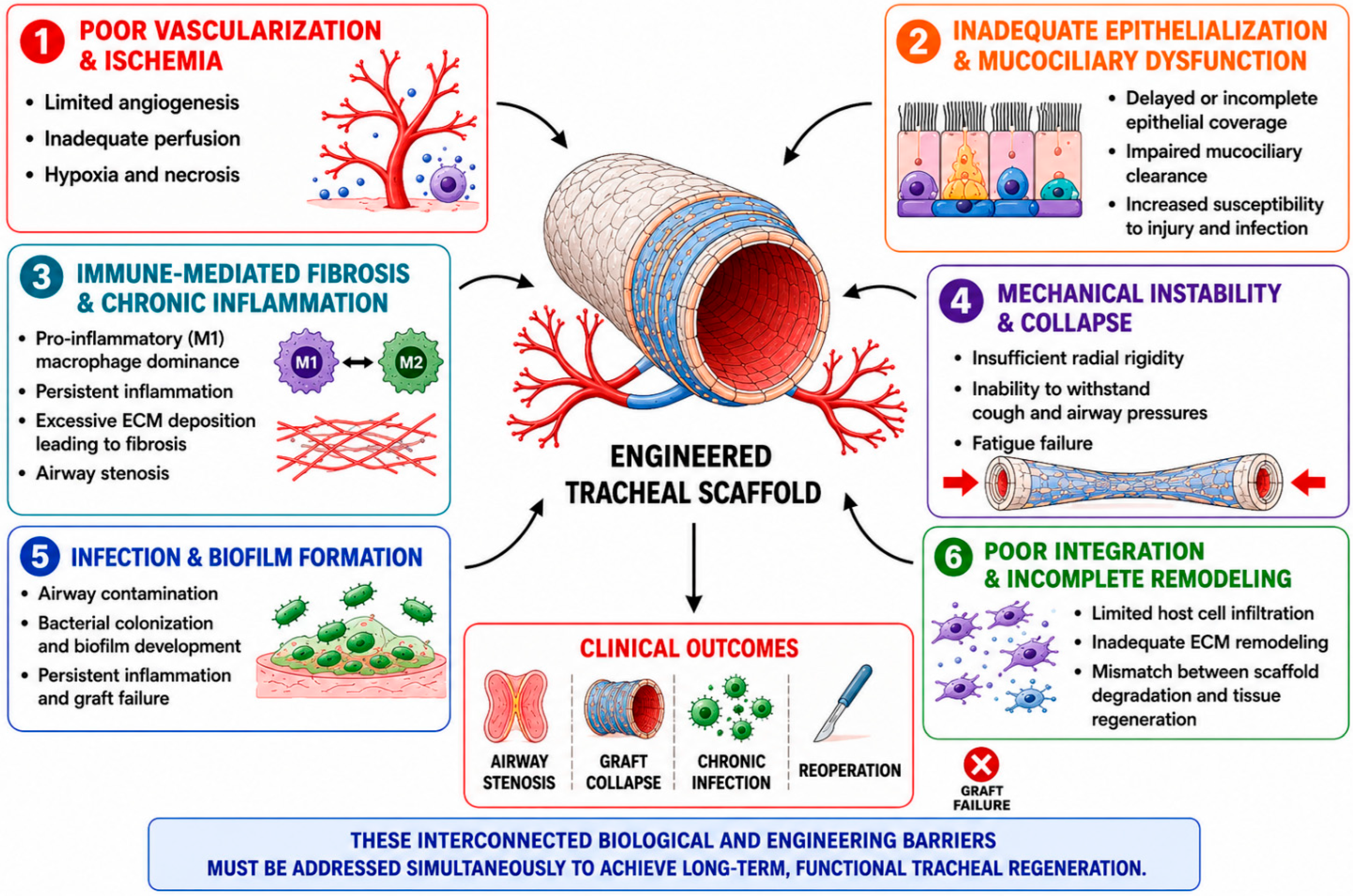

| Challenge | Biological/Engineering Mechanism | Clinical Consequence | Current Strategies | Remaining Limitations |
|---|---|---|---|---|
| Vascularization | Limited angiogenesis and insufficient oxygen diffusion impair graft perfusion | Ischemia, necrosis, delayed healing, graft failure | VEGF delivery, endothelial cell incorporation, pre-vascularized scaffolds, in vivo bioreactors [12,18,19,20] | Poor long-term perfusion and unstable vascular integration |
| Mechanical Stability | Mechanical mismatch and insufficient radial rigidity impair airway support under physiologic loading | Airway collapse, stenosis, fatigue failure | Synthetic polymers, reinforced scaffolds, anisotropic and hybrid scaffold systems [17,18,21,22,23] | Balancing flexibility, durability, and tissue remodeling |
| Immune Response | Foreign body reaction, macrophage activation, fibrosis, and chronic inflammation | Fibrotic encapsulation, stenosis, graft rejection | Immunomodulatory biomaterials, cytokine delivery, extracellular vesicles, surface modification [17,24,25] | Persistent inflammation and incomplete immune regulation |
| Epithelial Regeneration | Inadequate epithelial differentiation and impaired mucociliary function | Infection, mucus accumulation, impaired airway clearance | Stem cell seeding, epithelial progenitor cells, organoids, bioactive coatings [12,26,27,28,29,30,31,32,33] | Incomplete epithelial maturation and long-term functionality |
| Pediatric Growth Adaptation | Static scaffolds fail to accommodate airway growth and remodeling | Growth restriction; repeated surgical intervention | Biodegradable and growth-compatible biomaterials, auxetic structures [10,11,16,24] | Limited long-term growth adaptability and durability |
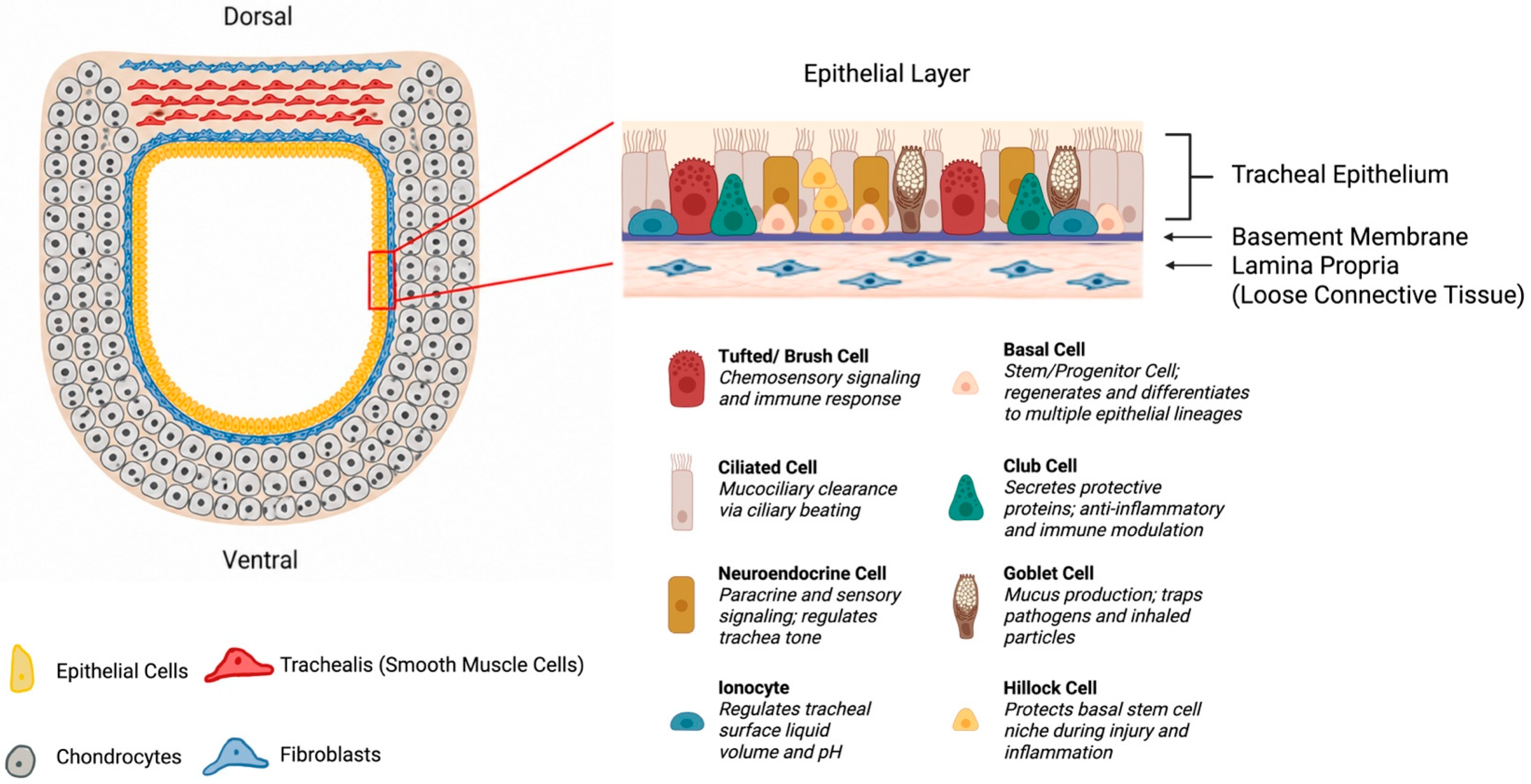
| Cell Type | Primary Function | Relevance to Tracheal Regeneration |
|---|---|---|
| Ciliated Cells | Coordinated ciliary beating mediates mucociliary clearance and removal of inhaled debris and pathogens [29] | Essential for restoring mucus transport and airway defense mechanisms |
| Goblet Cells | Production of mucus that traps inhaled particulates and pathogens [30] | Maintains airway lubrication and protective barrier function |
| Basal Cells | Multipotent stem/progenitor cells responsible for epithelial regeneration and differentiation [32] | Critical for long-term epithelial repair and scaffold repopulation |
| Club (Clara) Cells | Secretion of anti-inflammatory proteins and regulation of immune responses [33] | Supports epithelial repair and modulation of airway inflammation |
| Pulmonary Neuroendocrine Cells (PNECs) | Sensory and paracrine signaling regulating airway tone and responsiveness [27] | May influence epithelial repair and airway remodeling |
| Tuft Cells | Chemosensory signaling and regulation of mucociliary responses to irritants [37] | Contributes to epithelial defense and airway responsiveness |
| Hillock Cells | Protection of basal stem cell niches during injury and inflammation [35] | Supports preservation of regenerative epithelial capacity |
| Cell Type | Advantages | Limitations | Representative Study |
|---|---|---|---|
| Mesenchymal Stem Cells (MSCs) | Immunomodulatory, anti-inflammatory, multipotent, easy to isolate | Limited differentiation toward airway epithelium in some models | Shin et al. [50] |
| Induced Pluripotent Stem Cells (iPSCs) | High differentiation potential; can generate airway epithelial cells | Tumorigenicity concerns and complex differentiation protocols | Ikeda et al. [21] |
| Autologous Chondrocytes | Promote cartilage regeneration and structural support | Limited proliferation capacity and donor tissue requirements | Nomoto et al. [22] |
| Airway Basal Stem Cells | Native airway progenitors capable of regenerating epithelium | Difficult isolation and expansion | Lin et al. [35] |
| Endothelial Cells | Promote vascularization of scaffolds | Require supportive microenvironment for stability | Khalid et al. [41] |
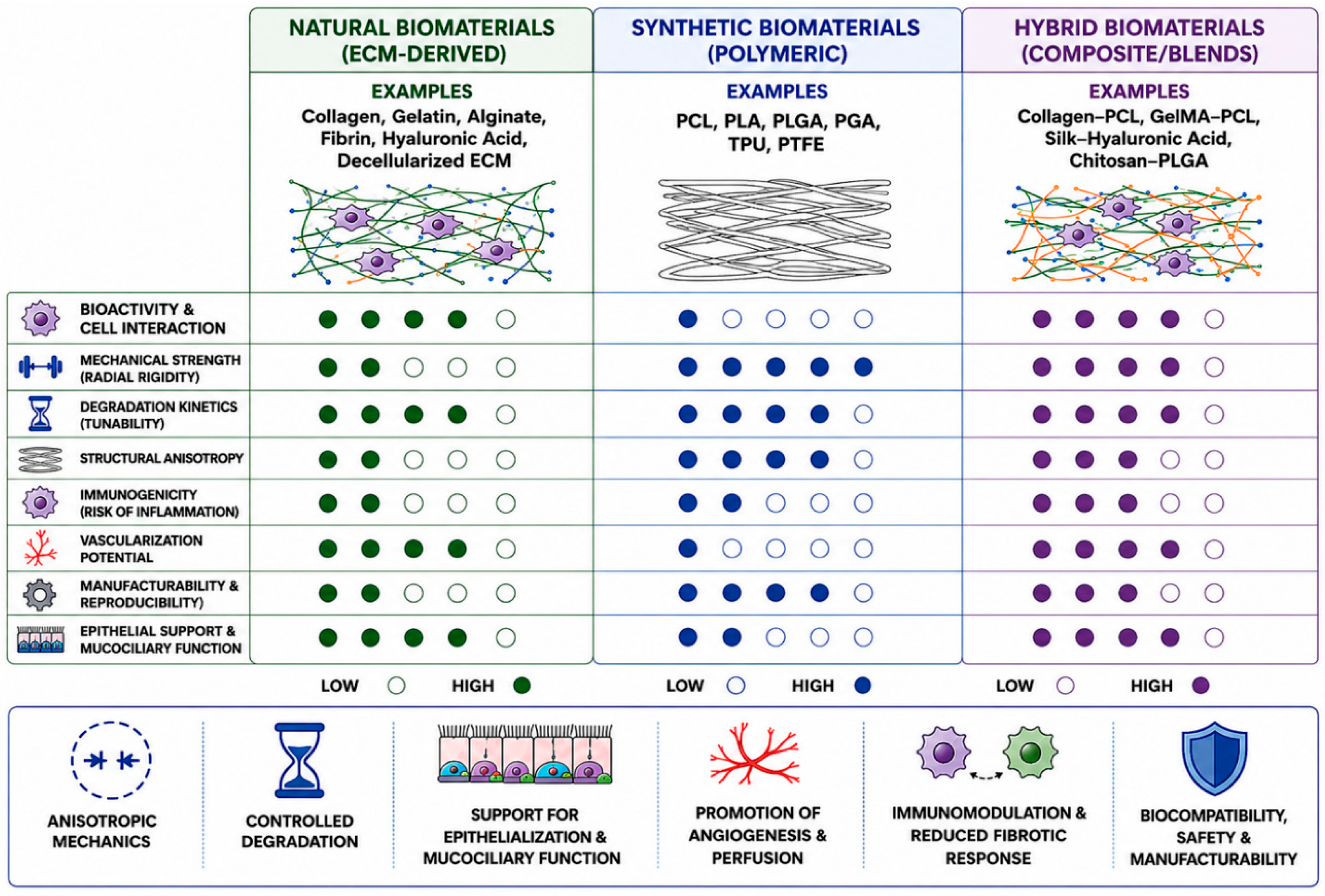
| Material | Type | Strengths | Limitations | Representative Study |
|---|---|---|---|---|
| Alginate | Natural | Biocompatible; supports cell adhesion and hydrogel formation | Weak mechanical strength and rapid degradation | Luo et al. [53] |
| Chitosan | Natural | Antimicrobial properties; promotes cell attachment | Limited mechanical stability | Nematollahi et al. [54] |
| Collagen | Natural | Mimics extracellular matrix; excellent cell compatibility | Rapid degradation and poor structural strength | Xu et al. [55] |
| Fibrin | Natural | Supports cell infiltration and angiogenesis | Weak mechanical properties and fast degradation | Dai et al. [56] |
| Gelatin | Natural | Promotes cell adhesion and proliferation | Low mechanical stability | Fares et al. [20] |
| Hyaluronic Acid | Natural | Supports cartilage regeneration and ECM signaling | Limited structural strength | Xu et al. [55] |
| Soy Protein | Natural | Biodegradable and supportive for cell growth | Limited studies in airway applications | Naik et al. [6] |
| HDPE | Synthetic | High mechanical strength and durability | Poor biodegradability and limited bioactivity | Naik et al. [6] |
| PLA | Synthetic | Biodegradable; tunable degradation rate | Can produce acidic degradation byproducts | DeStefano et al. [52] |
| PCL | Synthetic | Excellent mechanical strength; slow degradation | Hydrophobic surface limits cell attachment | Gandha et al. [42] |
| PC | Synthetic | Strong structural support | Limited biodegradability | Artham et al. [43] |
| PET | Synthetic | High durability and stability | Limited biocompatibility in regenerative applications | Naik et al. [6] |
| PGA | Synthetic | Biodegradable with good mechanical strength | Rapid degradation may compromise structural support | Naik et al. [6] |
| PLGA | Synthetic | Tunable degradation and widely used in tissue engineering | Degradation may produce acidic environment | Tatekawa et al. [44] |
| PPE | Synthetic | Tunable degradation and polymer properties | Limited long-term airway studies | Naik et al. [6] |
| TPU | Synthetic | Elastic and mechanically durable | Poor bioactivity for cell attachment | Naik et al. [6] |
Disclaimer/Publisher’s Note: The statements, opinions and data contained in all publications are solely those of the individual author(s) and contributor(s) and not of MDPI and/or the editor(s). MDPI and/or the editor(s) disclaim responsibility for any injury to people or property resulting from any ideas, methods, instructions or products referred to in the content. |
© 2026 by the authors. Licensee MDPI, Basel, Switzerland. This article is an open access article distributed under the terms and conditions of the Creative Commons Attribution (CC BY) license.
Share and Cite
Kosciuszek, N.D.; Walker, J.; Wanczyk, H.; Finck, C. Tracheal Tissue Engineering: Advances and Challenges. Bioengineering 2026, 13, 641. https://doi.org/10.3390/bioengineering13060641
Kosciuszek ND, Walker J, Wanczyk H, Finck C. Tracheal Tissue Engineering: Advances and Challenges. Bioengineering. 2026; 13(6):641. https://doi.org/10.3390/bioengineering13060641
Chicago/Turabian StyleKosciuszek, Nina D., Joanne Walker, Heather Wanczyk, and Christine Finck. 2026. "Tracheal Tissue Engineering: Advances and Challenges" Bioengineering 13, no. 6: 641. https://doi.org/10.3390/bioengineering13060641
APA StyleKosciuszek, N. D., Walker, J., Wanczyk, H., & Finck, C. (2026). Tracheal Tissue Engineering: Advances and Challenges. Bioengineering, 13(6), 641. https://doi.org/10.3390/bioengineering13060641

