Understanding and Advancing Wound Healing in the Era of Multi-Omic Technology
 ,
, 
Abstract
1. Introduction
2. Review
2.1. Fundamentals of Wound Healing
2.1.1. Hemostasis
2.1.2. Inflammation
2.1.3. Proliferation
2.1.4. Remodeling
2.1.5. Aberrant Wound Healing: Overhealing and Underhealing Wounds
2.2. Overview of Multi-Omic Technologies
2.2.1. Genomics
2.2.2. Proteomics
2.2.3. Transcriptomics
2.2.4. Epigenomics
2.2.5. Metabolomics
2.3. Integration of Multi-Omic Data
2.3.1. Single Cell: Isolation
2.3.2. Single Cell: Barcoding
2.3.3. Single Cell: Sequencing
2.4. Novel Insights from Multi-Omic Studies in Wound Healing
2.5. Challenges and Limitations of Multi-Omic Approaches
2.5.1. Technical and Methodological Challenges
2.5.2. Data Integration and Interpretation Complexities
2.5.3. Cost-Effectiveness and Accessibility in Clinical Settings
2.6. Future Directions
2.6.1. Integration of Artificial Intelligence and Machine Learning
2.6.2. Development of Wearable Biosensors and Continuous Monitoring Technologies
3. Conclusions
Author Contributions
Funding
Institutional Review Board Statement
Informed Consent Statement
Data Availability Statement
Acknowledgments
Conflicts of Interest
Abbreviations
| AI | Artificial Intelligence |
| PDGF | Platelet-Derived Growth Factor |
| TGF-β | Transforming Growth Factor Beta |
| ECM | Extracellular Matrix |
| VEGF | Vascular Endothelial Growth Factor |
| FGF | Fibroblast Growth Factor |
| MMPs | Matrix Metalloproteases |
| TIMPs | Tissue Inhibitors of Metalloproteases |
| GWAS | Genome-Wide Association Studies |
| TLN2 | Talin-2 |
| ZNF521 | Zinc Finger Protein 521 |
| CSMD1 | CUB and Sushi Multiple Domains 1 Gene |
| SERPIN | Serine Protease Inhibitor |
| RNA-seq | RNA Sequencing |
| scRNA-seq | Single-Cell RNA Sequencing |
| YAP | Yes-Associated Protein |
| TAZ | Tafazzin |
| Piezo1 | Piezo-Type Mechanosensitive Ion Channel Component 1 |
| RhoA | Ras Homolog Family Member A |
| ROCK2 | Rho-Associated Protein Kinase 2 |
| En1 | Engrailed-1 |
| COL1A1 | Collagen Type I Alpha 1 Chain |
| CCL2 | CC Motif Chemokine Ligand 2 |
| ATAC-seq | Assay for Transposase-Accessible Chromatin with High-Throughput Sequencing |
| THBS1 | Thrombospondin 1 |
| ChIP-seq | Chromatin Immunoprecipitation Sequencing |
| PcG | Polycomb Group |
| DNMT1 | DNA Methyltransferase 1 |
| RUNX2 | Runt-Related Transcription Factor 2 |
| α-SMA | Alpha-Smooth Muscle Actin |
| NMR | Nuclear Magnetic Resonance Spectroscopy |
| TNF-α | Tumor Necrosis Factor Alpha |
| IL-12 | Interleukin-12 |
| FACS | Fluorescence-Activated Cell Sorting |
| MACS | Magnetic-Activated Cell Sorting |
| LCM | Laser Capture Microdissection |
| UMIs | Unique Molecular Identifiers |
| sci-RNA-seq | Single Cell Combinatorial Indexing RNA Sequencing |
| SPLiT-seq | Split Pool Ligation-Based Transcriptome Sequencing |
| snRNA-seq | Single-Nucleus RNA Sequencing |
| CITE-seq | Cellular Indexing of Transcriptomes and Epitopes |
| scATAC-seq | Single-Cell Assay for Transposase-Accessible Chromatin with High-Throughput Sequencing |
| MERFISH | Multiplexed Error-Robust Fluorescence In Situ Hybridization |
| CXCL14 | C-X-C Motif Ligand 14 |
| SNF | Similarity Network Fusion |
| PLSR | Partial Least Squares Regression |
| mtCCA | Multi-Table Canonical Correlation Analysis |
| SVA | Surrogate Variable Analysis |
| ML | Machine Learning |
| EHR | Electronic Health Record |
| WEABM | Wound Environment Agent-Based Model |
References
- Copeland, K.; Purvis, A.R. A Retrospective Chart Review of Chronic Wound Patients Treated with Topical Oxygen Therapy. Adv. Wound Care 2017, 6, 143–152. [Google Scholar] [CrossRef] [PubMed]
- Sen, C.K. Human Wound and Its Burden: Updated 2025 Compendium of Estimates. Adv. Wound Care 2025, 14, 429–438. [Google Scholar] [CrossRef] [PubMed]
- Eming, S.A.; Martin, P.; Tomic-Canic, M. Wound Repair and Regeneration: Mechanisms, Signaling, and Translation. Sci. Transl. Med. 2014, 6, 265sr6. [Google Scholar] [CrossRef]
- Rodrigues, M.; Kosaric, N.; Bonham, C.A.; Gurtner, G.C. Wound Healing: A Cellular Perspective. Physiol. Rev. 2019, 99, 665–706. [Google Scholar] [CrossRef]
- Talbott, H.E.; Mascharak, S.; Griffin, M.; Wan, D.C.; Longaker, M.T. Wound Healing, Fibroblast Heterogeneity, and Fibrosis. Cell Stem Cell 2022, 29, 1161–1180. [Google Scholar] [CrossRef]
- Szpaderska, A.M.; Egozi, E.I.; Gamelli, R.L.; DiPietro, L.A. The Effect of Thrombocytopenia on Dermal Wound Healing. J. Investig. Dermatol. 2003, 120, 1130–1137. [Google Scholar] [CrossRef]
- Gillitzer, R.; Goebeler, M. Chemokines in Cutaneous Wound Healing. J. Leukoc. Biol. 2001, 69, 513–521. [Google Scholar] [CrossRef]
- Mirza, R.; DiPietro, L.A.; Koh, T.J. Selective and Specific Macrophage Ablation Is Detrimental to Wound Healing in Mice. Am. J. Pathol. 2009, 175, 2454–2462. [Google Scholar] [CrossRef]
- Alhajj, M.; Goyal, A. Physiology, Granulation Tissue. In StatPearls; StatPearls Publishing: Treasure Island, FL, USA, 2025. [Google Scholar]
- Parker, J.B.; Valencia, C.; Akras, D.; DiIorio, S.E.; Griffin, M.F.; Longaker, M.T.; Wan, D.C. Understanding Fibroblast Heterogeneity in Form and Function. Biomedicines 2023, 11, 2264. [Google Scholar] [CrossRef] [PubMed]
- Spielman, A.F.; Griffin, M.F.; Parker, J.; Cotterell, A.C.; Wan, D.C.; Longaker, M.T. Beyond the Scar: A Basic Science Review of Wound Remodeling. Adv. Wound Care 2023, 12, 57–67. [Google Scholar] [CrossRef]
- Caley, M.P.; Martins, V.L.C.; O’Toole, E.A. Metalloproteinases and Wound Healing. Adv. Wound Care 2015, 4, 225–234. [Google Scholar] [CrossRef] [PubMed]
- Telgenhoff, D.; Shroot, B. Cellular Senescence Mechanisms in Chronic Wound Healing. Cell Death Differ. 2005, 12, 695–698. [Google Scholar] [CrossRef] [PubMed]
- Van Der Veer, W.M.; Bloemen, M.C.T.; Ulrich, M.M.W.; Molema, G.; Van Zuijlen, P.P.; Middelkoop, E.; Niessen, F.B. Potential Cellular and Molecular Causes of Hypertrophic Scar Formation. Burns 2009, 35, 15–29. [Google Scholar] [CrossRef]
- Hood, L.; Rowen, L. The Human Genome Project: Big Science Transforms Biology and Medicine. Genome Med. 2013, 5, 79. [Google Scholar] [CrossRef]
- Behjati, S.; Tarpey, P.S. What Is next Generation Sequencing? Arch. Dis. Child. Educ. Pract. Ed. 2013, 98, 236–238. [Google Scholar] [CrossRef]
- Mani, S.; Lalani, S.R.; Pammi, M. Genomics and Multiomics in the Age of Precision Medicine. Pediatr. Res. 2025, 97, 1399–1410. [Google Scholar] [CrossRef]
- Tipton, C.D.; Wolcott, R.D.; Sanford, N.E.; Miller, C.; Pathak, G.; Silzer, T.K.; Sun, J.; Fleming, D.; Rumbaugh, K.P.; Little, T.D.; et al. Patient Genetics Is Linked to Chronic Wound Microbiome Composition and Healing. PLoS Pathog. 2020, 16, e1008511. [Google Scholar] [CrossRef]
- Sood, R.F.; Hocking, A.M.; Muffley, L.A.; Ga, M.; Honari, S.; Reiner, A.P.; Gibran, N.S. Genome-Wide Association Study of Postburn Scarring Identifies a Novel Protective Variant. Ann. Surg. 2015, 262, 563–569. [Google Scholar] [CrossRef]
- Escudero-Esparza, A.; Kalchishkova, N.; Kurbasic, E.; Jiang, W.G.; Blom, A.M. The Novel Complement Inhibitor Human CUB and Sushi Multiple Domains 1 (CSMD1) Protein Promotes Factor I-mediated Degradation of C4b and C3b and Inhibits the Membrane Attack Complex Assembly. FASEB J. 2013, 27, 5083–5093. [Google Scholar] [CrossRef]
- Tang, M.-R.; Wang, Y.-X.; Guo, S.; Han, S.-Y.; Wang, D. CSMD1 Exhibits Antitumor Activity in A375 Melanoma Cells through Activation of the Smad Pathway. Apoptosis 2012, 17, 927–937. [Google Scholar] [CrossRef] [PubMed]
- Al-Amrani, S.; Al-Jabri, Z.; Al-Zaabi, A.; Alshekaili, J.; Al-Khabori, M. Proteomics: Concepts and Applications in Human Medicine. World J. Biol. Chem. 2021, 12, 57–69. [Google Scholar] [CrossRef] [PubMed]
- Chen, Y.; Wu, Z.; Yi, X. Elucidating the Pan-Oncologic Landscape of S100A9: Prognostic and Therapeutic Corollaries from an Integrative Bioinformatics and Mendelian Randomization Analysis. Sci. Rep. 2024, 14, 19071. [Google Scholar] [CrossRef]
- Eming, S.A.; Koch, M.; Krieger, A.; Brachvogel, B.; Kreft, S.; Bruckner-Tuderman, L.; Krieg, T.; Shannon, J.D.; Fox, J.W. Differential Proteomic Analysis Distinguishes Tissue Repair Biomarker Signatures in Wound Exudates Obtained from Normal Healing and Chronic Wounds. J. Proteome Res. 2010, 9, 4758–4766. [Google Scholar] [CrossRef]
- Wang, Z.; Gerstein, M.; Snyder, M. RNA-Seq: A Revolutionary Tool for Transcriptomics. Nat. Rev. Genet. 2009, 10, 57–63. [Google Scholar] [CrossRef]
- Cheng, X.; Gao, Z.; Shan, S.; Shen, H.; Zheng, H.; Jin, L.; Li, Q.; Zhou, J. Single Cell Transcriptomics Reveals the Cellular Heterogeneity of Keloids and the Mechanism of Their Aggressiveness. Commun. Biol. 2024, 7, 1647. [Google Scholar] [CrossRef]
- Sass, P.A.; Dąbrowski, M.; Charzyńska, A.; Sachadyn, P. Transcriptomic Responses to Wounding: Meta-Analysis of Gene Expression Microarray Data. BMC Genom. 2017, 18, 850. [Google Scholar] [CrossRef] [PubMed]
- Madala, S.K.; Pesce, J.T.; Ramalingam, T.R.; Wilson, M.S.; Minnicozzi, S.; Cheever, A.W.; Thompson, R.W.; Mentink-Kane, M.M.; Wynn, T.A. Matrix Metalloproteinase 12-Deficiency Augments Extracellular Matrix Degrading Metalloproteinases and Attenuates IL-13–Dependent Fibrosis. J. Immunol. 2010, 184, 3955–3963. [Google Scholar] [CrossRef]
- Buenrostro, J.D.; Wu, B.; Litzenburger, U.M.; Ruff, D.; Gonzales, M.L.; Snyder, M.P.; Chang, H.Y.; Greenleaf, W.J. Single-Cell Chromatin Accessibility Reveals Principles of Regulatory Variation. Nature 2015, 523, 486–490. [Google Scholar] [CrossRef] [PubMed]
- Liu, Q.; Zaba, L.C.; Satpathy, A.T.; Longmire, M.; Zhang, W.; Li, K.; Granja, J.; Guo, C.; Lin, J.; Li, R.; et al. Chromatin Accessibility Landscapes of Skin Cells in Systemic Sclerosis Nominate Dendritic Cells in Disease Pathogenesis. Nat. Commun. 2020, 11, 5843. [Google Scholar] [CrossRef]
- Wang, T.; Zhu, B.; Lu, J.; Guo, X.; Li, R.; Yuan, Y.; Chen, J.; Dai, X.; Liu, S.; Du, J.; et al. Single-Cell Chromatin Landscapes Associated with the Burnt Skin Healing Process in Rats. Sci. Data 2025, 12, 639. [Google Scholar] [CrossRef]
- Bian, X.; Piipponen, M.; Liu, Z.; Luo, L.; Geara, J.; Chen, Y.; Sangsuwan, T.; Maselli, M.; Diaz, C.; Bain, C.A.; et al. Epigenetic Memory of Radiotherapy in Dermal Fibroblasts Impairs Wound Repair Capacity in Cancer Survivors. Nat. Commun. 2024, 15, 9286. [Google Scholar] [CrossRef]
- Pellegrini, M.; Ferrari, R. Epigenetic Analysis: ChIP-Chip and ChIP-Seq. In Next Generation Microarray Bioinformatics; Wang, J., Tan, A.C., Tian, T., Eds.; Methods in Molecular Biology; Humana Press: Totowa, NJ, USA, 2012; Volume 802, pp. 377–387. ISBN 978-1-61779-399-8. [Google Scholar]
- Shaw, T.; Martin, P. Epigenetic Reprogramming during Wound Healing: Loss of Polycomb-mediated Silencing May Enable Upregulation of Repair Genes. EMBO Rep. 2009, 10, 881–886. [Google Scholar] [CrossRef]
- Pastar, I.; Marjanovic, J.; Stone, R.C.; Chen, V.; Burgess, J.L.; Mervis, J.S.; Tomic-Canic, M. Epigenetic Regulation of Cellular Functions in Wound Healing. Exp. Dermatol. 2021, 30, 1073–1089. [Google Scholar] [CrossRef]
- Altorok, N.; Tsou, P.-S.; Coit, P.; Khanna, D.; Sawalha, A.H. Genome-Wide DNA Methylation Analysis in Dermal Fibroblasts from Patients with Diffuse and Limited Systemic Sclerosis Reveals Common and Subset-Specific DNA Methylation Aberrancies. Ann. Rheum. Dis. 2015, 74, 1612–1620. [Google Scholar] [CrossRef] [PubMed]
- Dowson, C.; O’Reilly, S. DNA Methylation in Fibrosis. Eur. J. Cell Biol. 2016, 95, 323–330. [Google Scholar] [CrossRef] [PubMed]
- Moco, S. Studying Metabolism by NMR-Based Metabolomics. Front. Mol. Biosci. 2022, 9, 882487. [Google Scholar] [CrossRef]
- Ashrafi, M.; Xu, Y.; Muhamadali, H.; White, I.; Wilkinson, M.; Hollywood, K.; Baguneid, M.; Goodacre, R.; Bayat, A. A Microbiome and Metabolomic Signature of Phases of Cutaneous Healing Identified by Profiling Sequential Acute Wounds of Human Skin: An Exploratory Study. PLoS ONE 2020, 15, e0229545. [Google Scholar] [CrossRef]
- Fluhr, J.W.; Darlenski, R.; Surber, C. Glycerol and the Skin: Holistic Approach to Its Origin and Functions. Br. J. Dermatol. 2008, 159, 23–34. [Google Scholar] [CrossRef]
- Sood, R.F.; Gu, H.; Djukovic, D.; Deng, L.; Ga, M.; Muffley, L.A.; Raftery, D.; Hocking, A.M. Targeted Metabolic Profiling of Wounds in Diabetic and Nondiabetic Mice. Wound Repair. Regen. 2015, 23, 423–434. [Google Scholar] [CrossRef] [PubMed]
- Valsami, E.-A.; Chu, G.; Guan, M.; Gilman, J.; Theocharidis, G.; Veves, A. The Role of Omics Techniques in Diabetic Wound Healing: Recent Insights into the Application of Single-Cell RNA Sequencing, Bulk RNA Sequencing, Spatial Transcriptomics, and Proteomics. Adv. Ther. 2025, 42, 3089–3110. [Google Scholar] [CrossRef]
- Liao, X.; Makris, M.; Luo, X.M. Fluorescence-Activated Cell Sorting for Purification of Plasmacytoid Dendritic Cells from the Mouse Bone Marrow. J. Vis. Exp. 2016, 54641. [Google Scholar] [CrossRef]
- Fernandes, T.G.; Diogo, M.M.; Cabral, J.S. Stem Cell Bioprocessing: For Cellular Therapy, Diagnostics and Drug Development; Woodhead Publishing Series in Biomedicine; Woodhead Publishing: Oxford, UK; Phildelphia, PA, USA, 2013; ISBN 978-1-907568-88-6. [Google Scholar]
- Sun, Y.; Yu, N.; Zhang, J.; Yang, B. Advances in Microfluidic Single-Cell RNA Sequencing and Spatial Transcriptomics. Micromachines 2025, 16, 426. [Google Scholar] [CrossRef]
- Li, M.; Liu, H.; Zhuang, S.; Goda, K. Droplet Flow Cytometry for Single-Cell Analysis. RSC Adv. 2021, 11, 20944–20960. [Google Scholar] [CrossRef]
- Choe, K.; Pak, U.; Pang, Y.; Hao, W.; Yang, X. Advances and Challenges in Spatial Transcriptomics for Developmental Biology. Biomolecules 2023, 13, 156. [Google Scholar] [CrossRef]
- Sun, J.; Philpott, M.; Loi, D.; Hoffman, G.; Robson, J.; Mehta, N.; Calcutt, E.; Gamble, V.; Brown, T.; Brown, T.; et al. Enhancing Single-Cell Transcriptomics Using Interposed Anchor Oligonucleotide Sequences. Commun. Biol. 2025, 8, 67. [Google Scholar] [CrossRef] [PubMed]
- Anaparthy, N.; Ho, Y.-J.; Martelotto, L.; Hammell, M.; Hicks, J. Single-Cell Applications of Next-Generation Sequencing. Cold Spring Harb. Perspect. Med. 2019, 9, a026898. [Google Scholar] [CrossRef]
- Rosenberg, A.B.; Roco, C.M.; Muscat, R.A.; Kuchina, A.; Sample, P.; Yao, Z.; Graybuck, L.T.; Peeler, D.J.; Mukherjee, S.; Chen, W.; et al. Single-Cell Profiling of the Developing Mouse Brain and Spinal Cord with Split-Pool Barcoding. Science 2018, 360, 176–182. [Google Scholar] [CrossRef]
- Lareau, C.A.; Ma, S.; Duarte, F.M.; Buenrostro, J.D. Inference and Effects of Barcode Multiplets in Droplet-Based Single-Cell Assays. Nat. Commun. 2020, 11, 866. [Google Scholar] [CrossRef]
- Zhang, H.; Mulqueen, R.M.; Iannuzo, N.; Farrera, D.O.; Polverino, F.; Galligan, J.J.; Ledford, J.G.; Adey, A.C.; Cusanovich, D.A. Txci-ATAC-Seq: A Massive-Scale Single-Cell Technique to Profile Chromatin Accessibility. Genome Biol. 2024, 25, 78. [Google Scholar] [CrossRef] [PubMed]
- Wu, H.; Kirita, Y.; Donnelly, E.L.; Humphreys, B.D. Advantages of Single-Nucleus over Single-Cell RNA Sequencing of Adult Kidney: Rare Cell Types and Novel Cell States Revealed in Fibrosis. J. Am. Soc. Nephrol. 2019, 30, 23–32. [Google Scholar] [CrossRef]
- Lacar, B.; Linker, S.B.; Jaeger, B.N.; Krishnaswami, S.R.; Barron, J.J.; Kelder, M.J.E.; Parylak, S.L.; Paquola, A.C.M.; Venepally, P.; Novotny, M.; et al. Nuclear RNA-Seq of Single Neurons Reveals Molecular Signatures of Activation. Nat. Commun. 2016, 7, 11022. [Google Scholar] [CrossRef]
- Salcher, S.; Heidegger, I.; Untergasser, G.; Fotakis, G.; Scheiber, A.; Martowicz, A.; Noureen, A.; Krogsdam, A.; Schatz, C.; Schäfer, G.; et al. Comparative Analysis of 10X Chromium vs. BD Rhapsody Whole Transcriptome Single-Cell Sequencing Technologies in Complex Human Tissues. Heliyon 2024, 10, e28358. [Google Scholar] [CrossRef]
- Heumos, L.; Schaar, A.C.; Lance, C.; Litinetskaya, A.; Drost, F.; Zappia, L.; Lücken, M.D.; Strobl, D.C.; Henao, J.; Curion, F.; et al. Best Practices for Single-Cell Analysis across Modalities. Nat. Rev. Genet. 2023, 24, 550–572. [Google Scholar] [CrossRef]
- Wong, M.T.; Ong, D.E.H.; Lim, F.S.H.; Teng, K.W.W.; McGovern, N.; Narayanan, S.; Ho, W.Q.; Cerny, D.; Tan, H.K.K.; Anicete, R.; et al. A High-Dimensional Atlas of Human T Cell Diversity Reveals Tissue-Specific Trafficking and Cytokine Signatures. Immunity 2016, 45, 442–456. [Google Scholar] [CrossRef]
- Stoeckius, M.; Hafemeister, C.; Stephenson, W.; Houck-Loomis, B.; Chattopadhyay, P.K.; Swerdlow, H.; Satija, R.; Smibert, P. Simultaneous Epitope and Transcriptome Measurement in Single Cells. Nat. Methods 2017, 14, 865–868. [Google Scholar] [CrossRef]
- Ju, J.; Ma, M.; Zhang, Y.; Ding, Z.; Chen, J. State Transition and Intercellular Communication of Synovial Fibroblasts in Response to Chronic and Acute Shoulder Injuries Unveiled by Single-Cell Transcriptomic Analyses. Connect. Tissue Res. 2024, 65, 73–87. [Google Scholar] [CrossRef]
- Dempsey, L.A. Immune Dysregulation. Nat. Immunol. 2020, 21, 596. [Google Scholar] [CrossRef] [PubMed]
- Xiao, Y.; Jin, W.; Ju, L.; Fu, J.; Wang, G.; Yu, M.; Chen, F.; Qian, K.; Wang, X.; Zhang, Y. Tracking Single-Cell Evolution Using Clock-like Chromatin Accessibility Loci. Nat. Biotechnol. 2025, 43, 784–798. [Google Scholar] [CrossRef] [PubMed]
- Stuart, T.; Butler, A.; Hoffman, P.; Hafemeister, C.; Papalexi, E.; Mauck, W.M.; Hao, Y.; Stoeckius, M.; Smibert, P.; Satija, R. Comprehensive Integration of Single-Cell Data. Cell 2019, 177, 1888–1902.e21. [Google Scholar] [CrossRef] [PubMed]
- Buenrostro, J.D.; Wu, B.; Chang, H.Y.; Greenleaf, W.J. ATAC-seq: A Method for Assaying Chromatin Accessibility Genome-Wide. CP Mol. Biol. 2015, 109. [Google Scholar] [CrossRef]
- Bartosovic, M.; Kabbe, M.; Castelo-Branco, G. Single-Cell CUT&Tag Profiles Histone Modifications and Transcription Factors in Complex Tissues. Nat. Biotechnol. 2021, 39, 825–835. [Google Scholar] [CrossRef] [PubMed]
- Theocharidis, G.; Thomas, B.E.; Sarkar, D.; Mumme, H.L.; Pilcher, W.J.R.; Dwivedi, B.; Sandoval-Schaefer, T.; Sîrbulescu, R.F.; Kafanas, A.; Mezghani, I.; et al. Single Cell Transcriptomic Landscape of Diabetic Foot Ulcers. Nat. Commun. 2022, 13, 181. [Google Scholar] [CrossRef]
- Rao, A.; Barkley, D.; França, G.S.; Yanai, I. Exploring Tissue Architecture Using Spatial Transcriptomics. Nature 2021, 596, 211–220. [Google Scholar] [CrossRef]
- Sarfatis, A.; Wang, Y.; Twumasi-Ankrah, N.; Moffitt, J.R. Highly Multiplexed Spatial Transcriptomics in Bacteria. Science 2025, 387, eadr0932. [Google Scholar] [CrossRef]
- Hao, Y.; Hao, S.; Andersen-Nissen, E.; Mauck, W.M.; Zheng, S.; Butler, A.; Lee, M.J.; Wilk, A.J.; Darby, C.; Zager, M.; et al. Integrated Analysis of Multimodal Single-Cell Data. Cell 2021, 184, 3573–3587.e29. [Google Scholar] [CrossRef]
- Chen, H.; Albergante, L.; Hsu, J.Y.; Lareau, C.A.; Lo Bosco, G.; Guan, J.; Zhou, S.; Gorban, A.N.; Bauer, D.E.; Aryee, M.J.; et al. Single-Cell Trajectories Reconstruction, Exploration and Mapping of Omics Data with STREAM. Nat. Commun. 2019, 10, 1903. [Google Scholar] [CrossRef]
- Browaeys, R.; Saelens, W.; Saeys, Y. NicheNet: Modeling Intercellular Communication by Linking Ligands to Target Genes. Nat. Methods 2020, 17, 159–162. [Google Scholar] [CrossRef]
- Efremova, M.; Vento-Tormo, M.; Teichmann, S.A.; Vento-Tormo, R. CellPhoneDB: Inferring Cell–Cell Communication from Combined Expression of Multi-Subunit Ligand–Receptor Complexes. Nat. Protoc. 2020, 15, 1484–1506. [Google Scholar] [CrossRef] [PubMed]
- Jin, S.; Guerrero-Juarez, C.F.; Zhang, L.; Chang, I.; Ramos, R.; Kuan, C.-H.; Myung, P.; Plikus, M.V.; Nie, Q. Inference and Analysis of Cell-Cell Communication Using CellChat. Nat. Commun. 2021, 12, 1088. [Google Scholar] [CrossRef]
- Liu, Z.; Bian, X.; Luo, L.; Björklund, Å.K.; Li, L.; Zhang, L.; Chen, Y.; Guo, L.; Gao, J.; Cao, C.; et al. Spatiotemporal Single-Cell Roadmap of Human Skin Wound Healing. Cell Stem Cell 2025, 32, 479–498.e8. [Google Scholar] [CrossRef] [PubMed]
- Foster, D.S.; Januszyk, M.; Yost, K.E.; Chinta, M.S.; Gulati, G.S.; Nguyen, A.T.; Burcham, A.R.; Salhotra, A.; Ransom, R.C.; Henn, D.; et al. Integrated Spatial Multiomics Reveals Fibroblast Fate during Tissue Repair. Proc. Natl. Acad. Sci. USA 2021, 118, e2110025118. [Google Scholar] [CrossRef] [PubMed]
- Mascharak, S.; desJardins-Park, H.E.; Davitt, M.F.; Griffin, M.; Borrelli, M.R.; Moore, A.L.; Chen, K.; Duoto, B.; Chinta, M.; Foster, D.S.; et al. Preventing Engrailed-1 Activation in Fibroblasts Yields Wound Regeneration without Scarring. Science 2021, 372, eaba2374. [Google Scholar] [CrossRef] [PubMed]
- Maheswary, T.; Nurul, A.A.; Fauzi, M.B. The Insights of Microbes’ Roles in Wound Healing: A Comprehensive Review. Pharmaceutics 2021, 13, 981. [Google Scholar] [CrossRef]
- Larouche, J.; Sheoran, S.; Maruyama, K.; Martino, M.M. Immune Regulation of Skin Wound Healing: Mechanisms and Novel Therapeutic Targets. Adv. Wound Care 2018, 7, 209–231. [Google Scholar] [CrossRef]
- Mohr, A.E.; Ortega-Santos, C.P.; Whisner, C.M.; Klein-Seetharaman, J.; Jasbi, P. Navigating Challenges and Opportunities in Multi-Omics Integration for Personalized Healthcare. Biomedicines 2024, 12, 1496. [Google Scholar] [CrossRef]
- Opitz, L.; Salinas-Riester, G.; Grade, M.; Jung, K.; Jo, P.; Emons, G.; Ghadimi, B.M.; Beißbarth, T.; Gaedcke, J. Impact of RNA Degradation on Gene Expression Profiling. BMC Med. Genomics 2010, 3, 36. [Google Scholar] [CrossRef]
- Denisenko, E.; Guo, B.B.; Jones, M.; Hou, R.; De Kock, L.; Lassmann, T.; Poppe, D.; Clément, O.; Simmons, R.K.; Lister, R.; et al. Systematic Assessment of Tissue Dissociation and Storage Biases in Single-Cell and Single-Nucleus RNA-Seq Workflows. Genome Biol. 2020, 21, 130. [Google Scholar] [CrossRef] [PubMed]
- Burja, B.; Paul, D.; Tastanova, A.; Edalat, S.G.; Gerber, R.; Houtman, M.; Elhai, M.; Bürki, K.; Staeger, R.; Restivo, G.; et al. An Optimized Tissue Dissociation Protocol for Single-Cell RNA Sequencing Analysis of Fresh and Cultured Human Skin Biopsies. Front. Cell Dev. Biol. 2022, 10, 872688. [Google Scholar] [CrossRef]
- Slyper, M.; Porter, C.B.M.; Ashenberg, O.; Waldman, J.; Drokhlyansky, E.; Wakiro, I.; Smillie, C.; Smith-Rosario, G.; Wu, J.; Dionne, D.; et al. A Single-Cell and Single-Nucleus RNA-Seq Toolbox for Fresh and Frozen Human Tumors. Nat. Med. 2020, 26, 792–802. [Google Scholar] [CrossRef]
- Dai, X.; Shen, L. Advances and Trends in Omics Technology Development. Front. Med. 2022, 9, 911861. [Google Scholar] [CrossRef]
- Sandhu, C.; Qureshi, A.; Emili, A. Panomics for Precision Medicine. Trends Mol. Med. 2018, 24, 85–101. [Google Scholar] [CrossRef] [PubMed]
- Liu, Y.; Beyer, A.; Aebersold, R. On the Dependency of Cellular Protein Levels on mRNA Abundance. Cell 2016, 165, 535–550. [Google Scholar] [CrossRef]
- Perl, K.; Ushakov, K.; Pozniak, Y.; Yizhar-Barnea, O.; Bhonker, Y.; Shivatzki, S.; Geiger, T.; Avraham, K.B.; Shamir, R. Reduced Changes in Protein Compared to mRNA Levels across Non-Proliferating Tissues. BMC Genom. 2017, 18, 305. [Google Scholar] [CrossRef] [PubMed]
- Andersson, M.Å.; Madsen, L.B.; Schmidtchen, A.; Puthia, M. Development of an Experimental Ex Vivo Wound Model to Evaluate Antimicrobial Efficacy of Topical Formulations. Int. J. Mol. Sci. 2021, 22, 5045. [Google Scholar] [CrossRef]
- Villas-Bôas, S.G.; Noel, S.; Lane, G.A.; Attwood, G.; Cookson, A. Extracellular Metabolomics: A Metabolic Footprinting Approach to Assess Fiber Degradation in Complex Media. Anal. Biochem. 2006, 349, 297–305. [Google Scholar] [CrossRef]
- Fomenko, M.V.; Yanshole, L.V.; Tsentalovich, Y.P. Stability of Metabolomic Content during Sample Preparation: Blood and Brain Tissues. Metabolites 2022, 12, 811. [Google Scholar] [CrossRef]
- Bersanelli, M.; Mosca, E.; Remondini, D.; Giampieri, E.; Sala, C.; Castellani, G.; Milanesi, L. Methods for the Integration of Multi-Omics Data: Mathematical Aspects. BMC Bioinform. 2016, 17, S15. [Google Scholar] [CrossRef]
- Rappoport, N.; Shamir, R. Multi-Omic and Multi-View Clustering Algorithms: Review and Cancer Benchmark. Nucleic Acids Res. 2018, 46, 10546–10562. [Google Scholar] [CrossRef]
- Le, D.T.P.; Pham, T.D. Unveiling the Role of Artificial Intelligence for Wound Assessment and Wound Healing Prediction. Explor. Med. 2023, 4, 589–611. [Google Scholar] [CrossRef]
- Liu, H.; Sun, W.; Cai, W.; Luo, K.; Lu, C.; Jin, A.; Zhang, J.; Liu, Y. Current Status, Challenges, and Prospects of Artificial Intelligence Applications in Wound Repair Theranostics. Theranostics 2025, 15, 1662–1688. [Google Scholar] [CrossRef]
- Ganesan, O.; Morris, M.X.; Guo, L.; Orgill, D. A Review of Artificial Intelligence in Wound Care. Art. Int. Surg. 2024, 4, 364–375. [Google Scholar] [CrossRef]
- Ma, J.; Shojaie, A.; Michailidis, G. Network-Based Pathway Enrichment Analysis with Incomplete Network Information. Bioinformatics 2016, 32, 3165–3174. [Google Scholar] [CrossRef]
- Zhang, Y.; Parmigiani, G.; Johnson, W.E. ComBat-Seq: Batch Effect Adjustment for RNA-Seq Count Data. NAR Genom. Bioinform. 2020, 2, lqaa078. [Google Scholar] [CrossRef] [PubMed]
- Johnson, W.E.; Li, C.; Rabinovic, A. Adjusting Batch Effects in Microarray Expression Data Using Empirical Bayes Methods. Biostatistics 2007, 8, 118–127. [Google Scholar] [CrossRef]
- Cirka, H.; Nguyen, T.T. Comparative Analysis of Animal Models in Wound Healing Research and the Utility for Humanized Mice Models. Adv. Wound Care 2025, 14, 479–512. [Google Scholar] [CrossRef]
- Mitić, T.; Georgescu, A.; Alexandru-Moise, N.; Davies, M.J.; Vindis, C.; Novella, S.; Gerdts, E.; Kararigas, G.; Wettinger, S.B.; Formosa, M.M.; et al. Current Status and Challenges of Multi-Omics Research Using Animal Models of Atherosclerosis. J. Mol. Cell Cardiol. Plus 2025, 13, 100476. [Google Scholar] [CrossRef]
- Zomer, H.D.; Trentin, A.G. Skin Wound Healing in Humans and Mice: Challenges in Translational Research. J. Dermatol. Sci. 2018, 90, 3–12. [Google Scholar] [CrossRef]
- Tauber, M.; Basso, L.; Martin, J.; Bostan, L.; Pinto, M.M.; Thierry, G.R.; Houmadi, R.; Serhan, N.; Loste, A.; Blériot, C.; et al. Landscape of Mast Cell Populations across Organs in Mice and Humans. J. Exp. Med. 2023, 220, e20230570. [Google Scholar] [CrossRef]
- Broszczak, D.A.; Sydes, E.R.; Wallace, D.; Parker, T.J. Molecular Aspects of Wound Healing and the Rise of Venous Leg Ulceration: Omics Approaches to Enhance Knowledge and Aid Diagnostic Discovery. Clin. Biochem. Rev. 2017, 38, 35–55. [Google Scholar]
- Hasin, Y.; Seldin, M.; Lusis, A. Multi-Omics Approaches to Disease. Genome Biol. 2017, 18, 83. [Google Scholar] [CrossRef] [PubMed]
- Lipkova, J.; Chen, R.J.; Chen, B.; Lu, M.Y.; Barbieri, M.; Shao, D.; Vaidya, A.J.; Chen, C.; Zhuang, L.; Williamson, D.F.K.; et al. Artificial Intelligence for Multimodal Data Integration in Oncology. Cancer Cell 2022, 40, 1095–1110. [Google Scholar] [CrossRef]
- Collins, F.S.; Varmus, H. A New Initiative on Precision Medicine. N. Engl. J. Med. 2015, 372, 793–795. [Google Scholar] [CrossRef]
- Weigelt, M.A.; Lev-Tov, H.A.; Tomic-Canic, M.; Lee, W.D.; Williams, R.; Strasfeld, D.; Kirsner, R.S.; Herman, I.M. Advanced Wound Diagnostics: Toward Transforming Wound Care into Precision Medicine. Adv. Wound Care 2022, 11, 330–359. [Google Scholar] [CrossRef]
- Rezapour, A.; Souresrafil, A.; Barzegar, M.; Sheikhy-Chaman, M.; Tatarpour, P. Economic Evaluation of Next-generation Sequencing Techniques in Diagnosis of Genetic Disorders: A Systematic Review. Clin. Genet. 2023, 103, 513–528. [Google Scholar] [CrossRef]
- Pagès, A.; Foulon, S.; Zou, Z.; Lacroix, L.; Lemare, F.; De Baère, T.; Massard, C.; Soria, J.-C.; Bonastre, J. The Cost of Molecular-Guided Therapy in Oncology: A Prospective Cost Study alongside the MOSCATO Trial. Genet. Med. 2017, 19, 683–690. [Google Scholar] [CrossRef] [PubMed]
- Ordish, J.; Mitchell, C.; Murfet, H.; Brigden, T.; Hall, A. Black Box Medicine and Transparency (Executive Summary); PHG Foundation (University of Cambridge): Cambridge, UK, 2020. [Google Scholar]
- Molla, G.; Bitew, M. Revolutionizing Personalized Medicine: Synergy with Multi-Omics Data Generation, Main Hurdles, and Future Perspectives. Biomedicines 2024, 12, 2750. [Google Scholar] [CrossRef]
- Zhang, B.; Gaiteri, C.; Bodea, L.-G.; Wang, Z.; McElwee, J.; Podtelezhnikov, A.A.; Zhang, C.; Xie, T.; Tran, L.; Dobrin, R.; et al. Integrated Systems Approach Identifies Genetic Nodes and Networks in Late-Onset Alzheimer’s Disease. Cell 2013, 153, 707–720. [Google Scholar] [CrossRef]
- Laufey Parker, J.B.; Griffin, M.; Tomasso, A.; Guo, J.; Valencia, C.; Morgan, A.; Kuhnert, M.; Januszyk, M.; Wan, D.C.; Longaker, M.T. 6. Multi-Omic Approach to the Remodeling Phase of Wound Healing: Attenuating Existing Scars Via Piezo 1 Inhibition. Plast. Reconstr. Surg. Glob. Open 2025, 13, 4–5. [Google Scholar] [CrossRef]
- Hussein, R.; Abou-Shanab, A.M.; Badr, E. A Multi-Omics Approach for Biomarker Discovery in Neuroblastoma: A Network-Based Framework. NPJ Syst. Biol. Appl. 2024, 10, 52. [Google Scholar] [CrossRef]
- Cheng, M.; Jiang, Y.; Xu, J.; Mentis, A.-F.A.; Wang, S.; Zheng, H.; Sahu, S.K.; Liu, L.; Xu, X. Spatially Resolved Transcriptomics: A Comprehensive Review of Their Technological Advances, Applications, and Challenges. J. Genet. Genom. 2023, 50, 625–640. [Google Scholar] [CrossRef] [PubMed]
- Reel, P.S.; Reel, S.; Pearson, E.; Trucco, E.; Jefferson, E. Using Machine Learning Approaches for Multi-Omics Data Analysis: A Review. Biotechnol. Adv. 2021, 49, 107739. [Google Scholar] [CrossRef]
- Mascharak, S.; Talbott, H.E.; Januszyk, M.; Griffin, M.; Chen, K.; Davitt, M.F.; Demeter, J.; Henn, D.; Bonham, C.A.; Foster, D.S.; et al. Multi-Omic Analysis Reveals Divergent Molecular Events in Scarring and Regenerative Wound Healing. Cell Stem Cell 2022, 29, 315–327.e6. [Google Scholar] [CrossRef] [PubMed]
- St. Laurent, G.; Seilheimer, B.; Tackett, M.; Zhou, J.; Shtokalo, D.; Vyatkin, Y.; Ri, M.; Toma, I.; Jones, D.; McCaffrey, T.A. Deep Sequencing Transcriptome Analysis of Murine Wound Healing: Effects of a Multicomponent, Multitarget Natural Product Therapy-Tr14. Front. Mol. Biosci. 2017, 4, 57. [Google Scholar] [CrossRef]
- Berezo, M.; Budman, J.; Deutscher, D.; Hess, C.T.; Smith, K.; Hayes, D. Predicting Chronic Wound Healing Time Using Machine Learning. Adv. Wound Care 2022, 11, 281–296. [Google Scholar] [CrossRef]
- Lu, S.-H.; Samandari, M.; Li, C.; Li, H.; Song, D.; Zhang, Y.; Tamayol, A.; Wang, X. Multimodal Sensing and Therapeutic Systems for Wound Healing and Management: A Review. Sens. Actuators Rep. 2022, 4, 100075. [Google Scholar] [CrossRef]
- Guan, H.; Wang, Y.; Niu, P.; Zhang, Y.; Zhang, Y.; Miao, R.; Fang, X.; Yin, R.; Zhao, S.; Liu, J.; et al. The Role of Machine Learning in Advancing Diabetic Foot: A Review. Front. Endocrinol. 2024, 15, 1325434. [Google Scholar] [CrossRef]
- Abd Elaziz, M.; Al-qaness, M.A.A.; Dahou, A.; Al-Betar, M.A.; Mohamed, M.M.; El-Shinawi, M.; Ali, A.; Ewees, A.A. Digital Twins in Healthcare: Applications, Technologies, Simulations, and Future Trends. WIREs Data Min. Knowl. 2024, 14, e1559. [Google Scholar] [CrossRef]
- Kamel Boulos, M.N.; Zhang, P. Digital Twins: From Personalised Medicine to Precision Public Health. JPM 2021, 11, 745. [Google Scholar] [CrossRef]
- Sarp, S.; Kuzlu, M.; Zhao, Y.; Gueler, O. Digital Twin in Healthcare: A Study for Chronic Wound Management. IEEE J. Biomed. Health Inform. 2023, 27, 5634–5643. [Google Scholar] [CrossRef]
- Cockrell, C.; Vodovotz, Y.; Zamora, R.; An, G. The Wound Environment Agent-Based Model (WEABM): A Digital Twin Platform for Characterization and Complex Therapeutic Discovery for Volumetric Muscle Loss 2024. bioRxiv 2024. [Google Scholar] [CrossRef]
- Forsberg, J.A.; Potter, B.K.; Wagner, M.B.; Vickers, A.; Dente, C.J.; Kirk, A.D.; Elster, E.A. Lessons of War: Turning Data Into Decisions. EBioMedicine 2015, 2, 1235–1242. [Google Scholar] [CrossRef] [PubMed]
- Chu, H.; Hu, X.; Lee, C.-Y.; Zhang, A.; Ye, Y.; Wang, Y.; Chen, Y.; Yan, X.; Wang, X.; Wei, J.; et al. A Wearable Electrochemical Fabric for Cytokine Monitoring. Biosens. Bioelectron. 2023, 232, 115301. [Google Scholar] [CrossRef]
- Kim, J.; Campbell, A.S.; De Ávila, B.E.-F.; Wang, J. Wearable Biosensors for Healthcare Monitoring. Nat. Biotechnol. 2019, 37, 389–406. [Google Scholar] [CrossRef]
- Vo, D.-K.; Trinh, K.T.L. Advances in Wearable Biosensors for Wound Healing and Infection Monitoring. Biosensors 2025, 15, 139. [Google Scholar] [CrossRef] [PubMed]
- Derakhshandeh, H.; Kashaf, S.S.; Aghabaglou, F.; Ghanavati, I.O.; Tamayol, A. Smart Bandages: The Future of Wound Care. Trends Biotechnol. 2018, 36, 1259–1274. [Google Scholar] [CrossRef]
- Su, L.; Jia, Y.; Fu, L.; Guo, K.; Xie, S. The Emerging Progress on Wound Dressings and Their Application in Clinic Wound Management. Heliyon 2023, 9, e22520. [Google Scholar] [CrossRef]
- Jiang, J.; Ding, J.; Wu, X.; Zeng, M.; Tian, Y.; Wu, K.; Wei, D.; Sun, J.; Guo, Z.; Fan, H. Flexible and Temperature-Responsive Hydrogel Dressing for Real-Time and Remote Wound Healing Monitoring. J. Mater. Chem. B 2023, 11, 4934–4945. [Google Scholar] [CrossRef]
- Gianino, E.; Miller, C.; Gilmore, J. Smart Wound Dressings for Diabetic Chronic Wounds. Bioengineering 2018, 5, 51. [Google Scholar] [CrossRef]
- Park, C.; Mishra, R.; Vigano, D.; Macagno, M.; Rossotti, S.; D’Huyvetter, K.; Garcia, J.; Armstrong, D.G.; Najafi, B. Smart Offloading Boot System for Remote Patient Monitoring: Toward Adherence Reinforcement and Proper Physical Activity Prescription for Diabetic Foot Ulcer Patients. J. Diabetes Sci. Technol. 2023, 17, 42–51. [Google Scholar] [CrossRef]
- Arya, S.S.; Dias, S.B.; Jelinek, H.F.; Hadjileontiadis, L.J.; Pappa, A.-M. The Convergence of Traditional and Digital Biomarkers through AI-Assisted Biosensing: A New Era in Translational Diagnostics? Biosens. Bioelectron. 2023, 235, 115387. [Google Scholar] [CrossRef] [PubMed]
- Sánchez-Tirado, E.; Agüí, L.; González-Cortés, A.; Campuzano, S.; Yáñez-Sedeño, P.; Pingarrón, J.M. Electrochemical (Bio)Sensing Devices for Human-Microbiome-Related Biomarkers. Sensors 2023, 23, 837. [Google Scholar] [CrossRef] [PubMed]
- Pal, M.; Selvaraju, S.; Khan, R. Editorial: Multi-Omics Approaches in Cancer Research with Applications in Tumour Prognosis, Metastasis and Biosensor Based Diagnosis of Biomarkers. Front. Oncol. 2023, 13, 1168975. [Google Scholar] [CrossRef]
- Wang, C.; Shirzaei Sani, E.; Gao, W. Wearable Bioelectronics for Chronic Wound Management. Adv. Funct. Materials 2022, 32, 2111022. [Google Scholar] [CrossRef] [PubMed]
- Lundquist, J.; Horstmann, B.; Pestov, D.; Ozgur, U.; Avrutin, V.; Topsakal, E. Energy-Efficient, On-Demand Activation of Biosensor Arrays for Long-Term Continuous Health Monitoring. Biosensors 2022, 12, 358. [Google Scholar] [CrossRef] [PubMed]


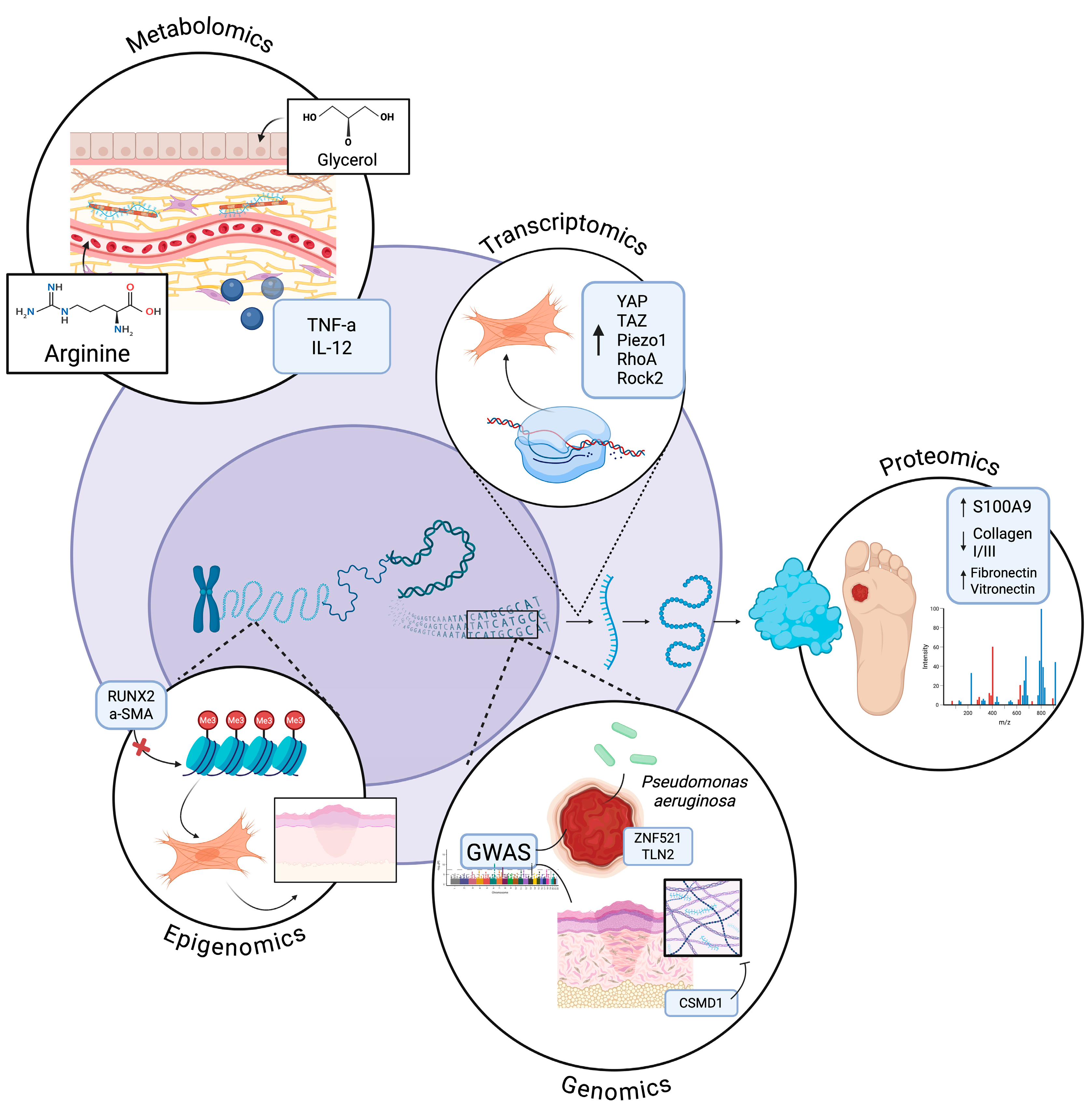
| -Omic Technology | Key Phases of Wound Healing | Insights |
|---|---|---|
| Genomics | Inflammation, Proliferation, Remodeling | Variants in TLN2 and ZNF521 linked to infection susceptibility [18] CSMD1 regulates complement inhibition and TGF-β/SMAD signaling across phases [19] |
| Proteomics | Inflammation, Proliferation, Remodeling | Elevated S100A9 in chronic wounds [23] Collagen I/III, tetranectin, and SERPINs enriched in healing wounds, Fibronectin, vitronectin dominate in stalled wounds [24] |
| Transcriptomics | Hemostasis, Inflammation, Proliferation, Remodeling | Variable transcriptional patterns during hemostasis and early inflammation across tissue type and injury context [27] YAP, TAZ, Piezo1, RhoA, and ROCK2 upregulated in keloid fibroblasts [26] Increased VEGFA, COL1A1, and MMP12 increased during later phases of wound healing [27] Immune gene expression persists beyond inflammation [27] |
| Epigenomics | Proliferation, Remodeling | Persistent THBS1-accessibility in irradiated fibroblasts [35,36] PcG-mediated gene silencing controls epithelial migration and remodeling [34] DNMT1 regulates keratinocyte proliferation with its loss impairing re-epithelialization [35] Fibroblast methylation changes (RUNX2, α-SMA) drive fibrosis [35,36] |
| Metabolomics | Inflammation, Proliferation, Remodeling | Linoleic acid suppresses inflammation [39] D-(+)-galactose and glycerol promote ECM remodeling and re-epithelialization [40] |
Disclaimer/Publisher’s Note: The statements, opinions and data contained in all publications are solely those of the individual author(s) and contributor(s) and not of MDPI and/or the editor(s). MDPI and/or the editor(s) disclaim responsibility for any injury to people or property resulting from any ideas, methods, instructions or products referred to in the content. |
© 2025 by the authors. Licensee MDPI, Basel, Switzerland. This article is an open access article distributed under the terms and conditions of the Creative Commons Attribution (CC BY) license.
Share and Cite
Jing, S.L.; Suh, E.J.; Huang, K.X.; Griffin, M.F.; Wan, D.C.; Longaker, M.T. Understanding and Advancing Wound Healing in the Era of Multi-Omic Technology. Bioengineering 2026, 13, 51. https://doi.org/10.3390/bioengineering13010051
Jing SL, Suh EJ, Huang KX, Griffin MF, Wan DC, Longaker MT. Understanding and Advancing Wound Healing in the Era of Multi-Omic Technology. Bioengineering. 2026; 13(1):51. https://doi.org/10.3390/bioengineering13010051
Chicago/Turabian StyleJing, Serena L., Elijah J. Suh, Kelly X. Huang, Michelle F. Griffin, Derrick C. Wan, and Michael T. Longaker. 2026. "Understanding and Advancing Wound Healing in the Era of Multi-Omic Technology" Bioengineering 13, no. 1: 51. https://doi.org/10.3390/bioengineering13010051
APA StyleJing, S. L., Suh, E. J., Huang, K. X., Griffin, M. F., Wan, D. C., & Longaker, M. T. (2026). Understanding and Advancing Wound Healing in the Era of Multi-Omic Technology. Bioengineering, 13(1), 51. https://doi.org/10.3390/bioengineering13010051