
Sediment Yield Assessment and Erosion Risk Analysis Using the SWAT Model in the Amman–Zarqa Basin, Jordan

 , ,
, ,  , ,
, ,  ,
,  ,
,
Abstract
1. Introduction
2. Methodology
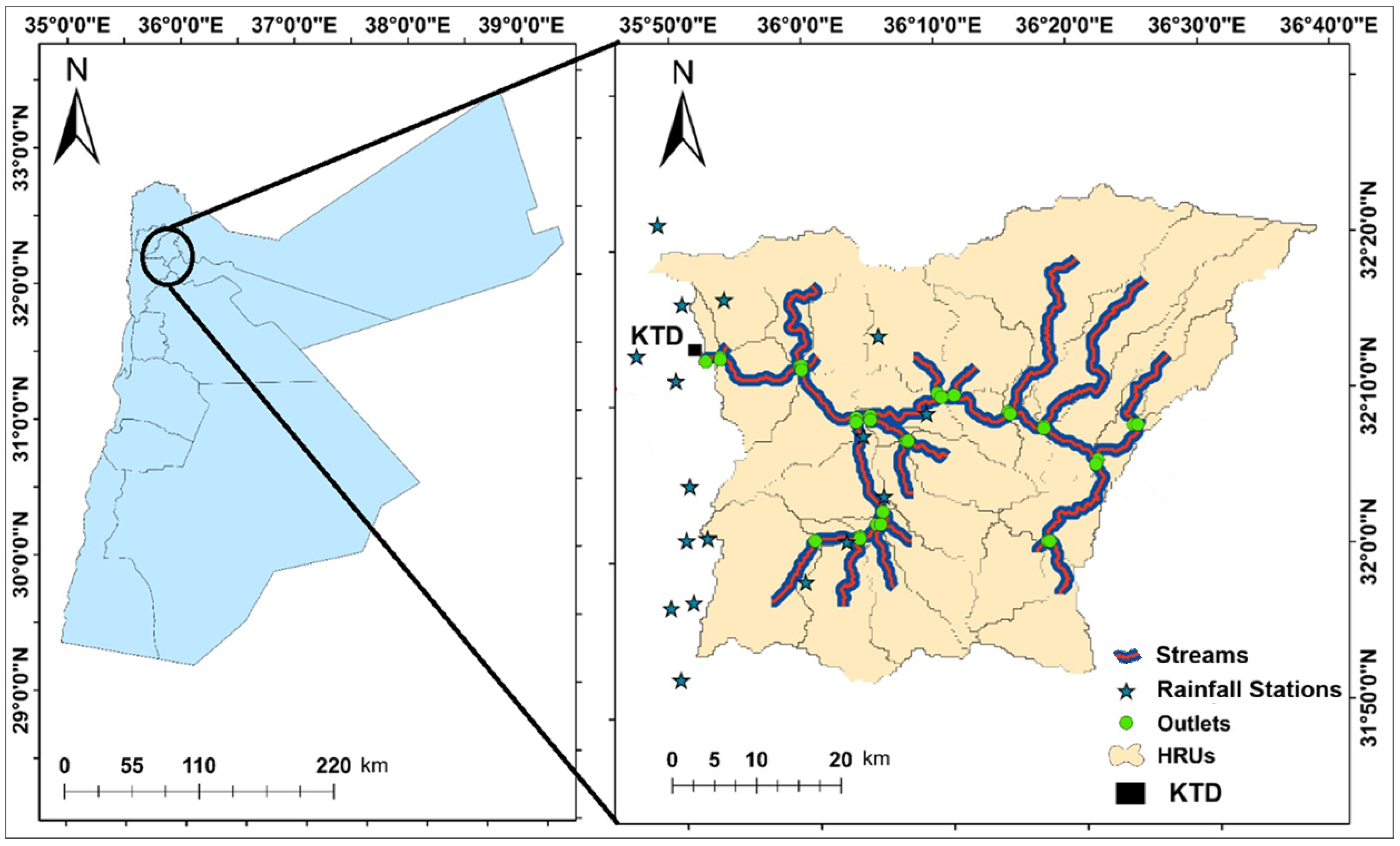
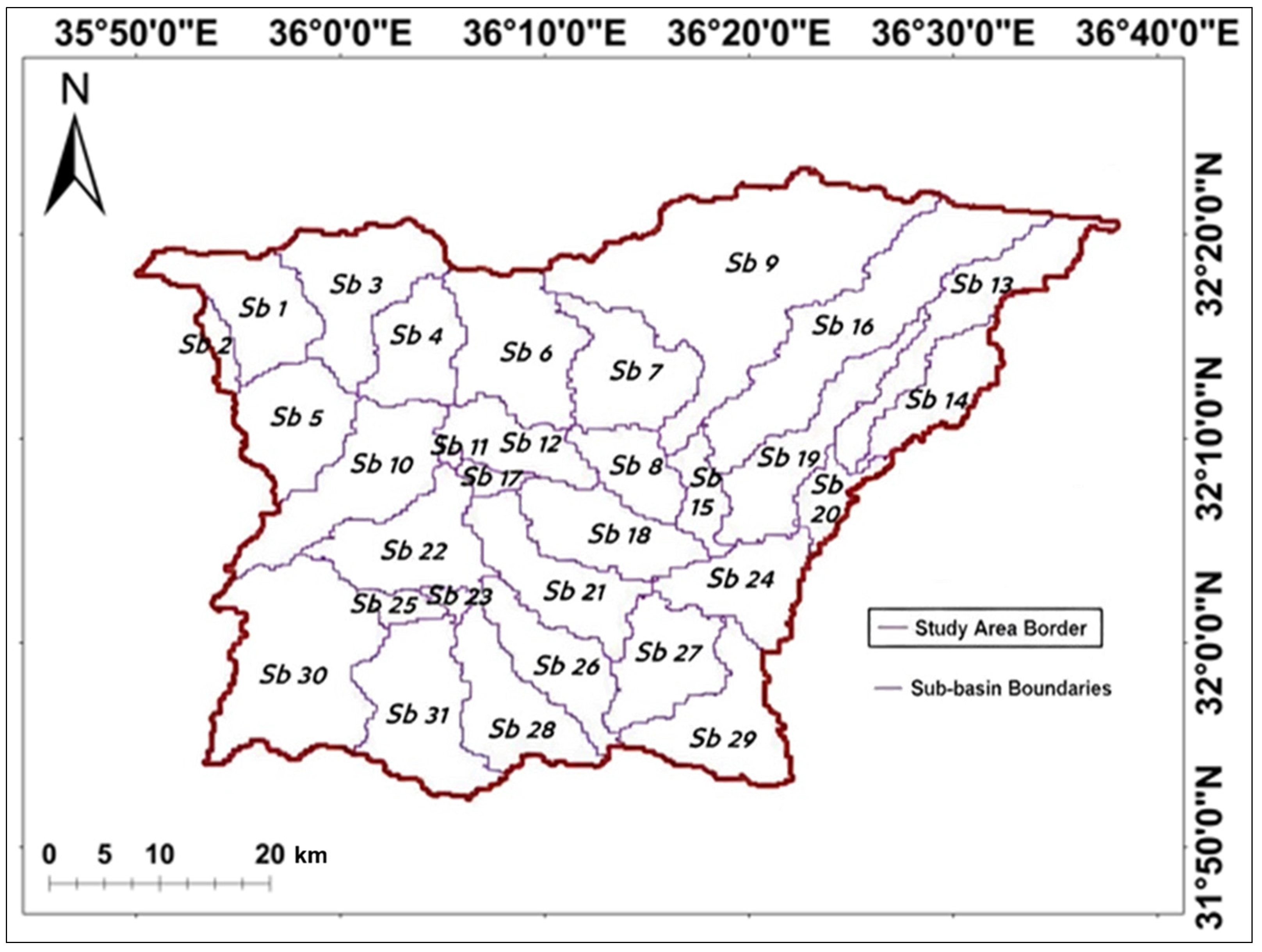
2.1. Study Site Description
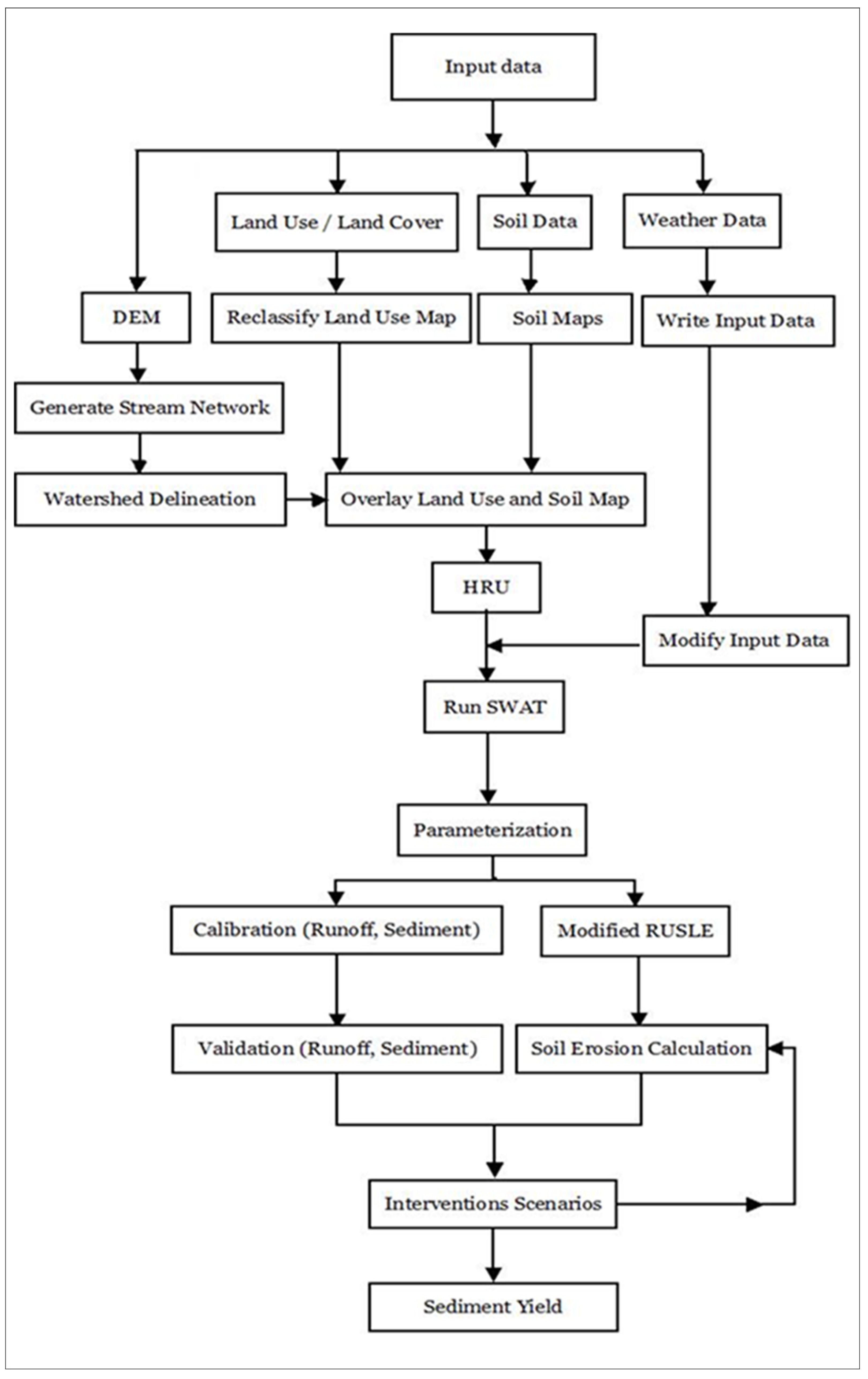
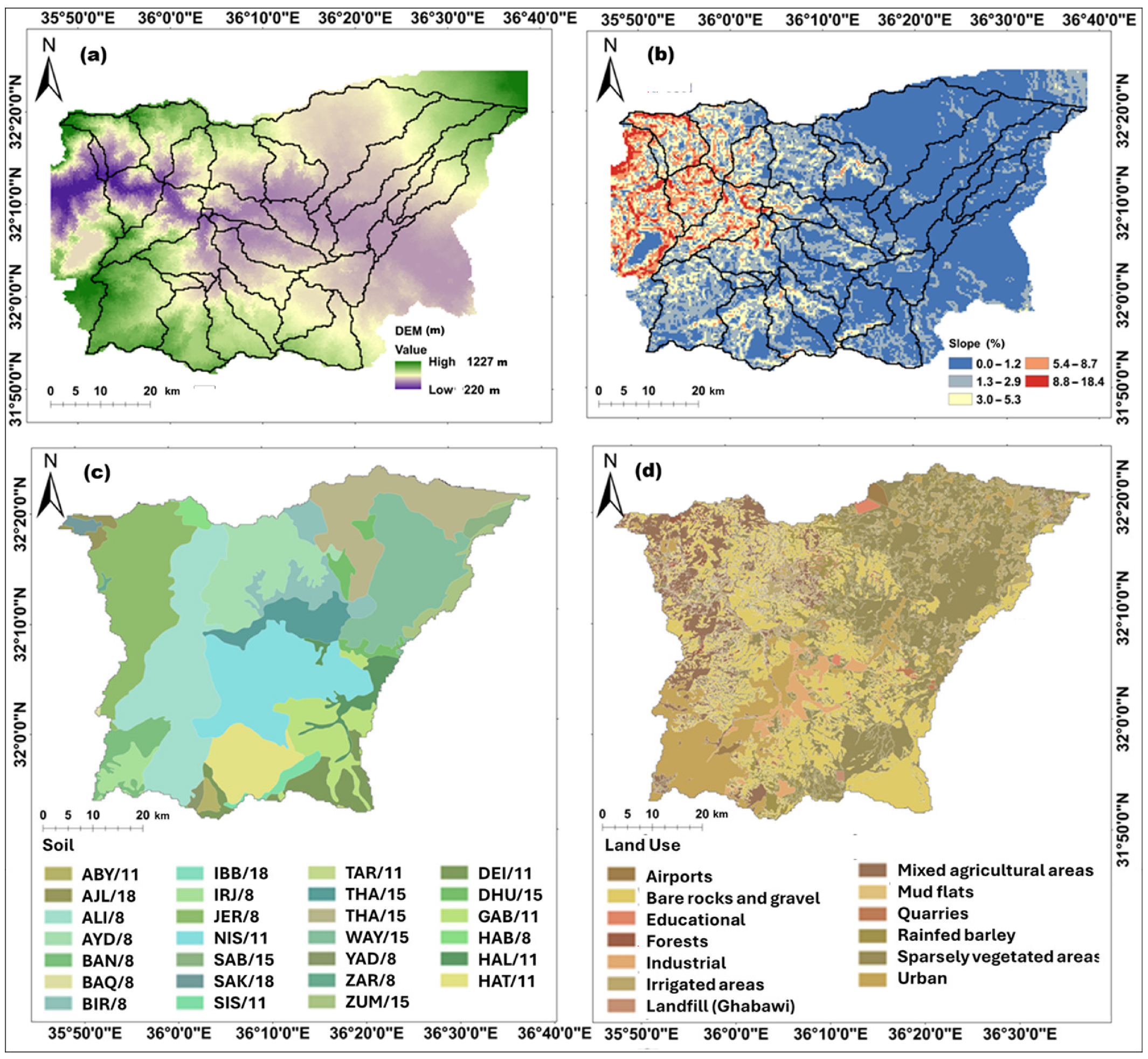
2.2. Input Data Preparation for SWAT Model
2.3. SWAT Model Parameterization for Sediment Yield Simulation
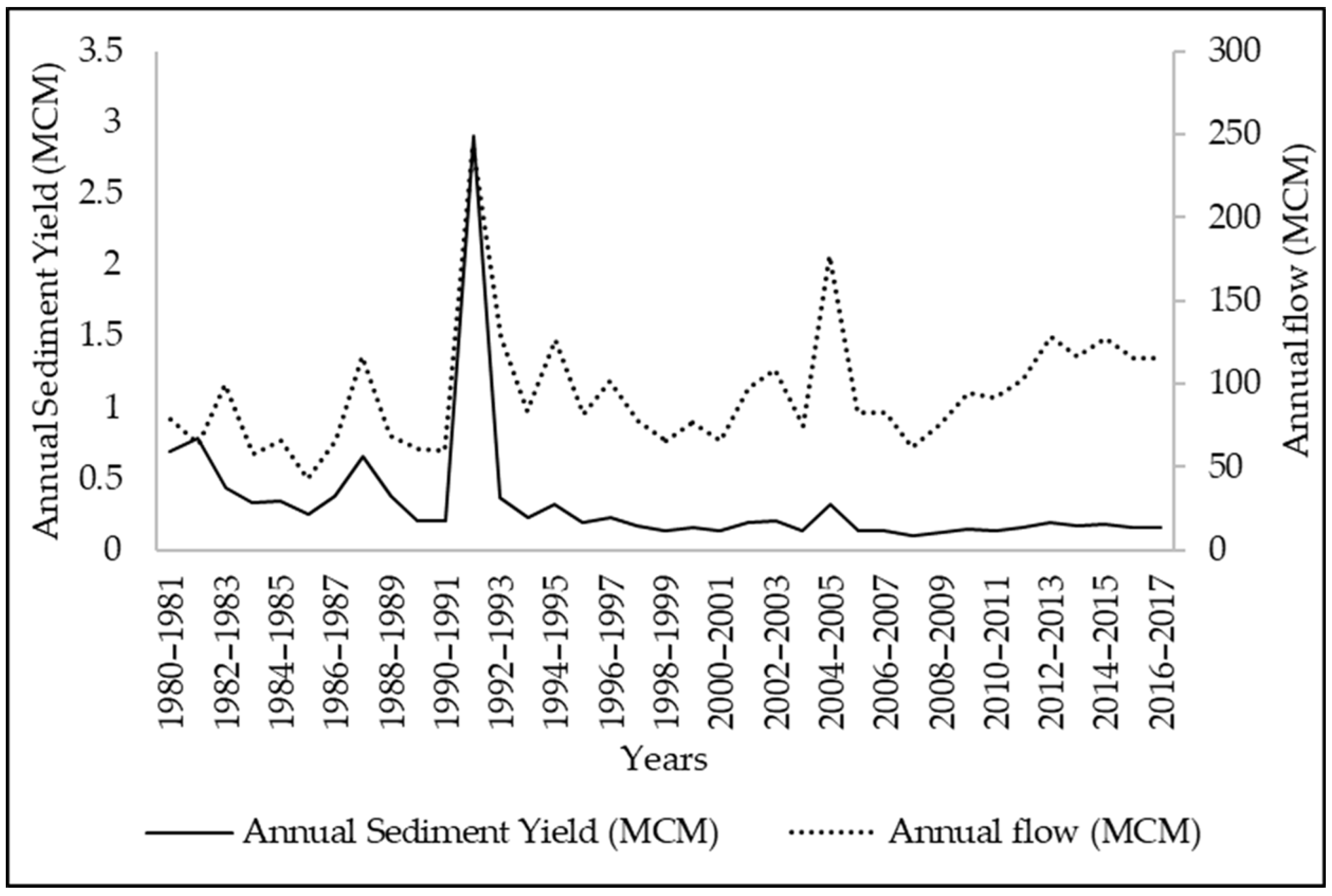
2.4. Sediment Data
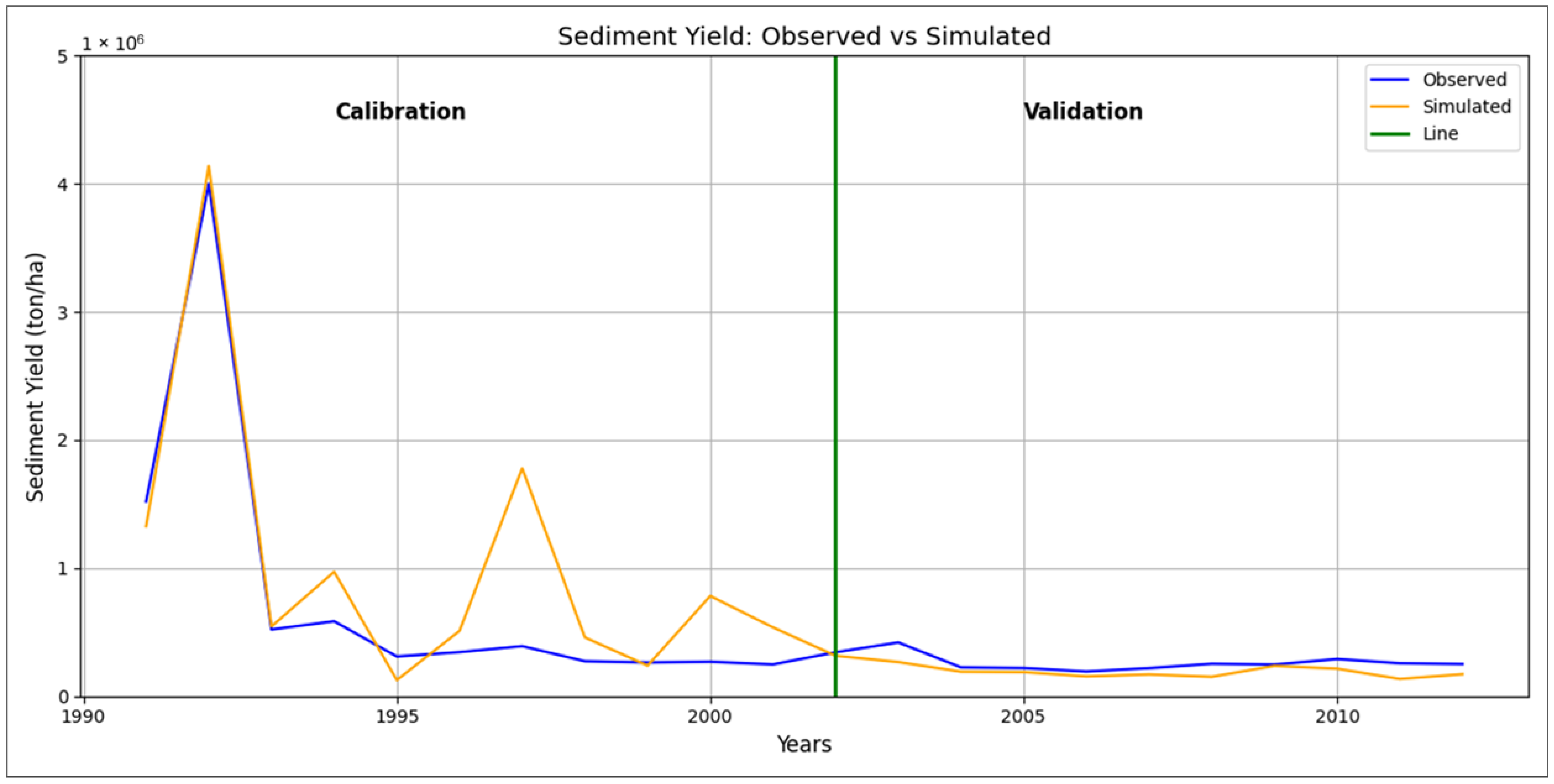
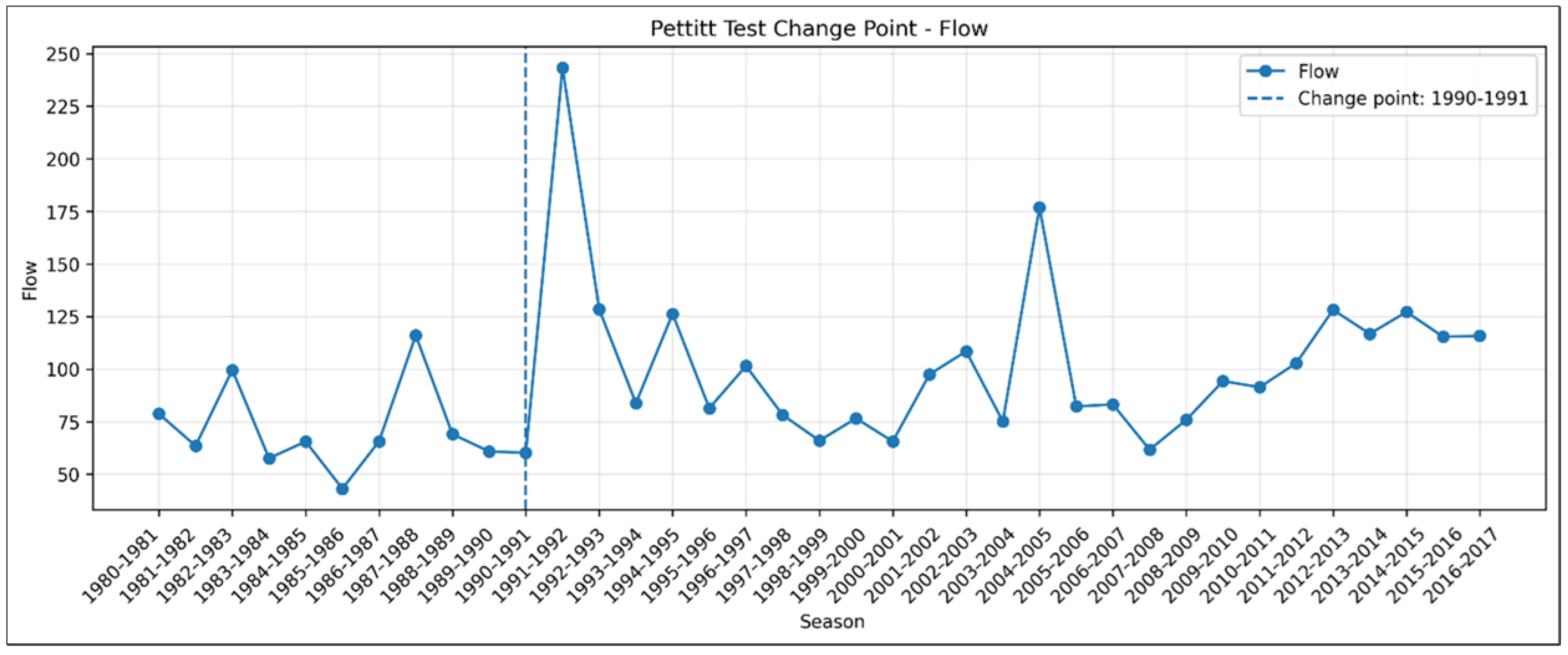
- 1992–1993 “Spike”: A significant flood or extreme weather event may have caused a surge in both water flow and sediment transport.
- 2005–2006 “Peak in Flow”: Another high-flow event occurred, but sediment yield did not rise proportionally, suggesting potential sediment control measures or changes in land use.
2.5. Model Calibration and Validation for Streamflow
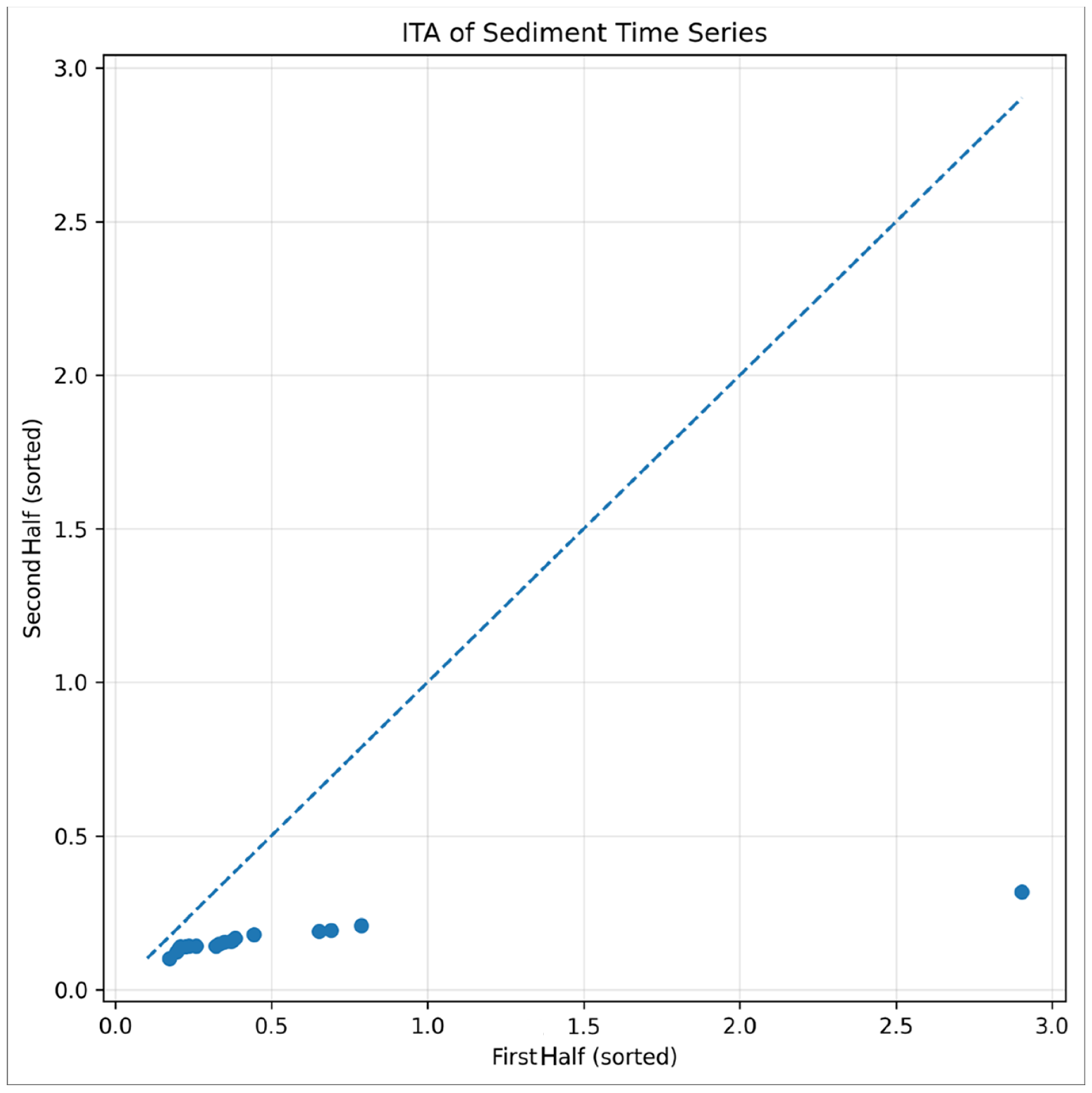
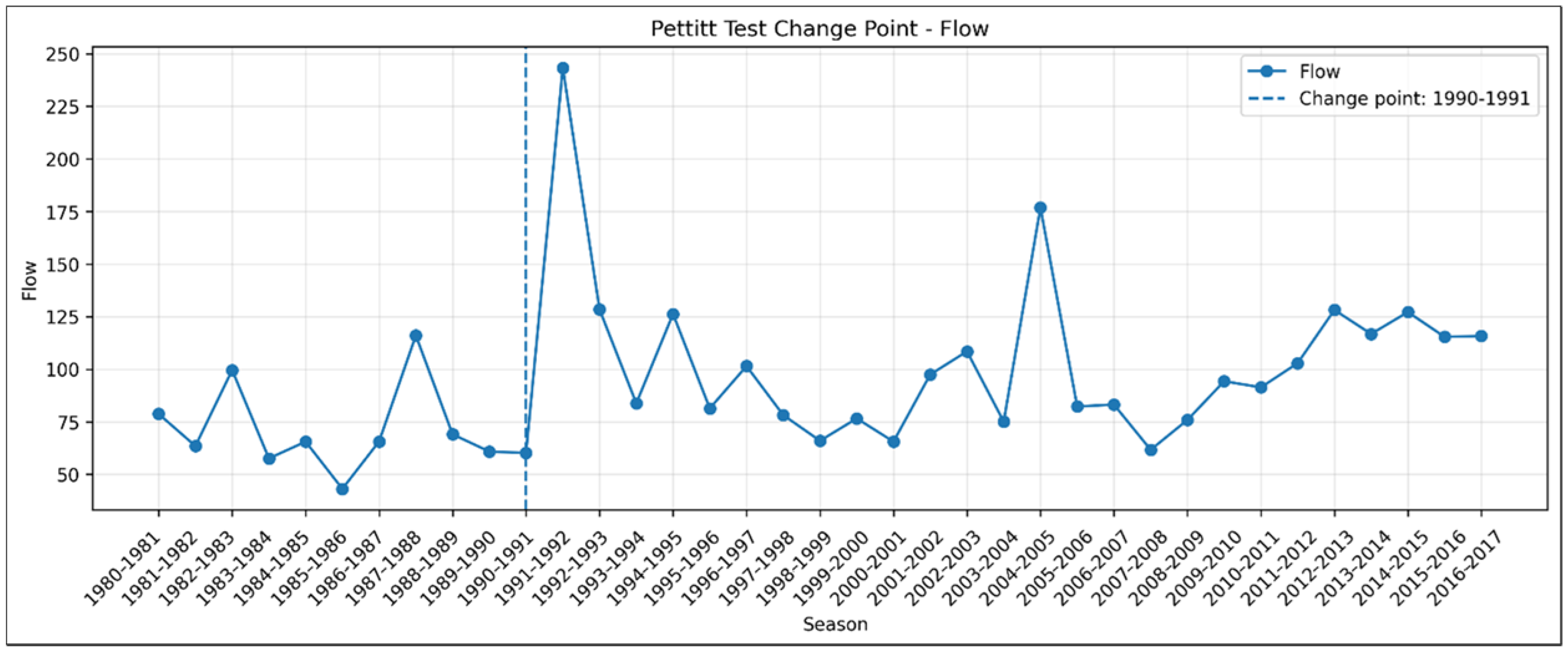
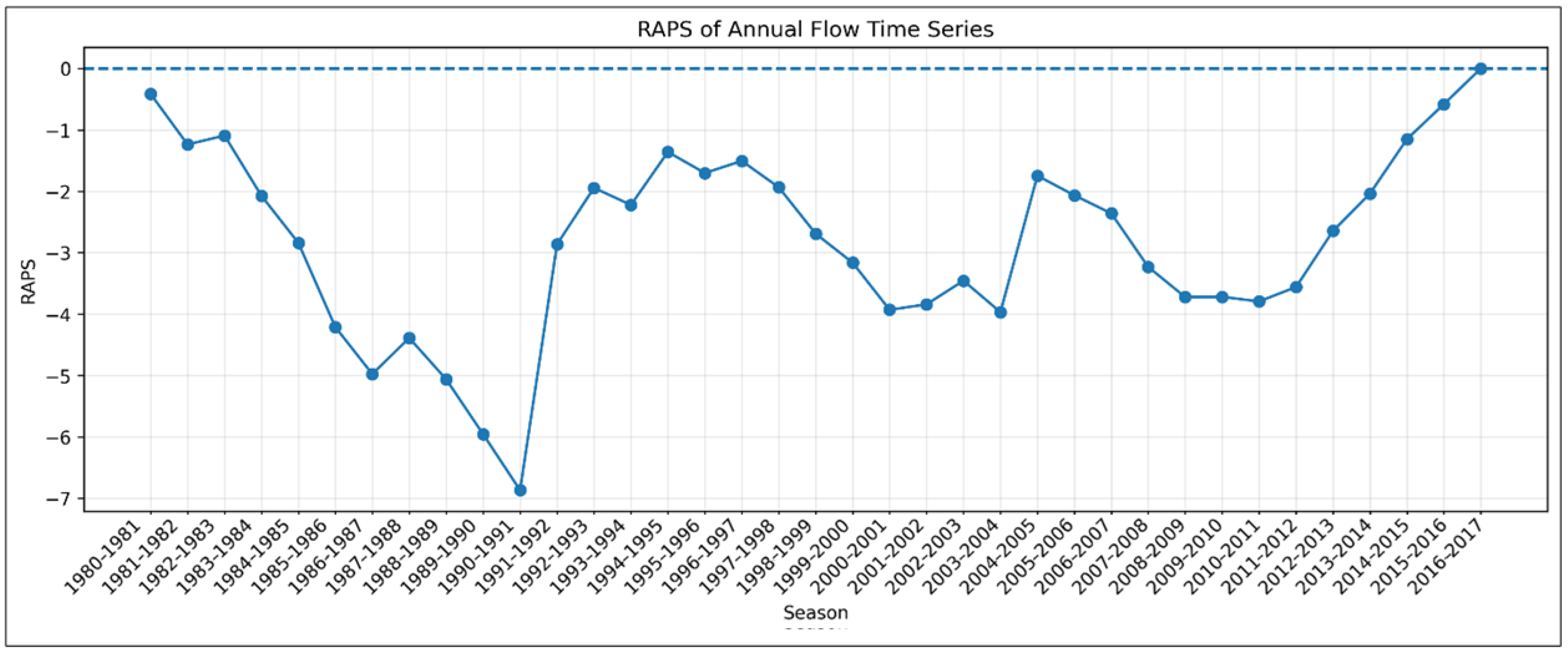
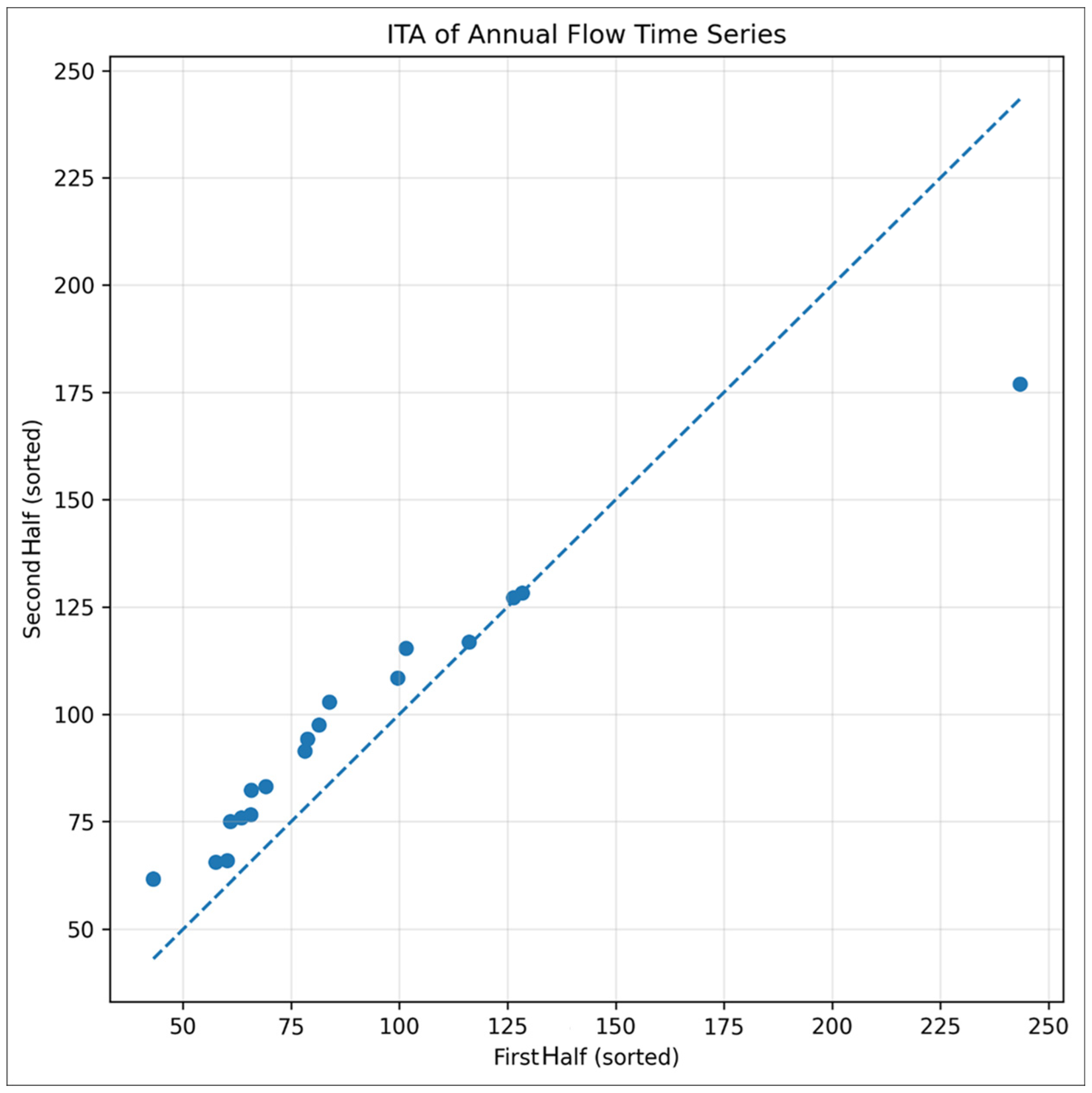
2.6. Time-Series Diagnostics (RAPS, ITA and Pettitt)
3. Results and Discussion
3.1. Sensitivity Analysis and Uncertainty Assessment
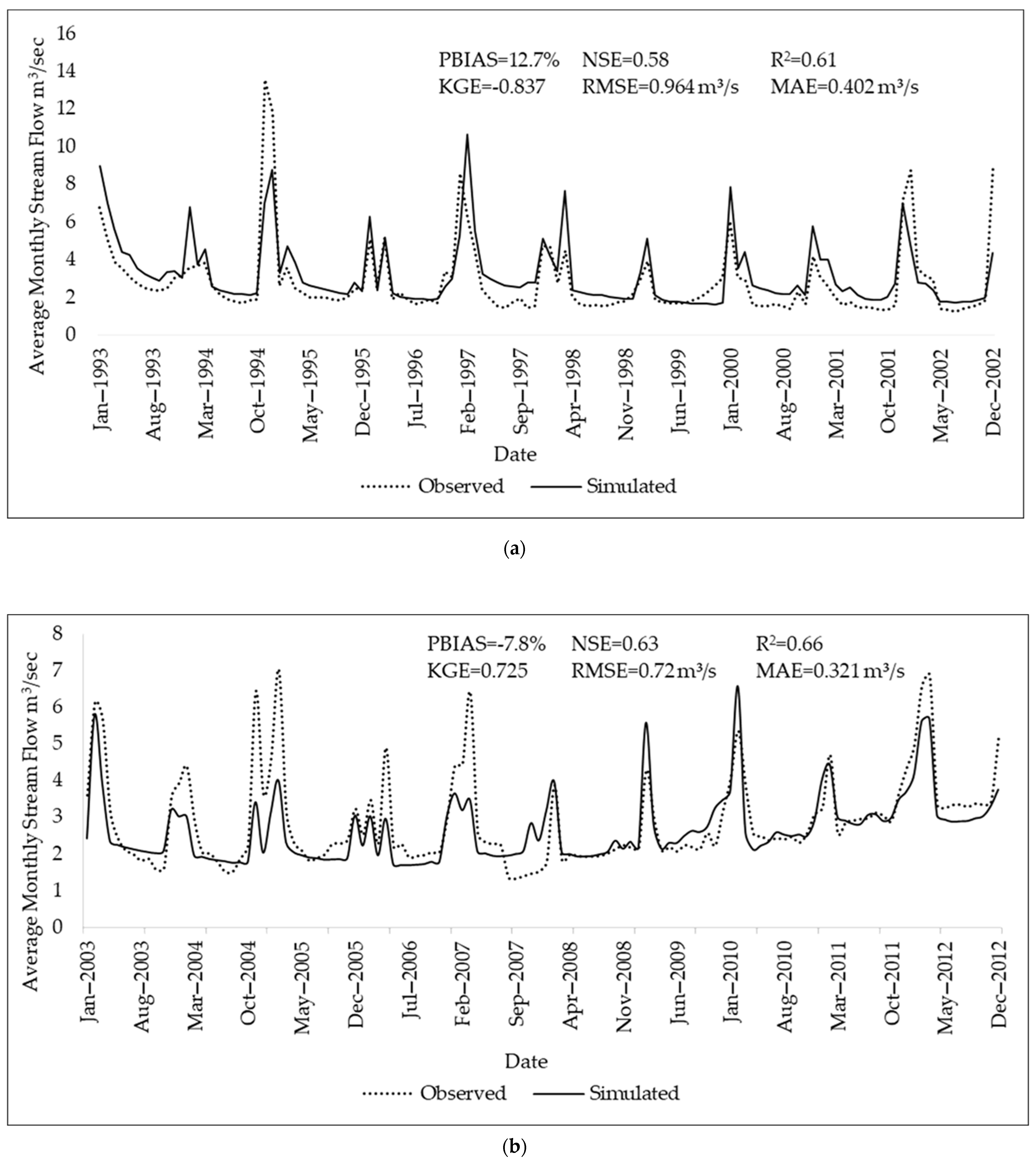
3.2. Calibration and Validation
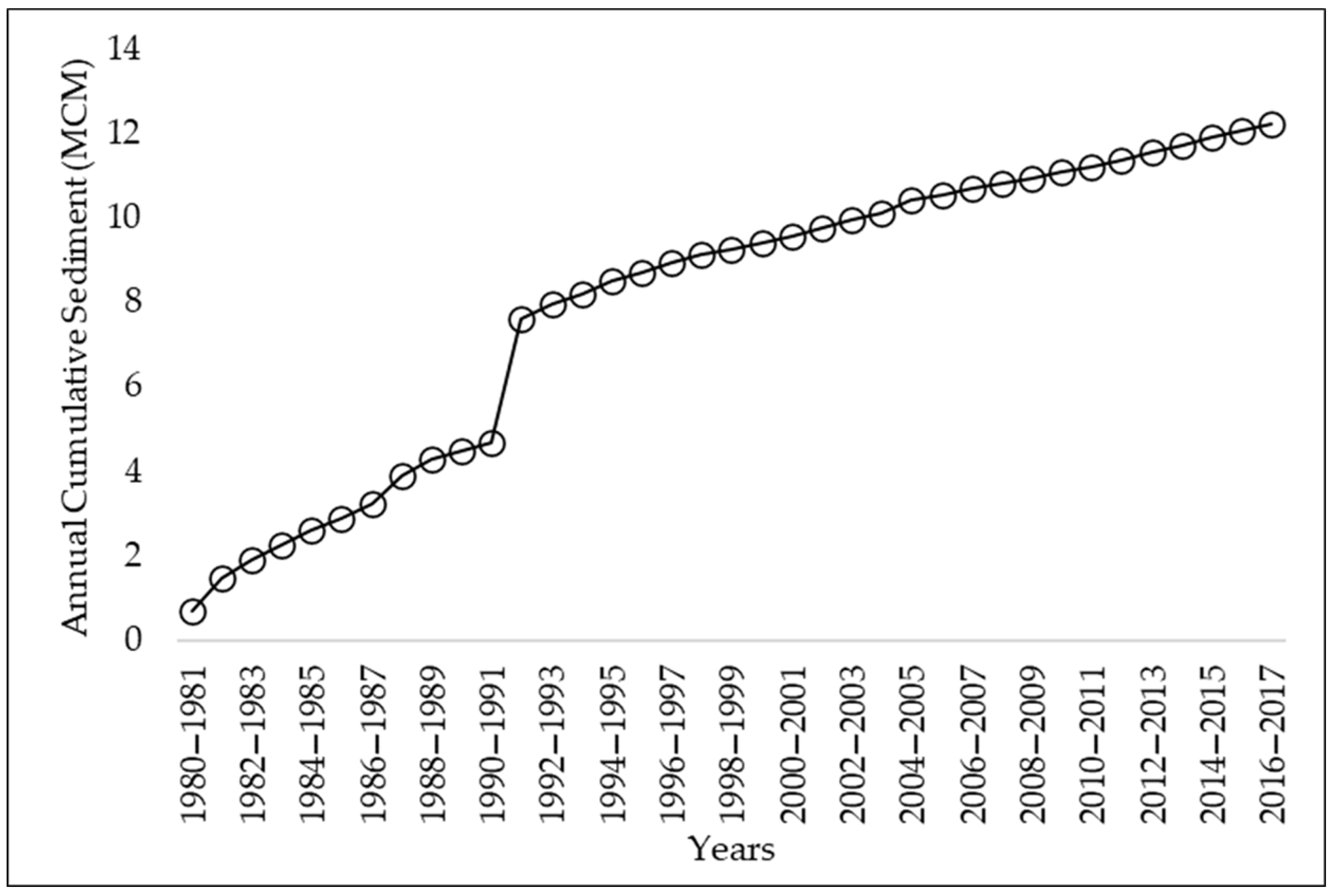
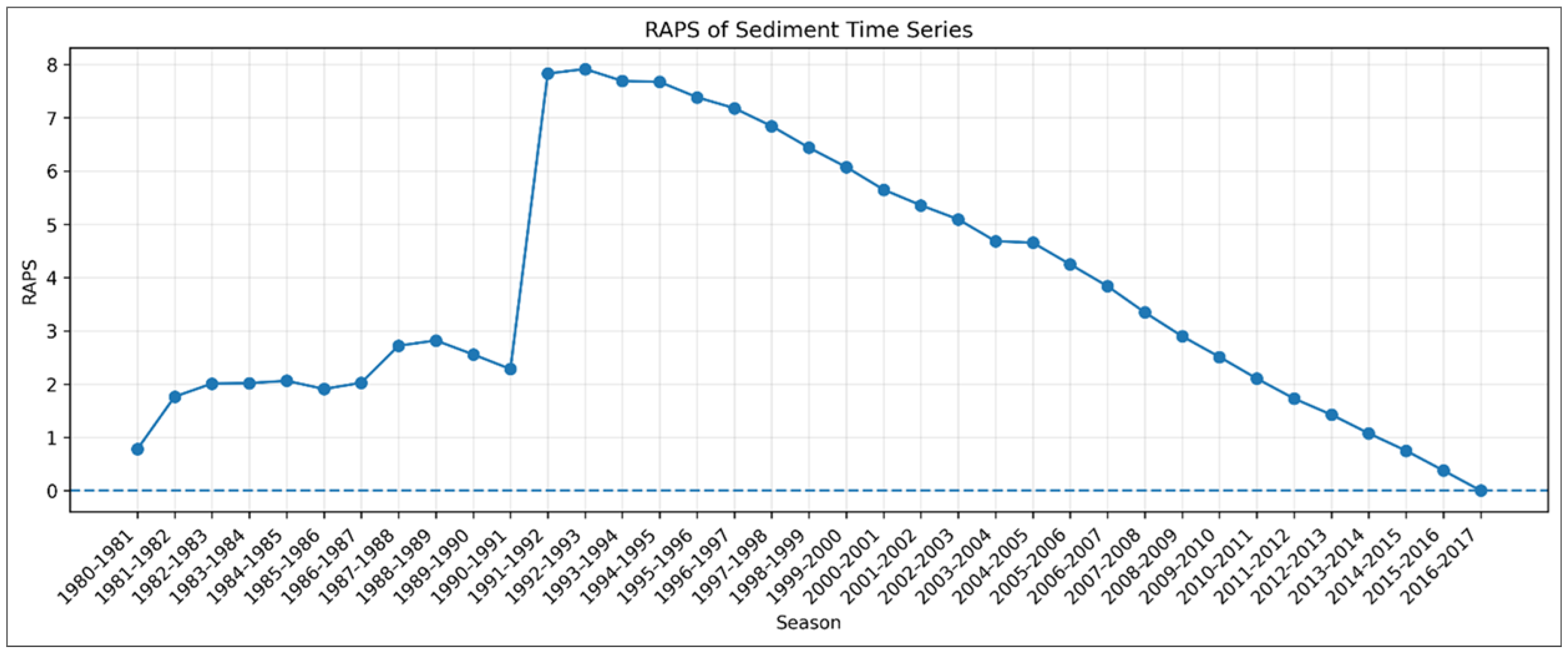
3.3. Time-Series Trend and Change-Point Analysis Top of Form
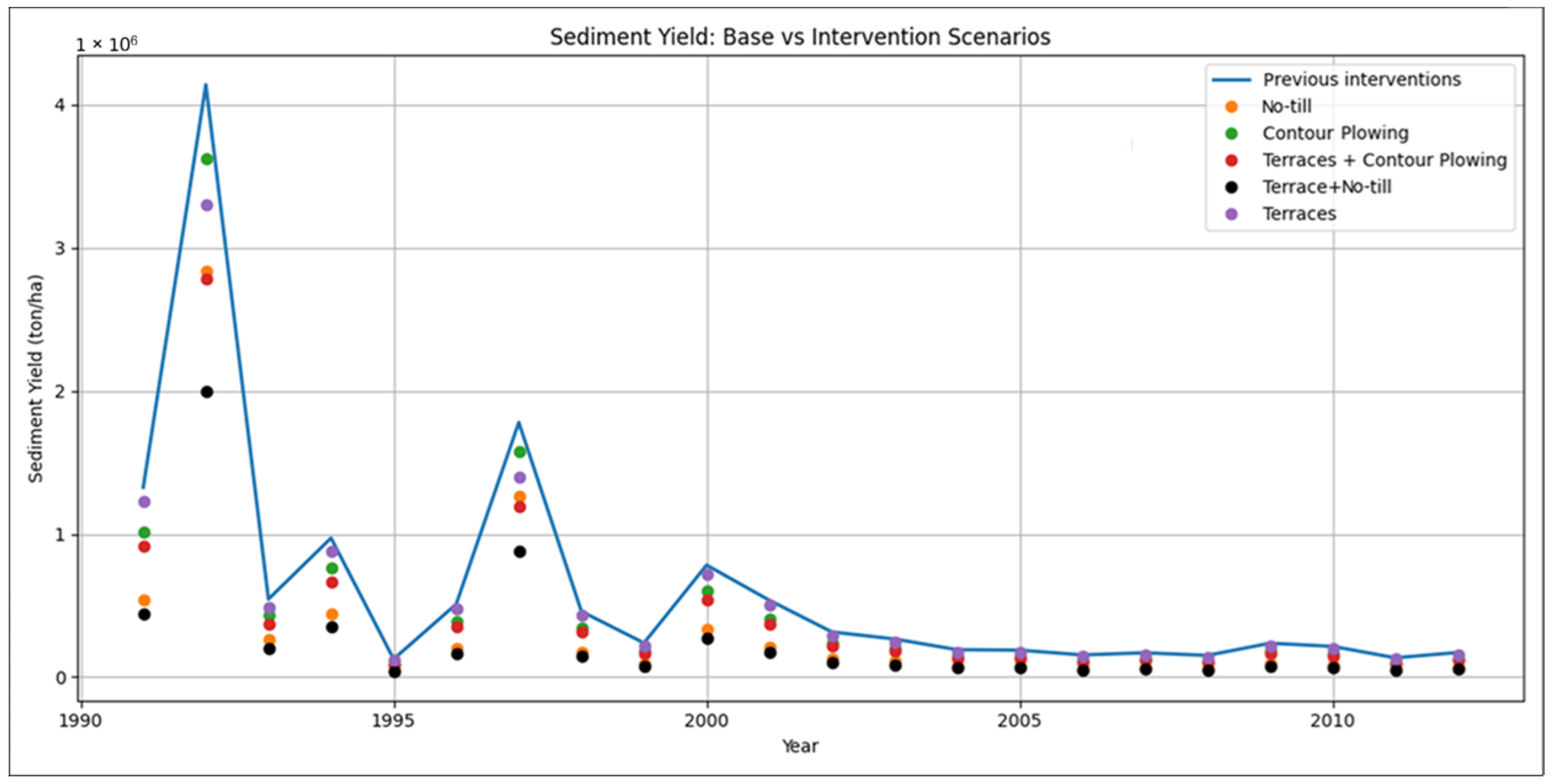
3.4. Sediment Hotspots and Implementation of the SLM
- Contour plowing in the areas of slope < 10%
- No-till in the areas of slope < 10%
- Stone wall terracing in the areas of slope > 10%
4. Conclusions
Author Contributions
Funding
Data Availability Statement
Acknowledgments
Conflicts of Interest
Abbreviations
| Variability ratio | |
| ALPHA_BF | Base Flow Alpha Factor |
| ARS | Agricultural Research Service |
| ASA | ArcGIS Spatial Analysis |
| AWC | Available Water Capacity |
| AZB | Amman-Zarqa Basin |
| Bias ratio | |
| BMP | Best Management Practices |
| C | Cover management factor |
| CFRG | Coarse fragment factor |
| CN | Curve Number |
| CN2 | Curve Number (Moisture Condition II) |
| DEM | Digital Elevation Model |
| ESCO | Soil Evaporation Compensation Factor |
| ET | Evapotranspiration |
| GSFLOW | Groundwater and Surface-water FLOW model |
| GW_DELAY | Groundwater Delay |
| GWQMN | Threshold Depth of Water in the Shallow Aquifer for Return Flow |
| HEC-RAS | Hydrologic Engineering Center–River Analysis System |
| HRUs | Hydrologic Response Units |
| JWWTP | Jerash Wastewater Treatment Plant |
| k | Position in the time series |
| K | Pettitt test statistic |
| KTD | King Talal Dam |
| LS | Slope length and steepness |
| Mean | |
| MCM | Million Cubic Meters |
| MIKE-SHE | Modeling System for Hydrology and Environment |
| MODFLOW | Modular Three-Dimensional Finite-Difference Ground-Water Flow Model |
| MUSLE | Modified Universal Soil Loss Equation |
| MWI | Ministry of Water and Irrigation |
| NDVI | Normalized Difference Vegetation Index |
| NSE | Nash–Sutcliffe Efficiency |
| Oi | Observed value of variable i |
| PBIAS | Percent Bias |
| PET | Potential Evapotranspiration |
| Pi | Simulated value of variable i |
| Linear correlation coefficient | |
| R | Peak runoff |
| R2 | Coefficient of determination |
| RAINHHMX | Maximum Half-Hour Rainfall |
| Standard deviation | |
| sgn | Sign function |
| ITA Trend Indicator (Slope Index) | |
| SLM | Sustainable Land Management |
| SSE | Sum of Squared Errors residuals |
| SWAT | Soil and Water Assessment Tool |
| SWAT-CUP | SWAT Calibration and Uncertainty Programs |
| SWWTP | Samra Wastewater Treatment Plant |
| t | Candidate Change-Point position |
| USLE | Universal Soil Loss Equation |
| USLE_K | Soil erodibility factor |
| USLE_P | Support practice factor |
| Value at time | |
| WGEN | Weather Generator |
References
- Bekele, S.; Abate, B. Estimation of sediment yield using SWAT model: A case of Soke River watershed, Ethiopia. Int. J. Eng. Res. 2021, 9, 695. [Google Scholar]
- Alkharabsheh, M.M.; Alexandridis, T.; Bilas, G.; Misopolinos, N.; Silleos, N.G. Impact of land cover change on soil erosion hazard in northern Jordan using remote sensing and GIS. Procedia Environ. Sci. 2013, 19, 912–921. [Google Scholar] [CrossRef] [Scilit]
- Abuhamoor, D.; AlMahasneh, L.; Tawaha, A. Spatial-based analysis for risk erosion hazard in Jordan. Sains Tanah J. Soil Sci. Agroclimatol. 2025, 22, 157. [Google Scholar] [CrossRef] [Scilit]
- Al-Sababhah, N.M.A.; Al Maqablah, M.M. Integrated evaluation of soil erosion-prone areas based on the GIS technique and analytic hierarchy process on hillside slopes, northwest Jordan. Jordan J. Earth Environ. Sci. 2023, 14, 158–174. [Google Scholar]
- El-Khateeb, M.; Abu-Dalo, M.; Salih, K.A.; Ayadi, H.; Choura, M. Environmental assessment of the surface sediment in the artificial lake at Jordan University of Science and Technology as a route to sustainable aquaculture. Arab. J. Geosci. 2023, 16, 552. [Google Scholar] [CrossRef] [Scilit]
- Shammout, M.W.; Shatanawi, K.; Al-Bakri, J.; Abualhaija, M.M. Impact of land use/cover changes on the flow of the Zarqa River in Jordan. J. Ecol. Eng. 2021, 22, 40–50. [Google Scholar] [CrossRef] [Scilit]
- Abdulla, F.; Eshtawi, T. Climate change effect on sediment yield at King Talal Dam (Jordan). Civil Environ. Res. 2015, 7, 13–27. [Google Scholar]
- El-Mahroug, S.E.; Suleiman, A.A.; Zoubi, M.M.; Al-Omari, S.; Abu-Afifeh, Q.Y.; Al-Jawaldeh, H.F.; Alta’any, Y.A.; Al-Nawaiseh, T.; Obeidat, N.; Alsoud, S.H.; et al. Predictive modeling of climate-driven crop yield variability using DSSAT towards sustainable agriculture. AgriEngineering 2025, 7, 156. [Google Scholar] [CrossRef] [Scilit]
- Abu-Afifeh, Q.; Rahbeh, M.; Al-Afeshat, A.; Al-Omari, S.; Qutishat, T.A.; Brezat, A.; Alkayed, A. Dam sustainability’s interdependency with climate change and dam failure drivers. Sustainability 2023, 15, 16239. [Google Scholar] [CrossRef] [Scilit]
- Al-Taani, A.; El Radaideh, N.; Al Kateeb, W.; Howari, F.; Nazzal, Y.; Iqbal, J.; Al Bsoul, A. Sustainable sediment management in Jordanian dams: Feasibility, economic viability, and agricultural reuse potential. J. Water Land Dev. 2025, 64, 211–220. [Google Scholar] [CrossRef] [Scilit]
- Sabale, R.S.; Londhe, S.; Jose, M.K. Reservoir sedimentation analysis using SWAT model. In Lecture Notes in Civil Engineering; Springer: Singapore, 2023; pp. 167–180. [Google Scholar] [CrossRef] [Scilit]
- Leta, M.K.; Waseem, M.; Rehman, K.; Tränckner, J. Sediment yield estimation and evaluating best management practices in Nashe watershed, Blue Nile Basin, Ethiopia. Environ. Monit. Assess. 2023, 195, 716. [Google Scholar] [CrossRef] [Scilit] [PubMed]
- Alam, S.A.; Maiti, R. Estimating sediment yield, water discharge and surface runoff using SWAT model. In Sediment Source to Sink: Deciphering Sediment Connectivity to Large Dams in Damodar River Basin; Springer: Cham, Switzerland, 2025; pp. 33–57. [Google Scholar]
- Zalaki-Badil, N.; Eslamian, S.; Sayyad, G.-A.; Hosseini, S.-E.; Asadilour, M.; Ostad-Ali-Askari, K.; Singh, V.; Dehghan, S. Using SWAT model to determine runoff and sediment yield in Maroon-Dam catchment. Int. J. Res. Stud. Agric. Sci. 2017, 3, 31–41. [Google Scholar] [CrossRef] [Scilit]
- Chiang, L.-C.; Lu, C.-M. Improvement of sediment simulation in landslide areas using SWAT model with various landslide triggering factors and multiple thresholds. Catena 2024, 240, 107948. [Google Scholar] [CrossRef] [Scilit]
- Ijam, A.; Al-Bdoor, A. Sediment yield assessment for Tannur Dam reservoir in Jordan. Civil Environ. Res. 2016, 8, 79–87. [Google Scholar]
- Hadadin, N.A.; Al-Adwan, S.R. Estimation of sediment yield using hydrological assessment tool model: A case of Wadi Al-Arab Dam, northern Jordan. Arab. J. Geosci. 2020, 13, 380. [Google Scholar] [CrossRef] [Scilit]
- Al-Weshah, R.; Smadi, K.; Ta’any, R. Sediment transport mitigation and management in Wadi Shu’eib Dam. Jordan J. Earth Environ. Sci. 2025, 16, 227–236. [Google Scholar]
- Babaei, H.; Nazari-Sharabian, M.; Karakouzian, M.; Ahmad, S. Identification of critical source areas (CSAs) and evaluation of best management practices (BMPs) in controlling eutrophication in the Dez River Basin. Environments 2019, 6, 20. [Google Scholar] [CrossRef] [Scilit]
- Kassem, A.A.; Aness, W.T.; Mohammed, M.G. Sediment estimation of the Mosul Dam Lake using SWAT and dual ANN models. Tikrit J. Eng. Sci. 2025, 32, 1853. [Google Scholar] [CrossRef] [Scilit]
- Aness, W.T.; Hadadin, N.A.; Zoubi, M.M.; Abu-Afifeh, Q.Y.; Al-Afeshat, A.F.; Al-Jawaldeh, H.F.; Qutishat, T.A.; Alhalaigah, M.R.; Alnizami, N.H.; Aljarrah, A.; et al. Runoff and Sediment Dynamics Modeling for Erosion Risk Reduction and Sustainable Watershed Management. Glob. J. Environ. Sci. Manag. 2026, 12, 813–836. [Google Scholar] [CrossRef]
- Rahbeh, M.; Alnizami, N.H.; Zoubi, M.M.; Abu-Afifeh, Q.A.; Qutishat, T.A.; AlHalaigah, M.R.; Al-Jawaldeh, H.F.; Al-Omari, S.; Al Qarallah, B. Comparative Reliability Analysis of CHIRPS and Gauge-Based Precipitation Measurements over the Zarqa River Basin. Jordan J. Earth Environ. Sci. 2026, 17, 83–96. Available online: https://www.researchgate.net/publication/402103200_Comparative_Reliability_Analysis_of_CHIRPS_and_Gauge-_based_Precipitation_Measurements_over_the_Zarqa_River_Basin (accessed on 6 April 2026).
- Ghumaid, A.A. Study of changes in hydrological conditions for the Amman–Zarqa Basin using incremental climate change scenarios, SWAT model, and geospatial techniques. An-Najah Univ. J. Res. B (Humanit.) 2023, 37, 943–980. [Google Scholar] [CrossRef] [Scilit]
- Al-Afeshat, A.; Zoubi, M.M.; Abu-Afifeh, Q.Y.; Al-Jawaldeh, H.; Qutishat, T.A.; Masoud, A.M.N.; Rahbeh, M. Interrelation of dam sustainability with local communities and water quality. Glob. J. Environ. Sci. Manag. 2025, 11, 157–176. [Google Scholar] [CrossRef]
- Rahbeh, M.; Srinivasan, R.; Mohtar, R.H. Numerical and conceptual evaluation of preferential flow in Zarqa River Basin, Jordan. Ecohydrol. Hydrobiol. 2019, 19, 224–237. [Google Scholar] [CrossRef] [Scilit]
- GIS Geography. What Is Remote Sensing? The Definitive Guide to Earth Observation. 2021. Available online: https://gisgeography.com/remote-sensing-earth-observation-guide/ (accessed on 23 December 2025).
- Arnold, J.G.; Srinivasan, R.; Muttiah, R.S.; Williams, J.R. Large area hydrologic modeling and assessment part I: Model development. J. Am. Water Resour. Assoc. 1998, 34, 73–89. [Google Scholar] [CrossRef] [Scilit]
- Hroub, H.A.; Rahbeh, M.; Zoubi, M.M.; Abu-Afifeh, Q.Y.; Al-Jawaldeh, H.; Obeidat, N. Projection of future temperature variations in river basins under climate change scenarios using general circulation models. Glob. J. Environ. Sci. Manag. 2025, 11, 403–426. [Google Scholar] [CrossRef]
- Gonzales, A.L.; Nonner, J.; Heijkers, J.; Uhlenbrook, S. Comparison of different base flow separation methods in a lowland catchment. Hydrol. Earth Syst. Sci. 2009, 13, 2055–2068. [Google Scholar] [CrossRef] [Scilit]
- Al-Qaisi, M. Climate Change Effects on Water Resources in Amman–Zarqa Basin—Jordan; Ministry of Water and Irrigation (MWI): Amman, Jordan, 2010.
- Shammout, M.W.; Abualhaija, M.M. An analysis of long-term yearly water-flow trend and its impact on sediment yield in King Talal Dam. Int. J. Eng. Res. Technol. 2019, 12, 3041–3049. [Google Scholar]
- Arnold, J.G.; Moriasi, D.N.; Gassman, P.W.; Abbaspour, K.C.; White, M.J.; Srinivasan, R.; Santhi, C.; Harmel, R.D.; Van Griensven, A.; Van Liew, M.W.; et al. SWAT: Model use, calibration, and validation. Trans. ASABE 2012, 55, 1491–1508. [Google Scholar] [CrossRef] [Scilit]
- Abbaspour, K.C. SWAT-CUP: SWAT Calibration and Uncertainty Programs—A User Manual; Swiss Federal Institute of Aquatic Science and Technology (Eawag): Dübendorf, Switzerland, 2015. [Google Scholar]
- Andrade, C. The p value and statistical significance: Misunderstandings, explanations, challenges, and alternatives. Indian J. Psychol. Med. 2019, 41, 210–215. [Google Scholar] [CrossRef] [Scilit]
- Garbrecht, J.; Fernandez, G.P. Visualization of Trends and Fluctuations in Climatic Records. J. Am. Water Resour. Assoc. 1994, 30, 297–306. [Google Scholar] [CrossRef] [Scilit]
- Şen, Z. Innovative Trend Analysis Methodology. J. Hydrol. Eng. 2012, 17, 1042–1046. [Google Scholar] [CrossRef] [Scilit]
- Tan, L.; Zan, C.; Liu, T.; Xiong, J.; Zhang, A. Evaluating multi-source precipitation data for streamflow simulation using the SWAT model in the alpine Manas River Basin, Northwest China. Sci. Rep. 2025, 15, 43770. [Google Scholar] [CrossRef] [Scilit]
- Xing, K.; Yang, P.; Liu, S.; Zhao, Q. A coupled SWAT-LSTM approach for climate-driven runoff dynamics in a snow- and ice-fed arid basin. Sustainability 2025, 17, 10235. [Google Scholar] [CrossRef] [Scilit]
- Zhang, Z.; Xiao, Y.; Chen, R.; Long, K.; Deng, H.; Zheng, Z.; Liao, J. Comparative assessment of machine learning models for daily streamflow prediction in a subtropical monsoon watershed. Sci. Rep. 2026, 16, 7341. [Google Scholar] [CrossRef] [Scilit]
- Mitova, M.; Rakotoarimanana, Z.; Kercheva, M.; Ishidaira, H. SWAT model calibration, validation and parameter sensitivity analysis using SWAT-CUP SUFI-2 for the Rusenski Lom River watershed, Bulgaria. In Environmental Protection and Disaster Risks (EnviroRisks 2024); Springer: Cham, Switzerland, 2024; Volume 883, pp. 381–390. [Google Scholar]
- Mehedi, M.; Döll, P.; Hosseini-Moghari, S.-M.; Papa, F.; Güntner, A. The benefits and trade-offs of multi-variable calibration of the WaterGAP global hydrological model (WGHM) in the Ganges and Brahmaputra basins. Hydrol. Earth Syst. Sci. 2025, 29, 567–596. [Google Scholar] [CrossRef] [Scilit]
- Bojer, A.K.; Abshare, M.W.; Mesfin, F.; Al-Quraishi, A.M.F. Assessing climate and land use impacts on surface water yield using remote sensing and machine learning. Sci. Rep. 2025, 15, 18477. [Google Scholar] [CrossRef] [Scilit] [PubMed]
- Shaikh, M.; Lodha, P.; Eslamian, S. A framework for climate change impact assessment and mitigation of hydrological parameters of the watershed through trend analysis and hydrological modeling. In Handbook of Eurasian Forecasting; Eslamian, S., Bintul Huda, M., Eslamian, F., Eds.; Nova Science Publishers: New York, NY, USA, 2022; pp. 79–110. [Google Scholar]
- Sahoo, S.; Das, V.K.; Debnath, K. Control of sandbar development on morphological evolution and channel dynamics of the Mahanadi Delta. Int. J. River Basin Manag. 2026, 24, 1–23. [Google Scholar] [CrossRef] [Scilit]
- Al-Nouti, A.F.; Fu, M.; Bokde, N.D. Reservoir operation-based machine learning models: Comprehensive review of limitations, research gaps, and future directions. Knowl.-Based Eng. Sci. 2024, 5, 75–139. [Google Scholar] [CrossRef] [Scilit]
- Wang, K.; Bertoli, G.; Cheng, S.; Schröter, K.; Caporali, E.; Piggott, M.D.; Wang, Y.; Arcucci, R. AI-empowered latent four-dimensional variational data assimilation for river discharge forecasting. IEEE J. Sel. Top. Appl. Earth Obs. Remote Sens. 2025, 18, 24676–24689. [Google Scholar] [CrossRef] [Scilit]
- Echogdali, F.Z.; Boutaleb, S.; Taia, S.; Ouchchen, M.; Id-Belqas, M.; Kpan, R.B.; Abioui, M.; Aswathi, J.; Sajinkumar, K.S. Assessment of Soil Erosion Risk in a Semi-Arid Climate Watershed Using SWAT Model: Case of Tata Basin, South-East of Morocco. Appl. Water Sci. 2022, 12, 164. [Google Scholar] [CrossRef] [Scilit]
- Pulighe, G.; Bonati, G.; Colangeli, M.; Traverso, L.; Lupia, F.; Altobelli, F.; Dalla Marta, A.; Napoli, M. Predicting Streamflow and Nutrient Loadings in a Semi-Arid Mediterranean Watershed with Ephemeral Streams Using the SWAT Model. Agronomy 2019, 10, 2. [Google Scholar] [CrossRef] [Scilit]
- Ricci, G.F.; De Girolamo, A.M.; Abdelwahab, O.M.M.; Gentile, F. Identifying Sediment Source Areas in a Mediterranean Watershed Using the SWAT Model. Land Degrad. Dev. 2018, 29, 1233–1248. [Google Scholar] [CrossRef] [Scilit]
- Abdelwahab, O.M.M.; Ricci, G.F.; De Girolamo, A.M.; Gentile, F. Modelling Soil Erosion in a Mediterranean Watershed: Comparison between SWAT and AnnAGNPS Models. Environ. Res. 2018, 166, 363–376. [Google Scholar] [CrossRef] [Scilit]
- Ziadat, F.M.; Zdruli, P.; Christiansen, S.; Caon, L.; Abdel Monem, M.; Fetsi, T. An overview of land degradation and sustainable land management in the Near East and North Africa. Sustain. Agric. Res. 2021, 11, 11–24. [Google Scholar] [CrossRef] [Scilit]
- Al-Bakri, J.T.; D’Urso, G.; Calera, A.; Abdalhaq, E.; Altarawneh, M.; Margane, A. Remote sensing for agricultural water management in Jordan. Remote Sens. 2023, 15, 235. [Google Scholar] [CrossRef] [Scilit]
- Jawarneh, R.N.; Abulibdeh, A.; Hashem, N.; Awawdeh, M.; Al-Awadhi, T.; Abdullah, M.M.; El-Kenawy, A.M. Assessing and predicting land cover dynamics for environmental sustainability in Jordan’s arid ecosystems using the CA–Markov model. Remote Sens. Appl. Soc. Environ. 2024, 35, 101262. [Google Scholar] [CrossRef] [Scilit]
- Al-Sababhah, N. Land suitability and capability analysis for sustainable allocation of agricultural crops and natural plants, northwest Jordan. J. Geovis. Spat. Anal. 2023, 8, 1. [Google Scholar] [CrossRef] [Scilit]
- Zubi, R.A.; Gill, T.E.; Lee, J.A.; Ardon-Dryer, K.; Kandakji, T. Spatiotemporal analysis of sand and dust emission point sources detected from satellite imagery in Syria, Jordan, and Iraq. Sci. Total Environ. 2024, 949, 175157. [Google Scholar] [CrossRef] [Scilit]
- Assaf, M.N.; Abdelal, Q.; Hussein, N.M.; Halaweh, G.; Alzubaidi, A.J. Water quality monitoring and management: Integration of machine learning algorithms and Sentinel-2 images for the estimation of chlorophyll-a. Model. Earth Syst. Environ. 2025, 11, 348. [Google Scholar] [CrossRef] [Scilit]
- Darwish, H.H.; Talozi, S. Assessment of water footprint in the Jordanian industrial sector as a means for sustainable water resources management. Nafta-Gaz 2024, 80, 450–468. [Google Scholar] [CrossRef] [Scilit]
- Debie, E. Effectiveness of sustainable land management initiatives in the highlands of Ethiopia. Reg. Environ. Change 2024, 24, 106. [Google Scholar] [CrossRef] [Scilit]
- Masri, Z.; Turkelboom, F.; Huang, C.-H.; Schumacher, T.E.; Govindan, V. Restoring soil and ecosystem functions in hilly olive orchards in northwestern Syria by adopting contour tillage and vegetation strips in a Mediterranean environment. Soil Syst. 2025, 10, 1. [Google Scholar] [CrossRef] [Scilit]
- Nguru, W.; Ouedraogo, I.; Muriithi, C.; Karanja, S.; Kinyua, M.; Nduah, A. A systematic review of land- and water-management technologies for resilient agriculture in the Sahel: Insights from climate analogues in sub-Saharan Africa. Sustainability 2026, 18, 787. [Google Scholar] [CrossRef] [Scilit]
- Zhou, W.; Li, C.; Wang, S.; Ren, Z.; Stringer, L.C. Effects of Vegetation Restoration on Soil Properties and Vegetation Attributes in the Arid and Semi-Arid Regions of China. J. Environ. Manag. 2023, 343, 118186. [Google Scholar] [CrossRef] [Scilit]
- Sharma, N.; Yousuf, A.; Kaushal, A. Evaluating the efficacy of best management practices in mitigating sediment yield and nutrient losses in the Lower Sutlej River Basin, India. Water Air Soil Pollut. 2024, 235, 703. [Google Scholar] [CrossRef] [Scilit]





| No. | Meteorological Station Type | ID | Station Name | Longitude | Latitude | Percentage of Missing Data * |
|---|---|---|---|---|---|---|
| 1 | Rainfall | AD0018 | Ibbin | 35.81369 | 32.3609 | - |
| 2 | Rainfall | AL0003 | Bal’ama | 36.08764 | 32.23574 | - |
| 3 | Rainfall | AL0005 | Kitta | 35.84177 | 32.27509 | - |
| 4 | Rainfall | AL0012 | Sukhna | 36.06542 | 32.12949 | - |
| 5 | Rainfall | AL0015 | Zarqa | 36.08916 | 32.0644 | - |
| 6 | Rainfall | AL0016 | Ruseifa | 36.04108 | 32.01693 | - |
| 7 | Rainfall | AL0017 | Sweilh | 35.84002 | 32.02261 | - |
| 8 | Rainfall | AL0018 | Jubeiha | 35.86649 | 32.02428 | - |
| 9 | Rainfall | AL0026 | Burma | 35.78305 | 32.22127 | - |
| 10 | Rainfall | AN0002 | Wadi EsSir | 35.81837 | 31.95057 | - |
| 11 | Rainfall | AN0003 | Na’ur | 35.82843 | 31.87387 | - |
| 12 | Rainfall/Climate | AL0019 | Amman Airport | 35.9878 | 31.97489 | 7% |
| 13 | Rainfall/Climate | AL0035 | King Hussein Nursery (Baq’a) | 35.84571 | 32.08029 | 1% |
| 14 | Rainfall/Climate | AL0053 | King Talal Dam | 35.83166 | 32.19399 | 38% |
| 15 | Rainfall/Climate | AL0057 | Natural Resources Authority | 35.84696 | 31.95584 | 86% |
| 16 | Rainfall/Climate | AL0066 | Khirebit Es Samra | 36.14565 | 32.15146 | 13% |
| 17 | Rainfall/Stream flow | AL0004 | Jarash | 35.89488 | 32.27932 | - |
| Dataset | Quantity | Quality Control |
|---|---|---|
| DEM | ~250 m (247.55 × 247.55 m cell size) | Projected to UTM Zone 36N (WGS84); slope reclassified into five classes (0–5%, 5–10%, 10–20%, 20–30%, and >30%) |
| LULC | To be confirmed | Reclassified to the SWAT land-use classes |
| Soil map | 34 coded soil units | Soil classes linked to the SWAT lookup tables and harmonized with GIS layers |
| Rainfall station inventory | 34 rainfall stations | Station IDs, names, coordinates, and annual average precipitation compiled |
| Selected climate stations used in SWAT | 17 weather stations | Missing climatic variables were supplemented using WGNmaker 4.1 where required |
| Hydrological reference station | 1 gauge station | Daily base flow, flood flow, and total discharge were checked for continuity |
| Monthly flow series | Monthly time series | One missing monthly value was identified; the series requires explicit clarification in the text as modeled or observed |
| Weather generator support | WGNmaker 4.1 Tool-based | Used to supplement missing required climatic inputs; not a replacement for observed records |
| Target Variable | Parameter Name * | Description of Parameters | Range Value |
|---|---|---|---|
| Stream flow parameters | r__CN2.mgt | SCS runoff curve number | −0.6–0.2 |
| v__ALPHA_BF.gw | Base flow alpha factor | 0–1 | |
| v__GW_DELAY.gw | Groundwater delay | 30–450 | |
| v__GWQMN.gw | The threshold depth of water in the shallow aquifer required for return flow to occur | 0–10 | |
| v__ESCO.hru | Soil evaporation compensation factor | 0.8–1 | |
| v__EPCO.hru | Plant uptake compensation factor | 0–1 | |
| v__CH_N2.rte | Manning’s “n” value for the main channel | 0–0.3 | |
| v__CH_K2.rte | Effective hydraulic conductivity in the main channel alluvium | 5–130 | |
| v__APHA_BNK.rte | The baseflow alpha factor for bank storage | 0–1 | |
| r__SOL_AWC().sol | Available water capacity of the soil layer | −0.4–0.4 | |
| r__SOL_K().sol | Saturated hydraulic conductivity | −0.8–0.8 | |
| v__SFTMP.bsn | Snowfall temperature | −5–10 | |
| v__SMTMP.bsn | Snowmelt base temperature | −20–20 | |
| v__SMFMX.bsn | Maximum melt rate for snow during the year (occurs on the summer solstice) | 0–20 | |
| v__SMFMN.bsn | Minimum melt rate for snow during the year (occurs on the winter solstice) | 0–20 | |
| Sediment parameters | r__USLE_K().sol | USLE soil erodibility factor | −0.5–0.7 |
| v__USLE_P.mgt | USLE support practice factor (Slope (10–20)) | 0–1 | |
| v__USLE_P.mgt | USLE support practice factor (Slope (20–30)) | 0–1 | |
| v__USLE_P.mgt | USLE support practice factor (Slope (30–9999)) | 0–1 | |
| r__RAINHHMX().wgn | Maximum 0.5-h rainfall in the entire period of record for the month | −0.5–1.5 | |
| v__SPCON.bsn | Linear re-entrainment parameter for channel sediment routing | 0.0001–0.01 | |
| v__SPEXP.bsn | Exponent parameter for calculating sediment re-entrained in channel sediment routing | 0.5–1.5 | |
| v__PRF_BSN.bsn | Peak rate adjustment factor for sediment routing in the main channel | 0–2 |
| Stream Flow Calibrated Parameters | Sediment Calibrated Parameters | ||
|---|---|---|---|
| Parameter Name | Calibrated Value | Parameter Name | Calibrated Value |
| r__CN2.mgt | −0.6 | r__USLE_K().sol | 0.46532 |
| v__ALPHA_BF.gw | 0.68727 | v__USLE_P.mgt | 0.77638 |
| v__GW_DELAY.gw | 263.18 | v__USLE_P.mgt | 0.71922 |
| v__GWQMN.gw | 4.8927 | v__USLE_P.mgt | 0.62451 |
| v__ESCO.hru | 0.8 | r__RAINHHMX().wgn | 1.5 |
| v__EPCO.hru | 0.76254 | v__SPCON.bsn | 0.0001 |
| v__CH_N2.rte | 0.070344 | v__SPEXP.bsn | 0.92879 |
| v__CH_K2.rte | 5.0 | v__PRF_BSN.bsn | 1.0424 |
| v__APHA_BNK.rte | 1 | ||
| r__SOL_AWC().sol | 0.4 | ||
| r__SOL_K().sol | 0.36472 | ||
| v__SFTMP.bsn | 1.8228 | ||
| v__SMTMP.bsn | 13.4 | ||
| v__SMFMX.bsn | 7.3781 | ||
| v__SMFMN.bsn | 13.306 | ||
Disclaimer/Publisher’s Note: The statements, opinions and data contained in all publications are solely those of the individual author(s) and contributor(s) and not of MDPI and/or the editor(s). MDPI and/or the editor(s) disclaim responsibility for any injury to people or property resulting from any ideas, methods, instructions or products referred to in the content. |
© 2026 by the authors. Licensee MDPI, Basel, Switzerland. This article is an open access article distributed under the terms and conditions of the Creative Commons Attribution (CC BY) license.
Share and Cite
AlHalaigah, M.R.; Rahbeh, M.; Alnizami, N.H.; Zoubi, M.M.; Al-Jawaldeh, H.F.; Alsoud, S.H.; Alta’any, Y.A.; Abu-Afifeh, Q.Y.; Brezat, A.; Al-Rkebat, R.; et al. Sediment Yield Assessment and Erosion Risk Analysis Using the SWAT Model in the Amman–Zarqa Basin, Jordan. Hydrology 2026, 13, 107. https://doi.org/10.3390/hydrology13040107
AlHalaigah MR, Rahbeh M, Alnizami NH, Zoubi MM, Al-Jawaldeh HF, Alsoud SH, Alta’any YA, Abu-Afifeh QY, Brezat A, Al-Rkebat R, et al. Sediment Yield Assessment and Erosion Risk Analysis Using the SWAT Model in the Amman–Zarqa Basin, Jordan. Hydrology. 2026; 13(4):107. https://doi.org/10.3390/hydrology13040107
Chicago/Turabian StyleAlHalaigah, Motasem R., Michel Rahbeh, Nisrein H. Alnizami, Mutaz M. Zoubi, Heba F. Al-Jawaldeh, Shahed H. Alsoud, Yazan A. Alta’any, Qusay Y. Abu-Afifeh, Ali Brezat, Rasha Al-Rkebat, and et al. 2026. "Sediment Yield Assessment and Erosion Risk Analysis Using the SWAT Model in the Amman–Zarqa Basin, Jordan" Hydrology 13, no. 4: 107. https://doi.org/10.3390/hydrology13040107
APA StyleAlHalaigah, M. R., Rahbeh, M., Alnizami, N. H., Zoubi, M. M., Al-Jawaldeh, H. F., Alsoud, S. H., Alta’any, Y. A., Abu-Afifeh, Q. Y., Brezat, A., Al-Rkebat, R., El-Mahroug, S. E., Al Qarallah, B., & Alzubaidi, A. J. (2026). Sediment Yield Assessment and Erosion Risk Analysis Using the SWAT Model in the Amman–Zarqa Basin, Jordan. Hydrology, 13(4), 107. https://doi.org/10.3390/hydrology13040107