Article

Multi-Objective Calibration of a Pre-Modern Nile Hydrologic Model Using Recovered Records

by
Irenee Felix Munyejuru
* and
James H. Stagge
Department of Civil, Environmental and Geodetic Engineering, The Ohio State University, Columbus, OH 43210, USA
*
Author to whom correspondence should be addressed.
Hydrology 2026, 13(4), 114; https://doi.org/10.3390/hydrology13040114
Submission received: 23 February 2026 / Revised: 8 April 2026 / Accepted: 9 April 2026 / Published: 15 April 2026

Abstract

Hydrologic models are instrumental in understanding the behavior of the Nile River Basin (NRB), yet their effectiveness is often limited by the basin’s complex hydrology and sparse observational records. This study applies a basin-scale hydrological modeling approach to simulate near-natural, pre-reservoir flow conditions in the NRB, while incorporating lake and wetland submodels. The basin was discretized into 34 sub-watersheds with an outlet at Aswan. The conceptual GR4J rainfall–runoff model was implemented within the Raven modeling framework, chosen for its parsimony and suitability for data-limited conditions. Multi-objective calibration used discharge data from the Global Runoff Data Centre (GRDC), supplemented by digitized historical records to improve spatial and temporal coverage. A stepwise calibration strategy was applied at 18 sites, focusing on pre-reservoir periods to capture natural flow dynamics. The calibrated model reproduces observed discharges with high skill. At the Aswan outlet, Nash–Sutcliffe Efficiency (NSE) values were 0.87 (calibration) and 0.80 (validation), with percent bias (PBIAS) values of 6.1% and 5.0%, respectively. Model performance was strongest in the Blue Nile, White Nile headwaters, and the Nile main stem. The model also successfully simulated the hydrological step-change observed in Lake Victoria during the 1960s, underscoring its robustness in simulating regional hydroclimate disruptions. This calibrated model enables reconstruction of historical Nile discharge and simulation of past hydrologic disturbances, including those driven by major volcanic eruptions over the past millennia.

1. Introduction

The transboundary Nile River is of immense importance due to its vital role in sustaining the livelihoods of more than 300 million people across the basin [1]. As one of the longest rivers in the world, the Nile River and its tributaries pass through eleven countries (Egypt, Sudan, South Sudan, Ethiopia, Uganda, Kenya, Tanzania, Rwanda, Burundi, Democratic Republic of Congo, and Eritrea), providing a critical water resource for agriculture, hydroelectric power generation, drinking water, and maintaining biodiversity [2]. The fertile Nile Delta and floodplain in Egypt supports extensive agricultural activities, which are the backbone of Egypt’s economy and food security [3,4].
Historically, the Nile has been a cradle of civilization, fostering the growth of ancient cultures, religious beliefs and practices, agricultural advancement, and continues to be a cultural and economic cornerstone for the region [5,6]. For example, prior to the construction of the Low Aswan Dam, agricultural activities in Egypt relied on the summer floods of the Nile [6,7]. Higher flood peaks allowed for more irrigated land, thereby boosting agriculture-based revenues. Conversely, lower floods were associated with negative societal responses, including revolts and societal unrest [5,6,8]. Such fluctuations in the Nile’s behavior are linked to changes in global hydroclimate, which result from the natural climate variability coupled with the complex hydrology of the Nile River Basin (NRB).
Precipitation in the NRB is largely driven by the InterTropical Convergence Zone (ITCZ) and other global teleconnections (e.g., the El Niño–Southern Oscillation, North Atlantic Oscillation, and Indian Ocean Dipole) [9,10,11]. The ITCZ is a low-pressure zone in the tropical latitudes where trade winds from both hemispheres converge, resulting in heavy precipitation and thunderstorms [12]. ITCZ migration influences both the timing and magnitude of precipitation patterns and plays a particularly important role in determining the seasonal flow variations in the Blue Nile [13]. Because the source of the Blue Nile is positioned farther north (~10° N) than the White Nile source (5° S to 5° N), these two primary watersheds are impacted by the ITCZ in distinct ways [14]. During the boreal summer months, when the northern hemisphere is warming, the ITCZ migrates northwards, leading to heavy precipitation over the Blue Nile region [15]. In response, added precipitation increases flow in the Blue Nile, creating a single, large seasonal pulse that travels downstream to impact water levels in the main Nile. Unlike the single wet season of the Blue Nile, the ITCZ crosses the White Nile region twice per year during its oscillatory movement between hemispheres and is responsible for two rainy seasons: one long (March–May) and one short (October–December) [16].
The NRB’s hydrological regimes have been extensively studied using hydrological and statistical techniques to better understand its response to climate variability [14,17,18]. However, much of the basin is located in Sub-Saharan Africa, a hydrological data-scarce region. A lack of data limits the ability of data-driven models to robustly reproduce hydrological variables of interest. This issue is even more pronounced when examining periods prior to the rise of earth observation products (such as remote sensing) in the late 1970s and early 1980s. For, example, the Global Runoff Data Centre (GRDC) database contains 113 gauges within the Nile Basin, 54 of which were available prior to 1965, when many large dams in the NRB were constructed. Only 13 of these gauges have at least 30 years of data and none are available at a daily time step. Moreover, most gauges with long records are located along the Blue Nile and Nile main stem, while relatively few are located in the headwaters.
Calibrating hydrologic models of the NRB has been challenging due to the scarcity of data, extensive flow regulation by large reservoirs, and the added influence of climate change. Because of these challenges, global gridded hydrologic models have struggled to represent several features of the NRB. Such models often fail to capture the complexity of lakes and wetlands [19], which play a crucial role in regulating the hydrological behavior of the White Nile. For example, large scale hydrologic models generally do not account for the Sudd’s seasonal flooding of wetlands, which removes approximately 50% of White Nile flow [20,21,22]. Regionally focused models can accommodate these features, but most have focused on decision-making around modern reservoirs, rather than the effects of climate disruptions on the pre-reservoir natural river.
Hydrological modeling of the NRB has predominantly examined rainfall–runoff dynamics and flow variability [23,24,25], most often focusing on the Blue Nile flood pulse [26,27]. The Blue Nile has received greater attention due to its importance for water management decisions and better available flow data than other Nile sub-catchments. Models applied in the Blue Nile include SWAT, VIC, HBV, IHACRES, and GR4J [27,28]. Notably, the simple conceptual model GR4J outperformed the physically based SWAT model across four small sub-watersheds in the upper Blue Nile [29]), partially informing our selection of GR4J for this study. In the White Nile, representing the effect of lakes and wetland flooding on travel time and losses is of greater importance than in the Blue Nile and remains a recognized modeling challenge [30,31].
Extensive human intervention in the Nile, in the form of large reservoirs and agricultural withdrawals, further complicates NRB hydrologic modeling. As such, most recent modeling efforts have focused on modern conditions to improve water resources decision making [32,33,34,35], avoiding the problem of near-natural modeling. These studies typically rely on post-1950 flow observations [23], which have embedded signals of climate change and human intervention. This limits existing models’ ability to represent pre-regulation hydrology and natural flow response to climate variability. Global-scale models that attempt to capture such variability tend to omit the downstream Nile due to data scarcity and the difficulty in simulating lake and wetland processes [36]. Consequently, a gap remains in modeling the entire NRB under near-natural conditions, prior to major reservoir operations but including critical lake and wetland dynamics, for the purpose of reconstructing pre-regulation historical hydrology.
Our goal, therefore, is to provide a well-calibrated hydrologic model of the entire Nile River Basin under near-natural conditions. To reflect near-natural conditions, we use recovered observations to extend the historical discharge records during calibration and validation. A simple lumped rainfall–runoff hydrologic model, GR4J by Perrin et al. [37], was chosen to complement the relative scarcity of data in the NRB region. By explicitly incorporating lakes and wetlands routing, processes that are often neglected in grid-based global hydrological models [36], our modeling framework captures the delayed hydrological response along the White Nile driven by the major lakes and the Sudd wetland [31,38,39]. We argue that the resulting model serves as a critical tool for reconstructing past hydrological responses to climate events, for example, through offering a more detailed simulation of hydrologic disruptions due to historical volcanic eruptions [7]. The model can also be used to estimate historical discharge at locations across the NRB where records are not available and for benchmarking studies to disentangle the impact of reservoir operations and irrigation withdrawals from the natural flow of the Nile. This study demonstrates how we (1) utilized recovered data to calibrate a near-natural rainfall–runoff model for the Nile, (2) employed a stepwise calibration at multiple locations across the NRB, and (3) assessed model sensitivity to hydroclimatic variability during the historical period.

2. Materials and Methods

2.1. Nile River Basin

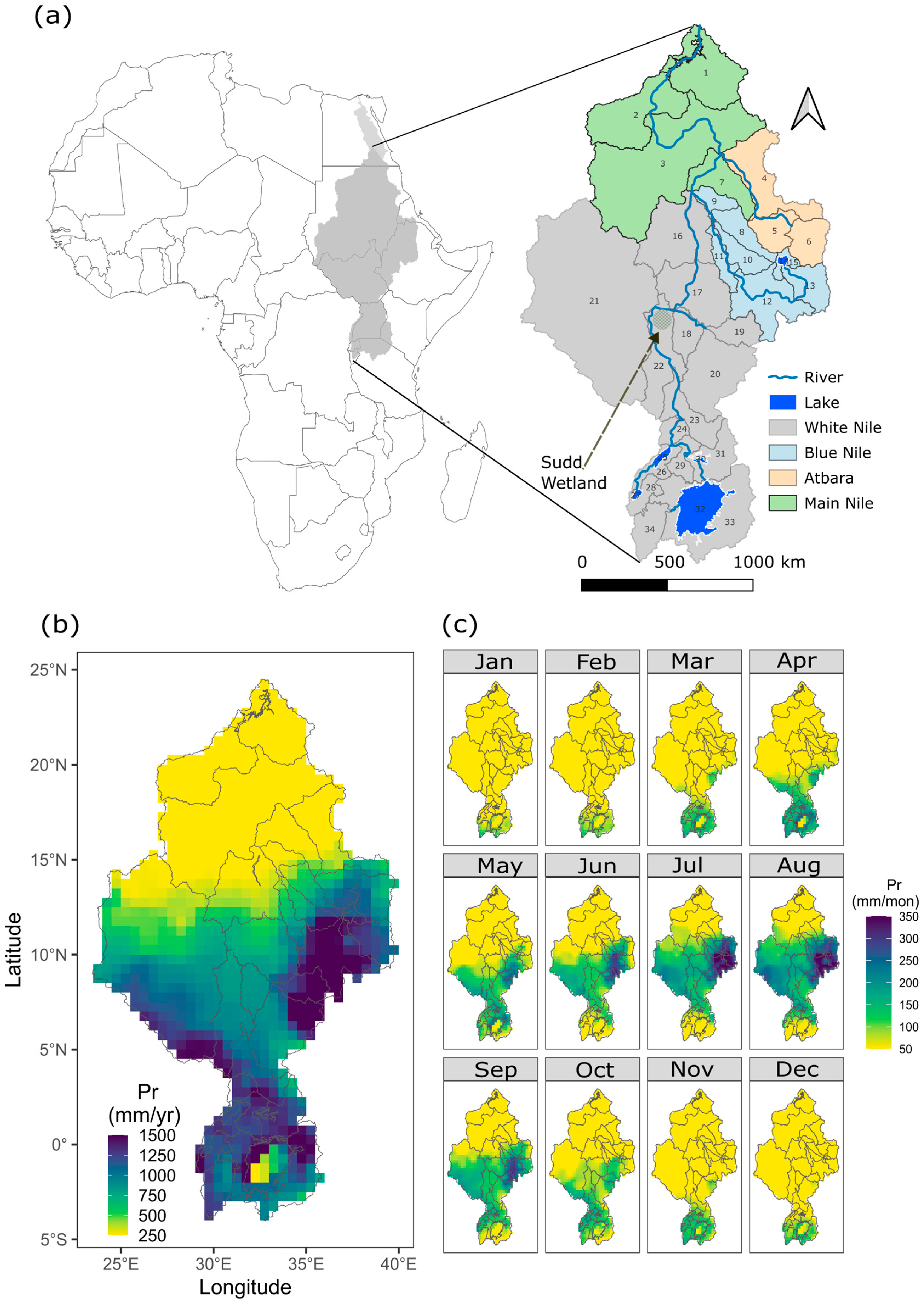
The Nile Basin comprises four major watersheds, namely the Blue Nile, White Nile, Atbara, and main Nile (Figure 1). The Blue Nile and the White Nile are the two main tributaries of the Nile River, contributing approximately 85% of the total annual flow and meeting in Khartoum, Sudan [40]. The Atbara River joins approximately 300 km downstream of Khartoum and contributes the remainder of flow to the Main Nile. The Blue Nile originates in the Ethiopian highlands and is responsible for the Nile River’s high flows [33,41,42]. The Ethiopian highlands receive a higher annual precipitation of about 1300 mm, occurring primarily during the rainy season, occurring from June to September and known as Kiremt (Figure 1c). On the northern side of the highlands, water flows into the Atbara River, which contributes about 15% of the Nile flow [40]. The western portion of the Blue Nile basin, covering Sudan and Egypt, is on the edge of the Sahara desert and receives annual precipitation of less than 200 mm [14].
The White Nile region, comprising Lake Victoria and Lake Albert, receives approximately 1100 mm of annual precipitation, largely distributed into two wet seasons (Figure 1c). The White Nile provides a steady baseflow for the Nile River, primarily due to the influence of a series of East African Great Lakes and the Sudd wetland in South Sudan [21,30,38]. These water bodies modulate the flow hydrograph of the White Nile, resulting in high temporal autocorrelation within the region’s hydrological system [39,43]. The Sudd wetland in South Sudan is the source of major water losses in the White Nile. When water levels rise in the Sudd wetland, the wetland’s size increases, and only half of the incoming water flows out. Due to its tropical location, the wetland receives abundant sunlight year-round, leading to high rates of water evaporation [30].

2.2. Data

The datasets used to calibrate and run the NRB model are presented in Table 1. Climate drivers (precipitation, daily minimum temperature, and daily maximum temperature) were used for simulation purposes, while discharge and lake-level data were used for calibration targets. Historical climate data were based on the GSWP3 (Global Soil Wetness Project Phase 3) dataset [44], a daily, high-resolution, global meteorological dataset used for hydrological and climate studies [45]. GSWP3 is one of the key datasets used in the second phase of the Inter-Sectoral Impact Assessment Model Intercomparison Project (ISIMIP2a) providing historical climate and land surface conditions essential for driving impact models and facilitating intercomparison studies [46]. GSWP3 provides daily bias-corrected meteorological data spanning from 1901 to 2010. This provides sufficient early 20th century coverage to capture much of the headwaters prior to major dam regulation in the latter part of the century.
Discharge data used for model calibration and validation were extracted from the GRDC database and from a series of published records, titled the Nile River Basin [47]. The GRDC database comprises archives of river discharge data across the globe, facilitating the international exchange of hydrological data. The Nile River Basin [47] hydrological dataset was collected and published by the Egyptian Ministry of Public Works in the early to mid-20th century to enhance the understanding of the Nile River and aid in water resources planning and management [48]. This dataset extends the time period available through the GRDC and includes several gauges not otherwise available. Its supporting documentation also provides a rich source of information for the early 20th century NRB on the climate, water sources and sinks, and the role of lakes and wetlands/swamps.
Table 1. Datasets used to run and calibrate the Nile Basin Model.
DataSourceFormatResolutionReference
Climate Drivers for Simulation
Minimum temperature
Maximum temperature
Precipitation
GSWP3GriddedDaily
0.5° × 0.5°
Dirmeyer et al. [44]
Hydrology Observations for Calibration
DischargeGRDC
HURST
GaugedMonthlyhttp://grdc.bafg.de/
(Accessed on 9 March 2023)
Hurst et al. [47]
Lake stagesDigitized
Dahiti
GaugedMonthlyVanderkelen et al. [49]
Yasuda et al. [50]
Schwatke et al. [51]

2.3. GR4J Hydrologic Model in Raven

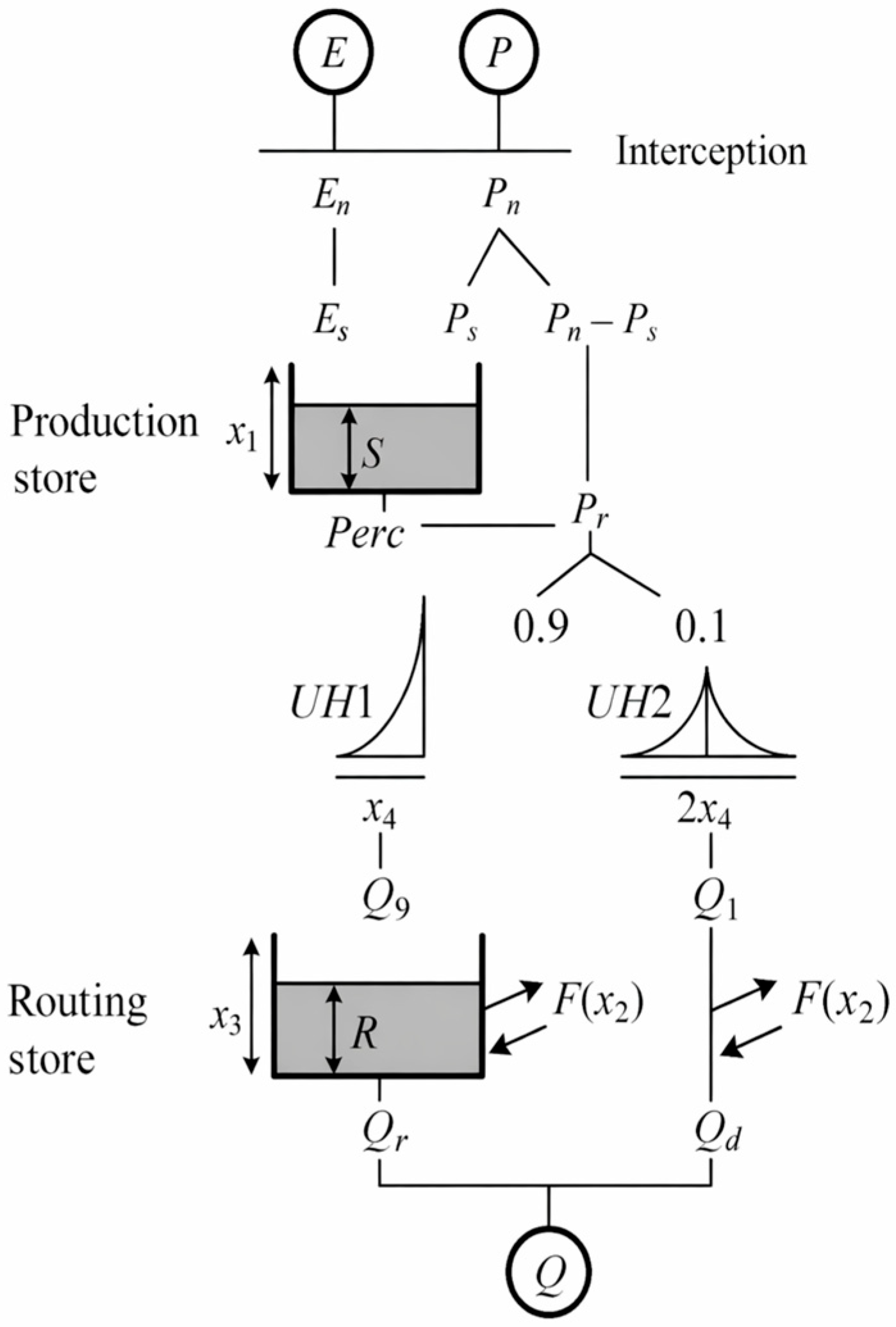
The NRB hydrological model was developed using emulation of the GR4J within the RAVEN hydrological framework v3.5 [52]. RAVEN was designed to allow emulation of other hydrological models while also including modules to capture the routing through river networks, lakes, and wetlands. The GR4J model [37] was selected for its simplicity, requiring relatively few parameters and minimal input data, while still effectively simulating hydrological processes, which makes it ideal for application in data-scarce regions such as the NRB. The GR4J rainfall–runoff model uses four parameters to simulate various hydrological processes (Figure 2). These four parameters are the production store (X1), groundwater exchange capacity (X2), routing capacity (X3), and lag or routing time (X4). The X1 and X2 parameters are responsible for mass balance in the model, controlling soil moisture capacity and groundwater exchange, respectively. The X3 and X4 parameters primarily influence the shape of the hydrograph and baseflow recession [37]. The required climate drivers to run the GR4J model are daily precipitation and potential evapotranspiration. Potential evapotranspiration was estimated from daily minimum and maximum temperature using the approach of Hargreaves and Samani [53]. Outputs from GR4J are discharge, evapotranspiration, and rate of groundwater exchange. GR4J was found to excel in reproducing watersheds’ hydrological behavior across a range of climates, including tropical humid regions of west Africa, which are climatologically similar to the White Nile headwaters [54,55,56,57,58,59].

2.4. Nile Model Setup

The NRB was spatially discretized into 34 Hydrologic Response Units (HRUs) (Figure 1). An HRU is defined as a lumped spatial unit with homogeneous properties, here defined solely based on sub-watershed area and relatively homogenous climate inputs. These basins were initially based on the Hydrosheds dataset [60] at the level 5 scale, with customized adjustments to accommodate gauge locations or splitting heterogeneous HRUs. The discretized NRB consists of twenty-nine land HRUs and five lake HRUs (Figure 1). Precipitation and temperature inputs from GSWP3 were spatially averaged over each HRU. While model simulations were performed at a daily timestep, all calibration was conducted based on goodness of fit at a monthly timestep. This approach was chosen to effectively capture the impact of climate variation on the seasonal minimum and maximum flows. In total, calibration was performed at 18 locations across the NRB.
All calibration of land and lake HRUs was conducted from upstream to downstream in a stepwise process. Once an HRU or set of HRUs was successfully calibrated, its parameters were fixed before continuing downstream to calibrate the next HRU(s). For land-based HRUs, we calibrated each of the GR4J model’s four parameters (X1–X4). The feasible parameter ranges were set as follows: X1: 0.1–3 m, X2: −20–10 mm/day, X3: 0–1000 mm, and X4: 1–20 days. The parameter ranges are relatively broader than those proposed by Perrin et al. [37] to reflect the larger spatial resolution of the HRUs and the wide variation in climate, soils, and topography across the NRB model.
Water HRUs were used to represent large lakes and are modeled within the Raven framework as storage volume with a broad-crested weir outlet. Five water HRUs were included in the model to represent major lakes within the Nile River Basin. Four of these—Lake Victoria, Lake Kyoga, Lake Edward, and Lake Albert—are located in the White Nile basin, while Lake Tana is located in the Blue Nile basin. No major modern reservoirs were incorporated into the model; calibration and validation were based on data from periods prior to the construction of large-scale reservoirs that significantly altered the natural flow. While earlier dams such as the Low Aswan and Sennar did exist in early 1900s, their impacts on the overall Nile flow dynamics were limited. Given the scale of the Nile Basin, it should be noted that small lakes were ignored, though their impacts might be substantial at a local scale.
In Raven, water HRUs are defined by a lake’s surface area and depth, in addition to the broad-crested weir outlet properties, including the crest height, width, and weir coefficient [52]. In addition to inflows from upstream HRUs and outflow from the weir outlet, lakes also consider evaporative losses from the lake surface and groundwater fluxes. Losses to evaporation are based on potential evapotranspiration (PET) input but are corrected via a PET correction coefficient since lakes experience open-water evaporation. Lake–groundwater fluxes are modulated by reference height and seepage rate. The reference height represents typical groundwater levels, such that when the lake water level rises above it, the lake loses water to the groundwater system, and when it falls below, the lake gains water from groundwater. This bidirectional exchange between lake and groundwater is controlled by the seepage coefficient.
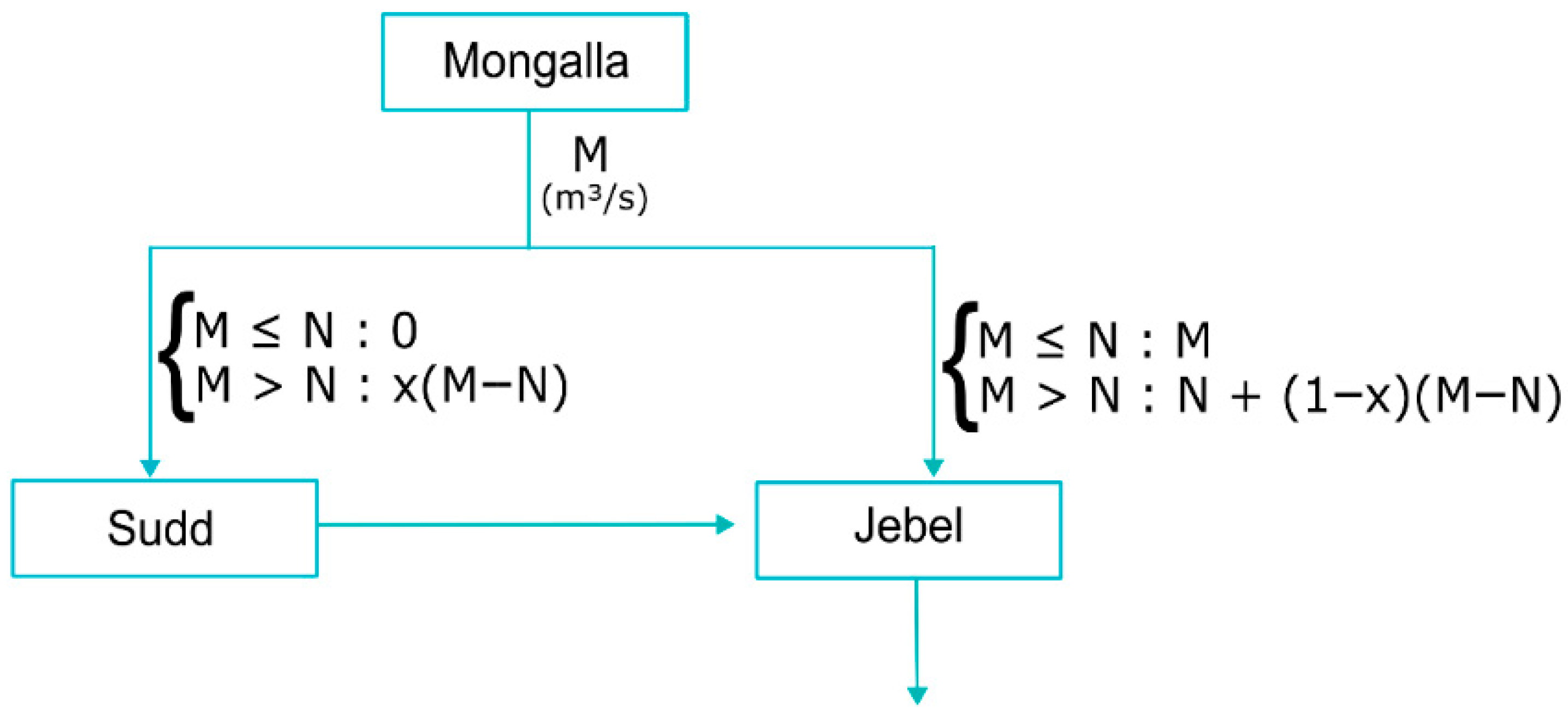
The Sudd wetland is modeled differently from lakes. The Sudd wetland is crucial to understanding Nile hydrology, as half of its inflow is typically lost to evapotranspiration and percolation into groundwater storages [22,38,61,62], greatly impacting the volume and timing of flow through the White Nile. The Sudd wetland has extensive vegetation cover in the flat plains of South Sudan and experiences high exposure to solar radiation year-round, which drives significant water loss. To simulate the hydrological processes of the Sudd wetland, we assume a hypothetical offline reservoir, modified to simulate inflow from the White Nile overflowing its banks and filling the wetland. Instead of connecting the upstream HRU to the Sudd, we implement a water diversion algorithm wherein water only enters the Sudd wetland when it is above a certain flow threshold (N) (Figure 3). When incoming flow is above the threshold, a fixed percentage (x) of the surplus (M-N) diverts into the Sudd. The Sudd, in turn, discharges back into the Jebel watershed downstream, following the same setup as a lake HRU, with outflow controlled by a weir control structure. Therefore, the Sudd requires the same parameters as a lake HRU, with additional parameters for overflow threshold (N) and percentage (x) of the surplus flow to divert into the Sudd during the flood stage. This approach approximates seasonal wetland behavior, greatly increasing surface area and water loss via evaporation during the flooded wet season and increasing storage time water held in areas adjacent to the main channel.

2.5. Multi-Objective Calibration

The Shuffled Complex Evolution (SCE-UA) technique [63] was used to calibrate the model. SCE was chosen because of its satisfactory parameter optimization in hydrological studies [63,64,65]. SCE-UA combines random shuffling and evolutionary techniques to optimize the parameter space and effectively minimize the difference between model simulation and observations [63]. We employed an SCE-UA algorithm from the SoilHyP package [66] written in R. Four objective functions were considered at each calibration location (Table 2). We divided the data into 80%, used for calibration, and 20% used for validation to avoid model overfitting. The optimal parameter set for each calibration run was chosen by ranking the performance of each parameter set on each objective function and then applying equal weighting to determine the best set. A multi-objective calibration focusing on a range of objectives should provide a balanced model with skill focusing on bias (MAE), skill with an emphasis on high flows (RMSE), tracking low flows (rNSE), and overall skill and timing (NSE).

2.6. Time Series Analysis

To further evaluate our model performance beyond traditional goodness-of-fit metrics, we applied Innovative Trend Analysis (ITA) [67] and Rescaled Adjusted Partial Sums (RAPS) [68] to both the observed and simulated discharge series. ITA consists of dividing the time series into two equal, chronologically ordered sub-periods and plotting the sorted values from the earlier portion against those from the later portion. This enables visual identification of monotonic trends, nonlinear behavior, and temporal asymmetry without the distributional assumptions inherent in conventional trend tests [67]. In general, if data appears above the 1:1 line, the data is increasing in the later period of the record, and vice versa. RAPS (Equation (1)) computes cumulative deviations of time series from their long-term mean, rescaled by the standard deviation, thereby highlighting persistent wet or dry anomalies, periodicities, and structural similarities or discrepancies between the observed and simulated discharge time series [68]. These time series analyses are essential in the context of the NRB because they compare model simulations to observations from a longer temporal perspective, showing the models’ ability to respond to multi-year droughts or pluvials realistically. For consistency, the calibration period was used as reference period for comparing the observed and simulated discharge series.
R A P S t = i = 1 t x i x ¯ s
where x i represents the value of the time series at time i ,   x ¯ is the long-term mean of the series, s represents the standard deviation of the series, and t is a time index from time 1 to N. ITA was performed using the full time series at a monthly scale at three key locations: the outflow of the White Nile at Khartoum, the outflow of the Blue Nile at Khartoum, and the furthest downstream main Nile gauge at Aswan. We performed RAPS analysis for each month, but focus on the most relevant wet season for each gauge, which is June–August (JJA) for the Blue and main stem Nile and March–May (MAM) for the White Nile.

2.7. Climate Sensitivity

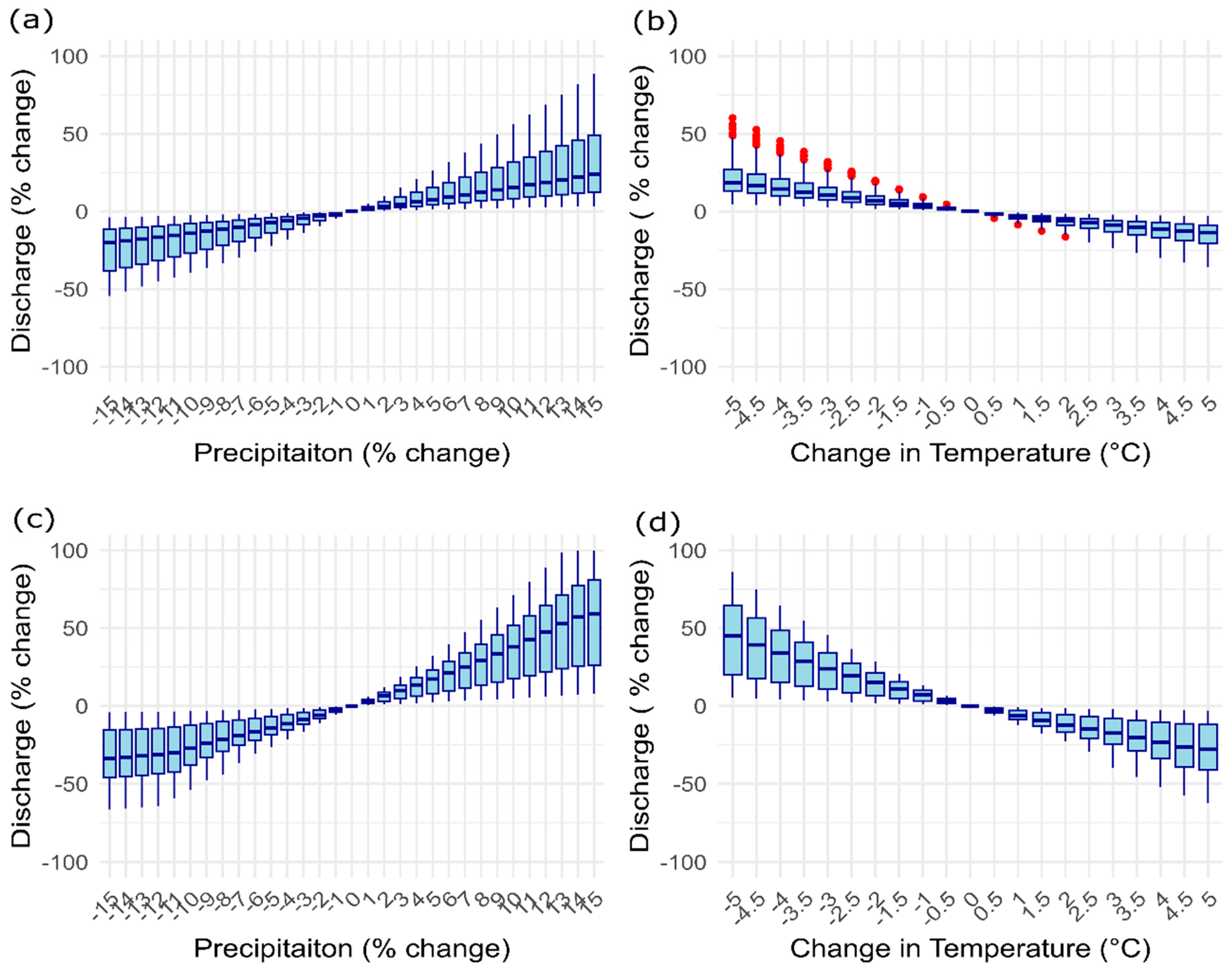
To test the sensitivity of flow at the model’s outlet to climate disruptions in its headwaters, we simulated discharge at Aswan, varying scaled temperature and precipitation for the Blue and White Nile watersheds, independently. For example, we ran a simulation using historical temperature and precipitation across the White Nile, while maintaining historical temperatures across the Blue Nile, but increasing historical precipitation by 5%. Temperature and precipitation were varied independently, with temperature changes ranging from −5° to 5° C and precipitation changes ranging from −15 to 15%. Handling precipitation and temperature sensitivity allows a more detailed view on their impacts but does not capture the combined effect of temperature and precipitation, as these variables have a covariance.

3. Results

3.1. Calibration and Validation

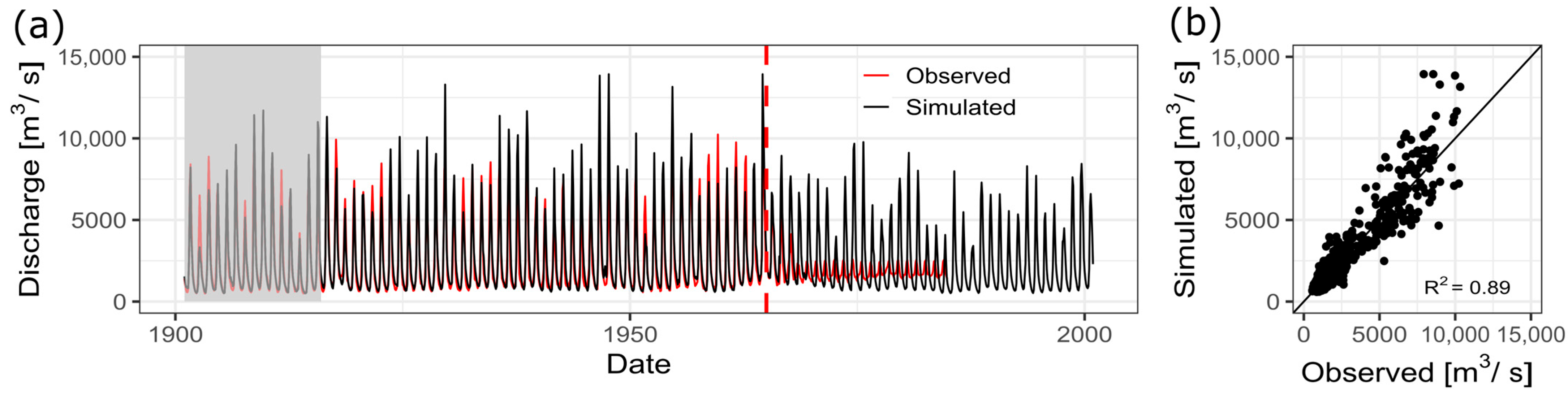
Because our primary goal was to accurately capture the combined signal at the furthest downstream gauge, we focus on flow at Aswan, in Egypt. In addition to NSE and rNSE, we employ PBIAS (Percent Bias) and R2 (Coefficient of Determination) as scaled performance metrics to assess relative model performance across the NRB. The calibrated model showed satisfactory performance at Aswan, reproducing observed discharge, with a slight overestimate of the most extreme monthly floods magnitudes (Figure 4). The NSE and PBIAS skills based on monthly means were 0.87 (0.80) and 6.1% (5.0%) during calibration (validation), respectively. The negligible worsening in the validation step, indicated by slightly lower NSE and slightly higher PBIAS, confirms the model is not overfit. An extended spin-up period, 1901–1915 shown as gray shaded area, was necessary to allow lakes in the White Nile to stabilize. At this location, the period between 1915 and 1965 was used for calibration and validation to avoid the dramatic change in flow after the Aswan High Dam (AHD) construction in the 1960s, shown as a vertical dashed line (Figure 4). Simulated time series after AHD construction suggest an estimate of the natural Nile flow in the absence of modern dams. We assume negligible storage effects from the relatively small Aswan low dam, completed in 1902 and raised twice around 1912 and 1933 [69,70].
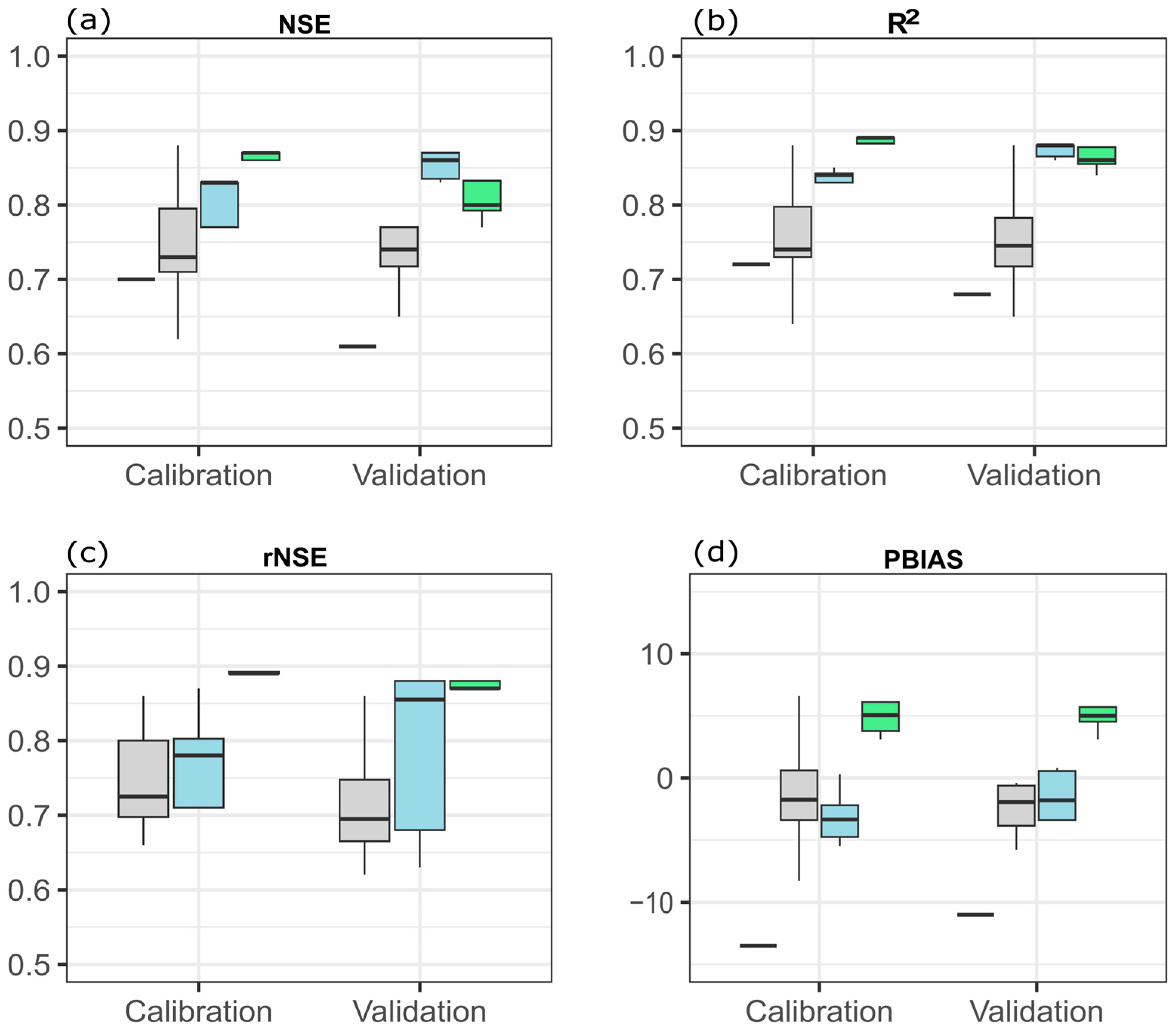
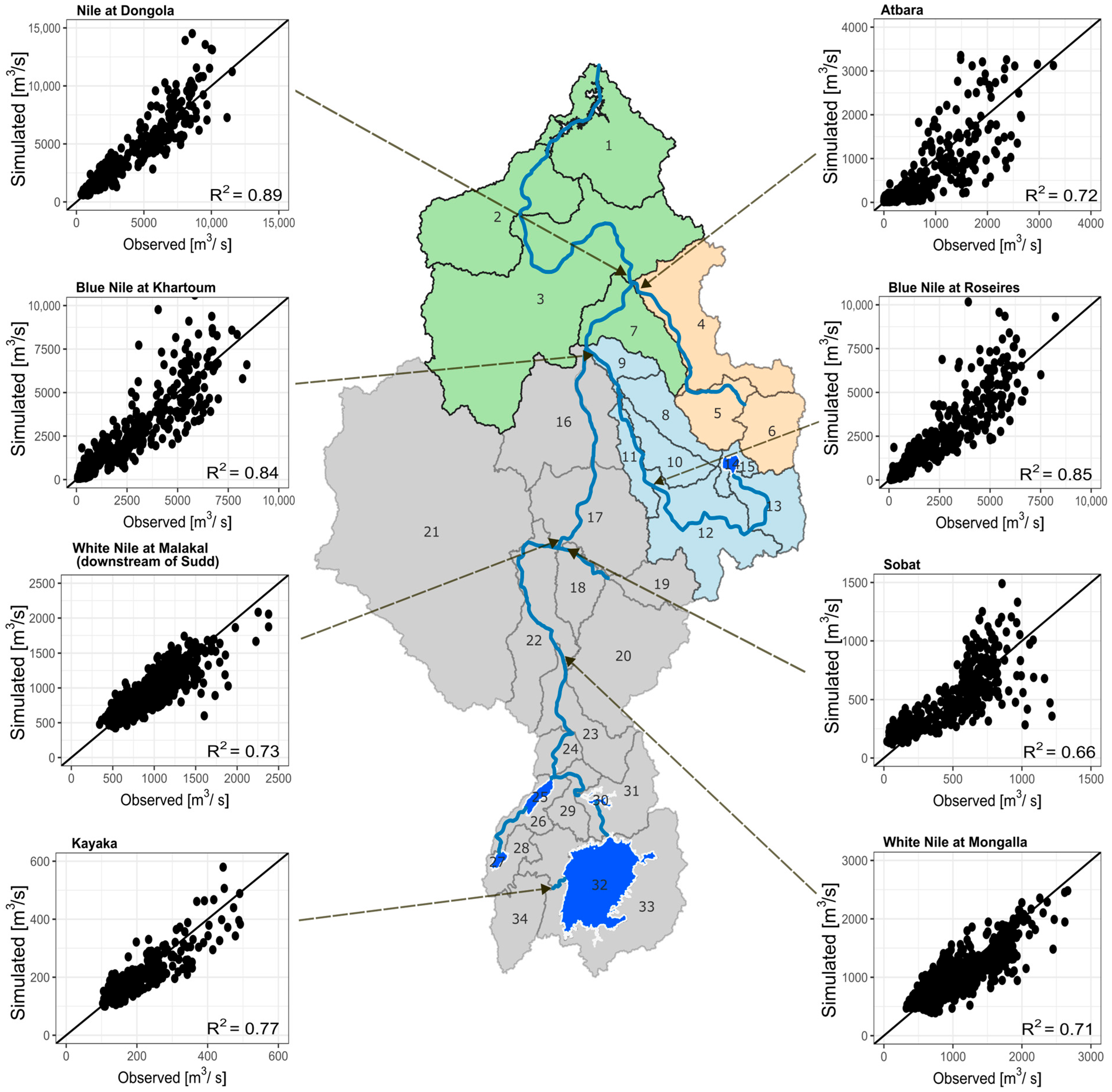
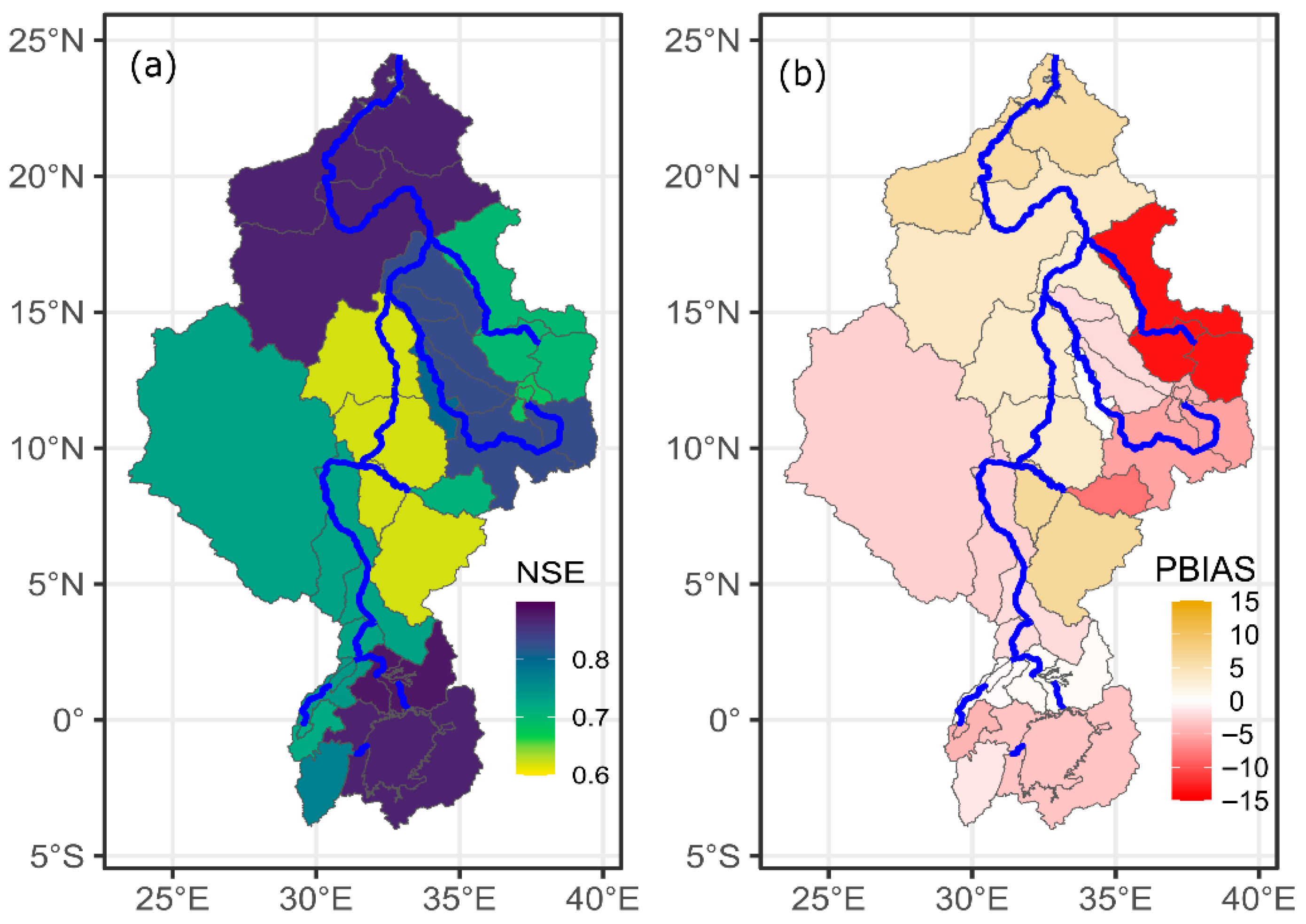
In addition to good model performance at the basin outlet, modeling skill was also good across the NRB’s sub-watersheds (Figure 5, Figure 6 and Figure 7). NSE during the calibration period ranges from 0.62 to 0.87, indicating acceptable performance for hydrologic modeling. Similarly, model evaluation using PBIAS during the calibration period yielded satisfactory results, falling within ±10% for all sub-watersheds except those in the Atbara region. The best model skill was found in the Blue Nile, the headwaters of the White Nile, and the main stem of the Nile downstream of the junction between the Blue and White branches (Figure 5 and Figure 6).
Two areas of lesser performance are located in the Atbara and Sobat sub-watersheds. The calibrated model consistently underestimates the observed discharge from the Atbara watershed by approximately 13% (Figure 5b and Figure 6), but still largely captures the hydrograph, as measured by a lower, but still acceptable, NSE of 0.7 during calibration and 0.61 during validation at the Atbara outlet (Figure 6a). Reduced model skill may stem from the use of a single gauge at the Atbara outlet, located several kilometers downstream of the critical headwater regions, for model calibration and validation.
There are no major decreases across the four tested objectives between the calibration and validation time periods, suggesting overfitting and equifinality is not a major issue in the model (Figure 6). Biases in the Sobat are likely due to the presence of wetlands, similarly to the nearby Sudd. However, these upstream discrepancies from the Sobat watershed were negligible when measured at Malakal, located just downstream of the Sudd and the Sobat (Figure 7). The rule used for simulating the Sudd wetland was therefore deemed successful and the Sobat adequately modeled given the available data.

3.2. Time Series Analysis: Observed vs. Simulated Discharge

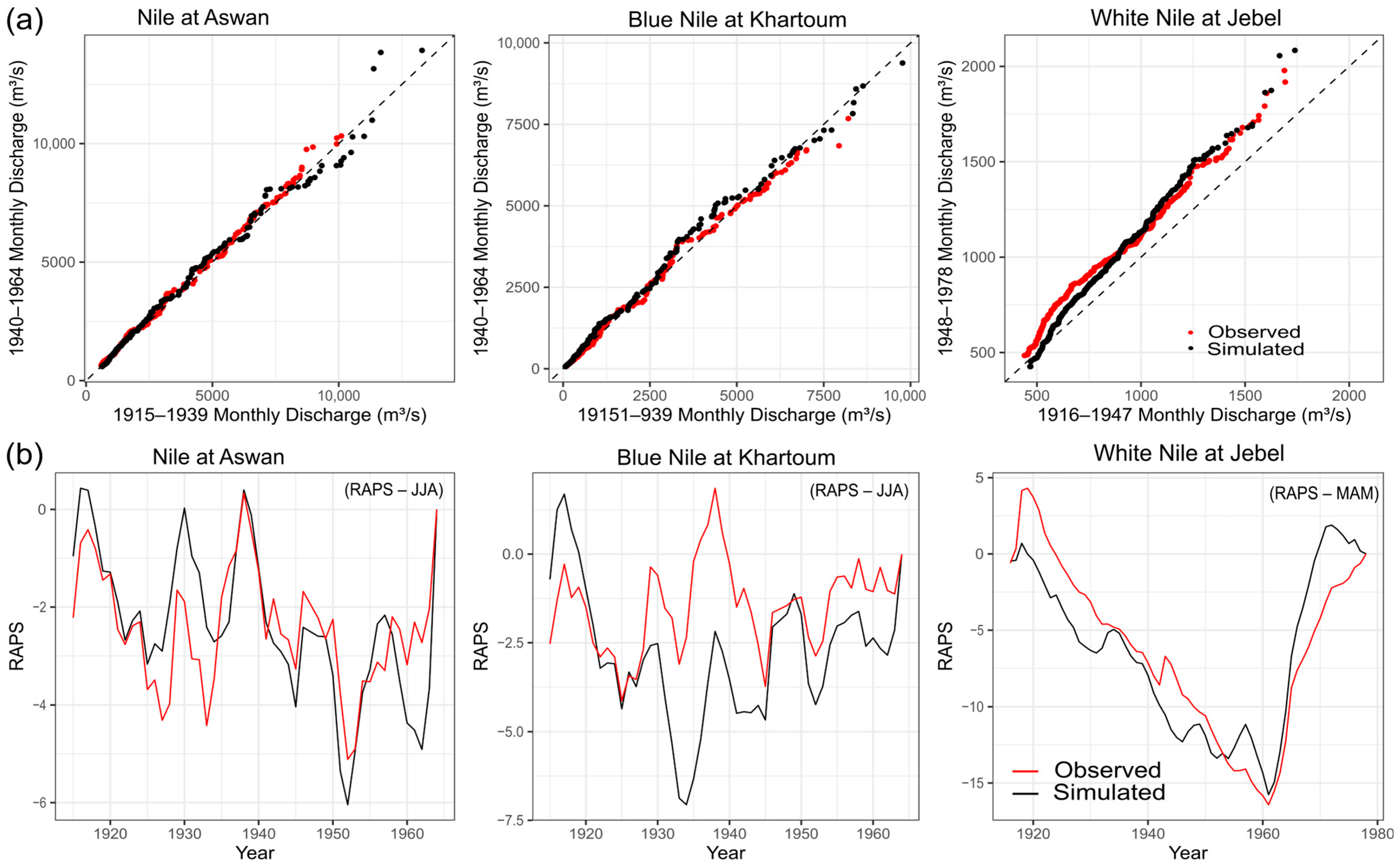
The ITA results show that simulated discharge captured the overall trend structure of the observed series at all three key sites, as indicated by observed (red) and simulated (black) points plotting near to one another (Figure 8a). Model simulations capture the negligible observed trend at Aswan and the Blue Nile, as indicated by points clustering around the 1:1 line. The model also accurately simulates a wetting trend in the White Nile flow segments, with most points lying above the 1:1 line, particularly for medium and high flows. This indicates that the 1948–1978 period was systematically wetter than 1916–1947 in the White Nile, consistent with the step change in Lake Victoria levels [49] and post-1960 step change in RAPS analysis (Figure 8b). RAPS analysis (Figure 8b), computed from seasonal means, JJA for Aswan and the Blue Nile, and MAM for the White Nile, provides a complementary perspective on the structural changes highlighted by the ITA. The time series show broad consistency between observations (red) and simulations (black) with respect to multi-decadal shifts between wet (ridge) and dry (trough) periods. The Blue and main Nile show more inter-decadal variation than a long-term trend, agreeing with ITA, with good agreement on min and max timing. For the Blue Nile, the model underestimates the wet anomaly around 1930 and exaggerates the dryness that follows, while still retaining the general temporal pattern. The White Nile shows exceptional agreement between observation and simulation with both indicating a prolonged decline in cumulative anomalies until approximately 1960, followed by a sharp and sustained increase. This behavior indicates a climatological shift from a multi-decadal dry phase to a wetter regime after 1960 [49]. The abrupt change in equatorial lake outflows during the 1960s likely dominates the long-term mean. Overall, the close agreement between observed and simulated diagnostics demonstrates that the model not only reproduces daily and monthly discharge magnitudes but also captures the underlying temporal structure of variability, reinforcing confidence in its ability to reconstruct pre-regulation hydrology and responses to multi-year climate anomalies.

3.3. Climate and Parameter Sensitivity Analyses

Sensitivity testing of the Blue and White Nile indicated that variation in climate forcings in either watershed significantly affects the main Nile (Figure 9). As expected, precipitation and temperature impact Nile flow in opposite directions: increases in precipitation leads to higher flow, while increases in temperature lead to reduced flow. Downstream flow is more sensitive to climate disruptions in the White Nile than the Blue Nile. For instance, for the same level of temperature perturbation, the impact of the White Nile is almost double that of the Blue Nile. An increase in mean temperature of 2° C in the White Nile during the last century would have decreased the annual flow at Aswan by 11.5%, whereas a similar increase in the Blue Nile would have decreased flow at Aswan by 6.6%. A consistent 7.5% increase in White Nile precipitation, approximately equivalent to the step change difference between precipitation in the 1960s and 1970s [71], would have increased flow at Aswan by 25%. A similar precipitation increase across the Blue Nile would have increased annual flow by 14%.
In part, this sensitivity to the White Nile could be due to the Blue Nile’s strong seasonality, where more than 80% of the precipitation falls in a period of four months, as opposed to the White Nile’s perennial nature, which is a result of major lakes and the Sudd wetland sustaining its flow even during periods of low rainfall. This distinction is evident in Figure 9b where the Nile River’s discharge appears to be minimally affected by temperature variability in the Blue Nile considering the same level of temperature variability in the White Nile (Figure 9d) results in remarkable changes in mean annual flow. Additionally, the high hydrological persistence in the White Nile system may amplify the impacts, because perturbations are distributed linearly throughout the simulation runs.
Parameter sensitivity was assessed using a method proposed by Ranatunga et al. [72]. Their approach involves changing one parameter at time within a specified range and measuring the relative sensitivity to the baseline model by utilizing Normalized Root Mean Square Error (NRMSE) as a sensitivity metric. The NRMSE is calculated by normalizing the RMSE (Table 2) by the range of discharge values from the baseline model, ( Q b a s e , m a x Q b a s e , m i n ). Within the Nile model, parameters for headwater watersheds were relatively more sensitive than those for downstream watersheds. The most sensitive parameter was X2, which controls groundwater exchange, while the least sensitive parameter was X4, mainly due to the large spatial scale. The X1 and X3 parameters exhibited contrasting patterns across the White Nile and Blue Nile watersheds. In the White Nile, both parameters had relatively larger values, suggesting greater sensitivity to lower parameter ranges. In the Blue Nile, however, X1 and X3 had lower values, indicating increased sensitivity towards higher parameter values. In summary, the sensitivity of GR4J parameters is inherently influenced by other factors such as watershed characteristics, including spatial scale, timing and magnitude of precipitation, as well as dominant hydrological processes [73].

4. Discussion

4.1. Model Calibration and Uncertainty

The resultant NRB model successfully captures observed historical discharge across a large and diverse watershed with a wide range of climate zones. Similar models have primarily focused on subsets of the Nile within a single climate zone [27,74,75]. Other full Nile models have employed regional and/or General Circulation Model (GCM) outputs to study Nile response under various climate scenarios [18,23,70,76] and other aspects of water resources in the NRB [24,77].
The choice of the GR4J as a base model was made to match the model simplicity to the relatively sparsely available data. We show that the GR4J model adequately and efficiently reproduces observed discharge across the NRB, during both calibration and validation phases. Research has shown that simple models can be effective at simulating hydrological processes and state variables, even in data scarce regions [55,75,78]. A further rationale for use of the GR4J model is to drive the model with simple climate inputs, to understand sensitivity across major watersheds. This choice limits the output to understanding runoff changes, not internal changes in physical water stores, a drawback shared by most of conceptual models [79,80].
Incorporating wetlands into hydrologic models can improve streamflow simulation by capturing storage dynamics that would otherwise be misrepresented [30,81]. Here we leverage a common conceptual representation of the fill-and-spill mechanism [52,82,83], in which wetlands are simulated as storages that fill once threshold conditions are exceeded, temporarily retain water, and then release it gradually back to the main channel or lose it to evapotranspiration. However, wetland hydrology is inherently complex, varies by wetland type or connection, and remains difficult to represent in large-scale hydrologic models. For example, many wetland systems are made of many small depressions, often conceptualized in models as a network of interconnected retention basins, where hydrologic response is influenced by interconnectivity and physical characteristics like wetland size and depth [81,83]. Such wetland models could not be considered for the Sudd, which experiences a bidirectional exchange of flow away from and back into the Nile system depending on seasonal hydrologic conditions [47]. By using a fill-and-spill model, with calibrated thresholds, our wetland modeling approach reproduces these dynamics by simulating delayed wetland responses and losses while simplifying fine-scale interactions, as shown by the improvement in model performance at White Nile at Malakal relative to model performance upstream Sobat and Mongalla watersheds (Figure 7).
Two specific regions of poor performance were Sobat and Atbara, primarily due to the huge differential in rainfall distribution and insufficient data coverage across both watersheds. For instance, even though Sobat is located in the White Nile basin, most of its headwaters originate in the Baro region of the southeastern Ethiopian highlands, which experiences high season rainfall. This runoff is then routed through a complex network of rivers and wetlands exhibiting similar hydrological conditions as the Sudd wetland [32,35]. According to Abdelkader et al. [32], evapotranspiration losses within the Sobat wetlands are in fact responsible for up to 80% of the discharge reduction in the region. Unlike the Sudd, there was no adequate gauge data to allow a detailed wetland model of the Sobat.
In the case of Atbara, the majority of discharge is generated in the Northwestern region of the Ethiopian highlands, whereas a larger portion of the downstream watershed is located in the arid region of the Sahara Desert. El-Sayed El-Mahdy et al. [74] reported that the Khashm El-Girba Dam, built in 1964, drains approximately 44% of the total Atbara area and discharges an annual volume of 11.18 Billion Cubic Meters (BCM), with a coefficient of variation of 43%. Our model simulations showed a good agreement at this location, simulating an annual discharge of 11.03 BCM and a coefficient of variation of 46%. This result suggests that the model performs best in the headwater regions of Atbara watershed but fails to adequately represent the portion of the watershed that extends the Sahara Desert.
Another potential source of uncertainty was the GSWP3 climate input data. One area of input uncertainty is over Lake Victoria, where the estimated long-term mean annual precipitation from GWSP3 is approximately 951 mm. This is significantly lower than 1200–1800 mm range reported previously [49,84,85,86]. Direct precipitation over Lake Victoria is responsible for up to 80% of the total lake inflow [49,87]. Because of the relative magnitude of direct rainfall, Dumont [84] argues that the lake is the primary source of the Nile, rather than its upstream tributaries in the mountain ranges of Rwanda or the Rwenzori mountains. The GSWP3 dataset also has a noted discontinuity around the 1978/1979 boundary [45,88]. The discontinuity is attributed to a change in the source of observational datasets used in the development of the GSWP3 dataset. Before 1979, precipitation and temperature were primarily reconstructed using ground-based observations and reanalyses. After 1979, the dataset transitioned to using remotely sensed data, which was intended to improve spatial coverage and reduce bias in the construction of climate forcings.

4.2. Capturing Regional Disruptions

The primary goal of the model was to create a hydrologic model that could capture major disruptions of the near-natural Nile flow due to climate anomalies like drought years or multi-year shifts. The Blue Nile and White Nile watersheds experience unique climate drivers due to their distinct seasonal patterns [14]. Here, we used scaled temperature and precipitation in the Blue and White Nile watersheds to simulate relative sensitivity to the NRB’s annual flow. We showed that disruption in any major watershed leads to important changes in downstream flow, mainly in Sudan and Egypt which heavily rely on the hydroclimatic conditions in the NRB’s headwater regions.
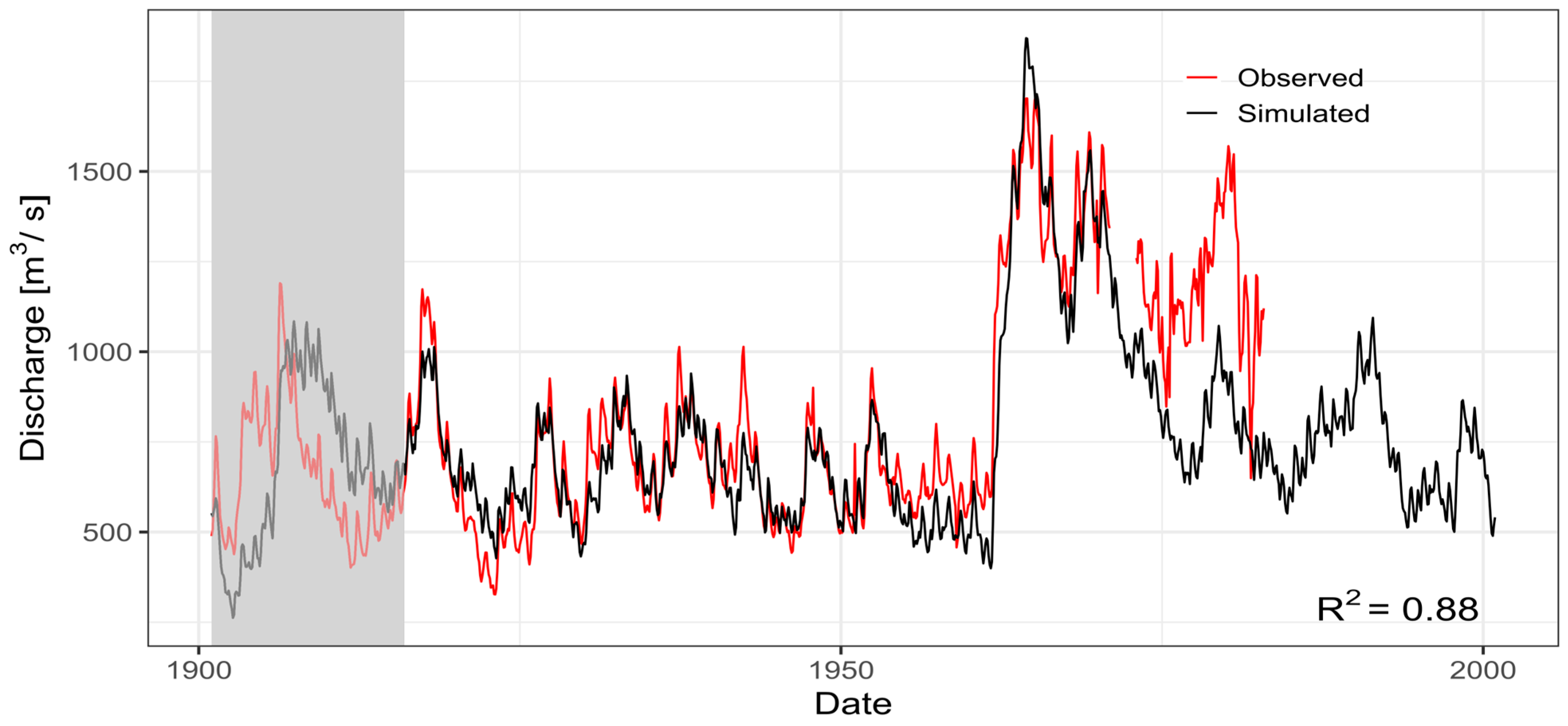
An example from the historical record is the climatic shift that produced an abrupt increase in Lake Victoria levels during the 1960s (Figure 10). This period experienced exceptionally high rainfall that marked a persistent increase in lake levels, a pattern also observed in other equatorial lakes [49]. This signal is only apparent in the White Nile as opposed to the entire basin and was possibly driven by global teleconnections [9,87]. The calibrated model effectively simulates the lake’s temporal variability throughout the calibration/validation period (1915–1975), successfully capturing this decadal shift in the hydrological regime over Lake Victoria (Figure 10). The NSE and PBIAS were estimated to be 0.87 and −3.9% during calibration and 0.85 and −3.8% during validation, respectively. The departure between observed and simulated discharge in the late quarter of the 20th century is attributed to discontinuity issues in the GSWP3 dataset after 1978 [45,88]. Errors during the extended spin-up period (gray shaded area) are due to the longer time needed for larger lakes like Lake Victoria and Lake Albert to stabilize. The ability of the calibrated model to successfully capture such a dramatic hydrologic change further supports the model’s use in simulating hydroclimate disruptions, extreme events, or multi-year regime changes.

5. Conclusions

The primary purpose of this study was to (1) develop a simple hydrologic model for the NRB, (2) calibrate and validate this model under near-natural conditions, and (3) use the model to understand the impacts on river discharge associated with distinct climate anomalies for the major watersheds of the NRB. The basin was discretized into 34 watersheds and forced using the GSWP3 climate dataset. Discharge and lake levels data for model calibration and validation were retrieved from GRDC, digitization of Hurst et al. [47] flow dataset available as typewritten tables, and by digitization of other published outputs focused on specific regions of the basin. Digitization of these “recovered records” made calibration of the model possible, particularly in the White Nile, where the availability of observational data in the early 20th century was scarce.
The calibrated hydrological model adequately reproduces observed discharge at multiple locations across the NRB. High skill scores were found in the Blue Nile, headwaters of the White Nile, and the Nile main stem, while the Atbara and Sobat sub-watersheds had lower, but still acceptable skill scores. The simple conceptual model of the Sudd wetland also effectively simulated this complex region that is critical for accurate water balance in the White Nile and commonly overlooked in gridded hydrological models. Additionally, the calibrated model successfully captured the effect of climate disruptions in the NRB’s major watersheds (e.g., the effect of temperature and precipitation; sudden step change in Lake Victoria discharge and levels in the 1960s).
While this study provides valuable insights on the near-natural conditions for the NRB, it is essential to recognize certain limitations that may affect the interpretation of the results. Watersheds with limited hydrological data—such as the Atbara and Sobat rivers—showed lower model performance compared to well-gauged watersheds like in the Blue Nile and Nile main stem. Furthermore, poor representation of GSWP3 precipitation over Lake Victoria suggests a potential bias in inputs that could lead to overcompensation from upstream watersheds and/or groundwater contributions.
While acknowledging these potential limitations, the calibrated model still provides an exceptionally good baseline model from which users can evaluate the effects of the ITCZ, climate change, and extreme events on the natural flow of the Nile River, without the effect of major reservoirs. The model accurately captures the behavior of the numerous White Nile lakes and the challenging water balance around the Sudd wetland, areas that are common pitfalls for global or continental-scale hydrologic models. Additionally, the model could be used to reconstruct historical discharges in the NRB, in locations and periods without good gauge data, and provide a baseline for comparison with the modern Nile, modified by larger reservoirs. Finally, our approach to incorporating a simple conceptual wetland into a larger hydrologic model could be expanded to other similar systems subject to seasonal river flooding into adjacent floodplain wetland systems.

Author Contributions

Conceptualization, I.F.M. and J.H.S.; methodology, I.F.M. and J.H.S.; validation, I.F.M.; formal analysis, I.F.M.; data curation, I.F.M. and J.H.S.; writing—original draft preparation, I.F.M.; writing—review and editing, J.H.S.; visualization, I.F.M. and J.H.S.; supervision, J.H.S.; funding acquisition, J.H.S.; All authors have read and agreed to the published version of the manuscript.

Funding

This research was funded by the US National Science Foundation Dynamics of Coupled Natural and Human Systems Program (grant no. 1824770).

Data Availability Statement

The original data presented in the study are openly available in a Figshare repository at https://doi.org/10.6084/m9.figshare.29575283 [88].

Acknowledgments

The authors acknowledge the support from the Ohio Supercomputer Center, and the Byrd Polar and Climate Research Center at the Ohio State University.

Conflicts of Interest

The authors declare no conflicts of interest.

References

  1. El-Fadel, M.; El-Sayegh, Y.; El-Fadl, K.; Khorbotly, D. The Nile River Basin: A Case Study in Surface Water Conflict Resolution. J. Nat. Resour. Life Sci. Educ. 2003, 32, 107–117. [Google Scholar] [CrossRef]
  2. Jeuland, M.; Wu, X.; Whittington, D. Infrastructure Development and the Economics of Cooperation in the Eastern Nile. In A River Flows Through It; Routledge: Oxfordshire, UK, 2020. [Google Scholar]
  3. Hassan, F.A. The Dynamics of a Riverine Civilization: A Geoarchaeological Perspective on the Nile Valley, Egypt. World Archaeol. 1997, 29, 51–74. [Google Scholar] [CrossRef]
  4. Mays, L.W. Water Technology in Ancient Egypt. In Ancient Water Technologies; Mays, L., Ed.; Springer: Dordrecht, The Netherlands, 2010; pp. 53–65. [Google Scholar]
  5. Hassan, F.A. Nile Floods and Political Disorder in Early Egypt. In Third Millennium BC Climate Change and Old World Collapse; Dalfes, H.N., Kukla, G., Weiss, H., Eds.; Springer: Berlin/Heidelberg, Germany, 1997; pp. 1–23. [Google Scholar]
  6. Manning, J.G.; Ludlow, F.; Stine, A.R.; Boos, W.R.; Sigl, M.; Marlon, J.R. Volcanic Suppression of Nile Summer Flooding Triggers Revolt and Constrains Interstate Conflict in Ancient Egypt. Nat. Commun. 2017, 8, 900. [Google Scholar] [CrossRef] [PubMed]
  7. Singh, R.; Tsigaridis, K.; Legrande, A.N.; Ludlow, F.; Manning, J.G. Investigating Hydroclimatic Impacts of the 168-158BCE Volcanic Quartet and Their Relevance to the Nile River Basin and Egyptian History. Clim. Past 2023, 19, 249–275. [Google Scholar] [CrossRef]
  8. Ludlow, F.; Manning, J.G. Volcanic Eruptions, Veiled Suns, and Nile Failure in Egyptian History: Integrating Hydroclimate into Understandings of Historical Change. In Climate Change and Ancient Societies in Europe and the Near East: Diversity in Collapse and Resilience; Erdkamp, P., Manning, J.G., Verboven, K., Eds.; Palgrave Studies in Ancient Economies; Springer International Publishing: Cham, Switzerland, 2021; pp. 301–320. [Google Scholar]
  9. Le, J.A.; El-Askary, H.M.; Allali, M.; Sayed, E.; Sweliem, H.; Piechota, T.C.; Struppa, D.C. Characterizing El Niño-Southern Oscillation Effects on the Blue Nile Yield and the Nile River Basin Precipitation Using Empirical Mode Decomposition. Earth Syst. Environ. 2020, 4, 699–711. [Google Scholar] [CrossRef]
  10. Marriner, N.; Flaux, C.; Kaniewski, D.; Morhange, C.; Leduc, G.; Moron, V.; Chen, Z.; Gasse, F.; Empereur, J.-Y.; Stanley, J.-D. ITCZ and ENSO-like Pacing of Nile Delta Hydro-Geomorphology during the Holocene. Quat. Sci. Rev. 2012, 45, 73–84. [Google Scholar] [CrossRef]
  11. Tesemma, Z.K.; Mohamed, Y.A.; Steenhuis, T.S. Trends in Rainfall and Runoff in the Blue Nile Basin: 1964–2003. Hydrol. Process. 2010, 24, 3747–3758. [Google Scholar] [CrossRef]
  12. Byrne, M.P.; Pendergrass, A.G.; Rapp, A.D.; Wodzicki, K.R. Response of the Intertropical Convergence Zone to Climate Change: Location, Width, and Strength. Curr. Clim. Change Rep. 2018, 4, 355–370. [Google Scholar] [CrossRef]
  13. Schneider, T.; Bischoff, T.; Haug, G.H. Migrations and Dynamics of the Intertropical Convergence Zone. Nature 2014, 513, 45–53. [Google Scholar] [CrossRef]
  14. Conway, D.; Hulme, M. Recent Fluctuations in Precipitation and Runoff over the Nile Sub-Basins and Their Impact on Main Nile Discharge. Clim. Change 1993, 25, 127–151. [Google Scholar] [CrossRef]
  15. Fetene, Z.A.; Zaitchik, B.F.; Zeleke, T.T.; Yeshita, B.D.; Recalde-Coronel, C.G. Influence of the Boreal Summer Intra-Seasonal Oscillation on Rainfall in the Blue Nile Basin. Clim. Dyn. 2021, 57, 3433–3445. [Google Scholar] [CrossRef]
  16. Conway, D. From Headwater Tributaries to International River: Observing and Adapting to Climate Variability and Change in the Nile Basin. Glob. Environ. Change 2005, 15, 99–114. [Google Scholar] [CrossRef]
  17. Tabari, H.; Taye, M.T.; Willems, P. Statistical Assessment of Precipitation Trends in the Upper Blue Nile River Basin. Stoch. Environ. Res. Risk Assess. 2015, 29, 1751–1761. [Google Scholar] [CrossRef]
  18. Yates, D.N.; Strzepek, K.M. Modeling the Nile Basin under Climatic Change. J. Hydrol. Eng. 1998, 3, 98–108. [Google Scholar] [CrossRef]
  19. Onyutha, C.; Rutkowska, A.; Nyeko-Ogiramoi, P.; Willems, P. How Well Do Climate Models Reproduce Variability in Observed Rainfall? A Case Study of the Lake Victoria Basin Considering CMIP3, CMIP5 and CORDEX Simulations. Stoch. Environ. Res. Risk Assess. 2019, 33, 687–707. [Google Scholar] [CrossRef]
  20. Mohamed, Y.A.; Savenije, H.H.G.; Bastiaanssen, W.G.M.; van den Hurk, B.J.J.M. New Lessons on the Sudd Hydrology Learned from Remote Sensing and Climate Modeling. Hydrol. Earth Syst. Sci. 2006, 10, 507–518. [Google Scholar] [CrossRef]
  21. Mohamed, Y.A.; van den Hurk, B.J.J.M.; Savenije, H.H.G.; Bastiaanssen, W.G.M. Impact of the Sudd Wetland on the Nile Hydroclimatology. Water Resour. Res. 2005, 41, W08420. [Google Scholar] [CrossRef]
  22. Senay, G.B.; Velpuri, N.M.; Bohms, S.; Demissie, Y.; Gebremichael, M. Understanding the Hydrologic Sources and Sinks in the Nile Basin Using Multisource Climate and Remote Sensing Data Sets. Water Resour. Res. 2014, 50, 8625–8650. [Google Scholar] [CrossRef]
  23. Booij, M.J.; Tollenaar, D.; van Beek, E.; Kwadijk, J.C.J. Simulating Impacts of Climate Change on River Discharges in the Nile Basin. Phys. Chem. Earth Parts A/B/C 2011, 36, 696–709. [Google Scholar] [CrossRef]
  24. Digna, R.F.; Mohamed, Y.A.; van der Zaag, P.; Uhlenbrook, S.; Corzo, G.A. Nile River Basin Modelling for Water Resources Management—A Literature Review. Int. J. River Basin Manag. 2017, 15, 39–52. [Google Scholar] [CrossRef]
  25. Johnston, R.; Smakhtin, V. Hydrological Modeling of Large River Basins: How Much Is Enough? Water Resour. Manag. 2014, 28, 2695–2730. [Google Scholar] [CrossRef]
  26. Taye, M.T.; Ntegeka, V.; Ogiramoi, N.P.; Willems, P. Assessment of Climate Change Impact on Hydrological Extremes in Two Source Regions of the Nile River Basin. Hydrol. Earth Syst. Sci. 2011, 15, 209–222. [Google Scholar] [CrossRef]
  27. Tegegne, G.; Park, D.K.; Kim, Y.-O. Comparison of Hydrological Models for the Assessment of Water Resources in a Data-Scarce Region, the Upper Blue Nile River Basin. J. Hydrol. Reg. Stud. 2017, 14, 49–66. [Google Scholar] [CrossRef]
  28. Dile, Y.T.; Tekleab, S.; Ayana, E.K.; Gebrehiwot, S.G.; Worqlul, A.W.; Bayabil, H.K.; Yimam, Y.T.; Tilahun, S.A.; Daggupati, P.; Karlberg, L.; et al. Advances in Water Resources Research in the Upper Blue Nile Basin and the Way Forward: A Review. J. Hydrol. 2018, 560, 407–423. [Google Scholar] [CrossRef]
  29. Di Vittorio, C.A.; Georgakakos, A.P. Hydrologic Modeling of the Sudd Wetland Using Satellite-Based Data. J. Hydrol. Reg. Stud. 2021, 37, 100922. [Google Scholar] [CrossRef]
  30. Mulangwa, D.; Naturinda, E.; Koboji, C.; Zaake, B.T.; Black, E.; Cloke, H.; Stephens, E.M. Lake Victoria to the Sudd Wetland: Flood Wave Timing, Connectivity and Wetland Buffering across the White Nile. EGUsphere [Preprint] 2025. [Google Scholar] [CrossRef]
  31. Abdelkader, A.; Haggag, M.; Hamed, K.; Radwan, H.G. Assessment of the Impacts of Proposed Water Resources Development Projects in Baro-Akobo-Sobat Basin on Nile Inflows at High Aswan Dam. J. Hydrol. Reg. Stud. 2023, 46, 101335. [Google Scholar] [CrossRef]
  32. Allam, M.M.; Eltahir, E.A.B. Water-Energy-Food Nexus Sustainability in the Upper Blue Nile (UBN) Basin. Front. Environ. Sci. 2019, 7, 5. [Google Scholar] [CrossRef]
  33. Elhaddad, H.; Sultan, M.; Yan, E.; Tran, D.; Torres-Uribe, H.E.; Karimi, H. Nile Basin Flow Regimes under 21st Century Climate Variability. Commun. Earth Environ. 2025, 6, 880. [Google Scholar] [CrossRef]
  34. Sileet, T.M.; El Shamy, M.; Abdel Aty, M.; Sharak, A.M. The Development of the Baro-Akobo-Sobat Sub-Basin and Its Impact on Downstream Nile Basin Countries. Nile Water Sci. Eng. J. 2013, 6, 38–53. [Google Scholar]
  35. Sutanudjaja, E.H.; Van Beek, R.; Wanders, N.; Wada, Y.; Bosmans, J.H.; Drost, N.; Van Der Ent, R.J.; De Graaf, I.E.; Hoch, J.M.; De Jong, K. PCR-GLOBWB 2: A 5 Arcmin Global Hydrological and Water Resources Model. Geosci. Model Dev. 2018, 11, 2429–2453. [Google Scholar] [CrossRef]
  36. Perrin, C.; Michel, C.; Andréassian, V. Improvement of a Parsimonious Model for Streamflow Simulation. J. Hydrol. 2003, 279, 275–289. [Google Scholar] [CrossRef]
  37. Sutcliffe, J.V. A Hydrological Study of the Southern Sudd Region of the Upper Nile. Hydrol. Sci. Bull. 1974, 19, 237–255. [Google Scholar] [CrossRef]
  38. Sutcliffe, J.; Brown, E. Water Losses from the Sudd. Hydrol. Sci. J. 2018, 63, 527–541. [Google Scholar] [CrossRef]
  39. Woodward, J.; Macklin, M.; Fielding, L.; Millar, I.; Spencer, N.; Welsby, D.; Williams, M. Shifting Sediment Sources in the World’s Longest River: A Strontium Isotope Record for the Holocene Nile. Quat. Sci. Rev. 2015, 130, 124–140. [Google Scholar] [CrossRef]
  40. Williams, M.A.J.; Adamson, D.A.; Abdulla, H.H. Landforms and Soils of the Gezira: A Quaternary Legacy of the Blue and White Nile Rivers. In A Land Between Two Niles; Routledge: Oxfordshire, UK, 1982. [Google Scholar]
  41. Zaroug, M.A.H.; Eltahir, E.A.B.; Giorgi, F. Droughts and Floods over the Upper Catchment of the Blue Nile and Their Connections to the Timing of El Niño and La Niña Events. Hydrol. Earth Syst. Sci. 2014, 18, 1239–1249. [Google Scholar] [CrossRef]
  42. Li, K.Y.; Coe, M.T.; Ramankutty, N.; Jong, R.D. Modeling the Hydrological Impact of Land-Use Change in West Africa. J. Hydrol. 2007, 337, 258–268. [Google Scholar] [CrossRef]
  43. Dirmeyer, P.A.; Gao, X.; Zhao, M.; Guo, Z.; Oki, T.; Hanasaki, N. GSWP-2: Multimodel Analysis and Implications for Our Perception of the Land Surface. Bull. Am. Meteorol. Soc. 2006, 87, 1381–1398. [Google Scholar] [CrossRef]
  44. Lange, S.; Büchner, M. ISIMIP2a Atmospheric Climate Input Data 2020. Available online: https://data.isimip.org/10.48364/ISIMIP.886955 (accessed on 9 March 2023).
  45. Müller Schmied, H.; Adam, L.; Eisner, S.; Fink, G.; Flörke, M.; Kim, H.; Oki, T.; Portmann, F.T.; Reinecke, R.; Riedel, C.; et al. Variations of Global and Continental Water Balance Components as Impacted by Climate Forcing Uncertainty and Human Water Use. Hydrol. Earth Syst. Sci. 2016, 20, 2877–2898. [Google Scholar] [CrossRef]
  46. Hurst, H.E.; Black, R.P.; Simaika, Y.M. The Hydrology of the Blue Nile and Atbara and of the Main Nile to Aswan, with Some Reference to Projects; US Government Printing Office: Washington, DC, USA, 1959; Volume 9.
  47. O’Connell, P.E.; Koutsoyiannis, D.; Lins, H.F.; Markonis, Y.; Montanari, A.; Cohn, T. The Scientific Legacy of Harold Edwin Hurst (1880–1978). Hydrol. Sci. J. 2016, 61, 1571–1590. [Google Scholar] [CrossRef]
  48. Vanderkelen, I.; van Lipzig, N.P.M.; Thiery, W. Modelling the Water Balance of Lake Victoria (East Africa)–Part 1: Observational Analysis. Hydrol. Earth Syst. Sci. 2018, 22, 5509–5525. [Google Scholar] [CrossRef]
  49. Yasuda, H.; Fenta, A.A.; Berihun, M.L.; Inosako, K.; Kawai, T.; Belay, A.S. Water Level Change of Lake Tana, Source of the Blue Nile: Prediction Using Teleconnections with Sea Surface Temperatures. J. Great Lakes Res. 2022, 48, 468–477. [Google Scholar] [CrossRef]
  50. Schwatke, C.; Dettmering, D.; Bosch, W.; Seitz, F. DAHITI—An Innovative Approach for Estimating Water Level Time Series over Inland Waters Using Multi-Mission Satellite Altimetry. Hydrol. Earth Syst. Sci. 2015, 19, 4345–4364. [Google Scholar] [CrossRef]
  51. Craig, J.R.; Brown, G.; Chlumsky, R.; Jenkinson, R.W.; Jost, G.; Lee, K.; Mai, J.; Serrer, M.; Sgro, N.; Shafii, M.; et al. Flexible Watershed Simulation with the Raven Hydrological Modelling Framework. Environ. Model. Softw. 2020, 129, 104728. [Google Scholar] [CrossRef]
  52. Hargreaves, G.H.; Samani, Z.A. Reference Crop Evapotranspiration from Temperature. Appl. Eng. Agric. 1985, 1, 96–99. [Google Scholar] [CrossRef]
  53. Dakhlaoui, H.; Ruelland, D.; Tramblay, Y.; Bargaoui, Z. Evaluating the Robustness of Conceptual Rainfall-Runoff Models under Climate Variability in Northern Tunisia. J. Hydrol. 2017, 550, 201–217. [Google Scholar] [CrossRef]
  54. Kodja, D.J.; Akognongbé, A.J.S.; Amoussou, E.; Mahé, G.; Vissin, E.W.; Paturel, J.-E.; Houndénou, C. Calibration of the Hydrological Model GR4J from Potential Evapotranspiration Estimates by the Penman-Monteith and Oudin Methods in the Ouémé Watershed (West Africa). Proc. IAHS 2020, 383, 163–169. [Google Scholar] [CrossRef]
  55. Kumari, N.; Srivastava, A.; Sahoo, B.; Raghuwanshi, N.S.; Bretreger, D. Identification of Suitable Hydrological Models for Streamflow Assessment in the Kangsabati River Basin, India, by Using Different Model Selection Scores. Nat. Resour. Res. 2021, 30, 4187–4205. [Google Scholar] [CrossRef]
  56. Meresa, H.K.; Gatachew, M.T. Climate Change Impact on River Flow Extremes in the Upper Blue Nile River Basin. J. Water Clim. Change 2018, 10, 759–781. [Google Scholar] [CrossRef]
  57. Monerie, P.-A.; Sanchez-Gomez, E.; Boé, J. On the Range of Future Sahel Precipitation Projections and the Selection of a Sub-Sample of CMIP5 Models for Impact Studies. Clim. Dyn. 2017, 48, 2751–2770. [Google Scholar] [CrossRef]
  58. Nepal, S.; Chen, J.; Penton, D.J.; Neumann, L.E.; Zheng, H.; Wahid, S. Spatial GR4J Conceptualization of the Tamor Glaciated Alpine Catchment in Eastern Nepal: Evaluation of GR4JSG against Streamflow and MODIS Snow Extent. Hydrol. Process. 2017, 31, 51–68. [Google Scholar] [CrossRef]
  59. Lehner, B.; Grill, G. Global River Hydrography and Network Routing: Baseline Data and New Approaches to Study the World’s Large River Systems. Hydrol. Process. 2013, 27, 2171–2186. [Google Scholar] [CrossRef]
  60. Abtew, W.; Melesse, A.M. The Nile River Basin. In Nile River Basin: Ecohydrological Challenges, Climate Change and Hydropolitics; Melesse, A.M., Abtew, W., Setegn, S.G., Eds.; Springer International Publishing: Cham, Switzerland, 2014; pp. 7–21. [Google Scholar]
  61. Rebelo, L.-M.; Senay, G.B.; McCartney, M.P. Flood Pulsing in the Sudd Wetland: Analysis of Seasonal Variations in Inundation and Evaporation in South Sudan. Earth Interact. 2012, 16, 1–19. [Google Scholar] [CrossRef]
  62. Duan, Q.Y.; Gupta, V.K.; Sorooshian, S. Shuffled Complex Evolution Approach for Effective and Efficient Global Minimization. J. Optim. Theory Appl. 1993, 76, 501–521. [Google Scholar] [CrossRef]
  63. Kan, G.; He, X.; Ding, L.; Li, J.; Hong, Y.; Zuo, D.; Ren, M.; Lei, T.; Liang, K. Fast Hydrological Model Calibration Based on the Heterogeneous Parallel Computing Accelerated Shuffled Complex Evolution Method. Eng. Optim. 2018, 50, 106–119. [Google Scholar] [CrossRef]
  64. Wang, Y.-C.; Yu, P.-S.; Yang, T.-C. Comparison of Genetic Algorithms and Shuffled Complex Evolution Approach for Calibrating Distributed Rainfall–Runoff Model. Hydrol. Process. 2010, 24, 1015–1026. [Google Scholar] [CrossRef]
  65. Dettmann, U.; Andrews, F.; Donckels, B. Package ‘SoilHyP, Version 0.1.7’; CRAN: Vienna, Austria, 2022. [Google Scholar]
  66. Şen, Z. Innovative Trend Significance Test and Applications. Theor. Appl. Climatol. 2015, 127, 939–947. [Google Scholar] [CrossRef]
  67. Đurin, B.; Raič, M.; Sušilović, P.; Banejad, H. Analysis of Homogeneity and Isotropy of the Flow in the Watercourses by Applying the RAPS and IPTA Methods. Adv. Civ. Archit. Eng. 2024, 15, 67–83. [Google Scholar] [CrossRef]
  68. Reynolds, N.Y. Dams, Ditches, and Drains: Managing Egypt’s Modern Hydroscape. In The Oxford Handbook of Modern Egyptian History; Baron, B., Ed.; Oxford University Press: Oxford, UK, 2024; pp. 196–216. [Google Scholar]
  69. Tate, E.L.; Sene, K.J.; Sutcliffe, J.V. A Water Balance Study of the Upper White Nile Basin Flows in the Late Nineteenth Century. Hydrol. Sci. J. 2001, 46, 301–318. [Google Scholar] [CrossRef]
  70. Vanderkelen, I.; Van Lipzig, N.; Thiery, W. Projecting the Future Levels of Lake Victoria. In Proceedings of the 20th EGU General Assembly, EGU2018, Vienna, Austria, 4–13 April 2018; p. 551. [Google Scholar]
  71. Ranatunga, T.; Tong, S.T.; Yang, Y.J. An Approach to Measure Parameter Sensitivity in Watershed Hydrological Modelling. Hydrol. Sci. J. 2017, 62, 76. [Google Scholar] [CrossRef]
  72. Wei, X.; Guo, S.; Xiong, L. Improving Efficiency of Hydrological Prediction Based on Meteorological Classification: A Case Study of GR4J Model. Water 2021, 13, 2546. [Google Scholar] [CrossRef]
  73. El-Sayed El-Mahdy, M.; Abdel-Monsef, M.; Abo-Elella, S.; Shahba, M. Impact of Climate Change on the Water Resources of the Atbara River Using Novel Hydrological Models. Water Sci. Technol. 2024, 89, 1419–1440. [Google Scholar] [CrossRef]
  74. Mihret, T.T.; Zemale, F.A.; Worqlul, A.W.; Ayalew, A.D.; Fohrer, N. Unlocking Watershed Mysteries: Innovative Regionalization of Hydrological Model Parameters in Data-Scarce Regions. J. Hydrol. Reg. Stud. 2025, 57, 102163. [Google Scholar] [CrossRef]
  75. Mohamed, Y.A.; van den Hurk, B.J.J.M.; Savenije, H.H.G.; Bastiaanssen, W.G.M. Hydroclimatology of the Nile: Results from a Regional Climate Model. Hydrol. Earth Syst. Sci. 2005, 9, 263–278. [Google Scholar] [CrossRef]
  76. Di Baldassarre, G.; Elshamy, M.; van Griensven, A.; Soliman, E.; Kigobe, M.; Ndomba, P.; Mutemi, J.; Mutua, F.; Moges, S.; Xuan, Y.; et al. Future Hydrology and Climate in the River Nile Basin: A Review. Hydrol. Sci. J. 2011, 56, 199–211. [Google Scholar] [CrossRef]
  77. Ghimire, U.; Agarwal, A.; Shrestha, N.K.; Daggupati, P.; Srinivasan, G.; Than, H.H. Applicability of Lumped Hydrological Models in a Data-Constrained River Basin of Asia. J. Hydrol. Eng. 2020, 25, 05020018. [Google Scholar] [CrossRef]
  78. Beven, K. How Far Can We Go in Distributed Hydrological Modelling? Hydrol. Earth Syst. Sci. 2001, 5, 1–12. [Google Scholar] [CrossRef]
  79. Kirchner, J.W. Getting the Right Answers for the Right Reasons: Linking Measurements, Analyses, and Models to Advance the Science of Hydrology. Water Resour. Res. 2006, 42, W03S04. [Google Scholar] [CrossRef]
  80. Qi, T.; Khanaum, M.M.; Boutin, K.; Otte, M.L.; Lin, Z.; Chu, X. Incorporating Wetland Delineation and Impacts in Watershed-Scale Hydrologic Modeling. Water 2023, 15, 2518. [Google Scholar] [CrossRef]
  81. McDonnell, J.J.; Spence, C.; Karran, D.J.; van Meerveld, H.J.; Harman, C.J. Fill-and-Spill: A Process Description of Runoff Generation at the Scale of the Beholder. Water Resour. Res. 2021, 57, e2020WR027514. [Google Scholar] [CrossRef]
  82. Taheri, M.; Ranjram, M.; Craig, J.R. An Upscaled Model of Fill-And-Spill Hydrological Response. Water Resour. Res. 2023, 59, e2022WR033494. [Google Scholar] [CrossRef]
  83. Dumont, H.J. (Ed.) The Nile: Origin, Environments, Limnology, and Human Use; Monographiae biologicae; Springer: Dordrecht, The Netherlands, 2009. [Google Scholar]
  84. Kizza, M.; Westerberg, I.; Rodhe, A.; Ntale, H.K. Estimating Areal Rainfall over Lake Victoria and Its Basin Using Ground-Based and Satellite Data. J. Hydrol. 2012, 464–465, 401–411. [Google Scholar] [CrossRef]
  85. Yin, X.; Nicholson, S.E. The Water Balance of Lake Victoria. Hydrol. Sci. J. 1998, 43, 789–811. [Google Scholar] [CrossRef]
  86. Awange, J.L.; Ogalo, L.; Bae, K.-H.; Were, P.; Omondi, P.; Omute, P.; Omullo, M. Falling Lake Victoria Water Levels: Is Climate a Contributing Factor? Clim. Change 2008, 89, 281–297. [Google Scholar] [CrossRef]
  87. Kim, H. Global Soil Wetness Project Phase 3 Atmospheric Boundary Conditions (Experiment 1). 2017. Available online: https://explore.openaire.eu/search/dataset?pid=10.20783%2Fdias.501 (accessed on 19 July 2024).
  88. Munyejuru, I.F. GR4J Hydrological Model Calibration for the Nile River Basin Under Near-Natural Flow Conditions. 2025. Available online: https://doi.org/10.6084/m9.figshare.29575283 (accessed on 12 December 2025).
Figure 1. (a) Spatial discretization of the NRB into 34 Hydrologic Response Units (HRUs); (b) long-term annual mean precipitation; and (c) long-term mean monthly precipitation. The outlet of the basin is located at Aswan, Egypt (a). Watershed numbers in (a) refer to unique ids in the hydrologic model.
Hydrology 13 00114 g001
Figure 2. Schematic structure of the GR4J rainfall–runoff model, reproduced from Perrin et al. [37]. P and E represent precipitation and potential evapotranspiration, respectively, with the subscripts n and s representing net and storage. S represents the production store with capacity X1, while R is the routing store, analogous to baseflow reservoir, with capacity X3. Perc is percolation from the production store, while Pr is the routing precipitation, separated into slow (Q9) and fast (Q1) routed components. Unit hydrographs UH1 and UH2 are applied to the slow and fast components to generate Q9 and Q1, slow and fast routed components respectively. Slow runoff is routed through the routing store R, after which groundwater exchange, F(x2), is applied to both slow and fast runoff, represented as Qr, nonlinear routing outflow, and Qd, direct flow. Q represents the total simulated discharge. X1 − X4 are the model fitting parameters representing the production storage capacity (X1), groundwater exchange (X2), routing store capacity (X3), and unit hydrograph time base (X4).
Hydrology 13 00114 g002
Figure 3. Theoretical framework for simulating the Sudd wetland, where M represents the flow leaving Mongalla watershed located upstream of Sudd, N is the minimum direct flow to the Jebel watershed, and x indicates the percentage of surplus flow diverted to Sudd.
Hydrology 13 00114 g003
Figure 4. (a) Time series of monthly discharge at the Aswan for observed (red) and simulated (black). The shaded area represents the model spin-up period (1901–1915); the dashed red line in 1965 shows the construction of Aswan High Dam and its impact on the natural flow of the Nile River. At this outlet, calibration and validation were performed during the near-natural period between 1915 and 1964, showing good agreement. (b) Scatter plot for observed vs. simulated discharge between 1915 and 1964. NSE and PBIAS were 0.87 (0.80) and 6.1% (5.0%) during calibration (validation), respectively.
Hydrology 13 00114 g004
Figure 5. Model skill measured by (a) Nash–Sutcliffe Efficiency (NSE) and (b) Percent Bias (PBIAS) for each sub-watershed.
Hydrology 13 00114 g005
Figure 6. Model performance for the major watersheds. Boxplots in each panel summarize results for the White Nile (gray), Blue Nile (blue), and the Nile main stem (green) during calibration and validation. The Atbara basin is shown as a single line because only one gauge is available at the Atbara Mouth. Panels present: (a) NSE, (b) R 2 , (c) rNSE, and (d) PBIAS. rNSE was not computed for the Atbara basin because dry-season flows are typically zero or near zero, causing the rNSE denominator to collapse and resulting in non-finite values.
Hydrology 13 00114 g006
Figure 7. Comparison between observed and simulated discharge at different locations across the basin. Watershed colors and numbers are identical to Figure 1 and represent the White Nile, Blue Nile, Atbara, and main Nile.
Hydrology 13 00114 g007
Figure 8. Time series diagnostics of observed (red) and simulated (black) Nile discharge using ITA (a) and RAPS (b). The dashed line in the ITA represents the 1:1 reference line, against which deviations indicate differences in trend magnitude and direction between two halves of the time series.
Hydrology 13 00114 g008
Figure 9. Sensitivity of the Nile River to distinct changes in climate drivers across the Blue Nile (upper panels) and White Nile (lower panels) watersheds. Panels (a,c) illustrate sensitivity to changes in precipitation for the Blue Nile and White Nile, respectively, while panels (b,d) show sensitivity to changes in temperature for the Blue Nile and White Nile. Discharge is presented in percent change at Aswan relative to the baseline.
Hydrology 13 00114 g009
Figure 10. Lake Victoria: simulating regional disruption in the 1960s. Observed (red), simulated (black) and model spin-up period (shaded area).
Hydrology 13 00114 g010
Table 2. Goodness of fit criteria used for calibration and validation. S i : simulated discharge; O i : observed discharge; O m : mean of the observed discharge.
FunctionFull NameFormula
MAEMean Absolute Error 1 N i = 1 N | S i O i |
RMSERoot Mean Square Error 1 N i = 1 N S i O i 2
NSENash–Sutcliffe Efficiency 1 i = 1 N S i O i 2 i = 1 N O i O m 2
rNSERelative Nash–Sutcliffe Efficiency 1 i = 1 N S i O i O i 2 i = 1 N O i O m O m 2
Disclaimer/Publisher’s Note: The statements, opinions and data contained in all publications are solely those of the individual author(s) and contributor(s) and not of MDPI and/or the editor(s). MDPI and/or the editor(s) disclaim responsibility for any injury to people or property resulting from any ideas, methods, instructions or products referred to in the content.