
Article

Evaluation of a Computational Simulation Approach Combining GIS, 2D Hydraulic Software, and Deep Learning Technique for River Flood Extent Mapping

by
Nikolaos Xafoulis
1,*,
Evangelia Farsirotou
1,
Spyridon Kotsopoulos
2 and
Aris Psilovikos
1
1
Laboratory of Ecohydraulics and Inland Water Management, Department of Ichthyology and Aquatic Environment, University of Thessaly, 38 446 Volos, Greece
2
Department of Energy Systems, University of Thessaly, 41 500 Larissa, Greece
*
Author to whom correspondence should be addressed.
Hydrology 2026, 13(1), 26; https://doi.org/10.3390/hydrology13010026
Submission received: 25 November 2025 / Revised: 23 December 2025 / Accepted: 4 January 2026 / Published: 9 January 2026

Abstract

Floods are among the most catastrophic natural disasters, causing severe impact on human lives and ecosystems. The proposed methodology integrates Geographic Information Systems, 2D hydraulic modeling, and deep learning techniques to develop a computational simulation approach for flood extent prediction and was implemented in the Enipeas River basin, located within the Thessalia River Basin District, Greece. Hydrological analysis was performed using the HEC-HMS software (version 4.12), while hydraulic simulations were conducted with HEC-RAS 2D. The hydraulic modeling produced synthetic flood scenarios for a 1000-year return period, generating spatially distributed outputs of flood extents. The deep learning algorithm was based on a U-Net (CNN) architecture. The model was trained using multi-channel raster tiles, including open access geospatial data such as Digital Elevation Model, slope, flow direction, stream centerline, land use, and simulated flood extents. Model validation was carried out in two independent domains (TS1 and TS2) located within the same river basin. Model outputs are adequately compared with both 2D hydraulic simulations and official Flood Risk Management Plan maps, and the comparison indicates close spatial and quantitative agreement, with flood extent area differences below 8%. Based on the results, the proposed methodology presents a potential and efficient tool for rapid flood risk mapping.

1. Introduction

Floods are among the most significant environmental hazards, as they directly affect human life, the natural environment, and socioeconomic activities. In recent years, in Europe and globally, there has been an increase in the frequency of extreme and sudden flooding events (flash floods), which are linked with heavy rainfall and often cause severe damage on multiple levels. It is widely acknowledged that, in the coming decades, flood events are expected to increase in frequency and intensity as a result of climate change, urbanization, and land-use changes [1,2,3,4]. In Greece, flash floods occur primarily because of intense convective rainfall, steep terrain, and heterogeneous land-use patterns, making them the dominant flood hazard in the region [5,6,7]. Flash floods have been extensively investigated by the scientific community; however, the growing intensity and frequency of such events in recent years has intensified the need for advanced prediction methodologies [8,9,10,11]. A key area of research involves the flood extent and flow depth estimation for various probability scenarios (return periods), which typically are simulated using numerical hydrological and hydraulic models [12,13,14]. The use of these models is critical not only for effective and immediate flood management but also for early prediction [11,15,16]. One-dimensional and two-dimensional flow simulation models are widely applied to achieve more accurate estimations of flood extent and flow depth [14,17,18,19,20,21,22,23], while stochastic models have also been developed to predict extreme rainfall and discharge [24,25,26,27]. To improve reliability, these models are calibrated using field measurements, sensor and remote sensing data, or even crowdsourced information such as photos and videos shared by citizens, enabling a more accurate representation of actual environmental conditions [20,28,29,30,31]. In the last decade, the rapid development and widespread adoption of Artificial Intelligence (AI) and Machine Learning (ML) have considerably broadened the available methodologies for flood risk prediction and susceptibility [32,33,34]. Numerous models have been developed based on Deep Learning (DL) techniques. Models such as Random Forest [35,36,37], XGBoost [38,39,40,41], Convolutional Neural Networks (CNNs), and other neural network architectures are being widely used and applied to analyze complex hydrological processes and predict flood events [42,43,44]. The availability of big data enables these algorithms to be trained with diverse datasets, thereby improving their ability to assess and forecast flood risks before an event occurs [45]. The training and optimization of such algorithms generally relies on a wide range of input datasets (channels), including meteorological parameters (e.g., rainfall, temperature), geospatial information (e.g., Digital Elevation Models (DEMs), land-use maps), as well as geological and soil characteristics [46,47]. Additional variables, such as soil moisture, vegetation cover, and remote sensing data, are often incorporated to better capture the natural processes that lead to floods.
In this research, a comprehensive flood risk assessment model, with a particular focus on predicting flood extents in large parts of rivers/streams in Greece, was developed. The model utilizes open-access data processed within a Geographic Information System (GIS) environment, together with simulated datasets derived from a 2D hydraulic flow simulation. These datasets were used to train an author-developed deep learning segmentation model based on a U-Net architecture employing Convolutional Neural Networks (CNNs). Unlike many existing studies that focus on algorithmic benchmarking, this research work emphasizes the integration of GIS data and physically based 2D hydraulic simulations with a custom configured deep learning to support flood extent mapping. The main contribution of this research is not the proposal of a new hydraulic solver or a novel neural network architecture; rather, it lies in the data strategy and integration design that enables flood extent prediction using a minimal set of widely available open-access input channels; a high-resolution DEM (5 m), land-use/land-cover information, and DEM-derived terrain descriptors (slope, flow direction, and stream centerline), together with simulated flood outputs. The proposed framework does not require historical rainfall time series, water-level observations, discharge or velocity measurements, or real-time hydrological inputs. This data-efficient configuration is particularly relevant for data-scarce environments, where conventional calibration datasets are sparse or unavailable, while still retaining strong spatial accuracy through learning flood propagation patterns from physically based simulations.
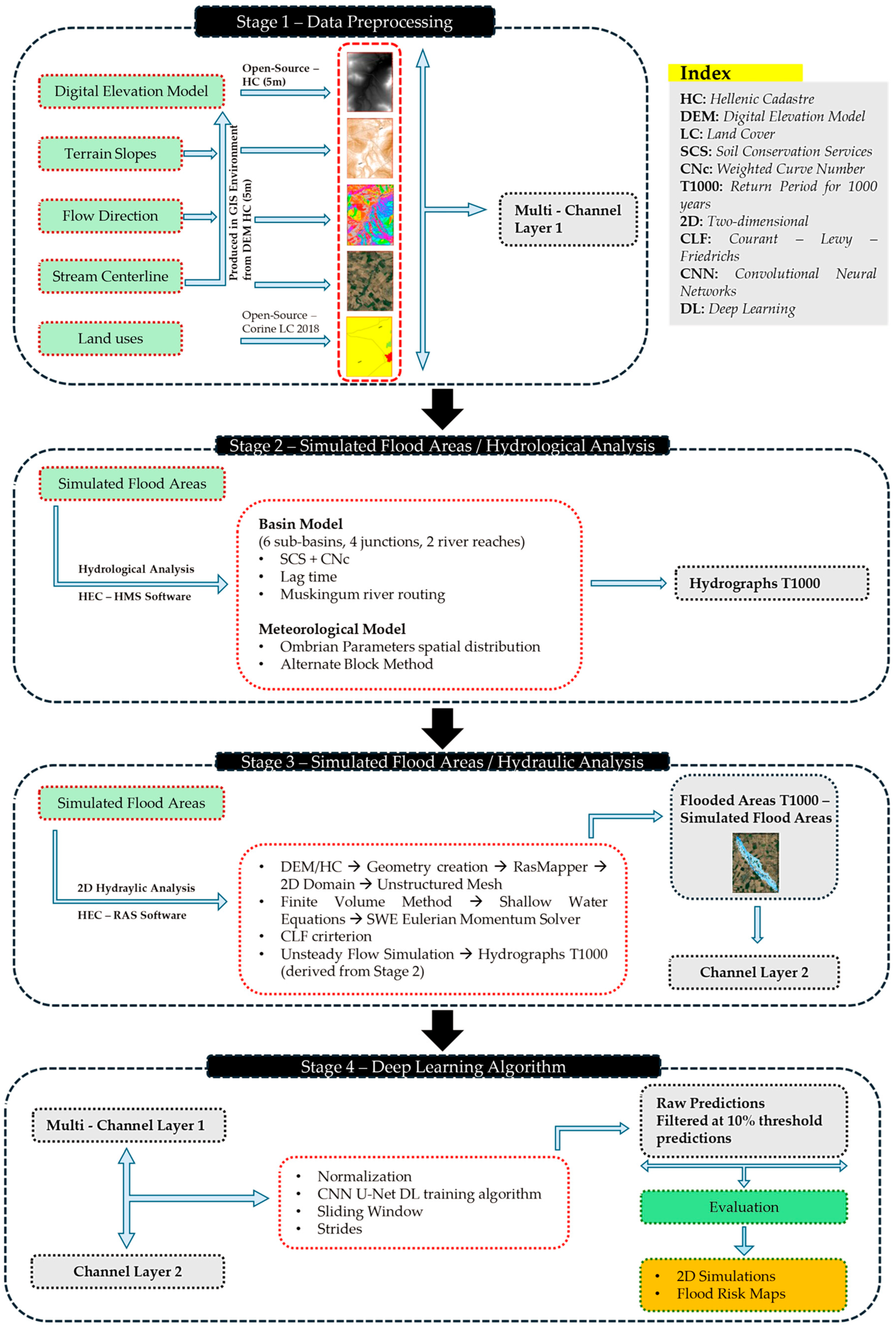
The model outputs (results) were validated against government official Flood Risk Maps generated within the framework of the Flood Risk Management Plans (FRMPs) for the study area. This approach combines the advantages of classical hydrological-hydraulic modeling with the capabilities of ML techniques, providing a robust framework that supports timely flood risk assessment, effective management, and informed decision-making. The methodology that is implemented in the current research is graphically presented step-by-step in Figure 1.

2. Materials and Methods

The proposed methodology is structured into four main steps (S1–S4):
  • S1-Hydro Analysis (HA): Hydrological modeling is carried out in the selected study area, where a hydraulic flow simulation is also implemented to generate the simulated datasets required for training algorithm. Hydrographs are derived for a range of probabilistic scenarios, reflecting different return periods.
  • S2-Flood Training Dataset Generation (FTDG): Flood training dataset is produced through 2D hydraulic flow simulations, ensuring detailed representation of flood extent.
  • S3-Training Algorithm (TA): The generated datasets are introduced into the algorithm’s training channels, enabling the development of a predictive model based on a U-Net architecture with Convolutional Neural Networks (CNNs).
  • S4-Validation (V): Model predictions are validated against simulated data as well as official Flood Risk Maps generated within the framework of the Flood Risk Management Plans (FRMPs).
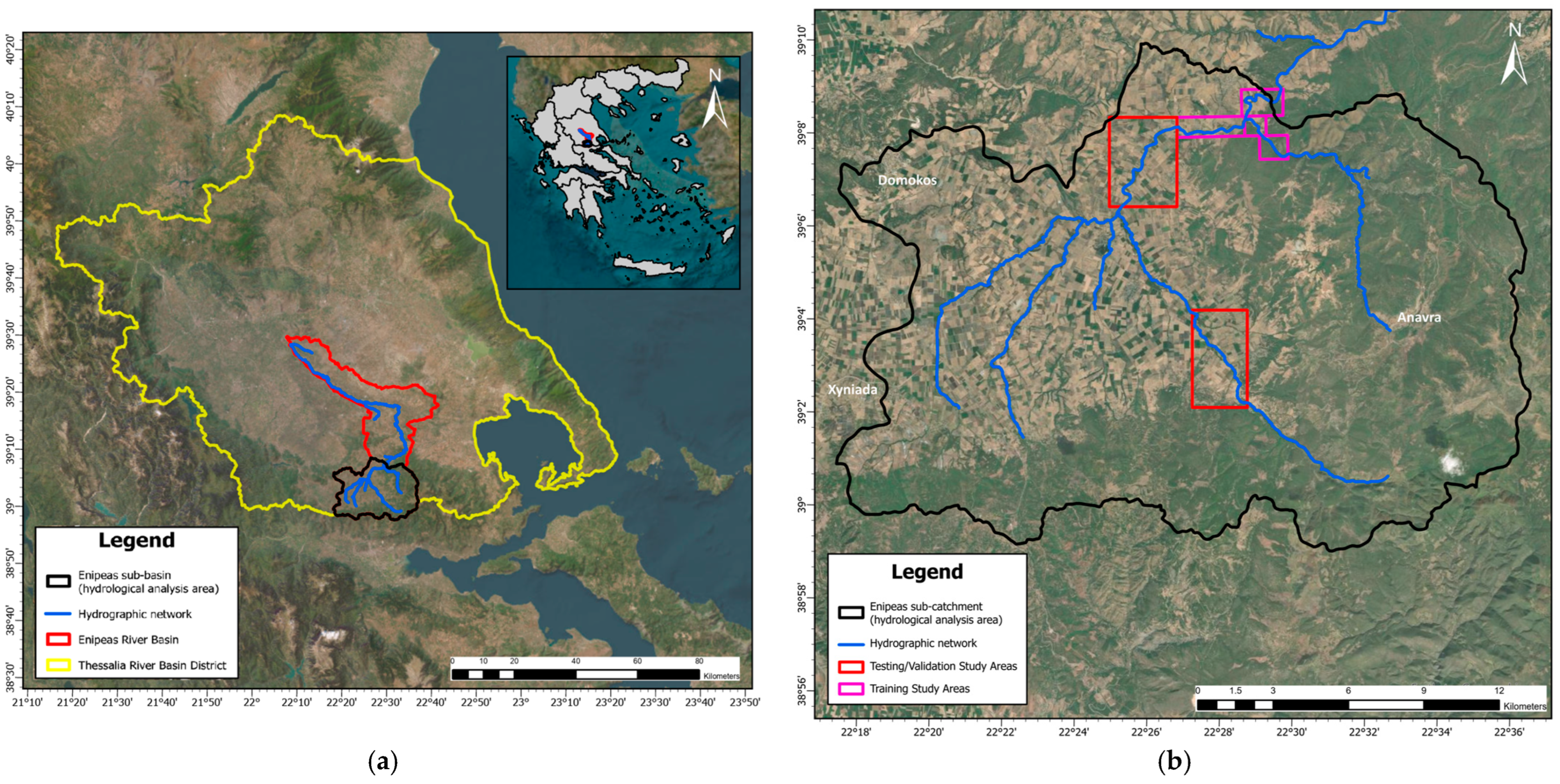
Study area is located within the Thessalia River Basin District (RBD; “GR08”-as defined under the EU Water Framework Directive) [48] which consists of two river basins: (i) the Pinios river basin and (ii) the Almyros–Pilion rivers basin. The focus of this research lies in the southern part of the RBD, within the Pinios river basin, specifically encompassing part of the mountainous catchment of the Enipeas River (“GR00080004002203”-as defined under the EU Water Framework Directive). The Enipeas River is a major tributary of the Pinios River and is therefore part of an open drainage system, with the Pinios River ultimately discharging into the Aegean Sea. Figure 2 shows the full extent of the study area, (a) depicts the location of the Enipeas River basin within the Thessalia River Basin District (RBD), while (b) presents the delineation of two distinct sub-areas: the training study area, corresponding to the lower section of the upper Enipeas River, and the testing study area, corresponding to the upper section of the river. This subdivision allows the algorithm to be trained on one hydrological setting (upper basin) and tested in an independent, yet hydrologically connected, domain (middle basin), thereby enabling an assessment of predictive performance.

2.1. Input Data

The Machine Learning (ML) algorithm for flood extent prediction was trained using an input dataset (channels), as presented in Table 1. The datasets include topographic information (Digital Elevation Model, terrain slope, flow direction), hydrodynamic outputs (simulated flood extents and depths), hydrological features (stream centerline), and land-use/land-cover (LULC) classes.
All datasets were processed within the Geographic Information System (GIS) environment software ArcGIS Pro (version 3.6.0) [49]. The terrain slope (0–100%) and flow direction (0–128) layers were derived from the Digital Elevation Model (DEM), while the stream centerline was generated from the flow accumulation, itself computed using the DEM and flow direction. The resulting datasets were then clipped into rectangular tiles to provide consistent input frames for the algorithm. The stream centerline was encoded as a binary raster (0 = no stream, 1 = stream centerline). A similar reclassification procedure was applied to the LULC data, which were recoded into integer values (e.g., Corine class 111 assigned as 1, class 112 as 2, etc.). All input channels were aligned within the same spatial grid/tile to ensure compatibility with the algorithm.
In addition to these inputs, the algorithm was trained with the results of the hydraulic simulations (simulated flood extents and flow depths). The generation of these simulated datasets also required various primary datasets, including geographical, hydrological, and hydraulic information. The hydraulic simulation outputs (simulated flood) were clipped to the same tile (as above), providing flow depth and flood extent information for model training and evaluation. For the present study, all datasets were derived from European and Greek open-access spatial platforms (Table 2). A Digital Elevation Model (DEM) with a 5 × 5 m grid cell size from the Hellenic Cadastre (HC) [50] was used to derive the Digital Terrain Model (DTM; SM2). Curve Numbers (CN) [51,52,53] and Manning roughness coefficients for the hydrological and hydraulic models were obtained from the land-use/land-cover and soil maps of Greece [48,54], based on established references [51,52,55,56].
For the hydrological analysis, the parameters of the Intensity–Duration–Frequency (IDF) curves were applied, following the methodologies outlined in the supporting documents of the River Basin Management Plans (RBMP; GR08; Thessalia RBD) [57,58].
Table 2. Geographical and hydrological/hydraulic data sources.
Nr.DataData TypeSpatial ResolutionSource
Raster (R)/Vector (V)/Tiff (T)[m]
1Digital Elevation Model (DEM)R5 × 5[50]
2Land Use/Land Cover (LUCL)R100 × 100[59]
3Curve Number (CN)R5 × 5[51,52,53]
4Soil MapR/VN/A[48,54]
5Intensity–Duration–Frequency (IDF) CurvesVN/A[57]
6Manning Roughness CoefficientR5 × 5[51,52,55,56]

2.2. Hydrological Analysis (HA)

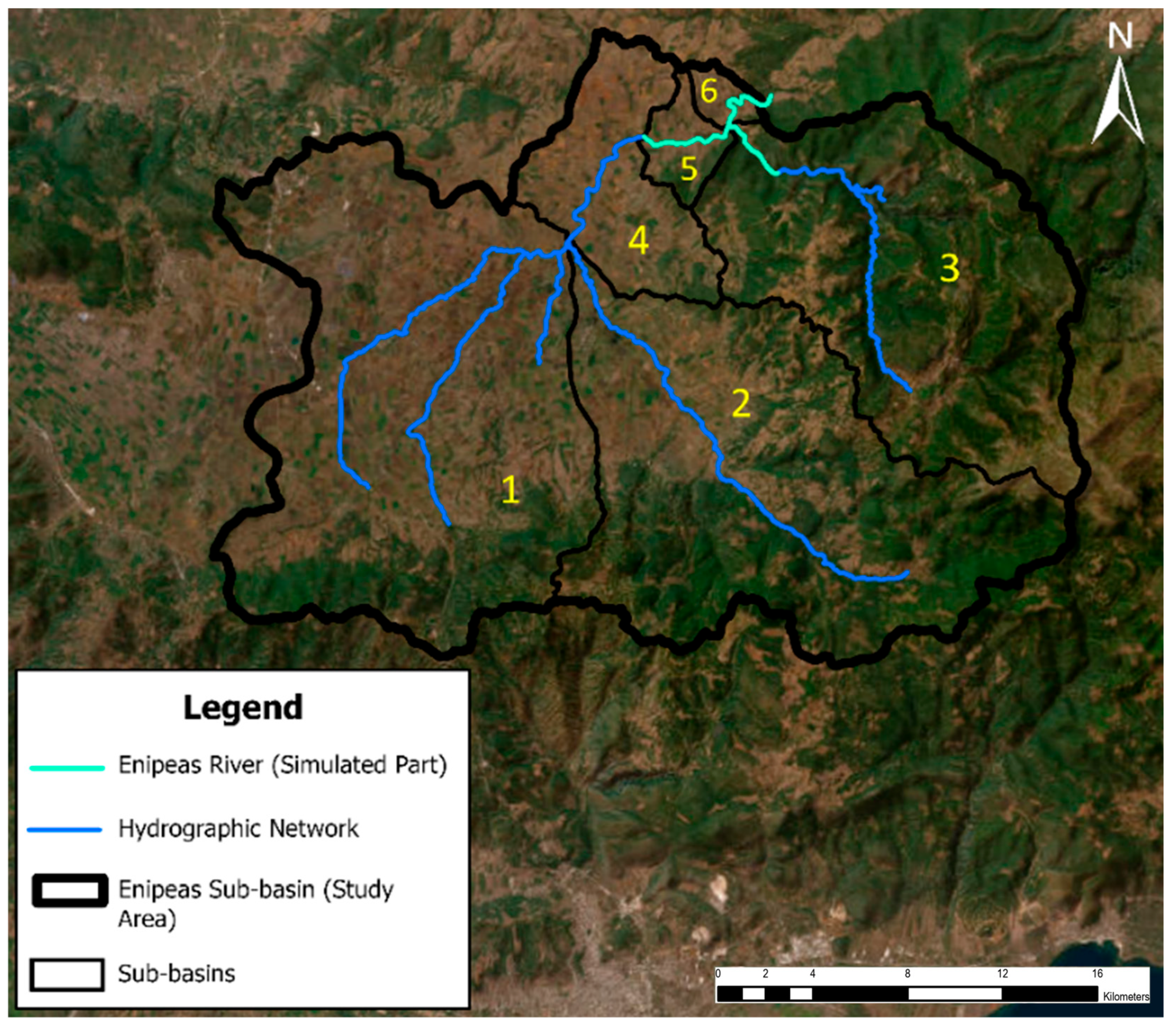
For the hydrological analysis of the training study area, the open-source HEC-HMS software (version 4.12), developed by the U.S. Army Corps of Engineers [60], was used. In hydrological modeling with HEC-HMS, a critical aspect involves delineation sub-basins (Figure 3; SM3) and its corresponding hydrographic network (SM4). The hydrographic network was derived from official Flood Risk Management Plan datasets provided by the national authority and represents the primary river channels used in flood risk assessment.
The Enipeas River (simulated part) corresponds to the section where the training dataset for the algorithm was generated through hydraulic simulations. Hydraulic simulations were also conducted for the river sections associated with sub-basin 2, to generate additional flood extent datasets for model evaluation. These simulations provided independent test cases beyond the training study area, thereby supporting the validation of the machine learning algorithm under different hydrological and geomorphological conditions. Specific sections of sub-basins 2 and 4 were designated as the testing study area. The Digital Elevation Model (DEM) was utilized for the delineation of sub-basins and the identification of the hydrographic network. An accurate simulation of surface runoff requires the estimation of several parameters for each sub-basin. Among these, the time of concentration is of particular importance, as it represents the travel time of water from the most distant point in the catchment to its outlet. In this study, the concentration time for all sub-basins was estimated using the empirical Giandotti equation [61]. The geomorphological characteristics of the delineated sub-basins are summarized in Table 3.

2.3. Direct Runoff

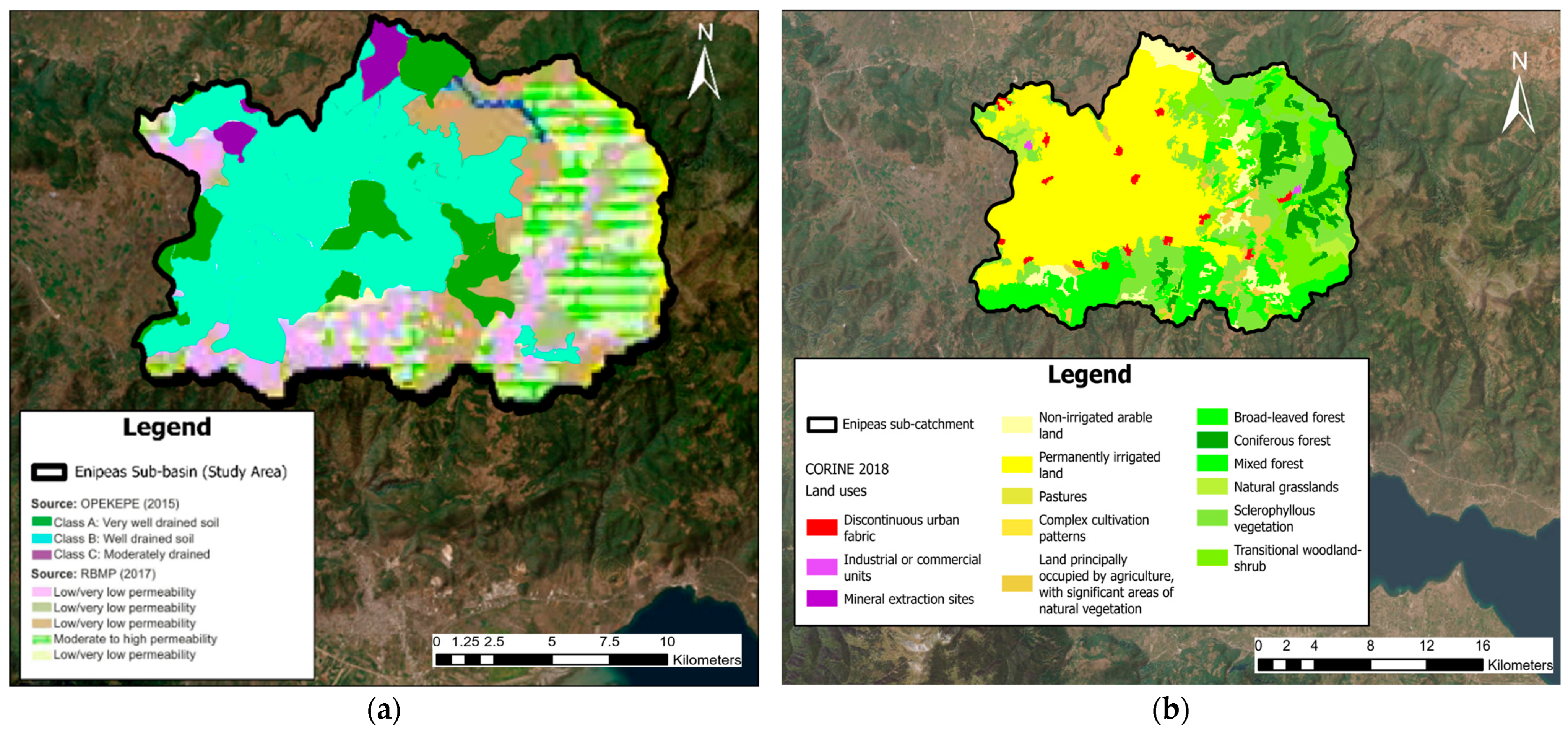
Geological/soil data derived from the Soil Map of Greece by the Greek Payment Authority of Common Agricultural Policy OPEKEPE [54], along with the hydrolithological data from the River Basin Management Plan for RDB of Thessalia [48], and land-use/land-cover data based on Corine 2018 [62] classification (see SM5-SM6) for the training study area are analytically presented in Figure 4 [63].
Precipitation transformation into runoff for each sub-basin was conducted utilizing the Soil Conservation Service-Curve Number (SCS-CN) unit hydrograph method [64], while losses from a design rainfall event were estimated employing the SCS-CN model (hyetographs are presented in SM7). The SCS-CN values depend on factors such as soil type, land uses/management practices, and hydrological conditions. The aforementioned factors varied in each sub-basin, and the weighted CN (referred as CNc) is estimated based on methodology proposed by Chow et al. (1988) and extensively described by Wanielista et al. (1997) and Koutsogiannis & Xanthopoulos (1999) [51,52,53] and ranges from grasslands to forestland. Soil hydraulic behavior was represented through the Curve Number methodology by linking detailed soil mapping units and hydrolithological formations to hydrologic soil groups. Impervious surfaces were excluded from soil classification and treated separately through land-use classification.
Based on the SCS method [64] and HEC-HMS Technical Reference manual [65], the lag times estimation per sub-basin is provided in Table 3. Lag time, denoting the interval between rainfall occurrence and peak river discharge, is influenced by various factors including sub-basin area, shape, soil type, and land uses and was calculated for each sub-basin based on the time concentration (tc) as described by the Gianotti equation [61]:
t lag = 0.60 · t c ,

2.4. Channel Routing

Reach elements conceptually correspond to the river parts modeled in HEC-HMS. Hence, the reach routing method characterizes the water flow within a river due to storage effects. Among the available models for flood routing in rivers, the Muskingum routing method [60] was selected for implementation. The required parameters for this method are traveling time (K) of the flood wave through routing reach and the dimensionless weight (x), which corresponds to the attenuation of the flood wave along the river, which were estimated equal to 1.0 and 0.20, respectively, according to bibliographic restrictions [65,66].

2.5. Designed Storm

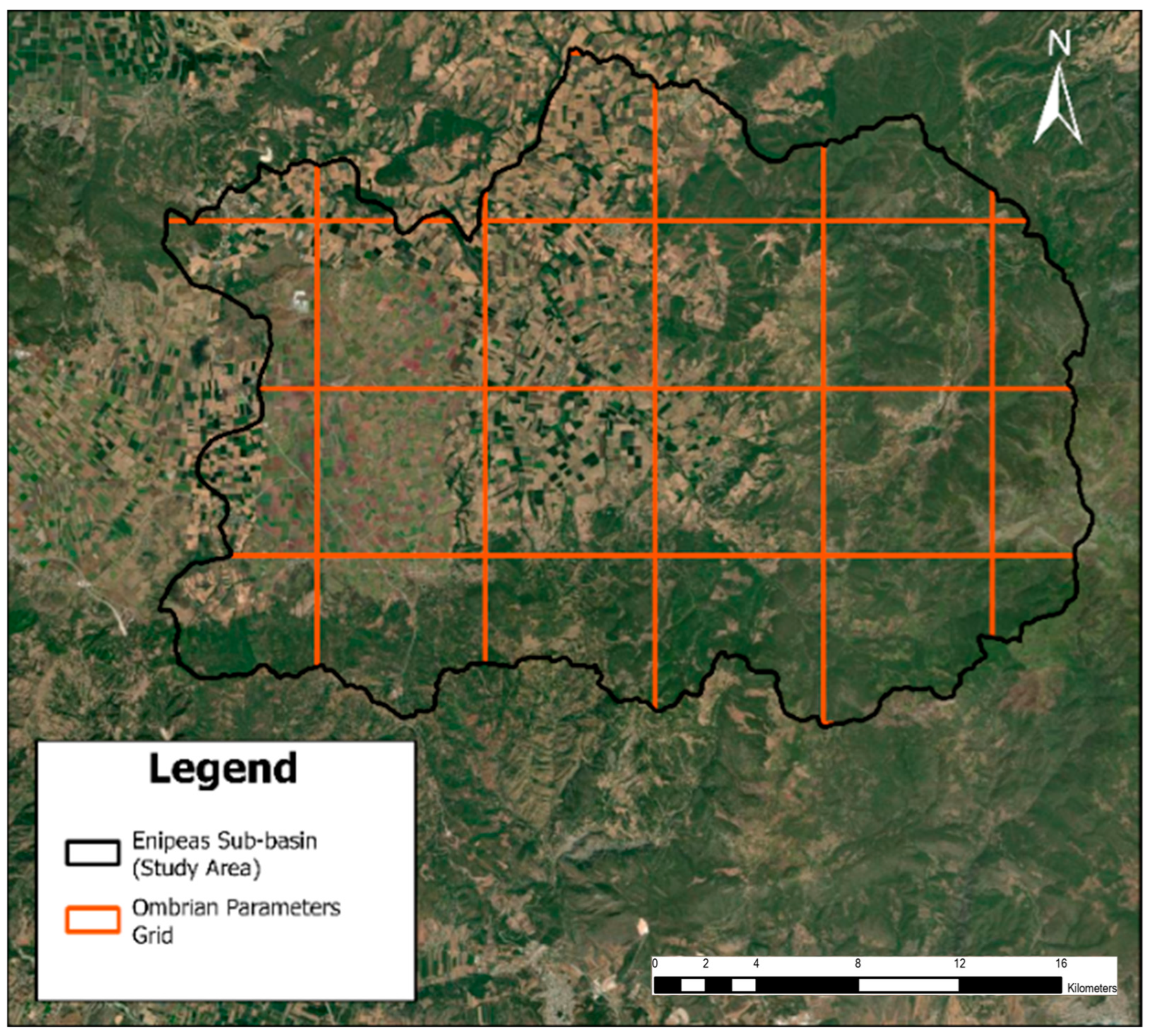
The official governmental methodology in Greece was applied to develop the meteorological model in the training study area and to introduce a rainfall episode (design hydrographs) into the hydrological modeling. This methodology was implemented specifically to represent low-probability floods or extreme events, typically corresponding to a return period of 1000 years. The map tiles defined in the RBMP (Figure 5) were selected, and the ombrian parameters (updated IDF curve parameters) were estimated for each sub-basin. The Intensity–Duration–Frequency (IDF) curve is expressed as proposed by Iliopoulou & Koutsogiannis, 2023 [57]:
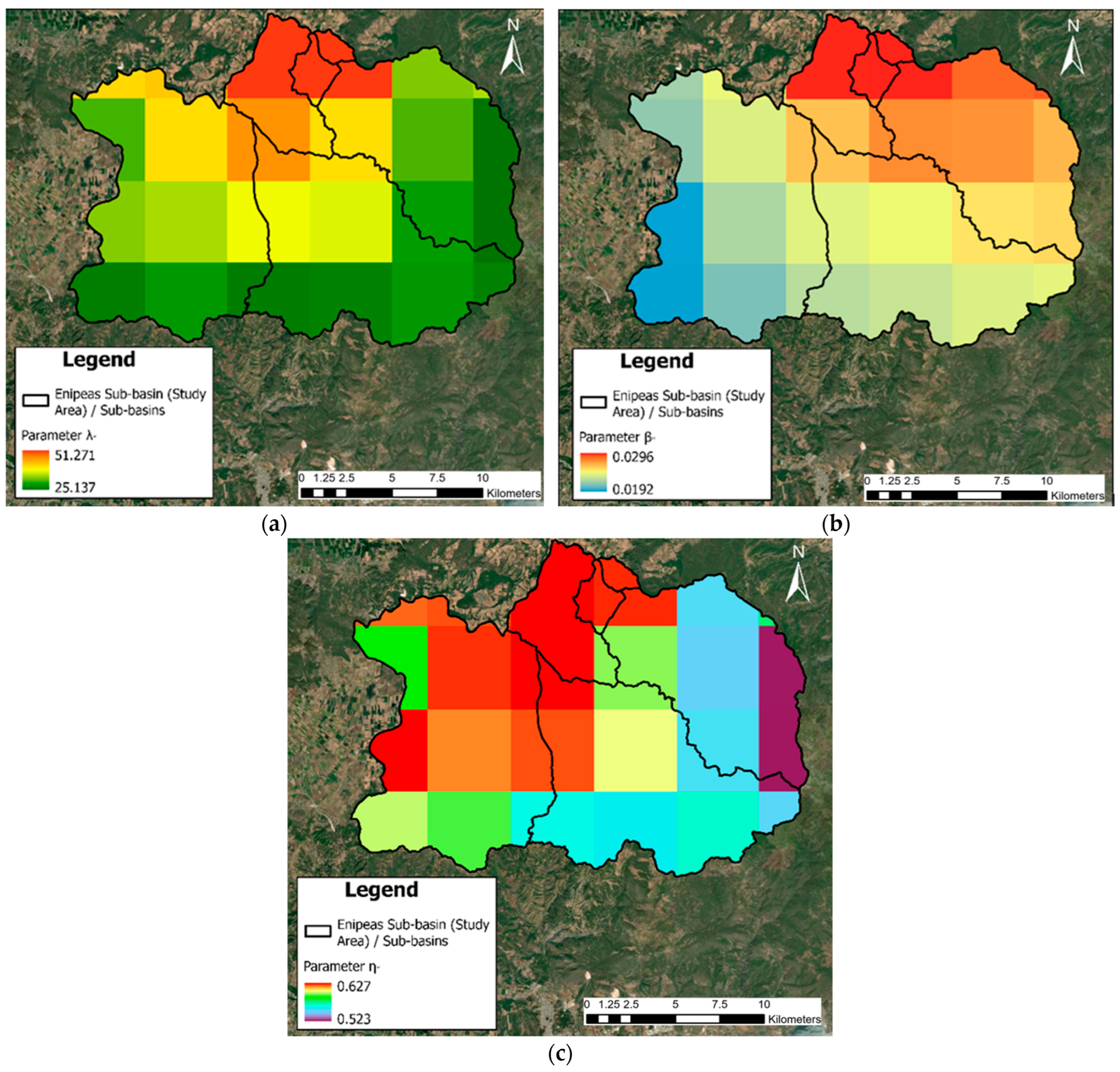
x = λ Τ / β ξ 1 1 + k / a η ,
where x is the max point rainfall intensity for a specific rainfall duration event k for a return period of T (mm/h), a (in time units), and ξ parameters are constant and equal to 0.18, λ (mm/h), β (years) and η are spatially distributed parameters.
Based on the available map tiles [57], spatial distribution of parameters λ, β, and η is produced using ArcGIS Pro software and is presented in Figure 6a, Figure 6b, and Figure 6c, respectively.
Point rainfall intensities were adjusted using the areal reduction factor (φ) per sub-basin according to Iliopoulou & Koutsogiannis, 2023 [57]:
φ = max 1 0.048 · A 0.36 0.01 · ln A k 0.35 , 0.25 ,
where A is the river basin area (km2) and k is the rainfall duration (h).
The area reduction factor (φ) values per sub-basin are presented in Table 3.
The final design hydrographs used as input data to the meteorological model were produced using IDF curves derived from the above methodology by applying the alternating block method [51,52] for each sub-basin.
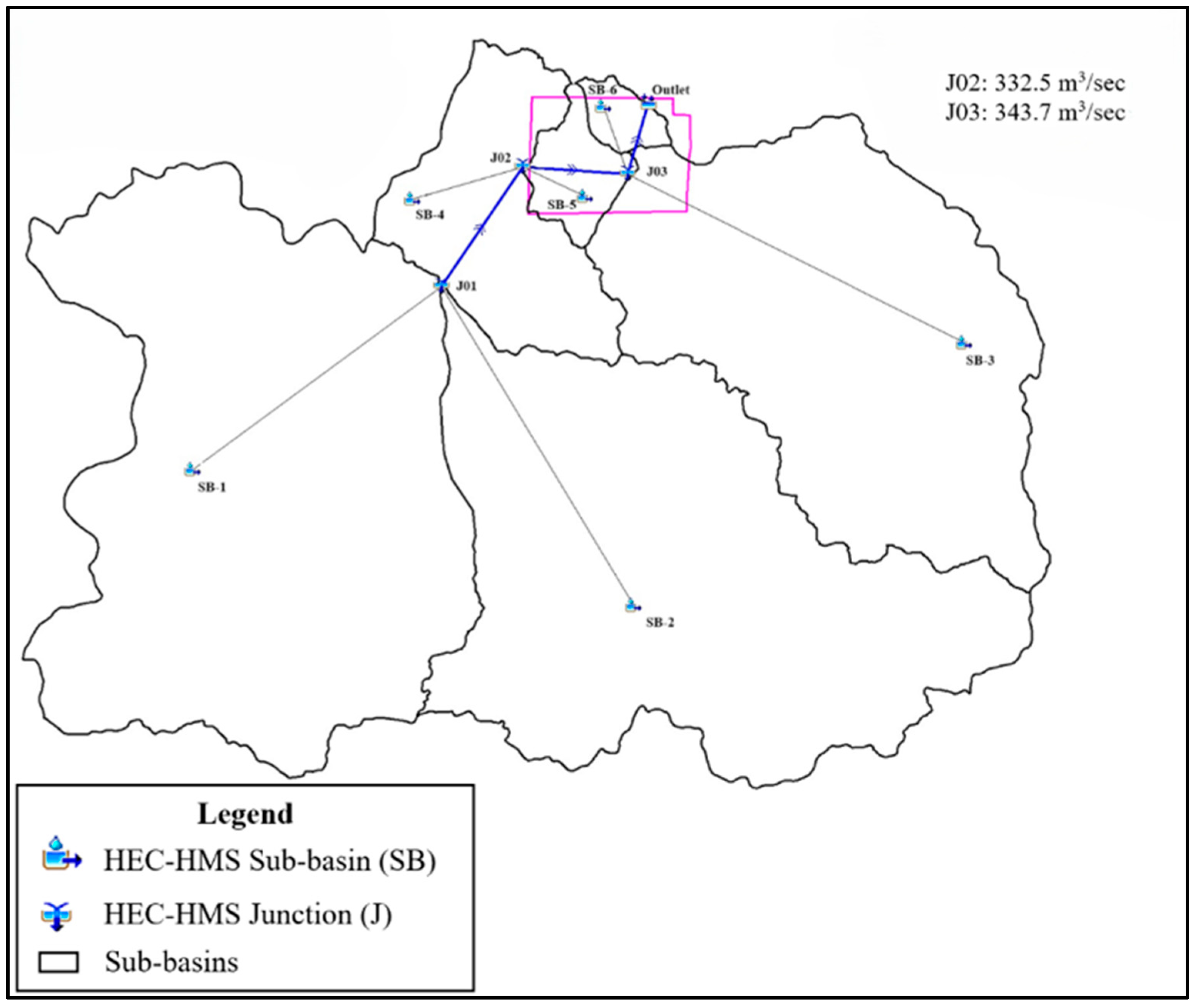
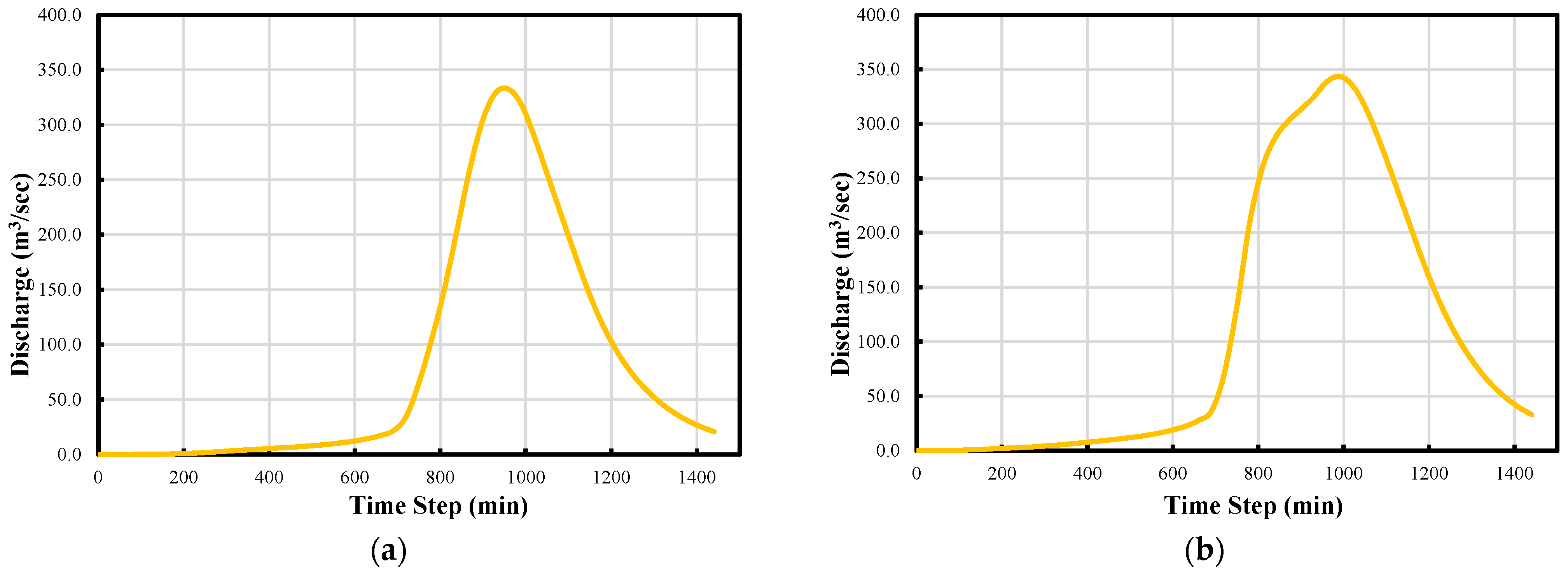
Building upon the methodology established in previous sections, nine hydrographs corresponding to the three junctions and six sub-basins created within the training study area. Maximum calculated designed discharges are presented in Figure 7 and the produced hydrographs, used as input data in hydraulic simulation model, are given in Figure 8.

2.6. Hydraulic Analysis

Numerical simulations are conducted using the Hydrological Engineering Center’s–River Analysis System (HEC-RAS) two-dimensional (2D) flood modeling software (version (6.6) [67] developed by the U.S. Army Corps of Engineers. Flow velocities, water surface elevations, inundation areas, and other hydraulic parameters were estimated by solving conservation of mass (Equation (4)) and momentum equations (Equations (5) and (6)) [67].
h t + ( h u ) x + ( h v ) y = q ,
u t + u u x + v v y = g H x + 1 h x ( ν t , x x h u x ) + 1 h y ( ν t , y y h v y ) τ b , x ρ R + τ s , x ρ h 1 ρ p α x + f u ,
v t + u v x + v v y = g H y + 1 h x ( ν t , x x h v x ) + 1 h y ( ν t , y y h v y ) τ b , y ρ R + τ s , y ρ h 1 ρ p α y + f v ,
where t is time (s), u, v are flow velocities (m/s) in the x and y directions, respectively, h is water depth (m), q is a source/sink flux term (m/s), H is water surface elevation (m), vt,xx and vt,yy are horizontal eddy viscosity coefficients (m2/s) in the x and y directions, respectively, τb,x and τb,y are bottom shear stresses (kg/m/s2) and τs,x and τs,y are surface wind stresses (kg/m/s2) in the x and y directions, respectively, f is Coriolis parameter (s−1), g is gravity acceleration (m/s2), and pa is atmospheric pressure (Kg/m/s2).
The embedded geospatial tool RAS-Mapper was also employed to build the terrain model, define river networks, generate the 2D flow area and computational meshes, and to visualize the hydraulic outputs and flood extents. According to Xafoulis et al. (2023) [63] the open-access Digital Elevation Model (DEM) provided by the Hellenic Cadastre, with a spatial resolution of 5 m, propagates fewer errors in hydraulic simulations, and in this study was processed to develop the Digital Terrain Model (DTM) for the training and testing study areas.
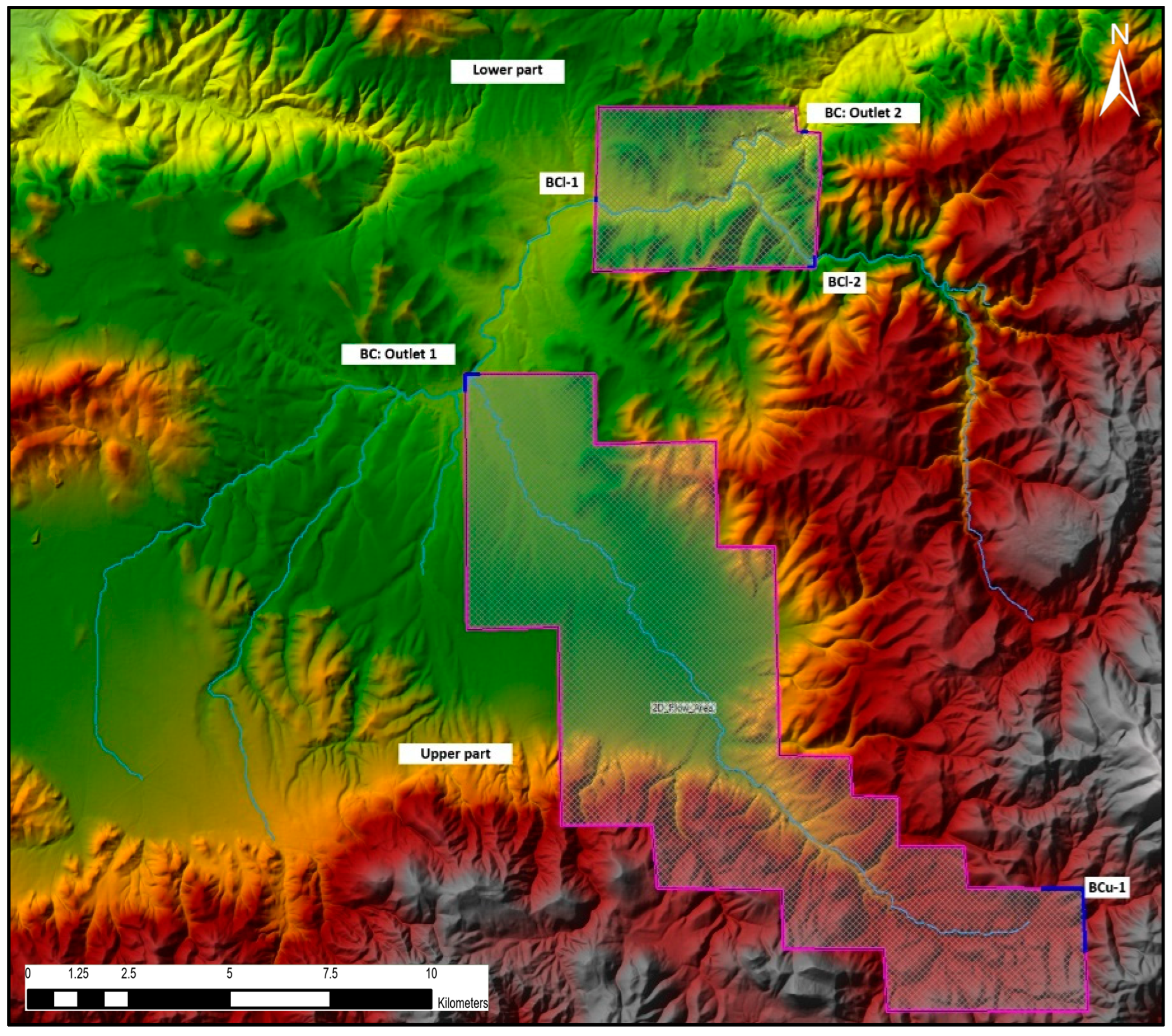
All hydraulic simulations were conducted in two 2D flow areas (lower part and upper part), which are presented as in the following figure (Figure 9).
The computational 2D structured meshes are established at cell spacing of DX, DY equal to 50, 50 which generated 2,375,281 and 223,739 computational cells for upper and lower part, respectively. After that, a refinement region was also digitized in riparian areas of both 2D flow areas using orthophotos from the UAV mission [63], in situ topographic survey, and google satellite imagery with cell spacing of DX, DY equal to 2, 2 reproducing unstructured meshes. In those areas, refinement is necessary to enhance more detailed hydraulic results within the river banks. An extensive investigation for the optimal grid cell size selection (both structured and unstructured mesh) to preserve the numerical simulations stability, was also conducted in the present study. Following mesh generation, boundary conditions (BCs) were defined for the 2D flow areas to perform unsteady flow analysis. Two BCs consisting of one upstream and one downstream are incorporated as external to the 2D flow area for the upper part and three BCs, consisting of two upstream and one downstream for the lower part (Figure 9-blue lines). The upstream (BCu-1, BCl-1, and lateral BCl-2) BCs were set as flow hydrographs with time series discharge data. The downstream BC outlet 1 and 2 is specified as a normal depth based on Digital Terrain Model (DTM) elevations.
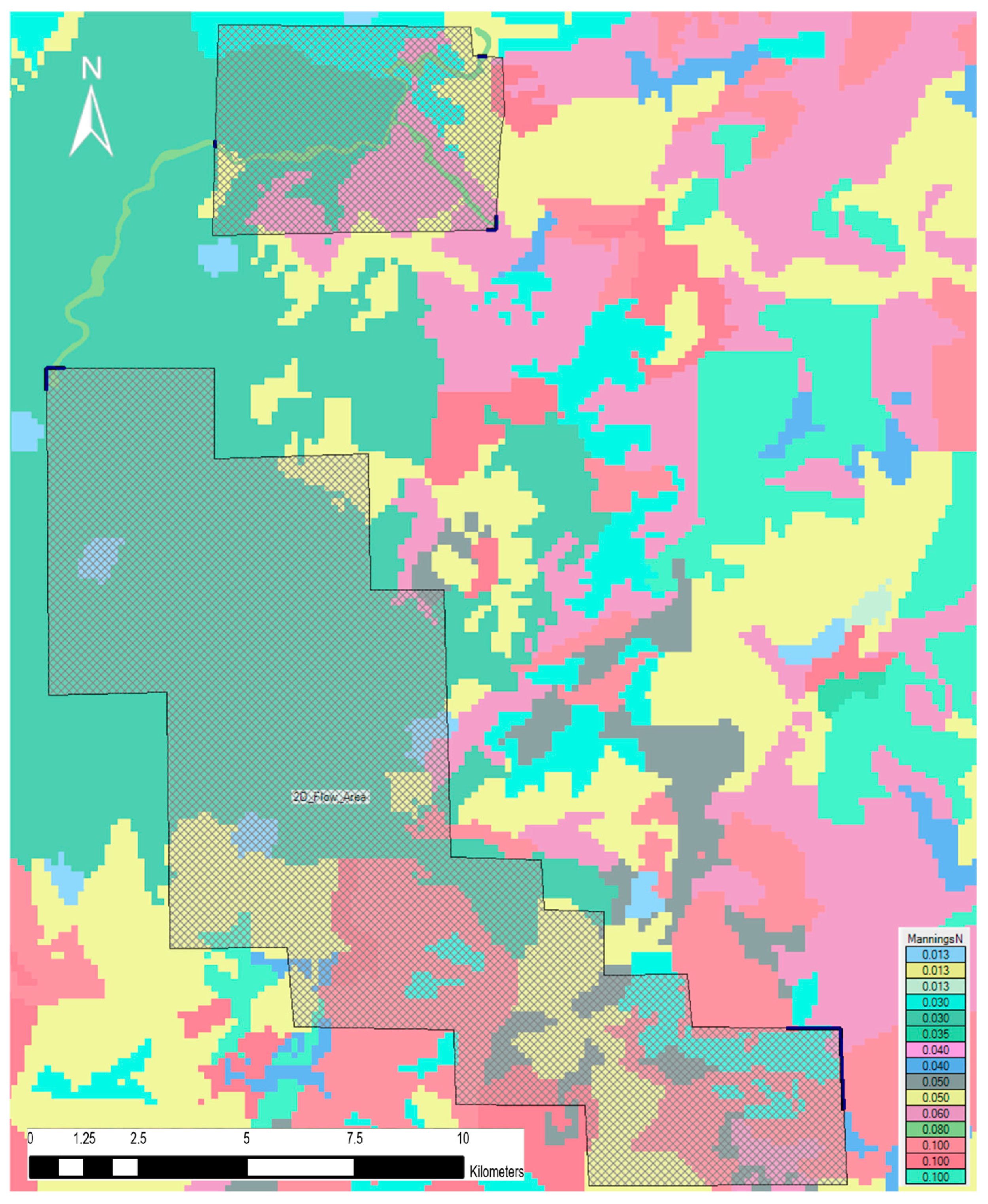
A spatially varied land-cover layer based on the Copernicus mission [62] was generated using the RAS Mapper and subsequently linked with the specific geometry dataset. Manning’s n values were selected for each land-cover type according to Papaioannou et al. (2018) [56] and adjusted in riparian areas by field observations and google satellite imagery, as presented in Figure 10.
For the unsteady flow simulations, the computational interval was set equal to five seconds after extended investigation to improve stability and numerical accuracy and the Courant condition [68] is also satisfied. The hydraulic model employed in this study was validated against official governmental Flood Risk Management Plans (FRMPs), which are recognized as authoritative reference datasets for flood risk assessment and planning at national and European levels.

2.7. Deep Learning

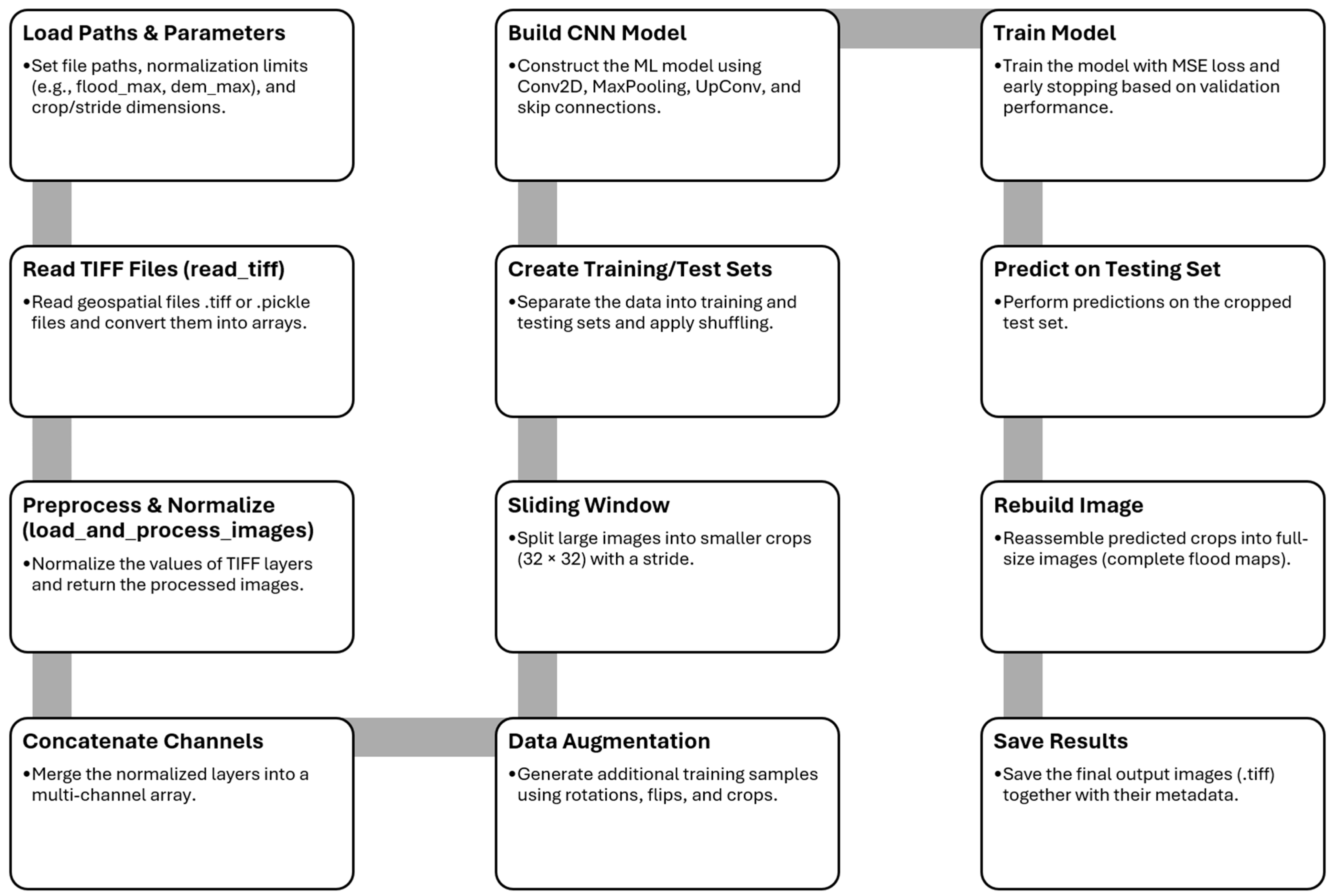
The proposed deep learning framework was designed to predict flood extents using multi-channel geospatial and simulated datasets. The model development process comprised four main stages: data pre-processing, DL architecture, model training, and evaluation. All input datasets were processed within a GIS environment and exported as raster images in standardized formats (tiff and pickle). Step-by-step workflow of the proposed deep learning framework, from preprocessing of geospatial and simulated datasets to model training, prediction, and output generation is presented in Figure 11.
Input datasets were clipped into square tiles of fixed dimensions (32 × 32 pixels) to facilitate model processing. Data augmentation techniques, including 90° rotations and horizontal/vertical flips, were applied to increase sample diversity and prevent overfitting. A sliding-window cropping method with 6-pixel strides was also implemented to enhance spatial sampling.
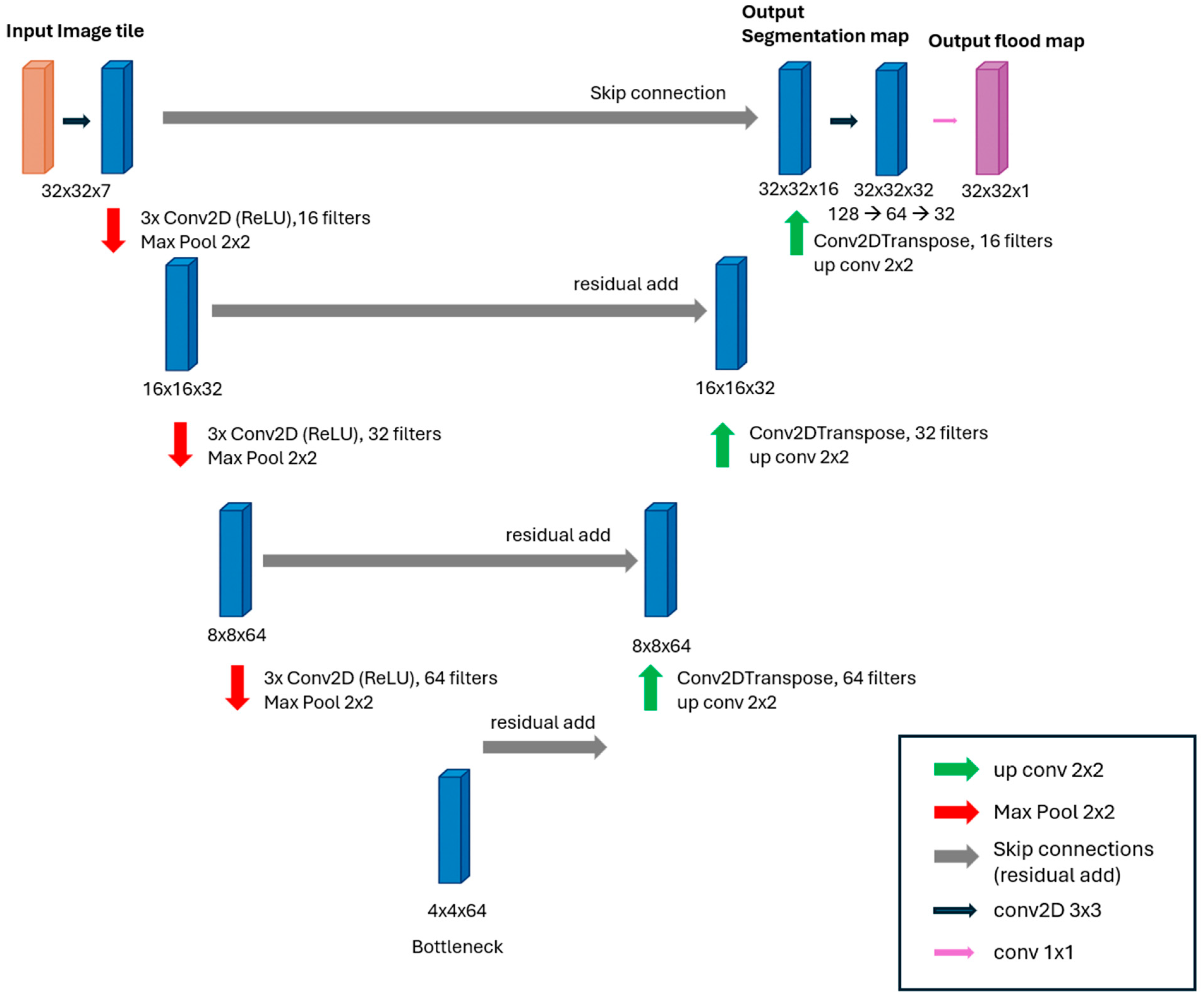
The model was implemented in TensorFlow/Keras [69] following a customized U-Net architecture [70,71] with an encoder-decoder structure and residual skip connections. Of three levels of successive convolutional blocks (each containing three 3 × 3 convolutional layers) followed by 2 × 2 max-pooling, progressively extracting hierarchical spatial features with increasing filter depths (16 → 32 → 64 filters). The bottleneck layer operated at 4 × 4 spatial resolution with 64 filters. The decoder employed transposed convolutions (deconvolutions) with 2 × 2 strides to upsample feature maps and reconstruct spatial resolution. Critical skip connections using element-wise addition (add operation) preserved fine-scale information by combining encoder features with corresponding decoder levels. The final processing block consisted of three convolutional layers (128 → 64 → 32 filters) followed by a 3 × 3 convolutional output layer with Rectified Linear Unit (ReLU) activation to produce continuous flood predictions. Each input raster layer was normalized independently using min and max scaling prior to model training, while binary flood extent layers were preserved in their original 0–1 representation (Figure 12).
The model was trained with input-output pairs consisting of the preprocessed geospatial channels (predictors) and simulated flood extents (target). The Adam optimizer [72], was used with a learning rate of 0.001, and the loss function was defined as the mean absolute error (MAE). Training was performed for a maximum of 500 epochs with a batch size of 16, employing early stopping (patience = 10 epochs) to avoid overfitting. The total number of trainable parameters in the DL model was 221,568.
After training, the model was evaluated using an independent test dataset (testing study area), to ensure that no tiles from this area had been included in the training process. Predictions were reconstructed from cropped tiles to form continuous flood maps. Model performance was assessed using Mean Absolute Error (MAE), which was used as both the loss function and the primary evaluation metric. Additionally, the mean squared error (MSE) was calculated on the test results to provide further insight into prediction accuracy. Performance evaluation combined these quantitative error metrics with a qualitative comparison of the predicted flood extents with the simulated datasets and the official flood risk maps.

3. Results

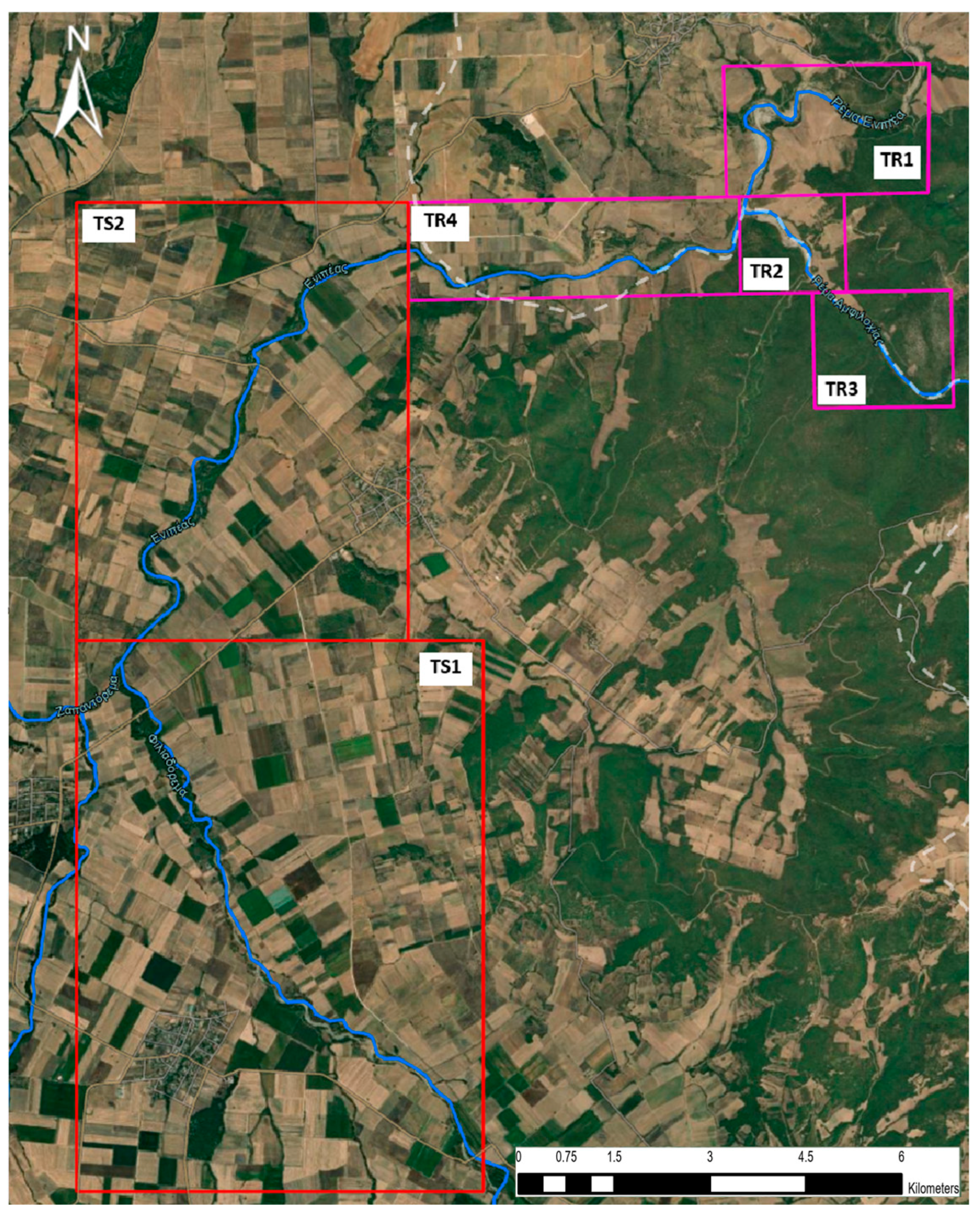
The Machine Learning (ML) algorithm was evaluated in two independent domains, TS1 and TS2, which were located within the Enipeas River basin but represent distinct geomorphological and hydrological characteristics. This subdivision was designed to test the predictive framework’s ability to perform under different topographic and hydrological conditions. The testing study areas (TS1 and TS2) correspond to a river reach length of 6.17 km and 4.86 km, respectively. Both domains were reserved exclusively for independent model evaluation, ensuring that no data from these areas were included during training. The lower sections of the basin (TR1–TR4) were used as the training domains, where the simulated flood datasets were generated through 2D hydraulic modeling and used to train the algorithm. Training (TR) and validation/testing (TS) domains are presented in Figure 13.
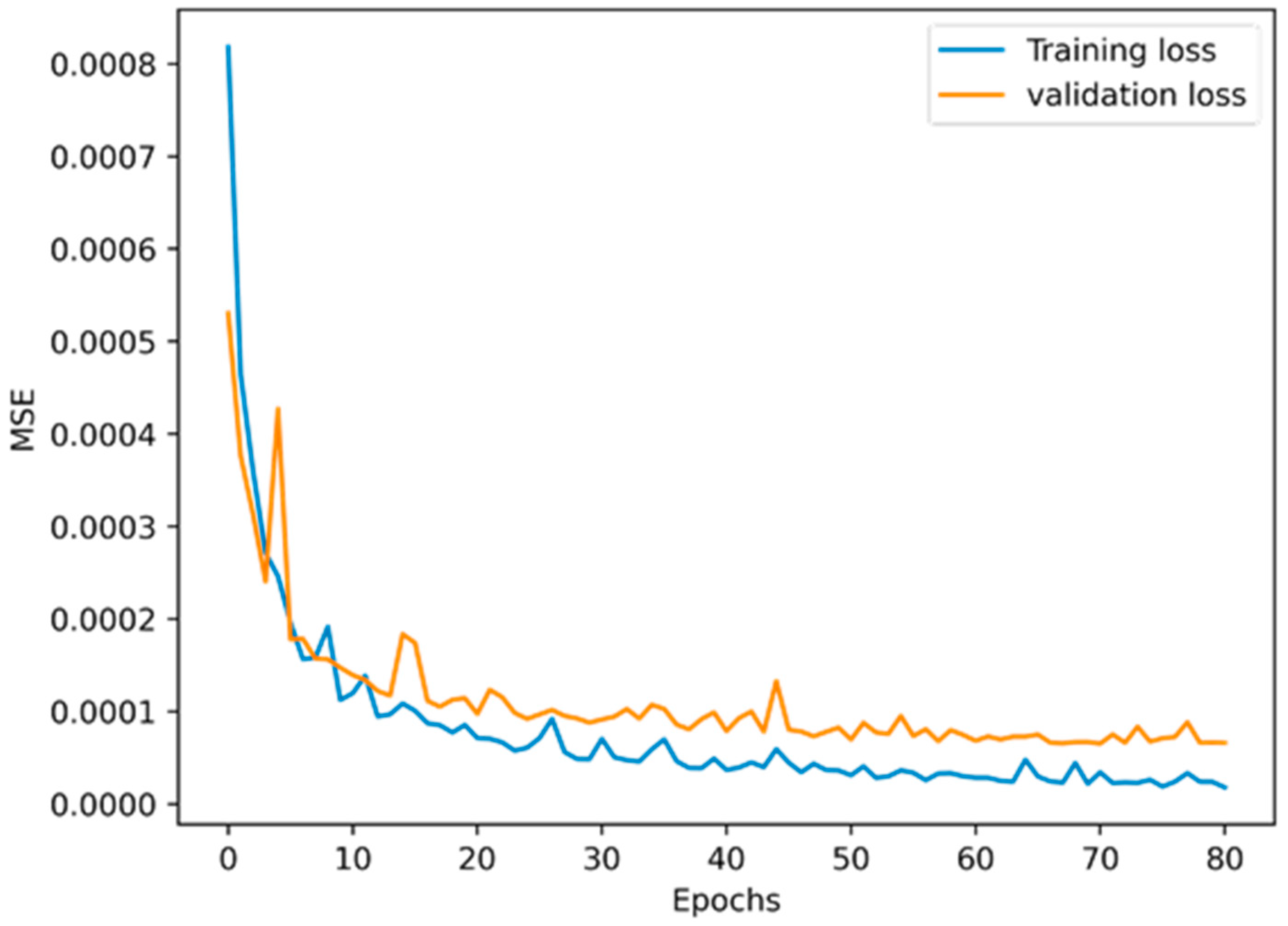
The evolution of training and validation losses (MSE) over 80 epochs are presented in Figure 14. Both curves show a steep decline during the initial epochs, indicating the model’s rapid convergence. After around 15 epochs, the losses stabilized, with the training loss remaining slightly lower than the validation loss. This suggests that the model is learning effectively without overfitting significantly. The consistent reduction and eventual leveling from the validation loss highlights the model’s ability to generalize adequately to unseen data.

3.1. Testing Study Area 1 (TS1)

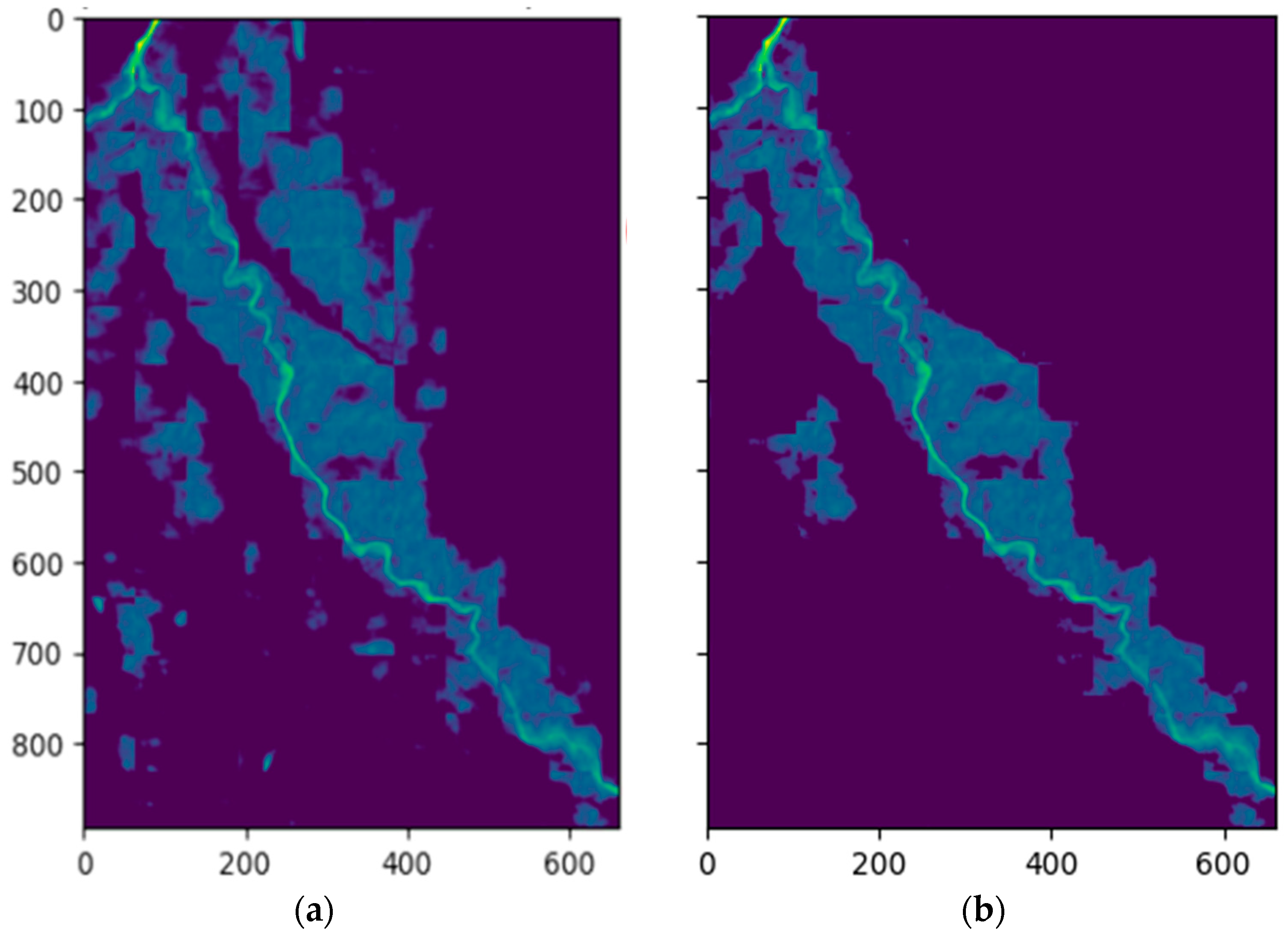
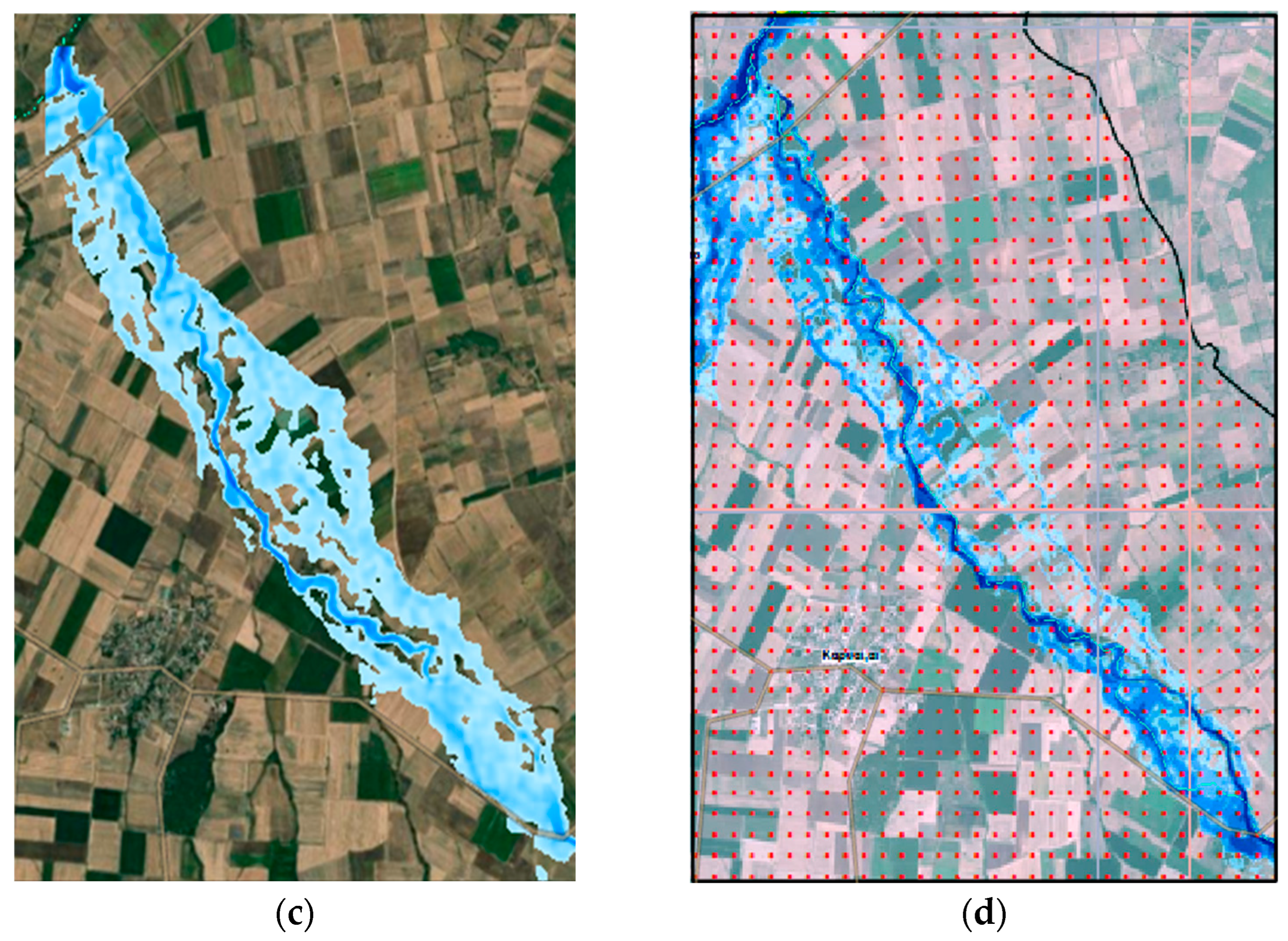
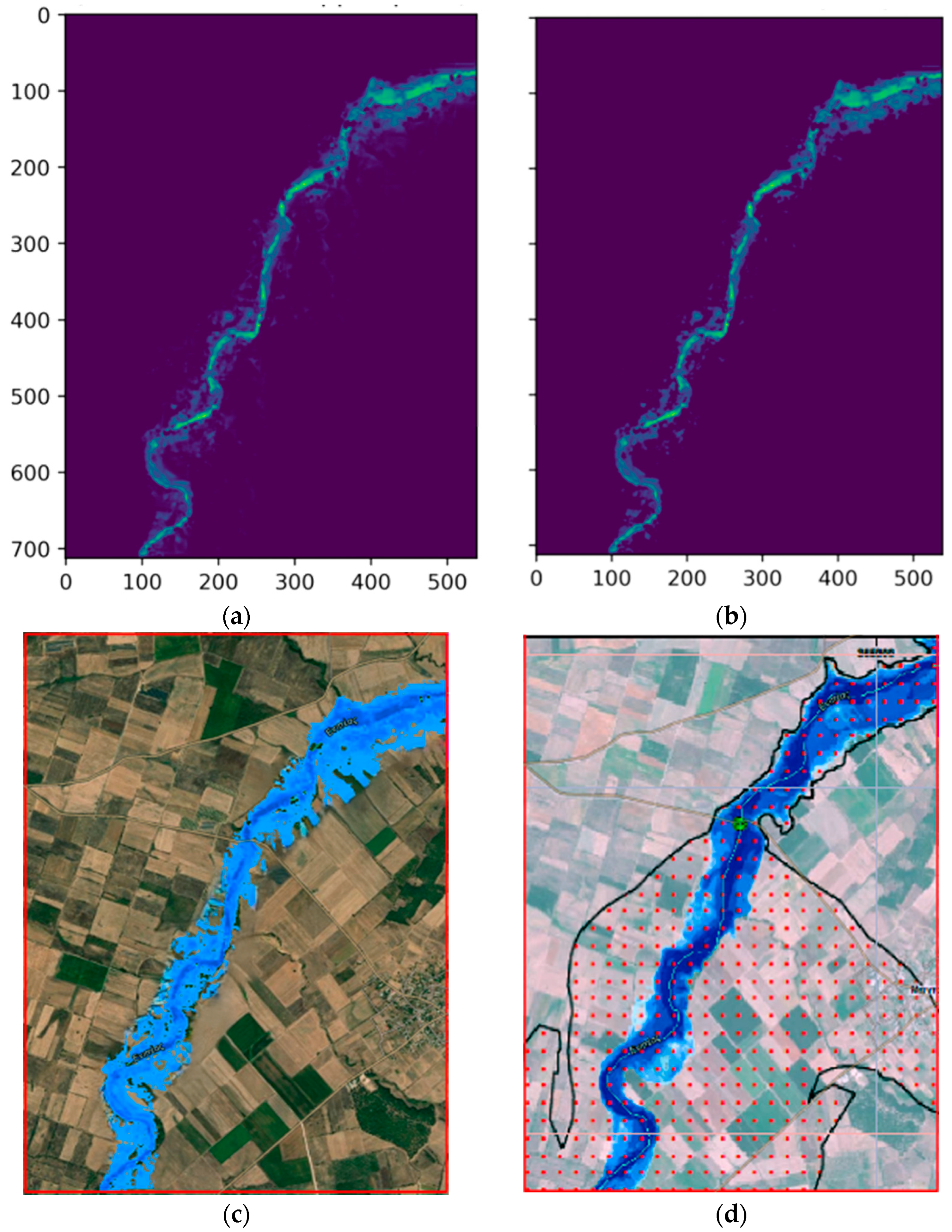
In Figure 15a, the raw predictions (reassembled from cropped tiles) captured the general flooded area are presented. Figure 15b shows the final prediction, which was created by applying a 10% probability threshold filter. This filter effectively reduces noise artifacts, particularly within the floodplain and agricultural zones. When compared with the reference datasets (the simulated flood map, Figure 15c, and the official Flood Risk Management Plan (FRMP) maps Figure 15d, the predicted extents give a strong agreement in both shape and spatial coverage.
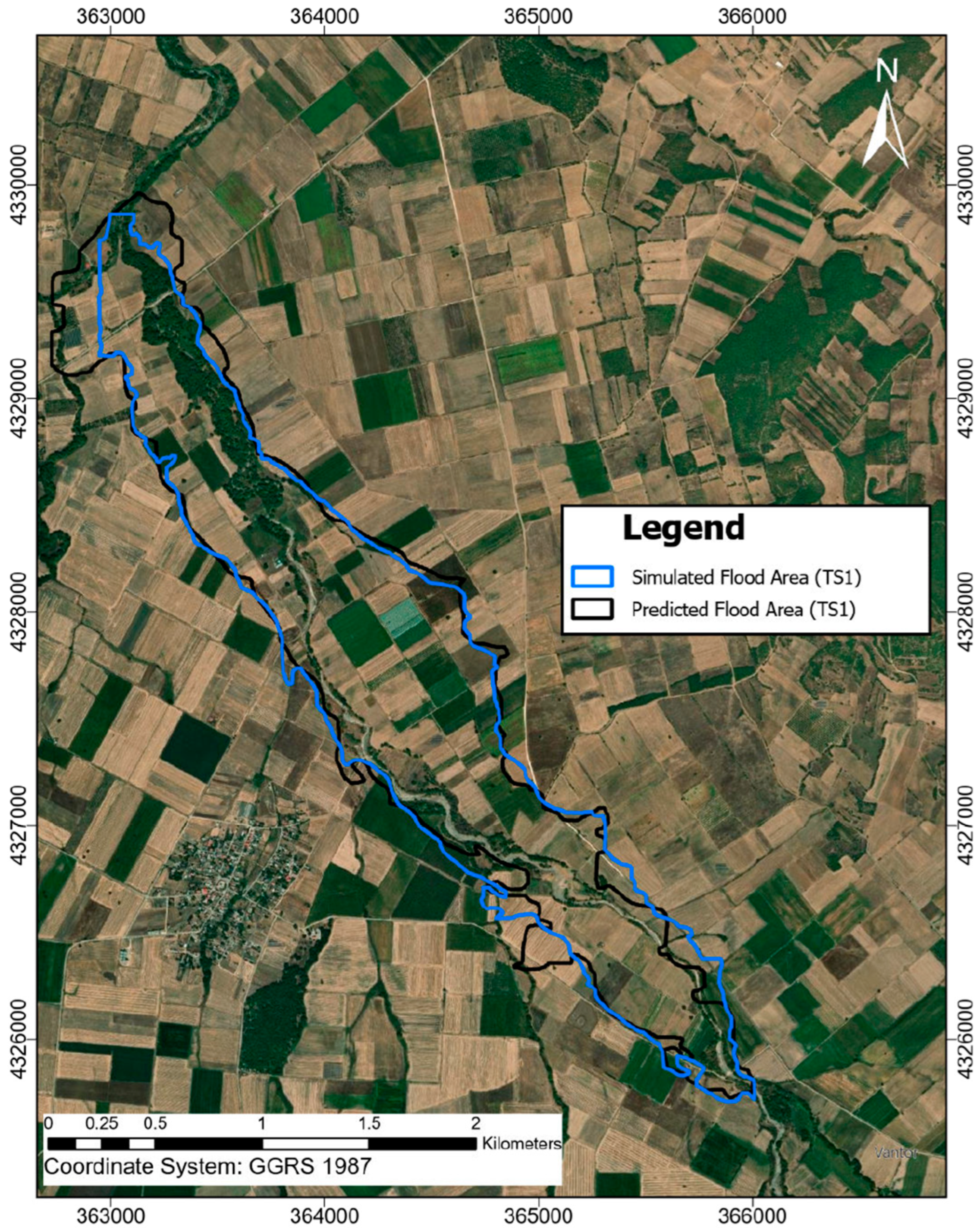
An important observation is made near the river junction, as shown in Figure 15b. In this area, the filtered prediction produced by the ML algorithm shows stronger agreement with the official FRMP flood map than with the 2D simulated dataset. This discrepancy stems from the fact that in the hydraulic simulations, the computational mesh boundary constrained the downstream propagation of the flood, thereby limiting the spatial evolution of the phenomenon. By contrast, the machine learning algorithm, even without explicitly incorporating the stream centerline in this domain, was able to recognize the underlying flood dynamics and generate a more realistic flood extent. This result demonstrates the algorithm’s capability to identify and compensate for limitations associated with hydraulic modeling. This highlights its potential as a complementary tool for improving flood risk assessment. The predicted flood area was 2.63 km2, while the simulated flood area was 2.54 km2, resulting in a modest overestimation of 3.54% (Figure 16). Intersection over Union (IoU) and F1 score were computed using binary flood extent rasters derived from model predictions and official FRMP flood maps to quantify spatial agreement at the pixel level.
This difference reflects slight overprediction in certain low-lying floodplain sections and some localized underestimation in depressions and side agricultural channels. Despite these minor discrepancies, the predicted boundaries aligned well with hydraulic simulations and official flood risk maps, confirming the robustness of the approach in generating realistic flood hazard assessments. A quantitative comparison of prediction performance for TS1 is presented in Table 4.

3.2. Testing Study Area 2 (TS2)

The second independent testing study area (TS2) corresponds to a 4.86 km river reach located downstream of TS1 domain. TS2 features a predominantly agricultural floodplain with moderate slopes and a dense irrigation network. This provides a distinct geomorphological context compared to the training areas. The raw predictions (reconstructed from cropped tiles) successfully delineated the general flood extent along the river centerline presented in Figure 17a. Applying a 10% probability threshold filter as in the previous domain (TS1) improved the final prediction by reducing eliminating false inundations (Figure 17b). A spatial comparison between the predicted, simulated (generated though 2D hydraulic simulations) (Figure 17c), and official Flood Risk Management Plan (FRMP) flood maps (Figure 17d) demonstrate strong consistency in both flood extent and inundation pattern.
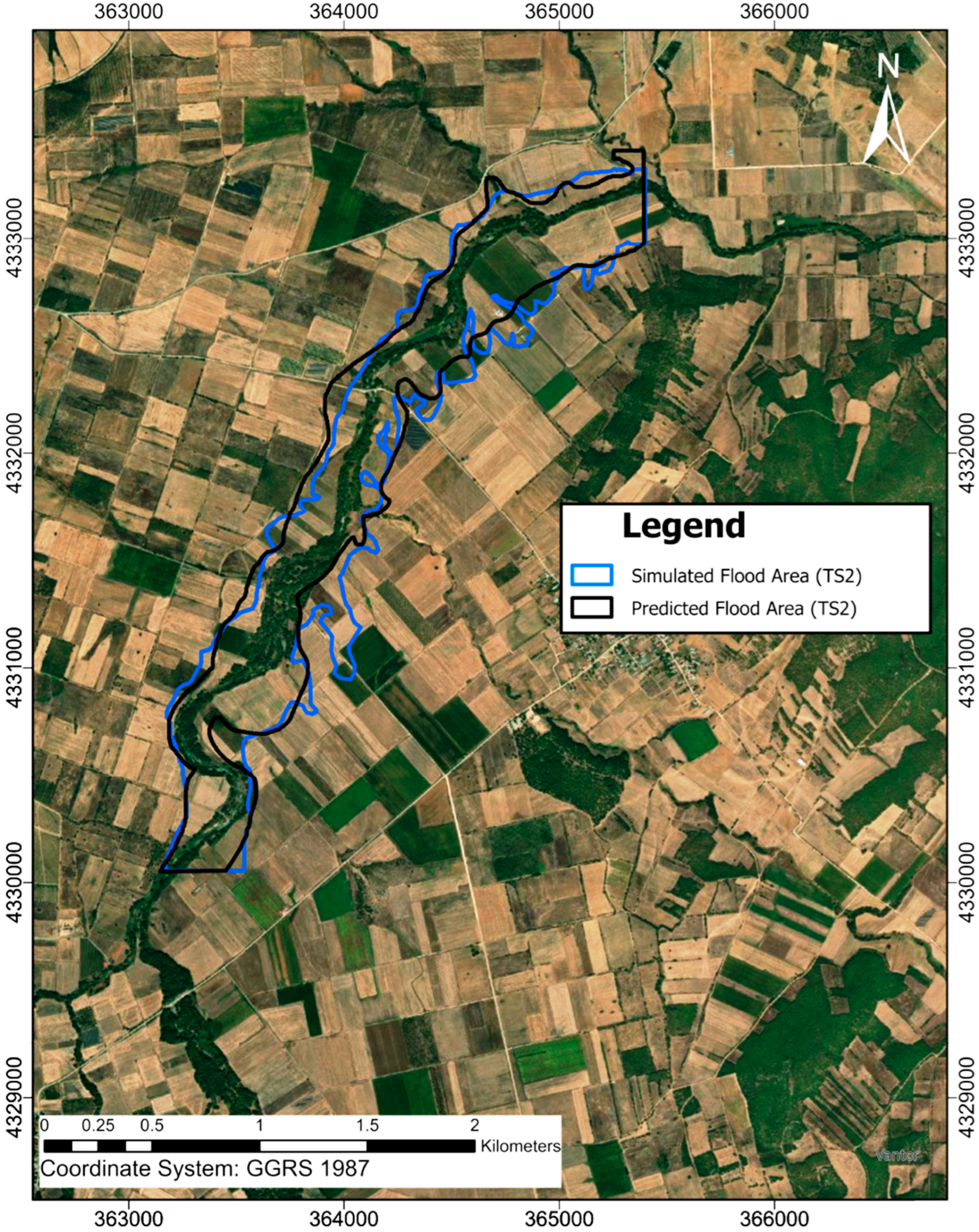
The predicted flood boundaries closely follow those from the hydraulic model, while locally exhibiting improved alignment with the FRMP delineation (Figure 18). Quantitatively, the predicted flood area was 1.50 km2, while the simulated flood area from HEC-RAS 2D was 1.39 km2, corresponding to a difference of +0.11 km2 (7.92%) (Table 5). This minor overestimation primarily occurred along secondary flow paths and agricultural depressions adjacent to the river channel, where slight model smoothing effects contributed to extended flood outlines.
Error-based performance metrics indicate a Mean Absolute Error (MAE) of ~0.012 and a Mean Squared Error (MSE) of ~0.00011, consistent with value observed during training and validation. These metrics confirm that the algorithm maintained predictive accuracy across hydrologically distinct domains, validating its generalization ability and robustness in estimating flood extents under varying topographic conditions.

4. Conclusions

Flood extent prediction methodology in river basins through the integration of 2D hydraulic simulations, open-access geospatial datasets, and deep learning techniques implemented using U-Net Convolutional Neural Network (CNN) architecture, is presented in this study. The approach was applied to the Enipeas River basin in Thessaly, Greece. By combining hydrological and hydraulic modeling with deep learning, this research provides a robust methodology for flood risk assessment. The results demonstrate that the proposed model can effectively reproduce flood extents with strong spatial and quantitative agreement when compared with 2D hydraulic simulations and official Flood Risk Management Plan (FRMP) maps. Across the independent tested areas (TS1 and TS2), the model provides a high level of predictive accuracy, achieving Mean Absolute Errors (MAE) and Mean Squared Errors (MSE) below 0.012 and 10−4, respectively. Flood extent predictions exhibited minimal differences equal to +3.54% and +7.92% for TS1 and TS2, compared to hydraulic simulations, confirming the model’s stability and generalization capability across distinct hydromorphological conditions.
Another important result was the model’s ability to identify flood propagation patterns beyond the spatial limits of the hydraulic mesh used in traditional simulations. This suggests that the deep learning framework has identified latent hydrological relationships and topographic factors, enabling it to predict flood extents accurately, even in areas with limited data. This method overcomes a key limitation of conventional hydraulic modeling, the requirement for extensive computational resources and detailed boundary condition data. The main contribution of the present work lies not in the introduction of a new hydraulic solver or a novel deep learning architecture, but in demonstrating that accurate flood extent mapping can be achieved through a tightly integrated GIS, hydrological/hydraulic modeling, and deep learning workflow using a minimal and widely available set of input datasets. The integration of multi-channel inputs including Digital Elevation Models (DEMs), slope, flow direction, land use/land cover (LULC), and simulated hydraulic results proved crucial for achieving reliable performance. The study also highlights the importance of consistent spatial alignment across data channels for improving predictive accuracy, rather than the use of high-resolution terrain and hydrological information. The model’s encoder–decoder design, coupled with skip connections, effectively captured both local and large-scale spatial features, allowing for robust representation of floodplain dynamics.
However, the present study also has certain limitations. The model was based on a single extreme rainfall scenario corresponding to a 1000-year return period, as defined by official IDF (ombrian) parameters. Although this provides valuable insights for extreme-event management, further research should include training under multiple scenarios that cover a wider range of return periods and rainfall patterns to enhance the model’s flexibility. Additionally, while the model uses open-access datasets proved sufficient for training and validation, the integration of rainfall and soil moisture data with higher temporal resolution from remote sensing sources such as Sentinel-1 or LIDAR imagery could further improve predictive performance. The model’s transferability to other basins with different geomorphological or climatic characteristics should be examined to ensure it can be generalized at regional and national scales.
Future research should aim to develop the proposed methodology into a dynamic, real-time flood forecasting system. By integrating rainfall, now-casting data, and hydrometeorological sensor networks, the current model could transform from a static risk assessment tool into a dynamic early warning system. In addition, systematic benchmarking against alternative machine learning and deep learning models, such as Random Forest, gradient boosting methods, and other convolutional neural network variants, will be explored to further assess comparative performance and generalization capability. Furthermore, linking the model with cloud-based GIS platforms would enable large-scale implementation and ensure interoperability with civil protection and emergency management systems.
In conclusion, this research provides a significant contribution to flood risk assessment by demonstrating the feasibility and effectiveness of a data-efficient, integrated GIS, hydrological/hydraulic modeling, and an author-developed deep learning workflow. Methodology offers a scalable, computationally efficient, and open-access solution that can substantially enhance flood preparedness and improve the resilience of vulnerable communities in flood-prone regions, particularly where conventional observational data are limited.

Supplementary Materials

The following supporting information can be downloaded at: https://drive.google.com/drive/folders/1VOnlYLK1l0eIiOjZAN-znPwtg4aunUsK?usp=sharing (accessed on 20 November 2025) and presented in https://www.mdpi.com/article/10.3390/hydrology13010026/s1, Table S1: List of supplementary material.

Author Contributions

Conceptualization, N.X. and E.F.; methodology, N.X. and E.F.; software, N.X. and E.F.; validation, N.X., E.F., S.K. and A.P.; formal analysis, N.X. and E.F.; investigation, N.X. and E.F.; resources, N.X. and E.F.; data curation, N.X. and E.F.; writing-original draft preparation, N.X. and E.F.; writing—review and editing, N.X., E.F., S.K. and A.P.; visualization, N.X. and E.F.; supervision, E.F., S.K. and A.P.; project administration, N.X. and E.F. All authors have read and agreed to the published version of the manuscript.

Funding

This research received no external funding.

Data Availability Statement

The Digital Elevation Model (DEM) used in this study (5m spatial resolution, LSO Project) is available online upon request at: http://gis.ktimanet.gr/geoportal/catalog/search/resource/details.page?uuid=%7B456CB655-B899-450A-87BF-8322B8FB8370%7D (accessed on 10 October 2025). Corine Land Cover dataset is openly accessible at: https://land.copernicus.eu/pan-european/corine-land-cover (accessed on 10 October 2025). The ML code will be made publicly accessible at: https://github.com/phdxafoulis-code/Flood_predictor_CNN_U-Net.git (accessed on 10 October 2025), following the defend of the PhD dissertation and the publication of all required papers.

Conflicts of Interest

The authors declare no conflicts of interest.

Abbreviations

The following abbreviations are used in this research:
EUEuropean Union
FRMPFlood Risk Management Plans
RBMPRiver Basin Management Plans
RDBRiver Basin District
HCHellenic Cadastre
2DTwo dimensional
DEMDigital Elevation Model
DTMDigital Terrain Model
MLMachine Learning
DLDeep Learning
CNNConvolutional Neural Network
CNCurve Number
CNcWeighted Curve Number
LULCLand Use/Land Cover
IDFIntension–Duration–Frequency
HEC-HMSHydrologic Engineering Center (HEC)-Hydrologic Modeling System (HMS)
HEC-RASHydrologic Engineering Center (HEC)-River Analysis System (RAS)
GISGeographical Information Systems
tcConcentration Time
tlagLag Time
OPEKEPEGreek Payment Authority of Common Agricultural Policy (C.A.P.) Aid Schemes
SCSSoil Conservation Service
IDIdentify
KTravel time of the flood wave through routing reach
xDimensionless weight
nManning Coefficient
φAreal Reduction Factor
N/ANon-Available
BCBoundary Condition
ConvConvolution
MAEMean Absolute Error
MSEMean Square Error
ReLURectified Linear Unit
IoUIntersection over Union
SMSupplementary Material

References

  1. Hammami, S.; Zouhri, L.; Souissi, D.; Souei, A.; Zghibi, A.; Marzougui, A.; Dlala, M. Application of the GIS Based Multi-Criteria Decision Analysis and Analytical Hierarchy Process (AHP) in the Flood Susceptibility Mapping (Tunisia). Arab. J. Geosci. 2019, 12, 653. [Google Scholar] [CrossRef]
  2. Trenberth, K.E. The Changing Flow of Energy Through the Climate System, 1st ed.; Cambridge University Press: Cambridge, UK, 2022; ISBN 978-1-108-97903-0. [Google Scholar]
  3. Meresa, H.; Zhang, Y.; Tian, J.; Faiz, M.A. Disentangling Aggregated Uncertainty Sources in Peak Flow Projections Under Different Climate Scenarios. J. Hydrol. 2022, 613, 128426. [Google Scholar] [CrossRef]
  4. Collier, M.J.; Frantzeskaki, N.; Connop, S.; Dick, G.; Dumitru, A.; Dziubała, A.; Fletcher, I.; Georgiou, P.; Hölscher, K.; Kooijman, E.; et al. An Integrated Process for Planning, Delivery, and Stewardship of Urban Nature-Based Solutions: The Connecting Nature Framework. Nat.-Based Solut. 2023, 3, 100060. [Google Scholar] [CrossRef]
  5. Dimitriou, E.; Efstratiadis, A.; Zotou, I.; Papadopoulos, A.; Iliopoulou, T.; Sakki, G.-K.; Mazi, K.; Rozos, E.; Koukouvinos, A.; Koussis, A.D.; et al. Post-Analysis of Daniel Extreme Flood Event in Thessaly, Central Greece: Practical Lessons and the Value of State-of-the-Art Water-Monitoring Networks. Water 2024, 16, 980. [Google Scholar] [CrossRef]
  6. Diakakis, M.; Mavroulis, S.; Deligiannakis, G. Floods in Greece, a Statistical and Spatial Approach. Nat. Hazards 2012, 62, 485–500. [Google Scholar] [CrossRef]
  7. Bathrellos, G.D.; Skilodimou, H.D.; Soukis, K.; Koskeridou, E. Temporal and Spatial Analysis of Flood Occurrences in the Drainage Basin of Pinios River (Thessaly, Central Greece). Land 2018, 7, 106. [Google Scholar] [CrossRef]
  8. Hapuarachchi, H.A.P.; Wang, Q.J.; Pagano, T.C. A Review of Advances in Flash Flood Forecasting. Hydrol. Process. 2011, 25, 2771–2784. [Google Scholar] [CrossRef]
  9. Myhre, G.; Alterskjær, K.; Stjern, C.W.; Hodnebrog, Ø.; Marelle, L.; Samset, B.H.; Sillmann, J.; Schaller, N.; Fischer, E.; Schulz, M.; et al. Frequency of Extreme Precipitation Increases Extensively with Event Rareness Under Global Warming. Sci. Rep. 2019, 9, 16063. [Google Scholar] [CrossRef] [PubMed]
  10. Fowler, H.J.; Wasko, C.; Prein, A.F. Intensification of Short-Duration Rainfall Extremes and Implications for Flood Risk: Current State of the Art and Future Directions. Philos. Trans. R. Soc. A 2021, 379, 20190541. [Google Scholar] [CrossRef]
  11. Sadkou, S.; Artigue, G.; Fréalle, N.; Ayral, P.; Pistre, S.; Sauvagnargues, S.; Johannet, A. A Review of Flash-Floods Management: From Hydrological Modeling to Crisis Management. J. Flood Risk Manag. 2024, 17, e12999. [Google Scholar] [CrossRef]
  12. Khosravi, K.; Khozani, Z.S.; Mao, L. A Comparison Between Advanced Hybrid Machine Learning Algorithms and Empirical Equations Applied to Abutment Scour Depth Prediction. J. Hydrol. 2021, 596, 126100. [Google Scholar] [CrossRef]
  13. Papacharalampous, G.; Tyralis, H. Time Series Features for Supporting Hydrometeorological Explorations and Predictions in Ungauged Locations Using Large Datasets. Water 2022, 14, 1657. [Google Scholar] [CrossRef]
  14. Xafoulis, N.; Farsirotou, E.; Kotsopoulos, S.; Alamanis, N. Flood Hazard Assessment in a Mountainous River Basin in Thessaly, Greece, Based on 1D/2D Numerical Simulation. Energy Nexus 2022, 8, 100142. [Google Scholar] [CrossRef]
  15. Byaruhanga, N.; Kibirige, D.; Gokool, S.; Mkhonta, G. Evolution of Flood Prediction and Forecasting Models for Flood Early Warning Systems: A Scoping Review. Water 2024, 16, 1763. [Google Scholar] [CrossRef]
  16. Santos, L.B.L.; Escobar-Silva, E.V.; Satolo, L.F.; Oyarzabal, R.S.; Diniz, M.M.; Negri, R.G.; Lima, G.R.T.; Stephany, S.; Soares, J.A.J.P.; Duque, J.S.; et al. Machine Learning-Based Hydrological Models for Flash Floods: A Systematic Literature Review. Smart Constr. Sustain. Cities 2025, 3, 21. [Google Scholar] [CrossRef]
  17. Spor, P.; Paşa, Y.; Doğan, E. Evaluation of Simulation Results of HEC-RAS Coupled 1D/2D and 2D Modeling Approaches Through Scenario-Based Analysis. Water 2025, 17, 1163. [Google Scholar] [CrossRef]
  18. Vozinaki, A.-E.K.; Morianou, G.G.; Alexakis, D.D.; Tsanis, I.K. Comparing 1D and Combined 1D/2D Hydraulic Simulations Using High-Resolution Topographic Data: A Case Study of the Koiliaris Basin, Greece. Hydrol. Sci. J. 2017, 62, 642–656. [Google Scholar] [CrossRef]
  19. Bellos, V.; Papageorgaki, I.; Kourtis, I.; Vangelis, H.; Kalogiros, I.; Tsakiris, G. Reconstruction of a Flash Flood Event Using a 2D Hydrodynamic Model Under Spatial and Temporal Variability of Storm. Nat. Hazards 2020, 101, 711–726. [Google Scholar] [CrossRef]
  20. Tegos, A.; Ziogas, A.; Bellos, V.; Tzimas, A. Forensic Hydrology: A Complete Reconstruction of an Extreme Flood Event in Data-Scarce Area. Hydrology 2022, 9, 93. [Google Scholar] [CrossRef]
  21. Jesna, I.; Bhallamudi, S.M.; Sudheer, K.P. Impact of Cross-Sectional Orientation in One-Dimensional Hydrodynamic Modeling on Flood Inundation Mapping. J. Flood Risk Manag. 2023, 16, e12893. [Google Scholar] [CrossRef]
  22. Tingsanchali, T.; Karim, M.F. Flood Hazard and Risk Analysis in the Southwest Region of Bangladesh. Hydrol. Process. 2005, 19, 2055–2069. [Google Scholar] [CrossRef]
  23. Crenganis, L.M.; Pricop, C.I.; Diac, M.; Olteanu-Raimond, A.-M.; Loghin, A.-M. Flood Risk Prediction and Management by Integrating GIS and HEC-RAS 2D Hydraulic Modelling: A Case Study of Ungheni, Iasi County, Romania. Water 2025, 17, 2959. [Google Scholar] [CrossRef]
  24. Kuchment, L.S.; Gelfan, A.N. Estimation of Extreme Flood Characteristics Using Physically Based Models of Runoff Generation and Stochastic Meteorological Inputs. Water Int. 2002, 27, 77–86. [Google Scholar] [CrossRef]
  25. Koutsoyiannis, D.; Onof, C.; Wheater, H.S. Multivariate Rainfall Disaggregation at a Fine Timescale. Water Resour. Res. 2003, 39, 2002WR001600. [Google Scholar] [CrossRef]
  26. Lawrence, D.; Paquet, E.; Gailhard, J.; Fleig, A.K. Stochastic Semi-Continuous Simulation for Extreme Flood Estimation in Catchments with Combined Rainfall–Snowmelt Flood Regimes. Nat. Hazards Earth Syst. Sci. 2014, 14, 1283–1298. [Google Scholar] [CrossRef]
  27. Tabari, H. Statistical Analysis and Stochastic Modelling of Hydrological Extremes. Water 2019, 11, 1861. [Google Scholar] [CrossRef]
  28. Xafoulis, N.; Farsirotou, E.; Kotsopoulos, S.; Alamanis, N. A Comprehensive Approach to Enhancing Flood Risk Assessment, Utilizing UAV-Derived Digital Terrain Model in 2D Numerical Simulations with Crowdsourced Data. In Proceedings of the 10th International Conference on Energy, Sustainability and Climate Crisis (ESCC 2023), Heraklion, Greece, 5–9 June 2023. [Google Scholar]
  29. Le Coz, J.; Patalano, A.; Collins, D.; Guillén, N.F.; García, C.M.; Smart, G.M.; Bind, J.; Chiaverini, A.; Le Boursicaud, R.; Dramais, G.; et al. Crowdsourced Data for Flood Hydrology: Feedback from Recent Citizen Science Projects in Argentina, France and New Zealand. J. Hydrol. 2016, 541, 766–777. [Google Scholar] [CrossRef]
  30. Songchon, C.; Wright, G.; Beevers, L. The Use of Crowdsourced Social Media Data to Improve Flood Forecasting. J. Hydrol. 2023, 622, 129703. [Google Scholar] [CrossRef]
  31. Weeser, B.; Jacobs, S.; Kraft, P.; Rufino, M.C.; Breuer, L. Rainfall-Runoff Modeling Using Crowdsourced Water Level Data. Water Resour. Res. 2019, 55, 10856–10871. [Google Scholar] [CrossRef]
  32. Tepetidis, N.; Benekos, I.; Iliopoulou, T.; Dimitriadis, P.; Koutsoyiannis, D. Combining Machine Learning Models and Satellite Data of an Extreme Flood Event for Flood Susceptibility Mapping. Water 2025, 17, 2678. [Google Scholar] [CrossRef]
  33. Plataridis, K.; Mallios, Z. Flood Susceptibility Mapping Using Hybrid Models Optimized with Artificial Bee Colony. J. Hydrol. 2023, 624, 129961. [Google Scholar] [CrossRef]
  34. Karim, F.; Armin, M.A.; Ahmedt-Aristizabal, D.; Tychsen-Smith, L.; Petersson, L. A Review of Hydrodynamic and Machine Learning Approaches for Flood Inundation Modeling. Water 2023, 15, 566. [Google Scholar] [CrossRef]
  35. Mobley, W.; Sebastian, A.; Blessing, R.; Highfield, W.E.; Stearns, L.; Brody, S.D. Quantification of Continuous Flood Hazard Using Random Forest Classification and Flood Insurance Claims at Large Spatial Scales: A Pilot Study in Southeast Texas. Nat. Hazards Earth Syst. Sci. 2021, 21, 807–822. [Google Scholar] [CrossRef]
  36. Schoppa, L.; Disse, M.; Bachmair, S. Evaluating the Performance of Random Forest for Large-Scale Flood Discharge Simulation. J. Hydrol. 2020, 590, 125531. [Google Scholar] [CrossRef]
  37. Band, S.S.; Janizadeh, S.; Chandra Pal, S.; Saha, A.; Chakrabortty, R.; Melesse, A.M.; Mosavi, A. Flash Flood Susceptibility Modeling Using New Approaches of Hybrid and Ensemble Tree-Based Machine Learning Algorithms. Remote Sens. 2020, 12, 3568. [Google Scholar] [CrossRef]
  38. Ma, M.; Zhao, G.; He, B.; Li, Q.; Dong, H.; Wang, S.; Wang, Z. XGBoost-Based Method for Flash Flood Risk Assessment. J. Hydrol. 2021, 598, 126382. [Google Scholar] [CrossRef]
  39. Riche, A.; Drias, A.; Guermoui, M.; Gherib, T.; Boulmaiz, T.; Souissi, B.; Melgani, F. A Novel Hybrid Deep-Learning Approach for Flood-Susceptibility Mapping. Remote Sens. 2024, 16, 3673. [Google Scholar] [CrossRef]
  40. Vojtek, M.; Janizadeh, S.; Vojteková, J. Riverine Flood Potential Assessment Using Metaheuristic Hybrid Machine Learning Algorithms. J. Flood Risk Manag. 2023, 16, e12905. [Google Scholar] [CrossRef]
  41. Elkurdy, M.; Binns, A.; Gharabaghi, B. Decomposing Streamflow for Improved River Flow Prediction Accuracy of Machine Learning Models. Int. J. River Basin Manag. 2025, 1–16. [Google Scholar] [CrossRef]
  42. Liao, Y.; Wang, Z.; Chen, X.; Lai, C. Fast Simulation and Prediction of Urban Pluvial Floods Using a Deep Convolutional Neural Network Model. J. Hydrol. 2023, 624, 129945. [Google Scholar] [CrossRef]
  43. Chen, J.; Li, Y.; Zhang, S. Fast Prediction of Urban Flooding Water Depth Based on CNN−LSTM. Water 2023, 15, 1397. [Google Scholar] [CrossRef]
  44. Alkaabi, K.; Sarfraz, U.; Al Darmaki, S. A Deep Learning Framework for Flash-Flood-Runoff Prediction: Integrating CNN-RNN with Neural Ordinary Differential Equations (ODEs). Water 2025, 17, 1283. [Google Scholar] [CrossRef]
  45. Zhang, J.; Guo, W.; Chang, S.W.; Nguyen, D.D.; Ngo, H.H. Data-Driven Innovations in Flood Hazard Assessment with Machine Learning. Earth Environ. Sustain. 2025, 1, 21–41. [Google Scholar] [CrossRef]
  46. Hasan, F.; Medley, P.; Drake, J.; Chen, G. Advancing Hydrology through Machine Learning: Insights, Challenges, and Future Directions Using the CAMELS, Caravan, GRDC, CHIRPS, PERSIANN, NLDAS, GLDAS, and GRACE Datasets. Water 2024, 16, 1904. [Google Scholar] [CrossRef]
  47. Latif, S.D.; Ahmed, A.N. A Review of Deep Learning and Machine Learning Techniques for Hydrological Inflow Forecasting. Env. Dev. Sustain. 2023, 25, 12189–12216. [Google Scholar] [CrossRef]
  48. Hellenic Democracy Ministry of Environment Energy and Climate Change Special Secretariat for Water. River Basin Management Plan for the Water District of Thessaly (GR08); Special Secretariat for Water: Athens, Greece, 2014. [Google Scholar]
  49. ESRI ArcGIS Pro. Available online: https://pro.arcgis.com/en/pro-app/latest/help/main/welcome-to-the-arcgis-pro-app-help.htm (accessed on 8 October 2025).
  50. Digital Elevation Model (DEM) for the LSO Project (5m). Available online: http://gis.ktimanet.gr/geoportal/catalog/search/resource/details.page?uuid=%7B456CB655-B899-450A-87BF-8322B8FB8370%7D (accessed on 28 September 2025).
  51. Chow, V.T.; Maidment, D.R.; Mays, L.W. Applied Hydrology; McGraw-Hill series in water resources and environmental engineering; McGraw-Hill: New York, NY, USA; St. Louis, MO, USA; Paris, France, 1988; ISBN 978-0-07-010810-3. [Google Scholar]
  52. Koutsogiannis, D.; Xanthopoulos, T. Engineering Hydrology; Kallipos.gr: Athens, Greece, 1999. [Google Scholar]
  53. Wanielista, M.P.; Kersten, R.; Eaglin, R. Hydrology: Water Quantity and Quality Control, 2nd ed.; Wiley: New York, NY, USA; Weinheim, Germany, 1997; ISBN 978-0-471-07259-1. [Google Scholar]
  54. OPEKEPE—Payment and Control Agency for Guidance and Guarantee Community Aid. Soil Map of Greece, Scale 1:30,000; Aristotle University of Thessaloniki: Thessaloniki, Greece, 2015. [Google Scholar]
  55. Dermissis, V. River Regulations, 1st ed.; Tziolas: Athens, Greece, 2011; ISBN 978-960-418-296-1. [Google Scholar]
  56. Papaioannou, G.; Efstratiadis, A.; Vasiliades, L.; Loukas, A.; Papalexiou, S.; Koukouvinos, A.; Tsoukalas, I.; Kossieris, P. An Operational Method for Flood Directive Implementation in Ungauged Urban Areas. Hydrology 2018, 5, 24. [Google Scholar] [CrossRef]
  57. Iliopoulou, T.; Koutsogiannis, D. Production of Maps with Updated Parameters of the Ombrian Curves at Country Level (Implementation of the EU Directive 2007/60/EC in Greece); National Technical University of Athens: Athens, Greece, 2023; p. 3. [Google Scholar]
  58. Koutsogiannis, D.; Markonis, Y.; Koukouvinos, A.; Papalexiou, S.; Mamassis, N.; Dimitriadis, P. Hydrological Study of Severe Rainfall in the Kephisos Basin, Greece, Study of the Management of Kephisos; National Technical University of Athens: Athens, Greece, 2010; p. 154. [Google Scholar]
  59. Corine Land Cover. Available online: https://land.copernicus.eu/pan-european/corine-land-cover (accessed on 10 October 2025).
  60. US Army Corps of Engineers Hydrologic Engineering Center (HEC). Available online: https://www.usace.army.mil (accessed on 12 October 2025).
  61. Giandotti, M. Previsione Delle Piene e Delle Magre dei Corsi D’acqua; Istituto Poligrafico dello Stato: Rome, Italy, 1934; Volume 8. [Google Scholar]
  62. European Environment Agency. Land Cover 2018 (Raster 100 m), Europe, 6-Yearly-Version 2020_20u1, May 2020; European Environment Agency: Copenhagen, Denmark, 2019. [Google Scholar] [CrossRef]
  63. Xafoulis, N.; Kontos, Y.; Farsirotou, E.; Kotsopoulos, S.; Perifanos, K.; Alamanis, N.; Dedousis, D.; Katsifarakis, K. Evaluation of Various Resolution DEMs in Flood Risk Assessment and Practical Rules for Flood Mapping in Data-Scarce Geospatial Areas: A Case Study in Thessaly, Greece. Hydrology 2023, 10, 91. [Google Scholar] [CrossRef]
  64. Soil Conservation Service Hydrology. In SCS National Engineering Handbook; Govt. Print. Off: Washington, DC, USA, 1972.
  65. Hydrologic Engineering Center (U.S.); United States Army Corps of Engineers. The Hydrologic Modeling System (HEC-HMS); US Army Corps of Engineers, Hydrologic Engineering Center Davis: Davis, CA, USA, 2001.
  66. Akbari, R.; Hessami-Kermani, M.-R.; Shojaee, S. Flood Routing: Improving Outflow Using a New Non-linear Muskingum Model with Four Variable Parameters Coupled with PSO-GA Algorithm. Water Resour. Manag. 2020, 34, 3291–3316. [Google Scholar] [CrossRef]
  67. Brunner, G.W. HEC-RAS River Analysis System Hydraulic Reference Manual (Version 6.0); U.S. Army Corps of Engineers, Hydrologic Engineering Center: Davis, CA, USA, 2021.
  68. Courant, R.; Friedrichs, K.; Lewy, H. Über die Partiellen Differenzengleichungen der Mathematischen Physik. Math. Ann. 1928, 100, 32–74. [Google Scholar] [CrossRef]
  69. Keeton, K.; Roscoe, T. Proceedings of the 12th USENIX Conference on Operating Systems Design and Implementation; ACM Other conferences; USENIX Association: Berkeley, CA, USA, 2016; ISBN 978-1-931971-33-1. [Google Scholar]
  70. Ronneberger, O.; Fischer, P.; Brox, T. U-Net: Convolutional Networks for Biomedical Image Segmentation. arXiv 2015, arXiv:1505.04597. [Google Scholar]
  71. Venkatesan, R.; Li, B. Convolutional Neural Networks in Visual Computing: A Concise Guide, 1st ed.; CRC Press: Boca Raton, FL, USA; Taylor & Francis: London, UK, 2017; ISBN 978-1-315-15428-2. [Google Scholar]
  72. Kingma, D.P.; Ba, J. Adam: A Method for Stochastic Optimization. arXiv 2014, arXiv:1412.6980. [Google Scholar]
Figure 1. Graphical abstract of the proposed methodology for flood extent mapping combining GIS, 2D hydraulic software, and deep learning technique.
Hydrology 13 00026 g001
Figure 2. Study area overview within the Thessalia River Basin District (RBD; GR08). (a) Location of the Enipeas River basin (red line) within the Thessalia RBD (yellow line); SM1. (b) Detailed view of the Enipeas River basin highlighting the delineation of the Training Study Areas (red polygons) and Testing/Validation Study Areas (magenta polygons) corresponding to the upper and middle sections of the basin.
Hydrology 13 00026 g002
Figure 3. Sub-basins (1 to 6) and hydrographic network of study area.
Hydrology 13 00026 g003
Figure 4. (a) Hydrolithological and soil types map and (b) Corine land-uses classification map of the study area.
Hydrology 13 00026 g004
Figure 5. Ombrian parameters grid.
Hydrology 13 00026 g005
Figure 6. Spatial distribution of parameters: (a) λ, (b) β∗, and (c) η.
Hydrology 13 00026 g006
Figure 7. Hydrological model formulation with max calculated designed discharges.
Hydrology 13 00026 g007
Figure 8. Produced hydrographs at Junctions (a) J02 and (b) J03 (also see SM8).
Hydrology 13 00026 g008
Figure 9. Two-dimensional flow areas and BCs for hydraulic simulations.
Hydrology 13 00026 g009
Figure 10. Two-dimensional flow areas and BCs for hydraulic simulations. Manning’s n values variation in simulated areas.
Hydrology 13 00026 g010
Figure 11. Workflow of the Deep Learning Framework for Flood Extent Prediction.
Hydrology 13 00026 g011
Figure 12. U-Net architecture used for flood extent prediction (also see SM11-SM12).
Hydrology 13 00026 g012
Figure 13. Training (TR, magenta) and testing (TS, red) domains.
Hydrology 13 00026 g013
Figure 14. Training and validation losses.
Hydrology 13 00026 g014
Figure 15. Comparison of predicted and ground truth flood extents for TS1. (a) Raw flood probability predictions reassembled from cropped tiles, (b) Final filtered prediction after applying a 10% probability threshold, (c) Simulated flood map used as a reference dataset and (d) Official Flood Risk Management Plan (FRMP) flood extent map.
Hydrology 13 00026 g015aHydrology 13 00026 g015b
Figure 16. Predicted (black line) and simulated (blue line) flood area for TS1 (SM13).
Hydrology 13 00026 g016
Figure 17. Comparison of predicted and ground truth flood extents for TS2. (a) Raw flood probability predictions reassembled from cropped tiles, (b) Final filtered prediction after applying a 10% probability threshold, (c) Simulated flood map used as a reference dataset and (d) Official Flood Risk Management Plan (FRMP) flood extent map.
Hydrology 13 00026 g017
Figure 18. Predicted (black line) and simulated (blue line) flood area for TS2 (SM14).
Hydrology 13 00026 g018
Table 1. ML algorithm input data.
Nr.ChannelData Type
Raster [R]/Vector [V]/Tiff [T]
Spatial Resolution
[m]
1Digital Elevation Model (DEM)R/T5 × 5
2Terrain SlopeR5 × 5
3Flow DirectionR5 × 5
4Stream CenterlineR5 × 5
5Land Use/Land Cover (LUCL)R100 × 100
6Simulated Flood AreasRN/A
Table 3. Geomorphological characteristics of sub-basins along with the respective concentration and lag times and Areal Reduction Factor (φ).
Sub-BasinAreaMain River LengthMean
Elevation
Outlet
Elevation
Time of
Concentration (tc)
Lag Time (tlag)Areal Reduction Factor
(φ)
CNc
[Km2][km][m][m][h][h]--
Sub-1141.2114.34538.95375.006.744.040.8971
Sub-2121.6617.87731.95375.004.692.810.8871
Sub-396.2613.42842.28344.733.332.000.8755
Sub-430.308.36426.47360.235.313.190.9274
Sub-56.723.16416.90344.722.221.330.9363
Sub-63.192.29397.29327.231.580.950.9455
Table 4. Model performance metrics for testing study area TS1.
MetricValue
Predicted Flood Area (km2)2.63
Simulated Flood Area (km2)2.54
% Difference+3.54%
Mean Absolute Error (MAE)0.010
Mean Squared Error (MSE)0.0001
IoU0.817
F1 score0.904
Table 5. Model performance metrics for testing study area TS2.
MetricValue
Predicted Flood Area (km2)1.50
Simulated Flood Area (km2)1.39
% Difference+7.92%
Mean Absolute Error (MAE)0.012
Mean Squared Error (MSE)0.0001
IoU0.763
F1 score0.861
Disclaimer/Publisher’s Note: The statements, opinions and data contained in all publications are solely those of the individual author(s) and contributor(s) and not of MDPI and/or the editor(s). MDPI and/or the editor(s) disclaim responsibility for any injury to people or property resulting from any ideas, methods, instructions or products referred to in the content.