
Machine Learning Models for Groundwater Level Prediction and Uncertainty Analysis in Ruataniwha Basin, New Zealand



Abstract
1. Introduction
2. Materials and Methods
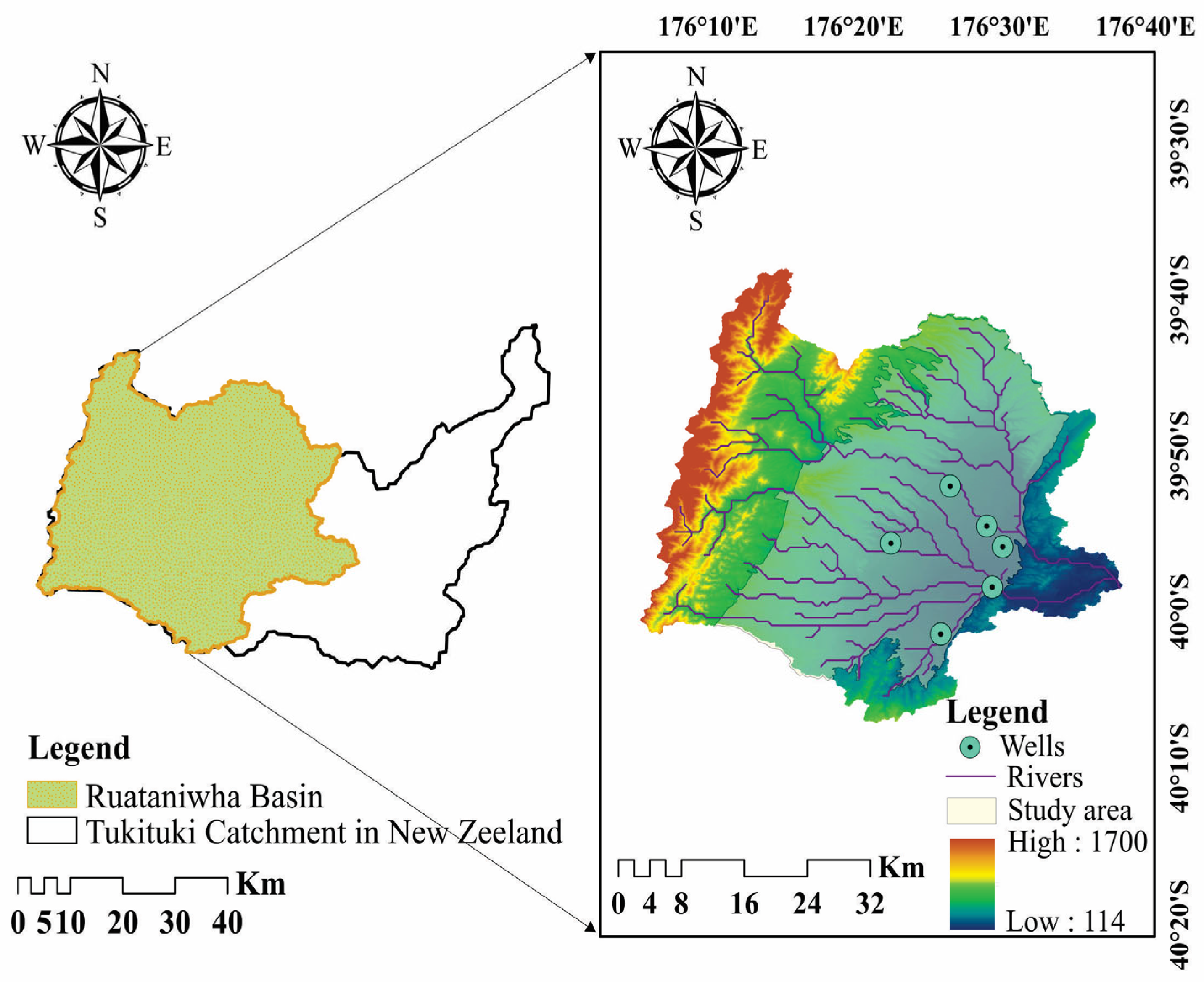
2.1. The Study Area
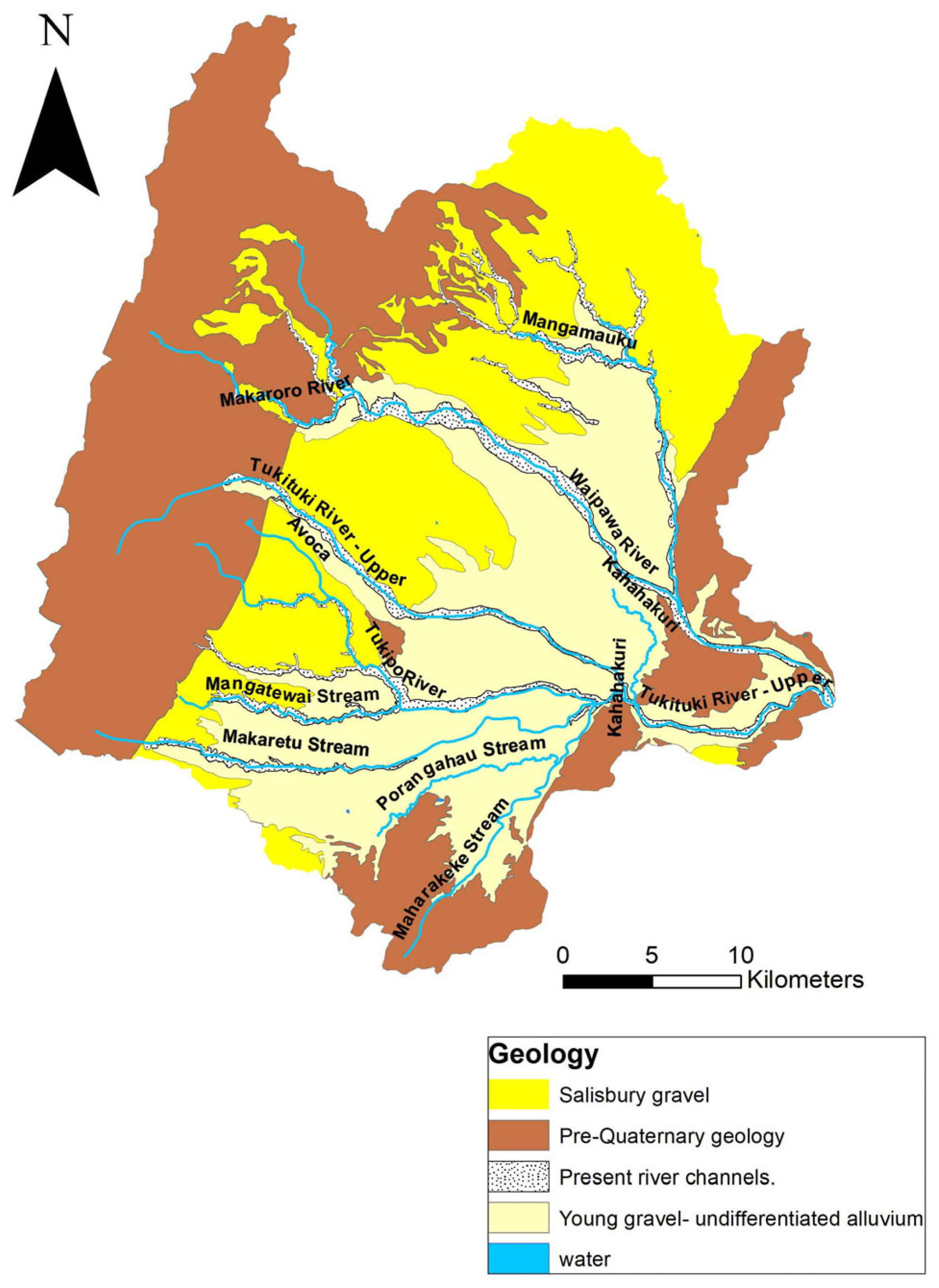
2.2. Geology and Hydrogeology
2.3. Data Description
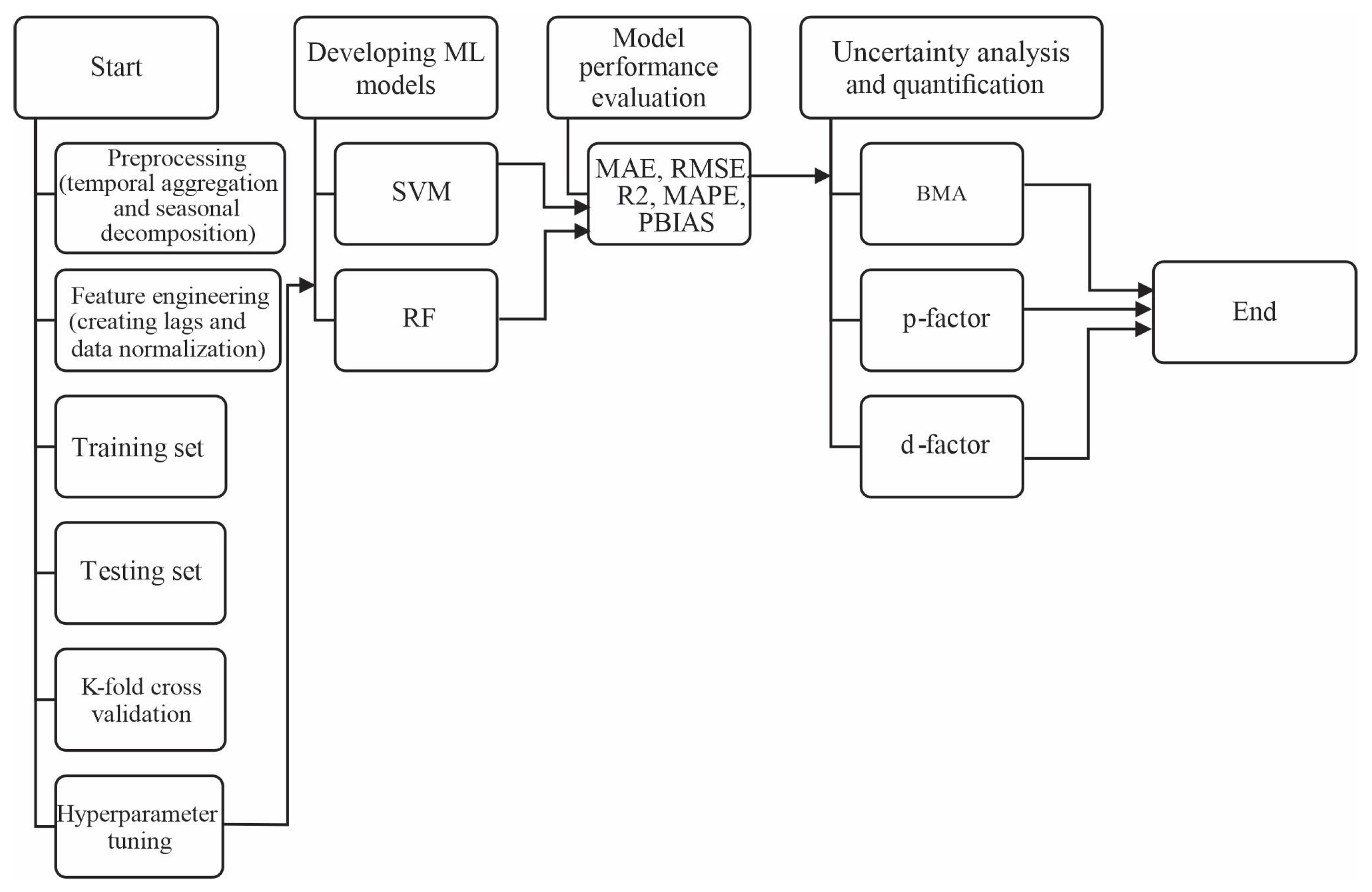
2.4. Data Preprocessing and Feature Engineering
2.5. Model Development
2.5.1. Random Forest (RF)
- Bootstrap sampling (, i is iteration) for each tree (b = 1 to B, where B is the total number of trees in the forest).
- Grow a regression tree Tb using the bootstrap sample; this helps inject randomness at each node split.
- At each node of a growing tree, a random subset of the input features is selected B trees .
- The final prediction is the average of the individual predictions from all the trees in the forest, as shown in Equation (3):
2.5.2. Support Vector Machine (SVM)
2.5.3. Model Optimization
2.6. Model Performance Evaluation
2.7. Uncertainty Analysis and Quantification
3. Results and Discussion
3.1. Results of Model Performance Evaluation
- ➢
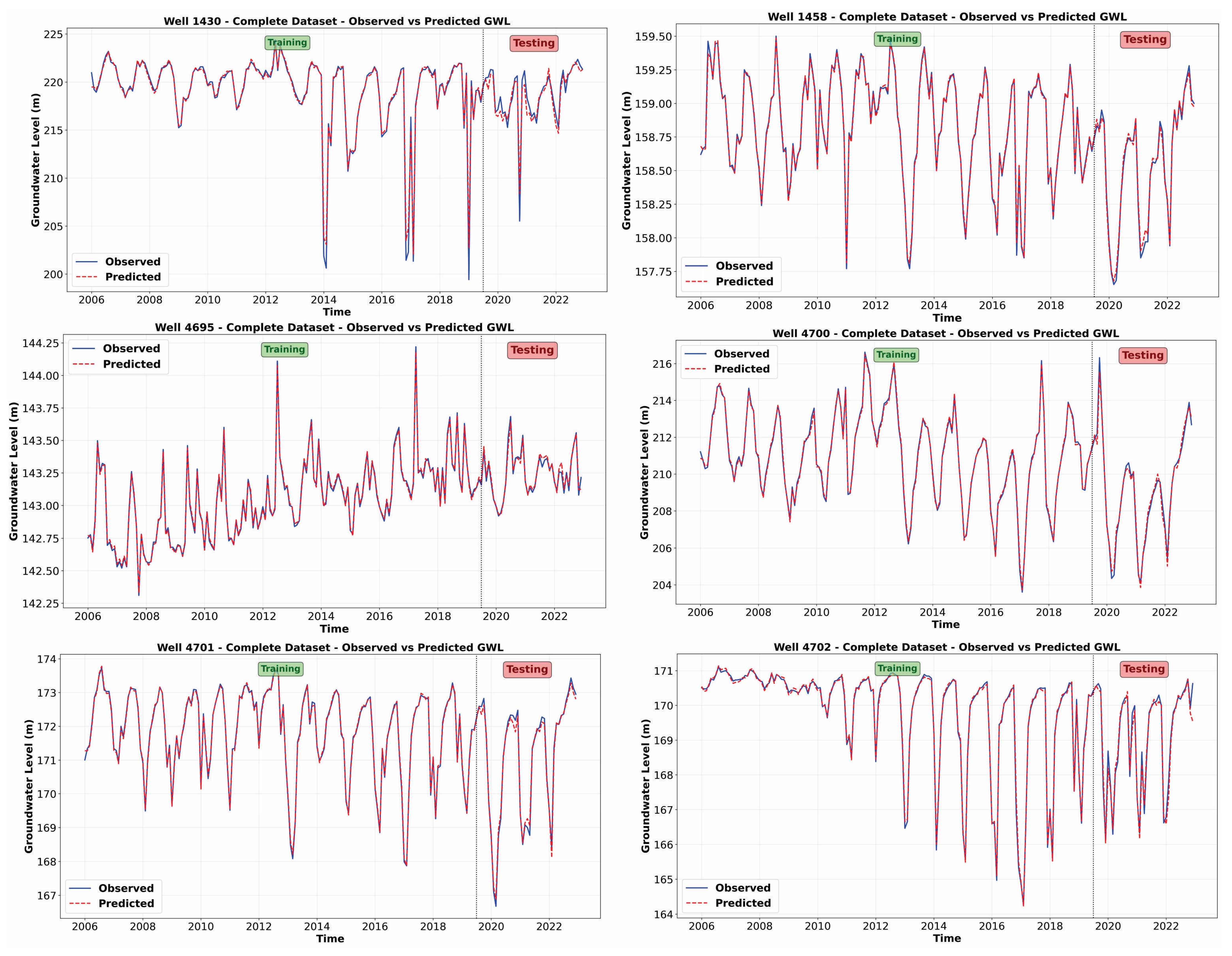
- MAE/RMSE: RF overall MAE = 0.013 to 0.174 m and RMSE = 0.04 to 0.53 m, versus SVM overall MAE = 0.016 to 0.339 m and RMSE = 0.02 to 0.59 m.
- ➢
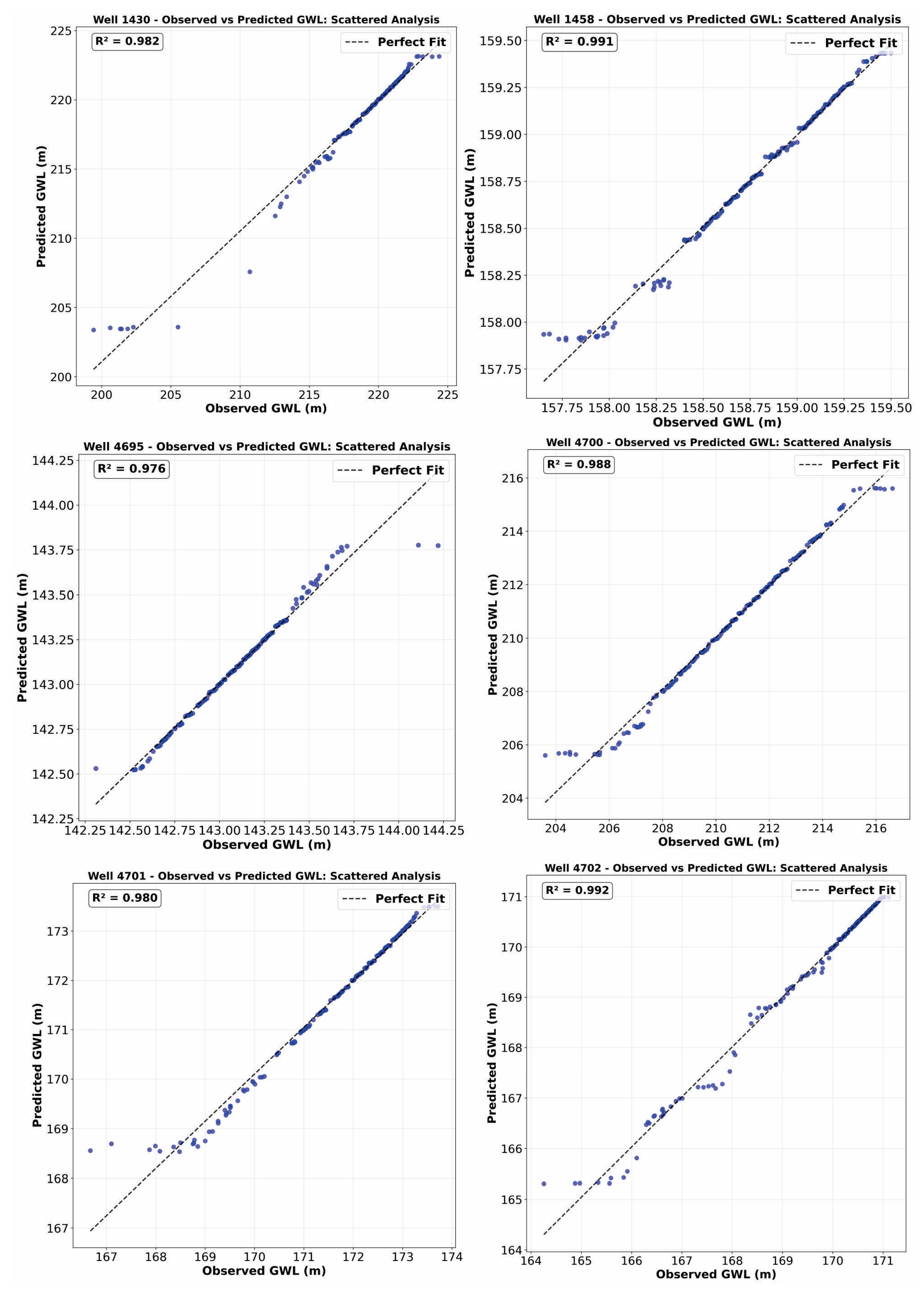
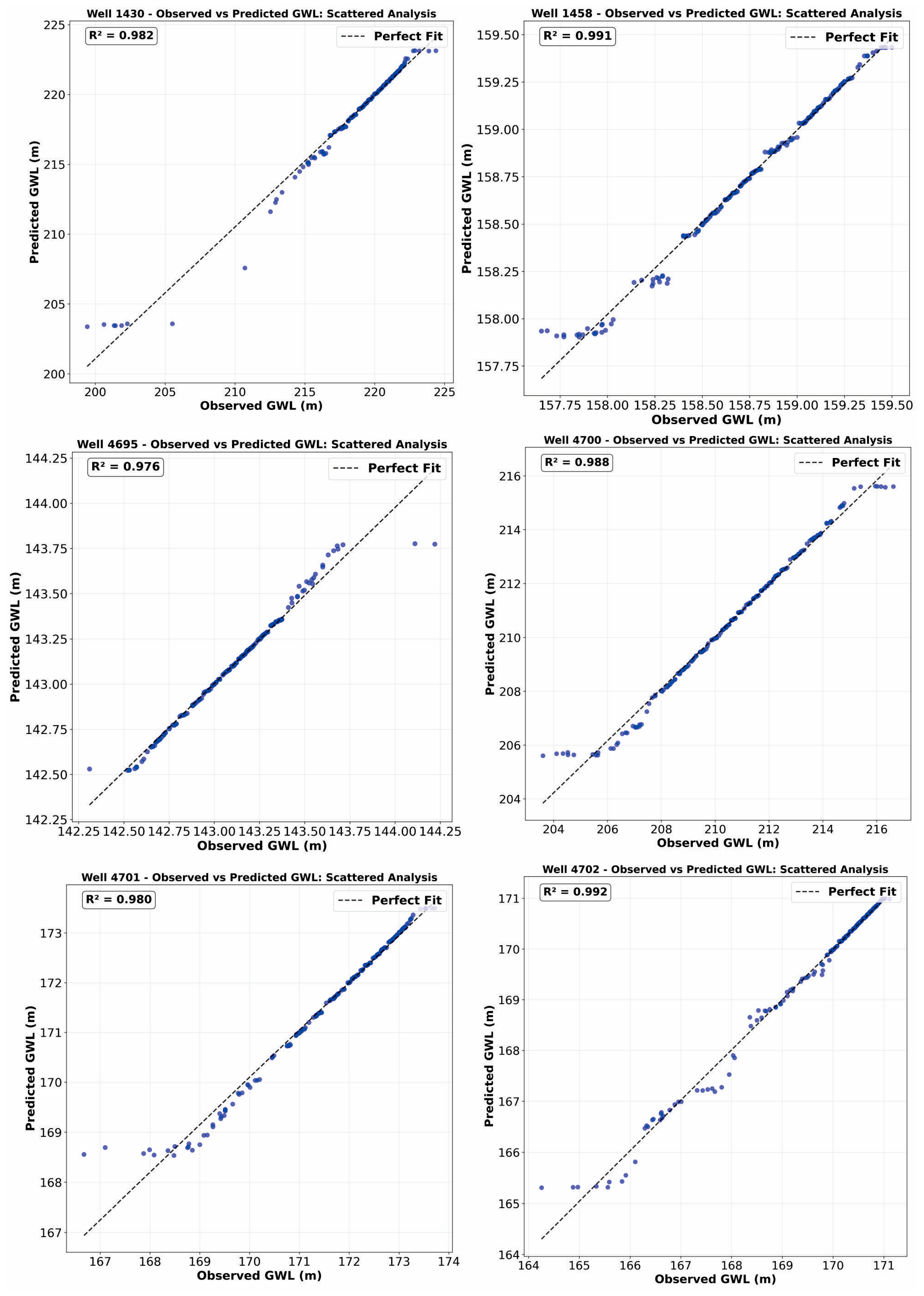
- R2: Across wells, RF explains 97.6 to 99.2% of variance, marginally lower than SVM with 97.8 to 99.7%.
- ➢
- MAPE/PBIAS: RF maintains a lower percent error (MAPE = 0.01 to 0.08%) and bias near zero, whereas SVM exhibits a slightly larger error (MAPE = 0.23 to1.56%) and modest bias at well 4701 (PBIAS = 0.85%).
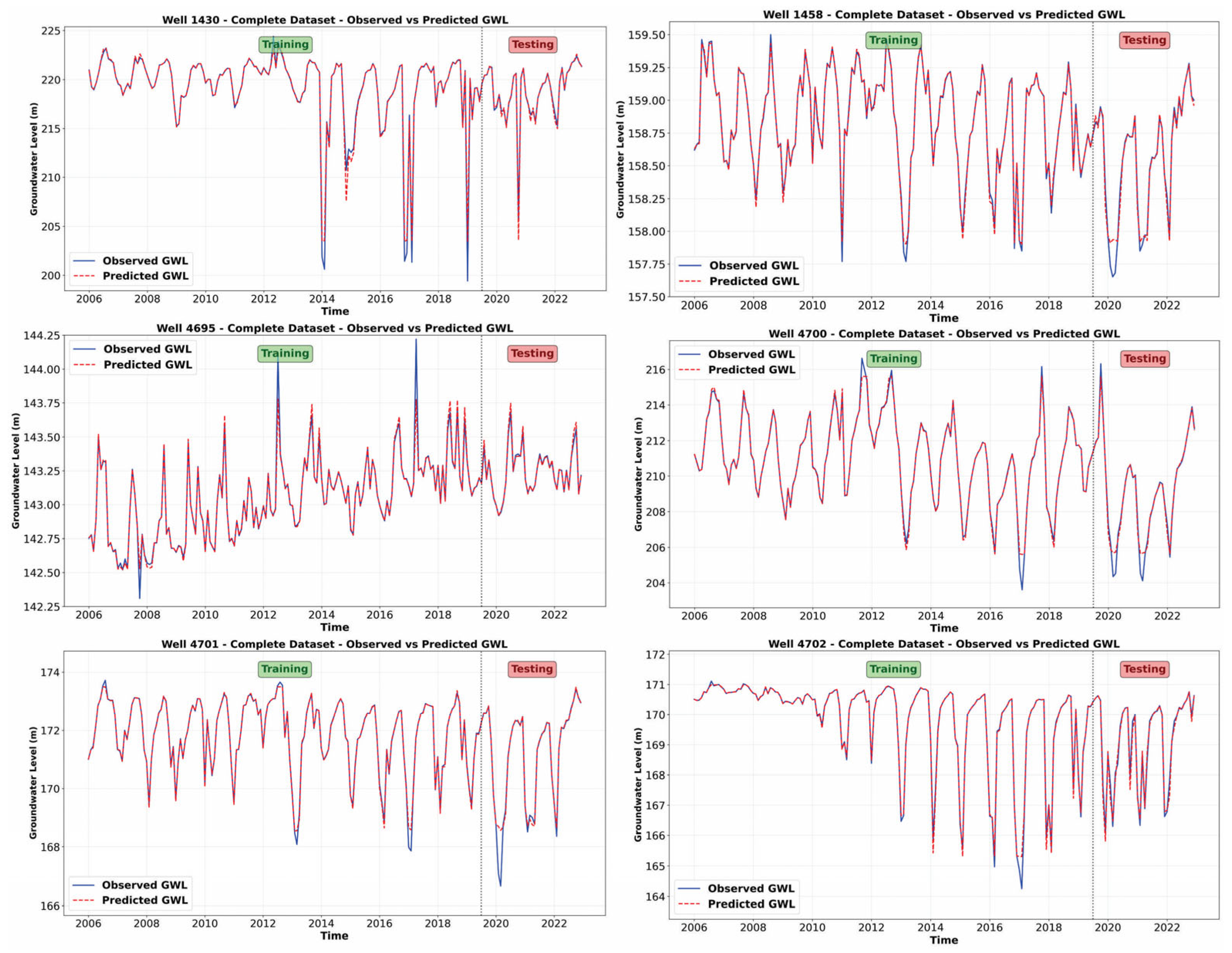
3.2. Comparison of the Time Series Prediction
3.3. Scatter Plot Analysis of RF and SVM
3.4. Uncertainty Analysis
4. Conclusions
Author Contributions
Funding
Data Availability Statement
Acknowledgments
Conflicts of Interest
References
- Ghosh, A.; Adhikary, P.P.; Bera, B.; Bhunia, G.S.; Shit, P.K. Assessment of groundwater potential zone using MCDA and AHP techniques: Case study from a tropical river basin of India. Appl. Water Sci. 2022, 12, 37. [Google Scholar] [CrossRef]
- Ravindiran, G.; Rajamanickam, S.; Sivarethinamohan, S.; Karupaiya Sathaiah, B.; Ravindran, G.; Muniasamy, S.K.; Hayder, G. A Review of the Status, Effects, Prevention, and Remediation of Groundwater Contamination for Sustainable Environment. Water 2023, 15, 3662. [Google Scholar] [CrossRef]
- Saito, L.; Christian, B.; Diffley, J.; Richter, H.; Rohde, M.M.; Morrison, S.A. Managing Groundwater to Ensure Ecosystem Function. Groundwater 2021, 59, 322–333. [Google Scholar] [CrossRef]
- Baalousha, H.M. Characterisation of groundwater-surface water interaction using field measurements and numerical modelling: A case study from the Ruataniwha Basin, Hawke’s Bay, New Zealand. Appl. Water Sci. 2012, 2, 109–118. [Google Scholar] [CrossRef]
- Rajeevan, U.; Mishra, B.K. Sustainable management of the groundwater resource of Jaffna, Sri Lanka with the participation of households: Insights from a study on household water consumption and management. Groundw. Sustain. Dev. 2020, 10, 100280. [Google Scholar] [CrossRef]
- Dao, P.U.; Heuzard, A.G.; Le, T.X.H.; Zhao, J.; Yin, R.; Shang, C.; Fan, C. The impacts of climate change on groundwater quality: A review. Sci. Total Environ. 2024, 912, 169241. [Google Scholar] [CrossRef]
- Ghazi, B.; Jeihouni, E.; Kalantari, Z. Predicting groundwater level fluctuations under climate change scenarios for Tasuj plain, Iran. Arab. J. Geosci. 2021, 14, 115. [Google Scholar] [CrossRef]
- Khorrami, M.; Malekmohammadi, B. Effects of excessive water extraction on groundwater ecosystem services: Vulnerability assessments using biophysical approaches. Sci. Total Environ. 2021, 799, 149304. [Google Scholar] [CrossRef] [PubMed]
- Wunsch, A.; Liesch, T.; Broda, S. Deep learning shows declining groundwater levels in Germany until 2100 due to climate change. Nat. Commun. 2022, 13, 1221. [Google Scholar] [CrossRef] [PubMed]
- Jasechko, S.; Seybold, H.; Perrone, D.; Fan, Y.; Shamsudduha, M.; Taylor, R.G.; Fallatah, O.; Kirchner, J.W. Rapid groundwater decline and some cases of recovery in aquifers globally. Nature 2024, 625, 715–721. [Google Scholar] [CrossRef]
- Herrera-García, G.; Ezquerro, P.; Tomas, R.; Béjar-Pizarro, M.; López-Vinielles, J.; Rossi, M.; Mateos, R.M.; Carreón-Freyre, D.; Lambert, J.; Teatini, P.; et al. Mapping the global threat of land subsidence. Science 2021, 371, 34–36. [Google Scholar] [CrossRef] [PubMed]
- Erban, L.E.; Gorelick, S.M.; Zebker, H.A.; Fendorf, S. Release of arsenic to deep groundwater in the Mekong Delta, Vietnam, linked to pumping-induced land subsidence. Proc. Natl. Acad. Sci. USA 2013, 110, 13751–13756. [Google Scholar] [CrossRef]
- Smith, R.; Knight, R.; Fendorf, S. Overpumping leads to California groundwater arsenic threat. Nat. Commun. 2018, 9, 2089. [Google Scholar] [CrossRef]
- Evans, S.W.; Jones, N.L.; Williams, G.P.; Ames, D.P.; Nelson, E.J. Groundwater Level Mapping Tool: An open source web application for assessing groundwater sustainability. Environ. Model. Softw. 2020, 131, 104782. [Google Scholar] [CrossRef]
- Khan, J.; Lee, E.; Balobaid, A.S.; Kim, K. A Comprehensive Review of Conventional, Machine Leaning, and Deep Learning Models for Groundwater Level (GWL) Forecasting. Appl. Sci. 2023, 13, 2743. [Google Scholar] [CrossRef]
- Igwebuike, N.; Ajayi, M.; Okolie, C.; Kanyerere, T.; Halihan, T. Application of machine learning and deep learning for predicting groundwater levels in the west coast aquifer system, south africa. Earth Sci. Inform. 2025, 18, 6. [Google Scholar] [CrossRef]
- Jafarzadeh, A.; Khashei-Siuki, A.; Pourreza-Bilondi, M. Performance Assessment of Model Averaging Techniques to Reduce Structural Uncertainty of Groundwater Modeling. Water Resour. Manag. 2022, 36, 353–377. [Google Scholar] [CrossRef]
- Mustafa, S.M.T.; Moudud Hasan, M.; Saha, A.K.; Rannu, R.P.; Van Uytven, E.; Willems, P.; Huysmans, M. Multi-model approach to quantify groundwater-level prediction uncertainty using an ensemble of global climate models and multiple abstraction scenarios. Hydrol. Earth Syst. Sci. 2019, 23, 2279–2303. [Google Scholar] [CrossRef]
- Ntona, M.M.; Busico, G.; Mastrocicco, M.; Kazakis, N. Modeling groundwater and surface water interaction: An overview of current status and future challenges. Sci. Total Environ. 2022, 846, 157355. [Google Scholar] [CrossRef]
- Sriram, R. Groundwater Level Prediction: A novel study on Machine Learning based approach with regression models for Sustainable Resource Management. In Proceedings of the 2023 IEEE International Conference on Cloud Computing in Emerging Markets (CCEM), Mysuru, India, 2–4 November 2023; pp. 137–142. [Google Scholar]
- Taccari, M.L.; Wang, H.; Nuttall, J.; Chen, X.; Jimack, P.K. Spatial-temporal graph neural networks for groundwater data. Sci. Rep. 2024, 14, 24564. [Google Scholar] [CrossRef]
- Huang, R.; Ma, C.; Ma, J.; Huangfu, X.; He, Q. Machine learning in natural and engineered water systems. Water Res. 2021, 205, 117666. [Google Scholar] [CrossRef]
- Bubakran, K.S.; Novinpour, E.A.; Aghdam, F.S. A comparative study of artificial neural networks and support vector machines for predicting groundwater levels in the Ziveh Aquifer–West Azerbaijan, NW Iran. Arab. J. Geosci. 2023, 16, 287. [Google Scholar] [CrossRef]
- Hou, Z.; Lao, W.; Wang, Y.; Lu, W. Homotopy-based hyper-heuristic searching approach for reciprocal feedback inversion of groundwater contamination source and aquifer parameters. Appl. Soft Comput. 2021, 104, 107191. [Google Scholar] [CrossRef]
- Cai, H.; Shi, H.; Liu, S.; Babovic, V. Impacts of regional characteristics on improving the accuracy of groundwater level prediction using machine learning: The case of central eastern continental United States. J. Hydrol. Reg. Stud. 2021, 37, 100930. [Google Scholar] [CrossRef]
- Kumar, R.; Dwivedi, S.B.; Gaur, S. A comparative study of machine learning and Fuzzy-AHP technique to groundwater potential mapping in the data-scarce region. Comput. Geosci. 2021, 155, 104855. [Google Scholar] [CrossRef]
- Sahour, H.; Gholami, V.; Vazifedan, M. A comparative analysis of statistical and machine learning techniques for mapping the spatial distribution of groundwater salinity in a coastal aquifer. J. Hydrol. 2020, 591, 125321. [Google Scholar] [CrossRef]
- Baalousha, H.M. Machine Learning-Driven Calibration of MODFLOW Models: Comparing Random Forest and XGBoost Approaches. Geosciences 2025, 15, 303. [Google Scholar] [CrossRef]
- Baalousha, H.M. Machine Learning Approaches for Groundwater Vulnerability Assessment in Arid Environments: Enhancing DRASTIC with ANN and Random Forest. Groundw. Sustain. Dev. 2025, 30, 101496. [Google Scholar] [CrossRef]
- Hikouei, I.S.; Eshleman, K.N.; Saharjo, B.H.; Graham, L.L.B.; Applegate, G.; Cochrane, M.A. Using machine learning algorithms to predict groundwater levels in Indonesian tropical peatlands. Sci. Total Environ. 2023, 857, 159701. [Google Scholar] [CrossRef]
- Liu, Q.; Gui, D.; Zhang, L.; Niu, J.; Dai, H.; Wei, G.; Hu, B.X. Simulation of regional groundwater levels in arid regions using interpretable machine learning models. Sci. Total Environ. 2022, 831, 154902. [Google Scholar] [CrossRef]
- Seifi, A.; Ehteram, M.; Singh, V.P.; Mosavi, A. Modeling and uncertainty analysis of groundwater level using six evolutionary optimization algorithms hybridized with ANFIS, SVM, and ANN. Sustainability 2020, 12, 4023. [Google Scholar] [CrossRef]
- Tao, H.; Hameed, M.M.; Marhoon, H.A.; Zounemat-Kermani, M.; Heddam, S.; Sungwon, K.; Sulaiman, S.O.; Tan, M.L.; Sa’adi, Z.; Mehr, A.D.; et al. Groundwater level prediction using machine learning models: A comprehensive review. Neurocomputing 2022, 489, 271–308. [Google Scholar] [CrossRef]
- BinMakhashen, G.M.; Benaafi, M. Predicting seawater intrusion in coastal areas using machine learning: A case study of arid coastal aquifers, Saudi Arabia. Groundw. Sustain. Dev. 2024, 26, 101300. [Google Scholar] [CrossRef]
- Raghavendra, S.; Deka, P.C. Support vector machine applications in the field of hydrology: A review. Appl. Soft Comput. J. 2014, 19, 372–386. [Google Scholar] [CrossRef]
- Rodriguez-Galiano, V.; Sanchez-Castillo, M.; Chica-Olmo, M.; Chica-Rivas, M. Machine learning predictive models for mineral prospectivity: An evaluation of neural networks, random forest, regression trees and support vector machines. Ore Geol. Rev. 2015, 71, 804–818. [Google Scholar] [CrossRef]
- Abdar, M.; Pourpanah, F.; Hussain, S.; Rezazadegan, D.; Liu, L.; Ghavamzadeh, M.; Fieguth, P.; Cao, X.; Khosravi, A.; Acharya, U.R.; et al. A review of uncertainty quantification in deep learning: Techniques, applications and challenges. Inf. Fusion 2021, 76, 243–297. [Google Scholar] [CrossRef]
- Abbaszadeh Shahri, A.; Shan, C.; Larsson, S. A Novel Approach to Uncertainty Quantification in Groundwater Table Modeling by Automated Predictive Deep Learning. Nat. Resour. Res. 2022, 31, 1351–1373. [Google Scholar] [CrossRef]
- Herrera, P.A.; Marazuela, M.A.; Hofmann, T. Parameter estimation and uncertainty analysis in hydrological modeling. Wiley Interdiscip. Rev. Water 2022, 9, e1569. [Google Scholar] [CrossRef]
- Varouchakis, E.A.; Yetilmezsoy, K.; Karatzas, G.P. A decision-making framework for sustainable management of groundwater resources under uncertainty: Combination of Bayesian risk approach and statistical tools. Water Policy 2019, 21, 602–622. [Google Scholar] [CrossRef]
- Fragoso, T.M.; Bertoli, W.; Louzada, F. Bayesian Model Averaging: A Systematic Review and Conceptual Classification. Int. Stat. Rev. 2018, 86, 1–28. [Google Scholar] [CrossRef]
- Baalousha, H.M. Modelling surface-groundwater interaction in the Ruataniwha basin, Hawke’s Bay, New Zealand. Environ. Earth Sci. 2012, 66, 285–294. [Google Scholar] [CrossRef]
- Griffiths, J.; Yang, J.; Woods, R.; Zammit, C.; Porhemmat, R.; Shankar, U.; Rajanayaka, C.; Ren, J.; Howden, N. Parameterization of a National Groundwater Model for New Zealand. Sustainability 2023, 15, 3280. [Google Scholar] [CrossRef]
- Ballance, P.F. New Zealand Geology: An Illustrated Guide; Geoscience Society of New Zealand: Wellington, New Zealand, 2017. [Google Scholar]
- Rawlinson, Z. Hawke’s Bay 3D Aquifer Mapping Project: 3D Hydrogeological Models from SkyTEM Data in the Ruataniwha Plains; Consultancy Report 2023/117; GNS Science: Lower Hutt, New Zealand, 2024; 60p. [Google Scholar]
- Francis, D. Subsurface Geology of the Ruataniwha Plains and Relation to Hydrology; Technical report; Geological Research Ltd.: Lower Hutt, New Zealand, 2001. [Google Scholar]
- Baalousha, H. Stochastic water balance model for rainfall recharge quantification in Ruataniwha Basin, New Zealand. Environ. Geol. 2009, 58, 85–93. [Google Scholar] [CrossRef]
- Jasper, C. Ruataniwha Aquifer Properties Analysis and Mapping (HBRC Publication No. 5640); Hawke’s Bay Regional Council: Hawke’s Bay, New Zealand, 2018. [Google Scholar]
- Breiman, L. Random forests. Mach. Learn. 2001, 45, 5–32. [Google Scholar] [CrossRef]
- He, S.; Wu, J.; Wang, D.; He, X. Predictive modeling of groundwater nitrate pollution and evaluating its main impact factors using random forest. Chemosphere 2022, 290, 133388. [Google Scholar] [CrossRef]
- Sachdeva, S.; Kumar, B. Comparison of gradient boosted decision trees and random forest for groundwater potential mapping in Dholpur (Rajasthan), India. Stoch. Environ. Res. Risk Assess. 2021, 35, 287–306. [Google Scholar] [CrossRef]
- Vapnik, V. The Nature of Statistical Learning Theory; Springer science & business media: Berlin/Heidelberg, Germany, 1999. [Google Scholar]
- Noble, W.S. What is a support vector machine? Nat. Biotechnol. 2006, 24, 1565–1567. [Google Scholar] [CrossRef]
- Pohan, A.B.; Kurniasih, A. Optimization of Classification Algorithm with GridSearchCV and Hyperparameter Tuning for Sentiment Analysis of the Nusantara Capital City. J. Artif. Intell. Eng. Appl. 2024, 3, 808–814. [Google Scholar] [CrossRef]
- Kumar, V.; Kedam, N.; Sharma, K.V.; Mehta, D.J.; Caloiero, T. Advanced Machine Learning Techniques to Improve Hydrological Prediction: A Comparative Analysis of Streamflow Prediction Models. Water 2023, 15, 2572. [Google Scholar] [CrossRef]
- Abbaspour, K.C.; Johnson, C.A.; van Genuchten, M.T. Estimating Uncertain Flow and Transport Parameters Using a Sequential Uncertainty Fitting Procedure. Vadose Zone J. 2004, 3, 1340–1352. [Google Scholar] [CrossRef]
- Demir, S.; Şahin, E.K. Liquefaction prediction with robust machine learning algorithms (SVM, RF, and XGBoost) supported by genetic algorithm-based feature selection and parameter optimization from the perspective of data processing. Environ. Earth Sci. 2022, 81, 459. [Google Scholar] [CrossRef]
- Shen, C.; Appling, A.P.; Gentine, P.; Bandai, T.; Gupta, H.; Tartakovsky, A.; Baity-Jesi, M.; Fenicia, F.; Kifer, D.; Li, L.; et al. Differentiable modelling to unify machine learning and physical models for geosciences. Nat. Rev. Earth Environ. 2023, 4, 552–567. [Google Scholar] [CrossRef]
- Goodarzi, M.R.; Bafrouei, H.B.; Vazirian, M. Insight into groundwater level prediction with feature effectiveness: Comparison of machine learning and numerical methods. Hydrol. Res. 2024, 56, 74–92. [Google Scholar] [CrossRef]
- Simões, K.; de Condé, R.C.C.; Roig, H.L.; Cicerelli, R.E. Application of the swat hydrological model in flow and solid discharge simulation as a management tool of the indaia river basin, alto são francisco, minas gerais. Rev. Ambient. Agua 2021, 16, e2694. [Google Scholar] [CrossRef]
- Pham, Q.B.; Kumar, M.; Di Nunno, F.; Elbeltagi, A.; Granata, F.; Islam, A.R.M.T.; Talukdar, S.; Nguyen, X.C.; Ahmed, A.N.; Anh, D.T. Groundwater level prediction using machine learning algorithms in a drought-prone area. Neural Comput. Appl. 2022, 34, 10751–10773. [Google Scholar] [CrossRef]
- Rahaman, M.M.; Thakur, B.; Kalra, A.; Li, R.; Maheshwari, P. Estimating high-resolution groundwater storage from GRACE: A random forest approach. Environments 2019, 6, 63. [Google Scholar] [CrossRef]
- Haaf, E.; Giese, M.; Reimann, T.; Barthel, R. Data-Driven Estimation of Groundwater Level Time-Series at Unmonitored Sites Using Comparative Regional Analysis. Water Resour. Res. 2023, 59, e2022WR033470. [Google Scholar] [CrossRef]



| Variables | Temporal Resolution | Source | Remark |
|---|---|---|---|
| Rainfall, temperature, and PET | Daily | Gauge stations | Averaged across stations |
| Storativity, transmissivity | Static | Piezometric records | Location-specific values for each of the 6 wells |
| Groundwater level and abstraction | Monthly | 6 wells | Direct measurements from HBRC monitoring wells |
| Model | Metrics | Training | Test | ||||||||||
|---|---|---|---|---|---|---|---|---|---|---|---|---|---|
| 1430 | 1458 | 4695 | 4700 | 4701 | 4702 | 1430 | 1458 | 4695 | 4700 | 4701 | 4702 | ||
| SVM | MAE | 0.269 | 0.016 | 0.014 | 0.104 | 0.049 | 0.056 | 0.628 | 0.03 | 0.023 | 0.222 | 0.114 | 0.17 |
| RMSE | 0.512 | 0.02 | 0.016 | 0.121 | 0.057 | 0.071 | 0.829 | 0.037 | 0.031 | 0.28 | 0.142 | 0.254 | |
| R2 | 0.985 | 0.997 | 0.997 | 0.997 | 0.998 | 0.998 | 0.918 | 0.993 | 0.966 | 0.990 | 0.995 | 0.968 | |
| PBIAS | −0.02 | 0.00 | 0.00 | 0.00 | 0.00 | 0.00 | 0.12 | 0.00 | 0.00 | 0.000 | 0.02 | 0.04 | |
| MAPE | 0.13 | 0.01 | 0.01 | 0.05 | 0.03 | 0.03 | 0.29 | 0.02 | 0.02 | 0.11 | 0.07 | 0.1 | |
| RF | MAE | 0.175 | 0.012 | 0.014 | 0.08 | 0.036 | 0.038 | 0.169 | 0.04 | 0.011 | 0.242 | 0.129 | 0.121 |
| RMSE | 0.564 | 0.024 | 0.050 | 0.218 | 0.097 | 0.115 | 0.366 | 0.075 | 0.021 | 0.457 | 0.393 | 0.187 | |
| R2 | 0.982 | 0.996 | 0.973 | 0.992 | 0.994 | 0.994 | 0.984 | 0.972 | 0.985 | 0.974 | 0.951 | 0.983 | |
| PBIAS | −0.02 | 0.00 | 0.00 | 0.00 | 0.00 | 0.00 | 0.04 | −0.01 | 0.00 | −0.02 | −0.05 | 0.03 | |
| MAPE | 0.08 | 0.01 | 0.01 | 0.04 | 0.02 | 0.02 | 0.08 | 0.03 | 0.01 | 0.12 | 0.08 | 0.07 | |
| Metrics | Support Vector Machine | Random Forest | ||||||||||
|---|---|---|---|---|---|---|---|---|---|---|---|---|
| 1430 | 1458 | 4695 | 4700 | 4701 | 4702 | 1430 | 1458 | 4695 | 4700 | 4701 | 4702 | |
| MAE | 0.339 | 0.019 | 0.016 | 0.127 | 0.063 | 0.077 | 0.174 | 0.018 | 0.013 | 0.112 | 0.055 | 0.055 |
| RMSE | 0.59 | 0.024 | 0.02 | 0.166 | 0.082 | 0.130 | 0.53 | 0.04 | 0.045 | 0.283 | 0.196 | 0.133 |
| R2 | 0.978 | 0.997 | 0.996 | 0.996 | 0.997 | 0.993 | 0.982 | 0.991 | 0.976 | 0.988 | 0.98 | 0.992 |
| PBIAS | 0.76 | −0.2 | −0.22 | −0.48 | 0.85 | 0.82 | 0.00 | 0.00 | 0.00 | 0.00 | −0.01 | 0.00 |
| MAPE | 1.56 | 0.29 | 0.23 | 1.39 | 0.87 | 0.86 | 0.08 | 0.01 | 0.01 | 0.05 | 0.03 | 0.03 |
| Metric | Support Vector Machine | Random Forest | ||||||||||
|---|---|---|---|---|---|---|---|---|---|---|---|---|
| 1430 | 1458 | 4695 | 4700 | 4701 | 4702 | 1430 | 1458 | 4695 | 4700 | 4701 | 4702 | |
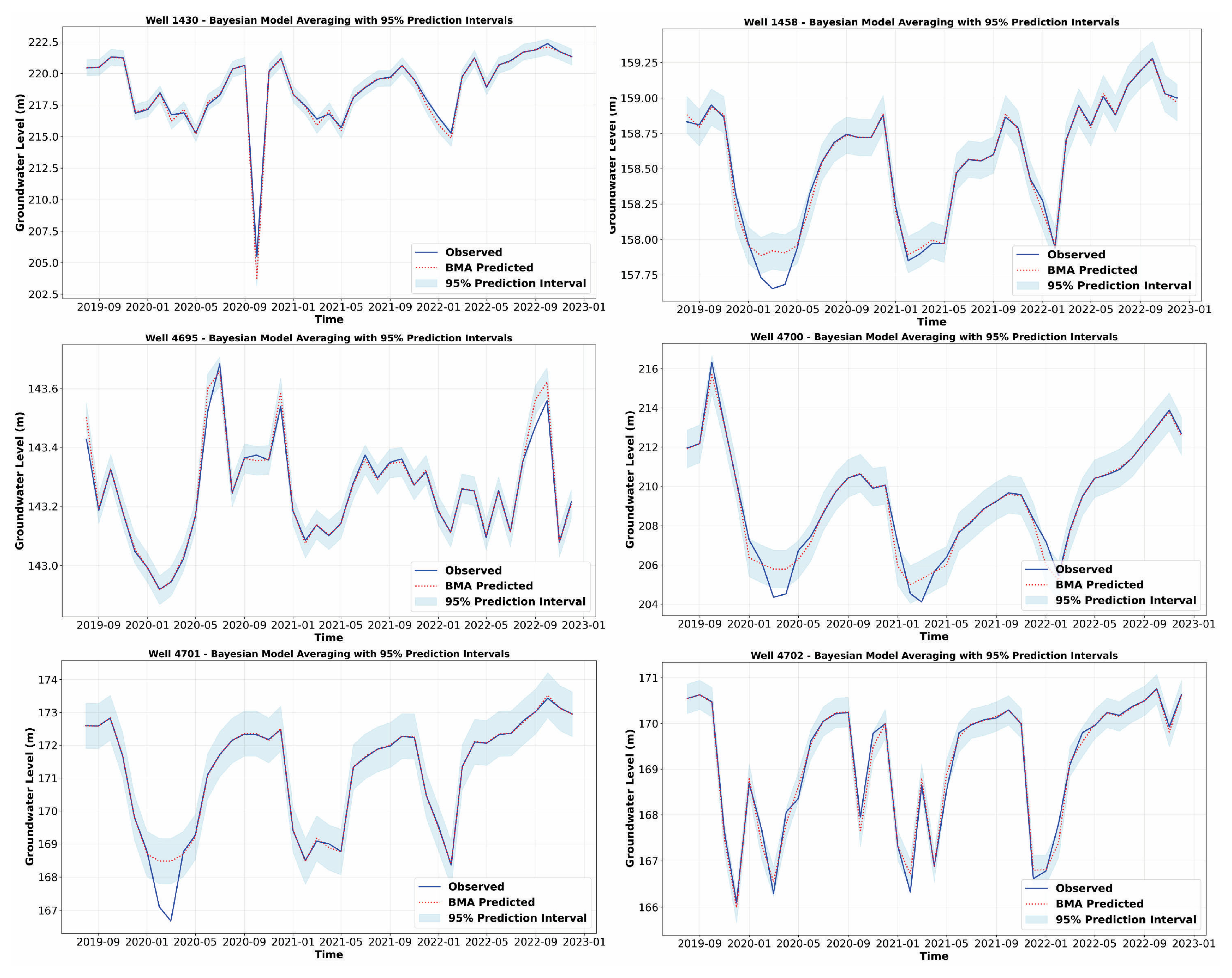
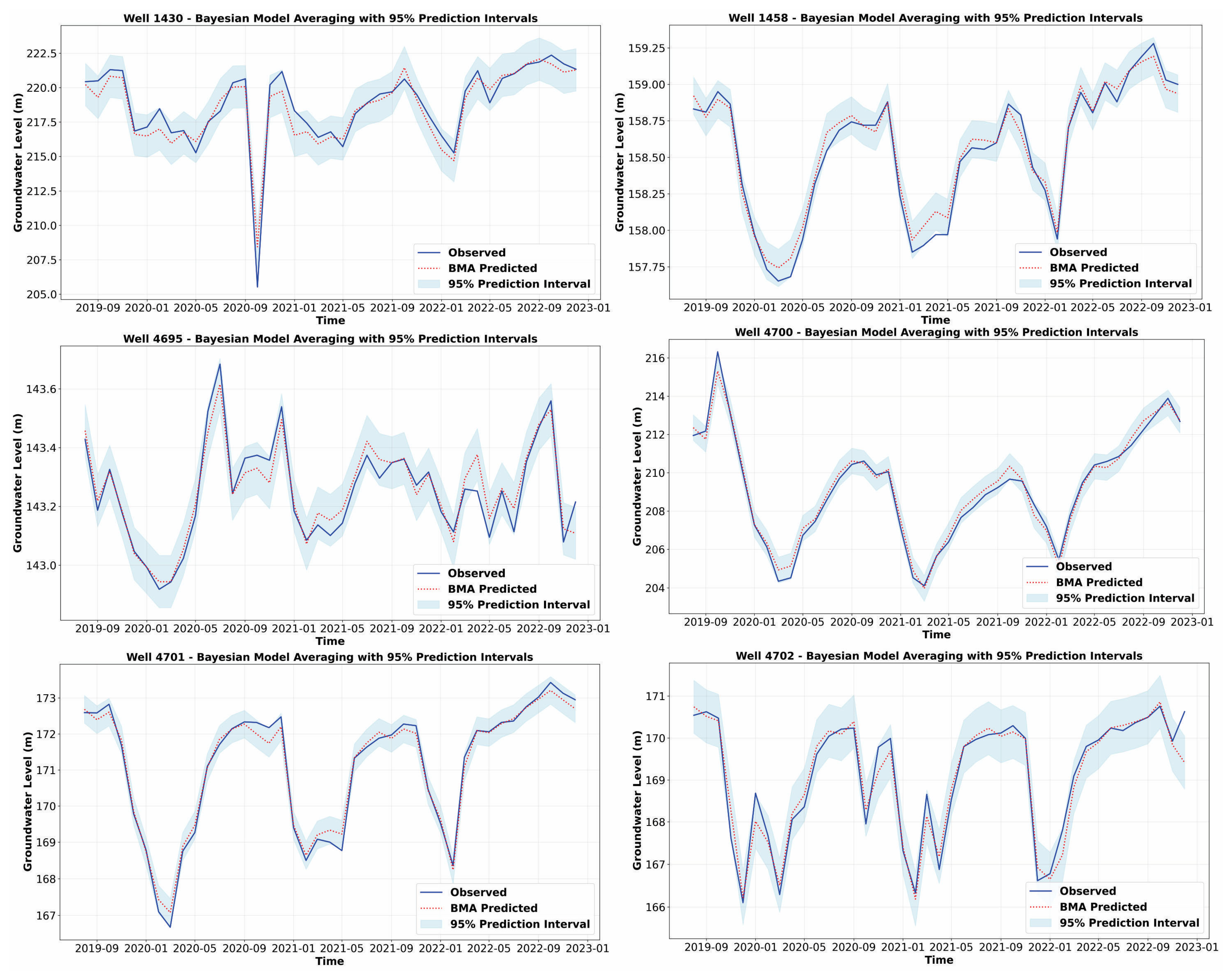
| p-factor | 0.951 | 0.951 | 0.951 | 0.951 | 0.927 | 0.927 | 0.976 | 0.927 | 0.902 | 0.878 | 0.951 | 0.902 |
| d-factor | 1.07 | 0.57 | 1.04 | 0.47 | 0.43 | 0.89 | 0.436 | 0.576 | 0.581 | 0.685 | 0.769 | 0.45 |
| Model | Well No. | Lower Boundary | Upper Boundary |
|---|---|---|---|
| SVM | 1430 | 216.988 | 220.070 |
| 1458 | 158.426 | 158.682 | |
| 4695 | 143.165 | 143.342 | |
| 4700 | 208.541 | 209.874 | |
| 4701 | 170.691 | 171.457 | |
| 4702 | 168.425 | 169.688 | |
| RF | 1430 | 218.046 | 219.306 |
| 1458 | 158.412 | 158.670 | |
| 4695 | 143.205 | 143.303 | |
| 4700 | 208.123 | 210.048 | |
| 4701 | 170.468 | 171.835 | |
| 4702 | 168.758 | 169.401 |
Disclaimer/Publisher’s Note: The statements, opinions and data contained in all publications are solely those of the individual author(s) and contributor(s) and not of MDPI and/or the editor(s). MDPI and/or the editor(s) disclaim responsibility for any injury to people or property resulting from any ideas, methods, instructions or products referred to in the content. |
© 2025 by the authors. Licensee MDPI, Basel, Switzerland. This article is an open access article distributed under the terms and conditions of the Creative Commons Attribution (CC BY) license (https://creativecommons.org/licenses/by/4.0/).
Share and Cite
Kanito, D.; Benaafi, M.; Baalousha, H.M. Machine Learning Models for Groundwater Level Prediction and Uncertainty Analysis in Ruataniwha Basin, New Zealand. Hydrology 2025, 12, 282. https://doi.org/10.3390/hydrology12110282
Kanito D, Benaafi M, Baalousha HM. Machine Learning Models for Groundwater Level Prediction and Uncertainty Analysis in Ruataniwha Basin, New Zealand. Hydrology. 2025; 12(11):282. https://doi.org/10.3390/hydrology12110282
Chicago/Turabian StyleKanito, Dawit, Mohammed Benaafi, and Husam Musa Baalousha. 2025. "Machine Learning Models for Groundwater Level Prediction and Uncertainty Analysis in Ruataniwha Basin, New Zealand" Hydrology 12, no. 11: 282. https://doi.org/10.3390/hydrology12110282
APA StyleKanito, D., Benaafi, M., & Baalousha, H. M. (2025). Machine Learning Models for Groundwater Level Prediction and Uncertainty Analysis in Ruataniwha Basin, New Zealand. Hydrology, 12(11), 282. https://doi.org/10.3390/hydrology12110282