Article

Insight into the Formation of Winter Black Carbon and Brown Carbon over Xi’an in Northwestern China

1
Department of Environmental Science and Engineering, Xi’an Jiaotong University, Xi’an 710049, China
2
State Key Laboratory of Loess Science, Institute of Earth Environment, Chinese Academy of Sciences, Xi’an 710061, China
3
Key Laboratory of Northwest Resource, Environment and Ecology, MOE, Xi’an University of Architecture and Technology, Xi’an 710055, China
4
Division of Environment and Sustainability, The Hong Kong University of Science and Technology, Hong Kong, China
*
Author to whom correspondence should be addressed.
Toxics 2026, 14(1), 93; https://doi.org/10.3390/toxics14010093

Submission received: 25 November 2025 / Revised: 11 January 2026 / Accepted: 14 January 2026 / Published: 20 January 2026

Abstract

This study evaluates the effectiveness of air pollution control measures in Xi’an, China, by investigating long-term changes in the concentrations, optical properties, and sources of black carbon (BC) and brown carbon (BrC). Wintertime observations of PM2.5 carbonaceous aerosols were conducted over multiple years using a continuous Aethalometer. The data were analyzed using advanced aethalometer models, potential source contribution function (PSCF) analysis, and generalized additive models (GAMs) to deconstruct emission sources and formation pathways. Our results revealed a significant decrease in the mass concentration and light absorption coefficient of BC (babs-BC) between the earlier and later study periods, indicating successful emission reductions. In contrast, the light absorption from BrC (babs-BrC) remained relatively stable, suggesting persistent and distinct emission sources. Source apportionment analysis demonstrated a temporal shift in dominant regional influences, from biomass burning in the initial years to coal combustion in later years. In addition, GAMs showed that the primary driver for liquid fuel-derived BC transitioned from gasoline to diesel vehicle emissions. For solid fuels, residential coal combustion consistently contributed over 50% of BC, highlighting that improvements in coal combustion technology were effective in reducing BC emissions. Furthermore, a substantial fraction of BrC was increased, with nocturnal peaks associated with high relative humidity, emphasizing the aqueous-phase formation influences. Collectively, these findings demonstrated that although certain control strategies successfully mitigated BC, the persistent challenge of BrC pollution necessitates targeted measures addressing secondary formation and primary fossil fuel sources.

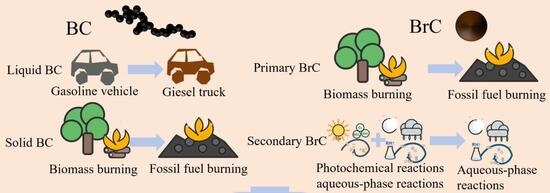
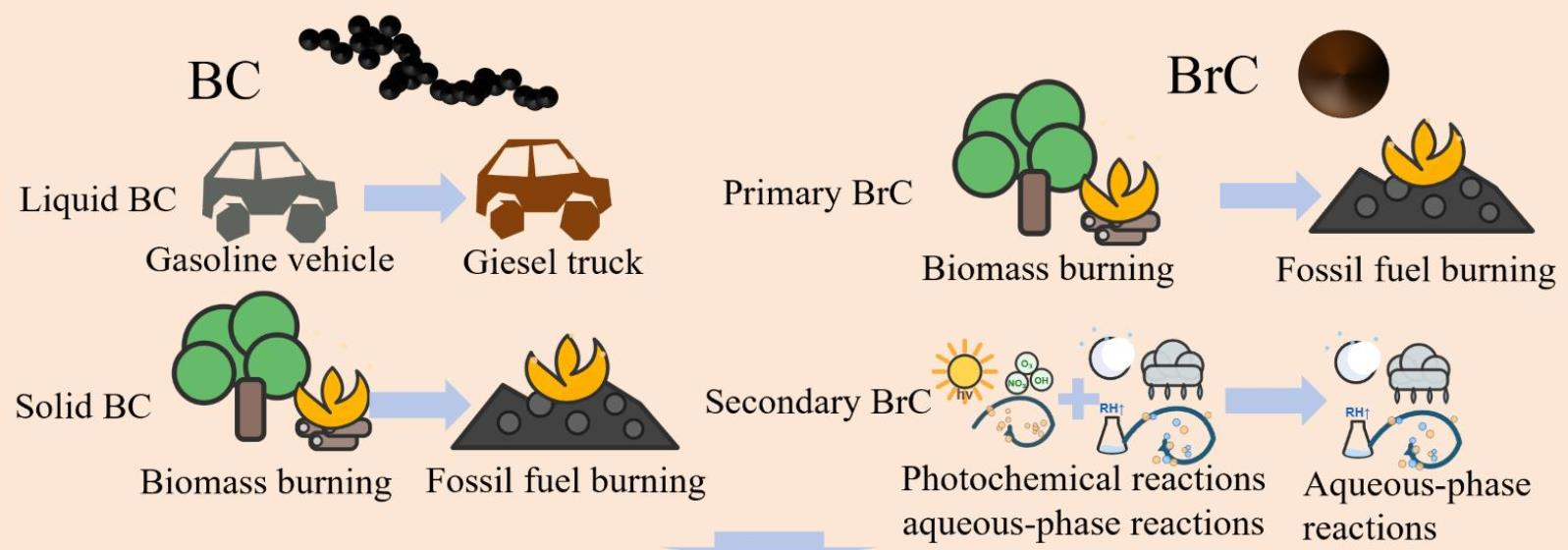
Graphical Abstract

1. Introduction

Carbonaceous aerosols that absorb light influence the climate by enhancing surface heating, promoting evaporation, and modifying cloud properties through direct and semi-direct radiative effects [1,2,3,4]. These light-absorbing particles are generally classified as black carbon (BC), which strongly absorbs across the visible spectrum, and brown carbon (BrC), which predominantly absorbs in the ultraviolet (UV) and short-visible wavelengths [5,6,7].
The recent studies have found that under certain regional conditions, energy-related incomplete combustion remains one of the primary sources of BC emissions, including the burning of fossil fuels, transportation fuels, and biomass. In China, BC does great harm to regional air quality [8,9]. Lu et al. [10] indicated that by 2030, China’s BC emissions may reach 166 Tg, and with the current energy mix. Moreover, Yu et al. [3] confirmed that BC emitted from different sources differs considerably in absorbance and radiation contribution. For example, an observation-constrained study in Nanjing found that BrC absorption accounted for 8.7–34.1% of total aerosol absorption at 370 nm, and that BrC’s average instantaneous direct radiative forcing was ~15% of that contributed by BC [11]. In parallel, measurements of residential biomass combustion emissions in Europe show BrC’s contribution to particulate light absorption varied between ~1% and 21% across 370–950 nm [12]. However, substantial uncertainties persist in quantifying BrC’s radiative impact—especially due to its heterogeneous composition and optical properties. The variability in imaginary refractive index, atmospheric aging, photobleaching effects, and source-dependent chromophore distributions all limit robust estimation of BrC’s global forcing [13]. In contrast to the pure light-absorbing substance BC, BrC is defined as a compound with a complex chemical composition, wide sources, and strong atmospheric reactivity. Moreover, BrC is composed of both primary and secondary organic carbons, which are often associated with various anthropogenic activities as well as complicated atmospheric processes.
Xi’an is located in central-northwest China, which is situated in the center of the Weihe Plain surrounded by Mt. Qinling and the Loess Plateau. Frequent occurrences of winter haze pollution have caused widespread public concern in this region, particularly during the winter of 2013 [14,15,16]. Since 2013, a series of air pollution control measures such as vehicle license plate number restrictions, “coal-to-gas”, and “clean-coal combustion” have gradually been implemented through government policy. After continual efforts, the occurrence of haze days has been considerably reduced over the past six years. In winter, traffic control and central heating activities have changed the air quality significantly over the years. Overall, comparing the levels, optical properties, sources, and regional transport of BC and BrC is essential to evaluating the effectiveness of air quality management strategies. Therefore, based on datasets of 5 min measurements over Xi’an, this study was conducted to (1) examine the 3-year variations in winter BC and BrC levels, sources, optical properties, and potential regional transport contribution in this region; (2) classify BC and BrC species, including liquid source- and solid source-derived BC and primary and secondary BrC, and assess their distribution differences during these years; and (3) quantify changes in multiple influential factors for different BC and BrC species, including meteorological indices and gaseous pollutants, before and after air pollution control measures.

2. Materials and Methods

2.1. Measurement and Classification of BC and BrC

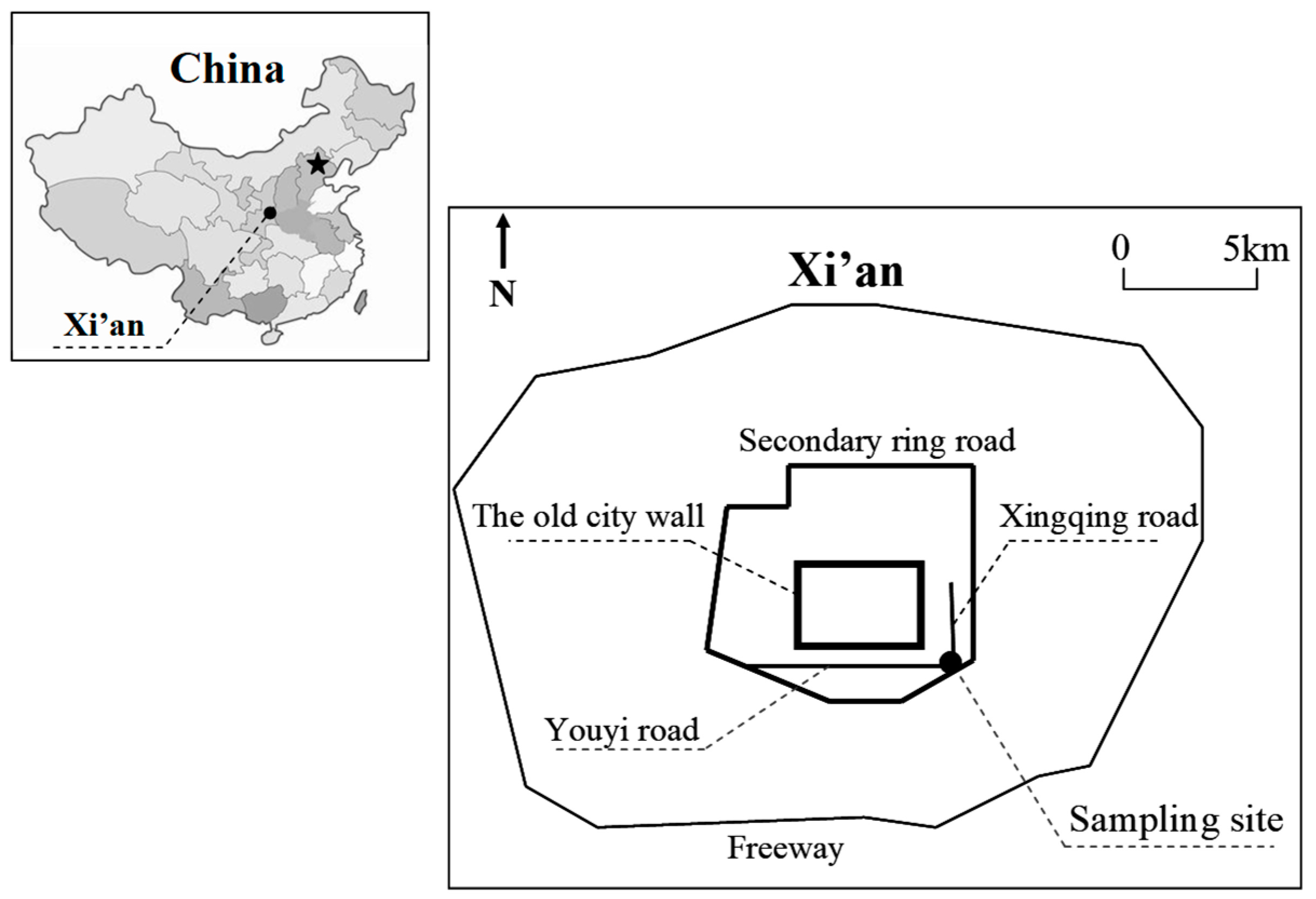
Figure 1 shows that the sampling site is situated on the roof (~15 m high) of the laboratory building at Xi’an Jiaotong University in southeastern Xi’an city. The site is surrounded by residential areas, campus, commercial streets, and the south second ring and Xingqing roads [17,18,19]. The aerosol light absorption coefficient (babs, Mm−1) was determined by monitoring the continuous, real-time reduction in light intensity as it passed through a glass fiber filter, where fine particulate matter (PM2.5) had been collected. Observations commenced in Xi’an in December 2013, utilizing a seven-wavelength Aethalometer (AE-31, Magee Scientific, Berkeley, CA, USA), operating at 370, 470, 520, 590, 660, 880, and 950 nm. In this study, a total of approximately 280,000 aerosol babs data points were collected during winter from 2013 to 2018, including December 2013–February 2014, December 2015–February 2016, and December 2017–February 2018. The inlet air flow of AE-31 was set as 5.0 L·min−1 and was calibrated before field measurements.
AE-31 babs data were post-processed with two corrections: a loading adjustment addressing nonlinear behavior as deposits accumulated on the filter, and a term accounting for scattering of light by the glass-fiber substrate [20,21]. Loading-related artifacts and filter-substrate scattering in the AE-31 were systematically characterized previously. This statement was originally made by Zhang et al. [22]. The derailed separating method of BC and BrC was presented by Olson et al. [23]. Therefore, BrC babs levels were calculated with two assumptions: The first assumption was that BC was the sole light absorber at 880 nm, and its absorption Ångstrom exponent (AAE) value was 1.0. The second assumption was that babs at 370 nm was mixed with BrC and BC. Subtracting the babs, the BC value from babs-370 nm yielded the net BrC absorption coefficient. Details regarding the babs-BrC calculations employed in this study were provided by Zhang et al. [24].

2.2. BC Source Identification Using the Aethalometer Model

Zhang et al. [25] identified two dominant sources of BC in China: liquid-fuel combustion (primarily vehicular) and solid-fuel burning (coal and biomass). At any selected wavelength, babs may be partitioned into liquid babs-BC (babs-Liquid) and solid babs-BC (babs-BCSolid). A straightforward separation procedure is adopted as follows:
b abs   370 liquid b abs   880 liquid = 370 880 ( AAE liquid )
b abs   370 solid b abs   880 solid = 370 880 ( AAE solid )
b abs   880 = b abs   880 liquid + b abs   880 solid
BC liquid = b abs   880 solid σ 880
where babs 370 and babs 880 denote absorption at 370 and 880 nm, respectively; b a b s λ l i q u i d marks the liquid-fuel share, and b a b s λ s o l i d reflects the solid-fuel contribution. babs is reported in Mm−1 (or 10−6 m−1); AAEliquid has a value of 1 for liquid fuel, and AAEsolid has a value of 2 for solid fuel [26]. Here, σ880 denotes the BC mass attenuation coefficient, 16.6 m2·g−1 at 880 nm.

2.3. Separation of Secondary BrC Absorption

BrC arises from primary as well as secondary pathways. Absorption by BrCP reflects contributions from combustion-related sources together with non-combustion BrC. Primary BrC from non-combustion origins is chiefly biogenic and occurs mostly in the coarse mode, so for a PM2.5-focused analysis, it can be disregarded [27]. Accordingly, the non-combustion portion of BrCP contributes negligibly to total babs-BrC owing to its small mass within PM2.5. To quantify the remainder, we partitioned babs into a secondary component (babs-BrCS) using a BC-tracer method. The resulting equations are provided below:
babs-BrCS = babs-BrC − combustion babs-BrCP
The primary combustion component of babs-BrC is computed as
Combustion babs-BrCP = (babs/BC) P × [BC]
where babs-BrC denotes the total BrC absorption coefficient at wavelength λ; P indicates the primary fraction; and [BC] denotes the BC concentration at 880 nm, obtained via the procedure in Section 2.1. The term (babs/BC)p, as defined per Equation (6), is the ratio between overall particle absorption and BC mass per volume for fresh combustion emissions and exhibits strong source sensitivity. Because this ratio is source dependent, selecting a representative value is nontrivial [28,29]. Consistent with our previous study [29], we estimated it using the minimum R-squared (MRS) criterion. This procedure generates multiple regressions relating BC to absorption by secondary BrC (refer to Figure S1 for R2). Assuming independence between BC and absorption by secondary BrC formed predominantly in ambient air, the chosen value of babs-BrCP is the one that yields the weakest association (is the smallest R2). After we obtained (babs/BC)p values at different wavelengths, we can then estimate the secondary BrC absorption during different sampling periods in Xi’an.

2.4. Potential Source Contribution Function (PSCF) and Cluster Analysis

PSCF was applied as an effective approach to identify potential source regions of babs-BC and babs-BrC across the sampling periods. Calculations were carried out in TrajStat, which relies on the MapWindow GIS ActiveX control open-source GIS framework (MapWindow open-source team, 2007) [30,31], with meteorological fields from the NCEP Global Data Assimilation System (GDAS). In addition, 24 h back trajectories ended in Xi’an (34.62° N, 108.93° E) at 500 m above ground level. The calculation was described as follows:
PSCFij = mij/nij
where mij and nij represent all endpoints and “high” endpoints falling within the ijth grid cell, respectively; the total amount of trajectory endpoints was calculated (the region of possible source was subdivided into i × j grid cells) at 0.5° latitude × 0.5° longitude in Xi’an. Thus, the calculated PSCFij was treated as a representative ratio of “high” grid points of babs-BC and babs-BrC events to their total grid points, respectively. These “high” events in this study were defined when the values of babs-BC and babs-BrC at the sampling site were larger than their own criterion values, respectively [32]. The criterion values were calculated as the 75th-percentile values of babs-BC and babs-BrC for the individual sampling periods [33,34].
Cluster analysis is a multivariate statistical technique to divide the total number of trajectory air masses into groups. For each twenty-hour trajectory, 24 x, y coordinates (i.e., trajectory location endpoints at each hour) were used as input variables for the clustering algorithm. A k-means clustering algorithm was used, and “Euclidean” was thus selected in TrajStat to evaluate the distances between latitudinal and longitudinal variables. Byčenkienė et al. [35] described this method in detail.

2.5. Generalized Additive Models (GAMs)

To assess the impact of control policies on BC and BrC, we applied generalized additive models (GAMs) to estimate how source-related pollutants and meteorology influence babs-BC and babs-BrC. The approach does not impose a fixed functional form on predictor–response relationships; instead, linear and nonlinear effects for each covariate are learned independently [36,37]. Predictors comprised meteorological variables, relative humidity, wind speed, and wind direction, and gaseous species SO2, NO2, and O3. We implemented four GAM specifications, given by
ln(babs) = s1(SO2) + s2(NO2) + s3(O3) + s4(relative humidity) + te(U,V) + ε
where babs denotes absorption coefficients for liquidBC, solidBC, BrC secondary, and BrC primary; si (i = 1, 2, 3, 4) are smooth functions; te is a tensor-product term; and ε denotes the GAM residual. Hourly meteorology was sourced from the national meteorological data portal of China, while SO2, NO2, and O3 were retrieved from the official site of the Xi’an Bureau of Environmental Protection. The five-minute babs series was aggregated to hourly means. Following [38], the combined effects of wind speed (m·s−1) and wind direction (rad) were examined via bivariate trend-surface modeling; formulations appear below:
U = wind speed × cos(wind direction)
V = wind speed × sin(wind direction)
where U > 0 denotes easterly flow, and V > 0 denotes northerly flow. Computations were performed in R (v. 3.6.1; R Foundation, Vienna, Austria), an open-source platform freely accessible online. GAMs were fitted with the mgcv package, and the significance of individual coefficients was evaluated using F-tests.

3. Results

3.1. Yearly Variations in BC Concentration

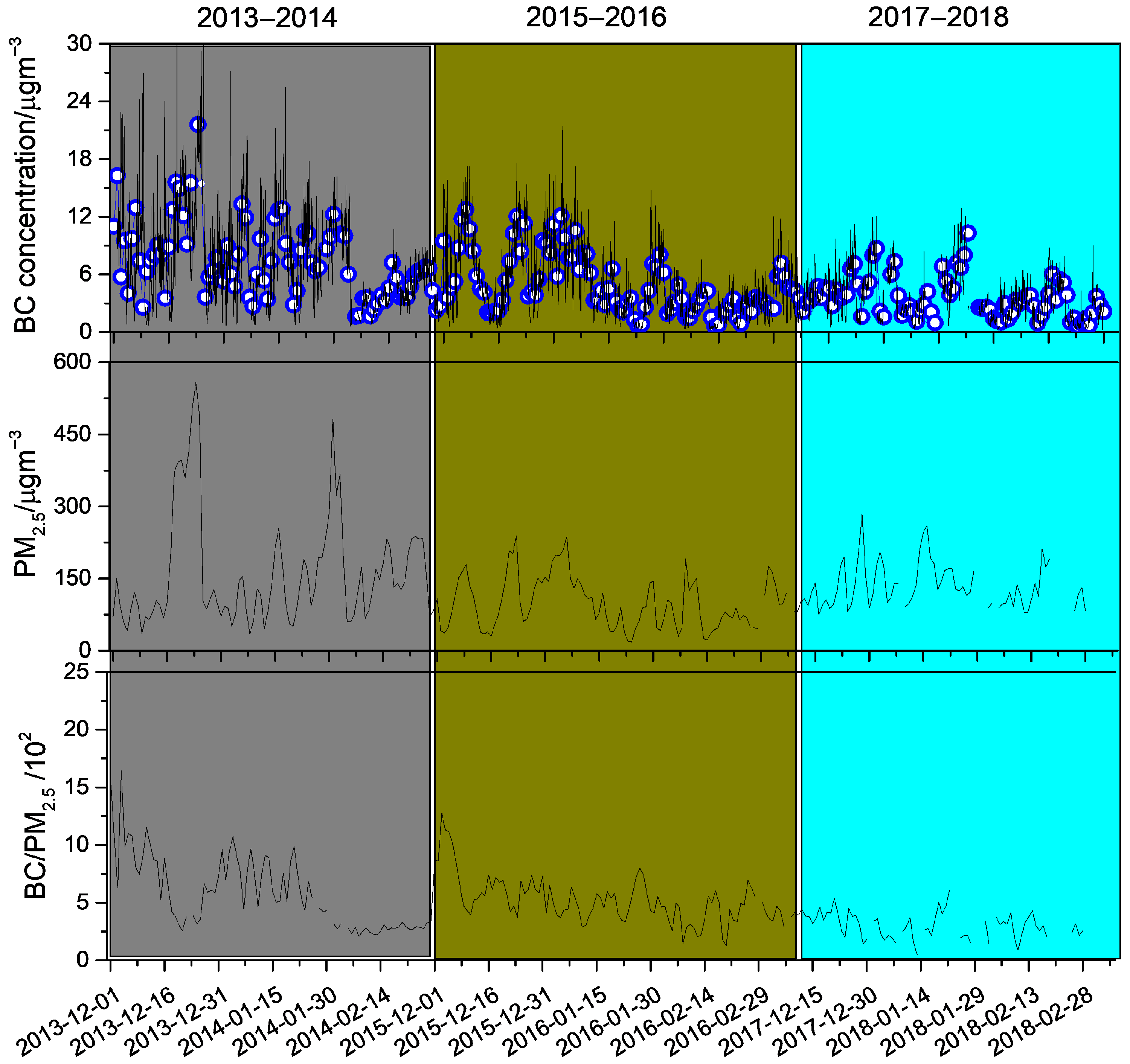
As presented in Figure 2, daily (24 h) mean BC concentrations were highest in winter 2013–2014 (7.5 ± 4.0 μg·m−3) and declined by a factor of 1.5–2 in 2015–2016 (5.2 ± 2.1 μg·m−3) and 2017–2018 (3.6 ± 1.1 μg·m−3). Across all winters, daily BC varied substantially (0.2 to 35.3 μg·m−3), indicating pronounced day-to-day fluctuations. Wintertime PM2.5 also showed strong variability, with the highest mean in 2013–2014 (162.4 ± 116.5 μg·m−3), followed by 2017–2018 (131.8 ± 45.7 μg·m−3) and 2015–2016 (96.4 ± 55.5 μg·m−3). Using daily means provides a consistent day-scale metric for interannual comparisons and, relative to sub-daily series, reduces short-lag serial dependence associated with diurnal cycling and short-term meteorological variability [39,40]. Consistent with the occurrence of shared pollution episodes, the daily PM2.5 and BC series were positively correlated in all three winters (Figure S2; r = 0.70 in 2013–2014, 0.80 in 2015–2016, and 0.60 in 2017–2018), with p < 0.001 for all periods. Because these are still time series influenced by multi-day stagnation, boundary-layer dynamics, and regional transport, we treat the correlation as a descriptive indicator of co-variation rather than definitive proof of co-emission or a single common source [41,42]. Additional constraints point to substantial shifts in dominant sources across winters: BC/PM2.5 ratios ranged from 0.012 to 0.164 during the sampling periods [26], with the smallest ratios (<0.05) mainly associated with residential solid-fuel combustion, whereas higher ratios (>0.1) were more frequent in 2013–2014, consistent with stronger contributions from industrial coal combustion and traffic emissions.
Table 1 indicates that the BC/CO ratios showed high variability during the sampling periods, ranging from 0.5 to 5.2. The average BC/CO ratio in this study appeared to be heavily influenced by diesel/gasoline vehicle and industrial emissions [25] and was determined to be comparable to measurements for urban plumes, such as those in Beijing [43], Shanghai [44], Guangzhou [45], Gwanjun [46], Bangkok [47], and Tokyo [48]. Moreover, the BC/CO ratios were considerably lower than those of biomass burning plumes. Studies on biomass combustion in different regions have reported greatly varying BC/CO ratios, which were relatively high for forest fires (28.5, [49]) and open burning of crop residue (8.9–9.4, [50]), reaching as low as 3.2 for crop residue burning over the North China Plain and in Central China [42]. Thus, the types of mass burned and combustion conditions affect BC/CO. As a central city in northwestern China, the heavy combustion of low-quality biomass fuels for heating during the cold winter leads to relatively high BC/CO over the Xi’an region.

3.2. Light-Absorbing Properties and Potential Source Regions of BC and BrC

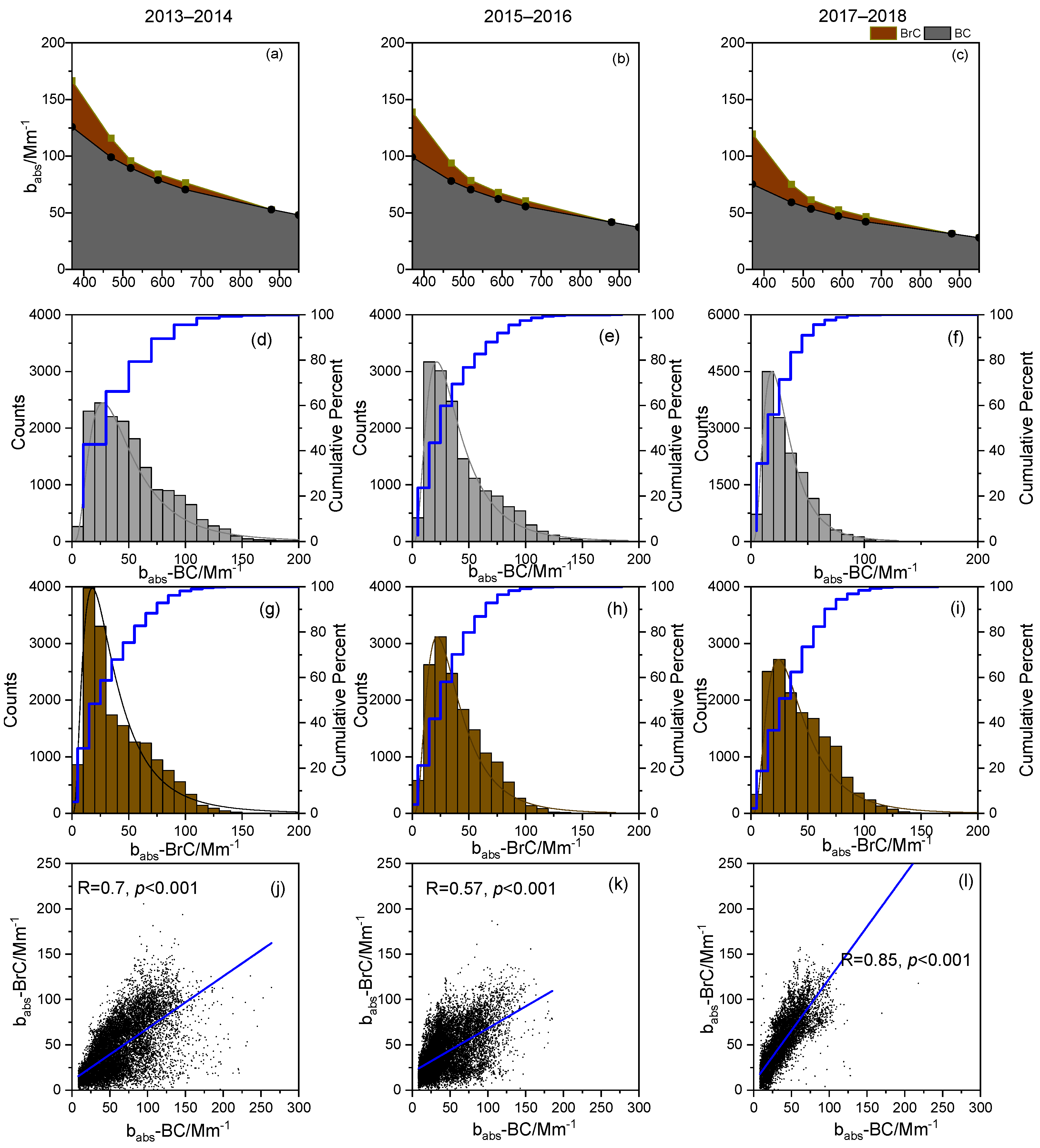
In Figure 3a–c, the yearly average babs-BC was the dominant contributor to particulate absorption over the seven wavelengths and decreased in winter over Xi’an. Previous studies confirmed that the light absorption coefficient of BC at 880 nm is representative of actual BC absorption without BrC effects [42,51]. Similarly to the observed BC concentration, babs-BC exhibited a decreasing trend from 60.0 Mm−1 during 2013–2014 to 42.4 Mm−1 during 2015–2016 and 32.1 Mm−1 during 2017–2018. As presented in other studies [22,23,29], the data of babs in the UV spectra (370 nm) (babs-BrC) were selected to represent babs data for ambient BrC in this study. In contrast to the preceding results, the winter babs-BrC value was high (41.7 Mm−1) during 2017–2018 but decreased to 37.9 Mm−1 during 2015–2016 and to 35.6 Mm−1 during 2013–2014. Similarly, the contribution of babs-BrC to total babs at the 370 nm wavelength increased substantially in each winter period, accounting for approximately 15% during 2013–2014, 17% during 2015–2016, and as much as 40% during 2017–2018. These trends demonstrate that the influence of BrC on light absorption was substantially strengthened.
As shown in Figure 3d–f, the distribution of babs-BC in different wintertime exhibited distinct variations. The babs-BC values had a flat and wide range (15–80 Mm−1) in 2013–2014, but in subsequent years, they were distributed in narrow ranges (10–30 Mm−1, >70%). Furthermore, only approximately 8% of the data exceeded 100 Mm−1 and 70 Mm−1 during 2015–2016 and 2017–2018 (Figure 3d–f), respectively, possibly because of changes in meteorological conditions and major contribution sources [24]. By contrast, winter babs-BrC exhibited an approximately unimodal distribution, with about 60% of values concentrated within 15–50 Mm−1 (Figure 3g–i) during the sampling periods, indicating a broadly consistent range of BrC absorption levels across winters. Moreover, the relationship between babs-BrC and babs-BC during these periods was demonstrated by the strong correlation observed during the winters of 2013–2014 and 2017–2018 and the weak correlation during that of 2015–2016 (0.57). Thus, we infer that BC and BrC are often co-emitted from common primary combustion sources, particularly incomplete residential coal and biomass burning, consistent with source-emission/combustion studies reporting the co-occurrence of BC and BrC absorption in emissions from combustion fuels, including mixed biomass and fossil-fuel combustion [23]. However, these findings also demonstrate that considerable amounts of BrC in 2015–2016 were produced from secondary rather than direct emissions (see Section 3.3).
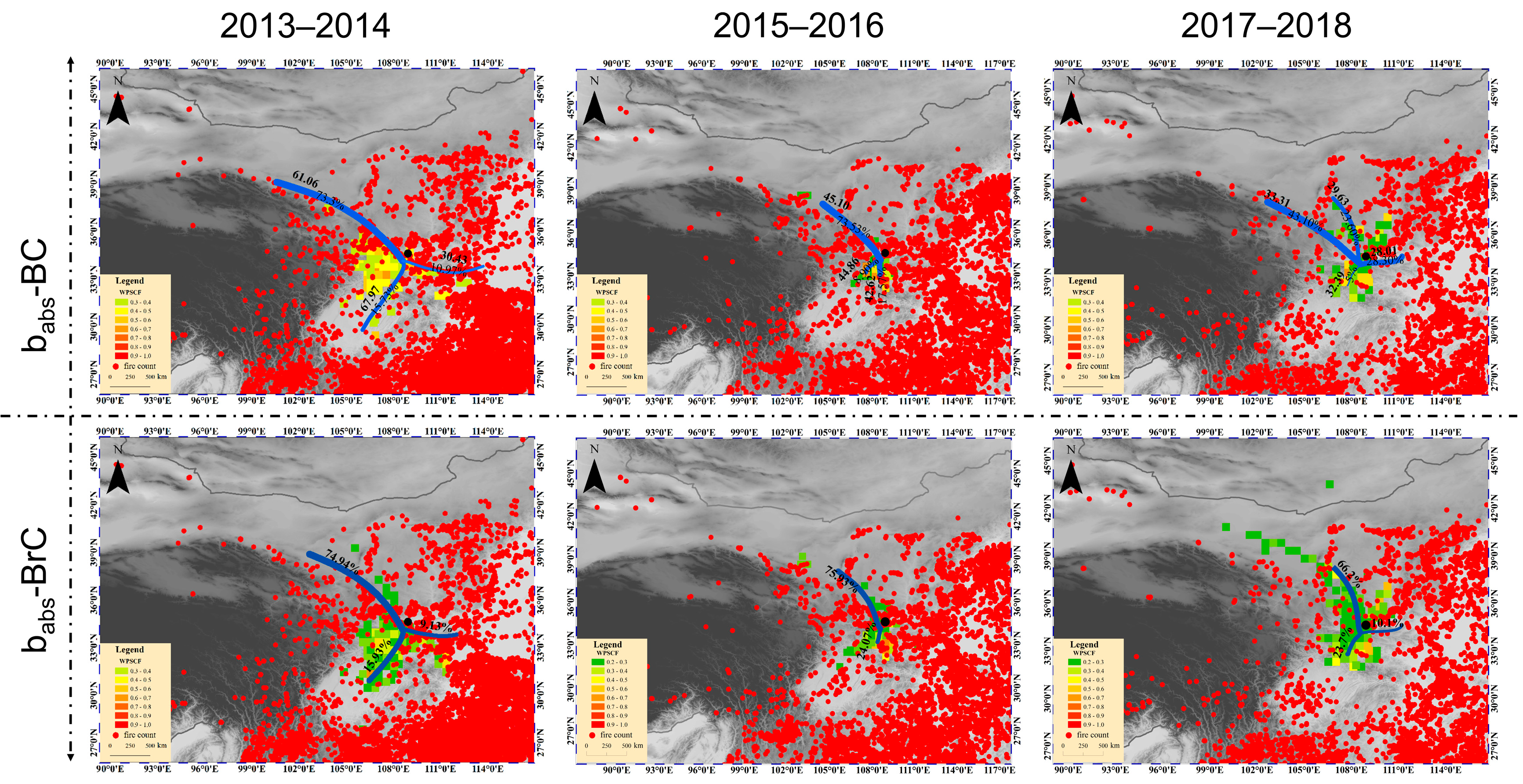
Figure 4 illustrates the results of the cluster analysis and potential source regions with weighted PSCF values for higher concentrations (above the 75th percentile) of babs-BC and babs-BrC in Xi’an. For babs-BC, the trajectories were grouped into three clusters during the entire sampling period. Cluster 1 from the northwestern direction was the largest (~73%), and the air masses associated with this cluster yielded the lowest PSCF values (<0.3) among the three clusters, indicating that air from Cluster 1 was less polluted. However, during 2013–2014 and 2015–2016, the other two polluted clusters (Clusters 2 and 3) of babs-BC were derived from the south–southwestern direction (>26% of the wintertime trajectories), which had high PSCF values (0.4–0.7). Moreover, dense open fire points in the south–southeast were well matched with these clusters during these two winter periods (Figure S3), indicating that babs-BC was largely affected by suburban area and local biomass combustion emissions [22,52]. By contrast, higher PSCF values (0.4–0.5) were mainly concentrated in clusters 2 and 3 during the winter of 2017–2018 in the north–northeast and southwest of Xi’an. These regions weakly corresponded to open fire points, possibly because of the intensive burning of fossil fuels. Similarly to babs-BC, babs-BrC was also heavily influenced by local emissions during the winter sampling periods. In addition, the babs-BrC clusters from the north-northeast direction had high PSCF values (0.4–0.6) during 2017–2018. These emissions were transported from surrounding regions and provinces (e.g., Yulin and Shanxi province), where coal remains widely used in industrial and residential sectors that increase BrC levels [53,54].

3.3. Assess BC and BrC Sources

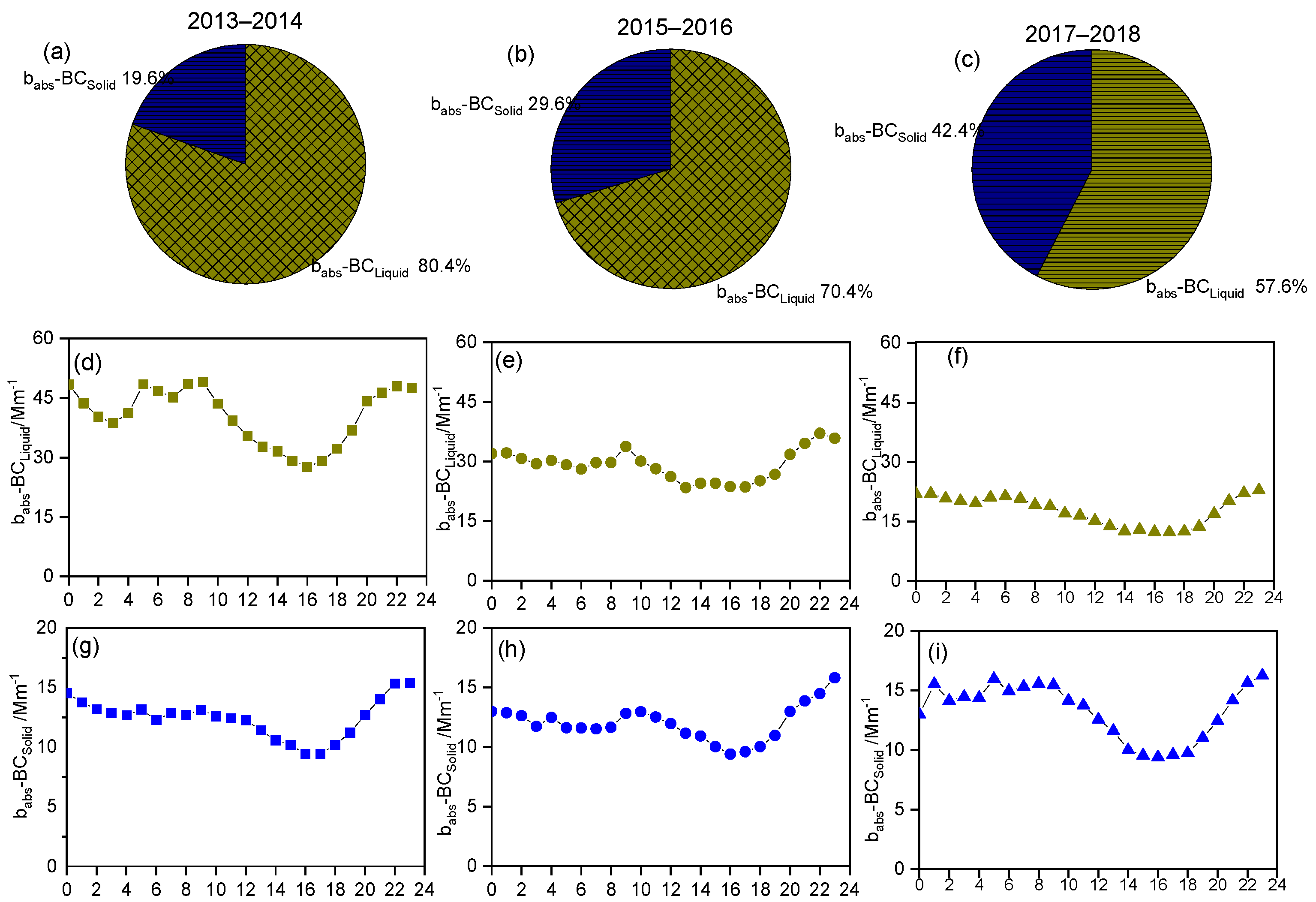
To investigate BC sources in depth, the relative contributions of liquid and solid sources to babs-BC were apportioned using the aethalometer model, as presented in Figure 5a–c. The average concentration of babs-Liquid in Xi’an was 32.1 ± 15.1 Mm−1, approximately three times the value of babs-BCSolid. In addition, babs-Liquid had a wider concentration range of 10.5–111.4 Mm−1, whereas babs-BCS had a narrower range of 5–15 Mm−1, indicating that BC absorptions in Xi’an were significantly influenced by vehicle emissions and varied with traffic flow. In addition, higher babs-Liquid fractions of 80.4% and 70.4% were observed during 2013–2014 and 2015–2016, respectively, whereas solid sources contributed up to approximately 30% of BC absorption during 2017–2018, indicating that major BC pollution sources changed to biomass/coal combustion emissions. In terms of the diurnal cycles of babs-Liquid (Figure 5d–f), babs-Liquid exhibited a bimodal distribution with two obvious high points during morning 06:00 local standard time (LST) and evening (18:00 LST traffic rush hours [55,56]. Moreover, babs-BCLiquid did not decrease after the evening rush hour mainly because of the lowering of the local nocturnal boundary layer, allowing little space for pollutants to accumulate. Unlike other urban areas, the third peak of babs-BCLiquid emissions from diesel vehicles occurred at approximately midnight and in the early morning because diesel trucks are allowed to drive on the second-ring roads. These babs-BCLiquid peaks were higher than those of gasoline emissions, indicating the strong BC intensity of diesel emissions [57,58,59]. In contrast to that of babs-Liquid, only one peak observed for babs-BCSolid persisted nearly throughout the night (18:00–06:00 LST), and minimum babs-BCSolid values were observed on all days. This indicates that these peaks were closely related to changes in household heating at night, thereby verifying that contributions of solid sources did not decrease substantially during these years.
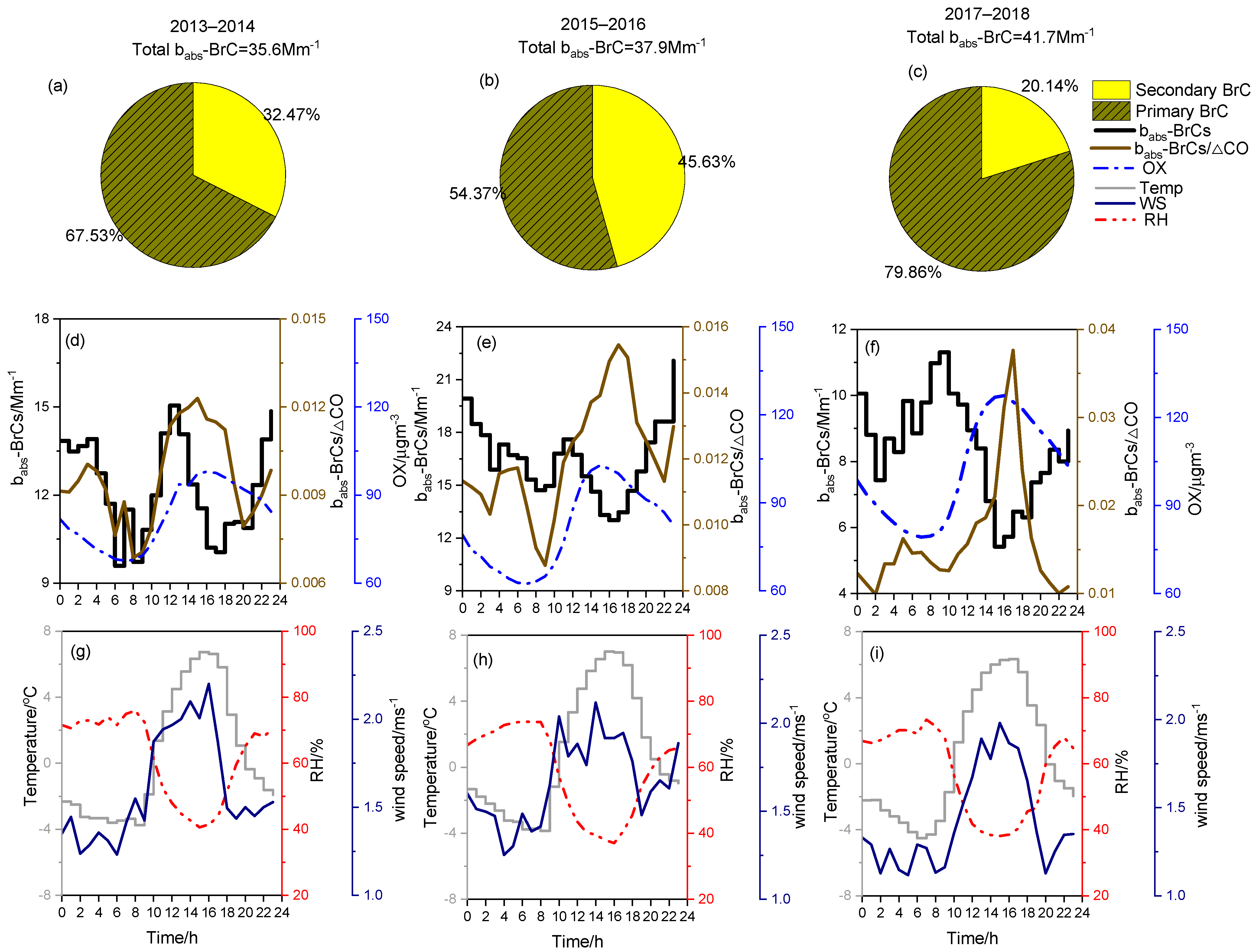
Figure 6a–c illustrates the average quantities of babs-BrCP and babs-BrCS during all sampling periods. The babs-BrCP values were 24.0, 20.6, and 33.3 Mm−1 in the years of 2013–2014, 2015–2016, and 2017–2018, respectively. Moreover, high ratios of babs-BrCP to total BrC (54.4–80.0%) were observed, suggesting that primary emissions produced from household heating (coal and biomass combustion) play an important role in BrC contributions [60,61]. Relatively low contributions of babs-BrCS to BrC were observed during 2013–2014 and 2017–2018, but they reached 45.6% during 2015–2016 because of changes in energy structures and BrC formation mechanisms.
To explain BrC formation, this study investigated the diurnal cycles of S-BrC concentration, babs-BrCS/ΔCO ratio, and odd-oxygen-mixing ratio (OX = NO2 + O3), as plotted in Figure 6d–f. The diurnal patterns of babs-BrCS were similar during 2013–2014 and 2015–2016 and peaked in midday 11:00–13:00 LST and at late night (22:00–02:00) LST. In addition, the babs-BrCS/ΔCO ratio increased at the same time because of activated secondary formation. Combined with variable meteorological conditions, the babs-BrCS peak at noon possibly occurred because of photochemical reactions with high OX, whereas the late-night babs-BrCS peak could be attributed to aqueous reactions under high-RH conditions [29,62]. By contrast, completely inverse variations in babs-BrCS and babs-BrCS/ΔCO were observed during 15:00–16:00 LST, indicating that the photochemical production rate of babs-BrCS was much lower than the photodegradation rate. Moreover, reduced babs-BrCS occurred at times with beneficial dispersion conditions and a relatively high boundary layer. During 2017–2018, the babs-BrCS values were completely different from those observed during the other two years. No substantial peak was observed at midday, whereas babs-BrCS retained high values after 20:00 LST for a relatively long time [63]. It was confirmed that the quantity of total chromophore observed in Xi’an in the winter of 2017 was poorly associated with secondary photochemical production of BrC. The high babs-BCS proportion in our study suggests that secondary BrC is mainly produced from aqueous reactions from fossil fuel burning and contains high levels of light-absorbing chromophores that could significantly affect the light-absorbing abilities of organic aerosols in the atmosphere [64].

3.4. Quantifying the Influence of Local Sources and Meteorology on BC

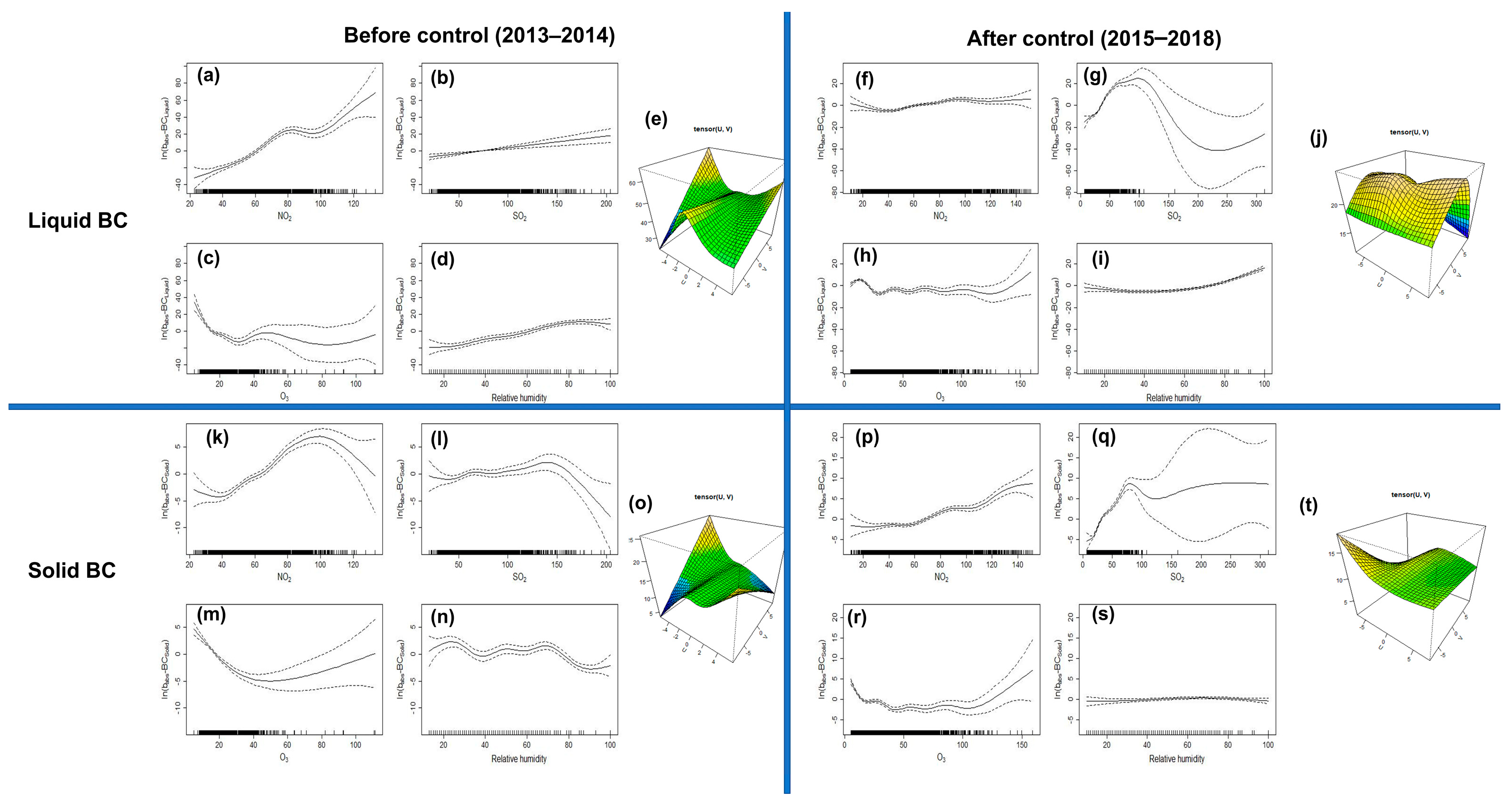
After the heavy pollution event in the winter of 2013, the Xi’an government implemented restrictions on vehicle license plate numbers and coal-to-gas conversion. Figure 1 indicates that BC emissions in Xi’an decreased by 32% and 50% from 2013 to 2014 and 2015–2016, as well as 2017–2018, respectively. Thus, GAMs for ln(babs-Liquid) and ln(babs-BCSolid) before (2013–2014) and after (2015–2018) the control period were applied to further assess the key emission effects from all observed gaseous pollutants and meteorological conditions. The R2 value calculated for the GAMs ranged from 0.5 to 0.7, indicating that the GAMs could explain more than 50% and 70% of the ln(babs-Liquid) and ln(babs-BCSolid) variance during 2013–2014 and 2015–2018, respectively.
During 2013–2014, NO2 and RH accounted for 26.3% and 8.2% of the variance in babs-Liquid levels at the 99% confidence level, respectively, and both increased linearly with ln(babs-Liquid), indicating that high RH (50–70%) under relatively stable meteorological conditions (wind speed < 2 m·s−1) could accelerate the condensation, nucleation, and growth of vehicle emissions [65,66], leading to the accumulation of babs-Liquid. After the implementation of restrictions on vehicle license plate numbers, the contribution of NO2 decreased by 4.1 times during 2015–2018, demonstrating the high effectiveness of the restrictions in reducing BC concentrations. In contrast to those observed during 2013–2014, high SO2 levels explained 56.6% of ln(babs-Liquid), confirming that increased diesel truck emissions at night contributed the most to babs-Liquid levels during 2015–2018. Unlike the increasing variables, the variance in O3 decreased linearly with increased ln(babs-Liquid), indicating that babs-Liquid decreases rapidly with high oxidant levels because O3 can catalyze the photochemical reaction of BC, such that it is mostly consumed. In addition, these decreasing effects occurred only in low-O3 ranges (<25 μg·m−3), whereas O3 deviance became large and sparse when its value exceeded 50 μg·m−3. Other meteorological conditions, such as wind speed and direction, contributed less to the deviance of babs-Liquid with low variance ranges (<2%). For ln(babs-BCSolid), combined NO2 and SO2 explained 49.3% and 75.4% of ln(babs-BCSolid) in 2013–2014 and 2015–2018, respectively. Tian et al. [67] demonstrated that inefficient combustion of raw coal for heating can produce large amounts of NOx and SO2. Thus, winter heating emissions from coal combustion constituted a substantial fraction of babs-BCSolid. However, Figure 7 indicates that increased SO2 concentrations during 2015–2018 exhibited a significantly linear relationship with ln(babs-BCSolid) (p < 0.001, F-test, Table 2) compared with those during 2013–2014. This indicates that improving coal combustion technology in winter remains an effective means of reducing the production of babs-BCSolid. Similar to babs-Liquid, RH affected babs-BCSolid accumulation more during 2013–2014 than during 2015–2018. By contrast, the combination of wind speed and wind direction appeared to be an increasing contributor (>10%) to the transportation of polluted air in the southern (V < 0) and western (U < 0) directions, leading to high ln(babs-BCSolid) values during 2013–2014. Similarly, the PSCF and cluster analyses highlighted the influence of biomass combustion.

3.5. Source Apportionment of BrC

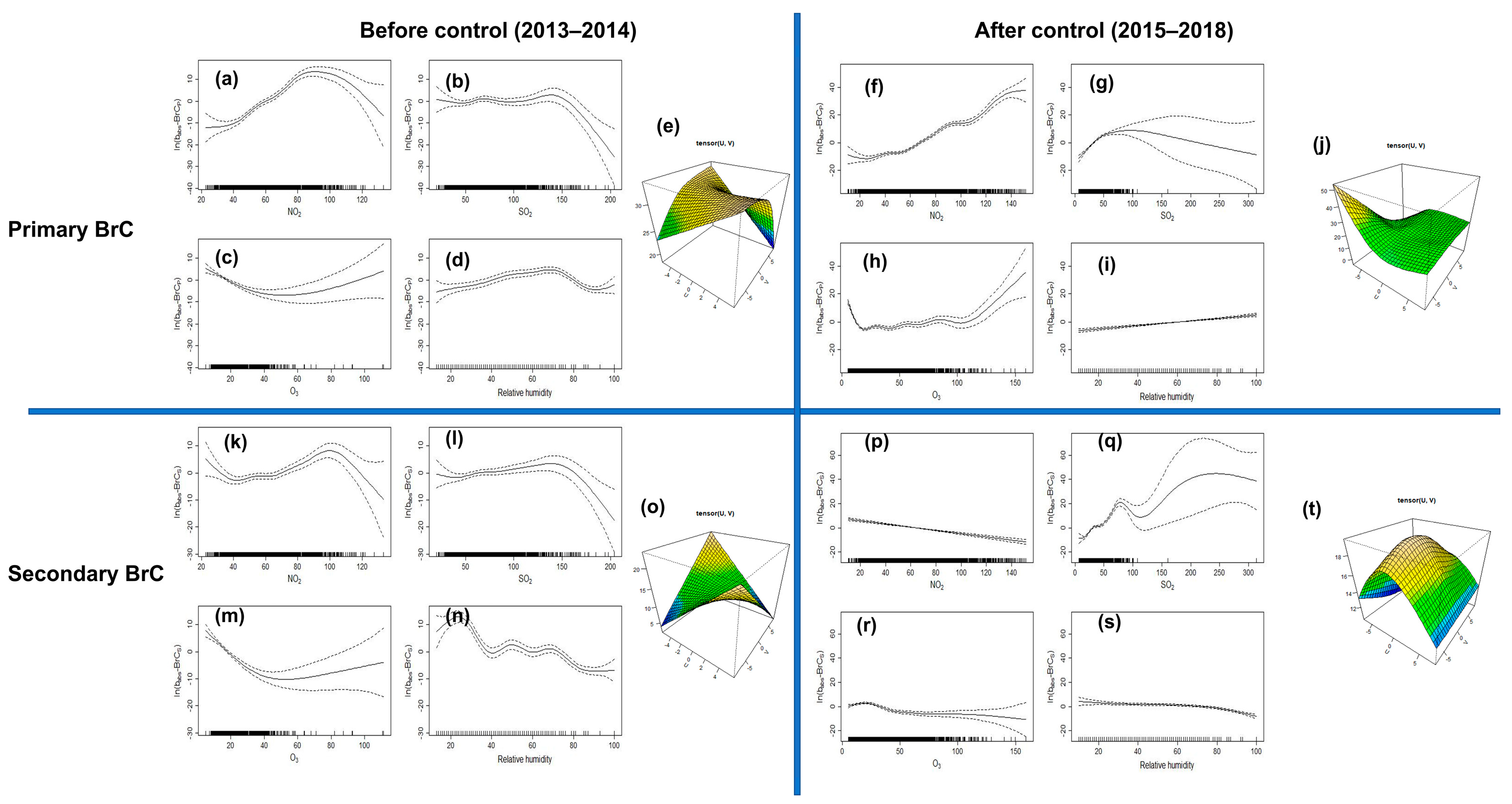
To quantify BrC sources, GAMs were created for ln(babs-BrCP) and ln(babs-BrCS). Gaseous pollutants and meteorological parameters in the GAMs could explain 41–60% of ln(babs-BrCP) variance but only 20–30% of ln(babs-BrCS) (Table 2). Unlike those of BC, similar BrC values were observed during the sampling periods. High NO2 and SO2 concentration levels contributed considerably (>50%) to ln(babs-BrCP) before and after the control period, confirming the fossil fuel combustion influences. As supported, Lei et al. [19] highlighted that 35% of primary BrC in winter was derived from traffic emissions and coal combustion. Similarly to BC, RH was a major meteorological parameter for high ln(babs-BrCP) during 2013–2014. In addition, approximately 5% of the variability in ln(babs-BrCP) was related to wind speed and direction during 2013–2014, indicating that high wind speed from the west–southwestern direction was conducive to primary BrC diffusion. Regarding O3 effects (Figure 8), a similarly linear decreasing trend showed photodegradation of babs-BrCP was significant in Xi’an winters. The low R2 value for ln(babs-BrCS) calculated in the GAMs suggests that a substantial portion of ln(babs-BrCS) could not be explained by the parameters in the current model. More parameters must be considered for GAMs to quantify babs-BrCS in future work.

4. Conclusions

This study investigated the concentrations and optical properties of BC and BrC during three winter periods from 2013 to 2018. Optical parameters were used along with PSCF analysis, and the results reveal that both BC and primary BrC were typically affected by direct local emissions and the transportation of polluted air masses from surrounding biomass-burning areas or coal-dominated regions. A high secondary BrC ratio was also observed in winter, indicating that aqueous transforming reactions were dominant sources of BrC. Moreover, a GAM statistical methodology was used to evaluate the contributions of gaseous pollutants and meteorological conditions before (2013–2014) and after (2015–2018) air pollution control policies. Most variations in babs-BC derived from liquid sources could be explained by NO during 2013–2014 and by SO during 2015–2018, indicating that restrictions on vehicle license plate numbers were effective in reducing gasoline vehicle influences and had a limited effect on diesel emissions. The combination of SO and NO concentrations emitted from residential coal combustion for heating explained the significant increase in solid babs-BC and primary babs-BrC. In addition, meteorological variables exhibited multilinear relationships with babs-BC and babs-BrC in different years, indicating that the meteorological variables had considerable effects on the accumulation and dispersion of BC and BrC emissions across the studied years.

Supplementary Materials

The following supporting information can be downloaded at: https://www.mdpi.com/article/10.3390/toxics14010093/s1. Figure S1: R2 from regression between babs-BrCS versus BC and assumed (babs)/BC)P ratio in three years; Figure S2: Correlations of PM2.5 and BC concentrations; Figure S3: Fire counts during sampling periods.

Author Contributions

Conceptualization, D.L.; methodology, Q.Z. and P.W.; software, Z.M. and P.W.; validation, P.W. and Y.W.; formal analysis, D.L. and H.X.; investigation, Z.M.; resources, Z.S.; data curation, H.X. and Y.W.; writing—original draft preparation, D.L.; writing—review and editing, Q.Z. and Z.S.; visualization, D.L.; supervision, Q.Z., Z.M. and Y.W.; project administration, H.X.; funding acquisition, Q.Z. and Z.S. All authors have read and agreed to the published version of the manuscript.

Funding

This study was supported by the National Natural Science Foundation of China (42577536), Key R&D project of Shaanxi Province (2024SF-ZDCYL-05-06), Natural Science Basic Research Program of Shaanxi Province (2025JC-YBMS-259).

Institutional Review Board Statement

Not applicable.

Informed Consent Statement

Not applicable.

Data Availability Statement

The data presented in this study are available on request from the corresponding author.

Acknowledgments

The authors would like to acknowledge the kind help and suggestions of all the anonymous reviewers.

Conflicts of Interest

The authors declare no conflicts of interest.

References

  1. Kanakidou, M.; Seinfeld, J.H.; Pandis, S.N.; Barnes, I.; Dentener, F.J.; Facchini, M.C.; Dingenen, R.V.; BErvens, A.N.; Nielsen, C.J.; Swietlicki, E.; et al. Organic aerosol and global climate modelling: A review. Atmos. Chem. Phys. 2005, 5, 1053–1123. [Google Scholar] [CrossRef]
  2. Robinson, A.L.; Donahue, N.M.; Shrivastava, M.K.; Weitkamp, E.A.; Sage, A.M.; Grieshop, A.P.; Lane, T.E.; Pierce, J.R.; Pandis, S.N. Rethinking organic aerosols: Semivolatile emissions and photochemical aging. Science 2007, 315, 1259–1262. [Google Scholar] [CrossRef]
  3. Yu, L.; Smith, J.; Laskin, A.; George, K.M.; Anastasio, C.; Laskin, J.; Dillner, A.M.; Zhang, Q. Molecular transformations of phenolic SOA during photochemical aging in the aqueous phase: Competition among oligomerization, functionalization, and fragmentation. Atmos. Chem. Phys. 2016, 16, 4511–4527. [Google Scholar] [CrossRef]
  4. Moschos, V.; Kumar, N.K.; Daellenbach, K.R.; Baltensperger, U.; Prévôt, A.S.H.; El Haddad, I. Source Apportionment of brown carbon absorption by coupling ultraviolet–visible spectroscopy with aerosol mass spectrometry. Environ. Sci. Technol. Lett. 2018, 5, 302–308. [Google Scholar] [CrossRef]
  5. Moosmüller, H.; Chakrabarty, R.K.; Arnott, W.P. Aerosol light absorption and its measurement: A review. J. Quant. Spectrosc. Radiat. Transfer. 2009, 110, 844–878. [Google Scholar] [CrossRef]
  6. Chakrabarty, R.K.; Arnold, I.J.; Francisco, D.M.; Hatchett, B.; Hosseinpour, F.; Loria, M.; Pokharel, A.; Woody, B.M. Black and brown carbon fractal aggregates from combustion of two fuels widely used in Asian rituals. J. Quant. Spectrosc. Radiat. Transfer. 2013, 122, 25–30. [Google Scholar] [CrossRef]
  7. Lack, D.A.; Langridge, J.M. On the attribution of black and brown carbon light absorption using the Ångström exponent. Atmos. Chem. Phys. 2013, 13, 10535–10543. [Google Scholar] [CrossRef]
  8. Kanaya, Y.; Yamaji, K.; Miyakawa, T.; Taketani, F.; Zhu, C.; Choi, Y.; Komazaki, Y.; Ikeda, K.; Kondo, Y.; Klimont, Z. Rapid reduction in black carbon emissions from China: Evidence from 2009–2019 observations on Fukue Island, Japan. Atmos. Chem. Phys. 2020, 20, 6339–6356. [Google Scholar] [CrossRef]
  9. Zhao, W.; Zhao, Y.; Zheng, Y.; Chen, D.; Xin, J.; Li, K.; Che, H.; Li, Z.; Ma, M.; Hang, Y. Long-term variability in black carbon emissions constrained by gap-filled absorption aerosol optical depth and associated premature mortality in China. Atmos. Chem. Phys. 2024, 24, 6593–6612. [Google Scholar] [CrossRef]
  10. Lu, Y.; Wang, Q.; Zhang, X.; Qian, Y.; Qian, X. China’s black carbon emission from fossil fuel consumption in 2015, 2020, and 2030. Atmos. Environ. 2019, 212, 201–207. [Google Scholar] [CrossRef]
  11. Cheng, Y.; Liu, C.; Wang, J.; Wang, J.; Zhang, Z.; Chen, L.; Ge, D.; Zhu, C.; Wang, J.; Ding, A. An observation-constrained estimation of brown carbon aerosol direct radiative effects. Atmos. Chem. Phys. 2024, 24, 3065–3078. [Google Scholar] [CrossRef]
  12. Basnet, S.; Hartikainen, A.; Virkkula, A.; Yli-Pirilä, P.; Kortelainen, M.; Suhonen, H.; Kilpeläinen, L.; Ihalainen, M.; Väätäinen, S.; Louhisalmi, J.; et al. Contribution of brown carbon to light absorption in emissions of European residential biomass combustion appliances. Atmos. Chem. Phys. 2024, 24, 3197–3215. [Google Scholar] [CrossRef]
  13. Laskin, A.; West, C.P.; Hettiyadura, A.P.S. Molecular insights into the composition, sources, and aging of atmospheric brown carbon. Chem. Soc. Rev. 2025, 54, 1583–1612. [Google Scholar] [CrossRef]
  14. Duan, J.; Huang, R.-J.; Wang, Y.; Xu, W.; Zhong, H.; Lin, C.; Huang, W.; Gu, Y.; Ovadnevaite, J.; Ceburnis, D.; et al. Measurement report: Size-resolved secondary organic aerosol formation modulated by aerosol water uptake in wintertime haze. Atmos. Chem. Phys. 2024, 24, 7687–7698. [Google Scholar] [CrossRef]
  15. Su, H.; Zhang, T.; Liu, S.; Qu, Y.; Li, H.; Zhou, J.; Zhao, Z.; Wang, Q.; Li, L.; Shen, M.; et al. Growth of nitrate contribution to aerosol pollution during wintertime in Xi’an, northwest China: Formation mechanism and effects of NH3. Particuology 2024, 87, 303–315. [Google Scholar] [CrossRef]
  16. Yang, S.; Yang, X.; Wang, Y.; Wang, Z.; Pang, Y.; He, C.; Liu, F. An unexpected increase in PM2.5 levels in Xi’an during the COVID-19 pandemic restrictions: The interplay of anthropogenic and natural factors. J. Environ. Sci. 2025, 156, 321–331. [Google Scholar] [CrossRef] [PubMed]
  17. Shen, Z.; Zhang, L.; Cao, J.; Tian, J.; Liu, L.; Wang, G.; Zhao, Z.; Wang, X.; Zhang, R.; Liu, S. Chemical composition, sources, and deposition fluxes of water-soluble inorganic ions obtained from precipitation chemistry measurements collected at an urban site in northwest China. J. Environ. Monit. 2012, 14, 3000–3008. [Google Scholar] [CrossRef]
  18. Zhang, Q.; Shen, Z.; Cao, J.; Zhang, R.; Zhang, L.; Huang, R.J.; Zheng, C.; Wang, L.; Liu, S.; Xu, H.; et al. Variations in PM2.5, TSP, BC, and trace gases (NO, SO, and O3) between haze and non-haze episodes in winter over Xi’an, China. Atmos. Environ. 2015, 112, 64–71. [Google Scholar] [CrossRef]
  19. Lei, Y.; Shen, Z.; Zhang, T.; Lu, D.; Zeng, Y.; Zhang, Q.; Xu, H.; Bei, N.; Wang, X.; Cao, J. High time resolution observation of PM2.5 Brown carbon over Xi’an in northwestern China: Seasonal variation and source apportionment. Chemosphere 2019, 237, 124530. [Google Scholar] [CrossRef]
  20. Luoma, K.; Virkkula, A.; Aalto, P.; Lehtipalo, K.; Petäjä, T.; Kulmala, M. Effects of different correction algorithms on absorption coefficient—A comparison of three optical absorption photometers at a boreal forest site. Atmos. Meas. Tech. 2021, 14, 6419–6441. [Google Scholar] [CrossRef]
  21. Coen, M.C.; Weingartner, E.; Apituley, A.; Ceburnis, D.; Fierz-Schmidhauser, R.; Flentje, H.; Henzing, J.S.; Jennings, S.G.; Moerman, M.; Petzold, A.; et al. Minimizing light absorption measurement artifacts of the Aethalometer: Evaluation of five correction algorithms. Atmos. Meas. Tech. 2010, 3, 457–474. [Google Scholar] [CrossRef]
  22. Zhang, Q.; Shen, Z.; Ning, Z.; Wang, Q.; Cao, J.; Lei, Y.; Sun, J.; Zeng, Y.; Westerdahl, D.; Wang, X.; et al. Characteristics and source apportionment of winter black carbon aerosols in two Chinese megacities of Xi’an and Hong Kong. Environ. Sci. Pollut. Res. 2018, 25, 33783–33793. [Google Scholar] [CrossRef]
  23. Olson, M.R.; Victoria Garcia, M.; Robinson, M.A.; Van Rooy, P.; Dietenberger, M.A.; Bergin, M.; Schauer, J.J. Investigation of black and brown carbon multiple-wavelength-dependent light absorption from biomass and fossil fuel combustion source emissions. J. Geophys. Res. Atmos. 2015, 120, 6682–6697. [Google Scholar] [CrossRef]
  24. Zhang, Q.; Ning, Z.; Shen, Z.; Li, G.; Zhang, J.; Lei, Y.; Xu, H.; Sun, J.; Zhang, L.; Westerdahl, D.; et al. Variations of aerosol size distribution, chemical composition and optical properties from roadside to ambient environment: A case study in Hong Kong, China. Atmos. Environ. 2017, 166, 234–243. [Google Scholar] [CrossRef]
  25. Zhang, Q.; Streets, D.G.; Carmichael, G.R.; He, K.B.; Huo, H.; Kannari, A.; Klimont, Z.; Park, I.S.; Reddy, S.; Fu, J.S.; et al. Asian emissions in 2006 for the NASA INTEX-B mission. Atmos. Chem. Phys. 2009, 9, 5131. [Google Scholar] [CrossRef]
  26. Liu, Y.; Yan, C.; Zheng, M. Source apportionment of black carbon during winter in Beijing. Sci. Total Environ. 2018, 618, 531–541. [Google Scholar] [CrossRef]
  27. Perrino, C.; Marcovecchio, F. A new method for assessing the contribution of Primary Biological Atmospheric Particles to the mass concentration of the atmospheric aerosol. Environ. Int. 2016, 87, 108–115. [Google Scholar] [CrossRef] [PubMed]
  28. Shrivastava, M.; Cappa, C.D.; Fan, J.; Goldstein, A.H.; Guenther, A.B.; Jimenez, J.L.; Kuang, C.; Laskin, A.; Martin, S.T.; Ng, N.L.; et al. Recent advances in understanding secondary organic aerosol: Implications for global climate forcing. Rev. Geophys. 2017, 55, 509–559. [Google Scholar] [CrossRef]
  29. Wang, Q.; Han, Y.; Ye, J.; Liu, S.; Pongpiachan, S.; Zhang, N.; Han, Y.; Tian, J.; Wu, C.; Long, X.; et al. High Contribution of secondary brown carbon to aerosol light absorption in the Southeastern Margin of Tibetan Plateau. Geophys. Res. Lett. 2019, 46, 4962–4970. [Google Scholar] [CrossRef]
  30. Wang, Y.Q.; Zhang, X.Y.; Draxler, R.R. TrajStat: GIS-based software that uses various trajectory statistical analysis methods to identify potential sources from long-term air pollution measurement data. Environ. Model. Softw. 2009, 24, 938–939. [Google Scholar] [CrossRef]
  31. Zhu, C.-S.; Qu, Y.; Dai, W.-T.; Su, X.-L.; Zhou, J.-M.; Wang, N.; Qu, J.; Cao, J.-J. Comparison of black carbon, primary and secondary brown carbon light absorption and direct solar absorption at the foothill and summit of Mt. Hua, China. Sci. Total Environ. 2022, 848, 157814. [Google Scholar] [CrossRef]
  32. Wang, Q.; Huang, R.-J.; Zhao, Z.; Zhang, N.; Wang, Y.; Ni, H.; Tie, X.; Han, Y.; Zhuang, M.; Wang, M.; et al. Size distribution and mixing state of refractory black carbon aerosol from a coastal city in South China. Atmos. Res. 2016, 181, 163–171. [Google Scholar] [CrossRef]
  33. Karaca, F.; Anil, I.; Alagha, O. Long-range potential source contributions of episodic aerosol events to PM10 profile of a megacity. Atmos. Environ. 2009, 43, 5713–5722. [Google Scholar] [CrossRef]
  34. Fleming, Z.L.; Monks, P.S.; Manning, A.J. Review: Untangling the influence of air-mass history in interpreting observed atmospheric composition. Atmos. Res. 2012, 104–105, 1–39. [Google Scholar] [CrossRef]
  35. Byčenkienė, S.; Plauškaitė, K.; Dudoitis, V.; Ulevicius, V. Urban background levels of particle number concentration and sources in Vilnius, Lithuania. Atmos. Res. 2014, 143, 279–292. [Google Scholar] [CrossRef]
  36. Pearce, J.L.; Beringer, J.; Nicholls, N.; Hyndman, R.J.; Tapper, N.J. Quantifying the influence of local meteorology on air quality using generalized additive models. Atmos. Environ. 2011, 45, 1328–1336. [Google Scholar] [CrossRef]
  37. Dekoninck, L.; Botteldooren, D.; Panis, L.I.; Hankey, S.; Jain, G.; S, K.; Marshall, J. Applicability of a noise-based model to estimate in-traffic exposure to black carbon and particle number concentrations in different cultures. Environ. Int. 2015, 74, 89–98. [Google Scholar] [CrossRef]
  38. Wang, Z.; Zhong, S.; He, H.-d.; Peng, Z.-R.; Cai, M. Fine-scale variations in PM2.5 and black carbon concentrations and corresponding influential factors at an urban road intersection. Build. Environ. 2018, 141, 215–225. [Google Scholar] [CrossRef]
  39. Rajaguru, G.; Lim, S.; O’Neill, M. A review of temporal aggregation and systematic sampling on time-series analysis. J. Account. Lit. 2025, 47, 110–128. [Google Scholar] [CrossRef]
  40. Nystrup, P.; Lindström, E.; Pinson, P.; Madsen, H. Temporal hierarchies with autocorrelation for load forecasting. Eur. J. Oper. Res. 2020, 280, 876–888. [Google Scholar] [CrossRef]
  41. Kalogridis, A.-C.; Vratolis, S.; Liakakou, E.; Gerasopoulos, E.; Mihalopoulos, N.; Eleftheriadis, K. Assessment of wood burning versus fossil fuel contribution to wintertime black carbon and carbon monoxide concentrations in Athens, Greece. Atmos. Chem. Phys. 2018, 18, 10219–10236. [Google Scholar] [CrossRef]
  42. Zheng, H.; Kong, S.; Wu, F.; Cheng, Y.; Niu, Z.; Zheng, S.; Yang, G.; Yao, L.; Yan, Q.; Wu, J.; et al. Intra-regional transport of black carbon between the south edge of the North China Plain and central China during winter haze episodes. Atmos. Chem. Phys. 2019, 19, 4499–4516. [Google Scholar] [CrossRef]
  43. Han, S.; Kondo, Y.; Oshima, N.; Takegawa, N.; Miyazaki, Y.; Hu, M.; Lin, P.; Deng, Z.; Zhao, Y.; Sugimoto, N.; et al. Temporal variations of elemental carbon in Beijing. J. Geophys. Res. Atmos. 2009, 114, D23202. [Google Scholar] [CrossRef]
  44. Zhou, X.; Gao, J.; Wang, T.; Wu, W.; Wang, W. Measurement of black carbon aerosols near two Chinese megacities and the implications for improving emission inventories. Atmos. Environ. 2009, 43, 3918–3924. [Google Scholar] [CrossRef]
  45. Verma, R.L.; Sahu, L.K.; Kondo, Y.; Takegawa, N.; Han, S.; Jung, J.S.; Kim, Y.J.; Fan, S.; Sugimoto, N.; Shammaa, M.H.; et al. Temporal variations of black carbon in Guangzhou, China, in summer 2006. Atmos. Chem. Phys. 2010, 10, 6471–6485. [Google Scholar] [CrossRef]
  46. Park, S.S.; Bae, M.S.; Schauer, J.J.; Ryu, S.Y.; Kim, Y.J.; Yong Cho, S.; Kim, S.J. Evaluation of the TMO and TOT methods for OC and EC measurements and their characteristics in PM2.5 at an urban site of Korea during ACE-Asia. Atmos. Environ. 2005, 39, 5101–5112. [Google Scholar] [CrossRef]
  47. Sahu, L.K.; Kondo, Y.; Miyazaki, Y.; Pongkiatkul, P.; Kim Oanh, N.T. Seasonal and diurnal variations of black carbon and organic carbon aerosols in Bangkok. J. Geophys. Res. 2011, 116, d15302. [Google Scholar] [CrossRef]
  48. Kondo, Y.; Komazaki, Y.; Miyazaki, Y.; Moteki, N.; Takegawa, N.; Kodama, D.; Deguchi, S.; Nogami, M.; Fukuda, M.; Miyakawa, T.; et al. Temporal variations of elemental carbon in Tokyo. J. Geophys. Res. Atmos. 2006, 111, D12205. [Google Scholar] [CrossRef]
  49. Badarinath, K.V.S.; Latha, K.M.; Chand, T.R.K.; Reddy, R.R.; Gopal, K.R.; Reddy, L.S.S.; Narasimhulu, K.; Kumar, K.R. Black carbon aerosols and gaseous pollutants in an urban area in North India during a fog period. Atmos. Res. 2007, 85, 209–216. [Google Scholar] [CrossRef]
  50. Yamaji, K.; Li, J.; Uno, I.; Kanaya, Y.; Irie, H.; Takigawa, M.; Komazaki, Y.; Pochanart, P.; Liu, Y.; Tanimoto, H.; et al. Impact of open crop residual burning on air quality over Central Eastern China during the Mount Tai Experiment 2006 (MTX2006). Atmos. Chem. Phys. 2010, 10, 7353–7368. [Google Scholar] [CrossRef]
  51. Wang, Y.; de Foy, B.; Schauer, J.J.; Olson, M.R.; Zhang, Y.; Li, Z.; Zhang, Y. Impacts of regional transport on black carbon in Huairou, Beijing, China. Environ. Pollut. 2017, 221, 75–84. [Google Scholar] [CrossRef]
  52. Sun, J.; Shen, Z.; Cao, J.; Zhang, L.; Wu, T.; Zhang, Q.; Yin, X.; Lei, Y.; Huang, Y.; Huang, R.J.; et al. Particulate matters emitted from maize straw burning for winter heating in rural areas in Guanzhong Plain, China: Current emission and future reduction. Atmos. Res. 2017, 184, 66–76. [Google Scholar] [CrossRef]
  53. Lei, Y.; Shen, Z.; Wang, Q.; Zhang, T.; Cao, J.; Sun, J.; Zhang, Q.; Wang, L.; Xu, H.; Tian, J.; et al. Optical characteristics and source apportionment of brown carbon in winter PM2.5 over Yulin in Northern China. Atmos. Res. 2018, 213, 27–33. [Google Scholar] [CrossRef]
  54. Zhan, C.; Wan, D.; Han, Y.; Zhang, J. Historical variation of black carbon and PAHs over the last ~200 years in central North China: Evidence from lake sediment records. Sci. Total Environ. 2019, 690, 891–899. [Google Scholar] [CrossRef] [PubMed]
  55. Pérez, N.; Pey, J.; Cusack, M.; Reche, C.; Querol, X.; Alastuey, A.; Viana, M. Variability of particle number, black carbon, and PM10, PM2.5, and PM1 levels and speciation: Influence of road traffic emissions on urban air quality. Aerosol Sci. Technol. 2010, 44, 487–499. [Google Scholar] [CrossRef]
  56. Abulimiti, A.; Zhang, Y.; Yu, M.; Hong, Y.; Lin, Y.-C.; Gul, C.; Cao, F. Sources and trends of black carbon aerosol in the megacity of Nanjing, eastern China, after the China Clean Action Plan and Three-Year Action Plan. Atmos. Chem. Phys. 2025, 25, 6161–6178. [Google Scholar] [CrossRef]
  57. Wang, R.; Tao, S.; Shen, H.; Wang, X.; Li, B.; Shen, G.; Wang, B.; Li, W.; Liu, X.; Huang, Y.; et al. Global Emission of black carbon from motor vehicles from 1960 to 2006. Environ. Sci. Technol. 2012, 46, 1278–1284. [Google Scholar] [CrossRef]
  58. Zheng, X.; Wu, Y.; Jiang, J.; Zhang, S.; Liu, H.; Song, S.; Li, Z.; Fan, X.; Fu, L.; Hao, J. Characteristics of on-road diesel vehicles: Black carbon emissions in Chinese cities based on portable emissions measurement. Environ. Sci. Technol. 2015, 49, 13492–13500. [Google Scholar] [CrossRef]
  59. Ježek Brecelj, I.; Gregorič, A.; Zgonik, L.; Rutar, T.; Ivančič, M.; Alföldy, B.; Močnik, G.; Rigler, M. On-road vehicle emissions measurements show a significant reduction in black carbon and nitrogen oxide emissions in Euro 6c and 6d diesel-powered cars. Atmos. Chem. Phys. 2025, 25, 9113–9125. [Google Scholar] [CrossRef]
  60. Shen, Z.; Zhang, Q.; Cao, J.; Zhang, L.; Lei, Y.; Huang, Y.; Huang, R.J.; Gao, J.; Zhao, Z.; Zhu, C.; et al. Optical properties and possible sources of brown carbon in PM2.5 over Xi’an, China. Atmos. Environ. 2017, 150, 322–330. [Google Scholar] [CrossRef]
  61. Sun, J.; Zhang, Y.; Zhi, G.; Hitzenberger, R.; Jin, W.; Chen, Y.; Wang, L.; Tian, C.; Li, Z.; Chen, R.; et al. Brown carbon’s emission factors and optical characteristics in household biomass burning: Developing a novel algorithm for estimating the contribution of brown carbon. Atmos. Chem. Phys. 2021, 21, 2329–2341. [Google Scholar] [CrossRef]
  62. Wang, Y.; Chen, J.; Wang, Q.; Qin, Q.; Ye, J.; Han, Y.; Li, L.; Zhen, W.; Zhi, Q.; Zhang, Y.; et al. Increased secondary aerosol contribution and possible processing on polluted winter days in China. Environ. Int. 2019, 127, 78–84. [Google Scholar] [CrossRef]
  63. Chen, Q.; Wang, M.; Wang, Y.; Zhang, L.; Li, Y.; Han, Y. Oxidative Potential of Water-Soluble Matter Associated with Chromophoric Substances in PM2.5 over Xi’an, China. Environ. Sci. Technol. 2019, 53, 8574–8584. [Google Scholar] [CrossRef] [PubMed]
  64. Li, C.; Wang, Z.; Li, B.; Peng, Z.-R.; Fu, Q. Investigating the relationship between air pollution variation and urban form. Build. Environ. 2019, 147, 559–568. [Google Scholar] [CrossRef]
  65. Jamriska, M.; Morawska, L.; Mengersen, K. The effect of temperature and humidity on size segregated traffic exhaust particle emissions. Atmos. Environ. 2008, 42, 559–568. [Google Scholar] [CrossRef]
  66. Meng, X.; Wu, Z.; Chen, J.; Qiu, Y.; Zong, T.; Song, M.; Lee, J.; Hu, M. Particle phase state and aerosol liquid water greatly impact secondary aerosol formation: Insights into phase transition and its role in haze events. Atmos. Chem. Phys. 2024, 24, 2399–2414. [Google Scholar] [CrossRef]
  67. Tian, J.; Wang, Q.; Ni, H.; Wang, M.; Zhou, Y.; Han, Y.; Shen, Z.; Pongpiachan, S.; Zhang, N.; Zhao, Z.; et al. Emission characteristics of primary brown carbon absorption from biomass and coal burning: Development of an optical emission inventory for China. J. Geophys. Res. Atmos. 2019, 124, 1879–1893. [Google Scholar] [CrossRef]
Figure 1. Location of sampling site.
Toxics 14 00093 g001
Figure 2. Temporal variations in 1 h black carbon (BC) concentrations, 24 h PM2.5 concentrations, and 24 h BC/PM2.5 ratios (blue circle represents 1 h BC concentration) in 2013–2014 (gray shadow), 2015–2016 (dark yellow shadow), and 2017–2018 (light blue shadow).
Toxics 14 00093 g002
Figure 3. (ac) Proportions of light absorptions of black carbon (BC) and brown carbon (BrC) to total light absorption (babs) in different wavelengths. Frequency distributions of (df) babs-BC and (gi) babs-BrC. (jl) correlations between babs-BC and babs-BrC.
Toxics 14 00093 g003
Figure 4. Cluster trajectories and 75th-percentile potential source contribution function probabilities of aethalometer-generated black carbon (BC) and brown carbon (BrC) light absorption (babs-BC and babs-BrC) reaching Xi’an during sampling periods (The red points represent fire points, and the blue lines represent pollution cluster trajectories).
Toxics 14 00093 g004
Figure 5. (ac) Relative contributions of babs-Liquid and babs-BCSolid. (di) Diurnal variations in babs-Liquid and babs-BCSolid.
Toxics 14 00093 g005
Figure 6. (ac) Proportion of babs-BrCP and babs-BrCS in 3 years. (di) Temporal evolution of babs-BrCS in 3 years; diurnal variations (local time [LT]) of babs-BrCS/ΔCO ratios (ΔCO = (1–1.25%) × measured CO values), relative humidity (RH), temperature, windspeed, and odd oxygen (OX = NO + O3) values.
Toxics 14 00093 g006
Figure 7. Fitted components of the ln(babs-BCLiquid) and ln(babs-BCSolid) model. Smooth functions are shown for (a,f,k,p) NO2, (b,g,l,q) SO2, (c,h,m,r) O3, (d,i,n,s) RH, (e,j,o,t) wind direction and windspeed. Note: The horizontal and vertical axes of the one-dimensional graph separately indicate the independent variable and its smooth function (tensor function for wind speed and wind direction); the dashed line areas show the estimate of the 95% confidence intervals, and the vertical dashes at the bottom of the plot illustrate locations where data for the plotted covariate informs the model estimates.
Toxics 14 00093 g007
Figure 8. Fitted components of the ln(babs-BrCP) and ln(babs-BrCS) model. Smooth functions are shown for (a,f,k,p) NO2, (b,g,l,q) SO2, (c,h,m,r) O3, (d,i,n,s) RH, (e,j,o,t) wind direction and windspeed. Note: The horizontal and vertical axes of the one-dimensional graph separately indicate the independent variable and its smooth function (tensor function for wind speed and wind direction); the dashed line areas show the estimate of the 95% confidence intervals, and the vertical dashes at the bottom of the plot illustrate locations where data for the plotted covariate informs the model estimates.
Toxics 14 00093 g008
Table 1. Comparison of BC and CO mass concentrations and BC/CO ratios with other urban observations and near-source measurements.
Urban Areas
RegionSampling PeriodsBC/μg·m−3CO/mg·m−3BC/CO (10−3)Reference
Xi’an2013–2014 December–February7.420.9This study
2015–2016 December–February4.92.50.5–3.7
2017–2018 December–February3.720.8–4.0
Beijing2005–2006 winter6.71.64.2[43]
Guangzhou2006 July4.71.04.7[45]
Shanghai20052.4–5.50.2–2.53.7[44]
Tokyo2003–20051.80.44.6[48]
Nagoya2003 March//5.0
Bangkok2007–2008 dry season//6.3[47]
2007–2008 wet season//7.8
Gwanjun (traffic-dominated)2001 March–April2.7–3.80.4–0.73.7–5.4[46]
North China Plain–Central China2017 January3.9–8.5/3.2–12.8[42]
Near-sources
Industry 5.7[25]
Traffic 4.1
Biomass burning—forest fire 28.5[49]
Biomass burning—crop residue 8.9–9.4[50]
Table 2. F-statistics and p-values for the F-tests of each coefficient of the ln(PM2.5) and ln(BC) GAMs.
VarianceBefore Control (2013–2014)After Control (2015–2018)
BC ln(babs-BCLiquid)ln(babs-BCSolid)ln(babs-BCLiuqid)ln(babs-BCSolid)
F-statistic% of variancepF-statistic% of variancepF-statistic% of variancepF-statistic% of variancep
s(NO)51.226.3<0.001 35.626.7<0.001 16.26.4 <0.001 39.2 10.4 <0.001
s(O3)15.356.5<0.00142.69.7<0.00124.233.6<0.00124.6 21.7 <0.001
s(SO)19.90.0<0.0012.922.6 <0.001 133.356.6<0.00183.7 65.0 <0.001
s(RH)36.58.2<0.00111.730.5 <0.00187.51.5<0.0012.5 0.8 0.060
te(U,V)1.60.00.1651.810.4 0.1011.71.9 0.067 2.92.0 0.002
BrC ln(babs-BrCP)ln(babs-BrCS)ln(babs-BrCP)ln(babs-BrCS)
F-statistic% of variancepF-statistic% of variancepF-statistic% of variancepF-statistic% of variancep
s(NO)41.9 35.5 <0.0017.9 28.3 <0.001153.2 35.3 <0.001147.6 0.0 <0.001
s(O3)18.9 9.5 <0.00136.2 9.1 <0.00151.9 43.8 <0.00119.45.8 <0.001
s(SO)3.5 30.2 <0.001 3.116.4 0.003 62.215.6 <0.0016.0 91.6 <0.001
s(RH)138 22.5<0.00136.4 46.2 <0.001101.4 0.0 <0.00127.01.6 <0.001
te(U,V)1.3 2.30.2622.20.0 0.087 1.6 5.20.0813.0 1.0 0.003
Disclaimer/Publisher’s Note: The statements, opinions and data contained in all publications are solely those of the individual author(s) and contributor(s) and not of MDPI and/or the editor(s). MDPI and/or the editor(s) disclaim responsibility for any injury to people or property resulting from any ideas, methods, instructions or products referred to in the content.