
Evolution and Key Drivers of Typical Air Pollutants in Binzhou, China: A Case Study of the Yellow River Delta’s Central City (2019–2024)
 ,
, 
Abstract
1. Introduction
2. Materials and Methods
2.1. Data Sources and Processing
2.2. Definition of Compound Pollution
2.3. Gray Relational Analysis
2.3.1. Data Normalization
2.3.2. Calculation of Gray Relational Coefficient
2.3.3. Calculation of Gray Relational Grade
3. Results and Discussion
3.1. The Overall Trend of Air Quality Changes in Binzhou City over the Past Six Years
3.1.1. Overall Pollution Changes
3.1.2. Characteristics of the Pollution Season
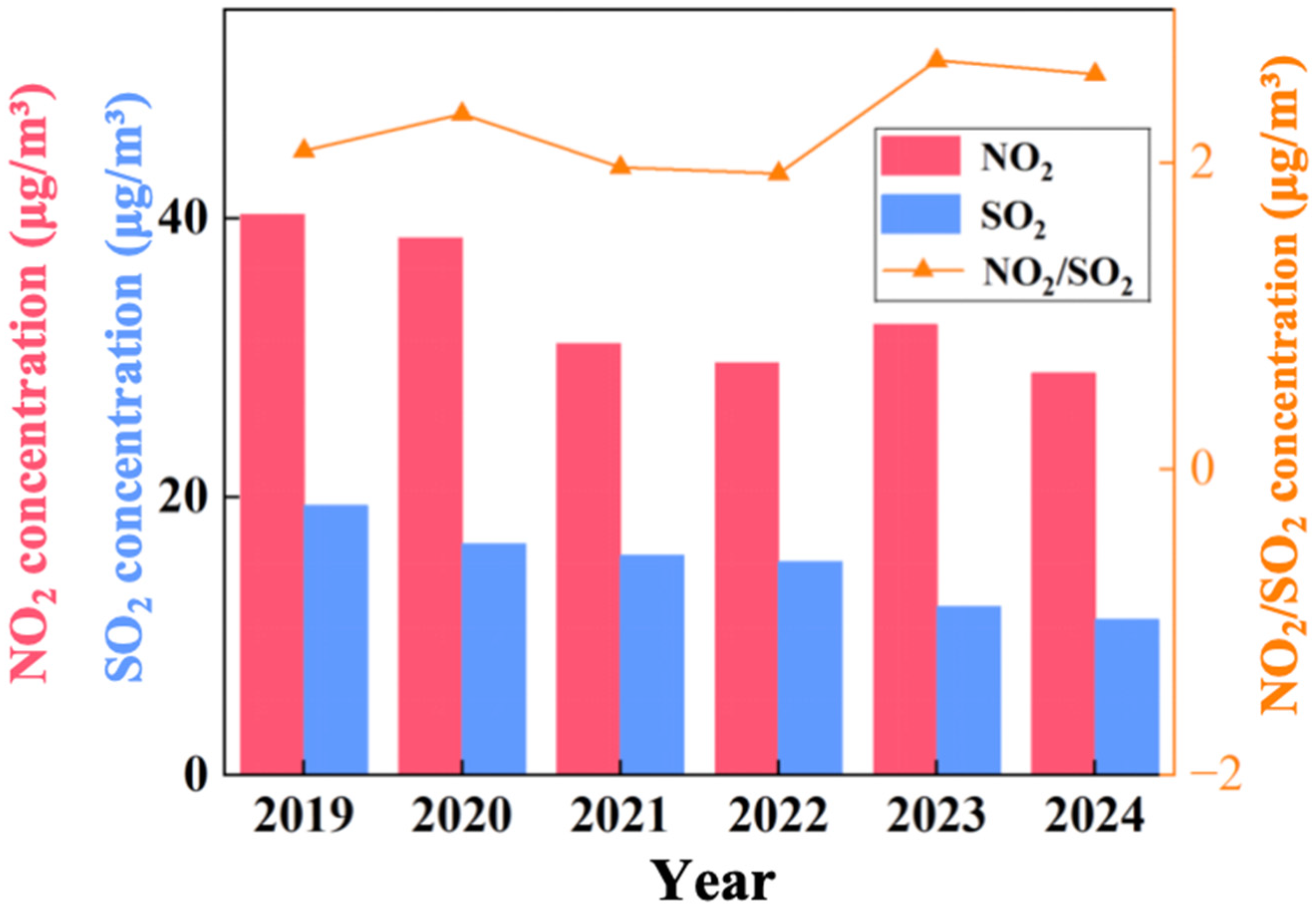
3.1.3. The Changing Trends of NO2 and SO2
3.2. The Current Situation of Combined Pollution of PM2.5 and O3
3.2.1. PM2.5 Concentration Characteristics
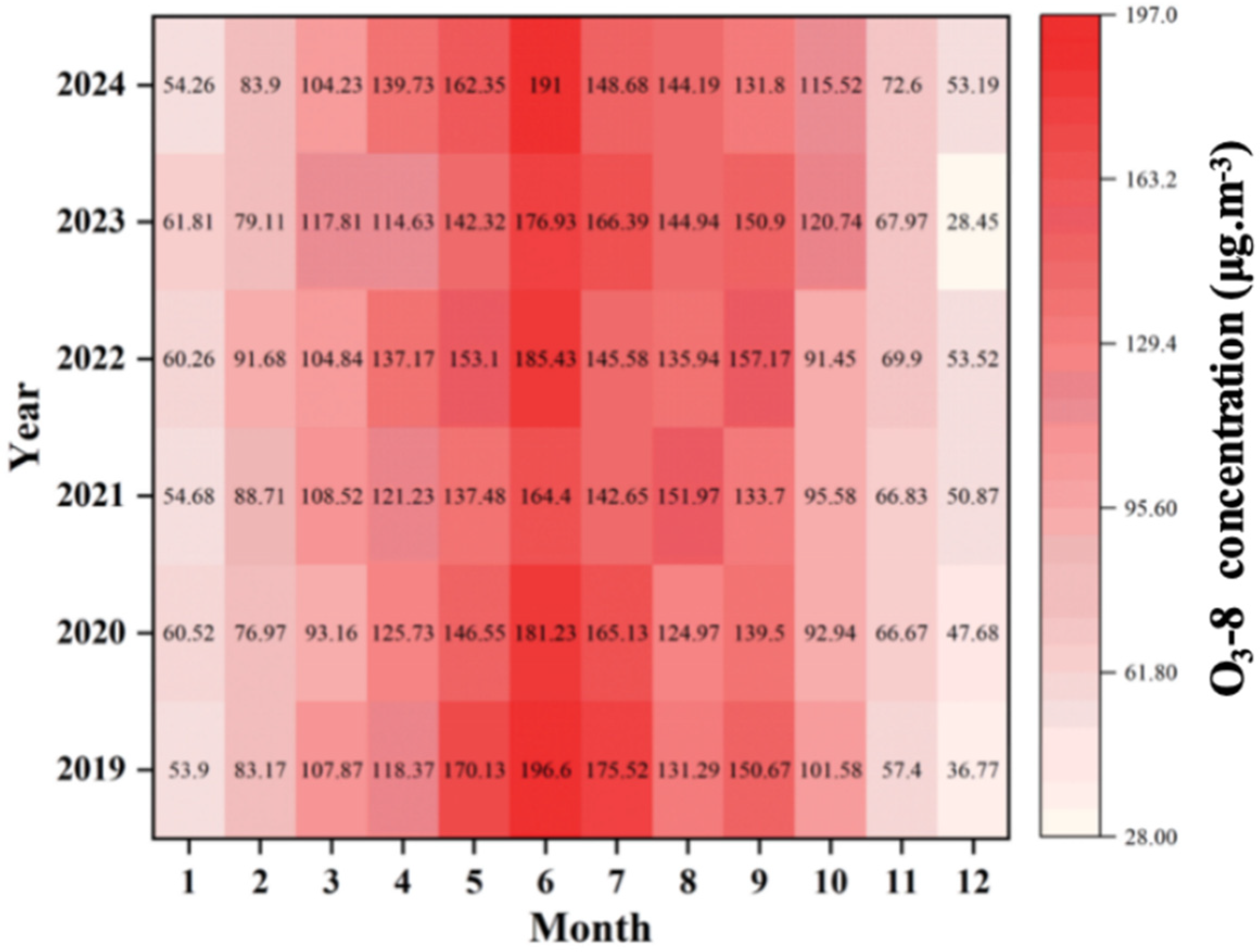
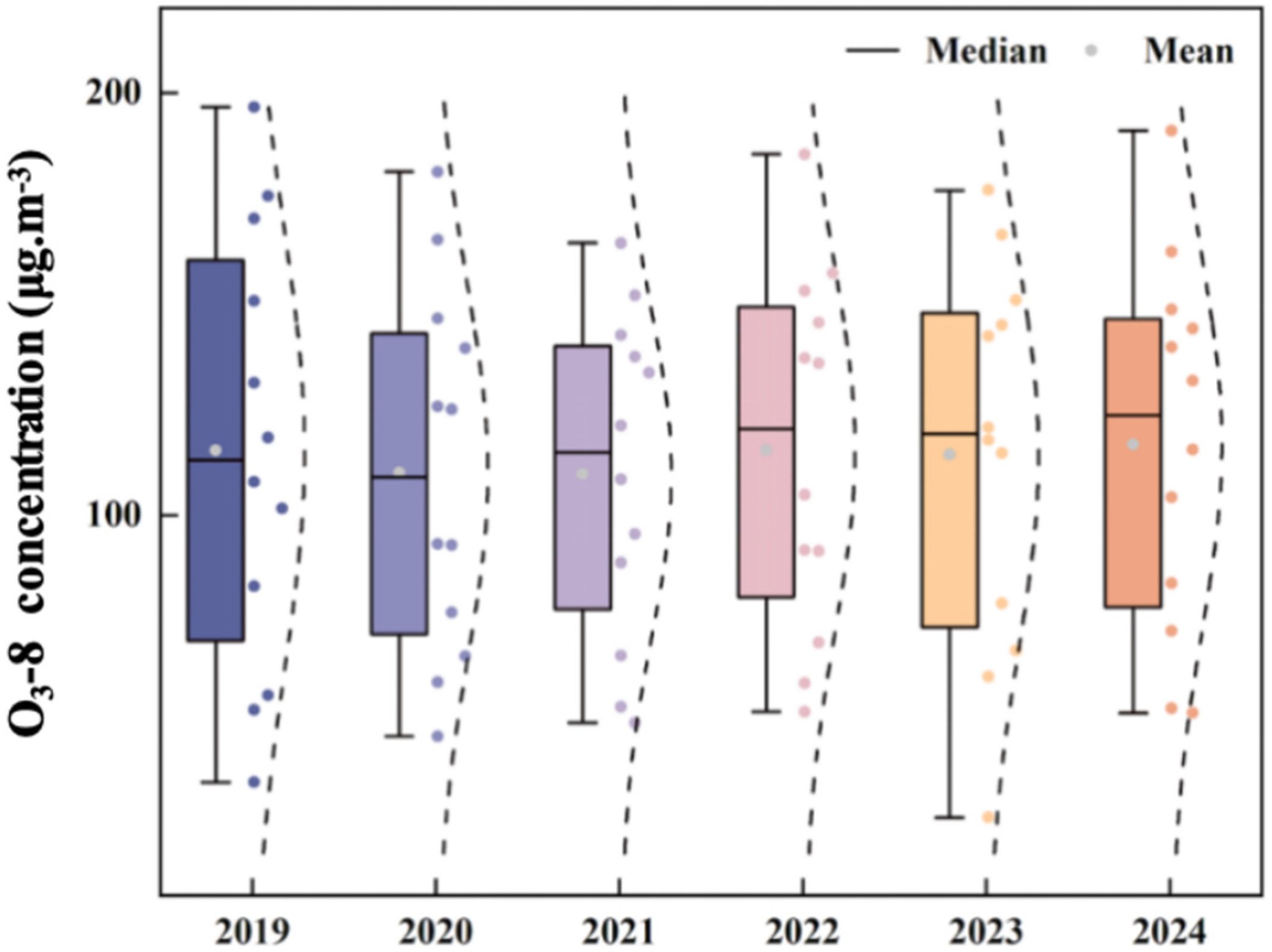
3.2.2. O3 Reacts with Photochemical Reactions
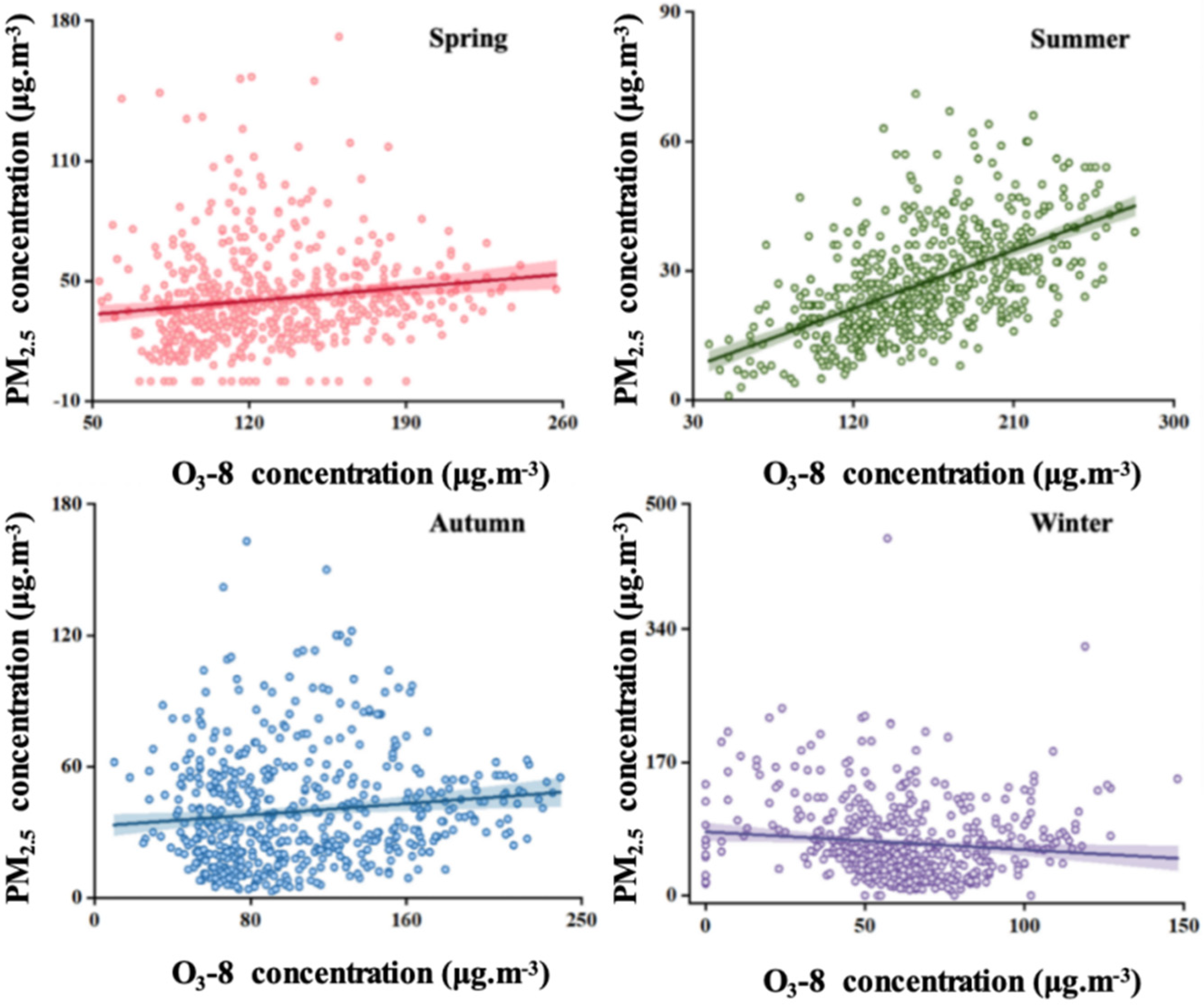
3.2.3. Combined Pollutions of PM2.5 and O3
3.3. Key Drivers Identified by Gray Relational Analysis
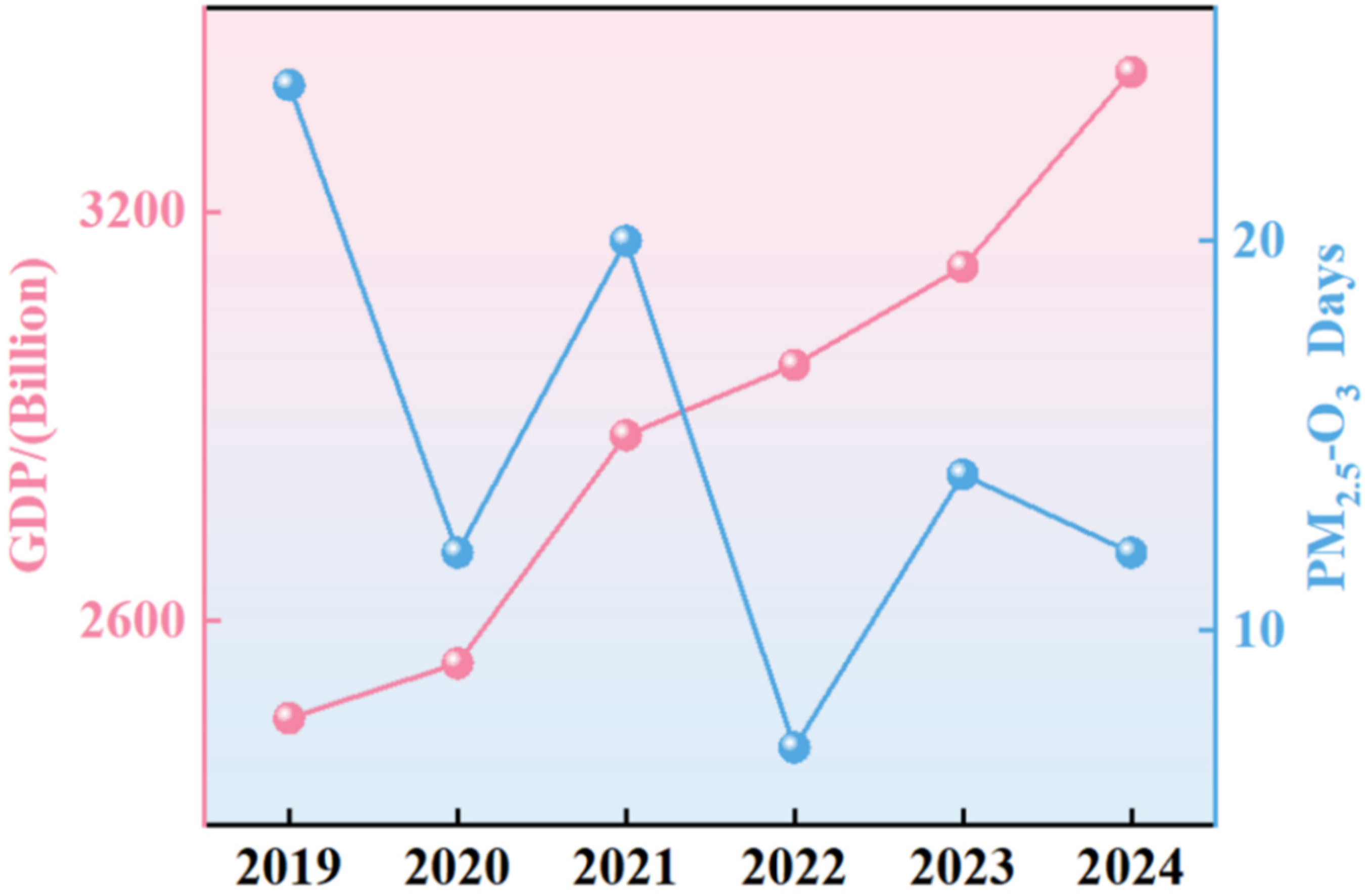
3.3.1. The Characteristics of Compound Pollution Based on the Background of GDP Growth
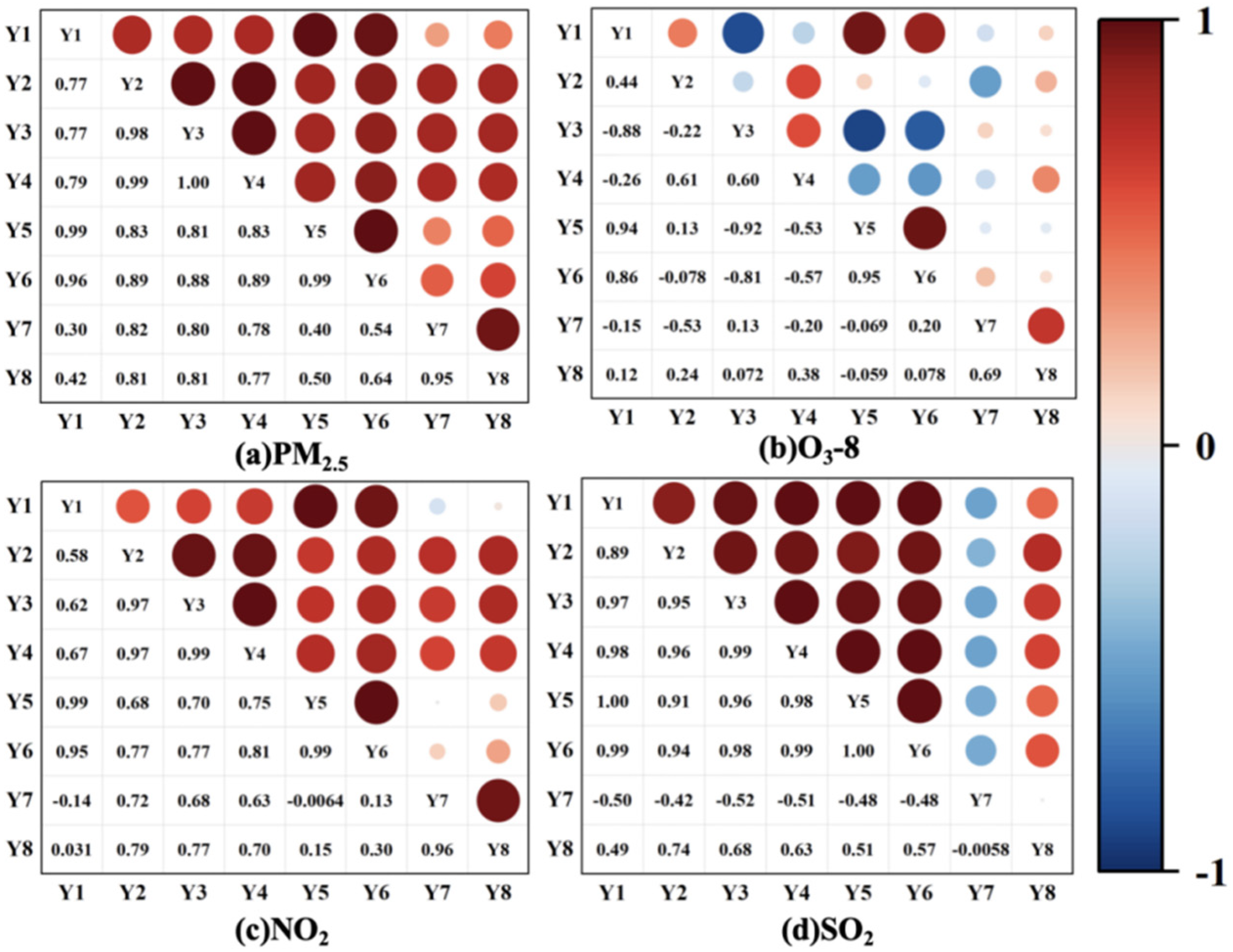
3.3.2. Gray Relational Analysis of the Key Influencing Factors of Ecological Environment Air Quality
4. Conclusions
Author Contributions
Funding
Institutional Review Board Statement
Informed Consent Statement
Data Availability Statement
Conflicts of Interest
References
- Chen, X.; Shao, S.; Tian, Z.; Xie, Z.; Yin, P. Impacts of air pollution and its spatial spillover effect on public health based on China’s big data sample. J. Clean. Prod. 2017, 142, 915–925. [Google Scholar] [CrossRef] [Scilit]
- Chen, Z.; Wang, J.N.; Ma, G.X.; Zhang, Y.S. China tackles the health effects of air pollution. Lancet 2013, 382, 1959–1960. [Google Scholar] [CrossRef] [Scilit]
- Jing, Q.; Sheng, L.F.; Zhang, W.H.; An, X.D. Characteristics of PM2.5 and O3 pollution and related meteorological impacts in ‘2+26’ cities of Beijing-Tianjin-Hebei and its surrounding areas from 2018 to 2021. Res. Environ. Sci. 2023, 36, 875–886. [Google Scholar]
- Yang, B.X. Spatiotemporal evolution of PM2.5 pollution in the ‘2+26’cities under regional joint governance. China Acad. J. 2024, 37, 1100–1110. [Google Scholar]
- Kang, N.; Wang, R.; Li, P.; Xue, T.; Liu, J.; Wan, W.; Gong, J.; Zhang, S.; Zhu, T. Beyond the halving commitment: China can do more to achieve clean air for global health. Innovation 2025, 6, 100996. [Google Scholar] [CrossRef] [Scilit]
- Li, S.; Yu, D.; Shi, C.; Zhao, N.; Xu, X.; Lu, S. Correlation analysis of PM2.5 and O3 in different types of urban forests in Beijing. Res. Environ. Sci. 2024, 37, 536–544. [Google Scholar]
- Hong, Y.; Ma, Y.J.; Su, C.C.; Wang, Y.F.; Ren, W.H.; Wang, J.K.; Wang, D.D.; Xu, X.B. Analysis of the Relationship between O3 and PM2.5 and the Main Factors Controlling Air Pollution in Shenyang. Res. Environ. Sci. 2024, 37, 455–468. [Google Scholar]
- Cheng, Y.; Dai, H.; Cheng, S.; Li, L.; Tong, H.; Li, J. Assessment of the Pollution Characteristics of PM2.5 and O3, Their Health Effects and Economic Losses in the Yangtze River Delta Region. Res. Environ. Sci. 2025, 38, 497–509. [Google Scholar]
- Jiang, L.; Liu, Y.S.; Yang, Y.J. Spatiotemporal Features of PM2.5 and O3 Pollution from 2015 to 2023 and Their Correlation with Meteorological Factors in Jiangxi Province. Res. Environ. Sci. 2025, 38, 460–472. [Google Scholar]
- Ning, Q.; He, M.; Ji, Y.Y.; Yin, H.; Li, J.D.; Shang, F.Y.; Zhang, K.; Yang, Y.J.; Li, H.; Gao, R.; et al. Characteristics and formation of complex air pollution and sources of VOCs in the Yellow River Delta region. Res. Environ. Sci. 2024, 37, 439–454. [Google Scholar]
- He, S.; Wang, C.; Cheng, S. Characteristics and Influencing Factors of PM2.5-O3 Double High Combined Pollution in Baoding City. Environ. Sci. 2025, 46, 1–14. [Google Scholar]
- Li, J.H.; Yan, Q.; Zhang, Z.Z.; Du, X.H.; Wei, P.; Xiao, T.Y.; Zhang, W.J. Optimization Analysis of Governance Scenarios under Constraints of Mid-and Long-Term Winter Targets for PM2.5 in Fen-Wei Plain. Res. Environ. Sci. 2024, 37, 963–974. [Google Scholar]
- Liu, X.; Chen, P.; Huang, C.; Wang, T.; Niu, T.; Li, M.; Li, R.; Wu, H.; Qu, Y. Study on the NO2 pollution and its connection with PM2.5 and O3 in Dazhou based on source apportionment. Atmos. Pollut. Res. 2025, 16, 102645. [Google Scholar] [CrossRef] [Scilit]
- Ma, J.; Hopke, P.K.; Zhu, X. PM2.5 pollution in a typical county of Northern China: Implications for air quality management. Atmos. Pollut. Res. 2025, 16, 102470. [Google Scholar] [CrossRef] [Scilit]
- Zhang, Y.L.; Cao, F. Fine particulate matter (PM2.5) in China at a city level. Sci. Rep. 2015, 5, 14884. [Google Scholar] [CrossRef] [Scilit] [PubMed]
- HJ 633-2012; Technical Specification for Ambient Air Quality Index (Trial). Ministry of Ecology and Environment of the People’s Republic of China: Beijing, China; China Environmental Science Press: Beijing, China, 2012.
- GB 3095-2012; Ambient Air Quality Standards. Ministry of Environmental Protection of the People’s Republic of China: Beijing, China, 2012.
- Deng, J. Control problems of grey systems. Syst. Control Lett. 1982, 1, 288–294. [Google Scholar]
- Huang, X.; Ding, A.; Gao, J.; Zheng, B.; Zhou, D.; Qi, X.; Tang, R.; Wang, J.; Ren, C.; Nie, W.; et al. Enhanced secondary pollution offset reduction of primary emissions during COVID-19 lockdown in China. Natl. Sci. Rev. 2021, 8, nwaa137. [Google Scholar] [CrossRef] [Scilit]
- Le, T.; Wang, Y.; Liu, L.; Yang, J.; Yung, Y.L.; Li, G.; Seinfeld, J.H. Unexpected air pollution with marked emission reductions during the COVID-19 outbreak in China. Science 2020, 369, 702–706. [Google Scholar] [CrossRef] [Scilit]
- Kou, W.; Gao, Y.; Zhang, S.; Cai, W.; Geng, G.; Davis, S.J.; Wang, H.; Guo, X.; Cheng, W.; Zeng, X.; et al. High downward surface solar radiation conducive to ozone pollution more frequent under global warming. Sci. Bull. 2023, 68, 388–392. [Google Scholar] [CrossRef] [Scilit]
- Zheng, B.; Tong, D.; Li, M.; Liu, F.; Hong, C.; Geng, G.; Li, H.; Li, X.; Peng, L.; Qi, J.; et al. Trends in China’s anthropogenic emissions since 2010 as the consequence of clean air actions. Atmos. Chem. Phys. 2018, 18, 14095–14111. [Google Scholar] [CrossRef] [Scilit]
- Giani, P.; Castruccio, S.; Anav, A.; Howard, D.; Hu, W.; Crippa, P. Short-term and long-term health impacts of air pollution reductions from COVID-19 lockdowns. Lancet Planet. Health 2023, 7, 491–500. [Google Scholar]
- Li, J.; Hou, L.; Wang, L.; Tang, L. Decoupling analysis between economic growth and air pollution in key regions of air pollution control in China. Sustainability 2021, 13, 6600. [Google Scholar] [CrossRef] [Scilit]
- Liu, J.; Wang, M.; Deng, J.; Chen, X.; Tang, X.; Zeng, L. Temporal and Spatial Evolution Patterns of AQI, Particulate Matter, and Ozone in Shandong Province and Key Influencing Factors. Res. Environ. Sci. 2023, 36, 273–284. [Google Scholar]
- Zhang, Y.; Xiao, G.J.; Liu, Y.; Li, X.Y.; Chen, Z.X.; Tao, Y. Characteristics of low-altitude atmospheric inversion and its influence on air pollutant concentration in Urumqi. J. Chengdu Univ. Inf. Technol. 2023, 38, 208–213. [Google Scholar]
- Qin, M.; She, Y.; Wang, M.; Wang, H.; Chang, Y.; Tan, Z.; An, J.; Huang, J.; Yuan, Z.; Lu, J.; et al. Increased urban ozone in heatwaves due to temperature-induced emissions of anthropogenic volatile organic compounds. Nat. Geosci. 2025, 18, 50–56. [Google Scholar] [CrossRef] [Scilit] [PubMed]
- Zhang, G.Q. Analysis of Influencing Factors and Evolution Trend Prediction of Atmospheric PM2.5 and O3 Pollution in Chang-Zhu-Tan Urban Agglomeration. Master’s Thesis, Hunan University of Science and Technology, Xiangtan, China, 2023. [Google Scholar]
- Wang, Y.; Yao, L.; Wang, L.; Liu, Z.; Ji, D.; Tang, G.; Zhang, J.; Sun, Y.; Hu, B.; Xin, J. Mechanism for the formation of the January 2013 heavy haze pollution episode over central and eastern China. Sci. China Earth Sci. 2014, 57, 14–25. [Google Scholar] [CrossRef] [Scilit]
- Li, K.; Jacob, D.J.; Liao, H.; Shen, L.; Zhang, Q.; Bates, K.H. Anthropogenic drivers of 2013--2017 trends in summer surface ozone in China. Proc. Natl. Acad. Sci. USA 2019, 116, 422–427. [Google Scholar] [CrossRef] [Scilit] [PubMed]
- Cheng, Y.; Zheng, G.; Wei, C.; Mu, Q.; Zheng, B.; Wang, Z.; Gao, M.; Zhang, Q.; He, K.; Carmichael, G.; et al. Reactive nitrogen chemistry in aerosol water as a source of sulfate during haze events in China. Sci. Adv. 2016, 2, e1601530. [Google Scholar] [CrossRef] [Scilit]
- Sillman, S. The relation between ozone, NOx and hydrocarbons in urban and polluted rural environments. Atmos. Environ. 1999, 33, 1821–1845. [Google Scholar] [CrossRef] [Scilit]
- Wang, P.; Chen, Y.; Hu, J.; Zhang, H.; Ying, Q. Source apportionment of secondary organic aerosol in China using a regional source-oriented chemical transport model and comparing to the CMAQ-VBS. Atmos. Chem. Phys. 2017, 17, 9355–9376. [Google Scholar]
- Wang, H.; Liu, Y.; Chen, X.; Gao, Y.; Qiu, W.; Jing, S.; Wang, Q.; Lou, S.; Edwards, P.M.; Huang, C.; et al. Unexpected Fast Radical Production Emerges in Cool Seasons: Implications for Ozone Pollution Control. Natl. Sci. Open 2022, 1, 20220013. [Google Scholar] [CrossRef] [Scilit]
- Li, M.; Huang, X.; Yan, D.; Lai, S.; Zhang, Z.; Zhu, L.; Lu, Y.; Jiang, X.; Wang, N.; Wang, T.; et al. Coping with the concurrent heatwaves and ozone extremes in China under a warming climate. Sci. Bull. 2024, 69, 2938–2947. [Google Scholar] [CrossRef] [Scilit] [PubMed]
- Tong, L.; Liu, Y.; Meng, Y.; Dai, X.; Huang, L.; Luo, W.; Yang, M.; Pan, Y.; Zheng, J.; Xiao, H. Surface ozone changes during the COVID-19 outbreak in China: An insight into the pollution characteristics and formation regimes of ozone in the cold season. J. Atmos. Chem. 2023, 80, 103–120. [Google Scholar] [CrossRef] [Scilit] [PubMed]
- Zeng, X.G.; Ruan, F.F.; Peng, Y.Y. Health effects’ spatial distribution analysis of PM2.5 pollution in China based on spatial grid scale. China Environ. Sci. 2019, 39, 2624–2632. [Google Scholar]
- Zheng, S.; Pozzer, A.; Cao, C.X.; Lelieveld, J. Long-term (2001–2012) concentrations of fine particulate matter (PM2.5) and the impact on human health in Beijing, China. Atmos. Chem. Phys. 2015, 15, 5715–5725. [Google Scholar] [CrossRef] [Scilit]
- He, W.; Zhang, W.J.; Wang, S.L.; Chai, F.H.; Li, H.; Zhang, J.Q.; Wang, H.; Hu, J. Effects and Improvement Suggestions on Air Pollution Joint Prevention and Control Mechanism in Beijing-Tianjin-Hebei Region. Res. Environ. Sci. 2019, 32, 1696–1703. [Google Scholar]
- Wang, Q.; Su, M. Drivers of decoupling economic growth from carbon emission—An empirical analysis of 192 countries. J. Clean. Prod. 2020, 242, 118561. [Google Scholar]
- Wu, R.; Dai, H.; Geng, Y.; Xie, Y.; Masui, T.; Liu, Z. Economic impacts from PM2.5 pollution-related health effects in China’s road transport sector: A provincial-level analysis. Environ. Int. 2016, 95, 152–159. [Google Scholar]
- Hao, Y.; Liu, Y.M. The influential factors of urban PM2.5 concentrations in China: A spatial econometric analysis. J. Clean. Prod. 2016, 112, 1443–1453. [Google Scholar] [CrossRef] [Scilit]
- Zhong, F.Q.; Su, Q.T.; Zhou, R.J.; Yi, M.J.; Wu, Q.Z.; Yan, Y. Impact of crop straw burning on urban air quality based on WRF-Chem simulations. Clim. Environ. Res. 2017, 22, 149–161. [Google Scholar]
- Xu, B.; Lin, B. Regional differences of pollution emissions in China: Contributing factors and mitigation strategies. J. Clean. Prod. 2015, 103, 226–238. [Google Scholar] [CrossRef] [Scilit]
- Liu, Y.; Wu, J.; Yu, D.; Ma, Q. The relationship between urban form and air pollution depends on seasonality and city size. Environ. Sci. Pollut. Res. 2018, 25, 15554–15567. [Google Scholar] [CrossRef] [Scilit] [PubMed]





| Grade | 2019 | 2020 | 2021 | 2022 | 2023 | 2024 | Total | |
|---|---|---|---|---|---|---|---|---|
| Good | Number | 34 | 46 | 52 | 58 | 45 | 54 | 289 |
| Ratio | 9.3% | 12.6% | 14.2% | 15.9% | 12.3% | 14.8% | 13.2% | |
| Moderate | Number | 173 | 190 | 193 | 195 | 171 | 190 | 1112 |
| Ratio | 47.4% | 52.1% | 52.9% | 53.4% | 46.8% | 52.1% | 50.9% | |
| Unhealthy for Sensitive Groups | Number | 99 | 93 | 91 | 87 | 110 | 92 | 572 |
| Ratio | 27.1% | 25.5% | 24.9% | 23.8% | 30.1% | 25.2% | 26.2% | |
| Unhealthy | Number | 44 | 24 | 21 | 21 | 28 | 24 | 162 |
| Ratio | 12.1% | 6.6% | 5.8% | 5.8% | 7.7% | 6.6% | 7.4% | |
| Very Unhealthy | Number | 15 | 13 | 4 | 4 | 8 | 5 | 49 |
| Ratio | 4.1% | 3.6% | 1.1% | 1.1% | 2.2% | 1.4% | 2.2% | |
| Hazardous | Number | 0 | 0 | 4 | 0 | 3 | 1 | 8 |
| Ratio | 0.0% | 0.0% | 1.1% | 0.0% | 0.8% | 0.3% | 0.4% |
| Season | AQI | CO (mg/m3) | PM2.5 (μg/m3) | PM10 (μg/m3) | NO2 (μg/m3) | SO2 (μg/m3) | O3-8 (μg/m3) | |
|---|---|---|---|---|---|---|---|---|
| Spring | Mean | 96.86 | 0.79 | 40.84 | 88.51 | 31.42 | 15.74 | 128.07 |
| Median | 89.00 | 0.70 | 38.00 | 73.00 | 30.00 | 11.00 | 132.00 | |
| Summer | Mean | 102.42 | 0.69 | 27.20 | 49.22 | 19.46 | 9.72 | 159.60 |
| Median | 93.00 | 0.60 | 28.50 | 56.00 | 24.50 | 13.00 | 144.00 | |
| Autumn | Mean | 80.22 | 0.82 | 39.46 | 72.48 | 38.07 | 14.48 | 104.60 |
| Median | 70.00 | 0.70 | 42.00 | 46.50 | 32.00 | 13.50 | 103.00 | |
| Winter | Mean | 97.49 | 1.04 | 66.98 | 101.79 | 44.69 | 20.37 | 62.19 |
| Median | 85.00 | 1.00 | 52.00 | 82.00 | 44.00 | 17.50 | 73.50 |
| Spring | Summer | Autumn | Winter | Total | |
|---|---|---|---|---|---|
| 2019 | 13 | 0 | 5 | 6 | 24 |
| 2020 | 3 | 0 | 6 | 3 | 12 |
| 2021 | 10 | 0 | 7 | 3 | 20 |
| 2022 | 2 | 0 | 4 | 1 | 7 |
| 2023 | 6 | 0 | 4 | 4 | 14 |
| 2024 | 5 | 0 | 4 | 3 | 12 |
Disclaimer/Publisher’s Note: The statements, opinions and data contained in all publications are solely those of the individual author(s) and contributor(s) and not of MDPI and/or the editor(s). MDPI and/or the editor(s) disclaim responsibility for any injury to people or property resulting from any ideas, methods, instructions or products referred to in the content. |
© 2025 by the authors. Licensee MDPI, Basel, Switzerland. This article is an open access article distributed under the terms and conditions of the Creative Commons Attribution (CC BY) license (https://creativecommons.org/licenses/by/4.0/).
Share and Cite
Xu, Y.; Wen, J.; Zhang, M.; Li, Y.; Zhang, Y.; Niu, Y.; Jiang, X. Evolution and Key Drivers of Typical Air Pollutants in Binzhou, China: A Case Study of the Yellow River Delta’s Central City (2019–2024). Toxics 2025, 13, 1007. https://doi.org/10.3390/toxics13121007
Xu Y, Wen J, Zhang M, Li Y, Zhang Y, Niu Y, Jiang X. Evolution and Key Drivers of Typical Air Pollutants in Binzhou, China: A Case Study of the Yellow River Delta’s Central City (2019–2024). Toxics. 2025; 13(12):1007. https://doi.org/10.3390/toxics13121007
Chicago/Turabian StyleXu, Yan, Jingyu Wen, Mingwei Zhang, Yapeng Li, Yinxiao Zhang, Yueyuan Niu, and Xiaotong Jiang. 2025. "Evolution and Key Drivers of Typical Air Pollutants in Binzhou, China: A Case Study of the Yellow River Delta’s Central City (2019–2024)" Toxics 13, no. 12: 1007. https://doi.org/10.3390/toxics13121007
APA StyleXu, Y., Wen, J., Zhang, M., Li, Y., Zhang, Y., Niu, Y., & Jiang, X. (2025). Evolution and Key Drivers of Typical Air Pollutants in Binzhou, China: A Case Study of the Yellow River Delta’s Central City (2019–2024). Toxics, 13(12), 1007. https://doi.org/10.3390/toxics13121007