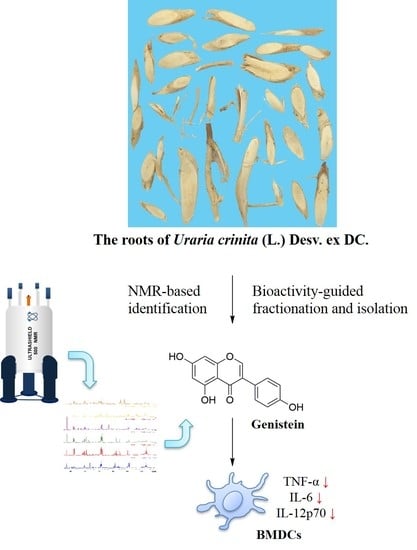
Bioactivity-Guided Fractionation and NMR-Based Identification of the Immunomodulatory Isoflavone from the Roots of Uraria crinita (L.) Desv. ex DC

 , , and
 Abstract
Share and Cite
Tu, P.-C.; Chan, C.-J.; Liu, Y.-C.; Kuo, Y.-H.; Lin, M.-K.; Lee, M.-S. Bioactivity-Guided Fractionation and NMR-Based Identification of the Immunomodulatory Isoflavone from the Roots of Uraria crinita (L.) Desv. ex DC. Foods 2019, 8, 543. https://doi.org/10.3390/foods8110543
Tu P-C, Chan C-J, Liu Y-C, Kuo Y-H, Lin M-K, Lee M-S. Bioactivity-Guided Fractionation and NMR-Based Identification of the Immunomodulatory Isoflavone from the Roots of Uraria crinita (L.) Desv. ex DC. Foods. 2019; 8(11):543. https://doi.org/10.3390/foods8110543
Chicago/Turabian StyleTu, Ping-Chen, Chih-Ju Chan, Yi-Chen Liu, Yueh-Hsiung Kuo, Ming-Kuem Lin, and Meng-Shiou Lee. 2019. "Bioactivity-Guided Fractionation and NMR-Based Identification of the Immunomodulatory Isoflavone from the Roots of Uraria crinita (L.) Desv. ex DC" Foods 8, no. 11: 543. https://doi.org/10.3390/foods8110543
APA StyleTu, P.-C., Chan, C.-J., Liu, Y.-C., Kuo, Y.-H., Lin, M.-K., & Lee, M.-S. (2019). Bioactivity-Guided Fractionation and NMR-Based Identification of the Immunomodulatory Isoflavone from the Roots of Uraria crinita (L.) Desv. ex DC. Foods, 8(11), 543. https://doi.org/10.3390/foods8110543