Shaping Circularity in the Food Industry: Strategic Pillars Enabled by Biorefinery Systems

 ,
,  , , and
Abstract
1. Introduction
2. Theory Background
2.1. Circular Economy Foundations in the Food Industry
2.2. Operational and Governance Dimensions of Circular Transition
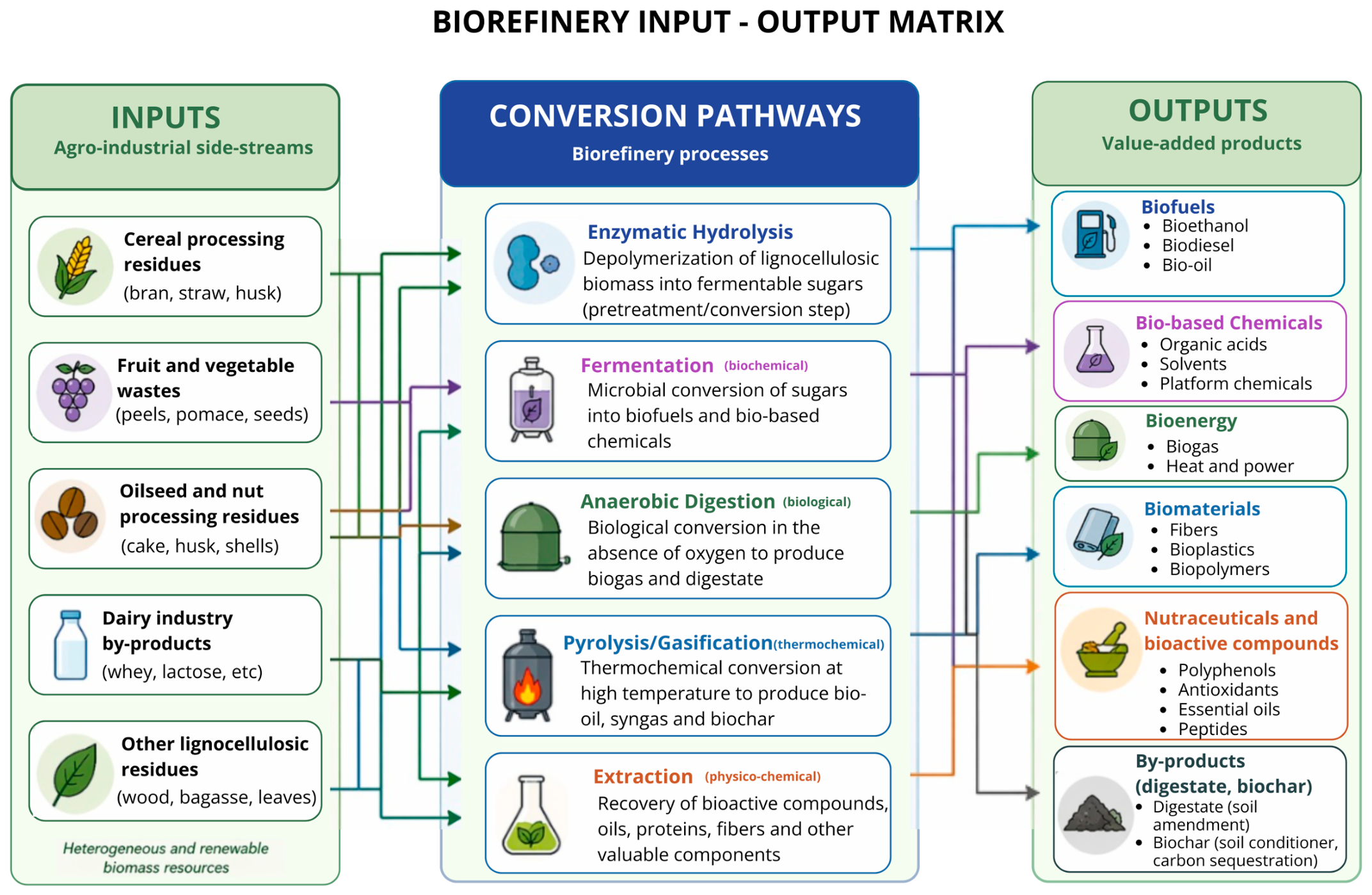
2.3. Biorefinery Systems and Biomass Conversion as Structural Enablers of Circularity
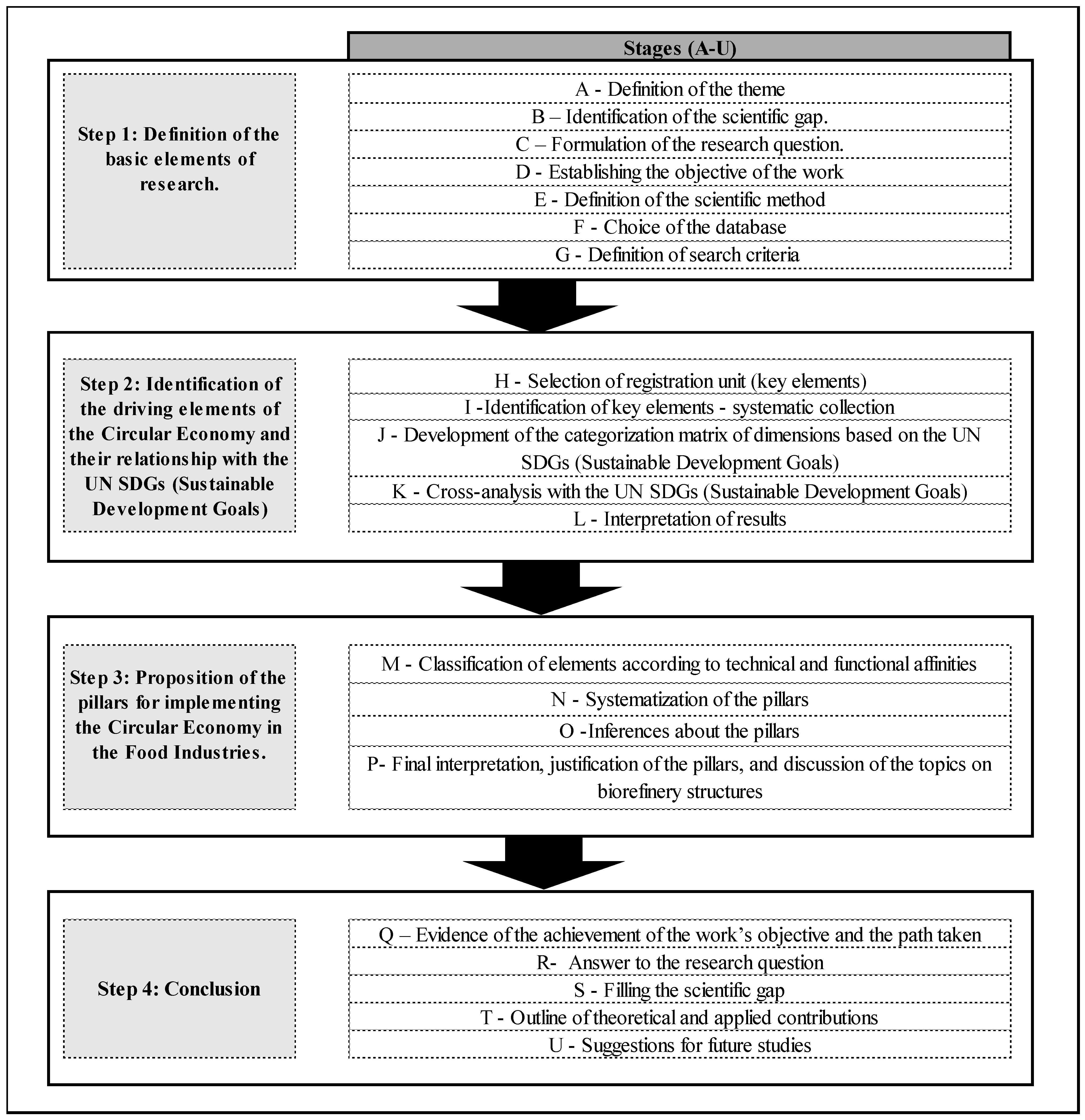
3. Research Method
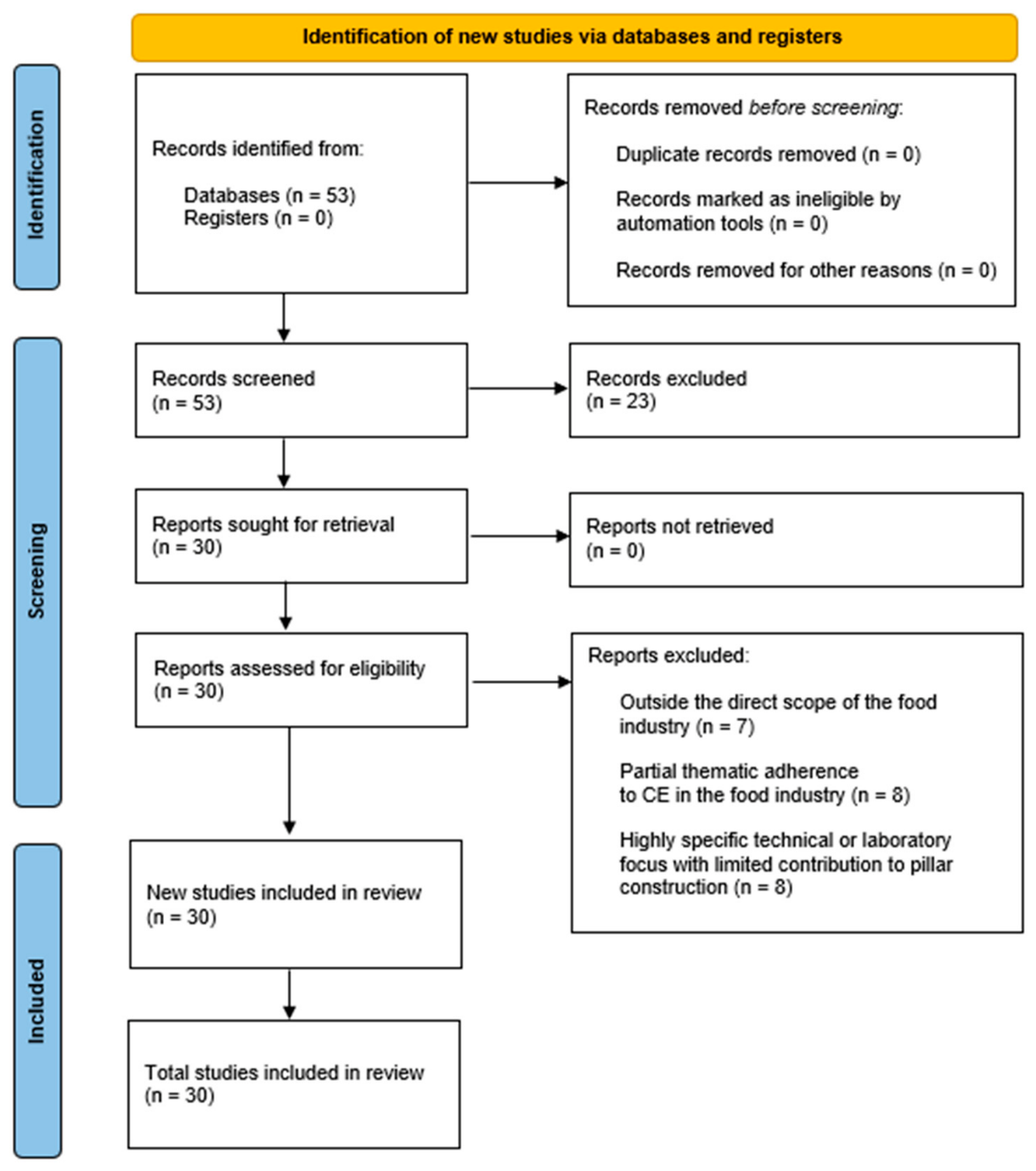
3.1. Step 1—Defining the Basic Elements of the Research
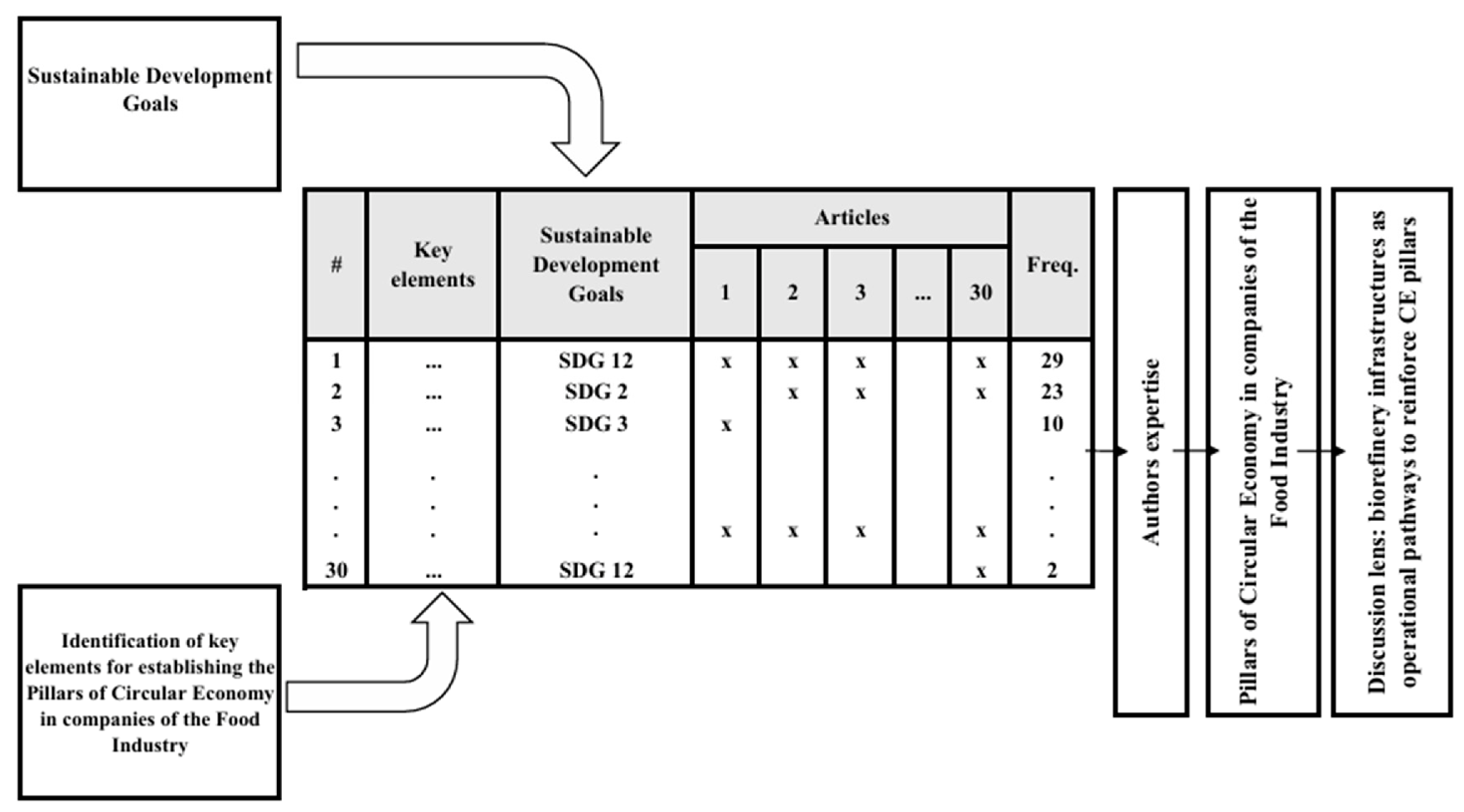
3.2. Step 2—Identification of the Structuring Elements of CE and Their Relationship with the SDGs
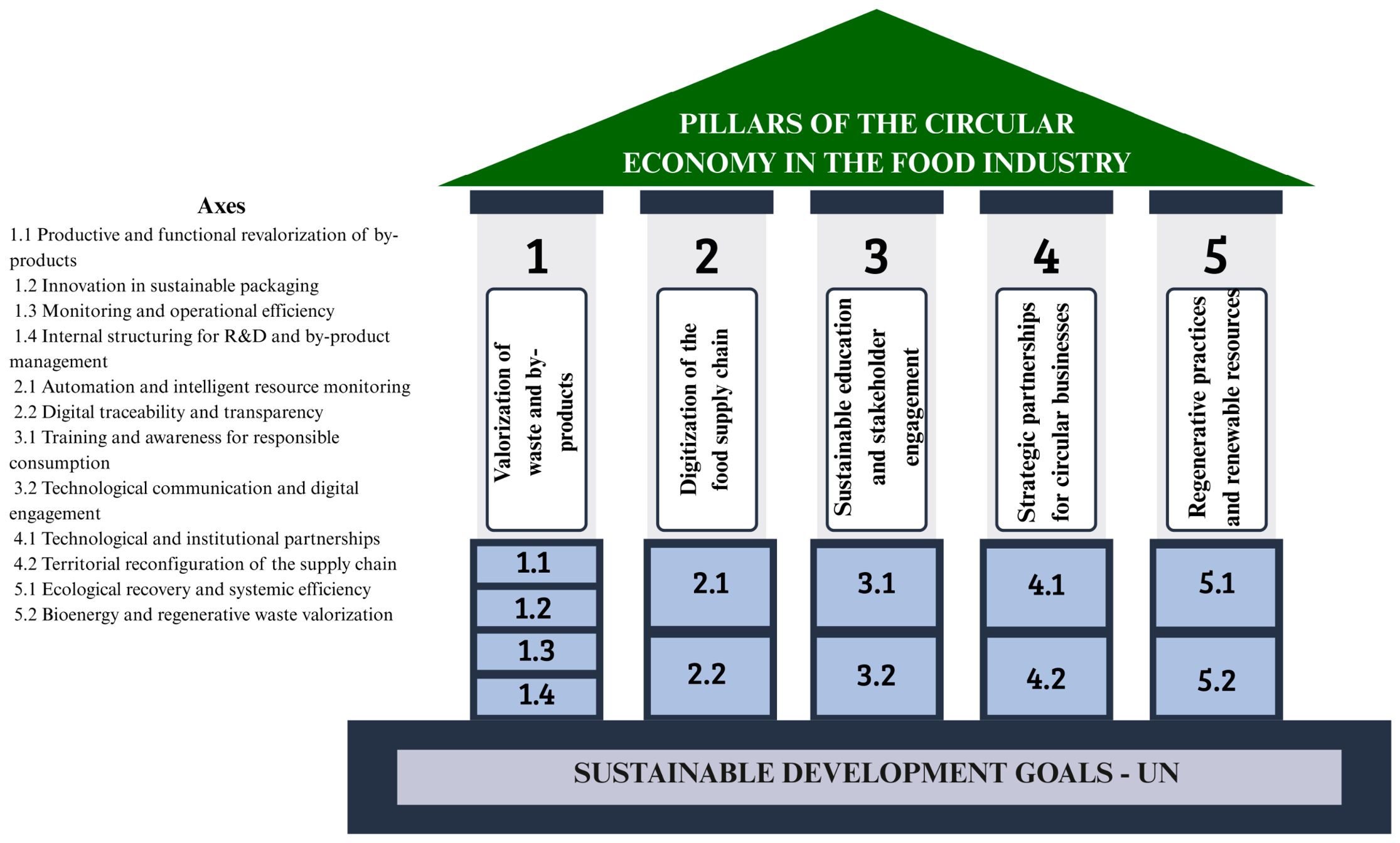
3.3. Step 3—Systematization and Proposal of Pillars for Implementing CE in the Food Industry
3.4. Step 4: Conclusions
4. Identification and Classification of Structuring Elements According to the SDGs
5. Proposal of Pillars for the Circular Economy Transition in the Food Industry and Discussions on Biorefinery Structures
5.1. Pillar 1—Valorization of Waste and By-Products
5.2. Pillar 2—Digitization of the Food Chain
5.3. Pillar 3—Sustainable Education and Stakeholder Engagement
5.4. Pillar 4—Strategic Partnerships for Circular Businesses
5.5. Pillar 5—Regenerative Practices and Renewable Resources
6. Conclusions
Author Contributions
Funding
Institutional Review Board Statement
Informed Consent Statement
Data Availability Statement
Conflicts of Interest
Appendix A

| # | Title | Author | Journal | Citation |
|---|---|---|---|---|
| 1 | Barriers to circular food supply chains in China | [20] | Supply Chain Management | 184 |
| 2 | Sustainable consumption in the circular economy. An analysis of consumers’ purchase intentions for waste-to-value food | [123] | Journal of Cleaner Production | 182 |
| 3 | The role of farm animals in a circular food system | [91] | Global Food Security | 162 |
| 4 | Algae and their potential for a future bioeconomy, landless food production, and the socio-economic impact of an algae industry | [93] | Organic Agriculture | 67 |
| 5 | Innovative processes in managing an enterprise from the energy and food sector in the era of industry 4.0 | [94] | Processes | 63 |
| 6 | Circular economy and corporate social responsibility in the agricultural system: Cases study of the Italian agri-food industry | [128] | Agricultural Economics (Czech Republic) | 59 |
| 7 | Consumers’ attitude towards food by-products: the influence of food technology neophobia, education and information | [57] | International Journal of Food Science and Technology | 55 |
| 8 | Nested circularity in food systems: A Nordic case study on connecting biomass, nutrient and energy flows from field scale to continent | [135] | Resources, Conservation and Recycling | 56 |
| 9 | A fuzzy multi-objective optimization model for sustainable closed-loop supply chain network design in food industries | [136] | Environment, Development and Sustainability | 50 |
| 10 | Suffciency business strategies in the food industry-the case of oatly | [137] | Sustainability (Switzerland) | 47 |
| 11 | Analysis of Waste Minimization Challenges to European Food Production Enterprises | [95] | Emerging Science Journal | 35 |
| 12 | From orange juice by-product in the food industry to a functional ingredient: Application in the circular economy | [51] | Foods | 35 |
| 13 | Coming out the egg: Assessing the benefits of circular economy strategies in agri-food industry | [52] | Journal of Cleaner Production | 30 |
| 14 | Plastics and sustainable purchase decisions in a circular economy: The case of Dutch food industry | [105] | PLoS ONE | 24 |
| 15 | Combining land-based organic and landless food production: a concept for a circular and sustainable food chain for Africa in 2100 | [92] | Organic Agriculture | 24 |
| 16 | The socio-economic force field of the creation of short food supply chains in Europe | [138] | Journal of Food and Nutrition Research | 23 |
| 17 | Material flow cost accounting (MFCA) to enhance environmental entrepreneurship in the meat sector: Challenges and opportunities | [21] | Journal of Environmental Management | 22 |
| 18 | The future role of reverse logistics as a tool for sustainability in food supply chains: a Delphi-based scenario study | [22] | Supply Chain Management | 20 |
| 19 | Assessment of the sustainability of the European agri-food sector in the context of the circular economy | [48] | Sustainable Production and Consumption | 19 |
| 20 | Consumer perception of the circular economy concept applied to the food domain: An exploratory approach | [54] | Sustainability (Switzerland) | 18 |
| 21 | Dry Anaerobic Digestion of Food Industry by-Products and Bioenergy Recovery: A Perspective to Promote the Circular Economy Transition | [102] | Waste and Biomass Valorization | 16 |
| 22 | Introducing a degrowth approach to the circular economy policies of food production, and food loss and waste management: Towards a circular bioeconomy | [64] | Sustainability (Switzerland) | 15 |
| 23 | Filamentous fungi for sustainable vegan food production systems within a circular economy: Present status and future prospects | [107] | Food Research International | 14 |
| 24 | Grape pomace as an energy source for the food industry: A thermochemical and kinetic analysis | [47] | Food and Bioproducts Processing | 13 |
| 25 | Actions needed before insects can contribute to a real closed-loop circular economy in the EU | [23] | Journal of Insects as Food and Feed | 10 |
| 26 | A feasibility study on green biorefinery of high lignin content agro-food industry waste through supercritical water treatment | [103] | Journal of Cleaner Production | 10 |
| 27 | Circular Economy for Food Industry Waste: Development and Characterization of Spray-Dried Acid Whey Encapsulated in Millet Matrix | [130] | ACS Food Science and Technology | 9 |
| 28 | Greener technologies in agri-food wastes valorization for plant pigments: Step towards circular economy | [104] | Current Research in Green and Sustainable Chemistry | 9 |
| 29 | Social media on the route to circular economy transition from a dialogic perspective: evidence from the agri-food industry | [49] | British Food Journal | 8 |
| 30 | In the nexus of sustainability, circular economy and food industry: Circular food package design | [53] | Journal of Cleaner Production | 8 |
| # | Structuring Elements/Articles | 1 [20] | 2 [123] | 3 [91] | 4 [93] | 5 [94] | 6 [128] | 7 [57] | 8 [135] | 9 [136] | 10 [137] | 11 [95] | 12 [51] | 13 [52] | 14 [105] | 15 [92] | 16 [138] | 17 [21] | 18 [22] | 19 [48] | 20 [54] | 21 [102] | 22 [64] | 23 [107] | 24 [47] | 25 [23] | 26 [103] | 27 [130] | 28 [104] | 29 [49] | 30 [53] |
|---|---|---|---|---|---|---|---|---|---|---|---|---|---|---|---|---|---|---|---|---|---|---|---|---|---|---|---|---|---|---|---|
| 1 | Integrate CE practices into the food supply chain to reduce waste at all stages, from agricultural production to final consumption, and to create collection and resource recovery systems to reuse food waste in new production cycles. | x | x | x | x | x | x | x | x | x | x | x | x | x | x | x | x | x | x | x | x | x | x | x | x | x | x | x | x | x | |
| 2 | Promote the use of agricultural by-products and waste to generate value throughout the production chain, whether through animal feed, optimized biomass utilization, or bioenergy generation, thereby contributing to a more efficient and sustainable system. | x | x | x | x | x | x | x | x | x | x | x | x | x | x | x | x | x | x | x | x | x | x | x | |||||||
| 3 | Encourage education and awareness among consumers and supply chain members about the benefits and importance of CE, thereby raising stakeholder awareness about waste reduction programs and recycling implementation. | x | x | x | x | x | x | x | x | x | x | ||||||||||||||||||||
| 4 | Invest in technologies that enable advanced recycling of agricultural waste, such as automated composting to produce natural fertilizers and pyrolysis to convert biomass into biofuels. | x | x | x | x | x | x | x | x | x | x | ||||||||||||||||||||
| 5 | Promote business models that encourage responsible consumption and waste reduction, including the use of sustainable packaging that extends food shelf life. | x | x | x | x | x | x | x | x | x | x | ||||||||||||||||||||
| 6 | Promote the use of biodegradable or recyclable packaging materials to minimize environmental impact and reduce waste in the food supply chain. | x | x | x | x | x | x | x | |||||||||||||||||||||||
| 7 | Implement advanced technological solutions to monitor the consumption of critical resources, promoting efficiency and sustainability in the production chain. At the same time, adopt circular business models that integrate Corporate Social Responsibility practices, focusing on the reuse and recycling of materials for the well-being of workers and the community. | x | x | x | x | x | x | x | |||||||||||||||||||||||
| 8 | Set goals for reducing waste and increasing the use of by-products, establish the actions necessary to achieve them, and monitor progress through key performance indicators (KPIs), disclosing advances in sustainability reports. | x | x | x | x | x | x | x | |||||||||||||||||||||||
| 9 | Promote the use of Industry 4.0 technologies to optimize resource and by-product management in food production. | x | x | x | x | x | x | ||||||||||||||||||||||||
| 10 | Invest in research and development of sustainable production models that improve resource management, using statistical approaches to address uncertainties in demand and rates of return, and promote the efficiency of material flows in a CE system. | x | x | x | x | x | x | ||||||||||||||||||||||||
| 11 | Establish partnerships with local biorefineries that use anaerobic digestion to convert food waste into renewable energy, thereby maximizing energy recovery and advancing the CE. | x | x | x | x | x | x | ||||||||||||||||||||||||
| 12 | Digitize production processes and the food supply chain, using technologies such as blockchain, IoT, and augmented reality to improve traceability, food safety, and sustainability, ensuring that consumers have access to accurate and reliable information about the origin and environmental impact of food products. | x | x | x | x | x | |||||||||||||||||||||||||
| 13 | Promote agricultural practices that reduce chemical use, support biodiversity, and enhance soil resilience, thereby positively impacting the health and well-being of workers and consumers. | x | x | x | x | x | |||||||||||||||||||||||||
| 14 | Promote the cultivation of algae in aquatic environments to reduce the need for arable land and help mitigate global warming through carbon sequestration. Invest in technologies that use wastewater to cultivate algae, transforming it into high-quality biomass for the production of nutritious foods and bioenergy. | x | x | x | x | ||||||||||||||||||||||||||
| 15 | Develop educational campaigns that explain the environmental and health benefits of reusing food byproducts in the production of new functional foods, increasing consumer acceptance of these new products. | x | x | x | x | ||||||||||||||||||||||||||
| 16 | Promote packaging made from biodegradable and compostable materials, such as bioplastics and polylactic acid (PLA), to minimize environmental impact and meet consumer preferences, thereby reducing plastic waste. | x | x | x | x | ||||||||||||||||||||||||||
| 17 | Develop bioreactor technologies that use waste to feed microalgae, enabling the efficient production of food and biomass. Microalgae fed on this waste produce lipids and carbohydrates that can be used in food manufacturing and bioenergy generation. | x | x | x | x | ||||||||||||||||||||||||||
| 18 | To establish partnerships with other companies in the food sector, universities, and R&D centers to share knowledge, technologies, and best practices for the use of by-products, and to consider public–private partnerships for financing and technical support. | x | x | x | |||||||||||||||||||||||||||
| 19 | Using insects to process food and agricultural waste, transforming it into sources of protein for animal feed and potentially for human consumption, contributes to a more sustainable and circular food production system. | x | x | x | |||||||||||||||||||||||||||
| 20 | Invest in technologies that use green solvents to obtain natural pigments from food waste, replacing synthetic dyes. | x | x | x | |||||||||||||||||||||||||||
| 21 | Provide information on how innovative food technologies are used to create food from by-products, emphasizing sustainability and health aspects. | x | x | ||||||||||||||||||||||||||||
| 22 | Establish internal programs dedicated to identifying and utilizing byproducts from primary production, including creating teams or committees focused on R&D for new products from waste, such as fruit and vegetable peels. | x | x | ||||||||||||||||||||||||||||
| 23 | Establish partnerships with local suppliers to minimize emissions associated with product transportation, thereby reducing CO2 emissions and supporting local economies, prioritizing closer supply chains to reduce logistics costs. | x | x | ||||||||||||||||||||||||||||
| 24 | Adopt analytical tools for the organization’s departments to improve transparency and efficiency in the management of waste and byproducts, enabling food-sector companies to identify and reduce hidden costs associated with material and energy waste. | x | x | ||||||||||||||||||||||||||||
| 25 | Establish mechanisms for the collection and valorization of non-edible by-products, such as feathers, blood, and slaughterhouse waste, for use in non-food sectors, transforming what would otherwise be waste into sources of revenue. | x | x | ||||||||||||||||||||||||||||
| 26 | Adopting degrowth principles, redefining business success in terms of sustainability, reducing environmental impacts, limiting the use of natural resources, and focusing on the efficiency of existing processes. | x | x | ||||||||||||||||||||||||||||
| 27 | Prioritize re-territorializing production to favor proximity to local suppliers, aiming to reduce transportation costs, lower the carbon footprint, support local economies, and increase supply chain resilience. | x | x | ||||||||||||||||||||||||||||
| 28 | Using fruit processing by-products as raw material for biochar and bioenergy production | x | x | ||||||||||||||||||||||||||||
| 29 | Implement industrial-scale waste-recovery processes, such as extracting fibers from fruit peels, producing proteins from legumes, and isolating antioxidants from by-products, to create functional food ingredients. | x | x | ||||||||||||||||||||||||||||
| 30 | Use social media as key tools to promote dialogue and engagement around the CE in the agri-food sector | x | x |
References
- UNEP. UNEP Food Waste Index Report 2021; UNEP: Nairobi, Kenya, 2021. [Google Scholar]
- Apeh, O.O.; Nwulu, N.I. Improving Traceability and Sustainability in the Agri-Food Industry through Blockchain Technology: A Bibliometric Approach, Benefits and Challenges. Energy Nexus 2025, 17, 100388. [Google Scholar] [CrossRef]
- FAO. The State of Food Security and Nutrition in the World 2024; FAO: Rome, Italy, 2024. [Google Scholar]
- FAO. The State of Food and Agriculture 2021; FAO: Rome, Italy, 2021; ISBN 978-92-5-134329-6. [Google Scholar]
- IPCC. Climate Change 2022: Mitigation of Climate Change; IPCC: Geneva, Switzerland, 2022. [Google Scholar]
- Rockström, J.; Steffen, W.; Noone, K.; Persson, Å.; Chapin, F.S.; Lambin, E.F.; Lenton, T.M.; Scheffer, M.; Folke, C.; Schellnhuber, H.J.; et al. A Safe Operating Space for Humanity. Nature 2009, 461, 472–475. [Google Scholar] [CrossRef] [PubMed]
- Jamil, U.; Pearce, J.M. Regenerative Agrivoltaics: Integrating Photovoltaics and Regenerative Agriculture for Sustainable Food and Energy Systems. Sustainability 2025, 17, 4799. [Google Scholar] [CrossRef]
- Ellen MacArthur Foundation. The Big Food Redesign: Regenerating Nature with the Circular Economy; Ellen MacArthur Foundation: Cowes, UK, 2021. [Google Scholar]
- HLPE. Food Security and Nutrition: Building a Global Narrative Towards 2030; HLPE: Rome, Italy, 2020. [Google Scholar]
- Kirchherr, J.; Reike, D.; Hekkert, M. Conceptualizing the Circular Economy: An Analysis of 114 Definitions. Resour. Conserv. Recycl. 2017, 127, 221–232. [Google Scholar] [CrossRef]
- Korhonen, J.; Honkasalo, A.; Seppälä, J. Circular Economy: The Concept and Its Limitations. Ecol. Econ. 2018, 143, 37–46. [Google Scholar] [CrossRef]
- Geissdoerfer, M.; Savaget, P.; Bocken, N.M.P.; Hultink, E.J. The Circular Economy—A New Sustainability Paradigm? J. Clean. Prod. 2017, 143, 757–768. [Google Scholar] [CrossRef]
- HLPE. Food Losses and Waste in the Context of Sustainable Food Systems A Report by the High Level Panel of Experts on Food Security and Nutrition; HLPE: Rome, Italy, 2014. [Google Scholar]
- Rico Lugo, S.D.; Kimita, K.; Nishino, N. Characteristics of Decision Process towards Circular Food Economy: A Review. Clean. Logist. Supply Chain. 2023, 7, 100104. [Google Scholar] [CrossRef]
- European Commission. Communication from the Commission to the European Parliament, the European Council, the Council, the European Economic and Social Committee and the Committee of the Regions—The European Green Deal; European Commission: Brussels, Belgium, 2019. [Google Scholar]
- European Commission. Communication from the Commission to the European Parliament, the Council, the European Economic and Social Committee and the Committee of the Regions—A New Circular Economy Action Plan for a Cleaner and More Competitive Europe; European Commission: Brussels, Belgium, 2020. [Google Scholar]
- European Commission. Communication from the Commission to the European Parliament, the Council, the European Economic and Social Committee and the Committee of the Regions—A Farm to Fork Strategy for a Fair, Healthy and Environmentally-Friendly Food System; European Commission: Brussels, Belgium, 2021. [Google Scholar]
- United Nations. United Nations Sustainable Development—17 Goals to Transform Our World; United Nations: New York, NY, USA, 2021. [Google Scholar]
- Rabbi, M.F.; Bin Amin, M. Circular Economy and Sustainable Practices in the Food Industry: A Comprehensive Bibliometric Analysis. Clean. Responsible Consum. 2024, 14, 100206. [Google Scholar] [CrossRef]
- Farooque, M.; Zhang, A.; Liu, Y. Barriers to Circular Food Supply Chains in China. Supply Chain Manag. 2019, 24, 677–696. [Google Scholar] [CrossRef]
- Bux, C.; Amicarelli, V. Material Flow Cost Accounting (MFCA) to Enhance Environmental Entrepreneurship in the Meat Sector: Challenges and Opportunities. J. Environ. Manag. 2022, 313, 115001. [Google Scholar] [CrossRef]
- Münch, C.; von der Gracht, H.A.; Hartmann, E. The Future Role of Reverse Logistics as a Tool for Sustainability in Food Supply Chains: A Delphi-Based Scenario Study. Supply Chain Manag. 2023, 28, 262–283. [Google Scholar] [CrossRef]
- Lalander, C.; Vinnerås, B. Actions Needed before Insects Can Contribute to a Real Closed-Loop Circular Economy in the EU. J. Insects Food Feed 2022, 8, 337–342. [Google Scholar] [CrossRef]
- Espuny, M.; Reis, J.S.d.M.; Giupponi, E.C.B.; Rocha, A.B.T.; Costa, A.C.F.; Poltronieri, C.F.; Oliveira, O.J. de The Role of the Triple Helix Model in Promoting the Circular Economy: Government-Led Integration Strategies and Practical Application. Recycling 2025, 10, 50. [Google Scholar] [CrossRef]
- Kamm, B.; Kamm, M. Principles of Biorefineries. Appl. Microbiol. Biotechnol. 2004, 64, 137–145. [Google Scholar] [CrossRef] [PubMed]
- Ragauskas, A.J.; Williams, C.K.; Davison, B.H.; Britovsek, G.; Cairney, J.; Eckert, C.A.; Frederick, W.J.; Hallett, J.P.; Leak, D.J.; Liotta, C.L.; et al. The Path Forward for Biofuels and Biomaterials. Science 2006, 311, 484–489. [Google Scholar] [CrossRef]
- Tsegaye, B.; Jaiswal, S.; Jaiswal, A.K. Food Waste Biorefinery: Pathway towards Circular Bioeconomy. Foods 2021, 10, 1174. [Google Scholar] [CrossRef]
- Saravanan, A.; Ragini, Y.P.; Karishma, S.; Hemavathy, R.V.; Jyotsna, M. A Review on Advancing Sustainable Energy: The Role of Biomass and Bioenergy in a Circular Economy. Sustain. Futures 2025, 10, 100835. [Google Scholar] [CrossRef]
- Cherubini, F. The Biorefinery Concept: Using Biomass Instead of Oil for Producing Energy and Chemicals. Energy Convers. Manag. 2010, 51, 1412–1421. [Google Scholar] [CrossRef]
- Annevelink, B.; Garcia Chavez, L.; van Ree, R.; Vural Gursel, I.; Bell, G.; Mandl, M.; Lindorfer, J.; Hesser, F.; Hilz, X.; Stern, T.; et al. IEA Bioenergy: Task 42 Biorefining in a Circular Economy Published by IEA Bioenergy Global Biorefinery Status Report 2022 with Inputs from; IEA Bioenergy: Paris, France, 2022. [Google Scholar]
- Bugge, M.M.; Hansen, T.; Klitkou, A. What Is the Bioeconomy? A Review of the Literature. Sustainability 2016, 8, 691. [Google Scholar] [CrossRef]
- European Union. Employment, Social Affairs & Inclusion—European Commission. Available online: https://ec.europa.eu/social/home.jsp?langId=en (accessed on 17 October 2020).
- Morone, P.; Falcone, P.M.; Lopolito, A. How to Promote a New and Sustainable Food Consumption Model: A Fuzzy Cognitive Map Study. J. Clean. Prod. 2019, 208, 563–574. [Google Scholar] [CrossRef]
- Chen, Y.; Wang, W.; Zhou, G.; Deveci, M.; Kadry, S.; Coffman, D. Promoting Circular Supply Chain in Food Sector: A Decision Framework for Analysing the Role of Artificial Intelligence-Driven Open Innovation. Eng. Appl. Artif. Intell. 2026, 165, 113387. [Google Scholar] [CrossRef]
- Jurgilevich, A.; Birge, T.; Kentala-Lehtonen, J.; Korhonen-Kurki, K.; Pietikäinen, J.; Saikku, L.; Schösler, H. Transition towards Circular Economy in the Food System. Sustainability 2016, 8, 69. [Google Scholar] [CrossRef]
- Kurita, A.E.; Espuny, M.; Campos, T.L.R.; Kazançoğlu, Y.; Kandsamy, J.; de Oliveira, O.J. Drivers for Circular Economy Development: Making Businesses More Environmentally Friendly. Environ. Sci. Pollut. Res. 2023, 30, 79553–79570. [Google Scholar] [CrossRef]
- Rizwan, D.; Kirmani, S.B.R.; Masoodi, F.A. Circular Economy in the Food Systems: A Review. Environ. Qual. Manag. 2025, 34, 70096. [Google Scholar] [CrossRef]
- de Oliveira, M.M.; Lago, A.; Dal’ Magro, G.P. Food Loss and Waste in the Context of the Circular Economy: A Systematic Review. J. Clean. Prod. 2021, 294, 126284. [Google Scholar] [CrossRef]
- De Bernardi, P.; Bertello, A.; Forliano, C. Circularity of Food Systems: A Review and Research Agenda. Br. Food J. 2023, 125, 1094–1129. [Google Scholar] [CrossRef]
- Atanasovska, I.; Choudhary, S.; Koh, L.; Ketikidis, P.H.; Solomon, A. Research Gaps and Future Directions on Social Value Stemming from Circular Economy Practices in Agri-Food Industrial Parks: Insights from a Systematic Literature Review. J. Clean. Prod. 2022, 354, 131753. [Google Scholar] [CrossRef]
- Hassan, H.; Faggian, R. System thinking approaches for circular economy: Enabled inclusive, synergistic, and eco-effective pathways for sustainable development. Front. Sustain. 2023, 4, 1267282. [Google Scholar] [CrossRef]
- Do, Q.; Ramudhin, A.; Colicchia, C.; Creazza, A.; Li, D. A Systematic Review of Research on Food Loss and Waste Prevention and Management for the Circular Economy. Int. J. Prod. Econ. 2021, 239, 108209. [Google Scholar] [CrossRef]
- Kamble, S.; Gunasekaran, A.; Dhone, N.C. Industry 4.0 and Lean Manufacturing Practices for Sustainable Organisational Performance in Indian Manufacturing Companies. Int. J. Prod. Res. 2020, 58, 1319–1337. [Google Scholar] [CrossRef]
- Marques, L.; Manzanares, M.D. Towards Social Network Metrics for Supply Network Circularity. Int. J. Oper. Prod. Manag. 2023, 43, 595–618. [Google Scholar] [CrossRef]
- Ligarda-Samanez, C.A.; Huamán-Carrión, M.L.; Calsina-Ponce, W.C.; Cruz, G.D.l.; Calderón Huamaní, D.F.; Cabel-Moscoso, D.J.; Garcia-Espinoza, A.J.; Sucari-León, R.; Aroquipa-Durán, Y.; Muñoz-Saenz, J.C.; et al. Technological Innovations and Circular Economy in the Valorization of Agri-Food By-Products: Advances, Challenges and Perspectives. Foods 2025, 14, 1950. [Google Scholar] [CrossRef]
- Pakseresht, A.; Ahmadi Kaliji, S.; Xhakollari, V. How Blockchain Facilitates the Transition toward Circular Economy in the Food Chain? Sustainability 2022, 14, 11754. [Google Scholar] [CrossRef]
- Madadian, E.; Rahimi, J.; Mohebbi, M.; Simakov, D.S.A. Grape Pomace as an Energy Source for the Food Industry: A Thermochemical and Kinetic Analysis. Food Bioprod. Process. 2022, 132, 177–187. [Google Scholar] [CrossRef]
- Castillo-Díaz, F.J.; Belmonte-Ureña, L.J.; López-Serrano, M.J.; Camacho-Ferre, F. Assessment of the Sustainability of the European Agri-Food Sector in the Context of the Circular Economy. Sustain. Prod. Consum. 2023, 40, 398–411. [Google Scholar] [CrossRef]
- Esposito, B.; Sica, D.; Malandrino, O.; Supino, S. Social Media on the Route to Circular Economy Transition from a Dialogic Perspective: Evidence from the Agri-Food Industry. Br. Food J. 2024, 126, 64–79. [Google Scholar] [CrossRef]
- Veloso, V.; Santos, A.; Carvalho, A.; Barbosa-Póvoa, A. A Comprehensive Framework for Assessing Circular Economy Strategies in Agri-Food Supply Chains. Environ. Dev. Sustain. 2025, 1–46. [Google Scholar] [CrossRef]
- de Castro, L.A.; Lizi, J.M.; das Chagas, E.G.L.; de Carvalho, R.A.; Vanin, F.M. From Orange Juice By-Product in the Food Industry to a Functional Ingredient: Application in the Circular Economy. Foods 2020, 9, 593. [Google Scholar] [CrossRef]
- Abbate, S.; Centobelli, P.; Cerchione, R.; Giardino, G.; Passaro, R. Coming out the Egg: Assessing the Benefits of Circular Economy Strategies in Agri-Food Industry. J. Clean. Prod. 2023, 385, 135665. [Google Scholar] [CrossRef]
- Kazancoglu, Y.; Ada, E.; Ozbiltekin-Pala, M.; Aşkın Uzel, R. In the Nexus of Sustainability, Circular Economy and Food Industry: Circular Food Package Design. J. Clean. Prod. 2023, 415, 137778. [Google Scholar] [CrossRef]
- Sousa, P.M.; Moreira, M.J.; de Moura, A.P.; Lima, R.C.; Cunha, L.M. Consumer Perception of the Circular Economy Concept Applied to the Food Domain: An Exploratory Approach. Sustainability 2021, 13, 11340. [Google Scholar] [CrossRef]
- ISO 14001:2015; Environmental Management Systems—Requirements with Guidance for Use. ISO: Geneva, Switzerland, 2015.
- Provin, A.P.; de Aguirar Dutra, A.R.; de Sousa e Silva Gouveia, I.C.A.; Cubas, A.L.V. Circular Economy for Fashion Industry: Use of Waste from the Food Industry for the Production of Biotextiles. Technol. Forecast. Soc. Change 2021, 169, 120858. [Google Scholar] [CrossRef]
- Cattaneo, C.; Lavelli, V.; Proserpio, C.; Laureati, M.; Pagliarini, E. Consumers’ Attitude towards Food by-Products: The Influence of Food Technology Neophobia, Education and Information. Int. J. Food Sci. Technol. 2019, 54, 679–687. [Google Scholar] [CrossRef]
- Talukder, M.S.; Biswas, M.I.; Azad, N. The Role of Online Information Sources in Enhancing Circular Consumption Behaviour: Fostering Sustainable Consumption Patterns in the Digital Age. Bus. Strategy Environ. 2025, 34, 1419–1439. [Google Scholar] [CrossRef]
- ISO 14040:2006; Environmental Management—Life Cycle Assessment—Principles and Framework. ISO: Geneva, Switzerland, 2006.
- ISO 14044:2006; Environmental Management—Life Cycle Assessment—Requirements and Guidelines. ISO: Geneva, Switzerland, 2006.
- Niero, M.; Hauschild, M.Z. Closing the Loop for Packaging: Finding a Framework to Operationalize Circular Economy Strategies. Procedia CIRP 2017, 61, 685–690. [Google Scholar] [CrossRef]
- Schaubroeck, T.; Schaubroeck, S.; Heijungs, R.; Zamagni, A.; Brandão, M.; Benetto, E. Attributional & Consequential Life Cycle Assessment: Definitions, Conceptual Characteristics and Modelling Restrictions. Sustainability 2021, 13, 7386. [Google Scholar] [CrossRef]
- Kambanou, M.L.; Sakao, T. Using Life Cycle Costing (LCC) to Select Circular Measures: A Discussion and Practical Approach. Resour. Conserv. Recycl. 2020, 155, 104650. [Google Scholar] [CrossRef]
- Hoehn, D.; Laso, J.; Margallo, M.; Ruiz-salmón, I.; Amo-setién, F.J.; Abajas-bustillo, R.; Sarabia, C.; Quiñones, A.; Vázquez-rowe, I.; Bala, A.; et al. Introducing a Degrowth Approach to the Circular Economy Policies of Food Production, and Food Loss and Waste Management: Towards a Circular Bioeconomy. Sustainability 2021, 13, 3379. [Google Scholar] [CrossRef]
- Esposito, B.; Sessa, M.R.; Sica, D.; Malandrino, O. Towards Circular Economy in the Agri-Food Sector. A Systematic Literature Review. Sustainability 2020, 12, 7401. [Google Scholar] [CrossRef]
- Percival Zhang, Y.-H.; Himmel, M.E.; Mielenz, J.R. Outlook for Cellulase Improvement: Screening and Selection Strategies. Biotechnol. Adv. 2006, 24, 452–481. [Google Scholar] [CrossRef]
- Butean, A.; Cutean, I.; Barbero, R.; Enriquez, J.; Matei, A. A Review of Artificial Intelligence Applications for Biorefineries and Bioprocessing: From Data-Driven Processes to Optimization Strategies and Real-Time Control. Processes 2025, 13, 2544. [Google Scholar] [CrossRef]
- Nizami, A.S.; Rehan, M.; Waqas, M.; Naqvi, M.; Ouda, O.K.M.; Shahzad, K.; Miandad, R.; Khan, M.Z.; Syamsiro, M.; Ismail, I.M.I.; et al. Waste Biorefineries: Enabling Circular Economies in Developing Countries. Bioresour. Technol. 2017, 241, 1101–1117. [Google Scholar] [CrossRef]
- Chemat, F.; Vian, M.A.; Cravotto, G. Green Extraction of Natural Products: Concept and Principles. Int. J. Mol. Sci. 2012, 13, 8615–8627. [Google Scholar] [CrossRef]
- Galanakis, C.M. Recovery of High Added-Value Components from Food Wastes: Conventional, Emerging Technologies and Commercialized Applications. Trends Food Sci. Technol. 2012, 26, 68–87. [Google Scholar] [CrossRef]
- Santini, A.; Cammarata, S.M.; Capone, G.; Ianaro, A.; Tenore, G.C.; Pani, L.; Novellino, E. Nutraceuticals: Opening the Debate for a Regulatory Framework. Br. J. Clin. Pharmacol. 2018, 84, 659–672. [Google Scholar] [CrossRef]
- Caldeira, C.; Vlysidis, A.; Fiore, G.; De Laurentiis, V.; Vignali, G.; Sala, S. Sustainability of Food Waste Biorefinery: A Review on Valorisation Pathways, Techno-Economic Constraints, and Environmental Assessment. Bioresour. Technol. 2020, 312, 123575. [Google Scholar] [CrossRef]
- Kim, S.; Dale, B.E. Global Potential Bioethanol Production from Wasted Crops and Crop Residues. Biomass Bioenergy 2004, 26, 361–375. [Google Scholar] [CrossRef]
- Gnansounou, E.; Dauriat, A. Techno-Economic Analysis of Lignocellulosic Ethanol: A Review. Bioresour. Technol. 2010, 101, 4980–4991. [Google Scholar] [CrossRef]
- Bridgwater, A.V. Review of Fast Pyrolysis of Biomass and Product Upgrading. Biomass Bioenergy 2012, 38, 68–94. [Google Scholar] [CrossRef]
- Mata-Alvarez, J.; Dosta, J.; Romero-Güiza, M.S.; Fonoll, X.; Peces, M.; Astals, S. A Critical Review on Anaerobic Co-Digestion Achievements between 2010 and 2013. Renew. Sustain. Energy Rev. 2014, 36, 412–427. [Google Scholar] [CrossRef]
- Lu, Y.; Liu, C.; Wang, K.I.-K.; Huang, H.; Xu, X. Digital Twin-Driven Smart Manufacturing: Connotation, Reference Model, Applications and Research Issues. Robot. Comput. Integr. Manuf. 2020, 61, 101837. [Google Scholar] [CrossRef]
- Lee, J.; Bagheri, B.; Kao, H.-A. A Cyber-Physical Systems Architecture for Industry 4.0-Based Manufacturing Systems. Manuf. Lett. 2015, 3, 18–23. [Google Scholar] [CrossRef]
- Cheng, Y.; Bi, X.; Xu, Y.; Liu, Y.; Li, J.; Du, G.; Lv, X.; Liu, L. Artificial Intelligence Technologies in Bioprocess: Opportunities and Challenges. Bioresour. Technol. 2023, 369, 128451. [Google Scholar] [CrossRef]
- Khanal, S.K.; Tarafdar, A.; You, S. Artificial Intelligence and Machine Learning for Smart Bioprocesses. Bioresour. Technol. 2023, 375, 128826. [Google Scholar] [CrossRef]
- Tao, F.; Cheng, J.; Qi, Q.; Zhang, M.; Zhang, H.; Sui, F. Digital Twin-Driven Product Design, Manufacturing and Service with Big Data. Int. J. Adv. Manuf. Technol. 2018, 94, 3563–3576. [Google Scholar] [CrossRef]
- Stock, T.; Seliger, G. Opportunities of Sustainable Manufacturing in Industry 4.0. Procedia CIRP 2016, 40, 536–541. [Google Scholar] [CrossRef]
- Bardin, L. Content Analysis, 1st ed.; SAGE Publications: London, UK; New Delhi, India; Thousand Oaks, CA, USA, 2011. [Google Scholar]
- Nobrega Dos Santos, C.; Carolina Ferreira Costa, A.; Ellen Francisco, F.; Oliveira, O.J. De Driving the Development and Improvement of Occupational Health and Safety Through Industry 4.0 Technologies. IEEE Access 2025, 13, 81048–81062. [Google Scholar] [CrossRef]
- Anuardo, R.G.; Espuny, M.; Costa, A.C.F.; Espuny, A.L.G.; Kazançoğlu, Y.; Kandsamy, J.; de Oliveira, O.J. Transforming E-Waste into Opportunities: Driving Organizational Actions to Achieve Sustainable Development Goals. Sustainability 2023, 15, 14150. [Google Scholar] [CrossRef]
- da Rocha, A.B.T.; Borges de Oliveira, K.; Espuny, M.; Salvador da Motta Reis, J.; Oliveira, O.J. Business Transformation through Sustainability Based on Industry 4.0. Heliyon 2022, 8, e10015. [Google Scholar] [CrossRef]
- UN General Assembly. Transforming Our World: The 2030 Agenda for Sustainable Development. Available online: https://www.refworld.org/docid/57b6e3e44.html (accessed on 22 October 2019).
- Elo, S.; Kääriäinen, M.; Kanste, O.; Pölkki, T.; Utriainen, K.; Kyngäs, H. Qualitative Content Analysis. Sage Open 2014, 4, 215824401452263. [Google Scholar] [CrossRef]
- Page, M.J.; McKenzie, J.E.; Bossuyt, P.M.; Boutron, I.; Hoffmann, T.C.; Mulrow, C.D.; Shamseer, L.; Tetzlaff, J.M.; Akl, E.A.; Brennan, S.E.; et al. The PRISMA 2020 Statement: An Updated Guideline for Reporting Systematic Reviews. BMJ 2021, 372, n71. [Google Scholar] [CrossRef]
- Schroeder, P.; Anggraeni, K.; Weber, U. The Relevance of Circular Economy Practices to the Sustainable Development Goals. J. Ind. Ecol. 2019, 23, 77–95. [Google Scholar] [CrossRef]
- Van Zanten, H.H.E.; Van Ittersum, M.K.; De Boer, I.J.M. The Role of Farm Animals in a Circular Food System. Glob. Food Secur. 2019, 21, 18–22. [Google Scholar] [CrossRef]
- Rahmann, G.; Grimm, D.; Kuenz, A.; Hessel, E. Combining Land-Based Organic and Landless Food Production: A Concept for a Circular and Sustainable Food Chain for Africa in 2100. Org. Agric. 2020, 10, 9–21. [Google Scholar] [CrossRef]
- Ullmann, J.; Grimm, D. Algae and Their Potential for a Future Bioeconomy, Landless Food Production, and the Socio-Economic Impact of an Algae Industry. Org. Agric. 2021, 11, 261–267. [Google Scholar] [CrossRef]
- Borowski, P.F. Innovative Processes in Managing an Enterprise from the Energy and Food Sector in the Era of Industry 4.0. Processes 2021, 9, 381. [Google Scholar] [CrossRef]
- Grinberga-Zalite, G.; Zvirbule, A. Analysis of Waste Minimization Challenges to European Food Production Enterprises. Emerg. Sci. J. 2022, 6, 530–543. [Google Scholar] [CrossRef]
- Jaswir, I.; Sari, D.P.; Haji Che Daud, M.R.b.; Sukmana, R. Motives for Participation in Halal Food Standard Implementation: An Empirical Study in Malaysian Halal Food Industry. Int. J. Islam. Middle East. Financ. Manag. 2023, 16, 928–954. [Google Scholar] [CrossRef]
- Oricchio, G.; Zanda, S.; Gregori, G.L.; Marinelli, L. Top Management Evaluation in Italian Food and Beverage Industry. Br. Food J. 2021, 123, 1249–1267. [Google Scholar] [CrossRef]
- Grujić, S.; Grujčić, M. The Strategy of Increasing Production Competitiveness in Food Industry of the Republic of Srpska by Stimulating a New Product Development. Acta Econ. 2021, 19, 67–84. [Google Scholar] [CrossRef]
- Nha Trang, N.T.; Nguyen, T.-T.; Pham, H.V.; Anh Cao, T.T.; Trinh Thi, T.H.; Shahreki, J. Impacts of Collaborative Partnership on the Performance of Cold Supply Chains of Agriculture and Foods: Literature Review. Sustainability 2022, 14, 6462. [Google Scholar] [CrossRef]
- Post, C.; Sarala, R.; Gatrell, C.; Prescott, J.E. Advancing Theory with Review Articles. J. Manag. Stud. 2020, 57, 351–376. [Google Scholar] [CrossRef]
- Gioia, D.A.; Corley, K.G.; Hamilton, A.L. Seeking Qualitative Rigor in Inductive Research: Notes on the Gioia Methodology. Organ. Res. Methods 2013, 16, 15–31. [Google Scholar] [CrossRef]
- Sganzerla, W.G.; Tena-Villares, M.; Buller, L.S.; Mussatto, S.I.; Forster-Carneiro, T. Dry Anaerobic Digestion of Food Industry By-Products and Bioenergy Recovery: A Perspective to Promote the Circular Economy Transition. Waste Biomass Valorization 2022, 13, 2575–2589. [Google Scholar] [CrossRef]
- Adamovic, T.; Tarasov, D.; Demirkaya, E.; Balakshin, M.; Cocero, M.J. A Feasibility Study on Green Biorefinery of High Lignin Content Agro-Food Industry Waste through Supercritical Water Treatment. J. Clean. Prod. 2021, 323, 129110. [Google Scholar] [CrossRef]
- Sharma, M.; Sridhar, K.; Gupta, V.K.; Dikkala, P.K. Greener Technologies in Agri-Food Wastes Valorization for Plant Pigments: Step towards Circular Economy. Curr. Res. Green Sustain. Chem. 2022, 5, 100340. [Google Scholar] [CrossRef]
- Núñez-Cacho, P.; Leyva-Díaz, J.C.; Sánchez-Molina, J.; van der Gun, R. Plastics and Sustainable Purchase Decisions in a Circular Economy: The Case of Dutch Food Industry. PLoS ONE 2020, 15, 0239949. [Google Scholar] [CrossRef]
- Trevizan Pelissaro, D.; Bruschi, G.J.; Pavan Korf, E.; Dalla Rosa, F. Rice Husk Ash as an Alternative Soluble Silica Source for Alkali-Activated Metakaolin Systems Applied to Recycled Asphalt Pavement Stabilization. Transp. Geotech. 2023, 39, 100940. [Google Scholar] [CrossRef]
- Awasthi, M.K.; Kumar, V.; Hellwig, C.; Wikandari, R.; Harirchi, S.; Sar, T.; Wainaina, S.; Sindhu, R.; Binod, P.; Zhang, Z.; et al. Filamentous Fungi for Sustainable Vegan Food Production Systems within a Circular Economy: Present Status and Future Prospects. Food Res. Int. 2023, 164, 112318. [Google Scholar] [CrossRef]
- Gregg, J.S.; Jürgens, J.; Happel, M.K.; Strøm-Andersen, N.; Tanner, A.N.; Bolwig, S.; Klitkou, A. Valorization of Bio-Residuals in the Food and Forestry Sectors in Support of a Circular Bioeconomy: A Review. J. Clean. Prod. 2020, 267, 122093. [Google Scholar] [CrossRef]
- Javourez, U.; O’Donohue, M.; Hamelin, L. Waste-to-Nutrition: A Review of Current and Emerging Conversion Pathways. Biotechnol. Adv. 2021, 53, 107857. [Google Scholar] [CrossRef] [PubMed]
- Xiong, X.; Yu, I.K.M.; Tsang, D.C.W.; Bolan, N.S.; Sik Ok, Y.; Igalavithana, A.D.; Kirkham, M.B.; Kim, K.-H.; Vikrant, K. Value-Added Chemicals from Food Supply Chain Wastes: State-of-the-Art Review and Future Prospects. Chem. Eng. J. 2019, 375, 121983. [Google Scholar] [CrossRef]
- Ragini, Y.P.; Karishma, S.; Kamalesh, R.; Saravanan, A.; TajSabreen, B.; Eswaar, D.K. Sustainable Biorefinery Approaches in the Valorization of Agro-Food Industrial Residues for Biofuel Production: Economic and Future Perspectives. Sustain. Energy Technol. Assess. 2025, 75, 104239. [Google Scholar] [CrossRef]
- Shawky, E.; Gibbons, S.; Selim, D.A. Bio-Sourcing from Byproducts: A Comprehensive Review of Bioactive Molecules in Agri-Food Waste (AFW) Streams for Valorization and Sustainable Applications. Bioresour. Technol. 2025, 431, 132640. [Google Scholar] [CrossRef]
- Narisetty, V.; Adlakha, N.; Kumar Singh, N.; Dalei, S.K.; Prabhu, A.A.; Nagarajan, S.; Naresh Kumar, A.; Amruthraj Nagoth, J.; Kumar, G.; Singh, V.; et al. Integrated Biorefineries for Repurposing of Food Wastes into Value-Added Products. Bioresour. Technol. 2022, 363, 127856. [Google Scholar] [CrossRef]
- Kumar, V.; Malyan, S.K.; Apollon, W.; Verma, P. Valorization of Pulp and Paper Industry Waste Streams into Bioenergy and Value-Added Products: An Integrated Biorefinery Approach. Renew. Energy 2024, 228, 120566. [Google Scholar] [CrossRef]
- Said, Z.; Sharma, P.; Thi Bich Nhuong, Q.; Bora, B.J.; Lichtfouse, E.; Khalid, H.M.; Luque, R.; Nguyen, X.P.; Hoang, A.T. Intelligent Approaches for Sustainable Management and Valorisation of Food Waste. Bioresour. Technol. 2023, 377, 128952. [Google Scholar] [CrossRef]
- Saliu, T.D.; Oladoja, N.A. Nutrient Recovery from Wastewater and Reuse in Agriculture: A Review. Environ. Chem. Lett. 2021, 19, 2299–2316. [Google Scholar] [CrossRef]
- Zhao, G.; Ye, C.; Zubairu, N.; Mathiyazhagan, K.; Zhou, X. Deployment of Industry 4.0 Technologies to Achieve a Circular Economy in Agri-Food Supply Chains: A Thorough Analysis of Enablers. J. Environ. Manag. 2025, 373, 123856. [Google Scholar] [CrossRef]
- Tyagi, S.; Bag, S.; Oberoi, S.S.; Banerjee, S.; Benabdellah, A.C. Transforming Food Systems: A Comprehensive Review and Research Agenda for Digital Technologies in Circular and Sustainable SC. J. Glob. Inf. Manag. 2024, 32, 1–33. [Google Scholar] [CrossRef]
- Arias, A.; Feijoo, G.; Moreira, M.T. How Could Artificial Intelligence Be Used to Increase the Potential of Biorefineries in the near Future? A Review. Environ. Technol. Innov. 2023, 32, 103277. [Google Scholar] [CrossRef]
- Tsui, T.H.; van Loosdrecht, M.C.M.; Dai, Y.; Tong, Y.W. Machine Learning and Circular Bioeconomy: Building New Resource Efficiency from Diverse Waste Streams. Bioresour. Technol. 2023, 369, 128445. [Google Scholar] [CrossRef] [PubMed]
- Bosona, T.; Gebresenbet, G.; Olsson, S.O. Traceability System for Improved Utilization of Solid Biofuel from Agricultural Prunings. Sustainability 2018, 10, 258. [Google Scholar] [CrossRef]
- Lin, K.; Chavalarias, D.; Panahi, M.; Yeh, T.; Takimoto, K.; Mizoguchi, M. Mobile-Based Traceability System for Sustainable Food Supply Networks. Nat. Food 2020, 1, 673–679. [Google Scholar] [CrossRef]
- Coderoni, S.; Perito, M.A. Sustainable Consumption in the Circular Economy. An Analysis of Consumers’ Purchase Intentions for Waste-to-Value Food. J. Clean. Prod. 2020, 252, 119870. [Google Scholar] [CrossRef]
- Camilleri, M.A.; Cricelli, L.; Mauriello, R.; Strazzullo, S. Consumer Perceptions of Sustainable Products: A Systematic Literature Review. Sustainability 2023, 15, 8923. [Google Scholar] [CrossRef]
- Mehta, N.; Cunningham, E.; Roy, D.; Cathcart, A.; Dempster, M.; Berry, E.; Smyth, B.M. Exploring Perceptions of Environmental Professionals, Plastic Processors, Students and Consumers of Bio-Based Plastics: Informing the Development of the Sector. Sustain. Prod. Consum. 2021, 26, 574–587. [Google Scholar] [CrossRef]
- Lange, L.; Connor, K.O.; Arason, S.; Bundgård-Jørgensen, U.; Canalis, A.; Carrez, D.; Gallagher, J.; Gøtke, N.; Huyghe, C.; Jarry, B.; et al. Developing a Sustainable and Circular Bio-Based Economy in EU: By Partnering Across Sectors, Upscaling and Using New Knowledge Faster, and For the Benefit of Climate, Environment & Biodiversity, and People & Business. Front. Bioeng. Biotechnol. 2021, 8, 619066. [Google Scholar] [CrossRef]
- Makepa, D.C.; Chihobo, C.H. Barriers to Commercial Deployment of Biorefineries: A Multi-Faceted Review of Obstacles across the Innovation Chain. Heliyon 2024, 10, e32649. [Google Scholar] [CrossRef]
- Fortunati, S.; Morea, D.; Mosconi, E.M. Circular Economy and Corporate Social Responsibility in the Agricultural System: Cases Study of the Italian Agri-Food Industry. Agric. Econ. 2020, 66, 489–498. [Google Scholar] [CrossRef]
- Lacombe, V.; Rajaonson, J. Strategic Dynamics of Circular Economy Initiatives in Food Systems: A Game Theory Perspective. Sustainability 2025, 17, 6025. [Google Scholar] [CrossRef]
- Nani, M.; Krishnaswamy, K. Circular Economy for Food Industry Waste: Development and Characterization of Spray-Dried Acid Whey Encapsulated in Millet Matrix. ACS Food Sci. Technol. 2023, 3, 123–133. [Google Scholar] [CrossRef]
- Duan, Y.; Pandey, A.; Zhang, Z.; Awasthi, M.K.; Bhatia, S.K.; Taherzadeh, M.J. Organic Solid Waste Biorefinery: Sustainable Strategy for Emerging Circular Bioeconomy in China. Ind. Crops Prod. 2020, 153, 112568. [Google Scholar] [CrossRef]
- Valipour, M.; Mafakheri, F.; Gagnon, B.; Prinz, R.; Bergström, D.; Brown, M.; Wang, C. Integrating Bio-Hubs in Biomass Supply Chains: Insights from a Systematic Literature Review. J. Clean. Prod. 2024, 467, 142930. [Google Scholar] [CrossRef]
- Tudor, V.C.; Micu, M.M.; Marcuta, A.; Iancu, T.; Marcuta, L.; Smedescu, D.; Toader, C.-S.; Mazuru, L.; Cosmin, C. Circularity of the Economy and Sustainable Performance of Agri-Food Systems in the European Union. Sustainability 2026, 18, 2736. [Google Scholar] [CrossRef]
- Kaviraj; Sharma, S. Municipal Solid Waste Management through Vermicomposting Employing Exotic and Local Species of Earthworms. Bioresour. Technol. 2003, 90, 169–173. [Google Scholar] [CrossRef] [PubMed]
- Koppelmäki, K.; Helenius, J.; Schulte, R.P.O. Nested Circularity in Food Systems: A Nordic Case Study on Connecting Biomass, Nutrient and Energy Flows from Field Scale to Continent. Resour. Conserv. Recycl. 2021, 164, 105218. [Google Scholar] [CrossRef]
- Alinezhad, M.; Mahdavi, I.; Hematian, M.; Tirkolaee, E.B. A Fuzzy Multi-Objective Optimization Model for Sustainable Closed-Loop Supply Chain Network Design in Food Industries. Environ. Dev. Sustain. 2022, 24, 8779–8806. [Google Scholar] [CrossRef]
- Bocken, N.; Morales, L.S.; Lehner, M. Suffciency Business Strategies in the Food Industry-the Case of Oatly. Sustainability 2020, 12, 824. [Google Scholar] [CrossRef]
- Popp, J.; Fogarassy, C.; Profile, S.; Lakner, Z. The Socio-Economic Force Field of the Creation of Short Food Supply Chains in Europe. J. Food Nutr. Res. 2019, 58, 31–41. [Google Scholar]


| Conversion Pathway | Main Outputs | Energy Intensity | GHG Emissions | Economic Feasibility | Key Operational Challenge |
|---|---|---|---|---|---|
| Fermentation | Bioethanol, organic acids | Medium | Low | Moderate–High | Feedstock variability |
| Anaerobic digestion | Biogas, digestate | Low | Very low | High | Limited product diversity |
| Pyrolysis/gasification | Bio-oil, syngas, biochar | High | Medium | Moderate | High energy demand |
| Extraction (bioactives) | Nutraceuticals, functional compounds | Medium | Low | High (value-added products) | High processing cost and purification complexity |
| # | Structuring Elements | Axes | Frequency |
|---|---|---|---|
| 1 | Integrate CE practices into the food supply chain to reduce waste at all stages, from agricultural production to final consumption, and to create collection and resource recovery systems to reuse food waste in new production cycles. | SDG 12 | 29 |
| 2 | Promote the use of agricultural by-products and waste to generate value throughout the production chain, whether through animal feed, optimized biomass utilization, or bioenergy generation, thereby contributing to a more efficient and sustainable system. | SDG 2 | 23 |
| 3 | Encourage education and awareness among consumers and supply chain members about the benefits and importance of CE, thereby raising stakeholder awareness about waste reduction programs and recycling implementation. | SDG 3 | 10 |
| 4 | Invest in technologies that enable advanced recycling of agricultural waste, such as automated composting to produce natural fertilizers and pyrolysis to convert biomass into biofuels. | SDG 7 | 10 |
| 5 | Promote business models that encourage responsible consumption and waste reduction, including the use of sustainable packaging that extends food shelf life. | SDG 12 | 10 |
| 6 | Promote the use of biodegradable or recyclable packaging materials to minimize environmental impact and reduce waste in the food supply chain. | SDG 12 | 7 |
| 7 | Implement advanced technological solutions to monitor the consumption of critical resources, promoting efficiency and sustainability in the production chain. At the same time, adopt circular business models that integrate Corporate Social Responsibility practices, focusing on the reuse and recycling of materials for the well-being of workers and the community. | SDG 8 | 7 |
| 8 | Set goals for reducing waste and increasing the use of by-products, establish the actions necessary to achieve them, and monitor progress through key performance indicators (KPIs), disclosing advances in sustainability reports. | SDG 12 | 7 |
| 9 | Promote the use of Industry 4.0 technologies to optimize resource and by-product management in food production. | SDG 9 | 6 |
| 10 | Invest in research and development of sustainable production models that improve resource management, using statistical approaches to address uncertainties in demand and rates of return, and promote the efficiency of material flows in a CE system. | SDG 9 | 6 |
| 11 | Establish partnerships with local biorefineries that use anaerobic digestion to convert food waste into renewable energy, thereby maximizing energy recovery and advancing the CE. | SDG 7 | 6 |
| 12 | Digitize production processes and the food supply chain, using technologies such as blockchain, IoT, and augmented reality to improve traceability, food safety, and sustainability, ensuring that consumers have access to accurate and reliable information about the origin and environmental impact of food products. | SDG 9 | 5 |
| 13 | Promote agricultural practices that reduce chemical use, support biodiversity, and enhance soil resilience, thereby positively impacting the health and well-being of workers and consumers. | SDG 2 | 5 |
| 14 | Promote the cultivation of algae in aquatic environments to reduce the need for arable land and help mitigate global warming through carbon sequestration. Invest in technologies that use wastewater to cultivate algae, transforming it into high-quality biomass for the production of nutritious foods and bioenergy. | SDG 13 | 4 |
| 15 | Develop educational campaigns that explain the environmental and health benefits of reusing food byproducts in the production of new functional foods, increasing consumer acceptance of these new products. | SDG 3 | 4 |
| 16 | Promote packaging made from biodegradable and compostable materials, such as bioplastics and polylactic acid (PLA), to minimize environmental impact and meet consumer preferences, thereby reducing plastic waste. | SDG 12 | 4 |
| 17 | Develop bioreactor technologies that use waste to feed microalgae, enabling the efficient production of food and biomass. Microalgae fed on this waste produce lipids and carbohydrates that can be used in food manufacturing and bioenergy generation. | SDG 7 | 4 |
| 18 | To establish partnerships with other companies in the food sector, universities, and R&D centers to share knowledge, technologies, and best practices for the use of by-products, and to consider public–private partnerships for financing and technical support. | SDG 17 | 3 |
| 19 | Using insects to process food and agricultural waste, transforming it into protein sources for animal feed and potentially for human consumption, contributes to a more sustainable, circular food production system. | SDG 2 | 3 |
| 20 | Invest in technologies that use green solvents to obtain natural pigments from food waste, replacing synthetic dyes. | SDG 12 | 3 |
| 21 | Provide information on how innovative food technologies are used to create food from by-products, emphasizing sustainability and health aspects. | SDG 3 | 2 |
| 22 | Establish internal programs dedicated to identifying and utilizing byproducts from primary production, including creating teams or committees focused on R&D for new products from waste, such as fruit and vegetable peels. | SDG 12 | 2 |
| 23 | Establish partnerships with local suppliers to minimize emissions associated with product transportation, thereby reducing CO2 emissions and supporting local economies, prioritizing closer supply chains to reduce logistics costs. | SDG 13 | 2 |
| 24 | Adopt analytical tools for the organization’s departments to improve transparency and efficiency in the management of waste and byproducts, enabling food-sector companies to identify and reduce hidden costs associated with material and energy waste. | SDG 9 | 2 |
| 25 | Establish mechanisms for the collection and valorization of non-edible by-products, such as feathers, blood, and slaughterhouse waste, for use in non-food sectors, transforming what would otherwise be waste into sources of revenue. | SDG 15 | 2 |
| 26 | Adopting degrowth principles, redefining business success in terms of sustainability, reducing environmental impacts, limiting the use of natural resources, and focusing on the efficiency of existing processes. | SDG 12 | 2 |
| 27 | Prioritize re-territorializing production to favor proximity to local suppliers, aiming to reduce transportation costs, lower the carbon footprint, support local economies, and increase supply chain resilience. | SDG 11 | 2 |
| 28 | Using fruit processing by-products as raw material for biochar and bioenergy production | SDG 15 | 2 |
| 29 | Implement industrial-scale waste-recovery processes, such as extracting fibers from fruit peels, producing proteins from legumes, and isolating antioxidants from by-products, to create functional food ingredients. | SDG 9 | 2 |
| 30 | Use social media as key tools to promote dialogue and engagement around the CE in the agri-food sector | SDG 12 | 2 |
Disclaimer/Publisher’s Note: The statements, opinions and data contained in all publications are solely those of the individual author(s) and contributor(s) and not of MDPI and/or the editor(s). MDPI and/or the editor(s) disclaim responsibility for any injury to people or property resulting from any ideas, methods, instructions or products referred to in the content. |
© 2026 by the authors. Licensee MDPI, Basel, Switzerland. This article is an open access article distributed under the terms and conditions of the Creative Commons Attribution (CC BY) license.
Share and Cite
Espuny, M.; Oliveira Maia, A.L.d.; Poltronieri, C.F.; Carvalho, C.P.d.; Oliveira, O.J.d. Shaping Circularity in the Food Industry: Strategic Pillars Enabled by Biorefinery Systems. Foods 2026, 15, 1600. https://doi.org/10.3390/foods15091600
Espuny M, Oliveira Maia ALd, Poltronieri CF, Carvalho CPd, Oliveira OJd. Shaping Circularity in the Food Industry: Strategic Pillars Enabled by Biorefinery Systems. Foods. 2026; 15(9):1600. https://doi.org/10.3390/foods15091600
Chicago/Turabian StyleEspuny, Maximilian, Ana Luiza de Oliveira Maia, Camila Fabrício Poltronieri, Cleginaldo Pereira de Carvalho, and Otávio José de Oliveira. 2026. "Shaping Circularity in the Food Industry: Strategic Pillars Enabled by Biorefinery Systems" Foods 15, no. 9: 1600. https://doi.org/10.3390/foods15091600
APA StyleEspuny, M., Oliveira Maia, A. L. d., Poltronieri, C. F., Carvalho, C. P. d., & Oliveira, O. J. d. (2026). Shaping Circularity in the Food Industry: Strategic Pillars Enabled by Biorefinery Systems. Foods, 15(9), 1600. https://doi.org/10.3390/foods15091600