Cryoprotective Effects of Tuna Skin Antifreeze Peptides on the Quality of Salmon Flesh During Low-Temperature Fluctuations
 ,
,
Abstract
1. Introduction
2. Materials and Methods
2.1. Materials
2.2. Preparation of Hydrolysates from Tuna Skin Protein
2.3. Preparatory Treatment of Salmon Cubes
2.4. Determination During Freeze–Thaw Cycles of Salmon Physical Properties
2.4.1. Textural Profile
2.4.2. Moisture Variation
2.4.3. Color Measurement
2.4.4. Electronic Nose (E-Nose) Analysis
2.5. Assay of MP Concentration
2.6. Analysis of MP Structure
2.7. Analyses of MP Oxidative Alteration and Lipid Oxidation
2.7.1. Assessment of Surface Hydrophobicity (SoANS)
2.7.2. Total Sulfhydryl (T-SH) Content
2.7.3. Solubility
2.7.4. Carbonyl Content
2.7.5. Dityrosine Content
2.7.6. Ca2+-ATPase Activity
2.7.7. Sodium Dodecyl Sulfate–Polyacrylamide Gel Electrophoresis (SDS-PAGE)
2.7.8. Identification of Peptide Sequences
2.8. Statistical Analysis
3. Results
3.1. Textural Properties
3.2. Assessment of Physicochemical Characteristics
3.2.1. WHC
3.2.2. Color
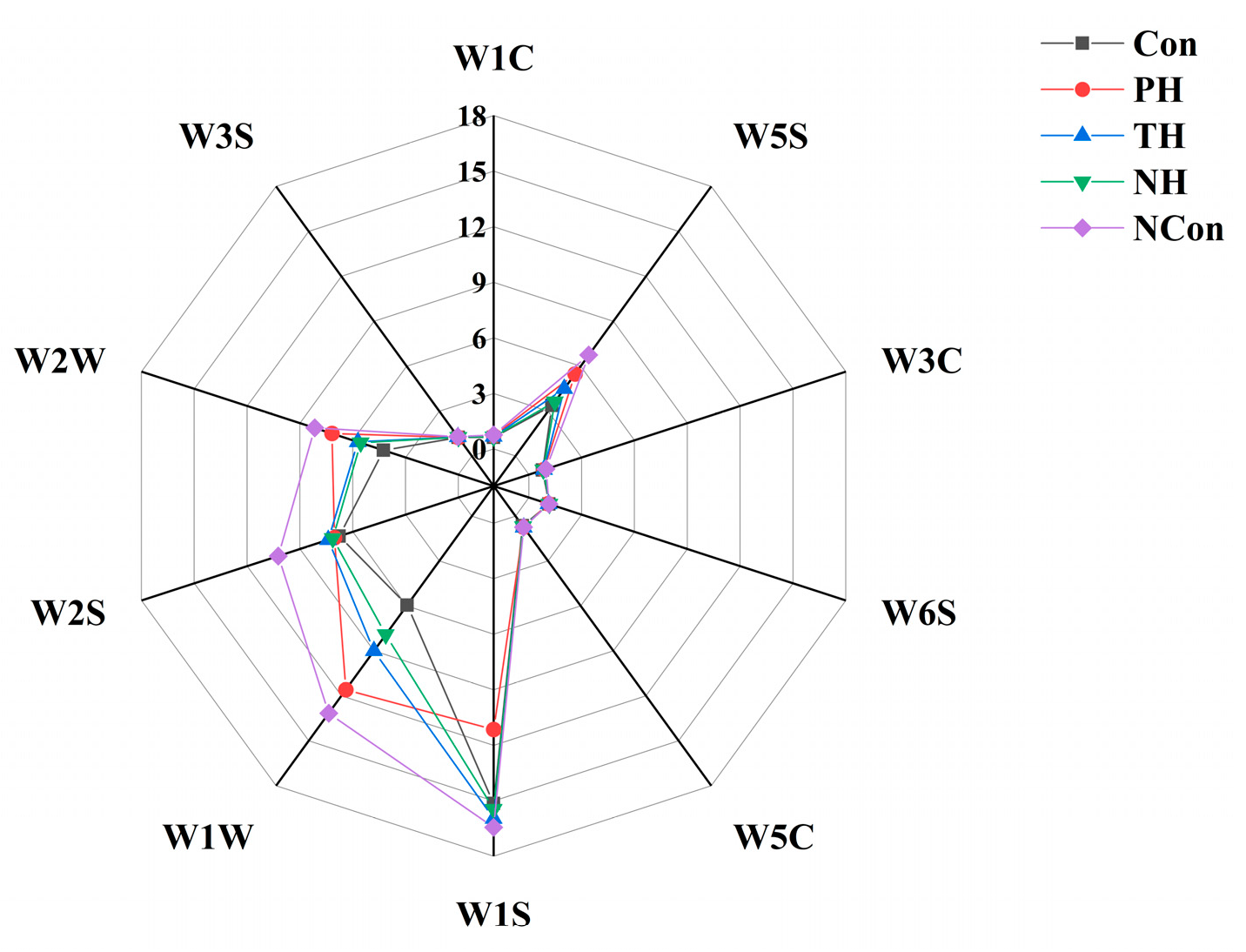
3.3. Analysis by E-Nose

3.4. MP Structure Changes Analysis
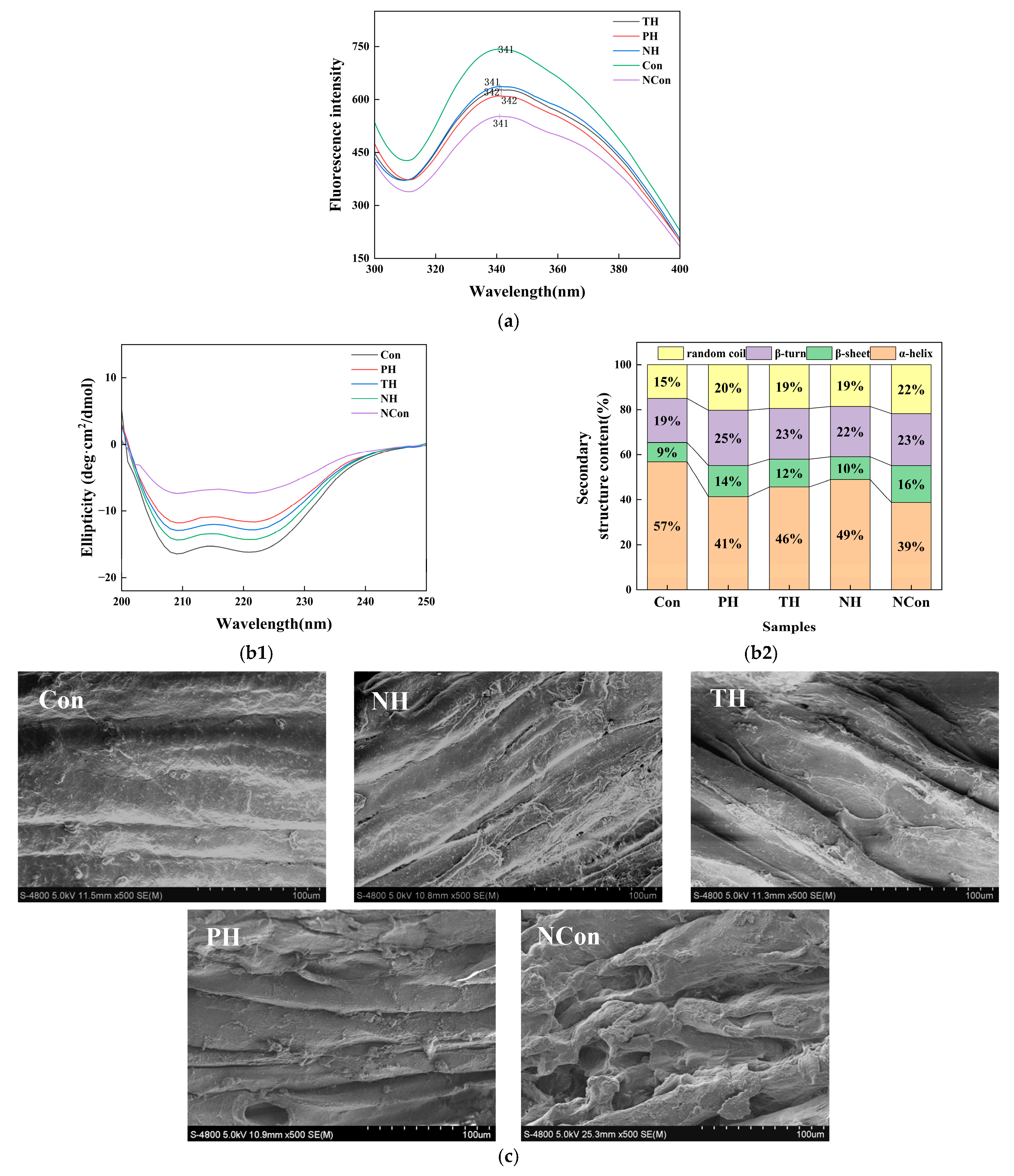
3.4.1. Fluorescence Spectroscopy Analysis
3.4.2. CD Spectroscopy Analysis
3.4.3. Correlation with Quality Characteristics
3.5. SEM Analysis
3.6. Protein Denaturation and Oxidation Analysis
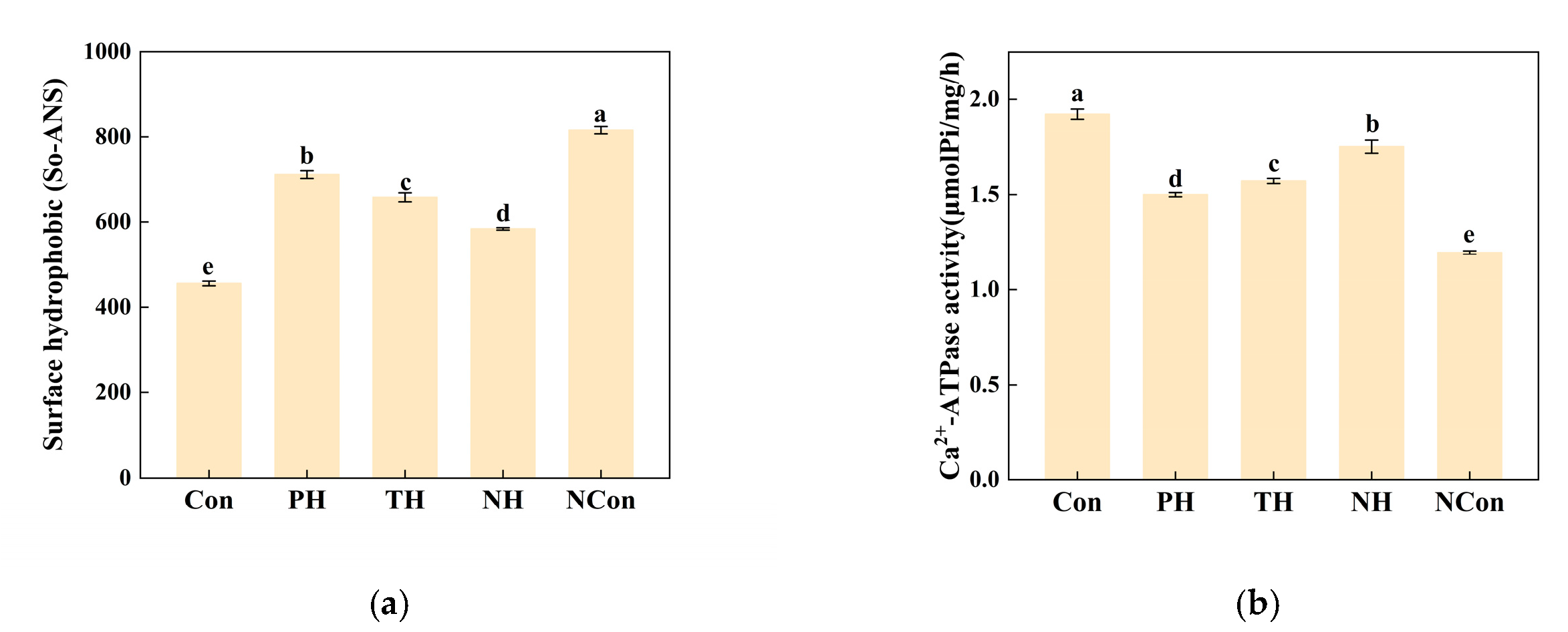
3.6.1. So-ANS
3.6.2. Ca2+-ATPase Activity
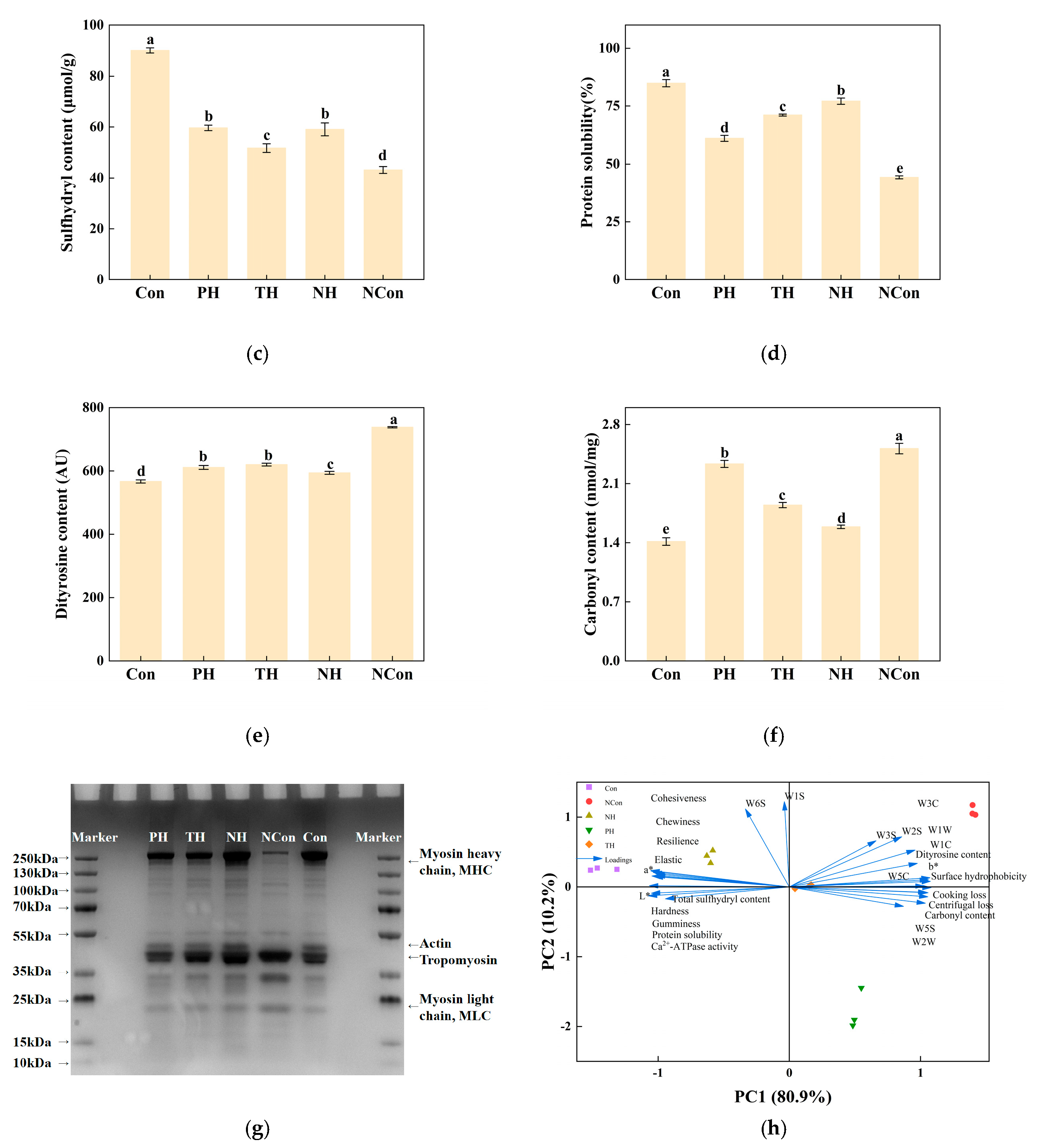
3.6.3. T-SH Content
3.6.4. Solubility of Proteins
3.6.5. Dityrosine Content
3.6.6. Carbonyl Content
3.6.7. SDS-PAGE
3.6.8. Identification and Characterization of Peptides in the NH Fraction
3.6.9. Principal Component Analysis (PCA)
4. Conclusions
Supplementary Materials
Author Contributions
Funding
Institutional Review Board Statement
Informed Consent Statement
Data Availability Statement
Conflicts of Interest
Abbreviations
| MP | Myofibrillar protein |
| Con | Positive control |
| NCon | Negative control |
| NH | Tuna skin neutral protease hydrolysate |
| TH | Tuna skin trypsin hydrolysate |
| PH | Tuna skin pepsin hydrolysate |
| SEM | Scanning electron microscopy |
| AFPs | Antifreeze peptides |
| ANOVA | Analysis of variance |
| ANS | 1-anilinonaphthalene-8-sulphonic acid |
| PBS | Phosphate-buffered solution |
| BSA | Bovine serum albumin |
| CD | Circular dichroism |
| DNPH | 2,4-Dinitrophenylhydrazine |
| E-nose | Electronic nose |
| T-SH | Total sulfhydryl |
| SoANS | Surface hydrophobicity |
| TCA | Trichloroacetic acid |
| WHC | Water holding capacity |
| SDS-PAGE | Sodium dodecyl sulfate–polyacrylamide gel electrophoresis |
| LC-MS/MS | Liquid chromatography–tandem mass spectrometry |
| PCA | Principal Component Analysis |
| Ej | Evynnis japonica |
| MHC | myosin heavy chain |
| MLC Trp | myosin light chain tryptophan |
References
- Banerjee, R.; Maheswarappa, N.B. Superchilling of muscle foods: Potential alternative for chilling and freezing. Crit. Rev. Food Sci. Nutr. 2019, 59, 1256–1263. [Google Scholar] [CrossRef]
- Zhang, M.; Haili, N.; Chen, Q.; Xia, X.; Kong, B. Influence of ultrasound-assisted immersion freezing on the freezing rate and quality of porcine longissimus muscles. Meat Sci. 2018, 136, 1–8. [Google Scholar] [CrossRef] [PubMed]
- Walayat, N.; Xiong, H.; Xiong, Z.; Moreno, H.M.; Nawaz, A.; Niaz, N.; Randhawa, M.A. Role of cryoprotectants in surimi and factors affecting surimi gel properties: A review. Food Rev. Int. 2020, 38, 1103–1122. [Google Scholar] [CrossRef]
- Chen, X.; Li, X.; Yang, F.; Wu, J.; Huang, D.; Huang, J.; Wang, S. Effects and mechanism of antifreeze peptides from silver carp scales on the freeze-thaw stability of frozen surimi. Food Chem. 2022, 396, 133717. [Google Scholar] [CrossRef]
- Chen, X.; Wu, J.; Li, X.; Yang, F.; Yu, L.; Li, X.; Huang, J.; Wang, S. Investigation of the cryoprotective mechanism and effect on quality characteristics of surimi during freezing storage by antifreeze peptides. Food Chem. 2022, 371, 131054. [Google Scholar] [CrossRef]
- Peng, X.; Mei, J.; Zhao, L.; Wei, Y.; Liu, K.; Zhong, S.; Hu, J.; Yuan, M. Investigation of the protective effects of antifreeze peptides from grass carp skin on frozen surimi. LWT-Food Sci. Technol. 2025, 218, 117471. [Google Scholar] [CrossRef]
- Jiang, W.; Yang, F.; Cai, D.; Du, J.; Wu, M.; Cai, X.; Chen, X.; Wang, S. Peptidomics & molecular simulation-based specific screening of antifreeze peptides from Evynnis japonica scale and the action mechanism. J. Agric. Food Chem. 2025, 73, 2634–2644. [Google Scholar] [CrossRef] [PubMed]
- Ahmed, R.; Chun, B.-S. Subcritical water hydrolysis for the production of bioactive peptides from tuna skin collagen. J. Supercrit. Fluids 2018, 141, 88–96. [Google Scholar] [CrossRef]
- Oliveira, D.; Bernardi, D.; Drummond, F.; Dieterich, F.; Boscolo, W.; Leivas, C.; Kiatkoski, E.; Waszczynskyj, N. Potential use of tuna (Thunnus albacares) by-product: Production of antioxidant peptides and recovery of unsaturated fatty acids from tuna head. Int. J. Food Eng. 2017, 13, 20150365. [Google Scholar] [CrossRef]
- Tan, M.; Han, M.; Zhou, Y.; Chen, Z.; Cao, W. Trash to treasure: Potential antifreeze peptide from Litopenaeus vannamei head via ultrasound-assisted autolysis. Food Chem. X 2025, 27, 102395. [Google Scholar] [CrossRef] [PubMed]
- Sadowska, M.; Kołodziejska, I.; Niecikowska, C. Isolation of collagen from the skins of Baltic cod (Gadus morhua). Food Chem. 2003, 81, 257–262. [Google Scholar] [CrossRef]
- Zhu, K.; Zheng, Z.; Dai, Z. Identification of antifreeze peptides in shrimp byproducts autolysate using peptidomics and bioinformatics. Food Chem. 2022, 383, 132568. [Google Scholar] [CrossRef]
- Egelandsdal, B.; Abie, S.M.; Bjarnadottir, S.; Zhu, H.; Kolstad, H.; Bjerke, F.; Martinsen, O.G.; Mason, A.; Munch, D. Detectability of the degree of freeze damage in meat depends on analytic-tool selection. Meat Sci. 2019, 152, 8–19. [Google Scholar] [CrossRef] [PubMed]
- Xu, Z.; Cao, S.; Cui, N.; Zhang, R.; Qin, Z.; Liu, H.; Wu, J.; Du, M.; Tan, Z.; Li, T. Screening and characterization of an antifreeze peptide from sea cucumber intestinal protein hydrolysates. Food Chem. 2025, 463, 141194. [Google Scholar] [CrossRef]
- Cai, L.; Nian, L.; Zhao, G.; Zhang, Y.; Sha, L.; Li, J. Effect of herring antifreeze protein combined with chitosan magnetic nanoparticles on quality attributes in red sea bream (Pagrosomus major). Food Bioprocess Technol. 2018, 12, 409–421. [Google Scholar] [CrossRef]
- Du, X.; Chang, P.; Tian, J.; Kong, B.; Sun, F.; Xia, X. Effect of ice structuring protein on the quality, thermal stability and oxidation of mirror carp (Cyprinus carpio L.) induced by freeze-thaw cycles. LWT-Food Sci. Technol. 2020, 124, 109140. [Google Scholar] [CrossRef]
- Li, Y.; Han, X.; Zhang, Y.; Wang, Y.; Wang, J.; Teng, W.; Wang, W.; Cao, J. Thawed drip and its membrane-separated components: Role in retarding myofibrillar protein gel deterioration during freezing-thawing cycles. Food Res. Int. 2024, 188, 114461. [Google Scholar] [CrossRef] [PubMed]
- Zhang, K.; Wang, Y.; Fan, X.; Li, N.; Tan, Z.; Liu, H.; Liu, X.; Zhou, D.; Li, D. Effects of calcium chloride on the gelling and digestive characteristics of myofibrillar protein in Litopenaeus vannamei. Food Chem. 2024, 441, 138348. [Google Scholar] [CrossRef]
- Gornall, A.G.; Bardawill, C.J.; David, M.M. Determination of serum proteins by means of the biuret reaction. J. Biol. Chem. 1949, 177, 751–766. [Google Scholar] [CrossRef]
- Ni, X.; Chen, C.; Li, R.; Liu, Q.; Duan, C.; Wang, X.; Xu, M. Effects of ultrasonic treatment on the structure and functional characteristics of myofibrillar proteins from black soldier fly. Int. J. Biol. Macromol. 2024, 278, 135057. [Google Scholar] [CrossRef]
- Lu, H.; Zhang, L.; Li, Q.; Luo, Y. Comparison of gel properties and biochemical characteristics of myofibrillar protein from bighead carp (Aristichthys nobilis) affected by frozen storage and a hydroxyl radical-generation oxidizing system. Food Chem. 2016, 223, 96–103. [Google Scholar] [CrossRef]
- Cai, L.; Nian, L.; Cao, A.; Zhang, Y.; Li, X. Effect of carboxymethyl chitosan magnetic nanoparticles plus herring antifreeze protein on conformation and oxidation of myofibrillar protein from red sea bream (Pagrosomus major) after freeze-thaw treatment. Food Bioprocess Technol. 2019, 13, 355–366. [Google Scholar] [CrossRef]
- Davies, K.J.; Delsignore, M.E. Protein damage and degradation by oxygen radicals. III. Modification of secondary and tertiary structure. J. Biol. Chem. 1987, 262, 9908–9913. [Google Scholar] [CrossRef]
- Mann, A.S.M.W.O.V.M. Mass spectrometric sequencing of proteins from silver-stained polyacrylamide gels. Anal. Chem. 1996, 68, 850–858. [Google Scholar] [CrossRef]
- Xie, J.; Yan, Y.; Pan, Q.; Shi, W.; Gan, J.; Lu, Y.; Tao, N.; Wang, X.; Wang, Y.; Xu, C. Effect of frozen time on Ctenopharyngodon idella surimi: With emphasis on protein denaturation by Tri-step spectroscopy. J. Mol. Struct. 2020, 1217, 128421. [Google Scholar] [CrossRef]
- Yasemi, M. Prevention of denaturation of freshwater crayfish muscle subjected to different freeze-thaw cycles by gelatin hydrolysate. Food Chem. 2017, 234, 199–204. [Google Scholar] [CrossRef]
- Wang, W.; Bu, Y.; Li, W.; Zhu, W.; Li, J.; Li, X. Effects of nano freezing-thawing on myofibrillar protein of Atlantic salmon fillets: Protein structure and label-free proteomics. Food Chem. 2024, 442, 138369. [Google Scholar] [CrossRef]
- Nikoo, M.; Benjakul, S.; Ahmadi Gavlighi, H.; Xu, X.; Regenstein, J.M. Hydrolysates from rainbow trout (Oncorhynchus mykiss) processing by-products: Properties when added to fish mince with different freeze-thaw cycles. Food Biosci. 2019, 30, 100418. [Google Scholar] [CrossRef]
- Zhu, X.; Yuan, P.; Zhang, T.; Wang, Z.; Cai, D.; Chen, X.; Shen, Y.; Xu, J.; Song, C.; Goff, D. Effect of carboxymethyl chitosan on the storage stability of frozen dough: State of water, protein structures and quality attributes. Food Res. Int. 2022, 151, 110863. [Google Scholar] [CrossRef] [PubMed]
- Huff-Lonergan, E.; Lonergan, S.M. Mechanisms of water-holding capacity of meat: The role of postmortem biochemical and structural changes. Meat Sci. 2005, 71, 194–204. [Google Scholar] [CrossRef]
- Zhang, Z.; Xiong, Z.; Lu, S.; Walayat, N.; Hu, C.; Xiong, H. Effects of oxidative modification on the functional, conformational and gelling properties of myofibrillar proteins from Culter alburnus. Int. J. Biol. Macromol. 2020, 162, 1442–1452. [Google Scholar] [CrossRef]
- Cao, L.; Majura, J.J.; Liu, L.; Cao, W.; Chen, Z.; Zhu, G.; Gao, J.; Zheng, H.; Lin, H. The cryoprotective activity of tilapia skin collagen hydrolysate and the structure elucidation of its antifreeze peptide. LWT-Food Sci. Technol. 2023, 179, 114670. [Google Scholar] [CrossRef]
- Lan, W.; Hu, X.; Sun, X.; Zhang, X.; Xie, J. Effect of the number of freeze-thaw cycles number on the quality of Pacific white shrimp (Litopenaeus vannamei): An emphasis on moisture migration and microstructure by LF-NMR and SEM. Aquac. Fish. 2019, 5, 193–200. [Google Scholar] [CrossRef]
- Steine, G.; Alfnes, F.; Rørå, M.B. The effect of color on consumer WTP for farmed salmon. Mar. Resour. Econ. 2005, 20, 211–219. [Google Scholar] [CrossRef]
- Hopkins, D.L.; Littlefield, P.J.; Thompson, J.M. A research note on factors affecting the determination of myofibrillar fragmentation. Meat Sci. 2000, 56, 19–22. [Google Scholar] [CrossRef] [PubMed]
- Bindu, J.; Ginson, J.; Kamalakanth, C.K.; Asha, K.K.; Srinivasa Gopal, T.K. Physico-chemical changes in high pressure treated indian white prawn (Fenneropenaeus indicus) during chill storage. Innov. Food Sci. Emerg. Technol. 2013, 17, 37–42. [Google Scholar] [CrossRef]
- Liu, S.; Liao, T.; McCrummen, S.T.; Hanson, T.R.; Wang, Y. Exploration of volatile compounds causing off-flavor in farm-raised channel catfish (Ictalurus punctatus) fillet. Aquac. Int. 2016, 25, 413–422. [Google Scholar] [CrossRef]
- Vidal, N.P.; Manzanos, M.J.; Goicoechea, E.; Guillen, M.D. Farmed and wild sea bass (Dicentrarchus labrax) volatile metabolites: A comparative study by SPME-GC/MS. J. Sci. Food Agric. 2016, 96, 1181–1193. [Google Scholar] [CrossRef]
- Chung, H.Y.; Yung, I.K.S.; Ma, W.C.J.; Kim, J.-S. Analysis of volatile components in frozen and dried scallops (Patinopecten yessoensis) by gas chromatography/mass spectrometry. Food Res. Int. 2001, 35, 43–53. [Google Scholar] [CrossRef]
- Cui, M.; Li, J.; Li, J.; Wang, F.; Li, X.; Yu, J.; Huang, Y.; Liu, Y. Screening and characterization of a novel antifreeze peptide from silver carp muscle hydrolysate. Food Chem. 2023, 403, 134480. [Google Scholar] [CrossRef]
- Walayat, N.; Xiong, Z.; Xiong, H.; Moreno, H.M.; Niaz, N.; Ahmad, M.N.; Hassan, A.; Nawaz, A.; Ahmad, I.; Wang, P.K. Cryoprotective effect of egg white proteins and xylooligosaccharides mixture on oxidative and structural changes in myofibrillar proteins of Culter alburnus during frozen storage. Int. J. Biol. Macromol. 2020, 158, 865–874. [Google Scholar] [CrossRef] [PubMed]
- Tang, J.; Yang, C.; Zhou, L.; Ma, F.; Liu, S.; Wei, S.; Zhou, J.; Zhou, Y. Studies on the binding behavior of prodigiosin with bovine hemoglobin by multi-spectroscopic techniques. Spectrochim. Acta Part A Mol. Biomol. Spectrosc. 2012, 96, 461–467. [Google Scholar] [CrossRef]
- Zhao, W.; Yang, R. The effect of pulsed electric fields on the inactivation and structure of lysozyme. Food Chem. 2008, 110, 334–343. [Google Scholar] [CrossRef]
- Nian, L.; Cao, A.; Cai, L. Investigation of the antifreeze mechanism and effect on quality characteristics of largemouth bass (Micropterus salmoides) during F-T cycles by hAFP. Food Chem. 2020, 325, 126918. [Google Scholar] [CrossRef]
- Shi, Y.; Li, R.; Tu, Z.; Ma, D.; Wang, H.; Huang, X.; He, N. Effect of γ-irradiation on the physicochemical properties and structure of fish myofibrillar proteins. Radiat. Phys. Chem. 2015, 109, 70–72. [Google Scholar] [CrossRef]
- Zhang, Y.; Kim, Y.H.B.; Puolanne, E.; Ertbjerg, P. Role of freezing-induced myofibrillar protein denaturation in the generation of thaw loss: A review. Meat Sci. 2022, 190, 108841. [Google Scholar] [CrossRef]
- Yang, F.; Jiang, W.; Chen, X.; Wu, J.; Huang, J.; Cai, X.; Wang, S. Investigation on the quality regulating mechanism of antifreeze peptides on frozen surimi: From macro to micro. Food Res. Int. 2023, 163, 112299. [Google Scholar] [CrossRef]
- Li, N.; Meng, Q.; Zhao, X.; Yin, F.; Zhou, D.; Li, D. Pressure-driven depolymerization of Antarctic krill aggregates: Structural reconfiguration and gelation-enhanced functionality. Food Chem. 2026, 504, 147868. [Google Scholar] [CrossRef]
- Chen, S.; Tao, F.; Pan, C.; Hu, X.; Ma, H.; Li, C.; Zhao, Y.; Wang, Y. Modeling quality changes in Pacific white shrimp (Litopenaeus vannamei) during storage: Comparison of the Arrhenius model and Random Forest model. J. Food Process. Preserv. 2020, 45, 1–11. [Google Scholar] [CrossRef]
- Li, F.; Du, X.; Wang, B.; Pan, N.; Xia, X.; Bao, Y. Inhibiting effect of ice structuring protein on the decreased gelling properties of protein from quick-frozen pork patty subjected to frozen storage. Food Chem. 2021, 353, 129104. [Google Scholar] [CrossRef]
- Benjakul, S.; Visessanguan, W.; Thongkaew, C.; Tanaka, M. Effect of frozen storage on chemical and gel-forming properties of fish commonly used for surimi production in Thailand. Food Hydrocoll. 2005, 19, 197–207. [Google Scholar] [CrossRef]
- Colombo, G.; Clerici, M.; Giustarini, D.; Portinaro, N.; Badalamenti, S.; Rossi, R.; Milzani, A.; Dalle-Donne, I. A central role for intermolecular dityrosine cross-linking of fibrinogen in high molecular weight advanced oxidation protein product (AOPP) formation. Biochim. Et Biophys. Acta 2015, 1850, 1–12. [Google Scholar] [CrossRef]
- Ma, J.; Wang, X.; Li, Q.; Zhang, L.; Wang, Z.; Han, L.; Yu, Q. Oxidation of myofibrillar protein and crosslinking behavior during processing of traditional air-dried yak (Bos grunniens) meat in relation to digestibility. LWT-Food Sci. Technol. 2021, 142, 110984. [Google Scholar] [CrossRef]
- Nikoo, M.; Benjakul, S. Potential application of seafood-derived peptides as bifunctional ingredients, antioxidant–cryoprotectant: A review. J. Funct. Foods 2015, 19, 753–764. [Google Scholar] [CrossRef]
- Lorido, L.; Ventanas, S.; Akcan, T.; Estevez, M. Effect of protein oxidation on the impaired quality of dry-cured loins produced from frozen pork meat. Food Chem. 2016, 196, 1310–1314. [Google Scholar] [CrossRef]
- Xu, Z.; Guan, S.; Cao, S.; Zhang, R.; Liu, H.; Qin, Z.; Dong, X.; Wu, J.; Li, T. Cryoprotective activity of different characterized fractions isolated from sea cucumber intestinal protein hydrolysates against salmon. Food Chem. 2025, 491, 145136. [Google Scholar] [CrossRef]



| Samples | Hardness (g) | Elasticity (mm) | Cohesiveness | Gumminess (g) | Chewiness (mJ) | Resilience (mm) |
|---|---|---|---|---|---|---|
| Con | 14.49 ± 0.97 a | 1.70 ± 0.21 a | 1.81 ± 0.08 a | 11.35 ± 0.58 a | 0.53 ± 0.05 a | 0.36 ± 0.01 a |
| PH | 7.20 ± 0.42 d | 0.73 ± 0.07 cd | 0.72 ± 0.06 d | 6.19 ± 0.57 d | 0.30 ± 0.03 cd | 0.18 ± 0.01 cd |
| TH | 9.86 ± 0.62 c | 0.96 ± 0.05 c | 0.94 ± 0.06 c | 7.29 ± 0.48 c | 0.36 ± 0.02 bc | 0.19 ± 0.01 c |
| NH | 12.40 ± 0.47 b | 1.31 ± 0.33 b | 1.45 ± 0.10 b | 8.83 ± 0.52 b | 0.43 ± 0.05 b | 0.27 ± 0.04 b |
| NCon | 6.00 ± 0.67 e | 0.48 ± 0.03 d | 0.54 ± 0.07 e | 5.43 ± 0.38 d | 0.25 ± 0.05 d | 0.15 ± 0.02 d |
| Samples | L* | a* | b* | Thawing Loss (%) | Cooking Loss (%) | Centrifugal Loss (%) |
|---|---|---|---|---|---|---|
| Con | 75.76 ± 3.02 a | 5.55 ± 0.89 a | 12.02 ± 0.83 d | -- | 11.10 ± 0.66 d | 6.42 ± 0.52 e |
| PH | 59.98 ± 0.57 c | 2.06 ± 0.36 cd | 16.86 ± 0.87 b | 8.54 ± 0.59 b | 16.51 ± 0.58 b | 12.43 ± 0.50 b |
| TH | 60.81 ± 0.96 c | 2.62 ± 0.21 c | 15.92 ± 0.57 b | 6.42 ± 0.49 c | 16.00 ± 0.52 b | 10.40 ± 1.28 c |
| NH | 67.79 ± 0.23 b | 4.10 ± 0.41 b | 14.23 ± 0.40 c | 4.65 ± 0.29 d | 13.97 ± 0.20 c | 8.48 ± 0.69 d |
| NCon | 53.65 ± 0.85 d | 1.24 ± 0.10 d | 19.78 ± 0.85 a | 10.91 ± 0.83 a | 20.08 ± 0.63 a | 14.51 ± 0.55 a |
Disclaimer/Publisher’s Note: The statements, opinions and data contained in all publications are solely those of the individual author(s) and contributor(s) and not of MDPI and/or the editor(s). MDPI and/or the editor(s) disclaim responsibility for any injury to people or property resulting from any ideas, methods, instructions or products referred to in the content. |
© 2026 by the authors. Licensee MDPI, Basel, Switzerland. This article is an open access article distributed under the terms and conditions of the Creative Commons Attribution (CC BY) license.
Share and Cite
Xu, Z.; Zhang, Z.; Qin, Z.; Li, T.; Zhang, Z.; Zhou, S.; Sun, J.; Li, T. Cryoprotective Effects of Tuna Skin Antifreeze Peptides on the Quality of Salmon Flesh During Low-Temperature Fluctuations. Foods 2026, 15, 1105. https://doi.org/10.3390/foods15061105
Xu Z, Zhang Z, Qin Z, Li T, Zhang Z, Zhou S, Sun J, Li T. Cryoprotective Effects of Tuna Skin Antifreeze Peptides on the Quality of Salmon Flesh During Low-Temperature Fluctuations. Foods. 2026; 15(6):1105. https://doi.org/10.3390/foods15061105
Chicago/Turabian StyleXu, Zhe, Ziyu Zhang, Zijin Qin, Tengfei Li, Zihao Zhang, Shuyu Zhou, Jianbo Sun, and Tingting Li. 2026. "Cryoprotective Effects of Tuna Skin Antifreeze Peptides on the Quality of Salmon Flesh During Low-Temperature Fluctuations" Foods 15, no. 6: 1105. https://doi.org/10.3390/foods15061105
APA StyleXu, Z., Zhang, Z., Qin, Z., Li, T., Zhang, Z., Zhou, S., Sun, J., & Li, T. (2026). Cryoprotective Effects of Tuna Skin Antifreeze Peptides on the Quality of Salmon Flesh During Low-Temperature Fluctuations. Foods, 15(6), 1105. https://doi.org/10.3390/foods15061105