Screening of Four Microbes for Solid-State Fermentation of Hawk Tea to Improve Its Flavor: Electronic Nose/GC-MS/GC-IMS-Guided Selection

Abstract
1. Introduction
2. Materials and Methods
2.1. Sample Preparation
2.2. Electronic Nose Analysis
2.3. Analysis of Hawk Tea Samples by GC-MS
2.4. Analysis of Hawk Tea Samples by GC-IMS
2.5. Calculation of Odor Activity Value and Relative Odor Activity Value
2.6. Sensory Evaluation
2.7. Statistical Analysis
3. Results and Discussion
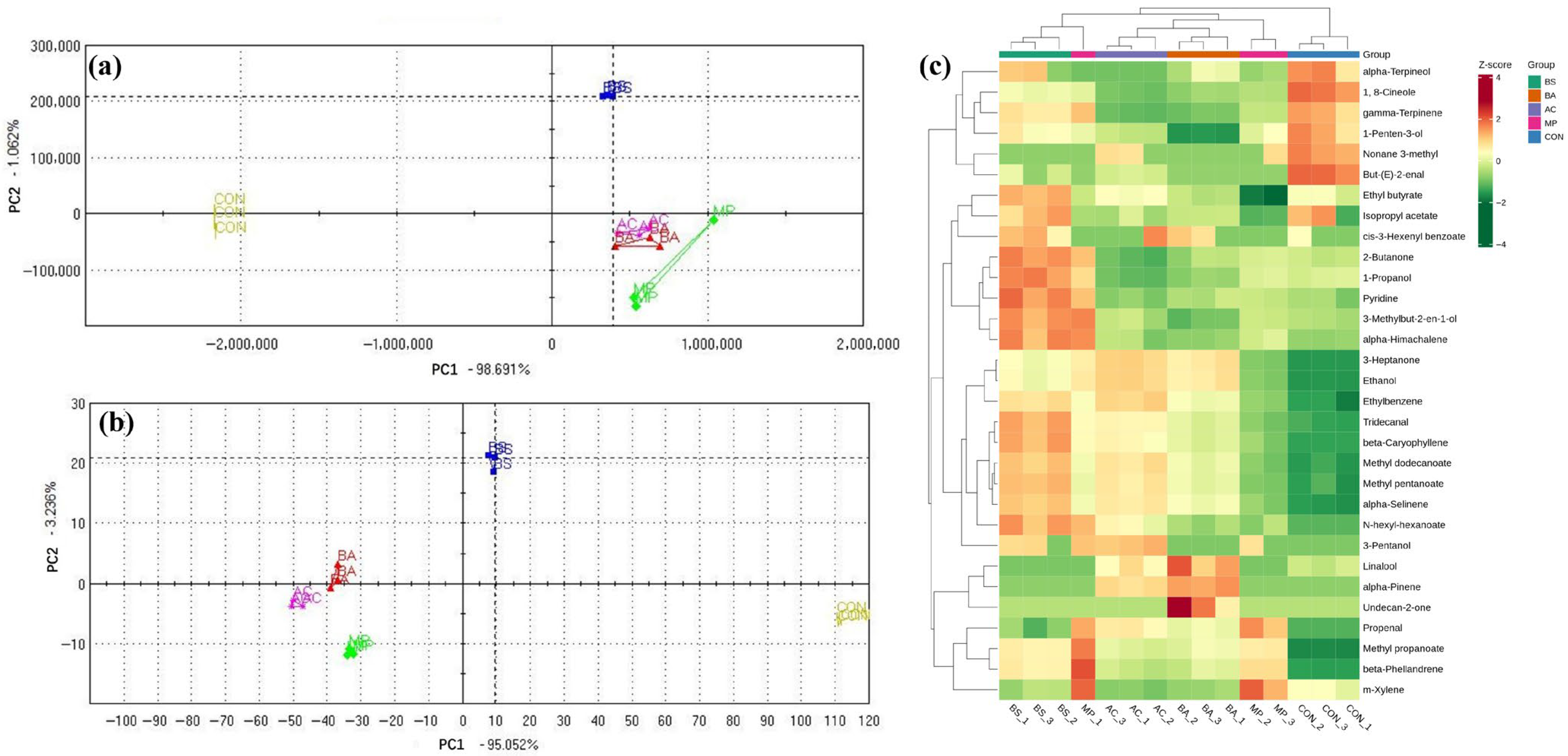
3.1. Flavor Profiles of Hawk Tea Samples Revealed by Electronic Nose
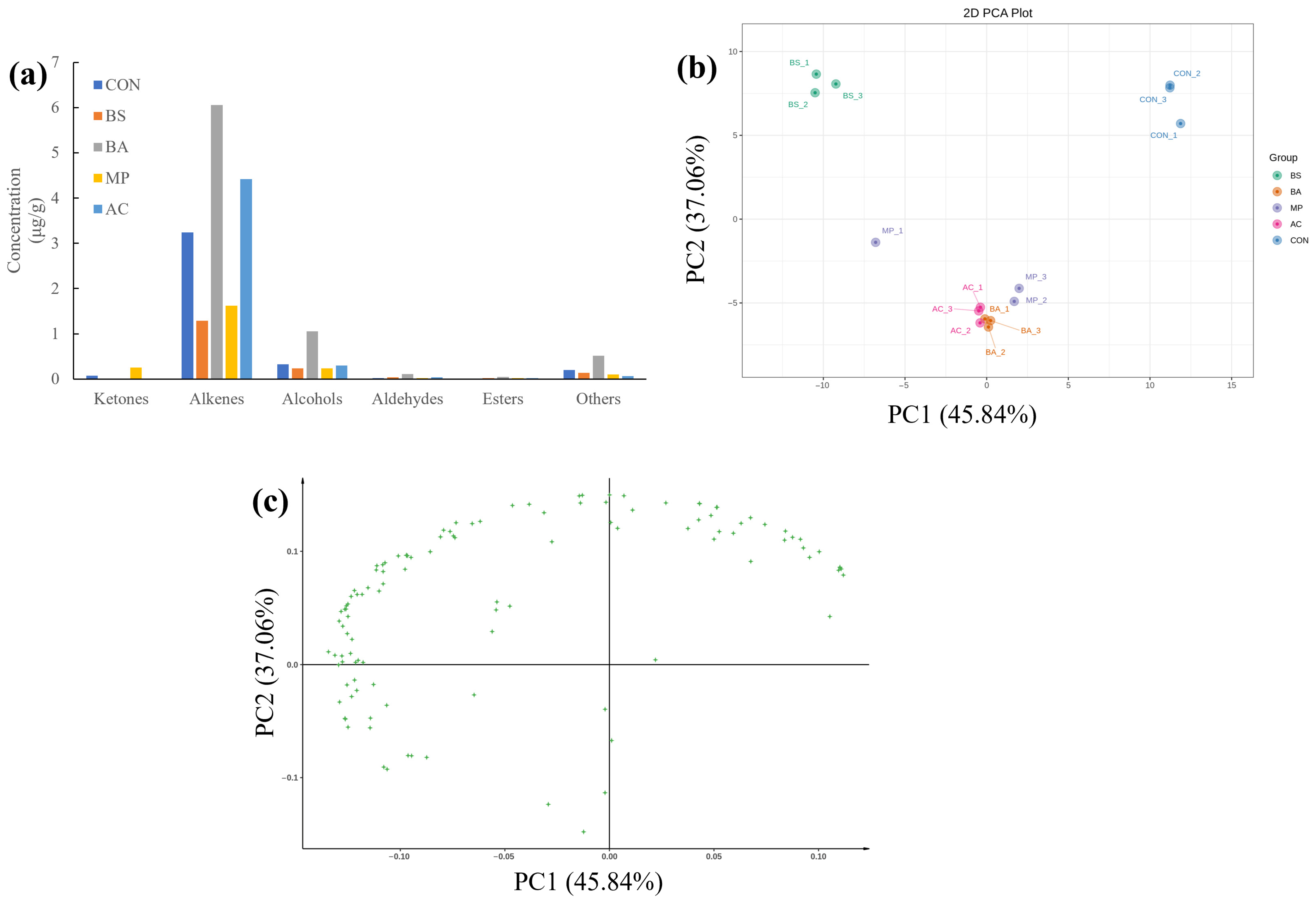
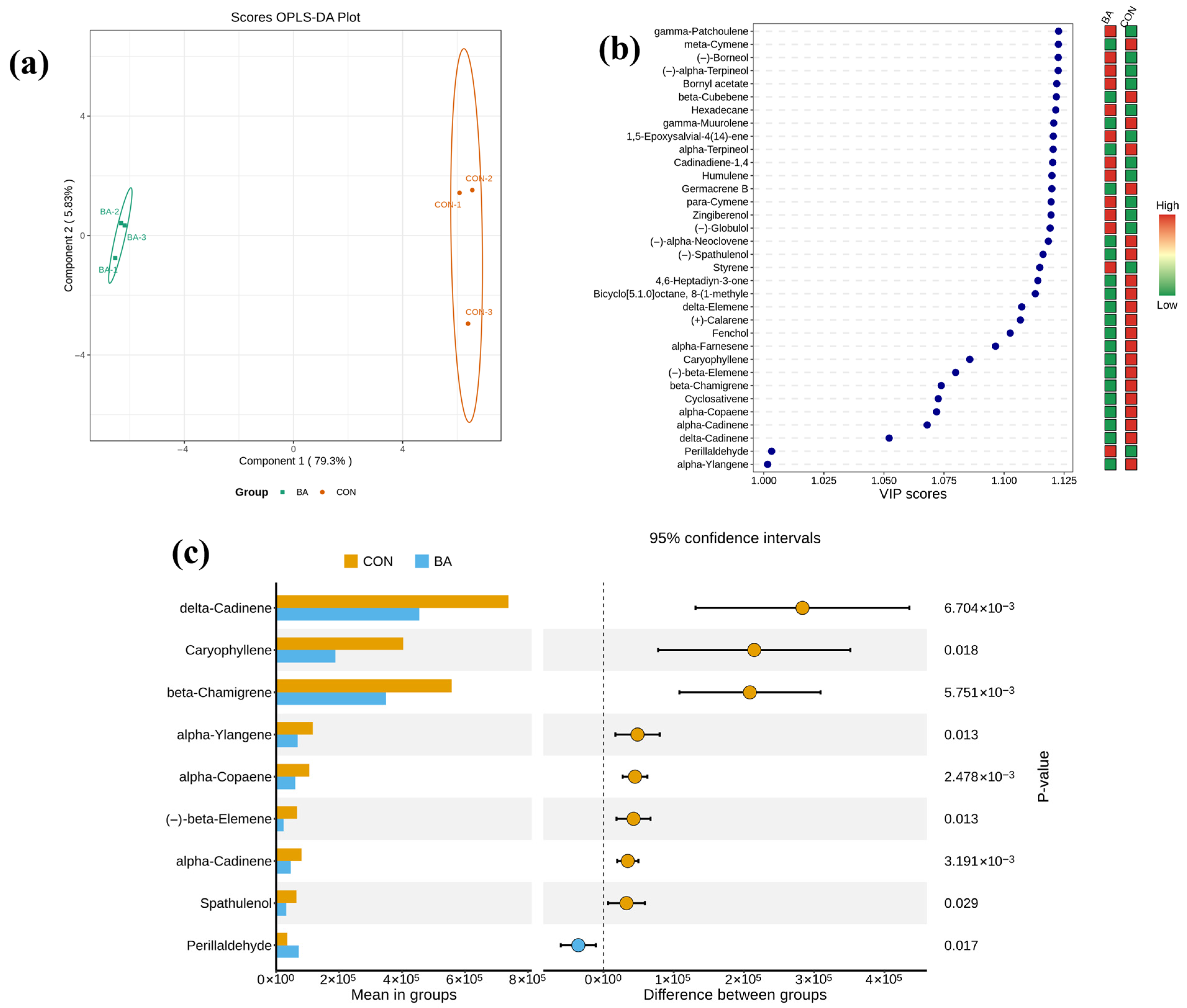
3.2. The Volatile Compounds of Hawk Tea Samples Identified by GC-MS
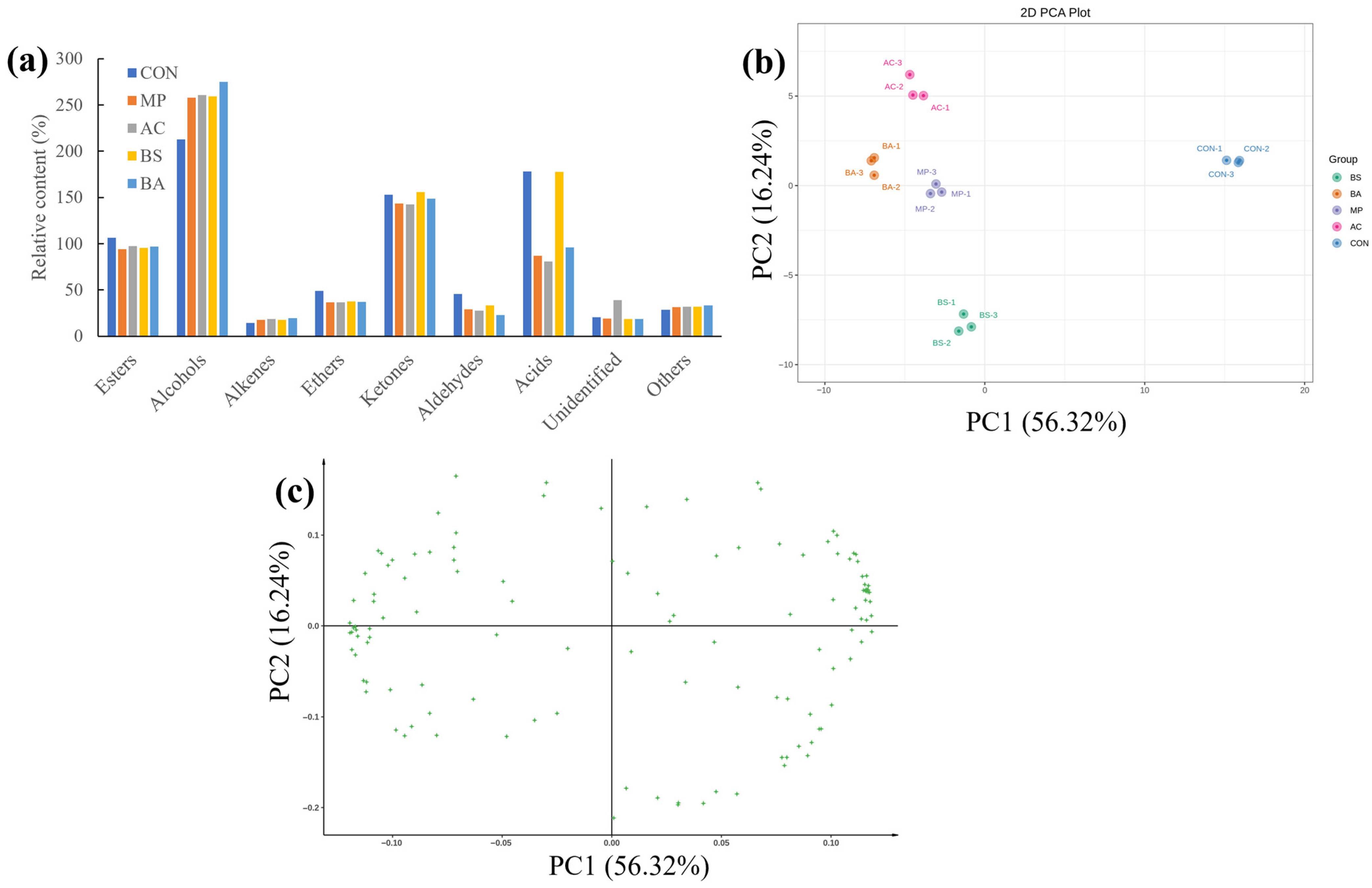
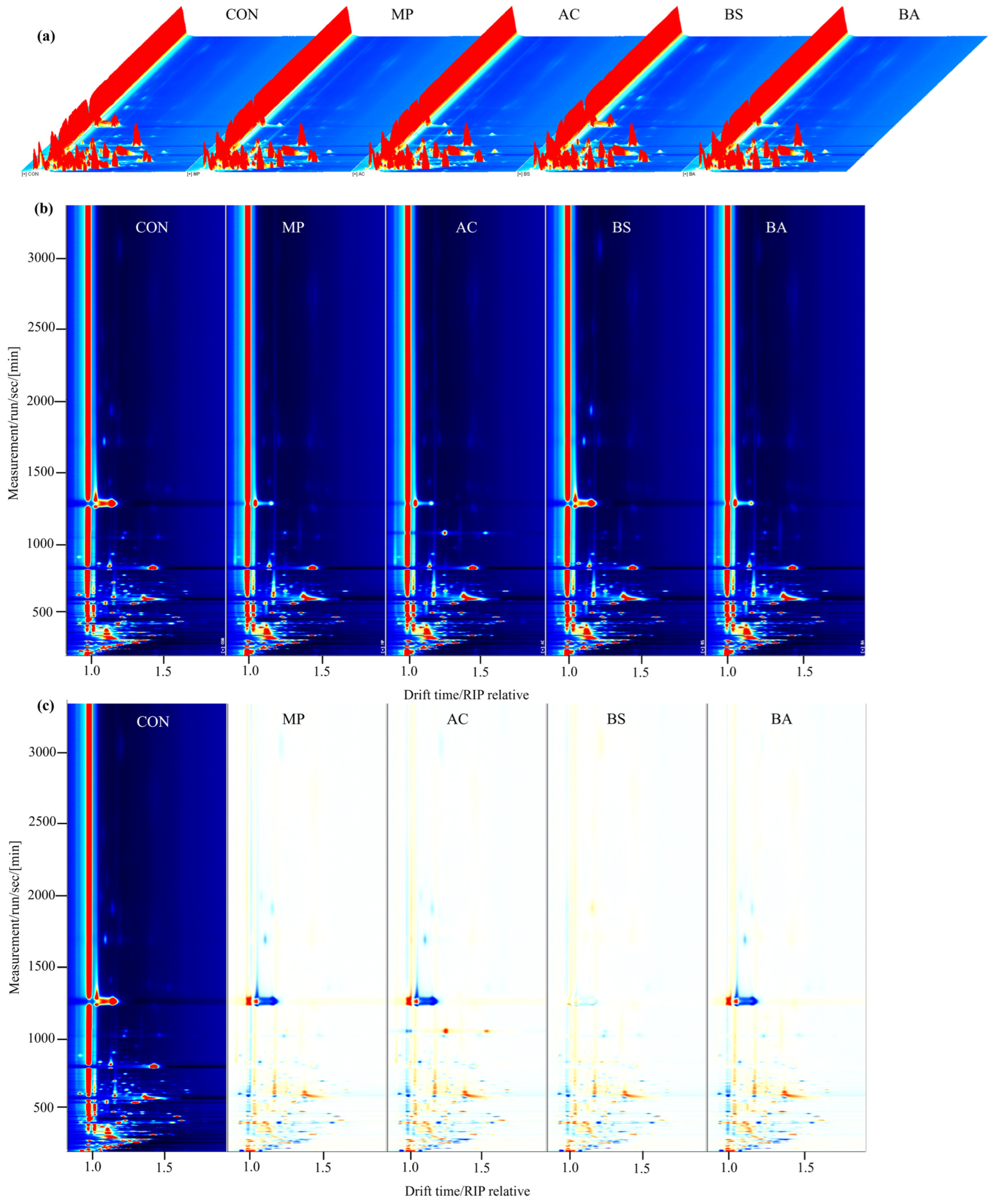
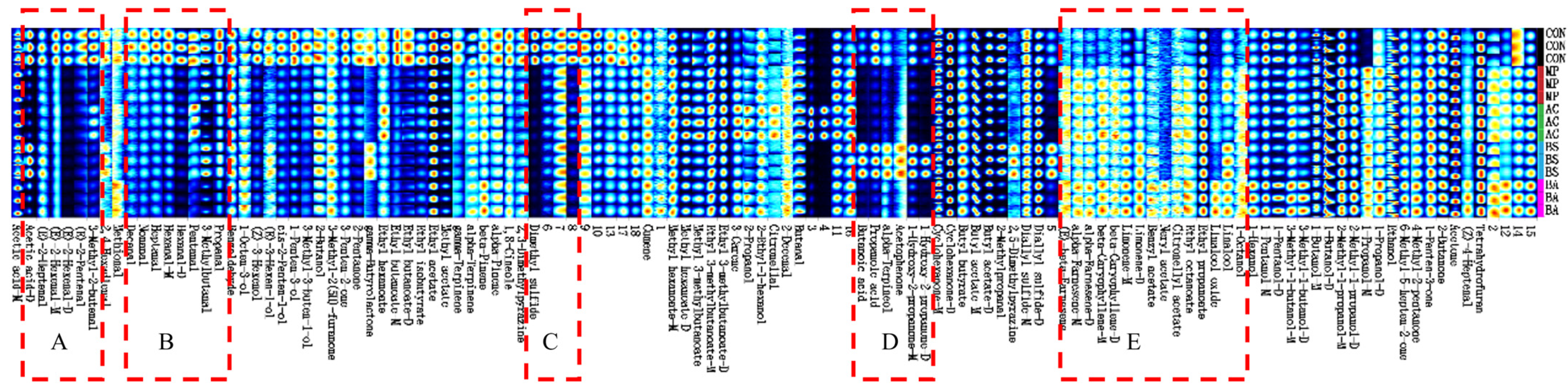
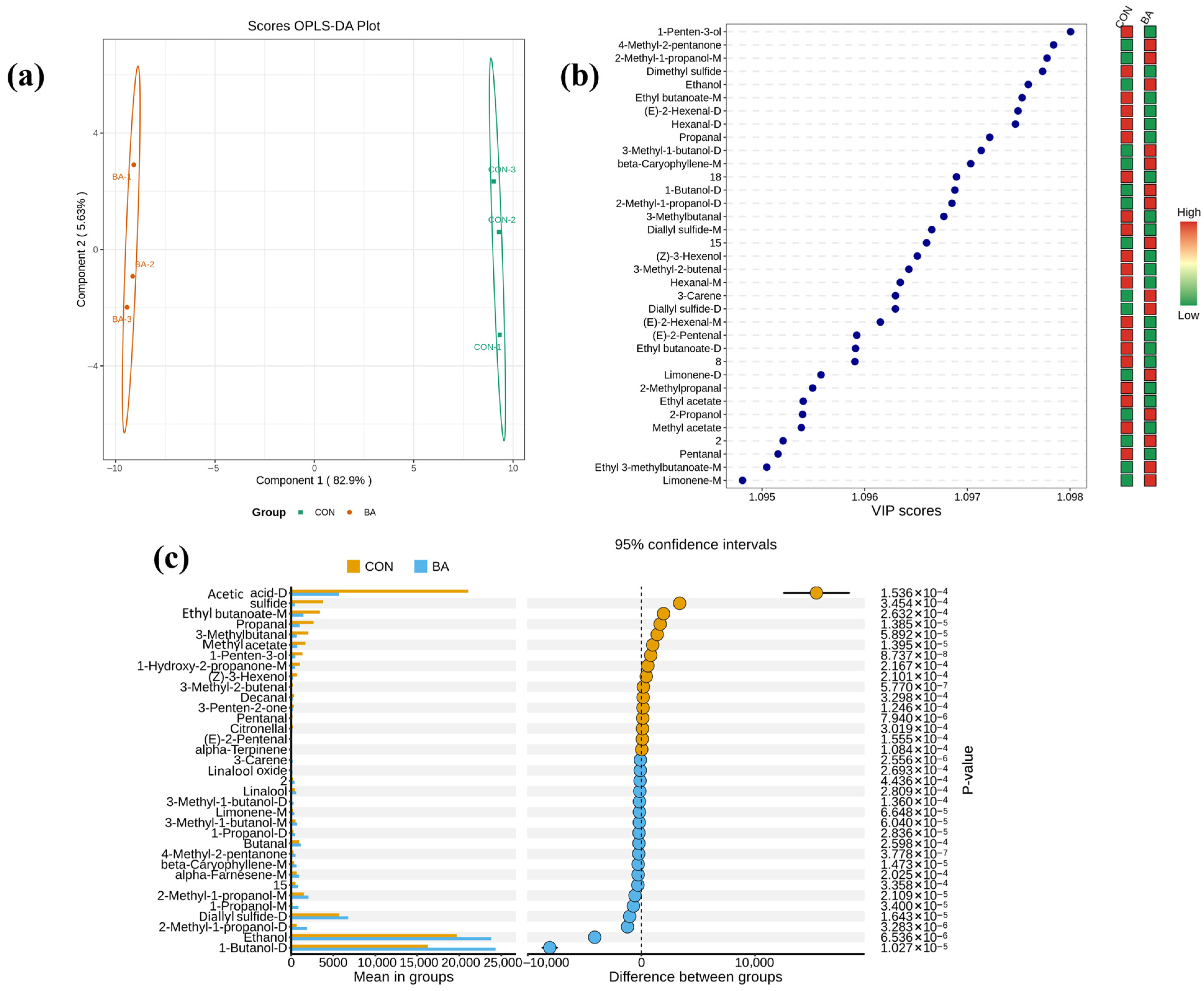
3.3. The Volatile Compounds of Hawk Tea Samples Identified by GC-IMS
3.4. Odor Profiles of Five Hawk Tea Samples
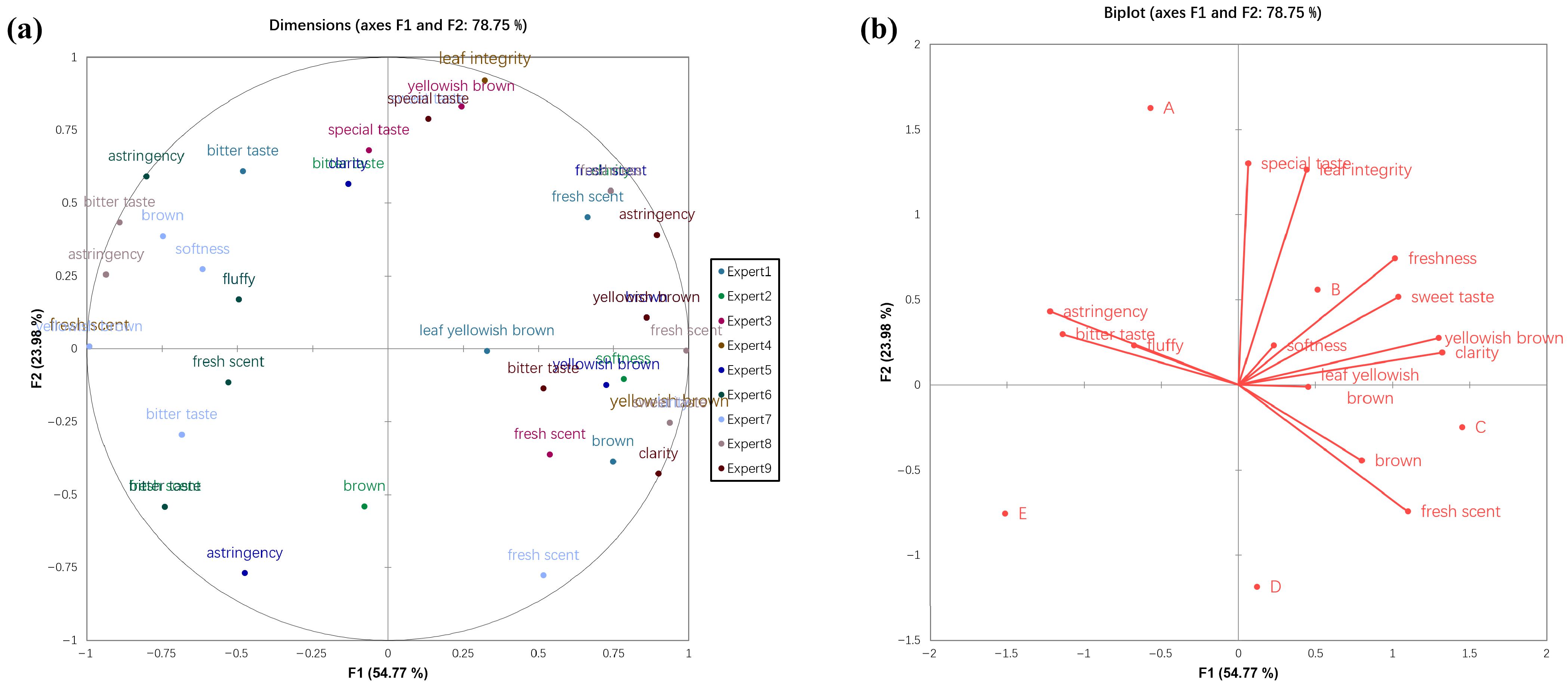
3.5. Sensory Evaluation of Hawk Tea Flavor
3.6. The Key Aroma Compounds in Blastobotrys adeninivorans-Fermented Hawk Tea
4. Conclusions
Supplementary Materials
Author Contributions
Funding
Institutional Review Board Statement
Informed Consent Statement
Data Availability Statement
Acknowledgments
Conflicts of Interest
References
- Feng, J.; Yang, J.; Chang, Y.; Qiao, L.; Dang, H.; Luo, K.; Guo, H.; An, Y.; Ma, C.; Shao, H.; et al. Caffeine-free hawk tea lowers cholesterol by reducing free cholesterol uptake and the production of very-low-density lipoprotein. Commun. Biol. 2019, 2, 173. [Google Scholar] [CrossRef]
- Jia, X.; Yuan, M. Hawk tea, a traditional and healthy natural beverage in south China. In Non-Alcoholic Beverages, 1st ed.; Grumezescu, A.M., Holban, A.M., Eds.; Woodhead Publishing: Duxford, UK, 2019; Volume 6, pp. 107–128. [Google Scholar]
- Yang, Y.Y.; Peng, J.; Li, Q.Q.; Song, Q.F.; Cronk, Q.; Xiong, B. Optimization of pile-fermentation process, quality and microbial diversity analysis of dark hawk tea (Machilus rehderi). LWT 2024, 192, 115707. [Google Scholar] [CrossRef]
- Jia, X.; Li, P.; Wan, J.; He, C. A review on phytochemical and pharmacological properties of Litsea coreana. Pharm. Biol. 2017, 55, 1368–1374. [Google Scholar] [CrossRef]
- Assad, M.; Ashaolu, T.J.; Khalifa, I.; Baky, M.H.; Farag, M.A. Dissecting the role of microorganisms in tea production of different fermentation levels: A multifaceted review of their action mechanisms, quality attributes and future perspectives. World J. Microbiol. Biotechnol. 2023, 39, 265. [Google Scholar] [CrossRef]
- Cai, M.; Huang, L.; Dong, S.; Diao, N.; Ye, W.; Peng, Z.; Fang, X. Enhancing the flavor profile of summer green tea via fermentation with Aspergillus niger RAF106. Foods 2023, 12, 3420. [Google Scholar] [CrossRef]
- An, T.; Shen, S.; Zu, Z.; Chen, M.; Wen, Y.; Chen, X.; Chen, Q.; Wang, Y.; Wang, S.; Gao, X. Changes in the volatile compounds and characteristic aroma during liquid-state fermentation of instant dark tea by Eurotium cristatum. Food Chem. 2023, 410, 135462. [Google Scholar] [CrossRef] [PubMed]
- Xiao, Y.; Zhong, K.; Bai, J.R.; Wu, Y.P.; Gao, H. Insight into effects of isolated Eurotium cristatum from Pingwu Fuzhuan brick tea on the fermentation process and quality characteristics of Fuzhuan brick tea. J. Sci. Food Agric. 2020, 100, 3598–3607. [Google Scholar] [CrossRef] [PubMed]
- Chen, G.; Peng, Y.; Xie, M.; Xu, W.; Chen, C.; Zeng, X.; Liu, Z. A critical review of Fuzhuan brick tea: Processing, chemical constituents, health benefits and potential risk. Crit. Rev. Food Sci. Nutr. 2023, 63, 5447–5464. [Google Scholar] [CrossRef] [PubMed]
- Zhang, D.; Huang, Y.; Fan, X.; Zeng, X. Effects of solid-state fermentation with Aspergillus cristatus (MK346334) on the dynamics changes in the chemical and flavor profile of dark tea by HS-SPME-GC-MS, HS-GC-IMS and electronic nose. Food Chem. 2024, 455, 139864. [Google Scholar] [CrossRef]
- Xu, X.M.; Zheng, Y.R.; Liu, Z.M.; Wang, J.D.; Wang, Q.G. Screening of Monascus as cheese starter and its effects on physicochemical, texture and antioxidant properties of cheese. J. Food Sci. Technol. 2023, 49, 127–135. [Google Scholar]
- Rui, Y.; Wan, P.; Chen, G.J.; Xie, M.H.; Sun, Y.; Zeng, X.X.; Liu, Z.H. Analysis of bacterial and fungal communities by Illumina MiSeq platforms and characterization of Aspergillus cristatus in Fuzhuan brick tea. LWT 2019, 110, 168–174. [Google Scholar] [CrossRef]
- Wang, Z.; Jin, Q.; Jiang, R.; Liu, Y.; Xie, H.; Ou, X.; Li, Q.; Liu, Z.; Huang, J. Characteristic volatiles of Fu brick tea formed primarily by extracellular enzymes during Aspergillus cristatus fermentation. Food Res. Int. 2024, 177, 113854. [Google Scholar] [CrossRef]
- Peng, Q.; Zheng, H.; Li, J.; Li, S.; Huang, J.; Xu, Y.; Xie, G. Impact of Bacillus subtilis on Chinese yellow rice wine (Huangjiu) fermentation: Method variations and flavor analysis. Food Chem. 2024, 460, 140658. [Google Scholar] [CrossRef]
- Tian, F.; Shi, J.; Li, Y.; Gao, H.; Chang, L.; Zhang, Y.; Gao, L.; Xu, P.; Tang, S. Proteogenomics study of Blastobotrys adeninivorans TMCC 70007—A dominant yeast in the fermentation process of Pu-erh tea. J. Proteome Res. 2021, 20, 3290–3304. [Google Scholar] [CrossRef]
- Peng, L.; Wang, X.; He, M.; Sha, X.; Dou, Z.; Xiao, L.; Li, W. Discrimination and screening of volatile metabolites in Atractylodis rhizoma from different varieties using headspace solid-phase microextraction-gas chromatography-mass spectrometry and headspace gas chromatography-ion mobility spectrometry, and ultra-fast gas chromatography electronic nose. J. Chromatogr. A 2024, 1725, 464931. [Google Scholar]
- Yu, B.; Zhang, D.; Yan, X.W.; Wang, J.W.; Yao, L.; Tan, L.H.; Zhao, S.P.; Li, N.; Cao, W.G. Comparative evaluation of the chemical composition, antioxidant and antimicrobial activities of the volatile oils of hawk tea from six botanical origins. Chem. Biodivers. 2016, 13, 1573–1583. [Google Scholar] [CrossRef]
- Guo, X.; Schwab, W.; Ho, C.T.; Song, C.; Wan, X. Characterization of the aroma profiles of oolong tea made from three tea cultivars by both GC-MS and GC-IMS. Food Chem. 2022, 376, 131933. [Google Scholar] [CrossRef] [PubMed]
- Zheng, A.R.; Wei, C.K.; Wang, M.S.; Ju, N.; Fan, M. Characterization of the key flavor compounds in cream cheese by GC-MS, GC-IMS, sensory analysis and multivariable statistics. Curr. Res. Food Sci. 2024, 8, 100772. [Google Scholar] [CrossRef]
- Bi, J.; Li, Y.; Yang, Z.; Lin, Z.; Chen, F.; Liu, S.; Li, C. Effect of different cooking times on the fat flavor compounds of pork belly. J. Food Biochem. 2022, 46, e14184. [Google Scholar] [CrossRef]
- Rodríguez-Noriega, S.; Buenrostro-Figueroa, J.J.; Rebolloso-Padilla, O.N.; Corona-Flores, J.; Camposeco-Montejo, N.; Flores-Naveda, A.; Ruelas-Chacón, X. Developing a descriptive sensory characterization of flour tortilla applying Flash Profile. Foods 2021, 10, 1473. [Google Scholar] [CrossRef] [PubMed]
- Qian, Y.J.; Wei, W.; Zhu, G.F.; Pi, W.X.; Lu, T.L.; Mao, C.Q. Study on dynamic changes of odor components in Cornus officinalis during processing by ultra-fast gas phase electronic nose. Chin. Pharm. J. 2022, 33, 2182–2186. [Google Scholar]
- Granato, D.; Santos, J.S.; Escher, G.B.; Ferreira, B.L.; Maggio, R.M. Use of principal component analysis (PCA) and hierarchical cluster analysis (HCA) for multivariate association between bioactive compounds and functional properties in foods: A critical perspective. Trends Food Sci. Technol. 2017, 72, 83–90. [Google Scholar] [CrossRef]
- Bisele, M.; Bencsik, M.; Lewis, M.G.C.; Barnett, C.T. Optimisation of a machine learning algorithm in human locomotion using principal component and discriminant function analyses. PLoS ONE 2017, 12, e0183990. [Google Scholar] [CrossRef]
- Pang, X.; Qin, Z.; Zhao, L.; Cheng, H.; Hu, X.; Song, H.; Wu, J. Development of regression model to differentiate quality of black tea (Dianhong): Correlate aroma properties with instrumental data using multiple linear regression analysis. Int. J. Food Sci. Technol. 2012, 47, 2372–2379. [Google Scholar] [CrossRef]
- Gabetti, E.; Sgorbini, B.; Stilo, F.; Bicchi, C.; Rubiolo, P.; Chialva, F.; Reichenbach, S.E.; Bongiovanni, V.; Cordero, C.; Cavallero, A. Chemical fingerprinting strategies based on comprehensive two-dimensional gas chromatography combined with gas chromatography-olfactometry to capture the unique signature of Piemonte peppermint essential oil (Mentha × piperita var. Italo-Mitcham). J. Chromatogr. A 2021, 1645, 462101. [Google Scholar] [CrossRef]
- Bergman, M.E.; Davis, B.; Phillips, M.A. Medically useful plant terpenoids: Biosynthesis, occurrence, and mechanism of action. Molecules 2019, 24, 3961. [Google Scholar] [CrossRef]
- Miyazawa, M.; Honjo, Y.; Kameoka, H. Biotransformation of the sesquiterpenoid (+)-γ-Gurjunene using a plant pathogenic fungus, Glomerella cingulata, as a biocatalyst. Phytochemistry 1998, 49, 1283–1285. [Google Scholar] [CrossRef]
- Zhang, C.P.; Su, J.; Wang, J.A.; Zhao, Z.G. Identification of volatile and odor-active compounds in Maojian herbal tea (Dracocephalum rupestre Hance). J. Food Compos. Anal. 2024, 135, 106643. [Google Scholar] [CrossRef]
- Zhu, J.; Zhou, Y.; Wen, H. Analysis of differences in volatile components of Rucheng Baimao (Camellia pubescens) black tea in different seasons. Foods 2025, 14, 763. [Google Scholar] [CrossRef] [PubMed]
- Li, Y.; Ran, W.; He, C.; Zhou, J.; Chen, Y.; Yu, Z.; Ni, D. Effects of different tea tree varieties on the color, aroma, and taste of Chinese Enshi green tea. Food Chem. X 2022, 14, 100289. [Google Scholar] [CrossRef] [PubMed]
- Miyazawa, M.; Yoshinaga, S.; Kashima, Y.; Nakahashi, H.; Hara, N.; Nakagawa, H.; Usami, A. Chemical composition and characteristic odor compounds in essential oil from Alismatis Rhizoma (Tubers of Alisma orientale). J. Oleo Sci. 2016, 65, 91–97. [Google Scholar] [CrossRef][Green Version]
- Ferreira, D.D.F.; Garruti, D.D.S.; Barin, J.S.; Cichoski, A.J.; Wagner, R. Characterization of odor-active compounds in gabiroba fruits (Campomanesia xanthocarpa O. Berg). J. Food Qual. 2015, 39, 90–97. [Google Scholar] [CrossRef]
- Ye, J.; Zhang, Q.; Cheng, P.; Wang, Y.; Zou, J.; Lin, S.; Li, M.; Jia, M.; Chen, Y.; Jia, X.; et al. Aviation mutagenesis alters the content of volatile compounds in Dahongpao (Camellia sinensis) leaves and improves tea quality. Foods 2024, 13, 946. [Google Scholar] [CrossRef] [PubMed]
- Raffo, A.; Baiamonte, I.; De Benedetti, L.; Lupotto, E.; Marchioni, I.; Nardo, N.; Cervelli, C. Exploring volatile aroma and non-volatile bioactive compounds diversity in wild populations of rosemary (Salvia rosmarinus Schleid.). Food Chem. 2023, 404, 134532. [Google Scholar] [CrossRef]
- Jin, W.; Cai, W.; Zhao, S.; Gao, R.; Jiang, P. Uncovering the differences in flavor volatiles of different colored foxtail millets based on gas chromatography-ion migration spectrometry and chemometrics. Curr. Res. Food Sci. 2023, 7, 100585. [Google Scholar] [CrossRef]
- Wei, J.; Mu, X.; Wang, S.; Wei, Q.; Zhu, L.; Zhang, X.; Zhang, J.; Liu, X.; Wen, B.; Li, M.; et al. Integrated metabolome and transcriptome analysis provides insights into the mechanisms of terpenoid biosynthesis in tea plants (Camellia sinensis). Food Res. Int. 2025, 201, 115542. [Google Scholar] [CrossRef]
- Hong, X.; Wang, C.; Jiang, R.; Hu, T.; Zheng, X.; Huang, J.; Liu, Z.; Li, Q. Characterization of the key aroma compounds in different aroma types of Chinese yellow tea. Foods 2023, 12, 27. [Google Scholar] [CrossRef] [PubMed]
- Su, D.; He, J.J.; Zhou, Y.Z.; Li, Y.L.; Zhou, H.J. Aroma effects of key volatile compounds in Keemun black tea at different grades: HS-SPME-GC-MS, sensory evaluation, and chemometrics. Food Chem. 2022, 373, 131587. [Google Scholar] [CrossRef]
- Chen, S.; Xie, P.; Li, Y.; Wang, X.; Liu, H.; Wang, S.; Han, W.; Wu, R.; Li, X.; Guan, Y.; et al. New insights into stress-induced β-ocimene biosynthesis in tea (Camellia sinensis) leaves during Oolong tea processing. J. Agric. Food Chem. 2021, 69, 11656–11664. [Google Scholar] [CrossRef]
- Godara, A.; Kao, K.C. Adaptive laboratory evolution of β-caryophyllene producing Saccharomyces cerevisiae. Microb. Cell Fact. 2021, 20, 106. [Google Scholar] [CrossRef]
- Jabłoński, S.J.; Mielko-Niziałek, K.A.; Leszczyński, P.; Gasiński, A.; Kawa-Rygielska, J.; Młynarz, P.; Łukaszewicz, M. Examination of internal metabolome and VOCs profile of brewery yeast and their mutants producing beer with improved aroma. Sci. Rep. 2024, 14, 14582. [Google Scholar] [CrossRef]
- Zhao, Z.J.; Sun, Y.L.; Ruan, X.F. Bornyl acetate: A promising agent in phytomedicine for inflammation and immune modulation. Phytomedicine 2023, 114, 154781. [Google Scholar] [CrossRef] [PubMed]
- Minh Tu, N.T.; Onishi, Y.; Son, U.S.; Ogawa, E.; Ukeda, H.; Sawamura, M. Characteristic odour components of Citrus inflata Hort. ex Tanaka (Mochiyu) cold-pressed peel oil. Flavour Fragrance J. 2003, 18, 454–459. [Google Scholar] [CrossRef]
- Huang, H.; Chen, Y.; Hong, J.; Chen, H.; Zhao, D.; Wu, J.; Li, J.; Sun, J.; Sun, X.; Huang, M.; et al. Unraveling the chemosensory characteristics on different types of spirits based on sensory contours and quantitative targeted flavoromics analysis. Food Chem. X 2024, 23, 101716. [Google Scholar] [CrossRef] [PubMed]
- Gao, X.; Han, X.; Tang, Y.; Song, H.; Meng, Q.; Chen, R.; Yu, J.; Yang, P.; Yu, Z. Exploring changes in key aroma-active compounds of soy sauce due to different fermentation processes. J. Food Compos. Anal. 2024, 133, 106393. [Google Scholar] [CrossRef]
- Liu, N.; Shen, S.; Huang, L.; Deng, G.; Wei, Y.; Ning, J.; Wang, Y. Revelation of volatile contributions in green teas with different aroma types by GC-MS and GC-IMS. Food Res. Int. 2023, 169, 112845. [Google Scholar] [CrossRef]
- Dein, M.; Munafo, J.P., Jr. Characterization of odorants in southern mountain mint, Pycnanthemum pycnanthemoides. J. Agric. Food Chem. 2022, 70, 9722–9729. [Google Scholar] [CrossRef]
- Xu, J.; Zeng, M.; Wang, Z.; Chen, Q.; Qin, F.; Chen, J.; He, Z. Characteristic flavor compounds in soy protein isolate and their correlation with sensory attributes. Food Res. Int. 2025, 206, 116038. [Google Scholar] [CrossRef]



| No. | Compounds | RI a | RI b | CAS | Odor c | Thresholds (mg/kg) d | Content (μg/g) | ||||
|---|---|---|---|---|---|---|---|---|---|---|---|
| CON | BS | BA | MP | AC | |||||||
| Ketones | |||||||||||
| 1 | 4,6-Heptadiyn-3-one | 868 | 868 | 29743-27-9 | - | n.f. | 0.052 ± 0.017 | 0.012 ± 0.006 | n.d. | 0.254 ± 0.059 | n.d. |
| 2 | 1,3-Dichloroacetone | 862 | 868 | 534-07-6 | - | n.f. | 0.026 ± 0.021 | n.d. | n.d. | n.d. | n.d. |
| Alkenes | |||||||||||
| 3 | Sabinene | 974 | 974 | 3387-41-5 | Woody, terpene, citrus, pine, spice | 0.98 | 0.009 ± 0.004 | n.d. | n.d. | n.d. | n.d. |
| 4 | meta-Cymene | 1023 | 1023 | 535-77-3 | - | 0.8 | 0.015 ± 0.001 | n.d. | n.d. | n.d. | n.d. |
| 5 | Isosylvestrene | 1027 | 1027 | 1461-27-4 | - | n.f. | 0.059 ± 0.018 | n.d. | 0.162 ± 0.014 | n.d. | 0.154 ± 0.008 |
| 6 | (Z)-beta-Ocimene | 1039 | 1038 | 3338-55-4 | Warm, floral, herb, flower, sweet | 0.034 | 0.05 ± 0.043 | n.d. | n.d. | 0.004 ± 0.001 | n.d. |
| 7 | Bicyclo[5.1.0]octane, 8-(1-methyle | 1098 | 1099 | 54166-47-1 | - | n.f. | 0.006 ± 0.001 | n.d. | n.d. | n.d. | n.d. |
| 8 | delta-Elemene | 1336 | 1338 | 20307-84-0 | Sweet, herbal, woody | n.f. | 0.022 ± 0.008 | n.d. | n.d. | n.d. | 0.006 ± 0.005 |
| 9 | Cyclosativene | 1365 | 1368 | 22469-52-9 | - | n.f. | 0.003 ± 0 | n.d. | n.d. | n.d. | n.d. |
| 10 | alpha-Ylangene | 1369 | 1372 | 14912-44-8 | - | n.f. | 0.073 ± 0.008 | 0.025 ± 0.002 | 0.105 ± 0.021 | 0.033 ± 0.011 | 0.081 ± 0.027 |
| 11 | alpha-Copaene | 1374 | 1376 | 3856-25-5 | Woody, spicy, honey | n.f. | 0.065 ± 0.004 | 0.029 ± 0.002 | 0.093 ± 0.013 | 0.034 ± 0.013 | 0.102 ± 0.008 |
| 12 | (−)-beta-Elemene | 1391 | 1391 | 515-13-9 | Sweet | n.f. | 0.041 ± 0.007 | 0.013 ± 0.002 | 0.036 ± 0.007 | 0.015 ± 0.005 | 0.037 ± 0.008 |
| 13 | beta-Caryophyllene | 1417 | 1419 | 87-44-5 | Sweet, woody, spice, clove, dry | 0.064 | 0.252 ± 0.038 | 0.104 ± 0.014 | 0.291 ± 0.031 | 0.119 ± 0.034 | 0.27 ± 0.054 |
| 14 | Isosativene | 1427 | 1428 | 24959-83-9 | - | n.f. | n.d. | n.d. | 0.01 ± 0.004 | n.d. | n.d. |
| 15 | (+)-Calarene | 1432 | 1432 | 17334-55-3 | - | n.f. | 0.008 ± 0.002 | n.d. | n.d. | n.d. | 0.009 ± 0.007 |
| 16 | (−)-alpha-Neoclovene | 1454 | 1454 | 4545-68-0 | - | n.f. | 0.004 ± 0 | n.d. | n.d. | n.d. | n.d. |
| 17 | Alloaromadendrene | 1463 | 1461 | 25246-27-9 | Woody | n.f. | 0.013 ± 0.006 | n.d. | 0.144 ± 0.101 | n.d. | 0.038 ± 0.01 |
| 18 | gamma-Gurjunene | 1474 | 1473 | 22567-17-5 | Musty | n.f. | n.d. | n.d. | 0.43 ± 0.422 | n.d. | n.d. |
| 19 | gamma-Muurolene | 1478 | 1477 | 30021-74-0 | Herbal, woody, spice | n.f. | 0.181 ± 0.039 | 0.085 ± 0.112 | n.d. | 0.102 ± 0.075 | 0.304 ± 0.231 |
| 20 | beta-Selinene | 1484 | 1486 | 17066-67-0 | Herbal, | n.f. | 0.513 ± 0.096 | 0.325 ± 0.09 | 0.862 ± 0.093 | 0.34 ± 0.081 | 0.648 ± 0.128 |
| 21 | Guaiene | 1490 | 1490 | 88-84-6 | Sweet, woody, dry, guaiacwood, spicy, powdery | n.f. | 0.076 ± 0.041 | 0.042 ± 0.027 | 0.106 ± 0.029 | 0.051 ± 0.024 | 0.12 ± 0.007 |
| 22 | (−)-alpha-Muurolene | 1499 | 1499 | 10208-80-7 | Woody | n.f. | 0.126 ± 0.022 | 0.059 ± 0.011 | 0.344 ± 0.262 | 0.062 ± 0.014 | 0.133 ± 0.01 |
| 23 | gamma-Cadinene | 1512 | 1513 | 39029-41-9 | Herbal, woody | n.f. | 0.145 ± 0.03 | 0.107 ± 0.027 | 0.571 ± 0.468 | 0.09 ± 0.029 | 0.215 ± 0.031 |
| 24 | delta-Cadinene | 1522 | 1524 | 483-76-1 | Thyme, herbal, woody, dry | n.f. | 0.461 ± 0.043 | 0.278 ± 0.037 | 0.703 ± 0.101 | 0.279 ± 0.084 | 0.633 ± 0.09 |
| 25 | Zonarene | 1532 | 1527 | 41929-05-9 | - | n.f. | 0.044 ± 0.027 | n.d. | n.d. | n.d. | n.d. |
| 26 | alpha-Cadinene | 1538 | 1538 | 24406-05-1 | Woody, dry | n.f. | 0.05 ± 0.004 | 0.031 ± 0.005 | 0.071 ± 0.01 | 0.035 ± 0.007 | 0.061 ± 0.009 |
| 27 | alpha-Calacorene | 1540 | 1542 | 21391-99-1 | Woody | n.f. | 0.034 ± 0.017 | 0.051 ± 0.012 | 0.149 ± 0.004 | 0.042 ± 0.013 | 0.063 ± 0.024 |
| 28 | Germacrene B | 1553 | 1557 | 15423-57-1 | Woody, earthy, spicy | n.f. | 0.011 ± 0.002 | n.d. | n.d. | n.d. | n.d. |
| 29 | trans-Sesquisabinene hydrate | 1584 | 1581 | 145512-84-1 | - | n.f. | n.d. | n.d. | n.d. | 0.012 ± 0.01 | 0.016 ± 0.007 |
| 30 | Cadalene | 1672 | 1674 | 483-78-3 | - | n.f. | n.d. | 0.009 ± 0.006 | n.d. | n.d. | 0.006 ± 0.001 |
| 31 | para-Cymene | 1024 | 1025 | 99-87-6 | Fresh, citrus, terpene, woody, spice | 0.005 | n.d. | 0.011 ± 0 | 0.027 ± 0.004 | 0.011 ± 0.001 | 0.02 ± 0.011 |
| 32 | beta-Cubebene | 1388 | 1389 | 13744-15-5 | Citrus, fruity, radish | n.f. | 0.01 ± 0.001 | n.d. | n.d. | n.d. | 0.009 ± 0 |
| 33 | Aromadendrene | 1437 | 1440 | 489-39-4 | Wood | n.f. | 0.015 ± 0.001 | n.d. | n.d. | n.d. | n.d. |
| 34 | Humulene | 1451 | 1454 | 6753-98-6 | Woody | 0.16 | n.d. | 0.048 ± 0.002 | 0.119 ± 0.025 | 0.057 ± 0.023 | 0.099 ± 0.014 |
| 35 | beta-Chamigrene | 1475 | 1476 | 18431-82-8 | - | n.f. | 0.348 ± 0.03 | n.d. | 0.54 ± 0.049 | n.d. | 0.478 ± 0.08 |
| 36 | Viridiflorene | 1493 | 1493 | 21747-46-6 | - | n.f. | 0.576 ± 0.159 | n.d. | 0.877 ± 0.215 | 0.265 ± 0.025 | 0.691 ± 0.08 |
| 37 | alpha-Farnesene | 1508 | 1508 | 502-61-4 | Citrus, herbal, lavender, bergamot, myrrh, neroli, green | n.f. | 0.007 ± 0.002 | n.d. | n.d. | n.d. | n.d. |
| 38 | 7-epi-alpha-Selinene | 1515 | 1517 | 123123-37-5 | - | n.f. | 0.031 ± 0.017 | n.d. | n.d. | 0.017 ± 0.005 | 0.082 ± 0.028 |
| 39 | Selina-3,7(11)-diene | 1539 | 1542 | 6813-21-4 | - | n.f. | 0.015 ± 0.007 | 0.006 ± 0.002 | n.d. | 0.004 ± 0 | n.d. |
| 40 | 1,5-Epoxysalvial-4(14)-ene | 1564 | 1573 | 88395-47-5 | - | n.f. | n.d. | 0.017 ± 0.002 | 0.05 ± 0.006 | 0.014 ± 0.003 | 0.016 ± 0.002 |
| 41 | meta-Xylene | 867 | 866 | 108-38-3 | Plastic | 1.1 | n.d. | n.d. | n.d. | n.d. | 0.009 ± 0.003 |
| 42 | (−)-gamma-Elemene | 1432 | 1434 | 29873-99-2 | Green, woody, oily | n.f. | n.d. | n.d. | 0.076 ± 0.045 | n.d. | n.d. |
| 43 | (E)-alpha-Bergamotene | 1435 | 1435 | 13474-59-4 | Woody, warm, tea | n.f. | n.d. | n.d. | n.d. | 0.009 ± 0.007 | n.d. |
| 44 | Hexadecane | 1600 | 1600 | 544-76-3 | - | n.f. | n.d. | 0.014 ± 0.003 | 0.04 ± 0.005 | 0.015 ± 0 | 0.016 ± 0.002 |
| 45 | Styrene | 889 | 893 | 100-42-5 | Sweet, balsam, floral, plastic | 0.065 | n.d. | 0.007 ± 0.001 | 0.029 ± 0.008 | 0.011 ± 0.002 | 0.012 ± 0.003 |
| 46 | alpha-Guaiene | 1437 | 1439 | 3691-12-1 | Sweet, woody, balsam, peppery | n.f. | n.d. | n.d. | n.d. | n.d. | 0.032 ± 0 |
| 47 | Cadinadiene-1,4 | 1530 | 1533 | 16728-99-7 | - | n.f. | n.d. | n.d. | 0.136 ± 0.037 | n.d. | n.d. |
| 48 | Amorphadiene | 1458 | 1458 | 92692-39-2 | - | n.f. | n.d. | 0.014 ± 0 | n.d. | n.d. | n.d. |
| 49 | Cubenene | 1531 | 1532 | 29837-12-5 | Spicy, fruity, mango | n.f. | n.d. | 0.018 ± 0.012 | n.d. | n.d. | 0.057 ± 0.043 |
| 50 | gamma-Patchoulene | 1441 | 1441 | 508-55-4 | - | n.f. | n.d. | n.d. | 0.082 ± 0.005 | n.d. | n.d. |
| Alcohols | |||||||||||
| 51 | alpha-Terpineol | 1190 | 1189 | 98-55-5 | Pine, terpene, lilac, citrus, woody, floral | 0.086 | 0.011 ± 0.002 | 0.013 ± 0 | n.d. | n.d. | n.d. |
| 52 | Cubebol | 1515 | 1515 | 23445-02-5 | Spicy, minty | n.f. | 0.033 ± 0.022 | 0.042 ± 0.007 | 0.103 ± 0.007 | 0.02 ± 0.017 | n.d. |
| 53 | Ledol | 1563 | 1565 | 577-27-5 | - | n.f. | n.d. | n.d. | n.d. | 0.004 ± 0 | n.d. |
| 54 | Spathulenol | 1574 | 1576 | 6750-60-3 | Earthy, herbal, fruity | n.f. | 0.04 ± 0.004 | 0.013 ± 0.002 | 0.049 ± 0.019 | 0.011 ± 0.001 | 0.012 ± 0 |
| 55 | (−)-Spathulenol | 1581 | 1577 | 77171-55-2 | Honey | n.f. | 0.016 ± 0.004 | n.d. | n.d. | n.d. | n.d. |
| 56 | Viridiflorol | 1598 | 1591 | 552-02-3 | Sweet, green, herbal, fruity, tropical, minty | n.f. | 0.003 ± 0.001 | n.d. | n.d. | n.d. | n.d. |
| 57 | Zingiberenol | 1614 | 1616 | 58334-55-7 | Ginger, metal | n.f. | n.d. | 0.014 ± 0 | 0.026 ± 0.003 | 0.012 ± 0.003 | n.d. |
| 58 | gamma-Eudesmol | 1629 | 1631 | 1209-71-8 | Waxy, sweet | n.f. | 0.051 ± 0.028 | 0.024 ± 0.015 | 0.118 ± 0.011 | n.d. | 0.018 ± 0.001 |
| 59 | beta-Acorenol | 1649 | 1649 | 28400-11-5 | - | n.f. | n.d. | n.d. | n.d. | 0.094 ± 0.029 | n.d. |
| 60 | alpha-Eudesmol | 1651 | 1653 | 473-16-5 | - | n.f. | 0.085 ± 0.036 | 0.068 ± 0.027 | 0.245 ± 0.072 | n.d. | 0.12 ± 0.017 |
| 61 | Fenchol | 1112 | 1113 | 1632-73-1 | Camphor, borneol, pine, woody, dry, sweet, lemon | 0.78 | 0.009 ± 0.003 | n.d. | n.d. | n.d. | n.d. |
| 62 | Junenol | 1610 | 1617 | 472-07-1 | - | n.f. | n.d. | 0.01 ± 0.005 | n.d. | 0.014 ± 0.005 | 0.017 ± 0.001 |
| 63 | beta-Eudesmol | 1647 | 1649 | 473-15-4 | Woody, green | n.f. | 0.074 ± 0.007 | 0.048 ± 0.007 | 0.362 ± 0.335 | 0.066 ± 0.019 | 0.052 ± 0.006 |
| 64 | (−)-alpha-Terpineol | 1191 | 1190 | 10482-56-1 | Lilac, floral, terpenic | 9.18 | n.d. | n.d. | 0.03 ± 0.001 | 0.007 ± 0.003 | 0.006 ± 0 |
| 65 | (−)-Globulol | 1580 | 1580 | 489-41-8 | - | n.f. | n.d. | n.d. | 0.051 ± 0.008 | n.d. | n.d. |
| 66 | (−)-Borneol | 1164 | 1166 | 464-45-9 | Pine, woody, camphor | 0.08 | n.d. | n.d. | 0.067 ± 0.004 | 0.006 ± 0.001 | n.d. |
| 67 | 1-epi-Cubenol | 1627 | 1627 | 19912-67-5 | - | n.f. | n.d. | n.d. | n.d. | n.d. | 0.075 ± 0.04 |
| Aldehydes | |||||||||||
| 68 | Perillaldehyde | 1272 | 1272 | 2111-75-3 | Fresh, green, herbal, grassy, sweet, mint, cumin | 0.03 | 0.022 ± 0.005 | 0.035 ± 0.014 | 0.11 ± 0.018 | 0.019 ± 0.009 | 0.038 ± 0.024 |
| Esters | |||||||||||
| 69 | Ethyl decanoate | 1398 | 1396 | 110-38-3 | Sweet, waxy, fruity, apple, grape, oily, brandy | 0.005 | n.d. | 0.006 ± 0.002 | n.d. | 0.009 ± 0.001 | 0.009 ± 0.001 |
| 70 | Bornyl acetate | 1285 | 1285 | 76-49-3 | Woody, pine, herbal, cedar, spice | 0.075 | n.d. | 0.013 ± 0 | 0.047 ± 0.032 | 0.009 ± 0.002 | 0.014 ± 0.001 |
| 71 | Ethyl palmitate | 1997 | 1993 | 628-97-7 | Mild, waxy, fruity, creamy, milky, balsam | 2 | n.d. | n.d. | n.d. | 0.003 ± 0 | n.d. |
| Others | |||||||||||
| 72 | 1-Chlorooctane | 1059 | 1059 | 111-85-3 | - | n.f. | 0.204 ± 0.088 | 0.078 ± 0.005 | 0.345 ± 0.142 | 0.045 ± 0.01 | 0.043 ± 0.013 |
| 73 | Heptadecane | 1700 | 1700 | 629-78-7 | - | n.f. | n.d. | 0.058 ± 0.001 | 0.146 ± 0.028 | 0.055 ± 0.007 | 0.012 ± 0 |
| 74 | 2,4-Dimethyldecane | 1103 | 1106 | 2801-84-5 | - | n.f. | n.d. | n.d. | 0.023 ± 0.011 | n.d. | 0.011 ± 0.001 |
| Compounds | Thresholds (mg/kg) | OAVs | ||||
|---|---|---|---|---|---|---|
| CON | BS | BA | MP | AC | ||
| (Z)-beta-Ocimene | 0.034 | 1.494 | n.d. | n.d. | n.d. | n.d. |
| beta-Caryophyllene | 0.064 | 3.941 | 0.205 | 4.559 | 0.237 | 4.221 |
| para-Cymene | 0.005 | n.d. | n.d. | 5.566 | n.d. | 4.192 |
| Perillaldehyde | 0.03 | 0.742 | n.d. | 3.692 | n.d. | 1.278 |
| Ethyl decanoate | 0.005 | 40.984 | n.d. | 69.013 | n.d. | 8.624 |
| Bornyl acetate | 0.075 | n.d. | 1.043 | 1.954 | 0.611 | 0.166 |
| Compounds | Thresholds (Water, mg/kg) | ROAVs | ||||
|---|---|---|---|---|---|---|
| CON | MP | AC | BS | BA | ||
| 2-Decenal | 0.001 | 10.97 | 11.52 | 14.00 | 12.33 | 13.03 |
| Linalool | 0.00022 | 75.69 | 90.10 | 67.15 | 91.90 | 100.00 |
| Decanal | 0.003 | 4.19 | 3.03 | 2.55 | 2.84 | 2.31 |
| Citronellal | 0.006 | 1.36 | 0.77 | 1.50 | 1.46 | 0.77 |
| 1-Octen-3-ol | 0.0015 | 1.10 | 0.90 | 0.95 | 1.06 | 1.04 |
| Nonanal | 0.0011 | 10.18 | 6.29 | 6.01 | 5.80 | 4.44 |
| 1-Hexanol | 0.0056 | 1.02 | 1.02 | 1.02 | 0.97 | 1.44 |
| 3-Methyl-1-butanol-M | 0.004 | 4.82 | 5.16 | 5.50 | 4.70 | 6.55 |
| 3-Methyl-1-butanol-D | 0.004 | 1.02 | 1.51 | 1.88 | 1.30 | 2.65 |
| 1,8-Cineole | 0.0011 | 12.77 | 9.06 | 6.96 | 9.43 | 9.51 |
| Heptanal | 0.0028 | 1.77 | 0.88 | 0.83 | 0.79 | 0.74 |
| 1-Butanol-D | 0.4592 | 1.32 | 1.84 | 1.91 | 1.84 | 1.97 |
| Diallyl sulfide-D | 0.1 | 2.13 | 2.43 | 2.44 | 2.53 | 2.52 |
| Hexanal-M | 0.005 | 6.21 | 3.28 | 3.67 | 2.99 | 2.23 |
| Hexanal-D | 0.005 | 3.13 | 0.85 | 1.11 | 0.72 | 0.50 |
| Butyl acetate-M | 0.058 | 1.35 | 1.50 | 1.43 | 1.53 | 1.52 |
| 1-Penten-3-one | 0.023 | 2.92 | 3.10 | 3.11 | 3.09 | 3.17 |
| alpha-Pinene | 0.014 | 1.27 | 1.08 | 1.23 | 1.07 | 1.14 |
| Methyl 3-methylbutanoate | 0.0044 | 0.70 | 0.88 | 1.18 | 0.81 | 0.94 |
| Ethyl propanoate | 0.01 | 10.72 | 15.80 | 16.11 | 16.05 | 17.07 |
| 3-Methylbutanal | 0.0011 | 69.22 | 45.53 | 19.10 | 64.80 | 22.26 |
| Ethyl acetate | 0.005 | 57.75 | 38.41 | 39.56 | 39.05 | 37.82 |
| Butanal | 0.002 | 17.25 | 21.65 | 23.06 | 21.10 | 21.27 |
| 2-Methylpropanal | 0.0015 | 11.05 | 8.52 | 4.55 | 11.62 | 4.10 |
| Propanal | 0.0151 | 6.54 | 3.34 | 3.46 | 3.97 | 2.48 |
| Attribute | Description |
|---|---|
| Appearance | Fluffy, small spots, brown |
| Liquor color | Clarity, yellowish brown |
| Aroma | Fresh scent, moldy smell, cool taste |
| Taste | Bitter taste, sweet taste, astringency, freshness, special taste |
| Leaf bottom | Leaf integrity, leaf yellowish brown, softness |
Disclaimer/Publisher’s Note: The statements, opinions and data contained in all publications are solely those of the individual author(s) and contributor(s) and not of MDPI and/or the editor(s). MDPI and/or the editor(s) disclaim responsibility for any injury to people or property resulting from any ideas, methods, instructions or products referred to in the content. |
© 2026 by the authors. Licensee MDPI, Basel, Switzerland. This article is an open access article distributed under the terms and conditions of the Creative Commons Attribution (CC BY) license.
Share and Cite
Yang, Y.-R.; Cao, W.-G.; Li, C.-Y.; Li, S.-Y.; Huang, Q. Screening of Four Microbes for Solid-State Fermentation of Hawk Tea to Improve Its Flavor: Electronic Nose/GC-MS/GC-IMS-Guided Selection. Foods 2026, 15, 324. https://doi.org/10.3390/foods15020324
Yang Y-R, Cao W-G, Li C-Y, Li S-Y, Huang Q. Screening of Four Microbes for Solid-State Fermentation of Hawk Tea to Improve Its Flavor: Electronic Nose/GC-MS/GC-IMS-Guided Selection. Foods. 2026; 15(2):324. https://doi.org/10.3390/foods15020324
Chicago/Turabian StyleYang, Yi-Ran, Wei-Guo Cao, Chen-Yu Li, Shu-Yan Li, and Qin Huang. 2026. "Screening of Four Microbes for Solid-State Fermentation of Hawk Tea to Improve Its Flavor: Electronic Nose/GC-MS/GC-IMS-Guided Selection" Foods 15, no. 2: 324. https://doi.org/10.3390/foods15020324
APA StyleYang, Y.-R., Cao, W.-G., Li, C.-Y., Li, S.-Y., & Huang, Q. (2026). Screening of Four Microbes for Solid-State Fermentation of Hawk Tea to Improve Its Flavor: Electronic Nose/GC-MS/GC-IMS-Guided Selection. Foods, 15(2), 324. https://doi.org/10.3390/foods15020324