Immature Honey as a Quality Challenge in Global Apicultural Production

 ,
,  , , , and
Abstract
1. Introduction
- Analysis of international regulatory frameworks concerning the microbiological parameters of honey;
- Biology and metabolomics of the honey ripening process as a continuum;
- Microbiology of osmophilic yeasts in the context of water activity and fermentation risk;
- Diversity of global beekeeping production systems and their implications for standardization;
- Analysis of the EU honey market and the regulatory consequences of overly strict interpretations;
- A proposed framework for functional maturity assessment with recommendations for standardization bodies and Apimondia.
2. International Regulatory Frameworks: What Standards Actually Prohibit
2.1. Codex Alimentarius, CODEX STAN 12-1981
2.2. EU Directive 2001/110/EC and National Law
2.3. United States Pharmacopeia (USP) and Other National Standards
2.4. Comparative Overview of Standards
2.5. Regulatory Conclusion
3. Biology of Honey Ripening: A Continuous Process, Not a Binary Event
3.1. Enzymatic Transformation of Nectar
- Invertase (-D-fructosidase): It catalyzes the hydrolysis of sucrose into fructose and glucose; produced by the hypopharyngeal glands of worker bees [21]; its activity increases gradually from low values in immature honey to maximum values in mature honey, making it one of the most sensitive indicators of the degree of maturity [12].
- Catalase: It decomposes excess H2O2, regulating the balance between antibacterial activity and protection of the remaining honey components from oxidation [21].
3.2. Ripening as a Process: Metabolomic Evidence
3.3. The Concept of Functional Maturity
- Microbiological stability: absence of active fermentation; water activity ; moisture ≤ ; osmophilic yeast count below the growth threshold under given conditions of temperature and storage [10].
- Biological stability: antioxidant activity (DPPH, FRAP) at the level appropriate for the given botanical and geographical type; polyphenol and flavonoid content not reduced relative to reference values; antibacterial activity (assessed by H2O2 production and the presence of defensins) unchanged [13].
4. Microbiology of Yeasts in Honey: Presence vs. Activity vs. Adulteration
4.1. Osmophilic Yeasts as a Natural Component of Honey
4.1.1. Biological Characteristics of Osmophilic Yeasts
4.1.2. Sources of Colonization and Prevalence
4.2. Water Activity as a Critical Control Parameter
4.2.1. Definition and Significance of Water Activity in Honey
4.2.2. Osmophilic Yeast Growth Threshold and Water Activity
4.2.3. Glucose Crystallization as a Dynamic Factor Modifying Water Activity
4.3. Yeast Count as a Risk Indicator, Not a Disqualifying Parameter
4.3.1. Multiparametric Model of Fermentation Risk
4.3.2. Limitations of the Plate Method (CFU/g) as a Risk Assessment Tool
- Failure to distinguish viable from dead cells: the plate method counts only cells capable of forming colonies on solid medium under incubation conditions; living cells in a state of deep anabiosis induced by low honey may fail to grow on the medium or grow atypically, leading to underestimation of the true yeast count;
- Lack of correlation with in situ : the CFU/g result is a measure of the potential population size but does not indicate whether under the conditions prevailing in the tested product this population is active; only the combination of CFU/g with measurement allows assessment of the actual fermentation risk [11];
- Lack of species specificity: standard selective media do not differentiate yeast species with different fermentation potential; Metschnikowia spp. with low fermentation potential are counted identically to Z. rouxii with high potential [8].
- Legal–scientific conclusion: in light of the above methodological limitations, the mere determination of yeast count (CFU/g) in honey, without a simultaneous measurement of , determination of the product’s phase state, storage temperature, and time since harvest, does not constitute a sufficient scientific basis for assessing fermentation risk, let alone for disqualifying the product from commercial trade. Given that no applicable standard (Codex, EU, ISO) establishes a CFU/g limit for honey (cf. Section 2), a potential inspector’s decision to disqualify a product based solely on CFU/g count would be devoid of both scientific and legal grounds.
4.4. Fermentation as a Dynamic and Post-Harvest Event
5. Global Production Systems and Climatic Conditions
5.1. Global Landscape of Apicultural Production
African Production: Climatic Humidity and Traditional Hive Systems
5.2. Honeys of Stingless Tropical Bees
5.3. Specific Microclimates and Weather Conditions in the Temperate Zone
5.4. Comparison of Production Systems
5.5. Limitations of the Morphological Capping Criterion
6. EU Honey Market and Regulatory Implications
6.1. Structure and Dynamics of Honey Imports into the EU
6.2. The Scale of Honey Adulteration on the EU Market: Empirical Data
6.3. Analytical Gaps: Absence of a Validated Immaturity Biomarker
- There is no specific marker: no single chemical compound or enzyme is identified as a biomarker exclusively of immaturity in a manner independent of botanical and geographical type; the physicochemical parameters of mature honey from the tropics may resemble the parameters of immature honey from the temperate zone [13,17].
- Metagenomics and metabolomics have limited discriminatory power without reference databases: as Schoder [20] emphasizes in his 2026 review, the high analytical resolution of omic methods (genomics, proteomics, NMR, GC-MS, and LC-HRMS) does not guarantee unambiguous fraud attribution without solid, globally representative reference databases; “high analytical resolution alone therefore does not guarantee unambiguous fraud attribution” [20].
- Blending effects mask immaturity: blending immature with mature honeys in proportions below 50% is analytically indistinguishable from mature honey by conventional methods [20]; it should be emphasized that this problem also applies to the honey extraction stage—it is impossible to determine what fraction of honey was mature and what was immature at the time of extraction.
6.4. Regulatory Risk: Consequences of Overly Strict Interpretation
- Risk of discrimination against tropical producers.
- Risk of aggravating the deficit and price increases.
- Risk of creating arbitrary trade barriers.
- Risk of missing the actual problem.
6.5. Regulatory Proposals: Harmonization, Traceability, and Proportionality
- Update EU Directive 2001/110/EC with a water activity () criterion: introduction of mandatory measurement alongside moisture content as a primary parameter for fermentation risk assessment. Measurement of is a validated, commercially available method (instruments such as AquaLab, Rotronic HygroLab) and inexpensive; this would constitute a substitution of the morphological criterion with a physicochemical criterion having direct scientific justification [10,11].
- Establish a multiparametric microbiological assessment protocol: fermentation risk assessment should be conducted simultaneously for , water content, storage temperature, and yeast count (in accordance with the risk Equation (1) proposed in Section 4.3); none of these parameters may be decisive in isolation from the others [27,30].
7. Proposed Framework for Functional Maturity Assessment
7.1. Water Activity as a Priority Parameter
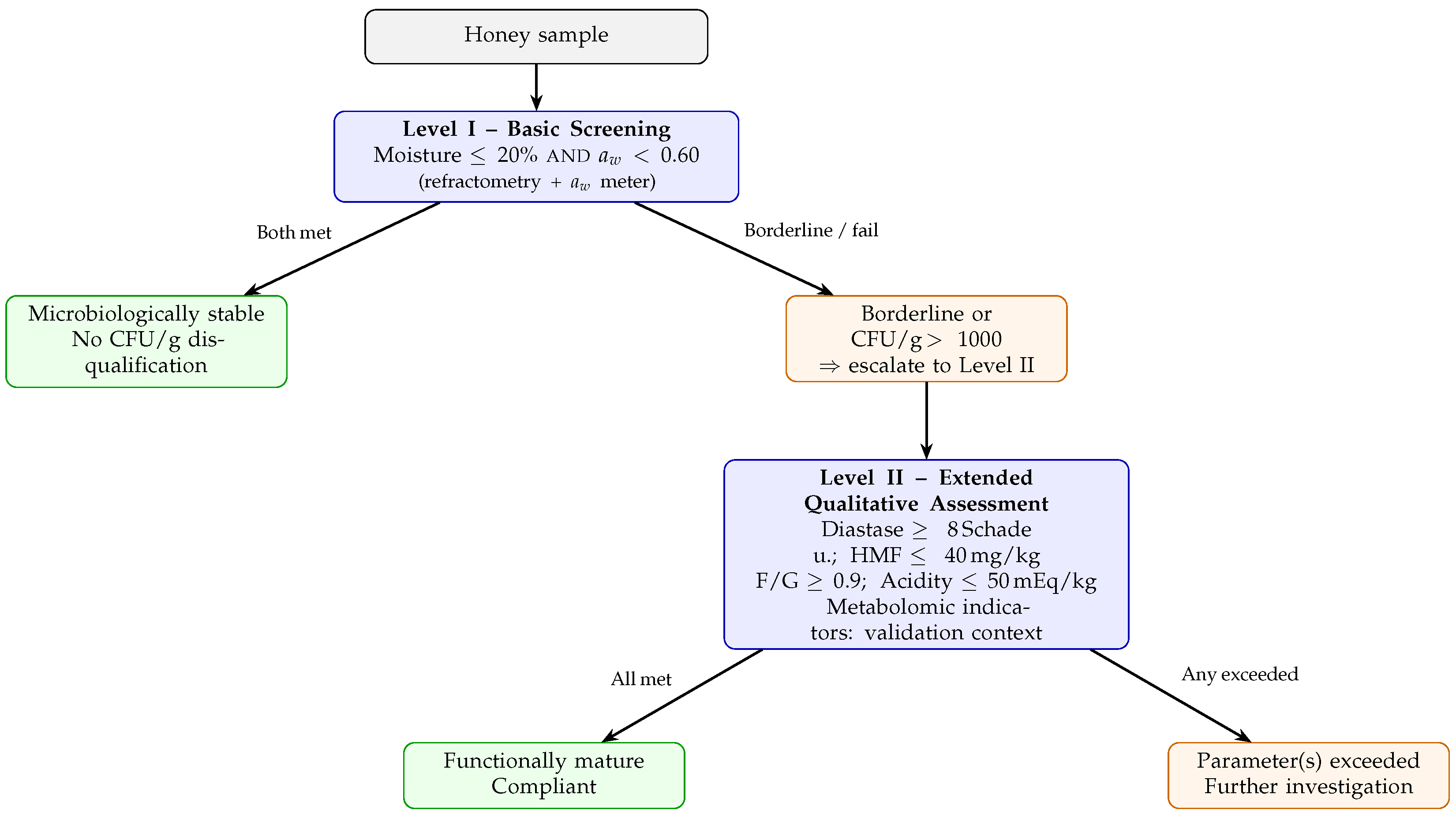
7.2. Hierarchical Decision Framework
7.2.1. Level I—Basic Screening
- Moisture taking into account legally specified exceptions (refractometry, Codex STAN 12-1981 method), a normative parameter, mandatory in all major standards;
- Water activity taking into account possible exceptions, a parameter proposed as a normative supplement; when both of these criteria are met, the honey is microbiologically stable by virtue of the state of microbiological knowledge, and yeast growth is not observed and is effectively inhibited under standard storage conditions, regardless of their count [10,11].
7.2.2. Level II—Extended Qualitative
7.3. Recommendations for Regulatory Bodies and Apimondia
7.3.1. Recommendations for Apimondia
- Supplement the 2023 position with the criterion: the Apimondia recommendation should explicitly state that the presence of osmophilic yeasts in honey does not constitute grounds for declaring immaturity, provided moisture ≤ and ; both parameters should be listed as simultaneous necessary conditions [10,11].
- Take into account the regional diversity of production systems: the position should contain a clear clause regarding honeys from tropical climates and traditional systems, recognizing technological dehumidification as a legal production practice [23] or excluding specific dehumidification techniques that negatively affect the product.
- Initiate dialogue with ISO TC 34/SC 17: the ISO 24607:2025 standard on bee honey should be extended to include the criterion as a normative parameter [7].
7.3.2. Recommendations for EU Bodies (EC, DG SANTE)
7.3.3. Recommendations for Laboratories and the Scientific Community
- Perform multilaboratory validation of the decenedioic acid biomarker and extend its verification beyond three botanical types (rapeseed, acacia, and jujube) to tropical, stingless bee, and traditional production system honeys [14].
8. Conclusions and Future Perspectives
8.1. Main Scientific Conclusions
8.2. Regulatory and Practical Implications of the Apimondia Position
8.3. Functional Maturity Assessment Framework
8.4. Limitations and Directions for Future Research
- Multilaboratory validation of the decenedioic acid biomarker on samples representing the global diversity of botanical types and production systems, extending beyond the three types (rapeseed, acacia, and jujube) studied by Sun et al. [14]; validation should encompass stingless bee honeys (Meliponini) and honeys from traditional East African systems [23].
- Development and validation of a multidimensional functional maturity index (FMI, Functional Maturity Index) integrating the results of Level II parameters into a single index with a value of 0–100, calibrated for different botanical and geographical types; such an index could replace binary disqualification decisions with a gradient approach proportionate to the deviation from the optimal state [12,13,14].
- Harmonization of ISO TC 34/SC 17 standards taking into account the meliponiculture production system—the stingless bee honey category requires a separate standardization track with its own moisture thresholds, , and enzymatic criteria, taking into account the biological properties of these insects [37,38].
Author Contributions
Funding
Institutional Review Board Statement
Informed Consent Statement
Data Availability Statement
Acknowledgments
Conflicts of Interest
References
- Apimondia Working Group on Adulteration of Bee Products. Apimondia Statement on Honey Fraud; Version 2; Apimondia Federation: Rome, Italy, 2023. [Google Scholar]
- CBI—Centre for the Promotion of Imports. The European Market Potential for Certified Honey; CBI Market Intelligence: The Hague, The Netherlands, 2024. [Google Scholar]
- EU Pollinator Hub. European Honey Market; EU Pollinator Hub: Brussels, Belgium, 2025. [Google Scholar]
- Apimondia International Federation of Beekeepers’ Associations. Apimondia Official Website. 2026. Available online: https://apimondia.org/ (accessed on 3 April 2026).
- García, N. Apimondia Statement on Immature Honey Production. Bee World 2025, 102, 56–60. [Google Scholar] [CrossRef]
- Munitis, M.T.; Cabrera, E.; Rodriguez-Navarro, A. An Obligate Osmophilic Yeast from Honey. Appl. Microbiol. 1976, 32, 3. [Google Scholar] [CrossRef] [PubMed]
- CODEX STAN 12-1981; Codex Standard for Honey, Revised 2023. Codex Alimentarius Commission: Rome, Italy; FAO/WHO: Geneva, Switzerland, 2023.
- Rodríguez Machado, A.; Caro, C.M.; Hurtado-Murillo, J.J.; Gomes Lobo, C.J.; Zúñiga, R.N.; Franco, W. Unconventional Yeasts Isolated from Chilean Honey. Foods 2024, 13, 1582. [Google Scholar] [CrossRef]
- ISO/DIS 24607; Honey—Specifications. International Organization for Standardization: Geneva, Switzerland, 2025.
- Zamora, M.C.; Chirife, J. Determination of Water Activity Change Due to Crystallization in Honeys from Argentina. Food Control 2006, 17, 59–64. [Google Scholar] [CrossRef]
- Rüegg, M.; Blanc, B. The water activity of honey and related sugar solutions. Lebensm.-Wiss. Technol. 1981, 14, 1–6. [Google Scholar]
- Zhang, G.Z.; Tian, J.; Zhang, Y.Z.; Li, S.S.; Zheng, H.Q.; Hu, F.L. Investigation of the Maturity Evaluation Indicator of Honey in Natural Ripening Process: The Case of Rape Honey. Foods 2021, 10, 2882. [Google Scholar] [CrossRef]
- Guo, N.; Zhao, L.; Zhao, Y.; Li, Q.; Xue, X.; Wu, L.; Gomez Escalada, M.; Wang, K.; Peng, W. Comparison of the Chemical Composition and Biological Activity of Mature and Immature Honey: An HPLC/QTOF/MS-Based Metabolomic Approach. J. Agric. Food Chem. 2020, 68, 4062–4071. [Google Scholar] [CrossRef]
- Sun, J.; Zhao, H.; Wu, F.; Zhu, M.; Zhang, Y.; Cheng, N.; Xue, X.; Wu, L.; Cao, W. Molecular Mechanism of Mature Honey Formation by GC-MS- and LC-MS-Based Metabolomics. J. Agric. Food Chem. 2021, 69, 3362–3370. [Google Scholar] [CrossRef]
- European Parliament and Council. Council Directive 2001/110/EC of 20 December 2001 relating to honey. Off. J. Eur. Communities 2001, L10, 47–52. [Google Scholar]
- Regulation (EC) No 852/2004 of the European Parliament and of the Council of 29 April 2004 on the hygiene of foodstuffs. Off. J. Eur. Union 2004, L139, 1–54.
- Tsagkaris, A.S.; Koulis, G.A.; Danezis, G.P.; Martakos, I.; Dasenaki, M.; Georgiou, C.A.; Thomaidis, N.S. Honey Authenticity: Analytical Techniques, State of the Art and Challenges. RSC Adv. 2021, 11, 11273–11294. [Google Scholar] [CrossRef]
- GH/T 18796-2012; Honey. Standards Press of China: Beijing, China, 2012.
- Brazil, Ministério da Agricultura e Abastecimento. Instrução Normativa No. 11, de 20 de Outubro de 2000. Regulamento Técnico de Identidade e Qualidade do Mel; Diário Oficial da União: Brasília, Brazil, 2000.
- Schoder, D. Honey Fraud as a Moving Analytical Target: Omics-Informed Authentication Within a Multi-Layer Analytical Framework. Foods 2026, 15, 712. [Google Scholar] [CrossRef] [PubMed]
- Alaerjani, W.M.A.; Abu-Melha, S.; Alshareef, R.M.H.; Al-Farhan, B.S.; Ghramh, H.A.; Al-Shehri, B.M.A.; Bajaber, M.A.; Khan, K.A.; Alrooqi, M.M.; Modawe, G.A.; et al. Biochemical Reactions and Their Biological Contributions in Honey. Molecules 2022, 27, 4719. [Google Scholar] [CrossRef]
- Balasubramanyam, M.V. Role of Different Enzymes in Nectar to Honey Transformations in Indigenous Rock Bee Apis dorsata F. In Cutting Edge Research in Biology; Book Publisher International: London, UK, 2023; Volume 6, pp. 130–141. [Google Scholar] [CrossRef]
- Tadele, E.; Worku, D.; Muluneh, T.; Ayana, Y.; Melese, A. Comprehensive Review on Improved Honey Production: Techniques, Challenges, Opportunities, and Future Prospects in Africa. Front. Bee Sci. 2025, 3, 1588416. [Google Scholar] [CrossRef]
- Biswas, A.; Naresh, K.S.; Jaygadkar, S.S.; Chaudhari, S.R. Enabling honey quality and authenticity with NMR and LC-IRMS based platform. Food Chem. 2023, 418, 135825. [Google Scholar] [CrossRef]
- Xue, S.J.; Zhou, M.; Guo, J.; Zhao, F.Y.; Jiang, W.W.; Huang, X.; Zhang, J.Y. Unveiling the culturable and non-culturable yeast biodiversity in chaste honey produced by the sympatric Apis cerana and Apis mellifera from eastern China. Int. J. Food Microbiol. 2025, 410, 111423. [Google Scholar] [CrossRef] [PubMed]
- Al-Waili, N.S.; Salom, K.; Al-Ghamdi, A.; Ansari, M.J. Antibiotic, Pesticide, and Microbial Contaminants of Honey: Human Health Hazards. Sci. World J. 2012, 2012, 930849. [Google Scholar] [CrossRef]
- Analytica Laboratories. Managing the Risk of Fermenting Honey. Technical Report; Analytica Laboratories. 2020. Available online: https://www.analytica.co.nz/media/nuwbyumm/managing-the-risk-of-furmenting-honey.pdf (accessed on 31 May 2026).
- Gleiter, R.A.; Horn, H.; Isengard, H.D. Influence of Type and State of Crystallisation on the Water Activity of Honey. Food Chem. 2006, 96, 441–445. [Google Scholar] [CrossRef]
- Shafiq, H.; Iftikhar, F.; Ahmad, A.; Kaleem, M.; Sair, A.T. Effect of Crystallization on the Water Activity of Honey. Int. J. Food Nutr. Sci. 2014, 3, 1–6. [Google Scholar]
- Apiculture New Zealand. Managing the Risk of Fermenting Honey; Apiculture NZ Industry Document: Wellington, New Zealand, 2021. [Google Scholar]
- Phiri, B.J.; Fèvre, D.; Hidano, A. Uptrend in global managed honey bee colonies and production based on a six-decade viewpoint. Sci. Rep. 2022, 12, 2045–2322. [Google Scholar] [CrossRef] [PubMed]
- Destatis—Statistisches Bundesamt. International Statistics: Global Honey Bee Population on the Rise; Destatis, Federal Statistical Office Germany: Wiesbaden, Germany, 2026.
- Lastriyanto, A.; Wibowo, S.A.; Erwan, E.; Jaya, F.; Batoro, J.; Masyithoh, D.; Lamerkabel, J.S.A. Moisture Reduction of Honey in Dehumidification and Evaporation Processes. J. Mech. Eng. Sci. Technol. 2020, 4, 153–163. [Google Scholar] [CrossRef]
- Ikhsan, L.N.; Chin, K.Y.; Ahmad, F. Methods of the Dehydration Process and Its Effect on the Physicochemical Properties of Stingless Bee Honey: A Review. Molecules 2022, 27, 7243. [Google Scholar] [CrossRef]
- Beyene, T.; Abi, D.; Chalchissa, G.; WoldaTsadik, M. Evaluation of Transitional and Modern Hives for Honey Production in Mid Rift Valley of Ethiopia. Glob. J. Anim. Sci. Res. 2015, 3, 48–56. [Google Scholar]
- Gobessa, S.; Seifu, E.; Bezabih, A. Physicochemical Properties of Honey Produced in the Homesha District of Western Ethiopia. J. Apic. Sci. 2012, 56, 56. [Google Scholar] [CrossRef]
- Echeverrigaray, S.; Scariot, F.J.; Foresti, L.; Schwarz, L.V.; Rocha, R.K.M.; da Silva, G.P.; Moreira, J.P.; Delamare, A.P.L. Yeast biodiversity in honey produced by stingless bees raised in the highlands of southern Brazil. Int. J. Food Microbiol. 2021, 347, 109200. [Google Scholar] [CrossRef] [PubMed]
- Melia, S.; Juliyarsi, I.; Kurnia, Y.F.; Aritonang, S.N.; Rusdimansyah, R.; Sukma, A.; Setiawan, R.D.; Pratama, Y.E.; Supandil, D. Profile of stingless bee honey and microbiota produced in West Sumatra, Indonesia, by several species (Apidae, Meliponinae). Vet. World 2024, 17, 785–795. [Google Scholar] [CrossRef] [PubMed]
- Gebremedhn, H.; Estifanos, A. On Farm Evaluation of Kenyan Top Bar Hive (KTBH) for Honey Production in Tigray, Ethiopia. Livest. Res. Rural. Dev. 2013, 25, 86. [Google Scholar]
- European Commission; DG Agriculture and Rural Development. Honey Market Presentation; Technical report; European Commission: Brussels, Belgium, 2024. [Google Scholar]
- Eurostat. EU Imported €359.3 Million Worth of Honey in 2023. Eurostat Daily Data News, World Bee Day Release. 2024. Available online: https://ec.europa.eu/eurostat/web/products-eurostat-news/w/ddn-20240520-1 (accessed on 31 May 2026).
- Tridge Global Intelligence. China Is the Largest Supplier of Honey to the EU: 37% of Extra-EU Imports in 2023; Tridge Market Intelligence: Seoul, Republic of Korea, 2024. [Google Scholar]
- European Commission, DG SANTE. EU Coordinated Action ‘From the Hives’ (Honey 2021–2022): 46% of Imported Honey Suspicious of Adulteration; European Commission, Food Safety: Brussels, Belgium, 2022. [Google Scholar]
- European Parliament and Council of the European Union. Directive (EU) 2024/1438 of the European Parliament and of the Council of 14 May 2024 amending Council Directives 2001/110/EC relating to honey, 2001/112/EC relating to fruit juices, 2001/113/EC relating to fruit jams, jellies and marmalades, and 2001/114/EC relating to certain partly or wholly dehydrated preserved milk for human consumption. Off. J. Eur. Union 2024, L, 1438. [Google Scholar]
- European Commission. Response to Written Question E-001756/2023 on the Use of 1H-NMR Profiling in Honey Authenticity Control (Reply by Commissioner Stella Kyriakides on Behalf of the European Commission). European Parliament—Written Questions. 2023. Available online: https://www.europarl.europa.eu/RegData/seance_pleniere/textes_deposes/interpellations/2023/01756/P9_I(2023)01756_EN.pdf (accessed on 7 May 2026).
- Álvarez-Suárez, J.M.; Majtan, J.; Tejera, E.; Santos-Buelga, C.; González-Paramás, A.M. The molecular identity of honey: Toward reliable biochemical authentication. Trends Food Sci. Technol. 2025, 155, 105331. [Google Scholar] [CrossRef]


| Standard | Moisture (%) | HMF (mg/kg) | Diastase (Schade u.) | CFU/g Limit Yeasts | Criterion Microbiolog. |
|---|---|---|---|---|---|
| Codex STAN 12-1981 | ≤ | ≤40 | ≥8 | none | prohibition of fermentation |
| EU Directive 2001/110/EC | ≤ | ≤40 | ≥8 | none | prohibition of fermentation |
| USP (honey monograph) | ≤ | n.a. | n.a. | none | prohibition of fermentation |
| Reg. (EC) 852/2004 | n.a. | n.a. | n.a. | none | general food ∗ |
| Moisture [%] | Yeast Count [CFU/g] | ||
|---|---|---|---|
| <10 | 10–1000 | >1000 | |
| ≤17.0 | negligible risk | negligible risk | negligible risk |
| – | negligible risk | low risk | moderate risk |
| – | negligible risk | moderate risk | high risk |
| – | low risk | high risk | very high risk |
| >20.0 | moderate risk | high risk | very high risk |
| Feature | Langstroth Hive | Kenya Top Bar Hive | Traditional Hive |
|---|---|---|---|
| Capping control | Full (frame inspection) | Partial | None (destructive) |
| In situ dehumidification | Yes | Limited | None |
| Average yield [kg/hive/year] | 20–40 | 15–26 [39] | 5–15 [23] |
| Typical honey moisture | 16–19% | 17–20% | 17–23% |
| Risk of yeast colonization | Low | Moderate | High |
| Global use | Americas, Australia, Europe | East Africa | Africa, S.E. Asia |
Disclaimer/Publisher’s Note: The statements, opinions and data contained in all publications are solely those of the individual author(s) and contributor(s) and not of MDPI and/or the editor(s). MDPI and/or the editor(s) disclaim responsibility for any injury to people or property resulting from any ideas, methods, instructions or products referred to in the content. |
© 2026 by the authors. Licensee MDPI, Basel, Switzerland. This article is an open access article distributed under the terms and conditions of the Creative Commons Attribution (CC BY) license.
Share and Cite
Gajda, A.; Lewandowski, B.; Rujna, P.; Banach, J.K.; Pietrzak-Fiećko, R.; Tkacz, E. Immature Honey as a Quality Challenge in Global Apicultural Production. Foods 2026, 15, 2136. https://doi.org/10.3390/foods15122136
Gajda A, Lewandowski B, Rujna P, Banach JK, Pietrzak-Fiećko R, Tkacz E. Immature Honey as a Quality Challenge in Global Apicultural Production. Foods. 2026; 15(12):2136. https://doi.org/10.3390/foods15122136
Chicago/Turabian StyleGajda, Anna, Bartosz Lewandowski, Przemysław Rujna, Joanna Katarzyna Banach, Renata Pietrzak-Fiećko, and Ewaryst Tkacz. 2026. "Immature Honey as a Quality Challenge in Global Apicultural Production" Foods 15, no. 12: 2136. https://doi.org/10.3390/foods15122136
APA StyleGajda, A., Lewandowski, B., Rujna, P., Banach, J. K., Pietrzak-Fiećko, R., & Tkacz, E. (2026). Immature Honey as a Quality Challenge in Global Apicultural Production. Foods, 15(12), 2136. https://doi.org/10.3390/foods15122136