Revealing the Flavor and Metabolite Differences of Chinese Sweet Rice Wine Fermented with Diverse Rice Varieties Using GC-IMS and UPLC-MS/MS
 ,
,
Abstract
1. Introduction
2. Materials and Methods
2.1. Materials
2.2. CSRW Fermentation
2.3. Physicochemical Analyses
2.4. Sensory Evaluation
2.5. Detection of Total Phenols and Flavonoid Contents
2.6. Determination of Antioxidant Activity
2.7. HS-GC-IMS Analysis
2.8. UPLC-MS/MS Analysis
2.9. Statistical Analysis
3. Results and Discussion
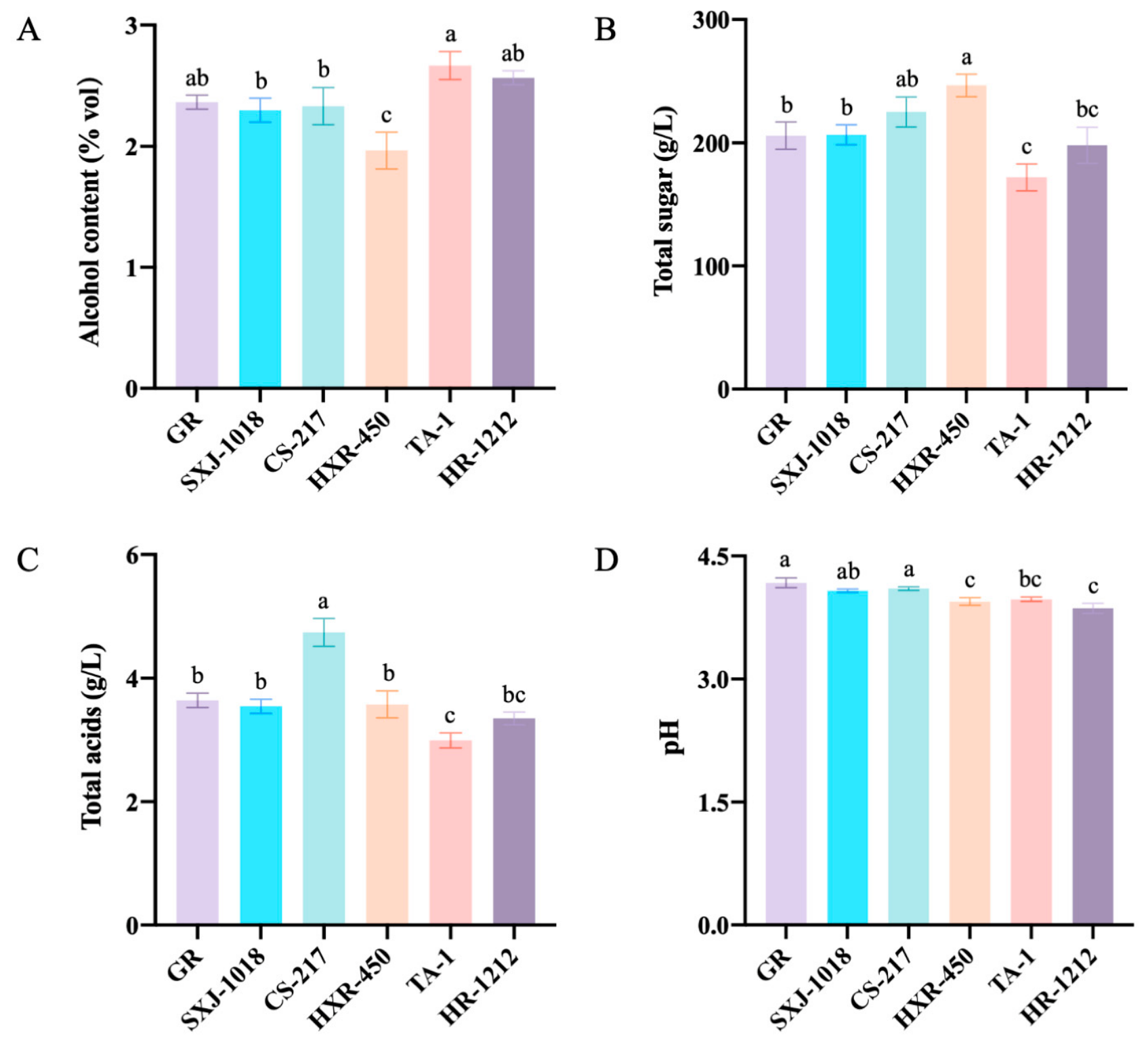
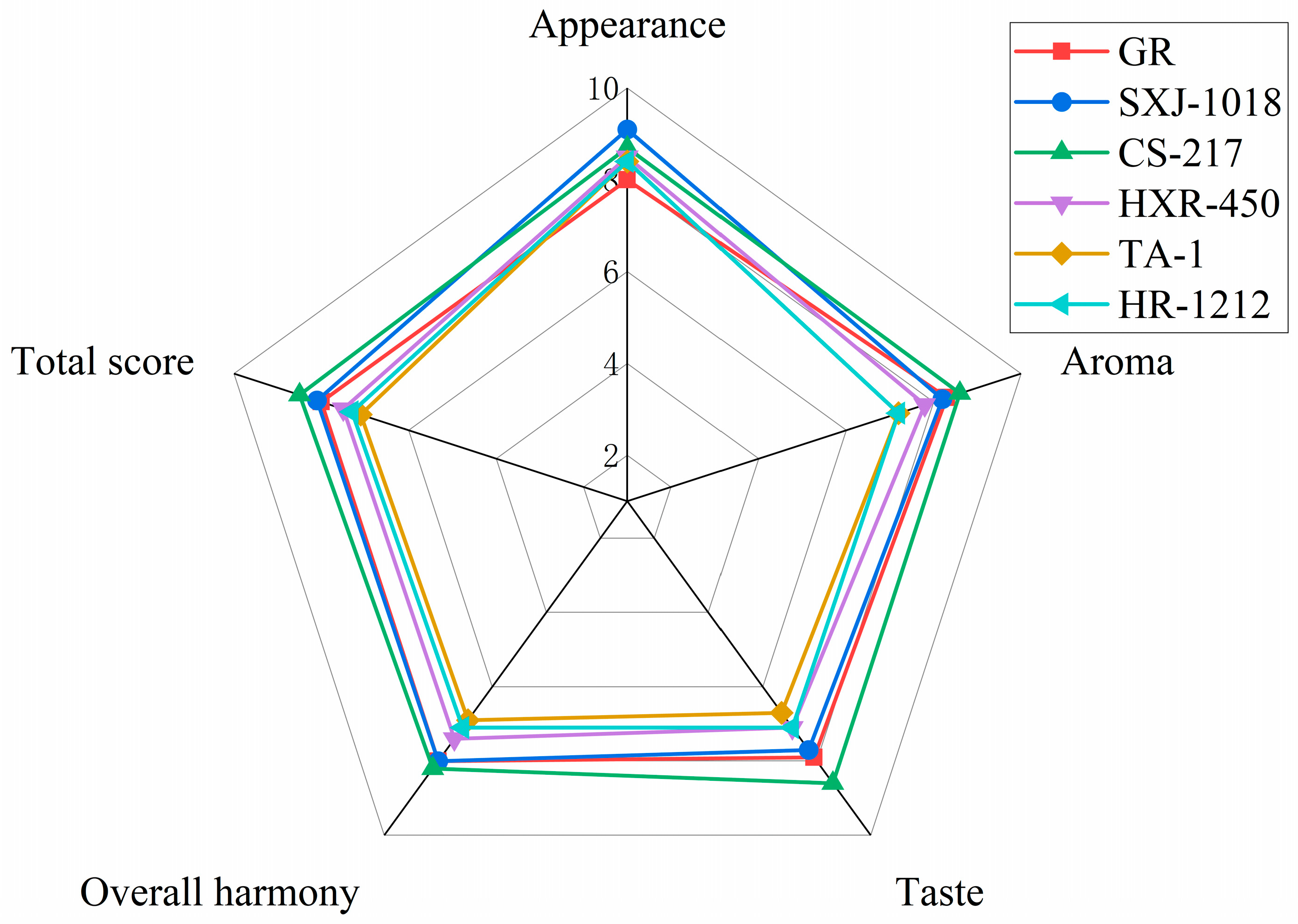
3.1. Physicochemical Characteristics and Sensory Analysis
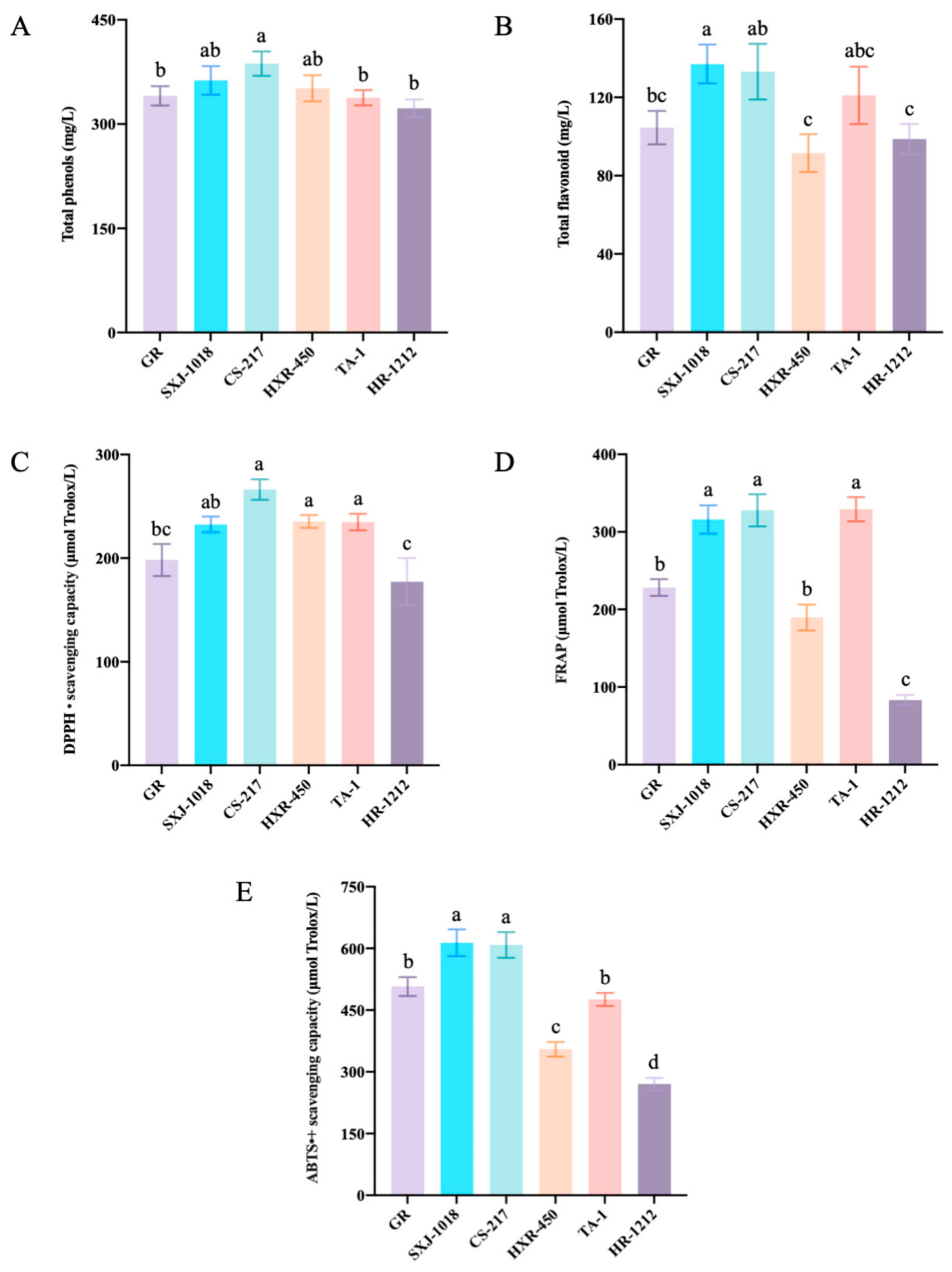
3.2. Total Phenols, Flavonoid Contents, and Antioxidant Capacity
3.3. HS-GC-IMS Analysis of Volatile Compounds in CSRW
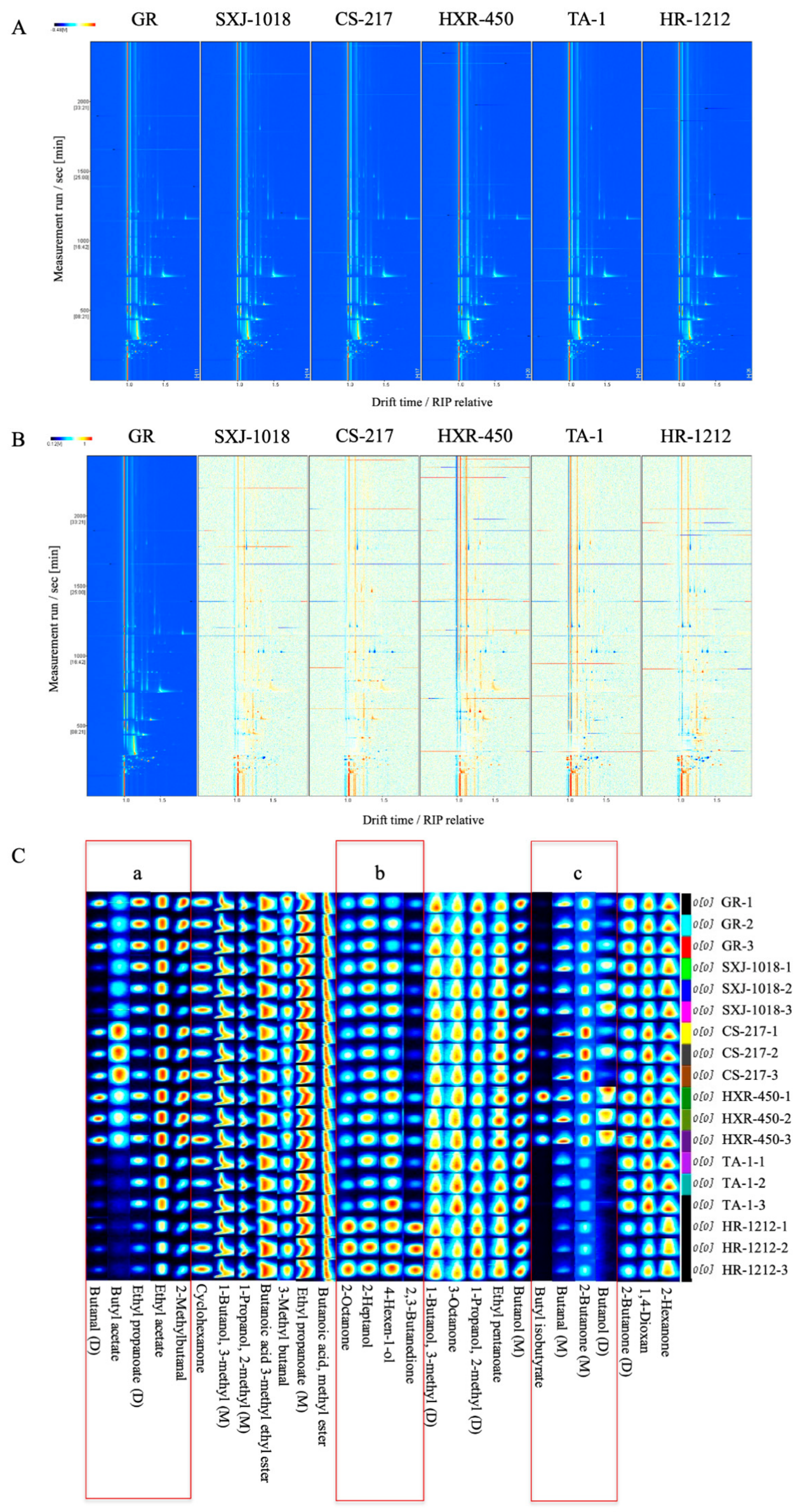
3.3.1. Determination of VOCs
3.3.2. Differential VOCs in CSRW Fermented with Diverse Rice Varieties
3.3.3. ROAV
3.4. UPLC-MS/MS Analysis of Non-Volatile Metabolites
3.4.1. Classification of Non-Volatile Metabolites
3.4.2. Metabolite Pathway Enrichment Analysis
4. Conclusions
Supplementary Materials
Author Contributions
Funding
Institutional Review Board Statement
Informed Consent Statement
Data Availability Statement
Conflicts of Interest
References
- Zhao, X.; Duan, P.; Fan, C.; Wang, X.; Su, J.; Wang, X.; Li, X.; Wang, Z.; Peng, Y. Correlations between the inherent components of grains in various rice varieties and the quality of sweet rice wine. Foods 2026, 15, 179. [Google Scholar] [CrossRef] [PubMed]
- Chen, G.-M.; Huang, Z.-R.; Wu, L.; Wu, Q.; Guo, W.-L.; Zhao, W.-H.; Liu, B.; Zhang, W.; Rao, P.-F.; Lv, X.-C.; et al. Microbial diversity and flavor of Chinese rice wine (Huangjiu): An overview of current research and future prospects. Curr. Opin. Food Sci. 2021, 42, 37–50. [Google Scholar] [CrossRef]
- Cai, H.; Zhang, Q.; Shen, L.; Luo, J.; Zhu, R.; Mao, J.; Zhao, M.; Cai, C. Phenolic profile and antioxidant activity of Chinese rice wine fermented with different rice materials and starters. LWT 2019, 111, 226–234. [Google Scholar] [CrossRef]
- Zhou, M.; Bu, T.; Zheng, J.; Liu, L.; Yu, S.; Li, S.; Wu, J. Peptides in Brewed Wines: Formation, Structure, and Function. J. Agric. Food Chem. 2021, 69, 2647–2657. [Google Scholar] [CrossRef]
- Cai, H.; Zhang, T.; Zhang, Q.; Luo, J.; Cai, C.; Mao, J. Microbial diversity and chemical analysis of the starters used in traditional Chinese sweet rice wine. Food Microbiol. 2018, 73, 319–326. [Google Scholar] [CrossRef] [PubMed]
- Xiong, Z.; Chen, X.; Wu, Q.; Zou, Z.; Xiao, W.; Song, C.; Shen, C.; Liu, B.; Li, Q. Fermentation of buckwheat rice wine based on a new mixed Jiuqu and its quality evaluation. LWT 2025, 215, 117255. [Google Scholar] [CrossRef]
- Xu, Y.; Jin, Y.; Su, J.; Yang, N.; Xu, X.; Jin, Z.; Cui, B.; Wu, F. Changes in the nutritional value, flavor, and antioxidant activity of brown glutinous rice during fermentation. Food Biosci. 2021, 43, 101273. [Google Scholar] [CrossRef]
- Tao, F.; Zheng, G.; Zhou, L.; Liu, Z.; Hu, C.; Gao, K.; Yu, B.; Wang, X.; Wan, C.; Yu, H.; et al. The red rice wine and its function evaluation based on Caenorhabditis elegans. J. Cereal Sci. 2026, 129, 104445. [Google Scholar] [CrossRef]
- Shen, C.; Yu, Y.; Zhang, X.; Zhang, H.; Chu, M.; Yuan, B.; Guo, Y.; Li, Y.; Zhou, J.; Mao, J.; et al. The dynamic of physicochemical properties, volatile compounds and microbial community during the fermentation of Chinese rice wine with diverse cereals. Food Res. Int. 2024, 198, 115319. [Google Scholar] [CrossRef] [PubMed]
- Yang, Y.; Zhong, H.; Yang, N.; Zhu, D.; Li, J.; Yang, Z.; Yang, T. Effects of the proteins of indica rice and indica waxy rice on the formation of volatiles of sweet rice wine. Int. J. Food Sci. Technol. 2022, 57, 3604–3615. [Google Scholar] [CrossRef]
- Wang, R.; Xu, Y.; Wang, D. Differences in brewing characteristics between saccharifying microorganisms, Rhizopus and Aspergillus, for the fermentation of rice wine. Food Biosci. 2025, 66, 106328. [Google Scholar] [CrossRef]
- He, Y.; Wang, X.; Li, P.; Lv, Y.; Nan, H.; Wen, L.; Wang, Z. Research progress of wine aroma components: A critical review. Food Chem. 2023, 402, 134491. [Google Scholar] [CrossRef] [PubMed]
- Gong, X.; Zhang, D.; Xie, L.; Chen, C. Research progress on the relationship between microbial community and flavor quality formation in rice wine. Food Sci. 2024, 45, 358–366. [Google Scholar] [CrossRef]
- Fang, Q.; Ke, L.; Bian, L.; Chi, H.; Qiu, X.; Chen, Y.; Li, S.; Chen, S.; Shi, S. Comprehensive Characterization of Volatile Flavor Compounds in Thamnaconus modestus Under Different Thermal Processing Methods: A Multi-Instrumental Flavoromics Approach. Foods 2026, 15, 1352. [Google Scholar] [CrossRef]
- Zhu, F.; Li, S.; Guan, X.; Huang, K.; Li, Q. Influence of vacuum soaking on the brewing properties of japonica rice and the quality of Chinese rice wine. J. Biosci. Bioeng. 2020, 130, 159–165. [Google Scholar] [CrossRef]
- Lai, R.; Liu, J.; Huang, Q.; Fei, X.; Yin, W.; An, H.; Zhao, J.; Zhang, J.; Luo, R.; Lin, Q.; et al. Variation of the odor-active compounds of cooked fragrant Simiao rice with degrees of milling. LWT 2025, 218, 117493. [Google Scholar] [CrossRef]
- Phitaktansakul, R.; Kim, K.-W.; Aung, K.M.; Maung, T.Z.; Min, M.-H.; Somsri, A.; Lee, W.; Lee, S.-B.; Nam, J.; Kim, S.-H.; et al. Multi-omics analysis reveals the genetic basis of rice fragrance mediated by betaine aldehyde dehydrogenase 2. J. Adv. Res. 2022, 42, 303–314. [Google Scholar] [CrossRef]
- Zhao, Q.; Xi, J.; Xu, X.; Yin, Y.; Xu, D.; Jin, Y.; Tong, Q.; Dong, L.; Wu, F. Volatile fingerprints and biomarkers of Chinese fragrant and non-fragrant japonica rice before and after cooking obtained by untargeted GC/MS-based metabolomics. Food Biosci. 2022, 47, 101764. [Google Scholar] [CrossRef]
- Yang, Y.; Li, S.; Xia, Y.; Wang, G.; Ni, L.; Zhang, H.; Ai, L. Effects of different lactic acid bacteria on the characteristic flavor profiles of Chinese rice wine. J. Sci. Food Agric. 2023, 104, 421–430. [Google Scholar] [CrossRef]
- Yao, L.; Shi, X.; Chen, H.; Zhang, L.; Cen, L.; Li, L.; Lv, Y.; Qiu, S.; Zeng, X.; Wei, C. Major active metabolite characteristics of Dendrobium officinale rice wine fermented by Saccharomyces cerevisiae and Wickerhamomyces anomalus cofermentation. Foods 2023, 12, 2370. [Google Scholar] [CrossRef]
- Lin, Y.; Yang, H.; Jiang, L.; Zhang, Y.; Li, J.; Zhu, X. Analysis of the flavour components, total phenolic content and antioxidant capacity between rice wine from two raw rice and starters. Int. J. Food Sci. Technol. 2024, 59, 129–141. [Google Scholar] [CrossRef]
- Zheng, Q.; TIan, W.; Wang, S.; Liu, X.; Kong, Q.; Yue, L.; Yan, W.; Zhang, Y.; Nong, L.; Xu, X.; et al. Using GC-IMS and FTIR to investigate the effect of ionizing radiation on volatile compounds and hydrogen bonding of strong-flavor baijiu. Food Chem. X 2025, 27, 102452. [Google Scholar] [CrossRef] [PubMed]
- Lin, Y.; Yuan, D.; Zhang, S.; Wu, T. Differences in flavor characteristics of rounds of Sauce-based Baijiu based on GC-IMS, GC-MS, and electronic tongue. J. Food Compos. Anal. 2024, 135, 106696. [Google Scholar] [CrossRef]
- Chen, T.; Wu, F.; Guo, J.; Ye, M.; Hu, H.; Guo, J.; Liu, X. Effects of glutinous rice protein components on the volatile substances and sensory properties of Chinese rice wine. J. Sci. Food Agric. 2020, 100, 3297–3307. [Google Scholar] [CrossRef]
- Wang, Q.J.; Sun, D.-W.; Jeong, S.-T.; Yeo, S.-H.; Choi, J.-H.; Choi, H.-S. Screening of rice cultivars for brewing high quality turbid rice wine. LWT 2014, 56, 145–152. [Google Scholar] [CrossRef]
- Chen, L.; Li, D.; Ren, L.; Song, S.; Ma, X.; Rong, Y. Effects of simultaneous and sequential cofermentation of Wickerhamomyces anomalus and Saccharomyces cerevisiae on physicochemical and flavor properties of rice wine. Food Sci. Nutr. 2021, 9, 71–86. [Google Scholar] [CrossRef] [PubMed]
- Dela Rosa, J.G.L.; Medina, P.M.B. Philippine rice wine (Tapuy) made from Ballatinao black rice and traditional starter culture (Bubod) showed high alcohol content, total phenolic content, and antioxidant activity. Food Sci. Technol. 2022, 42, e45120. [Google Scholar] [CrossRef]
- Tsuji, A.; Koyanagi, T. Significant contribution of amino acids to antioxidant capacity of Japanese rice wine (sake). J. Sci. Food Agric. 2025, 105, 227–234. [Google Scholar] [CrossRef]
- Ye, Y.; Wang, L.; Zhan, P.; Tian, H.; Liu, J. Characterization of the aroma compounds of Millet Huangjiu at different fermentation stages. Food Chem. 2022, 366, 130691. [Google Scholar] [CrossRef]
- Zhang, K.; Zhang, T.-T.; Guo, R.-R.; Ye, Q.; Zhao, H.-L.; Huang, X.-H. The regulation of key flavor of traditional fermented food by microbial metabolism: A review. Food Chem. X 2023, 19, 100871. [Google Scholar] [CrossRef]
- Yu, H.; Guo, W.; Xie, T.; Ai, L.; Tian, H.; Chen, C. Aroma characteristics of traditional Huangjiu produced around Winter Solstice revealed by sensory evaluation, gas chromatography–mass spectrometry and gas chromatography–ion mobility spectrometry. Food Res. Int. 2021, 145, 110421. [Google Scholar] [CrossRef] [PubMed]
- Tian, Y.; Huang, J.; Xie, T.; Huang, L.; Zhuang, W.; Zheng, Y.; Zheng, B. Oenological characteristics, amino acids and volatile profiles of Hongqu rice wines during pottery storage: Effects of high hydrostatic pressure processing. Food Chem. 2016, 203, 456–464. [Google Scholar] [CrossRef] [PubMed]
- Ji, M.; Gong, J.; Liu, Y.; Liu, C.; Ao, C.; Wang, M.; Tan, J. HS-SPME/GC-IMS and GC-MS for volatile fingerprinting of co-fermented grape-mulberry wine: A novel strategy for quality and authenticity control. Food Control 2026, 187, 112171. [Google Scholar] [CrossRef]
- Wang, Z.; Wang, Y.; Zhu, T.; Wang, J.; Huang, M.; Wei, J.; Ye, H.; Wu, J.; Zhang, J.; Meng, N. Characterization of the key odorants and their content variation in Niulanshan Baijiu with different storage years using flavor sensory omics analysis. Food Chem. 2022, 376, 131851. [Google Scholar] [CrossRef]
- Zhao, Y.; Liu, X.; Zhang, S.; Wang, Z.; Tian, S.; Wu, Q. Identification and free radical scavenging activity of oligopeptides from mixed-distillate fermented baijiu grains and soy sauce residue. Metabolites 2024, 14, 298. [Google Scholar] [CrossRef] [PubMed]
- Zhang, T.; Liao, Z.; Li, Z.; Liu, Y.; Bi, J.; Liu, Y.; Song, Y.; Qin, Y. Revealing the flavor differences of Sauvignon Blanc wines fermented in different oak barrels and stainless-steel tanks through GC-MS, GC-IMS, electronic, and artificial sensory analyses. Food Chem. X 2025, 25, 102188. [Google Scholar] [CrossRef]
- Deng, Y.; Zheng, H.; Zhao, M.; Cao, C.; Kan, H.; Wu, B.; Liu, Y. Flavor characteristics and metabolomics of sweet rice wine fermented with different non-Saccharomyces yeasts. Food Res. Int. 2025, 211, 116473. [Google Scholar] [CrossRef]
- Sun, P.; Lin, S.; Li, X.; Li, D. Different stages of flavor variations among canned Antarctic krill (Euphausia superba): Based on GC-IMS and PLS-DA. Food Chem. 2024, 459, 140465. [Google Scholar] [CrossRef] [PubMed]
- Zhang, B.; Zheng, S.; Huang, M.; Wu, Q.; Dong, W.; Wu, J.; Liu, H.; Zhao, D.; Yu, Y.; Li, J. Analysis of volatile compounds in Xiangjiao baijiu from different storage containers and years based on HS-GC-IMS and DI-GC–MS. Food Chem. X 2024, 24, 101976. [Google Scholar] [CrossRef]
- Wang, Y.; Ma, Y.; Duan, J.; Wang, B.; Ma, T.; Jiang, Y.; Zhang, B. Discrimination and characterization of the volatile organic compounds in red and black raspberry wines fermented with different commercial Saccharomyces cerevisiae: An integrated analysis using E-nose, GC-MS, GC-IMS, and multivariate statistical models. Food Chem. 2025, 478, 143678. [Google Scholar] [CrossRef]
- Zhang, J.; Lu, J.; Yu, X.; Chen, S.; Xu, Y. Characterization of aroma differences in Jiangxiangxing Baijiu with varying ethanol concentrations: Emphasis on olfactory threshold changes of aroma compounds. Food Chem. 2025, 469, 142506. [Google Scholar] [CrossRef]
- Peng, Y.-X.; Feng, B.; Zhang, Z.-J.; Li, K.; Wang, S.; Niu, D. Effect of fermentation alcohol termination by ceramic membrane filtration on the aroma of sugarcane fruit wine. Food Microbiol. 2025, 128, 104724. [Google Scholar] [CrossRef] [PubMed]
- Niu, Y.; Zhu, Q.; Xiao, Z. Characterization of perceptual interactions among ester aroma compounds found in Chinese Moutai Baijiu by gas chromatography-olfactometry, odor Intensity, olfactory threshold and odor activity value. Food Res. Int. 2020, 131, 108986. [Google Scholar] [CrossRef] [PubMed]
- Feng, H.; Skinkis, P.A.; Qian, M.C. Pinot noir wine volatile and anthocyanin composition under different levels of vine fruit zone leaf removal. Food Chem. 2017, 214, 736–744. [Google Scholar] [CrossRef] [PubMed]
- Culleré, L.; Escudero, A.; Cacho, J.; Ferreira, V. Gas chromatography-olfactometry and chemical quantitative study of the aroma of six premium quality spanish aged red wines. J. Agric. Food Chem. 2004, 52, 1653–1660. [Google Scholar] [CrossRef]
- Bian, S.; Song, S.; Qu, M.; Dang, X.; Mei, D.; Lin, C.; Wang, W.; Shang, J.; Ni, D.; Zhang, D. Comparative analysis of the metabolite compositions and antioxidant capacity of waxy and non-waxy black rice (Oryza sativa L.) bran via widely targeted metabolomics. Food Chem. X 2025, 32, 103387. [Google Scholar] [CrossRef]
- Tang, A.; Peng, B. Uncovering the flavor differences between black rice wine and glutinous rice wine by GC-MS, GC-IMS, HPLC, and electronic sensory analysis. Food Biosci. 2024, 60, 104235. [Google Scholar] [CrossRef]
- Bai, C.; Fan, B.; Hao, J.; Yao, Y.; Ran, S.; Wang, H.; Li, H.; Wei, R. Changes in microbial community diversity and the formation mechanism of flavor metabolites in industrial-scale spontaneous fermentation of cabernet sauvignon wines. Foods 2025, 14, 235. [Google Scholar] [CrossRef]
- Wang, W.; Zhou, X.; Liu, Y. Characterization and evaluation of umami taste: A review. TrAC Trends Anal. Chem. 2020, 127, 115876. [Google Scholar] [CrossRef]
- Cordente, A.G.; Schmidt, S.; Beltran, G.; Torija, M.J.; Curtin, C.D. Harnessing yeast metabolism of aromatic amino acids for fermented beverage bioflavouring and bioproduction. Appl. Microbiol. Biotechnol. 2019, 103, 4325–4336. [Google Scholar] [CrossRef]
- Hapala, I.; Griac, P.; Holic, R. Metabolism of Storage Lipids and the Role of Lipid Droplets in the Yeast Schizosaccharomyces pombe. Lipids 2020, 55, 513–535. [Google Scholar] [CrossRef]
- Mbuyane, L.L.; Bauer, F.F.; Bloem, A.; Camarasa, C.; Ortiz-Julien, A.; Divol, B. Species-Dependent Metabolic Response to Lipid Mixtures in Wine Yeasts. Front. Microbiol. 2022, 13, 823581. [Google Scholar] [CrossRef]
- Kruis, A.J.; Levisson, M.; Mars, A.E.; van der Ploeg, M.; Daza, F.G.; Ellena, V.; Kengen, S.W.M.; van der Oost, J.; Weusthuis, R.A. Ethyl acetate production by the elusive alcohol acetyltransferase from yeast. Metab. Eng. 2017, 41, 92–101. [Google Scholar] [CrossRef] [PubMed]
- Hu, X.; Fang, C.; Lu, L.; Hu, Z.; Zhang, W.; Chen, M. Dynamic Changes in Volatiles, Soluble Sugars, and Fatty Acids in Glutinous Rice during Cooking. Foods 2023, 12, 1700. [Google Scholar] [CrossRef]
- Guan, L.; Wang, Z.; Wang, W.; Duan, W.; Zhang, M.; Li, S. Influence of nutritional composition on rice metabolites and the formation of cooked rice aroma. J. Cereal Sci. 2026, 129, 104439. [Google Scholar] [CrossRef]
- Cutillas, A.-B.; Carrasco, A.; Martinez-Gutierrez, R.; Tomas, V.; Tudela, J. Composition and Antioxidant, Antienzymatic and Antimicrobial Activities of Volatile Molecules from Spanish Salvia lavandulifolia (Vahl) Essential Oils. Molecules 2017, 22, 1382. [Google Scholar] [CrossRef] [PubMed]
- Lu, Y.; Pang, Z.; Xia, J. Comprehensive investigation of pathway enrichment methods for functional interpretation of LC-MS global metabolomics data. Brief. Bioinform. 2023, 24, bbac553. [Google Scholar] [CrossRef]
- Bubić, A.; Mrnjavac, N.; Stuparević, I.; Łyczek, M.; Wielgus-Kutrowska, B.; Bzowska, A.; Luić, M.; Ašler, I.L. In the quest for new targets for pathogen eradication: The adenylosuccinate synthetase from the bacterium Helicobacter pylori. J. Enzym. Inhib. Med. Chem. 2018, 33, 1405–1414. [Google Scholar] [CrossRef] [PubMed]
- Gooding, J.R.; Jensen, M.V.; Dai, X.; Wenner, B.R.; Lu, D.; Arumugam, R.; Ferdaoussi, M.; MacDonald, P.E.; Newgard, C.B. Adenylosuccinate Is an Insulin Secretagogue Derived from Glucose-Induced Purine Metabolism. Cell Rep. 2015, 13, 157–167. [Google Scholar] [CrossRef]
- López-Sámano, M.; Beltrán, L.F.L.-A.; Sánchez-Thomas, R.; Dávalos, A.; Villaseñor, T.; García-García, J.D.; García-de Los Santos, A. A novel way to synthesize pantothenate in bacteria involves β-alanine synthase present in uracil degradation pathway. Microbiologyopen 2020, 9, e1006. [Google Scholar] [CrossRef]
- Guan, X.L.; Souza, C.M.; Pichler, H.; Dewhurst, G.; Schaad, O.; Kajiwara, K.; Wakabayashi, H.; Ivanova, T.; Castillon, G.A.; Piccolis, M.; et al. Functional interactions between sphingolipids and sterols in biological membranes regulating cell physiology. Mol. Biol. Cell 2009, 20, 2083–2095. [Google Scholar] [CrossRef]



| VOC | Odor Threshold (μg/L) | ROAV | |||||
|---|---|---|---|---|---|---|---|
| GR | SXJ-1018 | CS-217 | HXR-450 | TA-1 | HR-1212 | ||
| 2-methylbutanal | 89.47 a | 76.43 | 35.24 | 70.77 | 82.44 | 42.44 | 41.80 |
| Butanal (D) | 17 b | 30.90 | 9.00 | 28.03 | 38.38 | 9.73 | 11.80 |
| 2,3-butanedione | 20.44 c | 24.75 | 22.48 | 15.48 | 30.07 | 22.18 | 67.95 |
| Butyl acetate | 86.95 a | 6.87 | 6.53 | 12.67 | 8.49 | 2.50 | 1.99 |
| Ethyl pentanoate | 26.8 d | 79.70 | 97.24 | 97.03 | 100.00 | 93.07 | 98.09 |
| 1-propanol, 2-methyl (M) | 11,673.24 a | 1.01 | 1.13 | 1.16 | 1.18 | 0.97 | 1.18 |
| Ethyl propanoate (D) | 1800 e | 0.47 | 0.38 | 0.28 | 0.37 | 0.33 | 0.20 |
| 2-heptanol | 61.61 a | 17.14 | 18.71 | 16.55 | 17.81 | 14.74 | 20.70 |
| 1-butanol, 3-methyl (M) | 404,582 a | <0.1 | <0.1 | <0.1 | <0.1 | <0.1 | <0.1 |
| Butanol (M) | 150,000 f | <0.1 | <0.1 | <0.1 | <0.1 | <0.1 | <0.1 |
Disclaimer/Publisher’s Note: The statements, opinions and data contained in all publications are solely those of the individual author(s) and contributor(s) and not of MDPI and/or the editor(s). MDPI and/or the editor(s) disclaim responsibility for any injury to people or property resulting from any ideas, methods, instructions or products referred to in the content. |
© 2026 by the authors. Licensee MDPI, Basel, Switzerland. This article is an open access article distributed under the terms and conditions of the Creative Commons Attribution (CC BY) license.
Share and Cite
Zheng, Q.; Tian, W.; Yue, L.; Kong, Q.; Wang, H.; Chen, Z.; Zhang, Y.; Wang, C.; Wu, S.; Yan, W.; et al. Revealing the Flavor and Metabolite Differences of Chinese Sweet Rice Wine Fermented with Diverse Rice Varieties Using GC-IMS and UPLC-MS/MS. Foods 2026, 15, 2137. https://doi.org/10.3390/foods15122137
Zheng Q, Tian W, Yue L, Kong Q, Wang H, Chen Z, Zhang Y, Wang C, Wu S, Yan W, et al. Revealing the Flavor and Metabolite Differences of Chinese Sweet Rice Wine Fermented with Diverse Rice Varieties Using GC-IMS and UPLC-MS/MS. Foods. 2026; 15(12):2137. https://doi.org/10.3390/foods15122137
Chicago/Turabian StyleZheng, Qi, Wenhui Tian, Ling Yue, Qiulian Kong, Haihong Wang, Zhijun Chen, Yi Zhang, Chunfang Wang, Songheng Wu, Weiqiang Yan, and et al. 2026. "Revealing the Flavor and Metabolite Differences of Chinese Sweet Rice Wine Fermented with Diverse Rice Varieties Using GC-IMS and UPLC-MS/MS" Foods 15, no. 12: 2137. https://doi.org/10.3390/foods15122137
APA StyleZheng, Q., Tian, W., Yue, L., Kong, Q., Wang, H., Chen, Z., Zhang, Y., Wang, C., Wu, S., Yan, W., & Wu, S. (2026). Revealing the Flavor and Metabolite Differences of Chinese Sweet Rice Wine Fermented with Diverse Rice Varieties Using GC-IMS and UPLC-MS/MS. Foods, 15(12), 2137. https://doi.org/10.3390/foods15122137