Unveiling the Antioxidant Mechanism of Canolol: Packaging Impacts the Long-Term Stability of Microwave-Pretreated Rapeseed Oil


Abstract
1. Introduction
2. Materials and Methods
2.1. Materials
2.2. Sampling and Storage Treatment
2.3. Physicochemical Parameters
2.4. Determination of Total Phenolic Content (TPC) and Antioxidant Properties
2.5. Characterization of Lipid Micronutrients
2.5.1. Tocopherol Measurement
2.5.2. Phytosterol Measurement
2.5.3. Canolol Measurement
2.6. HPLC-Q-TOF/MS/MS Detection of Oxidation Products from Canolol and EtL Hydroperoxides in EtL Oxidation System
2.7. Statistical Analysis
3. Results and Discussion
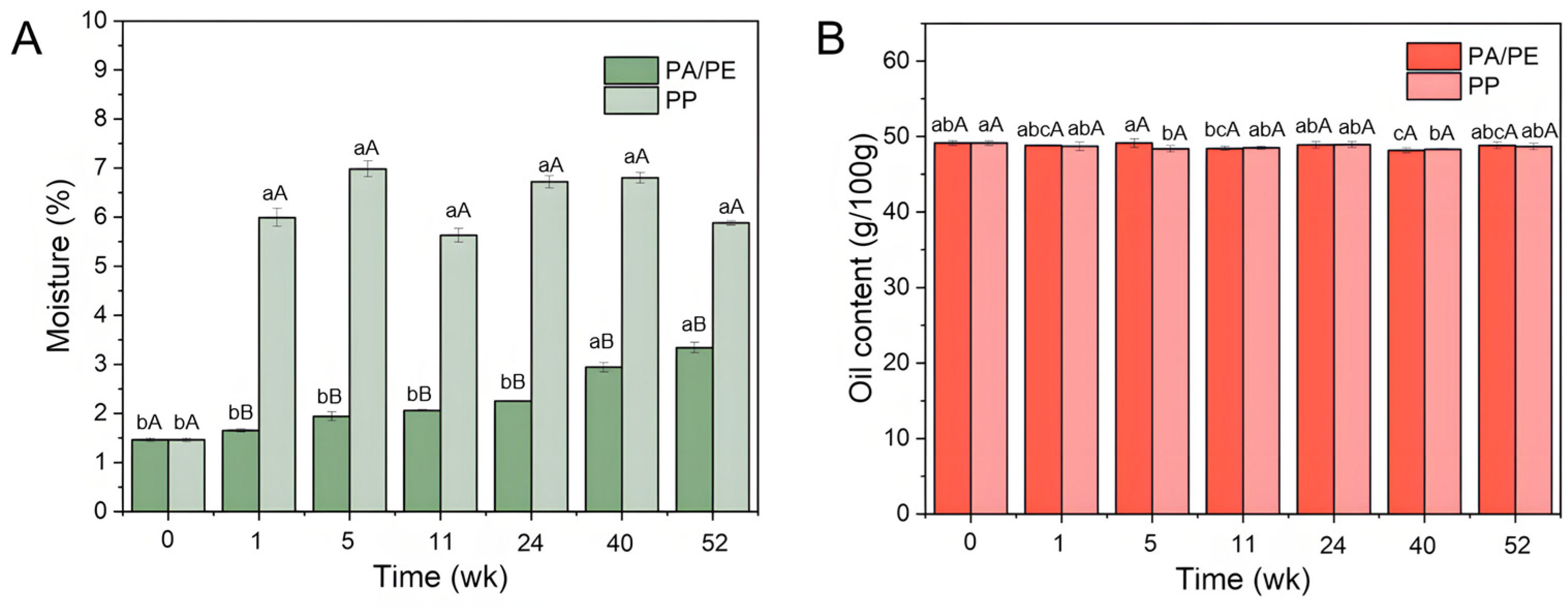
3.1. The Moisture and Oil Content of Microwaved Rapeseeds in PP and PA/PE Packaging During Storage
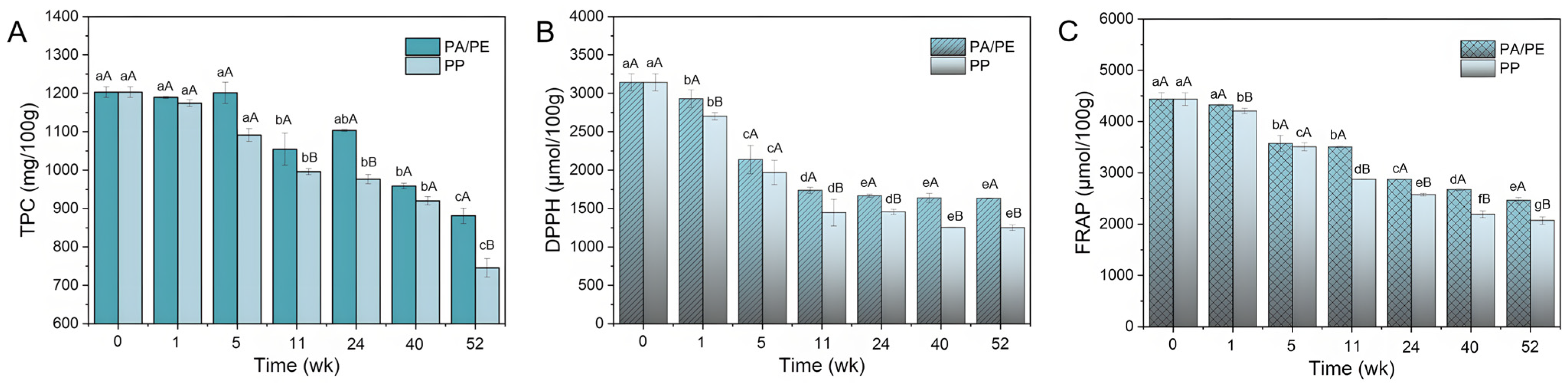
3.2. TPCs and Antioxidant Activities of Microwaved Rapeseed Seeds in PP and PA/PE Packaging During Storage
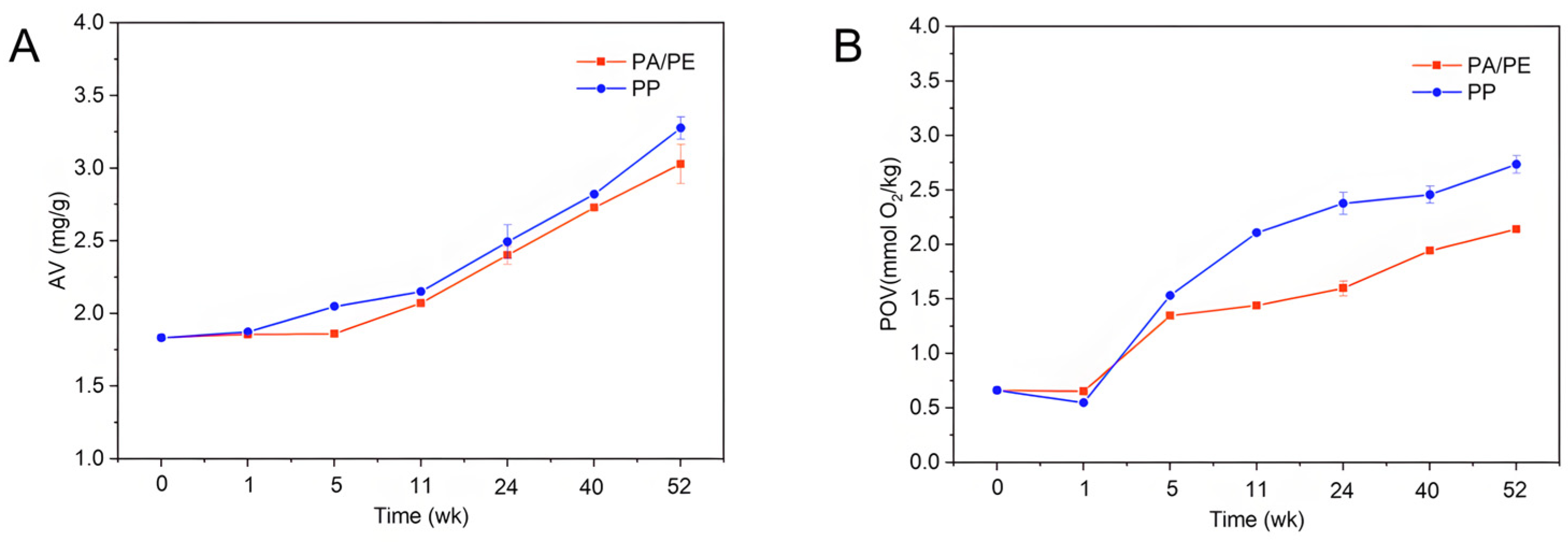
3.3. AV and POV Analyses of Microwaved Rapeseed Oils Packaged in PP and PA/PE During Storage
3.4. Changes in Bioactive Compounds of Microwaved Rapeseed Oils Stored in PP and PA/PE Packaging
3.5. HPLC-Q-TOF/MS/MS Analysis of the Antioxidant Products of Canolol
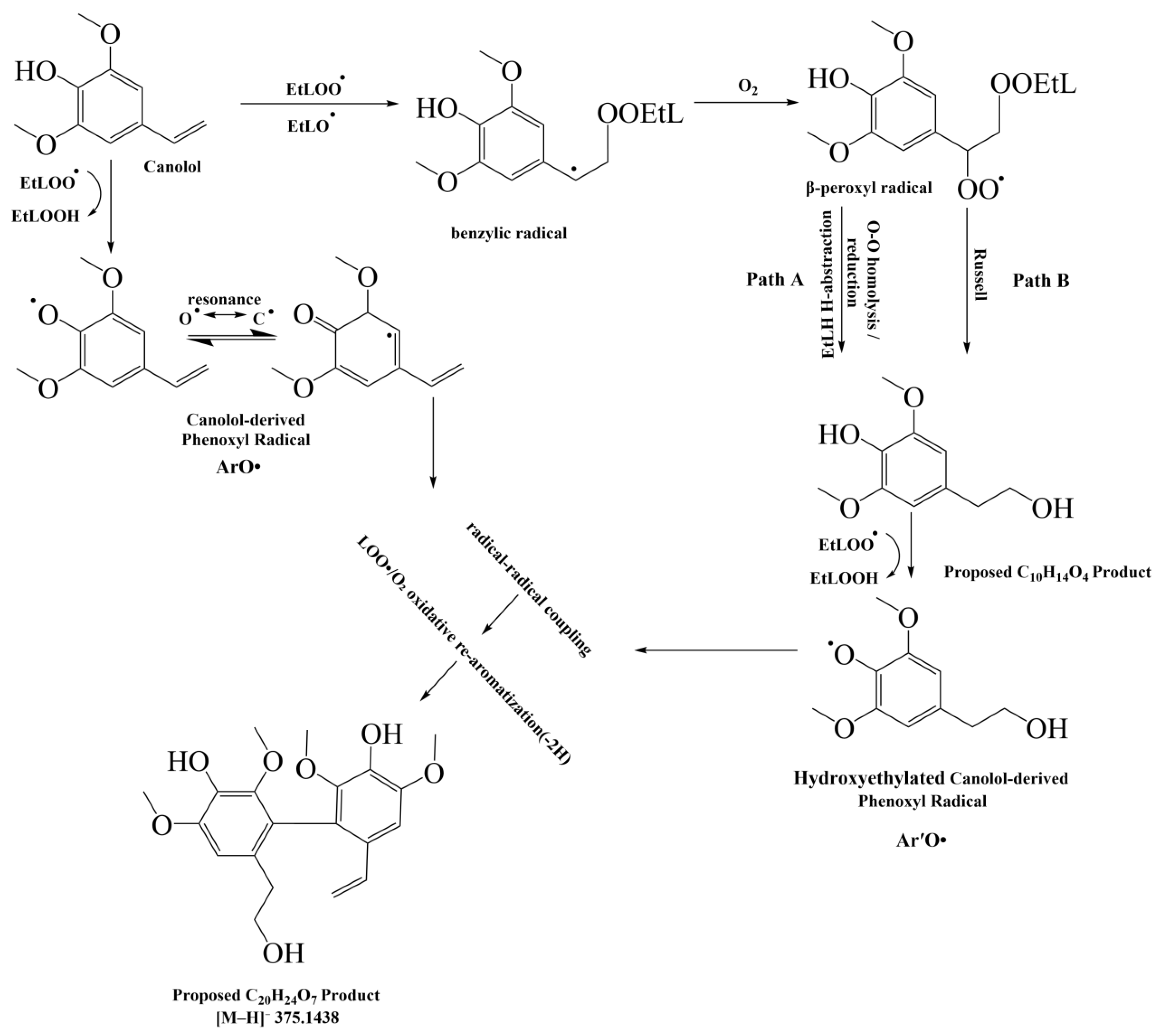
3.6. Proposed Antioxidation Mechanism of Canolol in EtL
4. Conclusions
Supplementary Materials
Author Contributions
Funding
Institutional Review Board Statement
Informed Consent Statement
Data Availability Statement
Conflicts of Interest
Abbreviations
| PUFA | Polyunsaturated fatty acids |
| Canolol | 2,6-Dimethoxy-4-vinylphenol |
| P-AV | P-anisidine value |
| POV | Peroxide value |
| PET | Polyethylene terephthalate |
| AL | Aluminum |
| PA | Polyamide |
| PE | Polyethylene |
| PA/PE | Polyamide/polyethylene |
| PP | Polypropylene |
| AV | Acid value |
| AIBN | 2,2’-Azobis(isobutyronitrile) |
| EtL | Ethyl linoleate |
| HPLC-Q-TOF/MS/MS | High-performance liquid chromatography-quadrupole time-of-flight tandem mass spectrometry |
| BSTFA + TMCS | N,O-Bis(trimethylsilyl)trifluoroacetamide with trimethylchlorosilane |
| FC | Folin–Ciocalteu |
| DPPH | 2,2-dipheny1-1-picrylhydrazyl |
| TPTZ | 2,4,6-tris(2-pyridyl)-s-triazine |
| Trolox | 6-hydroxy-2,5,7,8-tetramethylchroman-2-carboxylic acid |
| TPC | Total phenolic content |
| SAE | Sinapic acid equivalent |
| TE | Trolox equivalent |
| FRAP | Ferric reducing antioxidant power |
| HPLC | High-performance liquid chromatography |
| GC | Gas chromatography |
| UPLC | Ultra-performance liquid chromatography |
| PDA | Photodiode array |
| ESI | Electrospray ionization |
| FFA | Free fatty acid |
| COSO | Camellia oleifera seed oil |
| EVOO | Extra virgin olive oil |
| SFRO | Strong-fragrant rapeseed oils |
| TIC IDA | Total ion chromatogram Information-dependent acquisition |
| HAT | Hydrogen atom transfer |
References
- Cong, Y.; Zheng, M.; Huang, F.; Liu, C.; Zheng, C. Sinapic acid derivatives in microwave-pretreated rapeseeds and minor components in oils. J. Food Compos. Anal. 2020, 87, 103394. [Google Scholar] [CrossRef]
- Quiles, J.L.; Ramírez-Tortosa, M.C.; Gómez, J.A.; Huertas, J.R.; Mataix, J. Role of vitamin E and phenolic compounds in the antioxidant capacity, measured by ESR, of virgin olive, olive and sunflower oils after frying. Food Chem. 2002, 76, 461–468. [Google Scholar] [CrossRef]
- Thiyam, U.; Stöckmann, H.; Zum Felde, T.; Schwarz, K. Antioxidative effect of the main sinapic acid derivatives from rapeseed and mustard oil by-products. Eur. J. Lipid Sci. Technol. 2006, 108, 239–248. [Google Scholar] [CrossRef]
- Koski, A.; Pekkarinen, S.; Hopia, A.; Wähälä, K.; Heinonen, M. Processing of rapeseed oil: Effects on sinapic acid derivative content and oxidative stability. Eur. Food Res. Technol. 2003, 217, 110–114. [Google Scholar] [CrossRef]
- Aachary, A.A.; Chen, Y.; Eskin, N.A.M.; Thiyam-Hollander, U. Crude canolol and canola distillate extracts improve the stability of refined canola oil during deep-fat frying. Eur. J. Lipid Sci. Technol. 2014, 116, 1467–1476. [Google Scholar] [CrossRef]
- Mayengbam, S.; Aachary, A.; Thiyam-Hollander, U. Endogenous Phenolics in Hulls and Cotyledons of Mustard and Canola: A Comparative Study on Its Sinapates and Antioxidant Capacity. Antioxidants 2014, 3, 544–558. [Google Scholar] [CrossRef]
- Shrestha, K.; De Meulenaer, B. Effect of seed roasting on canolol, tocopherol, and phospholipid contents, Maillard type reactions, and oxidative stability of mustard and rapeseed oils. J. Agric. Food Chem. 2014, 62, 5412–5419. [Google Scholar] [CrossRef]
- Zheng, C.; Yang, M.; Zhou, Q.; Liu, C.S.; Huang, F.H. Changes in the content of canolol and total phenolics, oxidative stability of rapeseed oil during accelerated storage. Eur. J. Lipid Sci. Technol. 2014, 116, 1675–1684. [Google Scholar] [CrossRef]
- Chun, J.; Lee, J.; Eitenmiller, R.R. Vitamin E and Oxidative Stability During Storage of Raw and Dry Roasted Peanuts Packaged under Air and Vacuum. J. Food Sci. 2006, 70, C292–C297. [Google Scholar] [CrossRef]
- Severini, C.; Pill1, T.D.; Baiano, A. Autoxidation of packed roasted almonds as affected by two packaging films. J. Food Process. Preserv. 2003, 27, 321–335. [Google Scholar] [CrossRef]
- Fu, X.; Xing, S.; Xiong, H.; Min, H.; Zhu, X.; He, J.; Feng, J.; Mu, H. Effects of packaging materials on storage quality of peanut kernels. PLoS ONE 2018, 13, e0190377. [Google Scholar] [CrossRef] [PubMed]
- Azadmard-Damirchi, S.; Habibi-Nodeh, F.; Hesari, J.; Nemati, M.; Achachlouei, B.F. Effect of pretreatment with microwaves on oxidative stability and nutraceuticals content of oil from rapeseed. Food Chem. 2010, 121, 1211–1215. [Google Scholar] [CrossRef]
- Yang, M.; Huang, F.; Liu, C.; Zheng, C.; Zhou, Q.; Wang, H. Influence of Microwave Treatment of Rapeseed on Minor Components Content and Oxidative Stability of Oil. Food Bioprocess Technol. 2012, 6, 3206–3216. [Google Scholar] [CrossRef]
- Wroniak, M.; Rękas, A.; Siger, A.; Janowicz, M. Microwave pretreatment effects on the changes in seeds microstructure, chemical composition and oxidative stability of rapeseed oil. LWT-Food Sci. Technol. 2016, 68, 634–641. [Google Scholar] [CrossRef]
- Abramovič, H.; Butinar, B.; Nikolič, V. Changes occurring in phenolic content, tocopherol composition and oxidative stability of Camelina sativa oil during storage. Food Chem. 2007, 104, 903–909. [Google Scholar] [CrossRef]
- Pan, F.; Wang, X.; Wen, B.; Wang, C.; Xu, Y.; Dang, W.; Zhang, M. Development of walnut oil and almond oil blends for improvements in nutritional and oxidative stability. Grasas Aceites 2020, 71, e381. [Google Scholar] [CrossRef]
- Gawrysiak-Witulska, M.; Rudzinska, M.; Wawrzyniak, J.; Siger, A. The Effect of Temperature and Moisture Content of Stored Rapeseed on the Phytosterol Degradation Rate. J. Am. Oil Chem. Soc. 2012, 89, 1673–1679. [Google Scholar] [CrossRef]
- Lang, C.; Huang, Y.; Lin, K.; Chen, W.; Chen, W.; Zhong, Q.; Pei, J.; Lv, Y.; He, R.; Zhang, M.; et al. Exploring the optimization of microwave-treated rapeseed oil extraction based on response surface and lipidomics and its effects on quality characteristics, chemical composition, nutritional properties, and antioxidant capacity during storage. J. Food Compos. Anal. 2025, 146, 107787. [Google Scholar] [CrossRef]
- GB 5009.3-2016; Determination of Moisture in Foods. National Health Commission: Beijing, China, 2016.
- GB 5009.6-2016; Determination of Fat in Foods. National Health Commission: Beijing, China, 2016.
- AOCS Official Method Cd 3d-63; Acid Value. The American Oil Chemists’ Society: Urbana, IL, USA, 2017.
- GB 5009.227-2016; Determination of Peroxide Value in Foods. National Health Commission: Beijing, China, 2016.
- Wang, W.; Yang, B.; Li, W.; Zhou, Q.; Liu, C.; Zheng, C. Effects of steam explosion pretreatment on the bioactive components and characteristics of rapeseed and rapeseed products. LWT-Food Sci. Technol. 2021, 143, 111172. [Google Scholar] [CrossRef]
- Ma, X.; Zheng, C.; Zhou, Q.; Huang, C.; Wang, W.; Huang, Y.; Liu, C. Comparison evaluation pretreatments on the quality characteristics, oxidative stability, and volatile flavor of walnut oil. Food Chem. 2024, 448, 139124. [Google Scholar] [CrossRef]
- Wang, W.; Zheng, C.; Yang, B.; Li, W.; Huang, F.; Liu, C. Effect of radio frequency pretreatment on the component of rapeseed and its product: Comparative study with microwave pretreatment under different oil extraction methods. Food Chem. 2025, 474, 143167. [Google Scholar] [CrossRef] [PubMed]
- Huang, Y.; Liu, C.; Ge, Z.; Huang, F.; Tang, H.; Zhou, Q.; Liu, R.; Huang, J.; Zheng, C. Influence of different thermal treatment methods on the processing qualities of sesame seeds and cold-pressed oil. Food Chem. 2023, 404, 134683. [Google Scholar] [CrossRef] [PubMed]
- Yang, Y.; Chen, J.; Chen, L. A comprehensive insight into peanut storage: Patterns of quality changes, pathways of quality deterioration, and storage strategies. Food Chem. X 2025, 30, 102973. [Google Scholar] [CrossRef] [PubMed]
- Cong, Y.; Cheong, L.-Z.; Huang, F.; Zheng, C.; Wan, C.; Zheng, M. Effects of microwave irradiation on the distribution of sinapic acid and its derivatives in rapeseed and the antioxidant evaluation. LWT-Food Sci. Technol. 2019, 108, 310–318. [Google Scholar] [CrossRef]
- Yeken, M.Z.; Soydemir, H.E.; Kibar, H.; Çiftçi, V. Long-term storage affects on the phenolic, mineral, color and cooking traits of chickpea seed. J. Stored Prod. Res. 2023, 102, 102122. [Google Scholar] [CrossRef]
- Rękas, A.; Wroniak, M. Oxidation kinetics of rapeseed oil pressed from microwave pre-treated seeds during long-term storage. J. Food Process. Preserv. 2018, 42, e13630. [Google Scholar] [CrossRef]
- Xu, Y.-J.; Jiang, F.; Song, J.; Yang, X.; Shu, N.; Yuan, L.; Tan, C.P.; Liu, Y. Understanding of the Role of Pretreatment Methods on Rapeseed Oil from the Perspective of Phenolic Compounds. J. Agric. Food Chem. 2020, 68, 8847–8854. [Google Scholar] [CrossRef]
- Zhao, X.; Zhang, H.; Wang, S.; Zhang, X.; Zhong, W.; Wang, X.; Gao, P. Optimizing oxidative stability of Camellia oleifera seed oil: Multimodal analysis of antioxidant efficacy, tocopherol loss, benzo[a]pyrene suppression, and kinetic mechanisms. Food Chem. 2026, 502, 147731. [Google Scholar] [CrossRef]
- Pristouri, G.; Badeka, A.; Kontominas, M.G. Effect of packaging material headspace, oxygen and light transmission, temperature and storage time on quality characteristics of extra virgin olive oil. Food Control 2010, 21, 412–418. [Google Scholar] [CrossRef]
- Yao, F.; Dull, G.; Eitenmiller, R. Tocopherol Quantification by HPLC in Pecans and Relationship to Kernel Quality during Storage. J. Food Sci. 1992, 57, 1194–1197. [Google Scholar] [CrossRef]
- Erickson, M.C.; Santerre, C.R.; Malingre, M.E. Oxidative Stability in Raw and Roasted Pecans: Chemical, Physical and Sensory Measurements. J. Food Sci. 1994, 59, 1234–1238. [Google Scholar] [CrossRef]
- Chen, C.; Ye, P.-P.; Cui, F.-J.; Tan, M.; Zhang, H.-B.; Zhou, T.-L.; Shi, J.-C.; Shu, X.-Q.; Chen, Z.-W. Overall quality changes and deterioration mechanism of fragrant rapeseed oils during 6-Month storage. Food Chem. 2024, 439, 138116. [Google Scholar] [CrossRef]
- Gawrysiak-Witulska, M.; Siger, A.; Wawrzyniak, J.; Nogala-Kalucka, M. Changes in tocochromanol content in seeds of brassica napus l. During adverse conditions of storage. J. Am. Oil Chem. Soc. 2011, 88, 1379–1385. [Google Scholar] [CrossRef]
- Evtyugin, D.D.; Evtuguin, D.V.; Casal, S.; Domingues, M.R. Advances and Challenges in Plant Sterol Research: Fundamentals, Analysis, Applications and Production. Molecules 2023, 28, 6526. [Google Scholar] [CrossRef]
- Schröder, M.; Vetter, W. Investigation of unsaponifiable matter of plant oils and isolation of eight phytosterols by means of high-speed counter-current chromatography. J. Chromatogr. A 2012, 1237, 96–105. [Google Scholar] [CrossRef]
- Spielmeyer, A.; Wagner, A.; Jahreis, G. Influence of thermal treatment of rapeseed on the canolol content. Food Chem. 2009, 112, 944–948. [Google Scholar] [CrossRef]
- Siger, A.; Michalak, M. The long-term storage of cold-pressed oil from roasted rapeseed: Effects on antioxidant activity and levels of canolol and tocopherols. Eur. J. Lipid Sci. Technol. 2015, 117, 1030–1041. [Google Scholar] [CrossRef]
- Litwinienko, G.; Dąbrowska, M. Thermogravimetric investigation of antioxidant activity of selected compounds in lipid oxidation. J. Therm. Anal. Calorim. 2001, 65, 411–417. [Google Scholar] [CrossRef]
- Wakamatsu, D.; Morimuraa, T.; Kida, K.; Nakai, C.; Maeda, H. Isolation, identification, and structure of a potent alkyl-peroxyl radical scavenger in crude canola oil, canolol. Biosci. Biotechnol. Biochem. 2005, 69, 1568–1574. [Google Scholar] [CrossRef]
- Do, Q.; Lee, D.D.; Dinh, A.N.; Seguin, R.P.; Zhang, R.; Xu, L. Development and application of a peroxyl radical clock approach for measuring both hydrogen-atom transfer and peroxyl radical addition rate constants. J. Org. Chem. 2021, 86, 153–168. [Google Scholar] [CrossRef] [PubMed]
- Russell, G.A. Deuterium-isotope effects in the autoxidation of aralkyl hydrocarbons. II. The interaction of peroxy radicals. J. Am. Chem. Soc. 1957, 79, 3871–3877. [Google Scholar] [CrossRef]
- Lindsay, D.; Howard, J.A.; Horswill, E.C.; Iton, L.; Ingold, K.U.; Cobbley, T.; Ll, A. The bimolecular self-reactions of secondary peroxy radicals. Product studies. Can. J. Chem. 1973, 51, 870–880. [Google Scholar] [CrossRef]



| Storage Time (wk) | α-Tocopherol (mg/kg) | γ-Tocopherol (mg/kg) | Total Tocopherol (mg/kg) | Brassicasterol (mg/kg) | Campesterol (mg/kg) | β-Sitosterol (mg/kg) | Total Phytosterol (mg/kg) | Canolol (mg/kg) | ||||||||
|---|---|---|---|---|---|---|---|---|---|---|---|---|---|---|---|---|
| PA/PE | PP | PA/PE | PP | PA/PE | PP | PA/PE | PP | PA/PE | PP | PA/PE | PP | PA/PE | PP | PA/PE | PP | |
| 0 | 238.57 ± 0.42 aA | 238.57 ± 0.42 aA | 434.15 ± 3.15 aA | 434.15 ± 3.15 aA | 672.71 ± 3.57 aA | 672.71 ± 3.57 aA | 843.90 ± 3.23 cA | 843.90 ± 3.23 dA | 2742.07 ± 1.74 cdA | 2742.07 ± 1.74 cA | 3088.31 ± 2.61 bA | 3088.31 ± 2.61 dA | 6674.27 ± 6.88 cA | 6674.27 ± 6.88 cA | 1411.18 ± 4.05 aA | 1411.18 ± 4.05 aA |
| 1 | 235.56 ± 1.57 aA | 235.90 ± 0.64 aA | 429.49 ± 1.83 aA | 430.61 ± 1.92 abA | 665.05 ± 3.32 aA | 666.51 ± 1.28 aA | 860.34 ± 9.75 cA | 855.07 ± 9.93 dA | 2761.90 ± 30.65 bcA | 2774.72 ± 35.43 bcA | 3098.88 ± 28.20 bA | 3117.76 ± 38.91 cdA | 6721.12 ± 61.06 bcA | 6747.55 ± 83.65 cA | 1409.85 ± 6.26 aA | 1380.35 ± 12.48 bB |
| 5 | 236.37 ± 1.71 aA | 227.99 ± 3.94 bB | 428.58 ± 6.38 aA | 424.69 ± 5.32 bcB | 664.96 ± 8.02 aA | 652.68 ± 6.54 bB | 894.17 ± 10.92 aA | 907.09 ± 12.95 bcA | 2820.98 ± 21.98 abA | 2838.60 ± 40.40 bA | 3199.81 ± 8.21 aA | 3208.49 ± 46.36 bcA | 6914.96 ± 32.77 abA | 6954.18 ± 99.62 bA | 1316.06 ± 6.38 bA | 1138.33 ± 4.75 cB |
| 11 | 232.83 ± 5.97 aA | 218.26 ± 4.37 cB | 416.87 ± 2.16 bA | 405.55 ± 1.77 dB | 649.70 ± 6.89 bA | 623.80 ± 3.13 cB | 853.78 ± 22.91 cB | 922.64 ± 18.46 abA | 2735.22 ± 47.58 cdB | 2935.08 ± 54.95 aA | 3135.15 ± 54.55 abB | 3345.02 ± 60.21 aA | 6724.15 ± 71.82 cB | 7202.74 ± 132.88 aA | 1272.26 ± 5.24 cA | 1116.43 ± 12.36 dB |
| 24 | 213.20 ± 3.93 bA | 195.96 ± 6.92 dB | 418.94 ± 7.92 bA | 404.83 ± 5.91 dB | 632.15 ± 11.61 cA | 600.79 ± 1.01 dB | 886.31 ± 10.22 abA | 898.99 ± 8.40 cA | 2737.79 ± 12.58 cdA | 2772.23 ± 44.67 bcA | 3121.42 ± 28.73 bA | 3047.45 ± 8.53 deB | 6745.52 ± 45.88 bcA | 6718.67 ± 60.16 cA | 1195.70 ± 11.21 dA | 924.34 ± 7.21 eB |
| 40 | 194.11 ± 1.35 cA | 149.72 ± 6.77 eB | 429.50 ± 1.52 aA | 419.05 ± 0.84 cB | 623.61 ± 2.68 cA | 568.77 ± 6.40 eB | 889.58 ± 8.28 aB | 936.53 ± 5.91 aA | 2857.30 ± 12.02 aB | 2923.44 ± 18.61 aA | 3090.23 ± 24.31 bB | 3277.72 ± 10.74 abA | 6837.10 ± 44.56 abB | 7137.69 ± 31.39 aA | 1215.88 ± 8.72 eA | 512.11 ± 3.80 fB |
| 52 | 193.99 ± 4.12 cA | 144.86 ± 3.40 eB | 431.81 ± 7.90 aA | 418.54 ± 2.43 cB | 625.81 ± 11.66 cA | 563.40 ± 3.49 eB | 864.83 ± 12.17 bcA | 848.61 ± 6.40 dB | 2684.27 ± 81.58 dA | 2667.58 ± 51.73 dA | 3108.41 ± 70.21 bA | 2983.58 ± 111.41 eA | 6657.52 ± 151.68 cA | 6499.77 ± 160.87 dA | 1094.96 ± 12.56 fA | 333.92 ± 8.76 gB |
| RT[min] | Accurate Mass | Exact Mass of Most Probable Structure | Error in ppm | RDB | m/z of Main Fragments by ESI-MS2 | Molecular Formula |
|---|---|---|---|---|---|---|
| 14.05 | 179.0706 | 179.0714 | −4.3 | 5 | 149.0245, 121.0301, 164.0473, 93.0360 | C10H12O3 |
| 17.09 | 375.1437 | 375.1449 | −3.3 | 9 | 181.0500, 166.0263, 342.1079, 327.0833, 357.1314, 151.0025, 178.0629, 192.0789 | C20H24O7 |
Disclaimer/Publisher’s Note: The statements, opinions and data contained in all publications are solely those of the individual author(s) and contributor(s) and not of MDPI and/or the editor(s). MDPI and/or the editor(s) disclaim responsibility for any injury to people or property resulting from any ideas, methods, instructions or products referred to in the content. |
© 2026 by the authors. Licensee MDPI, Basel, Switzerland. This article is an open access article distributed under the terms and conditions of the Creative Commons Attribution (CC BY) license.
Share and Cite
Huang, Y.; Zheng, C.; Liu, C.; Wan, C.; Deng, Q.; Li, Z.; Zheng, M. Unveiling the Antioxidant Mechanism of Canolol: Packaging Impacts the Long-Term Stability of Microwave-Pretreated Rapeseed Oil. Foods 2026, 15, 1797. https://doi.org/10.3390/foods15101797
Huang Y, Zheng C, Liu C, Wan C, Deng Q, Li Z, Zheng M. Unveiling the Antioxidant Mechanism of Canolol: Packaging Impacts the Long-Term Stability of Microwave-Pretreated Rapeseed Oil. Foods. 2026; 15(10):1797. https://doi.org/10.3390/foods15101797
Chicago/Turabian StyleHuang, Ying, Chang Zheng, Changsheng Liu, Chuyun Wan, Qianchun Deng, Zisong Li, and Mingming Zheng. 2026. "Unveiling the Antioxidant Mechanism of Canolol: Packaging Impacts the Long-Term Stability of Microwave-Pretreated Rapeseed Oil" Foods 15, no. 10: 1797. https://doi.org/10.3390/foods15101797
APA StyleHuang, Y., Zheng, C., Liu, C., Wan, C., Deng, Q., Li, Z., & Zheng, M. (2026). Unveiling the Antioxidant Mechanism of Canolol: Packaging Impacts the Long-Term Stability of Microwave-Pretreated Rapeseed Oil. Foods, 15(10), 1797. https://doi.org/10.3390/foods15101797