Turning Mushy Lipids into Fruity Notes: Unlocking Lactone Biosynthesis Potential in Fat Industry Lipid Waste



Abstract
1. Introduction
2. Methods
2.1. Materials
2.2. Analytical Methods
2.2.1. Dry Mater Content
2.2.2. Protein Determination by Kjeldahl Method
- VS = volume (mL) of standardized acid used to titrate a test;
- VB = volume (mL) of standardized acid used to titrate reagent blank;
- M = molarity of standard HCl;
- 14.01 = atomic weight of N;
- W = weight of the sample analyzed;
- 10 = factor to convert mg/g to percent
- F = factor to convert N to protein—5.3.
2.2.3. Fat Content Determination
Characteristics of the Fat Fraction in Oily Waste
- Acid value determination by potentiometric titration
- 2.
- Peroxide value determination
- 3.
- Determination of the oxidative induction time
- 4.
- Fatty acids composition analysis
- 5.
- Determination of the lipid indices
- 6.
- Determination of total polyphenols content
- 7.
- Determination of antioxidant activity
- Ab—absorbance of the blank
- As—absorbance of the test sample.
2.2.4. Chromatographic Analysis of Volatile Biosynthesis Products
2.2.5. Microbiological Culture with Added Mushy, Lipid Waste
Multiplication of L. plantarum and Y. lipolytica Cells
Microbiological Cultivation with the Addition of Lipid Waste, Targeting Lactone Biosynthesis
2.2.6. Statistical Analysis
3. Results and Discussion
3.1. Physicochemical Characterization of Cold-Press Oil Residues
3.2. Fatty Acid Composition and Oxidative Stability of Residual Oils
3.3. Health-Related Lipid Indices (h/H, AI, TI)
3.4. Valorization Potential of Cold-Press Residues for Microbial Transformation
4. Conclusions
Author Contributions
Funding
Institutional Review Board Statement
Informed Consent Statement
Data Availability Statement
Conflicts of Interest
References
- Sharma, S.; Ahmad, T.; Kumar, A.; Kaur, B. Sustainable processing of food waste for production of bio-products: A review. Bioresour. Technol. 2021, 337, 125589. [Google Scholar] [CrossRef]
- Mirabella, N.; Castellani, V.; Sala, S. Current options for the valorization of food manufacturing waste: A review. J. Clean. Prod. 2014, 65, 28–41. [Google Scholar] [CrossRef]
- Zabed, H.; Faruq, G.; Sahu, J.N.; Boyce, A.N.; Qi, X. Bioethanol production from renewable sources: Current perspectives and technological progress. Renew. Sustain. Energy Rev. 2017, 71, 475–501. [Google Scholar] [CrossRef]
- Grispoldi, L.; Di Mattia, C.D.; Paciulli, M.; Chiavaro, E.; Pomilio, F. Apple pomace as a valuable for enhancing nutritional and antioxidant properties if italiam salami. Antioxidants 2022, 11, 1221. [Google Scholar] [CrossRef] [PubMed]
- Ozkan, G.; Günal-Köroğlu, D.; Capanoglu, E. Valorization of fruit and vegetable processing by-products/wastes. Adv. Food Nutr. Res. 2023, 107, 1–39. [Google Scholar] [CrossRef]
- Sarkar, A.; Kaul, P. Evaluation of tomato processing by-products: A comparative study in a pilot scale setup. J. Food Process Eng. 2014, 37, 299–307. [Google Scholar] [CrossRef]
- Padayachee, A.; Day, L.; Howell, K.; Gidley, M.J. Complexity and health functionality of plant cell wall fibers from fruits and vegetables. Crit. Rev. Food Sci. Nutr. 2017, 57, 59–81. [Google Scholar] [CrossRef]
- Bobinaite, R.; Viskelis, P.; Bobinas, Č.; Mieželienė, A.; Alenčikienė, G.; Venskutonis, P.R. Raspberry marc extracts increase antioxidative potential, ellagic acid, ellagitannin and anthocyanin concentrations in fruit purees. LWT-Food Sci. Technol. 2016, 66, 460–467. [Google Scholar] [CrossRef]
- Goldmeyer, B.; Penna, N.G.; Melo, Â.; Rosa, C.S.D. Características físico-químicas e propriedades funcionais tecnológicas do bagaço de mirtilo fermentado e suas farinhas. Rev. Bras. Frutic. 2014, 36, 980–987. [Google Scholar] [CrossRef]
- Rabetafika, H.N.; Bchir, B.; Blecker, C.; Richel, A. Fractionation of apple by-products as source of new ingredients: Current situation and perspectives. Trends Food Sci. Technol. 2014, 40, 1–25. [Google Scholar] [CrossRef]
- Guil-Guerrero, J.L.; Ramos, L.; Moreno, C.; Zúñiga-Paredes, J.C.; Carlosama-Yepez, M.; Ruales, P. Plant Foods By-Products as Sources of Health-Promoting Agents for Animal Production: A Review Focusing on the Tropics. Agron. J. 2016, 108, 1759–1774. [Google Scholar] [CrossRef]
- Ramachandran, S.; Singh, S.K.; Larroche, C.; Soccol, C.R.; Pandey, A. Oil cakes and their biotechnological applications—A review. Bioresour. Technol. 2007, 98, 2000–2009. [Google Scholar] [CrossRef]
- Ancuța, P.; Sonia, A. Oil press-cakes and meals valorization through circular economy approaches: A review. Appl. Sci. 2020, 10, 7432. [Google Scholar] [CrossRef]
- Luo, Y.; Zhang, K. Review on performance of asphalt and asphalt mixture with waste cooking oil. Materials 2023, 16, 1341. [Google Scholar] [CrossRef]
- Jain, S.; Chandrappa, A.K. Critical review on waste cooking oil rejuvenation in asphalt mixture with high recycled asphalt. Environ. Sci. Pollut. Res. 2023, 30, 77981–78003. [Google Scholar] [CrossRef]
- Ren, Y.; Li, Y.; He, Z.; Qin, Y.; Sakamaki, T.; Li, Y.Y. System stability associated with different lipid contents during mesophilic anaerobic digestion of lipid-rich food waste. J. Clean. Prod. 2024, 443, 141171. [Google Scholar] [CrossRef]
- Alhraishawi, A.; Aslan, S. Effect of lipid content on anaerobic digestion process and microbial community: Review study. Eur. Sci. J. ESJ 2022, 8, 197–208. [Google Scholar]
- Jimoh, A.A.; Lin, J. Biosurfactant: A new frontier for greener technology and environmental sustainability. Ecotoxicol. Environ. Saf. 2019, 184, 109607. [Google Scholar] [CrossRef]
- Kim, J.H.; Oh, Y.R.; Hwang, J.; Kang, J.; Kim, H.; Jang, Y.A.; Eom, G.T. Valorization of waste-cooking oil into sophorolipids and application of their methyl hydroxyl branched fatty acid derivatives to produce engineering bioplastics. Waste Manag. 2021, 124, 195–202. [Google Scholar] [CrossRef]
- Bilal, M.; Ji, L.; Xu, Y.; Xu, S.; Lin, Y.; Iqbal, H.M.N.; Cheng, H. Bioprospecting Kluyveromyces marxianus as a robust host for industrial biotechnology. Front. Bioeng. Biotechnol. 2022, 10, 851768. [Google Scholar] [CrossRef]
- Kamzolova, S.V. A Review on citric acid production by Yarrowia lipolytica yeast: Past and present challenges and developments. Processes 2023, 11, 3435. [Google Scholar] [CrossRef]
- Castro, E.V.; Memari, G.; Ata, Ö.; Mattanovich, D. Carbon efficient production of chemicals with yeasts. Yeast 2023, 40, 583–593. [Google Scholar] [CrossRef]
- Beopoulos, A.; Cescut, J.; Haddouche, R.; Uribelarrea, J.L.; Molina-Jouve, C.; Nicaud, J.M. Yarrowia lipolytica as a model for bio-oil production. Prog. Lipid Res. 2009, 48, 375–387. [Google Scholar] [CrossRef] [PubMed]
- Lamers, D.; van Biezen, N.; Martens, D.; Peters, L.; van de Zilver, E.; Jacobs-van Dreumel, N.; Lokman, C. Selection of oleaginous yeasts for fatty acid production. BMC Biotechnol. 2016, 16, 45. [Google Scholar] [CrossRef]
- Zinjarde, S.; Apte, M.; Mohite, P.; Kumar, A.R. Yarrowia lipolytica and pollutants: Interactions and applications. Biotechnol. Adv. 2014, 32, 920–933. [Google Scholar] [CrossRef]
- Braga, A.; Belo, I. Biotechnological production of γ-decalactone, a peach like aroma, by Yarrowia lipolytica. World J. Microbiol. Biotechnol. 2016, 32, 169. [Google Scholar] [CrossRef] [PubMed]
- Dzialo, M.C.; Park, R.; Steensels, J.; Lievens, B.; Verstrepen, K.J. Physiology, ecology and industrial applications of aroma formation in yeast. FEMS Microbiol. Rev. 2017, 41, S95–S128. [Google Scholar] [CrossRef] [PubMed]
- Heshof, R.; de Graaff, L.H.; Villaverde, J.J.; Silvestre, A.J.; Haarmann, T.; Dalsgaard, T.K.; Buchert, J. Industrial potential of lipoxygenases. Crit. Rev. Biotechnol. 2016, 36, 665–674. [Google Scholar] [CrossRef]
- Lorenzen, J.; Driller, R.; Waldow, A.; Qoura, F.; Loll, B.; Brück, T. Rhodococcus erythropolis oleate hydratase: A new member in the oleate hydratase family tree—Biochemical and structural studies. ChemCatChem 2018, 10, 407–414. [Google Scholar] [CrossRef]
- Silva, R.; Coelho, E.; Aguiar, T.Q.; Domingues, L. Microbial biosynthesis of lactones: Gaps and opportunities towards sustainable production. Appl. Sci. 2021, 11, 8500. [Google Scholar] [CrossRef]
- Wallen, L.L.; Benedict, R.G.; Jackson, R.W. The microbiological production of 10-hydroxystearic acid from oleic acid. Arch. Biochem. Biophys. 1962, 99, 249–253. [Google Scholar] [CrossRef]
- Hou, C.T. Production of 10-Ketostearic Acid from Oleic Acid by Flavobacterium sp. Strain DS5 (NRRL B-14859). Appl. Environ. Microbiol. 1994, 60, 3760–3763. [Google Scholar] [CrossRef] [PubMed]
- Lanser, A.C.; Plattner, R.D.; Bagby, M.O. Production of 15-, 16- and 17-hydroxy-9-octadecenoic acids by bioconversion of oleic acid with Bacillus pumilus. J. Am. Oil Chem. Soc. 1992, 69, 363–366. [Google Scholar] [CrossRef]
- El-Sharkawy, S.H.; Yang, W.; Dostal, L.; Rosazza, J.P. Microbial oxidation of oleic acid. Appl. Environ. Microbiol. 1992, 58, 2116–2122. [Google Scholar] [CrossRef]
- Lanser, A.C. Conversion of oleic acid to 10-ketostearic acid by a Staphylococcus species. J. Am. Oil Chem. Soc. 1993, 70, 543–545. [Google Scholar] [CrossRef]
- Wanikawa, A.; Hosoi, K.; Kato, T. Conversion of unsaturated fatty acids to precursors of γ-lactones by lactic acid bacteria during the production of malt whisky. J. Am. Soc. Brew. Chem. 2000, 58, 51–56. [Google Scholar] [CrossRef]
- Serra, S.; De Simeis, D. Use of Lactobacillus rhamnosus (ATCC 53103) as Whole-Cell Biocatalyst for the Regio- and Stereoselective Hydration of Oleic, Linoleic, and Linolenic Acid. Catalysts 2018, 8, 109. [Google Scholar] [CrossRef]
- PN-EN ISO 5509:2001; Animal and Vegetable Fats and Oils—Preparation of Methyl Esters of Fatty Acids. ISO: Geneva, Switzerland, 2000.
- Ulbright, T.L.V.; Southgate, D.A.T. Coronary heart disease: Seven dietary factors. Lancet 1991, 338, 985–992. [Google Scholar] [CrossRef] [PubMed]
- Mierlită, D. Effects of diets containing hemp seeds or hemp cake on fatty acid compo-sition andoxidative stability of sheep milk. S. Afr. J. Anim. Sci. 2018, 48, 504–515. [Google Scholar] [CrossRef]
- Grahovac, N.; Aleksić, M.; Trajkovska, B.; Marjanović Jeromela, A.; Nakov, G. Extraction and Valorization of Oilseed Cakes for Value-Added Food Components—A Review for a Sustainable Foodstuff Production in a Case Process Approach. Foods 2025, 14, 2244. [Google Scholar] [CrossRef]
- Symoniuk, E.; Wroniak, M.; Napiórkowska, K.; Brzezińska, R.; Ratusz, K. Oxidative stability and antioxidant activity of selected cold-pressed oils and oils mixtures. Foods 2022, 11, 1597. [Google Scholar] [CrossRef]
- Vichare, S.A.; Morya, S. Exploring Waste Utilization Potential: Nutritional, Functional and Medicinal Properties of Oilseed Cakes. Front. Food Sci. Technol. 2024, 4, 1441029. [Google Scholar] [CrossRef]
- Rakita, S.; Kokić, B.; Manoni, M.; Mazzoleni, S.; Lin, P.; Luciano, A.; Ottoboni, M.; Cheli, F.; Pinotti, L. Cold-Pressed Oilseed Cakes as Alternative and Sustainable Feed Ingredients: A Review. Foods 2023, 12, 432. [Google Scholar] [CrossRef]
- Petraru, A.; Amariei, S.; Senila, L. Lipids from Oilcakes—High Quality Ingredients for Functional Food Products. Molecules 2025, 30, 3640. [Google Scholar] [CrossRef]
- Islam, M.; Rajagukguk, Y.V.; Siger, A.; Tomaszewska-Gras, J. Assessment of hemp seed oil quality pressed from fresh and stored seeds of Henola cultivar using differential scanning calorimetry. Foods 2022, 12, 135. [Google Scholar] [CrossRef] [PubMed]
- Tura, M.; Ansorena, D.; Astiasarán, I.; Mandrioli, M.; Toschi, T.G. Evaluation of hemp seed oils stability under accelerated storage test. Antioxidants 2022, 11, 490. [Google Scholar] [CrossRef] [PubMed]
- Siol, M.; Chołuj, N.; Mańko-Jurkowska, D.; Bryś, J. Assessment of the stability and nutritional quality of hemp oil and pumpkin seed oil blends. Foods 2024, 13, 3813. [Google Scholar] [CrossRef]
- Teter, A.; Domaradzki, P.; Kędzierska-Matysek, M.; Sawicka-Zugaj, W.; Florek, M. Comprehensive investigation of humic-mineral substances from oxyhumolite: Effects on fatty acid composition and health lipid indices in milk and cheese from Holstein-Friesian cows. Appl. Sci. 2023, 13, 9624. [Google Scholar] [CrossRef]
- Szczepańska, E.; Colombo, D.; Tentori, F.; Olejniczak, T.; Brenna, E.; Monti, D.; Boratyński, F. Ene-reductase transformation of massoia lactone to δ-decalactone in a continuous-flow reactor. Sci. Rep. 2021, 11, 18794. [Google Scholar] [CrossRef]
- Krzyczkowska, J.; Phan-Thi, H.; Waché, Y. Lactone Formation in Yeast and Fungi. In Fungal Metabolites; Springer: Cham, Switzerland, 2015; pp. 1–39. [Google Scholar] [CrossRef]
- Waché, Y.; Aguedo, M.; Nicaud, J.M.; Belin, J.M. Catabolism of hydroxyacids and biotechnological production of lactones by Yarrowia lipolytica. Appl. Microbiol. Biotechnol. 2003, 61, 393–404. [Google Scholar] [CrossRef]
- Małajowicz, J.; Fabiszewska, A.; Nowak, D.; Kuśmirek, S. Improved gamma-decalactone synthesis by Yarrowia lipolytica yeast using Taguchi robust design method. Appl. Sci. 2022, 12, 10231. [Google Scholar] [CrossRef]
- Serra, S.; De Simeis, D. One-pot process for the biotransformation of vegetable oils into natural deca-and dodecalactones. J. Biotechnol. 2024, 382, 70–77. [Google Scholar] [CrossRef] [PubMed]
- Ebrecht, A.C.; Mofokeng, T.M.; Hollmann, F.; Smit, M.S.; Opperman, D.J. Lactones from unspecific peroxygenase-catalyzed in-chain hydroxylation of saturated fatty acids. Org. Lett. 2023, 25, 4990–4995. [Google Scholar] [CrossRef] [PubMed]
- Boratyński, F.; Szczepańska, E.; De Simeis, D.; Serra, S.; Brenna, E. Bacterial Biotransformation of Oleic Acid: New Findings on the Formation of γ-Dodecalactone and 10-Ketostearic Acid in the Culture of Micrococcus luteus. Molecules 2020, 25, 3024. [Google Scholar] [CrossRef] [PubMed]
- Małajowicz, J.; Fabiszewska, A.; Zieniuk, B.; Bryś, J.; Kozłowska, M.; Marciniak-Lukasiak, K. Valorization of Oil Cakes in Two-Pot Lactone Biosynthesis Process. Foods 2025, 14, 187. [Google Scholar] [CrossRef]



| Code | Raw Material |
|---|---|
| WA | Walnut (Juglans regia) |
| SF | Sunflower (Helianthus annuus) |
| HS | Hemp seed (Cannabis sativa) |
| FX | Flaxseed (Linum usitatissimum) |
| BC | Black cumin (Nigella sativa) |
| PS | Blue poppy seed (Papaver somniferum) |
| Code | Dry Mass (%) | Protein Content (%) | Fat Content (%) | Acid Value (mg KOH/g Oil) | Peroxide Value (meq O2/kg) | DPPH Inhibition (%) | Total Phenolic Content (mg GAE/g Oil) |
|---|---|---|---|---|---|---|---|
| WA | 15.76 ± 2.24 c | 18.95 ± 0.00 a | 72.37± 3.34 a | 81.27 ± 1.36 a | 9.24 ± 1.30 e | 22.00 ± 0.01 c | 0.07 ± 0.00 b |
| SF | 5.50 ± 0.75 e | 16.32 ± 0.12 b | 76.17 ± 3.06 a | 57.35 ± 2.70 b | 26.33 ± 0.47 c | 15.00 ± 0.01 b | 0.11 ± 0.00 a |
| HS | 21.50 ± 1.75 b | 19.44 ± 0.00 a | 76.15 ± 1.63 a | 20.89 ± 1.66 c | 16.47 ± 2.63 d | 9.00 ± 0.01 b | 0.04 ± 0.00 c |
| FX | 25.00 ± 1.00 a | 15.58 ± 0.00 b | 70.10 ± 4.38 a | 75.60 ± 1.99 a | 52.16 ± 4.95 a | 16.00 ± 0.01 a | 0.09 ± 0.01 b |
| BC | 10.55 ± 2.55 d | 13.11 ± 0.00 c | 49.06.0 ± 4.16 b | 81.31± 2.33 a | 35.33 ± 4.63 b | 33.00 ± 0.02 d | 0.08 ± 0.00 b |
| PS | 21.89 ± 2.05 b | 17.31 ± 0.00 b | 75.46 ± 0.80 a | 77.74 ± 0.28 a | 8.76 ± 1.98 e | 13.00 ± 0.01 ab | 0.10 ± 0.00 a |
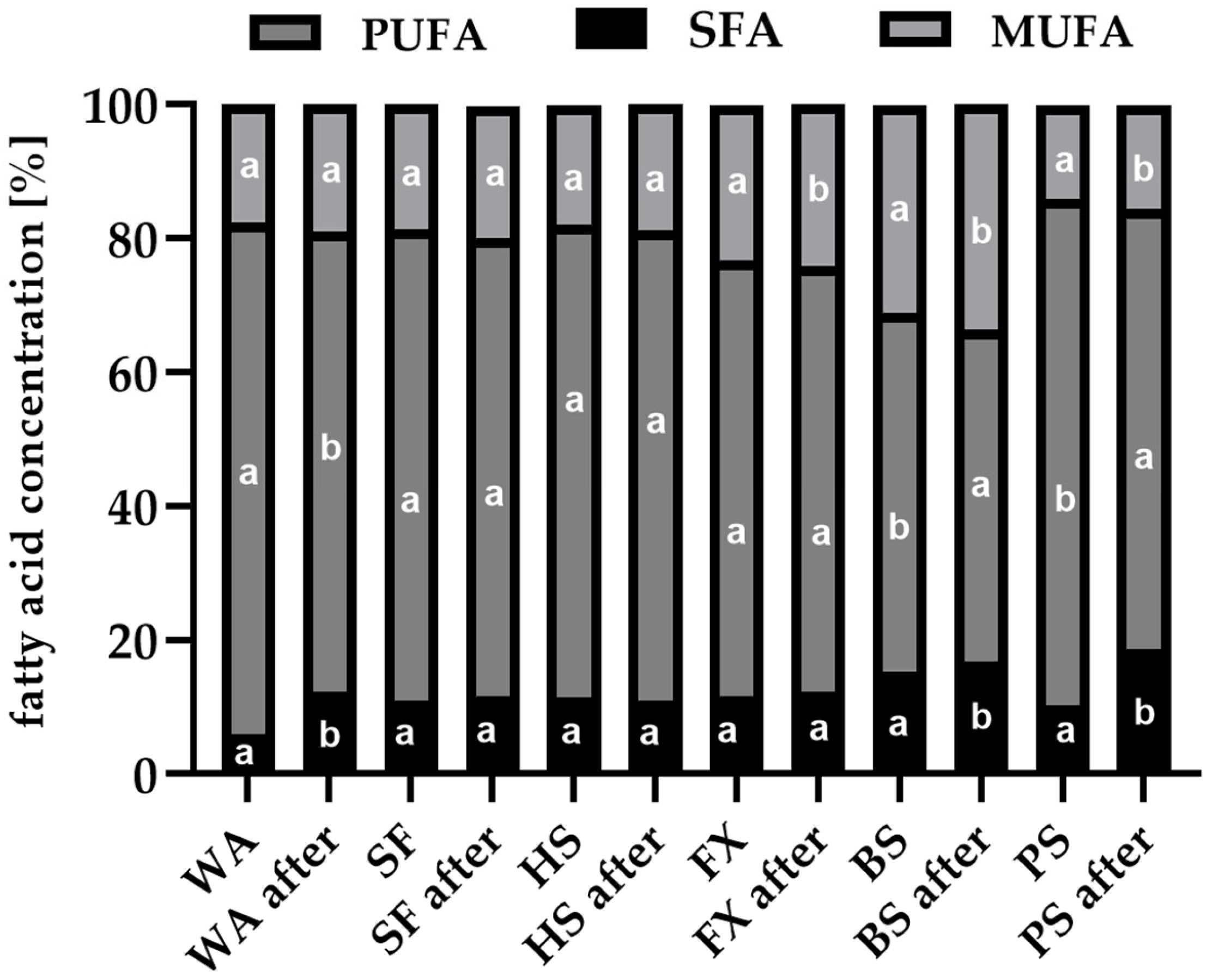
| Symbol | WA | SF | HS | FX | BC | PS |
|---|---|---|---|---|---|---|
| C16:0 | 5.97 ± 0.08 c | 6.04 ± 0.28 b | 6.80± 0.26 b | 6.70 ± 0.44 b | 8.83 ± 0.41 a | 9.74 ± 0.01 a |
| C18:0 | nd | 4.62 ± 0.08 a | 4.55 ± 0.23 a | 4.83 ± 0.23 a | 3.46 ± 0.00 b | 2.11 ± 0.08 b |
| C18:1 n-9 | 17.58 ± 0.11 b | 18.54 ± 0.06 b | 17.96 ± 0.08 b | 20.95 ± 0.07 a | 21.42 ± 0.13 a | 14.08 ± 2.21 c |
| C18:2 n-6 | 62.31 ± 0.23 c | 69.76 ± 0.31 b | 58.31 ± 0.21 d | 42.30 ± 0.18 e | 34.73 ± 0.99 f | 73.20 ± 2.28 a |
| C18:3 n-3 | 14.15 ± 0 22 c | nd | 12.40 ± 0.16 c | 22.88 ± 0.11 a | 18.02 ± 0.64 b | 0.87 ± 0.01 d |
| C20:0 | nd | 0.32 ± 0.07 b | nd | nd | 1.09 ± 0.01 a | nd |
| C20:1 c | nd | nd | nd | 2.35 ± 0.08 b | 8.32 ± 0.23 a | nd |
| C20:3 n-3 | nd | nd | nd | nd | 0.71 ± 0.12 b | nd |
| C20:4 n-6 | nd | 0.73 ± 0.05 a | nd | nd | nd | nd |
| C21:0 | nd | nd | nd | nd | 2.01 ± 0.03 a | nd |
| C22:1 n-9 | nd | nd | nd | nd | 1.42 ± 0.01 a | nd |
| SFA | 5.97 ± 0.08 c | 10.98 ± 0.29 b | 11.34 ± 0.03 b | 11.53 ± 0.44 b | 15.39 ± 0.36 a | 11.85 ± 0.07 b |
| MUFA | 17.58 ± 0.11 b | 18.54 ± 0.06 b | 17.96 ± 0.08 b | 23.30 ± 0.07 b | 31.15 ± 0.11 a | 14.08 ± 2.21 b |
| PUFA | 76.45 ± 0.45 a | 70.49 ± 0.36 b | 70.70 ± 0.04 b | 65.17 ± 0.14 c | 53.46 ± 0.35 d | 75.67 ± 2.27 c |
| Waste | Oxidation Induction Time [min] |
|---|---|
| WA | 10.49 ± 3.61 c |
| SF | 3.12 ± 0.48 d |
| HS | 39.00 ± 2.87 a |
| FX | 22.34 ± 3.79 b |
| BC | 33.83 ± 2.82 a |
| PS | 12.15 ± 0.76 c |
| Waste | h/H | AI | TI |
|---|---|---|---|
| WA | 15.75 a | 0.064 b | 0.114 c |
| SF | 14.74 a | 0.068 b | 0.239 a |
| HS | 13.04 b | 0.077 b | 0.150 b |
| FX | 13.21 b | 0.076 b | 0.113 c |
| BC | 9.58 c | 0.104 a | 0.099 c |
| PS | 9.05 c | 0.111 a | 0.256 a |
Disclaimer/Publisher’s Note: The statements, opinions and data contained in all publications are solely those of the individual author(s) and contributor(s) and not of MDPI and/or the editor(s). MDPI and/or the editor(s) disclaim responsibility for any injury to people or property resulting from any ideas, methods, instructions or products referred to in the content. |
© 2025 by the authors. Licensee MDPI, Basel, Switzerland. This article is an open access article distributed under the terms and conditions of the Creative Commons Attribution (CC BY) license (https://creativecommons.org/licenses/by/4.0/).
Share and Cite
Małajowicz, J.; Wierzchowska, K.; Jasińska, K.; Fabiszewska, A. Turning Mushy Lipids into Fruity Notes: Unlocking Lactone Biosynthesis Potential in Fat Industry Lipid Waste. Foods 2025, 14, 4326. https://doi.org/10.3390/foods14244326
Małajowicz J, Wierzchowska K, Jasińska K, Fabiszewska A. Turning Mushy Lipids into Fruity Notes: Unlocking Lactone Biosynthesis Potential in Fat Industry Lipid Waste. Foods. 2025; 14(24):4326. https://doi.org/10.3390/foods14244326
Chicago/Turabian StyleMałajowicz, Jolanta, Katarzyna Wierzchowska, Karina Jasińska, and Agata Fabiszewska. 2025. "Turning Mushy Lipids into Fruity Notes: Unlocking Lactone Biosynthesis Potential in Fat Industry Lipid Waste" Foods 14, no. 24: 4326. https://doi.org/10.3390/foods14244326
APA StyleMałajowicz, J., Wierzchowska, K., Jasińska, K., & Fabiszewska, A. (2025). Turning Mushy Lipids into Fruity Notes: Unlocking Lactone Biosynthesis Potential in Fat Industry Lipid Waste. Foods, 14(24), 4326. https://doi.org/10.3390/foods14244326