On the Role of Food in the Transmission of Helicobacter pylori Infection: A Narrative Review

Abstract
1. Introduction
| (pylori[Title]) AND water[Title] | PubMed: 123 | Web of Science: 218 |
| (pylori[Title]) AND food[Title] | PubMed: 58 | Web of Science: 75 |
| (pylori[Title]) AND foods[Title] | PubMed: 12 | Web of Science: 97 |
| (pylori[Title]) AND milk[Title] | PubMed: 56 | Web of Science: 75 |
| (pylori[Title]) AND dairy[Title] | PubMed: 2 | Web of Science: 10 |
| (pylori[Title]) AND meat[Title] | PubMed: 10 | Web of Science: 11 |
| (pylori[Title]) AND fish[Title] | PubMed: 15 | Web of Science: 44 |
| (pylori[Title]) AND bovine[Title] | PubMed: 26 | Web of Science: 34 |
| (pylori[Title]) AND beef[Title] | PubMed: 4 | Web of Science: 5 |
| (pylori[Title]) AND cow[Title] | PubMed: 4 | Web of Science: 11 |
| (pylori[Title]) AND cattle[Title] | PubMed: 2 | Web of Science: 4 |
| (pylori[Title]) AND camel[Title] | PubMed: 3 | Web of Science: 4 |
| (pylori[Title]) AND sheep[Title] | PubMed: 8 | Web of Science: 14 |
| (pylori[Title]) AND goat[Title] | PubMed: 2 | Web of Science: 6 |
| (pylori[Title]) AND pig[Title] | PubMed: 18 | Web of Science: 80 |
| (pylori[Title]) AND poultry[Title] | PubMed: 4 | Web of Science: 4 |
| (pylori[Title]) AND chicken[Title] | PubMed: 3 | Web of Science: 4 |
| (pylori[Title]) AND vegetables[Title] | PubMed: 5 | Web of Science: 15 |
| (pylori[Title]) AND lettuce[Title] | PubMed: 2 | Web of Science: 3 |
| (pylori[Title]) AND fruits[Title] | PubMed: 8 | Web of Science: 25 |
| (pylori[Title]) AND animals[Title] | PubMed: 12 | Web of Science: 112 |
| (pylori[Title]) AND dogs[Title] | PubMed: 7 | Web of Science: 53 |
| (pylori[Title]) AND cats[Title] | PubMed: 13 | Web of Science: 45 |
2. Transmission Routes of Helicobacter pylori Infection
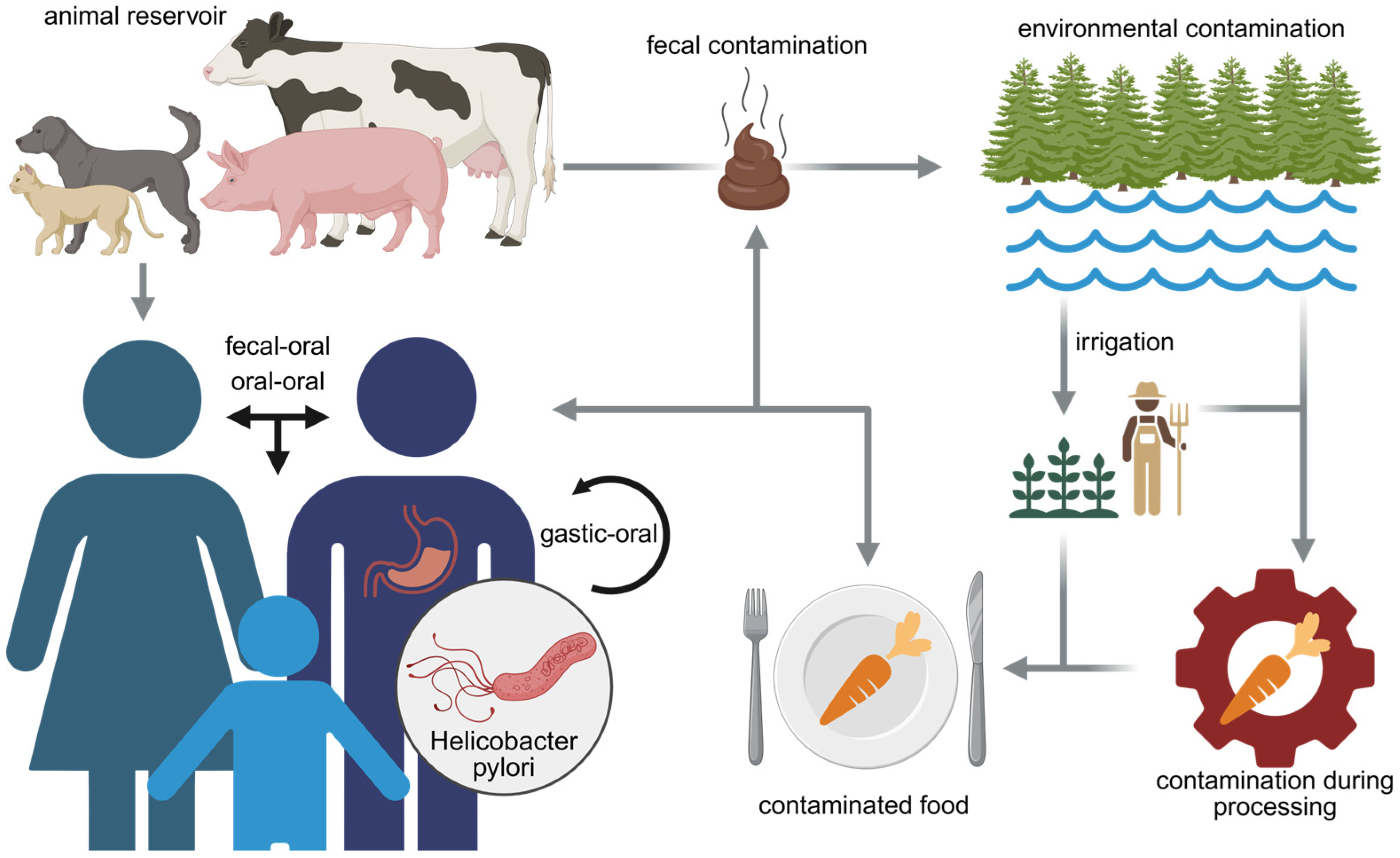
2.1. Oral–Oral Transmission
2.2. Gastric–Oral Transmission
2.3. Fecal–Oral Transmission
3. The Role of Water in the Transmission of Helicobacter pylori
3.1. Survival of Helicobacter Pylori in Water

| Year | Title | Result | Reference |
|---|---|---|---|
| 1989 | Survival of Campylobacter pylori in artificially contaminated milk | H. pylori did not multiply in milk but survived with a steady decline by one log in four days at both temperatures. At room temperature H. pylori was detectable after 5 days, and at 4 °C, over the whole test period of 6 days. | Karim et al. [74] |
| 1990 | Survival of Helicobacter pylori in water and saline | At 7 °C H. pylori remained viable and culturable for a period of 3–7 days in artificial seawater, 11–14 days in distilled water and up to 16 days in physiological saline. At room temperature H. pylori became non- culturable within 1 day in distilled water and 3 days in saline. | West et al. [66] |
| 1993 | Use of autoradiography to assess viability of Helicobacter pylori in water | H. pylori remained viable and culturable for up to 48 h and, in some cases, 20 to 30 days, depending on physical conditions of the environment. | Shahamat et al. [73] |
| 1998 | Survival of Helicobacter pylori in milk and tap water | H. pylori survived for up to 10 days in milk at 4 °C storage but only 4 days in tap water. | Fan et al. [67] |
| 1998 | Biofilms in drinking water systems: a possible reservoir for Helicobacter pylori | Artificially inoculated Helicobacter pylori were detected in biofilm material for a period of up to 192 h. | Mackay et al. [75] |
| 2000 | Survival of Helicobacter pylori in beef products | H. pylori survived in ground beef stored at 4 °C for 6 days in contact with air and for 3 days after vacuum packaging. In ground beef stored at −18 °C packaged either in air or in vacuum, H. pylori survived for 3 days. | Stevenson et al. [25] |
| 2001 | Survival of Helicobacter pylori in ready-to-eat foods at 4 °C | H. pylori survived in pasteurized milk and tofu up to 5 days but only 2 days in leaf lettuce and raw chicken. No survival was observed in yogurt. | Poms et al. [65] |
| 2002 | Optimizing enrichment culture conditions for detecting Helicobacter pylori in foods | H. pylori survived 6 days in sterile milk at 4 °C, 3 days in autoclaved ground beef, and 7 days in irradiated ground beef. | Jiang and Doyle [24] |
| 2003 | Survival of Helicobacter pylori in a natural fresh- water environment | H. pylori survived in VBNC state. | Adams et al. [71] |
| 2004 | Fate of Helicobacter pylori artificially inoculated in lettuce and carrot samples | H. pylori survived for up to 72 h in sanitized lettuce and carrot and up to 96 h in sterilized carrot samples. | Gomes et al. [76] |
| 2007 | Survival and viability of Helicobacter pylori after inoculation into chlorinated drinking water | H. pylori lost culturability after 5 min in chlorinated drinking water. Viable cells were still detected after 3 h but not after 24 h. | Moreno et al. [72] |
| 2007 | Survival of Helicobacter pylori in artificially contaminated ultrahigh temperature and pasteurized milk | H. pylori survived up to 9 days in pasteurized milk and 12 days in UHT milk. | Quaglia et al. [77] |
| 2008 | Survival of gastric and enterohepatic Helicobacter spp. in water: implications for transmission | H. pylori survived in water at 25 °C in the dark > 96 h, whereas H. felis survived < 6 h. | Azevedo et al. [39] |
| 2008 | Persistence of Helicobacter pylori in heterotrophic drinking-water biofilms | Culturable H. pylori could not be cultured at any time point but was able to persist as VBNC in biofilms for at least 31 days. | Giao et al. [78] |
| 2010 | Survival of spinach- associated Helicobacter pylori in the VBNC state | H. pylori introduced to spinach rapidly became non- detectable by plating, but mRNA transcripts were still detectable after 6 days. | Buck et al. [79] |
| 2011 | Survival of Helicobacter pylori in Turkish fermented sucuk and heat-treated sucuk during production | H. pylori could grow and survive during traditional sucuk fermentation and drying. | Guner et al. [80] |
| 2017 | Biofilm formation enhances Helicobacter pylori survivability in vegetables | H. pylori survived for up to 3 days in spring onion, lettuce and spinach and 4 days in cabbage. | Ng et al. [81] |
| 2020 | Survival of Helicobacter pylori as culturable and non-culturable form in artificially contaminated Mytilus galloprovincialis | H. pylori survived in artificially contaminated mussels. The bacteria could be isolated after 2 days, and after 4 days, detected as a non-culturable form. | Quaglia et al. [82] |
| 2022 | Isolation of Helicobacter pylori from raw milk and study on its survival in fermented milk products | H. pylori remained viable for two days in yoghurt without probiotics and survived for 7 days in control milk samples. | Al Sherief et al. [83] |
| 2022 | Exposure to water results in lysis and death of Helicobacter pylori | H. pylori rapidly lose their growth ability, lyse and die after exposure to sterile distilled water, making it unlikely that H. pylori survives in the VBNC state in water. | Inamasu et al. [84] |
3.2. Association of Helicobacter Pylori with Water
| Year | Sample type | Country | Method | Result | Reference |
|---|---|---|---|---|---|
| 1996 | Peruvian children 2 months to 12 years old | Peru | 13C-urea breath test | Overall prevalence was 48%. Children from homes with external water sources three times more likely to be infected, compared to homes with internal water sources. | Klein et al. [128] |
| 1996 | Drinking water | Peru | PCR, RT-PCR for 16S rRNA | H. pylori adhesin gene amplified by PCR from 24 of 48 drinking water samples, whereas RT-PCR for H. pylori 16S rRNA and H. pylori adhesin gene PCR was positive in 11out of the 48 samples. | Hulten et al. [100] |
| 1999 | Surface water and shallow ground water | USA | fluorescent antibody (CTC) staining | Actively respiring H. pylori binding monoclonal antibody present in 25 of 42 (60%) of the surface water samples and 13 of 20 (65%) of shallow groundwaters samples. | Hegarty et al. [93] |
| 1999 | Water from a delivery truck and two lakes | Canada | Nested PCR | H. pylori-specific DNA detected in water from a delivery truck and two lakes. | McKeown et al. [117] |
| 1999 | Tap and well water, field soil samples, flies, feces from cows | Japan | Nested PCR | H. pylori-specific DNA detected in water, field soil, flies and cow feces. | Sasaki et al. [97] |
| 2001 | Well water | USA | PCR | H. pylori-specific DNA detected using molecular methods in untreated well water. | Baker et al. [104] |
| 2001 | Tap water, well water, river water, and sea water | Japan | PCR, qPCR for 16S rRNA | None of the samples of tap (10 samples), river (10 samples), or sea water (10 samples) positive for adhesin, ureA or 16S rRNA gene PCR. None of the 6 samples of well water positive for adhesin or ureA PCR, but 2 of 6 samples revealed a positive 16S rRNA PCR. | Horiuchi et al. [105] |
| 2001 | Water systems for human use | Mexico | PCR | H. pylori-specific nested PCR positive in 58 (42%) of 139 analyzed water samples. | Mazari-Hiriart et al. [102] |
| 2002 | Municipal wastewater | U.S.-Mexico border | Culture, PCR | 132 isolates obtained by culture from municipal wastewater samples and 23 isolates could be identified as H. pylori. | Lu et al. [88] |
| 2003 | Well water | Japan | PCR | H. pylori-ureA gene detected in 4 out of 43 (9.3%) well water samples and H. pylori 16S rRNA gene detected in 1 out of 43 (2.3%) samples. | Imanishi et al. [106] |
| 2003 | River water and wastewater | Spain | FISH, PCR | H. pylori detected by FISH in two river water samples and one wastewater sample, while PCR yielded only one positive result. H. pylori culture negative for all samples. | Moreno et al. [89] |
| 2004 | Seawater | Italy | Nested PCR | H. pylori, either free or bound to planktonic organisms, detected in 7 out of 12 samples. | Cellini et al. [91] |
| 2004 | River water and stool samples from children living near the rivers | Japan | Nested PCR | H. pylori DNA detected in water from middle and downstream reaches of four rivers. Prevalence of H. pylori in stool samples from 224 children examined was 9.8% for those living near the middle reaches and 23.8% nearby downstream. | Fujimura et al. [58] |
| 2004 | Water from private wells | Germany | PCR; 13C-urea breath test | H. pylori DNA detected in about 10% of 157 wells. About 6% of 1884 tested children positive for H. pylori. | Krumbiegel et al. [107] |
| 2004 | Drinking water and biofilm samples | England | Culture, PCR | Culture negative for all 151 samples, but Helicobacter-specific DNA detected in 26% of samples from domestic properties, schools and hydrants, with the highest frequency in biofilms (42%). | Watson et al. [122] |
| 2005 | Seawater and plankton | Italy | Culture, PCR | H. pylori not detected by culture in any of 36 environmental samples, while 15 out of 36 (41.7%) samples were positive for the 16S rRNA gene. Amplification of the ureA gene was positive in 22.2% environmental samples and cagA PCR resulted in 19.4% positive samples. | Carbone et al. [90] |
| 2005 | Seawater | Italy | Culture, PCR | H. pylori isolated from water samples containing large zooplanktonic organisms. | Cellini et al. [92] |
| 2005 | Human stool and water | Spain | Nested PCR, stool antigen test (HpSA) | H. pylori detected in 33% of 36 human stool samples and in 66% of 15 wastewater samples, and in 11% of 23 river samples, but in none of the 19 spring water samples. | Queralt et al. [61] |
| 2007 | Wastewater | USA | Culture, PCR, qPCR | H. pylori DNA detected by qPCR in 86% (20/23) of sewage samples. In seeded groundwater H. pylori was detectable for up to 12 days by conventional MPN-PCR. | Nayak et al. [68] |
| 2009 | Water and biofilm samples | Bangladesh | Real-time PCR | H. pylori DNA not detected by real-time PCR in samples of drinking and environmental water (n = 75) and natural water biofilms (n = 21). | Janzon et al. [103] |
| 2009 | Potable water, surface water, and wastewater | Spain | Real-time PCR | H. pylori DNA detected in 3 out of 40 wastewater samples. All river (19) and drinking water (10) samples negative. | Yáñez et al. [86] |
| 2010 | Drinking water | Iraq | Culture | 469 isolates obtained from 198 drinking water samples. Of 173 isolates tested, 14 isolates represented Helicobacter spp. and 10 identified as H. pylori. | Al-Sulami et al. [110] |
| 2011 | Drinking water | Pakistan | Culture, PCR | Presumptive H. pylori isolates obtained from 37.5% (225/600) of drinking water samples. 40% (90/225) of positive samples were PCR-positive for vacA and cagA. | Samra et al. [108] |
| 2011 | Coastal freshwater, estuary, and marine waters | USA | Clone library analysis, PCR | H. pylori 16S rRNA gene amplified in approx. 21% of the samples. 80% of those samples also positive for H. pylori 16S rRNA gene. | Twing et al. [96] |
| 2012 | Drinking water | Iraq | Culture | H. pylori isolated from 11 (4.13%) out of 266 tap water samples and 3 (1.46%) out of 205 reverse osmosis water samples. | Al-Sulami et al. [109] |
| 2012 | Drinking water | Pakistan | PCR | H. pylori DNA detected in 2 out of 50 (4%) water samples | Khan et al. [118] |
| 2013 | Tap water, dental units’ water, and bottled mineral water | Iran | Culture, PCR | H. pylori isolated from 2 out of 50 tap water samples (4%), 2 out of 35 dental units’ water (5.8%) samples, and from 1 out of 40 (2.5%) water cooler samples. H. pylori ureC gene detected in 7% of water samples including tap water (10%), dental unit water (11.4%), refrigerated water with filtration, and 10% of water cooler samples. | Bahrami et al. [111] |
| 2013 | Seawater | Georgia, Puerto Rico, Trinidad | Culture, PCR | H. pylori detected in 4 out of 31 samples. | Holman et al. [94] |
| 2014 | Drinking water | Iran | PCR | H. pylori DNA detected in 56% (66/118) of water samples. Frequency of 36% (25/70) for tap water and 85% (41/48) for wells. | Amirhooshang et al. [121] |
| 2014 | River water | Greece | DVC-FISH | H. pylori detected in 23 out of 48 water samples (47.9%), while no seasonal variation and no correlation with indicators of fecal contamination were observed. | Tirodimos et al. [95] |
| 2015 | Ground water, river water, tap water, and human blood | Egypt | PCR, ELISA | H. pylori DNA detected in 2 out of 51 (4%) water samples. ELISA test positive in 67% of 173 blood samples. | El-Sharouny et al. [119] |
| 2015 | Drinking water | Spain | Culture, qPCR, DVC-FISH | H. pylori detected in 16 out of 24 drinking water samples. Viable cells detected in 6 samples. | Santiago et al. [116] |
| 2016 | Drinking water | Iran | Culture, PCR | H. pylori isolated from 12 out of 400 (3%) drinking water samples. | Ranjbar et al. [112] |
| 2016 | Bottled mineral water | Iran | Culture, PCR | H. pylori isolated from 8 (1.77%) out of 450 bottled mineral water samples. | Ranjbar et al. [114] |
| 2018 | Surface water | Spain | PMA-qPCR | Viable H. pylori detected in 91.3% of samples, with an average concentration of 3.46 +/− 1.06 log cells per 100 mL. | Acosta et al. [98] |
| 2018 | Drinking water samples | Peru | qPCR | H. pylori detected in 49 of 241 (20.3%) drinking water samples by qPCR. | Boehnke et al. [70] |
| 2018 | Influent and effluent water from drinking water treatment plants (DWTP) | Colombia | Culture, qPCR, FISH | H. pylori isolated from 56 of 310 influent and effluent water samples, in 26 out of 155 (16.8%) influent samples, and in 30 out of 155 (19.4%) effluent water samples. H. pylori DNA detected in 77 out of the 310 influent and effluent water samples. | Vesga et al. [70] |
| 2019 | Tap water and gastric tissue from cancer patients | Peru | hspA and ureA gene qPCR | H. pylori detected by qPCR in 69.5% of 82 gastric tissue samples and in 12.2% of 82 tap-water samples collected from the homes of cancer patients. | Castillo et al. [120] |
| 2019 | Drinking water, wastewater, and sewage sludge | Iran | Nested PCR for 16S rRNA gene, semi-nested ureA PCR | H. pylori 16S rRNA gene detected in 36% (14/39) of wastewater samples and 8% (2/25) of drinking water samples, while PCR detection of the ureA gene yielded only two positive results. None of the anaerobically digested sewage sludge samples positive for H. pylori. | Farhadkhani et al. [87] |
| 2021 | Human stool and gastric biopsies, feces from cow, buffalo, sheep, and camel, feces and saliva from dogs and cats | Egypt | 16S rRNA gene PCR | Helicobacter spp. DNA detected in 13 of 29 (44.8%) of the human samples. H. pylori in 2 (15.4%), and H. bovis in 4 (30.8%) samples, 7 (53.9%) unidentified. In fecal samples from livestock animals Helicobacter spp. DNA was detected in 6 out of 15 (40% cattle), 4 out of 12 (33.3% buffalo), 2 out of 8 (25% sheep), and 2 out of 9 (22.2% camel). H. pylori not detected in samples from livestock animals. In pets, Helicobacter spp. DNA detected in 13 (37.1%) out of 35 samples from dogs and 5 (21.7%) out of 23 samples from cats. H. pylori not detected in pet samples. | Youssef et al. [129] |
| 2023 | Tap water and surface water | Yemen | Culture | H. pylori detected in 9.6% tap water samples and 13.2% surface water samples. | Almashhadany et al. [115] |
| 2023 | Tap water | Iran | Culture; qPCR | H. pylori detected in 3 out of 50 tap water samples before enrichment, and 6 positive by RT qPCR after enrichment. Two samples of H. pylori culture positive. | Hasanvand et al. [113] |
| 2025 | Tap water and tap biofilm | Peru | Culture | H. pylori isolated from 2/192 (1%) tap water and 3/192 (1.6%) biofilm samples. | Custodio et al. [123] |
4. The Role of Food in the Transmission of Helicobacter pylori
4.1. Milk and Dairy Products
4.2. Meat
4.3. Fish and Seafood
4.4. Ready-to-Eat Food
4.5. Vegetables
| Year | Sample Type | Country | Method | Result | Reference |
|---|---|---|---|---|---|
| 1992 | Blood and gastric brushings from pigs, rabbits and cows | Italy | ELISA | H. pylori identified in gastric brushings by a monoclonal antibody in 8 out of 10 pigs and 7 out of 10 rabbits. Raised serum IgG levels were found in 93% of pigs and 87% of rabbits. | Vaira et al. [173] |
| 1993 | Human blood | Chile | ELISA | Seropositivity of H. pylori antibodies in 1815 Chileans was >60% in lower socioeconomic groups and correlated with increased age, low socioeconomic status, and consumption of uncooked vegetables. | Hopkins et al. [174] |
| 1996 | Children 2–9 years old | Colombia | 13C-urea breath test | H. pylori prevalence was overall 69%, and increased from 53% in 2-year-olds to 87% in 9-year-old children. Children who frequently consumed raw vegetables were more likely to be infected. Children in contact with sheep had increased prevalence odds. | Goodman et al. [175] |
| 1997 | Housefly | USA | Culture | H. pylori detected on bodies of houseflies and in their intestinal tracts. Proven dissemination of viable H. pylori in excreta of houseflies. | Grubel et al. [176] |
| 1999 | Gastric mucosa of horses, calves, pigs, rabbits, and chickens | Greece | Culture | H. pylori detected in all large-sized animals, while no positive cases observed in rabbits and chickens. | Dimola et al. [177] |
| 1999 | Raw sheep milk | Italy | PCR | H. pylori 16S rRNA gene detected in 60% of 51 raw milk samples from 12 sheep and vacA gene amplified from 5 milk samples. | Dore et al. [130] |
| 2000 | Housefly | USA | PCR | H. pylori ureA gene amplified in 6.9% of 3-fly or 5-fly pools of 2229 wild houseflies from several agricultural sites. | Li et al. [178] |
| 2000 | Cattle and retail beef products | USA | Culture | Helicobacter spp. not isolated from mucosal samples from rumen and abomasum of 105 cattle. All 20 retail beef cuts negative for H. pylori. | Stevenson et al. [25] |
| 2001 | Sheep milk and gastric tissue | Italy | Culture, PCR | H. pylori cultured from sheep milk and tissue samples Helicobacter DNA detected in 60% of 63 milk samples and 30% of 20 sheep tissue samples. The vacA gene of H. pylori amplified in 5 of 38 positive milk samples and 2 of 6 positive sheep tissue samples. | Dore et al. [131] |
| 2002 | Raw and pasteurized cow milk | Japan | Culture, PCR, EM | H. pylori detected by semi-nested PCR amplification of the ureA gene in 13 of 18 (72.2%) raw milk samples and in 11 of 20 (55%) commercial pasteurized milk samples. Culture positive for one raw milk sample but none of the pasteurized milk samples. | Fujimura et al. [132] |
| 2002 | Raw bovine milk | USA | Culture, PCR | H. pylori not detected either by PCR or by culture in 120 raw bovine milk samples. | Jiang and Doyle [24] |
| 2002 | Raw sheep milk | Turkey | Culture | H. pylori not detected in any of 440 examined raw sheep milk samples. | Turutoglu et al. [134] |
| 2008 | Raw chicken and ready-to-eat tuna | USA | Multiplex PCR | H. pylori DNA detected in 36% (4/11) of the raw chickens and 44% (8/18) of ready-to-eat raw tuna meat tested by a multiplex PCR assay. | Meng et al. [162] |
| 2008 | Raw goat, sheep, and cow milk | Italy | Nested PCR followed by culture | H. pylori-specific glmM gene was detected in 139 (34.7%) of 400 raw milk samples, but no isolates were obtained from the PCR-positive samples. | Quaglia et al. [133] |
| 2011 | Raw bovine milk | Greece | FISH | H. pylori were detected by FISH in four out of twenty (20%) raw milk samples. | Angelidis et al. [151] |
| 2011 | Serum, raw milk and feces of cows | Iran | PCR, ELISA | H. pylori antibodies detected in 25 (27%) of 92 cow serum specimens. Of these 25 seropositive cows, 10 (40%) fecal samples and 4 (16%) milk samples were antigen positive for H. pylori. Four antigen-positive milk samples revealed a positive H. pylori stool antigen test. | Safaei et al. [145] |
| 2012 | Raw milk from bovine, buffalo, camel, ovine, and caprine | Iran | Culture, PCR | H. pylori cultured from two sheep and one buffalo milk sample of 447 milk samples from 230 dairy bovine, buffalo, camel, ovine, and caprine. H. pylori ureC gene detected in 56 (12.5%) of milk samples, including 19 cow (14.1%), 11 sheep (12.2%), nine goat (8.7%), two camel (3.6%), and 15 buffalo (23.4%) samples. | Rahimi et al. [137] |
| 2014 | Vegetables and salads | Iran | Culture, PCR | H. pylori cultured from 44 out of 460 samples (9.6%). H. pylori DNA detected in 50 out of 460 samples (10.9%). | Atapoor et al. [169] |
| 2014 | Gastric biopsies of cow, sheep, goat, and humans | Iran | Culture, PCR | H. pylori detected in 164 (82%) human, 32 (16%) sheep, and 6 (3%) cow samples out of 800 gastric biopsy samples of cows, sheep, goats and humans. | Momtaz et al. [179] |
| 2014 | Raw milk and traditional dairy products | Iran | Culture, PCR | H. pylori detected in 103 out of 520 (19.8%) milk samples and 77 out of 400 (19.2%) traditional dairy product samples. The most frequently contaminated samples were ovine milk (35%) and traditional cheese (30%). | Mousavi et al. [138] |
| 2014 | Washed and unwashed vegetables and salads | Iran | Culture, PCR | H. pylori cultured from 7 out of 50 (14%) salad and 52 out of 380 (13.68%) vegetable samples. Leek, lettuce, and cabbage were the most common contaminated samples. | Yahaghi et al. [170] |
| 2015 | Fecal samples from different fish species and fish handlers | Egypt | Lateral Flow Assay (LFA), PCR | The overall prevalence rates for H. pylori in 315 examined fish were 6.7% for LFA and 1.9% for PCR. Only tilapia fish showed positive results by both methods (10.9% and 3.1%). 61.1% of stool samples from 18 fish handlers were positive for LFA. | Abdel-Moein et al. [165] |
| 2015 | Raw bulk tank milk of dairy cattle | Italy | Culture, PCR | Three out of 163 bulk milk samples positive for Helicobacteraceae, but not in subsequent H. pylori-specific PCR. H. pylori was not isolated. | Bianchini et al. [135] |
| 2015 | Raw bovine milk and traditional dairy products | Iran | Culture, PCR | H. pylori isolated from 33 (13.8%) of 120 bovine milk and 120 dairy product samples. All isolates confirmed by ureC PCR. | Esmaeiligoudarzi et al. [139] |
| 2015 | Raw bovine milk | Sudan | Culture, PCR | H. pylori glmM gene detected in 11 out of 50 (22%) raw milk samples. | Osman et al. [146] |
| 2015 | Raw milk from cow, sheep, goat, camel, buffalo; human gastric biopsies | Iran | PCR | H. pylori DNA detected in 12 (16%) cows, 8 (13.8%) sheep, 2 (4.8%) goats, 2 (13.3%) camels, and 4 (20%) buffalo out of 210 raw milk samples. H. pylori DNA detected in 82 out of 100 (82%) human samples. | Talaei et al. [143] |
| 2016 | Raw bovine milk, human stool and serum samples | Egypt | Culture, PCR, ELISA | H. pylori glmM gene detected in 11% of 100 raw cow milk samples. H. pylori antigen detected in 59% of 100 human stool samples and antibodies were detected in 50% of 100 serum samples. | Abdel-Latif et al. [147] |
| 2016 | Meat and meat products | Egypt | Culture | H. pylori detected in one sample of each of 30 raw meat, 20 raw poultry meat, and 20 luncheon meat samples. | El Dairouty et al. [154] |
| 2016 | Fish, ham, chicken, vegetables, meat sandwiches, minced meat | Iran | Culture, PCR | H. pylori isolated from 60 out of 300 (20%) food samples. Vegetable sandwich (45%), minced meat (32%) and meat sandwich (20%) positives. | Ghorbani et al. [156] |
| 2016 | Ready-to-eat food | Iran | Culture, PCR | H. pylori contained in 74 out of 550 (13.5%) ready-to-eat food samples. Olive salad (36%), restaurant salad (30%), fruit salad (28%) and soup (22%). | Hemmatinezhad et al. [167] |
| 2016 | Milk and meat from cow, sheep, goat, camel, and buffalo | Iran | Culture, PCR | H. pylori present in 92 out of 420 (21.9%) raw milk samples and in 105 out of 400 (26.2%) meat samples collected from various parts of Iran. | Saeidi and Sheikhshahrokh [142] |
| 2017 | Minced meat and hamburger samples | Iran | Culture, PCR | H. pylori was detected in 11 out of 150 (7.3%) meat samples with a prevalence of 1.4% for hamburger and 12.5% for minced-meat. | Gilani et al. [157] |
| 2017 | Various types of meat | Iran | Culture, PCR | H. pylori was detected in 11 out of 220 (5.0%) meat samples with a prevalence of 72.2% for meat samples of slaughterhouses and 27.7% for meat samples of butcheries. | Gilani et al. [158] |
| 2017 | Raw milk and dairy products | Iran | Culture, PCR | H. pylori was harboured by 60 out of 300 (20%) samples with a prevalence of 38.7% for raw milk and 13.2% for traditional dairy products. Ovine milk (45%) and traditional cheese (40%) revealed the highest prevalence for H. pylori. | Khaji et al. [140] |
| 2017 | Raw milk, meat and vegetables | Iran | Culture, PCR | H. pylori isolated from 40 out of 340 (11.8%) samples with a prevalence of 7.3% in meat, 16% in milk, and 12.5% in vegetable samples. Ovine milk (26%) was the most often contaminated product. | Talimkhani et al. [144] |
| 2018 | Raw milk and feces from cows, buffaloes, and sheep | Egypt | Culture, Nested PCR | H. pylori present in 29% percent of feces and milk samples collected from apparently healthy cows, buffaloes, and sheep examined. | Elhariri et al. [148] |
| 2018 | Raw milk, blood, and feces from cows | Algeria | Culture, PCR, ELISA | No H. pylori isolates obtained from milk and feces of 200 cows, while ELISA detected IgG antibodies in 12% of blood samples and 4% of milk samples from 200 cows. PCR for glmM gene was positive in 13% of 200 cows milk samples and confirmed all IgG-positive milk samples. | Guessoum et al. [150] |
| 2018 | Chicken meat, liver, and gizzard | Egypt | Culture, PCR | H. pylori isolated from 7 out of 90 (7.78%) chicken samples: 3 from chicken liver, 2 from meat, and 2 from gizzard. | Hamada et al. [159] |
| 2018 | Raw milk from bovine, ovine, caprine, buffalo, and camel | Iran | Culture, PCR | H. pylori cultured from 67 (10.6%) out of 630 raw milk samples. The prevalence was 17.3% in 110 samples from ovine, 13.8% in 130 caprine samples, 10.8% in 130 buffalo samples, 7.5% in 120 bovine samples, and 5.0% in 140 camel samples. | Ranjbar et al. [141] |
| 2019 | Shellfish: mussels, clams, cockles | Spain | vacA gene qPCR | H. pylori vacA gene qPCR positive for 12 out of 100 investigated samples, with 67% (8/12) positive mussels, 25% (3/12) clams, and only 8% (1/12) positive cockles. | Pina-Perez et al. [164] |
| 2020 | Feces, blood, and wool of sheep, lamb, and sheep dog | Italy | Culture, PCR, ELISA, stool antigen test (HpSA) | 58 animals studied (44 sheep, 8 lambs and 6 sheep dogs). H. pylori antigen test positive in 82% (36/44) sheep samples and in 100% of lamb and sheep-dog stool samples. High anti- H. pylori IgG serum levels detected in all 6 sheep-dog and in 42 out of 44 sheep. H. pylori was not detected in sheep wool samples. | Dore et al. [180] |
| 2020 | Raw meat | Iran | Culture, PCR | H. pylori isolated from 52 out of 600 (8.66%) raw meat samples with raw ovine meat (13.07%) showing the highest prevalence. | Mashak et al. [161] |
| 2020 | Lettuce and free-living amoebae (FLA) | Nether-lands | Culture, PMA-qPCR, DVC-FISH | H. pylori not detected in any lettuce sample by molecular techniques or culture. Intra-amoebic H. pylori DNA detected by PMA-qPCR in 55% of the samples and viable intra-amoebic H. pylori cells in 25% of the samples by DVC-FISH. | Moreno-Mesonero et al. [126] |
| 2021 | Abomasum samples | Iraq | 16S rRNA gene PCR | H. pylori 16S rRNA gene detected by PCR in 31 out of 150 gastric samples from sheep. | Kareem and Al-Maaly [181] |
| 2021 | Gastric biopsies of wild boar | Portugal | PCR | H. pylori DNA detected in 2 animals out of 14 wild boar and H. suis DNA detected in one animal. | Nunes et al. [182] |
| 2022 | Raw milk from cows | Egypt | Culture, PCR | H. pylori isolated from 13.3% out of 30 samples of cows’ milk and 6.7% out of 30 samples of marketable raw milk. | Al Sherief and Thabet [83] |
| 2022 | Chicken meat | Yemen | Culture | H. pylori isolated from 13.8% of 260 chicken meat samples. | Almashhadany et al. [152] |
| 2022 | Feces from goat | China | Metagenomic sequencing | H. pylori identified in fresh fecal samples from diarrhetic goats but not in fresh fecal samples from clinically healthy goats. | Cheng et al. [183] |
| 2022 | Chicken breast, liver, gizzard; swab samples from processing surfaces | Egypt | 16S rRNA gene PCR | H. pylori DNA detected in 16 of 300 (5.3%) chicken samples and H. pullorum in 14 (4.7%) samples. Two H. pylori isolates were isolated from 30 swab samples from two different cutting boards. | Elrais et al. [155] |
| 2022 | Raw milk from cows and goat | Czech Republic | Culture, Nested PCR | H. pylori detected by nested PCR in 31 samples (40%) of 77 raw cow milk samples and 30 samples (58%) of 52 raw goats’ milk. | Furmancíková et al. [136] |
| 2022 | Raw vegetables | Spain | qPCR | H. pylori DNA detected in 17 (17%) out of 100 vegetable samples. 12/45 (26.6%) lettuce, 2/21 (9.5%) spinach, and 3/34 (8.8%) chard samples positive. | García-Ferrús et al. [171] |
| 2023 | Raw poultry meat | Iran | Culture, Multiplex PCR | H. pylori isolated from 20 of 320 (6.3%) raw chicken meat samples. Highest incidence was found in chicken raw meat (15%). No isolate was recovered from goose or quail. | Asadi et al. [153] |
| 2023 | Raw and ready-to-eat meat | Egypt | Culture, PCR | H. pylori detected in 40.8% (49/120) of raw meat products and in 29.2% (38/130) of ready-to-eat meat products, e.g., in 53.3% (32/60) raw ground beef, 56.7% (17/30) beef burger, 40% (8/20) beef burger sandwiches, 55% (11/20) beef shawarma sandwiches, 60% (12/20) beef kofta sandwiches, 13.3% (4/30) beef luncheon, and 15% (3/20) beef sausage sandwiches. Of 204 biochemically identified H. pylori isolates, 53.9% (110/204) were confirmed by PCR | Maghrabia et al. [160] |
| 2023 | Fish (Tilapia); water; stool samples from handlers | Egypt | Culture, PCR, stool antigen test (HpSA) | H. pylori isolated from 9 out of 115 (7.8%) Tilapia fish, but ureC gene PCR confirmed only five isolates (4.4%) as H. pylori. Culture was positive for 7 out of 50 freshwater samples, with 6 confirmed by PCR. Stool antigen test was positive for 40 of 88 fish-handlers, but culture was only positive for 35 samples (39.8%) and only 31 samples were confirmed by ureC gene amplification. | Mubarak et al. [163] |
| 2023 | Ready-to-eat food | Czech Republic | Nested PCR | glmM gene of H. pylori detected in 50% (n = 25) of all 50 samples. Composite food category (e.g., sandwiches, baguettes, tortillas, buns, etc.) showed highest prevalence, 58.6% (n = 21), followed by “other” (smoked and marinated fish) 50% (n = 4), and “salads” 30.8% (n = 4). | Navrátilová et al. [166] |
| 2023 | Feces from camel, sheep, and humans | Egypt | PCR, stool antigen test (HpSA) | Prevalence of H. pylori in 250 stool samples from sheep, camels and humans was 27.6% determined by HpSA and 24.4% determined by 16S rRNA PCR. In detail HpSA test was positive in 12% of sheep and 26% of camel stool samples. Prevalence of H. pylori in human stool samples was 44% determined by HpSA. | Rabah et al. [184] |
| 2023 | Feces from cattle, buffalo, sheep, dog, cat, and humans; animal milk samples | Egypt | PCR, stool antigen test (HpSA), rapid antibody test | Prevalence of H. pylori infection in 143 animal samples was 22.2% determined by rapid antibody test and 16% determined by HpSA. Detection rates were 28% from 50 cats, 24% from 50 dogs, 12% from 50 buffaloes, 10% from 50 sheep, and 4.7% from 43 cattle. Prevalence of H. pylori in 768 fresh human stool samples was 74.8% determined by HpSA. H. pylori glmM gene was detected by PCR in 21 of 27 human antigen-positive samples and 5 of 13 animal milk samples. | Shaaban et al. [149] |
| 2024 | Lettuce and strawberries | Colombia | PCR | H. pylori DNA detected in samples of strawberries from farms (25%) and supermarkets (11.1%), and in lettuce from markets (25%). | Vesga et al. [172] |
| 2025 | Abomasum of dairy cattle and sheep | Italy | PCR | Helicobacteraceae-specific DNA detected in 9% of bovine and 42% of ovine abomasa. No samples tested positive for H. pylori. | Recchia et al. [185] |
5. The Role of Animals in the Transmission of Helicobacter pylori
6. The Impact of Detection Methods on the Evidence for Helicobacter pylori Transmission by Food and Water
7. Conclusions
Funding
Institutional Review Board Statement
Informed Consent Statement
Data Availability Statement
Acknowledgments
Conflicts of Interest
Abbreviations
| ATCC | American Type Culture Collection |
| cagA | cytotoxin-associated gene A |
| CTC | Cyanoditoyl Tetrazolium Chloride |
| DNA | Deoxyribonucleic Acid |
| DOI | Digital Object Identifier |
| DVC | Direct Viable Count |
| DWTP | Drinking Water Treatment Plant |
| EM | Electron Microscopy |
| ELISA | Enzyme-Linked Immunosorbent Assay |
| FISH | Fluorescence in situ Hybridization |
| FLA | Free Living Amoebae |
| glmM | phosphoglucosamine Mutase |
| HpSA | Helicobacter pylori Stool Antigen |
| LFA | Lateral Flow Assay |
| MPN | Most Probable Number |
| mRNA | messenger Ribonucleic Acid |
| NGS | Next-Generation Sequencing |
| PAI | Pathogenicity Island |
| PCR | Polymerase Chain Reaction |
| PMA | Propidium Monoazide |
| PPI | Proton Pump Inhibitor |
| qPCR | quantitative Polymerase Chain Reaction |
| RTE | Ready-To-Eat |
| rRNA | ribosomal Ribonucleic Acid |
| RT-PCR | Reverse Transcription Polymerase Chain Reaction |
| T4SS | Type IV Secretion System |
| UHT | Ultra Heat Treated |
| UK | United Kingdom |
| US | United States |
| ureA | urease A |
| ureB | urease B |
| ureC | urease C |
| vacA | vacuolating cytotoxin A |
| VBNC | Viable But Nono-Culturable |
| WGS | Whole Genome Sequencing |
References
- Mannion, A.; Shen, Z.; Fox, J.G. Comparative genomics analysis to differentiate metabolic and virulence gene potential in gastric versus enterohepatic Helicobacter species. BMC Genom. 2018, 19, 830. [Google Scholar] [CrossRef]
- Romo-Gonzalez, C.; Bustamante-Ogando, J.C.; Yamazaki-Nakashimada, M.A.; Aviles-Jimenez, F.; Otero-Mendoza, F.; Espinosa-Rosales, F.J.; Espinosa-Padilla, S.E.; Scheffler Mendoza, S.C.; Duran-McKinster, C.; Garcia-Romero, M.T.; et al. Infections with Enterohepatic Non-H. pylori Helicobacter Species in X-Linked Agammaglobulinemia: Clinical Cases and Review of the Literature. Front. Cell. Infect. Microbiol. 2021, 11, 807136. [Google Scholar] [CrossRef] [PubMed]
- Gueneau, P.; Loiseaux-De Goer, S. Helicobacter: Molecular phylogeny and the origin of gastric colonization in the genus. Infect. Genet. Evol. 2002, 1, 215–223. [Google Scholar] [CrossRef] [PubMed]
- Prada, C.F.; Casadiego, M.A.; Freire, C.C. Evolution of Helicobacter spp.: Variability of virulence factors and their relationship to pathogenicity. PeerJ 2022, 10, e13120. [Google Scholar] [CrossRef] [PubMed]
- Verhoef, C.; Pot, R.G.; de Man, R.A.; Zondervan, P.E.; Kuipers, E.J.; JN, I.J.; Kusters, J.G. Detection of identical Helicobacter DNA in the stomach and in the non-cirrhotic liver of patients with hepatocellular carcinoma. Eur. J. Gastroenterol. Hepatol. 2003, 15, 1171–1174. [Google Scholar] [CrossRef] [PubMed]
- Malfertheiner, P.; Camargo, M.C.; El-Omar, E.; Liou, J.M.; Peek, R.; Schulz, C.; Smith, S.I.; Suerbaum, S. Helicobacter pylori infection. Nat. Rev. Dis. Primers 2023, 9, 19. [Google Scholar] [CrossRef] [PubMed]
- Tomb, J.F.; White, O.; Kerlavage, A.R.; Clayton, R.A.; Sutton, G.G.; Fleischmann, R.D.; Ketchum, K.A.; Klenk, H.P.; Gill, S.; Dougherty, B.A.; et al. The complete genome sequence of the gastric pathogen Helicobacter pylori. Nature 1997, 388, 539–547. [Google Scholar] [CrossRef]
- Warren, J.R.; Marshall, B. Unidentified curved bacilli on gastric epithelium in active chronic gastritis. Lancet 1983, 1, 1273–1275. [Google Scholar] [CrossRef]
- van Duynhoven, Y.T.; de Jonge, R. Transmission of Helicobacter pylori: A role for food? Bull. World Health Organ. 2001, 79, 455–460. [Google Scholar]
- Duan, M.; Li, Y.; Liu, J.; Zhang, W.; Dong, Y.; Han, Z.; Wan, M.; Lin, M.; Lin, B.; Kong, Q.; et al. Transmission routes and patterns of Helicobacter pylori. Helicobacter 2023, 28, e12945. [Google Scholar] [CrossRef]
- Dunne, C.; Dolan, B.; Clyne, M. Factors that mediate colonization of the human stomach by Helicobacter pylori. World J. Gastroenterol. 2014, 20, 5610–5624. [Google Scholar] [CrossRef] [PubMed]
- Eaton, K.A.; Brooks, C.L.; Morgan, D.R.; Krakowka, S. Essential role of urease in pathogenesis of gastritis induced by Helicobacter pylori in gnotobiotic piglets. Infect. Immun. 1991, 59, 2470–2475. [Google Scholar] [CrossRef] [PubMed]
- Kirschner, D.E.; Blaser, M.J. The dynamics of Helicobacter pylori infection of the human stomach. J. Theor. Biol. 1995, 176, 281–290. [Google Scholar] [CrossRef] [PubMed]
- Odenbreit, S.; Puls, J.; Sedlmaier, B.; Gerland, E.; Fischer, W.; Haas, R. Translocation of Helicobacter pylori CagA into gastric epithelial cells by type IV secretion. Science 2000, 287, 1497–1500. [Google Scholar] [CrossRef]
- Ding, S.Z.; Goldberg, J.B.; Hatakeyama, M. Helicobacter pylori infection, oncogenic pathways and epigenetic mechanisms in gastric carcinogenesis. Future Oncol. 2010, 6, 851–862. [Google Scholar] [CrossRef]
- Foegeding, N.J.; Caston, R.R.; McClain, M.S.; Ohi, M.D.; Cover, T.L. An Overview of Helicobacter pylori VacA Toxin Biology. Toxins 2016, 8, 173. [Google Scholar] [CrossRef]
- Robinson, K.; Kenefeck, R.; Pidgeon, E.L.; Shakib, S.; Patel, S.; Polson, R.J.; Zaitoun, A.M.; Atherton, J.C. Helicobacter pylori-induced peptic ulcer disease is associated with inadequate regulatory T cell responses. Gut 2008, 57, 1375–1385. [Google Scholar] [CrossRef]
- Backert, S.; Haas, R.; Gerhard, M.; Naumann, M. The Helicobacter pylori Type IV Secretion System Encoded by the cag Pathogenicity Island: Architecture, Function, and Signaling. Curr. Top. Microbiol. Immunol. 2017, 413, 187–220. [Google Scholar] [CrossRef]
- Singh, M.; Prasad, K.N.; Yachha, S.K.; Saxena, A.; Krishnani, N. Helicobacter pylori infection in children: Prevalence, diagnosis and treatment outcome. Trans. R. Soc. Trop. Med. Hyg. 2006, 100, 227–233. [Google Scholar] [CrossRef]
- Liu, M.; Gao, H.; Miao, J.; Zhang, Z.; Zheng, L.; Li, F.; Zhou, S.; Zhang, Z.; Li, S.; Liu, H.; et al. Helicobacter pylori infection in humans and phytotherapy, probiotics, and emerging therapeutic interventions: A review. Front. Microbiol. 2023, 14, 1330029. [Google Scholar] [CrossRef]
- Srisuphanunt, M.; Wilairatana, P.; Kooltheat, N.; Duangchan, T.; Katzenmeier, G.; Rose, J.B. Molecular Mechanisms of Antibiotic Resistance and Novel Treatment Strategies for Helicobacter pylori Infections. Trop. Med. Infect. Dis. 2023, 8, 163. [Google Scholar] [CrossRef] [PubMed]
- Thung, I.; Aramin, H.; Vavinskaya, V.; Gupta, S.; Park, J.Y.; Crowe, S.E.; Valasek, M.A. Review article: The global emergence of Helicobacter pylori antibiotic resistance. Aliment. Pharmacol. Ther. 2016, 43, 514–533. [Google Scholar] [CrossRef] [PubMed]
- Miftahussurur, M.; Yamaoka, Y. Diagnostic Methods of Helicobacter pylori Infection for Epidemiological Studies: Critical Importance of Indirect Test Validation. Biomed. Res. Int. 2016, 2016, 4819423. [Google Scholar] [CrossRef] [PubMed]
- Jiang, X.; Doyle, M.P. Optimizing enrichment culture conditions for detecting Helicobacter pylori in foods. J. Food Prot. 2002, 65, 1949–1954. [Google Scholar] [CrossRef]
- Stevenson, T.H.; Bauer, N.; Lucia, L.M.; Acuff, G.R. Attempts to isolate Helicobacter from cattle and survival of Helicobacter pylori in beef products. J. Food Prot. 2000, 63, 174–178. [Google Scholar] [CrossRef]
- Dunn, B.E.; Cohen, H.; Blaser, M.J. Helicobacter pylori . Clin. Microbiol. Rev. 1997, 10, 720–741. [Google Scholar] [CrossRef]
- Jung, K.; Bae, H.; Kim, J.K.; Jeong, B.; Park, M.I.; Lee, J.Y. Comparison of three methods for generating the coccoid form of Helicobacter pylori and proteomic analysis. BMC Microbiol. 2024, 24, 448. [Google Scholar] [CrossRef]
- Cellini, L. Helicobacter pylori: A chameleon-like approach to life. World J. Gastroenterol. 2014, 20, 5575–5582. [Google Scholar] [CrossRef]
- Patel, S.K.; Pratap, C.B.; Jain, A.K.; Gulati, A.K.; Nath, G. Diagnosis of Helicobacter pylori: What should be the gold standard? World J. Gastroenterol. 2014, 20, 12847–12859. [Google Scholar] [CrossRef]
- Hooi, J.K.Y.; Lai, W.Y.; Ng, W.K.; Suen, M.M.Y.; Underwood, F.E.; Tanyingoh, D.; Malfertheiner, P.; Graham, D.Y.; Wong, V.W.S.; Wu, J.C.Y.; et al. Global Prevalence of Helicobacter pylori Infection: Systematic Review and Meta-Analysis. Gastroenterology 2017, 153, 420–429. [Google Scholar] [CrossRef]
- Malaty, H.M.; El-Kasabany, A.; Graham, D.Y.; Miller, C.C.; Reddy, S.G.; Srinivasan, S.R.; Yamaoka, Y.; Berenson, G.S. Age at acquisition of Helicobacter pylori infection: A follow-up study from infancy to adulthood. Lancet 2002, 359, 931–935. [Google Scholar] [CrossRef] [PubMed]
- Liou, J.M.; Malfertheiner, P.; Lee, Y.C.; Sheu, B.S.; Sugano, K.; Cheng, H.C.; Yeoh, K.G.; Hsu, P.I.; Goh, K.L.; Mahachai, V.; et al. Screening and eradication of Helicobacter pylori for gastric cancer prevention: The Taipei global consensus. Gut 2020, 69, 2093–2112. [Google Scholar] [CrossRef] [PubMed]
- Vale, F.F.; Vitor, J.M. Transmission pathway of Helicobacter pylori: Does food play a role in rural and urban areas? Int. J. Food Microbiol. 2010, 138, 1–12. [Google Scholar] [CrossRef] [PubMed]
- Kayali, S.; Manfredi, M.; Gaiani, F.; Bianchi, L.; Bizzarri, B.; Leandro, G.; Di Mario, F.; De’ Angelis, G.L. Helicobacter pylori, transmission routes and recurrence of infection: State of the art. Acta Biomed. 2018, 89 (Suppl. 8), 72–76. [Google Scholar] [CrossRef]
- Raymond, J.; Thiberge, J.M.; Kalach, N.; Bergeret, M.; Dupont, C.; Labigne, A.; Dauga, C. Using macro-arrays to study routes of infection of Helicobacter pylori in three families. PLoS ONE 2008, 3, e2259. [Google Scholar] [CrossRef]
- Almashhadany, D.A.; Zainel, M.A.; AbdulRahman, T.T. Review of foodborne helicobacteriosis. Ital. J. Food Saf. 2024, 13, 12176. [Google Scholar] [CrossRef]
- Gomes, B.C.; De Martinis, E.C.P. The significance of Helicobacter pylori in water, food and environmental samples. Food Control 2004, 15, 397–403. [Google Scholar] [CrossRef]
- Jiang, X.; Doyle, M.P. Effect of environmental and substrate factors on survival and growth of Helicobacter pylori. J. Food Prot. 1998, 61, 929–933. [Google Scholar] [CrossRef]
- Azevedo, N.F.; Almeida, C.; Fernandes, I.; Cerqueira, L.; Dias, S.; Keevil, C.W.; Vieira, M.J. Survival of gastric and enterohepatic Helicobacter spp. in water: Implications for transmission. Appl. Environ. Microbiol. 2008, 74, 1805–1811. [Google Scholar] [CrossRef]
- Schwarz, S.; Morelli, G.; Kusecek, B.; Manica, A.; Balloux, F.; Owen, R.J.; Graham, D.Y.; van der Merwe, S.; Achtman, M.; Suerbaum, S. Horizontal versus familial transmission of Helicobacter pylori. PLoS Pathog. 2008, 4, e1000180. [Google Scholar] [CrossRef]
- Kivi, M.; Rodin, S.; Kupershmidt, I.; Lundin, A.; Tindberg, Y.; Granstrom, M.; Engstrand, L. Helicobacter pylori genome variability in a framework of familial transmission. BMC Microbiol. 2007, 7, 54. [Google Scholar] [CrossRef] [PubMed]
- Kivi, M.; Tindberg, Y.; Sorberg, M.; Casswall, T.H.; Befrits, R.; Hellstrom, P.M.; Bengtsson, C.; Engstrand, L.; Granstrom, M. Concordance of Helicobacter pylori strains within families. J. Clin. Microbiol. 2003, 41, 5604–5608. [Google Scholar] [CrossRef] [PubMed]
- Yang, T.; Zhang, Y.; Zhang, H.; Wu, X.; Sun, J.; Hua, D.; Pan, K.; Liu, Q.; Cui, G.; Chen, Z. Intracellular presence and genetic relationship of Helicobacter pylori within neonates’ fecal yeasts and their mothers’ vaginal yeasts. Yeast 2023, 40, 401–413. [Google Scholar] [CrossRef] [PubMed]
- Ding, S.Z.; Du, Y.Q.; Lu, H.; Wang, W.H.; Cheng, H.; Chen, S.Y.; Chen, M.H.; Chen, W.C.; Chen, Y.; Fang, J.Y.; et al. Chinese Consensus Report on Family-Based Helicobacter pylori Infection Control and Management (2021 Edition). Gut 2022, 71, 238–253. [Google Scholar] [CrossRef]
- Dimitriadi, D. Helicobacter pylori: A sexually transmitted bacterium? Cent. Eur. J. Urol. 2014, 67, 407–409. [Google Scholar] [CrossRef]
- Graham, D.Y.; Opekun, A.R.; Osato, M.S.; El-Zimaity, H.M.; Lee, C.K.; Yamaoka, Y.; Qureshi, W.A.; Cadoz, M.; Monath, T.P. Challenge model for Helicobacter pylori infection in human volunteers. Gut 2004, 53, 1235–1243. [Google Scholar] [CrossRef]
- Burgers, R.; Schneider-Brachert, W.; Reischl, U.; Behr, A.; Hiller, K.A.; Lehn, N.; Schmalz, G.; Ruhl, S. Helicobacter pylori in human oral cavity and stomach. Eur. J. Oral Sci. 2008, 116, 297–304. [Google Scholar] [CrossRef]
- Ferguson, D.A., Jr.; Li, C.; Patel, N.R.; Mayberry, W.R.; Chi, D.S.; Thomas, E. Isolation of Helicobacter pylori from saliva. J. Clin. Microbiol. 1993, 31, 2802–2804. [Google Scholar] [CrossRef]
- Parsonnet, J.; Shmuely, H.; Haggerty, T. Fecal and oral shedding of Helicobacter pylori from healthy infected adults. JAMA 1999, 282, 2240–2245. [Google Scholar] [CrossRef]
- Souto, R.; Colombo, A.P. Detection of Helicobacter pylori by polymerase chain reaction in the subgingival biofilm and saliva of non-dyspeptic periodontal patients. J. Periodontol. 2008, 79, 97–103. [Google Scholar] [CrossRef]
- Gebara, E.C.; Faria, C.M.; Pannuti, C.; Chehter, L.; Mayer, M.P.; Lima, L.A. Persistence of Helicobacter pylori in the oral cavity after systemic eradication therapy. J. Clin. Periodontol. 2006, 33, 329–333. [Google Scholar] [CrossRef] [PubMed]
- Singh, V.; Trikha, B.; Vaiphei, K.; Nain, C.K.; Thennarasu, K.; Singh, K. Helicobacter pylori: Evidence for spouse-to-spouse transmission. J. Gastroenterol. Hepatol. 1999, 14, 519–522. [Google Scholar] [CrossRef] [PubMed]
- Luman, W.; Zhao, Y.; Ng, H.S.; Ling, K.L. Helicobacter pylori infection is unlikely to be transmitted between partners: Evidence from genotypic study in partners of infected patients. Eur. J. Gastroenterol. Hepatol. 2002, 14, 521–528. [Google Scholar] [CrossRef] [PubMed]
- Okuda, M.; Tanaka, T.; Nakamoto, H.; Katai, A.; Nakata, H.; Koike, M.; Miyamoto, H. Helicobacter pylori infection in childhood: H. pylori isolation rate in gastric juice in relation to positive serum antibody rates. J. Gastroenterol. 1996, 31 (Suppl. 9), 6–8. [Google Scholar]
- Akamatsu, T.; Tabata, K.; Hironga, M.; Kawakami, H.; Uyeda, M. Transmission of Helicobacter pylori infection via flexible fiberoptic endoscopy. Am. J. Infect. Control 1996, 24, 396–401. [Google Scholar] [CrossRef]
- Luzza, F.; Mancuso, M.; Imeneo, M.; Contaldo, A.; Giancotti, L.; Pensabene, L.; Doldo, P.; Liberto, M.C.; Strisciuglio, P.; Foca, A.; et al. Evidence favouring the gastro-oral route in the transmission of Helicobacter pylori infection in children. Eur. J. Gastroenterol. Hepatol. 2000, 12, 623–627. [Google Scholar] [CrossRef]
- Perry, S.; de la Luz Sanchez, M.; Yang, S.; Haggerty, T.D.; Hurst, P.; Perez-Perez, G.; Parsonnet, J. Gastroenteritis and transmission of Helicobacter pylori infection in households. Emerg. Infect. Dis. 2006, 12, 1701–1708. [Google Scholar] [CrossRef]
- Fujimura, S.; Kato, S.; Kawamura, T. Helicobacter pylori in Japanese river water and its prevalence in Japanese children. Lett. Appl. Microbiol. 2004, 38, 517–521. [Google Scholar] [CrossRef]
- Monteiro, L.; Gras, N.; Megraud, F. Magnetic immuno-PCR assay with inhibitor removal for direct detection of Helicobacter pylori in human feces. J. Clin. Microbiol. 2001, 39, 3778–3780. [Google Scholar] [CrossRef]
- Monteiro, L.; Gras, N.; Vidal, R.; Cabrita, J.; Megraud, F. Detection of Helicobacter pylori DNA in human feces by PCR: DNA stability and removal of inhibitors. J. Microbiol. Methods 2001, 45, 89–94. [Google Scholar] [CrossRef]
- Queralt, N.; Bartolome, R.; Araujo, R. Detection of Helicobacter pylori DNA in human faeces and water with different levels of faecal pollution in the north-east of Spain. J. Appl. Microbiol. 2005, 98, 889–895. [Google Scholar] [CrossRef] [PubMed]
- Cellini, L.; Dainelli, B.; Angelucci, D.; Grossi, L.; Di Bartolomeo, S.; Di Campli, E.; Marzio, L. Evidence for an oral-faecal transmission of Helicobacter pylori infection in an experimental murine model. APMIS 1999, 107, 477–484. [Google Scholar] [CrossRef] [PubMed]
- Laporte, R.; Pernes, P.; Pronnier, P.; Gottrand, F.; Vincent, P. Acquisition of Helicobacter pylori infection after outbreaks of gastroenteritis: Prospective cohort survey in institutionalised young people. BMJ 2004, 329, 204–205. [Google Scholar] [CrossRef] [PubMed][Green Version]
- Brown, L.M. Helicobacter pylori: Epidemiology and routes of transmission. Epidemiol. Rev. 2000, 22, 283–297. [Google Scholar] [CrossRef]
- Poms, R.E.; Tatini, S.R. Survival of Helicobacter pylori in ready-to-eat foods at 4 degrees C. Int. J. Food Microbiol. 2001, 63, 281–286. [Google Scholar] [CrossRef]
- West, A.P.; Millar, M.R.; Tompkins, D.S. Survival of Helicobacter pylori in water and saline. J. Clin. Pathol. 1990, 43, 609. [Google Scholar] [CrossRef]
- Fan, X.G.; Chua, A.; Li, T.G.; Zeng, Q.S. Survival of Helicobacter pylori in milk and tap water. J. Gastroenterol. Hepatol. 1998, 13, 1096–1098. [Google Scholar] [CrossRef]
- Nayak, A.K.; Rose, J.B. Detection of Helicobacter pylori in sewage and water using a new quantitative PCR method with SYBR green. J. Appl. Microbiol. 2007, 103, 1931–1941. [Google Scholar] [CrossRef]
- Konishi, K.; Saito, N.; Shoji, E.; Takeda, H.; Kato, M.; Asaka, M.; Ooi, H.K. Helicobacter pylori: Longer survival in deep ground water and sea water than in a nutrient-rich environment. APMIS 2007, 115, 1285–1291. [Google Scholar] [CrossRef]
- Boehnke, K.F.; Brewster, R.K.; Sanchez, B.N.; Valdivieso, M.; Bussalleu, A.; Guevara, M.; Saenz, C.G.; Alva, S.O.; Gil, E.; Xi, C. An assessment of drinking water contamination with Helicobacter pylori in Lima, Peru. Helicobacter 2018, 23, e12462. [Google Scholar] [CrossRef]
- Adams, B.L.; Bates, T.C.; Oliver, J.D. Survival of Helicobacter pylori in a natural freshwater environment. Appl. Environ. Microbiol. 2003, 69, 7462–7466. [Google Scholar] [CrossRef] [PubMed]
- Moreno, Y.; Piqueres, P.; Alonso, J.L.; Jimenez, A.; Gonzalez, A.; Ferrus, M.A. Survival and viability of Helicobacter pylori after inoculation into chlorinated drinking water. Water Res. 2007, 41, 3490–3496. [Google Scholar] [CrossRef]
- Shahamat, M.; Mai, U.; Paszko-Kolva, C.; Kessel, M.; Colwell, R.R. Use of autoradiography to assess viability of Helicobacter pylori in water. Appl. Environ. Microbiol. 1993, 59, 1231–1235. [Google Scholar] [CrossRef] [PubMed]
- Karim, Q.N.; Maxwell, R.H. Survival of Campylobacter pylori in artificially contaminated milk. J. Clin. Pathol. 1989, 42, 778. [Google Scholar] [CrossRef] [PubMed]
- Mackay, W.G.; Gribbon, L.T.; Barer, M.R.; Reid, D.C. Biofilms in drinking water systems: A possible reservoir for Helicobacter pylori. J. Appl. Microbiol. 1998, 85 (Suppl. 1), 52S–59S. [Google Scholar] [CrossRef]
- Gomes, B.C.; De Martinis, E.C.P. Fate of Helicobacter pylori artificially inoculated in lettuce and carrot samples. Braz. J. Microbiol. 2004, 35, 145–150. [Google Scholar] [CrossRef]
- Quaglia, N.C.; Dambrosio, A.; Normanno, G.; Parisi, A.; Firinu, A.; Lorusso, V.; Celano, G.V. Survival of Helicobacter pylori in artificially contaminated ultrahigh temperature and pasteurized milk. Food Microbiol. 2007, 24, 296–300. [Google Scholar] [CrossRef]
- Giao, M.S.; Azevedo, N.F.; Wilks, S.A.; Vieira, M.J.; Keevil, C.W. Persistence of Helicobacter pylori in heterotrophic drinking-water biofilms. Appl. Environ. Microbiol. 2008, 74, 5898–5904. [Google Scholar] [CrossRef]
- Buck, A.; Oliver, J.D. Survival of spinach-associated Helicobacter pylori in the viable but nonculturable state. Food Control 2010, 21, 1150–1154. [Google Scholar] [CrossRef]
- Guner, A.; Kav, K.; Tekinsen, K.K.; Dogruer, Y.; Telli, N. Survival of Helicobacter pylori in Turkish fermented sucuk and heat-treated sucuk during production. J. Food Prot. 2011, 74, 2055–2061. [Google Scholar] [CrossRef]
- Ng, C.G.; Loke, M.F.; Goh, K.L.; Vadivelu, J.; Ho, B. Biofilm formation enhances Helicobacter pylori survivability in vegetables. Food Microbiol. 2017, 62, 68–76. [Google Scholar] [CrossRef] [PubMed]
- Quaglia, N.C.; Storelli, M.M.; Scardocchia, T.; Lattanzi, A.; Celano, G.V.; Monno, R.; Dambrosio, A. Helicobacter pylori: Survival in cultivable and non-cultivable form in artificially contaminated Mytilus galloprovincialis. Int. J. Food Microbiol. 2020, 312, 108363. [Google Scholar] [CrossRef] [PubMed]
- Al Sherief, L.T.; Thabet, S.S. Isolation of Helicobacter pylori from Raw Milk and Study on Its Survival in Fermented Milk Products. J. Appl. Vet. Sci. 2022, 7, 73–81. [Google Scholar] [CrossRef]
- Inamasu, Y.; Ogawa, M.; Saito, M.; Harada, M.; Fukuda, K. Helicobacter pylori results in lysis and death after exposure to water. Helicobacter 2022, 27, e12921. [Google Scholar] [CrossRef]
- Vesga, F.J.; Moreno, Y.; Ferrus, M.A.; Campos, C.; Trespalacios, A.A. Detection of Helicobacter pylori in drinking water treatment plants in Bogota, Colombia, using cultural and molecular techniques. Int. J. Hyg. Environ. Health 2018, 221, 595–601. [Google Scholar] [CrossRef]
- Yanez, M.A.; Barbera, V.M.; Soria, E.; Catalan, V. Quantitative detection of Helicobacter pylori in water samples by real-time PCR amplification of the cag pathogenicity island gene, cagE. J. Appl. Microbiol. 2009, 107, 416–424. [Google Scholar] [CrossRef]
- Farhadkhani, M.; Nikaeen, M.; Hassanzadeh, A.; Nikmanesh, B. Potential transmission sources of Helicobacter pylori infection: Detection of H. pylori in various environmental samples. J. Environ. Health Sci. Eng. 2019, 17, 129–134. [Google Scholar] [CrossRef]
- Lu, Y.; Redlinger, T.E.; Avitia, R.; Galindo, A.; Goodman, K. Isolation and genotyping of Helicobacter pylori from untreated municipal wastewater. Appl. Environ. Microbiol. 2002, 68, 1436–1439. [Google Scholar] [CrossRef]
- Moreno, Y.; Ferrus, M.A.; Alonso, J.L.; Jimenez, A.; Hernandez, J. Use of fluorescent in situ hybridization to evidence the presence of Helicobacter pylori in water. Water Res. 2003, 37, 2251–2256. [Google Scholar] [CrossRef]
- Carbone, M.; Maugeri, T.L.; Gugliandolo, C.; La Camera, E.; Biondo, C.; Fera, M.T. Occurrence of Helicobacter pylori DNA in the coastal environment of southern Italy (Straits of Messina). J. Appl. Microbiol. 2005, 98, 768–774. [Google Scholar] [CrossRef]
- Cellini, L.; Del Vecchio, A.; Di Candia, M.; Di Campli, E.; Favaro, M.; Donelli, G. Detection of free and plankton-associated Helicobacter pylori in seawater. J. Appl. Microbiol. 2004, 97, 285–292. [Google Scholar] [CrossRef] [PubMed]
- Cellini, L.; Di Campli, E.; Grande, R.; Di Bartolomeo, S.; Prenna, M.; Pasquantonio, M.S.; Pane, L. Detection of Helicobacter pylori associated with zooplankton. Aquat. Microb. Ecol. 2005, 40, 115–120. [Google Scholar] [CrossRef]
- Hegarty, J.P.; Dowd, M.T.; Baker, K.H. Occurrence of Helicobacter pylori in surface water in the United States. J. Appl. Microbiol. 1999, 87, 697–701. [Google Scholar] [CrossRef] [PubMed]
- Holman, C.B.; Bachoon, D.S.; Otero, E.; Ramsubhag, A. Detection of Helicobacter pylori in the coastal waters of Georgia, Puerto Rico and Trinidad. Mar. Pollut. Bull. 2014, 79, 354–358. [Google Scholar] [CrossRef]
- Tirodimos, I.; Bobos, M.; Kazakos, E.; Haidich, A.B.; Dardavessis, T.; Kostopoulos, I.; Arvanitidou, M. Molecular detection of Helicobacter pylori in a large Mediterranean river, by direct viable count fluorescent in situ hybridization (DVC-FISH). J. Water Health 2014, 12, 868–873. [Google Scholar] [CrossRef]
- Twing, K.I.; Kirchman, D.L.; Campbell, B.J. Temporal study of Helicobacter pylori presence in coastal freshwater, estuary and marine waters. Water Res. 2011, 45, 1897–1905. [Google Scholar] [CrossRef]
- Sasaki, K.; Tajiri, Y.; Sata, M.; Fujii, Y.; Matsubara, F.; Zhao, M.; Shimizu, S.; Toyonaga, A.; Tanikawa, K. Helicobacter pylori in the natural environment. Scand. J. Infect. Dis. 1999, 31, 275–279. [Google Scholar] [CrossRef]
- Acosta, C.P.; Codony, F.; Fittipaldi, M.; Sierra-Torres, C.H.; Morato, J. Monitoring levels of viable Helicobacter pylori in surface water by qPCR in Northeast Spain. J. Water Health 2018, 16, 839–845. [Google Scholar] [CrossRef]
- Bellack, N.R.; Koehoorn, M.W.; MacNab, Y.C.; Morshed, M.G. A conceptual model of water’s role as a reservoir in Helicobacter pylori transmission: A review of the evidence. Epidemiol. Infect. 2006, 134, 439–449. [Google Scholar] [CrossRef]
- Hulten, K.; Han, S.W.; Enroth, H.; Klein, P.D.; Opekun, A.R.; Gilman, R.H.; Evans, D.G.; Engstrand, L.; Graham, D.Y.; El-Zaatari, F.A. Helicobacter pylori in the drinking water in Peru. Gastroenterology 1996, 110, 1031–1035. [Google Scholar] [CrossRef]
- Fujimura, S.; Kato, S.; Watanabe, A. Water source as a Helicobacter pylori transmission route: A 3-year follow-up study of Japanese children living in a unique district. J. Med. Microbiol. 2008, 57 Pt 7, 909–910. [Google Scholar] [CrossRef] [PubMed]
- Mazari-Hiriart, M.; Lopez-Vidal, Y.; Calva, J.J. Helicobacter pylori in water systems for human use in Mexico City. Water Sci. Technol. 2001, 43, 93–98. [Google Scholar] [CrossRef] [PubMed]
- Janzon, A.; Sjoling, A.; Lothigius, A.; Ahmed, D.; Qadri, F.; Svennerholm, A.M. Failure to detect Helicobacter pylori DNA in drinking and environmental water in Dhaka, Bangladesh, using highly sensitive real-time PCR assays. Appl. Environ. Microbiol. 2009, 75, 3039–3044. [Google Scholar] [CrossRef] [PubMed]
- Baker, K.H.; Hegarty, J.P. Presence of Helicobacter pylori in drinking water is associated with clinical infection. Scand. J. Infect. Dis. 2001, 33, 744–746. [Google Scholar] [CrossRef]
- Horiuchi, T.; Ohkusa, T.; Watanabe, M.; Kobayashi, D.; Miwa, H.; Eishi, Y. Helicobacter pylori DNA in drinking water in Japan. Microbiol. Immunol. 2001, 45, 515–519. [Google Scholar] [CrossRef]
- Imanishi, Y.; Ogata, T.; Matsuzuka, A.; Tasaki, T.; Fujioka, T.; Akashi, M.; Makino, Y.; Nishizono, A. Possibility for the presence of Helicobacter pylori in drinking well water. Kansenshogaku Zasshi 2003, 77, 18–23. [Google Scholar] [CrossRef][Green Version]
- Krumbiegel, P.; Lehmann, I.; Alfreider, A.; Fritz, G.J.; Boeckler, D.; Rolle-Kampczyk, U.; Richter, M.; Jorks, S.; Muller, L.; Richter, M.W.; et al. Helicobacter pylori determination in non-municipal drinking water and epidemiological findings. Isot. Environ. Health Stud. 2004, 40, 75–80. [Google Scholar] [CrossRef]
- Samra, Z.Q.; Javaid, U.; Ghafoor, S.; Batool, A.; Dar, N.; Athar, M.A. PCR assay targeting virulence genes of Helicobacter pylori isolated from drinking water and clinical samples in Lahore metropolitan, Pakistan. J. Water Health 2011, 9, 208–216. [Google Scholar] [CrossRef]
- Al-Sulami, A.A.; Al-Edani, T.A.; Al-Abdula, A.A. Culture Method and PCR for the Detection of Helicobacter pylori in Drinking Water in Basrah Governorate Iraq. Gastroenterol. Res. Pract. 2012, 2012, 245167. [Google Scholar] [CrossRef]
- Al-Sulami, A.A.; Al-Taee, A.M.; Juma’a, M.G. Isolation and identification of Helicobacter pylori from drinking water in Basra governorate, Iraq. East. Mediterr. Health J. 2010, 16, 920–925. [Google Scholar] [CrossRef]
- Bahrami, A.R.; Rahimi, E.; Ghasemian Safaei, H. Detection of Helicobacter pylori in city water, dental units’ water, and bottled mineral water in Isfahan, Iran. Sci. World J. 2013, 2013, 280510. [Google Scholar] [CrossRef]
- Ranjbar, R.; Khamesipour, F.; Jonaidi-Jafari, N.; Rahimi, E. Helicobacter pylori isolated from Iranian drinking water: vacA, cagA, iceA, oipA and babA2 genotype status and antimicrobial resistance properties. FEBS Open Bio 2016, 6, 433–441. [Google Scholar] [CrossRef] [PubMed]
- Hasanvand, B.; Bakhtiari, S.; Kashef, M.; Abiri, R.; Alvandi, A. Potentially Infectious Helicobacter pylori in Tap Water in Kermanshah, Western Iran. Iran. J. Public Health 2023, 52, 1514–1521. [Google Scholar] [CrossRef] [PubMed]
- Ranjbar, R.; Khamesipour, F.; Jonaidi-Jafari, N.; Rahimi, E. Helicobacter pylori in bottled mineral water: Genotyping and antimicrobial resistance properties. BMC Microbiol. 2016, 16, 40. [Google Scholar] [CrossRef] [PubMed]
- Almashhadany, D.A.; Mayas, S.M.; Omar, J.A.; Muslat, T.A.M. Frequency and seasonality of viable Helicobacter pylori in drinking water in Dhamar Governorate, Yemen. Ital. J. Food Saf. 2023, 12, 10855. [Google Scholar] [CrossRef]
- Santiago, P.; Moreno, Y.; Ferrus, M.A. Identification of Viable Helicobacter pylori in Drinking Water Supplies by Cultural and Molecular Techniques. Helicobacter 2015, 20, 252–259. [Google Scholar] [CrossRef]
- McKeown, I.; Orr, P.; Macdonald, S.; Kabani, A.; Brown, R.; Coghlan, G.; Dawood, M.; Embil, J.; Sargent, M.; Smart, G.; et al. Helicobacter pylori in the Canadian arctic: Seroprevalence and detection in community water samples. Am. J. Gastroenterol. 1999, 94, 1823–1829. [Google Scholar] [CrossRef]
- Khan, A.; Farooqui, A.; Kazmi, S.U. Presence of Helicobacter pylori in drinking water of Karachi, Pakistan. J. Infect. Dev. Ctries. 2012, 6, 251–255. [Google Scholar] [CrossRef]
- El-Sharouny, E.; El-Shazli, H.; Olama, Z. Detection of Helicobacter pylori DNA in Some Egyptian Water Systems and Its Incidence of Transmission to Individuals. Iran. J. Public Health 2015, 44, 203–210. [Google Scholar]
- Castillo, M.; Bernabe, L.; Castaneda, C.A.; Chavez, I.; Ruiz, E.; Barreda, F.; Valdivia, D.; Suarez, N.; Nieves, J.; Dias-Neto, E.; et al. Helicobacter pylori Detected in Tap Water of Peruvian Patients with Gastric Cancer. Asian Pac. J. Cancer Prev. 2019, 20, 3193–3196. [Google Scholar] [CrossRef]
- Amirhooshang, A.; Ramin, A.; Ehsan, A.; Mansour, R.; Shahram, B. High frequency of Helicobacter pylori DNA in drinking water in Kermanshah, Iran, during June–November 2012. J. Water Health 2014, 12, 504–512. [Google Scholar] [CrossRef]
- Watson, C.L.; Owen, R.J.; Said, B.; Lai, S.; Lee, J.V.; Surman-Lee, S.; Nichols, G. Detection of Helicobacter pylori by PCR but not culture in water and biofilm samples from drinking water distribution systems in England. J. Appl. Microbiol. 2004, 97, 690–698. [Google Scholar] [CrossRef] [PubMed]
- Custodio, M.; Montalvo-Otivo, R.; Crispin-Ayala, J.; Bendezu-Meza, J.; Herrera-Quintana, P.; De la Cruz, H.; Huarcaya, J. Occurrence of Helicobacter pylori in drinking water sources and antimicrobial resistance profile in the central region of Peru. Heliyon 2025, 11, e41533. [Google Scholar] [CrossRef] [PubMed]
- Price, C.T.D.; Hanford, H.E.; Al-Quadan, T.; Santic, M.; Shin, C.J.; Da’as, M.S.J.; Abu Kwaik, Y. Amoebae as training grounds for microbial pathogens. mBio 2024, 15, e0082724. [Google Scholar] [CrossRef] [PubMed]
- Winiecka-Krusnell, J.; Wreiber, K.; von Euler, A.; Engstrand, L.; Linder, E. Free-living amoebae promote growth and survival of Helicobacter pylori. Scand. J. Infect. Dis. 2002, 34, 253–256. [Google Scholar] [CrossRef]
- Moreno-Mesonero, L.; Hortelano, I.; Moreno, Y.; Ferrus, M.A. Evidence of viable Helicobacter pylori and other bacteria of public health interest associated with free-living amoebae in lettuce samples by next generation sequencing and other molecular techniques. Int. J. Food Microbiol. 2020, 318, 108477. [Google Scholar] [CrossRef]
- Kawaguchi, K.; Matsuo, J.; Osaki, T.; Kamiya, S.; Yamaguchi, H. Prevalence of Helicobacter and Acanthamoeba in natural environment. Lett. Appl. Microbiol. 2009, 48, 465–471. [Google Scholar] [CrossRef]
- Klein, P.D.; Opekun, A.R.; Smith, E.O.; Klein, P.D.; Graham, D.Y.; Gaillour, A.; Gastrointestinal Physiology Working Group. Water source as risk factor for Helicobacter pylori infection in Peruvian children. Lancet 1991, 337, 1503–1506. [Google Scholar] [CrossRef]
- Youssef, A.I.; Afifi, A.; Abbadi, S.; Flamed, A.; Enany, M. PCR-based detection of Helicobacter pylori and non-Helicobacter pylori species among humans and animals with potential for zoonotic infections. Pol. J. Vet. Sci. 2021, 24, 445–450. [Google Scholar] [CrossRef]
- Dore, M.P.; Sepulveda, A.R.; Osato, M.S.; Realdi, G.; Graham, D.Y. Helicobacter pylori in sheep milk. Lancet 1999, 354, 132. [Google Scholar] [CrossRef]
- Dore, M.P.; Sepulveda, A.R.; El-Zimaity, H.; Yamaoka, Y.; Osato, M.S.; Mototsugu, K.; Nieddu, A.M.; Realdi, G.; Graham, D.Y. Isolation of Helicobacter pylori from sheep-implications for transmission to humans. Am. J. Gastroenterol. 2001, 96, 1396–1401. [Google Scholar] [CrossRef]
- Fujimura, S.; Kawamura, T.; Kato, S.; Tateno, H.; Watanabe, A. Detection of Helicobacter pylori in cow’s milk. Lett. Appl. Microbiol. 2002, 35, 504–507. [Google Scholar] [CrossRef] [PubMed]
- Quaglia, N.C.; Dambrosio, A.; Normanno, G.; Parisi, A.; Patrono, R.; Ranieri, G.; Rella, A.; Celano, G.V. High occurrence of Helicobacter pylori in raw goat, sheep and cow milk inferred by glmM gene: A risk of food-borne infection? Int. J. Food Microbiol. 2008, 124, 43–47. [Google Scholar] [CrossRef]
- Turutoglu, H.; Mudul, S. Investigation of Helicobacter pylori in raw sheep milk samples. J. Vet. Med. B Infect. Dis. Vet. Public Health 2002, 49, 308–309. [Google Scholar] [CrossRef] [PubMed]
- Bianchini, V.; Recordati, C.; Borella, L.; Gualdi, V.; Scanziani, E.; Selvatico, E.; Luini, M. Helicobacteraceae in Bulk Tank Milk of Dairy Herds from Northern Italy. BioMed Res. Int. 2015, 2015, 639521. [Google Scholar] [CrossRef] [PubMed][Green Version]
- Furmancíková, P.; Stastková, Z.; Navrátilová, P.; Bednárová, I.; Dvorácková, M. Prevalence and detection of Helicobacter pylori in raw cows’ and goats’ milk in selected farms in the Czech Republic. J. Food Nutr. Res.-Slov. 2022, 61, 192–197. [Google Scholar]
- Rahimi, E.; Kheirabadi, E.K. Detection of Helicobacter pylori in bovine, buffalo, camel, ovine, and caprine milk in Iran. Foodborne Pathog. Dis. 2012, 9, 453–456. [Google Scholar] [CrossRef]
- Mousavi, S.; Dehkordi, F.S.; Rahimi, E. Virulence factors and antibiotic resistance of Helicobacter pylori isolated from raw milk and unpasteurized dairy products in Iran. J. Venom. Anim. Toxins Incl. Trop. Dis. 2014, 20, 51. [Google Scholar] [CrossRef]
- Esmaeiligoudarzi, D.; Tameshkel, F.S.; Ajdarkosh, H.; Arsalani, M.; Sohani, M.H.; Behnod, V. Prevalence of Helicobacter pylori in Iranian Milk and Dairy Products Using Culture and UreC Based-PCR Techniques. Biomed. Pharmacol. J. 2015, 8, 179–183. [Google Scholar] [CrossRef]
- Khaji, L.; Banisharif, G.; Alavi, I. Genotyping of the Helicobacter pylori isolates of raw milk and traditional dairy products. Microbiol. Res.-Italy 2017, 8, 7288. [Google Scholar] [CrossRef]
- Ranjbar, R.; Farsani, F.Y.; Dehkordi, F.S. Phenotypic analysis of antibiotic resistance and genotypic study of the vacA, cagA, iceA, oipA and babA genotypes of the Helicobacter pylori strains isolated from raw milk. Antimicrob. Resist. Infect. Control 2018, 7, 115. [Google Scholar] [CrossRef] [PubMed]
- Saeidi, E.; Sheikhshahrokh, A. vacA Genotype Status of Helicobacter pylori Isolated from Foods with Animal Origin. Biomed. Res. Int. 2016, 2016, 8701067. [Google Scholar] [CrossRef]
- Talaei, R.; Souod, N.; Momtaz, H.; Dabiri, H. Milk of livestock as a possible transmission route of Helicobacter pylori infection. Gastroenterol. Hepatol. Bed Bench 2015, 8 (Suppl. 1), S30–S36. [Google Scholar] [PubMed]
- Talimkhani, A.; Mashak, Z. Prevalence and Genotyping of Helicobacter pylori Isolated From Meat, Milk and Vegetable in Iran. Jundishapur J. Microb. 2017, 10, e14240. [Google Scholar] [CrossRef]
- Safaei, H.G.; Rahimi, E.; Zandi, A.; Rashidipour, A. Helicobacter pylori as a zoonotic infection: The detection of H. pylori antigens in the milk and faeces of cows. J. Res. Med. Sci. 2011, 16, 184–187. [Google Scholar]
- Osman, E.Y.; El-Eragi, A.M.; Musa, A.M.; El-Magboul, S.B.; MB, A.R.; Abdo, A.E. Detection of Helicobacter pylori glmM gene in bovine milk using nested polymerase chain reaction. Vet. World 2015, 8, 913–917. [Google Scholar] [CrossRef][Green Version]
- Abdel-Latif, E.F.; Marouf, S.A.; Hamza, D.A. Molecular and serological detection of Helicobacter pylori in cow’s milk and its impact on human health. Int. J. Biol. Pharm. Allied Sci. 2016, 5, 60–66. [Google Scholar]
- Elhariri, M.; Hamza, D.; Elhelw, R.; Hamza, E. Occurrence of cagA+ vacA s1a m1 i1 Helicobacter pylori in farm animals in Egypt and ability to survive in experimentally contaminated UHT milk. Sci. Rep. 2018, 8, 14260. [Google Scholar] [CrossRef]
- Shaaban, S.I.; Talat, D.; Khatab, S.A.; Nossair, M.A.; Ayoub, M.A.; Ewida, R.M.; Diab, M.S. An investigative study on the zoonotic potential of Helicobacter pylori. BMC Vet. Res. 2023, 19, 16. [Google Scholar] [CrossRef]
- Guessoum, M.; Guechi, Z.; Adnane, M. First-time serological and molecular detection of Helicobacter pylori in milk from Algerian local-breed cows. Vet. World 2018, 11, 1326–1330. [Google Scholar] [CrossRef]
- Angelidis, A.S.; Tirodimos, I.; Bobos, M.; Kalamaki, M.S.; Papageorgiou, D.K.; Arvanitidou, M. Detection of Helicobacter pylori in raw bovine milk by fluorescence in situ hybridization (FISH). Int. J. Food Microbiol. 2011, 151, 252–256. [Google Scholar] [CrossRef]
- Almashhadany, D.A.; Mayas, S.M.; Ali, N.L. Isolation and identification of Helicobacter pylori from raw chicken meat in Dhamar Governorate, Yemen. Ital. J. Food Saf. 2022, 11, 10220. [Google Scholar] [CrossRef]
- Asadi, S.; Rahimi, E.; Shakerian, A. Helicobacter pylori Strains Isolated from Raw Poultry Meat in the Shahrekord Region, Iran: Frequency and Molecular Characteristics. Genes 2023, 14, 1006. [Google Scholar] [CrossRef]
- El Dairouty, R.K.; Murad, H.A.; El Shenawy, M.A.; Hosny, I.M.; Okda, A.Y.; El Shamy, S.M. Helicobacter pylori and its Interrelations with other Foodborne Pathogenic Bacteria in Egyptian Meat and some Meat Products. Curr. Sci. Int. 2016, 5, 139–146. [Google Scholar]
- Elrais, A.M.; Arab, W.S.; Sallam, K.I.; Elmegid, W.A.; Elgendy, F.; Elmonir, W.; Imre, K.; Morar, A.; Herman, V.; Elaadli, H. Prevalence, Virulence Genes, Phylogenetic Analysis, and Antimicrobial Resistance Profile of Helicobacter Species in Chicken Meat and Their Associated Environment at Retail Shops in Egypt. Foods 2022, 11, 1890. [Google Scholar] [CrossRef]
- Ghorbani, F.; Gheisari, E.; Dehkordi, F.S. Genotyping of VacA alleles of Helicobacter pylori strains recovered from some Iranian food items. Trop. J. Pharm. Res. 2016, 15, 1631–1636. [Google Scholar] [CrossRef]
- Gilani, A.; Razavilar, V.; Rokni, N.; Rahimi, E. VacA and cagA genotypes status and antimicrobial resistance properties of Helicobacter pylori strains isolated from meat products in Isfahan province, Iran. Iran. J. Vet. Res. 2017, 18, 97–102. [Google Scholar]
- Gilani, A.; Razavilar, V.; Rokni, N.; Rahimi, E. VacA and cagA genotypes of Helicobacter pylori isolated from raw meat in Isfahan province, Iran. Vet. Res. Forum 2017, 8, 75–80. [Google Scholar]
- Hamada, M.; Elbehiry, A.; Marzouk, E.; Moussa, I.M.; Hessain, A.M.; Alhaji, J.H.; Heme, H.A.; Zahran, R.; Abdeen, E. Helicobacter pylori in a poultry slaughterhouse: Prevalence, genotyping and antibiotic resistance pattern. Saudi J. Biol. Sci. 2018, 25, 1072–1078. [Google Scholar] [CrossRef]
- Maghrabia, A.E.; Elshebrawy, H.A.; Mahros, M.A.; Elgazzar, M.M.; Sallam, K.I. Clarithromycin-, and metronidazole-resistant Helicobacter pylori isolated from raw and ready-to-eat meat in Mansoura, Egypt. Int. J. Food Microbiol. 2023, 387, 110052. [Google Scholar] [CrossRef]
- Mashak, Z.; Jafariaskari, S.; Alavi, I.; Sakhaei Shahreza, M.; Safarpoor Dehkordi, F. Phenotypic and Genotypic Assessment of Antibiotic Resistance and Genotyping of vacA, cagA, iceA, oipA, cagE, and babA2 Alleles of Helicobacter pylori Bacteria Isolated from Raw Meat. Infect. Drug Resist. 2020, 13, 257–272. [Google Scholar] [CrossRef]
- Meng, X.; Zhang, H.; Law, J.; Tsang, R.; Tsang, T. Detection of Helicobacter pylori from Food Sources by a Novel Multiplex PCR Assay. J. Food Saf. 2008, 28, 609–619. [Google Scholar] [CrossRef]
- Mubarak, A.G.; Abd-Elhafeez, H.H.; Mohamed, H.M.A. Molecular characterization of Helicobacter pylori isolated from Nile Tilapia (Oreochromis niloticus) and fish handlers. BMC Vet. Res. 2023, 19, 250. [Google Scholar] [CrossRef]
- Pina-Perez, M.C.; Gonzalez, A.; Moreno, Y.; Ferrus, M.A. Helicobacter pylori Detection in Shellfish: A Real-Time Quantitative Polymerase Chain Reaction Approach. Foodborne Pathog. Dis. 2019, 16, 137–143. [Google Scholar] [CrossRef]
- Abdel-Moein, K.A.; Saeed, H.; Samir, A. Novel detection of Helicobacter pylori in fish: A possible public health concern. Acta Trop. 2015, 152, 141–144. [Google Scholar] [CrossRef]
- Navrátilová, P.; Stástková, Z.; Furmancíková, P.; Bednárová, I. Ready-to-eat foods as a possible source of Helicobacter pylori. Acta Vet. Brno 2023, 92, 427–434. [Google Scholar] [CrossRef]
- Hemmatinezhad, B.; Momtaz, H.; Rahimi, E. VacA, cagA, iceA and oipA genotypes status and antimicrobial resistance properties of Helicobacter pylori isolated from various types of ready to eat foods. Ann. Clin. Microbiol. Antimicrob. 2016, 15, 2. [Google Scholar] [CrossRef]
- Ahmed, K.S.; Madompoyil, B.; Ahi, J.D.; Khan, A.A.; Tiwari, S.K.; Habeeb, M.A. A study on the transmission of Helicobacter pylori from food prepared and consumed under hygienic and unhygienic conditions: A first study using biopsy samples. Health 2014, 6, 274–283. [Google Scholar] [CrossRef]
- Atapoor, S.; Safarpoor Dehkordi, F.; Rahimi, E. Detection of Helicobacter pylori in Various Types of Vegetables and Salads. Jundishapur J. Microbiol. 2014, 7, e10013. [Google Scholar] [CrossRef]
- Yahaghi, E.; Khamesipour, F.; Mashayekhi, F.; Safarpoor Dehkordi, F.; Sakhaei, M.H.; Masoudimanesh, M.; Khameneie, M.K. Helicobacter pylori in vegetables and salads: Genotyping and antimicrobial resistance properties. Biomed. Res. Int. 2014, 2014, 757941. [Google Scholar] [CrossRef]
- García-Ferrús, M.; González, A.; Pina-Pérez, M.C.; Ferrús, M.A. Helicobacter pylori Is Present at Quantifiable Levels in Raw Vegetables in the Mediterranean Area of Spain. Agriculture 2022, 12, 339. [Google Scholar] [CrossRef]
- Vesga, F.J.; Venegas, C.; Florez Martinez, V.; Sanchez-Alfonso, A.C.; Trespalacios, A.A. Origin of fecal contamination in lettuce and strawberries: From microbial indicators, molecular markers, and H. pylori. Heliyon 2024, 10, e36526. [Google Scholar] [CrossRef] [PubMed]
- Vaira, D.; Ferron, P.; Negrini, R.; Cavazzini, L.; Holton, J.; Ainley, C.; Londei, M.; Vergura, M.; Dei, R.; Colecchia, A.; et al. Detection of Helicobacter pylori-like organisms in the stomach of some food-source animals using a monoclonal antibody. Ital. J. Gastroenterol. 1992, 24, 181–184. [Google Scholar]
- Hopkins, R.J.; Vial, P.A.; Ferreccio, C.; Ovalle, J.; Prado, P.; Sotomayor, V.; Russell, R.G.; Wasserman, S.S.; Morris, J.G., Jr. Seroprevalence of Helicobacter pylori in Chile: Vegetables may serve as one route of transmission. J. Infect. Dis. 1993, 168, 222–226. [Google Scholar] [CrossRef] [PubMed]
- Goodman, K.J.; Correa, P.; Tengana Aux, H.J.; Ramirez, H.; DeLany, J.P.; Guerrero Pepinosa, O.; Lopez Quinones, M.; Collazos Parra, T. Helicobacter pylori infection in the Colombian Andes: A population-based study of transmission pathways. Am. J. Epidemiol. 1996, 144, 290–299. [Google Scholar] [CrossRef]
- Grubel, P.; Hoffman, J.S.; Chong, F.K.; Burstein, N.A.; Mepani, C.; Cave, D.R. Vector potential of houseflies (Musca domestica) for Helicobacter pylori. J. Clin. Microbiol. 1997, 35, 1300–1303. [Google Scholar] [CrossRef]
- Dimola, S.; Caruso, M.L. Helicobacter pylori in animals affecting the human habitat through the food chain. Anticancer Res. 1999, 19, 3889–3894. [Google Scholar]
- Li, S.E.; Stutzenberger, F.J. The housefly (Musca domestica) as a possible vector for Helicobacter pylori at agricultural sites. Int. J. Environ. Heal. R. 2000, 10, 141–152. [Google Scholar] [CrossRef]
- Momtaz, H.; Dabiri, H.; Souod, N.; Gholami, M. Study of Helicobacter pylori genotype status in cows, sheep, goats and human beings. BMC Gastroenterol. 2014, 14, 61. [Google Scholar] [CrossRef]
- Dore, M.P.; Pes, G.M.; Sanna, G.; Sepulveda, A.R.; Graham, D.Y. Helicobacter pylori infection in shepherds, sheep and sheep-dogs. Microb. Health Dis. 2020, 2, e306. [Google Scholar] [CrossRef]
- Kareem, F.A.; Al-Maaly, N.M.H. Molecular Detection of Helicobacter pylori in Sheep at AL-Muthana Province of Iraq. Indian J. Forensic Med. Toxicol. 2021, 15, 1159–1165. [Google Scholar] [CrossRef]
- Nunes, F.C.; Mateus, T.L.; Teixeira, S.; Barradas, P.; de Witte, C.; Haesebrouck, F.; Amorim, I.; Gärtner, F. Presence of Helicobacter pylori and H. suis DNA in free-Range wild boars. Animals 2021, 11, 1269. [Google Scholar] [CrossRef] [PubMed]
- Cheng, C.; Wang, G.H.; Cheng, D.R.; Liu, M.; Zhu, S.M.; Chen, X.F.; Tao, J.P. Zoonotic Bacteria Harboring in Goat Intestine: A One Health Perspective. J. Pure Appl. Microbiol. 2022, 16, 2151–2164. [Google Scholar] [CrossRef]
- Rabah, I.M.; Al Arab, B.; Nossair, M.A.; Hafez, E.E.; Elkamshishi, M.M.; Khalifa, E. Epidemiological investigation of Helicobacter pylori as an emerging zoonosis in Matrouh province, North-West egypt: A community based Cross-sectional study. J. Adv. Vet. Res. 2023, 13, 1827–1834. [Google Scholar]
- Recchia, M.; Bertola, L.; Selvatico, E.; Dalzovo, E.; Bianchini, V.; Luini, M.; Riccaboni, P.; Scanziani, E.; Recordati, C. Molecular, pathological and immunohistochemical investigation of Helicobacteraceae in the abomasum of dairy cattle and sheep in Northern Italy. Vet. Microbiol. 2025, 300, 110327. [Google Scholar] [CrossRef]
- Cover, T.L.; Blaser, M.J. Helicobacter pylori in health and disease. Gastroenterology 2009, 136, 1863–1873. [Google Scholar] [CrossRef]
- Almagro-Martínez, C.; Alenda-Botella, A.; Botella-Juan, L. Systematic review on the zoonotic potential of Helicobacter Pylori. Discov. Public Health 2025, 22, 432. [Google Scholar] [CrossRef]
- Torkan, S.; Shahreza, M.H.S. VacA, CagA, IceA, and OipA Genotype Status of Helicobacter pylori isolated from Biopsy Samples from Iranian Dogs. Trop. J. Pharm. Res. 2016, 15, 377–384. [Google Scholar] [CrossRef]
- Handt, L.K.; Fox, J.G.; Dewhirst, F.E.; Fraser, G.J.; Paster, B.J.; Yan, L.L.; Rozmiarek, H.; Rufo, R.; Stalis, I.H. Helicobacter pylori isolated from the domestic cat: Public health implications. Infect. Immun. 1994, 62, 2367–2374. [Google Scholar] [CrossRef]
- Webb, P.M.; Knight, T.; Elder, J.B.; Newell, D.G.; Forman, D. Is Helicobacter pylori transmitted from cats to humans? Helicobacter 1996, 1, 79–81. [Google Scholar] [CrossRef]
- Bode, G.; Rothenbacher, D.; Brenner, H.; Adler, G. Pets are not a risk factor for Helicobacter pylori infection in young children: Results of a population-based study in Southern Germany. Pediatr. Infect. Dis. J. 1998, 17, 909–912. [Google Scholar] [CrossRef] [PubMed]
- Dore, M.P.; Bilotta, M.; Vaira, D.; Manca, A.; Massarelli, G.; Leandro, G.; Atzei, A.; Pisanu, G.; Graham, D.Y.; Realdi, G. High prevalence of Helicobacter pylori infection in shepherds. Dig. Dis. Sci. 1999, 44, 1161–1164. [Google Scholar] [CrossRef] [PubMed]
- Quaglia, N.C.; Dambrosio, A. Helicobacter pylori: A foodborne pathogen? World J. Gastroenterol. 2018, 24, 3472–3487. [Google Scholar] [CrossRef] [PubMed]
- Alonso, R.; Munoz, C.; Pelaez, T.; Cercenado, E.; Rodriguez-Creixems, M.; Bouza, E. Rapid detection of toxigenic Clostridium difficile strains by a nested PCR of the toxin B gene. Clin. Microbiol. Infect. 1997, 3, 145–147. [Google Scholar] [CrossRef][Green Version]
- Schrader, C.; Schielke, A.; Ellerbroek, L.; Johne, R. PCR inhibitors-occurrence, properties and removal. J. Appl. Microbiol. 2012, 113, 1014–1026. [Google Scholar] [CrossRef]
- Piqueres, P.; Moreno, Y.; Alonso, J.L.; Ferrus, M.A. A combination of direct viable count and fluorescent in situ hybridization for estimating Helicobacter pylori cell viability. Res. Microbiol. 2006, 157, 345–349. [Google Scholar] [CrossRef]
- Guo, L.; Ze, X.; Jiao, Y.; Song, C.; Zhao, X.; Song, Z.; Mu, S.; Liu, Y.; Ge, Y.; Jing, Y.; et al. Development and validation of a PMA-qPCR method for accurate quantification of viable Lacticaseibacillus paracasei in probiotics. Front. Microbiol. 2024, 15, 1456274. [Google Scholar] [CrossRef]
- Batani, G.; Bayer, K.; Boge, J.; Hentschel, U.; Thomas, T. Fluorescence in situ hybridization (FISH) and cell sorting of living bacteria. Sci. Rep. 2019, 9, 18618. [Google Scholar] [CrossRef]
- Kubota, K. CARD-FISH for environmental microorganisms: Technical advancement and future applications. Microbes Environ. 2013, 28, 3–12. [Google Scholar] [CrossRef]
- Saracino, I.M.; Pavoni, M.; Zullo, A.; Fiorini, G.; Lazzarotto, T.; Borghi, C.; Vaira, D. Next generation sequencing for the prediction of the antibiotic resistance in Helicobacter pylori: A literature review. Antibiotics 2021, 10, 437. [Google Scholar] [CrossRef]
- Wood, A.J.; Benton, C.H.; Delahay, R.J.; Marion, G.; Palkopoulou, E.; Pooley, C.M.; Smith, G.C.; Kao, R.R. The utility of whole-genome sequencing to identify likely transmission pairs for pathogens with slow and variable evolution. Epidemics 2024, 48, 100787. [Google Scholar] [CrossRef]


Disclaimer/Publisher’s Note: The statements, opinions and data contained in all publications are solely those of the individual author(s) and contributor(s) and not of MDPI and/or the editor(s). MDPI and/or the editor(s) disclaim responsibility for any injury to people or property resulting from any ideas, methods, instructions or products referred to in the content. |
© 2025 by the author. Licensee MDPI, Basel, Switzerland. This article is an open access article distributed under the terms and conditions of the Creative Commons Attribution (CC BY) license (https://creativecommons.org/licenses/by/4.0/).
Share and Cite
Schuppler, M. On the Role of Food in the Transmission of Helicobacter pylori Infection: A Narrative Review. Foods 2025, 14, 4325. https://doi.org/10.3390/foods14244325
Schuppler M. On the Role of Food in the Transmission of Helicobacter pylori Infection: A Narrative Review. Foods. 2025; 14(24):4325. https://doi.org/10.3390/foods14244325
Chicago/Turabian StyleSchuppler, Markus. 2025. "On the Role of Food in the Transmission of Helicobacter pylori Infection: A Narrative Review" Foods 14, no. 24: 4325. https://doi.org/10.3390/foods14244325
APA StyleSchuppler, M. (2025). On the Role of Food in the Transmission of Helicobacter pylori Infection: A Narrative Review. Foods, 14(24), 4325. https://doi.org/10.3390/foods14244325