From Images to Words: How Packaging Style Affects Brand Preference in Heritage Food
Abstract
1. Introduction
2. Related Literature and Hypotheses Development
2.1. Food Packaging and Heritage Element Representation Style
2.2. The Influence of Heritage Element Representation Style on Consumer Brand Preference
2.3. The Mediating Effect of Perceived Value
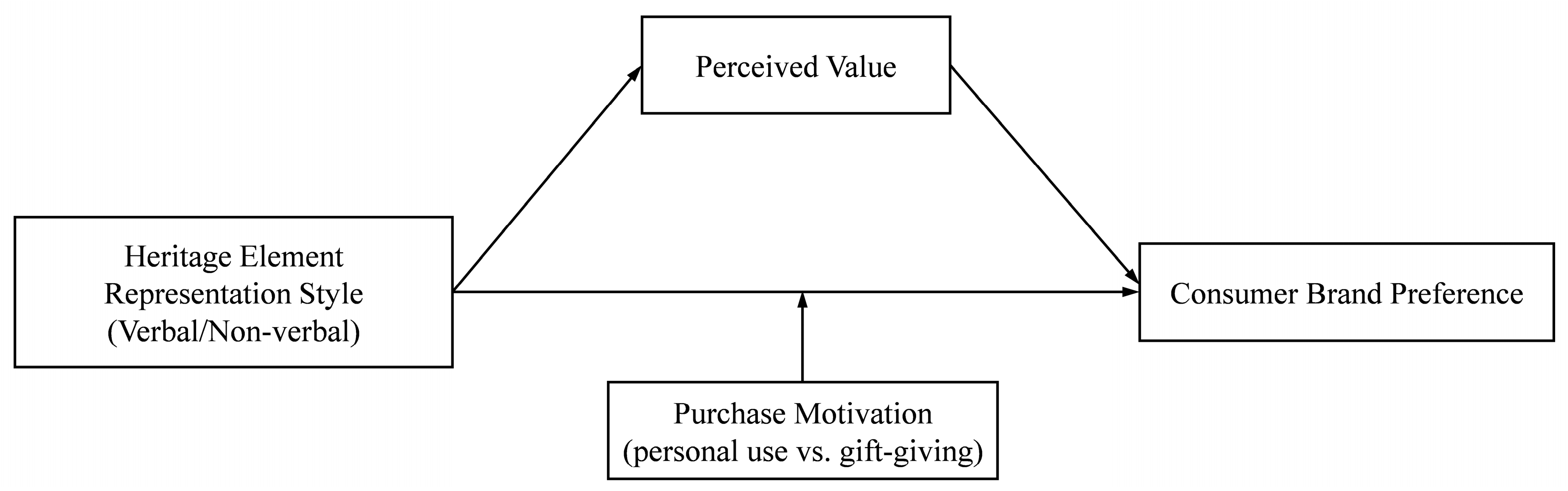
2.4. The Moderating Effect of Purchase Motivation
3. Materials and Methods
3.1. Overview of Experimental Designs
3.2. Study 1
3.2.1. Method
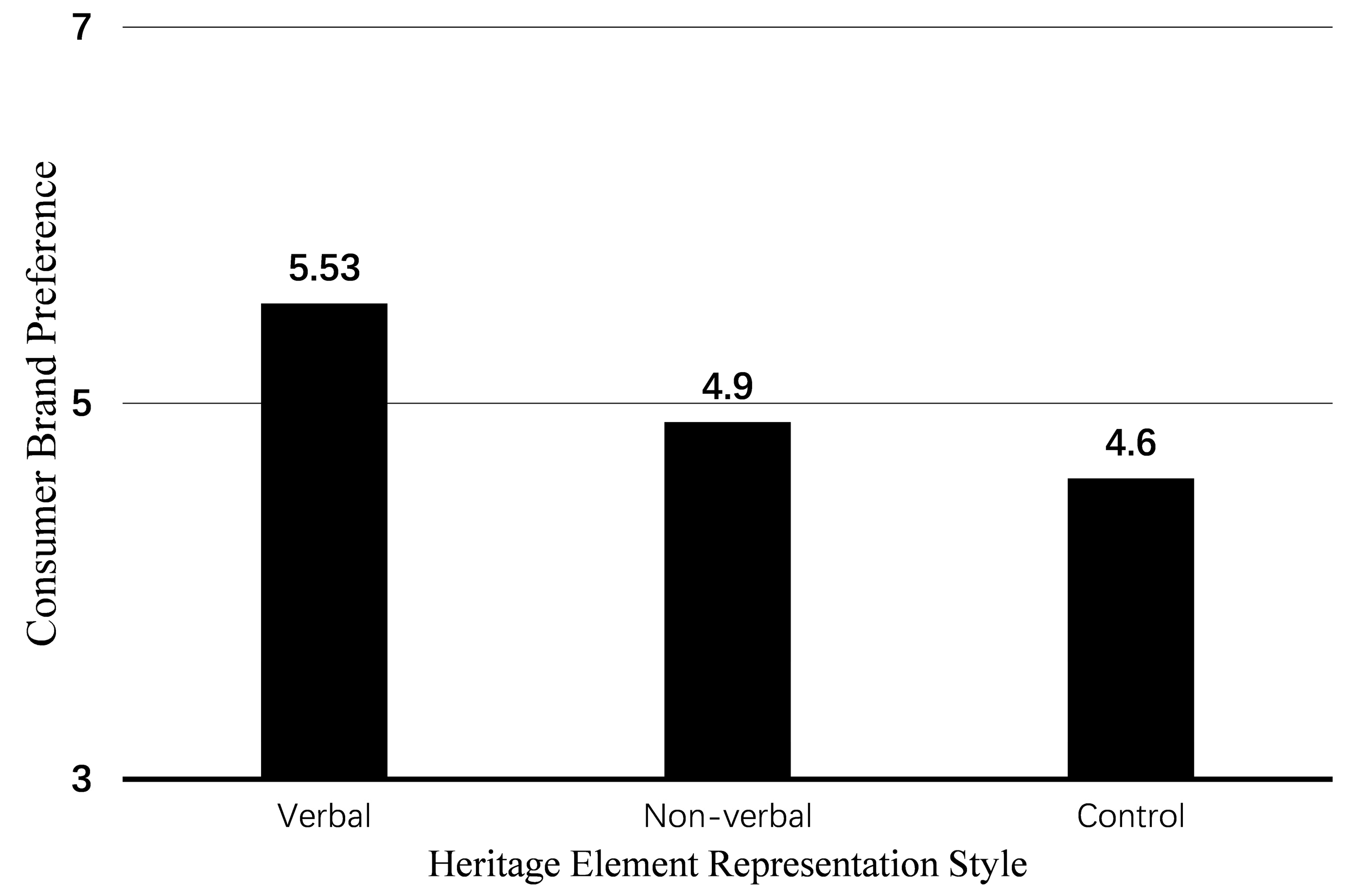
3.2.2. Results
3.2.3. Discussion
3.3. Study 2
3.3.1. Pretest
3.3.2. Formal Experimental Design
3.3.3. Method
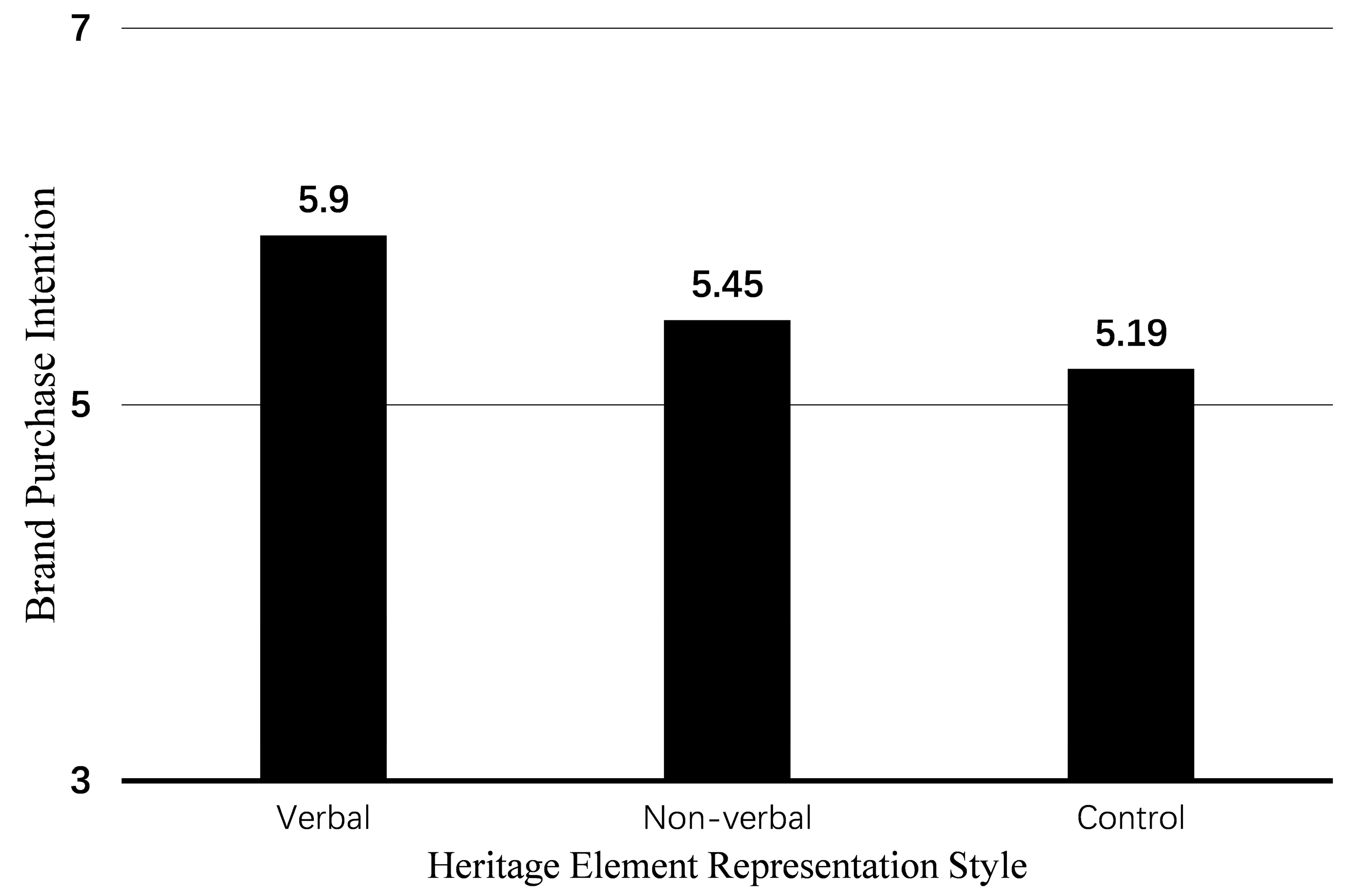
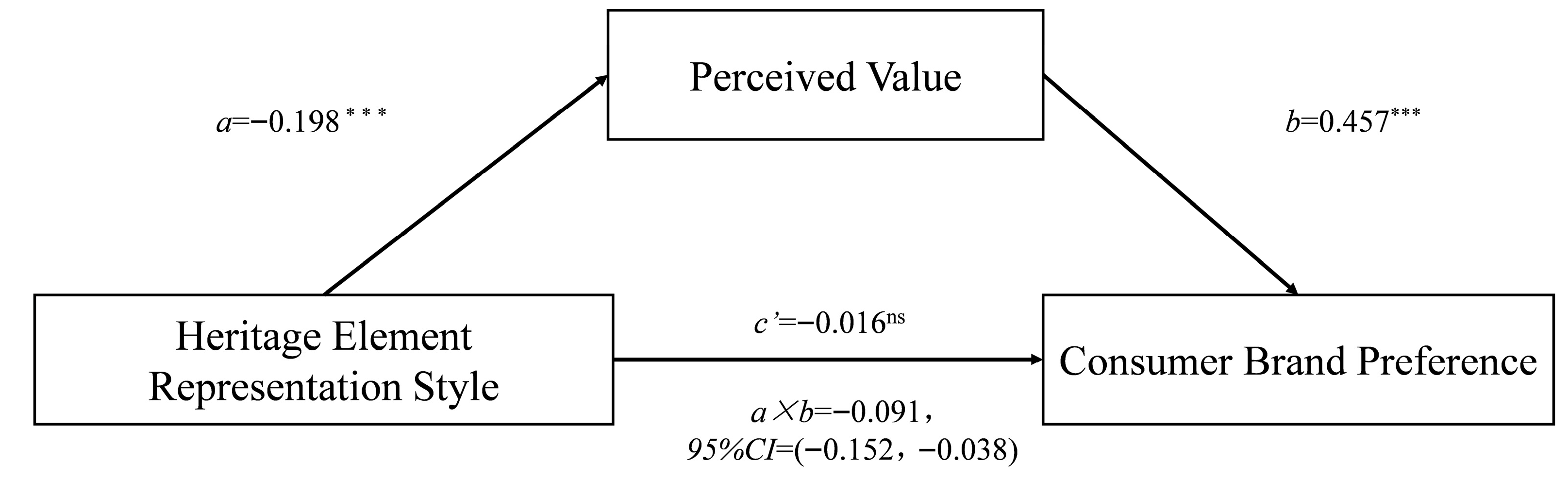
3.3.4. Results
3.3.5. Discussion
3.4. Study 3
3.4.1. Pretest
3.4.2. Formal Experimental Design
3.4.3. Method
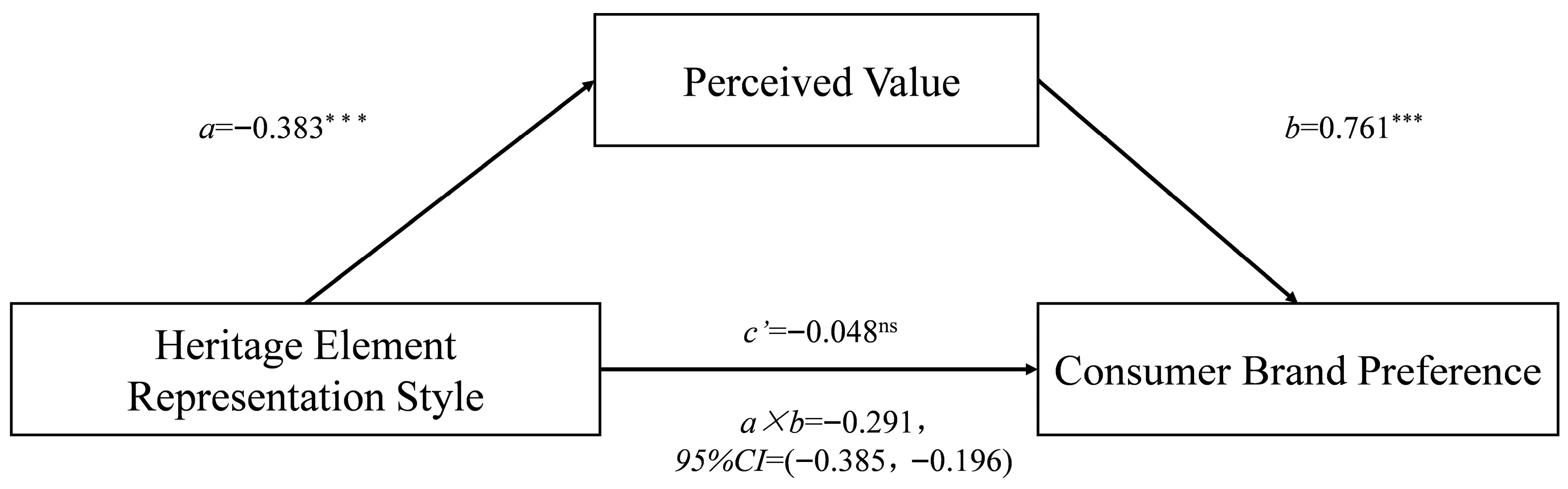
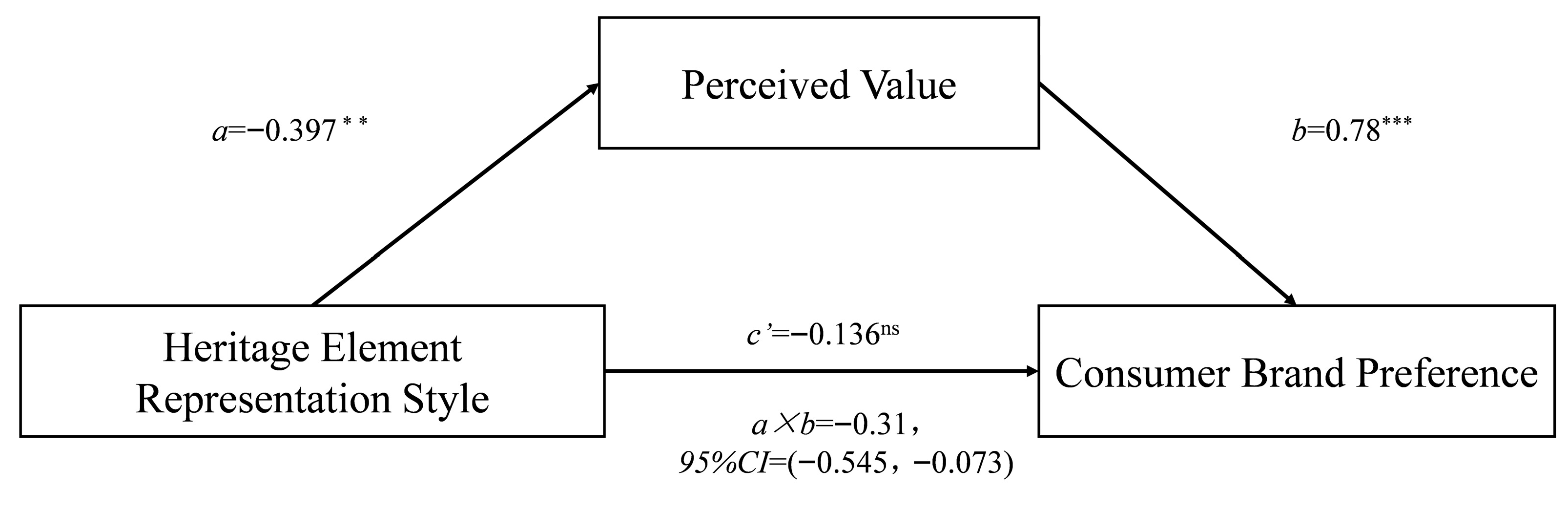
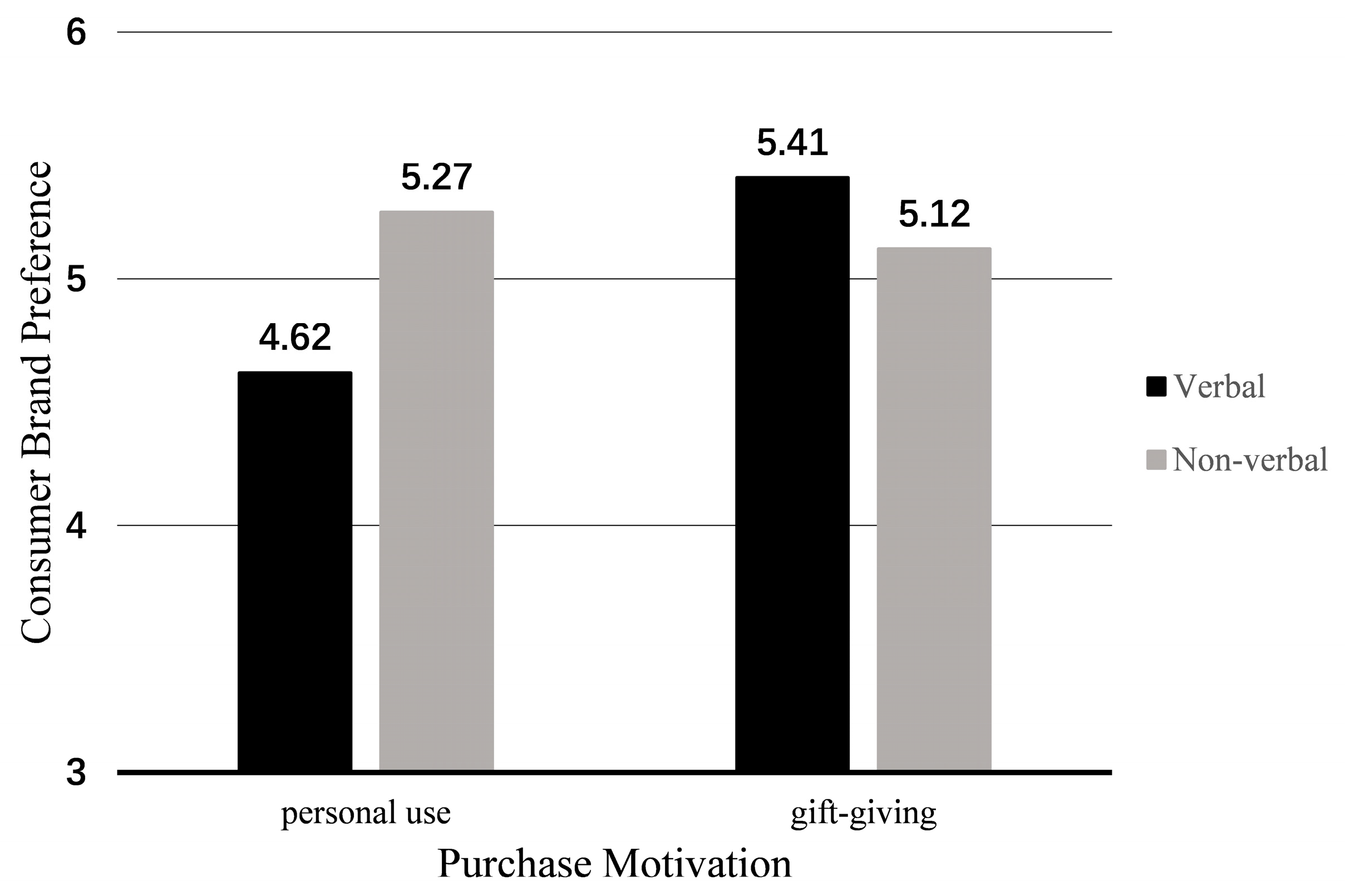
3.4.4. Results
3.4.5. Discussion
4. General Discussion
4.1. Conclusions
4.2. Theoretical Contributions
4.3. Managerial Implications
4.4. Limitations
Author Contributions
Funding
Institutional Review Board Statement
Informed Consent Statement
Data Availability Statement
Conflicts of Interest
Appendix A
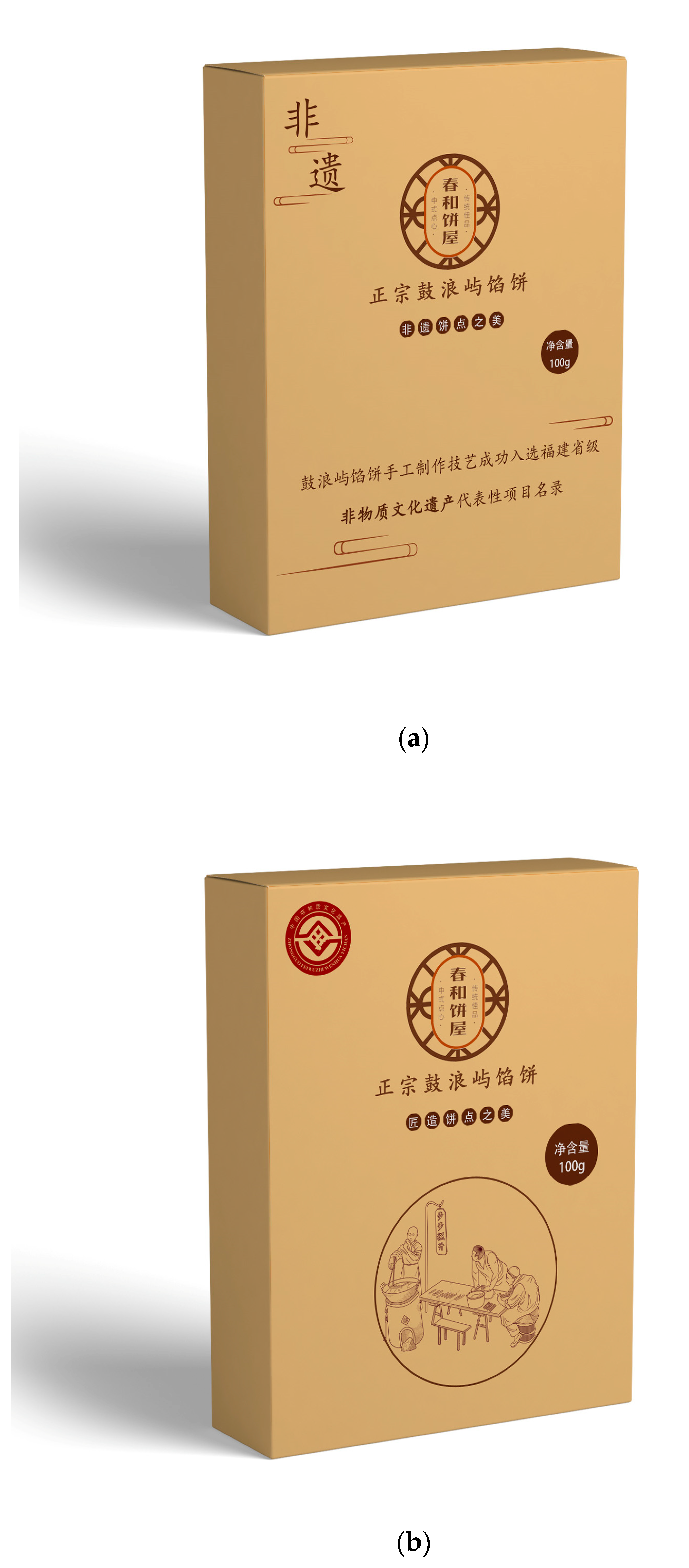
Appendix A.1. Material Stimulus in Study 1

Appendix A.2. Material Stimulus in Study 2

Appendix A.3. Material Stimulus in Study 3

References
- UNESCO World Heritage Centre. Intangible Heritage Domains in the 2003 Convention. Available online: https://ich.unesco.org/en/intangible-heritage-domains-00052 (accessed on 21 May 2020).
- Lee, K.-S. Culinary aesthetics: World-traveling with culinary arts. Ann. Tour. Res. 2022, 97, 103487. [Google Scholar] [CrossRef]
- Sen, A. Food, place, and memory: Bangladeshi fish stores on Devon Avenue, Chicago. Food Foodways 2016, 24, 67–88. [Google Scholar] [CrossRef]
- Almansouri, M.; Verkerk, R.; Fogliano, V.; Luning, P.A. Exploration of heritage food concept. Trends Food Sci. Technol. 2021, 111, 790–797. [Google Scholar] [CrossRef]
- Liu, Y.; Chen, M.; Wang, Q. The impact of symmetry design of intangible cultural heritage souvenir on tourists’ aesthetic pleasure. Front. Psychol. 2022, 13, 987716. [Google Scholar] [CrossRef]
- Soukhathammavong, B.; Park, E. The authentic souvenir: What does it mean to souvenir suppliers in the heritage destination? Tour. Manag. 2019, 72, 105–116. [Google Scholar] [CrossRef]
- Butler, G.; Khoo-Lattimore, C.; Mura, P. Heritage Tourism in Malaysia: Fostering a Collective National Identity in an Ethnically Diverse Country. Asia Pac. J. Tour. Res. 2014, 19, 199–218. [Google Scholar] [CrossRef]
- DeSoucey, M.; Elliott, M.A.; Schmutz, V. Rationalized authenticity and the transnational spread of intangible cultural heritage. Poetics 2019, 75, 101332. [Google Scholar] [CrossRef]
- Sara, R. Packaging as a Retail Marketing Tool. Int. J. Phys. Distrib. Logist. Manag. 1990, 20, 29–30. [Google Scholar] [CrossRef]
- Underwood, R.L.; Klein, N.M.; Burke, R.R. Packaging communication: Attentional effects of product imagery. J. Prod. Brand Manag. 2001, 10, 403–422. [Google Scholar] [CrossRef]
- Qiu, Q.; Zuo, Y.; Zhang, M. Intangible Cultural Heritage in Tourism: Research Review and Investigation of Future Agenda. Land 2022, 11, 139. [Google Scholar] [CrossRef]
- Butkevičienė, V.; Stravinskienė, J.; Rūtelionienė, A. Impact of consumer package communication on consumer decision making process. Eng. Econ. 2008, 56, 57–65. [Google Scholar]
- Silayoi, P.; Speece, M. Packaging and purchase decisions: An exploratory study on the impact of involvement level and time pressure. Br. Food J. 2004, 106, 607–628. [Google Scholar] [CrossRef]
- Mai, R.; Symmank, C.; Seeberg-Elverfeldt, B. Light and Pale Colors in Food Packaging: When Does This Package Cue Signal Superior Healthiness or Inferior Tastiness? J. Retail. 2016, 92, 426–444. [Google Scholar] [CrossRef]
- Vilnai-Yavetz, I.; Koren, R. Cutting through the clutter: Purchase intentions as a function of packaging instrumentality, aesthetics, and symbolism. Int. Rev. Retail Distrib. Consum. Res. 2013, 23, 394–417. [Google Scholar] [CrossRef]
- Chitturi, R.; Londoño, J.C.; Henriquez, M.C. Visual design elements of product packaging: Implications for consumers’ emotions, perceptions of quality, and price. Color Res. Appl. 2022, 47, 729–744. [Google Scholar] [CrossRef]
- Mitchell, A.A.; Olson, J.C. Are product attribute beliefs the only mediator of advertising effects on brand attitude? J. Mark. Res. 1981, 18, 318–332. [Google Scholar] [CrossRef]
- Benachenhou, S.M.; Guerrich, B.; Moussaoui, Z. The effect of packaging elements on purchase intention: Case study of Algerian customers. Manag. Sci. Lett. 2018, 8, 217–224. [Google Scholar] [CrossRef]
- Trope, Y.; Liberman, N. Temporal construal. Psychol. Rev. 2003, 110, 403. [Google Scholar] [CrossRef]
- Coulmas, F. Writing Systems: An Introduction to Their Linguistic Analysis; Cambridge University Press: Cambridge, UK, 2003. [Google Scholar]
- Almansouri, M.; Verkerk, R.; Fogliano, V.; Luning, P.A. The heritage food concept and its authenticity risk factors-Validation by culinary professionals. Int. J. Gastron. Food Sci. 2022, 28, 100523. [Google Scholar] [CrossRef]
- Kapelari, S.; Alexopoulos, G.; Moussouri, T.; Sagmeister, K.J.; Stampfer, F. Food Heritage Makes a Difference: The Importance of Cultural Knowledge for Improving Education for Sustainable Food Choices. Sustainability 2020, 12, 1509. [Google Scholar] [CrossRef]
- Littaye, A.Z. The multifunctionality of heritage food: The example of pinole, a Mexican sweet. Geoforum 2016, 76, 11–19. [Google Scholar] [CrossRef]
- Ampuero, O.; Vila, N. Consumer perceptions of product packaging. J. Consum. Mark. 2006, 23, 100–112. [Google Scholar] [CrossRef]
- Konstantoglou, A.; Folinas, D.; Fotiadis, T. Investigating food packaging elements from a consumer’s perspective. Foods 2020, 9, 1097. [Google Scholar] [CrossRef] [PubMed]
- Martinho, V.J.P.D. Food marketing as a special ingredient in consumer choices: The main insights from existing literature. Foods 2020, 9, 1651. [Google Scholar] [CrossRef] [PubMed]
- McDaniel, C.; Baker, R. Convenience food packaging and the perception of product quality. J. Mark. 1977, 41, 57–58. [Google Scholar] [CrossRef]
- Rolls, B.J.; Roe, L.S.; Kral, T.V.; Meengs, J.S.; Wall, D.E. Increasing the portion size of a packaged snack increases energy intake in men and women. Appetite 2004, 42, 63–69. [Google Scholar] [CrossRef]
- Molina-Besch, K.; Wikström, F.; Williams, H. The environmental impact of packaging in food supply chains—Does life cycle assessment of food provide the full picture? Int. J. Life Cycle Assess. 2019, 24, 37–50. [Google Scholar] [CrossRef]
- Guillard, V.; Gaucel, S.; Fornaciari, C.; Angellier-Coussy, H.; Buche, P.; Gontard, N. The next generation of sustainable food packaging to preserve our environment in a circular economy context. Front. Nutr. 2018, 5, 121. [Google Scholar] [CrossRef]
- Gil-Pérez, I.; Rebollar, R.; Lidón, I. Without words: The effects of packaging imagery on consumer perception and response. Curr. Opin. Food Sci. 2020, 33, 69–77. [Google Scholar] [CrossRef]
- Schifferstein, H.N.; Fenko, A.; Desmet, P.M.; Labbe, D.; Martin, N. Influence of package design on the dynamics of multisensory and emotional food experience. Food Qual. Prefer. 2013, 27, 18–25. [Google Scholar] [CrossRef]
- Simmonds, G.; Spence, C. Thinking inside the box: How seeing products on, or through, the packaging influences consumer perceptions and purchase behaviour. Food Qual. Prefer. 2017, 62, 340–351. [Google Scholar] [CrossRef]
- Lacher, R.G.; Oh, C.-O.; Jodice, L.W.; Norman, W.C. The Role of Heritage and Cultural Elements in Coastal Tourism Destination Preferences:A Choice Modeling–Based Analysis. J. Travel Res. 2013, 52, 534–546. [Google Scholar] [CrossRef]
- Szubert, M.; Warcholik, W.; Żemła, M. The Influence of Elements of Cultural Heritage on the Image of Destinations, Using Four Polish Cities as an Example. Land 2021, 10, 671. [Google Scholar] [CrossRef]
- Yu, X.; Xu, H. Cultural heritage elements in tourism: A tier structure from a tripartite analytical framework. J. Destin. Mark. Manag. 2019, 13, 39–50. [Google Scholar] [CrossRef]
- George, E.W. Intangible cultural heritage, ownership, copyrights, and tourism. Int. J. Cult. Tour. Hosp. Res. 2010, 4, 376–388. [Google Scholar] [CrossRef]
- Rodzi, N.I.M.; Zaki, S.A.; Subli, S.M.H.S. Between Tourism and Intangible Cultural Heritage. Procedia-Soc. Behav. Sci. 2013, 85, 411–420. [Google Scholar] [CrossRef]
- Guo, Y.; Cao, Z.; Zhu, Z. The influence of ICH-narrator/self-congruity on tourist’s purchase intention of intangible cultural heritage products in a narrative context. J. Hosp. Tour. Manag. 2022, 52, 151–160. [Google Scholar] [CrossRef]
- Deng, X.; Wang, L. The impact of semantic fluency on consumers’ aesthetic evaluation in graphic designs with text. J. Contemp. Mark. Sci. 2020, 3, 433–446. [Google Scholar] [CrossRef]
- Lenzerini, F. Intangible Cultural Heritage: The Living Culture of Peoples. Eur. J. Int. Law 2011, 22, 101–120. [Google Scholar] [CrossRef]
- Siamagka, N.-T.; Balabanis, G. Revisiting Consumer Ethnocentrism: Review, Reconceptualization, and Empirical Testing. J. Int. Mark. 2015, 23, 66–86. [Google Scholar] [CrossRef]
- Cowan, K.; Spielmann, N. Culture is in the “I” of the beholder: Identity confirmation in tourist advertisements. J. Bus. Res. 2020, 121, 378–388. [Google Scholar] [CrossRef]
- Trope, Y.; Liberman, N. Construal-level theory of psychological distance. Psychol. Rev. 2010, 117, 440. [Google Scholar] [CrossRef]
- Trope, Y.; Liberman, N.; Wakslak, C. Construal Levels and Psychological Distance: Effects on Representation, Prediction, Evaluation, and Behavior. J. Consum. Psychol. 2007, 17, 83–95. [Google Scholar] [CrossRef]
- Glaser, W.R. Picture naming. Cognition 1992, 42, 61–105. [Google Scholar] [CrossRef] [PubMed]
- Amit, E.; Algom, D.; Trope, Y. Distance-dependent processing of pictures and words. J. Exp. Psychol. Gen. 2009, 138, 400. [Google Scholar] [CrossRef] [PubMed]
- Bar-Anan, Y.; Liberman, N.; Trope, Y. The association between psychological distance and construal level: Evidence from an implicit association test. J. Exp. Psychol. Gen. 2006, 135, 609. [Google Scholar] [CrossRef]
- Fiedler, K. Construal level theory as an integrative framework for behavioral decision-making research and consumer psychology. J. Consum. Psychol. 2007, 17, 101–106. [Google Scholar] [CrossRef]
- Bourgeon-Renault, D.; Urbain, C.; Petr, C.; Le Gall-Ely, M.; Gombault, A. An Experiential Approach to the Consumption Value of Arts and Culture: The Case of Museums and Monuments. Int. J. Arts Manag. 2006, 9, 35–47. Available online: http://www.jstor.org/stable/41064896 (accessed on 30 January 2016).
- Sintas, J.L.; Álvarez, E.G. The Consumption of Cultural Products: An Analysis of the Spanish Social Space. J. Cult. Econ. 2002, 26, 115–138. [Google Scholar] [CrossRef]
- Chang, T.-Z.; Wildt, A.R. Price, product information, and purchase intention: An empirical study. J. Acad. Mark. Sci. 1994, 22, 16–27. [Google Scholar] [CrossRef]
- Zeithaml, V.A. Consumer Perceptions of Price, Quality, and Value: A Means-End Model and Synthesis of Evidence. J. Mark. 1988, 52, 2–22. [Google Scholar] [CrossRef]
- García-Salirrosas, E.E.; Esponda-Perez, J.A.; Millones-Liza, D.Y.; Haro-Zea, K.L.; Moreno-Barrera, L.A.; Ezcurra-Zavaleta, G.A.; Rivera-Echegaray, L.A.; Escobar-Farfan, M. The Influence of Healthy Lifestyle on Willingness to Consume Healthy Food Brands: A Perceived Value Perspective. Foods 2025, 14, 213. [Google Scholar] [CrossRef]
- Gillison, S.; Reynolds, K. Shopping for yourself versus shopping for someone else. J. Consum. Mark. 2016, 33, 225–234. [Google Scholar] [CrossRef]
- Lu, J.; Xie, X.; Xu, J. Desirability or Feasibility:Self–Other Decision-Making Differences. Personal. Soc. Psychol. Bull. 2013, 39, 144–155. [Google Scholar] [CrossRef]
- Carsana, L.; Jolibert, A. The influence of brand schematicity on the importance of product cues: Self-purchasing versus gift-giving situations. J. Consum. Mark. 2017, 34, 255–267. [Google Scholar] [CrossRef]
- Wu, L.; Lee, C. Limited Edition for Me and Best Seller for You: The Impact of Scarcity versus Popularity Cues on Self versus Other-Purchase Behavior. J. Retail. 2016, 92, 486–499. [Google Scholar] [CrossRef]
- Givi, J.; Galak, J. Sentimental value and gift giving: Givers’ fears of getting it wrong prevents them from getting it right. J. Consum. Psychol. 2017, 27, 473–479. [Google Scholar] [CrossRef]
- Chen, H.; Pang, J.; Koo, M.; Patrick, V.M. Shape matters: Package shape informs brand status categorization and brand choice. J. Retail. 2020, 96, 266–281. [Google Scholar] [CrossRef]
- Zhang, Y.; Mittal, V. The attractiveness of enriched and impoverished options: Culture, self-construal, and regulatory focus. Personal. Soc. Psychol. Bull. 2007, 33, 588–598. [Google Scholar] [CrossRef] [PubMed]
- Zatori, A.; Smith, M.K.; Puczko, L. Experience-involvement, memorability and authenticity: The service provider’s effect on tourist experience. Tour. Manag. 2018, 67, 111–126. [Google Scholar] [CrossRef]
- Jamal, A.; Goode, M.M. Consumers and brands: A study of the impact of self-image congruence on brand preference and satisfaction. Mark. Intell. Plan. 2001, 19, 482–492. [Google Scholar] [CrossRef]
- McClure, C.; Seock, Y.-K. The role of involvement: Investigating the effect of brand’s social media pages on consumer purchase intention. J. Retail. Consum. Serv. 2020, 53, 101975. [Google Scholar] [CrossRef]
- Sweeney, J.C.; Soutar, G.N. Consumer perceived value: The development of a multiple item scale. J. Retail. 2001, 77, 203–220. [Google Scholar] [CrossRef]
- Septianto, F.; Seo, Y.; Zhao, F. The effects of competence and warmth appeals on luxury and sustainable brand advertising: The moderating role of construal level. J. Advert. 2022, 51, 369–384. [Google Scholar] [CrossRef]
- Güzel, F.Ö. The dimensions of tour experience, emotional arousal, and post-experience behaviors: A research on Pamukkale in Turkey. Procedia-Soc. Behav. Sci. 2014, 150, 521–530. [Google Scholar] [CrossRef]
- Hayes, A.F. Introduction to Mediation, Moderation, and Conditional Process Analysis: A Regression-Based Approach; Guilford Publications: New York, NY, USA, 2017. [Google Scholar]
- Rettie, R.; Brewer, C. The verbal and visual components of package design. J. Prod. Brand Manag. 2000, 9, 56–70. [Google Scholar] [CrossRef]
- Otterbring, T.; Shams, P.; Wästlund, E.; Gustafsson, A. Left isn’t always right: Placement of pictorial and textual package elements. Br. Food J. 2013, 115, 1211–1225. [Google Scholar] [CrossRef]
- Yanar, A. Using the Culturel Identity and Geographical Indication in Touristic Souvenirs: Case of Turkey. Soc. Sci. (NWSASOS) 2016, 11, 258–269. [Google Scholar] [CrossRef]
- Mei, B. Traditional packaging design for local food based on the intangible cultural heritage of Shang-Jin Jun Kiln in Henan Province. Food Mach. 2023, 39, 117–122. [Google Scholar] [CrossRef]
- Zu-zhou, Q.; Hui, Q.; Yun, L. Packaging design of intangible cultural heritage food based on the characteristics of traditional folk houses in east Fujian. Food Mach. 2022, 38, 138–143. [Google Scholar] [CrossRef]
- Kuvykaite, R.; Dovaliene, A.; Navickiene, L. Impact of package elements on consumer’s purchase decision. Econ. Manag. 2009, 14, 441–447. [Google Scholar]
- van Rompay, T.J.L.; Fransen, M.L.; Borgelink, B.G.D. Light as a feather: Effects of packaging imagery on sensory product impressions and brand evaluation. Mark. Lett. 2014, 25, 397–407. [Google Scholar] [CrossRef]
- Su, X.; Li, X.; Wang, Y.; Zheng, Z.; Huang, Y. Awe of Intangible Cultural Heritage: The Perspective of ICH Tourists. SAGE Open 2020, 10, 2158244020941467. [Google Scholar] [CrossRef]
- Deng, X.; Kahn, B.E. Is Your Product on the Right Side? The “Location Effect” on Perceived Product Heaviness and Package Evaluation. J. Mark. Res. 2009, 46, 725–738. [Google Scholar] [CrossRef]



| Variable | Scale | References |
|---|---|---|
| Consumer Brand Preference | When I need to purchase related products, this brand would be my first choice. | Jamal and Goode [63] |
| Compared to other similar brands, I choose this brand not just because of the product itself. | ||
| I pay attention to information related to this brand and prefer maintaining a positive interactive relationship with it. | ||
| I am willing to recommend this brand’s products to family and friends. | ||
| I tend to repurchase this brand’s products to reduce associated decision-making costs. | ||
| Brand Purchase Intention | I am likely to purchase products from this brand in the future. | McClure and Seock [64] |
| I hope to purchase products from this brand in the future. | ||
| I plan to purchase products from this brand in the future. | ||
| Perceived Value | You feel that purchasing this product will earn you more praise from those around you. | Sweeney and Soutar [65] |
| You feel that purchasing this product will help you build a good social image. | ||
| You feel that purchasing this product will leave a good impression on others. | ||
| You feel that purchasing this product will help you gain social recognition. | ||
| Processing Fluency | The information provided on the packaging is clear. | Septianto et al. [66] |
| The information provided on the packaging is easy to understand. | ||
| Emotional Arousal | Purchasing this product is exciting. | Güzel [67] |
| Purchasing this product is thrilling. | ||
| Purchasing this product is enjoyable. | ||
| Purchasing this product is fun. |
Disclaimer/Publisher’s Note: The statements, opinions and data contained in all publications are solely those of the individual author(s) and contributor(s) and not of MDPI and/or the editor(s). MDPI and/or the editor(s) disclaim responsibility for any injury to people or property resulting from any ideas, methods, instructions or products referred to in the content. |
© 2025 by the authors. Licensee MDPI, Basel, Switzerland. This article is an open access article distributed under the terms and conditions of the Creative Commons Attribution (CC BY) license (https://creativecommons.org/licenses/by/4.0/).
Share and Cite
Wang, H.; Lin, L.; Wang, H.; Jin, X.; Ruan, C. From Images to Words: How Packaging Style Affects Brand Preference in Heritage Food. Foods 2025, 14, 3858. https://doi.org/10.3390/foods14223858
Wang H, Lin L, Wang H, Jin X, Ruan C. From Images to Words: How Packaging Style Affects Brand Preference in Heritage Food. Foods. 2025; 14(22):3858. https://doi.org/10.3390/foods14223858
Chicago/Turabian StyleWang, Haiyan, Lingrong Lin, Honghai Wang, Xiaoye Jin, and Chenhan Ruan. 2025. "From Images to Words: How Packaging Style Affects Brand Preference in Heritage Food" Foods 14, no. 22: 3858. https://doi.org/10.3390/foods14223858
APA StyleWang, H., Lin, L., Wang, H., Jin, X., & Ruan, C. (2025). From Images to Words: How Packaging Style Affects Brand Preference in Heritage Food. Foods, 14(22), 3858. https://doi.org/10.3390/foods14223858