Adaptive Identification of Food Sweetness Concentration: An Electroencephalogram Feature Classification Network Under Taste Stimulation


Abstract
1. Introduction
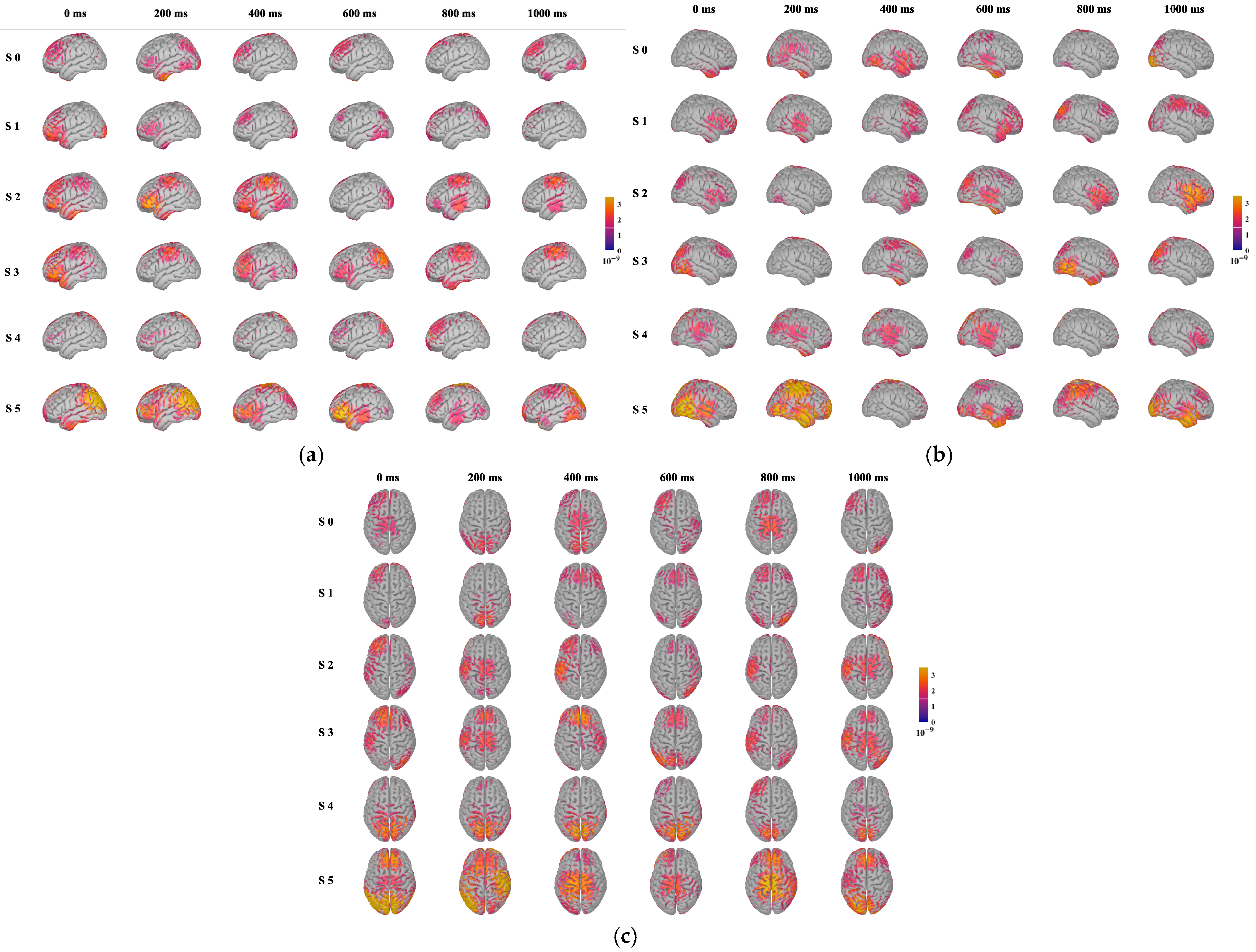
- To visually elucidate the neural dynamics of sweet taste perception, we employ brain source localization to map the intensity, spatial distribution, and temporal dynamics of EEG under varying sweetness concentrations. This aims to verify the feasibility of qualitatively identifying different sweetness levels using EEG data.
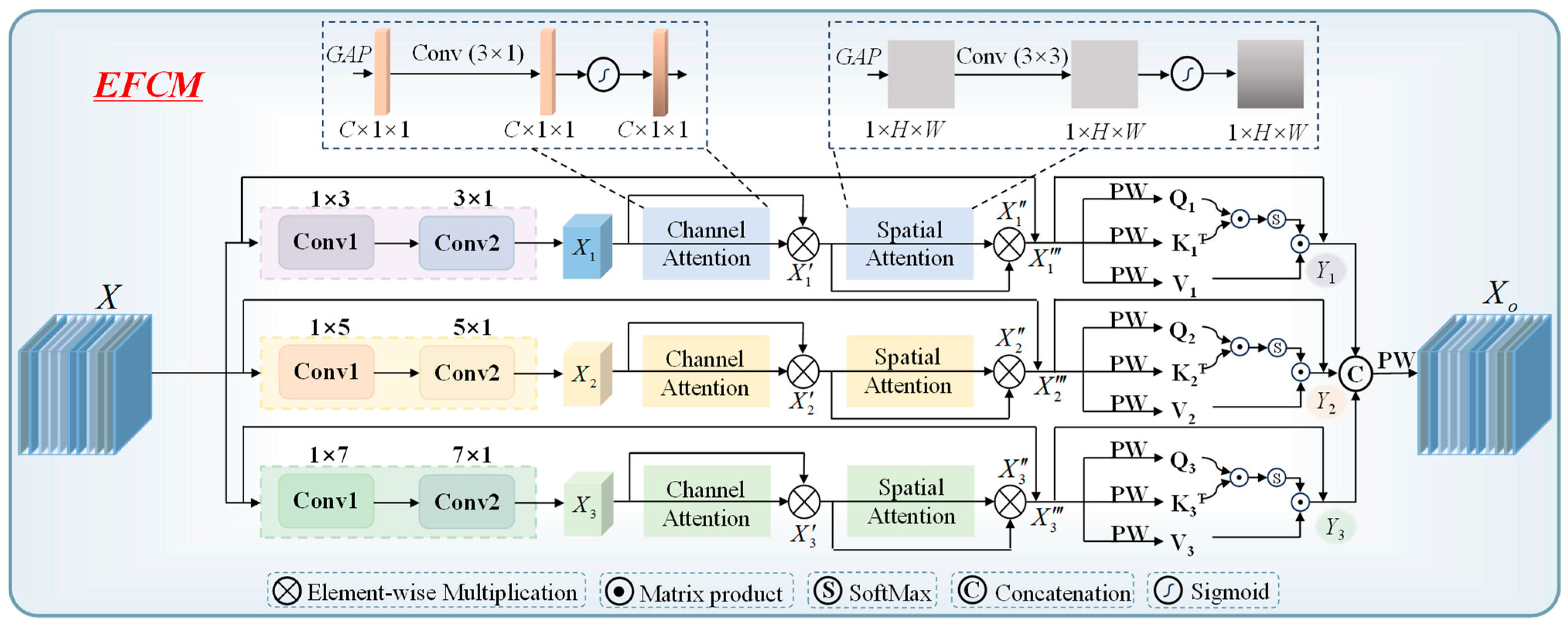
- To effectively extract discriminative features from the complex taste-EEG data, we propose a novel EEG Feature Computation Module (EFCM). This module is designed to capture multi-scale features through a multi-branch structure, convolutional layers for local features, a self-attention mechanism for global dependencies, and residual connections for stable training.
- To achieve accurate and stable classification, we construct a lightweight EEG Feature Classification Network (EFCC-Net) based on the EFCM. The network’s performance and superiority are rigorously validated through structural optimization, ablation studies, and comparisons with state-of-the-art methods.
2. Materials and Methods
2.1. Instrument and Sample
2.2. Taste-Evoked EEG Experiment
- (1)
- The experimental environment should remain quiet to ensure that EEG detection data was not affected by ambient noise, and strong light sources should be avoided to prevent discomfort for experimenters. Before each experiment, the laboratory should be cleaned and ventilated to eliminate any odors.
- (2)
- Participants should maintain good sleep quality and mental state on the day of the experiment, avoid consuming coffee, spicy foods, or neuroactive drugs, and refrain from using perfumes or other strong fragrances. We used an actigraphy to monitor total sleep time, sleep efficiency, sleep latency, and the number of awakenings. A subject is considered to have obtained sufficient sleep when the following criteria are collectively met: total sleep time reaches or exceeds 7 h, sleep efficiency is above 85%, sleep latency falls between 10 and 30 min, and nighttime awakenings are infrequent (typically fewer than 10 times throughout the night). Before the experiment, participants should be informed of the experimental procedure and key precautions.
- (3)
- To prevent data distortion due to excessive scalp resistance, participants should ensure their hair is clean and avoid using excessive amounts of oily conditioners. They should also eat on schedule, with the experiment conducted one hour after a meal to prevent residual taste perception from affecting the data.
- (4)
- The experimental environment should be strictly electromagnetically shielded, ensuring that no electronic devices other than the experimental equipment are present in the laboratory.
- (1)
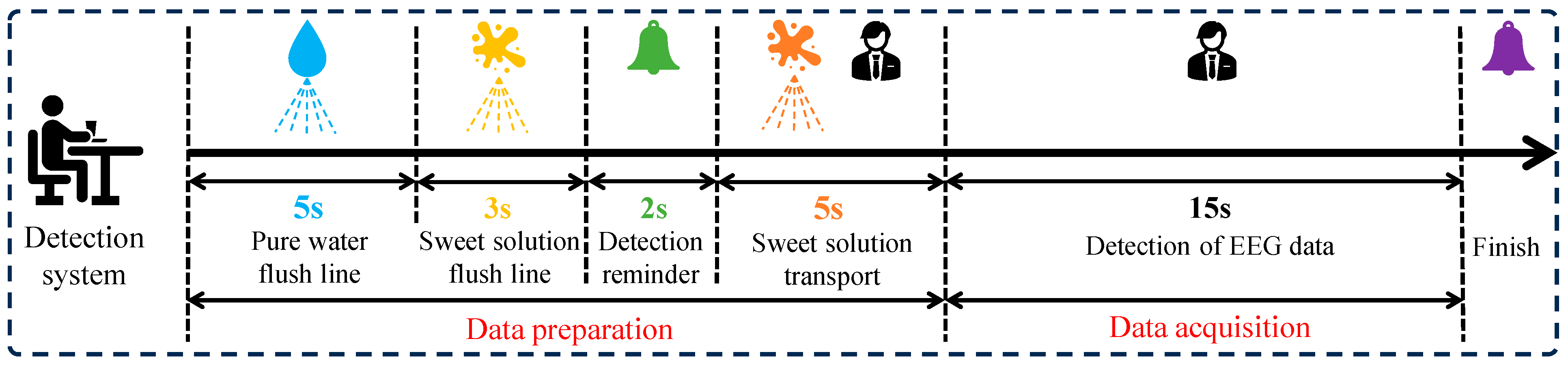
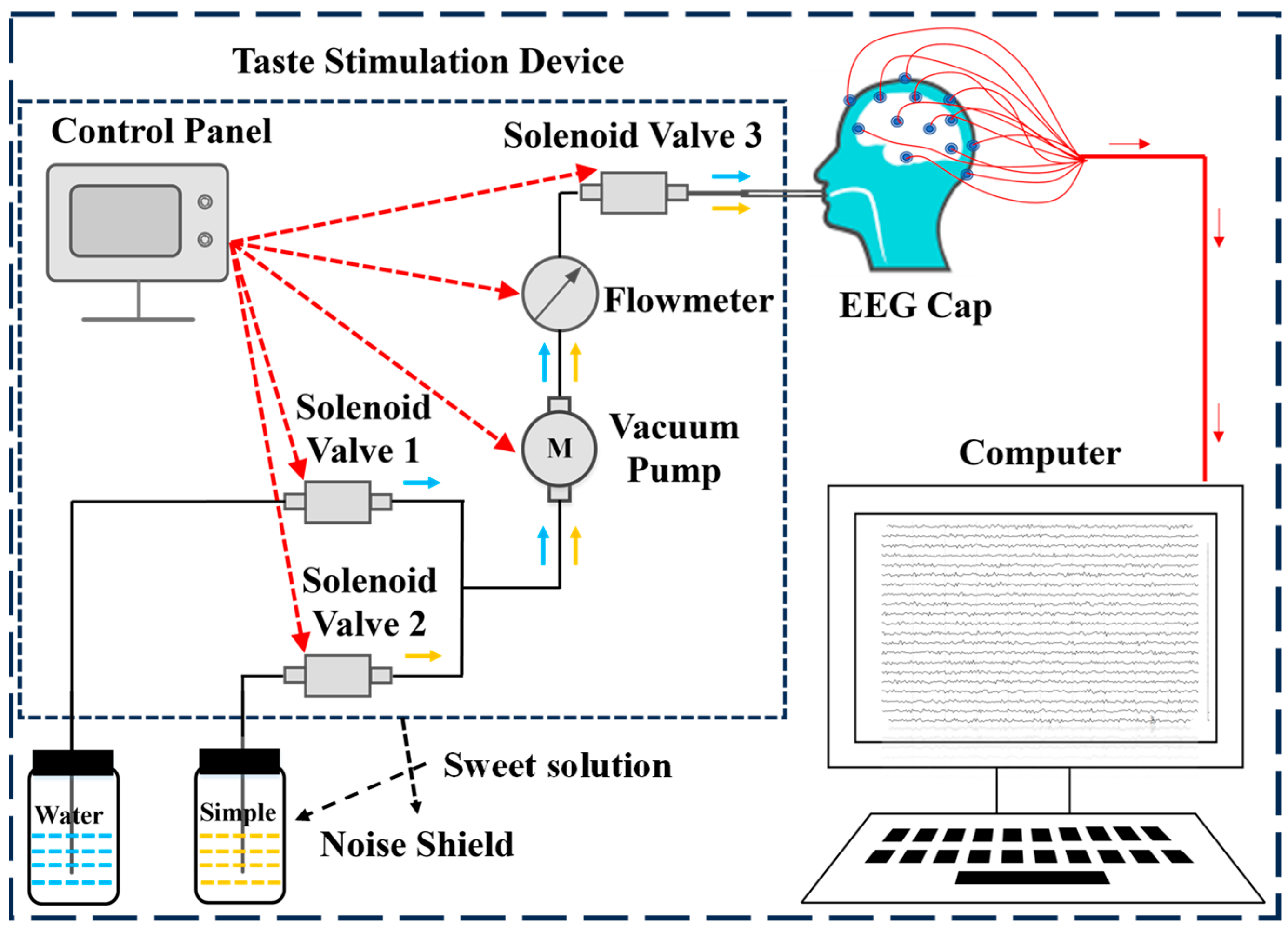
- Distilled water rinse: Before each experiment began, pressing the switch will activate the distilled water rinsing mode of the taste stimulation device. Distilled water was rapidly delivered to the nozzle for 5 s to flush the pipeline.
- (2)
- Solution rinse: After the distilled water rinse, the device automatically switched to the solution rinsing mode, quickly delivering the solution to the nozzle for 3 s to ensure that all distilled water was expelled and the pipeline was fully filled with the experimental solution. Upon completion, a buzzer emits a 0.5 s soft beep to notify the participant that the experiment was about to begin.
- (3)
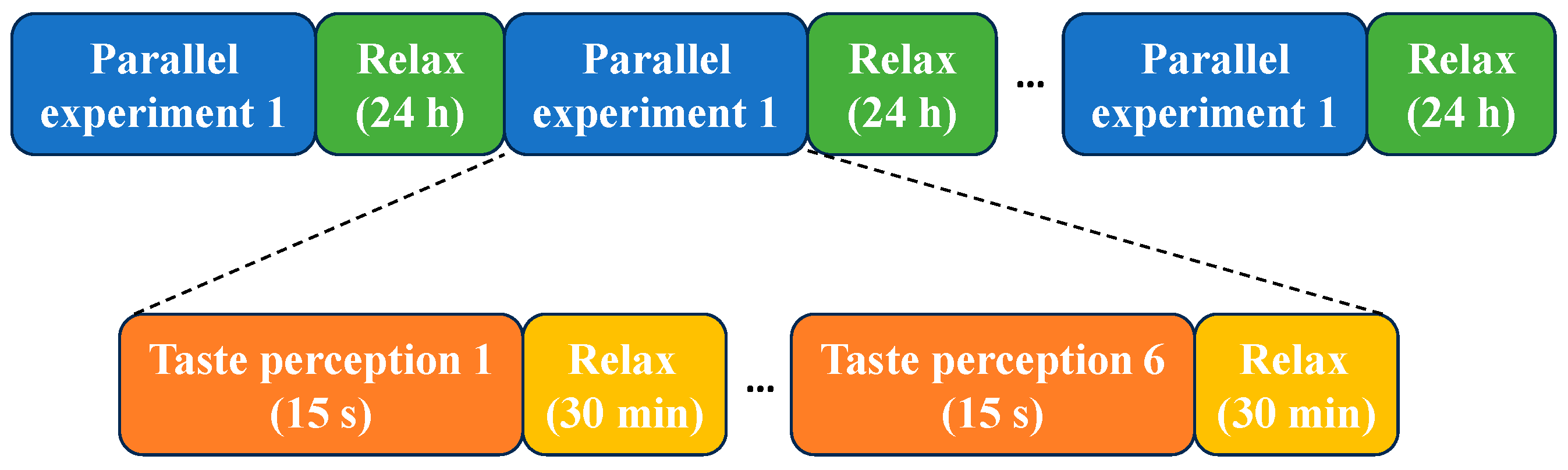
- Solution stimulation: Two seconds after the rinsing process ends, the taste stimulation device switched to solution stimulation mode, delivering 2.5 mL of sweet solution to the participant’s tongue over 5 s at a flow rate of 0.5 mL/s. The participant held the solution in their mouth for 15 s to fully induce the sweet taste EEG signal while avoiding swallowing.
- (4)
- End of stimulation: Once the EEG data collection was complete, the buzzer sounded again to indicate the end of the experiment. The participant then thoroughly rinsed their mouth by gargling three times with 50 mL of clean water. To prevent taste fatigue, the participant rests for 30 min before proceeding to the next experiment.
- (5)
2.3. EEG Feature Computation Module
- (1)
- Local feature computation
- (2)
- Global feature computation
- (3)
- Feature fusion
2.4. EEG Classification Networks and Hyperparameters
- (1)
- PW convolution is applied to perform deep expansion of the raw EEG data, facilitating deep feature computation within EFCM. The number of channels in this convolution computation has been discussed in Section 3.2.
- (2)
- EFCM is used to extract deep EEG features, where convolution operations capture local dynamic details, self-attention mechanisms focus on global dynamic relationships, and multi-branch computations enhance the richness of extracted features. This process ensures that the input and output dimensions remain unchanged. The number of EFCM units has also been discussed in Section 3.2.
- (3)
- PW convolution is applied for dimensionality reduction of deep EEG features, enabling their fusion.
- (4)
- Pooling operations with a kernel size of 1 × 2 are applied along the temporal sequence direction to reduce the complexity of feature mapping.
- (5)
- Two fully connected layers are employed for adaptive recognition of taste EEG features at different sweetness concentrations. The first fully connected layer consists of 128 neurons, while the second layer contains 6 neurons.

3. Results and Discussion
3.1. EEG Analysis of Sweet Taste Perception
3.2. Optimization of EFCC-Net Structure
3.3. Ablation Analysis
3.4. Performance Comparison of Classification Networks
3.5. Future Research Directions
3.6. Potential Limitations
4. Conclusions
Author Contributions
Funding
Institutional Review Board Statement
Informed Consent Statement
Data Availability Statement
Conflicts of Interest
References
- Wang, X.; Wang, G.; Liu, D. EEG-Based Analysis of Neural Responses to Sweeteners: Effects of Type and Concentration. Foods 2025, 14, 2460. [Google Scholar] [CrossRef]
- Gantner, M.; Piotrowska, A.; Kostyra, E.; Hallmann, E.; Ponder, A.; Sionek, B.; Neffe-Skocińska, K. Influence of Herbal Additives on the Physicochemical, Microbiological, Polyphenolic, and Sensory Profile of Green Tea-Based Kombucha. Foods 2025, 14, 3497. [Google Scholar] [CrossRef]
- Qian, J.; Wang, X.; Song, F.; Liang, Y.; Zhu, Y.; Fang, Y.; Zeng, W.; Zhang, D.; Dong, J. ChemSweet: An AI-driven computational platform for next-gen sweetener discovery. Food Chem. 2025, 463, 141362. [Google Scholar] [CrossRef]
- Kistler, T.; Pridal, A.; Bourcet, C.; Denkel, C. Modulation of sweetness perception in confectionary applications. Food Qual. Prefer. 2021, 88, 104087. [Google Scholar] [CrossRef]
- Meng, W.; Hou, F.; Zhao, M.; Kong, J.; Wu, J.; Zuo, J.; Liu, Q. Emotion recognition via affective EEG signals: State of the art. Neurocomputing 2025, 643, 130418. [Google Scholar] [CrossRef]
- Lawhern, V.; Solon, A.J.; Waytowich, N.; Gordon, S.M.; Hung, C.P.; Lance, B.J. EEGNet: A compact convolutional neural network for EEG-based brain–computer interfaces. J. Neural Eng. 2018, 15, 056013. [Google Scholar] [CrossRef]
- Alahmadi, T.J.; Rahman, A.U.; Alhababi, Z.A.; Ali, S.; Alkahtani, H.K. Prediction of mild cognitive impairment using EEG signal and BiLSTM network. Mach. Learn. Sci. Technol. 2024, 5, 025028. [Google Scholar] [CrossRef]
- Tautan, A.-M.; Andrei, A.-G.; Smeralda, C.L.; Vatti, G.; Rossi, S.; Ionescu, B. Unsupervised learning from EEG data for epilepsy: A systematic literature review. Artif. Intell. Med. 2025, 162, 103095. [Google Scholar] [CrossRef]
- Gao, H.; Zhao, S.; Li, H.; Liu, L.; Wang, H.; Wang, Y.; Luo, Z.; Zhang, J.; Li, G. Basic taste sensation recognition from EEG based on multiscale convolutional neural network with residual learning. IEEE Trans. Instrum. Meas. 2023, 72, 2515810. [Google Scholar] [CrossRef]
- Vidal, M.; Moura, N.; Kerrebroeck, B.V.; Aguilera, A.M.; Fritz, T.H.; Leman, M. Modeling Emotional Arousal With Turbulence Measured by EEG. Psychophysiology 2025, 62, e70093. [Google Scholar] [CrossRef]
- Wang, B.; Miao, M.; Zhang, K.; Liu, W.; Sheng, Z.; Xu, B.; Hu, W. MSMGE-CNN: A multi-scale multi-graph embedding convolutional neural network for motor related EEG decoding. Mach. Learn. Sci. Technol. 2024, 5, 045047. [Google Scholar] [CrossRef]
- Rasool, A.; Aslam, S.; Xu, Y.; Wang, Y.; Pan, Y.; Chen, W. Deep neurocomputational fusion for ASD diagnosis using multi-domain EEG analysis. Neurocomputing 2025, 641, 130353. [Google Scholar] [CrossRef]
- Márquez, D.C.; Anderson, S.J.; Hecker, K.G.; Murari, K. A Current-Based EEG Amplifier and Validation With a Saline Phantom and an SSVEP Paradigm. IEEE Trans. Biomed. Eng. 2025, 72, 445–453. [Google Scholar] [CrossRef]
- Zhai, S.; Guo, X. A novel lightweight dynamic focusing convolutional neural network LAND-FCNN for EEG emotion recognition. Measurement 2024, 234, 114862. [Google Scholar] [CrossRef]
- Xia, X.; Liu, X.; Zheng, W.; Jia, X.; Wang, B.; Shi, Y.; Men, H. Recognition of odor and pleasantness based on olfactory EEG combined with functional brain network model. Int. J. Mach. Learn. Cybern. 2023, 14, 2761–2776. [Google Scholar] [CrossRef]
- Jenke, R.; Peer, A.; Buss, M. Feature Extraction and Selection for Emotion Recognition from EEG. IEEE Trans. Affect. Comput. 2014, 5, 327–339. [Google Scholar] [CrossRef]
- Hou, H.-R.; Meng, Q.-H. A Double-Square-Based Electrode Sequence Learning Method for Odor Concentration Identification Using EEG Signals. IEEE Trans. Instrum. Meas. 2021, 70, 2510110. [Google Scholar] [CrossRef]
- Mhaskar, C.; Kaushik, V.; Arjula, A. Unsupervised Machine Learning Methods to Understand Relaxation Effect of Fragrances through EEG Technique. SOFW J. 2021, 9, 147. [Google Scholar]
- Cui, Z.; Wu, B.; Blank, I.; Yu, Y.; Gu, J.; Zhou, T.; Zhang, Y.; Wang, W.; Liu, Y. TastePeptides-EEG: An ensemble model for umami taste evaluation based on electroencephalogram and machine learning. J. Agric. Food Chem. 2023, 71, 13430–13439. [Google Scholar] [CrossRef]
- Wang, Y.; Wang, H.; Wen, X.; Liu, J.; Shi, Y.; Men, H. Origin identification of Angelica dahurica using a bidirectional mixing network combined with an electronic nose system. Sens. Actuators B Chem. 2025, 429, 137356. [Google Scholar] [CrossRef]
- An, C.; Qu, M.; Zhao, Y.; Wu, Z.; Lv, X.; Yu, Y.; Wei, Z.; Rao, X.; Xu, H. Accurate Classification of Multi-Cultivar Watermelons via GAF-Enhanced Feature Fusion Convolutional Neural Networks. Foods 2025, 14, 2860. [Google Scholar] [CrossRef]
- Xing, M.; Hu, S.; Wei, B.; Lv, Z. Spatial-frequency-temporal convolutional recurrent network for olfactory-enhanced EEG emotion recognition. J. Neurosci. Methods 2022, 376, 109624. [Google Scholar] [CrossRef]
- Ma, W.; Li, Y.; Li, T.; Yang, H.; Li, Z.; Wang, L.; Xuan, J. SFSWTS: A spatial-frequency shifted windows and time self-attention network for EEG emotion recognition. Neurocomputing 2025, 640, 130309. [Google Scholar] [CrossRef]
- Tong, C.; Ding, Y.; Zhang, Z.; Zhang, H.; Lim, K.J.; Guan, C. TASA: Temporal Attention With Spatial Autoencoder Network for Odor-Induced Emotion Classification Using EEG. IEEE Trans. Neural Syst. Rehabil. Eng. 2024, 32, 1944–1954. [Google Scholar] [CrossRef]
- Wang, S.; Hu, X.Z.; Liu, Y.Y.; Tao, N.P.; Lu, Y.; Wang, X.C.; Lam, W.; Lin, L.; Xu, C.H. Direct authentication and composition quantitation of red wines based on Tri-step infrared spectroscopy and multivariate data fusion. Food Chem. 2022, 372, 131259. [Google Scholar] [CrossRef]
- Martins, F.M.; González, V.M.; Villar, J.R.; López, B.G.; Gómez-Menéndez, A. Inception networks, data augmentation and transfer learning in EEG-based photosensitivity diagnosis. Mach. Learn. Sci. Technol. 2025, 6, 015034. [Google Scholar] [CrossRef]
- Xia, X.; Shi, Y.; Li, P.; Liu, X.; Liu, J.; Men, H. FBANet: An Effective Data Mining Method for Food Olfactory EEG Recognition. IEEE Trans. Neural Netw. Learn. Syst. 2024, 35, 13550–13560. [Google Scholar] [CrossRef]
- Xia, X.; Cheng, Y.; Zhang, Z.; Hua, Z.; Wang, Q.; Shi, Y.; Men, H. Advancing research on odor-induced sweetness enhancement: A EEG local-global fusion transformer network for sweetness quantification combined with EEG technology. Food Chem. 2025, 463, 141533. [Google Scholar] [CrossRef]
- Xia, X.; Wang, Q.; Wang, H.; Liu, C.; Li, P.; Shi, Y.; Men, H. Optimizing food taste sensory evaluation through neural network-based taste electroencephalogram channel selection. IEEE Trans. Instrum. Meas. 2025, 74, 2521209. [Google Scholar] [CrossRef]
- Hazarika, S.; Choudhury, R.; Montazer, B.; Medhi, S.; Goswami, M.P.; Sarma, U. Detection of Citrus Tristeza Virus in Mandarin Orange Using a Custom-Developed Electronic Nose System. IEEE Trans. Instrum. Meas. 2020, 69, 9010–9018. [Google Scholar] [CrossRef]
- Laohakangvalvit, T.; Sripian, P.; Nakagawa, Y.; Feng, C.; Tazawa, T.; Sakai, S.; Sugaya, M. Study on the psychological states of olfactory stimuli using electroencephalography and heart rate variability. Sensors 2023, 23, 4026. [Google Scholar] [CrossRef]
- Zhang, Y.; Tian, Y.; Kong, Y.; Zhong, B.; Fu, Y. Residual Dense Network for Image Super-Resolution. In Proceedings of the 2018 IEEE/CVF Conference on Computer Vision and Pattern Recognition, Salt Lake City, UT, USA, 18–23 June 2018. 1. [Google Scholar]
- Li, K.; Wang, Y.; Gao, P.; Song, G.; Liu, Y.; Li, H.; Qiao, Y. UniFormer: Unified Transformer for Efficient Spatiotemporal Representation Learning. In Proceedings of the 2022 Computer Vision and Pattern Recognition, New Orleans, LA, USA, 19–24 June 2022. [Google Scholar]
- Small, D.M. Taste representation in the human insula. Brain Struct. Funct. 2010, 214, 551–561. [Google Scholar] [CrossRef]
- Veldhuizen, M.G.; Bender, G.; Constable, R.T.; Small, D.M. Trying to Detect Taste in a Tasteless Solution: Modulation of Early Gustatory Cortex by Attention to Taste. Chem. Senses 2007, 32, 569–581. [Google Scholar] [CrossRef] [PubMed]
- Rolls, E.T. Taste, olfactory, and food reward value processing in the brain. Prog. Neurobiol. 2015, 127–128, 64–90. [Google Scholar] [CrossRef]
- Kobayakawa, T.; Ogawa, H.; Kaneda, H.; Ayabe-Kanamura, S.; Saito, S. Spatio-temporal Analysis of Cortical Activity Evoked by Gustatory Stimulation in Humans. Chem. Senses 1999, 24, 201–209. [Google Scholar] [CrossRef] [PubMed]
- Ohla, K.; Hudry, J.; Coutre, J.l. The Cortical Chronometry of Electrogustatory Event-related Potentials. Brain Topogr. 2009, 22, 73–82. [Google Scholar] [CrossRef] [PubMed]
- Veldhuizen, M.G.; Babbs, R.K.; Patel, B.; Fobbs, W.; Kroemer, N.B.; Garcia, E.; Yeomans, M.R.; Small, D.M. Integration of Sweet Taste and Metabolism Determines Carbohydrate Reward. Curr. Biol. 2017, 27, 2476–2485.e6. [Google Scholar] [CrossRef]




| Case | Accuracy (%) | Precision (%) | Recall (%) | |
|---|---|---|---|---|
| Conv(1 × K) | Conv(K × 1) | |||
| √ | 95.09 ± 0.12 | 95.00 ± 0.13 | 94.96 ± 0.12 | |
| √ | 92.45 ± 0.15 | 92.89 ± 0.14 | 92.74 ± 0.16 | |
| √ | √ | 96.57 ± 0.03 | 96.58 ± 0.03 | 96.53 ± 0.03 |
| Case | Accuracy (%) | Precision (%) | Recall (%) | ||
|---|---|---|---|---|---|
| Branch 1 | Branch 2 | Branch 3 | |||
| √ | 91.22 ± 0.13 | 91.17 ± 0.14 | 91.02 ± 0.13 | ||
| √ | 94.37 ± 0.16 | 94.44 ± 0.16 | 94.25 ± 0.16 | ||
| √ | 94.89 ± 0.11 | 94.91 ± 0.10 | 94.80 ± 0.11 | ||
| √ | √ | 94.98 ± 0.13 | 95.13 ± 0.12 | 95.03 ± 0.13 | |
| √ | √ | 95.22 ± 0.11 | 95.29 ± 0.11 | 95.31 ± 0.11 | |
| √ | √ | 95.49 ± 0.11 | 95.55 ± 0.12 | 95.57 ± 0.18 | |
| √ | √ | √ | 96.57 ± 0.03 | 96.58 ± 0.03 | 96.53 ± 0.03 |
| Case | Accuracy (%) | Precision (%) | Recall (%) | ||
|---|---|---|---|---|---|
| Convolution | Self-Attention | Residual | |||
| √ | 89.26 ± 0.21 | 89.47 ± 0.20 | 89.55 ± 0.20 | ||
| √ | 92.39 ± 0.14 | 92.83 ± 0.13 | 92.67 ± 0.13 | ||
| √ | √ | 89.85 ± 0.18 | 89.74 ± 0.19 | 89.83 ± 0.18 | |
| √ | √ | 93.12 ± 0.11 | 93.01 ± 0.11 | 93.02 ± 0.12 | |
| √ | √ | 94.54 ± 0.12 | 94.55 ± 0.14 | 94.66 ± 0.15 | |
| √ | √ | √ | 96.57 ± 0.03 | 96.58 ± 0.03 | 96.53 ± 0.03 |
| Methods | Accuracy (%) | Precision (%) | Recall (%) |
|---|---|---|---|
| LeNet 5 | 88.75 ± 0.21 | 88.87 ± 0.22 | 88.43 ± 0.21 |
| MobileNet V2 | 90.51 ± 0.21 | 90.41 ± 0.21 | 90.16 ± 0.21 |
| ShuffleNet V2 | 92.07 ± 0.15 | 91.93 ± 0.16 | 92.08 ± 0.16 |
| Transformer | 94.04 ± 0.19 | 94.39 ± 0.19 | 94.20 ± 0.20 |
| LeViT | 94.18 ± 0.13 | 94.26 ± 0.11 | 94.20 ± 0.12 |
| Ref. [15] | 92.45 ± 0.17 | 92.89 ± 0.15 | 92.74 ± 0.16 |
| Ref. [22] | 94.35 ± 0.15 | 94.35 ± 0.15 | 94.28 ± 0.15 |
| Ref. [23] | 93.12 ± 0.20 | 93.01 ± 0.20 | 93.02 ± 0.20 |
| Ref. [24] | 94.27 ± 0.19 | 94.59 ± 0.19 | 94.38 ± 0.19 |
| Ref. [26] | 94.20 ± 0.19 | 94.47 ± 0.19 | 94.28 ± 0.19 |
| Ref. [27] | 94.80 ± 0.11 | 94.74 ± 0.12 | 94.70 ± 0.13 |
| EFCC-Net | 96.57 ± 0.03 | 96.58 ± 0.03 | 96.53 ± 0.03 |
Disclaimer/Publisher’s Note: The statements, opinions and data contained in all publications are solely those of the individual author(s) and contributor(s) and not of MDPI and/or the editor(s). MDPI and/or the editor(s) disclaim responsibility for any injury to people or property resulting from any ideas, methods, instructions or products referred to in the content. |
© 2025 by the authors. Licensee MDPI, Basel, Switzerland. This article is an open access article distributed under the terms and conditions of the Creative Commons Attribution (CC BY) license (https://creativecommons.org/licenses/by/4.0/).
Share and Cite
Wang, H.; Men, H.; Shi, Y. Adaptive Identification of Food Sweetness Concentration: An Electroencephalogram Feature Classification Network Under Taste Stimulation. Foods 2025, 14, 3855. https://doi.org/10.3390/foods14223855
Wang H, Men H, Shi Y. Adaptive Identification of Food Sweetness Concentration: An Electroencephalogram Feature Classification Network Under Taste Stimulation. Foods. 2025; 14(22):3855. https://doi.org/10.3390/foods14223855
Chicago/Turabian StyleWang, He, Hong Men, and Yan Shi. 2025. "Adaptive Identification of Food Sweetness Concentration: An Electroencephalogram Feature Classification Network Under Taste Stimulation" Foods 14, no. 22: 3855. https://doi.org/10.3390/foods14223855
APA StyleWang, H., Men, H., & Shi, Y. (2025). Adaptive Identification of Food Sweetness Concentration: An Electroencephalogram Feature Classification Network Under Taste Stimulation. Foods, 14(22), 3855. https://doi.org/10.3390/foods14223855