Application of Image Computing in Non-Destructive Detection of Chinese Cuisine




Abstract
1. Introduction
2. Literature Search Methodology
- Chinese Cuisine Features: e.g., Chinese cuisine, Mapo Tofu, dumpling texture, and regional flavor.
- Technical Approaches: e.g., hyperspectral imaging, spatial–spectral CNN, and attention mechanism.
- Application Objectives: e.g., non-destructive testing, food freshness, and allergen detection.
2.1. Inclusion and Exclusion Criteria
2.2. Screening Process
2.3. Reference Management and Supplementary Searches
3. Classification of Ordinary Dish Images
3.1. Established Dish Image Dataset
Types and Evolution of Datasets
3.2. Image Classification Methods
3.2.1. Traditional Image Analysis Methods
3.2.2. The Rise of Deep Learning Methods
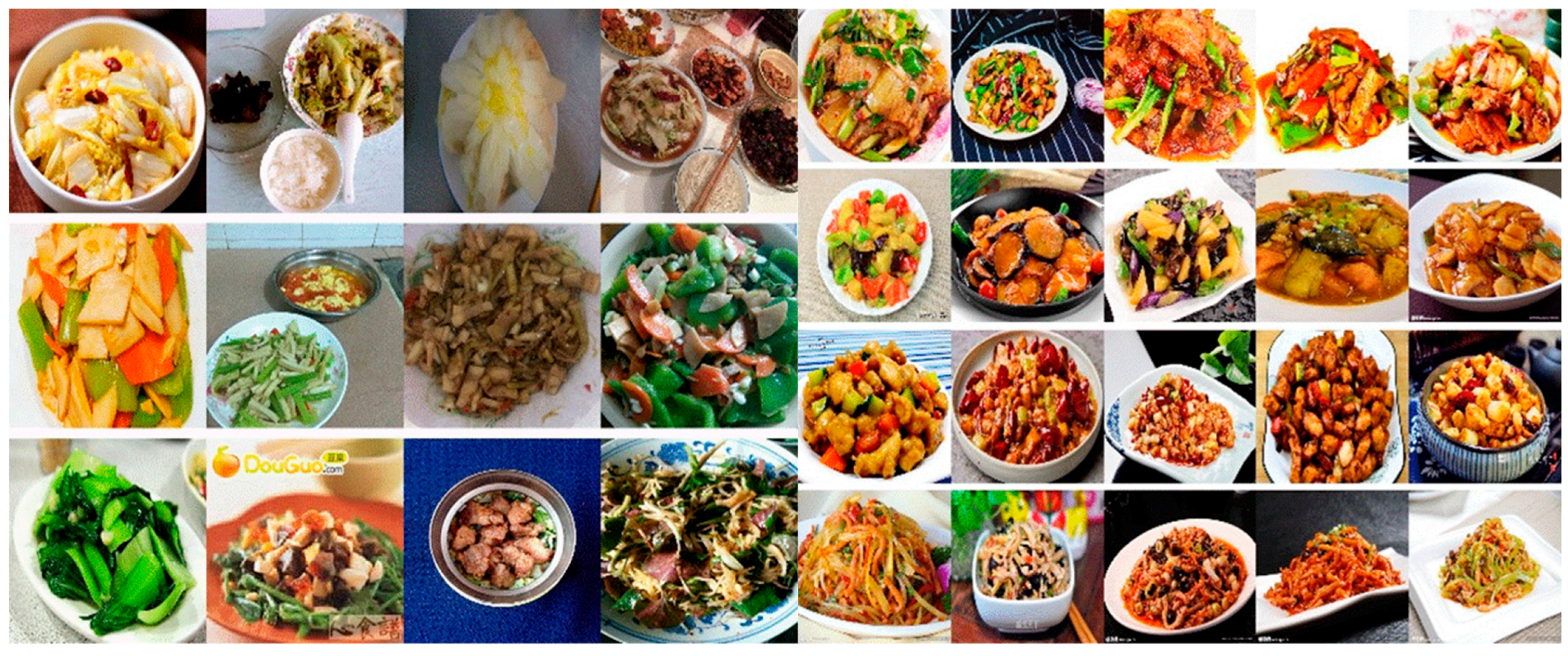
3.2.3. Special Challenges and Solutions in Chinese Food Image Classification
4. Hyperspectral Imaging
4.1. Hyperspectral Imaging Techniques
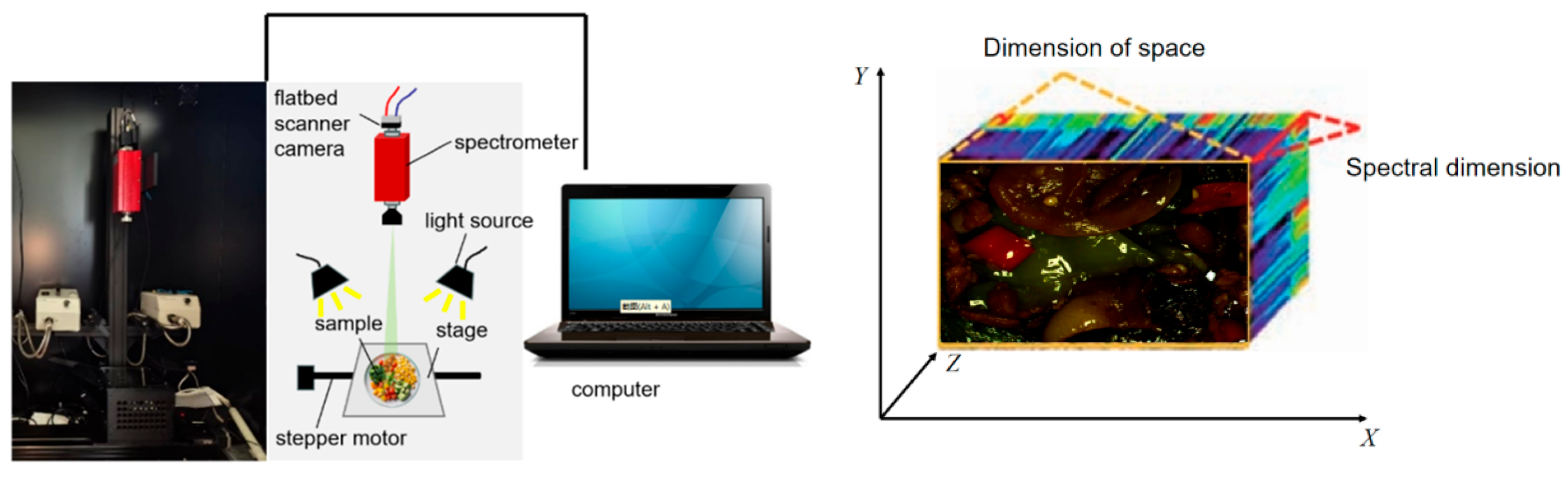
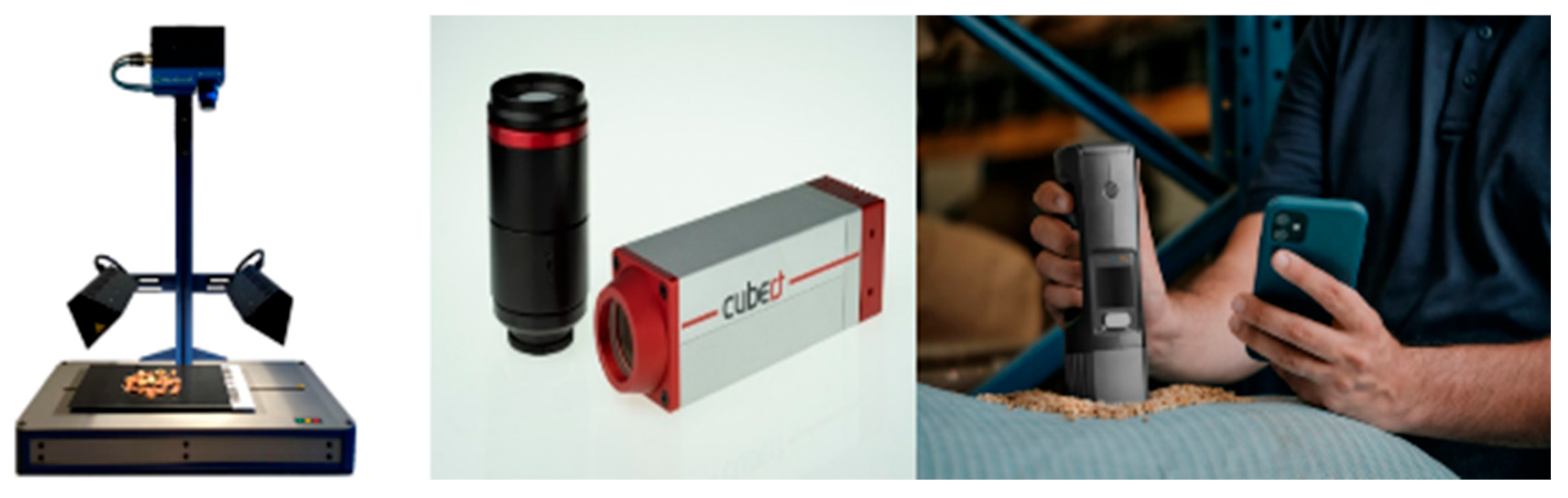
4.1.1. Hyperspectral Imaging Equipment and Technical Principles
4.1.2. Spectral Band Functionality and Food Inspection Applications
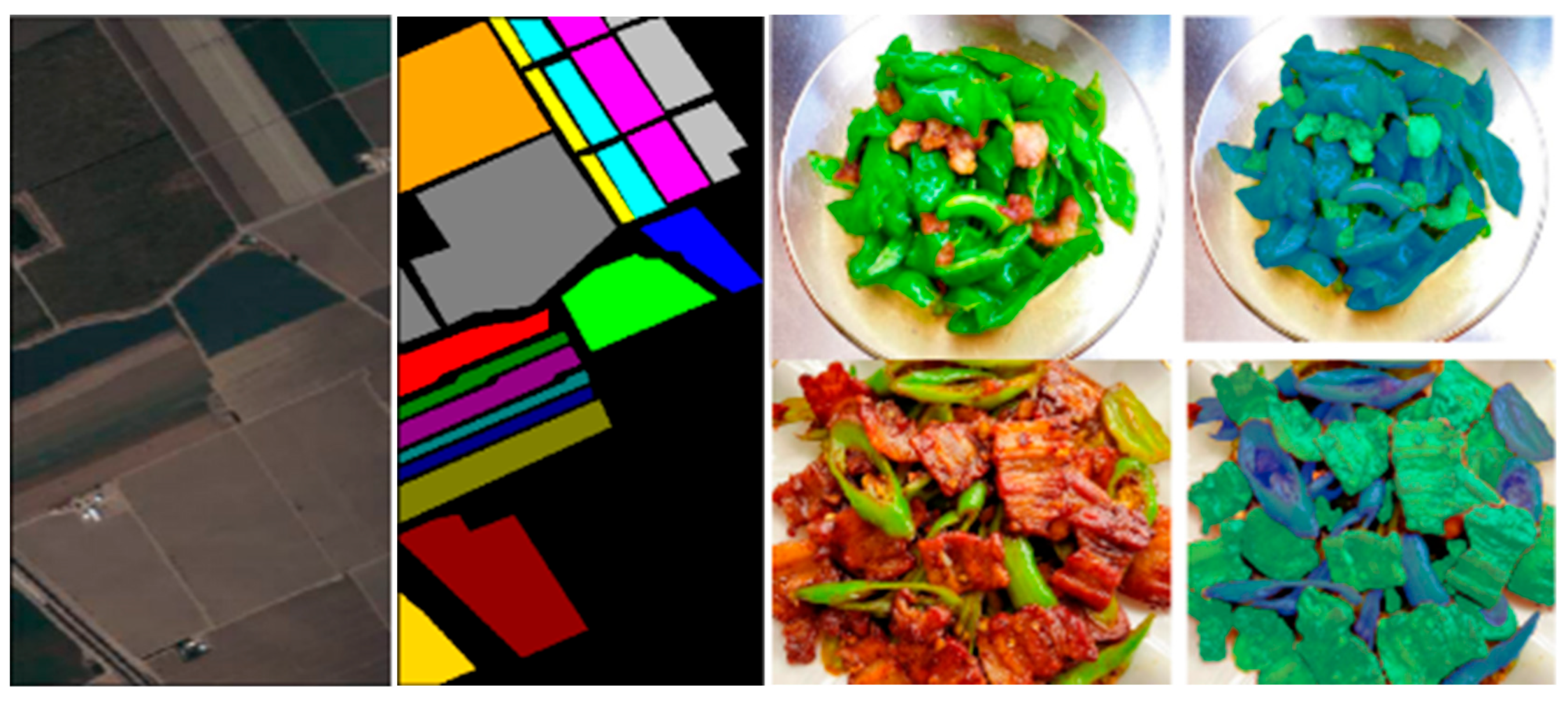
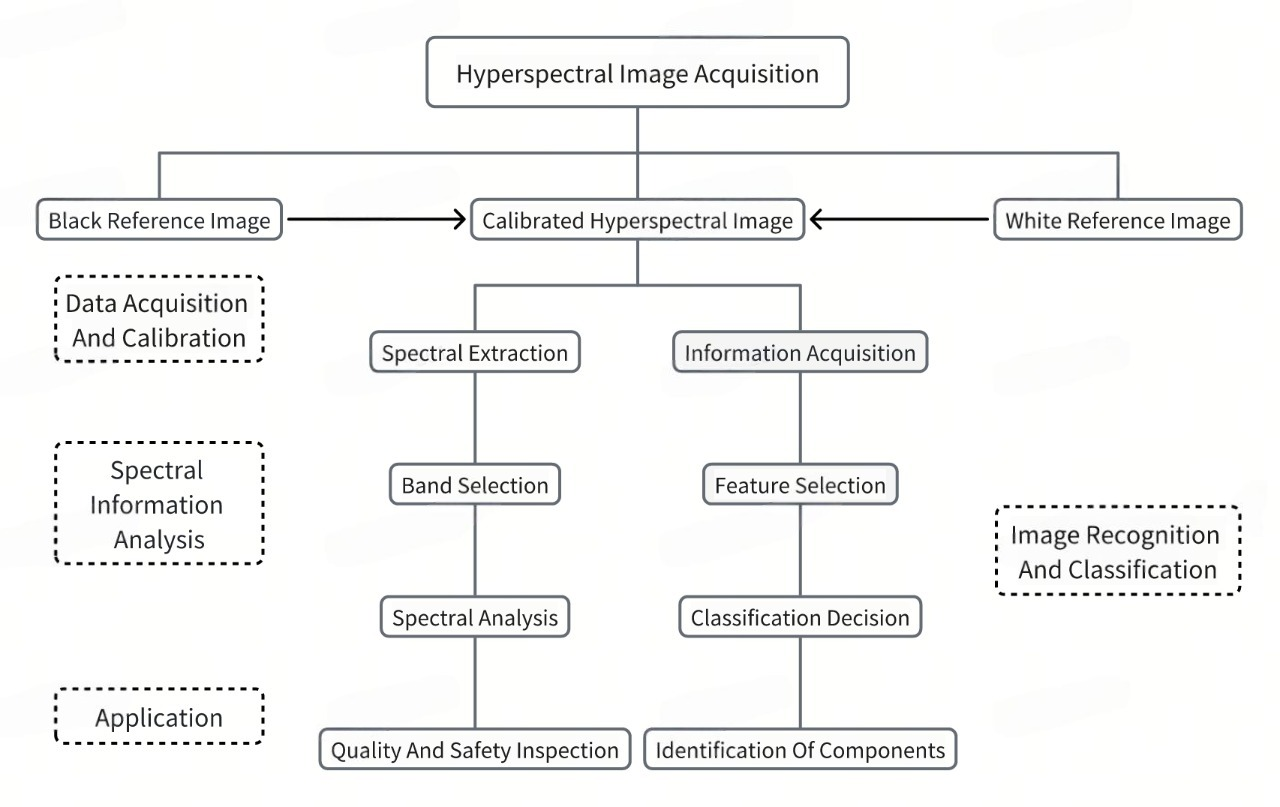
4.1.3. Data Processing and Classification Enhancement
4.2. Deep Learning Approaches Based on Convolutional Neural Networks
4.2.1. Background on Hyperspectral Analysis with CNNs
4.2.2. Challenges in Modeling Complex Food Structures
4.2.3. Representative Fusion Models
4.3. Challenges and Future Research Directions
5. Application of Hyperspectral Technology in Food Inspection
5.1. Foundations of Hyperspectral Technology in Food Detection
5.1.1. Principles and Analytical Methods
5.1.2. Empirical Applications
5.2. Emerging Applications Enabled by Hyperspectral and AI Technologies
5.2.1. Nutritional Monitoring: Semantic Segmentation and Deep Estimation
5.2.2. Intelligent Storage and Spoilage Detection
5.2.3. Personalized Diets and Automated Serving Robots
5.3. Summary, Limitations, and Future Directions
- (1)
- Construction of Multimodal Datasets: To better capture the diversity and cultural context of Chinese cuisine, future datasets should integrate heterogeneous data types, including spectral and RGB images, nutritional information, textual labels (e.g., ingredient lists, dish names), and regional or cultural annotations. Developing automated annotation systems will be crucial to reducing labeling costs and facilitating the creation of large-scale, high-quality datasets that are both representative and generalizable across geographic regions.
- (2)
- Optimization of Deep Learning Models: Achieving high classification accuracy under real-world constraints requires models that balance precision with efficiency. Research should emphasize the following: Lightweight neural networks and sparse classifiers suitable for mobile and embedded devices. Efficient spectral–spatial feature fusion techniques. Few-shot and data-efficient learning algorithms that perform well with limited samples.
- (3)
- Advanced Applications of Hyperspectral Technology: Beyond classification, hyperspectral imaging should be further leveraged for food safety and health monitoring, particularly in detecting trace elements, heavy metals, pesticide residues, and foodborne allergens or contaminants. These expanded applications would significantly enhance the practical impact of HSI in daily food inspection and public health assurance.
- (4)
- Development of Cross-Cultural and Generalizable Models: To support global food AI applications, recognition systems must adapt across regions and cultures. This necessitates the following: Aggregating datasets representing diverse food traditions. Training models on culturally heterogeneous data. Incorporating knowledge transfer techniques to bridge gaps between different cuisines
6. Conclusions
Author Contributions
Funding
Institutional Review Board Statement
Informed Consent Statement
Data Availability Statement
Conflicts of Interest
References
- Chang, Y. Research on Dietary Nutrition and Health Issues Among College Students. J. Heilongjiang Coll. Educ. 2014, 33, 195–196. [Google Scholar]
- Estay, K.; Proserpio, C.; Cattaneo, C.; Laureati, M. Children’s food neophobia across different socioeconomic backgrounds in Chile: Exploring acceptance and willingness to try unfamiliar vegetables. Food Qual. Preference 2025, 129, 105511. [Google Scholar] [CrossRef]
- Liu, Y.; Liu, C.; Sun, L.; Li, M.; Zhu, Y.; Deng, W.; Yu, J.; Zhang, W.; Song, Z. Investigating flavor and quality characteristics in Chinese bacon from different regions using integrated GC-IMS, electronic sensory assessment, and sensory analysis. Meat Sci. 2025, 220, 109709. [Google Scholar] [CrossRef] [PubMed]
- Ding, H.; Tian, J.; Yu, W.; Wilson, D.I.; Young, B.R.; Cui, X.; Xin, X.; Wang, Z.; Li, W. The application of artificial intelligence and big data in the food industry. Foods 2023, 12, 4511. [Google Scholar] [CrossRef]
- Namkhah, Z.; Fatemi, S.F.; Mansoori, A.; Nosratabadi, S.; Ghayour-Mobarhan, M.; Sobhani, S. Advancing sustainability in the food and nutrition system: A review of artificial intelligence applications. Front. Nutr. 2023, 10, 1295241. [Google Scholar] [CrossRef]
- Raki, H.; Aalaila, Y.; Taktour, A.; Peluffo-Ordóñez, D. Combining AI tools with non-destructive technologies for crop-based food safety: A comprehensive review. Foods 2023, 13, 11. [Google Scholar] [CrossRef]
- Min, W.; Jiang, S.; Liu, L.; Rui, Y.; Jain, R. A survey on food computing. ACM Comput. Surv. 2019, 52, 1–36. [Google Scholar] [CrossRef]
- Shen, C.; Wang, R.; Nawazish, H.; Wang, B.; Cai, K.; Xu, B. Machine vision combined with deep learning–based approaches for food authentication: An integrative review and new insights. Compr. Rev. Food Sci. Food Saf. 2024, 23, e70054. [Google Scholar] [CrossRef]
- Kaushal, S.; Tammineni, D.K.; Rana, P.; Sharma, M.; Sridhar, K.; Chen, H. Computer vision and deep learning-based approaches for detection of food nutrients/nutrition: New insights and advances. Trends Food Sci. Technol. 2024, 146, 104408. [Google Scholar] [CrossRef]
- Kim, H.; Venkataramanan, R.; Sheth, A. A Survey on Food Ingredient Substitutions. arXiv 2024, arXiv:2501.01958. [Google Scholar]
- Wang, C. Research on Food Intelligent Recognition Technology Based on Machine Vision; South China University of Technology: Guangzhou, China, 2019; Volume 2020. [Google Scholar]
- Li, Y. Study on the Oil Content of Stir-Fried Dishes and the Degradation of Repeatedly Used Cooking Oil Quality; Guizhou University: Guizhou, China, 2022; Volume 2022. [Google Scholar]
- Minocha, N.; Singh, A. Nutrition Essentials: Building a Foundation for Optimal Health Through Diet. In Impact of Yoga and Proper Diet on Cardiopulmonary Function; IGI Global Scientific Publishing: Hershey, PA, USA, 2025; pp. 119–160. [Google Scholar]
- Evert, A.B.; Dennison, M.; Gardner, C.D.; Garvey, W.T.; Lau, K.H.K.; MacLeod, J.; Mitri, J.; Pereira, R.F.; Rawlings, K.; Robinson, S. Nutrition therapy for adults with diabetes or prediabetes: A consensus report. Diabetes Care 2019, 42, 731–754. [Google Scholar] [CrossRef] [PubMed]
- Mousavi Khaneghah, A.; Mostashari, P. Decoding food reactions: A detailed exploration of food allergies vs. intolerances and sensitivities. Crit. Rev. Food Sci. Nutr. 2025, 65, 2669–2713. [Google Scholar] [CrossRef]
- Ding, H.H.; Xie, Z.Q.; Yu, W.; Cui, X.H.; Wilson, D.I. Artificial intelligence enhances food testing process: A comprehensive review. Food Biosci. 2025, 68, 106404. [Google Scholar] [CrossRef]
- Gu, C.Y.; Wang, G.; Zhuang, W.H.; Hu, J.; He, X.; Zhang, L.; Du, Z.; Xu, X.M.; Yin, M.G.; Yao, Y.C.; et al. Artificial intelligence-enabled analysis methods and their applications in food chemistry. Crit. Rev. Food Sci. Nutr. 2025, 22, 1–22. [Google Scholar] [CrossRef]
- Yang, C.; Guo, Z.; Fernandes Barbin, D.; Dai, Z.; Watson, N.; Povey, M.; Zou, X. Hyperspectral Imaging and Deep Learning for Quality and Safety Inspection of Fruits and Vegetables: A Review. J. Agric. Food Chem. 2025, 73, 10019–10035. [Google Scholar] [CrossRef]
- Siar, M.; Teshnehlab, M. A combination of feature extraction methods and deep learning for brain tumour classification. IET Image Process. 2022, 16, 416–441. [Google Scholar] [CrossRef]
- Sun, D.-W.; Pu, H.; Yu, J. Applications of hyperspectral imaging technology in the food industry. Nat. Rev. Electr. Eng. 2024, 1, 251–263. [Google Scholar] [CrossRef]
- Coman, L.-I.; Ianculescu, M.; Paraschiv, E.-A.; Alexandru, A.; Bădărău, I.-A. Smart Solutions for Diet-Related Disease Management: Connected Care, Remote Health Monitoring Systems, and Integrated Insights for Advanced Evaluation. Appl. Sci. 2024, 14, 2351. [Google Scholar] [CrossRef]
- Lu, B.; Dao, P.D.; Liu, J.; He, Y.; Shang, J. Recent advances of hyperspectral imaging technology and applications in agriculture. Remote. Sens. 2020, 12, 2659. [Google Scholar] [CrossRef]
- Cao, R.; Li, J.; Ding, H.; Zhao, T.; Guo, Z.; Li, Y.; Sun, X.; Wang, F.; Qiu, J. Synergistic approaches of AI and NMR in enhancing food component analysis: A comprehensive review. Trends Food Sci. Technol. 2024, 156, 104852. [Google Scholar] [CrossRef]
- Huang, W.; Yin, M.; Xia, J.; Zhang, X. A review of cross-scale and cross-modal intelligent sensing and detection technology for food quality: Mechanism analysis, decoupling strategy and integrated applications. Trends Food Sci. Technol. 2024, 151, 104646. [Google Scholar] [CrossRef]
- Guo, B.; Lu, X.; Jiang, X.; Shen, X.-L.; Wei, Z.; Zhang, Y.J.F. Artificial Intelligence in Advancing Algal Bioactive Ingredients: Production, Characterization, and Application. Foods 2025, 14, 1783. [Google Scholar] [CrossRef]
- Ma, P.H.; Lau, C.P.; Yu, N.; Li, A.; Liu, P.; Wang, Q.; Sheng, J.P. Image-based nutrient estimation for Chinese dishes using deep learning. Food Res. Int. 2021, 147, 110437. [Google Scholar] [CrossRef]
- Zhou, J.; Xin, X.; Li, W.; Ding, H.H.; Yu, S.; Cui, X.H. Flavor analysis and region prediction of Chinese dishes based on food pairing. Inf. Process. Manag. 2024, 61, 103684. [Google Scholar] [CrossRef]
- Schmidgall, S.; Ziaei, R.; Achterberg, J.; Kirsch, L.; Hajiseyedrazi, S.; Eshraghian, J. Brain-inspired learning in artificial neural networks: A review. APL Mach. Learn. 2024, 2, 186054. [Google Scholar] [CrossRef]
- Hammad, M. Deep Learning Activation Functions: Fixed-Shape, Parametric, Adaptive, Stochastic, Miscellaneous, Non-Standard, Ensemble. arXiv 2024, arXiv:2407.11090. [Google Scholar]
- Nwankpa, C.; Ijomah, W.; Gachagan, A.; Marshall, S. Activation functions: Comparison of trends in practice and research for deep learning. arXiv 2018, arXiv:1811.03378. [Google Scholar]
- Dubey, S.R.; Singh, S.K.; Chaudhuri, B.B. Activation functions in deep learning: A comprehensive survey and benchmark. Neurocomputing 2022, 503, 92–108. [Google Scholar] [CrossRef]
- Aliferis, C.; Simon, G. Overfitting, underfitting and general model overconfidence and under-performance pitfalls and best practices in machine learning and AI. Artif. Intell. Mach. Learn. Health Care Med. Sci. Best Pract. Pitfalls 2024, 477–524. [Google Scholar]
- Bidyalakshmi, T.; Jyoti, B.; Mansuri, S.M.; Srivastava, A.; Mohapatra, D.; Kalnar, Y.B.; Narsaiah, K.; Indore, N. Application of Artificial Intelligence in Food Processing: Current Status and Future Prospects. Food Eng. Rev. 2024, 17, 27–54. [Google Scholar] [CrossRef]
- Matsuda, Y.; Yanai, K. Multiple-food recognition considering co-occurrence employing manifold ranking. In Proceedings of the 21st International Conference on Pattern Recognition (ICPR2012), Tsukuba, Japan, 11–15 November 2012; pp. 2017–2020. [Google Scholar]
- Bossard, L.; Guillaumin, M.; Gool, L.V. Food-101-Mining Discriminative Components with Random Forests. In Proceedings of the 13th European Conference on Computer Vision (ECCV), Zurich, Switzerland, 6–12 September 2014; pp. 446–461. [Google Scholar]
- Hou, S.H.; Feng, Y.S.; Wang, Z.L. VegFru: A Domain-Specific Dataset for Fine-grained Visual Categorization. In Proceedings of the 16th IEEE International Conference on Computer Vision (ICCV), Venice, Italy, 22–29 October 2017; pp. 541–549. [Google Scholar]
- Kaur, P.; Sikka, K.; Wang, W.; Belongie, S.; Divakaran, A. Foodx-251: A dataset for fine-grained food classification. arXiv 2019, arXiv:1907.06167. [Google Scholar]
- Mohanty, S.P.; Singhal, G.; Scuccimarra, E.A.; Kebaili, D.; Heritier, H.; Boulanger, V.; Salathe, M. The Food Recognition Benchmark: Using Deep Learning to Recognize Food in Images. Front. Nutr. 2022, 9, 875143. [Google Scholar] [CrossRef] [PubMed]
- Min, W.Q.; Wang, Z.L.; Liu, Y.X.; Luo, M.J.; Kang, L.P.; Wei, X.M.; Wei, X.L.; Jiang, S.Q. Large Scale Visual Food Recognition. IEEE Trans. Pattern Anal. Mach. Intell. 2023, 45, 9932–9949. [Google Scholar] [CrossRef]
- Wu, X.; Fu, X.; Liu, Y.; Lim, E.-P.; Hoi, S.C.H.; Sun, Q. A large-scale benchmark for food image segmentation. In Proceedings of the 29th ACM International Conference on Multimedia, Virtual Event, 20 July–24 October 2021; pp. 506–515. [Google Scholar]
- Chen, J.J.; Ngo, C.W. Deep-based Ingredient Recognition for Cooking Recipe Retrieval. In Proceedings of the 24th ACM Multimedia Conference (MM), Amsterdam, The Netherlands, 15–19 October 2016; pp. 32–41. [Google Scholar]
- Chen, X.; Zhu, Y.; Zhou, H.; Diao, L.; Wang, D. Chinesefoodnet: A large-scale image dataset for chinese food recognition. arXiv 2017, arXiv:1705.02743. [Google Scholar]
- Fan, B.K.; Li, W.Q.; Dong, L.; Li, J.Z.; Nie, Z.D. Automatic Chinese Food recognition based on a stacking fusion model. In Proceedings of the 45th Annual International Conference of the IEEE-Engineering-in-Medicine-and-Biology-Society (EMBC), Sydney, Australia, 24–27 July 2023. [Google Scholar]
- Zayas, I. Discrimination between Arthur and Arkan wheats by image analysis. Cereal Chem. 1985, 62, 478–480. [Google Scholar]
- Lai, F.S.; Zayas, I.; Pomeranz, Y. Application of pattern recognition techniques in the analysis of cereal grains. Cereal Chem. 1986, 63, 168–172. [Google Scholar]
- Deng, Z.; Wang, T.; Zheng, Y.; Zhang, W.; Yun, Y.-H. Deep learning in food authenticity: Recent advances and future trends. rends Food Sci. Technol. 2024, 144, 104344. [Google Scholar] [CrossRef]
- Xia, B.; Abidin, M.R.Z.; Ab Karim, S. From tradition to technology: A comprehensive review of contemporary food design. Int. J. Gastron. Food Sci. 2024, 37, 100977. [Google Scholar] [CrossRef]
- Khan, A.; Sohail, A.; Zahoora, U.; Qureshi, A.S. A survey of the recent architectures of deep convolutional neural networks. Artif. Intell. Rev. 2020, 53, 5455–5516. [Google Scholar] [CrossRef]
- Sarraf, A.; Azhdari, M.; Sarraf, S. A comprehensive review of deep learning architectures for computer vision applications. Am. Sci. Res. J. Eng. Technol. Sci. ASRJETS 2021, 77, 1–29. [Google Scholar]
- Jiang, C.; Zhou, Q.; Lei, J.; Wang, X. A Two-Stage Structural Damage Detection Method Based on 1D-CNN and SVM. Appl. Sci. 2022, 12, 10394. [Google Scholar] [CrossRef]
- Özcan, R.; Tütüncü, K.; Karaca, M. Comparison of Plant Detection Performance of CNN-based Single-stage and Two-stage Models for Precision Agriculture. Appl. Sci. 2022, 36, 53–58. [Google Scholar]
- Mao, Y.; Yu, X.; Huang, K.; Zhang, Y.-J.A.; Zhang, J. Green edge AI: A contemporary survey. arXiv 2024, arXiv:2312.00333. [Google Scholar] [CrossRef]
- Iqbal, U.; Davies, T.; Perez, P. A Review of Recent Hardware and Software Advances in GPU-Accelerated Edge-Computing Single-Board Computers (SBCs) for Computer Vision. Sensors 2024, 24, 4830. [Google Scholar] [CrossRef]
- Wang, C. GPU-Based Acceleration and Optimization Research on Computer Vision. Ph.D. Dissertation, School of Computing, Tokyo Institute Technology, Tokyo, Japan, 2023. [Google Scholar]
- Krizhevsky, A.; Sutskever, I.; Hinton, G.E. ImageNet Classification with Deep Convolutional Neural Networks. Commun. ACM 2017, 60, 84–90. [Google Scholar]
- Rai, D.H. Artificial Intelligence Through Time: A Comprehensive Historical Review. Bachelor’s Thesis, Institute of Science and Technology, Tribhuvan University, Kirtipur, Nepal, 2024. [Google Scholar]
- Kusumoto, R.; Han, X.H.; Chen, Y.W.J.I. Sparse model in hierarchic spatial structure for food image recognition. In Proceedings of the 2013 6th International Conference on Biomedical Engineering and Informatics, Hangzhou, China, 16–18 December 2013. [Google Scholar]
- Romero, A.; Gatta, C.; Camps-Valls, G. Unsupervised deep feature extraction for remote sensing image classification. IEEE Trans. Geosci. Remote. Sens. 2015, 54, 1349–1362. [Google Scholar] [CrossRef]
- Pandey, P.; Deepthi, A.; Mandal, B.; Puhan, N.B. FoodNet: Recognizing Foods Using Ensemble of Deep Networks. IEEE Signal Process. Lett. 2017, 24, 1758–1762. [Google Scholar] [CrossRef]
- Sultana, J.; Ahmed, B.M.; Masud, M.M.; Huq, A.O.; Ali, M.E.; Naznin, M. A study on food value estimation from images: Taxonomies, datasets, and techniques. IEEE Access 2023, 11, 45910–45935. [Google Scholar] [CrossRef]
- Martinel, N.; Foresti, G.L.; Micheloni, C. Wide-Slice Residual Networks for Food Recognition. In Proceedings of the 2018 IEEE Winter Conference on Applications of Computer Vision (WACV), Lake Tahoe, NV, USA, 12–15 March 2018. [Google Scholar]
- Kiourt, C.; Pavlidis, G.; Markantonatou, S. Deep learning approaches in food recognition. In Machine Learning Paradigms: Advances in Deep Learning-Based Technological Applications; Springer International Publishing: Cham, Switzerland, 2020; pp. 83–108. [Google Scholar]
- Simonyan, K.; Zisserman, A. Very deep convolutional networks for large-scale image recognition. arXiv 2014, arXiv:1409.1556. [Google Scholar]
- He, K.M.; Zhang, X.Y.; Ren, S.Q.; Sun, J. Deep Residual Learning for Image Recognition. In Proceedings of the 2016 IEEE Conference on Computer Vision and Pattern Recognition (CVPR), Seattle, WA, USA, 27–30 June 2016; pp. 770–778. [Google Scholar]
- Szegedy, C.; Ioffe, S.; Vanhoucke, V.; Alemi, A.A. Inception-v4, Inception-ResNet and the Impact of Residual Connections on Learning. In Proceedings of the 31st AAAI Conference on Artificial Intelligence, San Francisco, CA, USA, 4–9 February 2017; pp. 4278–4284. [Google Scholar]
- Alaeddine, H.; Jihene, M. Wide deep residual networks in networks. Multimed. Tools Appl. 2023, 82, 7889–7899. [Google Scholar] [CrossRef]
- Huang, G.; Liu, Z.; van der Maaten, L.; Weinberger, K.Q. Densely Connected Convolutional Networks. In Proceedings of the 30th IEEE/CVF Conference on Computer Vision and Pattern Recognition (CVPR), Honolulu, HI, USA, 21–26 July 2017; pp. 2261–2269. [Google Scholar]
- Hu, J.; Shen, L.; Albanie, S.; Sun, G.; Wu, E.H. Squeeze-and-Excitation Networks. IEEE Trans. Pattern Anal. Mach. Intell. 2020, 42, 2011–2023. [Google Scholar] [CrossRef] [PubMed]
- Yang, Z.; Luo, T.G.; Wang, D.; Hu, Z.Q.; Gao, J.; Wang, L.W. Learning to Navigate for Fine-Grained Classification. In Proceedings of the 15th European Conference on Computer Vision (ECCV), Munich, Germany, 8–14 September 2018; pp. 438–454. [Google Scholar]
- Yu, C.J.; Zhao, X.Y.; Zheng, Q.; Zhang, P.; You, X.G. Hierarchical Bilinear Pooling for Fine-Grained Visual Recognition. In Proceedings of the 15th European Conference on Computer Vision (ECCV), Munich, Germany, 8–14 September 2018; pp. 595–610. [Google Scholar]
- Hu, T.; Qi, H.; Huang, Q.; Lu, Y. See better before looking closer: Weakly supervised data augmentation network for fine-grained visual classification. arXiv 2019, arXiv:1901.09891. [Google Scholar]
- Min, S.B.; Yao, H.T.; Xie, H.T.; Zha, Z.J.; Zhang, Y.D. Multi-Objective Matrix Normalization for Fine-Grained Visual Recognition. IEEE Trans. Image Process. 2020, 29, 4996–5009. [Google Scholar] [CrossRef] [PubMed]
- Du, R.; Chang, D.; Bhunia, A.K.; Xie, J.; Ma, Z.; Song, Y.-Z.; Guo, J. Fine-grained visual classification via progressive multi-granularity training of jigsaw patches. In Proceedings of the European Conference on Computer Vision, Glasgow, UK, 23–28 August 2020; pp. 153–168. [Google Scholar]
- Yu, F.; Wang, D.Q.; Shelhamer, E.; Darrell, T. Deep Layer Aggregation. In Proceedings of the 31st IEEE/CVF Conference on Computer Vision and Pattern Recognition (CVPR), Salt Lake City, UT, USA, 18–23 June 2018; pp. 2403–2412. [Google Scholar]
- Qiu, J.; Lo, F.P.-W.; Sun, Y.; Wang, S.; Lo, B. Mining discriminative food regions for accurate food recognition. arXiv 2022, arXiv:2207.03692. [Google Scholar]
- Nong, L.; Peng, G.; Xu, T.; Zhu, J.J.E.A.o.A.I. From ensemble to knowledge distillation: Improving large-scale food recognition. Eng. Appl. Artif. Intell. 2025, 151, 110727. [Google Scholar] [CrossRef]
- Ji, W.; Zhang, T.; Xu, B.; He, G.Z. Apple recognition and picking sequence planning for harvesting robot in a complex environment. J. Agric. Eng. 2024, 55, 11. [Google Scholar] [CrossRef]
- Garcia-Garcia, A.; Orts-Escolano, S.; Oprea, S.; Villena-Martinez, V.; Martinez-Gonzalez, P.; Garcia-Rodriguez, J. A survey on deep learning techniques for image and video semantic segmentation. Appl. Soft Comput. 2018, 70, 41–65. [Google Scholar] [CrossRef]
- Garcia-Garcia, A.; Orts-Escolano, S.; Oprea, S.; Villena-Martinez, V.; Garcia-Rodriguez, J. A review on deep learning techniques applied to semantic segmentation. arXiv 2017, arXiv:1704.06857. [Google Scholar]
- Shang, G.; Liu, G.; Zhu, P.; Han, J.; Xia, C.; Jiang, K. A deep residual U-Type network for semantic segmentation of orchard environments. Appl. Sci. 2020, 11, 322. [Google Scholar] [CrossRef]
- Anagnostis, A.; Tagarakis, A.C.; Kateris, D.; Moysiadis, V.; Sørensen, C.G.; Pearson, S.; Bochtis, D.J.S. Orchard mapping with deep learning semantic segmentation. Sensors 2021, 21, 3813. [Google Scholar] [CrossRef] [PubMed]
- Pfisterer, K.J.; Amelard, R.; Chung, A.G.; Syrnyk, B.; MacLean, A.; Keller, H.H.; Wong, A. Automated food intake tracking requires depth-refined semantic segmentation to rectify visual-volume discordance in long-term care homes. Sci. Rep. 2022, 12, 83. [Google Scholar] [CrossRef] [PubMed]
- Pfisterer, K.J.; Amelard, R.; Chung, A.G.; Syrnyk, B.; MacLean, A.; Keller, H.H.; Wong, A.J. When segmentation is not enough: Rectifying visual-volume discordance through multisensor depth-refined semantic segmentation for food intake tracking in long-term care. arXiv 2019, arXiv:1910.11250. [Google Scholar]
- Shen, Z.; Savvides, M.J. Meal v2: Boosting vanilla resnet-50 to 80%+ top-1 accuracy on imagenet without tricks. arXiv 2020, arXiv:2009.08453. [Google Scholar]
- Ye, M.; Ruiwen, N.; Chang, Z.; He, G.; Tianli, H.; Shijun, L.; Yu, S.; Tong, Z.; Ying, G. A lightweight model of VGG-16 for remote sensing image classification. IEEE J. Sel. Top. Appl. Earth Obs. Remote. Sens. 2021, 14, 6916–6922. [Google Scholar] [CrossRef]
- Guizilini, V.; Vasiljevic, I.; Chen, D.; Ambrus, R.; Gaidon, A. Towards Zero-Shot Scale-Aware Monocular Depth Estimation. In Proceedings of the IEEE/CVF International Conference on Computer Vision (ICCV), Paris, France, 2–6 October 2023; pp. 9199–9209. [Google Scholar]
- Hu, M.; Yin, W.; Zhang, C.; Cai, Z.P.; Long, X.X.; Chen, H.; Wang, K.X.; Yu, G.; Shen, C.H.; Shen, S. Metric3D v2: A Versatile Monocular Geometric Foundation Model for Zero-Shot Metric Depth and Surface Normal Estimation. IEEE Trans. Pattern Anal. Mach. Intell. 2024, 46, 10579–10596. [Google Scholar] [CrossRef]
- Ke, B.X.; Obukhov, A.; Huang, S.Y.; Metzger, N.; Daudt, R.C.; Schindler, K. Repurposing Diffusion-Based Image Generators for Monocular Depth Estimation. In Proceedings of the IEEE/CVF Conference on Computer Vision and Pattern Recognition (CVPR), Seattle, WA, USA, 16–22 June 2024; pp. 9492–9502. [Google Scholar]
- Li, Z.; Bhat, S.F.; Wonka, P. PatchFusion: An End-to-End Tile-Based Framework for High-Resolution Monocular Metric Depth Estimation. In Proceedings of the IEEE/CVF Conference on Computer Vision and Pattern Recognition (CVPR), Seattle, WA, USA, 16–22 June 2024; pp. 10016–10025. [Google Scholar]
- Szegedy, C.; Liu, W.; Jia, Y.Q.; Sermanet, P.; Reed, S.; Anguelov, D.; Erhan, D.; Vanhoucke, V.; Rabinovich, A. Going Deeper with Convolutions. In Proceedings of the IEEE Conference on Computer Vision and Pattern Recognition (CVPR), Boston, MA, USA, 7–12 June 2015; pp. 1–9. [Google Scholar]
- Howard, A.; Sandler, M.; Chu, G.; Chen, L.C.; Chen, B.; Tan, M.X.; Wang, W.J.; Zhu, Y.K.; Pang, R.M.; Vasudevan, V.; et al. Searching for MobileNetV3. In Proceedings of the IEEE/CVF International Conference on Computer Vision (ICCV), Seoul, Republic of Korea, 27 October–2 November 2019; pp. 1314–1324. [Google Scholar]
- Tan, M.X.; Le, Q.V. EfficientNet: Rethinking Model Scaling for Convolutional Neural Networks. In Proceedings of the 36th International Conference on Machine Learning (ICML), Long Beach, CA, USA, 9–15 June 2019. [Google Scholar]
- Dosovitskiy, A.; Beyer, L.; Kolesnikov, A.; Weissenborn, D.; Zhai, X.; Unterthiner, T.; Dehghani, M.; Minderer, M.; Heigold, G.; Gelly, S. An image is worth 16x16 words: Transformers for image recognition at scale. arXiv 2020, arXiv:2020.11929. [Google Scholar]
- Liu, Z.; Lin, Y.T.; Cao, Y.; Hu, H.; Wei, Y.X.; Zhang, Z.; Lin, S.; Guo, B.N. Swin Transformer: Hierarchical Vision Transformer using Shifted Windows. In Proceedings of the 18th IEEE/CVF International Conference on Computer Vision (ICCV), Electr Network, 11–17 October 2021; pp. 9992–10002. [Google Scholar]
- Chen, C.-S.; Chen, G.-Y.; Zhou, D.; Jiang, D.; Chen, D.-S. Res-vmamba: Fine-grained food category visual classification using selective state space models with deep residual learning. arXiv 2024, arXiv:2402.15761. [Google Scholar]
- Wan, G.L.; He, J.G.; Meng, X.H.; Liu, G.S.; Zhang, J.J.; Ma, F.; Zhang, Q.; Wu, D. Hyperspectral imaging technology for nondestructive identification of quality deterioration in fruits and vegetables: A review. Crit. Rev. Food Sci. Nutr. 2025, 1–30. [Google Scholar] [CrossRef] [PubMed]
- Nikzadfar, M.; Rashvand, M.; Zhang, H.W.; Shenfield, A.; Genovese, F.; Altieri, G.; Matera, A.; Tornese, I.; Laveglia, S.; Paterna, G.; et al. Hyperspectral Imaging Aiding Artificial Intelligence: A Reliable Approach for Food Qualification and Safety. Appl. Sci. 2024, 14, 9821. [Google Scholar] [CrossRef]
- ElMasry, G.M.; Nakauchi, S. Image analysis operations applied to hyperspectral images for non-invasive sensing of food quality—A comprehensive review. Biosyst. Eng. 2016, 142, 53–82. [Google Scholar] [CrossRef]
- Liu, Q.C.; Xiao, L.; Yang, J.X.; Wei, Z.H. CNN-Enhanced Graph Convolutional Network With Pixel- and Superpixel-Level Feature Fusion for Hyperspectral Image Classification. IEEE Trans. Geosci. Remote Sens. 2021, 59, 8657–8671. [Google Scholar] [CrossRef]
- Soni, A.; Dixit, Y.; Reis, M.M.; Brightwell, G. Hyperspectral imaging and machine learning in food microbiology: Developments and challenges in detection of bacterial, fungal, and viral contaminants. Compr. Rev. Food. Sci. Food Saf. 2022, 21, 3717–3745. [Google Scholar] [CrossRef]
- Pu, H.B.; Lin, L.; Sun, D.W. Principles of Hyperspectral Microscope Imaging Techniques and Their Applications in Food Quality and Safety Detection: A Review. Compr. Rev. Food. Sci. Food Saf. 2019, 18, 853–866. [Google Scholar] [CrossRef]
- Kowalewski, J.; Domaradzki, J.; Zieba, M.; Podgórski, M. Hyperspectral Imaging—A Short Review of Methods and Applications. Metrol. Meas. Syst. 2023, 30, 637–654. [Google Scholar] [CrossRef]
- Wu, Y.; Wang, Y.M.; Zhang, D. Design and Analysis of Spaceborne Hyperspectral Imaging System for Coastal Studies. Remote Sens. 2025, 17, 986. [Google Scholar] [CrossRef]
- Arablouei, R.; Goan, E.; Gensemer, S.; Kusy, B. Fast and robust pushbroom hyperspectral imaging via DMD-based scanning. In Proceedings of the 19th Annual Conference on Novel Optical Systems Design and Optimization, San Diego, CA, USA, 29–30 August 2016. [Google Scholar]
- Chang, C.I. An information-theoretic approach to spectral variability, similarity, and discrimination for hyperspectral image analysis. IEEE Trans. Inf. Theory 2000, 46, 1927–1932. [Google Scholar] [CrossRef]
- Chen, W.; He, J.; Liu, G. Hyperspectral Image Classification Based on Convolution Neural Network with Attention Mechanism. Laser Optoelectron. Prog. 2022, 59, 1811001. [Google Scholar]
- Wang, A.L.; Liu, M.H.; Xue, D.; Wu, H.B.; Zhao, L.F.; Yuji, I. Hyperspectral Image Classification Combined Dynamic Convolution with Triplet Attention Mechanism. Laser Optoelectron. Prog. 2022, 59, 11. [Google Scholar] [CrossRef]
- Mei, S.; Ji, J.; Bi, Q.; Hou, J.; Li, W. Integrating spectral and spatial information into deep convolutional Neural Networks for hyperspectral classification. In Proceedings of the 2016 IEEE International Geoscience and Remote Sensing Symposium (IGARSS), Beijing, China, 10–15 July 2016. [Google Scholar]
- Karoui, R.; Downey, G.; Blecker, C. Mid-Infrared Spectroscopy Coupled with Chemometrics: A Tool for the Analysis of Intact Food Systems and the Exploration of Their Molecular Structure-Quality Relationships—A Review. Chem. Rev. 2010, 110, 6144–6168. [Google Scholar] [CrossRef]
- Guo, M.Q.; Wang, K.Q.; Lin, H.; Wang, L.; Cao, L.M.; Sui, J.X. Spectral data fusion in nondestructive detection of food products: Strategies, recent applications, and future perspectives. Compr. Rev. Food. Sci. Food Saf. 2024, 23, 1–23. [Google Scholar] [CrossRef] [PubMed]
- Tang, S.Q.; Zhong, N.; Zhou, Y.H.; Chen, S.B.; Dong, Z.B.; Qi, L.; Feng, X. Synergistic spectral-spatial fusion in hyperspectral Imaging: Dual attention-based rice seed varieties identification. Food Control 2025, 176, 111411. [Google Scholar] [CrossRef]
- Zhang, L.; Zhang, S.B.; Liu, J.C.; Wei, Y.G.; An, D.; Wu, J.W. Maize seed variety identification using hyperspectral imaging and self-supervised learning: A two-stage training approach without spectral preprocessing. Expert Syst. Appl. 2024, 238, 122113. [Google Scholar] [CrossRef]
- Kohei, Y.; Han, X.H.; Ieee Comp, S.O.C. Deep Residual Attention Network for Hyperspectral Image Reconstruction. In Proceedings of the 25th International Conference on Pattern Recognition (ICPR), Milan, Italy, 10–15 January 2021; pp. 8547–8553. [Google Scholar]
- Almoujahed, M.B.; Apolo-Apolo, O.E.; Alhussein, M.; Kazlauskas, M.; Kriauciuniene, Z.; Sarauskis, E.; Mouazen, A.M. Prediction of Deoxynivalenol contamination in wheat kernels and flour based on visible near-infrared spectroscopy, feature selection and machine learning modelling. Spectroc. Acta Pt. A-Molec. Biomolec. Spectr. 2025, 330, 125718. [Google Scholar] [CrossRef]
- Zhang, D.Y.; Xu, Y.F.; Huang, W.Q.; Tian, X.; Xia, Y.; Xu, L.; Fan, S.X. Nondestructive measurement of soluble solids content in apple using near infrared hyperspectral imaging coupled with wavelength selection algorithm. Infrared Phys. Technol. 2019, 98, 297–304. [Google Scholar] [CrossRef]
- Zhang, Z.S.; Cheng, H.; Chen, M.Y.; Zhang, L.X.; Cheng, Y.D.; Geng, W.J.; Guan, J.F. Detection of Pear Quality Using Hyperspectral Imaging Technology and Machine Learning Analysis. Foods 2024, 13, 3956. [Google Scholar] [CrossRef]
- Barbedo, J.G.A. Detection of nutrition deficiencies in plants using proximal images and machine learning: A review. Comput. Electron. Agric. 2019, 162, 482–492. [Google Scholar] [CrossRef]
- Shen, X.Y.; Xing, L.J.; Pan, L.Q.; Miao, Y.J.; Zhang, W.G. Prediction of chicken breast meat freshness based on hyperspectral imaging technique and high-throughput sequencing. Poult. Sci. 2025, 104, 104999. [Google Scholar] [CrossRef]
- Barbin, D.F.; Elmasry, G.; Sun, D.W.; Allen, P.; Morsy, N. Non-destructive assessment of microbial contamination in porcine meat using NIR hyperspectral imaging. Innov. Food Sci. Emerg. Technol. 2013, 17, 180–191. [Google Scholar] [CrossRef]
- Feng, Y.Z.; Sun, D.W. Determination of total viable count (TVC) in chicken breast fillets by near-infrared hyperspectral imaging and spectroscopic transforms. Talanta 2013, 105, 244–249. [Google Scholar] [CrossRef]
- Huang, L.; Zhao, J.; Zhang, Y. Rapid detection of total viable count (TVC) in pork meat by hyperspectral imaging. Food Res. Int. 2020, 54, 821–828. [Google Scholar] [CrossRef]
- Li, H.H.; Kutsanedzie, F.; Zhao, J.W.; Chen, Q.S. Quantifying Total Viable Count in Pork Meat Using Combined Hyperspectral Imaging and Artificial Olfaction Techniques. Food Anal. Meth. 2016, 9, 3015–3024. [Google Scholar] [CrossRef]
- Cheng, W.; Sun, D.W.; Cheng, J.H. Pork biogenic amine index (BAI) determination based on chemometric analysis of hyperspectral imaging data. LWT 2016, 73, 13–19. [Google Scholar] [CrossRef]
- Yang, D.; Lu, A.; Ren, D.; Wang, J. Rapid determination of biogenic amines in cooked beef using hyperspectral imaging with sparse representation algorithm. Infrared Phys. Technol. 2017, 86, 23–34. [Google Scholar] [CrossRef]
- Liu, L.; Ngadi, M.O.; Prasher, S.O.; Gariepy, C.J. Categorization of pork quality using Gabor filter-based hyperspectral imaging technology. J. Food Eng. 2010, 99, 284–293. [Google Scholar] [CrossRef]
- Sun, Z.; Wang, T.; Zou, X.; Liu, Y.; Liang, L.; Li, J.; Liu, X. Discrimination between Raw and Restructured Beef Steak Using Hyperspectral and Ultrasound Imaging. Food Sci. 2021, 42, 257–263. [Google Scholar]
- Sun, Z.B.; Pan, H.D.; Zuo, M.; Li, J.K.; Liang, L.M.; Ho, C.T.; Zou, X.B. Non-destructive assessment of equivalent umami concentrations in salmon using hyperspectral imaging technology combined with multivariate algorithms. Spectroc. Acta Pt. A-Molec. Biomolec. Spectr. 2023, 285, 121890. [Google Scholar] [CrossRef] [PubMed]
- Yao, K.S.; Sun, J.; Chen, C.; Xu, M.; Cheng, J.H.; Zhou, X. Non-Destructive Identification for Panax Notoginseng Powder of Different Parts Based on Hyperspectral Imaging Technique. Spectrosc. Spectr. Anal. 2023, 43, 2027–2031. [Google Scholar]
- Yao, K.S.; Sun, J.; Zhang, L.; Zhou, X.; Tian, Y.; Tang, N.Q.; Wu, X.H. Nondestructive detection for egg freshness based on hyperspectral imaging technology combined with harris hawks optimization support vector regression. J. Food Saf. 2021, 41, e12888. [Google Scholar] [CrossRef]
- Yao, K.S.; Sun, J.; Zhou, X.; Nirere, A.; Tian, Y.; Wu, X.H. Nondestructive detection for egg freshness grade based on hyperspectral imaging technology. J. Food Process Eng. 2020, 43, 9. [Google Scholar] [CrossRef]
- Khulal, U.; Zhao, J.W.; Hu, W.W.; Chen, Q.S. Nondestructive quantifying total volatile basic nitrogen (TVB-N) content in chicken using hyperspectral imaging (HSI) technique combined with different data dimension reduction algorithms. Food Chem. 2016, 197, 1191–1199. [Google Scholar] [CrossRef] [PubMed]
- Xia, Y.; Xiao, X.P.; Adade, S.; Xi, Q.B.; Wu, J.; Xu, Y.; Chen, Q.M.; Chen, Q.S. Physicochemical properties and gel quality monitoring of surimi during thermal processing using hyperspectral imaging combined with deep learning. Food Control 2025, 175, 111258. [Google Scholar] [CrossRef]
- Li, H.H.; Li, C.H.; Shoaib, M.; Zhang, W.; Murugesan, A. Advances in Non-Thermal Processing of Meat and Monitoring Meat Protein Gels Through Vibrational Spectroscopy. Foods 2025, 14, 1929. [Google Scholar] [CrossRef] [PubMed]
- Park, B.; Lawrence, K.C.; Windham, W.R.; Buhr, R.J. Hyperspectral imaging for detecting fecal and ingesta contamination on poultry carcasses. Trans. ASAE 2002, 45, 2017. [Google Scholar] [CrossRef]
- Zhao, H.-T.; Feng, Y.-Z.; Chen, W.; Jia, G.-F. Application of invasive weed optimization and least square support vector machine for prediction of beef adulteration with spoiled beef based on visible near-infrared (Vis-NIR) hyperspectral imaging. Meat Sci. 2019, 151, 75–81. [Google Scholar] [CrossRef]
- Aheto, J.H.; Huang, X.Y.; Tian, X.Y.; Ren, Y.; Bonah, E.; Alenyorege, E.A.; Lv, R.Q.; Dai, C.X. Combination of spectra and image information of hyperspectral imaging data for fast prediction of lipid oxidation attributes in pork meat. J. Food Process Eng. 2019, 42, e13225. [Google Scholar] [CrossRef]
- Cheng, J.H.; Sun, J.; Yao, K.S.; Dai, C.X. Generalized and hetero two-dimensional correlation analysis of hyperspectral imaging combined with three-dimensional convolutional neural network for evaluating lipid oxidation in pork. Food Control 2023, 153, 109940. [Google Scholar] [CrossRef]
- Sun, Z.; Liang, L.; Yan, X.; Zou, X.; Wang, T.; Liu, X.; Li, J. Detection of Freshness Indexes of Imported Chilled Beef Using Hyperspectral Imaging Technology. Food Sci. 2020, 41, 315–323. [Google Scholar]
- Yao, K.S.; Sun, J.; Chen, C.; Xu, M.; Zhou, X.; Cao, Y.; Tian, Y. Non-destructive detection of egg qualities based on hyperspectral imaging. J. Food Eng. 2022, 325, 111024. [Google Scholar] [CrossRef]
- Sun, J.; Cheng, J.H.; Xu, M.; Yao, K.S. A method for freshness detection of pork using two-dimensional correlation spectroscopy images combined with dual-branch deep learning. J. Food Compos. Anal. 2024, 129, 106144. [Google Scholar] [CrossRef]
- Xi, Q.B.; Chen, Q.M.; Ahmad, W.; Pan, J.; Zhao, S.G.; Xia, Y.; Ouyang, Q.; Chen, Q.S. Quantitative analysis and visualization of chemical compositions during shrimp flesh deterioration using hyperspectral imaging: A comparative study of machine learning and deep learning models. Food Chem. 2025, 481, 143997. [Google Scholar] [CrossRef]
- Sun, J.; Yang, F.Y.; Cheng, J.H.; Wang, S.M.; Fu, L.H. Nondestructive identification of soybean protein in minced chicken meat based on hyperspectral imaging and VGG16-SVM. J. Food Compos. Anal. 2024, 125, 105713. [Google Scholar] [CrossRef]
- Yang, F.Y.; Sun, J.; Cheng, J.H.; Fu, L.H.; Wang, S.M.; Xu, M. Detection of starch in minced chicken meat based on hyperspectral imaging technique and transfer learning. J. Food Process Eng. 2023, 46, e14304. [Google Scholar] [CrossRef]
- Jiang, S.Y.; Sun, J.; Xin, Z.; Mao, H.P.; Wu, X.H.; Li, Q.L. Visualizing distribution of pesticide residues in mulberry leaves using NIR hyperspectral imaging. J. Food Process Eng. 2017, 40, e12510. [Google Scholar] [CrossRef]
- Sun, J.; Cong, S.L.; Mao, H.P.; Wu, X.H.; Yang, N. Quantitative detection of mixed pesticide residue of lettuce leaves based on hyperspectral technique. J. Food Process Eng. 2018, 41, e12654. [Google Scholar] [CrossRef]
- Lu, B.; Sun, J.; Yang, N.; Hang, Y.Y. Fluorescence hyperspectral image technique coupled with HSI method to predict solanine content of potatoes. J. Food Process Preserv. 2019, 43, e14198. [Google Scholar] [CrossRef]
- Lu, X.Z.; Sun, J.; Mao, H.P.; Wu, X.H.; Gao, H.Y. Quantitative determination of rice starch based on hyperspectral imaging technology. Int. J. Food Prop. 2017, 20, S1037–S1044. [Google Scholar] [CrossRef]
- Shi, L.; Sun, J.; Cong, S.L.; Ji, X.Y.; Yao, K.S.; Zhang, B.; Zhou, X. Fluorescence hyperspectral imaging for detection of selenium content in lettuce leaves under cadmium-free and cadmium environments. Food Chem. 2025, 481, 144055. [Google Scholar] [CrossRef]
- Yu, K.; Zhong, M.M.; Zhu, W.J.; Rashid, A.; Han, R.W.; Virk, M.S.; Duan, K.W.; Zhao, Y.J.; Ren, X.F. Advances in Computer Vision and Spectroscopy Techniques for Non-Destructive Quality Assessment of Citrus Fruits: A Comprehensive Review. Foods 2025, 14, 386. [Google Scholar] [CrossRef]
- Ahmad, H.; Sun, J.; Nirere, A.; Shaheen, N.; Zhou, X.; Yao, K.S. Classification of tea varieties based on fluorescence hyperspectral image technology and ABC-SVM algorithm. J. Food Process Preserv. 2021, 45, e15241. [Google Scholar] [CrossRef]
- Dai, C.X.; Sun, J.; Huang, X.Y.; Zhang, X.R.; Tian, X.Y.; Wang, W.; Sun, J.T.; Luan, Y. Application of Hyperspectral Imaging as a Nondestructive Technology for Identifying Tomato Maturity and Quantitatively Predicting Lycopene Content. Foods 2023, 12, 2957. [Google Scholar] [CrossRef]
- Sun, J.; Jiang, S.Y.; Mao, H.P.; Wu, X.H.; Li, Q.L. Classification of Black Beans Using Visible and Near Infrared Hyperspectral Imaging. Int. J. Food Prop. 2016, 19, 1687–1695. [Google Scholar] [CrossRef]
- Sun, J.; Lu, X.Z.; Mao, H.P.; Jin, X.M.; Wu, X.H. A Method For Rapid Identification of Rice Origin by Hyperspectral Imaging Technology. J. Food Process Eng. 2017, 40, e12297. [Google Scholar] [CrossRef]
- Tian, Y.; Sun, J.; Zhou, X.; Wu, X.H.; Lu, B.; Dai, C.X. Research on apple origin classification based on variable iterative space shrinkage approach with stepwise regression-support vector machine algorithm and visible-near infrared hyperspectral imaging. J. Food Process Eng. 2020, 43, e13432. [Google Scholar] [CrossRef]
- Zhu, J.S.; Cai, J.R.; Sun, B.S.; Xu, Y.J.; Lu, F.; Ma, H.L. Inspection and classification of wheat quality using image processing. Qual. Assur. Saf. Crop Foods 2023, 15, 43–54. [Google Scholar] [CrossRef]
- Cong, S.L.; Sun, J.; Zhang, B.; Shi, L.; Zhou, X.; Wu, X.H. A new method to identify the adulteration levels of Lonicerae Flos in Lonicerae Japonicae Flos using fluorescence hyperspectral imaging combined with optimized convolutional neural network. Microchem. J. 2025, 210, 112974. [Google Scholar] [CrossRef]
- Shi, J.; Liu, C.; Wu, S.; Huang, X.; Li, Z.; Zou, X. Rapid Quantitative Characterization of Water Distribution Uniformity of Noodle Dough Sheet. Food Sci. 2020, 41, 138–144. [Google Scholar]
- Zhou, X.; Sun, J.; Mao, H.P.; Wu, X.H.; Zhang, X.D.; Yang, N. Visualization research of moisture content in leaf lettuce leaves based on WT-PLSR and hyperspectral imaging technology. J. Food Process Eng. 2018, 41, e12647. [Google Scholar] [CrossRef]
- Shi, L.; Sun, J.; Zhang, B.; Wu, Z.Q.; Jia, Y.L.; Yao, K.S.; Zhou, X. Simultaneous detection for storage condition and storage time of yellow peach under different storage conditions using hyperspectral imaging with multi-target characteristic selection and multi-task model. J. Food Compos. Anal. 2024, 135, 106647. [Google Scholar] [CrossRef]
- Sun, J.; Wu, M.M.; Hang, Y.Y.; Lu, B.; Wu, X.H.; Chen, Q.S. Estimating cadmium content in lettuce leaves based on deep brief network and hyperspectral imaging technology. J. Food Process Eng. 2019, 42, e13293. [Google Scholar] [CrossRef]
- Zhang, L.; Sun, J.; Zhou, X.; Nirere, A.; Wu, X.H.; Dai, R.M. Classification detection of saccharin jujube based on hyperspectral imaging technology. J. Food Process Preserv. 2020, 44, e14591. [Google Scholar] [CrossRef]
- Zhou, X.; Jun, S.; Yan, T.; Bing, L.; Hang, Y.Y.; Quansheng, C. Hyperspectral technique combined with deep learning algorithm for detection of compound heavy metals in lettuce. Food Chem. 2020, 321, 126503. [Google Scholar] [CrossRef]
- Zhou, X.; Zhao, C.J.; Sun, J.; Cao, Y.; Yao, K.S.; Xu, M. A deep learning method for predicting lead content in oilseed rape leaves using fluorescence hyperspectral imaging. Food Chem. 2023, 409, 135251. [Google Scholar] [CrossRef] [PubMed]
- Wang, Z.Z.; Li, T.G.; Du, R.; Yang, N.; Ping, J.F. A high-efficiency lettuce quality detection system based on FPGA. Comput. Electron. Agric. 2025, 231, 109978. [Google Scholar] [CrossRef]
- Tian, Y.; Sun, J.; Zhou, X.; Yao, K.S.; Tang, N.Q. Detection of soluble solid content in apples based on hyperspectral technology combined with deep learning algorithm. J. Food Process Preserv. 2022, 46, e16414. [Google Scholar] [CrossRef]
- Xu, M.; Sun, J.; Cheng, J.H.; Yao, K.N.; Wu, X.H.; Zhou, X. Non-destructive prediction of total soluble solids and titratable acidity in Kyoho grape using hyperspectral imaging and deep learning algorithm. Int. J. Food Sci. Technol. 2023, 58, 9–21. [Google Scholar] [CrossRef]
- Zheng, X.; Li, Y.; Wei, W.; Peng, Y. Detection of adulteration with duck meat in minced lamb meat by using visible near-infrared hyperspectral imaging. Meat Sci. 2019, 149, 55–62. [Google Scholar] [CrossRef]
- Crichton, S.; Kirchner, S.; Porley, V.; Retz, S.; von Gersdorff, G.J.E.; Hensel, O.; Weygandt, M.; Sturm, B.J.M.s. Classification of organic beef freshness using VNIR hyperspectral imaging. Meat Sci. 2017, 129, 20–27. [Google Scholar] [CrossRef]
- Shi, Y.; Wang, Y.Y.; Hu, X.T.; Li, Z.H.; Huang, X.W.; Liang, J.; Zhang, X.A.; Zheng, K.Y.; Zou, X.B.; Shi, J.Y. Nondestructive discrimination of analogous density foreign matter inside soy protein meat semi-finished products based on transmission hyperspectral imaging. Food Chem. 2023, 411, 135431. [Google Scholar] [CrossRef]
- Sun, J.; Tang, K.; Wu, X.H.; Dai, C.X.; Chen, Y.; Shen, J.F. Nondestructive identification of green tea varieties based on hyperspectral imaging technology. J. Food Process Eng. 2018, 41, e12800. [Google Scholar] [CrossRef]
- Tang, N.Q.; Sun, J.; Yao, K.S.; Zhou, X.; Tian, Y.; Cao, Y.; Nirere, A. Identification of Lycium barbarum varieties based on hyperspectral imaging technique and competitive adaptive reweighted sampling-whale optimization algorithm-support vector machine. J. Food Process Eng. 2021, 44, e13603. [Google Scholar] [CrossRef]
- Yang, N.; Yuan, M.F.; Wang, P.; Zhang, R.B.; Sun, J.; Mao, H.P. Tea diseases detection based on fast infrared thermal image processing technology. J. Sci. Food Agric. 2019, 99, 3459–3466. [Google Scholar] [CrossRef]
- Cao, Y.; Li, H.R.; Sun, J.; Zhou, X.; Yao, K.S.; Nirere, A. Nondestructive determination of the total mold colony count in green tea by hyperspectral imaging technology. J. Food Process Eng. 2020, 43, e13570. [Google Scholar] [CrossRef]
- Li, L.Q.; Xie, S.M.; Ning, J.M.; Chen, Q.S.; Zhang, Z.Z. Evaluating green tea quality based on multisensor data fusion combining hyperspectral imaging and olfactory visualization systems. J. Sci. Food Agric. 2019, 99, 1787–1794. [Google Scholar] [CrossRef]
- Zheng, P.F.; Adade, S.; Rong, Y.N.; Zhao, S.G.; Han, Z.; Gong, Y.T.; Chen, X.Y.; Yu, J.H.; Huang, C.C.; Lin, H. Online System for Monitoring the Degree of Fermentation of Oolong Tea Using Integrated Visible-Near-Infrared Spectroscopy and Image-Processing Technologies. Foods 2024, 13, 1708. [Google Scholar] [CrossRef]
- Xin, X.; Sun, J.; Shi, L.; Yao, K.S.; Zhang, B. Application of hyperspectral imaging technology combined with ECA-MobileNetV3 in identifying different processing methods of Yunnan coffee beans. J. Food Compos. Anal. 2025, 143, 107625. [Google Scholar] [CrossRef]
- Tang, N.Q.; Jun, S.; Min, X.; Yao, K.S.; Yan, C.; Liu, D.J. Identification of fumigated and dyed Lycium barbarum by hyperspectral imaging technology. J. Food Process Eng. 2022, 45, e13950. [Google Scholar] [CrossRef]
- You, J.; Li, D.S.; Wang, Z.; Chen, Q.S.; Ouyang, Q. Prediction and visualization of moisture content in Tencha drying processes by computer vision and deep learning. J. Sci. Food Agric. 2024, 104, 5486–5494. [Google Scholar] [CrossRef]



| Allergen Category | Common Food Examples | Typical Chinese Cuisine Applications | Major Symptoms |
|---|---|---|---|
| Crustaceans/Fish | Shrimp, Crab, Perch | Seafood Congee, Steamed Fish, Spicy Hot Pot | Difficulty breathing, Laryngeal edema |
| Cereals | Wheat, Oats, Soy Sauce | Noodles, Steamed Buns, Stir-fry Seasoning | Digestive discomfort, Skin rash |
| Legumes/Nuts | Peanuts, Soybeans, Cashews | Kung Pao Chicken, Mapo Tofu, Cold Dishes | Anaphylactic shock, Abdominal pain |
| Dairy/Eggs | Milk, Eggs, Lactose | Desserts, Egg Dumplings, Milk Tea | Vomiting, Hives |
| Fruits | Mango, Pineapple, Strawberry | Desserts, Sweet and Sour Dishes | Stomatitis, Lip swelling |
| Dataset Name | Year | Images/Classes | Source | Coverage |
|---|---|---|---|---|
| UECFOOD-100 [34] | 2012 | 14,361/100 | Web | Japanese |
| Food-101 [35] | 2014 | 10,100/101 | Food spotting | Western |
| Vegfru [36] | 2017 | 160,000/292 | Web | Misc. |
| FoodX-251 [37] | 2019 | 158,846/251 | Web | Misc. |
| MyFoodRepo-273 [38] | 2022 | 24,119/273 | Web | Misc. |
| Food2k [39] | 2023 | 1,036,564/2000 | Web | Misc. |
| ISIA Food-500 | 2020 | 399,726/500 | Web | Misc. |
| FoodSeg103 [40] | 2024 | 7118/104 | Recipe1M | Misc. |
| VIREO Food-172 [41] | 2016 | 110,241/172 | Web | Chinese |
| ChineseFoodNet [42] | 2017 | 185,628/208 | Web, Recipe, Menu | Chinese |
| CNFOOD-241 [43] | 2023 | 191,811/241 | Web | Chinese |
| Model | Food2K | |
|---|---|---|
| Top-1 Acc. | Top-5 Acc. | |
| VGG-16 [63] | 78.96 | 85.94 |
| ResNet152 [64] | 81.95 | 96.57 |
| Inception-ResNet-v4 [65] | 82.07 | 96.74 |
| WRN-50–2-bottleneck [66] | 81.94 | 96.19 |
| DenseNet161 [67] | 81.87 | 96.53 |
| SE-ResNeXt101_32x4d [68] | 80.81 | 95.61 |
| SENet154 [68] | 83.62 | 97.22 |
| NTS-NET (ResNet50) [69] | 81.24 | 94.94 |
| HBP (ResNet50) [70] | 77.56 | 92.87 |
| WS-DAN (ResNet50) [71] | 81.37 | 96.27 |
| Inception v4 @ 448px [65] | 82.46 | 97.17 |
| MOMN (ResNet50) [72] | 80.84 | 96.02 |
| PMG (ResNet50) [73] | 81.29 | 96.12 |
| DLA [74] | 80.14 | 96.37 |
| PAR-Net (ResNet101) [75] | 80.93 | 96.6 |
| PRENet (ResNet101) [39] | 83.75 | 97.33 |
| Ensemble (Inception_v4, Swin_S, ViT_B, MViTv2_B) [76] | 86.22 | 98.04 |
| Model | Year | Pretrain Weights | CNFOOD-241 | |
|---|---|---|---|---|
| Top-1 Acc. | Top-5 Acc. | |||
| VGG-16 [63] | 2014 | Y | 64.05 | 85.94 |
| GoogLeNet [90] | 2014 | Y | 67.49 | 88.45 |
| ResNet-101 [64] | 2015 | Y | 69.58 | 92.44 |
| DesNet-121 [67] | 2016 | Y | 73.62 | 93.87 |
| MobilNetV3 [91] | 2017 | Y | 66.74 | 86.74 |
| EfficientNetB6 [92] | 2019 | Y | 78.07 | 95.41 |
| ViT-B/16 [93] | 2020 | Y | 69.75 | 92.52 |
| Swin Transformer [94] | 2021 | Y | 80.02 | 95.69 |
| Res-Vmamba [95] | 2024 | Y | 82.15 | 96.91 |
| Ensemble (ResNeXt101@448, VOLO_D3, MViTv2_B_KD) [76] | 2025 | Y | 83.09 | 97.29 |
| Product | Application | Accuracy (Based on the Latest) | References |
|---|---|---|---|
| Fresh meat | Total bacterial count |  | [119,120,121,122] |
| Biogenic amine index |  | [123,124] | |
| Quality sorting |  | [125,126,127,128,129,130,131,132,133] | |
| Fecal contamination |  | [134] | |
| Spoilage |  | [135,136,137,138,139,140,141] | |
| Protein content |  | [142,143] | |
| Fruits and vegetables [18] | Pesticide residues |  | [144,145] |
| Trace Elements and sugar content |  | [146,147,148,149] | |
| Variety identification |  | [150,151,152,153,154,155,156] | |
| Water content |  | [157,158] | |
| Spoilage |  | [159] | |
| Heavy metal |  | [160,161,162,163,164] | |
| Soluble solid content |  | [165,166] | |
| Meat products | Adulteration |  | [167,168] |
| Foreign body |  | [169] | |
| Tea and coffee | Breed identification |  | [170,171,172] |
| Determination of mold |  | [173] | |
| Quality |  | [174,175,176] | |
| Fumigated and dyed |  | [177] | |
| Water content |  | [178] |
Disclaimer/Publisher’s Note: The statements, opinions and data contained in all publications are solely those of the individual author(s) and contributor(s) and not of MDPI and/or the editor(s). MDPI and/or the editor(s) disclaim responsibility for any injury to people or property resulting from any ideas, methods, instructions or products referred to in the content. |
© 2025 by the authors. Licensee MDPI, Basel, Switzerland. This article is an open access article distributed under the terms and conditions of the Creative Commons Attribution (CC BY) license (https://creativecommons.org/licenses/by/4.0/).
Share and Cite
Huang, X.; Li, Z.; Li, Z.; Shi, J.; Zhang, N.; Qin, Z.; Du, L.; Shen, T.; Zhang, R. Application of Image Computing in Non-Destructive Detection of Chinese Cuisine. Foods 2025, 14, 2488. https://doi.org/10.3390/foods14142488
Huang X, Li Z, Li Z, Shi J, Zhang N, Qin Z, Du L, Shen T, Zhang R. Application of Image Computing in Non-Destructive Detection of Chinese Cuisine. Foods. 2025; 14(14):2488. https://doi.org/10.3390/foods14142488
Chicago/Turabian StyleHuang, Xiaowei, Zexiang Li, Zhihua Li, Jiyong Shi, Ning Zhang, Zhou Qin, Liuzi Du, Tingting Shen, and Roujia Zhang. 2025. "Application of Image Computing in Non-Destructive Detection of Chinese Cuisine" Foods 14, no. 14: 2488. https://doi.org/10.3390/foods14142488
APA StyleHuang, X., Li, Z., Li, Z., Shi, J., Zhang, N., Qin, Z., Du, L., Shen, T., & Zhang, R. (2025). Application of Image Computing in Non-Destructive Detection of Chinese Cuisine. Foods, 14(14), 2488. https://doi.org/10.3390/foods14142488