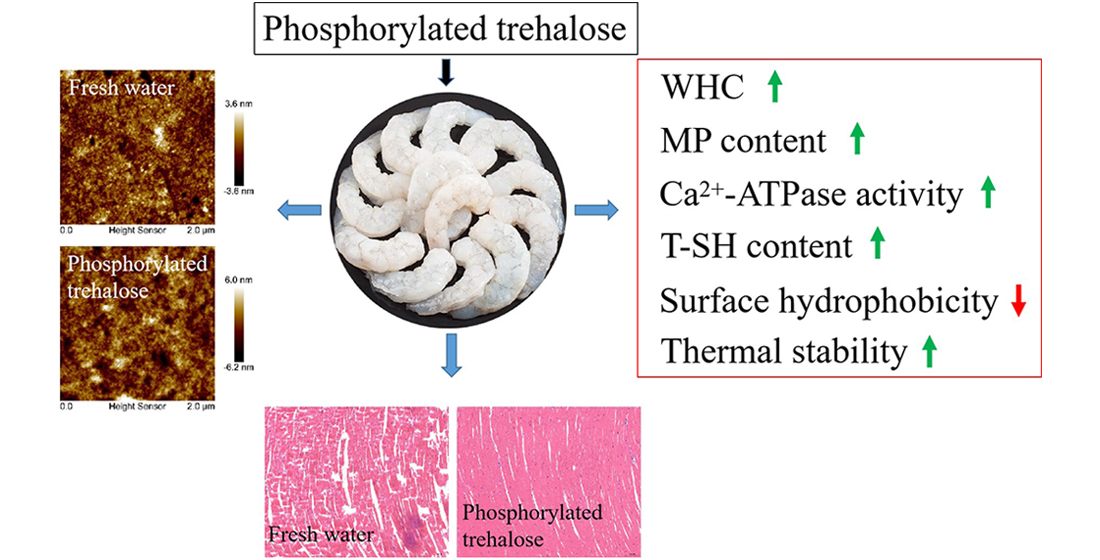
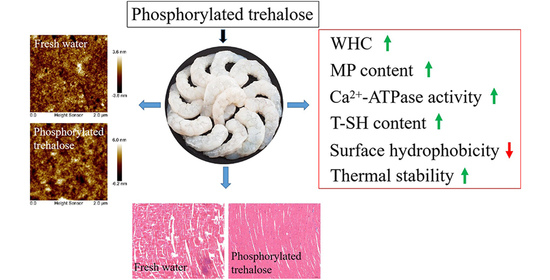
Phosphorylated Trehalose Suppresses the Denaturation of Myofibrillar Proteins in Peeled Shrimp (Litopenaeus vannamei) during Long-Term Frozen Storage


Abstract
Share and Cite
Shui, S.; Yang, H.; Lu, B.; Zhang, B. Phosphorylated Trehalose Suppresses the Denaturation of Myofibrillar Proteins in Peeled Shrimp (Litopenaeus vannamei) during Long-Term Frozen Storage. Foods 2022, 11, 3189. https://doi.org/10.3390/foods11203189
Shui S, Yang H, Lu B, Zhang B. Phosphorylated Trehalose Suppresses the Denaturation of Myofibrillar Proteins in Peeled Shrimp (Litopenaeus vannamei) during Long-Term Frozen Storage. Foods. 2022; 11(20):3189. https://doi.org/10.3390/foods11203189
Chicago/Turabian StyleShui, Shanshan, Huicheng Yang, Baiyi Lu, and Bin Zhang. 2022. "Phosphorylated Trehalose Suppresses the Denaturation of Myofibrillar Proteins in Peeled Shrimp (Litopenaeus vannamei) during Long-Term Frozen Storage" Foods 11, no. 20: 3189. https://doi.org/10.3390/foods11203189
APA StyleShui, S., Yang, H., Lu, B., & Zhang, B. (2022). Phosphorylated Trehalose Suppresses the Denaturation of Myofibrillar Proteins in Peeled Shrimp (Litopenaeus vannamei) during Long-Term Frozen Storage. Foods, 11(20), 3189. https://doi.org/10.3390/foods11203189