1. Introduction
Multifunctional composites are not simply mixtures that display more than one property. In the strongest sense, they are architectures in which several functions are intentionally routed through the same set of interfaces, networks and microstructural pathways. A lightweight film may shield electromagnetic interference while spreading heat; a coating may delay corrosion while acting as an electrical damage sensor; a porous sorbent may remove organic pollutants while reporting its own saturation by impedance spectroscopy; a flexible elastomer may harvest mechanical energy while maintaining conductivity under cyclic strain. These examples explain why hybrid materials are central to current inorganic and composite material research. The scientific challenge is no longer only to disperse a filler, but to design a property vector that remains stable under service conditions [
1,
2,
3,
4,
5,
6,
7,
8,
9,
10,
11,
12].
Carbon/inorganic hybrids occupy a particularly useful position in this landscape. Carbon phases such as carbon black, carbon nanotubes (CNTs), graphene nanoplatelets (GNPs), graphene oxide (GO), reduced graphene oxide (rGO), carbon fibers, carbon foams and bio-derived carbons supply electrical transport, high aspect ratio, low density, polarizability and tunable surface chemistry [
1,
2,
3,
4,
5,
6,
7,
8,
9,
10,
11,
12]. Inorganic phases such as oxides, ferrites, boron nitride, alumina, silica, sulfides, nitrides, carbides, MXenes and noble metal nanoparticles supply functions that carbon alone cannot deliver: magnetic loss, high dielectric response, catalytic activity, ionic storage, hardening, thermal conduction without electrical leakage, chemical selectivity and barrier performance [
13,
14,
15,
16,
17,
18,
19,
20,
21,
22,
23,
24,
25,
26,
27,
28,
29,
30]. The hybrid concept is therefore not decorative. It is a means of distributing roles across phases while using the interface as the coupling region.
The Special Issue theme of multifunctional composites and hybrid materials invites a review that is broader than a single filler family. A carbon/inorganic focus is appropriate because it cuts across the main application areas emphasized in the field: energy, environment, catalysis, electromagnetic protection, advanced characterization, modeling and scalable materials design. The subject also allows one to avoid two common weaknesses in review articles. The first is a catalog structure in which graphene, CNTs, MXenes and oxides are discussed sequentially without a unifying design principle. The second is an excessive emphasis on record values, such as the highest shielding effectiveness, highest thermal conductivity or highest adsorption capacity, without asking whether the property survives processing, thickness reduction, humidity, cycling, regeneration or device integration.
This review instead uses the interface as the organizing concept. Interfaces determine electrical percolation, tunneling, Maxwell–Wagner–Sillars polarization, phonon scattering, adsorption energy, catalytic charge separation, corrosion pathways and mechanical stress transfer. The same graphene platelet that improves microwave loss may increase thermal anisotropy, create electrical leakage, modify resin viscosity and change aging behavior. The same oxide nanoparticle that improves photocatalysis may embrittle a coating or introduce leaching risk. Multifunctionality is therefore a constrained optimization problem, not a simple sum of desirable properties.
The interface-centered approach also clarifies why carbon/inorganic hybrids are different from ordinary filled polymers. In an ordinary composite, the matrix often dominates the property while the filler provides reinforcement or cost adjustment. In a multifunctional hybrid, the interphase is itself an active zone. It can store charge, scatter phonons, bind pollutants, nucleate corrosion products, anchor oxide nanoparticles or transfer mechanical stress. For this reason, interfacial thickness, defect chemistry and contact resistance may be more important than the nominal filler fraction. This is especially true near percolation thresholds and in thin films, where a small change in contact morphology can determine whether the material behaves as an insulator, lossy dielectric, sensor or shield.
A further aim is to place selected graphitic composite studies by Bellucci and collaborators in a balanced context. These papers provide case studies on graphite and graphene nanoplatelet epoxy composites, broadband dielectric spectroscopy, microwave response, GNP contact metrology, thermal diffusivity, graphene-based filters and corrosive aging [
31,
32,
33,
34,
35,
36,
37,
38,
39,
40,
41,
42,
43,
44,
45]. They are relevant because they emphasize real fillers, broad frequency ranges, processing effects and measurement methodology. They are not treated as the object of the review. Instead, they are used as a limited set of measurement-aware examples within a larger international literature that includes CNT/polymer composites, MXene shielding systems, graphene/oxide photocatalysts, carbon/BN thermal networks, sensors, energy devices and safe-by-design materials [
46,
47,
48,
49,
50,
51,
52,
53,
54,
55,
56,
57,
58,
59,
60,
61,
62,
63,
64,
65,
66,
67,
68,
69,
70,
71,
72,
73,
74,
75,
76,
77,
78,
79,
80,
81,
82,
83,
84,
85,
86,
87,
88,
89,
90,
91,
92,
93,
94,
95,
96,
97,
98,
99,
100].
2. Scope, Review Method and Literature Selection
The review covers carbon/inorganic hybrid composites in which at least one carbon phase is functionally coupled to an inorganic phase or to an inorganic-like two-dimensional material. Polymer matrices are included when the functional behavior is governed by the carbon/inorganic network rather than by the polymer alone. The scope therefore includes epoxy/graphene and epoxy/graphite composites, CNT and graphene polymer nanocomposites, MXene/polymer films, graphene/metal oxide photocatalysts, carbon/boron nitride thermal networks, magnetic carbon/oxide absorbers, carbon/ceramic coatings, carbon fiber laminates modified with inorganic nanostructures, and porous carbon/inorganic sorbents. Pure metals, neat ceramics and polymer composites without a functional carbon/inorganic interface are outside the main scope except when they provide relevant benchmarks.
The review follows a narrative, design-centered methodology rather than a formal bibliometric protocol. The literature was selected from Scopus, Web of Science, ScienceDirect, PubMed/Medline where relevant to safety or environmental exposure, Google Scholar, and publisher databases. Searches used combinations of the following terms: carbon/inorganic hybrid composites, graphene nanoplatelet epoxy, CNT polymer nanocomposite, MXene EMI shielding, graphene metal oxide photocatalyst, boron nitride carbon thermal composite, magnetic carbon microwave absorber, carbon-based adsorbent, biochar–graphene hybrid, impedance-monitored filter, multifunctional coating, safe-by-design nanocomposite, life cycle assessment and techno-economic assessment. Priority was given to scholarly research articles and review articles that connect composition, interface structure, processing, measurement conditions and at least one application-relevant function.
Inclusion criteria were: (i) a clear carbon phase, inorganic phase or inorganic-like two-dimensional phase; (ii) an interface or architecture that affects electrical, electromagnetic, thermal, chemical, environmental, mechanical or sensing behavior; (iii) sufficient characterization to link structure and function; and (iv) relevance to multifunctional use under processing, durability, scalability or application constraints. Exclusion criteria were: purely single-function materials without a carbon/inorganic interface, papers lacking sufficient material description, unverified record performance claims without geometry or test conditions, and works whose main contribution was outside the composite/hybrid-material scope. Foundational studies were retained when they established mechanisms or nomenclature, while recent works were prioritized for progress in MXenes, BN/carbon networks, graphene/oxide catalysts, carbon adsorbents and safe-by-design evaluation.
Selected graphitic composite case study papers are included only where they clarify graphitic filler processing, broadband dielectric and microwave metrology, GNP thermal diffusivity, impedance-monitored filters or environmental aging [
31,
32,
33,
34,
35,
36,
37,
38,
39,
40,
41,
42,
43,
44,
45]. The remaining sections are anchored primarily in external literature covering CNT/polymer composites, MXene and graphene shielding systems, metal oxide/carbon photocatalysts, BN/carbon thermal networks, energy storage hybrids, smart coatings, environmental remediation, safety and sustainability [
46,
47,
48,
49,
50,
51,
52,
53,
54,
55,
56,
57,
58,
59,
60,
61,
62,
63,
64,
65,
66,
67,
68,
69,
70,
71,
72,
73,
74,
75,
76,
77,
78,
79,
80,
81,
82,
83,
84,
85,
86,
87,
88,
89,
90,
91,
92,
93,
94,
95,
96,
97,
98,
99,
100]. This structure is intended to provide representative coverage across mechanisms and applications while separating focused examples from field-wide conclusions.
Because the article is organized by mechanisms rather than by chronology, papers are grouped according to the physical or chemical function they clarify: percolation, dielectric loss, thermal transport, adsorption, photocatalysis, electrochemical storage, sensing, corrosion protection, processing, scale-up and safety. This structure is appropriate for multifunctional composites because graphene polymer composites, MXenes, metal oxides, biochar, BN networks and carbon fibers developed in partly separate communities but now converge toward hybrid architectures that must satisfy multiple requirements at once.
A practical consequence of this scope is that the same material may appear in several parts of the review. For example, a graphene/Fe3O4 composite can be discussed as a magnetic microwave absorber, a magnetically recoverable sorbent or a catalytic support. A MXene/cellulose film can be discussed as an EMI shield, a flexible electrode or a humidity-sensitive sensor. A GNP/epoxy coating can be discussed as a dielectric composite, a barrier layer or an aging-sensitive conductive network. This overlap is not a weakness of the classification; it is the essence of multifunctional materials. The review therefore follows functions and mechanisms rather than strict material taxonomies. The review scope, literature-selection logic and role of the selected case studies are summarized in
Table 1.
Table 1.
Review scope, the literature selection logic and role of selected case studies.
Table 1.
Review scope, the literature selection logic and role of selected case studies.
| Literature Block | Role in Review | Representative Functions | Selection Logic |
|---|
| Selected graphitic composite case studies | Focused examples, not the sole framework | Dielectric spectroscopy, microwave response, GNP contacts, thermal diffusivity, monitorable filters, aging | Used only where they clarify measurement-aware graphitic systems and interface–processing–property links |
| Foundational carbon literature | Field basis | CNTs, graphene, GO/rGO, polymer nanocomposites, percolation | Defines carbon building blocks, terminology, processing constraints and mechanisms |
| Inorganic and 2D inorganic literature | Field expansion | MXenes, oxides, ferrites, BN, ceramics, sulfides | Shows how inorganic phases add magnetic, catalytic, ionic, thermal and barrier functions |
| Application-specific literature | External validation | EMI, thermal management, remediation, sensing, energy, coatings | Defines figures of merit, benchmarks, durability constraints and scale-up requirements |
3. Building Blocks: Carbon Phases, Inorganic Phases and Hybrid Interfaces
Carbon phases provide the transport skeleton of many multifunctional hybrids. Carbon black is inexpensive, processable and industrially established, but its nearly isotropic particle morphology often requires relatively high loading to form conductive pathways. CNTs offer high aspect ratio, excellent intrinsic conductivity, mechanical reinforcement and piezoresistive sensitivity, but dispersion and health/safety handling remain nontrivial [
7,
8,
11]. Graphene and GNPs offer high in-plane conductivity, large surface area and strong anisotropy, but their performance depends sharply on platelet thickness, lateral size, defect density, oxidation state, restacking and matrix wetting [
1,
2,
4,
9,
10]. Carbon fibers and carbon fiber reinforced composites provide structural load bearing and are increasingly modified with CNTs, graphene, oxides or MXenes to add sensing, shielding or thermal functions.
Graphene oxide and reduced graphene oxide occupy a special position. GO is often easier to disperse than pristine graphene because oxygenated groups create hydrophilicity and chemical anchoring sites [
5,
6]. Those same groups disrupt the sp2 network, reduce conductivity and increase water uptake. rGO restores part of the conjugated network but rarely reaches pristine graphene performance. This creates a practical design choice. For EMI shielding and high-frequency contacts, excessive oxidation is usually harmful. For adsorption, photocatalysis or oxide nucleation, oxygenated groups are useful. The same material can therefore be either beneficial or problematic depending on the targeted property vector.
GNPs are especially relevant for application-oriented composites because they are more scalable than single-layer graphene and can be incorporated into epoxies, elastomers, coatings and pressed filter structures. The selected graphitic composite case study thread makes this point repeatedly: GNPs and graphitic fillers are treated not as ideal two-dimensional crystals but as real engineering fillers whose performance depends on loading, processing, contact formation, thermal history, measurement frequency and environmental exposure [
31,
32,
33,
34,
35,
36,
37,
38,
39,
40,
41,
42,
43,
44,
45]. This is a strength because many high-performance claims in the graphene literature rely on materials that are difficult to scale or poorly described.
Inorganic phases add functions that carbon phases alone cannot supply. TiO
2, ZnO and SnO
2 are common in photocatalysis, sensing and UV-responsive coatings; MnO
2, Ni(OH)
2, Co
3O
4 and related oxides provide pseudocapacitive or battery-type redox behavior; Fe
3O
4, ferrites and carbonyl iron introduce magnetic loss and magnetic recovery; silica, alumina and zirconia provide hardness and barrier properties; boron nitride and aluminum nitride offer thermal conduction with electrical insulation; and MXenes combine high conductivity, surface terminations and layered morphology [
13,
14,
15,
16,
17,
24,
25,
26,
27,
28,
29,
30,
54,
55,
56,
57,
58,
59]. The value of inorganic phases is not their presence but their accessibility and coupling. A buried oxide particle that cannot exchange charges, ions, heat or molecules with the environment contributes little to multifunctionality.
Boron nitride deserves particular emphasis because it solves one of the central trade-offs of carbon-rich composites. Carbon networks can conduct heat, but they also conduct electricity. In thermal interface materials for electronics, uncontrolled electrical leakage may be unacceptable. BN nanosheets, BN platelets and BN/carbon hybrids can provide thermally conductive pathways while moderating electrical conduction. The most useful hybrids exploit carbon for contact formation, mechanical bridging or microwave response and BN for insulating heat conduction. This illustrates a general principle: the inorganic phase is often not a filler added to improve one property, but a counterweight that controls the side effects of the carbon phase.
Magnetic inorganic fillers illustrate another design logic. Conductive carbon networks attenuate electromagnetic waves primarily through conduction loss, dielectric polarization and reflection. If the composite becomes too conductive, impedance mismatch can cause reflection-dominated shielding rather than absorption. Magnetic oxides and ferrites can introduce magnetic loss, improve impedance matching and enhance absorption. This is important for applications where secondary electromagnetic pollution from reflection is undesirable. Hybrid conductive magnetic systems are therefore more promising for absorption-dominant microwave materials than purely conductive systems optimized only for high shielding effectiveness.
The interface is the key structural element. Covalent functionalization can improve compatibility and stress transfer but may damage conjugated carbon networks. Non-covalent interactions, including pi-pi stacking, polymer wrapping, surfactants, electrostatic assembly and hydrogen bonding, can preserve conductivity but may be less stable under solvents, heat or aging. Silane coupling agents, polydopamine layers and in situ oxide growth can improve inorganic carbon attachment. The optimum approach depends on the service environment. A filter regenerated in water, a microwave absorber heated by dielectric loss and a coating exposed to corrosion require different interface chemistries.
Hierarchical architecture matters as much as composition. Random dispersion is rarely optimal. Segregated networks can reduce the percolation threshold by confining carbon fillers to interparticle boundaries. Laminated films can create anisotropic thermal and electrical pathways. Foams and aerogels increase internal reflection and accessible surface area. Core–shell particles can control interface polarization. Hybrid networks combining CNTs with graphene or MXenes can bridge gaps between platelets and reduce contact resistance. The general design aim is to create a continuous functional network with the smallest effective filler loading compatible with durability and processing.
The surrounding matrix should also be treated as an active design component. Even when the matrix is organic, its viscosity, polarity, curing chemistry, glass-transition temperature, modulus and permeability determine whether the carbon/inorganic network forms and survives. Epoxy matrices provide chemical resistance and dimensional stability but can be brittle. Elastomers enable stretchability and energy harvesting but can dilute filler contacts. Hydrogels and biopolymers improve environmental compatibility but introduce swelling and humidity effects. Ceramic and sol–gel matrices improve thermal and chemical resistance but may crack. The material description should therefore avoid the language of filler alone and describe the filler–matrix–interface triad.
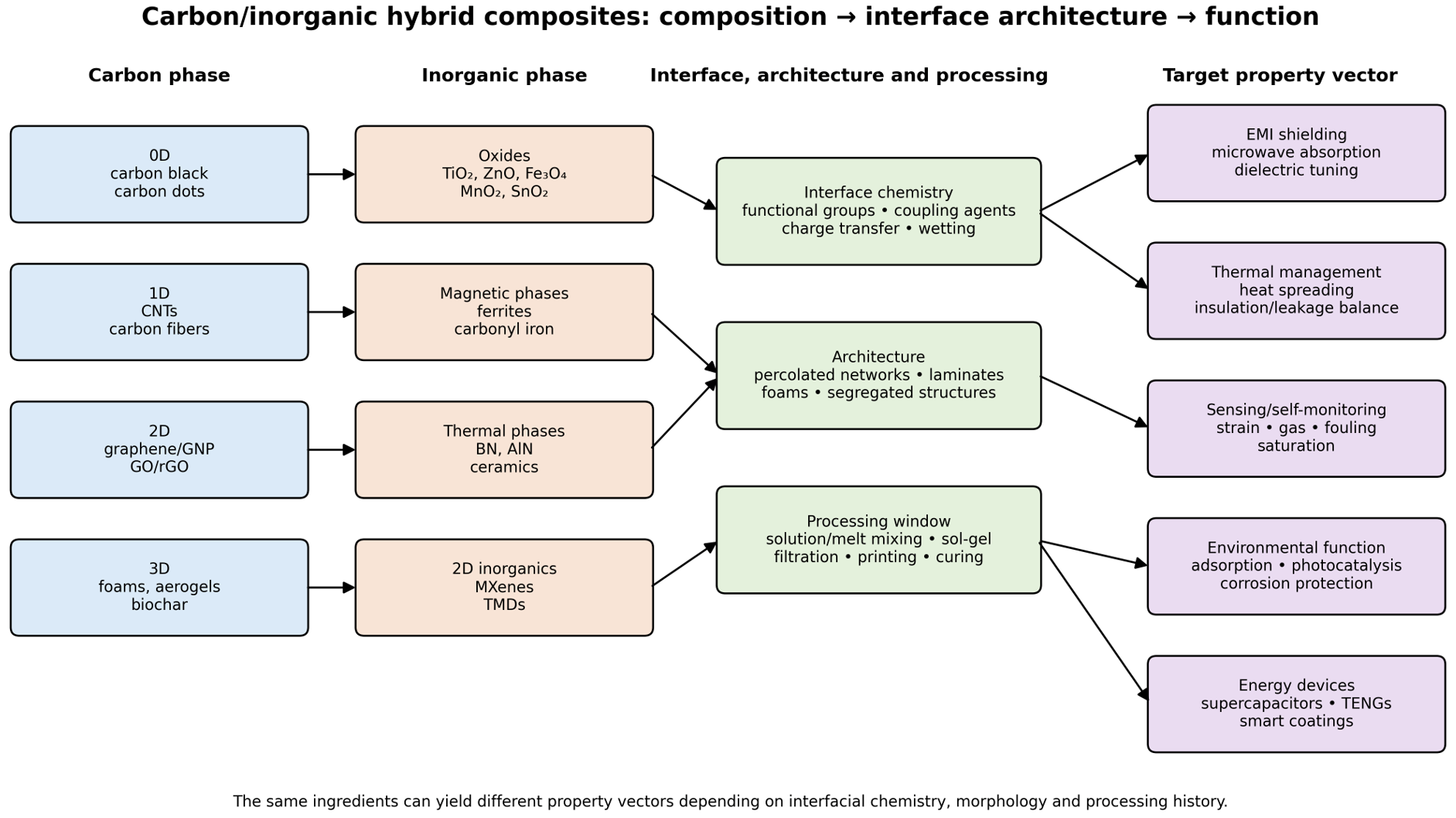
Figure 1 summarizes this composition-interface-processing-function logic.
Figure 1.
Design map for carbon/inorganic hybrid multifunctional composites. The scheme shows how 0D, 1D, 2D and 3D carbon phases combine with oxides, ferrites, boron nitride, MXenes and other inorganic phases. Interface chemistry, architecture and processing determine whether the same composition provides electromagnetic shielding, thermal management, sensing, remediation, catalysis, energy device behavior or protective functions.
Figure 1.
Design map for carbon/inorganic hybrid multifunctional composites. The scheme shows how 0D, 1D, 2D and 3D carbon phases combine with oxides, ferrites, boron nitride, MXenes and other inorganic phases. Interface chemistry, architecture and processing determine whether the same composition provides electromagnetic shielding, thermal management, sensing, remediation, catalysis, energy device behavior or protective functions.
4. Mechanisms of Multifunctionality
Electrical percolation is the most familiar mechanism in carbon-filled composites. Below a critical loading, conductive particles or platelets are isolated and the composite behaves as an insulator or weak dielectric. Near the percolation threshold, tunneling, capacitive gaps and local clusters create a sharp increase in conductivity and dielectric response. Above the threshold, continuous networks enable DC conduction, Joule heating, EMI shielding and piezoresistive sensing [
46,
47,
48,
49,
50,
51,
52,
53]. The threshold depends on filler aspect ratio, dispersion, orientation, aggregation, matrix viscosity, curing history and processing shear. It is not a universal property of a filler grade.
The percolation threshold is often reported as a single number, but it is better understood as a processing-sensitive window. A composite may percolate in one direction but not another because platelets align during coating, filtration or compression. The apparent threshold may shift after thermal annealing, mechanical deformation or solvent exposure because contacts are created or lost. Near the threshold, small changes in tunneling distance produce large changes in resistance, which is useful for sensing but dangerous for reliability. For this reason, materials designed for stable shielding may need to operate well above the threshold, while materials designed for strain or fouling sensing may deliberately operate close to it.
Percolation should not be interpreted only as DC conductivity. At high frequency, disconnected clusters can still contribute to polarization and loss. Interfaces act as capacitors, tunneling gaps act as frequency-dependent junctions and local dipoles can follow alternating fields only over specific relaxation windows. Broadband dielectric spectroscopy is therefore more informative than a single conductivity value. The selected broadband dielectric case studies show that graphitic composites must be characterized over frequency ranges relevant to their intended function rather than by room temperature DC conductivity alone [
32,
33,
34,
35,
36,
39].
Electromagnetic shielding and microwave absorption arise from several coupled processes: reflection at impedance discontinuities, absorption by conduction and polarization loss, magnetic loss when magnetic fillers are present, and multiple internal reflections in porous or multilayer structures [
21,
22,
23,
50,
51,
52,
53,
54,
55,
56,
57,
58]. A material may show high total shielding effectiveness but still be unsuitable for applications requiring absorption-dominant behavior. Conversely, a material with moderate total shielding may be valuable if it is thin, lightweight, flexible, thermally stable and absorption dominated. Reporting only total shielding effectiveness is therefore inadequate. Thickness, density, frequency band, reflection/absorption partition and measurement fixture must be provided.
Thermal transport is governed by a different but related network problem. Graphene, graphite and CNTs have high intrinsic thermal conductivity, yet polymer composite values are usually much lower because heat must cross many filler–filler and filler–matrix interfaces [
18,
19,
20]. Phonon boundary resistance, voids, poor wetting, platelet misalignment and defects reduce effective conductivity. Anisotropy is expected: graphene platelets conduct more effectively in-plane than through stacked interfaces. A high in-plane thermal conductivity may be useful for heat spreading, while through-plane conductivity is critical for thermal interface materials. The distinction must be measured and reported.
Thermal and electrical networks are sometimes correlated but not equivalent. A carbon-rich composite can be electrically percolated while still thermally limited by poor phonon transmission across interfaces. Conversely, BN-rich networks can conduct heat while remaining electrically insulating. Hybrid design can exploit this decoupling by combining carbon fillers that improve contact and mechanical bridging with ceramic fillers that provide electrically safe heat flow. The relevant figure of merit is not only thermal conductivity, but thermal conductivity at acceptable viscosity, electrical leakage, modulus, density and cost. This is why thermal management should be evaluated as a multidimensional design problem rather than as a single conductivity ranking.
The thermal part of the selected graphitic composite case study thread is significant because it treats metrology as part of the materials problem. Flash methods and photothermal beam deflection methods are sensitive to optical absorption, transmittance, reflectance, porosity, density and heat flow direction [
38,
40,
43]. If these conditions are not controlled, thermal diffusivity data can be misinterpreted. This is not a minor technical issue. Thermal management materials are often compared by values extracted with different assumptions, geometries and corrections. A review that targets multifunctional composites should therefore insist on uncertainty, directionality and optical/thermal boundary conditions.
In environmental hybrids, adsorption and catalysis couple surface chemistry with transport. Carbon phases provide surface area, porosity, electron transport and hydrophobic interactions, while oxides or sulfides provide active sites, photocatalytic band structures or redox activity [
24,
25,
26,
27,
59,
60,
61,
62,
63]. Graphene/oxide photocatalysts are often described as improving charge separation because carbon can accept or shuttle electrons, reducing recombination. However, real water treatment requires more than dye degradation under ideal laboratory conditions. Ions, pH, natural organic matter, turbidity, competing pollutants and catalyst recovery affect performance. Regeneration and by-product analysis are necessary before claiming environmental applicability.
Sensing arises when adsorption, strain, temperature, humidity, corrosion or fouling changes the electrical, dielectric, optical or electrochemical response of the hybrid network. CNTs and graphene are sensitive because surface adsorption perturbs conductance; oxides add selectivity and catalytic activity [
69,
70,
71,
72]. The weakness is often not sensitivity but selectivity and stability. Humidity, temperature and aging can mimic analyte response. For filter monitoring, the same issue arises: impedance changes must be assigned to pollutant loading or regeneration state rather than uncontrolled conductivity drift. The selected GNP filter case studies are important because they move from passive sorption toward monitorable remediation [
41,
42].
Energy-storage and energy harvesting functions depend on ion-accessible interfaces, electron pathways and mechanical durability. In supercapacitors and batteries, carbon provides conductivity and surface area while inorganic oxides, hydroxides, sulfides or MXenes provide redox activity and capacitance [
17,
28,
29,
30,
73,
74,
75,
76,
77,
78,
79]. In triboelectric nanogenerators and flexible energy devices, carbon fillers can tune dielectric response, charge trapping, mechanical compliance and electrode behavior [
45]. These devices demonstrate multifunctionality only if electrical output, mechanical cycling, humidity stability and processability are reported together. A high capacitance or output voltage measured in a fragile laboratory film is not enough.
Mechanical reinforcement is sometimes treated as separate from functional properties, but this is misleading. A composite that cracks under bending loses conductivity, sensing stability, shielding and barrier function. A coating that delaminates loses corrosion protection and thermal contact. A foam that collapses loses adsorption volume and internal reflection. Multifunctionality therefore requires mechanical integrity appropriate to the application. The correct question is not whether the filler increases modulus in a tensile test, but whether the functional network remains connected after the deformation, cycling and aging that the device will experience.
The most important mechanism-level conclusion is that multifunctionality is often produced by the same feature that creates trade-offs. A percolated carbon network helps EMI shielding, sensing and Joule heating but may harm insulation and microwave impedance matching. Porosity helps adsorption and internal reflection but reduces mechanical strength. Functionalization improves dispersion and selectivity but may degrade conductivity. Oxide loading improves catalysis or dielectric response but increases density and brittleness. The practical goal is balanced co-optimization, not a record value in one column of a table.
Modeling can help manage these trade-offs, but only if it is tied to realistic morphology. Effective medium models are useful for dilute systems, percolation models for network formation, finite element simulations for anisotropic heat flow and electromagnetic models for layered absorbers. Yet many models assume ideal particles, uniform dispersion and sharp interfaces. Real composites contain agglomerates, voids, platelet curvature, oxidation gradients and interphase regions. A valuable future direction is therefore correlative modeling: extracting morphology from microscopy, tomography or scattering, then using it to simulate electrical, thermal and electromagnetic response. Such an approach would reduce the gap between materials synthesis and device design.
5. Selected Graphitic Composite Case Studies Within the Broader Field
The selected graphitic composite papers are discussed in this section as case studies, not as a self-contained representation of the field. Their value for the present review is methodological: they connect realistic graphitic fillers, epoxy matrices, broadband dielectric spectroscopy, microwave response, high-frequency contact behavior, thermal diffusivity, impedance-monitored filters and aging. These topics overlap with wider research on CNT/polymer networks, MXene shields, graphene/oxide photocatalysts, BN/carbon thermal materials, energy devices and safe-by-design hybrid systems.
The 2015 broadband dielectric spectroscopy work is particularly central to the review theme [
33]. It studied epoxy composites filled with several carbon materials across a broad frequency window, linking percolation, dielectric behavior and shielding potential. The lesson is methodological as well as material-specific. A composite intended for EMI shielding, microwave attenuation or high-frequency sensing cannot be characterized only by one frequency or one conductivity value. The dielectric response can change across orders of magnitude in frequency because different polarization and transport mechanisms dominate. This broad frequency approach is directly relevant to multifunctional composites because the same network may be used for DC sensing, microwave shielding and dielectric heating.
The AIP Advances study on microstructure, elastic and electromagnetic properties of epoxy–graphite composites broadened the analysis from electrical response to structure–property coupling [
34]. This is important because multifunctional design is not achieved by adding an electromagnetic filler to an otherwise passive matrix. Mechanical integrity, filler connectivity and microstructure affect the stability of the electromagnetic function. A review focused on hybrid materials should therefore highlight papers that connect microstructure, elastic response and electromagnetic behavior, not only those reporting peak shielding effectiveness.
The 2016 GNP/epoxy electromagnetic studies strengthened this direction by showing how GNP loading and processing history influence broadband electromagnetic properties [
35,
36]. In particular, annealing and thermal history can modify contacts within a filler network, changing conductivity and microwave response. This point has broader consequences. Processing is not simply a route to make a sample; it is part of the final functional architecture. Resin viscosity, solvent choice, curing temperature, thermal post-treatment and pressure can all shift percolation and interfacial polarization. These variables need to be reported with the same seriousness as filler percentage.
The microwave contact case study is valuable because it moves from bulk composites to device-like high-frequency configurations [
39]. Measuring the electrical permittivity and conductivity of a GNP contact in the microwave range forces the material to be considered as part of a circuit, not only as a free-standing coupon. Many multifunctional composites fail at this transition. A material may show promising conductivity or shielding in a laboratory geometry but become difficult to contact, pattern, match or encapsulate in a device. High-frequency contact metrology is therefore a bridge between materials science and device engineering.
The thermal diffusivity case study group adds a second important axis [
38,
40,
43]. GNP materials are attractive for heat spreading, but their anisotropy and measurement sensitivity are often underestimated. Bellucci and collaborators addressed transmittance and reflectance effects during flash measurements and used photothermal beam deflection to distinguish in-plane and through-plane diffusivity. This is precisely the kind of metrological awareness that a mature review should promote. Without it, thermal management claims become difficult to compare and sometimes misleading.
The graphene filter studies add a third axis: environmental functionality and self-monitoring [
41,
42]. A pressed GNP filter that can adsorb pollutants and be monitored electrically represents a shift from passive materials to instrumented materials. In water remediation, the operational problem is not only capacity but knowing when the filter is approaching saturation, whether regeneration has restored performance and whether the material is drifting. Electrical impedance spectroscopy provides a plausible route to such monitoring. The concept can be generalized to carbon/oxide catalysts, conductive membranes, smart sorbent beds and corrosion monitoring coatings.
The aging study of graphene–epoxy/nanoplatelet thin films adds durability to the case study group [
44]. This is not secondary. Corrosive environments, humidity and chemical exposure can alter filler contacts, matrix adhesion, conductivity and barrier behavior. A multifunctional coating that performs well before aging but fails after exposure is not application-ready. Aging studies also make explicit a tension in carbon materials: defects and interfaces can create functional response, but they can also create pathways for degradation if not stabilized.
The more recent MWCNT/polysiloxane TENG work extends the case study group toward flexible energy harvesting devices [
45]. It is useful because it shows that carbon fillers can tune electromechanical and dielectric behavior in soft matrices. At the same time, it illustrates the limits of a case-study-based discussion. TENGs, supercapacitors, MXene devices, oxide/carbon catalysts and BN/carbon thermal networks have large external literature. The case study group is therefore positioned as a measurement-aware graphitic composite example set that intersects these broader fields rather than as a comprehensive substitute for them.
The purpose of this section is therefore limited and comparative. The case studies are used where they illustrate processing-sensitive graphitic networks and measurement methodology; broader claims on electromagnetic shielding, thermal management, catalysis, adsorption, sensing, energy storage, safety and scale-up are supported primarily by external literature. This boundary is important because a credible review must separate focused examples from field-wide conclusions.
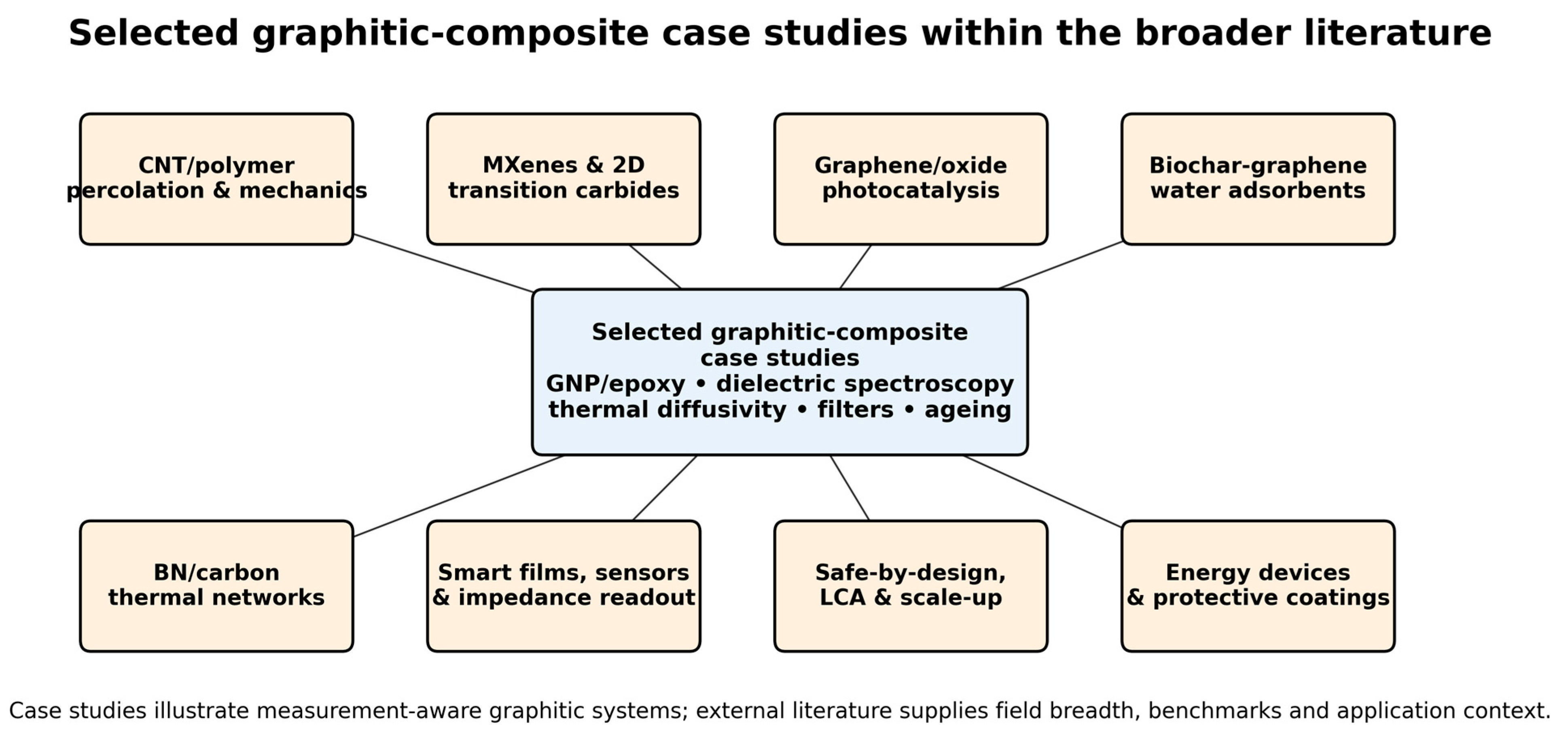
Figure 2 positions these selected graphitic-composite case studies within the surrounding benchmark fields. The selected graphitic-composite case studies and their function in the review are summarized in
Table 2.
Figure 2.
Selected graphitic composite case studies are used as measurement-aware examples within the review. External literature supplies the surrounding benchmark fields: CNT/polymer composites, MXenes, graphene/oxide photocatalysis, BN/carbon thermal networks, biochar–graphene water treatment adsorbents, sensors, safe-by-design evaluation and life cycle thinking. The figure distinguishes focused examples from field-wide support literature.
Figure 2.
Selected graphitic composite case studies are used as measurement-aware examples within the review. External literature supplies the surrounding benchmark fields: CNT/polymer composites, MXenes, graphene/oxide photocatalysis, BN/carbon thermal networks, biochar–graphene water treatment adsorbents, sensors, safe-by-design evaluation and life cycle thinking. The figure distinguishes focused examples from field-wide support literature.
Table 2.
Selected graphitic composite case study papers and their function in the review.
Table 2.
Selected graphitic composite case study papers and their function in the review.
| Reference Block | Material System | Main Function | Reason for Inclusion |
|---|
| [31,32] | GNP/exfoliated graphite/epoxy | Electrical and dielectric behavior | Early graphitic composite basis; realistic filler morphology |
| [33,34] | Carbon-filled epoxy and epoxy–graphite | Broadband dielectric, microstructure, elastic and electromagnetic properties | Core measurement-aware case study group |
| [35,36] | GNP/epoxy composites | Microwave response and shielding | Links processing, filler loading and high-frequency function |
| [39] | GNP contact | Permittivity and conductivity in microwave range | Device-relevant high-frequency contact perspective |
| [38,40,43] | Free-standing or assembled GNP structures | Thermal diffusivity and anisotropy | Highlights metrology, optical corrections and directional transport |
| [41,42] | Pressed GNP filters | Pollutant removal and impedance monitoring | Example of self-monitoring environmental multifunctionality |
| [44,45] | Graphene–epoxy films; MWCNT/polysiloxane TENGs | Aging; flexible energy harvesting | Extends case study group toward durability and smart devices |
6. Application Domains and External Literature Context
Electromagnetic interference shielding remains one of the most developed application domains for carbon/inorganic hybrid composites. The basic engineering target is to attenuate incident electromagnetic radiation, but the mechanism matters. Reflection-dominated shielding may be acceptable for enclosures but undesirable when secondary reflection causes system-level problems. Absorption-dominant shielding requires impedance matching, internal loss and often hierarchical or magnetic structures [
21,
22,
23,
50,
51,
52,
53,
54,
55,
56,
57,
58]. Carbon phases provide conductive loss and low density; magnetic oxides, ferrites and MXenes provide additional loss channels and interfacial polarization. The current frontier is not simply higher shielding effectiveness, but thin, flexible, durable and absorption-rich materials with reported density-normalized performance.
In practical EMI design, three performance descriptors should be kept separate. The first is total shielding effectiveness, which is useful but incomplete. The second is absorption contribution, which determines whether the material suppresses rather than redirects electromagnetic noise. The third is specific or absolute shielding effectiveness, which accounts for density and thickness. Lightweight aerospace and portable electronics require thin, low-density materials, while fixed infrastructure may tolerate higher mass. Carbon/inorganic hybrids are attractive because porosity, magnetic inclusions, conductive networks and laminated architectures can be combined to tune these descriptors. However, comparing values across papers without normalizing thickness and density is scientifically weak.
MXenes have transformed the EMI literature because Ti3C2Tx and related materials combine high conductivity, layered morphology and processability into films, foams, papers and polymer composites [
13,
14,
15,
16,
17,
54,
56,
57,
58,
80,
81,
82,
83,
97,
98,
99]. Their shielding can be impressive at small thickness, and their surface terminations allow hybridization with polymers, CNTs, graphene, cellulose and oxides. The main limitations are oxidation stability, humidity sensitivity, restacking and processing hazards associated with some etching routes. In a carbon/inorganic review, MXenes should be treated as both an opportunity and a warning. They show how powerful two-dimensional conductive inorganics can be, but they also show that stability and processing chemistry determine whether high performance survives beyond the laboratory.
Beyond EMI shielding, MXenes require a more critical treatment because their high conductivity, hydrophilic surface terminations and layered morphology can be advantageous for electrodes, sensors and electromagnetic attenuation but problematic for oxidation stability and long-term aqueous exposure. Hybridization with CNTs, graphene, cellulose, polymers or oxides can reduce restacking and improve mechanical integrity; however, the same additives can change ion transport, moisture uptake and end-of-life behavior. For this reason, MXene-based composites should be compared not only by shielding effectiveness or capacitance but also by oxidation resistance, film thickness, areal mass, storage conditions, processing route and chemical safety.
BN/carbon networks represent a separate and equally important material family. They are not simply thermal fillers mixed with graphene. They address the fundamental conflict between heat spreading and electrical insulation. BN platelets or nanosheets provide phonon pathways with low leakage current, while graphene, CNTs or carbon fibers can improve contact, toughness or electromagnetic function. The relevant figures of merit are therefore direction-dependent thermal conductivity, electrical resistivity, dielectric breakdown, viscosity, mechanical compliance and interfacial thermal resistance measured in the same formulation.
Metal oxide/carbon catalysts and sorbents also deserve independent treatment. In TiO2-, ZnO-, Fe3O4-, MnO2-, Co3O4- or Ni-based hybrids, carbon can increase adsorption, electron mobility and structural integrity, while the inorganic phase supplies active sites, band structure, redox activity or magnetic recovery. The main risks are leaching, photocorrosion, limited mineralization, by-product formation and performance loss in real matrices. Reviews should therefore distinguish dye decolorization from pollutant mineralization and should require regeneration, mass balance, pH/ionic-strength effects and by-product analysis before using the term application-ready.
Thermal management is increasingly coupled with electromagnetic protection. Electronics, power modules, aerospace systems and wearable devices often require both heat dissipation and electromagnetic compatibility. Carbon networks can contribute to both, but the requirements are not identical. Strong electrical conduction helps EMI shielding but can cause leakage. Platelet alignment helps in-plane heat spreading but may not improve through-plane dissipation. BN/carbon, graphene/ceramic and MXene/carbon hybrids are promising because they allow thermal and electrical pathways to be partially decoupled [
18,
19,
20,
55]. Reviews should therefore report direction-dependent thermal conductivity, electrical conductivity and shielding in the same samples whenever possible.
Environmental remediation is another major domain. Graphene/oxide photocatalysts, carbon/oxide sorbents, magnetic carbon hybrids and conductive membranes can remove or degrade organic pollutants, heavy metals, nutrients and emerging contaminants [
24,
25,
26,
27,
59,
60,
61,
62,
63]. Carbon improves adsorption and electron transport, while oxides provide photocatalytic or redox activity. However, the field still suffers from overly idealized tests. Dye degradation in deionized water under controlled light does not prove performance in real industrial or municipal water. The most convincing studies report kinetics, selectivity, pH effects, competing ions, natural organic matter, regeneration cycles, leaching and by-product formation. The impedance-monitored GNP filter case studies fit this field because they address operational monitoring, not only removal efficiency [
41,
42].
The recently published
Materials Today Chemistry review by Hu et al. on biochar–graphene hybrid adsorbents for organic pollutant removal is directly relevant to this point [
100]. It is useful for the present review because it shifts the discussion from generic carbon adsorbents to biomass-derived carbon/graphene hybrids and emphasizes adsorption mechanisms, synthesis routes, surface functionalization, regeneration, life cycle burdens and safe-by-design evaluation. Its inclusion broadens the environmental section beyond GNP filters and graphene/oxide photocatalysts and strengthens the connection between laboratory adsorption performance and water treatment feasibility.
For water treatment applications, the distinction between adsorption, degradation and mineralization is essential. Adsorption transfers contaminants from water to a solid phase and therefore requires regeneration or disposal. Photocatalytic degradation can transform contaminants but may generate intermediate products. Electrochemical or photoelectrochemical hybrids can drive reactions under bias or light, but energy cost and electrode fouling become relevant. Carbon/inorganic hybrids are promising because they can combine adsorption concentration, catalytic conversion and electrical monitoring in one platform. The strongest future materials will not simply remove a pollutant in a batch test; they will show controlled flow operation, regeneration, monitoring and mass balance under realistic water chemistry.
Sensing and self-monitoring cut across all application domains. A conductive carbon network can serve as a strain sensor in a structural composite, a corrosion sensor in a coating, a fouling sensor in a membrane, or a saturation sensor in a filter. Metal oxides add chemical sensitivity to gases and reactive species, while CNTs and graphene provide conductive readout [
69,
70,
71,
72]. The difficult part is selectivity and drift. Humidity, thermal expansion, matrix aging and contact degradation can all change resistance or impedance. Robust sensor composites therefore require reference channels, calibration models, encapsulation strategies and environmental correction. Without those elements, sensitivity claims are fragile.
Energy conversion and storage provide further examples of hybrid design. Graphene and CNTs improve electron transport and mechanical integrity in supercapacitors and batteries, while oxides, hydroxides, sulfides and MXenes provide redox-active surfaces and ion storage [
17,
28,
29,
30,
73,
74,
75,
76,
77,
78,
79]. In triboelectric or piezoelectric devices, carbon fillers can tune dielectric properties, mechanical compliance and electrode behavior [
45]. The same rules apply: mass loading, electrode thickness, full-device configuration, cycling stability and mechanical durability must be reported. A powder with high specific capacitance or a thin film with high output under ideal contact is not enough for application claims.
Protective coatings and corrosion-resistant hybrids add another dimension. Graphene, GNPs and rGO can create tortuous diffusion paths, while oxides and ceramic particles can improve hardness and barrier behavior [
84,
85,
86]. Yet graphene can also accelerate galvanic corrosion if it creates conductive pathways connected to a metal substrate [
86]. This is an important example of a trade-off that is often hidden in simplified narratives. Conductivity is not universally good. A carbon-rich coating must be designed so that barrier behavior, adhesion and electrochemical compatibility are preserved. Aging in corrosive media, as shown by the graphene–epoxy aging case study, is therefore essential rather than optional [
44].
Flexible devices and smart surfaces bring together many of these functions. A wearable patch may require conductivity, stretchability, EMI protection, thermal comfort, sensing and biocompatibility. A smart building coating may need pollutant degradation, UV stability, moisture resistance and self-cleaning. A structural aerospace composite may need load bearing, lightning-strike protection, de-icing, damage sensing and low mass. Carbon/inorganic hybrids are plausible platforms for these systems, but only if the field moves beyond single-property optimization and reports how functions interact under realistic service conditions.
A growing opportunity is multifunctional structural composites. Carbon fibers laminates already carry mechanical loads and conduct electricity, but they can be modified with CNTs, graphene, oxides or MXenes to add damage sensing, lightning-strike protection, de-icing, EMI shielding and thermal spreading. The design challenge is interlaminar. Nanofillers can improve interfacial strength and conductivity, but they can also increase resin viscosity, create filtration during infusion or weaken fiber matrix adhesion if poorly controlled. Structural multifunctionality should therefore be evaluated with both mechanical damage modes and functional retention after impact, fatigue or environmental aging.
The external literature also highlights the importance of nomenclature. Terms such as graphene, graphene nanoplatelets, few-layer graphene, graphite nanoplatelets, graphene oxide and reduced graphene oxide are often used loosely [
89]. This damages comparability. A material with 10-layer platelets, oxygenated edges and micron-scale lateral size is not equivalent to pristine monolayer graphene. Similarly, a MXene film with specific surface terminations and oxidation history is not a generic conductive two-dimensional sheet. Accurate description of filler morphology and chemistry is a prerequisite for meaningful multifunctional design.
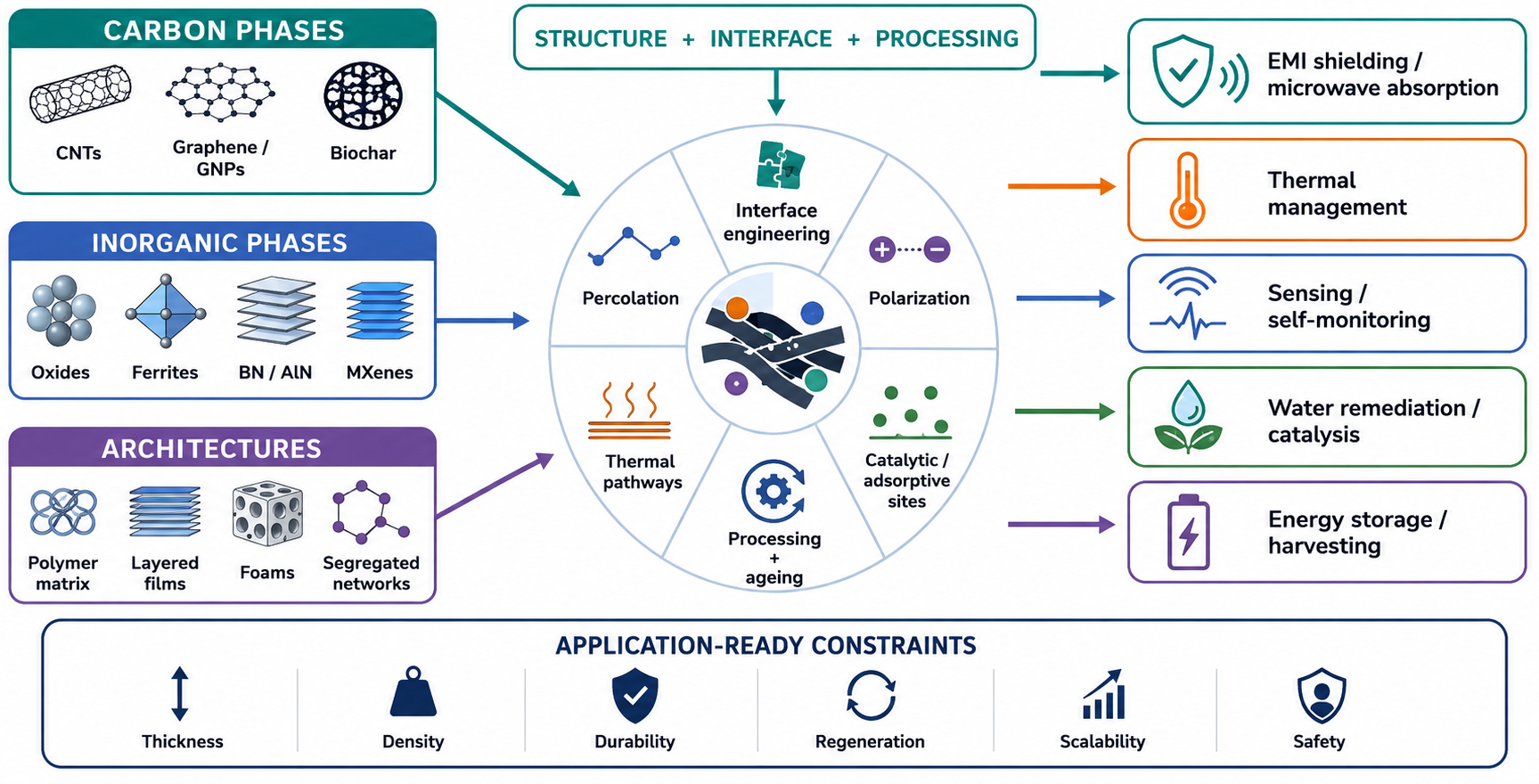
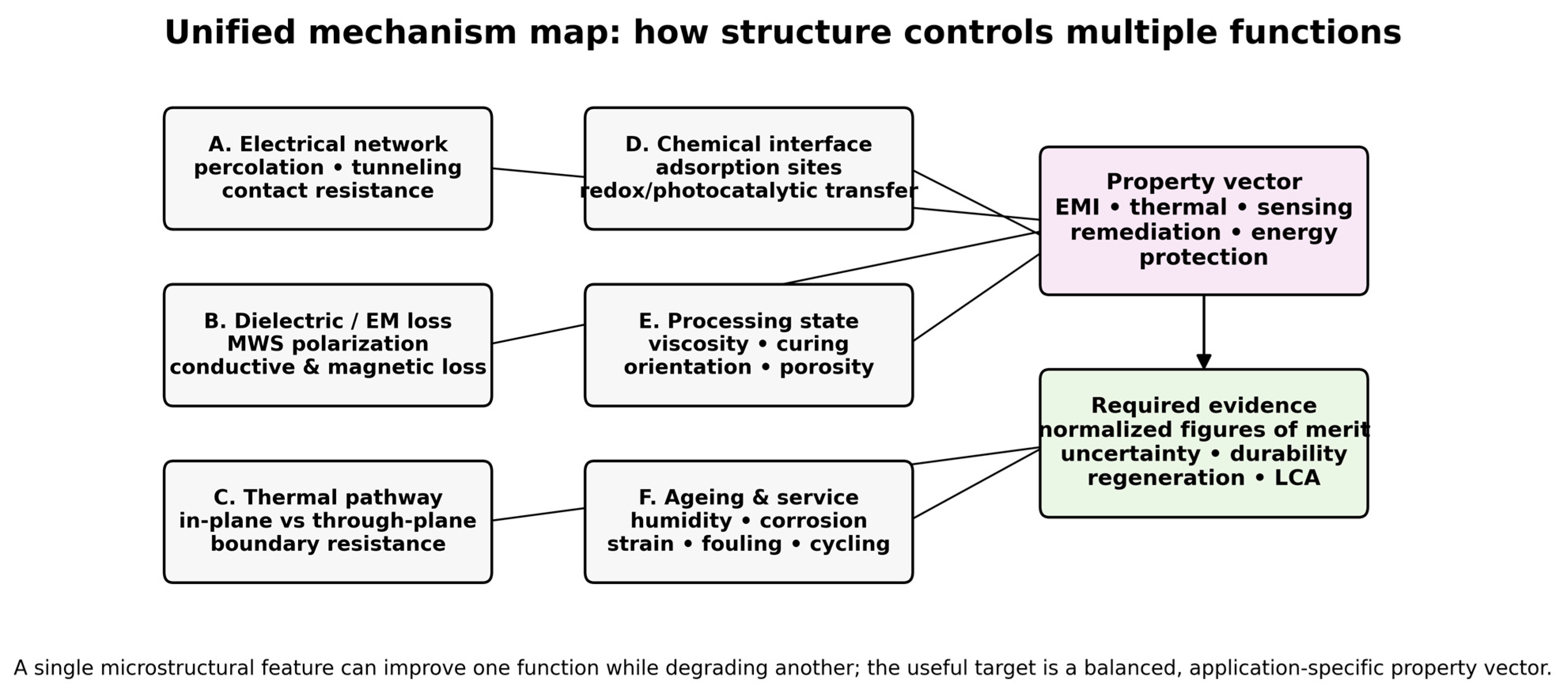
Figure 3 summarizes the resulting structure-interface-function mechanism map.
Figure 3.
Unified mechanism map linking structure, interfaces and multiple functions. Electrical networks, dielectric and magnetic losses, thermal pathways, chemical interfaces, processing state and aging/service conditions jointly determine the property vector. The same microstructural feature may improve one function while limiting another, which is why application-specific co-optimization is required.
Figure 3.
Unified mechanism map linking structure, interfaces and multiple functions. Electrical networks, dielectric and magnetic losses, thermal pathways, chemical interfaces, processing state and aging/service conditions jointly determine the property vector. The same microstructural feature may improve one function while limiting another, which is why application-specific co-optimization is required.
7. Processing, Scale-Up and Metrology
Processing determines the functional network. Solution mixing, sonication, three-roll milling, melt blending, in situ polymerization, resin infusion, vacuum filtration, electrophoretic deposition, spray coating, layer-by-layer assembly, sol–gel growth, hydrothermal synthesis, freeze casting, hot pressing and additive manufacturing all impose different morphologies. Sonication can disperse graphene or CNTs but may reduce platelet size or nanotube length. Surfactants improve stability but can leave insulating residues. Functionalization improves compatibility but may reduce conductivity. Melt blending is scalable but can increase aggregation or filler damage. Vacuum filtration produces aligned films but may not translate to thick composites. These are not secondary processing details; they are functional variables.
For epoxy and thermoset systems, viscosity and curing are especially important. A filler that disperses well at low viscosity may agglomerate during solvent evaporation or curing. A network may form before gelation or be frozen in a suboptimal state. Thermal post-treatment can improve contacts but may introduce residual stress or matrix degradation. The selected GNP/epoxy case studies are useful here because they link processing, annealing and electromagnetic response [
35,
36]. Without reporting resin viscosity, mixing procedure, curing schedule, sample thickness and uncertainty, filler loading effects cannot be compared reliably.
Scale-up changes morphology. A uniform small film can become compositionally graded when cast over a larger area. Solvent evaporation can orient platelets differently across thickness. Thick coatings may trap voids. Large panels may cure with temperature gradients. Pressed filters may develop radial density variation. Films that shield well in a coaxial fixture may crack or delaminate when bent, cut or laminated. Discussion of scale-up should therefore distinguish laboratory feasibility from process windows. The best future papers will report ranges of acceptable processing conditions rather than one optimized recipe.
Data management is another part of scale-up. Multifunctional composites generate high-dimensional datasets: filler grade, surface chemistry, processing route, rheology, curing cycle, porosity, conductivity, permittivity, permeability, thermal diffusivity, adsorption capacity, mechanical response and aging state. Machine learning approaches may help identify design windows, but only if the underlying data are well annotated. At present, many papers omit precisely the variables that would make their data reusable. A stronger community standard would require machine-readable supplementary tables reporting composition, morphology, processing and test conditions for every sample.
Metrology must be coupled to function. For EMI shielding, authors should report frequency band, sample thickness, areal density, fixture geometry, calibration, conductivity, reflection and absorption terms where possible, and environmental conditioning. For microwave absorption, reflection loss should be reported with matching thickness and bandwidth, not only a minimum value. For thermal transport, authors should report heat flow direction, density, porosity, specific heat assumptions, optical absorption corrections and uncertainty. For adsorption, authors should report pH, ionic strength, initial concentration, matrix composition, kinetics, regeneration and leaching. For sensing, authors should report detection range, response/recovery time, selectivity, hysteresis, drift and humidity interference.
A central weakness in the literature is the claim of multifunctionality based on sequential measurements that are not service-relevant. A material is measured for shielding, then in another test for thermal conductivity, then in another test for mechanical strength. This is useful, but it does not prove that the functions coexist during operation. Stronger demonstrations measure coupled conditions: shielding while heating, sensing under strain, filter impedance during pollutant adsorption, thermal conductivity after corrosion aging, or electrochemical performance after bending cycles. The EIS-monitored filter case study is valuable because it moves in this direction by measuring function during operation [
42].
Statistical reporting is also insufficient in many composite papers. Filler dispersion is heterogeneous, yet papers often report single values without sample-to-sample variation. Measurement uncertainty is particularly important near percolation thresholds, where small morphological changes produce large conductivity differences. Thermal measurements of anisotropic GNP structures require uncertainty in density and heat flow direction. Adsorption measurements require error bars and mass balance checks. If multifunctional composites are to be compared quantitatively, the field needs property maps rather than isolated maxima.
Reference materials would also help. EMI studies could include a standard conductive polymer or carbon-loaded coupon measured in the same fixture. Thermal studies could include a benchmark polymer and a benchmark commercial thermal pad. Adsorption studies could include activated carbon or a standard sorbent under identical conditions. Sensor studies could include a known oxide or CNT sensor exposed to the same humidity and analyte protocol. Such benchmarks would make individual claims less isolated and would allow readers to assess whether a new carbon/inorganic hybrid offers a real advantage or merely reproduces known behavior with a different formulation.
Device integration adds another metrological layer. Contacts, electrodes, substrates, encapsulation, patterning and packaging can dominate performance. A conductive film may have low sheet resistance but high contact resistance. A thermal material may conduct well as a pressed disk but poorly when bonded to rough surfaces. A filter may show impedance response in a laboratory cell but require robust feedthroughs and fouling-resistant electrodes in real water. A sensor may need baseline correction and signal processing. Future reviews should therefore include device-level architecture, not only material composition.
Reporting standards should include negative information. If high conductivity harms absorption, if high oxide loading embrittles the matrix, if a graphene coating accelerates corrosion under certain conditions, or if a filter loses capacity after regeneration, those results are scientifically valuable. Multifunctional design advances through trade-off maps. The field is mature enough to move away from promotional language and toward engineering criteria: what combination of properties is sufficient for a defined use case, and what failure mode limits further progress? The critical processing and experimental variables that should be reported for reproducibility are summarized in
Table 3, while application-oriented reporting metrics are summarized in
Table 4.
Table 3.
Critical processing and experimental variables that should be reported for reproducibility.
Table 3.
Critical processing and experimental variables that should be reported for reproducibility.
| Variable Class | Minimum Information to Report | Why It Matters | Typical Consequence If Omitted |
|---|
| Composition | Filler identity, loading in wt.% and vol.%, aspect ratio, oxidation state, inorganic phase content | Controls percolation, viscosity, density, toxicity and cost | Performance cannot be reproduced or compared |
| Dispersion and mixing | Solvent/surfactant, sonication or shear energy, mixing time, temperature, degassing | Controls agglomeration, platelet damage and contact formation | Apparent filler effect may be processing artifact |
| Matrix/process state | Resin viscosity, pot life, curing schedule, post-treatment, pressure, humidity | Determines network formation and residual stress | Different labs obtain different percolation thresholds |
| Sample geometry | Thickness, areal density, porosity, orientation, contact pressure, electrode/fixture geometry | Needed for EMI, thermal, sensing and adsorption normalization | Record values become misleading |
| Service environment | Temperature, humidity, pH, ionic strength, corrosive medium, cycling/strain history | Determines aging, leaching, fouling and stability | Application claims remain unverified |
Table 4.
Minimum reporting metrics for application-oriented carbon/inorganic hybrid composites.
Table 4.
Minimum reporting metrics for application-oriented carbon/inorganic hybrid composites.
| Function | Key Metrics | Context Variables | Common Failure Mode | Critical Reporting Need |
|---|
| EMI/microwave | SE, absorption/reflection partition, bandwidth | Thickness, density, frequency band, fixture | Delamination, oxidation, impedance mismatch | Report sample geometry and density-normalized performance |
| Thermal management | Thermal diffusivity, conductivity, anisotropy | Direction, porosity, density, contact pressure | Boundary resistance, cracking | Report uncertainty and heat flow direction |
| Sensing/self-monitoring | Sensitivity, LOD, response/recovery, drift | Humidity, temperature, strain, baseline | Selectivity loss, contact drift | Report calibration and interference tests |
| Remediation | Capacity, kinetics, regeneration, leaching | pH, ions, real matrix, competing pollutants | Fouling, by-products, nanoparticle release | Report cycles and matrix composition |
| Energy devices | Capacitance, energy/power, output, cycling | Mass loading, thickness, device type | Restacking, leakage, volume change | Report full-device data and stability |
| Coatings/protection | Barrier, corrosion current, adhesion | Medium, exposure time, defects | Pinholes, galvanic coupling, aging | Report aging and electrochemical compatibility |
8. Sustainability, Safety and Regulatory Relevance
Carbon/inorganic hybrids are often presented as enabling sustainable technologies, especially for water treatment, energy storage, lightweight shielding and durable coatings. This is plausible but not automatic. Sustainability depends on raw material sourcing, synthesis routes, solvent use, energy consumption, filler loading, durability, recyclability, toxicity, release during use, regeneration and end-of-life treatment. A material that removes pollutants but requires hazardous synthesis and cannot be regenerated may not be environmentally favorable. A lightweight EMI shield may save mass but create difficult recycling streams if it contains mixed carbon, polymer and inorganic phases.
Graphene family materials and CNTs require careful terminology and safety assessment [
89,
90,
91,
92,
93,
94]. Toxicity and exposure depend on lateral size, thickness, oxidation state, stiffness, metal residues, surface functionalization, aggregation and biopersistence. Embedded fillers in a cured matrix may present lower exposure risk than free powders, but machining, abrasion, thermal degradation, recycling and disposal can release particles. For water remediation materials, leaching and secondary contamination must be assessed. For photocatalysts, transformation products and nanoparticle release are as important as apparent degradation efficiency.
Safe-by-design does not mean avoiding nanomaterials. It means selecting morphology, surface chemistry, matrix encapsulation and processing routes that reduce hazard while preserving function. For example, GNPs embedded in epoxy may be acceptable for shielding if machining dust is controlled; pressed GNP filters require release assessment and regeneration protocols; MXenes require attention to etching chemistry and oxidation products; metal oxides require leaching tests; and magnetic recovery may reduce environmental release. The safety question is application-specific and cannot be answered by generic statements that graphene is either safe or unsafe.
Life cycle thinking also changes how one evaluates performance. A high-capacity sorbent that can be regenerated 20 times may outperform a higher-capacity single-use material. A moderate shielding film that is thin, recyclable and durable may outperform a record performance film requiring high filler loading and hazardous solvents. A thermally conductive composite that maintains performance after humidity and thermal cycling may be more sustainable than one with higher initial conductivity but rapid degradation. Durability is therefore not only an engineering requirement; it is a sustainability metric. A semi-quantitative comparison of sustainability, cost and scale-up considerations across application domains is provided in
Table 5.
Table 5.
Semi-quantitative sustainability, cost and scale-up considerations by application domain. Quantitative techno-economic and life cycle assessment is still scarce for many carbon/inorganic hybrids, but the minimum requirement is clear: authors should report the variables that allow future LCA and cost models to be built. These include filler loading, solvent and energy inputs, synthesis yield, regeneration cycles, service lifetime, release/leaching, and end-of-life route. Without these data, sustainability claims remain qualitative.
Table 5.
Semi-quantitative sustainability, cost and scale-up considerations by application domain. Quantitative techno-economic and life cycle assessment is still scarce for many carbon/inorganic hybrids, but the minimum requirement is clear: authors should report the variables that allow future LCA and cost models to be built. These include filler loading, solvent and energy inputs, synthesis yield, regeneration cycles, service lifetime, release/leaching, and end-of-life route. Without these data, sustainability claims remain qualitative.
| Application | Likely Cost/Scalability Driver | LCA or Safety Hotspot | Minimum Practical Evidence |
|---|
| Water treatment | Adsorbent cost per treated volume; regeneration lifetime; pressure drop | Secondary waste, nanoparticle release, regeneration energy, by-products | Capacity retained over cycles, leaching, real water matrix tests, mass balance |
| Flexible electronics | Film throughput, substrate compatibility, contact resistance, encapsulation | Solvent use, mixed material recycling, particle release during wear | Bending/cycling stability, humidity aging, sheet resistance after use |
| Aerospace/transport EMI | Specific shielding per density and thickness; process compatibility with laminates | End-of-life of mixed carbon/polymer/inorganic laminates; machining dust | SE normalized by density/thickness, fire/smoke constraints, fatigue and aging |
| Thermal management | Filler price, viscosity at useful loading, assembly contact pressure | Electrical leakage, mining/synthesis burden of fillers, disposal | Directional conductivity, breakdown strength, thermal cycling, process window |
| Catalysis/energy devices | Active material utilization, electrode thickness, cycle life | Metal leaching, etching chemistry, electrolyte waste, degradation products | Full-device metrics, leaching tests, cycle retention, recovery/recycling route |
End-of-life strategy should be considered at the design stage. Thermoset composites are difficult to recycle, and adding multiple nano- and microfillers can further complicate separation. Thermoplastic matrices can improve recyclability but may impose different processing temperatures and filler compatibility. Water treatment sorbents may become hazardous after pollutant uptake, so their regeneration route and final disposal must be part of the performance assessment. MXenes and metal oxides may transform chemically during use, while carbon fillers may persist. A life-cycle-aware review should therefore connect multifunctionality to material circularity, not only to operational performance.
Regulatory relevance depends on standardization. EMI shielding, thermal conductivity, adsorption, photocatalysis, corrosion resistance and sensor response are measured with different standards and conventions. A multifunctional hybrid intended for commercial use must satisfy the standards of its application domain, not only academic characterization. This includes fire behavior for building materials, electrical safety for electronics, leaching for water treatment, biocompatibility for wearable devices and waste-handling requirements for nanocomposites. Reviews should help the field identify which measurement standards are missing or inconsistently applied.
The selected graphitic filter and aging case studies intersect sustainability because they address operational monitoring and environmental durability [
41,
42,
44]. A filter that reports saturation and regeneration state addresses maintenance and waste management; a coating tested after corrosive exposure addresses service lifetime. These examples are useful, but practical sustainability also requires external evidence on regeneration energy, material release, cost, scalability and end-of-life handling, as emphasized in recent carbon adsorbent and safe-by-design literature [
90,
91,
92,
93,
94,
95,
96,
97,
98,
99,
100].
Finally, sustainability requires economic realism. Single-layer graphene, high-purity CNTs and some MXenes may be too expensive or process-sensitive for large-area water treatment, building materials or commodity coatings. GNPs, expanded graphite, carbon black, biochar, activated carbon and scalable oxides may be less spectacular but more plausible. The choice of filler should therefore match the application value. Aerospace, high-frequency electronics and sensors can justify expensive fillers; bulk remediation and construction materials usually cannot. A strong review should make this distinction explicitly.
9. Design Rules and Outlook
Several design rules emerge from the reviewed literature. First, define the property vector before selecting the filler. A composite for absorption-dominant microwave shielding is not the same as a composite for reflection shielding, heat spreading, corrosion protection or pollutant adsorption. Second, use the minimum filler loading that creates a stable functional network. Excess filler often increases viscosity, density, brittleness, cost and processing difficulty. Third, design the interface deliberately. Carbon–inorganic contact, matrix wetting, functional groups and defect density determine whether the phases cooperate or simply coexist.
A useful way to implement these rules is to start from an application matrix rather than from a material inventory. For each target, one should list the mandatory function, the secondary functions, the forbidden side effects, the service environment and the acceptable cost. For example, a thermal interface for power electronics may require high through-plane thermal conductivity, low electrical leakage, softness and aging resistance; a microwave absorber may require controlled impedance, magnetic or dielectric loss and low reflection; a monitorable filter may require adsorption, electrical readout, regeneration and particle retention. The optimal carbon/inorganic hybrid will differ in each case.
Fourth, treat anisotropy as a design variable. Platelet alignment, laminated films, foams and segregated networks can be beneficial if the application requires directional properties. Heat spreading, through-plane heat dissipation, surface shielding, structural sensing and filtration require different orientations. Fifth, couple measurements to service conditions. A material intended for humid environments must be tested under humidity; a filter must be monitored during adsorption and regeneration; a flexible device must be cycled; a coating must be aged; and an EMI material should be tested in the relevant frequency band and geometry.
Sixth, avoid unsupported multifunctionality claims. Measuring three properties does not automatically create a multifunctional material. A stronger claim requires showing that the properties coexist, that their trade-offs are understood and that failure modes have been considered. Seventh, report enough details for reproducibility: filler source, morphology, oxidation state, loading, dispersion route, solvent, matrix viscosity, curing schedule, sample geometry, density, thickness, conditioning and uncertainty. Without these details, the literature cannot be compared.
Future research should move toward integrated architectures. One promising direction is carbon/BN/oxide hybrids for combined thermal management, electrical safety and EMI control. Another is carbon/MXene/polymer systems with oxidation-resistant surface chemistry and absorption-dominant shielding. A third is impedance-monitored filtration and catalytic remediation, where carbon networks provide both sorption/catalysis support and diagnostic readout. The fourth is multifunctional coatings that combine barrier properties, corrosion monitoring, self-healing or photocatalytic cleaning. A fifth is flexible energy harvesting and sensing systems where carbon fillers are optimized below the leakage threshold rather than pushed toward maximum conductivity.
The role of artificial intelligence and automated experimentation will probably grow, but it should not replace mechanistic reasoning. Automated screening can identify formulations with attractive property combinations, yet the search space is too large and the data too heterogeneous for purely empirical optimization. The best use of automation is targeted: combine high-throughput mixing or printing with rapid impedance, thermal and mechanical screening, then interpret the results using percolation, interfacial polarization and transport models. This would make multifunctional composite development faster without reducing it to black-box formulation.
The selected case studies offer one example of measurement-aware work: broadband dielectric spectroscopy rather than single-frequency claims, microwave contact metrology rather than bulk conductivity alone, thermal diffusivity with optical corrections, impedance monitoring during filter operation and aging in corrosive environments. Future work should apply this same measurement discipline across MXenes, BN/carbon networks, oxide/carbon catalysts, carbon fiber hybrids and biochar–graphene adsorbents.
The outlook is therefore clear. Carbon/inorganic hybrid composites will remain important because no single material class can simultaneously satisfy conductivity, thermal transport, chemical activity, durability, flexibility, low density and environmental performance. The field will progress when researchers stop asking which filler is best and start asking which interface architecture best balances the required functions. That shift from filler selection to interface and network design is the route from laboratory composites to application-ready multifunctional materials.
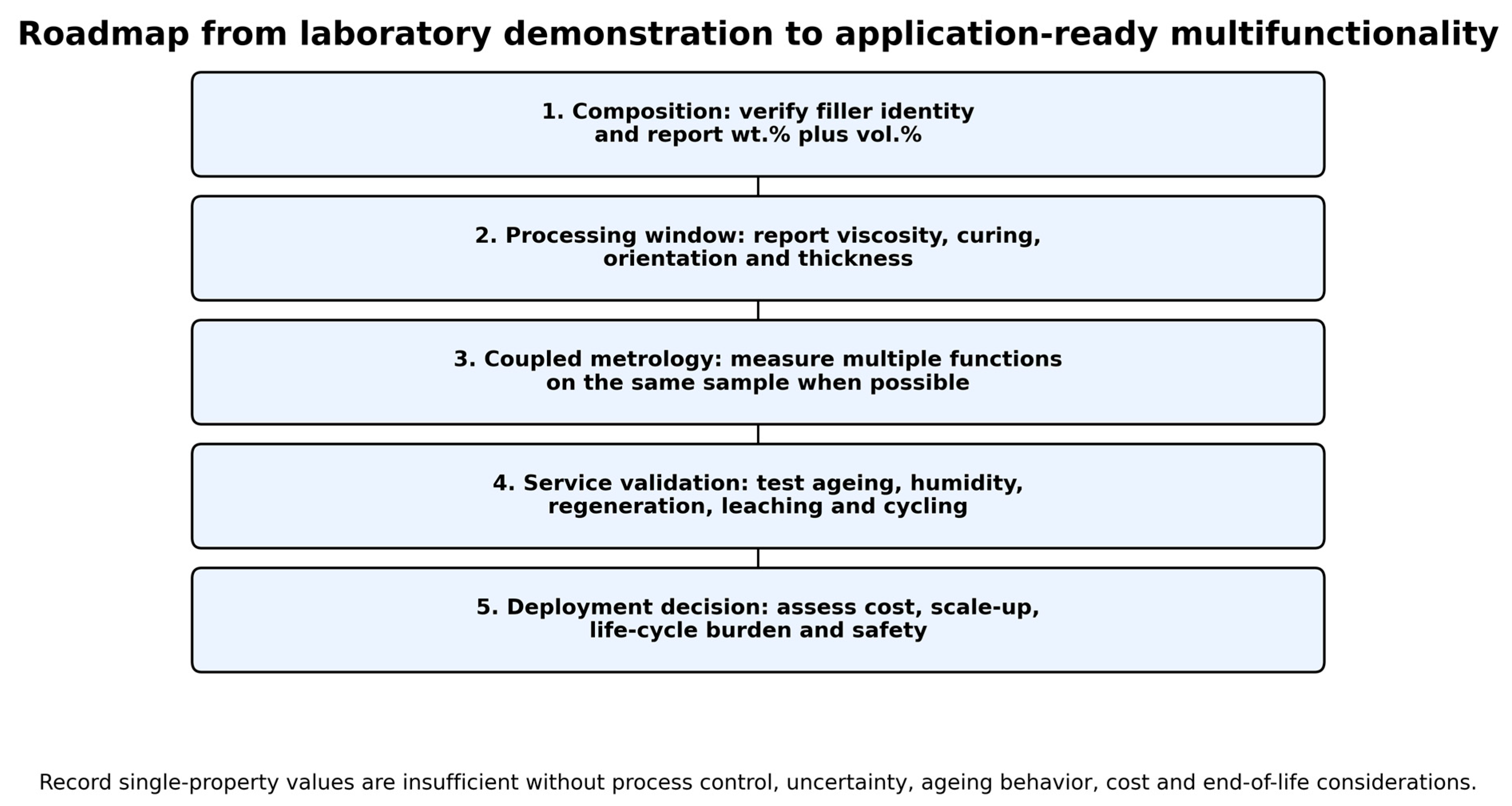
Figure 4 summarizes this transition from laboratory demonstration to application-ready multifunctionality.
Figure 4.
Roadmap from laboratory demonstration to application-ready multifunctionality. Reliable claims require verified composition, controlled processing windows, coupled metrology, service validation, and deployment-oriented assessment of cost, scale-up, life cycle and safety constraints. Record single-property values are insufficient without reproducibility, aging data and end-of-life considerations.
Figure 4.
Roadmap from laboratory demonstration to application-ready multifunctionality. Reliable claims require verified composition, controlled processing windows, coupled metrology, service validation, and deployment-oriented assessment of cost, scale-up, life cycle and safety constraints. Record single-property values are insufficient without reproducibility, aging data and end-of-life considerations.
10. Conclusions
Carbon/inorganic hybrid multifunctional composites are best understood as engineered interface networks. Carbon phases supply conductive, polarizable, porous and mechanically active pathways; inorganic phases supply dielectric, magnetic, catalytic, ionic, thermal, protective and selective functions. The resulting behavior depends on how these phases are coupled, oriented, processed and aged. This review has used selected graphitic composite case studies as a coherent example set linking epoxy composites, broadband dielectric spectroscopy, microwave behavior, thermal diffusivity, monitorable filters and aging, while embedding these examples in the broader international literature on CNTs, graphene, MXenes, oxides, BN, sensors, energy devices and environmental hybrids.
The main conclusion is that multifunctionality should be claimed only when functions are co-designed and tested under relevant constraints. High conductivity, high shielding, high adsorption capacity or high capacitance alone does not define a useful multifunctional material. What matters is the stable coexistence of functions under thickness, density, processability, aging, environmental, regeneration and safety constraints. The next generation of carbon/inorganic hybrid composites should therefore be judged by property maps, coupled metrology, durability and life-cycle-aware design rather than by isolated peak values.