
Article

Low-Temperature ZrAlOx-PVP Hybrid Dielectrics with Crosslinking-Regulated Leakage Suppression for Flexible IGZO TFTs
1
State Key Laboratory of Luminescent Materials and Devices, Guangdong Basic Research Center of Excellence for Energy & Information Polymer Materials, School of Materials Sciences and Engineering, South China University of Technology, Guangzhou 510640, China
2
Huangpu Hydrogen Innovation Center, School of Chemistry and Chemical Engineering, Guangzhou University, Guangzhou 510006, China
3
Science and Technology on Reliability Physics and Application Technology of Electronic Component Laboratory, Guangzhou 511370, China
4
Shenzhen Yaham Optoelectronics, Co., Ltd., Shenzhen 518103, China
5
Department of Engineering, University of Cambridge, Cambridge CB3 OFA, UK
*
Authors to whom correspondence should be addressed.
Inorganics 2026, 14(6), 161; https://doi.org/10.3390/inorganics14060161
Submission received: 22 May 2026 / Revised: 9 June 2026 / Accepted: 10 June 2026 / Published: 12 June 2026
(This article belongs to the Special Issue Multifunctional Composites and Hybrid Materials)

Abstract

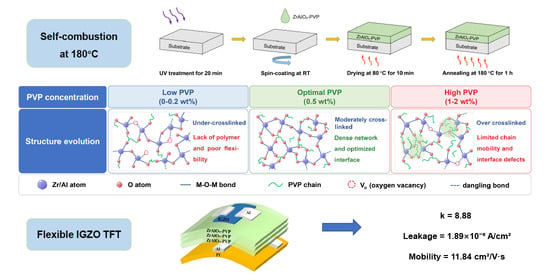
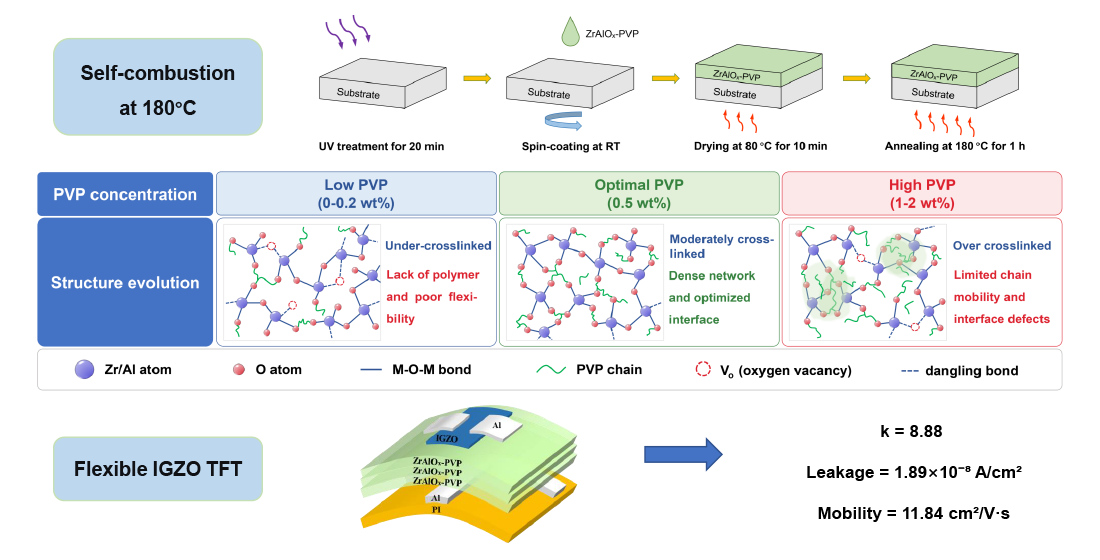
Flexible oxide electronics require dielectric layers that combine low-temperature processability, low leakage current, high capacitance density, and mechanical reliability. In this work, we prepared ZrAlOx-PVP hybrid dielectric films through a low-temperature self-combustion solution process at 180 °C and systematically investigated the effect of PVP doping (0–2 wt%). The results show that PVP promotes the formation of M-O-C related bonding environments, suggesting the construction of an organic–inorganic crosslinked structure. Moderate PVP incorporation effectively suppresses leakage pathways, whereas excessive PVP induces polymer aggregation and trap-assisted conduction. Among all samples, the film on flexible PI (polyimide) with a PVP doping concentration of 0.5 wt% exhibits the best overall performance, with a leakage current as low as 1.89 × 10⁻⁸ A/cm2 at 1 MV/cm, a dielectric constant of 8.88. After static bending at a radius of 20 mm, the film maintains stable dielectric behavior, indicating improved stress tolerance. Flexible IGZO TFT fabricated with the optimized dielectric shows a mobility of 11.84 cm2 V−1 s−1, a threshold voltage of 0.48 V, and a subthreshold swing of 0.24 V dec−1 before bending. This work demonstrates that moderate PVP crosslinking provides an effective balance between defect suppression and stress relaxation, offering a practical interface-engineering strategy for low-temperature flexible high-k dielectrics.

Graphical Abstract

1. Introduction

Flexible oxide electronics have attracted considerable attention for next-generation displays, wearable sensors, medical electronics, and low-power integrated systems [1,2,3,4,5]. In these devices, the gate dielectric is not merely an insulating layer but a key interface-regulating component in charge regulation. For flexible thin-film transistors (TFTs), developing high-performance dielectric materials that combine low-temperature processability, low leakage current, a high dielectric constant, and mechanical stability is of great significance for achieving low-voltage driving, low power consumption, and long-term stability in flexible devices [6]. However, there is a fundamental contradiction between the conventional fabrication routes of high-performance dielectric materials and flexible substrates. Generally, metal oxide dielectric films require high-temperature annealing to remove residual organic components of the precursors, promote the thorough progress of condensation reactions, and reduce defects such as oxygen vacancies [7], whereas flexible polymer substrates (PI, PEN, PET, etc.) have low glass transition temperatures that restrict processing to low temperatures, resulting in poorly densified films with high defect density and excessive leakage current [8]. Therefore, achieving low-temperature fabrication of dielectric layers that offer both superior electrical properties and mechanical flexibility remains a critical challenge in flexible electronics.
In terms of fabrication methods, the solution methods are promising for low-cost and large-area flexible electronics because of their compositional tunability, simple processing, and compatibility with scalable fabrication. Nevertheless, conventional solution method usually relies on high-temperature annealing (>400 °C) to achieve the hydrolysis and polycondensation of the precursors, which limits its application on flexible substrates [9]. To overcome this problem, many researchers have been working to reduce the processing temperature while maintaining the electrical performance of the devices [10]. Common low-temperature strategies often rely on external energy assistance to drive film formation, including deep ultraviolet (DUV) annealing, high-energy flash annealing, and high-pressure annealing [11,12,13,14]. Different from the above approaches, Kang et al. [15] introduced the self-combustion method, providing an effective route to reduce the external annealing temperature by utilizing internal chemical energy released from redox reactions between metal nitrates (oxidizers) and metal acetylacetonates (fuels) in the precursor system. For example, Bae et al. [16] used Al(NO3)3·9H2O and Al(C2H5O2)3 to obtain an AlOx gate dielectric layer via a self-combustion reaction at a low temperature of 250 °C. The leakage current density was 1.80 × 10⁻⁸ A/cm2, and the dielectric constant reached above 8.7. Although self-combustion method can achieve low annealing temperature, it still suffers from limited defect passivation within the films and poor mechanical stability under flexible conditions.
In terms of material selection, high-k dielectric materials possess a large dielectric constant, which can effectively increase device capacitance density and reduce operating voltage. ZrO2 and Al2O3 are representative high-k oxide dielectrics with complementary properties. ZrO2 offers a relatively high dielectric constant, while Al2O3 provides a wide bandgap, high insulating capability, and good chemical stability. As an amorphous composite oxide of ZrO2 and Al2O3, ZrAlOx composite dielectrics can therefore combine the high capacitance of Zr-based oxides with the leakage-suppressing characteristics of Al-based oxides. A number of composite high-k systems have already been reported and proven effective, such as hafnium zirconium oxide (HfZrOx) [17,18], zirconium aluminum oxide (ZrAlOx) [19], and lanthanum-doped zirconium oxide (LaZrOx) [20,21]. However, purely inorganic oxide networks are intrinsically rigid and can suffer from interfacial stress when integrated onto flexible polymer substrates, leading to delamination, cracking, and enhanced interfacial defects. This stress may result in a surge in leakage current, degraded dielectric performance, and overall device deterioration.
The organic-inorganic crosslinking strategy provides an effective route to address the above issues [22]. Poly(4-vinylphenol) (PVP) is widely used for organic doping owing to its favorable intrinsic flexibility, chemical stability, and solubility. More importantly, PVP enables its phenolic hydroxyl groups to coordinate into the inorganic oxide network, forming M-O-C crosslinked bonds and constructing a stable organic-inorganic crosslinked network [23,24]. For instance, Yu et al. [23] doped In2O3 films with PVP. By adjusting the In2O3:PVP weight ratio, they obtained the In2O3:5%PVP-based transistors that exhibit mobilities approaching 11 cm2 V−1 s−1 before, and retain up to about 90% performance after 100 bending/relaxing cycles at a radius of 10 mm. On the one hand, such organic-inorganic crosslinking may fill the voids between inorganic frameworks, which can passivate defect-related oxygen species, reducing the overall defect density on the film surface. On the other hand, the flexible organic polymer chains can buffer thermal and bending stresses through conformational motion, improving mechanical flexibility. However, the effect of PVP incorporation is not necessarily monotonic. A moderate amount of doping can create a uniform and dense organic-inorganic crosslinked network, achieving synergy between defect passivation and stress buffering, and thus reducing leakage current. Excessive doping may lead to overly dense crosslinking, making the film rigid and unable to buffer stress, while also causing polymer aggregation, interfacial disorder, and trap-assisted leakage conduction. Therefore, systematic research on the influence of PVP crosslinking density on defect states, conduction mechanisms and bending stability is important for designing reliable flexible oxide electronics.
In this work, ZrAlOx-PVP hybrid dielectric films with different PVP concentrations were fabricated on flexible PI substrates using a low-temperature self-combustion solution process. The focus of this study is to reveal how PVP-regulated crosslinking density modulates defect states, leakage transport, and mechanical stability. Flexible IGZO TFTs based on the optimized dielectric were further fabricated to verify device-level applicability. The results reveal that moderate PVP crosslinking balances defect suppression and stress relaxation, providing a practical interface-engineering strategy for low-temperature high-k hybrid dielectrics in flexible electronics.

2. Results and Discussion

The samples prepared with different PVP doping concentrations are designated as P00, P02, P05, P10, and P20, as summarized in Table 1.

2.1. PVP-Regulated Morphology and Thickness Evolution

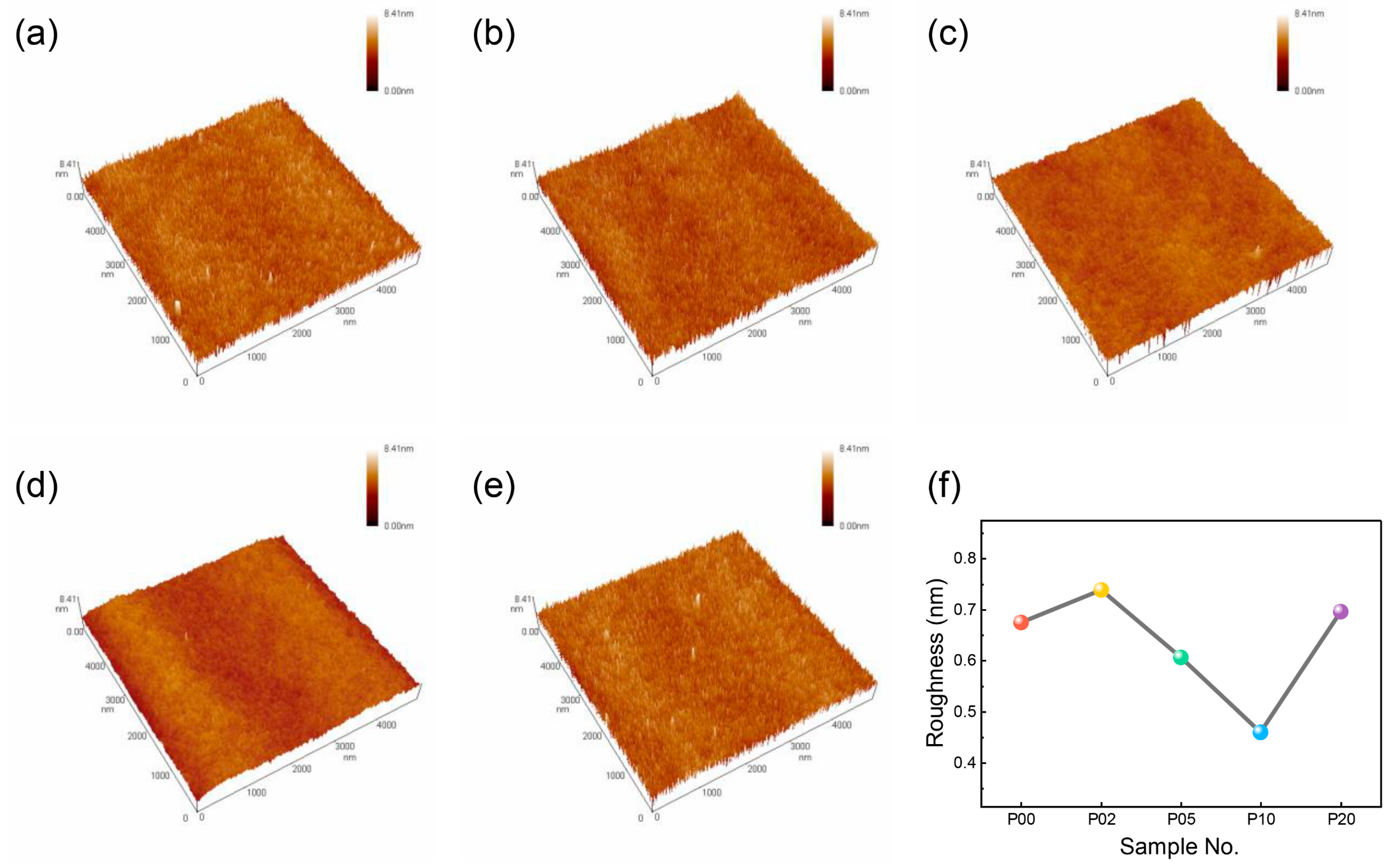
In order to investigate the influence of different PVP doping concentrations on the roughness of ZrAlOx-PVP hybrid dielectric films, AFM was used for testing. Figure 1 shows the summary of the 3D images of the films and the corresponding root mean square (RMS) values of the roughness under different doping concentrations, which are 0.68, 0.74, 0.61, 0.46 and 0.70 nm respectively. All ZrAlOx-PVP hybrid dielectric films exhibit smooth and dense surfaces, and no obvious pinholes or cracks are observed. When the doping concentration is 1 wt%, the film has the lowest surface roughness, indicating that it is the smoothest at this concentration. This may be because at a doping concentration of 1 wt%, PVP molecules condense with metal oxides through phenolic hydroxyl groups during annealing, uniformly filling the voids between inorganic particles and forming the densest organic-inorganic crosslinked network. Below this concentration, the amount of PVP participating in crosslinking is insufficient, which is not enough to fully fill the voids in the inorganic phase. When the concentration increases to 2 wt%, the roughness increases significantly, due to the stacking of excessive polymer chains. It should be emphasized that the lowest roughness of P10 on glass substrates does not necessarily guarantee the best electrical performance and mechanical stability on flexible PI substrates.
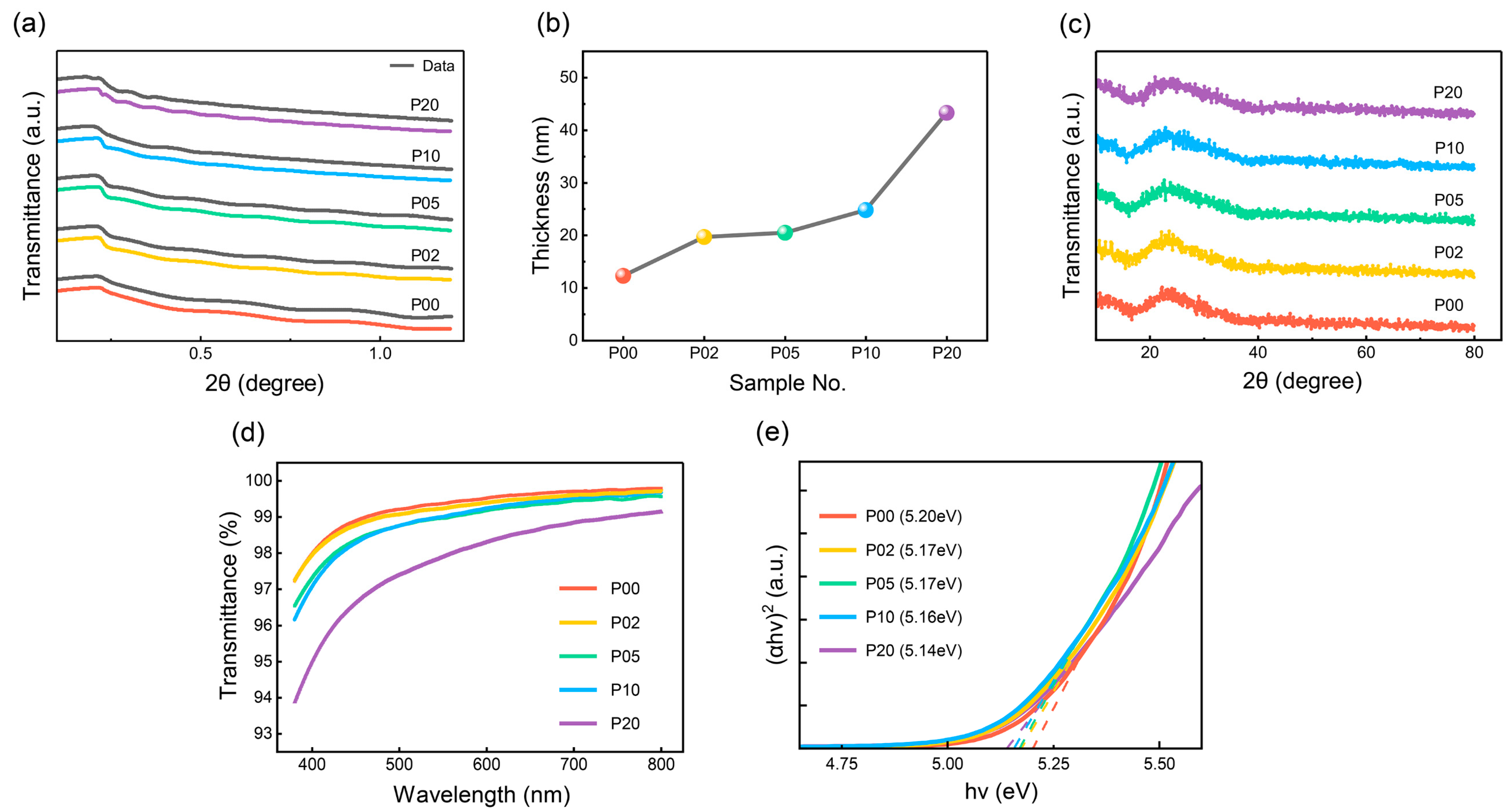
Figure 2a shows the XRR measurement and fitting curves. The thicknesses of the ZrAlOx-PVP hybrid dielectric films extracted from the fits are summarized in Figure 2b: 12.3 nm for P00, 19.7 nm for P02, 20.5 nm for P05, 24.8 nm for P10, and 43.3 nm for P20. A clear trend is observed: as the concentration of PVP increases, the thickness of the films gradually rises. This is because during the annealing process at 180 °C, the polymer PVP did not undergo significant thermal decomposition. Instead, it crosslinked with the inorganic network in the form of molecular chains during film formation, directly increasing the film thickness. Notably, when the PVP concentration increased from 1 wt% to 2 wt%, the thickness sharply increased from 24.8 nm to 43.3 nm, with an increase of about 75%. This indicates that the excess PVP, unable to fully bond into the network, aggregated and piled up together, leading to a substantial thickening of the film. This inference is consistent with the trend in film roughness discussed above, further supporting the picture of PVP aggregation and surface inhomogeneity. Therefore, the thickness evolution not only confirmed the effective incorporation of PVP, but also revealed the saturation of the crosslinking sites and harmful polymer aggregation at excessive doping levels, which was later associated with the decline in electrical properties of the P20 sample.
Figure 2c shows the XRD testing curves of ZrAlOx-PVP hybrid dielectric films. For the dielectric films with different doping concentrations, a single broad peak appears around 2θ = 23°, and no obvious diffraction peaks are observed, indicating that the films are amorphous. An ideal material for dielectrics should be amorphous, because the amorphous structure lacks grain boundaries, which can effectively reduce leakage current and improve the uniformity of the film.

2.2. Optical Properties and Bandgap Stability

To investigate the optical properties of the ZrAlOx-PVP hybrid dielectric films, the transmittance of the films was measured using a UV-visible spectrophotometer. As shown in Figure 2d, the ZrAlOx-PVP hybrid dielectric films exhibit high transmittance. Except for the P20 component, the transmittance in the visible range remains above 95%, indicating the feasibility of their application in transparent flexible devices. Figure 2e shows the (αhν)2 –hv curves for the films from P00 to P20. The corresponding band gap (Eg) of ZrAlOx-PVP hybrid dielectric films was calculated using the Tauc formula [23,25], as shown in Equation (1):
α h v = A h v   E g 1 n
where , n, A, and α correspond to the photon energy, optical transition exponent, a proportionality constant in the absorption process, and absorption coefficient, respectively. The band gap obtained by linear extrapolation are 5.20 eV, 5.17 eV, 5.17 eV, 5.16 eV, and 5.14 eV, respectively. With increasing PVP concentration, the band gap shows a decreasing trend, which is attributed to the intrinsically lower band gap of the organic component PVP. Nevertheless, the decrease is slight and the Eg of all dielectric films are greater than 5 eV, indicating that the wide bandgap characteristic of the ZrAlOx inorganic component is well preserved after PVP incorporation, and PVP does not introduce deep-level defect states that could significantly narrow the bandgap.

2.3. Chemical Bonding and Crosslinked Network Formation

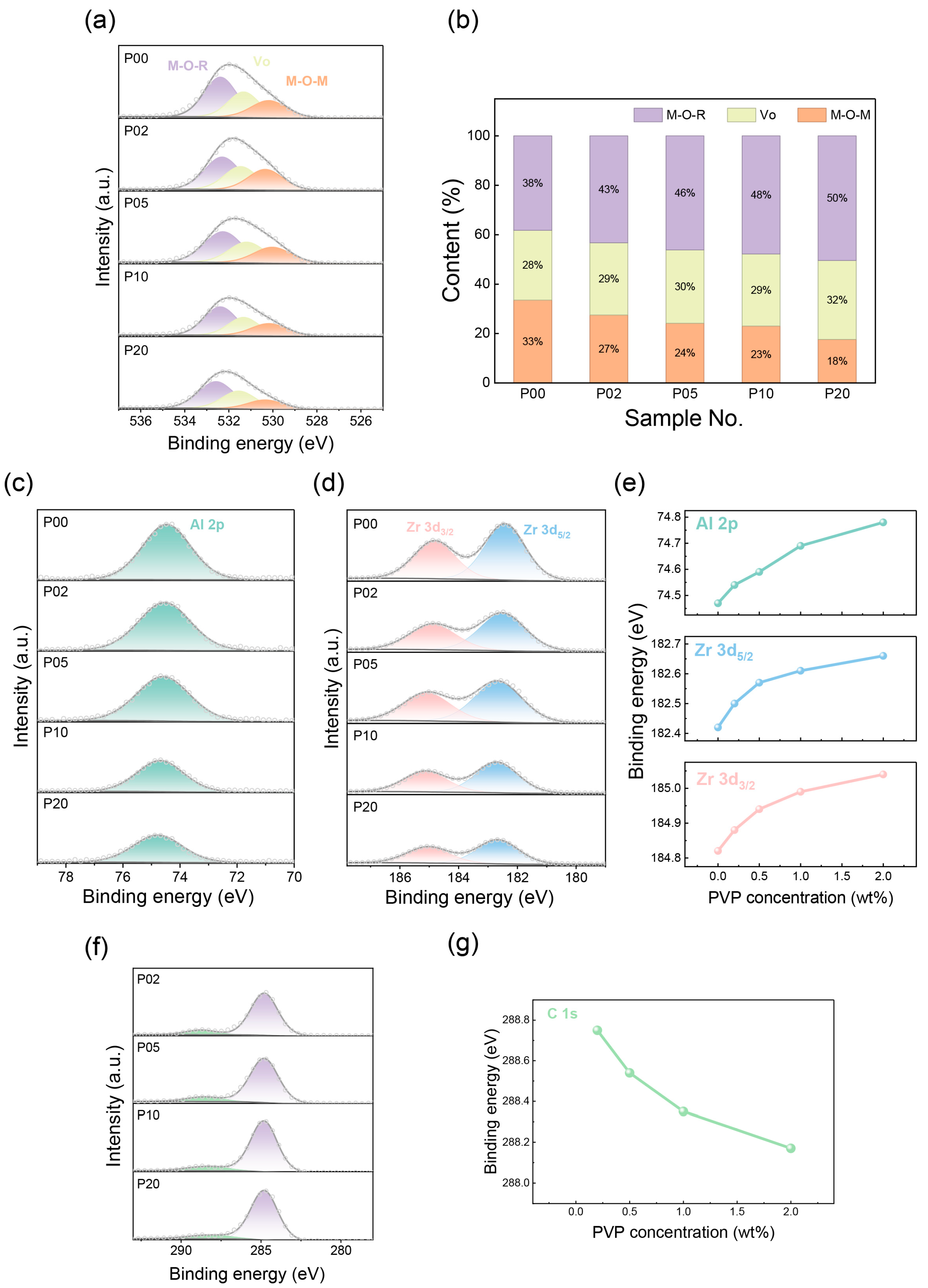
To investigate the degree of crosslinking in the organic-inorganic network, XPS was used to analyze the internal bonding configurations. Figure 3a shows the O 1s spectra, which can be deconvoluted into three main components [26]: ~530 eV is attributed to lattice oxygen (M-O-M), ~531 eV is attributed to oxygen vacancy-related oxygen (VO), and ~532 eV is attributed to hydroxyl-related oxygen (M-O-R). Figure 3b shows the corresponding peak area ratios. As the PVP concentration increases from 0 to 2 wt%, the proportion of M-O-M decreases, while the proportion of M-O-R increases, indicating that PVP inhibits the formation of a continuous inorganic lattice network. The abundant hydroxyl groups (-OH) in the PVP molecules, together with the interfacial oxygen (M-O-C) generated by condensation with ZrAlOx, contribute to the adsorbed oxygen signal, confirming that PVP bonds with the inorganic network to form an organic-inorganic crosslinked structure. Referring to Figure 3e, the binding energies of Al 2p and Zr 3d shift positively with increasing PVP doping concentration. This is because the highly electronegative C attracts electrons, reducing the density of the outer electron cloud of the metal, weakening the shielding effect, and enhancing the attraction of the inner electrons. Conversely, the binding energy of C 1s decreases with increasing PVP concentration (Figure 3g), as the carbon atoms gain electron density from the metal atoms via the M-O-C bonds. This further confirms the successful construction of the organic-inorganic crosslinked network. Notably, as the PVP doping concentration gradually increases, the magnitude of the binding energy shift decreases. This indicates that the crosslinking sites in ZrAlOx are approaching saturation, excess PVP can no longer form effective chemical bonds, thus tending to aggregate and stack.

2.4. Leakage Current Behavior and Defect-Assisted Conduction Mechanism

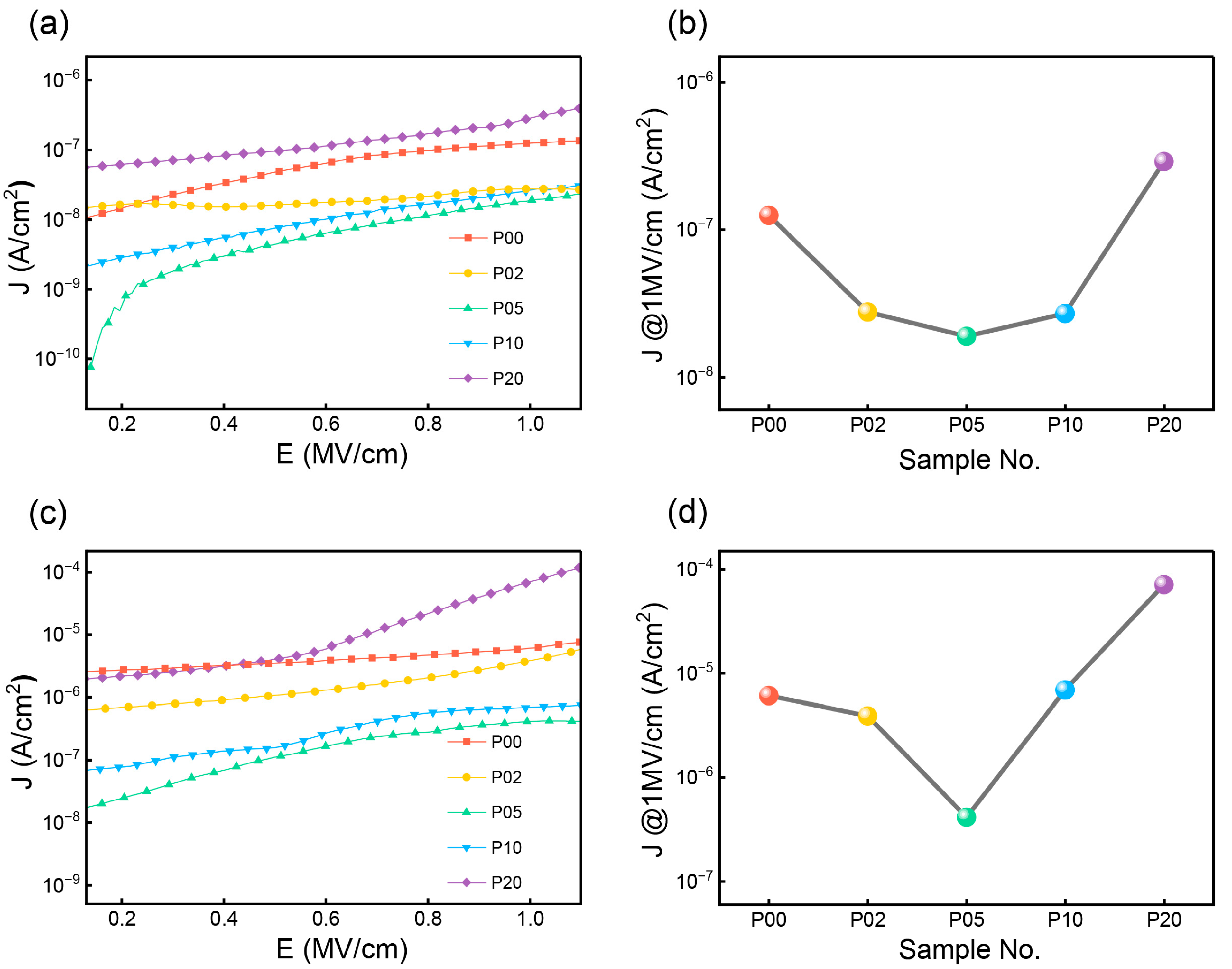
To investigate the electrical stability of flexible ZrAlOx-PVP hybrid dielectric films before and after static bending at a bending radius of 20 mm, the electrical properties of MIM devices were characterized using a semiconductor parameter analyzer. Figure 4a shows the relationship between leakage current density (J) and electric field strength (E) of the MIM devices with different PVP doping concentrations before bending, and Figure 4b summarizes the leakage current densities at an electric field of 1 MV/cm. The results indicate that the leakage current varies non-monotonically with the concentration of PVP: as the PVP doping concentration increases, the leakage current density of the ZrAlOx-PVP hybrid dielectric films first decreases and then increases. At a doping concentration of 0.5 wt%, the leakage current density is the smallest at 1.89 × 10⁻⁸ A/cm2@1 MV/cm. Leakage current density reflects the insulating performance of the dielectric layer under an electric field and is primarily determined by the defect state density within the film and the interface quality. A low leakage current is essential for reducing static power consumption, improving the on/off current ratio. When a low concentration of PVP is doped, the crosslinked network is sparse and discontinuous. Consequently, the film not only suffers from poor defect passivation, but also exhibits insufficient mechanical flexibility. An appropriate amount of PVP results in a moderate degree of crosslinking, achieving the most effective defect passivation and stress relaxation, thus significantly reducing leakage current pathways. When a high concentration of PVP is doped, aggregated PVP introduces additional interface defects and space charge accumulation, leading to a marked increase in leakage current density. After bending, as shown in Figure 4c, the leakage current density of each composition increases by about 1–2 orders of magnitude. This trend is attributed to the increase in crack and defect density in stress-concentrated regions, which provide additional leakage current channels for carriers. Although the leakage current increased after bending, the P05 component with the lowest leakage current density still maintains a relatively low level, with a value of 4.12 × 10⁻⁷ A/cm2@1 MV/cm, meeting the basic requirements of the dielectric layer for low-power flexible TFTs.
To analyze the leakage current conduction mechanism, we performed piecewise fitting of the J–E data using different leakage current models [27,28]. Since bending introduces stress-induced cracks and defects, which makes it difficult to evaluate the leakage mechanism with a single model, this work focuses on discussing the leakage current behavior on flexible PI substrates before bending. The Schottky emission and Poole–Frenkel (P–F) emission are expressed by Equations (2) and (3), respectively:
J SC = A T 2   e x p q S C β S C E 1 / 2 / k T
J PF = C E   e x p q P F β P F E 1 / 2 / k T
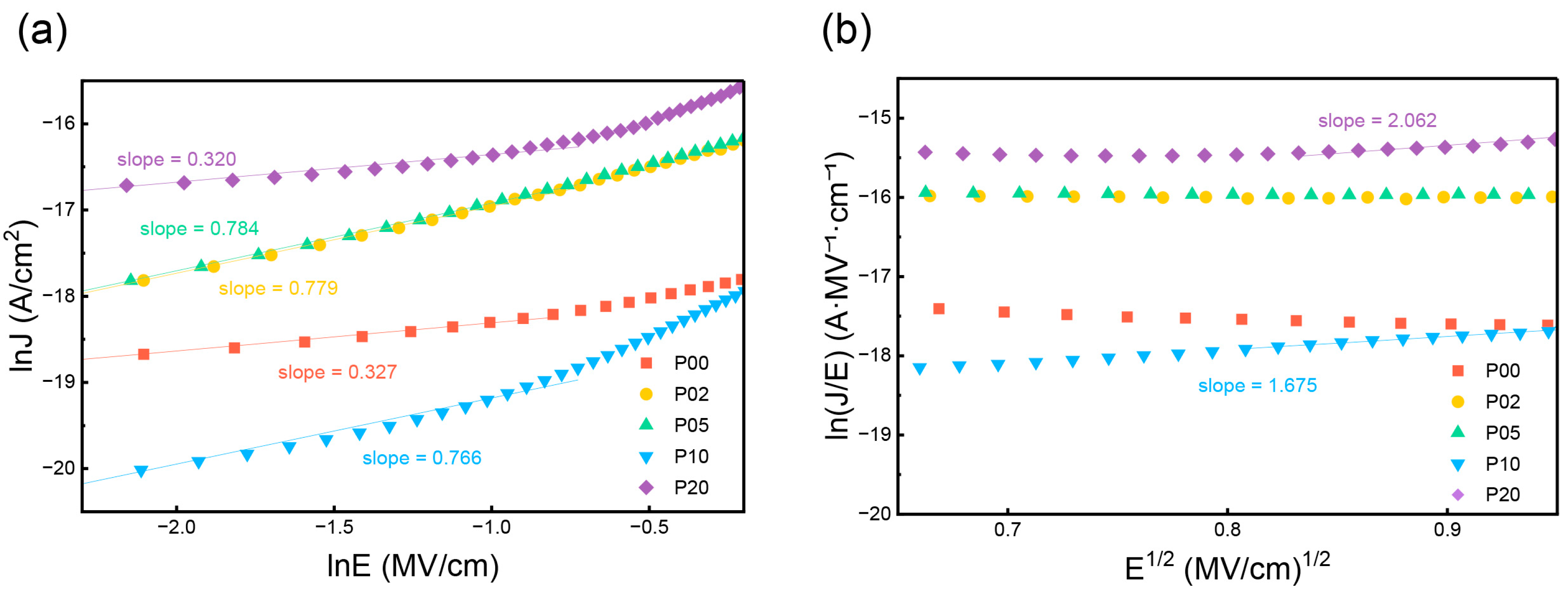
where A and C are constants, q S C is the schottky barrier height, q P F is the trap energy level, β S C = ( q 3 4 π ε ε 0 ) 1 / 2 , β P F = ( q 3 4 π ε ε 0 ) 1 / 2 , q is electronic charge, ε is the dynamic dielectric constant and ε 0 is the permittivity of free space. In the low electric field region (E < 0.6 MV/cm), as shown in Figure 5a, the slopes extracted from the lnJ–lnE fitting curves gradually approach 1 as the PVP doping concentration increases from 0 to 0.5 wt%, indicating that an appropriate amount of PVP doping effectively reduces the interface barrier and promotes ohmic conduction. When the doping concentration further increases, the slope begins to decrease, which is due to the excessive crosslinking and polymer stacking that introduces defect states, deviating from the ohmic conduction mechanism. In the high electric field region (E > 0.6 MV/cm), the slope of the fitted curve of ln(J/E)–E1/2 was extracted, as shown in Figure 5b. The linearity of ln(J/E) versus E1/2 for P10 and P20 suggests that trap-assisted Poole-Frenkel type emission becomes more pronounced at high electric fields. This demonstrates that excessive PVP doping introduces a large number of traps, facilitating electron hopping and thereby creating leakage current channels. Combined with the XPS and J–E analyses, these traps originate mainly from defects within the system, including oxygen vacancies (VO), M-OH groups, and interfacial defects induced by the accumulation of excess PVP. The non-monotonic leakage behavior indicates that PVP incorporation plays a dual role: defect passivation at moderate concentrations and trap generation at excessive concentrations.

2.5. Dielectric Properties and Frequency Stability

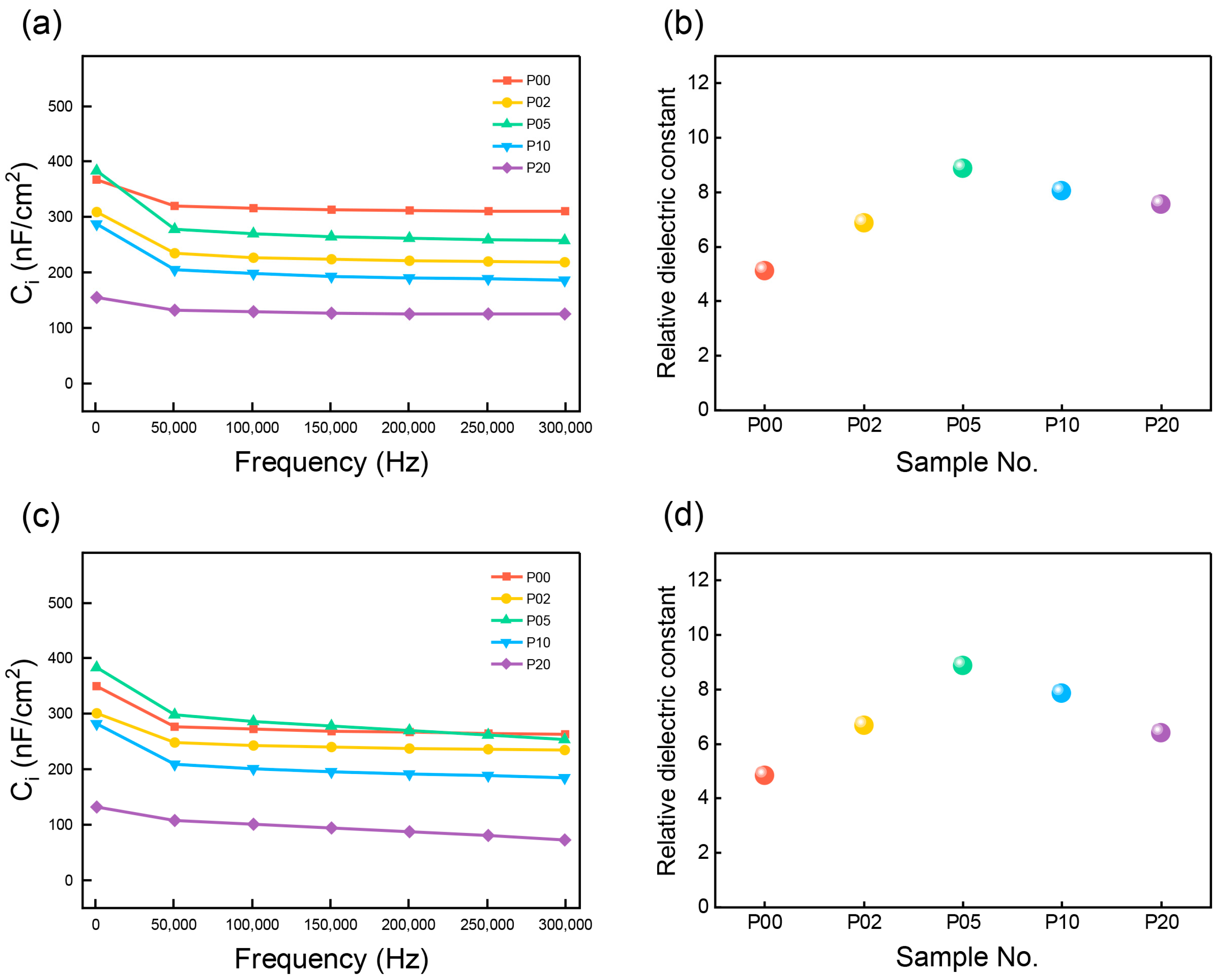
Figure 6 shows the capacitance–frequency (C–F) characteristics of the ZrAlOx-PVP hybrid dielectric films before and after static bending at a radius of 20 mm, along with the dielectric constant measured at 1 kHz. According to Equation (4):
C i = ε 0 k d
where ε 0 is the vacuum permittivity (8.85 × 10⁻¹² F/m), d is the film thickness and k is the relative dielectric constant. As the PVP doping concentration increases, the dielectric constant before and after bending both show a trend of first increasing and then decreasing. This trend arises because an appropriate amount of PVP improves the dispersion of inorganic particles and enhances interfacial bonding, thereby increasing the effective dielectric constant. However, as the PVP concentration further increases, a dilution effect dominates, causing the dielectric constant to decline. The values before bending are 5.10 (P00), 6.86 (P02), 8.88 (P05), 8.04 (P10), and 7.56 (P20); after bending, they are 4.84 (P00), 6.68 (P02), 8.88 (P05), 7.87 (P10), and 6.41 (P20). The dielectric constant of the components with PVP doping concentrations of 0–1 wt% shows a slight decreasing trend (<5.1%) after bending, with weak frequency dispersion, suggesting that both interface traps and polarization losses are low. While the P20 component shows a significant drop (−15.2%). This is because the bending stress leads to a sharp increase in interfacial defects and severe damage to polarization, resulting in a substantial decrease in the dielectric constant. At a doping concentration of 0.5 wt%, the dielectric constant reaches its maximum value of 8.88. A higher k value means a physically thicker dielectric layer can be used to suppress leakage current while maintaining or even increasing the capacitance density, which is beneficial for achieving good gate control in subsequent TFT devices. The P05 component exhibits the highest capacitance density: 384 nF/cm2@1 kHz before bending and 383 nF/cm2@1 kHz after bending. The capacitance density is determined by both the dielectric constant and the thickness. Therefore, although the P05 film is thicker than the P00 and P02 films, its excellent dielectric constant gives it the highest capacitance density. The P00 component also shows a relatively high capacitance density, which results from its small film thickness offsetting the influence of its lower dielectric constant. However, due to the film thickness of this component that has not been optimized by PVP doping, P00 component suffers from a much higher leakage current.

2.6. Substrate-Dependent Optimal Crosslinking Under Flexible Conditions

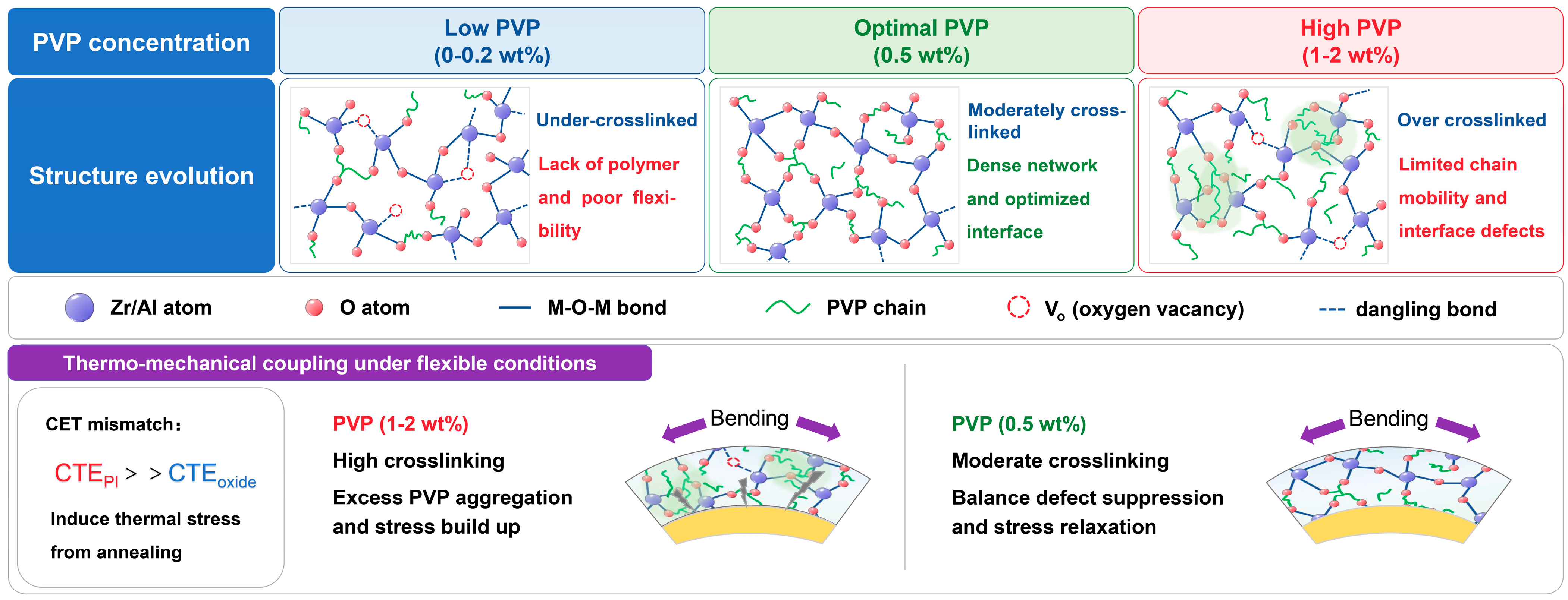
From the above analysis, the P05 component exhibits the lowest leakage current density, the highest dielectric constant, the best bending stability, and good high-frequency response. It is therefore the component with the best overall electrical performance and mechanical stability on flexible PI substrates. In the previous film structure characterization, the P10 component based on rigid glass substrates showed the most excellent surface morphology characteristics. The optimal PVP concentration shifts from the structurally favorable P10 condition on rigid substrates to the electrically favorable P05 condition on flexible PI substrates. A substrate-dependent optimal crosslinking behavior is identified, originating from the competition between structural densification and stress relaxation under flexible conditions. This substrate-dependent optimization behavior indicates that the dielectric performance of hybrid films is governed not only by intrinsic structural densification, but also by thermo-mechanical coupling at the film/substrate interface. On glass substrates, the P10 crosslinked network is the densest, with the smallest free volume and the best structural performance; while the crosslinking density of P05 is slightly lower than that of P10, and it has a larger free volume. When transferred to flexible PI substrates, there is a significant mismatch in the coefficient of thermal expansion (CTE) between PI and inorganic metal oxide films (the CTE of rigid glass is usually in the range of 7–10 × 10−6/°C [29], and the CTE of PI is 30–60 × 10−6/°C [30]), and thermal stress will be generated during the cooling step of the annealing process. Excessive crosslinking improves network rigidity but reduces segmental mobility, making the film less capable of relaxing thermal stress generated by CTE mismatch during cooling. In contrast, moderate crosslinking at 0.5 wt% PVP provides sufficient defect suppression while preserving stress relaxation capability, leading to improved electrical stability under bending. The mechanism is schematically illustrated in Figure 7.

2.7. Flexible TFT Device Demonstration with P05 Dielectric

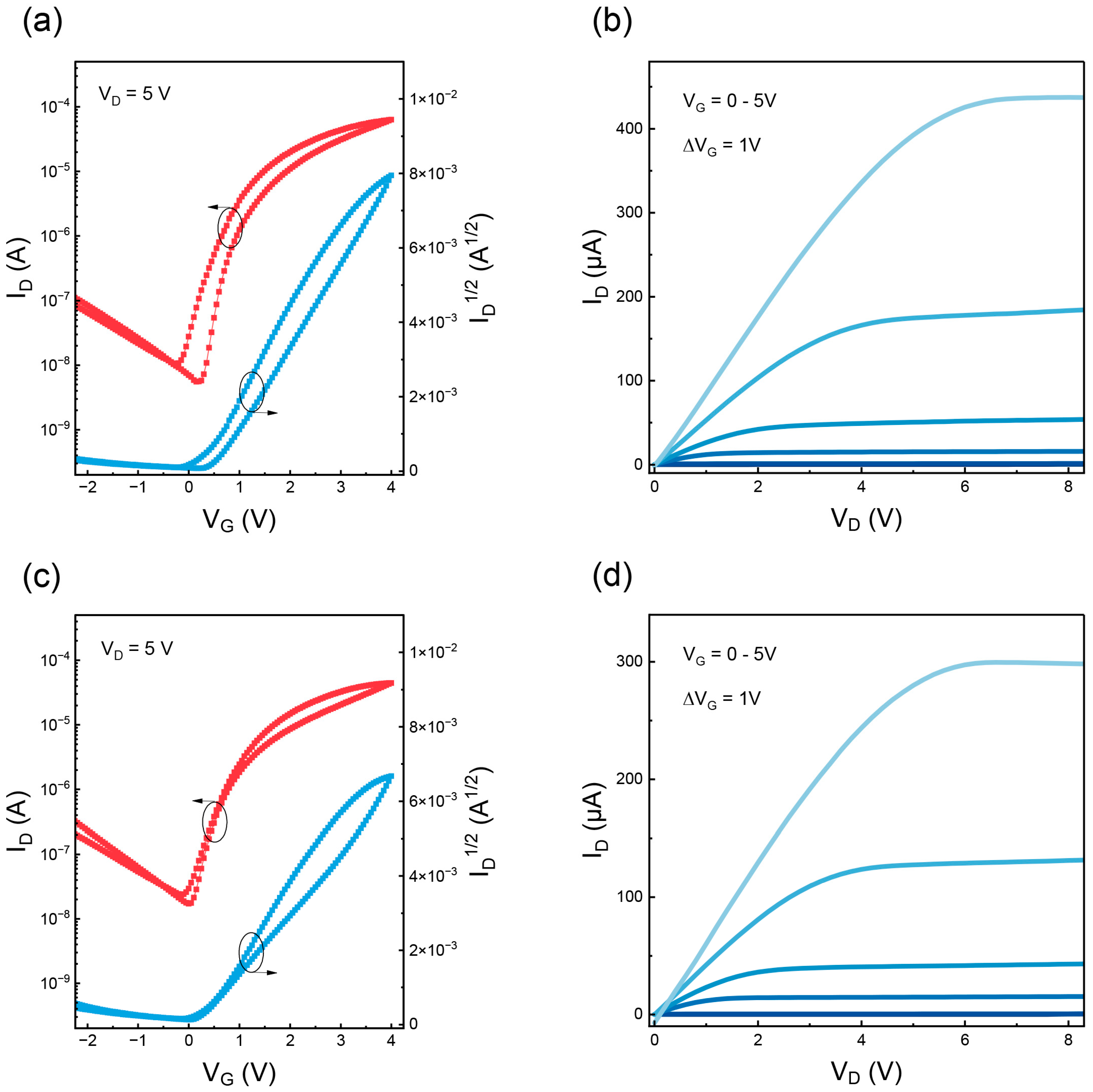
To verify the feasibility of the P05 component for practical applications, flexible multilayer ZrAlOx-PVP/IGZO TFT devices were fabricated. The transfer and output characteristic curves were measured, and the test results are shown in Figure 8. The mobility (μsat) and threshold voltage (Vth) were extracted from Equation (5). The Subthreshold swing (SS) was calculated by fitting Equation (6):
I D =   μ W 2 L C i   V G   V t h 2
S S = d log I D d V G 1
where C i represents the capacitance density of multilayer ZrAlOx-PVP hybrid dielectric, W and L are the width and length of the channel, VG represents the gate voltage and ID represents drain current. The TFT parameters extracted from the fitting are summarized in Table 2. The data in the table show that the flexible TFT device with the P05 dielectric exhibits excellent performance before bending. Its electron mobility reaches 11.84 cm2/V·s, with a low Vth of 0.48 V, a subthreshold swing of 0.24 V/dec and Ion/Ioff of 1.15 × 10⁴. This indicates that the device with P05 component enables good gate control and can be turned on without requiring a high driving voltage. After static bending with a radius of 20 mm, although the device performance degrades to some extent, it still maintains stable switching behavior, demonstrating that the P05 dielectric layer possesses structural integrity against mechanical stress and holds application value in flexible electronic devices.

3. Materials and Methods

3.1. Preparation of ZrAlOx-PVP Precursor Solutions

The total metal ion concentration in the self-combustion precursor solution was fixed at 0.2 M. In our previous work, the optimal molar ratio of zirconium nitrate [Zr(NO3)4·5H2O, 99.99%] to aluminum acetylacetonate [Al(C2H5O2)3, 98%] for the preparation of ZrAlOx dielectric films was determined to be 1:1 [31]. PVP ([CH2CH(C6H4OH)]n, Mw ca. 25,000) was introduced as the organic component. Five groups of precursor solutions were prepared by adding PVP at mass percentages of 0 wt%, 0.2 wt%, 0.5 wt%, 1 wt%, and 2 wt%, as shown in Table 1. The solvent was mixed in a volume ratio of DMF:DI = 4:1, and 3 mL of solvent was taken for each component to ensure complete dissolution of the inorganic and organic phases. All reagents were purchased from Macklin Biochemical Co., Ltd. (Shanghai, China), and all are manufactured in China. The mixture was stirred at 50 °C for 4 h to ensure complete dissolution of the mixed precursors until it became clear and transparent. After that, the precursor solution was filtered through a 0.22 µm organic syringe filter to remove any undissolved particles or impurities. Finally, the filtered solution was aged for 24 h to obtain the spin-coating solution.

3.2. Film Fabrication and Characterization

The glass substrates and the PI substrates with dimensions of 10 mm × 10 mm were ultrasonically cleaned in the sequence of deionized water—isopropanol—deionized water—isopropanol. Each ultrasonic treatment lasted for 15 min. Then, they were placed in an oven and dried at 80 °C for 12 h. The spin-coating deposition of the ZrAlOx-PVP hybrid dielectric film is schematically illustrated in Figure 9. After UV treatment on the substrate surface for 20 min to improve hydrophilicity, 40 μL of the precursor solution was dropped onto the substrate. The spin-coating process was carried out with a low spin speed of 500 rpm for 5 s, and a high spin speed of 5000 rpm for 30 s, resulting in a uniform dielectric film. The spin-coated films were dried at 80 °C for 10 min and then annealed in air at 180 °C for 1 h. The atomic force microscopy (AFM, CSPM5500, Beijing, China) was used to measure the surface roughness of the films. Film thickness was measured by the X-ray reflectivity (XRR, PANalytical Empyrean, Almelo, The Netherlands). The transmittance and optical bandgap of the films were characterized using a UV-visible spectrophotometer (UV-Vis, UV-3600 Shimadzu, Kyoto, Japan). The X-ray photoelectron spectroscopy (XPS, Nexsa, Waltham, MA, USA) was used to analyze the chemical states of elements on the film surface.

3.3. MIM and TFT Devices Fabrication and Electrical Measurements

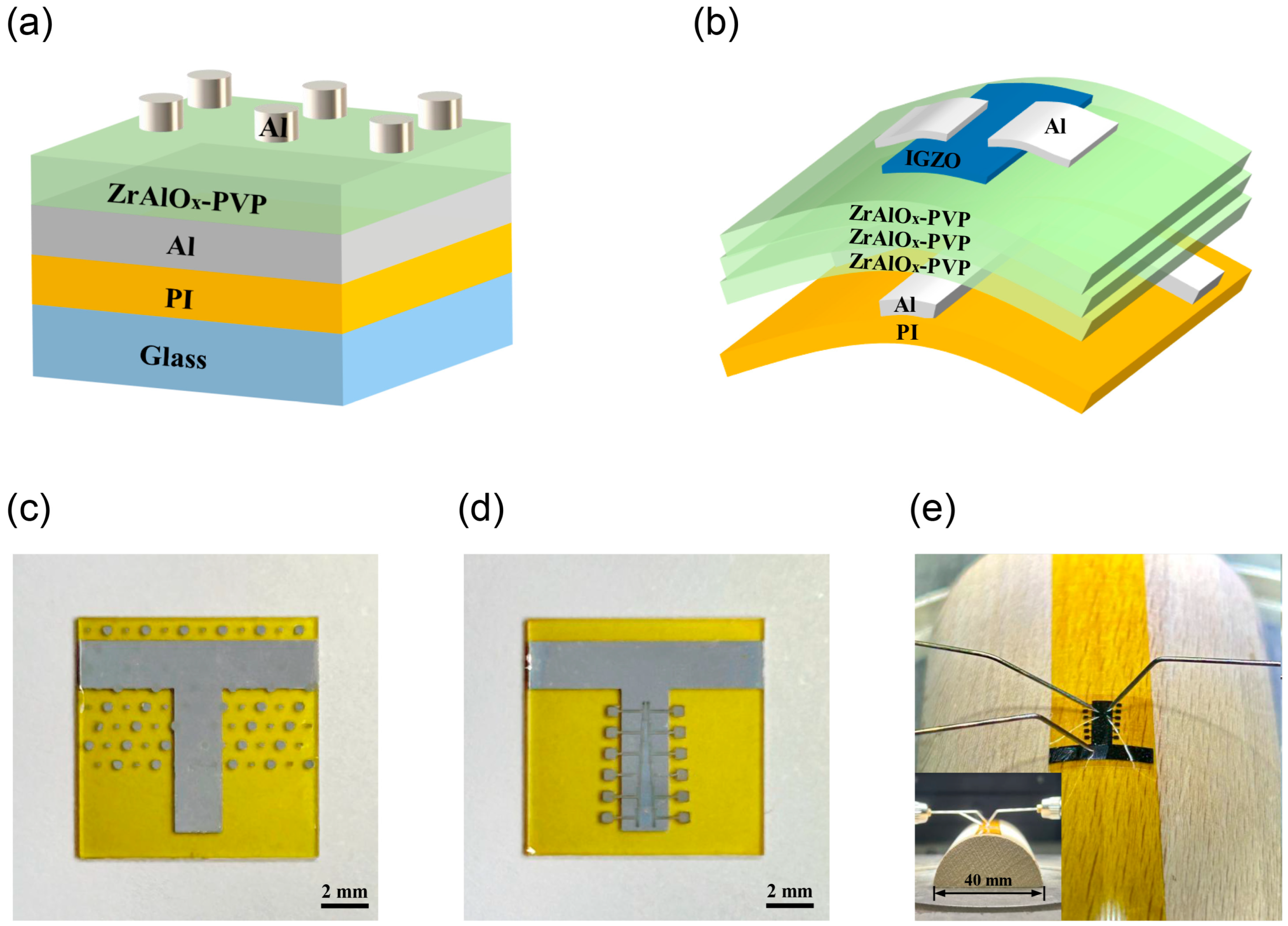
Metal–insulator–metal (MIM) capacitors were fabricated on flexible PI substrates. With a 300 nm thick Al as the bottom electrode, after spin-coating the dielectric film, a 101 nm thick array of aluminum top electrodes was evaporated onto the ZrAlOx-PVP hybrid dielectric films. Each top Al electrode has an area of 1.256 × 10⁻³ cm2. The MIM devices were obtained, as shown in Figure 10a. The current–voltage (I–V) and capacitance–frequency (C–F) characteristics of the MIM devices were measured using a semiconductor parameter analyzer (Primarius FS-Pro, Beijing, China). The devices were fixed onto a cylinder with a bending radius of 20 mm for static bending, and their I–V and C–F characteristics were measured while the devices remained in the bent state.
Flexible multilayer ZrAlOx-PVP/IGZO TFT devices were fabricated using an interlayer annealing process. The multilayer hybrid dielectric structure improves the surface morphology and interface quality, enhancing the electrical performance of the TFT devices. A bottom-gate top-contact structure was adopted, as shown in Figure 10b. The spin-coating and annealing parameters were exactly the same as those used for the single-layer films in MIM devices. Additionally, each dielectric layer after annealing needed to undergo UV treatment for 20 min before proceeding to the next layer fabrication. A total of three ZrAlOx-PVP dielectric layers were spin-coated. IGZO was then deposited by DC magnetron sputtering, followed by UV treatment for 30 min and annealing at 100 °C for 1 h. Finally, 100 nm thick Al electrodes were evaporated onto the IGZO layer. The transfer and output curves of the TFT devices were tested using the semiconductor parameter analyzer (Primarius FS-Pro, China). The devices were fixed onto a cylinder with a bending radius of 20 mm for static bending, and their transfer and output curves were measured while the devices remained in the bent state.

4. Conclusions

This work fabricated ZrAlOx-PVP hybrid dielectric films on flexible PI substrates via a self-combustion method at 180 °C. The sample doped with 0.5 wt% PVP achieved the lowest leakage current of 1.89 × 10⁻⁸ A/cm2@1 MV/cm and the highest dielectric constant of 8.88 before bending, and maintained stable performance after bending. For the first time we reveal that the optimal doping concentration is substrate-dependent: 1 wt% gives the densest structure on rigid glass, while on flexible PI, due to thermo-mechanical coupling effects, the thermal expansion mismatch of film/substrate interface generates thermal stress. Consequently, the moderately crosslinked 0.5 wt% PVP composition is more effective at relaxing stress and maintaining fewer defect states, demonstrating superior electrical and mechanical stability. The shift indicates that the design of flexible dielectric layers must take into account both structural densification and stress relaxation capability in order to balance defect suppression and mechanical stability. Flexible ZrAlOx-PVP/IGZO TFTs based on 0.5 wt% dielectric show good switching and remain functional after bending. In summary, the ZrAlOx-PVP hybrid dielectric films have a good application prospect in flexible displays and wearable devices. This result provides insights into crosslinking regulation and thermo-mechanical coupling optimization for the design of low-temperature, flexible high-k hybrid dielectric materials.

Author Contributions

Conceptualization, Y.Y. and H.N.; data curation, Y.Y.; methodology, X.F.; formal analysis, Y.Y.; validation, Y.Y., X.F. and R.Y.; investigation, C.Y. and H.Z.; resources, H.N.; writing—original draft preparation, Y.Y.; writing—review and editing, R.Y., H.N., and W.X.; visualization, Y.Y.; supervision, X.Z. and X.L.; project administration, J.P.; funding acquisition, H.N., R.Y. and D.L. All authors have read and agreed to the published version of the manuscript.

Funding

This research was funded by National Key R&D Program of China (Grant No.2024YFB3614400), National Natural Science Foundation of China (Grant No. 62375057), Guangdong S&T Program (Grant No.2024B0101040006), Guangzhou Science and Technology Plan (Grant No. 2025B01J4004), the Opening Project of Science and Technology on Reliability Physics and Application Technology of Electronic Component Laboratory (25D05), Guangdong Natural Science Foundation (No. 2024A1515012216 and 2026A1515012681), the Open Foundation of the Guangdong Provincial Key Laboratory of Electronic Information Products Reliability Technology (GDDZXX202504) and State Key Lab of Luminescent Materials and Devices (Skllmd-2024-05 and Skllmd-2025-07).

Institutional Review Board Statement

Not applicable.

Informed Consent Statement

Not applicable.

Data Availability Statement

The data are contained within the article.

Acknowledgments

We thank all the participants, institutions, editors, and reviewers for enabling us to conduct this research.

Conflicts of Interest

Authors Haitao Zhu, Xu Zhou and Xiaojie Li were employed by the company Shenzhen Yaham Opoelectronics, Co., Ltd. The remaining authors decare that the research was conducted in the absence of any commercial or financial relationships that could be construed as potential conflicts of interest.

References

  1. Myny, K. The development of flexible integrated circuits based on thin-film transistors. Nat. Electron. 2018, 1, 30–39. [Google Scholar] [CrossRef]
  2. Bhalerao, S.R.; Lupo, D.; Berger, P.R. Flexible, solution-processed, indium oxide (In2O3) thin film transistors (TFT) and circuits for internet-of-things (IoT). Mater. Sci. Semicond. Process. 2022, 139, 106354. [Google Scholar] [CrossRef]
  3. Kim, T.; Choi, C.H.; Hur, J.S.; Ha, D.; Kuh, B.J.; Kim, Y.; Cho, M.H.; Kim, S.; Jeong, J.K. Progress, Challenges, and Opportunities in Oxide Semiconductor Devices: A Key Building Block for Applications Ranging from Display Backplanes to 3D Integrated Semiconductor Chips. Adv. Mater. 2023, 35, 2204663. [Google Scholar] [CrossRef]
  4. Petti, L.; Münzenrieder, N.; Vogt, C.; Faber, H.; Büthe, L.; Cantarella, G.; Bottacchi, F.; Anthopoulos, T.D.; Tröster, G. Metal oxide semiconductor thin-film transistors for flexible electronics. Appl. Phys. Rev. 2016, 3, 021303. [Google Scholar] [CrossRef]
  5. Liu, K.; Ouyang, B.; Guo, X.; Guo, Y.; Liu, Y. Advances in flexible organic field-effect transistors and their applications for flexible electronics. npj Flex. Electron. 2022, 6, 1. [Google Scholar] [CrossRef]
  6. Wang, B.H.; Huang, W.; Chi, L.F.; Al-Hashimi, M.; Marks, T.J.; Facchetti, A. High-k Gate Dielectrics for Emerging Flexible and Stretchable Electronics. Chem. Rev. 2018, 118, 5690–5754. [Google Scholar] [CrossRef] [PubMed]
  7. Zhou, S.X.; Zhang, J.H.; Fang, Z.Q.; Ning, H.L.; Cai, W.; Zhu, Z.N.; Liang, Z.H.; Yao, R.H.; Guo, D.; Peng, J.B. Thermal effect of annealing-temperature on solution-processed high-k ZrO2 dielectrics. RSC Adv. 2019, 9, 42415–42422. [Google Scholar] [CrossRef]
  8. Kim, J.H.; Park, T.J.; Kim, S.K.; Cho, D.-Y.; Jung, H.-S.; Lee, S.Y.; Hwang, C.S. Chemical structures and electrical properties of atomic layer deposited HfO2 thin films grown at an extremely low temperature (≤100 °C) using O3 as an oxygen source. Appl. Surf. Sci. 2014, 292, 852–856. [Google Scholar] [CrossRef]
  9. Park, S.; Kim, C.H.; Lee, W.J.; Sung, S.; Yoon, M.H. Sol-gel metal oxide dielectrics for all-solution-processed electronics. Mater. Sci. Eng. R-Rep. 2017, 114, 1–22. [Google Scholar] [CrossRef]
  10. Park, J.W.; Kang, B.H.; Kim, H.J. A Review of Low-Temperature Solution-Processed Metal Oxide Thin-Film Transistors for Flexible Electronics. Adv. Funct. Mater. 2020, 30, 1904632. [Google Scholar] [CrossRef]
  11. Kim, S.J.; Yoon, S.; Kim, H.J. Review of solution-processed oxide thin-film transistors. Jpn. J. Appl. Phys. 2014, 53, 02BA02. [Google Scholar] [CrossRef]
  12. Mancinelli, A.; Bolat, S.; Kim, J.; Romanyuk, Y.E.; Briand, D. Deep-UV-Enhanced Approach for Low-Temperature Solution Processing of IZO Transistors with High-k AlOx/YAlOx Dielectric. ACS Appl. Electron. Mater. 2020, 2, 3141–3151. [Google Scholar] [CrossRef]
  13. Tetzner, K.; Lin, Y.H.; Regoutz, A.; Seitkhan, A.; Payne, D.J.; Anthopoulos, T.D. Sub-second photonic processing of solution-deposited single layer and heterojunction metal oxide thin-film transistors using a high-power xenon flash lamp. J. Mater. Chem. C 2017, 5, 11724–11732. [Google Scholar] [CrossRef]
  14. Jung, M.; Kim, C.; Hwang, J.; Kim, G.; Shin, H.; Gaddam, V.; Jeon, S. High Pressure Microwave Annealing Effect on Electrical Properties of HfxZr1-xO Films near Morphotropic Phase Boundary. Acs Appl. Electron. Mater. 2023, 5, 4826–4835. [Google Scholar] [CrossRef]
  15. Kang, Y.H.; Jeong, S.; Ko, J.M.; Lee, J.Y.; Choi, Y.; Lee, C.; Cho, S.Y. Two-component solution processing of oxide semiconductors for thin-film transistors via self-combustion reaction. J. Mater. Chem. C 2014, 2, 4247–4256. [Google Scholar] [CrossRef]
  16. Bae, E.J.; Kang, Y.H.; Han, M.; Lee, C.; Cho, S.Y. Soluble oxide gate dielectrics prepared using the self-combustion reaction for high-performance thin-film transistors. J. Mater. Chem. C 2014, 2, 5695–5703. [Google Scholar] [CrossRef]
  17. Chang, Y.; Bukke, R.N.; Bae, J.; Jang, J. Low-Temperature Solution-Processed HfZrO Gate Insulator for High-Performance of Flexible LaZnO Thin-Film Transistor. Nanomaterials 2023, 13, 2410. [Google Scholar] [CrossRef]
  18. Syamala Rao, M.G.; Pacheco-Zuñiga, M.A.; Garcia-Cerda, L.A.; Gutiérrez-Heredia, G.; Torres Ochoa, J.A.; Quevedo López, M.A.; Ramírez-Bon, R. Low-temperature sol-gel ZrHfO2-PMMA hybrid dielectric thin-films for metal oxide TFTs. J. Non-Cryst. Solids 2018, 502, 152–158. [Google Scholar] [CrossRef]
  19. Zhu, L.; He, G.; Zhang, C.; Yang, B.; Xia, Y.F.; Alam, F.; Zhang, Y.C. Water-Derived All-Oxide Thin-Film Transistors With ZrAlOx Gate Dielectrics and Exploration in Digital Circuits. IEEE Trans. Electron Devices 2019, 66, 4198–4204. [Google Scholar] [CrossRef]
  20. Tue, P.T.; Miyasako, T.; Li, J.W.; Tu, H.T.C.; Inoue, S.; Tokumitsu, E.; Shimoda, T. High-Performance Solution-Processed ZrInZnO Thin-Film Transistors. Ieee Trans. Electron Devices 2013, 60, 320–326. [Google Scholar] [CrossRef]
  21. Je, S.Y.; Son, B.-G.; Kim, H.-G.; Park, M.-Y.; Do, L.-M.; Choi, R.; Jeong, J.K. Solution-Processable LaZrOx/SiO2 Gate Dielectric at Low Temperature of 180 °C for High-Performance Metal Oxide Field-Effect Transistors. ACS Appl. Mater. Interfaces 2014, 6, 18693–18703. [Google Scholar] [CrossRef]
  22. Meza-Arroyo, J.; Ramírez-Bon, R. Organic–Inorganic Hybrid Dielectric Layers for Low-Temperature Thin-Film Transistors Applications: Recent Developments and Perspectives. Technologies 2025, 13, 20. [Google Scholar] [CrossRef]
  23. Yu, X.; Zeng, L.; Zhou, N.; Guo, P.; Shi, F.; Buchholz, D.B.; Ma, Q.; Yu, J.; Dravid, V.P.; Chang, R.P.H.; et al. Ultra-Flexible, “Invisible” Thin-Film Transistors Enabled by Amorphous Metal Oxide/Polymer Channel Layer Blends. Adv. Mater. 2015, 27, 2390–2399. [Google Scholar] [CrossRef]
  24. Zhang, Z.; Su, G.; Ning, H.; Jiang, B.; Liu, Y.; Xiong, X.; Jiang, Y.; Liu, D.; Yao, R.; Peng, J. Solution-processed transparent PVP:HfO2 hybrid dielectric films with low leakage current density and high k. Surf. Interfaces 2023, 42, 103357. [Google Scholar] [CrossRef]
  25. Wang, L.N.; He, G.; Lv, J.G.; Yu, H.; Wang, W.H.; Hu, Y.; Hu, P.Y.; Qiu, C. Electrical performance optimization and low-frequency noise evaluation of In2O3 TFT with CeAlOx/Al2O3 stacked gate dielectrics. RARE Met. 2025, 44, 10567–10579. [Google Scholar] [CrossRef]
  26. Ning, H.; Zeng, X.; Zhang, H.; Zhang, X.; Yao, R.; Liu, X.; Luo, D.; Xu, Z.; Ye, Q.; Peng, J. Transparent Flexible IGZO Thin Film Transistors Fabricated at Room Temperature. Membranes 2022, 12, 29. [Google Scholar] [CrossRef]
  27. Sahoo, S.K.; Misra, D.; Agrawal, D.C.; Mohapatra, Y.N.; Majumder, S.B.; Katiyar, R.S. Leakage mechanism of Ba0.8Sr0.2TiO3/ZrO2 multilayer thin films. J. Appl. Phys. 2010, 108, 074112. [Google Scholar] [CrossRef]
  28. Xiong, L.; Hu, J.; Yang, Z.; Li, X.; Zhang, H.; Zhang, G. Dielectric Properties Investigation of Metal–Insulator–Metal (MIM) Capacitors. Molecules 2022, 27, 3951. [Google Scholar] [CrossRef]
  29. Han, Y.; Zhang, M.L.; Cao, Z.B.; Yang, S.Y.; Wang, K.; Wang, Q.; Zhang, Y.; Lv, H.F.; Zhou, Y.; Jia, J.S. Research on Several Factors Affecting the Test of Thermal Expansion Coefficient of Glass Materials. Johns. Matthey Technol. Rev. 2025, 69, 489–498. [Google Scholar] [CrossRef]
  30. Panca, A.; Panidi, J.; Faber, H.; Stathopoulos, S.; Anthopoulos, T.D.; Prodromakis, T. Flexible Oxide Thin Film Transistors, Memristors, and Their Integration. Adv. Funct. Mater. 2023, 33, 2213762. [Google Scholar] [CrossRef]
  31. Zhang, Z.H.; Su, G.P.; Ning, H.L.; Yang, Y.X.; Fang, X.C.; Jiang, B.C.; Yang, Y.L.; Cheng, W.X.; Yao, R.H.; Peng, J.B. Low-temperature processing of high-performance transparent ultra-thin ZrAlOx hybrid dielectric films via solution self-combustion synthesis and application in TFTs. J. Alloys Compd. 2024, 1006, 176302. [Google Scholar] [CrossRef]
Figure 1. AFM 3D images of ZrAlOx-PVP films: (a) P00; (b) P02; (c) P05; (d) P10; (e) P20; (f) summary of roughness under different doping concentrations.
Inorganics 14 00161 g001
Figure 2. (a) XRR testing and fitting curves of ZrAlOx-PVP films; (b) summary of thickness fitting results; (c) XRD testing curves of ZrAlOx-PVP films; (d) Transmittance spectra of ZrAlOx-PVP films; (e) Absorbance spectra and bandgap fitting of ZrAlOx-PVP films.
Inorganics 14 00161 g002
Figure 3. XPS spectra of ZrAlOx-PVP films: (a) O 1s; (b) O 1s compositional ratios of M-O-M, VO and M-O-C; (c) Al 2p; (d) Zr 3d; (e) trends of peak positions of Al 2p, Zr 3d3/2 and Zr 3d5/2; (f) C 1s; (g) trend of peak positions of C 1s.
Inorganics 14 00161 g003
Figure 4. Leakage current characteristics of ZrAlOx-PVP MIM devices before and after static bending (radius = 20 mm): (a) J–E curves before bending; (b) leakage current density at 1 MV/cm before bending; (c) J–E curves after bending; (d) leakage current density at 1 MV/cm after bending.
Inorganics 14 00161 g004
Figure 5. Conduction mechanism analysis of ZrAlOx-PVP films before bending: (a) Plot of lnJ vs. lnE; (b) Plot of ln(J/E) vs. E1/2.
Inorganics 14 00161 g005
Figure 6. Capacitance–frequency characteristics and dielectric constant before and after bending: (a) C–F curves before bending; (b) summary of relative dielectric constant at 1 kHz before bending; (c) C–F curves after bending; (d) summary of relative dielectric constant at 1 kHz after bending.
Inorganics 14 00161 g006
Figure 7. Schematically illustration of crosslinked network structures and bending response of ZrAlOx-PVP hybrid dielectrics.
Inorganics 14 00161 g007
Figure 8. TFT device with P05: (a) transfer characteristics before bending; (b) output characteristic before bending; (c) transfer characteristics after bending; (d) output characteristic after bending.
Inorganics 14 00161 g008
Figure 9. Schematic representation of ZrAlOx-PVP thin film deposited by spin-coating.
Inorganics 14 00161 g009
Figure 10. Flexible MIM and TFT devices: (a) schematic illustration of MIM device structure; (b) schematic illustration of TFT device structure; (c) photograph of MIM device; (d) photograph of TFT device; (e) static bending test setup at a radius of 20 mm.
Inorganics 14 00161 g010
Table 1. Sample names for different PVP doping concentrations.
Precursor System ZrAlOxZrAlOx–0.2 wt% PVP ZrAlOx–0.5 wt% PVP ZrAlOx–1 wt% PVP ZrAlOx–2 wt% PVP
Doping concentrations00.2 wt%0.5 wt%1 wt%2 wt%
Sample namesP00P02P05P10P20
Table 2. Electrical parameters of ZrAlOx-PVP hybrid dielectric films with P05.
P05Mobility (cm2 /V·s)Ion (A)Ioff (A)Ion/IoffVth (V)SS (V/dec)
Before Bending11.846.31 × 10−55.51 × 10−91.15 × 1040.480.24
After Bending5.914.45 × 10−51.72 × 10−82.59 × 1030.150.36
Disclaimer/Publisher’s Note: The statements, opinions and data contained in all publications are solely those of the individual author(s) and contributor(s) and not of MDPI and/or the editor(s). MDPI and/or the editor(s) disclaim responsibility for any injury to people or property resulting from any ideas, methods, instructions or products referred to in the content.