Review

Research Progress and Prospect of Solid Electrolyte Garnet-Type Li7La3Zr2O12

1
School of Mechanical and Automotive Engineering, Liaocheng University, Liaocheng 252000, China
2
School of Aviation and Transportation, Jiangsu College of Engineering and Technology, Nantong 226007, China
*
Author to whom correspondence should be addressed.
Inorganics 2026, 14(6), 148; https://doi.org/10.3390/inorganics14060148
Submission received: 22 April 2026 / Revised: 27 May 2026 / Accepted: 27 May 2026 / Published: 29 May 2026

Abstract

At present, lithium lanthanum zirconate (LLZO) is regarded as one of the most promising solid-state electrolyte materials due to its high ionic conductivity (about 10−3 S/cm at room temperature), high chemical stability, and excellent chemical stability toward cathode materials and lithium metal anodes. However, there are several problems, such as poor interface contact with the lithium metal anode resulting in high interface impedance, a high sintering densification temperature (usually >1200 °C), a complex preparation process, and high cost. In recent years, researchers have conducted extensive studies on LLZO and achieved remarkable progress and results. This paper systematically reviews the research progress of LLZO’s structural characteristics, conductive mechanism, preparation methods, improvement strategies, and so on.

1. Introduction

The “Outline of the 14th Five-Year Plan for National Economic and Social Development and the Long-Range Objectives Through 2035 of the People’s Republic of China” sets clear targets, including advancing green and low-carbon development, reducing carbon emission intensity, and focusing on controlling the consumption of fossil energy. The development of new energy vehicles is far more than a trend—it is a key step in continuously adjusting the energy structure, establishing a green and low-carbon circular economic system, and achieving the strategic goals of peaking carbon emissions by 2030 and reaching carbon neutrality by 2060. There are increasing demands for high energy density and high safety in electric vehicles and energy storage systems. Traditional liquid lithium-ion batteries, while approaching their theoretical energy density, have exhibited critical safety issues such as poor thermal stability and the leakage of flammable electrolytes [1,2,3]. Solid-state batteries (SSBs), with their non-flammable and non-leaking advantages, are the most promising approach to addressing the safety concerns and range limitations of new energy vehicles, and represent an important development direction for the next generation of battery technology [4,5,6,7].
The preparation of performance-matched solid electrolytes is the core requirement for the development of high-performance SSBs. Over the past two decades, a large number of scholars have been dedicated to researching various solid electrolyte systems and have gained an in-depth understanding of their ion transport mechanisms in order to meet the demand for high-energy-density solid-state batteries [8,9]. Solid electrolytes can be classified according to their composition into inorganic solid electrolytes, polymer solid electrolytes, and composite solid electrolytes [10,11]. In polymers and some complex organic systems, macrocycles (such as crown ethers) and heterocycles have been widely studied due to their unique ability to coordinate lithium ions and facilitate their transport [12,13]. In addition to these complex molecular structures, phosphorus chemistry plays a very important role in improving the performance of solid electrolytes. Its significance is reflected in the functionalization of organic frameworks [12] and the optimization of inorganic conductor structures, such as the recently discovered phosphorus garnet-based electrolytes [14]. Particularly, inorganic solid-state electrolytes have attracted extensive attention due to their exceptional ionic conductivity, structural stability, and safety features. They are primarily divided into three categories: oxides, sulfides, and halides [15,16,17]. Furthermore, hydroborates are very important ionic conductors. Their ionic conductivity is excellent in lithium-based and sodium-based systems, and it also possesses good mechanical flexibility, a relatively low density, and a relatively low environmental impact [18,19]. Although these various electrolytes all have their own unique advantages, oxide solid electrolytes still demonstrate outstanding performance. The main types of oxide electrolytes include garnet-type [20,21], sodium super ionic conductor-type [22], and perovskite-type [23], etc. Lithium lanthanum zirconate (LLZO) solid-state electrolyte with a garnet structure is regarded as one of the most promising solid electrolyte materials at present due to its high ionic conductivity [24], wide electrochemical window [25], and good chemical stability toward cathode materials and lithium metal anodes [26]. This article summarizes the recent research progress of LLZO in terms of structural characteristics, conduction mechanisms, preparation methods, and improvement strategies, and looks forward to its future development prospects.

2. The Structural Characteristics of LLZO

Garnet-type solid-state electrolytes are a class of oxide inorganic solid-state electrolytes with a crystal structure similar to that of natural garnet. LLZO is the core representative of this type. They have outstanding application potential in the field of all-solid-state batteries. Since Murugan et al. [27] obtained the cubic-phase LLZO of the garnet type through the solid-state sintering method at 1230 °C in 2007, researchers have shown great interest in it and conducted systematic studies on it.
The general formula of the garnet structure is A3B2C3O12, corresponding to the natural garnet silicate structure, where A, B, and C represent cations at different lattice positions. Their coordination environments consist of eight-coordinated AO8 dodecahedra, six-coordinated BO6 octahedra, and four-coordinated CO4 tetrahedra, respectively. The basic framework of LLZO is constructed by LaO8 dodecahedra and ZrO6 octahedra; its chemical formula is Li7La3Zr2O12 [28].
LLZO mainly has two crystal structures: cubic (c-LLZO) and tetragonal (t-LLZO). In these structures, Li+ ions are located in the tetrahedral and octahedral interstices formed by the framework and move through the interconnected three-dimensional channels. The different arrangements of Li+ ions in these interstitial sites result in different crystal structures. The cubic phase usually has higher ionic conductivity, while the arrangement of Li+ in the tetragonal phase is more ordered, resulting in significantly lower ion mobility.
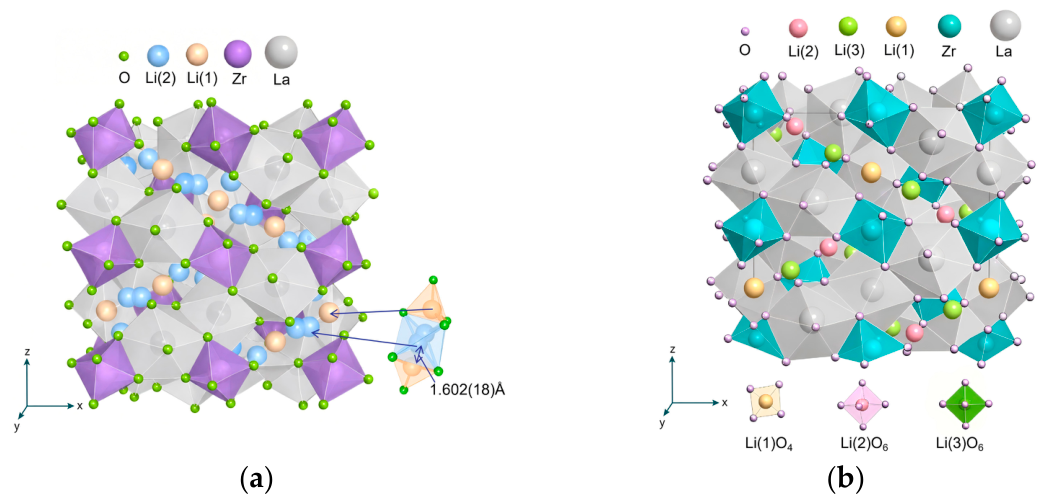
In 2009, Awaka et al. [29] were the first to synthesize the crystal structure of t-LLZO. As illustrated in Figure 1b, the lithium-ion in the tetragonal structure mainly occupies three types of interstitial points; namely, the tetrahedral interstitial 8a where Li1 is located, the octahedral interstitial 16f where Li2 is located, and the octahedral interstitial 32g where Li3 is located. Among them, the lithium ions at the 8a site are connected to four oxygen atoms, while the lithium ions at the 16f and 32g sites are all connected to six oxygen atoms. As shown in Figure 1a, the lithium-ion sites in the cubic phase are only located at two types of interstitial points: the tetrahedral interstice 24d, where Li1 is located, and the octahedral interstice 96h, where Li2 is located. At the 24d site, the lithium-ion is connected to four oxygen atoms, while at the 96h site, the lithium-ion is connected to six oxygen atoms [29,30].
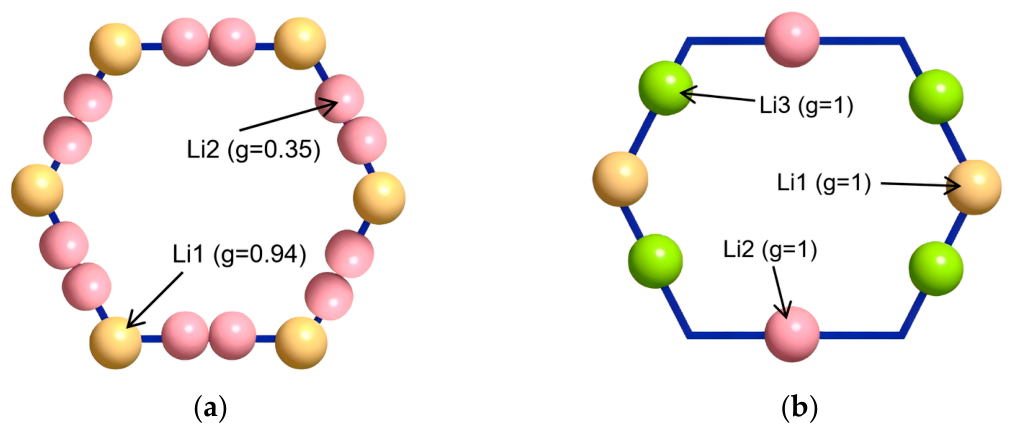
Awaka et al. [29] found that the room-temperature ionic conductivity of t-LLZO is two orders of magnitude lower than that of c-LLZO. As shown in Figure 2a, in c-LLZO, Li+ partially occupy the Li1 (0.94) and Li2 (0.35) within the ring-shaped channels. This disordered arrangement and the relatively short Li-Li hopping distance between adjacent positions result in a higher conductivity. On the contrary, in t-LLZO (Figure 2b), Li+ are arranged in an ordered manner in a completely occupied (Li1, Li2, and Li3, with an occupancy rate of 1 for all positions) at specific locations. This ordered state leads to a greater distance between adjacent Li+ compared to the cubic phase, thereby making the migration of Li+ more difficult.
The differences in the occupancy states and arrangement patterns of Li+ are the fundamental reasons that determine the crystal structure and ionic conductivity of LLZO. There are differences in the space group and ionic conductivity between t-LLZO and c-LLZO, as shown in Table 1 [31].

3. The Electrical Conduction Mechanism of LLZO

Although LLZO has a relatively high ionic conductivity, it still has a considerable gap compared to the currently commonly used liquid electrolytes. Clearly understanding the transport mode of Li+ in LLZO, that is, the ionic conductivity mechanism of LLZO, is beneficial to finding better improvement strategies to further enhance its ionic conductivity [32,33].
Xie et al. [34] synthesized an aluminum-free cubic phase of LLZO under low-temperature conditions. Through neutron diffraction, they determined the lithium-ion distribution in the aluminum-free cubic phase of LLZO. It was found that Li+ almost completely occupied the bridging octahedra (occupancy rate approximately 88%), while the 48g sites at the center were basically empty; the occupancy rate of the 24d tetrahedral sites was approximately 56%. Through this study, the following conclusion was reached. An octahedron cannot share faces with two already occupied tetrahedra simultaneously. The theoretical lithium capacity limit of the garnet structure is 7.5 lithium per chemical formula unit. In actual materials, when the lithium content exceeds approximately 6.4, the material system will optimize ion transmission by forming a short-range order of tetrahedral vacancies. It is predicted that the optimal ionic conductivity occurs around a lithium content of x ≈ 6.4.
Wang [35] and other scholars systematically studied the W-doped garnet electrolyte using multi-scale experimental methods. By employing high-resolution solid-state nuclear magnetic resonance technology, they clearly distinguished the three lattice sites of lithium ions (tetrahedral 24d, octahedral 48g, and distorted octahedral 96h), and through two-dimensional exchange spectroscopy, observed the exchange of lithium ions between the tetrahedral 24d site and the distorted octahedral 96h site, thereby experimentally confirming that the specific migration path of lithium ions was a cyclic network of 24d-96h-48g-96h-24d.
Tian et al. [36] combined neutron and X-ray total scattering techniques, inverse Monte Carlo simulation, and molecular dynamics simulation to study the three-dimensional dynamic distribution and diffusion mechanism of lithium ions in the high-performance solid electrolyte cubic phase LLZO without a preset lithium site model. They found that lithium ions were mainly distributed near the Li1 (tetrahedral) and Li2/Li3 sites. The Li2 site was nearly fully occupied, while there were a large number of vacancies at the Li1 site. The diffusion was not simultaneous for all lithium ions but was achieved by a small number of instantaneous migrating ions that jumped between the Li2 sites and passed through the vacant Li1 sites. This revealed the structural root of the high ionic conductivity of the material, indicating that the stable La3Zr2O12 framework provides a rigid diffusion channel for lithium ions, providing atomic-scale insights for rational design and optimization of solid-state electrolyte materials.
Kuganathan et al. [37] used atomic-scale simulation methods to study the intrinsic defect process and ion self-diffusion mechanism of the t-LLZO. They found that during high-temperature treatment, the material was most prone to lose Li2O, resulting in the simultaneous generation of lithium and oxygen vacancies, providing a carrier for lithium and oxygen diffusion. The activation energy for the migration of lithium ions through the vacancy mechanism is low (0.45 eV), which is significantly lower than that of oxygen ions (approximately 1.65 eV), indicating that lithium diffusion is easier than oxygen diffusion. A small amount of Li/La and Li/Zr mislocation cluster defects may form. The binding energy is negative, indicating that these defects are energetically stable. The electronic structure analysis shows that LLZO is a wide-bandgap semiconductor (approximately 4.50 eV). Oxygen vacancies and interstitial defects introduce defect levels but do not significantly change the overall density of states distribution. This research work, from the perspective of defect chemistry, revealed the fundamental structure of the rapid lithium conduction in LLZO. It was found that the volatilization of Li2O at high temperatures, which creates vacancies, is a key factor affecting its ionic conductivity and stability.

4. Preparation Method of LLZO

The most common preparation methods for LLZO currently include the solid-phase reaction method, sol-gel method, field-assisted sintering method, co-precipitation method, and advanced 3D printing techniques, etc.

4.1. Solid-Phase Reaction Method

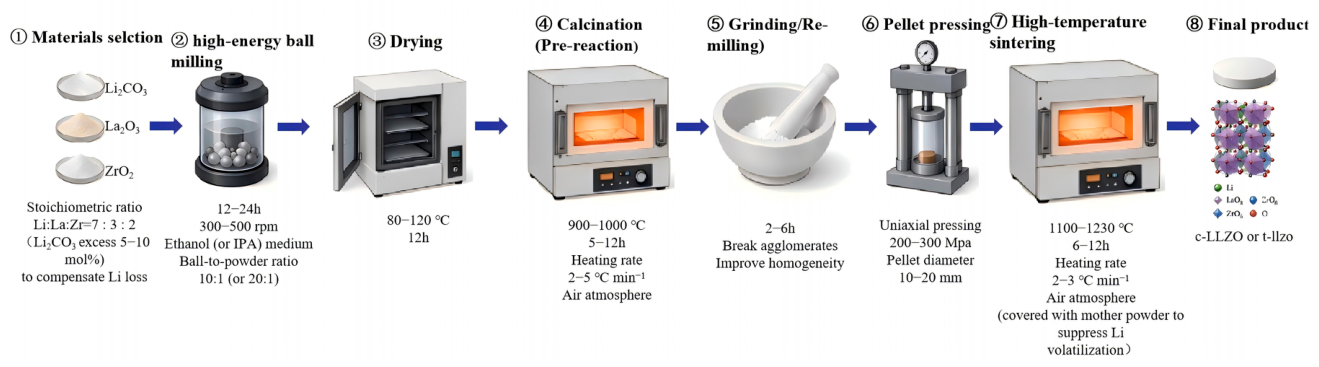
The solid-phase reaction method is one of the most commonly used approaches for manufacturing LLZO. This is because it is simple to operate, has low cost, high efficiency, and is suitable for large-scale production. During this process, the precursor substances of lithium, lanthanum, and zirconium (usually Li2CO3, La2O3, and ZrO2) are uniformly mixed through high-energy ball milling, resulting in a uniformly mixed powder mixture. Then, the mixed powder is dried and pre-calcined. During this process, initial solid-state diffusion occurs, and an intermediate phase gradually forms. After secondary grinding to improve particle uniformity, the powder is pressed into pellets and sintered at high temperatures to promote phase transformation and form a dense garnet-type LLZO. The process is shown in Figure 3. Although this method has some advantages, such as simple operation and industrial scalability, it usually requires a long high-temperature treatment time, which leads to lithium volatilization, formation of impurity phases, grain coarsening, and uneven element distribution. Therefore, excess lithium sources, doping treatments, and other processes are usually needed to optimize phase purity and electrochemical performance.
Rahmawati et al. [38] successfully synthesized Al-Y co-doped LLZO (LLZAYO) powder using the solid-state reaction method. They increased the cubic proportion of the material from 49.58 to 84.91%. The green body was densified by cold isostatic pressing (instead of high-temperature sintering), and the highest ionic conductivity of approximately 9.06 × 10⁻⁶ S/cm was obtained at a pressure of 40 MPa, which was about 8 times higher than that of the non-doped sample.
Cao et al. [39] prepared Y and Sb co-doped LLZO by the solid-state reaction method. When the doping amount of Y is 0.05, the material has the best performance. The ionic conductivity reaches 3.20 × 10⁻⁴ S/cm at 30 °C, and the relative density reaches 95.1%. The LiFePO4 full cell assembled with this electrolyte exhibits high discharge capacity (154 mAh/g in the first cycle) and good cycle stability.
Chen et al. [40] prepared Y-doped Li7La3Zr2O12 (Y-LLZO) solid electrolyte using the solid-state reaction method. The raw materials were LiOH, La2O3, and ZrO2 containing 3 mol% Y2O3. After grinding and mixing, they were calcined at 900 °C for 12 h to obtain pure cubic garnet powder. During the pressing and sintering process, it was found that Li2O volatilized severely at high temperatures (mass loss of 14.2%), resulting in difficulty in achieving dense material and the formation of impure phase La2Zr2O7. By introducing 1–4 wt.% Al2O3 as a sintering aid, the volatilization of lithium was inhibited, and the growth and densification of grains were promoted. After sintering at 1000 °C for 24 h, the density reached 4.93 g/cm3. The study found that the sample containing 2 wt.% Al2O3 had the best comprehensive performance, with a room-temperature ionic conductivity of approximately 1 × 10⁻⁵ S/cm and an activation energy of 0.352 eV, providing a feasible electrolyte preparation process scheme for all-solid-state batteries.
Huang et al. [41] systematically optimized the entire process of the traditional solid-phase reaction method to achieve the controllable preparation of high-performance Ga-doped LLZO (Ga-LLZO). Using simple oxides as raw materials, they carried out planetary grinding and mixing treatment, then subjected them to calcination at 850 °C, obtaining pure cubic-phase powders. Subsequently, at a temperature of 1100 °C in an air atmosphere, they sintered for 320 min, successfully preparing a ceramic electrolyte with a density of 94.5% and a room-temperature ionic conductivity of 1.49 × 10⁻³ S/cm. The study found that the high conductivity was mainly attributed to the high density and the significant reduction in grain boundaries caused by abnormal grain growth (>100 μm). This process still demonstrated good repeatability at the kilogram-scale level, providing a reliable basis for the large-scale preparation of LLZO electrolytes based on the solid-phase method.
Alam et al. [42] synthesized the tetragonal phase LLZO at 800 °C using a two-step solid-state reaction method. They systematically investigated the low-temperature transformation path of this material to the cubic phase with high ionic conductivity. It was found that the pure cubic phase can be obtained by secondary heat treatment of t-LLZO at 150 °C and 650 °C. The transition at 150 °C is mainly attributed to the hydration of the material, while the transition at 650 °C is directly related to the recombination of crystal structure and the disorder of lithium ions. The mixed phase was obtained at 450 °C and 950 °C. This research reveals a feasible low-temperature synthesis strategy, providing an important reference for reducing energy consumption in the preparation process of high-performance garnet solid electrolytes.

4.2. Sol-Gel Method

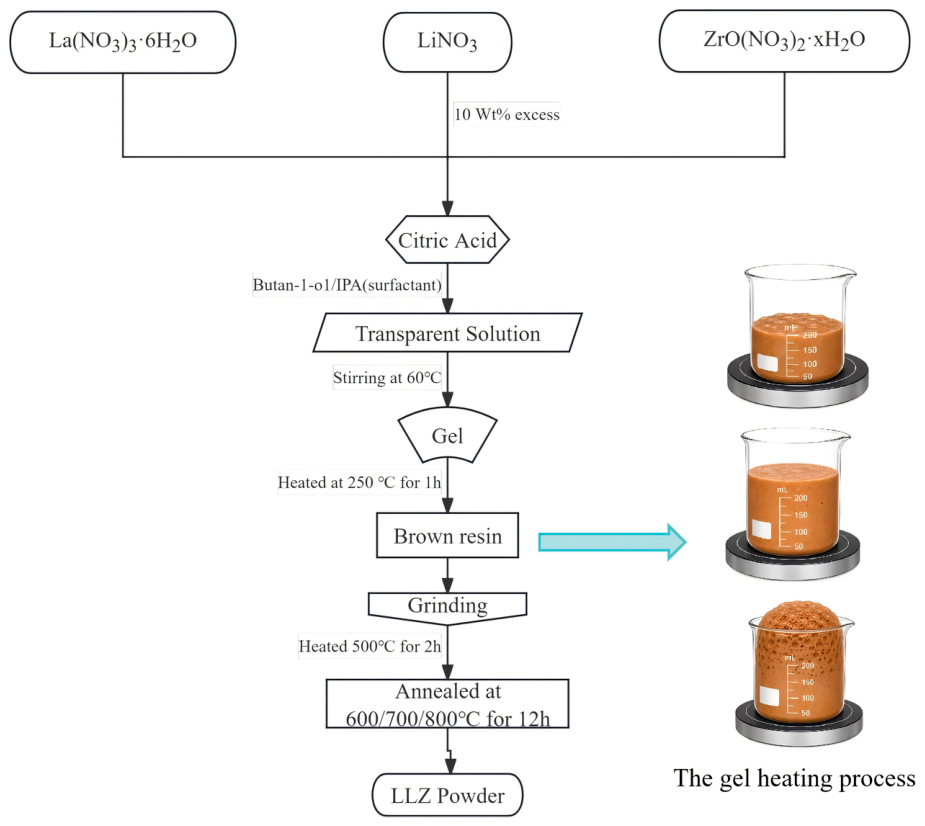
The sol-gel method is a wet chemical synthesis technique used for preparing LLZO. This method typically uses the alkoxides or inorganic salts of lithium, lanthanum, and zirconium as precursors. These precursors are dissolved in an organic solvent, and through hydrolysis and condensation reactions, a sol is formed. Then, through aging and drying processes, the sol transforms into a gel. The gel undergoes heat treatment, such as high-temperature calcination, to remove organic substances and form crystalline phases. Finally, through sintering, dense LLZO ceramic pellets or powders are obtained, as shown in Figure 4. The advantage of this method lies in its ability to mix the raw materials at the molecular level, achieving a high degree of uniformity in composition. This helps to reduce the synthesis temperature, inhibit the formation of impurity phases, and improve the ionic conductivity of the final product.
Sharifi et al. [43] synthesized Al3+-doped LLZO by the combustion sol-gel method. By using metal nitrate as a raw material and urea as fuel, the gel was formed by solution mixing and heating, and then calcined at 1000 °C for 1 h to obtain precursor powder with uniform composition, followed by pressing and sintering at 1180 °C for 10 h to obtain a ceramic electrolyte. Al3+ was successfully incorporated into the lattice and effectively promoted the stability of the cubic phase. The sample with an Al molar doping level of x = 0.25 (i.e., Li6.25Al0.25La3Zr2O12) exhibited the highest room-temperature ionic conductivity (4.7 × 10⁻⁴ S/cm), along with significantly improved density and hardness.
Tian et al. [44] systematically investigated the formation mechanism and sintering behavior of the aluminum-doped Li7 − 3xAlxLa3Zr2O12 prepared by the sol-gel method. They found that the calcination process could be divided into three stages: formation of La2Zr2O7 (<750 °C), transformation to LLZO (750–850 °C), and decomposition of LLZO (>850 °C). Appropriate aluminum doping not only can stabilize the cubic phase and reduce the densification temperature to 1100 °C, but also can increase the ionic conductivity to 3.08 × 10⁻⁴ S/cm. The study also found that abnormal grain growth triggered by sintering would lead to random grain orientation, which would further reduce the conductivity. It emphasized the need to monitor the orientation through XRD to optimize the sintering process, providing key guidance for the preparation of high-performance LLZO ceramic electrolytes.
Parascos et al. [45] synthesized Ga-doped LLZO powder using the sol-gel method. By controlling the chemical homogeneity of the precursor solution and conducting low-temperature calcination (700 °C), they effectively reduced lithium loss and enhanced the sintering activity of the powder. Combined with a tape casting process and low-temperature sintering (1050 °C), they successfully prepared a high-performance self-supporting film with a density of 98% and an ionic conductivity of 1.41 mS/cm. Furthermore, they constructed a multi-layer porous/dense/porous structure with a fully interconnected pore network. This structure enabled the symmetric lithium battery to cycle stably for over 200 times at 0.5 mA/cm2, and exhibited a high critical current density (CCD) of 2.5 mA/cm2. This work provides an important approach for the large-scale preparation of high-performance LLZO electrolytes using sol-gel and tape casting technologies for all-solid-state batteries.
Ashuri et al. [46] successfully synthesized aluminum-doped LLZO using the sol-gel combustion method. This method achieved atomic-level uniform mixing of the components through liquid precursors. At a sintering temperature of 1100 °C, the 0.25 mol Al-doped sample formed a pure cubic phase, achieving a high relative density of 94% and exhibiting optimal electrical conductivity.

4.3. Field-Assisted Sintering Method

The field-assisted sintering method, such as spark plasma sintering (SPS) or field-assisted sintering technology (FAST), is an advanced process for preparing LLZO. By applying direct current, pulse current, and axial pressure, the LLZO precursor powder can be rapidly densified and sintered within a few min at 1100–1180 °C and 5–10 MPa using the electric field induction effect. This method can effectively solve the problems of serious volatilization of traditional sintered lithium, low density, and long cycle. It can stabilize the cubic phase structure of LLZO, inhibit the impurity phase, and improve the density and room temperature lithium-ion conductivity. In addition, the crystal structure and ion transport properties can be optimized by adjusting the electric field strength, sintering temperature, and doping elements, which provides a key technical guarantee for the low-cost and large-scale preparation of LLZO electrolyte for high-performance all-solid-state batteries.
Zhang et al. [47] used the ultra-fast sintering technique to prepare LLZO. They used a direct current power supply to generate Joule heat in the two layers of carbon felt, thereby rapidly heating the LLZO sample to a high temperature within an extremely short period to achieve rapid densification. The study also found that ultra-fast sintering would leave a Li2O contamination layer approximately 40 nm thick on the surface of LLZO, significantly reducing the critical current density and cycle stability of the battery. Therefore, the research team proposed adding a brief thermal treatment (900 °C, 10 min) after sintering, successfully eliminating the surface Li2O and restoring the electrochemical performance to a level comparable to traditional sintering. This method significantly shortened the sintering time, reduced lithium loss, effectively inhibited the formation of low conductivity inclusions, and provided an important solution path for the large-scale preparation of high-performance solid-state batteries.
Fukuda et al. [48] conducted a systematic comparison of the performance of two rapid sintering methods, namely induction heat pressing (HP) and SPS, for the preparation of aluminum-doped LLZO. They found that both methods could achieve a high density of approximately 98% within 5 min under optimized conditions, and could obtain excellent performance with a room-temperature ionic conductivity exceeding 0.45 mS/cm. Although SPS has a slight advantage at lower temperatures due to a more uniform heat distribution within the mold, both methods essentially rely on thermal conduction and mechanical pressure as the dominant sintering mechanisms, and their final performances are similar. This challenges the traditional view that “SPS is necessarily superior to HP”, providing an important basis for the selection of rapid and efficient sintering processes for oxide electrolytes in solid-state batteries.

4.4. Co-Precipitation Method

The co-precipitation method is a classic liquid-phase synthesis process for preparing the LLZO. It uses soluble metal salts such as lithium nitrate as raw materials, and precipitates Li+, La3+, Zr4+, and dopant ions with precipitating agents such as ammonia water and ammonium bicarbonate to form hydroxides or carbonate precursors. After being dried and pre-fired at 700–850 °C to remove impurities and initially form a tetragonal phase, it is then subjected to high-temperature sintering (at atmospheric pressure/two-step sintering) at 1100–1200 °C to stabilize and densify the cubic phase. This method has low raw material cost, uniform element mixing, and controllable powder particle size. The room-temperature ionic conductivity of the prepared LLZO ranges from 1.5 × 10⁻⁴ to 2.0 × 10⁻⁴ S/cm. Moreover, by adjusting the pH value of the precipitation process and other parameters, the purity of the crystal phase and the ionic transport performance can be optimized. This is one of the feasible and economical key approaches for the large-scale production of LLZO.
Wang et al. [49] used the low-temperature synthesis method and successfully prepared cubic Li6.1Al0.3La3Zr2O12 with an average particle size of approximately 180 nm at 600 °C. This preparation process involved three steps: co-precipitation, hydrothermal aging, and low-temperature calcination. It avoided the formation of the tetragonal phase and lithium loss problems that occurred in the traditional high-temperature process. The prepared material has high ionic conductivity (0.42 mS/cm), low activation energy (0.17 eV), and high current density. The symmetrical battery test showed that it exhibited good cycle stability and high current density (2.16 mA/cm2) at the lithium metal interface, providing a feasible experimental basis for the development of high-performance and easy-to-process all-solid-state lithium metal batteries.
Guo et al. [50] used the co-precipitation method to synthesize high-performance Li6.4Ga0.2La3Zr2O12 powder. They precipitated Ga3+, La3+, and Zr4+ together in an alkaline solution to prepare nano-sized ternary GaLaZr precursors. These precursors were then formed into micron-sized spherical secondary particles through spray drying. Subsequently, Li2CO3 was introduced through three methods: wet ball milling, dry ball milling, and dry mixing. It was found that wet ball milling could achieve uniform mixing at the nanoscale, reducing the synthesis temperature of the cubic phase Ga-LLZO to 800 °C, which was significantly lower than the 1000 °C required by the dry method. Eventually, a high-performance electrolyte material with an ion conductivity of approximately 1 mS/cm was obtained. This method avoids the use of toxic gases and flammable solvents, and has the advantages of safety, environmental friendliness, and ease of large-scale production.

4.5. 3D Printing and Complex Architecture Fabrication

3D printing and complex architecture manufacturing are extremely advanced technologies for producing LLZO solid electrolytes. Traditional synthesis methods (such as solid-phase reactions and sol-gel methods) can produce flat pellets or films with good density, but they cannot customize the macroscopic and microscopic geometries of the solid electrolytes. By using 3D printing technology or template-assisted techniques (such as freeze casting), LLZO can be processed into complex 3D structures. This advanced method has unique advantages. It can significantly expand the contact area of the electrode/electrolyte, alleviate the mechanical stress at the interface, and facilitate the integration of thicker composite electrodes, thereby breaking the ion transport limitations of traditional planar batteries [51,52].
Dandeneau et al. [53] investigated the structural stability and electrochemical performance of Ga-doped c-LLZO tubular electrolytes prepared by 3D printing and reactive sintering in the molten eutectic PbLi. The experiments demonstrated that after being immersed at 350 °C for 100 h, the material maintained a cubic phase structure with high ionic conductivity; while at 450 °C, a tetragonal phase transformation and secondary phase formation occurred within only 6 h, and a darkening in color was observed after 50 h. This indicates that the temperature needs to be controlled below 450 °C to maintain phase stability. Linear voltage sweep tests showed that lithium could be successfully pumped out through the electrolyte at 350 °C, proving that this material is promising for use in fusion reactors for extracting hydrogen isotopes (tritium) from PbLi by direct electrolysis.
Shen et al. [54] fabricated a porous c-LLZO scaffold with oriented low-tortuosity channels through the freeze casting technique, and further infiltrated it with LiNi0.6Mn0.2Co0.2O2 active material to construct a composite thick electrode for solid-state batteries. The pore size (approximately 52 and 23 μm) and porosity (73 and 60%) could be controlled by adjusting the freezing temperature (−20 and −50 °C). The synchrotron radiation, X-ray micro-CT, and fluorescence spectra confirmed the uniform orientation of the channels and the effective distribution of the active material. The hybrid half-cell (containing liquid electrolyte and lithium anode) exhibited excellent capacity and Coulombic efficiency after cycling 90 times at 0.3 mA/cm2; simultaneously, a dense/porous LLZO bilayer structure was successfully prepared, and the open-circuit voltage of the all-solid-state battery was preliminarily verified. The theoretical model indicated that high porosity and small pore size could shorten the lithium-ion diffusion path and increase the contact area, thereby enhancing the battery performance. This freeze casting strategy provides a new idea for designing thick electrodes for high-energy-density solid-state batteries.
Karuppiah et al. [55] utilized digital light processing (DLP) 3D printing technology to fabricate T-doped LLZO. By optimizing the slurry formulation (using HDDA as the binder and Irgacure 1173 as the photoinitiator) and the debinding and sintering process (extending the 400 °C holding time), they successfully eliminated cracks and delamination defects, and obtained high-density and highly pure cubic-phase LLZO ceramics. The electrochemical impedance spectroscopy measured the total ionic conductivity at room temperature to be 3.15 × 10⁻⁵ S/cm, with an activation energy of 0.57 eV. Moreover, the study demonstrated that through DLP technology, LLZO scaffolds with oriented porous structures could be customized, providing a new idea for constructing thick solid-state battery electrodes with high interface contact and low tortuosity.
Conclusions: Different preparation methods have their own characteristics. The solid-phase method [38,39,40,41,42] is suitable for large-scale production, but it has problems of high temperature and lithium volatilization. The sol-gel and co-precipitation methods [43,44,45,46,49,50] have advantages in component uniformity, but the process is relatively complex. In contrast, field-assisted sintering [47,48] can achieve high density in a short time, thereby improving material performance. Moreover, new technologies such as 3D printing show potential in structural design, but they are still in the development stage. Therefore, in the future, it is necessary to achieve a balance between cost reduction, structural controllability, and performance improvement.

5. Improvement Strategies for LLZO

LLZO exists in two forms: the t-LLZO and the c-LLZO. The ionic conductivity of the latter is two orders of magnitude higher than that of the former. However, c-LLZO is a stable phase at high temperatures. The c-LLZO present at room temperature is essentially an amorphous and unstable phase of lithium ions. Moreover, it has poor contact with the positive and negative electrode solid–solid interfaces and a thick thickness, which significantly reduces the volumetric energy density of the battery and makes it difficult to be used alone as an electrolyte in solid-state batteries.
Regarding the issues faced by the LLZO in practical applications, such as insufficient ionic conductivity, low sintering density, high interface impedance, and poor mechanical flexibility, current research has developed a set of internal-to-external, multi-scale collaborative improvement strategy systems. (1) Starting from the lattice interior, optimize the Li+ transmission channels through element doping to enhance the intrinsic ionic conductivity; (2) At the material preparation level, introduce sintering aids to reduce the temperature required for increasing density, inhibit lithium volatilization, and regulate the crystal boundary structure; (3) In the electrolyte structure design, combine with polymer electrolytes to form flexible composite electrolytes, which can balance good ionic conductivity and mechanical properties; (4) In the battery integration process, optimize the contact interface between the electrode and the electrolyte to significantly reduce interface impedance and inhibit the growth of lithium dendrites. These strategies complement each other and jointly point towards the ultimate goal of constructing high-performance, highly stable, and scalable solid-state batteries.

5.1. Element Doping

At room temperature, the t-LLZO is more stable than the c-LLZO; therefore, finding a method to stabilize the cubic structure is of great importance. Elemental doping is a commonly used modification method. By introducing appropriate high-valent cations, the lithium content in LLZO is reduced, thereby introducing more Li+ vacancies as charge carriers to enhance the migration and ionic conductivity of Li+. An appropriate amount of lithium vacancies (studies show that introducing approximately 0.4 to 0.6 vacancies per formula unit is optimal) can effectively stabilize the cubic structure and prevent its transformation to the tetragonal phase, thereby generating room-temperature stable cubic LLZO [56]. For the LLZO material, the most effective doping strategies involve the substitution at lithium sites (such as Al3+, Ga3+) and zirconium sites (such as Ta5+, Nb5+). Among them, Ta5+ is considered one of the best dopants because it has excellent electrochemical stability. From the perspective of crystal chemistry, the ionic radius of the dopant is crucial for the stability of the framework. For example, Ta5+ (0.64 Å) is slightly smaller than Zr4+ (0.72 Å), and Al3+ (0.39 Å) is also smaller than Li+ (0.59 Å). A well-matched and usually smaller radius not only minimizes lattice distortion but also causes a slight lattice contraction, thereby further enhancing the stability of the garnet framework. Due to the high structural stability of the framework of garnet, this moderate aliovalent doping does not alter its structural properties. Therefore, it is an ideal method for adjusting the lithium content, increasing Li+ vacancies, and enhancing ionic conductivity [57,58].
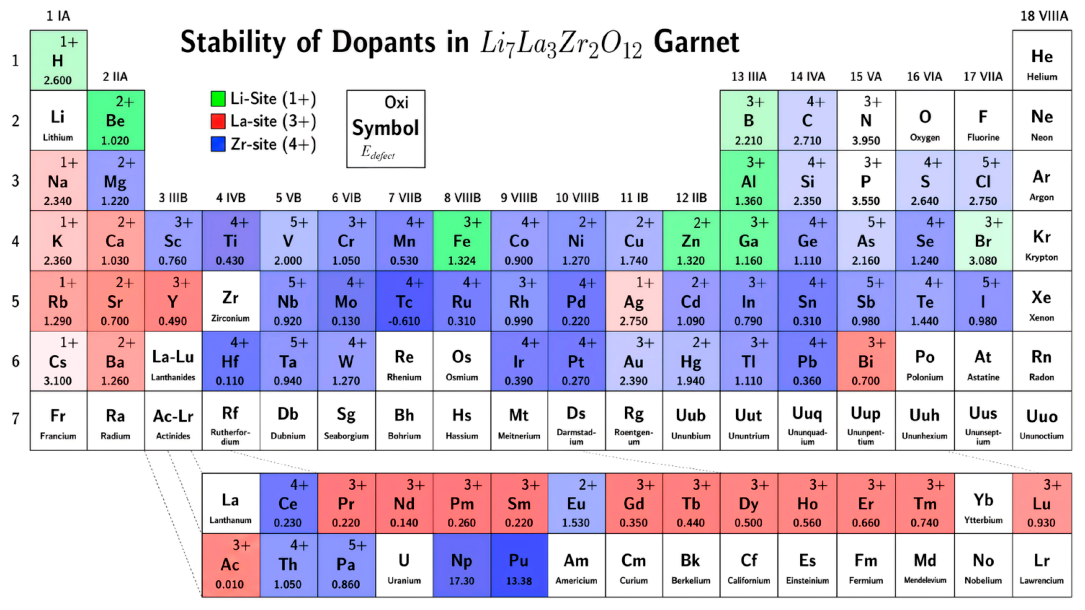
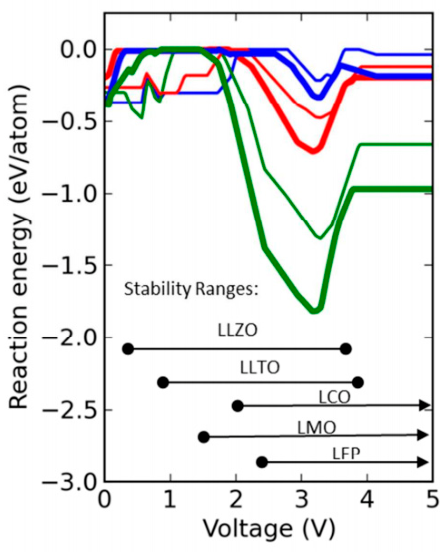
Miara et al. [59] explored two key approaches to enhance the performance of LLZO through first-principles calculations of the system. (1) They systematically screened 128 potential cation dopants and found that new dopants such as Zn2+ and Mg2+ might have greater potential for stabilizing the high-conductivity cubic phase than the traditional Al3+, as shown in Figure 5. (2) They evaluated the thermodynamic stability of the interface between LLZO and different cathode materials, and the results indicated that the LiCoO2 interface was the most stable, while LiFePO4 was prone to interface reactions and the formation of products such as Li3PO4, as shown in Table 2 and Figure 6. This research provides valuable references for finding stable cation dopants and cathodes, and helps to improve the overall performance of solid-state batteries with LLZO electrolytes and cathodes.
The different doping positions of the elements in the LLZO are classified into three categories: Li substitution, Zr substitution, and La substitution, and they are divided into three different doping forms: single doping, double doping, and triple doping. Detailed information on the calcination temperature, sintering time, room-temperature conductivity, relative density, and activation energy of the different doping methods of LLZO studied in recent years is listed in Table 3.

5.2. Incorporation of Sintering Aid Agents

In view of the problems of high-temperature sintering, lithium volatilization, high energy consumption, and poor interface compatibility in the preparation of LLZO, the incorporation of sintering aids has proven to be the most direct and effective modification strategy [85]. By introducing low-melting-point oxides, fluorides, or glass phase additives, transient or permanent liquid phases can be formed during the sintering process, thereby significantly reducing the sintering activation energy, and high densification of the material can also be achieved in the medium temperature range of 800–1000 °C. This provides the possibility for low-temperature co-sintering of LLZO and electrode materials, and also lays the foundation for large-scale industrial production.
Yang et al. [86] used Li3PO4 as a sintering aid and combined it with rapid ultra-high-temperature sintering technology to successfully prepare a high-performance garnet-type electrolyte (LLZNO-LPO) for solid-state lithium–sulfur batteries. The sintering agent Li3PO4 played an extremely important role in the process. It melted into a liquid phase at high temperatures, effectively filling the gaps between LLZNO grains, significantly improving the density of the ceramic and enhancing the contact between grain boundaries, thereby increasing the ionic conductivity to 4.28 × 10⁻⁴ S/cm. The solid-state lithium–sulfur battery assembled with this electrolyte achieved a high initial capacity of 943 mAh/g and a Coulomb efficiency of 99.5%, proving that the sintering aid is crucial for constructing a dense, highly conductive solid-state electrolyte that is capable of effectively blocking the shuttle of polysulfides.
Fuchigami et al. [87] synthesized La2Zr1.4Ta0.6O7/Li6.4La3Zr1.4Ta0.6O12 composite nanoparticles (approximately 120 nm) through planetary ball milling and annealing. They used these as sintering aids to enhance the performance of the LLZTO. It was found that when the composite nanoparticles were mixed with LLZTO microparticles at a ratio of 20 wt.%, a nearly monolayer coverage could form on the surface of the microparticles, and after sintering at 1160 °C, it could effectively promote densification and inhibit abnormal grain growth. The resulting product achieved a relative density of over 90%, an ionic conductivity of 3.9 × 10⁻⁴ S/cm, and a Vickers hardness of 6.26 GPa, indicating that this nano-composite additive can improve the sintering properties, electrochemical, and mechanical properties of the LLZO ceramic.
Luo et al. [88] used SiO2 as a sintering aid to prepare W-doped Li6.4La3Zr1.7W0.3O12 (LLZWO) through solid-phase reaction. They found that an appropriate amount of SiO2 (0.2 wt.%) could effectively promote sintering densification, increasing the relative density to 93.8%, and could increase the ionic conductivity to 9.11 × 10⁻⁴ S/cm, while reducing the lithium-ion migration activation energy to 0.38 eV. SiO2 is mainly enriched at the grain boundaries to form a glass phase, optimizing the grain boundary structure. However, adding too much (0.4 wt.%) would lead to performance degradation due to lithium volatilization and increased micropores. This study proved that an appropriate amount of SiO2 as a sintering aid is an effective way to improve the comprehensive performance of the LLZWO electrolyte, providing an important reference for its application in solid-state batteries.
Li et al. [89] employed a one-step preparation process combining solid-state reaction sintering (SSRS) with the addition of 1 wt.% CuO as a sintering aid to successfully prepare Ta-doped LLZO ceramics with a relative density exceeding 90% and without any impurity phases at a temperature of 1100 °C. The ionic conductivity of these ceramics reached approximately 1.06 × 10⁻⁴ S/cm, while the electronic conductivity was negligible, and the lithium-ion migration number was close to 1. The mechanism of CuO’s action lies in promoting the formation and decomposition of the intermediate phase La2Cu0.5Li0.5O4, accelerating the lithium-ion transport and densification process. This process is simple and energy-efficient, providing an effective approach for the large-scale preparation of all-solid-state lithium-ion battery electrolytes.
Hayash et al. [90] successfully reduced the sintering temperature of the LLZO to 750 °C by introducing Li3BO3 as a sintering aid and combining the Ca and Bi co-doping strategy. Ca2+ reacted with Li3BO3 to form a low-melting Li4Ca(BO3)2 liquid phase, and the doping of Bi further promoted the formation of Li-Ca-Bi-O liquid phase. These two liquid phases effectively promoted the flow, rearrangement, and necking between particles during the sintering process, thus achieving a relative density of up to 89% at low temperatures. The electrolyte obtained a high ionic conductivity of 3.0 × 10⁻⁴ S/cm at room temperature and was successfully applied to all-solid-state lithium batteries, showing good cycle performance.
Lee et al. [91] introduced different contents (1–10 wt.%) of Li2O-B2O3-SiO2 (LBS) glass as sintering additives into the preparation process of Ga-doped Li6.1Ga0.3La3Zr2O12 (LGLZO), and studied its effects on material structure, ion transport, and lithium dendrite resistance. It is found that an appropriate amount of LBS (1 wt.%) can effectively fill the grain boundary pores, improve the density, increase the lithium-ion conductivity to 2.64 × 10⁻³ S/cm, and reduce the activation energy to 0.299 eV, giving the material the best dendrite resistance (critical current density of 0.38 mA/cm2) and cycle stability. However, excessive addition (≥3 wt.%) will lead to the formation of the impurity phase La2Zr2O7, which will hinder ion transport and deteriorate electrochemical performance. Therefore, an appropriate amount of LBS as a sintering aid is a very effective strategy to improve the comprehensive performance of the solid electrolyte.

5.3. Construction of Composite Electrolyte

Although the intrinsic ionic conductivity of LLZO can be significantly enhanced through element doping and sintering process optimization, the inherent brittleness, high hardness, and poor solid–solid point contact with electrodes of all-ceramic electrolytes still severely restrict their practical application in flexible devices. To break through the performance bottleneck of a single material, combining LLZO ceramic fillers with high ionic conductivity and high-flexibility polymer matrices such as polyethylene oxide (PEO) and polyvinylidene fluoride (PVDF) to construct composite solid electrolytes (CSEs) has emerged as a highly promising solution. This “rigid-flexible” composite strategy not only effectively improves the mechanical processing performance and interfacial wettability of the electrolyte but also provides new high-speed channels for lithium-ion transport through the synergistic effect of the ceramic/polymer interface [92,93,94,95].
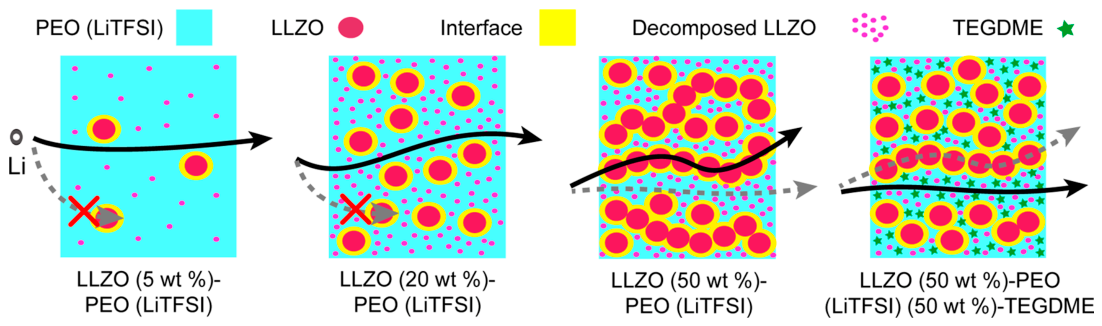
As shown in Figure 7, Zheng et al. [96] conducted a systematic study on the mechanism of lithium-ion transport in the LLZO-PEO composite electrolyte using solid-state NMR and isotope tracing techniques. They found that when the content of LLZO was less than 20 wt.%, Li+ tended to transfer within the PEO matrix. When the content of LLZO was 50 wt.%, a large amount of Li+ was transferred within LLZO. They also discovered that adding TEGDME liquid electrolyte could reshape the transport path to the polymer phase and significantly improve the ionic mobility. This highlights the importance of understanding the microscopic mechanism to optimize the design of composite electrolytes, providing a theoretical basis and method guidance for the design of high-performance solid-state battery composite electrolytes.
Li et al. [97] successfully reduced the crystallinity of the polymer matrix and enhanced the thermal stability and mechanical strength by blending PEO with PVDF in a 7:3 ratio. After further adding 10 wt.% cubic-phase LLZO ceramic fillers, they achieved an ion conductivity of up to 4.2 × 10⁻⁵ S/cm at 30 °C. The all-solid-state LiFePO4||Li battery based on this electrolyte maintained a capacity retention rate of 96.5% after 100 cycles at 60 °C. The Li||Li symmetric battery could stably cycle for over 300 h at 0.2 mA/cm2, significantly inhibiting the growth of lithium dendrites. The composite solid-state electrolyte also exhibited excellent flame-retardant properties. The comprehensive performance indicates that it is an ideal candidate material for the next generation of high-safety and high-performance all-solid-state batteries.
Saran [98] conducted a study introducing the tetragonal phase of In-doped LLZO into the PEO/LiTFSI polymer electrolyte at room temperature. They achieved a spontaneous transformation from the tetragonal phase to the cubic phase within the composite system. It was found that this transformation occurred only when the indium doping content was less than 20%. This phase transition significantly enhanced the ionic conductivity of the composite electrolyte (2.40 × 10⁻⁵ S/cm at room temperature). Additionally, the material exhibited a wide electrochemical window (5.3 V), a high lithium-ion migration number (0.34), and excellent cycling stability. This research revealed the synergistic effect between PEO and LLZO and the lithium-ion rearrangement mechanism, providing a new approach for the low-cost and low-temperature preparation of high-performance solid-state electrolytes.
Pang et al. [99] successfully prepared a high-performance organic–inorganic composite solid electrolyte (O-ICSEs) by combining Ga/Ta co-doped LLZO particles (Li6.4Ga0.1La3Zr1.7Ta0.3O12) with PEO-LiTFSI polymer. This electrolyte achieved an ion conductivity of 4.35 × 10⁻⁴ S/cm at 60 °C, expanded the electrochemical window to 5.5V, and significantly increased the lithium-ion migration number to 0.39. The solid-state battery operated stably for over 1000 h at 0.2 mA/cm2, and the full battery maintained a capacity retention rate of 91.1% after 100 cycles. This provided a feasible electrolyte solution for the development of high-safety and high-energy-density all-solid-state lithium-ion batteries.

5.4. Optimization of Electrode/Electrolyte Contact Interface

LLZO has a relatively wide electrochemical window [100,101]. However, when in direct contact with the oxide cathode under high voltage conditions, it is still difficult to completely avoid the occurrence of element interdiffusion and the space charge layer effect (Space Charge Layer). This leads to the formation of a decomposition product layer with high resistance at the interface. This chemical and electrochemical instability severely restricts the interfacial transport of lithium ions. To address this challenge, using materials with good chemical stability (such as LNbO3, Li3BO3, etc.) to perform surface coating on LLZO or positive electrode particles, and constructing an artificial cathode–electrolyte interphase (CEI), or constructing an interface buffer layer, has become a practical and effective modification method [102,103,104,105]. The aim of this strategy is to physically isolate the direct contact between LLZO and the cathode, inhibit the diffusion of harmful elements, and, at the same time, ensure the smooth transmission of lithium ions by leveraging the ionic conductivity of the coating layer itself.
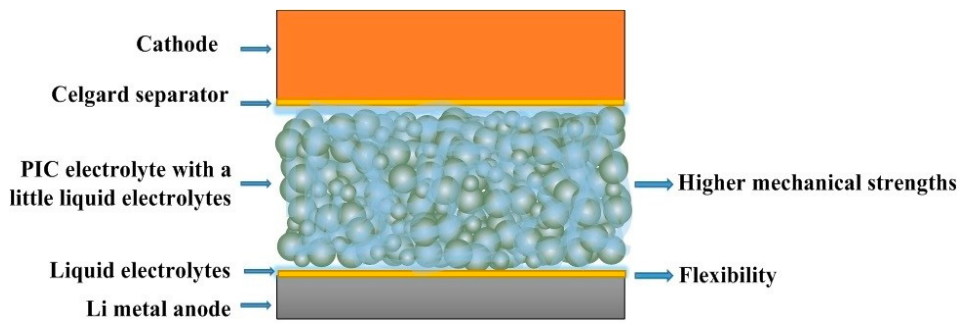
As shown in Figure 8, Li et al. [106] employed a “rigid-flexible” design concept to develop a novel soft–hard laminated hybrid electrolyte, referred to as polymer-in-ceramic (PIC), to enhance the performance of solid-state lithium metal batteries. The intermediate layer of this PIC electrolyte is a polymer–ceramic composite with a high ceramic content, providing robust mechanical properties to inhibit lithium dendrite growth. The outer layers consist of commercial separators impregnated with a liquid electrolyte, forming a soft and porous interface that significantly reduces electrode contact resistance. The PIC electrolyte exhibits a high room-temperature ionic conductivity of 4.76 × 10⁻⁴ S/cm and an interfacial resistance of less than 300 Ω, demonstrating excellent thermal stability and effective dendrite suppression. Furthermore, LiFePO4|Li cells based on this electrolyte deliver a high initial capacity of 125.8 mAh/g at room temperature, good cycling stability (94.9% capacity retention after 200 cycles), and high Coulombic efficiency, indicating their great potential for practical applications in solid-state batteries.
Song et al. [107] employed the dry coating technique to uniformly coat LiNbO3 on the surface of LLZO powder particles to isolate H2O and CO2 in the air and inhibit the formation of surface insulating Li2CO3. After the aging test, the initial ionic conductivity of the coated sample (9.17 × 10⁻⁴ S/cm) was maintained at 79%, which was much higher than that of the 23% of the uncoated sample. In the electrochemical tests, the lithium symmetric battery and LFP all-cell assembled with this electrolyte both had lower interface resistance, higher critical current density, and more stable cycling performance. This study indicates that performing preventive surface coating on the electrolyte powder is an effective way to improve the stability of the electrode–electrolyte interface and enhance the comprehensive performance of all-solid-state batteries.
To address the poor interface contact between garnet-type solid electrolytes and lithium metal anodes, as well as the problem of lithium dendrite growth, Ruan et al. [108] proposed a simple acid–salt treatment method. They constructed a 3D cross-linking LiF-LiCl (CF) interfacial layer on the surface, which enhanced the wettability of molten lithium through capillary action, forming a dense and stable interface. Benefiting from its excellent electronic insulation properties, this layer blocked electron conduction and inhibited the nucleation and growth of lithium dendrites. The modified symmetric cell achieved an extremely low interfacial resistance (11.6 Ω·cm2), a high critical current density (1.8 mA/cm2 at 25 °C), and an ultra-long cycling stability of over 1000 h. Furthermore, they first proposed the concept of critical areal capacity (CAC), defined as the areal capacity at which the CCDs obtained from time-constant and capacity-constant testing modes are equal, to systematically evaluate the endurance of the interface. Full cells matched with different cathodes demonstrated outstanding rate and cycling performances, providing a simple and effective interfacial engineering strategy for the development of high-safety and high-performance solid-state lithium metal batteries.
Qin et al. [109] proposed a strategy that utilizes the high-speed mechanical polishing (HMP) method to effectively remove Li2CO3 impurities on the surface and pores of the LLZTO, thereby significantly improving its interface contact with lithium metal. Through this experiment, the surface of LLZTO changed from being desorptive of lithium to being receptive of lithium, and the interface resistance decreased from approximately 1000 to 28.15 Ω·cm2. At the same time, the cycling stability of the symmetric battery (lasting for 1200 h at 0.1 mA/cm2) and the performance of the all-cell (with a LiFePO4 positive electrode cycling 500 times at 0.2C rate, with a capacity retention rate of 89.5%) were significantly enhanced. The study shows that HMP is a simple, environmentally friendly, and potentially scalable efficient interface engineering method.
Conclusions: Current research indicates that different optimization strategies have distinct focuses in enhancing performance. Doping [59,60,61,62,63,64,65,66,67,68,69,70,71,72,73,74,75,76,77,78,79,80,81,82,83,84] is mainly used to regulate the crystal structure and increase conductivity, while the composite strategy [96,97,98,99] focuses more on improving interface issues. In contrast, the structural design method can simultaneously affect the ion transport path and interface contact, but it is more challenging to implement. Therefore, future research may need to combine multiple strategies to achieve a coordinated improvement in performance.

6. Prospects

Although LLZO has a high ionic conductivity and inherent safety, which makes it a core component in the field of solid-state electrolytes, its commercialization process is still constrained by two key issues: the failure of rigid interface contact and the growth of lithium dendrites. Future research should not merely focus on improving a single ionic conductivity indicator, but should be conducted from the perspective of multi-physics field coupling. On one hand, it is necessary to utilize grain boundary engineering and composite interface design to solve the problem of dendrite penetration under high current density and break through the limitation of critical current density (CCD); on the other hand, it is essential to overcome the challenges of ultra-thin film (<50 μm) fabrication, processing technology, and low-cost low-temperature sintering techniques, in order to balance the high energy density and mechanical stability of the entire battery. In addition to the research on large-scale energy storage, integrating solid-state electrolytes into miniaturized, on-chip integrated energy devices is also a highly promising development direction. Currently, in the field of micro-energy systems, advanced technologies such as photolithography and 3D thin-film architectures (such as the Swiss roll design) have been successfully utilized to develop high-performance chip-level micro batteries [110] and micro supercapacitors with sensing functions [111]. On this basis, Zhang et al. [112] further achieved monolithic integration of energy storage and actuation at sub-millimeter scales through micro-origami technology. Therefore, exploring the feasibility of combining LLZO films and other inorganic solid-state electrolytes with the aforementioned advanced micro-manufacturing technologies is expected to provide miniature power sources for next-generation, inherently safe, microelectronic devices. Only when a balance is achieved between the microscopic mechanism explanation and the macroscopic engineering preparation can the LLZO-based solid-state battery truly move from the laboratory to large-scale application.

Author Contributions

P.W.: Conceptualization, Data curation, Formal analysis, Investigation, Methodology, Visualization, Writing—original draft. L.X.: Conceptualization, Funding acquisition, Project administration, Resources, Supervision, Writing—review and editing. X.L., R.Y., and J.L.: Investigation, Formal analysis, Writing—review and editing. All authors have read and agreed to the published version of the manuscript.

Funding

This research was funded by [Natural Science Research of Jiangsu Higher Education Institution of China] grant number [24KJD430002] and [Liaocheng University Initiation Fund for Doctoral Research] grant number [No. 318051906] and the APC was funded by Liaocheng University.

Data Availability Statement

No new data were created or analyzed in this study. Data sharing is not applicable to this article.

Conflicts of Interest

The authors declare no conflict of interest.

References

  1. Wu, Y.; Yuan, X.; Dong, C. Lithium-Ion Batteries: Applications and Practices, 2nd ed.; Chemical Industry Press—Materials Science and Engineering Publishing Center: Beijing, China, 2012; pp. 1–9. [Google Scholar]
  2. Liu, Y. Development situation of lithium ion battery industry in China in 2025. Eco-Ind. Sci. Phosphorus Fluor. Eng. 2025, 40, 8–14. [Google Scholar]
  3. Gao, D.; Shao, Z.; Wu, L.; Liu, Y. Patent Analysis and Prospect Outlook of Inorganic Solid-State Electrolyte Technologies for Lithium-Ion Batteries. Nonferrous Met. 2025, 15, 1935–1950. [Google Scholar] [CrossRef]
  4. Niu, C. When Will Solid-State Batteries Be “Put into Use”. China Econ. Wkly. 2025, 21, 70–71. [Google Scholar]
  5. Zhou, X.; Zhou, Y.; Yu, L.; Qi, L.; Oh, K.-S.; Hu, P.; Lee, S.-Y.; Chen, C. Gel polymer electrolytes for rechargeable batteries toward wide-temperature applications. Chem. Soc. Rev. 2024, 53, 5291–5337. [Google Scholar] [CrossRef] [PubMed]
  6. Fan, L.Z.; He, H.; Nan, C.W. Tailoring inorganic–polymer composites for the mass production of solid-state batteries. Nat. Rev. Mater. 2021, 6, 1003–1019. [Google Scholar] [CrossRef]
  7. Jiang, B.; Wei, Y.; Wu, J.; Cheng, H.; Yuan, L.; Li, Z.; Xu, H.; Huang, Y. Recent progress of asymmetric solid-state electrolytes for lithium/sodium-metal batteries. EnergyChem 2021, 3, 100058. [Google Scholar] [CrossRef]
  8. Janek, J.; Zeier, W. A solid future for battery development. Nat. Energy 2016, 1, 16141. [Google Scholar] [CrossRef]
  9. Manthiram, A.; Yu, X.; Wang, S. Lithium battery chemistries enabled by solid-state electrolytes. Nat. Rev. Mater. 2017, 2, 16103. [Google Scholar] [CrossRef]
  10. Liang, B.; Shi, H. Research on the Safety Performance of Lithium-Ion Batteries; Central South University Press: Changsha, China, 2014; pp. 1–52. [Google Scholar]
  11. Yang, T.; Wang, C.; Zhang, W.; Xia, Y.; Huang, H.; Gan, Y.; He, X.; Xia, X.; Tao, X.; Zhang, J. A critical review on composite solid electrolytes for lithium batteries: Design strategies and interface engineering. J. Energy Chem. 2023, 84, 189–209. [Google Scholar] [CrossRef]
  12. Simulescu, V.; Ilia, G. Macrocycles and cavitands containing phosphorus. J. Incl. Phenom. Macrocycl. Chem. 2010, 66, 3–14. [Google Scholar] [CrossRef]
  13. Nie, Y.; Li, S.; Yang, T.; He, L.; Feng, G.; Shao, Y.; Li, Q.; He, J.; Jin, M.; Luo, D.; et al. Crown-ether-programmed covalent organic framework nanochannels enable quasi-single-ion conductivity for solid-state lithium metal batteries. Natl. Sci. Rev. 2026, 13, 7. [Google Scholar] [CrossRef]
  14. Song, S.; Wang, S.; Shan, H.; He, L.; Feng, G.; Shao, Y.; Li, Q.; He, J.; Jin, M.; Luo, D.; et al. Phosphatized garnet-based solid electrolyte enables a sub-10-μm-thick lithium metal anode. Appl. Phys. Lett. 2025, 126, 193901. [Google Scholar] [CrossRef]
  15. Wu, J.; Liu, S.; Han, F.; Yao, X.; Wang, C. Lithium/sulfide all-solid-state batteries using sulfide electrolytes. Adv. Mater. 2021, 33, 2000751. [Google Scholar] [CrossRef]
  16. Kim, K.J.; Balaish, M.; Wadaguchi, M.; Kong, L.; Rupp, J.L.M. Solid-state Li-metal batteries: Challenges and horizons of oxide and sulfide solid electrolytes and their interfaces. Adv. Energy Mater. 2021, 11, 2002689. [Google Scholar] [CrossRef]
  17. Wang, C.; Liang, J.; Kim, J.T.; Sun, X. Prospects of halide-based all-solid-state batteries: From material design to practical application. Sci. Adv. 2022, 8, eadc9516. [Google Scholar] [CrossRef] [PubMed]
  18. Liu, H.; Zhou, X.; Ye, M.; Shen, J. Ion Migration Mechanism Study of Hydroborate/Carborate Electrolytes for All-Solid-State Batteries. Electrochem. Energy Rev. 2023, 6, 31. [Google Scholar] [CrossRef]
  19. Černý, R.; Murgia, F.; Brighi, M. Metal hydroborates: From hydrogen stores to solid electrolytes. J. Alloys Compd. 2022, 895, 162659. [Google Scholar] [CrossRef]
  20. Abouali, S.; Yim, C.H.; Merati, A.; Abu-Lebdeh, Y.; Thangadurai, V. Garnet-based solid-state Li batteries: From materials design to battery architecture. ACS Energy Lett. 2021, 6, 1920–1941. [Google Scholar] [CrossRef]
  21. Wu, J.F.; Pang, W.K.; Peterson, V.K.; Wei, L.; Guo, X. Garnet-type fast Li-ion conductors with high ionic conductivities for all solid-state batteries. ACS Appl. Mater. Interfaces 2017, 9, 12461–12468. [Google Scholar] [CrossRef]
  22. Hou, M.; Liang, F.; Chen, K.; Dai, Y.N.; Xue, D. Challenges and perspectives of NASICON-type solid electrolytes for all-solid-state lithium batteries. Nanotechnology 2020, 31, 132003. [Google Scholar] [CrossRef] [PubMed]
  23. Sun, C.; Alonso, J.; Bian, J. Recent advances in perovskite-type oxides for energy conversion and storage applications. Adv. Energy Mater. 2021, 11, 2000459. [Google Scholar] [CrossRef]
  24. Zhang, Y.; Chen, Y.; Shi, J.; Huang, K. Research Progress on Optimization Strategies for Conductivity of Garnet-Type Li7La3Zr2O12 Solid-State Electrolyte. Appl. Chem. 2024, 41, 484–495. [Google Scholar] [CrossRef]
  25. Bachman, J.; Muy, S.; Grimaud, A.; Chang, H.-H.; Pour, N.; Lux, S.F.; Paschos, O.; Maglia, F.; Lupart, S.; Lamp, P.; et al. Inorganic solid-state electrolytes for lithium batteries: Mechanisms and properties governing ion conduction. Chem. Rev. 2016, 116, 140–162. [Google Scholar] [CrossRef]
  26. Luo, W.; Gong, Y.; Zhu, Y.; Li, Y.; Yao, Y.; Zhang, Y.; Fu, K.; Pastel, G.; Lin, C.; Mo, Y.; et al. Reducing interfacial resistance between garnet-structured solid-state electrolyte and Li metal anode by a germanium layer. Adv. Mater. 2017, 29, 1606042. [Google Scholar] [CrossRef]
  27. Murugan, R.; Thangadurai, V.; Weppner, W. Fast Lithium Ion Conduction in Garnet-Type Li7La3Zr2O12. Angew. Chem. Int. Ed. 2007, 46, 7778–7781. [Google Scholar] [CrossRef]
  28. Zhao, C. Preparation and Ionic Conductivity of Ga/Al doped Li7La3Zr2O12 Solid State Electrolyte by Solid Phase Method. Master’s Thesis, Harbin Institute of Technology, Harbin, China, 2020. [Google Scholar]
  29. Awaka, J.; Kijima, N.; Hayakawa, H.; Akimoto, J. Synthesis and structure analysis of tetragonal Li7La3Zr2O12 with the garnet-related type structure. J. Solid. State Chem. 2009, 182, 2046–2052. [Google Scholar] [CrossRef]
  30. Awaka, J.; Takashima, A.; Kataoka, K.; Kijima, N.; Idemoto, Y.; Akimoto, J. Crystal structure of fast lithium-ion-conducting cubic Li7La3Zr2O12. Chem. Lett. 2011, 40, 60–62. [Google Scholar] [CrossRef]
  31. Jiang, P.; Shi, Y.; Li, K.; Han, B.; Yan, L.; Sun, Y.; Lu, X. Recent progress on the Li7La3Zr2O12(LLZO) solid electrolyte. Energy Storage Sci. Technol. 2020, 9, 523–537. [Google Scholar] [CrossRef]
  32. Liu, J.; Wang, T.; Yu, J.; Li, S.; Ma, H.; Liu, X. Review of the Developments and Difficulties in Inorganic Solid-State Electrolytes. Materials 2023, 16, 2510. [Google Scholar] [CrossRef]
  33. Lopez-Puga, C.; Du, J. Enhancing Lithium Ion Conduction in LLZO-Based Solid Electrolytes through Anion Doping for Advanced Energy Storage: Insights from Molecular Dynamics Simulations. Chem. Mater. 2024, 36, 11570–11582. [Google Scholar] [CrossRef]
  34. Xie, H.; Alonso, J.A.; Li, Y.; Fernández-Díaz, M.T.; Goodenough, J.B. Lithium distribution in aluminum-free cubic Li7La3Zr2O12. Chem. Mater. 2011, 23, 3587–3589. [Google Scholar] [CrossRef]
  35. Wang, D.; Zhong, G.; Pang, W.K.; Guo, Z.; Li, Y.; McDonald, M.J.; Fu, R.; Mi, J.-X.; Yang, Y. Toward understanding the lithium transport mechanism in garnet-type solid electrolytes: Li+ ion exchanges and their mobility at octahedral/tetrahedral sites. Chem. Mater. 2015, 27, 6650–6659. [Google Scholar] [CrossRef]
  36. Tian, H.; Cai, G.; Tan, L.; Lin, H.; Phillips, A.E.; Abrahams, I.; Keen, D.A.; Keeble, D.S.; Fiedler, A.; Zhang, J.; et al. Local structure and lithium-ion diffusion pathway of cubic Li7La3Zr2O12 studied by total scattering and the Reverse Monte Carlo method. J. Mater. Chem. A 2023, 11, 25516–25533. [Google Scholar] [CrossRef]
  37. Kuganathan, N.; Rushton, M.J.D.; Grimes, R.W.; Kilner, J.A.; Gkanas, E.I.; Chroneos, A. Self-diffusion in garnet-type Li7La3Zr2O12 solid electrolytes. Sci. Rep. 2021, 11, 451. [Google Scholar] [CrossRef] [PubMed]
  38. Rahmawati, F.; Arifah, S.K.; Hidayat, Y. Synthesis of Al-Y doped-lithium lanthanum zirconate and the effect of cold isostatic pressure to its electrical properties. Int. J. Renew. Energy Dev. 2023, 12, 789–796. [Google Scholar] [CrossRef]
  39. Cao, Z.; Li, Y.; Su, J.; Zhao, J.; Li, Y.; Yan, S.; Liu, Q.; He, T.; Zhang, H.; Li, G.-R. Y and Sb co-doped Li7La3Zr2O12 electrolyte for all solid-state lithium batteries. Ionics 2021, 27, 1861–1870. [Google Scholar] [CrossRef]
  40. Chen, Y.; Yan, X. Electrical properties and sinterability of Y-doped Li7La3Zr2O12 (Y-LLZO) synthesized by solid-state reaction for the solid electrolyte of all solid-state lithium ion battery. Ceram. Int. 2025, 51, 16. [Google Scholar] [CrossRef]
  41. Huang, X.; Su, J.; Song, Z.; Xiu, T.; Jin, J.; Badding, M.E.; Wen, Z. Synthesis of Ga-doped Li7La3Zr2O12 solid electrolyte with high Li+ ion conductivity. Ceram. Int. 2021, 47, 2123–2130. [Google Scholar] [CrossRef]
  42. Alam, T.; Das, A. Investigation of low-temperature synthesis strategy for a cubic phase Li7La3Zr2O12. Cryst. Res. Technol. 2024, 59, 2300130. [Google Scholar] [CrossRef]
  43. Sharifi, O.; Golmohammad, M.; Soozandeh, M.; Oskouee, M. Effects of Al Doping on the Properties of Li7La3Zr2O12 Garnet Solid Electrolyte Synthesized by Combustion Sol-Gel Method. Iran. J. Mater. Sci. Eng. 2022, 19, 1. [Google Scholar] [CrossRef]
  44. Tian, Y.; Zhou, Y.; Liu, Y.; Zhao, C.; Wang, W.; Zhou, Y. Formation mechanism of sol-gel synthesized Li7−3xAlxLa3Zr2O12 and the influence of abnormal grain growth on ionic conductivity. Solid State Ion. 2020, 354, 115407. [Google Scholar] [CrossRef]
  45. Parascos, K.; Watts, J.L.; Alarco, J.A.; Talbot, P.C. Fabrication of Li7La3Zr2O12 films with controlled porosity and fast Li+ transport. J. Energy Storage 2024, 92, 111996. [Google Scholar] [CrossRef]
  46. Ashuri, M.; Golmohammad, M.; Mehranjani, A.S.; Sani, M.F. Al-doped Li7La3Zr2O12 garnet-type solid electrolytes for solid-state Li-Ion batteries. J. Mater. Sci. Mater. Electron. 2021, 32, 6369–6378. [Google Scholar] [CrossRef]
  47. Zhang, H.; Klimpel, M.; Wieczerzak, K.; Dubey, R.; Okur, F.; Michler, J.; Jeurgens, L.P.; Chernyshov, D.; van Beek, W.; Kravchyk, K.V.; et al. Unveiling Surface Chemistry of Ultrafast-Sintered LLZO Solid-State Electrolytes for High-Performance Li-Garnet Solid-State Batteries. Chem. Mater. 2024, 36, 11254–11263. [Google Scholar] [CrossRef]
  48. Fukuda, M.; Li, Y.; Wei, J.; Harata, K.; Luo, G.; Snyder, G.J.; Sato, Y.S.; Kato, H.; Cheng, E.J. High-Temperature Sintering of Garnet Solid Electrolyte Li7La3Zr2O12: A Comparative Study of Induction Hot Pressing and Spark Plasma Sintering. Small 2025, 21, e06257. [Google Scholar] [CrossRef]
  49. Wang, S.; Chiu, H.; Demopoulos, G.P. Tetragonal phase-free crystallization of highly conductive nanoscale cubic garnet (Li6.1Al0.3La3Zr2O12) for all-solid-state lithium-metal batteries. J. Power Sources 2024, 595, 234061. [Google Scholar] [CrossRef]
  50. Guo, Z.; Zhang, X.; Zhao, H.; Xiao, Y.; Liang, S.; Wang, N.; Yang, J.; Huang, X. Synthesis of Li6.4Ga0.2La3Zr2O12 solid-state electrolyte powder material via co-precipitation route. J. Alloys Compd. 2025, 1022, 180050. [Google Scholar] [CrossRef]
  51. Mottaghi, M.; Pearce, J.M. A Review of 3D Printing Batteries. Batteries 2024, 10, 110. [Google Scholar] [CrossRef]
  52. Wang, L.; Yi, C.; Luo, J.; Zhang, Z.; Li, H.; Chen, L.; Wu, F. 3D printing for all-solid-state batteries. Mater. Sci. Eng. R 2025, 166, 101053. [Google Scholar] [CrossRef]
  53. Dandeneau, C.S.; Rajeev, R.; Gootgeld, A.; Hitchcock, D.A.; Olson, L.C.; Zhou, T.; Tong, J.; Brinkman, K.S.; Garcia-Diaz, B.L. Structural stability and electrochemical response of 3D printed and reactively sintered Ga-doped Li7La3Zr2O12 electrolytes. Mater. Lett. 2024, 375, 137240. [Google Scholar] [CrossRef]
  54. Shen, H.; Yi, E.; Amores, M.; Cheng, L.; Tamura, N.; Parkinson, D.Y.; Chen, G.; Chen, K.; Doeff, M. Oriented porous LLZO 3D structures obtained by freeze casting for battery applications. J. Mater. Chem. A 2019, 7, 20861–20870. [Google Scholar] [CrossRef]
  55. Karuppiah, D.; Komissarenko, D.; Thakur, T.; Yüzbasi, N.S.; Clemens, F.J.; Reisacher, E.; Kaya, P.; Pikul, J.; Blugan, G. Vat photopolymerization of tantalum-doped Li7La3Zr2O12 electrolytes: A new Frontier in solid-state battery design. J. Mater. Chem. A 2025, 13, 387–401. [Google Scholar] [CrossRef]
  56. Thompson, T.; Sharafi, A.; Johannes, M.D.; Huq, A.; Allen, J.L.; Wolfenstine, J.; Sakamoto, J. A tale of two sites: On defining the carrier concentration in garnet-based ionic conductors for advanced Li batteries. Adv. Energy Mater. 2015, 5, 1500096. [Google Scholar] [CrossRef]
  57. Qin, Z.; Xie, Y.; Meng, X.; Shan, C.; He, G.; Qian, D.; Mao, D.; Wan, L.; Huang, Y. High cycling stability enabled by Li vacancy regulation in Ta-doped garnet-type solid-state electrolyte. J. Eur. Ceram. Soc. 2023, 43, 2023–2032. [Google Scholar] [CrossRef]
  58. Yang, H.; Wu, N. Ionic conductivity and ion transport mechanisms of solid-state lithium-ion battery electrolytes: A review. Energy Sci. Eng. 2022, 10, 1643–1671. [Google Scholar] [CrossRef]
  59. Miara, L.J.; Richards, W.D.; Wang, Y.E.; Ceder, G. First-principles studies on cation dopants and electrolyte| cathode interphases for lithium garnets. Chem. Mater. 2015, 27, 4040–4047. [Google Scholar] [CrossRef]
  60. Rajeev, R.; Mishra, A.K.; Brinkman, K.S. Rapid solvent-free synthesis of Ga-doped LLZO (Li5.5Ga0.5La3Zr2O12): Towards scalable garnet electrolyte for next generation solid-state batteries. Chem. Commun. 2025, 61, 18436–18439. [Google Scholar] [CrossRef]
  61. Tao, X.; Yang, L.; Liu, J.; Zang, Z.; Zeng, P.; Zou, C.; Yi, L.; Chen, X.; Liu, X.; Wang, X. Preparation and performances of gallium-doped LLZO electrolyte with high ionic conductivity by rapid ultra-high-temperature sintering. J. Alloys Compd. 2023, 937, 168380. [Google Scholar] [CrossRef]
  62. Han, G.; Kinzer, B.; Garcia-Mendez, R.; Choe, H.; Wolfenstine, J.; Sakamoto, J. Correlating the effect of dopant type (Al, Ga, Ta) on the mechanical and electrical properties of hot-pressed Li-garnet electrolyte. J. Eur. Ceram. Soc. 2020, 40, 1999–2006. [Google Scholar] [CrossRef]
  63. Adjah, J.; Orisekeh, K.I.; Ahmed, R.A.; Vandadi, M.; Agyei-Tuffour, B.; Dodoo-Arhin, D.; Nyankson, E.; Asare, J.; Rahbar, N.; Soboyejo, W.O. Cyclic-induced deformation and the degradation of Al-doped LLZO electrolytes in all-solid-state Li-metal batteries. J. Power Sources 2024, 594, 234022. [Google Scholar] [CrossRef]
  64. Lee, H.C.; Oh, N.R.; Yoo, A.R.; Kim, Y.; Sakamoto, J. Preparation of a Li7La3Zr1.5Nb0.5O12 garnet solid electrolyte ceramic by using sol-gel powder synthesis and hot pressing and its characterization. J. Korean Phys. Soc. 2018, 73, 1535–1540. [Google Scholar] [CrossRef]
  65. Liu, Z.G.; Lu, F.; Wang, C.; Lin, P.; Wang, Z.; Lin, J.; Xu, J.; He, P.; Lin, T.; Duan, X. Doping Effects of Yb3+ on the Microstructure and Ionic Conductivity of Garnet-Type Solid State Electrolytes. SSRN 2022, 4249914. [Google Scholar] [CrossRef]
  66. Xiao, Y.; Yang, J.; Zhang, X.; Zhao, Z.; Wang, N.; Guo, Z.; Zhao, H.; Liang, S.; Chen, J.; Huang, X. Towards enhancing the performance of LLZO electrolyte with doping strategy: Mono or multiple components? J. Power Sources 2025, 631, 236287. [Google Scholar] [CrossRef]
  67. Liang, X.; Li, S.; Yang, G.; Wu, X.; Huang, D.; Ning, Y.; Luo, J.; Fang, Z. High lithium-ion conductivity in all-solid-state lithium batteries by Sb doping LLZO. Appl. Phys. A Mater. Sci. Process 2022, 128, 4. [Google Scholar] [CrossRef]
  68. Ahmad, H.; Iftikhar, F.J.; Noor, T.; Mustafa, G.M.; Ramay, S.M.; Ali, G. Reducing the grain boundary resistance by Al and Gd co-doping in LLZO-based solid-state electrolyte for lithium batteries. Ceram. Int. 2025, 51, 27699–27706. [Google Scholar] [CrossRef]
  69. Li, J.; Wang, F.; Meng, L.; Gao, T.; Liang, B.; Zhang, H.; Cui, M.; Lu, X.; Cao, Y.; Chen, J. Structure and Ionic Conductivity of Ga and Nb Dual Doped LLZO Synthesized by Sol-Gel Method. Mater. Sci. 2024, 30, 8–13. [Google Scholar] [CrossRef]
  70. Li, J.; Zhu, K.; Zhang, X.; Wang, T.; Li, X.; Wang, J.; Yan, K.; Liu, J. Effect of Ga-Bi co-doped on structural and ionic conductivity of Li7La3Zr2O12 solid electrolytes derived from sol–gel method. J. Electron. Mater. 2019, 48, 7762–7768. [Google Scholar] [CrossRef]
  71. Limpert, M.A.; Atwater, T.B.; Hamann, T.; Godbey, G.L.; Hitz, G.T.; McOwen, D.W.; Wachsman, E.D. Achieving desired lithium concentration in garnet solid electrolytes; processing impacts on physical and electrochemical properties. Chem. Mater. 2022, 34, 9468–9478. [Google Scholar] [CrossRef]
  72. Xu, Z.; Hu, X.; Fu, B.; Khan, K.; Wu, J.; Li, T.; Zhou, H.; Fang, Z.; Wu, M. Co-doping strategy enhanced the ionic conductivity and excellent lithium stability of garnet-type Li7La3Zr2O12 electrolyte in all solid-state lithium batteries. J. Mater. 2023, 9, 651–660. [Google Scholar] [CrossRef]
  73. Dong, B.; Oboho, B.; Li, L.; Tao, X.; Zhu, P.; Stockham, M.P.; Li, C.; Smith, R.; Li, Y.; Ding, Y.; et al. Experimental and computational study of Zn doping in Li5+xLa3Nb2−xZrxO12 garnet solid state electrolytes. Mater. Adv. 2024, 5, 6648–6660. [Google Scholar] [CrossRef]
  74. Xiang, X.; Chen, F.; Yang, W.; Yang, J.; Ma, X.; Chen, D.; Su, K.; Shen, Q.; Zhang, L.; Ma, B.; et al. Dual regulation of Li+ migration of Li6.4La3Zr1.4M0.6O12 (M= Sb, Ta, Nb) by bottleneck size and bond length of M−O. J. Am. Ceram. Soc. 2020, 103, 2483–2490. [Google Scholar] [CrossRef]
  75. Yang, Y.; Ma, T.; Zhang, Z. Effect of Cu/Ta-codoping on the microstructure and conductivity of Li7La3Zr2O12 by flash sintering. J. Mater. Sci. 2023, 58, 18003–18013. [Google Scholar] [CrossRef]
  76. Golmohammad, M.; Sazvar, A.; Shahraki, M.M.; Salimi, M. Effects of Nd and Al co-doping on the microstructure and lithium-ion transport in Li7La3Zr2O12 solid-state batteries. Solid. State Ion. 2024, 412, 116598. [Google Scholar] [CrossRef]
  77. Rahmawati, F.; Alaih, I.S.; Nursukatmo, H.; Nilasari, H.; Muzayanza, S.; Armaka, M.F.; Raihan, E. Low Temperature Sintering Al-B Doped-LLZO for All-Solid-State Lithium Battery. Appl. Sci. Eng. Prog. 2025, 18, 7551. [Google Scholar] [CrossRef]
  78. Wu, J.; Lu, Y.; Wu, H.; Luo, Q.; Bai, Z.; Li, J. Preparation and electrochemical properties of LLZO co-doping with Al and Ti for all solid-state battery. J. Solid. State Electrochem. 2023, 27, 2499–2507. [Google Scholar] [CrossRef]
  79. Kim, M.Y.; Kang, B.S.; Song, Y.W.; Park, S.-J.; Lim, J.; Kim, H.; Hong, Y.; Kim, H.-S.; Han, J.-H. Synthesis of garnet LLZO by aliovalent Co-doping, and electrochemical behavior of composite solid electrolyte for all-solid lithium batteries. J. Electrochem. Soc. 2022, 169, 120506. [Google Scholar] [CrossRef]
  80. Alizadeh, S.M.; Moghim, I.; Golmohammad, M. Synthesis and characterization of highly conductive Ga/Y co-doped LLZO by facile combustion sol-gel method. Solid. State Ion. 2023, 397, 116260. [Google Scholar] [CrossRef]
  81. Cai, J.; Liu, Y.; Tan, Y.; Chang, W.; Wu, J.; Wu, T.; Lai, C. Constructing Enhanced Composite Solid-State Electrolytes with Sb/Nb Co-Doped LLZO and PVDF-HFP. Appl. Sci. 2024, 14, 3115. [Google Scholar] [CrossRef]
  82. Shen, S.; Li, Z.; Chen, J.; Yuan, Z.; Xiang, X. Effect of Ga-Rb-Sc Doping on Microstructure and Lithium-Ion Migration of Li7La3Zr2O12. Chin. Ceram. 2025, 61, 26–31. [Google Scholar] [CrossRef]
  83. Aote, M.; Deshpande, A.V. Effect of Ca doping on Li ion conductivity of Ge and Ta doped garnet LLZO. J. Phys. Chem. Solids 2024, 190, 111980. [Google Scholar] [CrossRef]
  84. Fu, Z.; Ferguson, J. Processing and characterization of an Li7La3Zr0.5Nb0.5Ta0.5Hf0.5O12 high-entropy Li–garnet electrolyte. J. Am. Ceram. Soc. 2022, 105, 6175–6183. [Google Scholar] [CrossRef]
  85. Chen, C.; Wang, K.; He, H.; Hanc, E.; Kotobuki, M.; Lu, L. Processing and Properties of Garnet-Type Li7La3Zr2O12 Ceramic Electrolytes. Small 2023, 19, 2205550. [Google Scholar] [CrossRef]
  86. Yang, L.; Huang, X.; Zou, C.; Tao, X.; Liu, L.; Luo, K.; Zeng, P.; Dai, Q.; Li, Y.; Yi, L.; et al. Rapid preparation and performances of garnet electrolyte with sintering aids for solid-state Li–S battery. Ceram. Int. 2021, 47, 18196–18204. [Google Scholar] [CrossRef]
  87. Fuchigami, T.; Yamamoto, H.; Naoto, T.; Honda, S.; Nakayama, M.; Kakimoto, K. Sintering aid effect of La2Zr1.4Ta0.6O7/Li6.4La3Zr1.4Ta0.6O12 nanocomposite in garnet-type solid-state electrolyte. J. Am. Ceram. Soc. 2025, 108, e20484. [Google Scholar] [CrossRef]
  88. Luo, Y.; Li, X.; Chen, H.; Guo, L. Influence of sintering aid on the microstructure and conductivity of the garnet-type W-doped Li7La3Zr2O12 ceramic electrolyte. J. Mater. Sci. Mater. Electron. 2019, 30, 17195–17201. [Google Scholar] [CrossRef]
  89. Li, C.; Ishii, A.; Roy, L.; Hitchcock, D.; Meng, Y.; Brinkman, K. Solid-state reactive sintering of dense and highly conductive Ta-doped Li7La3Z2O12 using CuO as a sintering aid. J. Mater. Sci. 2020, 55, 16470–16481. [Google Scholar] [CrossRef]
  90. Hayashi, N.; Watanabe, K.; Shimanoe, K. Low-temperature sintering characteristics and electrical properties of Ca-and Bi-doped Li7La3Zr2O12electrolyte containing Li3BO3 additive. J. Mater. Chem. A 2023, 11, 2042–2053. [Google Scholar] [CrossRef]
  91. Lee, D.W.; Oh, H.S.; Lee, R.H.; Im, I.-H.; Lee, S.-H. Effect of Li2O–B2O3–SiO2 glass on Li+ diffusion and dendrite resistance of Li6.1Ga0.3La3Zr2O12 solid-state electrolyte. Ceram. Int. 2024, 50, 2895–2900. [Google Scholar] [CrossRef]
  92. Kodgire, P.; Tripathi, B.; Chandra, P. Review of Garnet-Based Solid Electrolytes for Li-Ion Batteries (LIBs). J. Electron. Mater. 2024, 53, 2203–2228. [Google Scholar] [CrossRef]
  93. Chen, X.; Li, Y.; Ren, Y.; Pan, K.; Jin, H.; Zhao, S. Research progress of PEO-based composite solid-state electrolytes for lithium batteries. Acta Mater. Compos. Sin. 2025, 42, 664–678. [Google Scholar] [CrossRef]
  94. Song, X.; Gao, Z.; Luo, L.; Ma, K.; Zhang, J. Research progress of organic-inorganic composite electrolytes for all-solid-state lithium batteries. Acta Mater. Compos. Sin. 2023, 40, 1857–1878. [Google Scholar] [CrossRef]
  95. Liu, C.; Zhong, L.; Gong, X.; Liu, F.; Lu, J.; Yu, D.; Chen, X.; Zhang, M. Research progress of organic-inorganic composite electrolytes for solid-state lithium batteries. Acta Mater. Compos. Sin. 2024, 41, 1–15. [Google Scholar] [CrossRef]
  96. Zheng, J.; Hu, Y.Y. New insights into the compositional dependence of Li-ion transport in polymer–ceramic composite electrolytes. ACS Appl. Mater. Interfaces 2018, 10, 4113–4120. [Google Scholar] [CrossRef]
  97. Li, J.; Zhu, K.; Yao, Z.; Qian, G.; Zhang, J.; Yan, K.; Wang, J. A promising composite solid electrolyte incorporating LLZO into PEO/PVDF matrix for all-solid-state lithium-ion batteries. Ionics 2020, 26, 1101–1108. [Google Scholar] [CrossRef]
  98. Saran, S. In-situ stabilization of the cubic phase of LLZO through the synergistic effect of In-doped-LLZO particles and PEO/LiTFSI solid electrolyte. J. Alloys Compd. 2025, 1043, 184267. [Google Scholar] [CrossRef]
  99. Pang, P.; Bai, Y.; Wang, H.; Chen, J.; Zhang, F.; Yi, Z.; Zhao, Y.; Jiang, K.; Zhu, G.; Xu, H. Ga/Ta co-doped LLZO enhanced voltage tolerance and lithium dendrite resistance of composite solid electrolytes. J. Energy Storage 2024, 84, 110809. [Google Scholar] [CrossRef]
  100. Shen, Y.; Lei, L.; Gao, P.; Khokhar, D.A.; Ahmed, A.; Nazir, M.A.; Tufail, M.K. Combined Spray-Drying and Flame-Based Synthesis of Aluminum-Doped Lithium Lanthanum Zirconate (LLZO) Solid Electrolytes. J. Am. Ceram. Soc. 2026, 109, e70798. [Google Scholar] [CrossRef]
  101. Khokhar, W.A.; Rafiq, M.; Aleem, A.R.; Khokhar, D.A.; Ahmed, A.; Nazir, M.A.; Tufail, M.K. Recent Advancements in the Interfacial Stability of Garnet Solid Electrolyte-s and Design Strategies for Solid-State Lithium Batteries: A Review. Energy Fuels 2024, 38, 21674–21700. [Google Scholar] [CrossRef]
  102. Zhao, Y.; Chen, L.; Su, Y.; Jin, H.; Wang, C. Review of garnet-type Li7La3Zr2O12 solid electrolyte: Materials and interface issues. J. Mater. Sci. 2025, 60, 629–661. [Google Scholar] [CrossRef]
  103. Takada, K.; Ohta, N.; Zhang, L.; Xu, X.; Hang, B.T.; Ohnishi, T.; Osada, M.; Sasaki, T. Interfacial phenomena in solid-state lithium battery with sulfide solid electrolyte. Solid State Ion. 2012, 225, 594–597. [Google Scholar] [CrossRef]
  104. Ohta, N.; Takada, K.; Sakaguchi, I.; Zhang, L.; Ma, R.; Fukuda, K.; Osada, M.; Sasaki, T. LiNbO3-coated LiCoO2 as cathode material for all solid-state lithium secondary batteries. Electrochem. Commun. 2007, 9, 1486–1490. [Google Scholar] [CrossRef]
  105. Bai, X.; Wang, P.; Zhang, J.; Li, J. TiO2 nanoparticles assisted LiNbO3-coated LiNi0.8Co0.1Mn0.1O2 cathode for lithium-ion batteries. ACS Appl. Nano Mater. 2024, 7, 2753–2763. [Google Scholar] [CrossRef]
  106. Li, J.; Shi, F.; Liu, J.; Zhu, K.; Gao, T.; Wang, J.; Yan, K.; Liu, J. Soft-Rigid Sandwich-Structured Hybrid Electrolytes Based on Polymer-in-Ceramic Electrolytes for Stable-Cycle Solid-State Lithium-Metal Batteries. ChemElectroChem 2022, 9, e202200658. [Google Scholar] [CrossRef]
  107. Song, H.; Song, Y.W.; Lee, H.; Lim, J.; Ryu, J.; Noh, Y.; Kang, S.-W.; Lee, S.H.; Yang, J.G.; Kim, J.; et al. Effect of LiNbO3 surface dry-coating on the air stability of Ga-doped LLZO solid electrolytes. Solid State Ion. 2025, 432, 117056. [Google Scholar] [CrossRef]
  108. Ruan, Y.; Lu, Y.; Li, Y.; Zheng, C.; Su, J.; Jin, J.; Xiu, T.; Song, Z.; Badding, M.E.; Wen, Z. A 3D cross-linking lithiophilic and electronically insulating interfacial engineering for garnet-type solid-state lithium batteries. Adv. Funct. Mater. 2021, 31, 2007815. [Google Scholar] [CrossRef]
  109. Qin, Z.; Xie, Y.; Meng, X.; Qian, D.; Shan, C.; Mao, D.; He, G.; Zheng, Z.; Wan, L.; Huang, Y. Interface engineering for garnet-type electrolyte enables low interfacial resistance in solid-state lithium batteries. Chem. Eng. J. 2022, 447, 137538. [Google Scholar] [CrossRef]
  110. Qu, Z.; Ma, J.; Huang, Y.; Li, T.; Tang, H.; Wang, X.; Liu, S.; Zhang, K.; Lu, J.; Karnaushenko, D.D. A Photolithographable Electrolyte for Deeply Rechargeable Zn Microbatteries in On-Chip Devices. Adv. Mater. 2024, 36, 2310667. [Google Scholar] [CrossRef]
  111. Ferro, L.M.M.; Merces, L.; Tang, H.; Karnaushenko, D.D.; Karnaushenko, D.; Schmidt, O.G.; Zhu, M. A Dual-Function Micro-Swiss-Roll Device: High-Power Supercapacitor and Biomolecule Probe. Adv. Mater. Technol. 2023, 8, 2300053. [Google Scholar] [CrossRef]
  112. Zhang, W.; Merces, L.; Ma, J.; Becker, C.; Karnaushenko, D.; Tang, H.; Qu, J.; Ferro, L.M.M.; Huang, Y.; Yan, Y.; et al. A bioinspired microdevice unifying energy storage and actuation through hydration control. Nat. Commun. 2026, 17, 2650. [Google Scholar] [CrossRef] [PubMed]
Figure 1. Crystal structure and lithium occupancy of the inorganic solid-state electrolyte LLZO (a) c-LLZO; (b) t-LLZO.
Inorganics 14 00148 g001
Figure 2. Li+ channels in inorganic solid-state electrolytes (a) c-LLZO; (b) t-LLZO.
Inorganics 14 00148 g002
Figure 3. Schematic illustration of the conventional solid-state reaction synthesis route for LLZO, including raw material selection, mechanical milling, calcination, pelletization, and high-temperature sintering, with key processing parameters and challenges such as lithium volatilization and impurity formation.
Inorganics 14 00148 g003
Figure 4. Flowchart of the sol-gel method for preparing LLZO.
Inorganics 14 00148 g004
Figure 5. Position and oxidation state preferences of dopant elements. The color indicates the stable cation occupancy sites (Li site is green, La site is red, Zr site is blue). The darker the color, the lower the defect energy. Reproduced with permission from Ref. [59] Copyright © 2015 American Chemical Society.
Inorganics 14 00148 g005
Figure 6. Blue: LiCoO2, Red: LiMnO2, Green: LiFePO4, thick: LLZO, thin: LLTO. Driving force for interphase formation between electrolyte and cathode, with varying voltage from 0 to 5 V vs. lithium metal. The calculated LLZO, LLTO, and LCO, LMO, LFP intrinsic stability windows are marked on the bottom for reference. Reproduced with permission from Ref. [59] Copyright © 2015 American Chemical Society.
Inorganics 14 00148 g006
Figure 7. Schematic diagram of lithium-ion channels in the composite electrolytes of LLZO (5 wt.%)—PEO (LiTFSI), LLZO (20 wt.%)—PEO (LiTFSI), LLZO (50 wt.%)—PEO (LiTFSI), and LLZO (50 wt.%)—PEO (LiTFSI) (50 wt.%)—TEGDM. Solid arrows: main Li+ pathways; dashed arrows: minor pathways; red X: blocked transport. Reproduced with permission from Ref. [96] Copyright © 2018 American Chemical Society.
Inorganics 14 00148 g007
Figure 8. Schematic diagram of a solid-state lithium metal battery with an interlayer structure and mixed electrolyte (PIC: polymer-in-ceramic). Reproduced with permission from Ref. [106]. Copyright © 2022 John Wiley and Sons.
Inorganics 14 00148 g008
Table 1. Basic properties of tetragonal and cubic phases of LLZO [31].
Indext-LLZOc-LLZO
space groupsI41/acdIa-3
lattice parametersa = 13.07~13.12 Å,a = 12.975 Å
room-temperature ionic conductivity10−6~10−5 S/cm10−4~10−3 S/cm
activation energy0.4~0.5 eV0.3~0.4 eV
lithium-ion occupancy status8a, 16f, and 32g all occupy the positions that 16e does not occupy24d, 96h portion occupied
Table 2. Maximum reaction energy and decomposition products of the electrolyte/cathode combination, where the available voltage for lithium is 3 V [59].
(x) Electrolyte(1 − x) Cathode ∆φ (eV/Atom) Normalized Decomposition Products
0.29 LLZO0.71 LCO−0.2070.143 La2O3 + 0.565 LiLaZrO4 + 0.715 Li2CoO3
0.22 LLZO0.78 LMO−0.6650.78 Li2MnO3 + 0.111 La2O3 + 0.221 La2Zr2O7
0.35 LLZO0.65 LFP−1.7350.53 LiFeO2 + 0.65 Li3PO4 + 0.12 La3FeO6 + 0.35 La2Zr2O7
0.50 LLTO0.50 LCO−0.1050.50 La3TaO7 + 0.50 Li3TaO4 + 0.50 Li2CoO3
0.50 LLTO0.50 LMO−0.4020.50 La3TaO7 + 0.50 Li3TaO4 + 0.50 Li2MnO3
0.38 LLTO0.62 LFP−1.1610.375 LaFeO3 + 0.625 Li3PO4 + 0.750 LaTaO4 + 0.125 Fe2O3
Table 3. Chemical formula, doping elements, calcination conditions, total electrical conductivity, activation energy, and density of LLZO.
Chemical FormulaDoping ElementCalcination Temperature, Sintering Time, and MethodRoom Temperature Conductivity/S/cmActivation Energy/eVRelative Density/%
Single-Doping
Li6.4Ga0.2La3Zr2O12 [41]Gasolid-phase reaction
850 °C/6 h
Second 1100 °C/320 min
1.49 × 10⁻³>94
Li6.25Al0.25La3Zr2O12 [43]Alcombustion sol-gel method
1000 °C/1 h
Second 1180 °C/10 h
4.7 × 10−490.1
Li6.25Al0.25La3Zr2O12 [44]Alsol-gel method
850 °C/2 h
Second 1100 °C/12 h
3.08 × 10−40.273 92.5
Li6.1Al0.3La3Zr2O12 [49]Alchemical co-precipitation
600 °C/4 h
Second 1050 °C/2 h
4.2 × 10−40.1797.8
Li6.4Ga0.2La3Zr2O12 [50]Gachemical co-precipitation
800 °C/6 h
pressed
1240 °C
1.05 × 10−30.24
Li5.5Ga0.5La3Zr2O12 [60]Gacombustion sol-gel metho sol-gel method
1100 °C/5 h
5.8 × 10−40.394.2
Li6.25Ga0.25La3Zr2O12 [61]Garapid high-temperature sintering (RUHTS)
1200 °C/2 min
1.48 × 10−399.1
Li6.25La3Al0.25Zr2O12 [62]Alhot-press,1225 °C, 47 MPa, 40 min6.8 × 10−498.16%
Li7La3Zr2O12 (Al-3wt.%) [63]Alsolid-phase reaction, argon atmosphere
1000 °C/12 h
3.04 × 10⁻⁴
(60 °C)
97.32
Li7La3Zr1.5Nb0.5O12 [64]Nbsol-gel
950 °C/4 h
7.4 × 10−40.4099
Li7La2.85Yb0.15Zr2O12 [65]Ybsolid-phase reaction
1200 °C/15 h
2.53 × 10−40.29490.2
Li6.625La3Zr1.625Ta0.375O12 [66]Tasolid-phase reaction
1220 °C/1 min → 1150 °C/1 h
7.68 × 10−40.4396.1
Li6.7La3Zr1.7Sb0.3O12 [67]Sbsolid-phase reaction
900 °C/6 h
Second 1100 °C/10 h
1.87 × 10⁻⁴
Co-Doping
Li5.9Al0.2La3Zr1.75W0.25O12 [35]Al, Wsolid-phase reaction
1150 °C/12 h
4.9 × 10−40.35
Li5.8La2.7Zr2Y0.2Al0.2O11.75 [38]Al, Ysolid-phase reaction
650 °C/15 h
Second 1000 °C/4 h
40 MPa, cold isostatic pressing
9.26 × 10⁻⁶
Li6.925La2.95Y0.05Zr1.925Sb0.075O12 [39]Y, Sbsolid-phase reaction
900 °C/12 h
Second 1190 °C/6 h
3.2 × 10⁻⁴ (30 °C)0.3095.1
Li7La3Zr2 − xYxO12 (3 mol% Y2O3, 2 wt.% Al2O3) [40]Y, Alsolid-phase reaction
900 °C/12 h,
Second 1000 °C/24 h (2 wt.% Al2O3)
1.0 × 10−50.352
Li6.76Al0.24La2.72Gd0.28Zr2O12 [68]Al, Gdsolid-phase reaction
950 °C/7 h
2.19 × 10⁻⁴
Li6.2Ga0.2La3Zr1.8Nb0.2O12 [69]Ga, Nbsol-gel 800 °C/8 h3.7 × 10−4
Li6.2Ga0.1La3Zr1.5Bi0.5O12 [70]Ga, Bisol-gel 800 °C/12 h1.70 × 10−40.3493.5
Li6.75Ca0.25Zr1.75Nb0.5O12 [71]Ca, Nbsolid-phase reaction
Al2O3 crucible
1100 °C/12 h
1.68 × 10⁻⁴>90
Li6.4La3Zr1.3Ta0.6Ce0.1O12 [72]Ce, Tasolid-phase reaction
1200 °C/3 h
1.05 × 10−30.319> 95
Li6.6La3ZrNb0.8Zn0.2O12 [73]Nb, Znsolid-phase reaction
1100 °C/4 h
2.1 × 10−40.3990
Li6.4La3Zr1.4Nb0.3Ta0.3O12 [74]Nb, Tasolid-phase reaction
900 °C/6 h
Second 1150 °C/12 h
4.48 × 10−40.2992.3
Li5.7Cu0.35La3Zr1.4Ta0.6O12 [75]Cu, Taflash sintering: 600 °C, 95 V/cm, 380 mA/mm2 (terminated).2.83 × 10−396.6
Li6.25Al0.25La2.8Nd0.2Zr2O12 [76]Al, Ndsolid-phase reaction
1150 °C/15 h
4.7 × 10−40.3294
Li7.15La1.14Al0.429B0.15Zr1.1O12−δ [77]Al, Bsolid-phase reaction
900 °C/12 h
6.898 × 10−40.153
Li6.25Al0.25La3Zr1.75Ti0.25O12 [78]Al, TiSol-gel 900 °C/6 h1.51 × 10−489.2
Li6.5Ga0.2La2.95Rb0.05Zr2O12 [79]Ga, Rbco-precipitation method
1200 °C/5 h
2.03 × 10⁻³
Li6.4Ga0.2La3Zr1.7Y0.3O12 [80]Ga, Ycombustion sol-gel method
1100 °C/10 h
1.04 × 10−30.2896.6
Li6.65La3Zr1.65Sb0.3Nb0.05O12 [81]Sb, Nbsolid-phase reaction
950 °C/6 h
2.08 × 10−488.7
Three Doping
Li6.7Ga0.25La2.85Rb0.15Zr1.85Sc0.15O12 [82]Ga, Rb, Scsolid-phase reaction
900 °C/12 h
second 1200 °C/12 h
1.21 × 10−30.22>93
Li6.6Ge0.05La2.95Ca0.05Zr1.75Ta0.25O12 [83]Ge, Ca, Tasolid-phase reaction
1050 °C/7.5 h
9.95 × 10−40.2395.09
Li7La3Zr0.5Nb0.5Ta0.5Hf0.5O12 [84]Nb, Ta, Hfsolid-phase reaction
1100 °C/16 h
4.67 × 10−40.2594
Note: “—” indicates that the data were not reported in the corresponding literature.
Disclaimer/Publisher’s Note: The statements, opinions and data contained in all publications are solely those of the individual author(s) and contributor(s) and not of MDPI and/or the editor(s). MDPI and/or the editor(s) disclaim responsibility for any injury to people or property resulting from any ideas, methods, instructions or products referred to in the content.