Review

Material Design Strategies for Suppressing Thermal Runaway in Lithium-Ion Batteries

1
School of Aeronautics, Shanghai Dianji University, Shanghai 201306, China
2
School of Artificial Intelligence, Shanghai Normal University Tianhua College, Shanghai 201815, China
*
Author to whom correspondence should be addressed.
Inorganics 2026, 14(5), 138; https://doi.org/10.3390/inorganics14050138 (registering DOI)

Submission received: 31 March 2026 / Revised: 2 May 2026 / Accepted: 14 May 2026 / Published: 16 May 2026

Abstract

Thermal runaway (TR) remains a critical bottleneck for the safe application of lithium-ion battery (LIB) in large-scale energy storage systems, arising from the instability of battery materials under high temperatures. This review systematically summarizes materials design strategies to suppress TR, focusing on modifications of cathodes, anodes, separators, and electrolytes. For cathodes, surface coating and bulk doping enhance the structural stability and thermal decomposition temperature of high-Ni materials, while nanoscale engineering and carbon networks improve the electronic conductivity and interfacial stability of LiFePO4 (LFP). For anodes, surface modification of graphite suppresses solid-electrolyte interphase degradation, and nanostructured silicon-based composites mitigate thermal failure caused by volume expansion. Separator functionalization, including ceramic coating, inorganic separators, and thermal shutdown separators, enhances thermo-mechanical stability and enables thermally triggered ion blocking. Flame-retardant electrolytes incorporate phosphorus-based, organosilicon, and halogenated additives that act through combined gas- and condensed-phase mechanisms. The review further discusses challenges in interfacial compatibility, system integration, and trade-offs among multiple performance metrics. Future efforts should focus on integrating intrinsic thermal stability with smart safety functions to achieve both high energy density and inherent safety. This review provides a systematic reference for the design and industrialization of high-safety materials for LIBs.

1. Introduction

The global energy landscape is shifting toward cleaner, low-carbon sources at an accelerating pace. Renewable energy capacity, especially from wind and solar power, continues to grow rapidly. However, the intermittent and variable nature of these energy sources brings significant challenges to grid stability [1,2]. Then, electrochemical energy storage systems, particularly lithium-ion battery (LIB) storage systems, have emerged as a key enabling technology. Thanks to their high energy density, fast response capability, and modular deployment, they play a vital role in shifting energy across time and space, while enhancing grid resilience and flexibility. From grid-side frequency regulation and peak shaving to renewable energy integration, and from customer-side time-of-use arbitrage to backup power supply, LIB storage is increasingly embedded across all levels of the modern power system. It has become essential infrastructure in the global transition to sustainable energy [3].
LIBs have emerged as a cornerstone of modern energy storage systems, driven by their high energy density, exceptional efficiency, long operational life, rapid response capability, and inherent design flexibility [4]. Their high energy density enables substantial electricity storage within a compact footprint, facilitating the construction of efficient megawatt-scale storage stations while minimizing land and infrastructure costs. With energy conversion efficiencies often exceeding 95%, LIBs significantly outperform traditional storage methods such as pumped hydro, resulting in minimal energy loss during charge–discharge cycles and improved overall system economics. Furthermore, high-quality LIBs can endure thousands of deep charge–discharge cycles under suitable conditions, with calendar lifetimes typically reaching 8 to 15 years, thereby ensuring long-term economic viability for storage projects. Their ability to transition between charging and discharging states within milliseconds to seconds enables precise, real-time frequency regulation, helping to offset minor grid fluctuations and maintain system stability. Built on a standardized cell-module-system architecture, LIB systems offer scalable and adaptable solutions that range from kilowatt-hour residential units to hundred-megawatt-hour grid-side installations.
As a result of these inherent advantages, lithium-ion battery energy storage systems (BESS) have become integral to all segments of the energy value chain. On the generation side, they are increasingly co-located with solar and wind farms, where they function as stabilizers to smooth short-term power fluctuations and as load shifters to store surplus renewable energy for release during peak demand periods. This capability significantly enhances grid compatibility and improves the capacity factor of renewable sources [5]. At the grid level, BESS serves as a fast-responding resource that delivers high-precision frequency regulation, a level of performance unattainable with conventional thermal generation, thereby supporting real-time frequency stability. It also provides peaking capacity during periods of high demand, which can defer or eliminate the need for costly infrastructure upgrades intended to accommodate transient load surges [6]. On the user side, commercial, industrial, and residential customers increasingly rely on BESS for peak-valley arbitrage, substantially lowering electricity costs. In addition, these systems offer reliable backup power during grid outages, ensuring continuity of critical operations and essential services [7].
However, the large-scale integration of LIB has also exposed significant safety risks. Thermal runaway (TR), the most serious safety failure mode in LIB, has become a key problem limiting its broader adoption in high-energy-density, high-power storage applications [8,9]. TR refers to a series of self-heating chain reactions inside a battery under abusive conditions such as overheating, overcharging, short circuits, or mechanical damage [10]. This leads to a rapid temperature rise, electrolyte decomposition, gas venting, and even fire or explosion. In densely integrated systems, like energy storage stations, TR can easily trigger a chain reaction in neighboring cells through heat conduction, radiation, or flame spread. This results in a catastrophic TR propagation chain, causing extensive equipment damage, personal injury, and environmental contamination. In recent years, fire and explosion incidents at energy storage stations have occurred both in China and abroad.
TR fundamentally results from the inherent instability of battery materials under high temperatures. From a materials science perspective, the process involves multiple interface failures, including oxygen release from the cathode, decomposition of the solid electrolyte interphase (SEI) layer on the anode, redox reactions of the electrolyte, and melting or shrinkage of the separator [11]. Therefore, addressing material-level issues through rational design to enhance the thermal stability and structural robustness of key components, including electrodes, electrolyte, and separator, is essential to suppress both the initiation and propagation of TR.
Significant progress has been made in materials design strategies for safer LIB. Examples include surface passivation coatings for high-Ni cathodes, nanostructured confinement of silicon-based anodes, ceramic-composite separators, and flame-retardant electrolytes. These approaches aim to increase material decomposition temperatures, reduce reaction activity, block heat and mass transfer pathways, or incorporate smart response mechanisms to enable fault self-isolation.
Despite extensive research on individual material modification strategies for suppressing TR, the existing literature predominantly classifies these approaches by material type—cathodes, anodes, separators, and electrolytes—without systematically connecting them to the specific stages of the TR chain reaction they are intended to interrupt. This material-centered classification, while comprehensive in scope, tends to obscure the functional relationships between a given strategy and its target intervention point within the TR pathway. As a result, it becomes difficult to rationally compare the relative efficacy of different strategies that target the same TR stage.
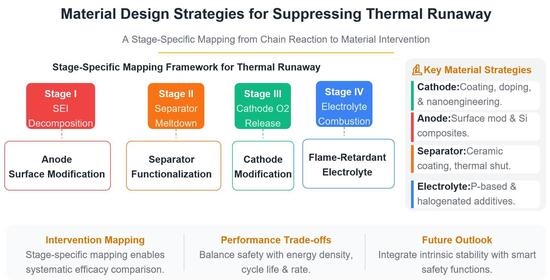
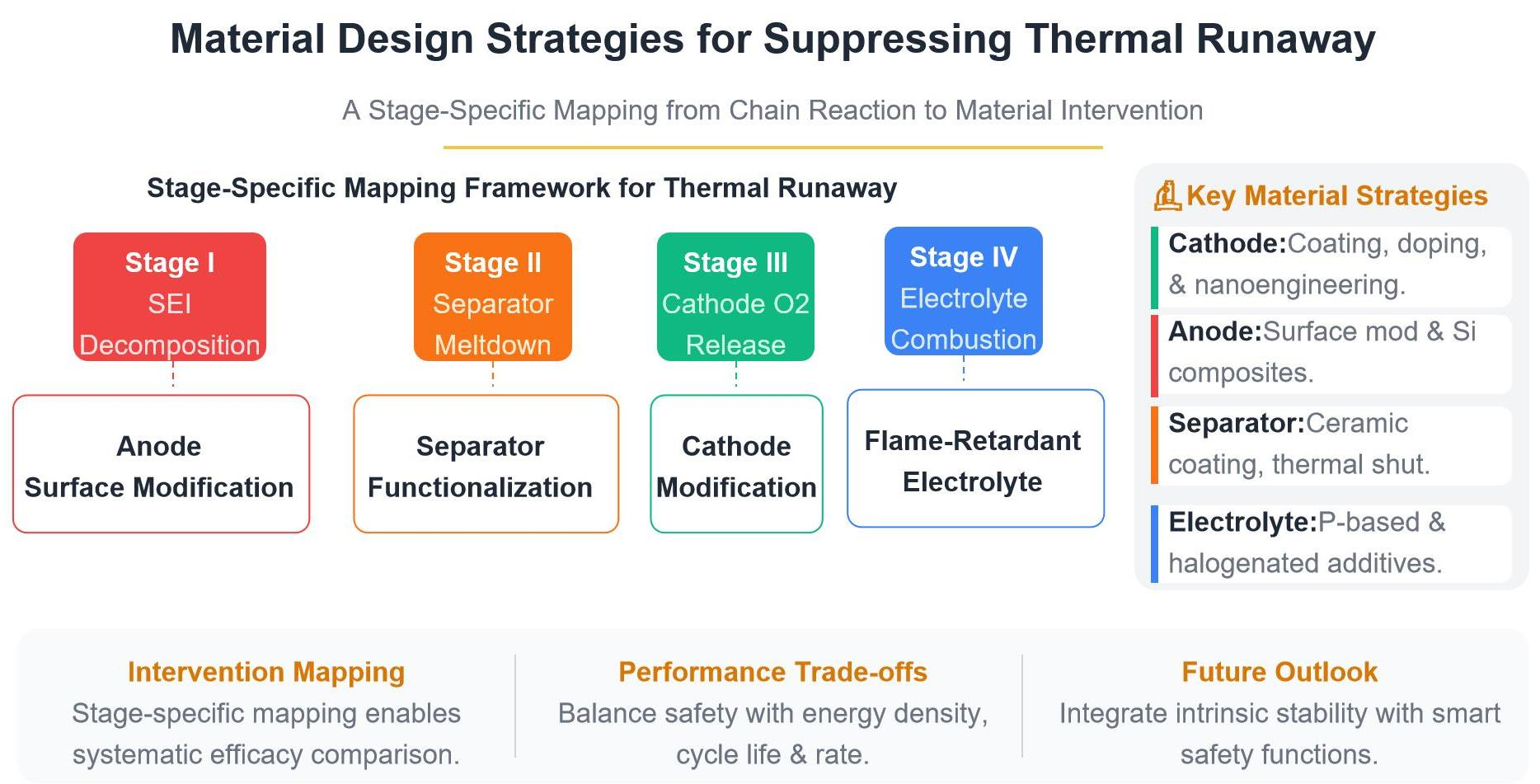
This review addresses this gap by establishing a stage-specific mapping framework that links material design strategies to the sequential stages of the TR evolutionary pathway. By analyzing the TR mechanism as a chain reaction proceeding through four distinct stages: SEI decomposition (Stage I), separator meltdown and internal short circuit (Stage II), cathode oxygen release (Stage III), and electrolyte combustion (Stage IV). We map the four categories of material strategies onto these stages according to their primary intervention points. Specifically, anode surface modifications primarily target Stage I by suppressing SEI degradation; separator functionalization serves as the critical intervention at Stage II by maintaining physical isolation; cathode modifications target Stage III by stabilizing the lattice structure against oxygen release; and flame-retardant electrolytes act across Stages IV by interrupting combustion chain reactions. Within this mapping framework, we provide a critical assessment of each strategy’s efficacy, its limitations, and its trade-offs with other performance metrics such as energy density, cycle life, and rate capability, aiming to offer a function-oriented perspective that guides the rational design of intrinsically safe, high-energy-density LIBs.

2. Causes of TR: Cell Behavior Under Abuse Conditions

TR does not occur spontaneously. It is typically triggered by external abuse conditions. These include mechanical impact, electrical overloading, and elevated temperature environments. Each abuse condition initiates specific internal failure modes, such as separator rupture, electrode material decomposition, or electrolyte reactions. Identifying these triggers and their corresponding internal cell responses represents the first line of defense against TR and provides the foundation for developing effective prevention strategies.

2.1. Mechanical Abuse: Separator Failure and Internal Short Circuit

The safety of LIBs depends critically on their internal structure. Within a typical cell, the cathode and anode are physically separated by an ultrathin separator. This separator is a microporous polymer membrane, typically polyethylene (PE) or polypropylene (PP). It permits lithium-ion transport to enable the electrochemical reactions required for charging and discharging, while absolutely preventing electron conduction between electrodes to avoid direct cathode-anode contact. Any breach of this physical isolation leads to a catastrophic internal short circuit. Mechanical abuse represents one of the most direct and destructive mechanisms for compromising this isolation.
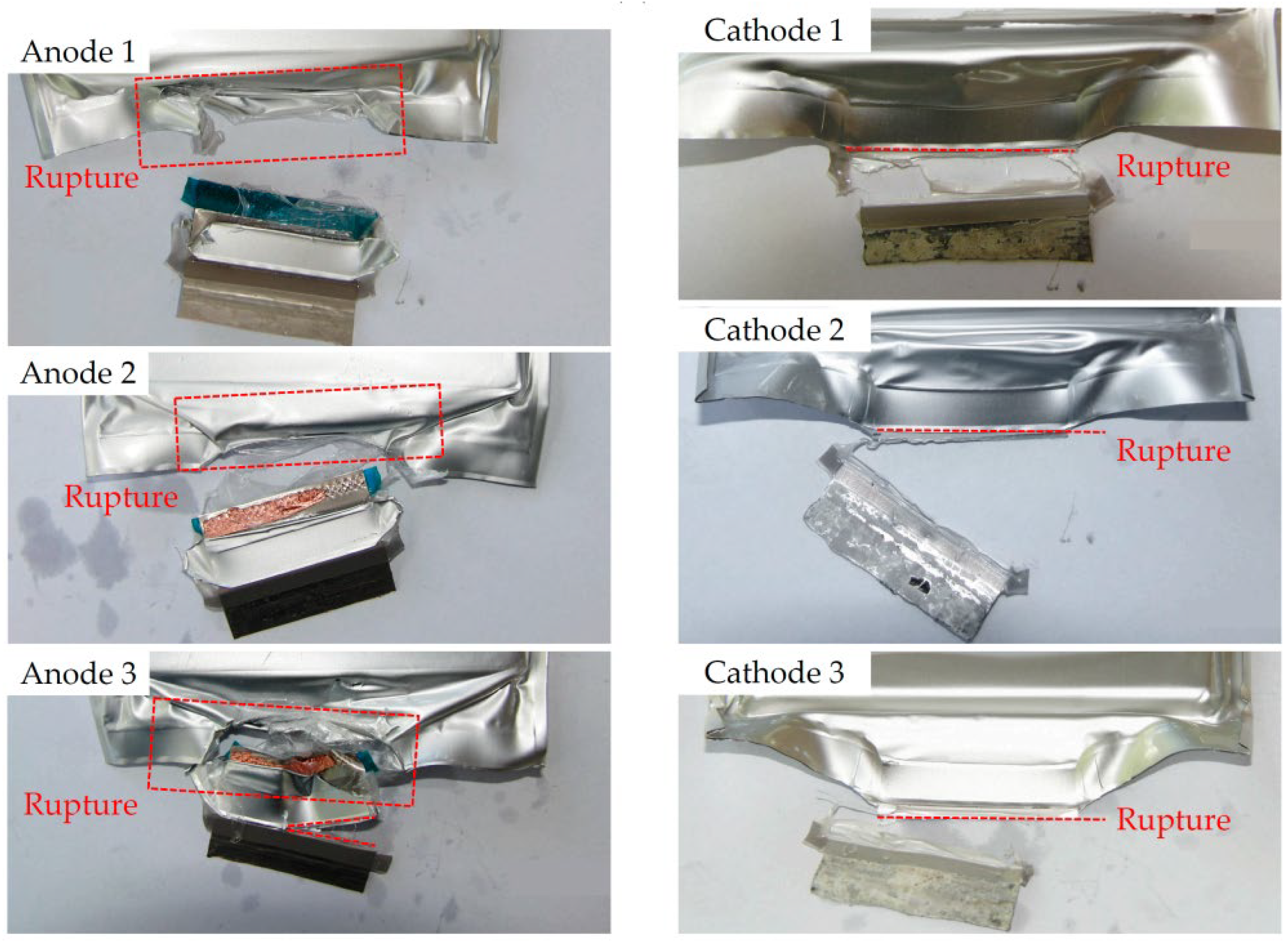
Mechanical abuse refers to external mechanical loading, including compression, nail penetration, or impact by sharp objects [12]. These forces are not distributed uniformly across the cell. Instead, they generate high local stress concentrations. When such localized stress exceeds the mechanical strength limit of internal materials, particularly the separator, it triggers irreversible structural damage (Figure 1).
Separator rupture marks the critical turning point in this process [14]. The separator is a precision-engineered component, typically 10~20 μm thick with pore diameters below 1 μm. Under normal mechanical loads, it maintains structural integrity. However, when external compression or nail penetration acts on the cell surface, the force transmits through the casing to the internal jellyroll or stacked electrodes, and ultimately to the separator. For localized loading by sharp objects like nail penetration, etc., the pressure at the contact point increases dramatically, far exceeding the separator’s puncture resistance and causing immediate perforation. For large-area compression, the internal jellyroll or electrodes may shift and deform, stretching the separator until it tears.
Once physical damage occurs, whether a microscale pore or a macroscopic crack, the carefully maintained internal equilibrium collapses. The cathode and anode active materials lose their physical barrier at the breach site and establish direct contact. Electrochemically, this creates a conductive pathway connecting the positive and negative electrodes internally at the damage location.
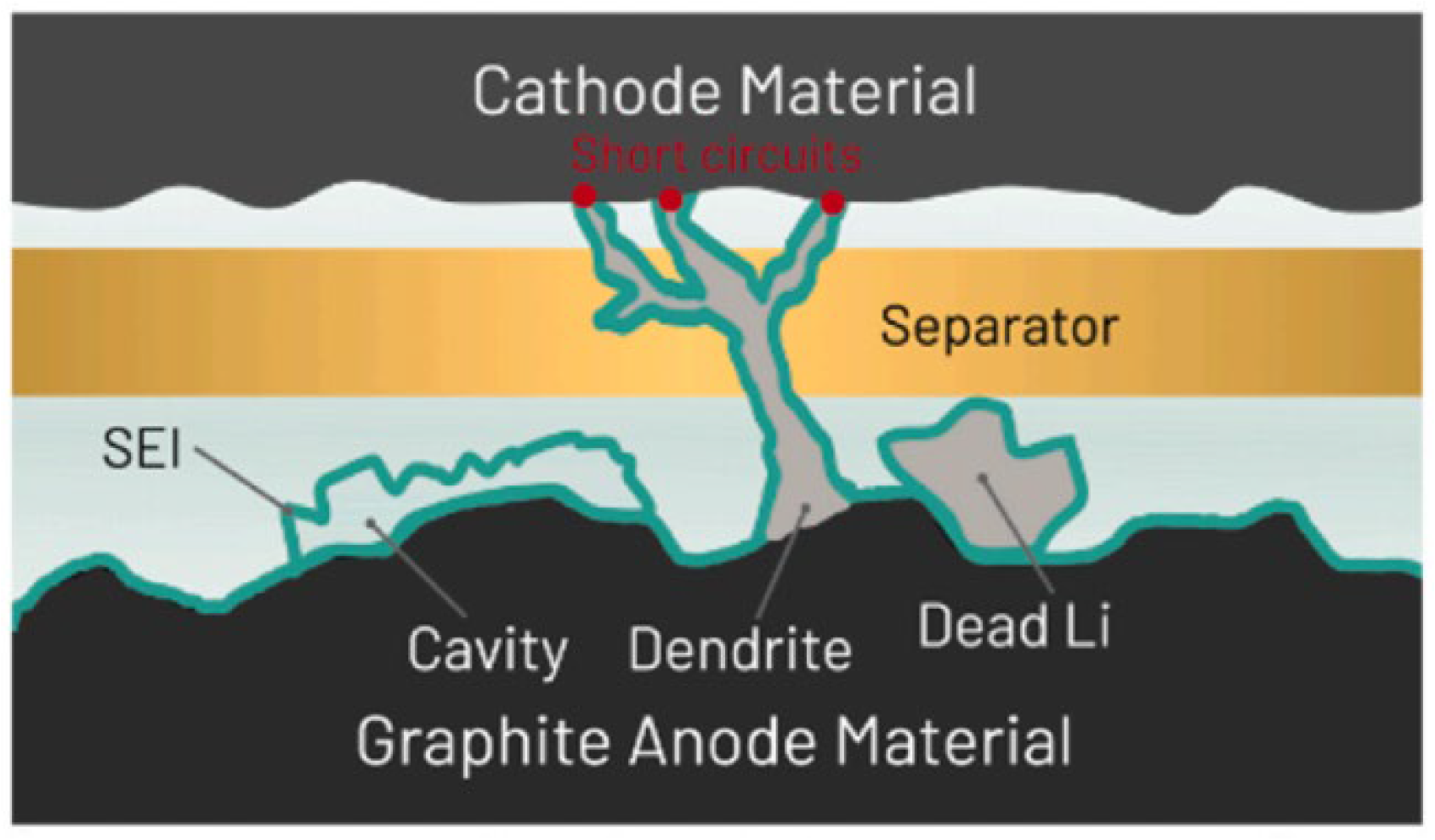
This newly formed conductive pathway enables electrons to bypass the external circuit entirely. Rather than following the intended path through the load, electrons flow directly from the anode (low potential) to the cathode (high potential), generating a massive local current. This process constitutes an internal short circuit (Figure 2). Unlike external faults, this internal short cannot be interrupted by external circuit breakers.
The short-circuit current could be estimated using Ohm’s law (I = V/R). Here, V represents the cell terminal voltage, which exceeds 4.2 V for a fully charged battery. R denotes the internal short-circuit resistance, typically very small and dependent on contact area, contact pressure, and active material conductivity. Assuming a short-circuit resistance of 100 mΩ, which is a relatively large estimate, the instantaneous heat generation at the short site reaches 160 W in a 4 V cell, according to Joule’s law (P = I2R). This represents substantial power density, with all heat released instantaneously within a microscopic local region.
This localized Joule heating initiates all subsequent thermal events. Temperature rises rapidly at the short site and the surrounding region. Elevated temperatures further degrade separator mechanical properties and chemical stability. PE separators, for example, melt at approximately 130~140 °C. Once local temperature exceeds this threshold, the separator shrinks and melts. This does not repair the initial damage; instead, it expands the short-circuit area, creates lower-resistance pathways, and generates larger currents and more intense heating. A localized thermal-electrical positive feedback loop thus establishes.
Mechanical abuse compromises the separator, the critical structure ensuring internal electrical isolation, through external stress application. Separator rupture enables direct cathode-anode contact, triggering an internal short circuit. The resulting Joule heat accumulates locally, seeding subsequent chain exothermic reactions. Understanding the separator rupture-induced internal short circuit mechanism is fundamental to comprehending the entire mechanical abuse-induced TR process.

2.2. Electrical Abuse: Cascade Side Reactions Induced by Overcharge and Overdischarge

Normal LIB operation depends on a precisely balanced electrochemical system. Charge and discharge processes involve reversible lithium-ion intercalation and deintercalation between electrodes. Each component, including cathode, anode, and electrolyte, remains stable only within specific voltage and electrochemical potential windows. Electrical abuse, particularly overcharge and overdischarge, disrupts this equilibrium and drives the cell outside its design safety envelope. This triggers an uncontrolled cascade of side reactions that ultimately seed TR [16].
Overcharge occurs when charging current continues after the cell reaches full state-of-charge (SOC). Normal lithiation reactions saturate at this point, and excess energy then drives detrimental side reactions.
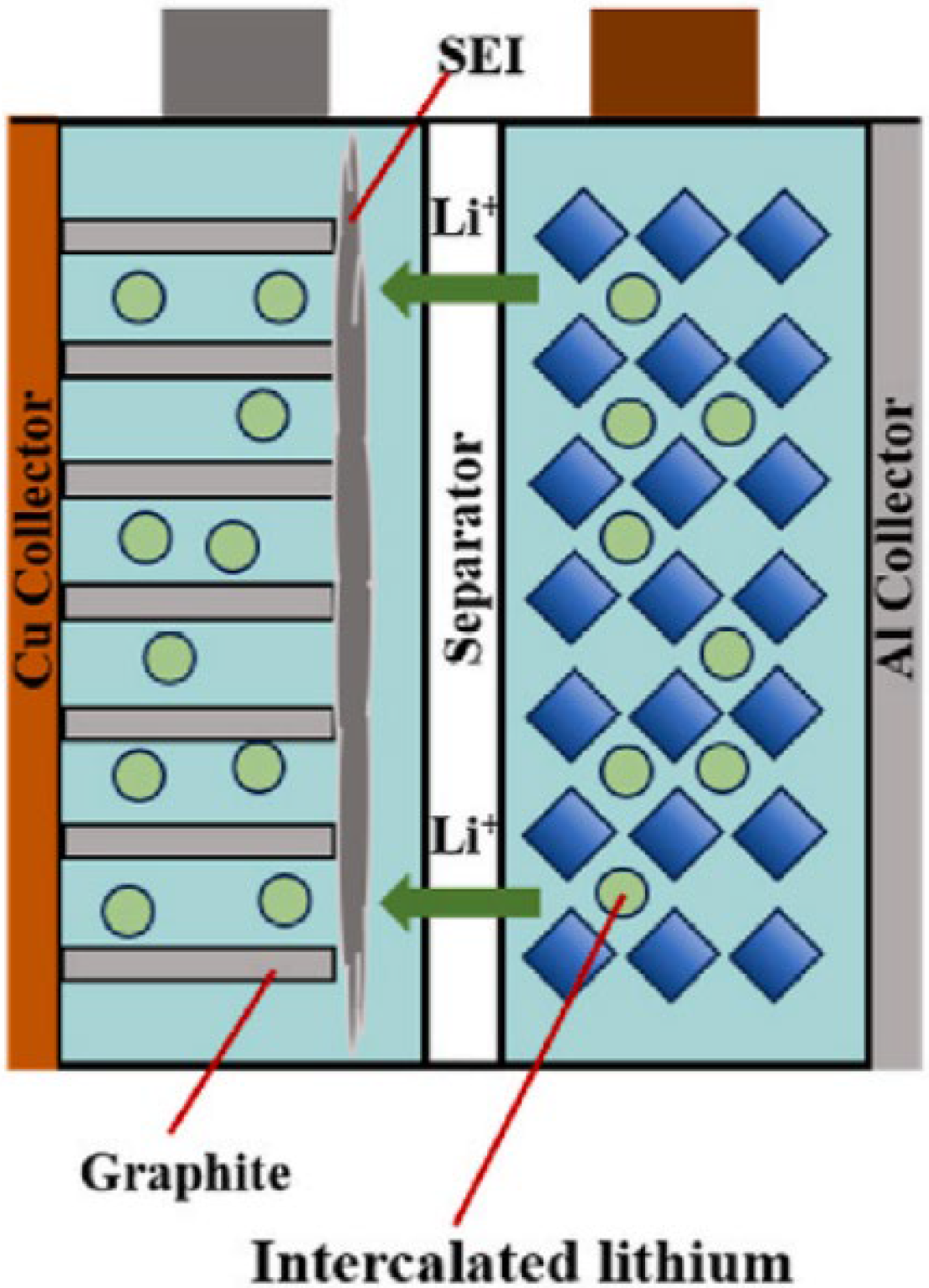
During normal charge, lithium ions deintercalate from the cathode, migrate through the electrolyte, and intercalate into the graphite anode. This process is relatively safe. However, overcharging raises the anode potential significantly. This increase creates a substantial barrier for lithium-ion intercalation. Consequently, lithium ions accumulate on the anode surface rather than entering the graphite structure. These ions then accept electrons directly and reduce to metallic lithium, forming a lithium plating layer. This phenomenon is termed lithium plating or lithium dendrite growth (Figure 3).
The plated lithium poses several critical hazards due to its high reactivity, unique growth morphology, and mechanical threat to the separator. Metallic lithium is highly reactive and reacts directly with the electrolyte, continuously consuming the electrolyte while generating heat and flammable gases. Furthermore, the plated lithium tends to grow in dendritic or mossy morphologies, forming needle-like structures. These sharp dendrites carry a high risk of piercing the already thin separator, creating an internal short circuit between the cathode and anode. This short circuit produces massive currents and localized high temperatures, ultimately triggering TR.
During overcharging, excessive lithium-ion extraction from the cathode material severely destabilizes its crystal lattice structure. This over-delithiation causes the cathode potential to rise sharply.
When lithium ions are excessively removed, the lattice framework of the cathode material may collapse due to an inability to maintain its structure. This damage is irreversible and directly results in the permanent loss of battery capacity.
More critically, at high potentials, transition metal oxides (e.g., oxides of cobalt, nickel and manganese) in the cathode become highly unstable and may decompose and release oxygen. For instance, a lithium cobalt oxide (LiCoO2) cathode can undergo the following reaction during overcharging: LiCoO2 → Li1−xCoO2 + xLi+ + xe. When the value of x is excessively large, Li1−xCoO2 can decompose further into Co3O4 and release oxygen. The release of oxygen is a particularly hazardous signal. It not only accelerates the internal pressure but also supplies a combustion accelerant for the electrolyte, significantly increasing the risk of TR.
Overdischarge typically occurs in series-connected battery packs. When one cell has the lowest capacity and the fastest voltage drop, it is forced into discharge by other cells in the pack. This drives its voltage below 0 V.
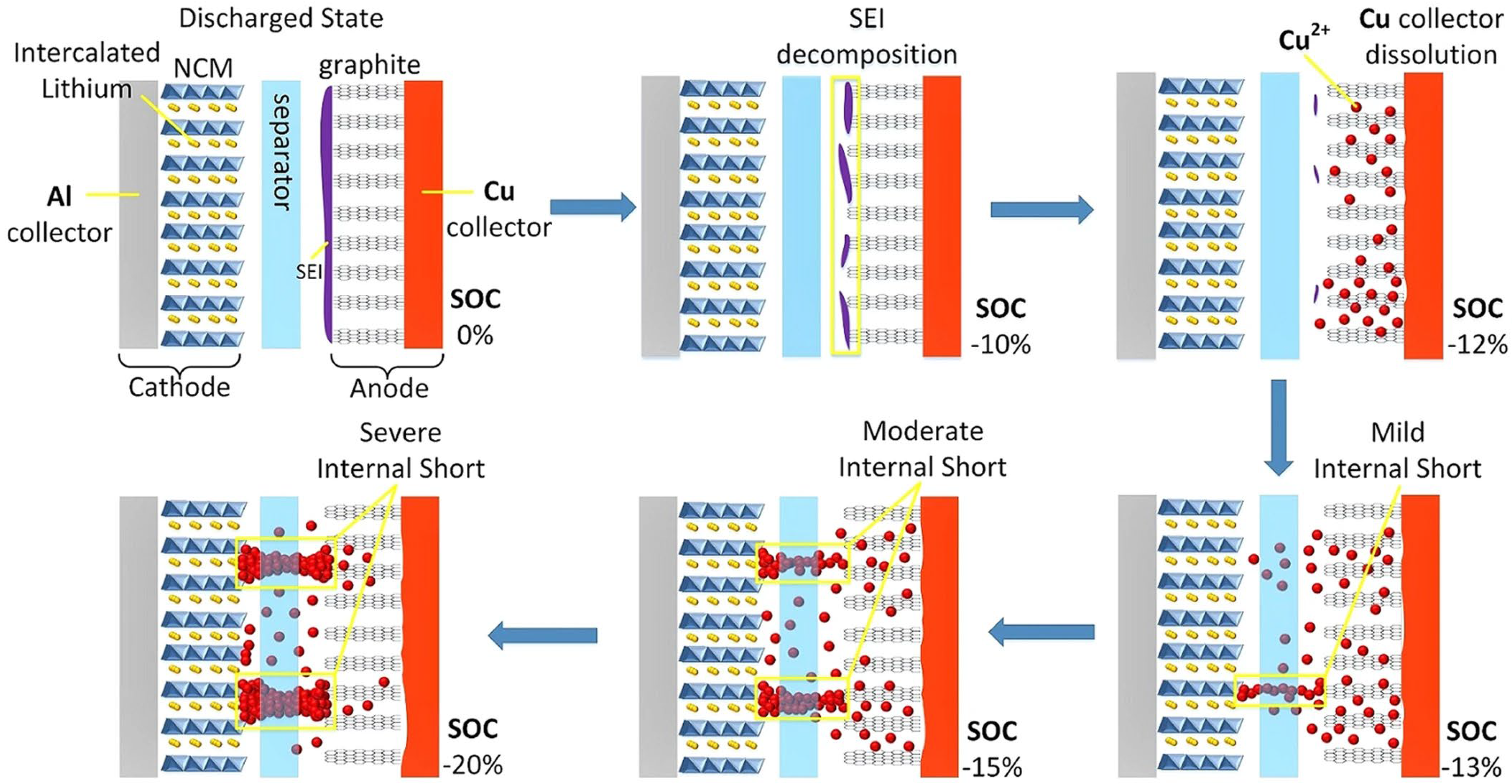
Under normal conditions, the anode has a low potential, and its current collector (copper foil) remains stable. However, when overdischarge drives the cell voltage to a very low or even negative value, the anode potential is forced to a highly positive level. Once this potential exceeds the dissolution potential of copper (approximately 3.5 V vs. Li/Li+), the normally stable copper foil current collector becomes unstable. It begins to undergo an oxidative dissolution reaction: Cu → Cu2+ + 2e (Figure 4).
The generation of Cu2+ creates two severe problems. First, the corrosion of copper foil disrupts the conductive network of the anode, causing permanent degradation of cell performance. Second, the dissolved Cu2+ would migrate through the electrolyte to the cathode. During the subsequent charging process, these Cu2+ ions reduce to metallic copper on the cathode surface, forming copper dendrites. Similar to lithium dendrites, copper dendrites are hard and sharp. They possess the same capacity to pierce the separator and trigger internal short circuits.
Electrical abuse disrupts the internal chemical equilibrium through two distinct pathways. Overcharging attacks both electrodes simultaneously. It generates highly reactive lithium dendrites and consumes electrolyte at the anode, while destroying crystal structures and releasing oxygen at the cathode. Overdischarging, through the specific mechanism of polarity reversal, corrodes the otherwise stable copper current collector. This process also creates conditions for subsequent copper dendrite formation and internal short circuits.
These cascading side reactions share common characteristics. They irreversibly consume active materials, degrade cell structures, generate additional heat and flammable gases, and substantially increase the probability of internal short circuits. Together, they push the battery toward TR.

2.3. Thermal Abuse: Material Decomposition and Reaction Runaway Triggered by Elevated Temperature

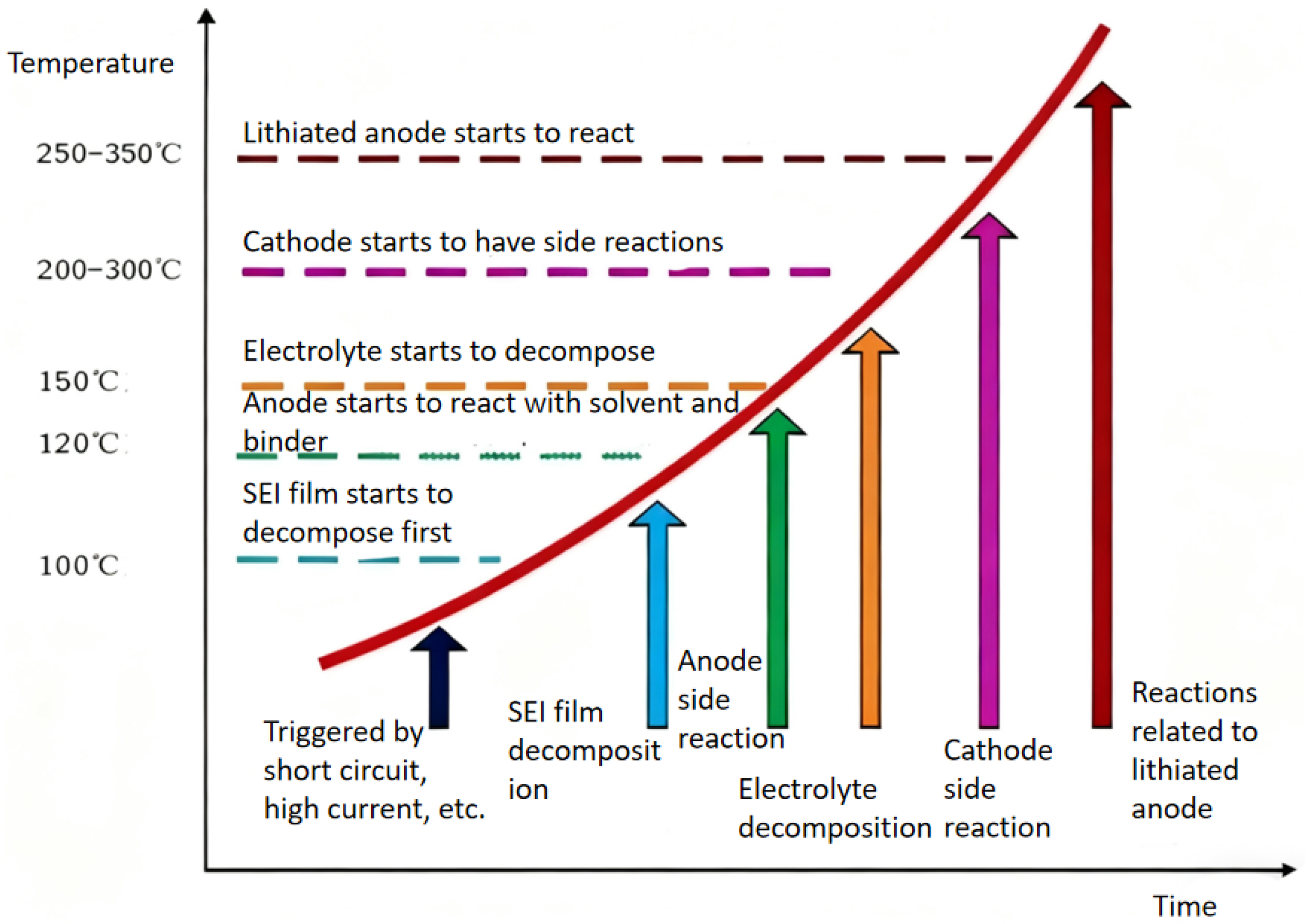
The LIB comprises a precise electrochemical system where each component remains stable within specific temperature limits. When ambient temperature exceeds the normal operating maximum, or when internal heat generation causes abnormal temperature rise, material-level decomposition and runaway reactions initiate. This process is termed thermal abuse [19]. Unlike mechanical or electrical abuse, thermal abuse directly compromises internal material chemical stability through temperature elevation, thereby triggering reaction cascades (Figure 5).
Temperature elevation first affects the most sensitive component, SEI [20]. The SEI forms on the anode surface during initial charge–discharge cycles as a passivation layer. It permits lithium-ion transport while preventing direct electrolyte-anode active material contact. At approximately 100 °C, SEI decomposition initiates. This protective layer breakdown enables electrolyte solvent molecules to access the highly reactive graphite anode surface, where reduction reactions occur. These reactions consume electrolyte, generate flammable gases like C2H6, CH4, etc., and release heat, further increasing cell temperature.
As the temperature rises further to approximately 120 °C, the separator undergoes a phase transition. Commercial polyolefin separators, like PE, PP, etc., typically melt between 130 °C and 160 °C. Near these melting points, the separator shrinks or melts, causing micropore structure collapse or complete destruction. Separator failure eliminates physical cathode-anode isolation, readily triggering large-scale internal short circuits, which could generate substantial Joule heating and accelerate temperature rise.
At approximately 150~200 °C, cathode materials begin decomposing. Take LiCoO2 cell for an example, LiCoO2 releases O2 upon heating:
LiCoO2 → LixCoO2 + O2
This O2 release increases internal pressure. More critically, it provides the oxidizer for the combustion of flammable electrolyte components, significantly intensifying reaction severity.
Concurrently, lithium salt LiPF6 in the electrolyte decomposes at elevated temperature. LiPF6 decomposes above approximately 80 °C to form PF5, which subsequently reacts with trace water to generate HF. HF corrodes internal components and degrades electrode material structure. These reactions also produce additional heat and gas.
Electrolyte solvents also decompose directly at elevated temperatures. Common carbonate solvents, like ethylene carbonate (EC), diethyl carbonate (DEC), dimethyl carbonate (DMC), propylene carbonate (PC), etc., undergo oxidation or reduction reactions at high temperature, producing CO, CO2, and substantial heat. These parasitic reactions interact synergistically with SEI decomposition and cathode decomposition, forming a self-accelerating thermal-chemical reaction cycle.
These reactions do not occur sequentially at distinct temperature thresholds. Instead, they overlap and interact synergistically during temperature rise. SEI decomposition heat accelerates separator melting. Separator failure-induced internal short circuits then rapidly increase cell temperature, promoting cathode decomposition. This positive feedback mechanism, where multiple exothermic reactions mutually reinforce, drives a self-accelerating temperature rise once thermal abuse initiates.
Thermal abuse sequentially compromises SEI stability, separator integrity, cathode structure, and electrolyte chemical stability through temperature elevation. These high-temperature decomposition reactions generate heat and gas directly. More critically, their positive feedback interdependencies form a self-accelerating reaction network.

3. TR Failure Mechanisms

Taking LiCoO2 cell as an example: graphite anode, LiPF6 electrolyte salt, and DMC/DEC/EC/PC solvent mixture. TR side reactions comprise six categories: SEI decomposition, anode-electrolyte reactions, separator collapse, cathode decomposition and electrolyte reactions, electrolyte decomposition, and binder-anode reactions.

3.1. SEI Decomposition

The SEI protects electrode materials from direct electrolyte contact, enhancing cell safety. However, it is chemically unstable and readily decomposes. At 80~120 °C, the SEI, which is primarily composed of (CH2OCO2Li)2, decomposes.
( CH 2 OCO 2 Li ) 2     Li 2 CO 3 + C 2 H 4 + CO 2 + 1 2 O 2

3.2. Anode-Electrolyte Reactions

The stable, ordered SEI protective layer decomposes upon heating. The exposed anode material then contacts and reacts with the electrolyte. Organic solvents also react with intercalated lithium, releasing flammable hydrocarbons, like C2H4, C3H6, C2H6, etc.
Li + C 3 H 4 O 3 ( EC )     LiCO 3 +   C 2 H 4 Li + C 4 H 6 O 3 ( PC )     LiCO 3 +   C 3 H 6 Li +   C 3 H 6 O 3 ( DMC )     LiCO 3   + C 2 H 6

3.3. Separator Collapse

As internal reactions proceed, cell temperature rises to the separator melting point. PE and PP separators melt at 135 °C and 166 °C, respectively. Further temperature increase causes separator shrinkage and cathode-anode contact, resulting in an internal short circuit.

3.4. Cathode Decomposition and Electrolyte Reactions

Internal short circuits sustain temperature rise, initiating cathode decomposition. LiCoO2 exhibits poor thermal stability, with an exothermic onset at 150 °C in EC/DEC electrolyte. Decomposition releases substantial O2, oxidizing the electrolyte to generate CO.
Li x CoO 2     x LiCoO 2 + 1 3 ( 1     x ) Co 3 O 4 + 1 3 ( 1     x ) O 2
Co 3 O 4     3 CoO + 1 2 O 2
CoO     Co + 1 2 O 2
EC + 5 2 O 2     3 CO 2 + 2 H 2 O
DEC ( C 5 H 10 O 3 ) + 6 O 2     5 CO 2 + 5 H 2 O
DEC + 7 2 O 2     5 CO + 5 H 2 O
The exothermic onset temperature and heat release of such cathode decomposition reactions are commonly characterized by differential scanning calorimetry (DSC), while the self-heating behavior of full cells under adiabatic conditions is measured by accelerating rate calorimetry (ARC). These techniques provide the quantitative thermal safety parameters referenced throughout this review.

3.5. Electrolyte Decomposition

Above 200 °C, the electrolyte decomposes directly. The lithium salt LiPF6 first decomposes to LiF and PF5; PF5 then reacts with trace water to form HF. Subsequently, DEC reacts with PF5 to produce C2H5OCOOPF4, C2H4, and additional HF. As the temperature rises further, C2H5OCOOPF4 decomposes to generate substantial CO2.
LiPF 6   LiF +   PF 5
H 2 O + PF 5   POF 3 + 2 HF
DEC +   PF 5   C 2 H 5 OCOOPF 4 + HF + C 2 H 4
C 2 H 4 + HF   C 2 H 5 F
C 2 H 5 OCOOPF 4     P F 3 O +   CO 2 + C 2 H 4 + HF
C 2 H 5 OCOOPF 4     P F 3 O +   CO 2 + C 2 H 5 F
C 2 H 5 OCOOPF 4   + HF     P F 4 OH +   CO 2 + C 2 H 5 F

3.6. Binder-Anode Reactions

Above 260 °C, the binder reacts with both cathode material and LixC6. For LiCoO2 cathodes containing polyvinylidene fluoride (PVDF) binder, the reaction initiates at ~200 °C, peaks at 287 °C, and terminates at 350 °C. The exothermic enthalpy is approximately 317 J/g. The primary product is Co3O4, accompanied by oxidation of electrolyte components.

3.7. Integrated Chain Reaction Pathway of TR

The individual decomposition and reaction processes described in Section 3.1, Section 3.2, Section 3.3, Section 3.4, Section 3.5 and Section 3.6 are not isolated events but constitute a self-accelerating chain reaction that proceeds through four sequential stages. Table 1 illustrates this integrated pathway and summarizes the characteristics of each stage.
Stage I: SEI decomposition (~80–120 °C). The SEI is the most thermally labile component in the anode system. Its decomposition, as described in Section 3.1, is the initiating event of the TR cascade. From a kinetic perspective, this stage represents the rate-determining step of the entire chain reaction, as the relatively high activation energy of SEI decomposition governs the duration of the induction period before self-accelerating exothermic reactions dominate. Once the SEI breaks down, the exposed lithiated graphite reacts with the electrolyte, generating flammable gases and releasing heat that gradually raises the internal cell temperature.
Stage II: Separator meltdown and internal short circuit (~130–160 °C). As the internal temperature approaches the melting point of the separators, the physical barrier between cathode and anode collapses. This phase transition represents a physical tipping point that transforms the system dynamics. The resulting internal short circuit generates intense Joule heating and establishes an electrical-thermal positive feedback loop, providing the activation energy that drives the subsequent exothermic reactions.
Stage III: Cathode oxygen release and electrolyte oxidation (~150–250 °C). At this temperature range, the layered structure of transition metal oxide cathodes becomes thermodynamically unstable, undergoing phase transitions accompanied by the release of lattice oxygen. The liberated oxygen reacts exothermically with organic carbonate solvents. This stage is the primary energy release phase of TR, contributing over 50% of the total heat generation. The low activation energy of oxygen evolution renders this process autocatalytic once initiated.
Stage IV: Electrolyte decomposition and binder reactions (>200 °C). At peak temperatures, the electrolyte undergoes direct thermal decomposition independent of cathode-derived oxygen. LiPF6 decomposes to LiF and PF5, and the PVDF binder reacts exothermically with lithiated graphite and cathode materials, driving the system to its maximum temperature of 800–1000 °C.
This stage-specific understanding of the TR pathway establishes distinct intervention points for material design: Stage I is the kinetic bottleneck where anode modifications can extend the induction period; Stage II is the physical tipping point where separator functionalization can block the propagation pathway; Stage III is the primary energy release phase where cathode modifications can suppress the oxidant source; and Stages IV is the amplification stage where flame-retardant electrolytes can terminate the combustion cascade.
It should be noted that the quantitative characterization of these thermal events relies on two complementary calorimetric techniques: differential scanning calorimetry (DSC), which measures the exothermic onset temperature and heat release of individual material components, and accelerating rate calorimetry (ARC), which evaluates the self-heating behavior and TR trigger temperature of full cells under near-adiabatic conditions. Throughout this review, where quantitative thermal safety data are cited, the test method and parameters are explicitly identified to facilitate meaningful cross-study comparison. These intervention points provide the mechanistic rationale for the material design strategies systematically examined in Section 4.

4. Material Design Strategies for Suppressing TR

The most effective safety strategy prevents TR at its origin. This requires cell-level innovations in material design to enhance intrinsic abuse tolerance. Approaches include developing thermally stable electrode materials, flame-retardant electrolytes, and robust separators, alongside integrating passive safety devices within individual cells. These strategies improve thermal stability and enable automatic safety isolation during emergencies.

4.1. Intrinsically Safe Electrode Material Design

TR risk correlates strongly with the intrinsic thermal stability of internal materials. Rational electrode material design enhances cell-level thermal stability at the origin, reducing both TR probability and severity. Current strategies focus on cathode modification, anode optimization, and novel material system development.

4.1.1. Cathode Modification

The cathode is a critical cell component. Its chemical and thermal stability significantly impacts battery safety. Optimizing cathode composition, structure, and surface properties enhances both types of stability, thereby reducing TR risk.
Within the TR chain reaction pathway, cathode decomposition at Stage III represents the primary energy release phase, where the thermal destabilization of layered oxide structures leads to lattice oxygen evolution that subsequently fuels electrolyte combustion. Cathode modification strategies, including surface coating, bulk doping, and nanostructuring, are therefore designed to enhance the structural stability of cathode materials at elevated temperatures, thereby suppressing or delaying the oxygen release that drives the cascade into its most energetic phase.
(1)
Modification of high-Ni NCM cathodes
Among currently investigated cathode materials, transition metal (TM) layered oxides have emerged as leading candidates for power batteries, offering high theoretical capacity, elevated operating voltage, and competitive manufacturing cost. Nickel-cobalt-manganese layered oxides Li(NixCoyMn2)O2 ( NCM, where x + y + z = 1 ) represent the most promising system for commercialization. Compositions are classified by Ni/Co/Mn ratios, like NCM111, NCM523, NCM622, and NCM811. Increasing Ni content enhances specific capacity, making high-Ni materials (>60% Ni) a focal research area for power batteries.
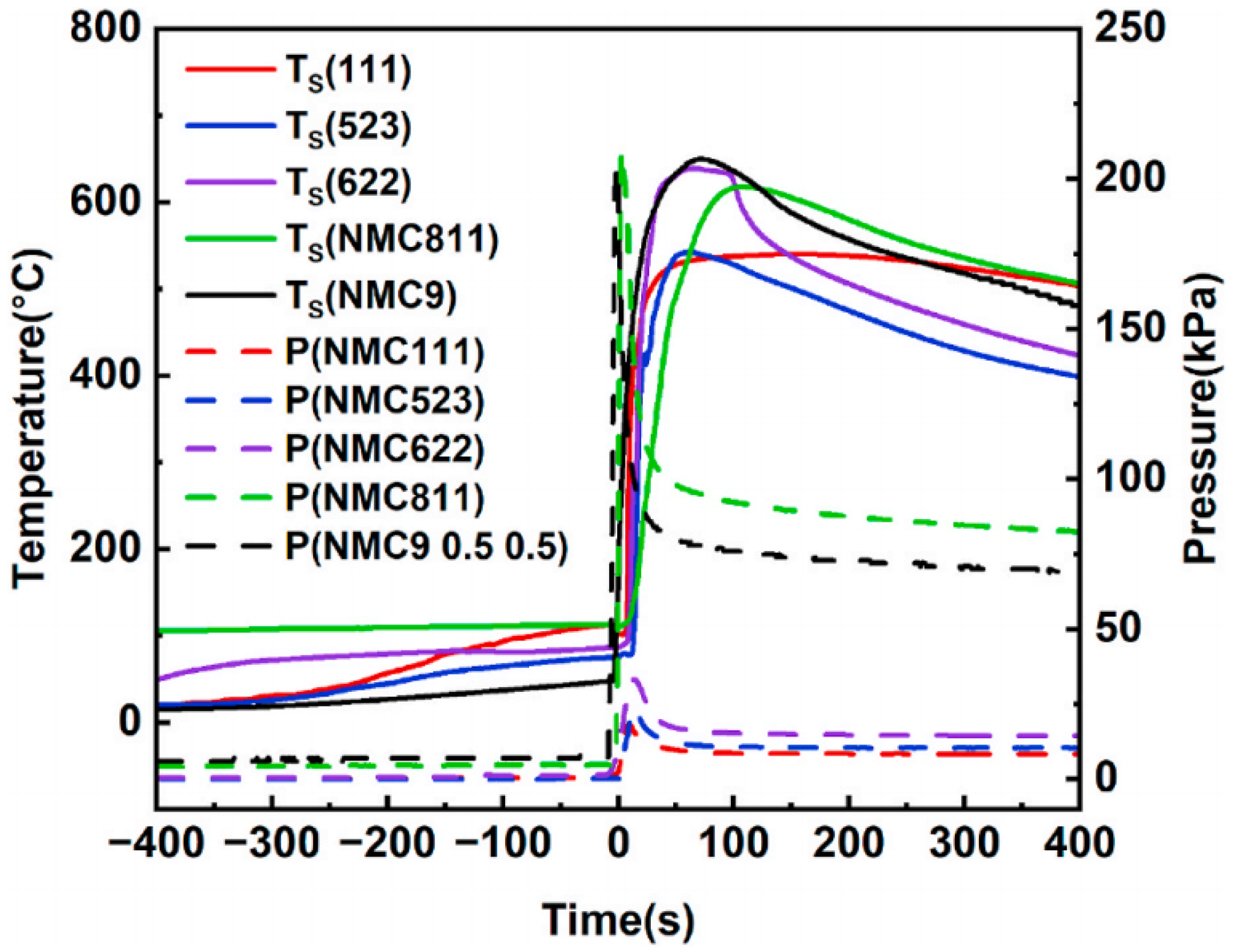
High-Ni NMC cathodes are widely investigated for their high energy density. However, they exhibit poor thermal stability, undergoing structural phase transitions at elevated temperatures with substantial O2 release that initiates internal combustion. Wu et al. [21] evaluated NCM safety across Ni contents, attributing high-Ni instability to surface structure degradation during heating. High-Ni materials transform to rock-salt structure at lower temperatures with concurrent O2 release, whereas low-Ni compositions delay O2 evolution to higher temperatures. Wei et al. [22] studied TR in prismatic cells with varying nickel contents. Increasing the nickel content in the NCM cathode from NCM111 (x = 0.33) to NCM9 0.5 0.5 (x = 0.9) raises the maximum surface temperature (Ts,max) during TR from 540.1 °C to 650.0 °C. This 110 °C increase indicates that higher-nickel batteries release more thermal energy and exhibit lower intrinsic thermal stability. The trend in Ts,max (NCM9 0.5 0.5 > NCM622 > NCM811 > NCM523 > NCM111) confirms that elevated nickel content exacerbates exothermic reactions, heightening TR hazards. (Figure 6). Multiple modification strategies have been developed to enhance high-Ni NMC thermal stability.
Surface coating serves as an effective interfacial engineering strategy for improving cycling stability and thermal safety of high-Ni cathodes. The mechanism involves constructing a physical or chemical barrier that blocks direct cathode-electrolyte contact, suppressing interfacial side reactions, mitigating transition metal dissolution, stabilizing surface structure, and ultimately enhancing TR tolerance. Coating material selection directly determines protection efficacy. Common coatings include oxides (Al2O3, TiO2, ZrO2), phosphates (Li3PO4), fluorides (AlF3), and composites (LiPON/Cu).
Surface coatings enhance high-Ni cathode performance through three distinct mechanisms. Inert coatings form physical barriers that block direct cathode-electrolyte contact, thereby preventing transition metal dissolution and O2 release. Structural stabilizers suppress Jahn-Teller distortion-induced phase transitions to maintain crystal integrity. Conductive coatings improve active material conductivity, enhance surface Li+ diffusion, and reduce interfacial resistance.
Oxides represent a widely applied coating material for electrode surface modification. These coatings stabilize the cathode structure and suppress cathode-electrolyte interactions, thereby improving electrochemical performance [23].
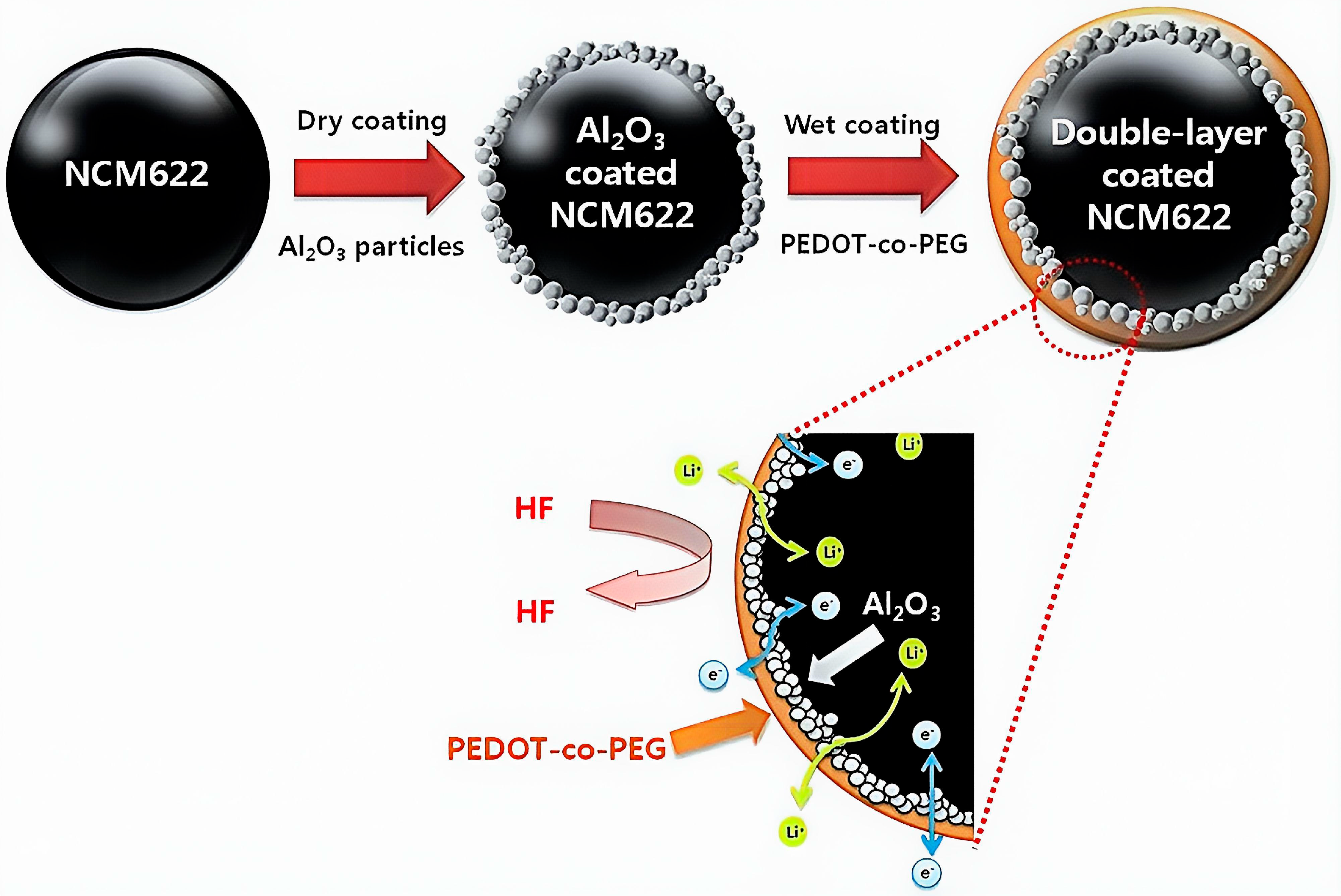
LiPF6, a primary lithium-ion electrolyte salt, decomposes in the presence of trace water to form HF (PF5 + H2O → POF3 + 2HF). The resulting HF attacks the cathode materials, causing a gradual transition of metal dissolution. Oxide coatings react with HF to form metal fluorides (e.g., Al2O3 + 6HF → 2AlF3 + 3H2O), thereby reducing electrolyte acidity and stabilizing cathode bulk structure.
Currently investigated oxide coatings include MgO, Al2O3, SiO2, TiO2, ZnO, CeO2, ZrO2, V2O5, Cr2O3, Mo2O3, and Co3O4.
To enable quantitative comparison of the thermal safety improvements conferred by different coating strategies, representative calorimetric data from the cited studies are highlighted here. Lee et al. [24] employed DSC to evaluate the thermal stability of delithiated NCM622 cathodes after 100 cycles (Figure 7). The pristine NCM622 exhibited a main exothermic peak at 271.0 °C with a reaction heat of 601.9 J/g. In contrast, the Al2O3-coated NCM622 showed a significantly shifted exothermic peak at 284.0 °C with a reduced heat generation of 391.0 J/g, and the double-layer coated NCM622 further shifted the exothermic peak to 288.5 °C with a heat generation of only 345.1 J/g. These results demonstrate that Al2O3-based coatings delay the onset of exothermic decomposition by approximately 13–17 °C and reduce the total heat release by 35–43% compared to pristine NCM622, primarily by suppressing direct contact between the electrolyte and the highly reactive delithiated cathode surface. While systematic quantitative benchmarking across all coating materials is currently constrained by the limited availability of standardized thermal safety data, the available DSC evidence from Lee et al. [24] provides a clear quantitative demonstration of the thermal stabilization effect of ceramic-based surface coatings.
Ma et al. [25] investigated MgO coating effects on NCM811 surface state, crystal structure, and electrochemical performance. After 100 cycles at room temperature, coated NCM811 exhibited capacity retention improvement from 74.5% to 90.1%, alongside enhanced rate capability and thermal safety. Performance enhancement derives from MgO suppression of deleterious side reactions and promotion of lithium-ion diffusion.
Elemental doping reduces Li/Ni cation disordering and enhances structural stability in high-Ni NMC cathodes. Dopants substitute lattice atoms at trace concentrations to improve structural integrity. Dopant categories comprise cationic and anionic substitution.
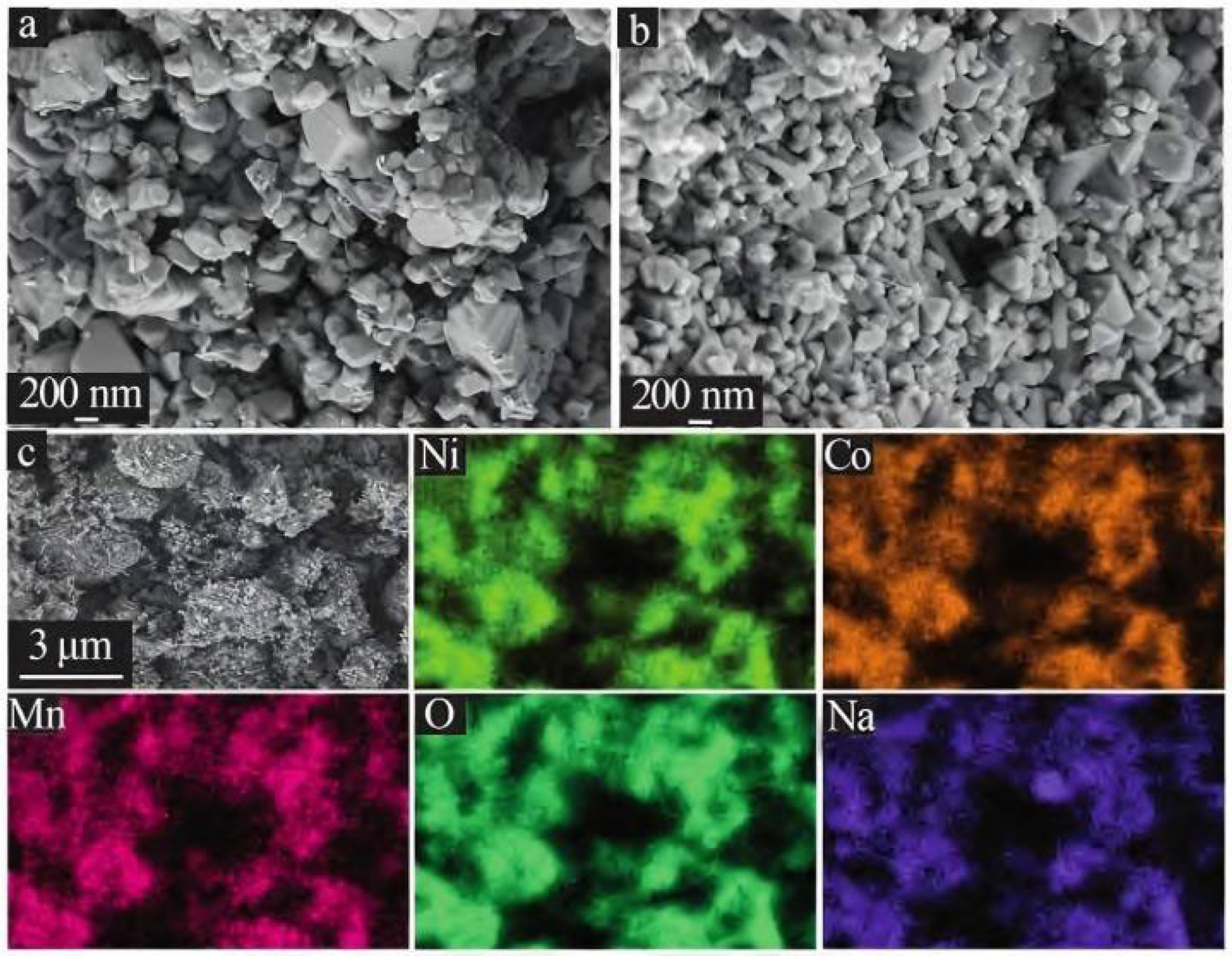
Cationic substitution introduces Na+, Mg2+, Al3+, Ti4+, Zr4+, Ta5+, Mo6+, B3+, W6+, Nb5+, and Ga3+ at Ni, Co, and Mn lattice sites. This reduces phase transition volume changes and maintains crystal structure. Larger-radius Na+ preferentially substitutes Li+, expanding Li+ diffusion channels to facilitate rapid (de)intercalation. Na+-doped NCM811 exhibits substantially improved structural stability at elevated temperature (Figure 8) [26].
Cationic substitution mechanisms encompass four primary effects. Dopants restrict abrupt lattice parameter variations during cycling. They enhance Li+ diffusion kinetics by expanding transport pathways. Dopants reduce Li/Ni cation mixing, thereby stabilizing the layered structure. They also minimize cathode-electrolyte interfacial impedance.
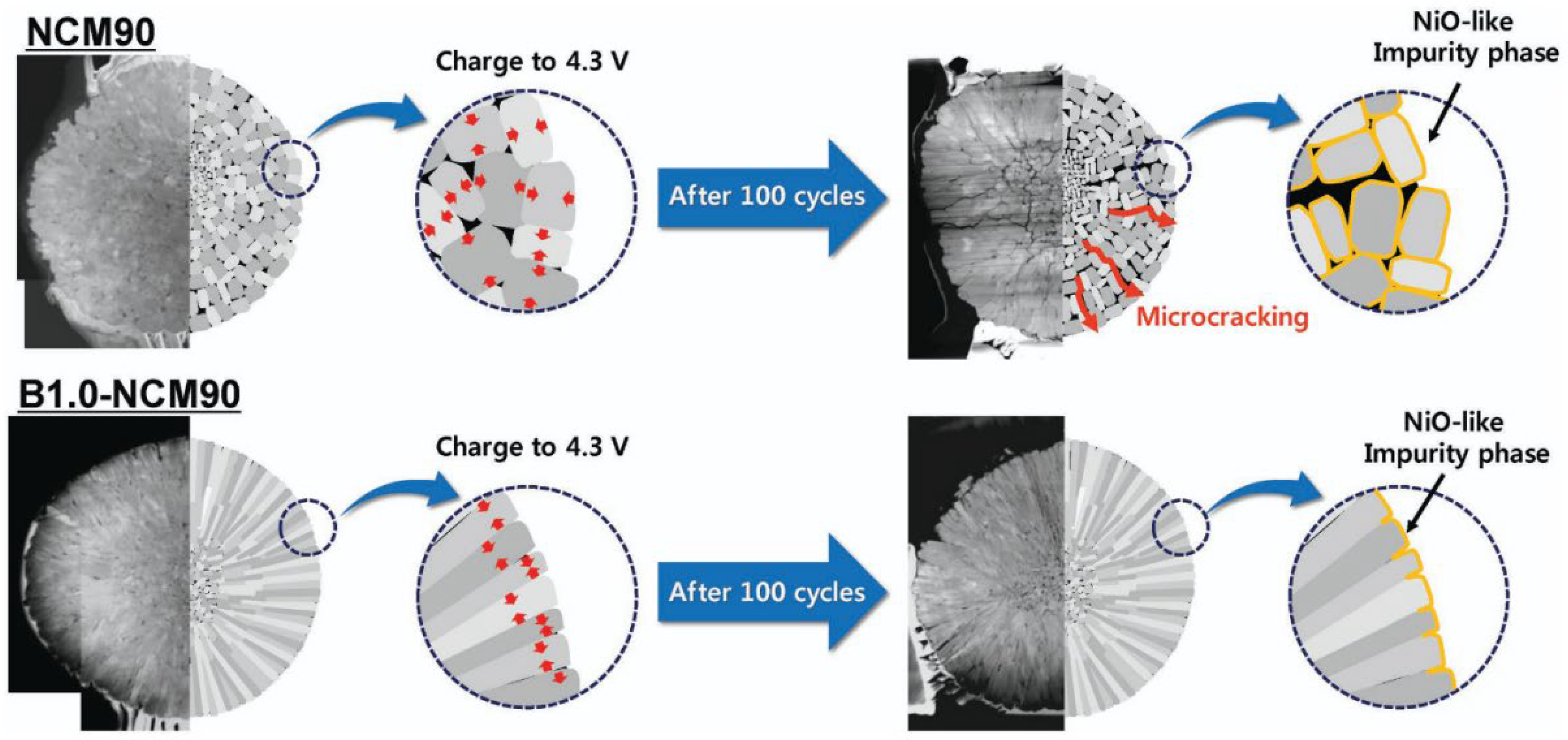
Park et al. [27] synthesized B-doped Li[Ni0.90Co0.05Mn0.05]O2 with superior cycling stability (Figure 9). Density functional theory calculations demonstrate that 1 mol% boron doping alters surface energy, generating a high-texture microstructure that partially alleviates internal strain during deep charging. Doping transforms particle morphology from random orientation to ordered rod-like arrays, enhancing structural stability and suppressing Ni-O phase formation and surface side reactions.
Anionic substitution improves cathode electrochemical performance with distinct advantages over cationic approaches. Fluorine doping forms oxyfluoride compounds that effectively suppress active material dissolution in HF-containing electrolyte, whereas cationic dopants offer limited protection against transition metal dissolution. Anionic substitution enhances metal-anion bond energy by replacing lattice oxygen, thereby improving structural stability. Unlike cationic dopants, which may disorder Li or transition metal sites, anionic substitution avoids cation site disruption, facilitating full theoretical energy density realization.
F, Cl, S, and N exhibit atomic radii comparable to oxygen, facilitating facile lattice substitution. Li et al. [28] demonstrated that fluorine substitution replaces partial M-O bonds with more stable M-F bonds due to high electronegativity. This enhances structural stability, suppresses active material-electrolyte reactions, mitigates interfacial resistance growth during cycling, and improves thermal stability.
(2)
Modification of LFP cathodes
Lithium iron phosphate (LiFePO4, LFP) has emerged as a mainstream traction battery cathode due to high safety, extended cycle life, environmental compatibility, and low cost. However, intrinsically low electronic conductivity (~10−9 S/cm) and lithium-ion diffusion coefficients (10−13~10−16 cm2/s) severely limit rate capability. Moreover, TR remains possible under thermal, electrical, or mechanical abuse conditions via electrolyte decomposition, cathode O2 release, and interfacial side reactions generating substantial heat and gas. This causes cell swelling, combustion, or explosion. Cathode material modification to enhance intrinsic conductivity and thermal stability is, therefore, essential for overcoming performance limitations and ensuring safety.
Recently, nanostructuring and composite material strategies have been extensively applied to optimize LFP microstructure and interfacial properties. Nanostructuring enhances reaction kinetics by shortening lithium-ion diffusion pathways. Composite material designs improve electronic transport through conductive network construction. These approaches synergistically enhance electrochemical performance and mitigate TR risk. This review systematically examines LFP cathode modifications for thermal safety, covering nanostructuring control and composite architecture.
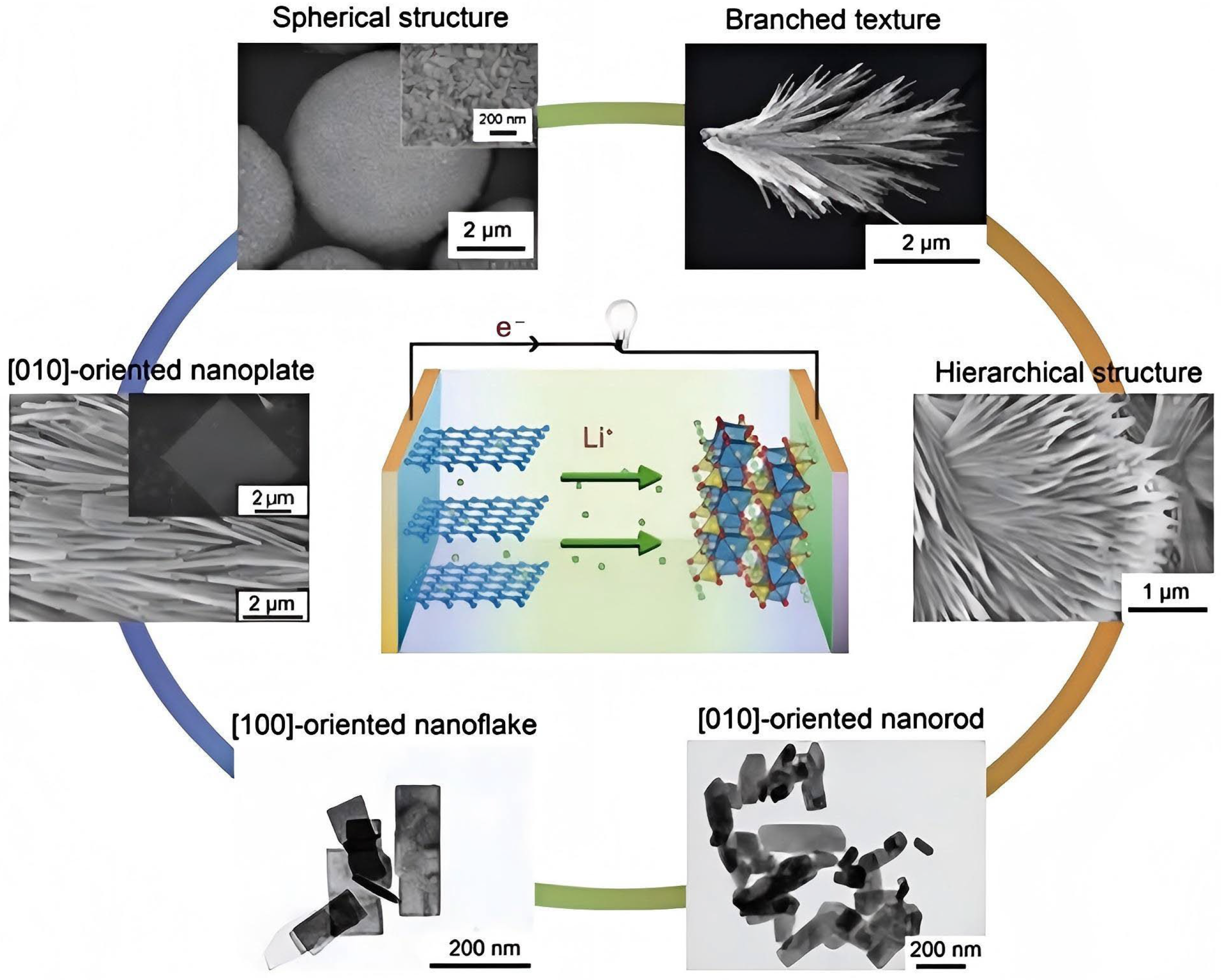
Nanostructuring reduces LFP particle size to the nanoscale (typically <100 nm), shortening lithium-ion diffusion distance along [010] channels. This reduces electrochemical polarization and enhances rate capability and cycling stability. Studies [29,30] indicate that high specific surface area improves electrolyte wetting and increases electrolyte contact area, potentially accelerating side reactions. Precise control of particle size and morphology is therefore required to balance ion transport efficiency with interfacial stability.
Hydrothermal and sol–gel synthesis enable nanoscale LFP particle engineering (Figure 10).
Pei et al. [32] employed sodium dodecylbenzenesulfonate (SDBS) as a morphology-directing agent to synthesize LFP nanoplates and nanorods with controlled b-axis thickness. These structures exhibit significantly shortened lithium-ion diffusion pathways, achieving >90% capacity retention at 1C. Kanagaraj et al. [33] synthesized seed-like and capsule-like LFP nanoparticles via hydrothermal methods. The distinctive morphologies effectively suppress particle agglomeration during cycling and enhance thermal stability. Nanostructured LFP demonstrates elevated TR onset temperature under abuse conditions, as nanoparticles uniformly distribute thermal stress and delay localized overheating.
Nanostructured LFP reduces polarization heating during charge–discharge by shortening lithium-ion diffusion distance, thereby suppressing TR chain reactions. Wang et al. [34] synthesized core–shell LFP/C nanocomposites via in situ polymerization. The 20~50 nm core dimensions and carbon shell effectively block direct electrolyte-active material contact, reducing heat release by 20% at elevated temperature. Additionally, nanoparticle surfaces readily form stable SEI films, minimizing electrolyte decomposition gas evolution and substantially enhancing thermal safety margins [35]. However, nanostructuring may reduce tap density and exacerbate interfacial side reactions, necessitating surface coating or doping for further optimization.
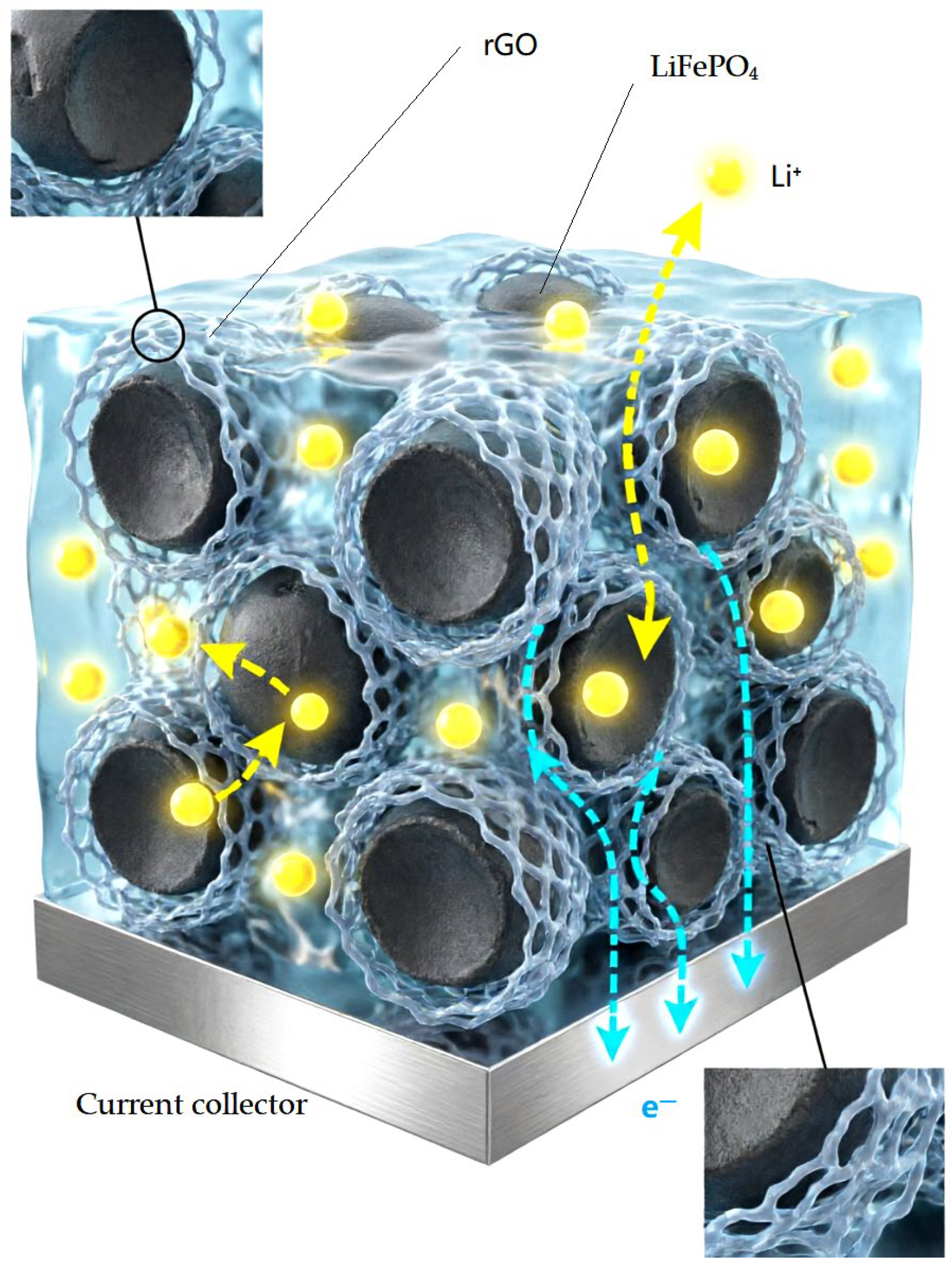
Composite architecture enhances LFP interfacial stability through conductive phase incorporation, providing an effective TR suppression strategy. Carbon coating forms continuous conductive networks on LFP particles, improving electron transport and suppressing Fe2+ oxidation. Zhang et al. [36] designed graphitic carbon/LFP nanonets with optimized pore channels and [010] orientation, significantly enhancing lithium-ion diffusion efficiency and achieving 99% capacity retention after 4000 cycles. Jiang et al. [37] constructed dual conductive networks using reduced graphene oxide (rGO) and carbon layers (Figure 11). The resulting LiFePO4@C/rGO composite maintains high capacity output at −20 °C and elevates the TR critical temperature to 120 °C.
Non-carbon coatings, including metal compounds (TiN, ZrO2) and conductive polymers (polypyrrole, polyaniline), expand interfacial modification strategies. Zhang et al. [38] applied TiN coating to LFP via sol–gel synthesis, increasing electronic conductivity to 10−2 S·cm−1. The coating effectively suppresses Fe2+ oxidation exothermic reactions at elevated temperatures. Huang and Goodenough [39] reported polypyrrole-coated LFP delivering 131 mAh·g−1 at 10C with superior interfacial stability versus unmodified material. These coatings block electrolyte corrosion through physical barrier effects while providing additional ion transport pathways.
Doping strategies synergize with composite material design to enhance TR protection. Chung et al. [40] employed supervalent cation doping (Nb5+, Mg2+) to increase intrinsic LFP conductivity by 108-fold, combining with carbon coating to form a bulk-interface dual-enhancement architecture. Lama et al. [41] demonstrated theoretically that Ru doping reduces lithium-ion diffusion activation energy and suppresses lattice distortion during TR. Non-metal doping (F, N) modulates band structure to further improve conductivity and thermal stability [42].
Despite the improvements in rate capability and thermal stability achieved through nanostructuring and composite strategies, several fundamental trade-offs warrant consideration.
As briefly noted in the literature [29,30], the high specific surface area of nanostructured LFP enhances electrolyte wetting and shortens Li+ diffusion distance, but it simultaneously increases the electrode/electrolyte contact area, which may accelerate parasitic interfacial reactions and gas generation at elevated temperatures. This trade-off between enhanced kinetics and increased surface reactivity represents a critical safety consideration that requires careful optimization of particle size and morphology.
And the tap density of nanocrystalline LFP is substantially lower than that of micron-sized counterparts, directly reducing the volumetric energy density of the cell, which is a significant drawback for applications where space is constrained.
Moreover, achieving uniform and thickness-controlled carbon coating on individual nanoparticles at an industrial scale remains technically demanding; incomplete or uneven coating coverage creates localized points of failure where Fe2+ dissolution and electrolyte decomposition can still occur.
These challenges underscore the need for advanced structural designs, such as core–shell architectures, single-crystal morphologies, or graded coatings, that can partially decouple the interdependency between kinetics, interfacial stability, and energy density.

4.1.2. Anode Modification

Anode materials critically influence LIB safety. Their thermal and chemical stability directly impacts TR risk. Optimizing anode composition, structure, and surface properties enhances both thermal and chemical stabilities, thereby reducing TR probability.
SEI decomposition at Stage I is the initiating event and kinetic bottleneck of the TR chain reaction, governing the duration of the induction period before self-accelerating exothermic reactions dominate. Anode modification strategies are therefore primarily directed at stabilizing the electrode/electrolyte interface and suppressing SEI thermal degradation, thereby delaying the onset of the cascade. Additionally, for high-capacity silicon-based anodes, mitigating volume expansion-induced structural degradation addresses a secondary failure pathway—lithium plating and dendritic growth—that can directly precipitate Stage II internal short circuits.
(1)
Graphite Anode Optimization
Graphite is the dominant commercial lithium-ion anode material. Its layered structure enables lithium-ion intercalation/deintercalation to form LiC6 with a theoretical capacity of 372 mAh·g−1. Key advantages include structural stability, minimal volume expansion (<10%), low lithiation potential (0.1~0.2 V vs. Li/Li+), excellent cycling stability, low cost, and abundant supply. However, graphite undergoes parasitic reactions at elevated temperatures, initiating TR. Multiple optimization strategies have been developed to enhance graphite thermal stability and safety.
Coating modification creates core–shell graphite particles by depositing shell materials with distinct structural properties onto graphite cores. This reduces excessive SEI growth from high external surface area, minimizes lithium consumption, and enhances graphite thermal stability. Common coating materials include amorphous carbon, metals, non-metals, their oxides, and conductive polymers.
Amorphous carbon exhibits a larger interlayer spacing than graphite, improving lithium-ion diffusion. It forms a lithium-ion buffer layer that enhances rate capability and prevents graphite exfoliation from solvent co-intercalation. Jeong et al. [43] reported a low-cost hydrothermal carbonization method to synthesize hard carbon-coated nano-silicon/graphite (HC-nSi/G) composites. In this hierarchical architecture, the hard carbon coating provides efficient electron transport pathways and accommodates silicon volume changes during cycling. Compared to simple mixtures of identical composition, HC-nSi/G demonstrates superior reversible capacity and rate performance. With optimized anode composition, HC-nSi/G achieves 879 mAh·g−1 reversible capacity, retaining 87.5% after 70 cycles at areal capacity loading exceeding 2 mAh·cm−2.
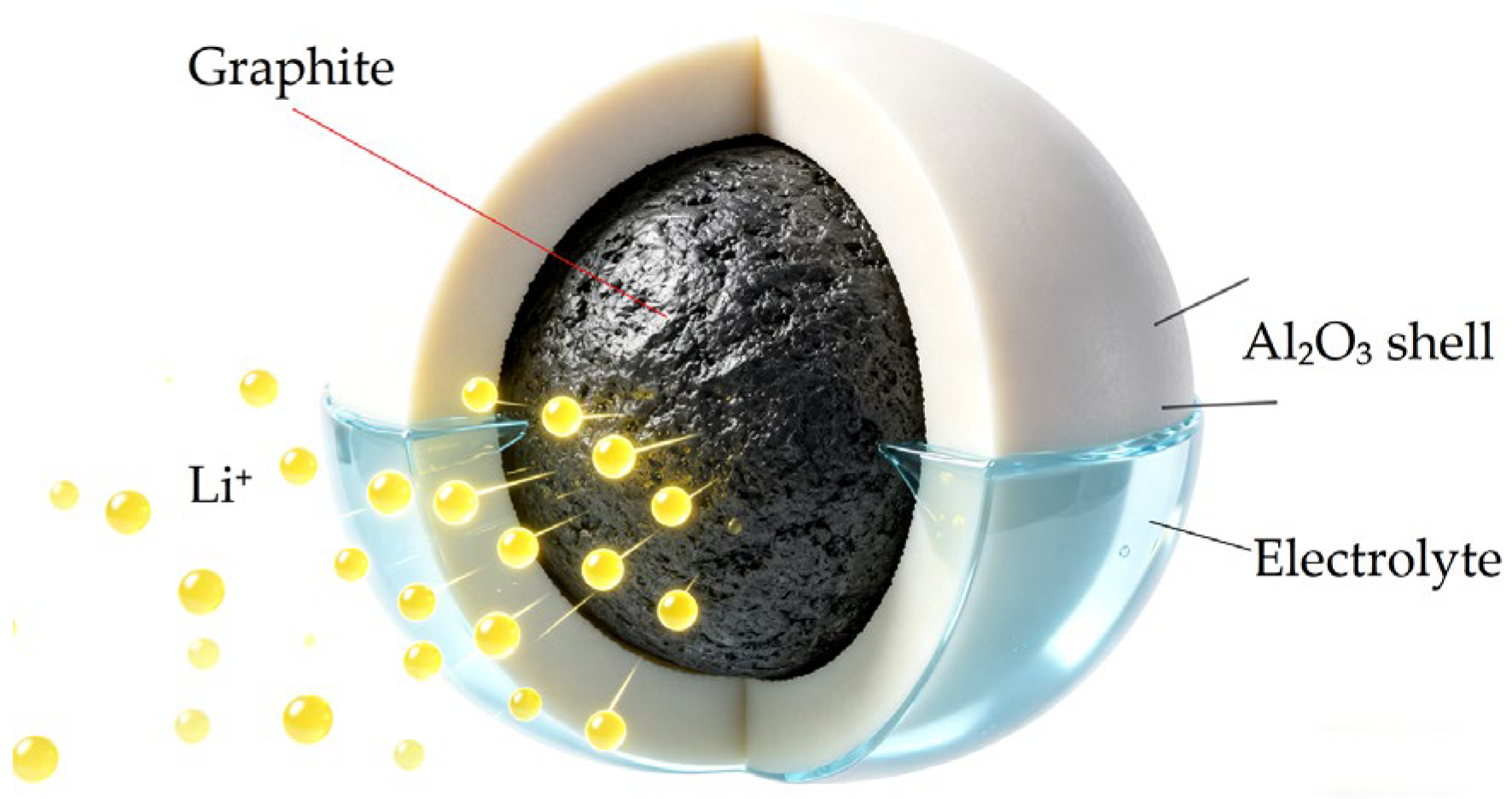
Graphite-metal and graphite-metal oxide composites enhance electronic conductivity, promote uniform electron distribution across particle surfaces, reduce polarization, improve rate capability, and increase electrode thermal stability. Kim et al. [44] synthesized a core–shell architecture with natural graphite cores and amorphous Al2O3 shells via hydrothermal methods (Figure 12). Graphite particles coated with 1 wt% Al2O3 deliver 337.1 mAh·g−1 reversible capacity at 4000 mA·g−1 current density. Full-cell testing with LiCoO2 cathodes confirms that amorphous Al2O3 incorporation enhances graphite thermal stability and fast-charging capability.
Similarly, MnO coating [45], Fe2O3 nanorod decoration [46], and Ag–C dual-coating [47] on graphite yield composite anodes with enhanced electronic conductivity and cycling stability.
Polymer coatings enhance graphite electronic conductivity and reduce interfacial impedance, improving charge–discharge efficiency and thermal stability. They also prevent parasitic reactions between graphite and electrolyte, extending cycle life. Veeraraghavan et al. [48] polymerized pyrrole onto commercial SFG10 graphite via in situ polymerization, forming thinner SEI films. Compared to pristine SFG10, the composite exhibits superior reversibility, higher Coulombic efficiency, improved rate capability, and extended cycling stability.
In summary, surface coating enhances graphite thermal stability at high current densities by minimizing direct graphite-electrolyte contact and promoting stable SEI formation. However, limitations exist. Some coating materials participate in SEI formation during initial cycling, consuming lithium ions and reducing initial Coulombic efficiency. Capacity improvements are modest, insufficient for high-energy-density cell requirements. Excessive coating thickness increases internal resistance, compromising graphite stability. Appropriate material selection and coating thickness optimization are therefore essential.
(2)
Silicon-based anode modification
Silicon-based anodes offer high capacity, energy density, and abundant supply, positioning them as promising graphite alternatives. However, poor electronic conductivity, substantial volume expansion during lithiation/delithiation, low Coulombic efficiency, and limited cycling stability cause structural degradation and TR risk. Silicon anodes are categorized as amorphous silicon, silicon oxides, low-dimensional silicon, silicon–carbon composites, silicon-metal composites, and silicon-conductive polymer composites.
Isotropic internal stress in amorphous silicon prevents structural fracture during lithiation/delithiation [49]. Additionally, its higher operating potential versus crystalline silicon suppresses lithium dendrite formation and improves cycling stability [50]. However, amorphous silicon readily pulverizes, compromising material stability.
Amorphous silicon oxide (SiOx) exhibits superior cycling stability versus amorphous silicon, improving with increasing oxygen content, but its overall stability remains inadequate. Low-dimensional silicon suffers from volume expansion, capacity fade, and cycling degradation during electrochemical cycling.
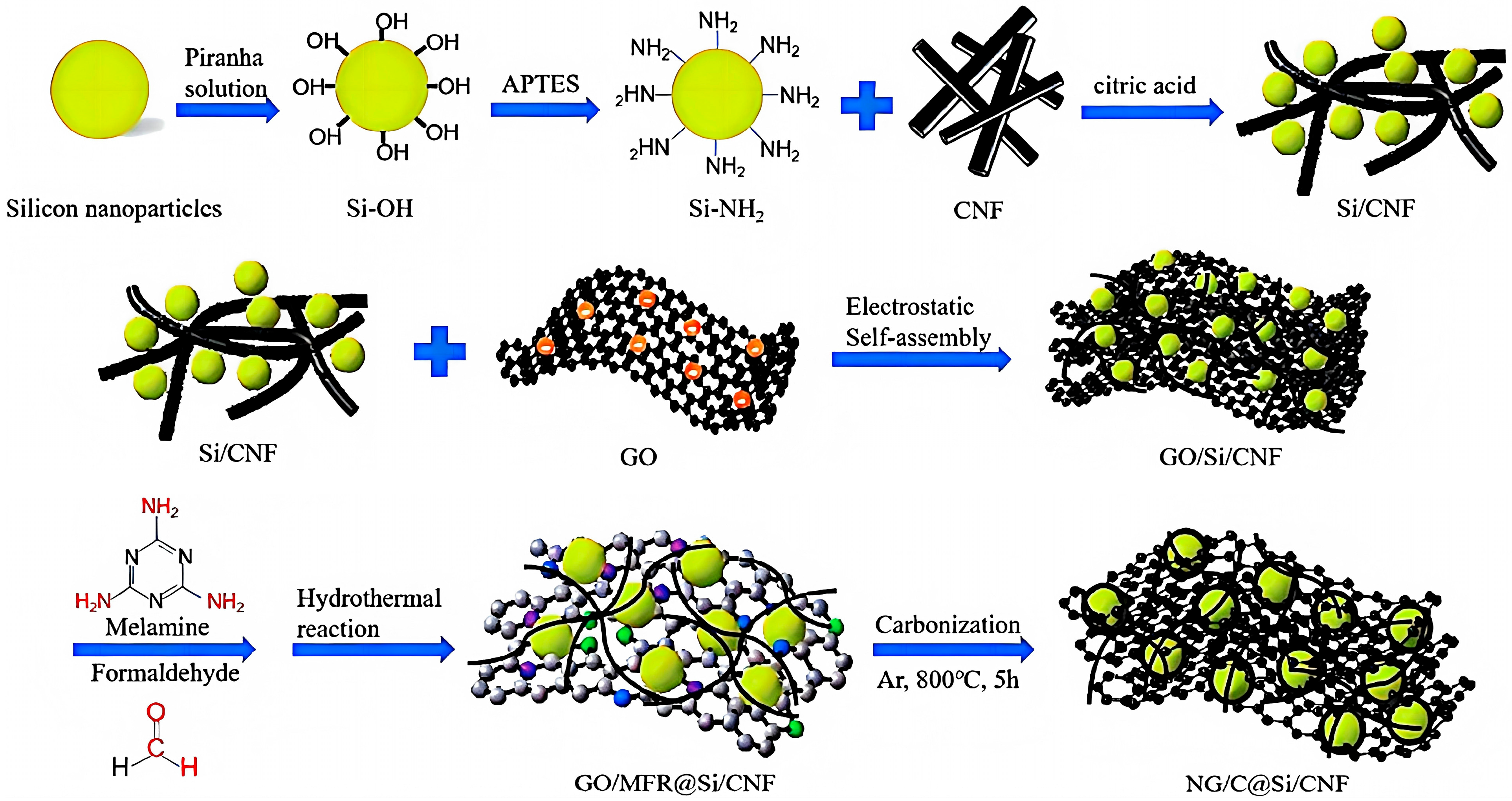
To address these limitations, researchers developed silicon composites combining Si with compatible materials. These comprise coating-type Si/C and embedded Si/C architectures. Coating-type Si/C includes solid core–shell, hollow core–shell, and yolk–shell structures (Figure 13); embedded Si/C comprises amorphous carbon and graphene matrices. High silicon content in coating-type Si/C enhances lithium storage capacity, while surface coatings accommodate volume expansion and stabilize SEI formation [51]. Embedded Si/C exhibits lower silicon content but higher carbon content, improving cycling stability. Overall, structural stability at high current densities, toxic emissions during synthesis, and Coulombic efficiency require further improvement.
Silicon-metal alloys offer higher theoretical specific capacity than conventional graphite anodes, indicating substantial development potential. Silicon alloys (SixMy, where M denotes metal; x and y indicate stoichiometry) comprise two categories: inactive metals (Fe, Co, Ni, Cu, Ti) that enhance conductivity and buffer volume expansion [52]; and active metals (Ge, Sn, Al, Zn) capable of lithium insertion. However, substantial volume expansion during lithiation/delithiation impedes the practical application of Silicon-metal alloy anodes.
Conductive polymers incorporated into silicon anodes provide 3D networks and high conductivity through conjugated π-bond structures, suppressing silicon volume effects [53]. Silicon-conductive polymer composites offer morphological versatility advantageous for volume expansion mitigation. Despite complex synthesis and limited research, these materials warrant continued attention.
(3)
Challenges and trade-offs
The anode modification strategies reviewed above each present specific limitations that constrain their practical application.
For graphite surface coatings, the primary challenge lies in balancing protection against impedance: thicker coating layers provide more effective physical barriers against electrolyte decomposition, but inevitably increase the interfacial resistance to lithium-ion transport, compromising rate capability. Additionally, certain coating materials consume lithium ions during the initial formation cycle to form their own SEI components, reducing the initial Coulombic efficiency of the cell—a trade-off between long-term stability and initial capacity that must be carefully managed.
For silicon-based anodes, despite the significant advances in nanostructured and composite architectures that partially accommodate the >300% volume expansion, maintaining structural integrity over extended cycling while preventing active material pulverization, electrical contact loss, and persistent electrolyte side reactions remains a formidable technical challenge. The synthesis of yolk–shell and core–shell structures often involves complex, multi-step processes that are difficult to scale, and the high carbon content in many Si/C composites, while beneficial for cycling stability, effectively dilutes the specific capacity advantage that silicon offers over graphite. These unresolved trade-offs highlight the need for continued innovation in coating uniformity, structural architecture, and scalable synthesis methods.

4.2. High-Stability Separator Applications

Separator failure at Stage II constitutes the critical physical tipping point in the TR pathway. The melting and shrinking of separators eliminate the physical isolation between cathode and anode, triggering massive internal short circuits that convert slow thermal accumulation into an uncontrollable electrical-thermal positive feedback loop. Separator functionalization strategies, including ceramic coating, inorganic separators, and thermally shut-down designs, are therefore designed to intervene precisely at this juncture, either by elevating the temperature at which structural integrity is lost or by enabling automatic ion transport shutdown before a catastrophic short circuit occurs.
Commercial LIB separators are primarily PP, PE, or PP/PE composites. They all exhibit poor thermal stability. High-performance separators require superior thermal tolerance to maintain dimensional stability at elevated temperatures without shrinkage or melting. They must also possess exceptional mechanical strength and puncture resistance, including high tensile strength, tear resistance, and penetration resistance, so as to withstand external compression, vibration, and puncture while suppressing lithium dendrite-induced internal short circuits. Chemical compatibility with electrolyte and all cell components without parasitic reactions is equally essential. Current research addresses these requirements through four main approaches, including surface-coated separators, inorganic separators, and thermally shut-down separators.

4.2.1. Surface-Coated Separators

The high-temperature tolerance of inorganic particles enables ceramic coating as an effective strategy for enhancing polyolefin separator thermal stability. Coating materials comprise inorganic nanoparticles, high-temperature polymers, and their composites. Common inorganic nanoparticles include SiO2, Al2O3, TiO2, ZrO2, and SnO2. Ceramic layers with elevated melting points and superior mechanical properties significantly improve composite separator thermal and dimensional stability.
Su et al. [54] developed Al2O3/HNT composite-coated separators (AH-PE) with 14 μm total thickness. These exhibit negligible shrinkage after 30 minutes at 170 °C, Li+ transference number of 0.47, and significantly enhanced rate capability and cycling stability in LFP//Li cells. The design addresses conventional coating limitations of pore blockage and impedance increase through synergistic hollow nanotube scaffolding and heat-resistant fillers, offering a novel approach for high-safety lithium-ion separators.
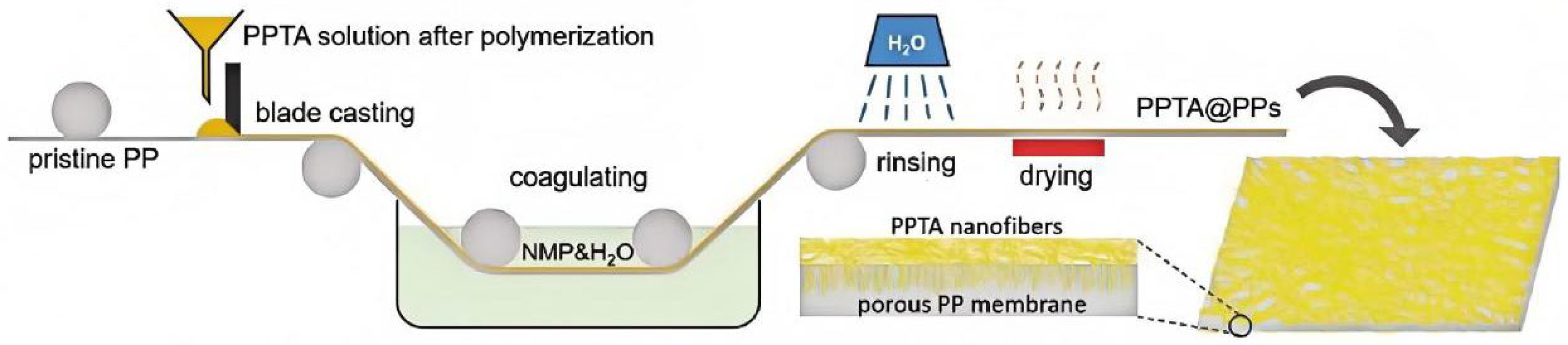
He et al. [55] fabricated binder-free composite separators (PPTA@PP) by depositing poly-p-phenylene terephthalamide (PPTA) nanofibers onto commercial PP substrates via continuous coating (Figure 14). Physical anchoring creates stable porous structures, optimizing electrolyte wetting and thermal stability. Nanofiber self-assembly networks regulated by non-solvent-induced phase separation ensure efficient lithium-ion transport. Cells with PPTA@PP separators exhibit superior cycling performance. Ion conductivity drops sharply after 200 °C heat treatment, triggering thermal shutdown and enhancing cell safety.
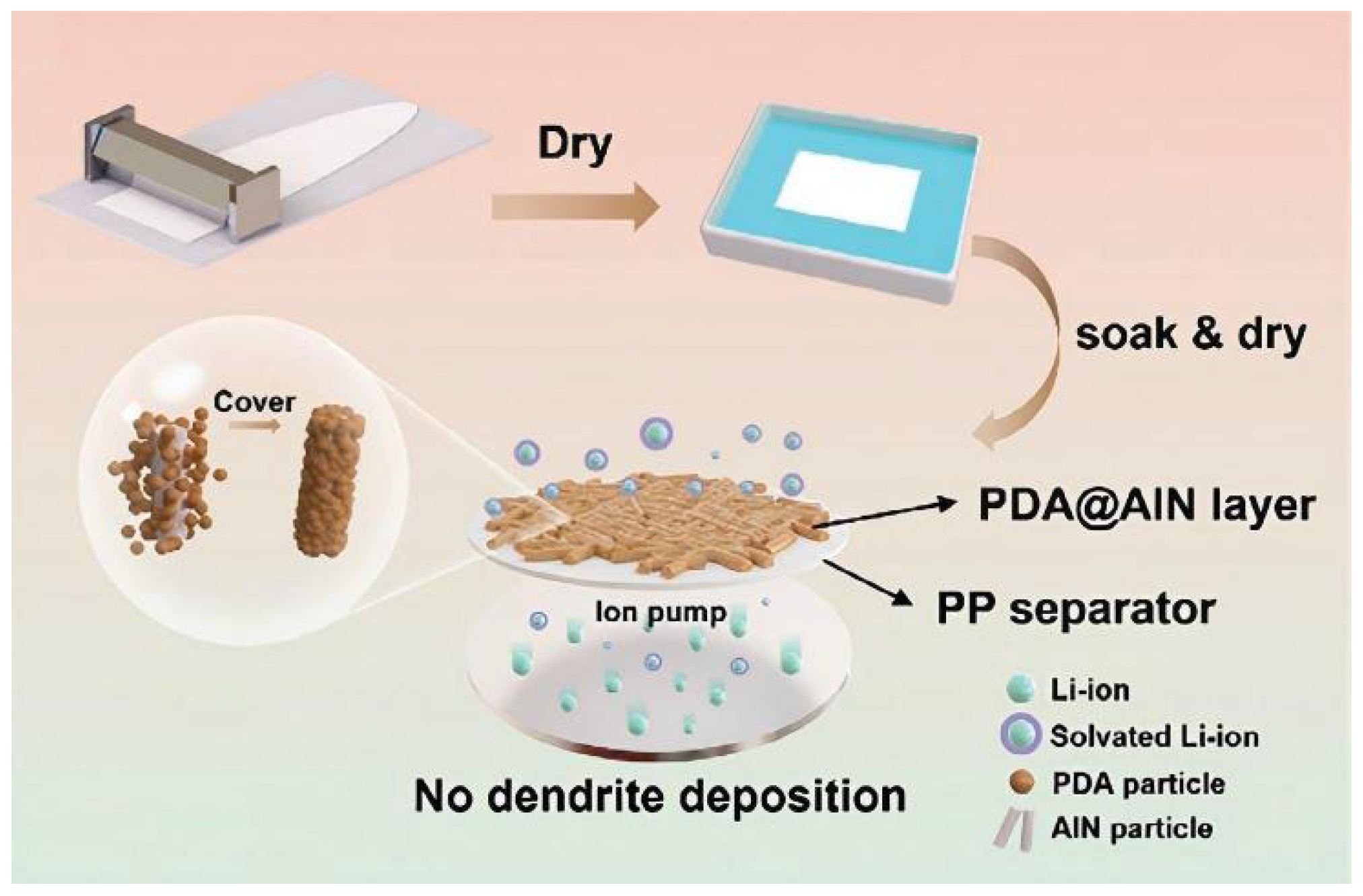
However, conventional polymer binders limit ceramic-coated separator thermal stability due to low melting points. High-melting-point polymer substitution enhances high-temperature cell safety. Tang et al. [56] developed a PDA@AlN@PP composite separator strategy for lithium metal batteries (Figure 15). Polar functional groups (N–H/O–H) synergize with aluminum nitride (AlN) high thermal conductivity to regulate lithium-ion transport and suppress dendrite growth. This separator enhances cycling stability in symmetric Li//Li cells and enables long-term capacity retention in LFP//Li half-cells. Theoretical calculations reveal the optimized deposition through a modified lithium-ion solvation structure.

4.2.2. Inorganic Separators

Inorganic materials are preferred functional separator components due to superior thermal tolerance, electrochemical inertness, and electrolyte affinity. These ceramic particles typically coat commercial polyolefin separators or embed within polymer matrices to enhance thermal stability. However, polymer substrates and organic binders in coatings limit breakthroughs in high-temperature performance. Pure ceramic/inorganic separators have therefore emerged as a research focus for achieving superior thermal and electrochemical properties.
Jing et al. [57] fabricated flexible ZrO2 ceramic separators via electrospinning-calcination. The nanofiber architecture combines high porosity with exceptional flexibility. Compared to commercial polyolefin separators, this material exhibits three advantages: superior electrolyte wetting for accelerated ion transport; thermal tolerance exceeding 1000 °C, far surpassing conventional separators; and high chemical inertness ensuring long-term cycling reliability. In lithium and sodium cells, this separator outperforms commercial counterparts at high rates (5C) and extended cycling (1000 cycles), offering a novel solution for high-power, high-safety batteries.
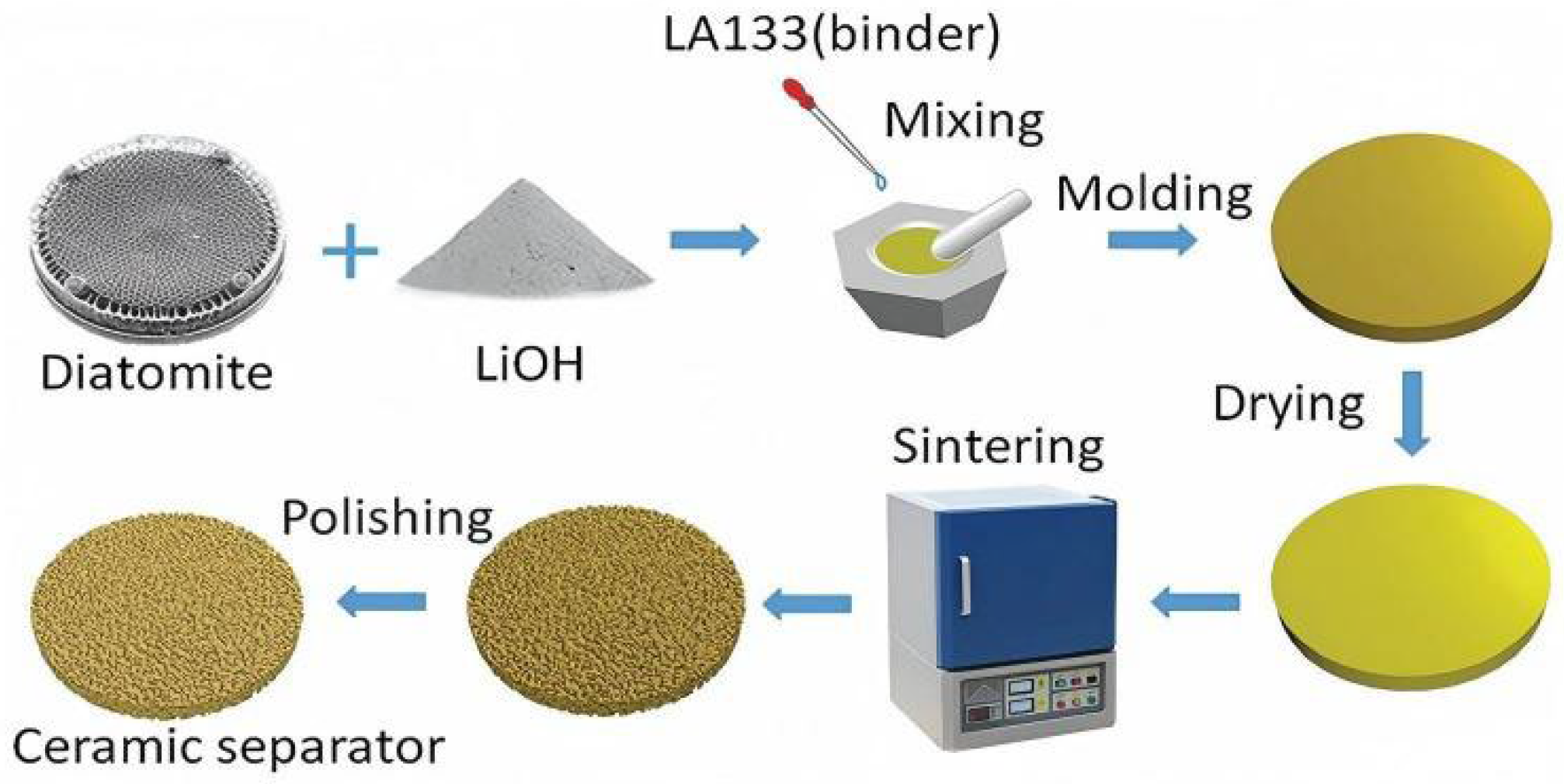
Diatomite and LiOH serve as ceramic precursors for high-porosity inorganic separators. Silicate formed from the SiO2-LiOH reaction functions as a solid electrolyte component, enhancing ionic conductivity and electrochemical performance. Li et al. [58] developed lithium silicate ceramic separators with significantly improved ionic conductivity, porosity, and electrolyte wetting versus commercial PP (Figure 16). Direct ceramic separator deposition onto electrodes offers a novel approach for simplifying cell manufacturing.

4.2.3. Thermally Shutdown Separators

Smart separators automatically deactivate ion transport channels at abnormal temperature elevation, arresting cell reactions to prevent TR initiation and propagation. Thermally shut-down separators achieve this functionality through thermosensitive materials incorporated within or onto base membranes. These materials undergo phase transition at defined thresholds, blocking pores and interrupting ion transport. The most widely implemented configuration is PP/PE/PP tri-layer composites. The lower-melting PE layer (~135 °C) fuses first to obstruct ion pathways, while higher-melting PP layers (~165 °C) maintain structural integrity to prevent internal short circuits. However, conventional PP/PE/PP separators are effective only for gradual temperature rise scenarios. Ensuring adequate safety protection requires maximizing the temperature differential between shutdown and shrinkage onset.
Xiao et al. [59] developed a thermally shutdown, high-stability LIB separator (HA/PE) via core–shell HDPE wax@AO composite coating. The design employs outer HDPE shell melting for pore-blocking shutdown, while inner oil shale components enhance flame retardancy (30% improvement), electrolyte compatibility, and self-discharge suppression for high-safety cell applications.
Wang et al. [60] fabricated PEG/PVDF@PBS core–shell composite separators integrating dual functions: intelligent thermal management via PEG phase-change energy storage, and thermal shutdown protection via PBS melting to stop TR. Compared to conventional PP separators, this material reduces capacity fade by 51%, polarization by 85%, and exhibits a 15-fold impedance increase at 100~120 °C for rapid safety response. Thermally shut-down separators blocking ion transport at abnormal temperature elevation effectively suppress TR and enhance cell safety.

4.2.4. Challenges and Trade-Offs for Separator Functionalization

Despite the significant advances in separator functionalization, several critical challenges remain.
For ceramic-coated separators, the adhesion between the ceramic layer and the polyolefin substrate is a persistent concern: delamination during cycling or under mechanical stress can create unprotected regions that become failure points. The coating process also partially blocks the pores of the base membrane, increasing ionic resistance and potentially compromising rate capability—a trade-off between thermal protection and ion transport efficiency.
For inorganic separators such as ZrO2 and diatomite-based ceramic membranes, although thermal tolerance can exceed 1000 °C, their mechanical flexibility and handling strength during cell assembly are generally inferior to polymer-based separators, posing challenges for large-scale manufacturing.
For thermally shut-down separators, the response speed is critical: in rapid TR scenarios where temperature escalates within seconds, the shutdown mechanism must activate quickly enough to prevent catastrophic failure. Furthermore, after shutdown, the separator must maintain sufficient mechanical integrity against internal gas pressure to prevent physical rupture, a dual requirement that is difficult to satisfy simultaneously.

4.3. Safe Electrolytes

Electrolytes serve as ionic conduction media for lithium-ion transport within cells. Intimate contact with electrodes at substantial potential differences inevitably induces interfacial redox reactions. These processes govern electrode-electrolyte interface stability, directly impacting cycling life and energy efficiency. Commercial electrolytes comprise carbonate solvents, primarily EC and DEC, with low flash points (<100 °C). This pronounced flammability elevates TR risk. Electrolyte chemical design thus determines both electrochemical performance and intrinsic cell safety.
The electrolyte plays a dual role in the TR pathway, spanning two critical stages. First, its reactivity with electrode surfaces governs SEI composition and thermal stability at Stage I, influencing the onset temperature of the cascade. Second, and more critically, the combustion of organic carbonate solvents serves as the primary amplification mechanism in Stage IV, where the electrolyte oxidizes exothermically with cathode-evolved oxygen and subsequently undergoes self-decomposition at temperatures exceeding 200 °C. Flame-retardant electrolyte strategies are therefore designed to intervene at both levels: incorporating film-forming additives to stabilize interfacial chemistry at Stage I, and introducing radical-scavenging or char-forming agents to interrupt combustion propagation at Stage IV.
The most direct approach to enhance LIB safety involves incorporating flame-retardant additives or eliminating flammable solvents entirely. EC, the most widely used solvent, exhibits thermal instability and facile decomposition at elevated temperatures, yet mature EC replacement technology remains unavailable. Flame-retardant additives, therefore, represent the most feasible strategy for improving electrolyte safety. These additives typically elevate electrolyte flash points, reducing flammability. However, compatibility issues between flame-retardant electrolytes and electrodes often compromise electrochemical performance. Achieving safety enhancement without sacrificing performance warrants continued investigation.
Flame-retardant additives must satisfy three criteria: chemical stability without adverse reactions with cell components within the operating voltage window; appropriate physical properties, including conductivity, viscosity, boiling point, density, and solubility; and high flame-retardant efficiency with low toxicity and moderate cost. Primary categories comprise phosphorus-based, organosilicon-based, and halogen-based flame retardants.

4.3.1. Phosphorus-Based Flame Retardants

Electrolyte solvent decomposition at elevated temperature generates hydrogen and hydroxyl radicals, initiating chain reactions that cause combustion. Organophosphorus flame retardants decompose to H3PO4 at high temperature, which subsequently converts to HPO2 and phosphorus-containing radicals (PO, PO2). HPO2 promotes carbonate carbonization, while PO and PO2·scavenge H and O radicals, suppressing chain reactions. Organophosphorus compounds exhibit high diversity, low toxicity, environmental compatibility, and low cost, attracting extensive research. Common additives include trimethyl phosphate (TMP), diethyl ethylphosphonate (DEEP), triethyl phosphate (TEP), tributyl phosphate (TBP), dimethyl methylphosphonate (DMMP), and triphenyl phosphate (TPP).
Wang et al. [61] incorporated TMP as a flame-retardant additive, demonstrating enhanced thermal stability. However, cycling performance degrades concurrently. TMP decomposes on graphite surfaces without forming a stable SEI, and co-intercalates with Li+, disrupting the layered structure.
Wu et al. [62] systematically evaluated cycling stability, rate capability, electrochemical stability, and flame retardancy of four electrolyte formulations: baseline LP30, LP30 with 5 vol% PFPN, LP30 with 5 vol% PFPN and 5 vol% DMAC, and LP30 with 5 vol% PFPN and 10 vol% DMAC. Electrochemical testing demonstrates that the PFPN-DMAC composite additive improves cycling performance, with DMAC content positively correlating with cycling stability and Coulombic efficiency. PFPN alone accelerates Coulombic efficiency fade and reduces electrochemical stability; these effects are eliminated upon DMAC incorporation.
Phosphorus-based flame retardants offer substantial cost advantages but exhibit narrow electrochemical windows and decompose on anode surfaces, causing capacity fade. Achieving non-flammable electrolytes at low concentrations is challenging; increasing concentration elevates viscosity and compromises electrochemical performance. Modification strategies include enhancing flame-retardant efficiency to reduce loading and co-formulation with film-forming additives to improve electrode compatibility.

4.3.2. Organosilicon-Based Flame Retardants

Organosilicon compounds have attracted extensive research due to their high thermal stability, low toxicity, reduced flammability, and environmental compatibility. Their flame-retardant mechanism involves forming a condensed-phase barrier that blocks heat transfer and electrolyte-volatile contact while promoting char formation.
Zhang et al. [63] evaluated vinyltris(2-methoxyethoxy)silane (VTMS) as an electrolyte flame-retardant additive. At loadings below 10 vol%, VTMS enhances LiCoO2 cathode thermal stability and reduces electrolyte flammability with minimal impact on electrochemical performance.
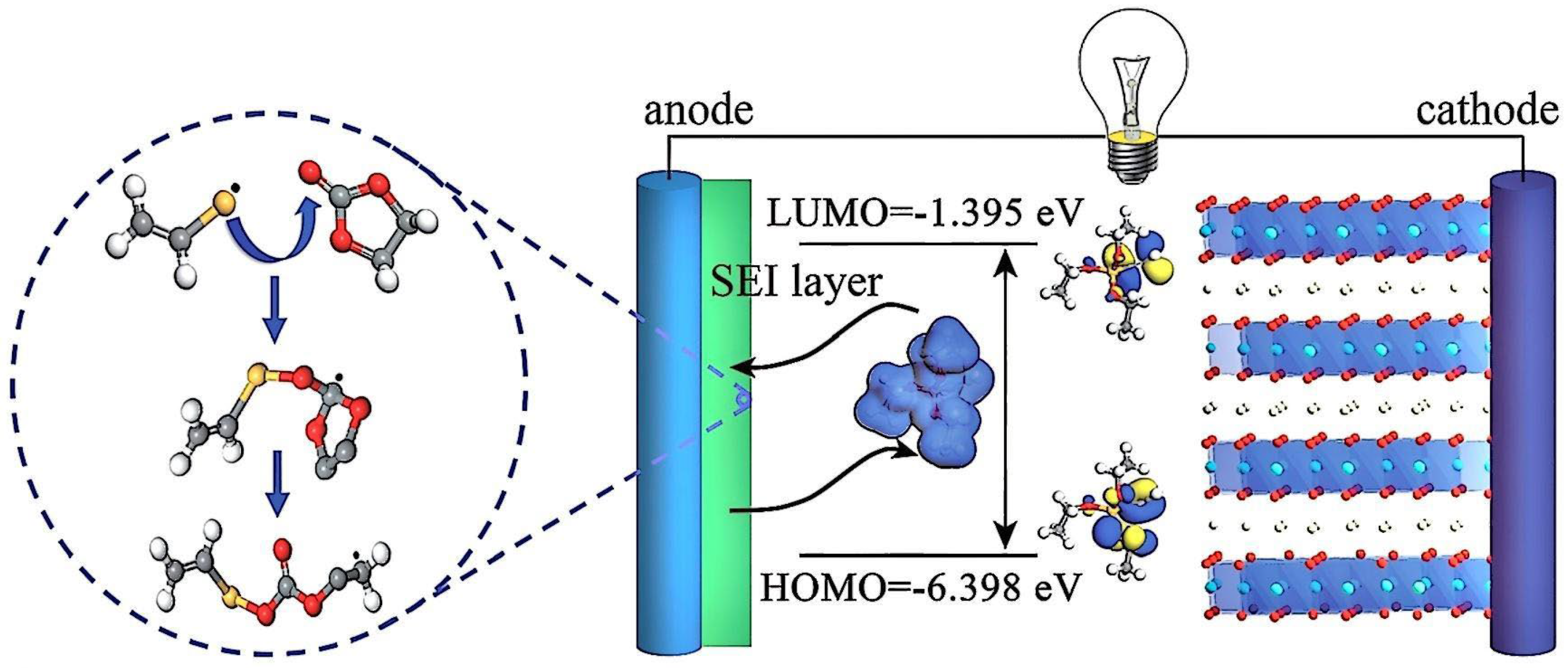
Chen et al. [64] evaluated vinyltriethoxysilane (VTES) safety in Li/LiCoO2 cells using 1 M LiPF6/EC:EMC:DMC (1:1:1 by volume) as baseline (Figure 17). Adding 5 vol% VTES increases the limiting oxygen index (LOI) to 24.8%, exceeding the 21% threshold for improved safety. Differential scanning calorimetry (DSC) shows reduced heat release with increasing VTES content. Thermogravimetric analysis (TGA) indicates slower decomposition between 100 and 175 °C for VTES-containing electrolytes versus baseline. VTES thus enhances electrolyte thermal stability.

4.3.3. Halogen-Based Flame Retardants

Halogenated flame retardants contain F, Cl, Br, or I, including fluorides, chlorides, bromides, and iodides. Upon heating, they generate halogen radicals that scavenge hydrogen and hydroxyl radicals, interrupting chain reactions and suppressing combustion. Flame-retardant efficacy decreases from F to Cl to Br to I. Fluorine-, chlorine-, and bromine-based additives are widely used; iodine-based additives are rare due to weak C-I bond instability. Fluorinated compounds dominate halogen flame-retardant research. Strongly electronegative fluorine substitution for hydrogen yields C-F bonds (~105.4 kcal·mol−1) substantially stronger than C-H bonds (~98.8 kcal·mol−1), requiring greater energy for bond dissociation and enhancing thermal stability. Fluorinated additives exhibit high flash points, adequate thermal stability, low viscosity, low surface tension, and low freezing points, though high cost limits application.
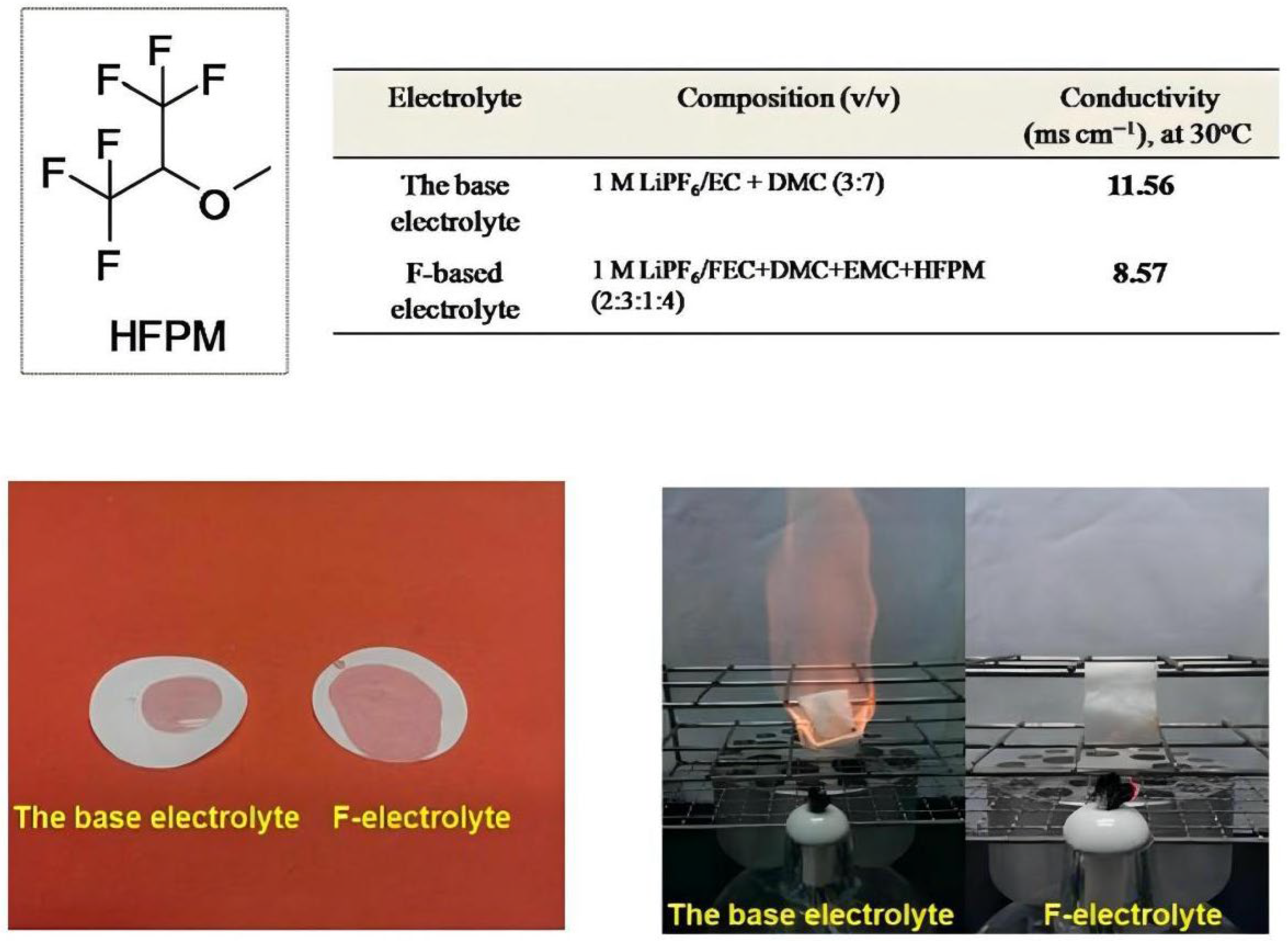
Xia et al. [65] incorporated 1,1,1,3,3,3-hexafluoroisopropyl methyl ether (HFPM) as a flame-retardant additive and evaluated electrolyte flammability (Figure 18). The electrolyte exhibited no ignition under test conditions, demonstrating high safety. In MCMB/LiNi0.5Mn1.5O4 18,650 cells, this formulation delivered 82% capacity retention after 200 cycles.

4.3.4. Challenges and Trade-Offs for Flame-Retardant Electrolyte

Each category of flame-retardant additive presents distinct limitations that constrain its practical deployment.
Phosphorus-based retardants, while cost-effective, often exhibit relatively high lowest unoccupied molecular orbital (LUMO) energy levels, causing preferential reduction on graphite anode surfaces before the electrolyte solvents. This interferes with the formation of a stable, dense SEI, leading to continuous lithium consumption and capacity fade during cycling.
Organosilicon compounds offer good thermal stability and environmental compatibility, but achieving non-flammability typically requires relatively high additive loadings that increase electrolyte viscosity and reduce ionic conductivity.
For halogenated additives, particularly fluorinated compounds, the high cost and the potential generation of HF at elevated temperatures, which can attack cathode materials and accelerate transition metal dissolution, remain significant concerns.
More broadly, a fundamental trade-off exists across all flame-retardant strategies: increasing additive concentration improves flame retardancy but inevitably elevates electrolyte viscosity and compromises rate capability. Where quantitative data are available, the LOI and self-extinguishing time (SET) provide standardized metrics for comparing flame retardancy. For example, the addition of 5 vol% VTES to a baseline carbonate electrolyte increases the LOI from below 21% to 24.8% [64], representing a quantifiable improvement in safety. However, such standardized measurements remain inconsistently reported across the literature, making systematic cross-study comparison difficult.
To facilitate an integrative comparison of the diverse material strategies reviewed in the paper, Table 2 summarizes their key characteristics across multiple dimensions. The table highlights several overarching trends:
(i)
Safety improvement is often accompanied by trade-offs in other performance metrics;
(ii)
No single strategy addresses all four stages of the TR cascade—cathode and electrolyte strategies target Stages III–IV, anode strategies target Stage I, and separator strategies target Stage II;
(iii)
Strategies already commercialized offer moderate but reliable improvements, while more effective solutions remain at earlier development stages. These observations underscore the need for synergistic multi-strategy design, as further discussed below.

5. Conclusions and Outlook

This review systematically examines material-level strategies for enhancing LIB thermal safety, focusing on modification technologies for cathodes, anodes, separators, and electrolytes. By situating these strategies within the TR chain reaction pathway, which proceeds through SEI decomposition (Stage I), separator meltdown (Stage II), cathode oxygen release (Stage III), and electrolyte combustion (Stage IV). This review clarifies the functional locus of each material approach. Key conclusions include:
  • Cathode modification strategies address thermal instability in high-Ni materials (NCM, NCA) through surface coating and bulk doping. These strategies primarily intervene at Stage III of the TR cascade, where destabilized layered oxides evolve lattice oxygen that fuels subsequent electrolyte combustion. Surface coatings with nanoscale protective layers such as Al2O3 and LiF block direct electrode-electrolyte contact, suppressing interfacial side reactions and transition metal dissolution. Bulk doping with heteroatoms (Mg, Al, F) enhances crystal structure stability and elevates oxygen evolution potential. For LFP, research focuses on nanostructuring and carbon coating to reduce particle size and improve conductive networks, significantly enhancing rate capability and thermal stability.
  • Anode optimization strategies focus on surface modification for graphite and nanoarchitectures for silicon. These strategies primarily target Stage I of the TR cascade, where SEI decomposition at elevated temperatures triggers the chain reaction and governs the induction period before self-accelerating exothermic reactions dominate. Graphite surface coatings with amorphous carbon or metal oxide layers suppress electrolyte decomposition and stabilize SEI formation. For high-capacity silicon anodes, researchers have designed nanostructures and composites, including silicon–carbon composites and yolk–shell architectures that accommodate volume expansion during cycling while improving interfacial stability.
  • Separator functionalization strategies enhance thermal and mechanical properties through multiple approaches. These strategies intervene at Stage II of the TR pathway, the critical tipping point where separator meltdown triggers the electrical-thermal positive feedback loop that drives the system toward uncontrollable escalation. Ceramic-coated separators deposit inorganic particles (Al2O3, SiO2) onto polyolefin substrates, substantially improving thermal stability and mechanical strength. Advanced polymer separators replace conventional polyolefins with high-temperature materials, significantly elevating shrinkage temperature. Intelligent thermally shutdown separators employ temperature-responsive materials that close pores at specific thresholds, effectively stopping TR propagation.
  • Electrolyte flame-retardant strategies employ phosphorus-based (TPP, DMMP), fluorinated, and composite additive systems. These strategies act at Stage IV of the TR cascade, where electrolyte combustion amplifies localized heating into catastrophic fire. These function through dual mechanisms: gas-phase radical scavenging and condensed-phase char promotion, substantially elevating flash point and self-extinguishing capability. Advanced lithium salts and solvent systems further enhance thermal stability and electrochemical window.
  • These four categories of material strategies form a stage-specific intervention framework: anode modifications delay the initiating event at Stage I, separator functionalization blocks the propagation pathway at Stage II, cathode modifications suppress the primary energy release at Stage III, and flame-retardant electrolytes terminate the final combustion cascade at Stages IV. This stage-specific perspective reveals that effective TR suppression depends on coordinated interventions spanning multiple stages of the chain reaction.
Despite significant advances in intrinsic material safety, current strategies face substantial challenges meeting the stringent demands of large-scale energy storage—high energy density, extended cycle life, and inherent safety. Addressing these challenges requires:
  • The multidimensional performance trade-off presents a fundamental challenge that manifests across all material components. For high-Ni cathodes, the inverse relationship between energy density and thermal stability is well quantified: as Ni content increases from NCM111 (x = 0.33) to NCM9 0.5 0.5 (x = 0.9), the maximum surface temperature during TR rises from 540.1 °C to 650.0 °C. This 110 °C increase indicates that higher-nickel batteries release more thermal energy and exhibit lower intrinsic thermal stability [22]. Surface coatings effectively block electrolyte access and suppress interfacial side reactions and O2 release, but inevitably increase interfacial impedance, impeding lithium-ion transport and compromising rate capability and power density. Bulk doping stabilizes crystal structure and suppresses phase transitions, yet precise control of dopant species, concentration, and distribution is difficult; excessive doping sacrifices active lithium content and reduces specific capacity. For LFP cathodes, the trade-off is different but equally constraining: nanostructuring shortens Li+ diffusion paths and improves rate capability, but the resulting high specific surface area increases interfacial reactivity at elevated temperatures, while the reduced tap density directly sacrifices volumetric energy density. For anodes, Silicon anodes offer high specific capacity but exhibit severe volume expansion (>300%) during cycling, which is the primary cause of capacity fade and a potential TR trigger. silicon–carbon composites and yolk–shell architectures partially accommodate volume changes, yet maintaining structural integrity over thousands of cycles while preventing active material pulverization, detachment, and persistent electrolyte side reactions remains a formidable technical challenge. For electrolytes, flame-retardant additives improve safety but elevate viscosity and interfacial resistance, with phosphorus-based retardants exhibiting the additional drawback of competing with solvent molecules for reduction at the anode surface, interfering with stable SEI formation.
  • Component compatibility and synergistic effects present system-level challenges. Battery optimization requires holistic consideration beyond single-material improvements. Phosphorus-based additives for electrolyte flame retardancy exhibit high LUMO energy levels, potentially reducing on graphite surfaces before solvent molecules and preventing dense SEI formation, exacerbating lithium loss and capacity fade. Fluorinated additives or film-forming agents may decompose at elevated temperatures to generate HF, attacking cathode materials, accelerating transition metal dissolution, and degrading separator integrity. Ceramic coatings enhance separator thermal dimensional stability and puncture resistance, yet coating-substrate adhesion, long-term chemical stability under cycling and abuse, and uniform lithium-ion transport through coated pores require precise optimization. Thermally shut-down separators designed to melt and close pores at specific temperatures face practical challenges in trigger precision, response kinetics, and mechanical integrity against internal gas pressure post-shutdown.
  • Emerging solid-state electrolyte systems offer a paradigm shift in addressing the intrinsic flammability of liquid electrolytes, yet they introduce new interfacial challenges [66,67]. Solid-state electrolytes (SSEs), including oxide-based, sulfide-based, and polymer-based systems, fundamentally eliminate the leakage and combustion risks of organic carbonate solvents [68]. However, the solid–solid interface between SSEs and electrodes exhibits significantly higher impedance than liquid-solid interfaces, limiting rate capability. Moreover, lithium dendrite propagation along grain boundaries in ceramic SSEs remains a concern, indicating that solid-state systems, while inherently safer, are not immune to internal short circuit failure. The integration of SSEs with high-voltage cathodes and high-capacity anodes remains a grand challenge at the frontier of battery safety research.
Material science innovations are transforming LIB’s TR prevention from passive protection to active intervention, and from single-material optimization to system-level synergistic design. The stage-specific mapping perspective presented in this review, spanning Stage I through Stage IV, further suggests that future material design should explicitly consider how multiple strategies can be coordinated to intervene at different stages of the TR cascade, thereby achieving protection that no single strategy can provide alone. Future research will increasingly emphasize intrinsic thermal stability enhancement coupled with intelligent safety function integration. The ultimate goal is to achieve substantially improved inherent safety without compromising energy density or power performance, establishing robust material foundations for safer, broader deployment in large-scale energy storage.

Author Contributions

Conceptualization and writing, X.H.; software and formal analysis, Q.L.; software and writing, K.Y.; methodology, C.D.; validation, B.T. All authors have read and agreed to the published version of the manuscript.

Funding

This research was funded by the State Key Laboratory of Mechanical System and Vibration grant number [MSV202512].

Data Availability Statement

No new data were created or analyzed in this study. Data sharing is not applicable to this article.

Conflicts of Interest

The authors declare no conflicts of interest.

References

  1. Wu, G.; Pan, L.; Wen, H.; Ye, S.; Huang, J. Fast regulation algorithm for low voltage at distribution end of regional power grid with high uncertainty and high proportion of wind-solar-load integration. J. Shenyang Univ. Technol. 2025, 47, 712–718. [Google Scholar]
  2. Li, Y.; Wang, F.; Qin, Y.; Zhang, Y.; Zhao, B.; Yu, Z. Real-time V2G load prediction game model based on smart contracts. J. Chongqing Univ. Posts Telecommun. (Nat. Sci. Ed.) 2025, 37, 387–395. [Google Scholar]
  3. Singh, B.; Singh, P.; Tejani, G.; Sharma, S.K.; Mousavirad, S.J. Role of lithium-ion batteries in microgrid system. Transp. Eng. 2025, 21, 100368. [Google Scholar] [CrossRef]
  4. Lu, H.; Shen, W.; Lv, D.; Zhao, J.; Song, W.; Tan, R. Research progress on safety strategies for thermal runaway in lithium-ion batteries. Mater. Rep. 2025, 39, 24060110. [Google Scholar]
  5. Gao, Y.; Ge, T.; Yang, B.; Liu, Y. Research on discharge performance and capacity changes of lithium-ion batteries in wind farm energy storage systems. Renew. Energy Resour. 2025, 43, 552–560. [Google Scholar]
  6. Li, H. Study on Characteristics of Lithium-Ion Batteries Excited by High-Frequency Ripple Current. Ph.D. Thesis, Beijing Jiaotong University, Beijing, China, 2022. [Google Scholar]
  7. Ding, Y.; Xu, Q.; Lv, Y.; Li, L. Optimal configuration of user-side energy storage considering power demand management. Power Syst. Technol. 2019, 43, 1179–1186. [Google Scholar]
  8. Ma, J.; Ma, K.; Zhang, J.; Lei, E.; Jin, L. Experimental Study on Cooling Effect of Extinguishing Agents on Thermal Runaway of Large-Capacity Lithium-Ion Battery. In Proceedings of the 2024 5th International Conference on Smart Grid and Energy Engineering (SGEE), Nanchang, China, 22–24 November 2024; pp. 364–368. [Google Scholar]
  9. Jiang, X.; Liu, X.; Zhang, P. Controlling thermal runaway propagation in lithium-ion battery module by two-phase flow of nitrogen and water mist. Appl. Therm. Eng. 2023, 235, 121446. [Google Scholar] [CrossRef]
  10. Dhuchakallaya, I.; Saechan, P. Mitigating thermal runaway propagation caused by external heating in a large-scale lithium-ion battery module using pressurized cooling effects. Sustain. Energy Technol. Assess. 2025, 82, 104477. [Google Scholar] [CrossRef]
  11. Tan, T.; Ma, Y. Thermal runaway modeling and gas generation behavior of Li-ion battery. Battery Bimon. 2025, 55, 1312–1318. [Google Scholar]
  12. Zhang, J.T.; Zhang, J.Y.; Duan, F.; Zhang, G.; Wang, X.; Su, X.; Wen, Y.; Jiang, L.; Jiang, W. Experimental study on thermal runaway characteristics of ternary power lithium-ion batteries under various abuse modes in open environmental conditions. J. Energy Storage 2026, 145, 118848. [Google Scholar] [CrossRef]
  13. Höschele, P.; Heindl, S.; Ellersdorfer, C. Experimental investigation of the mechanical and electrical failure of the electrode tab of lithium-ion pouch cells under quasi-static mechanical load. Batteries 2024, 10, 444. [Google Scholar] [CrossRef]
  14. Wang, L.; Hao, Z.; Lin, J.; Liu, B. Lithium-ion battery separator failure: From mechanical to electrochemical criterion. Int. J. Mech. Sci. 2026, 309, 111000. [Google Scholar] [CrossRef]
  15. Setta, J.; Lecocq, A.; Desprez, P.; Origuchi, M.; Destriau, L.; Marlair, G.; Carlier, D.; Croguennec, L.; Bordes, A. Internal short circuits in lithium-ion batteries; origins, detection, and experimental reproduction: A review. J. Power Sources 2025, 658, 238265. [Google Scholar] [CrossRef]
  16. Qian, L.; Yi, Y.; Zhang, W.; Fu, C.; Xia, C.; Ma, T. Revealing the impact of high current overcharge/overdischarge on the thermal safety of degraded Li-ion batteries. Int. J. Energy Res. 2023, 2023, 8571535. [Google Scholar] [CrossRef]
  17. Zhou, G.; Lu, H.; Zhang, S.; Song, W.; Zhao, J.; Liang, T.; Wang, J.; Zhang, Q.; Duanmu, W.; Hou, L.; et al. Investigation on thermal runaway characteristics and flame dynamics of overcharged NCM523 lithium-ion batteries with different charge rate. Case Stud. Therm. Eng. 2025, 75, 107204. [Google Scholar] [CrossRef]
  18. Guo, R.; Lu, L.; Ouyang, M.; Feng, X. Mechanism of the entire overdischarge process and overdischarge-induced internal short circuit in lithium-ion batteries. Sci. Rep. 2016, 6, 30248. [Google Scholar] [CrossRef]
  19. Schmidt, L.; Hankins, K.; Bläubaum, L.; Gerasimov, M.; Krewer, U. High temperature in situ gas analysis for identifying degradation mechanisms of lithium-ion batteries. Chem. Sci. 2025, 16, 5118–5128. [Google Scholar] [CrossRef] [PubMed]
  20. Oka, H.; Kadoura, H.; Takahashi, N.; Ikawa, T. Effect of amorphous carbon coating on the formation of solid electrolyte interphase and electrochemical properties of a graphite electrode. J. Power Sources 2022, 543, 231850. [Google Scholar] [CrossRef]
  21. Wu, L.; Nam, K.; Wang, X.; Zhou, Y.; Zheng, J.-C.; Yang, X.-Q.; Zhu, Y. Structural origin of overcharge-induced thermal instability of Ni-containing layeredcathodes for high-energy-density lithium batteries. Chem. Mater. 2011, 23, 3953–3960. [Google Scholar] [CrossRef]
  22. Wei, N.; Zhang, F.; Zhang, W.; Li, X. Comparative study on the thermal runaway characteristics of Li (NixCoyMnz)O2 batteries. Heliyon 2024, 10, e31203. [Google Scholar] [CrossRef]
  23. Lv, H.; Li, C.; Zhao, Z.; Wu, B.; Mu, D. A review: Modification strategies of nickel-rich layer structure cathode (Ni ≥ 0.8) materials for lithium ion power batteries. J. Energy Chem. 2021, 60, 435–450. [Google Scholar] [CrossRef]
  24. Lee, Y.; Shin, W.; Kannan, A.; Koo, S.M.; Kim, D.-W. Improvement of the cycling performance and thermal stability of lithium-ion cells bydouble-layer coating of cathode materials with Al2O3 nanoparticles and conductive polymer. ACS Appl. Mater. Interfaces 2015, 7, 13944–13951. [Google Scholar] [CrossRef]
  25. Ma, F.; Wu, Y.; Wei, G.; Qiu, S.; Qu, J. Enhanced electrochemical performance of LiNi0.8Co0.1Mn0.1O2 cathode via wet-chemical coating of MgO. J. Solid State Electrochem. 2019, 23, 2213–2224. [Google Scholar] [CrossRef]
  26. Yang, F.; Xie, Y. Study on preparation and Na+ doping modification of ternary material LiNi0.65Co0.15Mn0.2O2. Inorg. Chem. Ind. 2025, 57, 43–49. [Google Scholar]
  27. Park, K.; Jung, H.; Kuo, L.; Kaghazchi, P.; Yoon, C.S.; Sun, Y.-K. Improved cycling stability of Li[Ni0.90Co0.05Mn0.05]O2 through microstructure modification by boron doping for Li-ion batteries. Adv. Energy Mater. 2018, 8, 1801202. [Google Scholar] [CrossRef]
  28. Li, X.; Tang, Y.; Zhu, J.; Lv, H.; Zhao, L.; Wang, W.; Zhi, C.; Li, H. Boosting the cycling stability of aqueous flexible Zn batteries via F doping in nickel-cobalt carbonate hydroxide cathode. Small 2020, 16, 202001935. [Google Scholar] [CrossRef]
  29. Cheng, Q.; Zhao, X.; Yang, G.; Mao, L.; Liao, F.; Chen, L.; He, P.; Pan, D.; Chen, S. Recent advances of metal phosphates-based electrodes for high-performance metal ion batteries. Energy Storage Mater. 2021, 41, 842–882. [Google Scholar] [CrossRef]
  30. Zhu, Y.; Shi, Z.; Sun, J. Heterogeneous electrocatalysts for lithium-sulfur batteries. Chin. Sci. Bull. 2022, 68, 399–413. [Google Scholar] [CrossRef]
  31. Li, Z.; Yang, J.; Guang, T.; Fan, B.; Zhu, K.; Wang, X. Controlled hydrothermal/solvothermal synthesis of high-performance LiFePO4 for Li-ion batteries. Small Methods 2021, 5, 2100193. [Google Scholar] [CrossRef]
  32. Pei, B.; Yao, H.; Zhang, W.; Yang, Z. Hydrothermal synthesis of morphology-controlled LiFePO4 cathode material for lithium-ion batteries. J. Power Sources 2012, 220, 317–323. [Google Scholar] [CrossRef]
  33. Kanagaraj, A.B.; Al Shibli, H.; Alkindi, T.S.; Susantyoko, R.A.; An, B.H.; AlMheiri, S.; AlDahmani, S.; Fadaq, H.; Choi, D.S. Hydrothermal synthesis of LiFePO4 micro-particles for fabrication of cathode materials based on LiFePO4/carbon nanotubes nanocomposites for Li-ion batteries. Ionics 2018, 24, 3685–3690. [Google Scholar] [CrossRef]
  34. Wang, H.; Wang, R.; Liu, L.; Jiang, S.; Ni, L.; Bie, X.; Yang, X.; Hu, J.; Wang, Z.; Chen, H.; et al. In-situ self-polymerization restriction to form core-shell LiFePO4/C nanocomposite with ultrafast rate capability for high-power Li-ion batteries. Nano Energy 2017, 39, 346–354. [Google Scholar] [CrossRef]
  35. Yang, Z.; Dai, Y.; Wang, S.; Yu, J. How to make lithium iron phosphate better: A review exploring classical modification approaches in-depth and proposing future optimization methods. J. Mater. Chem. A 2016, 4, 18210–18222. [Google Scholar] [CrossRef]
  36. Zhang, Y.; Zhang, H.; Feng, Y.; Fang, L.; Wang, Y. Ultralong lifespan and ultrafast Li storage: Single-crystal LiFePO4 nanomeshes. Small 2016, 12, 516–523. [Google Scholar] [CrossRef] [PubMed]
  37. Jiang, G.; Hu, Z.; Xiong, J.; Zhu, X.; Yuan, S. Enhanced performance of LiFePO4 originating from the synergistic effect of graphene modification and carbon coating. J. Alloys Compd. 2018, 767, 528–537. [Google Scholar] [CrossRef]
  38. Zhang, M.; Garcia-Araez, N.; Hector, A.L.; Owen, J.R. A sol–gel route to titanium nitride conductive coatings on battery materials and performance of TiNcoated LiFePO4. J. Mater. Chem. A 2017, 5, 2251–2260. [Google Scholar] [CrossRef]
  39. Huang, Y.; Goodenough, J. High-rate LiFePO4 lithium rechargeable battery promoted by electrochemically active polymers. Chem. Mater. 2008, 20, 7237–7241. [Google Scholar] [CrossRef]
  40. Chung, S.; Bloking, J.; Chiang, Y. Electronically conductive phospho-olivines as lithium storage electrodes. Nat. Mater. 2002, 1, 123–128. [Google Scholar] [CrossRef]
  41. Lama, B.; Smirnova, A.; Paudel, T. Enhanced Li-ion diffusivity of LiFePO4 by Ru doping: Ab initio and machine learning force field results. ACS Appl. Energy Mater. 2023, 6, 10424–10431. [Google Scholar] [CrossRef]
  42. Ban, C.; Yin, W.; Tang, H.; Wei, S.-H.; Yan, Y.; Dillon, A.C. A novel codoping approach for enhancing the performance of LiFePO4 cathodes. Adv. Energy Mater. 2012, 2, 1028–1032. [Google Scholar] [CrossRef]
  43. Jeong, S.; Li, X.; Zheng, J.; Yan, P.; Cao, R.; Jung, H.J.; Wang, C.; Liu, J.; Zhang, J.-G. Hard carbon coated nano-Si/graphite composite as a high performance anode for Li-ion batteries. J. Power Sources 2016, 15, 323–329. [Google Scholar] [CrossRef]
  44. Kim, D.; Kim, Y.; Kim, H. Improved fast charging capability of graphite anodes via amorphous Al2O3 coating for high power lithium ion batteries. J. Power Sources 2019, 422, 18–24. [Google Scholar] [CrossRef]
  45. Lee, S.; Lee, J.; Eom, W.; Jung, Y.W.; Han, T.H. Aqueous-processable surface modified graphite with manganese oxide for lithium-ion battery anode. Appl. Surf. Sci. 2020, 526, 146720. [Google Scholar] [CrossRef]
  46. Yan, X.; Jiang, F.; Sun, X.; Du, R.; Zhang, M.; Kang, L.; Han, Q.; Du, W.; You, D.; Zhou, Y. A simple, low-cost and scale-up synthesis strategy of spherical-graphite/Fe2O3 composites as high-performance anode materials for half/full Lithium ion batteries. J. Alloys Compd. 2020, 822, 153719. [Google Scholar] [CrossRef]
  47. Hou, C. Structure and performance of spherical natural graphite modified by Ag-C Double Coating. Int. J. Electrochem. Sci. 2017, 12, 3652–3661. [Google Scholar] [CrossRef]
  48. Veeraraghavan, B.; Paul, J.; Haran, B.; Popov, B. Study of polypyrrole graphite composite as anode material for secondary lithium-ion batteries. J. Power Sources 2002, 2, 377–387. [Google Scholar] [CrossRef]
  49. Yu, Q.; Liu, J.; Liang, Y.; Liu, T.; Zheng, Y.; Lai, Z.; Liu, X.; Chen, J.; Zhang, Q.; Li, X. Synthesis of 3D stacked silicon nanosheets via electrochemical reduction of attapulgite in molten salt for high-performance lithium-ion batteries anode. Electrochim. Acta 2022, 422, 140515. [Google Scholar] [CrossRef]
  50. Su, A.; Li, J.; Dong, J.; Yang, D.; Chen, G.; Wei, Y. An amorphous/crystalline incorporated Si/SiOx anode material derived from biomass corn leaves for lithium-ion batteries. Small 2020, 16, 2001195. [Google Scholar] [CrossRef]
  51. Cong, R.; Jo, M.; Martino, A.; Park, H.-H.; Lee, H.; Lee, C.-S. Three-dimensional network of nitrogen-doped carbon matrix-encapsulated Si nanoparticles/carbon nanofibers hybrids for lithium-ion battery anodes with excellent capability. Sci. Rep. 2022, 12, 16002. [Google Scholar] [CrossRef]
  52. Wang, H.; Wang, C.; Tang, Y. Interface engineering toward high-efficiency alloy anode for next-generation energy storage device. EcoMat 2021, 3, e12131. [Google Scholar] [CrossRef]
  53. Li, C.; Bai, H.; Shi, G. Conducting polymer nanomaterials: Electrosynthesis and applications. Chem. Soc. Rev. 2009, 38, 2397. [Google Scholar] [CrossRef]
  54. Su, M.; Chen, Y.; Wang, S.; Wang, H. Bifunctional separator with high thermal stability and lithium dendrite inhibition toward high safety lithium-ion batteries. Chin. Chem. Lett. 2023, 34, 107553. [Google Scholar] [CrossRef]
  55. He, L.; Qiu, T.; Xie, C.; Tuo, X. A phase separation method toward PPTA–polypropylene nanocomposite separator for safe lithium ion batteries. J. Appl. Polym. Sci. 2018, 135, 46697. [Google Scholar] [CrossRef]
  56. Tang, W.; Zhao, T.; Wang, K.; Yu, T.; Lv, R.; Li, L.; Wu, F.; Chen, R. Dendrite-Free Lithium Metal Batteries Enabled by Coordination Chemistry in Polymer-Ceramic Modified Separators. Adv. Funct. Mater. 2024, 34, 2314045. [Google Scholar] [CrossRef]
  57. Jing, P.; Liu, M.; Wang, P.; Yang, J.; Tang, M.; He, C.; Pu, Y.; Liu, M. Flexible nonwoven ZrO2 ceramic membrane as an electrochemically stable and flame-resistant separator for high-power rechargeable batteries. Chem. Eng. J. 2020, 388, 124259. [Google Scholar] [CrossRef]
  58. Li, D.; Li, Y.; Yang, K.; Ding, M.; Su, H.; Wang, H.; Zhang, Z.; Li, F.; Xue, B. A porous diatomite ceramic separator for lithium ion batteries. New J. Chem. 2021, 45, 15840–15850. [Google Scholar] [CrossRef]
  59. Xiao, Y.; Fu, A.; Zou, Y.; Huang, L.; Wang, H.; Su, Y.; Zheng, J. High safety lithium-ion battery enabled by a thermal-induced shutdown separator. Chem. Eng. J. 2022, 438, 135550. [Google Scholar] [CrossRef]
  60. Wang, K.; Wang, W.; Wang, Y.; Wang, M. Dual phase change separator combining cooling and thermal shutdown functions for Li-ion battery with enhanced safety. Chem. Eng. J. 2024, 481, 148538. [Google Scholar] [CrossRef]
  61. Wang, X.; Yasukawa, E.; Kasuya, S. Nonflammable trimethyl phosphate solvent-containing electrolytes for lithium-ion batteries: I. fundamental properties. J. Electrochem. Soc. 2001, 148, A1058. [Google Scholar] [CrossRef]
  62. Wu, Z.; Wu, Y.; Tang, Y.; Jiang, J.-C.; Huang, A.-C. Evaluation of composite flame-retardant electrolyte additives improvement on the safety performance of lithium-ion batteries. Process Saf. Environ. Prot. 2023, 169, 285–292. [Google Scholar] [CrossRef]
  63. Zhang, H.; Xia, Q.; Wang, B.; Yang, L.C.; Wu, Y.P.; Sun, D.L.; Gan, C.L.; Luo, H.J.; Bebeda, A.W.; van Ree, T. Vinyl-tris-(methoxydiethoxy)silane as an effective and ecofriendly flame retardant for electrolytes in lithium ion batteries. Electrochem. Commun. 2009, 11, 526–529. [Google Scholar] [CrossRef]
  64. Chen, R.; Zhao, Y.; Li, Y.; Ye, Y.; Li, Y.; Wu, F.; Chen, S. Vinyltriethoxysilane as an electrolyte additive to improve the safety of lithium-ion batteries. J. Mater. Chem. A 2017, 5, 5142–5147. [Google Scholar] [CrossRef]
  65. Xia, L.; Xia, Y.; Wang, C.; Hu, H.; Lee, S.; Yu, Q.; Chen, H.; Liu, Z. 5 V-class electrolytes based on fluorinated solvents for li-ion batteries with excellent cyclability. ChemElectroChem 2015, 2, 1707–1712. [Google Scholar] [CrossRef]
  66. Li, F.; Hou, M.; Zhao, L.; Zhang, D.; Yang, B.; Liang, F. Electrolyte and interface engineering for solid-state sodium batteries. Energy Storage Mater. 2024, 65, 103181. [Google Scholar] [CrossRef]
  67. Lee, S.; Rawal, J.; Lee, J.; Gautam, J.; Kim, S.; Xu, G.-L.; Amine, K.; Park, S.-J. Solid-state electrolytes and their interfacial properties: Implications for solid-state lithium batteries. Electrochem. Energy Rev. 2025, 8, 9. [Google Scholar] [CrossRef]
  68. Feng, H.; Zhu, G.; Wan, Z.; Wang, F.R.; Hao, Z.; Feng, J. NCM811-sulfide electrolyte interfacial degradation mechanisms and regulation strategies in all-solid-state lithium battery. ChemSusChem 2025, 18, e202501033. [Google Scholar] [CrossRef] [PubMed]
Figure 1. Structural damage of the LIB under mechanical abuse. (Reprinted from [13]).
Inorganics 14 00138 g001
Figure 2. Formation of internal short circuits under mechanical abuse. (Reprinted from [15]).
Inorganics 14 00138 g002
Figure 3. Overcharged LIB. (Reprinted from [17]).
Inorganics 14 00138 g003
Figure 4. Over-discharge mechanism. (Reprinted from [18]).
Inorganics 14 00138 g004
Figure 5. The corresponding reactions at the temperature of heat abuse.
Inorganics 14 00138 g005
Figure 6. Variations in TS and pressure vs time. (Reprinted from [22]).
Inorganics 14 00138 g006
Figure 7. Schematic of double-layer coating of LiNi0.6Co0.2Mn0.2O2 material with Al2O3 nanoparticles and PEDOT-co-PEG [24].
Inorganics 14 00138 g007
Figure 8. SEM of NCM (a), NCM-2%Na (b), and EDS of NCM-2%Na (c). (Reprinted from [26]).
Inorganics 14 00138 g008
Figure 9. Schematic illustration of the effect of boron-doping on the NCM90 cathode’s mechanical stability during charge and discharge cycling [27].
Inorganics 14 00138 g009
Figure 10. Methods for LFP Particle Nanostructuring [31].
Inorganics 14 00138 g010
Figure 11. LiFePO4@C/rGO composite material schematic diagram.
Inorganics 14 00138 g011
Figure 12. Schematic illustration of the Al2O3 coated on a graphite surface.
Inorganics 14 00138 g012
Figure 13. Diagram for the preparation process of NG/C@Si/CNF. (Reprinted from [51]).
Inorganics 14 00138 g013
Figure 14. Schematic illustration of the fabrication process of PPTA@PPs [55].
Inorganics 14 00138 g014
Figure 15. Illustration of the preparation process for PDA@AlN@PP separators [56].
Inorganics 14 00138 g015
Figure 16. Preparation flow chart for a diatomite ceramic separator [58].
Inorganics 14 00138 g016
Figure 17. Schematic of a lithium-ion battery containing VTES as an additive [64].
Inorganics 14 00138 g017
Figure 18. The structure and testing of the electrolytes [65].
Inorganics 14 00138 g018
Table 1. Stage-by-stage summary of the TR chain reaction pathway.
StageTemperatureDominant ProcessKinetic RoleHeat Contribution
I80–120 °CSEI decompositionRate-determining stepLow (~5%)
II130–160 °CSeparator meltdown, internal short circuitPhysical tipping pointHigh (Joule heat)
III150–250 °CCathode O2 release, electrolyte oxidationPrimary energy releaseVery high (>50%)
IV>200 °CElectrolyte/binder decompositionDrives to peak temperatureHigh (~30–40%)
Table 2. Comprehensive comparison of material modification strategies discussed in this review.
MaterialStrategyTR StageMechanismSafety EnhancementKey Limitations
CathodeHigh-Ni oxide coating (Al2O3, MgO)Stage IIIPhysical barrier against O2 releaseDSC: exothermic peak delayed by 13–17 °C, heat reduced by 35–43% [24]Coating uniformity; long-term adhesion
High-Ni doping (Mg, Al, F, B)Stage IIILattice stabilization; reduced cation mixingDelayed phase transition; elevated O2 evolution potentialDopant distribution control; excessive doping sacrifices capacity
LFP nanostructuring + carbon coatingStage III Shortened Li+ diffusion path; conductive networkReduced polarization heating; elevated TR onset temperatureSurface reactivity vs. kinetics trade-off; tap density loss
AnodeGraphite surface coating (amorphous C, Al2O3)Stage IStabilized SEI; suppressed electrolyte contactDelayed SEI decompositionICE loss; modest capacity gain
Si/C composite (core–shell, yolk–shell)Stage I–IIVolume expansion accommodation; stable SEISuppressed Li plating and dendrite growthLong-term cycling stability; synthesis complexity; cost
SeparatorCeramic-coated separator (Al2O3, SiO2 on PE)Stage IIEnhanced thermal dimensional stabilityNegligible shrinkage at 170 °C [54]Coating adhesion; pore clogging
Inorganic separator (ZrO2, diatomite-based)Stage IIUltra-high thermal toleranceThermal stability > 1000 °C [57]Mechanical flexibility; manufacturing handling
Thermal shutdown separator (PP/PE/PP, HDPE wax@AO)Stage IIPore closure at threshold temperature15-fold impedance increase at 100–120 °C [60]; flame retardancy + 30% [59]Response speed in rapid TR; post-shutdown integrity
ElectrolyteP-based flame retardant (TPP, DMMP)Stage IVGas-phase radical scavenging (PO, PO2·)Elevated flash point; SET reductionAnode compatibility (LUMO); high loading needed
Organosilicon flame retardant (VTES, VTMS)Stage IVCondensed-phase barrierLOI from <21% to 24.8% at 5 vol% [64]High loading needed for non-flammability
Halogenated flame retardant (HFPM)Stage IVRadical scavenging (H, OH)No ignition under test conditions [65]High cost; potential HF generation
Disclaimer/Publisher’s Note: The statements, opinions and data contained in all publications are solely those of the individual author(s) and contributor(s) and not of MDPI and/or the editor(s). MDPI and/or the editor(s) disclaim responsibility for any injury to people or property resulting from any ideas, methods, instructions or products referred to in the content.