Article

Study on the Electrochemical Performance of End-of-Life Photovoltaic Crystalline Silicon as an Anode in Silicon-Air Batteries


Faculty of Metallurgical and Energy Engineering, Kunming University of Science and Technology, Kunming 650093, China
*
Author to whom correspondence should be addressed.
Inorganics 2026, 14(5), 135; https://doi.org/10.3390/inorganics14050135
Submission received: 13 April 2026 / Revised: 7 May 2026 / Accepted: 9 May 2026 / Published: 15 May 2026

Abstract

With the rapid development of the photovoltaic industry, the issue of high-value conversion and utilization of end-of-life photovoltaic modules emerges. This study proposes using them in silicon-air batteries and designs a one-step pretreatment process to obtain two types of anode materials: AB@Si and TC@Si. Additionally, to enhance the electrochemical performance of retired crystalline silicon from PV modules as anodes for silicon-air batteries and improve their mass conversion efficiency, this study introduces Triton X-100 into the KOH electrolyte to inhibit chemical corrosion of the anodes and investigates the mechanism of action of Triton X-100. The results indicate that the surfaces of AB@Si and TC@Si exhibit a pyramidal structure, demonstrating excellent passivation resistance when used in silicon-air batteries, with maximum mass conversion efficiencies of 3.5% and 1.83%, respectively. Under the influence of Triton X-100, the maximum mass conversion efficiencies reach 6.39% and 3.09%, respectively. Polarization curves and mass loss under non-current conditions indicate that Triton X-100 primarily affects the chemical corrosion process of the silicon anode, while its impact on electrochemical corrosion is negligible. Results from contact angle measurements and adsorption energy calculations indicate that Triton X-100 adsorbs onto the silicon surface via benzene ring groups or OH groups, reducing hydrophilicity and delaying the self-corrosion process of silicon, thereby improving the battery′s discharge lifespan and mass conversion efficiency.

1. Introduction

As the crisis surrounding traditional non-renewable energy sources intensifies and global climate change poses multiple challenges, countries around the world are increasingly turning their attention to sustainable development pathways [1]. Between 2025 and 2030, global renewable energy installed capacity is projected to increase by approximately 4600 gigawatts, doubling the scale of the previous five-year period [2,3,4]. Thanks to its significant advantages, such as being clean and renewable, solar energy is rapidly becoming the fastest-growing form of renewable energy and is widely regarded as one of the most promising clean energy sources [5,6,7]. However, solar panels have a limited average lifespan of approximately 25 to 30 years [8]. As global photovoltaic (PV) installed capacity continues to grow, the number of end-of-life PV modules will also rise steadily [9,10]. China will face particularly severe challenges in the disposal of PV waste in the coming decades [11,12]. End-of-life PV modules contain not only hazardous substances such as mercury, lead, and cadmium, but also valuable metallic materials such as aluminum, silicon, and silver [13]. When the silicon from retired PV modules is used as doped silicon—which possesses a high specific surface area—it exhibits low charge transfer resistance in silicon-air batteries and demonstrates inherent anti-passivation properties [14]. This enables the low-cost upcycling and reuse of retired crystalline silicon from PV modules. Since the discharge performance of silicon-air batteries is easily affected by anode passivation and corrosion, the key to enhancing their long-term discharge capability lies in optimizing the silicon anode material; consequently, the optimized design of silicon anodes has consistently been a research focus in this field [15,16,17].
Although quasi-solid-state electrolytes show promise in silicon-air batteries, traditional alkaline electrolyte systems remain a current research focus due to their stability during discharge and lower cost. The selection of retired crystalline silicon from photovoltaic modules as the anode material for silicon-air batteries stems, on the one hand, from its inherent cost advantage and, on the other hand, from the high-surface-area structure imparted by its fabrication process [18]. To adhere to a low-cost research approach, this study employs an aqueous alkaline electrolyte, further reducing the cost of the battery system. Silicon materials are prone to passivation in alkaline solutions; this characteristic severely affects the battery’s discharge capacity and has become a critical issue that must be overcome for the practical application of alkaline silicon-air batteries [19,20,21,22,23,24]. The actual capacity is far lower than the theoretical capacity (3820 mAh/g), with most of the capacity loss attributed to self-corrosion reactions. Both hydrogen gas and silicates generated during the reaction adversely affect battery performance. Therefore, conducting in-depth research on the discharge performance, energy efficiency, and storage lifespan of silicon anodes in alkaline electrolytes holds significant practical importance. When used as the anode in silicon-air batteries, its high specific surface area acts as a “double-edged sword”: while it possesses anti-passivation properties, it is also prone to severe self-corrosion. The resulting low mass conversion efficiency severely limits the realization of the battery’s specific capacity. Drawing on various mature anti-corrosion and passivation surface coating strategies developed for other metal-air batteries, this paper proposes the introduction of the organic electrolyte additive Triton X-100 (TX-100) to suppress self-corrosion [25,26,27,28].

2. Results and Discussion

2.1. Morphological and Elemental Differences Before and After Pretreatment

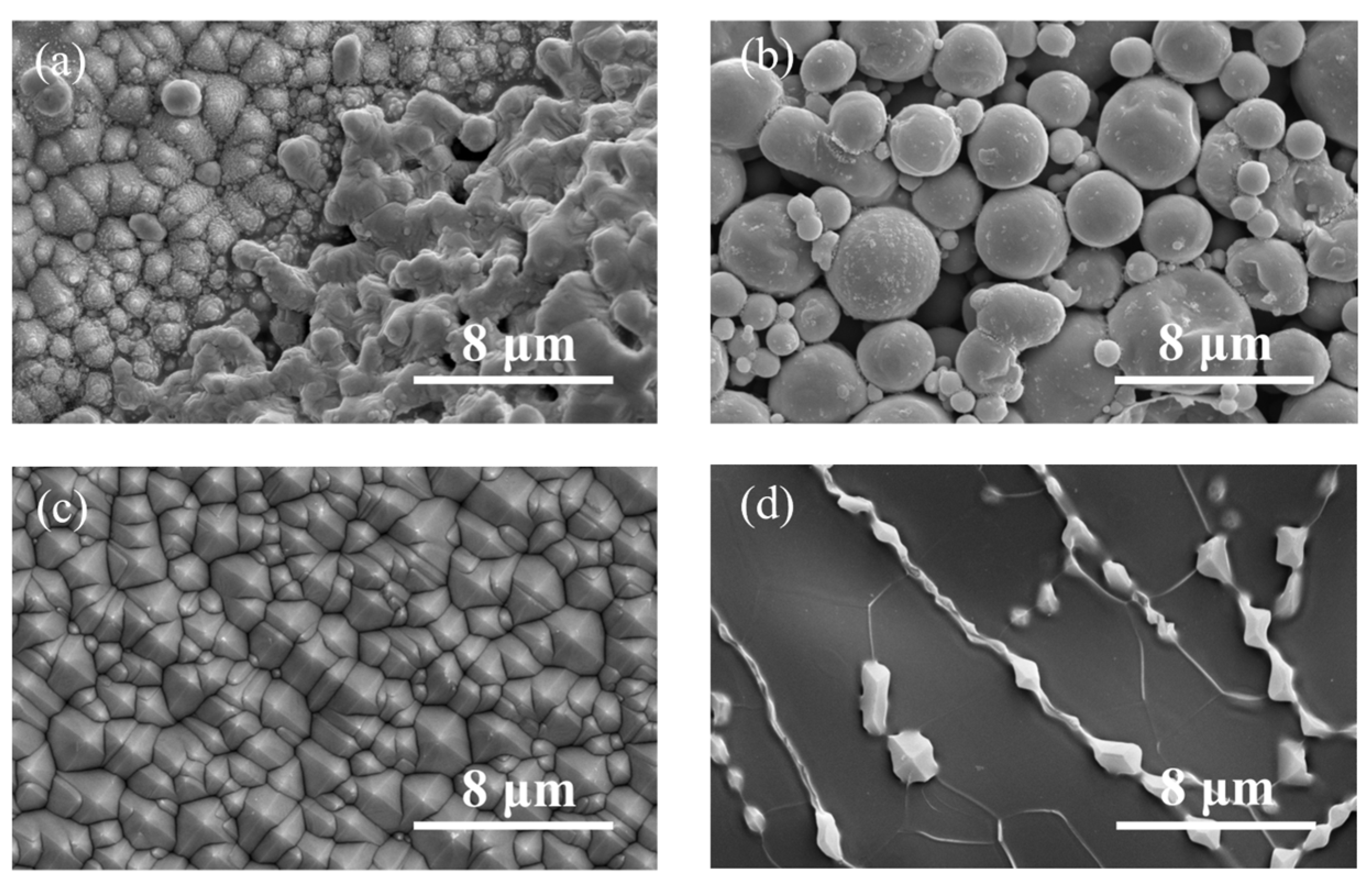
To investigate the morphological features and composition of the samples before and after treatment, SEM analysis was performed on both samples. Figure 1a shows the top surface morphology of the Al-Bsf-type retired crystalline silicon photovoltaic cell, whose structure consists primarily of pyramid-shaped silicon, lamellar silver, and dense silicon nitride. Figure 1b shows that the bottom surface is covered with a layer of spherical aluminum and aluminum oxide. Figure 1c shows the AB@Si sample obtained after pretreatment, where only the pyramid-shaped silicon structure remains on the upper surface; the silicon nitride layer has been effectively removed, and the surface appears smoother. Figure 1d shows that the aluminum and aluminum oxide on the lower surface have also been completely removed, exposing the silicon substrate, with a small number of pyramid-shaped protrusions visible.
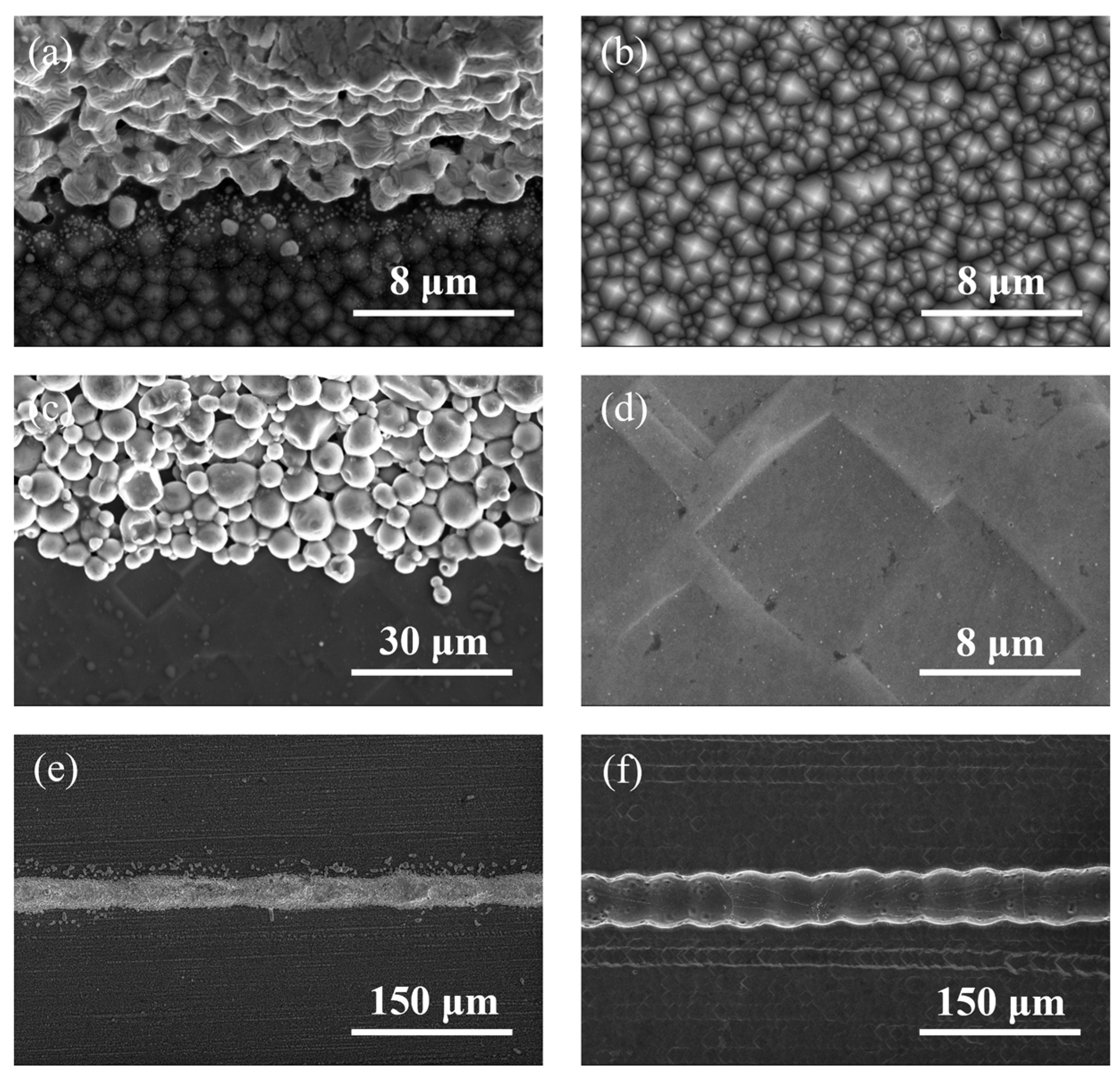
Figure 2a shows the top surface morphology of Top Con-type photovoltaic crystalline silicon waste, whose structure consists primarily of pyramid-shaped silicon, layered silver, and a dense silicon nitride layer. Figure 2b shows the TC@Si after pretreatment, with the silicon pyramid structure intact on the surface. Figure 2c shows the morphology of the bottom surface of the original sample, which is covered with spherical aluminum and aluminum oxide. Figure 2d shows that the lower surface, after pretreatment, exposes a silicon surface with a grid-like pattern. It is worth noting that the removal of the silver lines on the upper surface leaves a distinct groove; this structural feature may have a certain impact on the fluctuation of cell discharge. Figure 2e,f shows the morphology of the silver bonding strip at 150 μm before and after pretreatment.
Table 1 summarizes the elemental composition results from ICP and ONH analyses of the silicon wafers before and after pretreatment. These results demonstrate the effectiveness of the pretreatment process designed in this study in removing metallic impurities, which is crucial for enhancing the reactivity of the silicon anodes in SABs.

2.2. Discharge Properties of AB@Si and TC@Si

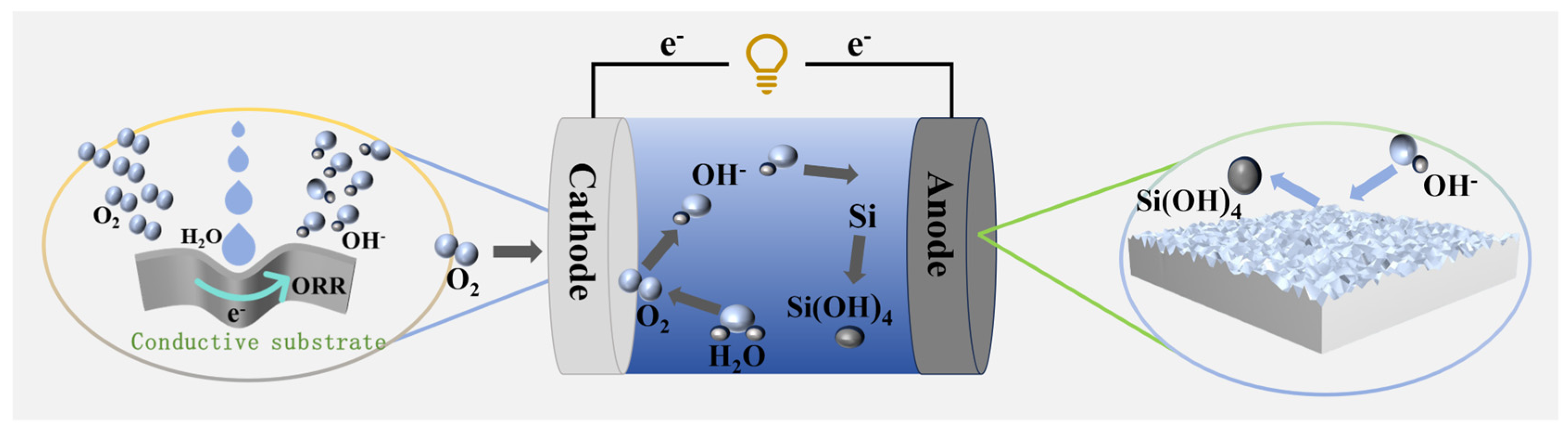
The silicon-air battery structure employs a commercially available nickel-based C/MnO2 cathode. The surface in contact with air consists of a nickel substrate coated with a carbon layer, while manganese dioxide is applied to the reaction surface as a catalyst. The physical cathode appears black on one side and a lighter blackish-gray on the other, with the manganese dioxide reaction surface appearing blackish-gray. A pretreated AB@Si material serves as the anode, and a 5 M potassium hydroxide (KOH) solution is used as the electrolyte. A schematic diagram illustrating the discharge process is shown in Figure 3. A custom-made mold was used to ensure a reaction area of 1 cm−2. The overall reaction of the battery can be expressed as:
Anode :   Si   + 4 O H S i O H 4 + 4 e   ( E 0 = 1.69   V )
Cathode :   O 2 + 2 H 2 O + 4 e 4 O H ( E 0 = 0.40   V )
Overall   reaction :   Si + O 2 + 2 H 2 O   S i O H 4 ( E 0 = 2.09   V )
Self-corrosion reactions also occur at the anode as follows:
Self - corrosion :   S i + 2 O H + 2 H 2 O S i O 2 ( O H ) 2 2 + 2 H 2
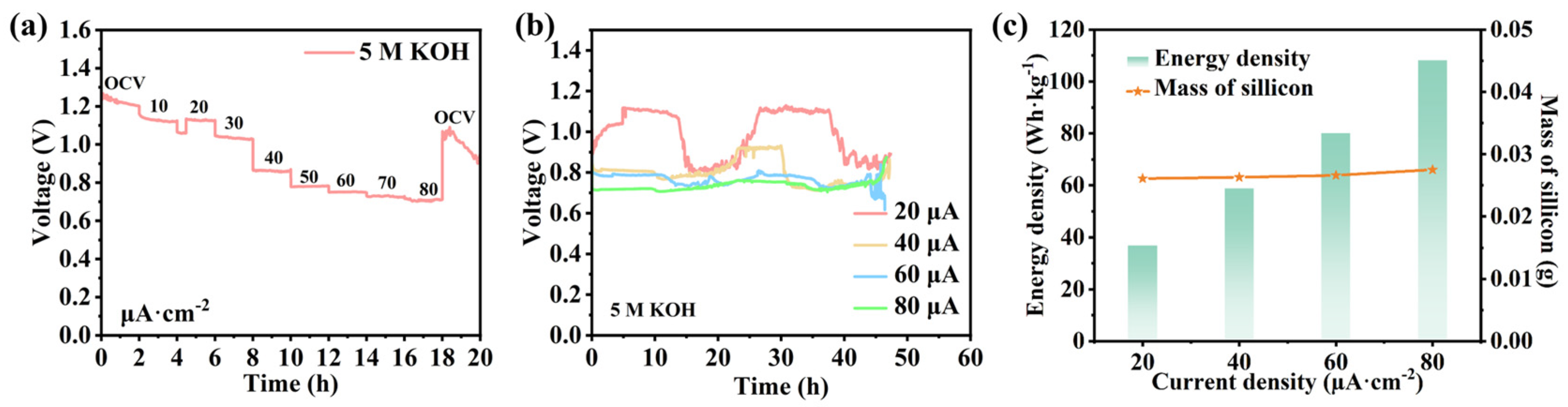
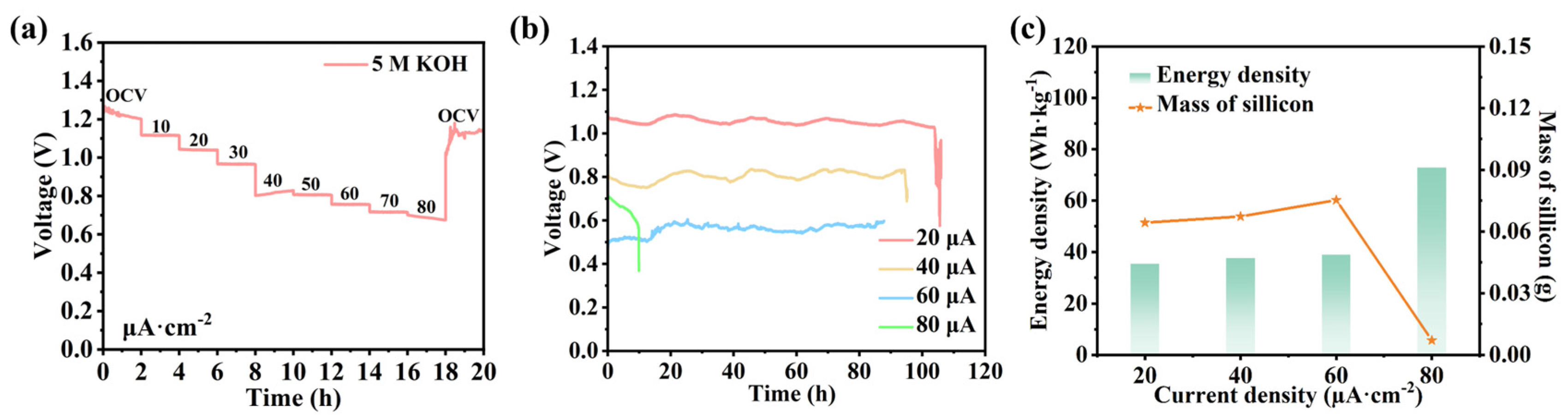
Figure 4a shows a silicon-air battery assembled with AB@Si as the anode. The cell was maintained at open-circuit voltage for 2 h to ensure thorough wetting of the electrode by the electrolyte, followed by 2 h of discharge at current densities ranging from 10 to 80 μA·cm−2, and finally returned to open-circuit voltage for another 2 h. The results show that AB@Si exhibits stable discharge performance over a wide range of current densities, with the discharge voltage gradually decreasing as the current density increases. Although the discharge duration of AB@Si decreases slightly with increasing current density, discharge stability significantly improves at higher current densities. Figure 4b shows the discharge lifetime test of AB@Si at different current densities. At a current density of 20 μA·cm−2, periodic fluctuations in the discharge voltage were observed due to the deposition of a silicon dioxide passivation layer on the AB@Si surface. Hydrogen gas generated by the hydrogen evolution reaction destroys this passivation layer, causing the surface to periodically switch between the passivated and activated states. At 80 μA·cm−2, discharge stability improves significantly. This is attributed to the enhanced hydrogen evolution reaction, which inhibits the formation of the passivation layer and keeps the AB@Si surface in an activated state [19]. Figure 4c shows the energy density calculated based on the mass loss of AB@Si before and after discharge at different current densities. The energy densities measured at current densities of 20, 40, 60, and 80 μA·cm−2 were 36.32, 58.75, 80.11, and 105.78 Wh·kg−1, respectively.
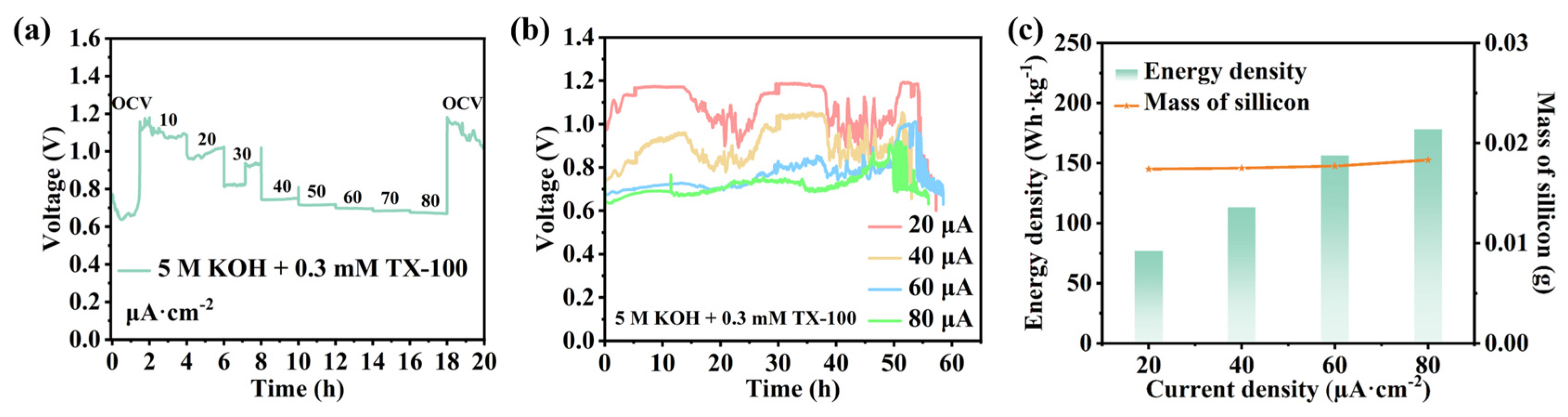
Figure 5a shows a silicon-air battery using TC@Si as the anode, which exhibits stable discharge performance across a wide range of current densities, with the discharge voltage gradually decreasing as the current density increases. Figure 5b presents discharge lifespan tests of TC@Si at different current densities, yielding discharge durations of 105.59 h, 95.09 h, 87.84 h, and 9.90 h, respectively. At 80 μA·cm−2, discharge lasted only 9.9 h. On the one hand, this is because at high current densities, the formation rate of the silicon dioxide passivation layer far exceeds the dissolution rate; the hydrogen produced by the hydrogen evolution reaction (HER) cannot affect the deposition of silicon dioxide, resulting in a dense silicon dioxide passivation layer covering the silicon surface, which hinders normal contact between the silicon and potassium hydroxide. deactivating the TC@Si surface and causing the discharge to cease. On the other hand, this is because TC@Si uses n-type silicon as the substrate with a p-type silicon top layer—the exact opposite of the AB@Si sample. This inherent difference in material composition prevents it from sustaining prolonged discharge at a current density of 80 μA·cm−2. Figure 5c shows the energy density at different current densities, which are 35.37, 37.66, 38.95, and 72.82 Wh·kg−1, respectively. Since the discharge duration at a current density of 80 μA·cm−2 is too short, the energy density at this point is not meaningful for performance evaluation. The mass conversion efficiencies for the two different samples were calculated and are shown in Table 2 and Table 3. The discharge time of TC@Si is extremely short under conditions of 80 μA·cm−2. Under these extreme conditions, sustained static chemical corrosion accounts for the dominant portion of the total mass loss, which significantly interferes with the calculation of mass conversion efficiency. Therefore, the data obtained under conditions of 80 μA·cm−2 are outliers and are not suitable for evaluating the actual electrochemical performance of the silicon anode; the mass conversion efficiency under these conditions is not representative.
Although both the AB@Si and TC@Si samples feature a pyramidal surface structure with a high specific surface area, the original intent of using this high-surface-area silicon in silicon-air batteries was to effectively mitigate the passivation of the silicon surface in KOH electrolyte by increasing the contact area between the anode and the electrolyte, thereby sustaining the electrochemical reaction. However, this high-surface-area structure also has adverse effects. While it enhances reaction activity, it inevitably intensifies side reactions between the anode and the electrolyte, primarily manifested as increased hydrogen evolution corrosion and unnecessary consumption of active material. The occurrence of these side reactions not only reduces the utilization rate of the silicon anode but also directly leads to a significant decrease in the mass conversion efficiency of the silicon-air battery. This phenomenon is highly consistent with conclusions reported in the literature, namely that silicon anodes with high specific surface areas are prone to severe chemical/electrochemical corrosion in high-concentration alkaline electrolytes. This corrosion severely limits the mass conversion efficiency of the active material, thereby affecting the overall performance of the battery. Although silicon theoretically possesses an energy density as high as 8470 Wh·kg−1, in actual battery systems, due to the aforementioned side reactions and interfacial stability issues, the current energy density remains far below this theoretical limit.

2.3. Discharge Characteristics of AB@Si and TC@Si After the Addition of TX-100

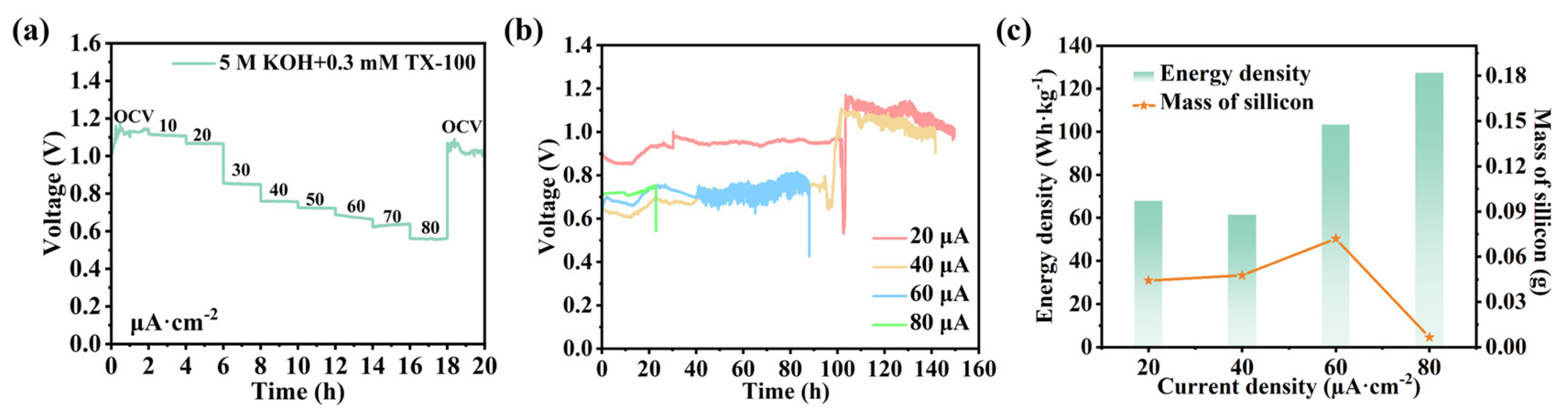
To demonstrate the effect of TX-100 on the discharge performance of the sample, discharge performance tests were conducted after mixing the additive into the potassium hydroxide (KOH) electrolyte. Prior to the discharge tests, the additive TX-100 must be thoroughly mixed with the KOH electrolyte. This was achieved by dissolving an appropriate amount of KOH granules in slightly less than 500 mL of deionized water. Separately, 0.1 g of TX-100 was dispersed in 10 mL of anhydrous ethanol and stirred at room temperature until homogeneous. The TX-100-ethanol solution was then added to the prepared potassium hydroxide solution. Magnetic stirring was performed at 500 rpm at room temperature for 1 h to ensure complete evaporation of the ethanol and uniform dispersion of TX-100. Deionized water was added during the process to bring the total volume of the solution to 500 mL, resulting in a clear, foam-free solution with a final composition of 5 M KOH + 0.3 mM TX-100. A silicon-air battery was assembled using AB@Si as the anode and 5 M KOH + 0.3 mM TX-100 as the electrolyte. Figure 6a shows the discharge curves of the battery at discharge current densities ranging from 10 to 80 μA·cm−2, with each discharge step lasting 2 h. It can be seen that the addition of TX-100 does not affect the battery’s performance across a wide range of current densities. Figure 6b shows the discharge lifespan tests of the battery at different current densities, with discharge lifespans of 57.28 h, 53.02 h, 58.50 h, and 55.93 h, respectively. Compared to the discharge curves of the battery without TX-100, the discharge lifetimes increased by 9.92 h, 5.87 h, 12.08 h, and 9.25 h, respectively. These results indicate that TX-100 can extend the discharge lifetime of AB@Si without hindering the discharge reaction. Figure 6c shows the energy density at different current densities, which increased by approximately 2.12, 1.92, 1.95, and 1.68 times, respectively, compared to the battery without TX-100.
Electrochemical performance tests were conducted on silicon-air batteries assembled using TC@Si as the anode and a 5 M KOH + 0.3 mM TX-100 solution as the electrolyte. The results in Figure 7a indicate that the introduction of TX-100 did not compromise the discharge stability of the TC@Si anode at different current densities; the battery still maintained a stable discharge plateau, suggesting that this additive does not significantly interfere with the initial discharge process of the electrode. Figure 7b shows that, compared to the control group without TX-100, although the discharge stability of the battery at different current densities decreased slightly after adding TX-100, the discharge lifespan was extended to varying degrees. Compared to the battery without TX-100, the discharge lifespans were extended by 43.97 h, 46.50 h, 0.20 h, and 13.04 h, respectively. This indicates that TX-100 can effectively delay the failure process of the TC@Si anode without interfering with the normal discharge reaction, and its effect on extending discharge life is particularly significant under low current densities of 20 and 40 μA·cm−2. Figure 7c shows the energy density at different current densities, which increased by approximately 1.92-fold, 1.63-fold, 2.65-fold, and 1.75-fold, respectively, compared to the battery without TX-100. As an electrolyte additive, TX-100 can effectively extend the discharge life of the TC@Si anode in alkaline systems by suppressing side reactions or regulating interfacial behavior, without interfering with the discharge process. It demonstrates particularly significant optimization effects at low current densities, providing a viable strategy for enhancing the practical performance of silicon-air batteries.
Combining the discharge performance data of AB@Si and TC@Si in a 5 M KOH + 0.3 mM TX-100 solution, the mass conversion efficiencies for the different samples were calculated, as shown in Table 4 and Table 5. The corrosion of silicon anodes in silicon-air batteries is divided into chemical corrosion and electrochemical corrosion. Chemical corrosion persists throughout the entire test once the silicon anode comes into contact with KOH electrolyte, while electrochemical corrosion only takes place during the discharge process. At the high current density of 80 μA·cm−2, TC@Si delivers an extremely short discharge lifespan. In this scenario, mass loss induced by long-term static chemical corrosion accounts for a dominant proportion and cannot be neglected. Such extra chemical corrosion interferes with data calculation, thereby causing the abnormal mass conversion efficiency of 7.37% presented in Table 5. As discussed above, the electrochemical performance at 80 μA·cm−2 is atypical and offers no practical reference significance. Consequently, the maximum effective mass conversion efficiency of TX-100 modified TC@Si is confirmed to be 3.09%.

2.4. Changes Before and After Adding TX-100

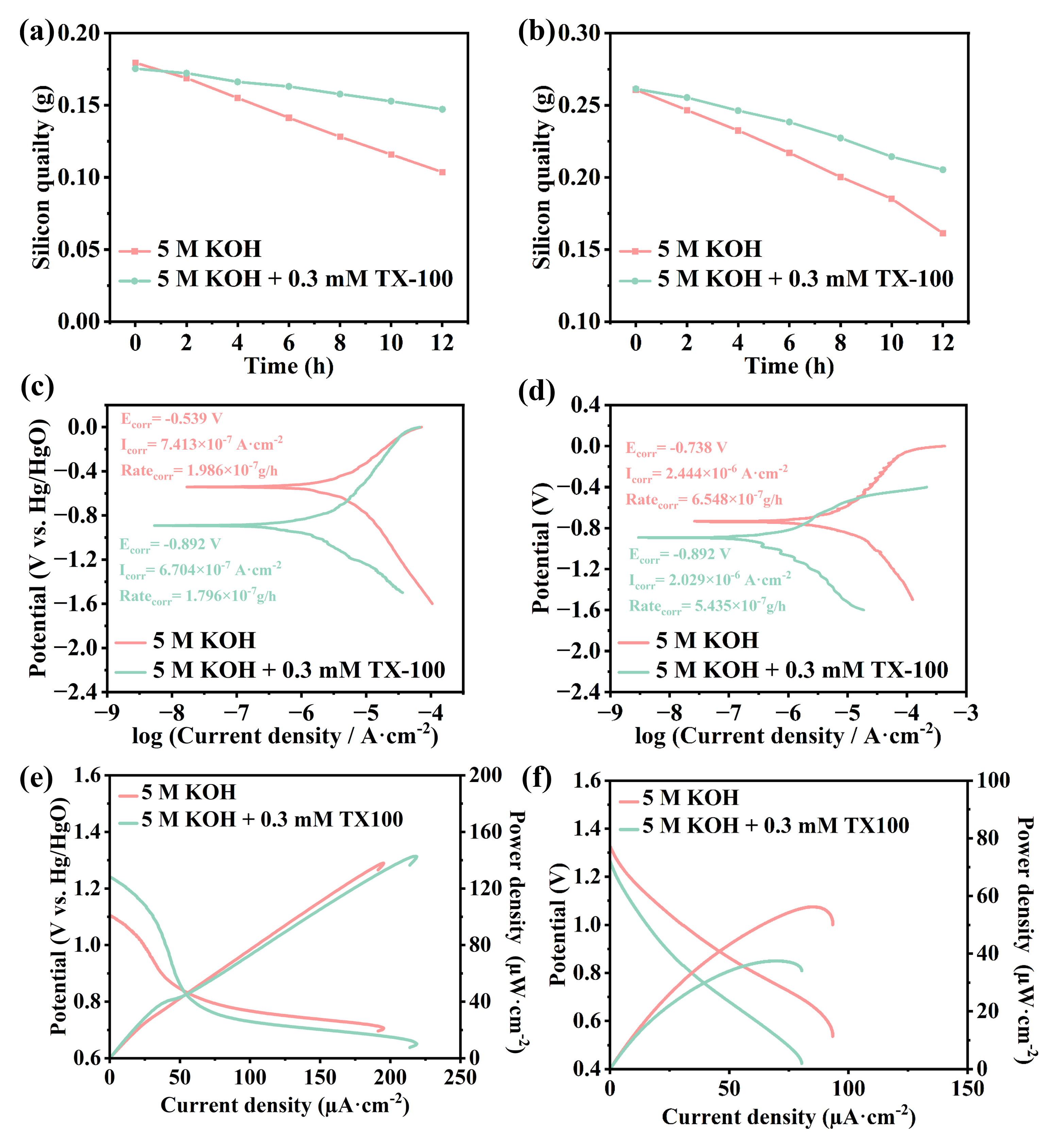
To systematically evaluate the chemical corrosion behavior of different silicon-based anode materials in an alkaline environment, AB@Si and TC@Si samples were selected in this study. After being cut to similar geometric dimensions, each was immersed in 20 mL of one of two electrolytes: a group in pure 5 M KOH solution and another group in 5 M KOH solution supplemented with 0.3 mM TX-100. The samples were removed every 2 h, washed, dried, and weighed to record the change in mass over time, as shown in Figure 8a,b. Both AB@Si and TC@Si exhibited significantly reduced mass loss in the KOH electrolyte containing TX-100.
To further evaluate the effect of TX-100 addition on the electrochemical corrosion behavior of different silicon-based anode materials, the built-in analysis program of the electrochemical workstation was used to extract the corrosion current density and corresponding electrochemical corrosion rate of AB@Si and TC@Si samples in 5 M KOH electrolyte containing 0.3 mM TX-100 from the potentiodynamic polarization curves in Figure 8c,d. The results are summarized in Table 6. The electrochemical corrosion rate of AB@Si decreased from 1.986 × 10⁻⁷ g/h to 1.796 × 10⁻⁷ g/h, while that of TC@Si decreased from 6.548 × 10⁻⁷ g/h to 5.435 × 10⁻⁷ g/h, showing different degrees of reduction. These results are generally consistent with the trends observed in the mass loss experiments, confirming that TX-100 can effectively inhibit the chemical corrosion of silicon anodes in alkaline media through interfacial adsorption. It is worth noting that even after the addition of TX-100, the electrochemical corrosion rate obtained from the potential-kinetic polarization curves remains significantly lower than the total corrosion rate derived from the discharge life tests. The total corrosion rate includes both chemical dissolution and electrochemical corrosion, indicating that during the actual operation of silicon–air batteries, the chemical dissolution mechanism still plays a dominant role. Although the contribution of electrochemical corrosion to the total corrosion rate is reduced, it remains at a relatively low level, accounting for approximately 3–5% of the total corrosion rate.
To evaluate the discharge performance of different silicon-based anode materials in alkaline electrolytes, LSV curves of the AB@Si and TC@Si samples were measured before and after the addition of TX-100. The results are shown in Figure 8e,f. The test results for AB@Si show that as the current density increased from 0 to 200 µA·cm−2, the discharge potential of the sample exhibited a steady downward trend, with an open-circuit potential of approximately 1.10 V, eventually dropping to around 0.69 V. After adding TX-100, the discharge voltage exhibited a trend of first rising and then falling compared to the untreated sample. The discharge current range of the TC@Si sample is relatively narrow. As the current density increases from 0 to 95 µA·cm−2, the discharge potential gradually decreases from an open-circuit potential of approximately 1.31 V to around 0.55 V, with a generally stable downward trend. After adding TX-100, the discharge voltage exhibited a downward trend compared to the untreated sample. This also explains why TC@Si cannot discharge stably for an extended period at a current density of 80 µA·cm−2. Regarding power density data, after adding TX-100, both samples maintained stable power output, though there were some differences in power performance between the materials. Specifically, AB@Si exhibited a relatively higher peak power density under TX-100-containing conditions, while the power density of TC@Si also remained stable after the addition of TX-100.
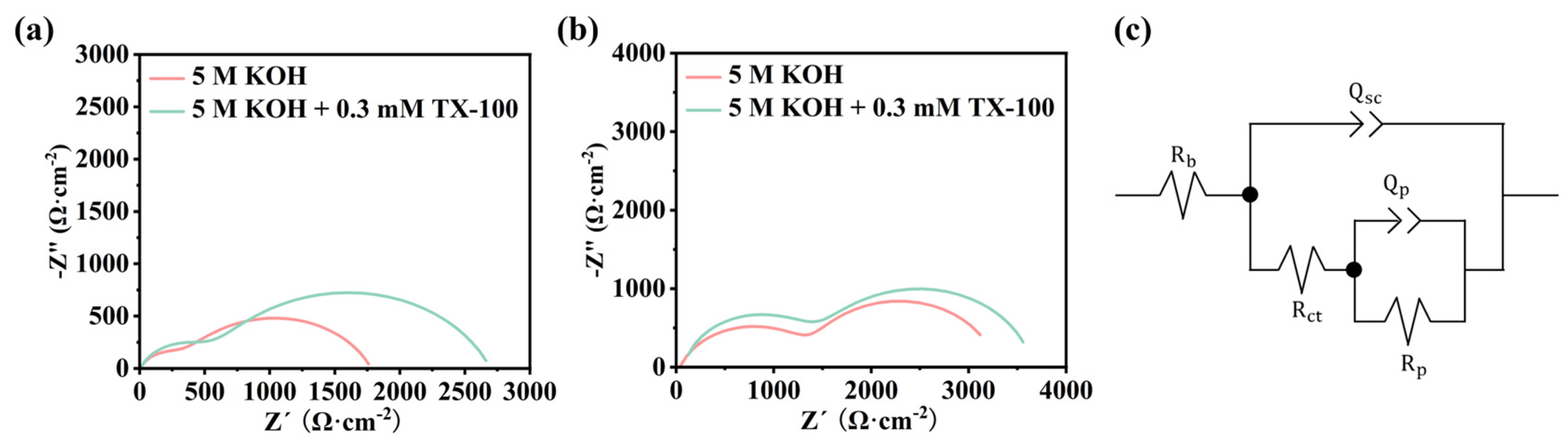
To investigate the interfacial behavior of different silicon materials in the electrolyte, electrochemical impedance spectroscopy (EIS) tests were conducted on the AB@Si and TC@Si samples. The test results are shown in Figure 9a,b. As can be seen from the figures, the EIS plots of the samples consist of two semicircles, located in the high-frequency and low-frequency regions, respectively. The semicircle in the high-frequency region primarily reflects the charge transfer resistance and the space charge layer capacitance, which are related to the electrochemical reaction processes occurring on the silicon electrode surface; the semicircle in the low-frequency region corresponds to the capacitance and resistance generated by the porous layer, which may be related to the pyramidal structure or corrosion morphology on the sample surface [29,30,31]. The intercept of the high-frequency region with the real axis in the spectra represents the sum of the uncompensated resistances, including electrolyte resistance, semiconductor bulk resistance, and contact resistance; here, contact resistance primarily refers to the electrical resistance between the silicon anode and the current collector. From a material comparison perspective, the type of silicon material has a significant impact on the impedance spectra. Compared to AB@Si, TC@Si exhibits a higher total impedance, indicating greater interfacial reaction resistance. After the addition of TX-100, the total impedance of both samples increased; this is likely due to the adsorption of TX-100 on the electrode surface, which increased the resistance of the interfacial layer.
To conduct a more in-depth analysis of the differences in the interface between various types of silicon anodes and the electrolyte, we established an equivalent circuit model to fit the impedance data, thereby quantitatively analyzing each impedance component. The results are shown in Figure 9c. This equivalent circuit consists of a resistor connected in series with two RC units, where the first RC unit (a resistor and a capacitor in parallel) is connected in parallel with the second RC unit. This circuit structure is based on the model used by Cohn et al. [31] in their study. To more accurately fit the experimental data, the ideal capacitive element in the circuit was replaced with a capacitive equivalent element (CPE). This is because the surface of silicon anodes is typically rough, and the samples used in the experiment have a pyramidal structure with porous characteristics; if a pure capacitive element based on an ideal plane were used directly, the fitting results would not match the actual measured data. The circuit components are as follows: Rb represents ohmic resistance (solution resistance, semiconductor resistance, and contact resistance between the current collector and the silicon anode); Rct represents charge transfer resistance; Qsc represents the constant-phase element (CPE), denoting the space charge layer capacitance; Rp represents the resistance generated by the porous layer; and Qp represents the capacitance generated by the porous layer.
The equivalent circuit model and experimental data were fitted using the nonlinear least-squares fitting software Zview v.40h, yielding the parameters for each equivalent circuit. The specific values are listed in Table 7. Theoretically, since the electrolyte is the same, the solution resistance should remain constant. However, in actual testing, the ohmic resistance values showed some variation, ranging from a minimum of 6.67 Ω·cm2 to a maximum of 40.23 Ω·cm2. There are several possible reasons for this variation: first, differences in the thickness of the electrode material and current collector can affect the ohmic resistance; second, variations in room temperature may also introduce errors.
The space charge layer capacitance Qsc is related to the doping type and concentration of the electrode material, with fitted values ranging from 0.63 to 219.6 nS·s−2·cm−2. As shown in the table, the exponent Qp of TC@Si is very close to 1, indicating that the constant phase angle element (CPE) of the TC@Si anode exhibits good capacitive behavior. When Qp ≈ 1, it can be inferred that the space charge region is relatively flat, similar to the behavior of a parallel-plate capacitor; the value of Qp is typically no greater than 1. The charge transfer resistance (Rct) reflects the ease with which charges traverse the interface between the electrode and the electrolyte during the electrode reaction. Since silicon is a semiconductor material, its charge transfer resistance is closely related to the carrier concentration of the material itself. Without the addition of TX-100, the charge transfer resistance of the samples was ranked as follows: TC@Si was the highest, and AB@Si was the lowest. After adding TX-100, the charge transfer resistance of both AB@Si and TC@Si increased.

2.5. Investigation of the Mechanism of Action of TX-100

To investigate the mechanism of action of TX-100, contact angle measurements and DFT calculations of adsorption energy were performed. Samples of similar dimensions were immersed in 20 mL of 5 M KOH solution and 5 M KOH solution containing 0.3 mM TX-100, respectively, for 3, 6, and 12 h. After soaking, the samples were dried in a vacuum oven at 70 °C for 3 h, followed by contact angle measurements. The results are shown in Table 8.
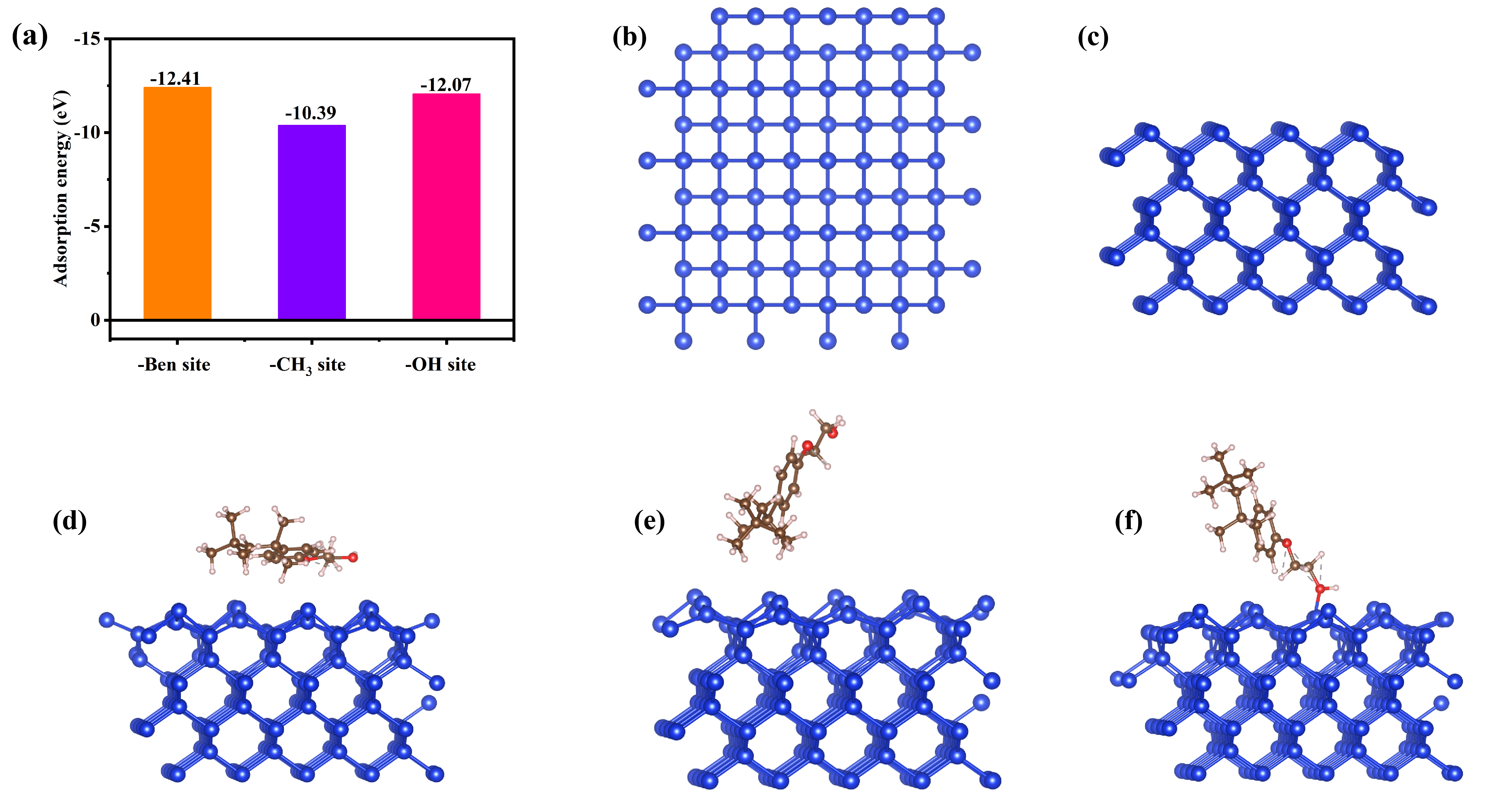
As the discharge of AB@Si and TC@Si proceeds, the pyramid structure gradually dissolves, exposing the Si(100) surface. To reduce computational load, only the adsorption energy of TX-100 on the Si(100) surface was considered [32,33,34,35]. The adsorption of three sites of the TX-100 molecule on the Si(100) surface was calculated; a more negative adsorption energy indicates stronger adsorption. The calculation results are shown in Figure 10. These results indicate that the long-chain TX-100 molecules adsorb onto the silicon surface, altering the hydrophilicity of AB@Si and TC@Si, reducing the interaction between silicon and water, and slowing down the self-corrosion of the silicon surface. The contact sites of Triton X-100 on the silicon surface are the phenyl ring groups or OH groups.

3. Experiment

3.1. Sample Preparation

The Al-Bsf and Top Con type retired crystalline silicon photovoltaic cells selected for this study typically consist of a silicon substrate, silver interconnects, a silicon nitride anti-reflective layer, and an aluminum back field [36]. During the manufacturing process of solar cells, to reduce light reflection losses, a pyramid-shaped textured surface is often created on the upper surface through anisotropic etching of silicon, and a dense silicon nitride layer is formed using chemical vapor deposition (CVD), thereby providing the upper surface with a large specific surface area. Therefore, using this surface as the reaction surface for silicon-air batteries is more conducive to improving cell performance. When such materials are applied to silicon-air batteries, the dense silicon nitride layer on the upper surface is difficult to dissolve in alkaline electrolytes at room temperature. This hinders effective contact between the silicon substrate and the electrolyte, preventing the battery reaction from proceeding normally. Additionally, the silver electrode lines on the surface trigger additional side reactions, causing significant fluctuations in the discharge curve. Meanwhile, the aluminum backfield and its oxides on the lower surface exhibit a spherical structure, which hinders the current collection efficiency of the current collector. Before using retired crystalline silicon waste as anode material for silicon-air batteries, it is necessary to remove impurities such as the silicon nitride layer, silver electrodes, aluminum backfield, and their oxides. To address this impurity removal requirement, this study designed a one-step treatment process using Al-Bsf and TopCon solar cells recovered from retired photovoltaic modules, which were cut into approximately 2 cm × 2 cm pieces. Under ultrasonic conditions, the cells were washed with 5–6% HF, ethanol, and deionized water for 20 min, 10 min, and 10 min, respectively, effectively removing the silver lines, silicon dioxide, and silicon nitride from the front surface. Simultaneously, the aluminum and aluminum oxides on the back surface were also removed, yielding AB@Si and TC@Si with exposed, smooth pyramidal structures.

3.2. Characterization

The surface morphology of retired photovoltaic crystalline silicon before and after pretreatment was obtained using a scanning electron microscope (SEM, Apreo 2C, Thermo Fisher Scientific, Waltham, MA, USA), and the differences in elemental composition before and after pretreatment were determined using an energy-dispersive spectrometer (EDS) (Thermo Fisher Scientific, Waltham, MA, USA). In the experiment, the silicon material was prepared into silicon electrodes, and half-cell and full-cell systems were constructed for electrochemical testing. In the half-cell tests, the electrochemical performance of the silicon electrodes was analyzed using Tafel plots (TP), linear sweep voltammetry (LSV), and electrochemical impedance spectroscopy (EIS) to obtain information on half-cell potential and current responses, as well as corrosion and passivation mechanisms. In whole-cell testing, a silicon-air cell was assembled using a silicon anode, electrolyte, and air cathode, and constant-current discharge experiments were conducted. Optimal discharge conditions were determined through analysis of the discharge curves. The equipment used for these electrochemical performance tests included an electrochemical workstation for half-cell testing and a battery charge–discharge testing system for whole-cell testing. Cell discharge was conducted at room temperature in air, with the electrodes connected as follows: the silicon anode was connected to the black electrode clamp of the testing equipment, and the air cathode was connected to the red electrode clamp. During the discharge test, the test is terminated when the discharge voltage drops sharply and linearly, and subsequent discharge voltages fail to recover to values near the original level. The mechanism of action of the additives was investigated through contact angle measurements and DFT calculations of adsorption energies.

4. Conclusions

In this work, retired photovoltaic crystalline silicon was used as the anode for silicon–air batteries to investigate the electrochemical performance of the cells. To address the issue of severe chemical corrosion that leads to low mass conversion efficiency, TX-100 was introduced into the KOH electrolyte to suppress the chemical corrosion of the samples. The electrochemical performance before and after the addition of TX-100 was compared, and the mechanism by which TX-100 inhibits the chemical corrosion of silicon was explored. The main conclusions are as follows:
(1) A one-step pretreatment process was designed to effectively remove metallic impurities and the silicon nitride layer from the surface of two types of retired crystalline silicon waste, namely Al-Bsf and Top Con. The resulting anode samples, denoted as AB@Si and TC@Si, both exhibited a silicon pyramidal texture on the reaction surface, which provided a large specific surface area and demonstrated good anti-passivation performance.
(2) After the addition of TX-100 to the KOH electrolyte, both the discharge lifetime and the energy density of the two samples increased, while the discharge voltage and open-circuit voltage were not significantly affected. TX-100 effectively prolonged the discharge lifetime at low current densities, reduced mass loss, and improved the mass conversion efficiency of the samples. The mass conversion efficiency increased by 6.39% for AB@Si and by 3.09% for TC@Si.
(3) Even under zero-current conditions, TX-100 suppressed chemical corrosion and reduced mass loss. TX-100 adsorbs onto the silicon surface through its benzene ring or hydroxyl groups, reducing the hydrophilicity and retarding the self-corrosion process of silicon. This allows more silicon to be preserved and to participate in the discharge, thereby enhancing the discharge lifetime and mass conversion efficiency of the battery.

Author Contributions

Conceptualization, T.G.; Methodology, T.G.; Formal analysis, F.X.; Investigation, T.G.; Writing—review and editing, T.G.; Supervision, S.L., X.L. and J.Y.; Funding acquisition, J.Y. All authors have read and agreed to the published version of the manuscript.

Funding

This research was funded by the National Natural Science Foundation of China (No. 52264056).

Institutional Review Board Statement

Not applicable.

Informed Consent Statement

Not applicable.

Data Availability Statement

The original contributions presented in this study are included in the article. Further inquiries can be directed to the corresponding author.

Conflicts of Interest

The authors declare that the research was conducted in the absence of any commercial or financial relationships that could be construed as a potential conflict of interest.

References

  1. Oteng, D.; Zuo, J.; Sharifi, E. A scientometric review of trends in solar photovoltaic waste management research. Sol. Energy 2021, 224, 545–562. [Google Scholar] [CrossRef]
  2. Peters, I.M.; Hauch, J.; Brabec, C. Cradle-to-cradle recycling in terawatt photovoltaics: A vision of perpetual utility. Joule 2024, 8, 899–912. [Google Scholar] [CrossRef]
  3. Yang, X.; Zhang, D.; Zhao, L.; Peng, C.; Ren, K.; Xu, C.; Liu, P.; Zhou, Y.; Lei, Y.; Yang, B.; et al. Upgrading Cycling Stability and Capability of Hybrid Na-CO2 Batteries via Tailoring Reaction Environment for Efficient Conversion CO2 to HCOOH. Adv. Energy Mater. 2024, 14, 2304365. [Google Scholar] [CrossRef]
  4. Singh, S.; Powar, S.; Dhar, A. End of life management of crystalline silicon and cadmium telluride photovoltaic modules utilising life cycle assessment. Resour. Conserv. Recycl. 2023, 197, 107097. [Google Scholar] [CrossRef]
  5. Atyaoui, M.; Atyaoui, A.; Khalifa, M.; Elyagoubi, J.; Dimassi, W.; Ezzaouia, H. Enhancement in photovoltaic properties of silicon solar cells by surface plasmon effect of palladium nanoparticles. Superlattices Microstruct. 2016, 92, 217–223. [Google Scholar] [CrossRef]
  6. Xie, M.; Ruan, J.; Bai, W.; Qiao, Q.; Bai, L.; Zhang, J.; Li, H.; Lv, F.; Fu, H. Pollutant payback time and environmental impact of Chinese multi-crystalline photovoltaic production based on life cycle assessment. J. Clean. Prod. 2018, 184, 648–659. [Google Scholar] [CrossRef]
  7. Wang, J.-P.; Lee, D.-H.; Go, M.-S.; So, E.-K. A study on the wet process conditions that affect the selective recovery of Si from photovoltaic cells by using the cavitation effect. Metals 2022, 12, 222. [Google Scholar] [CrossRef]
  8. Mahmoudi, S.; Huda, N.; Behnia, M. Environmental impacts and economic feasibility of end of life photovoltaic panels in Australia: A comprehensive assessment. J. Clean. Prod. 2020, 260, 120996. [Google Scholar] [CrossRef]
  9. Corcelli, F.; Ripa, M.; Leccisi, E.; Cigolotti, V.; Fiandra, V.; Graditi, G.; Sannino, L.; Tammaro, M.; Ulgiati, S. Sustainable urban electricity supply chain–Indicators of material recovery and energy savings from crystalline silicon photovoltaic panels end-of-life. Ecol. Indic. 2018, 94, 37–51. [Google Scholar] [CrossRef]
  10. Prasad, D.; Sanjana, B.; Kiran, D.S.; Kumar, P.S.; Ratheesh, R. A unique sustainable chemical method for the recovery of pure silicon from waste crystalline silicon solar panels. Sustain. Mater. Technol. 2023, 37, e00671. [Google Scholar] [CrossRef]
  11. Marcuzzo, R.; De Araujo, W.C.; Maldonado, M.U.; Vaz, C.R. A multi-country simulation-based study for end-of-life solar PV panel destination estimations. Sustain. Prod. Consum. 2022, 33, 531–542. [Google Scholar] [CrossRef]
  12. Xu, L.; Zhang, S.; Yang, M.; Li, W.; Xu, J. Environmental effects of China’s solar photovoltaic industry during 2011–2016: A life cycle assessment approach. J. Clean. Prod. 2018, 170, 310–329. [Google Scholar] [CrossRef]
  13. Pu, Y.; Wang, P.; Wang, Y.; Qiao, W.; Wang, L.; Zhang, Y. Environmental effects evaluation of photovoltaic power industry in China on life cycle assessment. J. Clean. Prod. 2021, 278, 123993. [Google Scholar] [CrossRef]
  14. Wang, L.; Wang, Z.; Wu, J.; Zhang, B.; Yu, J.; Li, J. Synergistic mechanochemical activation and carbon-thermal shock for full-component upcycling of retired photovoltaic modules. Resour. Conserv. Recycl. 2026, 228, 108822. [Google Scholar] [CrossRef]
  15. Weinrich, H.; Durmus, Y.E.; Tempel, H.; Kungl, H.; Eichel, R.-A. Silicon and iron as resource-efficient anode materials for ambient-temperature metal-air batteries: A review. Materials 2019, 12, 2134. [Google Scholar] [CrossRef]
  16. Yu, Y.; Gao, S.; Hu, S. Si modified by Zn and Fe as anodes in Si-air batteries with ameliorative properties. J. Alloys Compd. 2021, 883, 160902. [Google Scholar] [CrossRef]
  17. Durmus, Y.E.; Roitzheim, C.; Tempel, H.; Hausen, F.; Ein-Eli, Y.; Kungl, H.; Eichel, R.-A. Analysis on discharge behavior and performance of As-and B-doped silicon anodes in non-aqueous Si–air batteries under pulsed discharge operation. J. Appl. Electrochem. 2020, 50, 93–109. [Google Scholar] [CrossRef]
  18. Yan, R.; Wang, J.; He, S.; Huang, L.; Wang, B.; Zhu, M.; Hu, S. Quasi-solid-state silicon-air batteries with high capacities and wide-temperature adaptabilities. Energy Storage Mater. 2024, 71, 103656. [Google Scholar] [CrossRef]
  19. Chen, D.; Li, Y.; Zhang, X.; Hu, S.; Yu, Y. Investigation of the discharging behaviors of different doped silicon nanowires in alkaline Si-air batteries. J. Ind. Eng. Chem. 2022, 112, 271–278. [Google Scholar] [CrossRef]
  20. Park, D.-W.; Kim, S.; Ocon, J.D.; Abrenica, G.H.A.; Lee, J.K.; Lee, J. Controlled electrochemical etching of nanoporous Si anodes and its discharge behavior in alkaline Si–air batteries. ACS Appl. Mater. Interfaces 2015, 7, 3126–3132. [Google Scholar] [CrossRef] [PubMed]
  21. Chen, D.; Zhang, X.; Zhang, Y.; Liu, Z.; Deng, F.; Yu, Y. Si protected by metal-organic segments as anodes in Si-air batteries. Surf. Interfaces 2023, 38, 102777. [Google Scholar] [CrossRef]
  22. Wang, D.; Zhao, T.; Yu, Y. In/Ga-Doped Si as anodes for Si–Air Batteries with restrained self-corrosion and surface passivation: A first-principles study. Molecules 2023, 28, 3784. [Google Scholar] [CrossRef]
  23. Yu, Y.; Hu, S.; Huang, J. Germanium-modified silicon as anodes in Si–Ge air batteries with enhanced properties. J. Phys. Chem. Solids 2021, 157, 110226. [Google Scholar] [CrossRef]
  24. Sun, Y.; Yu, J.; Yang, W.; Li, D.; Chen, F.; Li, S.; Yang, S. Optimization of the discharge performance of silicon–air batteries by aluminum doping. J. Mater. Sci. Mater. Electron. 2024, 35, 265. [Google Scholar] [CrossRef]
  25. Han, C.; Li, W.; Liu, H.K.; Dou, S.; Wang, J. Principals and strategies for constructing a highly reversible zinc metal anode in aqueous batteries. Nano Energy 2020, 74, 104880. [Google Scholar] [CrossRef]
  26. Chen, X.; Liu, X.; Le, Q.; Zhang, M.; Liu, M.; Atrens, A. A comprehensive review of the development of magnesium anodes for primary batteries. J. Mater. Chem. A 2021, 9, 12367–12399. [Google Scholar] [CrossRef]
  27. Luo, L.; Zhu, C.; Yan, L.; Guo, L.; Zhou, Y.; Xiang, B. Synergistic construction of bifunctional interface film on anode via a novel hybrid additive for enhanced alkaline Al-air battery performance. Chem. Eng. J. 2022, 450, 138175. [Google Scholar] [CrossRef]
  28. Wang, H.; Tan, R.; Yang, Z.; Feng, Y.; Duan, X.; Ma, J. Stabilization perspective on metal anodes for aqueous batteries. Adv. Energy Mater. 2021, 11, 2000962. [Google Scholar] [CrossRef]
  29. Mirzaeian, M.; Hall, P.J. Characterizing capacity loss of lithium oxygen batteries by impedance spectroscopy. J. Power Sources 2010, 195, 6817–6824. [Google Scholar] [CrossRef]
  30. Arai, H.; Müller, S.; Haas, O. AC impedance analysis of bifunctional air electrodes for metal-air batteries. J. Electrochem. Soc. 2000, 147, 3584–3591. [Google Scholar] [CrossRef]
  31. Cohn, G.; Eichel, R.A.; Ein-Eli, Y. New insight into the discharge mechanism of silicon–air batteries using electrochemical impedance spectroscopy. Phys. Chem. Chem. Phys. 2013, 15, 3256–3263. [Google Scholar] [CrossRef] [PubMed]
  32. Kresse, G.; Furthmüller, J. Efficient iterative schemes for ab initio total-energy calculations using a plane-wave basis set. Phys. Rev. B 1996, 54, 11169. [Google Scholar] [CrossRef] [PubMed]
  33. Perdew, J.P.; Burke, K.; Ernzerhof, M. Generalized gradient approximation made simple. Phys. Rev. Lett. 1996, 77, 3865. [Google Scholar] [CrossRef] [PubMed]
  34. Hammer, B.; Hansen, L.B.; Nørskov, J.K. Improved adsorption energetics within density-functional theory using revised Perdew-Burke-Ernzerhof functionals. Phys. Rev. B 1999, 59, 7413. [Google Scholar] [CrossRef]
  35. Grimme, S. Semiempirical GGA-type density functional constructed with a long-range dispersion correction. J. Comput. Chem. 2006, 27, 1787–1799. [Google Scholar] [CrossRef] [PubMed]
  36. Yu, Y.; Li, S.; Lu, J.; Xi, F.; Chen, X.; Wu, D.; Ma, W.; Deng, R. Green recycling of end-of-life photovoltaic modules via Deep-Eutectic solvents. Chem. Eng. J. 2024, 499, 155933. [Google Scholar] [CrossRef]
Figure 1. Scanning electron microscope images of Al-Bsf and AB@Si. (a) Front view of Al-Bsf. (b) Back view of Al-Bsf. (c) Front view of AB@Si. (d) Back view of AB@Si.
Inorganics 14 00135 g001
Figure 2. Scanning electron microscope images of Top Con and TC@Si. (a) Close-up of the front of Top Con. (b) Close-up of the front of TC@Si. (c) Back of Top Con. (d) Back of TC@Si. (e) Panoramic view of the front of Top Con. (f) Panoramic view of the front of TC@Si.
Inorganics 14 00135 g002
Figure 3. Schematic diagram of the discharge process.
Inorganics 14 00135 g003
Figure 4. Discharge performance of AB@Si using a 5 M KOH electrolyte. (a) Discharge voltage curves over a current density range of 10 to 80 μA·cm−2, with each step lasting 2 h. (b) Limit discharge curves at current densities of 20, 40, 60, and 80 μA·cm−2. (c) Curves showing the relationship between energy density and mass loss as a function of current density during discharge.
Inorganics 14 00135 g004
Figure 5. Discharge performance of TC@Si using a 5 M KOH electrolyte. (a) Discharge voltage curves over a current density range of 10 to 80 μA·cm−2, with each step lasting 2 h. (b) Limit discharge curves at current densities of 20, 40, 60, and 80 μA·cm−2. (c) Curves showing the relationship between energy density and mass loss as a function of current density during discharge.
Inorganics 14 00135 g005
Figure 6. Discharge performance of AB@Si using a 5 M KOH + 0.3 mM TX-100 electrolyte. (a) Discharge voltage curves over a current density range of 10 to 80 μA·cm−2, with 2 h intervals. (b) Limit discharge curves at current densities of 20, 40, 60, and 80 μA·cm−2. (c) Curves showing the relationship between energy density and mass loss versus current density during discharge.
Inorganics 14 00135 g006
Figure 7. Discharge performance of TC@Si using a 5 M KOH + 0.3 mM TX-100 electrolyte. (a) Discharge voltage curves over a current density range of 10 to 80 μA·cm−2, with 2 h intervals. (b) Limit discharge curves at current densities of 20, 40, 60, and 80 μA·cm−2. (c) Curves showing the relationship between energy density and mass loss versus current density during discharge.
Inorganics 14 00135 g007
Figure 8. Mass loss, TP curves, and LSV curves of AB@Si and TC@Si under no-current conditions before and after the addition of TX-100. (a) Mass loss of AB@Si. (b) Mass loss of TC@Si. (c) TP curve of AB@Si. (d) TP curve of TC@Si. (e) LSV curve of AB@Si. (f) LSV curve of TC@Si.
Inorganics 14 00135 g008
Figure 9. EIS curves and equivalent circuit diagrams before and after the addition of TX-100. (a) EIS of AB@Si. (b) EIS of TC@Si. (c) Equivalent circuit diagram.
Inorganics 14 00135 g009
Figure 10. Adsorption energy of TX-100 on the Si(100) surface. (a) Calculated adsorption energy. (b) Top view of Si(100). (c) Side view of Si(100). (d) Ben site. (e) CH3 site. (f) OH site.
Inorganics 14 00135 g010
Table 1. Elemental analysis data before and after sample pretreatment.
SampleAg/wt.%N/wt.%Al/wt.%
Al-Bsf0.560.02310.65
AB@Si0.00110.00190.0091
Top Con0.780.063/
TC@Si0.00120.0021/
Table 2. Corrosion mass and anode mass conversion efficiency of AB@Si in 5 M KOH solution at different current densities.
Discharge Current Density/μA·cm−2Corrosion Quality/mgAnode Mass Conversion Efficiency/%
2026.10.95
4026.31.87
6026.62.73
8027.53.55
Table 3. Corrosion mass and anode mass conversion efficiency of TC@Si in 5 M KOH solution at different current densities.
Discharge Current Density/μA·cm−2Corrosion Quality/mgAnode Mass Conversion Efficiency/%
2064.30.86
4067.31.50
6075.31.83
807.12.91 (×)
Table 4. Corrosion mass and anode mass conversion efficiency of AB@Si in 5 M KOH + 0.3 mM TX-100 solution at different current densities.
Discharge Current Density/μA·cm−2Corrosion Quality/mgNode Mass Conversion Efficiency/%
2017.41.71
4017.53.17
6017.75.18
8018.36.39
Table 5. Corrosion mass and anode mass conversion efficiency of TC@Si in 5 M KOH + 0.3 mM TX-100 solution at different current densities.
Discharge Current Density/μA·cm−2Corrosion Quality/mgNode Mass Conversion Efficiency/%
2044.21.77
4047.63.09
6071.91.92
806.57.37 (×)
Table 6. Corrosion current density and corrosion rate of AB@Si and TC@Si before and after the addition of TX-100.
Anode Types and the Electrolyte UsedCorrosion Current Density (A·cm−2)Corrosion Rate (g/h)
AB@Si7.413 × 10−71.986 × 10⁻⁷
AB@Si (TX-100)6.704 × 10−71.796 × 10−7
TC@Si2.444 × 10−66.548 × 10⁻⁷
TC@Si (TX-100)2.029 × 10−65.435 × 10−7
Table 7. Equivalent circuit parameters of AB@Si and TC@Si before and after the addition of TX-100.
AB@SiAB@Si
(TX-100)
TC@SiTC@Si
(TX-100)
Rs (Ω·cm−2)6.677.8139.6940.23
Qsc-Q (nS·sn·cm−2)0.0710.06371.69219.6
Qsc-n0.790.790.780.85
Rct (Ω·cm−2)40863814641636
Qp-Q (µS·sn·cm−2)0.570.9517.4725.72
Qp-n0.730.740.910.92
Rp (Ω·cm−2)1365205117842060
Table 8. Changes in contact angle for AB@Si and TC@Si after immersion in 5 M KOH solution and 5 M KOH + 0.3 mM TX-100 solution.
3 h (°)6 h (°)12 h (°)
AB@Si6.711.212.7
AB@Si (TX-100)6.611.320.2
TC@Si5.811.513.2
TC@Si (TX-100)5.918.432.3
Disclaimer/Publisher’s Note: The statements, opinions and data contained in all publications are solely those of the individual author(s) and contributor(s) and not of MDPI and/or the editor(s). MDPI and/or the editor(s) disclaim responsibility for any injury to people or property resulting from any ideas, methods, instructions or products referred to in the content.