Article

First-Principles Study on the Enhancement of Formaldehyde Adsorption on Graphene-like ZnO via Doping Au and Vacancy Defects

1
School of Electrical and Information Engineering, North Minzu University, Yinchuan 750021, China
2
Key Laboratory of Physics and Photoelectric Information Functional Materials, North Minzu University, Yinchuan 750021, China
3
Microelectronics and Solid-State Electronics Device Research Center, North Minzu University, Yinchuan 750021, China
4
Institute of Semiconductor Crystals and Ceramic Materials, Helanshan Laboratory, Yinchuan 750021, China
*
Author to whom correspondence should be addressed.
Inorganics 2026, 14(2), 53; https://doi.org/10.3390/inorganics14020053
Submission received: 28 January 2026 / Revised: 7 February 2026 / Accepted: 7 February 2026 / Published: 11 February 2026
(This article belongs to the Special Issue Mixed Metal Oxides, 3rd Edition)

Abstract

Graphene-like 2D ZnO (g-ZnO), a wide-bandgap semiconductor, shows great potential for gas sensing, owing to its high surface area and carrier mobility. However, the practical use of it is hampered by its intrinsic chemical inertness. In this study, density functional theory was first used to study the effects of zinc vacancies (VZn), oxygen vacancies (VO), and Au doping on formaldehyde (CH2O) sensing. The results show that engineering of the defects and the Au doping both significantly improve the reactivity of the material. Specifically, the VZn system promotes dissociative chemisorption (Eads = −5.55 eV) of CH2O to CO and H atoms. Charge compensation effectively passivates the vacancy states and returns the direct bandgap semiconducting nature of the system. Furthermore, Au doping raises the conduction band and enlarges the bandgap, while the charge accumulation around Au atoms activates the surrounding sites, causing the adsorption mechanism to change from physisorption to chemisorption. Overall, the introduction of VZn and Au doping is an efficient way to overcome the surface inertness and improve sensing sensitivity, offering a theoretical framework for the design of high-performance 2D gas sensors.

1. Introduction

Formaldehyde (CH2O) is a typical toxic gas [1] and a typical indoor pollutant, which mainly comes from industrial pollution, agricultural and aquatic industries, and chemical industries [2]. Its major concern for health is its carcinogenicity; world statistics show that there are about 10 million deaths per year due to cancers caused by exogenous factors [3]. B.K. Chagaleti et al. used first-principle calculations to investigate BN doped C60 heterofullerenes for clinical detection of CH2O as a biomarker for breast cancer [4], where oxygen ions in such small organic molecules are generally highly reactive [5]. Beyond its carcinogenic risks, CH2O is also a clinical biomarker in the exhaled breath of patients with various cancers, for instance, levels in the breath of lung cancer patients are as high as 83 ppb [6]. Clinically, the high-water solubility of CH2O requires the use of detection methods with exceptional sensitivity. Traditional techniques, such as gas chromatography–mass spectrometry [7] and high-performance liquid chromatography [8] are limited in terms of bulky instrumentation and low portability. Recently, semiconductor-based gas sensors have been extensively investigated to meet the need for fast CH2O detection. Compared to traditional methods, these sensors are small, portable and inexpensive. Their materials have unique bandgaps that change dramatically as they interact with gases, making for simple sensor design. The high chemical activity of these materials makes them ideal candidates for sensor fabrication, to satisfy widespread application requirements [9].
In the field of gas-sensitive materials, the traditional metal oxide semiconductor gas sensors have many limitations, such as high operating temperature, high power consumption and low selectivity [10]. P. Kumbhakar et al. pointed out that grain size plays a critical role in the conductivity, as the electron transport has to occur through depletion layers between grains and this influences the gas sensing performance of the material [11]. Over the past decade, the discovery of graphene has led to a lot of research on this novel two-dimensional material with a zero bandgap [12]. Thanks to its outstanding piezoelectric properties and high thermal conductivity, graphene has been broadly used in sensor devices such as wearable electronics [13] and piezoelectric sensors [14]. However, its zero bandgap restricts its application in switching devices and gas sensing applications. Consequently, various graphene-like materials have attracted great attention due to their tunable band structures and relatively low fabrication costs. For example, two-dimensional hexagonal boron nitride is a modified graphene-like material with applications as an electrocatalyst and hydrogen storage medium with remarkable adsorption capabilities [15] and high thermal conductivity [16]. Nevertheless, the synthesis of such materials is still difficult [17] because of the challenge to exfoliate the partially ionic bonds between the adjacent B-N layers [18]. Similarly, based on the derivation of monolayer MoS22 by K.S. Novoselov et al. using the tape method [19], graphene-like structures in transition metal dichalcogenides (TMDs) have led to innovations in device applications. Most of 2D TMDs have direct bandgaps in the range of 1.5–1.8 eV [20], making them more suitable for electronic and sensing devices than graphene.
Among many types of two-dimensional materials resembling graphene, 2D metal oxides have unique advantages in charge transport and structural stability. Li Tao et al. [21] reported that, compared with bulk metal oxide semiconductors, 2D materials have higher carrier mobility, higher mechanical strength and larger specific surface areas. The synergistic effect of the metal and oxygen atoms further improves their gas sensing ability. As a typical wide-bandgap semiconductor, zinc oxide (ZnO) has a large specific surface area, a large number of adsorption sites, and high exciton binding energy, which makes it a preferred material for gas-sensing applications. Traditional theoretical studies on ZnO-based sensors have been mostly concentrated on the bulk ZnO surfaces [22] and heterojunction structures [23]. Recent work by Shooshtari et al. [24] demonstrated that the gas sensing performance of CNT-ZnO composites towards organic vapors can be significantly enhanced by optimizing the length of the ZnO nanowires. Recently, graphene-like ZnO (g-ZnO) has received more and more attention because of its two-dimensional structure. Monolayer g-ZnO films are similar to graphene with a honeycomb structure. This structure is derived from phase transitions in the wurtzite ZnO under uniaxial stretching, and when compressed into a monolayer, the wurtzite structure has only the characteristics of the [0001] crystal plane. C. Hou et al. [25] developed a reagent-free electrophoretic method for the synthesis of 2D ZnO nanosheets around 1 nm thickness with a synthesis time of one hour with properties better than bulk ZnO. Despite these benefits, intrinsic g-ZnO still has a certain level of chemical inertia. The planar sp2 hybridization of the Zn and O atoms means that there is little interaction with the gas molecules, so there is little adsorption and charge transfer. Recent studies have shown that the introduction of vacancies or doping can be an effective way to modulate the electronic properties and improve the gas sensing capability [26]. Shooshtari et al. [27] demonstrated that the Schottky junctions formed at the metal–semiconductor interface play a critical role in tuning the depletion region and improving the overall sensitivity of the sensor. For example, H. Chen et al. [28] studied the adsorption of NO2 on g-ZnO with oxygen vacancies and found that the adsorption capacity was enhanced and the charge transfer was increased in the case of vacancy-doped monolayers compared to the pristine g-ZnO. Y. Shen et al. [29] systematically examined the adsorption behavior of g-ZnO towards CO, NH3, NO and NO2 and found that Zn vacancies significantly increased the adsorption energies and decreased the distance between the gas molecules and the surface. Vacancy introduction overcame the inertness of pristine g-ZnO and induced metallic behavior in the adsorbed material. Similarly, V.N. Hoang et al. [30] applied first-principle calculations to study NO, CO, and CO2 adsorption on Ni-doped g-ZnO. Pristine Ni-ZnO monolayers exhibited semi-metallic behavior, and gas adsorption led to metallicity. The absorption coefficient demonstrated an outstanding performance in the wavelength range of 100–250 nm. Y. Liu et al. [31] used density functional theory (DFT) to study transition metal (Fe, Co, Ni) and N co-doped ZnO monolayers and found ferromagnetism and highly chemically active surfaces that could be used in spintronics and catalysis. Y.S. Ardakani et al. [32] Te-doped g-ZnO for Hg0 and HgCl2 adsorption using DFT+UTDDFT and DFT-D2 methods; adsorption energies were obtained as −2.29 and −2.43 eV, respectively, with increased FUV absorption intensity. K. Bao et al. [33] showed that Li and Ag donor doping creates shallow donor levels and thus turns g-ZnO into a p-type semiconductor. X. Huang et al. [34] theoretically investigated noble metal (Ag, Au, Pt) doping in g-ZnO, demonstrating that Au doping narrows the bandgap, changes the g-ZnO from a semiconductor to a semimetal, induces magnetic properties and the red shift of the absorption spectrum, which reveals the potential of noble metal doped g-ZnO for advanced applications.
Several studies have been performed to examine the interactions between ZnO surfaces and CH2O molecules. For example, D. Chen et al. systematically studied the adsorption behavior of CH2O on the low index polar [0001] surface of ZnO, and found that CH2O molecules behave as electron acceptors, absorbing electrons from the ZnO surface [35]. W. Jin et al. investigated adsorption of CH2O on the non-polar [ 10 1 ¯ 0 ] surface of ZnO and found that the molecules form a unique chain-like structure [36]. These studies suggest that most of the existing research is based on bulk ZnO materials or traditional low-index surfaces, and the research on CH2O interactions with g-ZnO and modified g-ZnO is limited.
Motivated by this gap, the present study uses first-principle calculations based on DFT to systematically explore the interaction mechanisms between CH2O molecules and intrinsic g-ZnO and g-ZnO systems including oxygen vacancies, zinc vacancies and noble metal acceptor dopants (Au). The study first identifies the best adsorption configurations of CH2O on the different g-ZnO systems by adsorption energy calculations. Specifically, the VZn system promotes the dissociative chemisorption of CH2O to CO and H atoms, a process that has never been observed before. It then analyses the evolution of electronic structures and charge transfer mechanisms in each system, including surface band structures, density of states, and differential charge densities. This work is aimed at offering theoretical guidance for improving the gas sensing performance of ZnO-based nanomaterials towards CH2O.

2. Results and Discussion

2.1. Study on the Intrinsic g-ZnO Adsorption Behavior

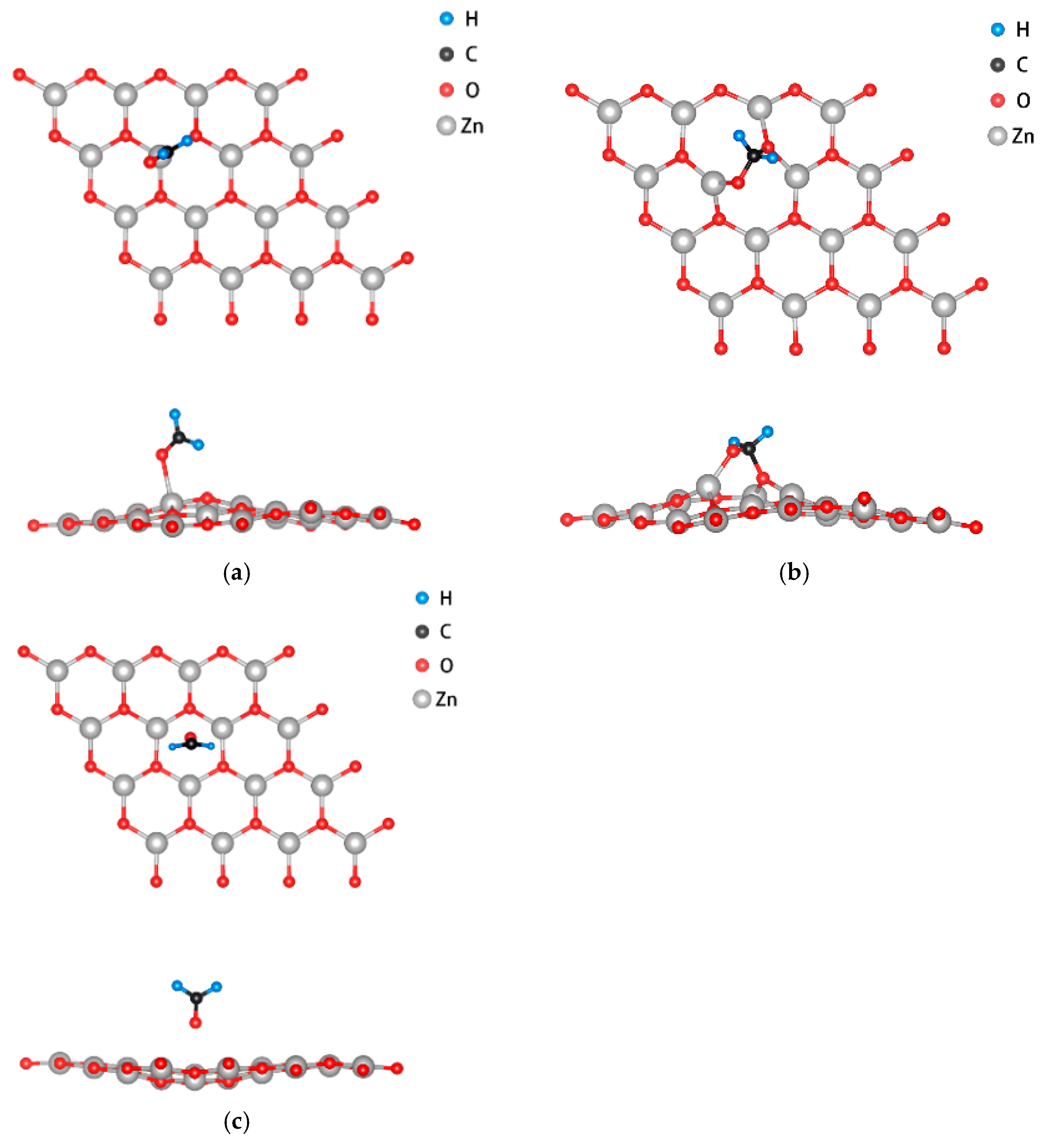
For intrinsic g-ZnO, three stable adsorption configurations of CH2O were found, labeled as A1, A2, and A3, as shown in Figure 1a–c, respectively. In configuration A1, the CH2O molecule is arranged above a Zn-O bond with the oxygen atom forming a weak pair interaction with a surface Zn atom. The corresponding bond length is 2.37 Å, which is slightly longer than the intrinsic Zn-O bond length in g-ZnO. The CH2O molecule is roughly parallel to the Zn-O bonds of the g-ZnO surface. Although the hydrogen atom of CH2O is attracted towards an oxygen atom of a surface, no bond formation takes place. The molecule retains the original sp2 planar geometry with no appreciable distortion of the structure. However, adsorption causes deformation of the g-ZnO surface, which bulges toward the adsorbed molecule, suggesting that the two-dimensional lattice is locally broken. The calculated adsorption energy for configuration A1 is −0.21 eV/CH2O. Configuration A2 has an adsorption mode that is clearly different from that of A1 and is the most complex of the three configurations. In the present case, the CH2O molecule adopts a bridging adsorption geometry above a Zn-O bond. The molecule is reoriented considerably and loses its planar structure to form a tetrahedral-like structure similar to the sp3 hybrid structure. The oxygen atom of CH2O is bonded to a surface Zn atom and the carbon atom is simultaneously bonded to a surface O atom. These interactions break the original Zn-O bond and lead to a structure that looks like a four-membered ring. Consequently, the two-dimensional lattice of g-ZnO is strongly perturbed at the adsorption site. Unlike the mild surface distortion in A1, both the surface Zn and O atoms in configuration A2 are strongly displaced from the lattice plane with pronounced convex deformation along the c-axis. The adsorption energy for this configuration is calculated to be −0.20 eV/CH2O. In the case of configuration A3, the CH2O molecule is least structurally altered, moving down by only 0.12 Å from its original position. The oxygen atom of the molecule is facing the g-ZnO surface, but no chemical bonding takes place between the adsorbate and the substrate. Instead, the g-ZnO surface shows significant deformation, including the formation of a concave area below the adsorption point along the c-axis. The adsorption energy for this configuration is −0.10 eV/CH2O. Overall, the relatively low adsorption energies, and the lack of significant charge transfer and chemical bond formation suggest that all three configurations are associated with physisorption of CH2O on intrinsic g-ZnO.

2.2. Study on the Adsorption Behavior of Defect-Rich g-ZnO

2.2.1. O Vacancy Defects System

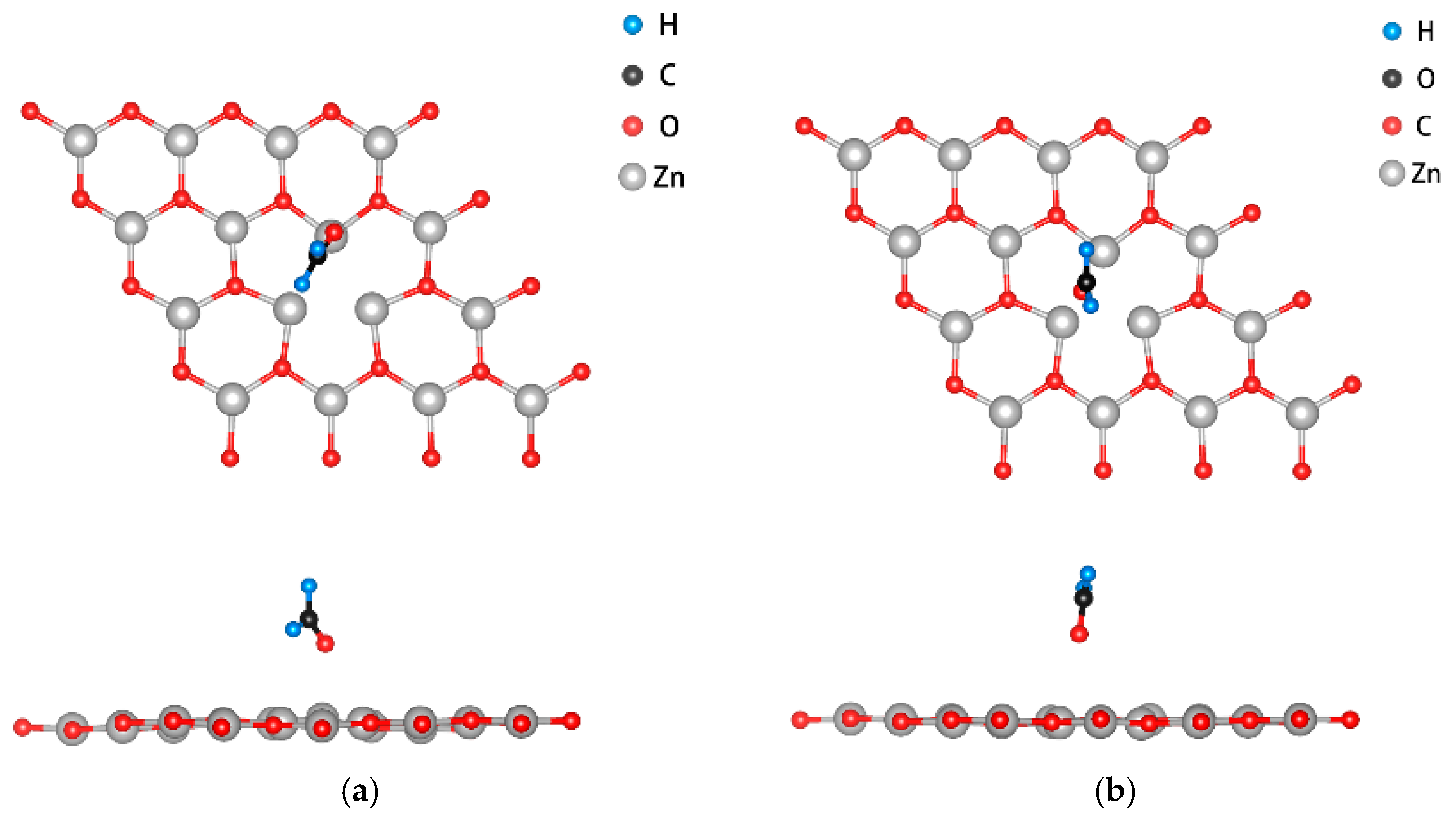
For the g-ZnO system with oxygen vacancy defects (VO-g-ZnO), two relatively stable configurations of the CH2O adsorption were found. Both configurations have low adsorption energies and are hence classified as physisorption. Configuration B1, in Figure 2a, has an adsorption energy of −0.10 eV/CH2O. In this arrangement, the CH2O molecule is essentially undeformed and is located about 2.40 Å above the surface. The oxygen atom of the CH2O molecule is oriented toward a surface Zn atom adjacent to the vacancy whereas the hydrogen atom is oriented toward a neighboring Zn atom. Structural changes in the VO-g-ZnO surface are small, with the lattice retaining for the most part its two-dimensional nature, although some slight adjustments in local bond angles are observed. Configuration B2, shown in Figure 2b, has an even lower adsorption energy of −0.05 eV/CH2O. Similar to the case of configuration B1, the CH2O molecule is not distorted by significant deformation. In this case, the oxygen atom of CH2O is close to the vacancy center, which is similar to the adsorption orientation of configuration A2. However, the resultant perturbation of the VO-g-ZnO surface is weaker than in B1 with only small changes in the Zn-O bond angles with respect to the pre-adsorption state. Overall, the VO-g-ZnO surface maintains its original two-dimensional structure.

2.2.2. Zn Vacancy Defects System

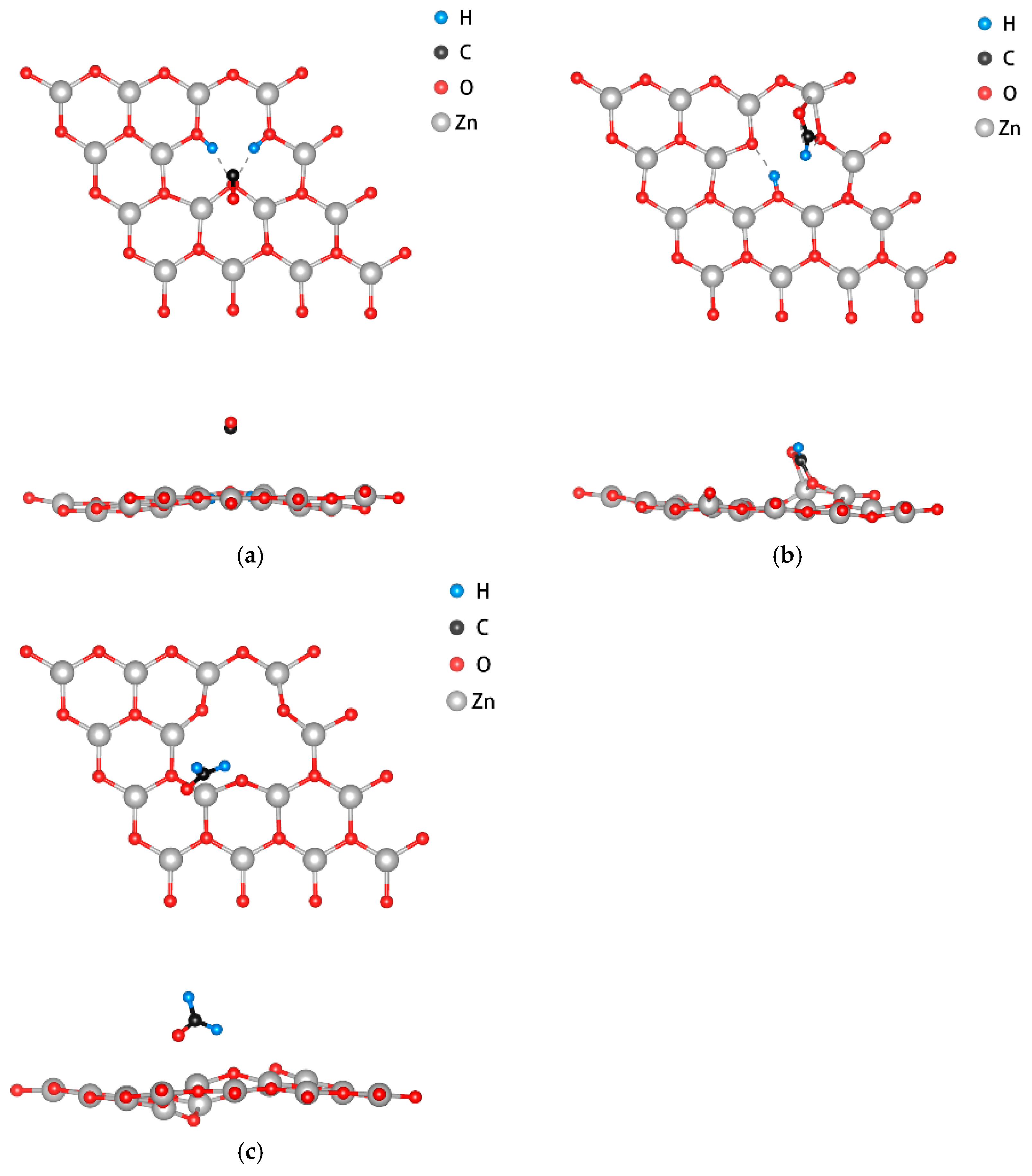
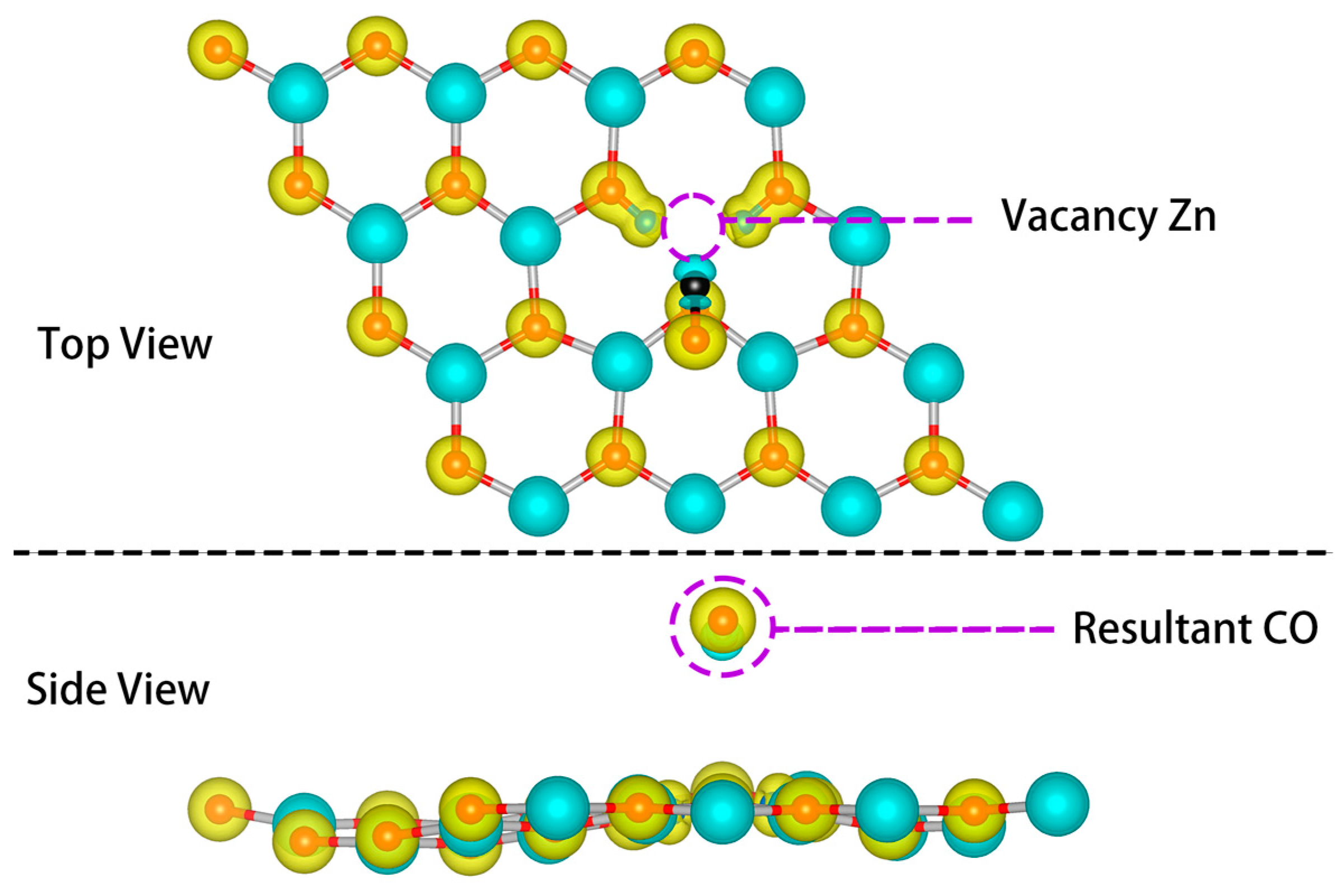
For the g-ZnO system with zn vacancy defects (VZn-g-ZnO), the adsorption behavior of CH2O is quite different from that in the oxygen-vacancy system. Three stable adsorption configurations were found, which include two dissociative adsorption structures (C1 and C2) and one molecular adsorption structure (C3). Among them, configuration C1, which is shown in Figure 3a, has the strongest adsorption. In such a configuration, the CH2O molecule is fully dissociated at the site of the vacancy. Each hydrogen atom is trapped by one of the nearby oxygen atoms to form O-H bonds, with a bond length of 0.99 Å. Upon the loss of both hydrogen atoms, the CH2O molecule is converted into carbon monoxide (CO), with C=O bond length of 1.14 Å, which is consistent with that of a free CO molecule. The resultant CO molecule is roughly parallel to the VZn-g-ZnO surface with the carbon atom located 0.21 Å above the oxygen atom at the vacancy site that does not bind hydrogen. Significant structural distortion of the VZn-g-ZnO surface is observed, including convex deformation of the vacancy region towards the adsorbate and irregular concave deformation elsewhere along the c-axis. This configuration has an extremely large adsorption energy of −5.55 eV/CH2O, the highest of all the investigated systems. Configuration C2, shown in Figure 3b, is also dissociative adsorption, but differs from C1 in the dissociation pathway. In this case, only one of the hydrogen atoms from the CH2O molecule is captured by an oxygen with a dangling bond near the vacancy to form an O-H bond with a length of 1.00 Å, a little longer than that in configuration C1. The remaining aldehyde fragment then interacts with the VZn-g-ZnO surface: the carbon atom bonds with an oxygen atom on the surface, and the oxygen atom bonds with an adjacent zinc atom, with bond lengths of 1.30 and 2.20 Å, respectively. Despite dissociation, the aldehyde group retains its original planar sp2 configuration. The VZn-g-ZnO surface has an overall concave deformation and the Zn and O atoms participating in the bonding have a large protrusion on its c-axis. The calculated adsorption energy value for this configuration is −4.94 eV/CH2O. Configuration C3 in Figure 3c represents molecular adsorption without dissociation of the CH2O molecule. Although the molecular structure is intact, its orientation with respect to the surface changes: the carbon atom is located above a zinc atom close to the vacancy, while the oxygen and hydrogen atoms are directed to a surface zinc atom and an oxygen atom, respectively. The VZn-g-ZnO surface is more complex in structural rearrangements, in which two oxygen atoms close to the vacancy protrude along the c-axis and one oxygen atom is indented downward. This configuration has a much lower adsorption energy of −0.47 eV/CH2O, which implies that the interaction is weaker than for the dissociative configurations.

2.3. Study on the Adsorption Behavior of Doped g-ZnO

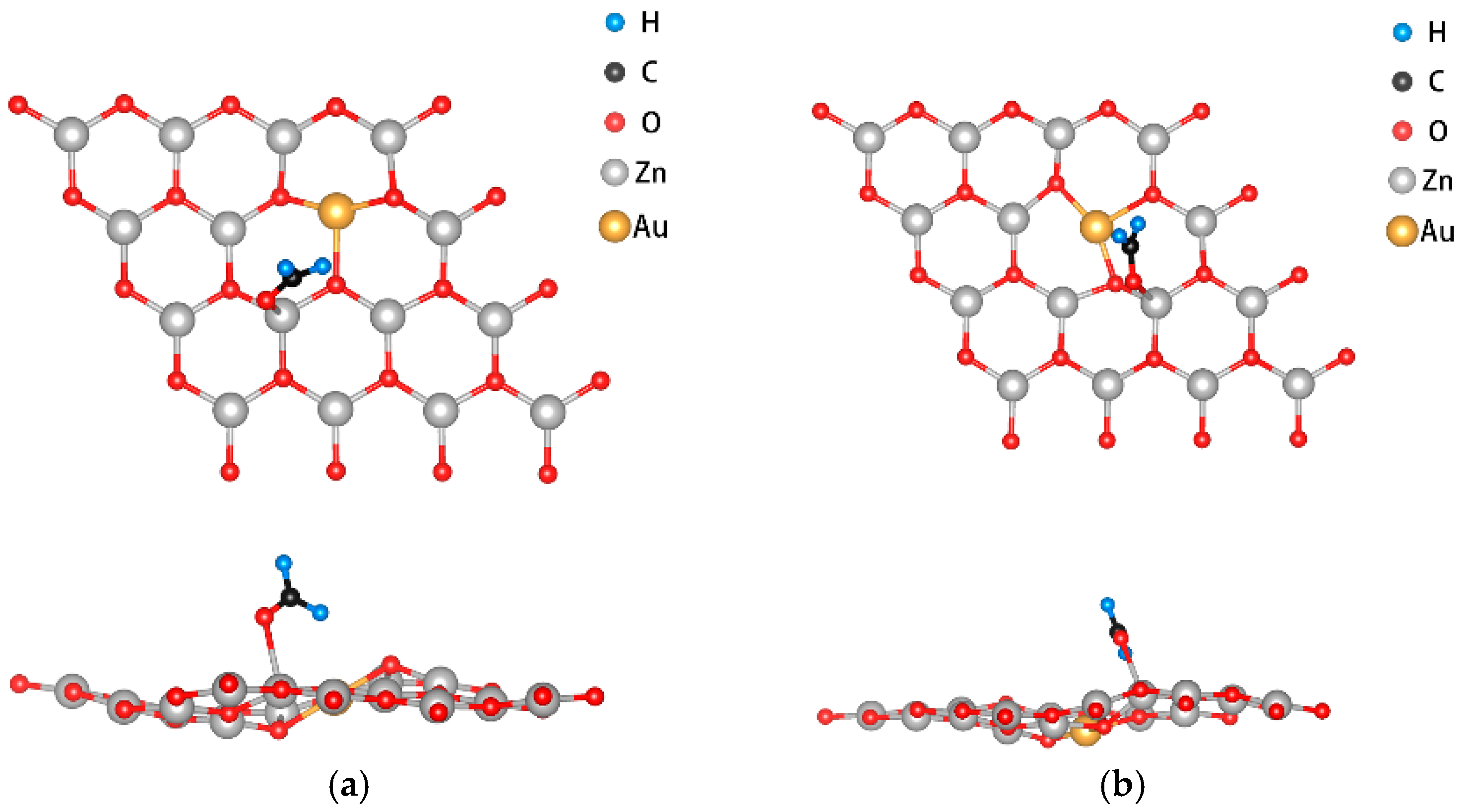
For the Au-doped g-ZnO system, two stable configurations of CH2O adsorption were found, called D1 and D2. As shown in Figure 4a, configuration D1 is end-on adsorption, where the CH2O molecule is located directly above the substituted Au atom. In this configuration, the oxygen atom of CH2O forms a bond with one of the neighboring surface Zn atoms with a bond length of 2.40 Å. In contrast to the dissociative adsorption in the VZn-g-ZnO system, the CH2O molecule is not broken but remains intact, indicating molecular (integral) adsorption. The C-O bond axis of CH2O is at an angle of roughly 90° to the g-ZnO surface. Owing to the larger atomic radius of Au and the strong adsorption interactions, large local distortion takes place in the two-dimensional honeycomb lattice at the doping site. The Au atom and the surrounding region of the lattice show strong convex deformation towards the adsorbed molecule. Specifically, atoms near the Au dopant are displaced asymmetrically, with depression being seen along the b-axis direction and upward bulging along the a-axis direction. The calculated adsorption energy value for configuration D1 is −1.16 eV/CH2O. In configuration D2, shown in Figure 4b the C-O bond axis of the CH2O molecule is inclined to the substrate plane. The oxygen atom serves as the active adsorption site and interacts with a neighboring surface Zn atom next to the Au dopant, and the carbon atom and two hydrogen atoms are oriented away from the surface. No dissociation of the CH2O molecule takes place and molecular framework remains intact. However, its spatial orientation is modified because of the combined effects of localized surface electric fields and steric hindrance. Au doping causes significant distortion of the lattice, which is a severe disturbance to the planarity of the surface. The O-Au-O bond angle is enlarged to 155.34° and the substitutional Au atom is significantly displaced below the original two-dimensional plane. In contrast, the surface Zn atom attached to CH2O sticks up from the plane due to the interactions induced by adsorption. The calculated adsorption energy for configuration D2 is −1.04 eV/CH2O.

3. Electronic Properties

3.1. Band Structure

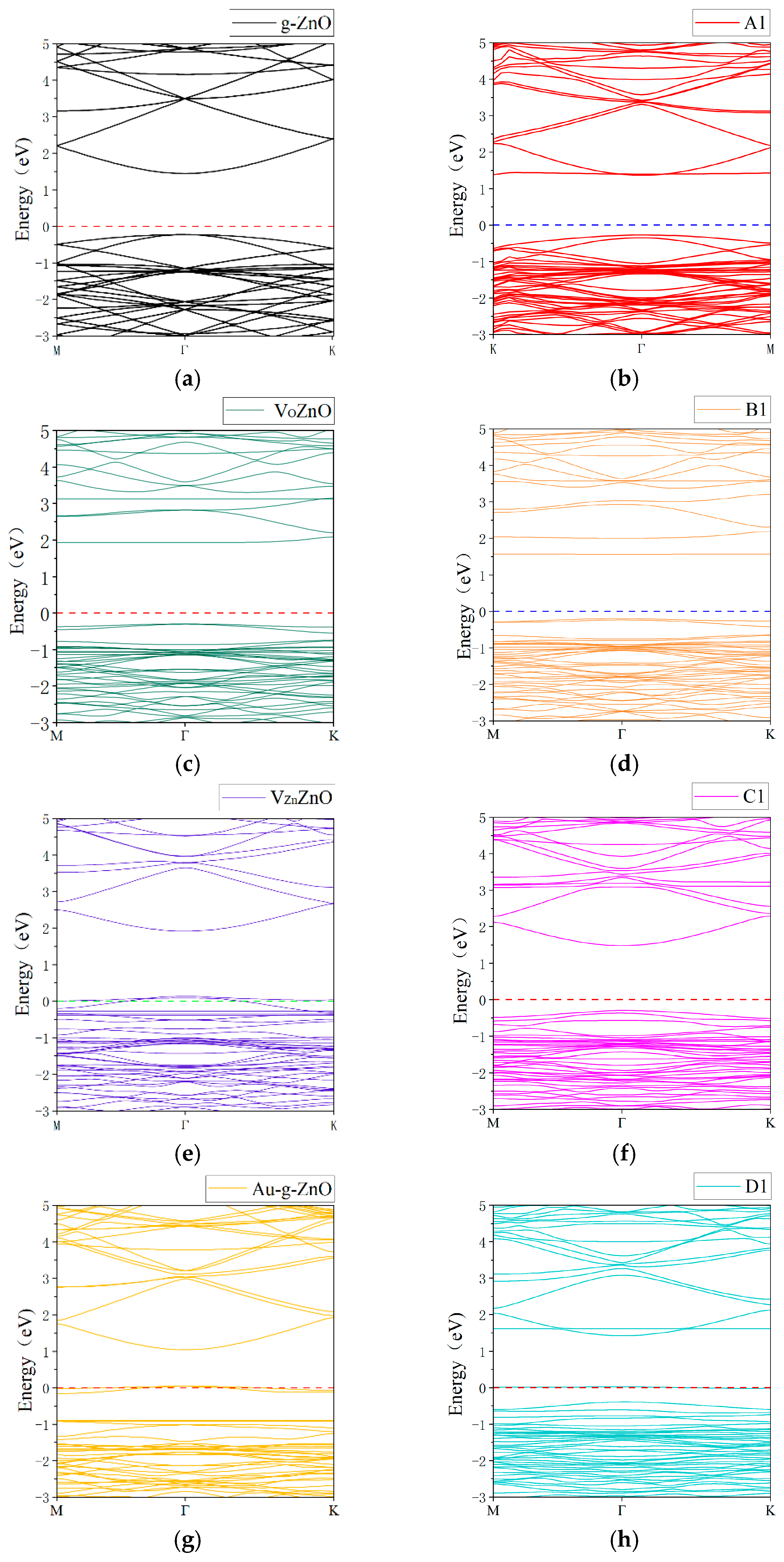
Band structure calculations were performed for four representative systems: intrinsic g-ZnO, VO-g-ZnO, VZn-g-ZnO, and Au-g-ZnO. For each system, both the pristine surface before the adsorption of CH2O and the most stable adsorption configuration after the adsorption of CH2O were studied. Figure 5a,c,e,g show the calculated band structures of intrinsic g-ZnO, VO-g-ZnO, VZn-g-ZnO, and Au-g-ZnO, respectively.
For intrinsic g-ZnO the valence band maximum (VBM) is at −0.26 eV and the conduction band minimum (CBM) is at 1.45 eV, which gives a bandgap of 1.67 eV. The bandgap region is free of impurity states, which represents a defect-free crystal structure. These results are in good agreement with those reported by Yong-Hui Zhang et al. [37] thus validating the reliability of the adopted computational parameters. Figure 5b shows the band structure corresponding to the adsorption configuration A1 for which a bandgap of 1.63 eV is found with the VBM and CBM at −0.27 eV and 1.37 eV, respectively. Compared to the pristine g-ZnO band structure in Figure 5a, the overall electronic structure is almost not affected by CH2O adsorption. A small decrease in the bandgap is found, and significant changes in the bandgap region above the Fermi level. Specifically, a nearly dispersionless flat band is developed at about 1.41 eV. This isolated energy level stems mostly from the unoccupied molecular orbitals of the adsorbed CH2O molecule, which is in line with its nature of physisorption. The appearance of this intermediate gap state effectively reduces the excitation energy required for electrons to move from the valence band to the conduction band, resulting in the observed bandgap narrowing.
Compared with intrinsic g-ZnO, the band structure of VO-g-ZnO exhibits a significant upward shift of CBM, which is 1.94 eV. The introduction of oxygen vacancy defects results in the existence of two nearly flat bands near the Fermi level at the conduction band edge. This behavior is due to the fact that the donor states related to oxygen vacancies are partially occupied after the loss of electrons and the defect electrons are promoted to states near the CBM. The band structure for adsorption configuration B1 is shown in Figure 5d. Similar to the intrinsic adsorption configuration A1, an additional almost dispersionless flat band appears at about 1.61 eV. This isolated energy level is attributed primarily to the lowest unoccupied molecular orbital (LUMO) of the adsorbed CH2O molecule. The strong flatness of this band in the whole Brillouin zone is indicative for a large effective electron mass and strong electronic localization in the CH2O molecule. The lack of significant orbital hybridization between the adsorbate and the substrate is another evidence that the interaction between CH2O and the oxygen-vacancy-containing g-ZnO surface is dominated by weak physisorption.
The band structure of VZn-g-ZnO shows strong deviations from that of the intrinsic system. Prior to CH2O adsorption the valence band crosses the Fermi level, with the VBM at 0.16 eV, which is indicative of metallic behavior. This phenomenon mainly originates from the presence of zinc vacancies as shallow acceptor defects which introduce a high density of hole states around the valence-band edge. In the absence of electron-donating Zn cations within the lattice, the Fermi level is no longer located near the center of the band gap, but instead is pinched and is located downwards into the valence band, thereby exposing O-2p-derived states above the Fermi level. Figure 5e shows the band structure of configuration C1 after adsorption of CH2O. In sharp contrast to the metallic behavior noticed before adsorption, configuration C1 shows a recovery towards typical semiconductor characteristics. The Fermi level moves into the band gap, leaving a direct band gap of 1.78 eV between the valence-band maximum and conduction-band minimum. This reconstruction of the electronic structure could be attributed to strong charge compensation induced by dissociative adsorption. Upon dissociation of the CH2O molecule at the zinc vacancy site dangling bonds around the defect form highly covalent bonds with the dissociation fragments. Acting effectively as an electron donor, the CH2O molecule injects electrons into the substrate, thus compensating the intrinsic hole states at the valence-band edge. This passivation process of defects, driven by chemical bonding, suppresses the original degenerate p-type conductivity and returns the system to a direct band gap semiconducting state.
The band structure of Au-g-ZnO shows some similarities with that of VZn-g-ZnO. Prior to CH2O adsorption, the valence band crosses the Fermi level, which gives the system metallic behavior. The introduction of Au atoms causes large electronic restructuring near the Fermi level. Unlike the intrinsic and VZn-g-ZnO systems, an isolated band with high dispersion crosses the Fermi level at the Gamma point, coming from deep impurity levels introduced by the Au dopant. This doping also causes the bandgap to decrease to 1.32 eV. Figure 5h shows the band structure of configuration D1 after CH2O adsorption. A separate additional band is formed, crossing one of the existing conduction bands. Similar to configurations A1 and B1, this band is attributed to the CH2O molecule. The CBM increases to 1.42 eV, and the system maintains metallic properties after adsorption. This behavior is due to chemical bonding between CH2O molecular orbitals and surface Zn atoms in g-ZnO, which leads to a splitting of low-energy surface or impurity states originally near the band-edge. The bonding state energy has a decreasing energy in the valence band, and the corresponding anti-bonding state has an increasing energy, which raises the CBM energy, and the electronic structure is stabilized at a lower-energy state. These electronic changes are in agreement with the relatively high adsorption energy of −1.16 eV observed for this configuration.

3.2. Projected Density of States

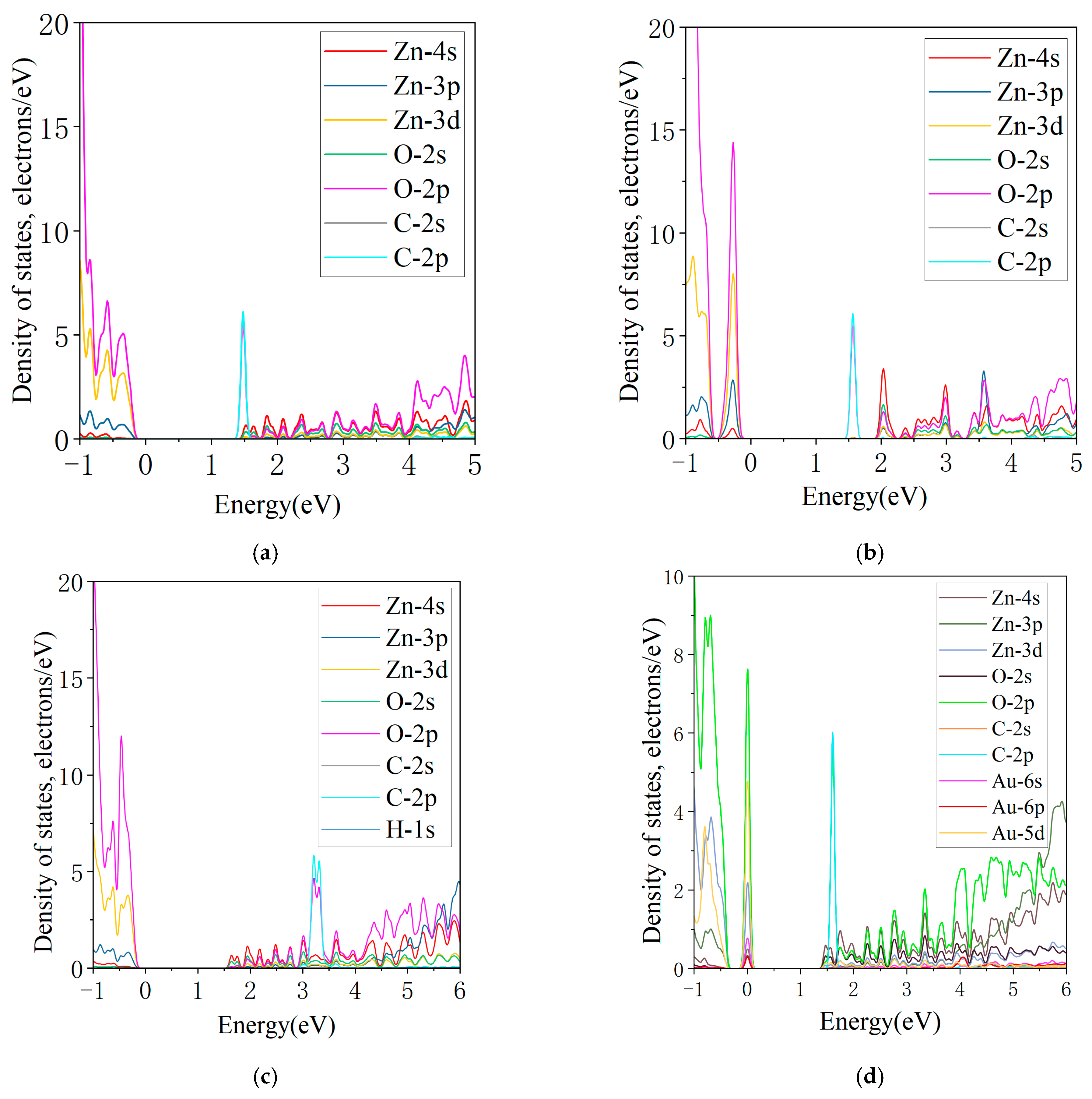
To further clarify the electronic properties of the most stable adsorption configurations, A1, B1, C1 and D1, for the four g-ZnO systems, PDOS calculations were carried out. Complementary charge density difference analyses were also performed that give insight into charge redistribution and the nature of interactions between CH2O molecules and the g-ZnO surfaces.
The PDOS for adsorption configuration A1 is shown in Figure 6a. The valence band is dominated by O-2p orbitals and Zn-3d orbitals, which have significant resonance overlap, and thus the valence band is dominated by the g-ZnO substrate. In agreement with the band structure analysis, a sharp and isolated C-2p DOS peak (cyan curve) is seen at about 1.4 eV. This confirms that the deep-level impurity state in the band gap is due to the unoccupied molecular orbitals in the adsorbed CH2O molecule. The large flatness of the corresponding band, combined with the narrow width of the PDOS peak, indicates a strongly localized electronic state. This implies that the CH2O molecule has not fully integrated into the delocalized conduction band of the substrate and that it behaves like an independent electron acceptor, which is a localized electron-trapping site. The CBM is mainly from Zn-4s and O-2p orbitals. At 4.6 eV, a separate resonance peak is obtained due to hybridization of Zn-4s and Zn-3p states, whereas further above, strong mixing is observed between Zn orbitals of different angular momenta.
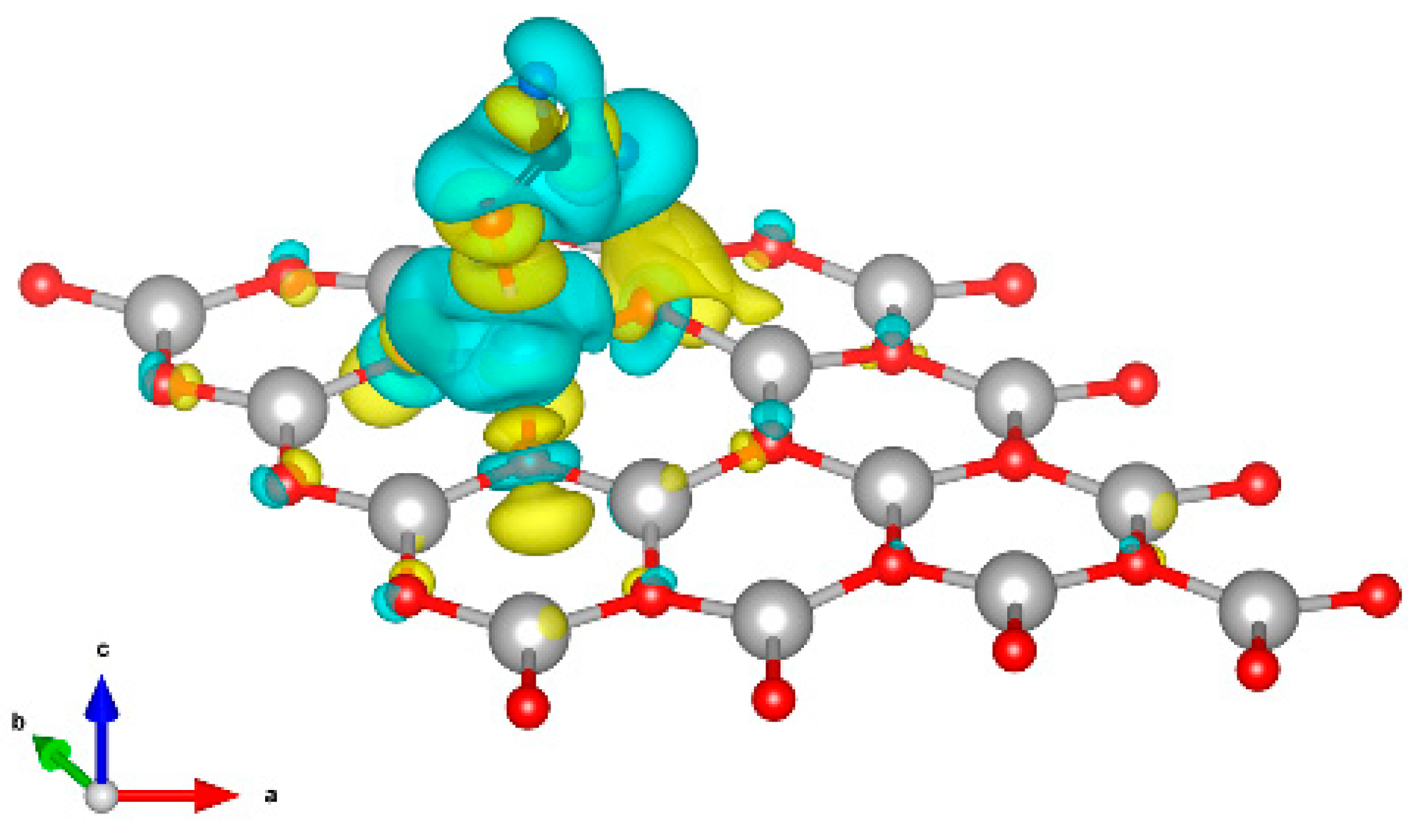
Figure 7 shows the difference in charge density for configuration A1, where yellow and cyan regions reflect charge accumulation and depletion, respectively. It can be seen that electron density is depleted from the g-ZnO surface at the bonding site and the oxygen atom in CH2O gains electrons. This leads to the accumulation of large charges around the O-Zn bond that is direct evidence of interfacial chemical bonding. Charge depletion is also seen behind surface oxygen atoms and near the C-H bonds of CH2O, which suggests polarization within the molecule. The oxygen atom provides the electron density to the interfacial bond, and this results in the relative reduction in electron density in other regions.
The PDOS for adsorption configuration B1 is shown in Figure 6b. In the valence band region, there are two main peaks, mainly contributed by the O-2p orbitals, and secondary peaks, contributed by the Zn-4s and Zn-3p orbitals, which reflects the level of stability ensured by the orbital hybridization in the substrate. The band structure shows the presence of an extremely flat, dispersionless band at a value of about 1.60 eV, which lies in the band gap. In the PDOS, this energy is a sharp hybridization peak between C-2p and O-2p states, which confirms that the flat band is coming from the hybridized molecular orbitals of the CH2O molecule. At higher energies, the observed orbital hybridization gives delocalized channels for electron transport in the conduction band.
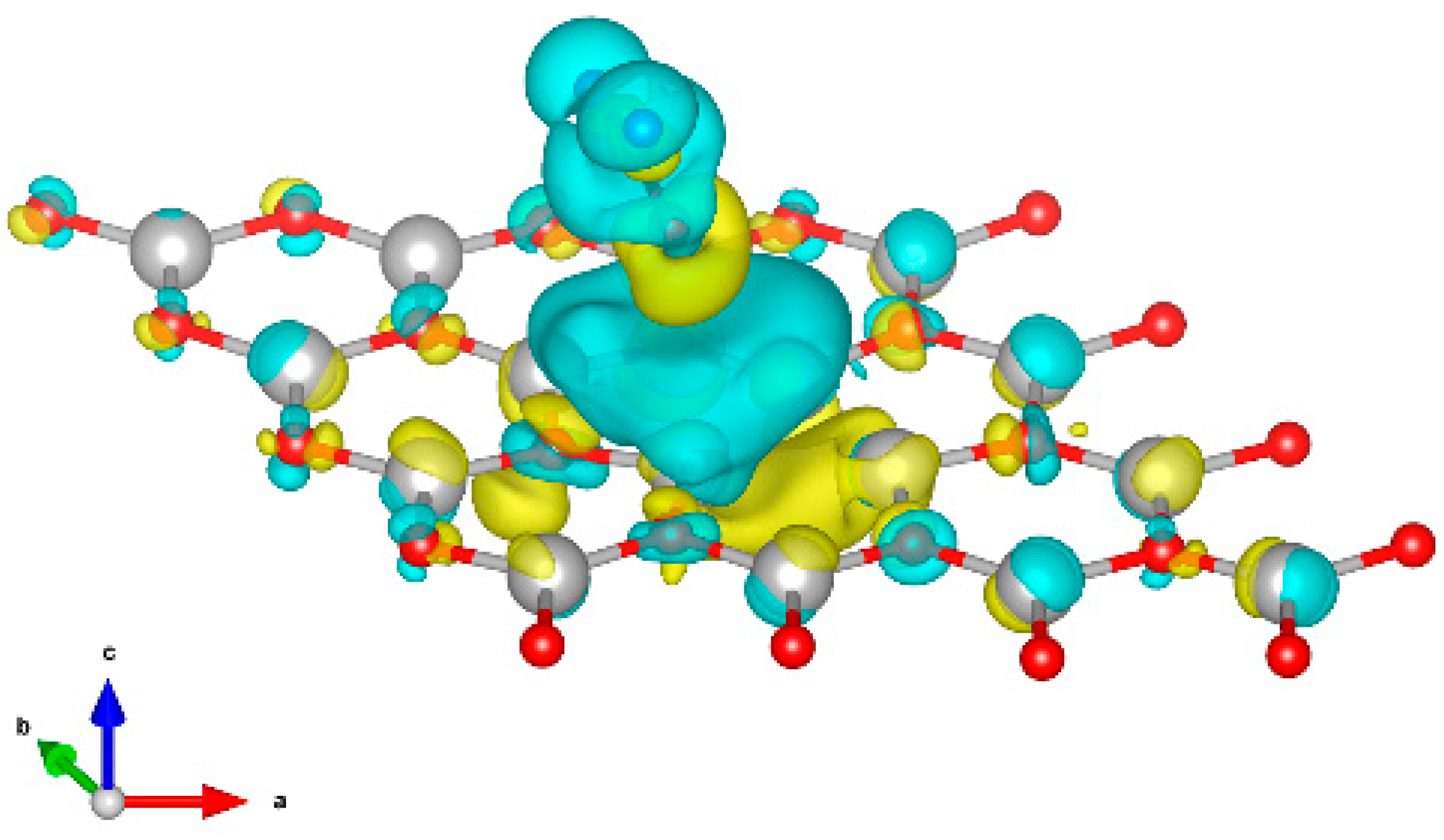
The charge density difference profile (Figure 8) reveals the accumulation of charge (yellow region) between the oxygen atom of CH2O and the Zn atom of the substrate. However, this accumulation is not due to covalent bonding through orbital hybridization but mostly to strong electrostatic polarization caused by the oxygen vacancy. The exposed cationic field at the vacancy site has a significant effect on the CH2O electron cloud, which leads to a redistribution of charge within the molecule, but there is no significant charge transfer to the substrate. The sharp and isolated C-2p/O-2p impurity states in the band gap, which can be seen by sharp peaks in the PDOS, are further evidence that the molecular orbitals of CH2O are highly localized and weakly coupled with the Zn orbitals of the g-ZnO surface. This is in contrast with the broadened peaks typical for covalently bonded systems and confirms that the adsorption in this configuration is mainly physisorptive.
The PDOS for the adsorption configuration C1 is shown in Figure 6c. As in the previous configurations, the O-2p orbitals are the dominant orbitals in the valence band and have much higher intensity than other orbitals. The lack of a Zn atom at the vacancy site leaves the surrounding lattice oxygen atoms under-coordinated, resulting in increased localization of O-2p electrons which dominate the VBM. A significant change from the previous configurations is that the sharp C-2p peak injected by the CH2O molecule is shifted to the deeper conduction band region of about 3.11 eV. This peak results from strong resonance between C-2p and O-2p orbitals and is clear evidence of strong covalent bonding. This corresponds to the formation of a CO molecule by dissociation, adsorbed above the Zn vacancy. The high energy position of this peak reflects the high double/triple bond character of the CO fragment and its antibonding orbitals are at higher energies. At higher energies, the contribution of Zn-3p orbitals gradually increases and a transition from dominance of s-orbital character to mixed s- and p-orbital character in the conduction band is observed.
The charge density difference profile (Figure 9) provides further evidence for these observations. The hydrogen atom dissociated from CH2O is transferred to a nearby lattice oxygen, creating a region of large charge accumulation between the H atom and the oxygen, which is indicative of a stable O-H chemical bond. Around the CO fragment, areas of both charge depletion and accumulation can be seen, indicating high orbital hybridization and charge redistribution with the under-coordinated oxygen atoms at the vacancy edge. This interaction leads to a shift of the density of states peak of the C atom upwards to about 3.22 eV, which is in agreement with the formation of strong chemical bonds and significant electronic interaction.
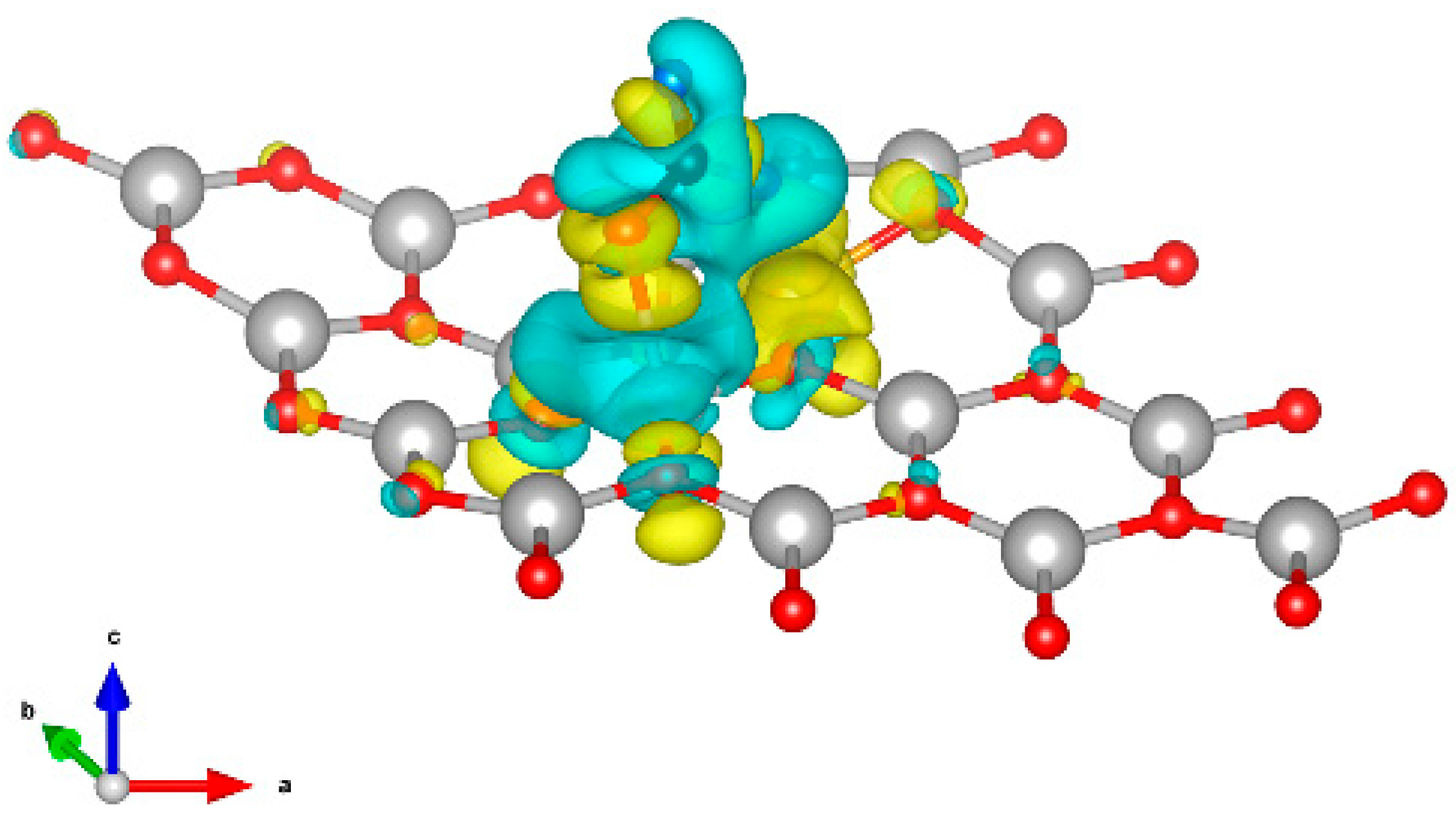
Figure 6d shows the PDOS for the Au-doped adsorption configuration D1. The Au-5d orbitals that are introduced by the doping are highly active within the valence band, with strong hybridization with Zn-3d and O-2p orbitals. This interaction is indicative of the formation of strong chemical bonds between the Au atom and the surrounding lattice oxygen and zinc atoms. Notably, the DOS peaks due to Au-5d and O-2p hybridization cross the Fermi level, proving that Au doping induces a large number of impurity states in the band gap. These states strongly interact with O-2p orbitals, effectively populating the original forbidden band and accounts for the band structure observation of a metallic band crossing the Fermi level. In the conduction band region, a sharp and intense resonance peak due to C-2p and O-2p orbitals of the CH2O molecule appears at about 1.6 eV. This peak is associated with the high LUMOs of CH2O, which do not fully integrate into the delocalized conduction band of the substrate. Instead, they are localized electron scattering centers superimposed over the metallized background. This localization is responsible for the upward movement of the CBM and the apparent widening of the band gap. The terminal adsorption mode in D1 is different from configuration A1, suggesting that CH2O is chemisorbed, which is consistent with the large adsorption energy observed.
The charge density difference profile (Figure 10) shows that a large charge accumulation exists between the Au atom and the CH2O molecule. A prominent “petal-like” pattern is found around the Au atom, which corresponds to the spatial polarization of the Au-5d orbitals. Compared with configuration A1 (Figure 8), where charge accumulation is mainly localized at the Zn-O bond of the adsorption site, configuration D1 exhibits an enhanced charge accumulation both at the Zn-O bond and around the Au atom. This deep orbital hybridization and electron cloud rearrangement imply that the Au atom is effective in activating neighboring Zn adsorption sites so that more extensive and intense interfacial charge transfer is possible than the pristine system. The enhanced adsorption capability of the Au-doped surface can be attributed to the synergistic interplay of geometric and electronic effects. While the incorporation of the large Au atom induces local lattice distortion that exposes neighboring Zn sites, the electronic effect plays a more dominant role. Charge density analysis indicates that Au modulates the electron density of neighboring Zn atoms, thereby increasing their electrophilicity and reactivity towards the formaldehyde molecule. This mechanism aligns with the concept of electronic sensitization reported in recent studies [27], where Au decoration was shown to significantly improve gas sensing response by modifying the surface electronic structure and inducing local charge transfer.

4. Computational Parameters and Model Specifications

All the calculations were done using the DFT [38] as implemented in the Vienna Ab initio simulation package (VASP, version 6.1.0) [39]. The exchange correlation energy was represented by the Perdew–Burke–Ernzerhof functional in the generalized gradient approximation. Electron–ion interactions were treated by the projector augmented wave method [40]. To ensure energy convergence, a plane wave cutoff energy of 500 eV was used. Integrations over Brillouin zone used a 3 × 3 × 1 Monkhorst–Pack k-point grid. The convergence criterion for the electronic self-consistent field calculations was set at 1 × 10⁻⁸ eV and the criterion for ionic relaxation was an atomic force below 0.02 eV/Å. Partial occupancies were treated with a gaussian smearing function with a width of 0.05 eV. Geometric optimizations were carried out by the conjugate gradient algorithm with dipole corrections in both self-consistent calculations and electronic property analyses. the DFT-D3 correction was adopted to correct the dispersion force [41]. Band structures, projected density of states (PDOS), and differential charge density profiles were post processed with the VASPKIT software package(version 1.5) [42].
The adsorption energy of an individual CH2O molecule was determined by the following Equation (1):
E ads = 1 N E total E slab N E gas
where Etotal is the total energy of the system after adsorption, Eslab represents the energy of the pristine g-ZnO supercell prior to CH2O adsorption, Egas is the energy of an isolated CH2O molecule, and N is the number of CH2O molecules involved in the adsorption calculation. In this paper, N = 1. It should be noted that for both molecular and dissociative adsorption, the Egas corresponds to the isolated intact molecule in the gas phase; thus, the dissociation energy cost is intrinsically included in the calculated E ads without need for a separate term.
For the charge density difference, which is given by the following Equation (2):
Δ ρ = ρ total ρ slab ρ gas
where ρtotal denotes the charge density of the adsorbed system, ρslab corresponds to the charge density of the g-ZnO surface without the gas, and ρgas is the charge density of an isolated CH2O molecule.
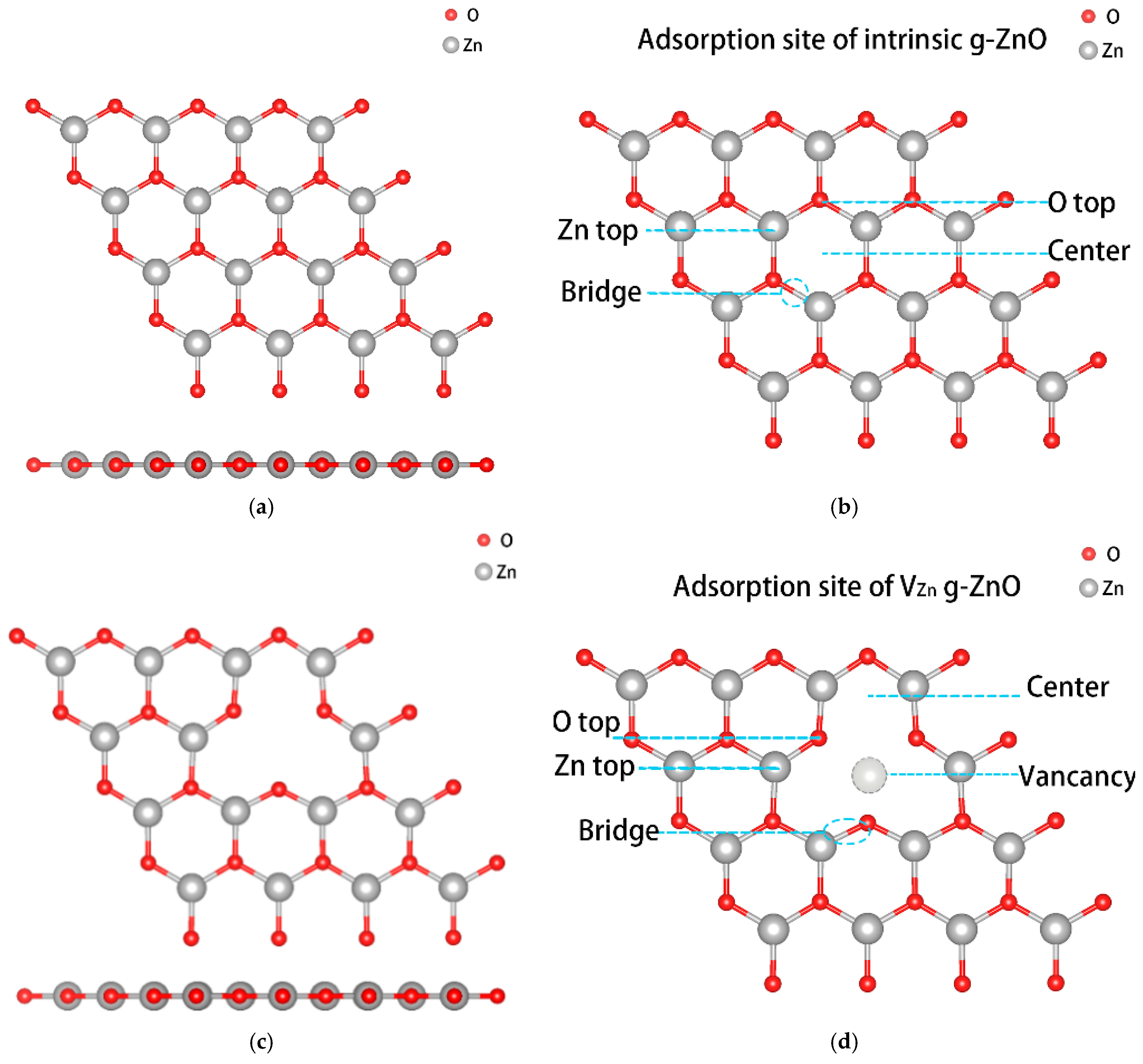
All calculations in this study used a 4 × 4 × 1 g-ZnO supercell in order to achieve structural stability after defect insertion and doping. The optimized configuration of intrinsic g-ZnO is shown in Figure 11a. This two-dimensional structure can be considered to be derived from cleavage along the [0001] polar surface of wurtzite ZnO. Compared to the pre-optimized ZnO [0001] surface, atoms in the optimized model show better alignment along the c-axis, which forms a highly planar arrangement typical of two-dimensional materials. The dimensions of the intrinsic g-ZnO supercell are a = 13.00 Å and b = 13.00 Å, which is in agreement with calculations reported by Yong-Hui Zhang et al. [43]. A 20 Å layer of vacuum was used along the c-axis to prevent interactions between periodic images. The supercell has 16 Zn atoms and 16 O atoms with optimized Zn-O bond lengths of 1.88 Å and bond angles of 120°. Figure 11b presents the considered adsorption sites: Zn top, O top, bridge and center. In all calculations, the CH2O molecule was initially placed at varying distances of 1.8 Å, 2.0 Å, and 2.5 Å above the adsorption sites. All CH2O molecules are freely relaxed without fixation, and both horizontal and vertical placement methods relative to the surface are considered. All optimization processes converged to the same energetically favorable configuration, confirming that the obtained adsorption state is robust and independent of these initial distances. In this work, we adopted neutral vacancy models to investigate the intrinsic geometric and electronic effects on adsorption. While neglecting charged states is an approximation, it avoids the spurious electrostatic interactions associated with charged slab calculations and allows for a consistent comparison of chemical reactivity trends across different configurations. Importantly, the neutral model effectively captures the direction and magnitude of charge transfer, which is the primary mechanism driving the resistance change in chemical-resistive sensors, consistent with the electronic sensitization principles described in recent studies.
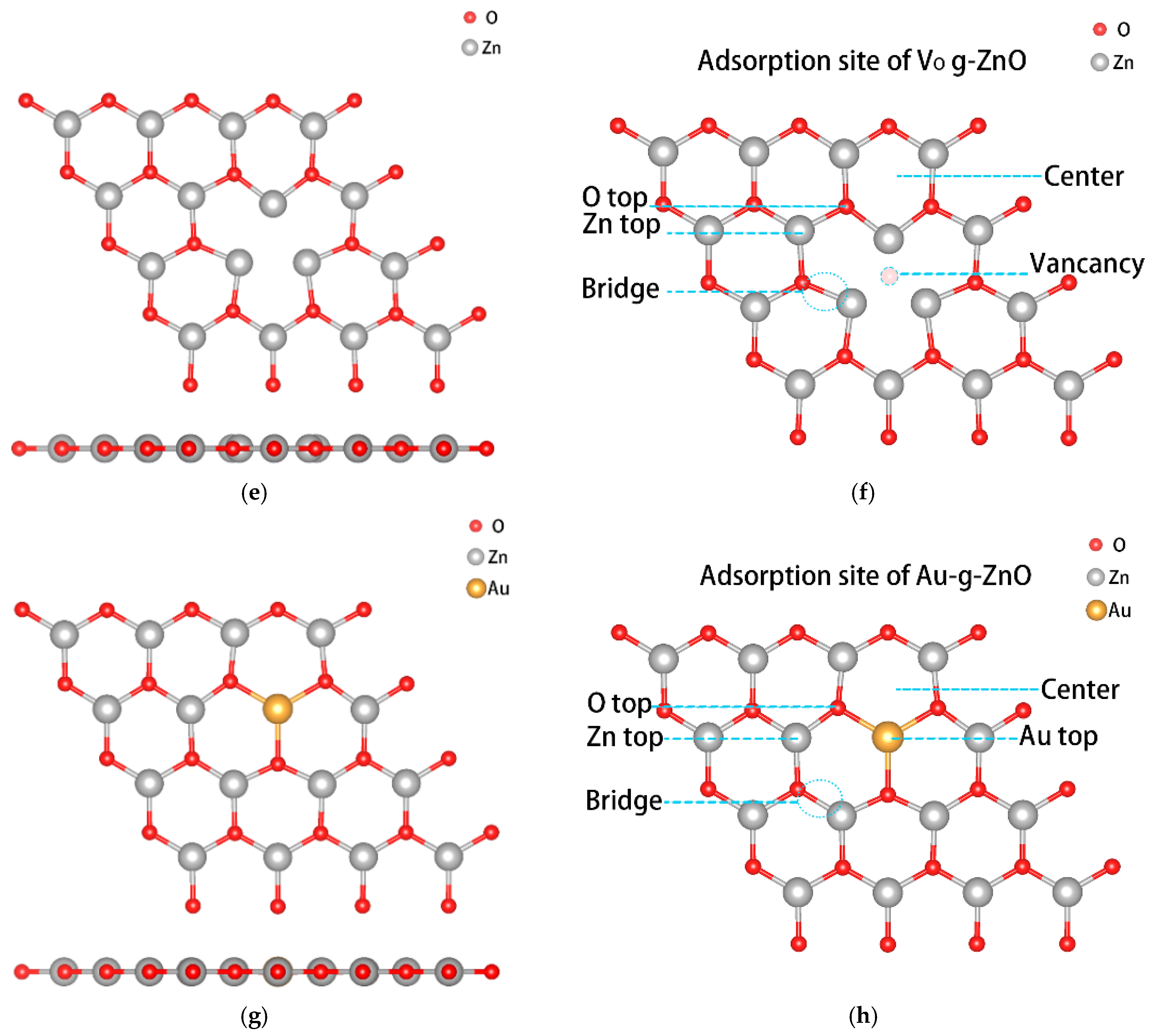
Figure 11c shows the optimized g-ZnO supercell with defects of zinc vacancies Zn. After structural optimization, the Zn-O bonds surrounding the vacancy are significantly distorted, with bond lengths being considerably decreased to 1.80 Å compared to those in the intrinsic g-ZnO. The angles of the Zn-O-Zn bond change to 127.25° and 114.57°, and the angle of the O-Zn-O bond changes to 126.34°. The creation of Zn vacancies creates localized centers of negative charge, which make the surrounding oxygen atoms relax away from the core of the vacancy. Figure 11e illustrates the optimized g-ZnO supercell with oxygen vacancy O defects. In this case, the Zn-O bonds next to the defect are significantly lengthened, to 1.90 and 1.93 Å. This behavior is indicative of increased reactivity of the adjacent Zn atoms. The oxygen vacancy behaves as a positive charge center, which attracts the surrounding Zn atoms to move towards the oxygen vacancy site. Consequently, the O-Zn-O bond angles reduce to 105.45 and 113.60° and the Zn-O-Zn bond angle increases to 115.92°. Notably, the O-vacancy system shows behavior that is opposite to that of the Zn-vacancy system. Upon removal of the oxygen atom, the surrounding Zn atoms migrate more aggressively towards the vacancy center, which can be explained by the highly unsaturated and chemically active nature of the Zn atoms compared to the oxygen atoms. The introduction of vacancies causes the formation of unsaturated bonds, which causes significant local structural reconstruction. Despite these local distortions, optimized lattice parameters are still consistent with the pre-optimization values. The computational results for both vacancy defect systems are in good agreement with those reported by Huang et al. [37], and indicate the reliability of the present calculations. Figure 11d,f show all the considered adsorption sites, i.e., Zn-top, O-top, bridge, center, and vacancy sites.
Figure 11g shows the optimized structure of g-ZnO after Au atom doping, by replacing one Zn atom with one Au atom. The resulting Au-O bond length is 2.09 Å, which is shorter than the Au-O bond length in Au2O3 (2.11 A), indicating the structural stability of the doped system. The bond angle of O-Au-O is 119.97° and the bond angle of Au-O-Zn is 114.58°. Compared with intrinsic g-ZnO, the Au-doped structure has no obvious bond-angle distortion, indicating that the lattice has good structural integrity after doping. These results show the very good stability of g-ZnO against Au incorporation. Figure 11h shows the respective adsorption sites that have been taken into account in this study, i.e., Zn-top, O-top, bridge, center and Au-top sites.

5. Conclusions

This research focuses on systematically investigating the adsorption behavior, geometric evolution, and electronic properties of CH2O molecules on g-ZnO surfaces on four different systems. Based on a thorough analysis of adsorption energies, band structures, PDOS, and charge density differences, the following conclusions may be made: for the intrinsic g-ZnO and oxygen vacancy (VO-g-ZnO) systems, the adsorption energies are generally low, and CH2O preserves its molecular configuration. These results show that the interactions are dominated by weak van der Waals forces, typical for physisorption. In contrast, the zinc vacancy (VZn-g-ZnO) system exhibits strong dissociative chemisorption, with an adsorption energy of −5.55 eV. While this level of interaction challenges the reversibility required for reusable sensors, it ensures an extremely high sensitivity that is ideal for detecting trace amounts of CH2O, or for use in disposable dosimeters. Additionally, this indicates its potential applications in CH2O removal and CH2O catalysis. The Zn vacancy is a highly reactive site causing the dissociation of CH2O into CO fragments and hydrogen atoms. Compared to other toxic gases (CO, NH3, NO, and NO2) [29], CH2O molecules exhibit the highest adsorption energy on VZn-g-ZnO, which is advantageous for its selectivity as a gas-sensitive sensor. The dissociated hydrogen atoms attach to oxygen atoms on the surface with dangling bonds. Through electron injection, this process essentially fills the shallow acceptor hole states caused by the Zn vacancy, and the electronic structure is restored from a defect-induced metallic state to a direct bandgap semiconductor. PDOS analysis has also confirmed the presence of strong resonance hybridization between the CO fragment and surface O-2p orbitals, with a characteristic peak found at 3.22 eV. Au doping greatly improves the chemical reactivity and electronic properties of g-ZnO. Upon Au incorporation, CH2O is chemisorbed stably, overcoming the chemical inertness of the intrinsic system. Au doping results in a semiconductor to metal transition with Au 5d orbitals contributing high density impurity states near the Fermi level. Charge density difference analyses show strong spatial polarization around the Au atom and more widespread interfacial charge transfer than the intrinsic surface, indicating an obvious change from physisorption to chemisorption. Overall, this work reveals the basic mechanisms of the gas sensing performance of g-ZnO towards CH2O and gives a theoretical basis for the rational design and optimization of ZnO-based gas sensors and surface catalytic materials.

Author Contributions

Conceptualization, C.M. and J.Y.; methodology, C.M.; software, J.Y. and Y.H.; validation, H.Z. and W.L.; formal analysis, C.M.; investigation, W.L.; resources, X.X.; data curation, Y.H.; writing—original draft preparation, J.Y.; writing—review and editing, J.Y.; visualization, H.Z.; supervision, C.M.; project administration, C.M.; funding acquisition, C.M. and X.X. All authors have read and agreed to the published version of the manuscript.

Funding

This research was funded by the Natural Science Foundation of Ningxia (Grant No. 2023AAC03275), Fundamental Research Funds for The Central Universities, North Minzu University (Grant Nos. 2021KYQD43 and 2024XYZDX01), Ningxia New Solid Electronic Materials and Devices Research and Development Innovation Team (No.2020CXTDLX12), The Graduate Innovation Program of North Minzu University, grant number YCX24344.

Data Availability Statement

The data that support the findings of this study are available from the corresponding author upon reasonable request. This includes the structural models, calculation input/output files, and adsorption energy results used in this work.

Acknowledgments

The authors gratefully acknowledge the Climbing Program of Helanshan Laboratory.

Conflicts of Interest

The authors declare no conflicts of interest.

References

  1. González-Martín, J.; Kraakman, N.J.R.; Pérez, C.; Lebrero, R.; Muñoz, R. A State–of–the-Art Review on Indoor Air Pollution and Strategies for Indoor Air Pollution Control. Chemosphere 2021, 262, 128376. [Google Scholar] [CrossRef]
  2. Lee, W.J.; Kim, K.Y. Formaldehyde Exposure of Aquaculture Workers in Korea. J. Agromed. 2024, 29, 426–431. [Google Scholar] [CrossRef]
  3. Prakash, B.; Brilhante de São José, J.F. (Eds.) Green Products in Food Safety; Academic Press: London, UK, 2023; ISBN 978-0-323-95590-4. [Google Scholar]
  4. Chagaleti, B.K.; Toghan, A.; Zaki, M.E.A.; Oubella, A.; Haggam, R.A. Non-Invasive Breast Cancer Detection: Leveraging the Potential of BN-Doped C60 Heterofullerene for Formaldehyde Sensing Using DFT Theory. Comput. Biol. Chem. 2026, 120, 108692. [Google Scholar] [CrossRef] [PubMed]
  5. Li, G.; Sun, R.; Dong, E.; Song, Y.; Zhang, X.; Zhai, S.; Li, Q. Real-Time Formaldehyde and Acetaldehyde Sensor Using a 5.72 Μm QCL for Multi-Gas Characterization Lung Cancer Screening. Measurement 2025, 254, 117895. [Google Scholar] [CrossRef]
  6. Adiguzel, Y.; Kulah, H. Breath Sensors for Lung Cancer Diagnosis. Biosens. Bioelectron. 2015, 65, 121–138. [Google Scholar] [CrossRef]
  7. Yan, J.; Chen, J.; Huang, Z.; He, L.; Wu, L.; Yu, L.; Zhu, W. Characterisation of the Volatile Compounds in Nine Varieties and Three Breeding Selections of Celery Using GC–IMS and GC–MS. Food Chem. X 2024, 24, 101936. [Google Scholar] [CrossRef]
  8. Piechocka, J.; Głowacki, R. Comprehensive Studies on the Development of HPLC-MS/MS and HPLC-FL Based Methods for Routine Determination of Homocysteine Thiolactone in Human Urine. Talanta 2024, 272, 125791. [Google Scholar] [CrossRef] [PubMed]
  9. Shlenkevitch, D.; Avraham, M.; Stolyarova, S.; Blank, T.; Nemirovsky, Y. Catalytic Gas Sensor Based on Micro Machined CMOS Transistor. In Proceedings of the 2019 IEEE International Conference on Microwaves, Antennas, Communications and Electronic Systems (COMCAS), Tel-Aviv, Israel, 4–6 November 2019; pp. 1–4. [Google Scholar]
  10. Kim, H.-J.; Lee, J.-H. Highly Sensitive and Selective Gas Sensors Using P-Type Oxide Semiconductors: Overview. Sens. Actuators B Chem. 2014, 192, 607–627. [Google Scholar] [CrossRef]
  11. Xu, C.; Tamaki, J.; Miura, N.; Yamazoe, N. Grain Size Effects on Gas Sensitivity of Porous SnO2-Based Elements. Sens. Actuators B Chem. 1991, 3, 147–155. [Google Scholar] [CrossRef]
  12. Novoselov, K.S.; Geim, A.K.; Morozov, S.V.; Jiang, D.; Zhang, Y.; Dubonos, S.V.; Grigorieva, I.V.; Firsov, A.A. Electric Field Effect in Atomically Thin Carbon Films. Science 2004, 306, 666–669. [Google Scholar] [CrossRef]
  13. Chen, H.; Zhuo, F.; Zhou, J.; Liu, Y.; Zhang, J.; Dong, S.; Liu, X.; Elmarakbi, A.; Duan, H.; Fu, Y. Advances in Graphene-Based Flexible and Wearable Strain Sensors. Chem. Eng. J. 2023, 464, 142576. [Google Scholar] [CrossRef]
  14. Huang, T.-H.; Espino, F.K.C.; Tian, X.-Y.; Widakdo, J.; Austria, H.F.M.; Setiawan, O.; Hung, W.-S.; Pamintuan, K.R.S.; Leron, R.B.; Chang, C.-Y.; et al. Piezocatalytic Property of PVDF/Graphene Self-Assembling Piezoelectric Membrane for Environmental Remediation. Chem. Eng. J. 2024, 487, 150569. [Google Scholar] [CrossRef]
  15. García-Miranda Ferrari, A.; Rowley-Neale, S.J.; Banks, C.E. Recent Advances in 2D Hexagonal Boron Nitride (2D-hBN) Applied as the Basis of Electrochemical Sensing Platforms. Anal. Bioanal. Chem. 2021, 413, 663–672. [Google Scholar] [CrossRef] [PubMed]
  16. Lü, C.-W.; Wang, C.-J.; Gu, J.-B. First-Principles Study of Structural, Elastic, Thermodynamic, Electronic and Optical Properties of Cubic Boron Nitride and Hexagonal Boron Nitride at High Temperature and High Pressure. Acta Phys. Sin. 2019, 68, 077102. [Google Scholar] [CrossRef]
  17. Jang, A.-R.; Hong, S.; Hyun, C.; Yoon, S.I.; Kim, G.; Jeong, H.Y.; Shin, T.J.; Park, S.O.; Wong, K.; Kwak, S.K.; et al. Wafer-Scale and Wrinkle-Free Epitaxial Growth of Single-Orientated Multilayer Hexagonal Boron Nitride on Sapphire. Nano Lett. 2016, 16, 3360–3366. [Google Scholar] [CrossRef] [PubMed]
  18. Shin, M.J.; Shin, Y.J. Stacking of 2D Materials Containing a Thin Layer of Hexagonal Boron Nitride Using Polycaprolactone. J. Korean Phys. Soc. 2021, 78, 1089–1094. [Google Scholar] [CrossRef]
  19. Novoselov, K.S.; Jiang, D.; Schedin, F.; Booth, T.J.; Khotkevich, V.V.; Morozov, S.V.; Geim, A.K. Two-Dimensional Atomic Crystals. Proc. Natl. Acad. Sci. USA 2005, 102, 10451–10453. [Google Scholar] [CrossRef]
  20. Vandenberghe, W.G.; Rostami Osanloo, M. Two-Dimensional Dielectrics for Future Electronics: Hexagonal Boron Nitride, Oxyhalides, Transition-Metal Nitride Halides, and Beyond. ACS Appl. Electron. Mater. 2023, 5, 623–631. [Google Scholar] [CrossRef]
  21. Li, T.; Yin, W.; Gao, S.; Sun, Y.; Xu, P.; Wu, S.; Kong, H.; Yang, G.; Wei, G. The Combination of Two-Dimensional Nanomaterials with Metal Oxide Nanoparticles for Gas Sensors: A Review. Nanomaterials 2022, 12, 982. [Google Scholar] [CrossRef]
  22. Tang, Q.-L.; Luo, Q.-H. Adsorption of CO2 at ZnO: A Surface Structure Effect from DFT+ U Calculations. J. Phys. Chem. C 2013, 117, 22954–22966. [Google Scholar] [CrossRef]
  23. Tao, D.; Liu, Y.; Jin, F.; Wang, Y.; Zhang, K.; Yang, S. Controllable Preparation and Gas Sensing Performance of Nanosized ZnO with Different Micromorphologies. Rare Met. Mat. Eng. 2017, 46, 2720–2724. [Google Scholar]
  24. Shooshtari, M.; Pahlavan, S.; Rahbarpour, S.; Ghafoorifard, H. Investigating Organic Vapor Sensing Properties of Composite Carbon Nanotube-Zinc Oxide Nanowire. Chemosensors 2022, 10, 205. [Google Scholar] [CrossRef]
  25. Hou, C.; Zhang, M.; Zhang, L.; Tang, Y.; Wang, H.; Chi, Q. Reagent-Free Electrophoretic Synthesis of Few-Atom-Thick Metal Oxide Nanosheets. Chem. Mater. 2017, 29, 1439–1446. [Google Scholar] [CrossRef]
  26. Guo, H.; Zhao, Y.; Lu, N.; Kan, E.; Zeng, X.C.; Wu, X.; Yang, J. Tunable Magnetism in a Nonmetal-Substituted ZnO Monolayer: A First-Principles Study. J. Phys. Chem. C 2012, 116, 11336–11342. [Google Scholar] [CrossRef]
  27. Shooshtari, M. Gold-Decorated Vertically Aligned Carbon Nanofibers for High-Performance Room-Temperature Ethanol Sensing. Microchim. Acta 2025, 192, 517. [Google Scholar] [CrossRef]
  28. Chen, H.; Qu, Y.; Ding, J.; Fu, H. Adsorption Behavior of Graphene-like ZnO Monolayer with Oxygen Vacancy Defects for NO2: A DFT Study. Superlattices Microstruct. 2019, 134, 106223. [Google Scholar] [CrossRef]
  29. Shen, Y.; Yuan, Z.; Cui, Z.; Ma, D.; Yuan, P.; Yang, K.; Dong, Y.; Wang, F.; Li, E. Effects of Vacancy Defects and the Adsorption of Toxic Gas Molecules on Electronic, Magnetic, and Adsorptive Properties of g−ZnO: A First-Principles Study. Chemosensors 2023, 11, 38. [Google Scholar] [CrossRef]
  30. Van Ngoc, H.; Thuy, H.T.P. Study of NO, CO, and CO2 Gas Adsorption on Ni-Doped ZnO Monolayers for Sensing Applications. Chem. Phys. Lett. 2025, 868, 142020. [Google Scholar] [CrossRef]
  31. Liu, Y.; Feng, S.; Yu, J. First-Principles Study on the Electronic Structure and Photocatalytic Properties of Transition Metal(Fe,Co,Ni) and N Co-Doped Graphene-like ZnO Monolayer. Solid State Commun. 2025, 404, 116037. [Google Scholar] [CrossRef]
  32. Safaei Ardakani, Y.; Moradi, M. Investigating the Structural, Electronic, Adsorption and Optical Properties of Te-Doped g-ZnO Monolayer before and after Adsorbing Hg0 and HgCl2, Using DFT + U, TDDFT and DFT-D2 Approaches. Mater. Sci. Eng. B 2020, 262, 114710. [Google Scholar] [CrossRef]
  33. Bao, K.; Zhao, Y.; Ding, W.; Xiao, Y.; Yang, B. First Principles Study of P-Type Transition and Enhanced Optoelectronic Properties of g-ZnO Based on Diverse Doping Strategies. Nanomaterials 2024, 14, 1863. [Google Scholar] [CrossRef]
  34. Huang, B.-Q.; Zhou, T.-G.; Wu, D.-X.; Zhang, Z.-F.; Li, B.-K. Properties of Vacancies and N-Doping in Monolayer g-ZnO: First-Principles Calculation and Molecular Orbital Theory Analysis. Acta Phys. Sin. 2019, 68, 246301. [Google Scholar] [CrossRef]
  35. Chen, D.; Liu, Y.; Yuan, Y.J. Investigation of Formaldehyde Adsorption on ZnO(0001) Surface by Density Functional Theory. Russ. J. Phys. Chem. 2020, 94, 423–428. [Google Scholar] [CrossRef]
  36. Jin, W.; Chen, G.; Duan, X.; Yin, Y.; Ye, H.; Wang, D.; Yu, J.; Mei, X.; Wu, Y. Adsorption Behavior of Formaldehyde on ZnO 1010¯ Surface: A FIrst Principles Study. Appl. Surf. Sci. 2017, 423, 451–456. [Google Scholar] [CrossRef]
  37. Perdew, J.P. Jacob’s Ladder of Density Functional Approximations for the Exchange-Correlation Energy. In Proceedings of the AIP Conference Proceedings; AIP: Antwerp, Belgium, 2001; Volume 577, pp. 1–20. [Google Scholar]
  38. Kresse, G.; Furthmüller, J. Efficiency of Ab-Initio Total Energy Calculations for Metals and Semiconductors Using a Plane-Wave Basis Set. Comput. Mater. Sci. 1996, 6, 15–50. [Google Scholar] [CrossRef]
  39. Perdew, J.P.; Burke, K.; Ernzerhof, M. Generalized Gradient Approximation Made Simple. Phys. Rev. Lett. 1996, 77, 3865–3868. [Google Scholar] [CrossRef] [PubMed]
  40. Grimme, S.; Antony, J.; Ehrlich, S.; Krieg, H. A Consistent and Accurate Ab Initio Parametrization of Density Functional Dispersion Correction (DFT-D) for the 94 Elements H-Pu. J. Chem. Phys. 2010, 132, 154104. [Google Scholar] [CrossRef]
  41. Wang, V.; Xu, N.; Liu, J.-C.; Tang, G.; Geng, W.-T. VASPKIT: A User-Friendly Interface Facilitating High-Throughput Computing and Analysis Using VASP Code. Comput. Phys. Commun. 2021, 267, 108033. [Google Scholar] [CrossRef]
  42. Zhang, X.; Sun, W.; Wang, Y.; Li, Z.; Huang, X.; Li, T.; Wang, H. Mechanochemical Synthesis of Microscale Zero-Valent Iron/N-Doped Graphene-like Biochar Composite for Degradation of Tetracycline via Molecular O2 Activation. J. Colloid Interface Sci. 2024, 659, 1015–1028. [Google Scholar] [CrossRef] [PubMed]
  43. Zhang, Y.-H.; Zhang, M.-L.; Zhou, Y.-C.; Zhao, J.-H.; Fang, S.-M.; Li, F. Tunable Electronic and Magnetic Properties of Graphene-like ZnO Monolayer upon Doping and CO Adsorption: A First-Principles Study. J. Mater. Chem. A 2014, 2, 13129–13135. [Google Scholar] [CrossRef]
Figure 1. Three stable configurations of CH2O adsorption on intrinsic g-ZnO: (a) Terminal adsorption configuration A1; (b) bridge adsorption configuration A2; (c) configuration A3 with the lowest adsorption energy.
Inorganics 14 00053 g001
Figure 2. Two stable configurations of CH2O adsorption on VO-g-ZnO: (a) configuration B1; (b) configuration B2.
Inorganics 14 00053 g002
Figure 3. Three stable configurations of CH2O adsorption on VZn-g-ZnO: (a) configuration C1 with formaldehyde completely dissociated; (b) configuration C2 with CH2O partially dissociated; (c) configuration C3.
Inorganics 14 00053 g003
Figure 4. Two stable configurations of CH2O adsorption on Au-g-ZnO: (a) configuration D1; (b) configuration D2.
Inorganics 14 00053 g004
Figure 5. Band structures of various pristine systems and their representative configurations, where the dashed line at the 0 point on the vertical axis denotes the Fermi level: (a) band structure of intrinsic g-ZnO; (b) band structure of configuration A1; (c) band structure of VO-g-ZnO; (d) band structure of configuration B1; (e) band structure of VZn-g-ZnO; (f) band structure of configuration C1; (g) band structure of Au-g-ZnO; (h) band structure of configuration D1.
Inorganics 14 00053 g005
Figure 6. PDOS of representative configurations: (a) PDOS of configuration A1; (b) PDOS of configuration B1; (c) PDOS of configuration C1; (d) PDOS of configuration D1.
Inorganics 14 00053 g006
Figure 7. Differential charge density profile for configuration A1.
Inorganics 14 00053 g007
Figure 8. Differential charge density profile for configuration B1.
Inorganics 14 00053 g008
Figure 9. Differential charge density profile for configuration C1.
Inorganics 14 00053 g009
Figure 10. Differential charge density profile for configuration D1.
Inorganics 14 00053 g010
Figure 11. Structural and adsorption sites of various g-ZnO systems: (a) structure of intrinsic g-ZnO; (b) adsorption sites of intrinsic g-ZnO; (c) structure of VO-g-ZnO; (d) adsorption sites of VO-g-ZnO; (e) structure diagram of VZn-g-ZnO; (f) adsorption sites of VZn-g-ZnO; (g) structure diagram of Au-g-ZnO; (h) adsorption sites of Au-g-ZnO.
Inorganics 14 00053 g011aInorganics 14 00053 g011b
Disclaimer/Publisher’s Note: The statements, opinions and data contained in all publications are solely those of the individual author(s) and contributor(s) and not of MDPI and/or the editor(s). MDPI and/or the editor(s) disclaim responsibility for any injury to people or property resulting from any ideas, methods, instructions or products referred to in the content.