
Review

Recent Advances in Hole Transport Layer Engineering for High-Performance Quantum Dot Light-Emitting Diodes
Department of Materials Science and Engineering, Kumoh National Institute of Technology, Gumi 39177, Republic of Korea
*
Author to whom correspondence should be addressed.
These authors contributed equally to this work.
Inorganics 2026, 14(2), 52; https://doi.org/10.3390/inorganics14020052
Submission received: 13 January 2026 / Revised: 5 February 2026 / Accepted: 6 February 2026 / Published: 10 February 2026
(This article belongs to the Special Issue Synthesis and Application of Luminescent Materials, 3rd Edition)

Abstract

Owing to their superior color purity and solution-processability, quantum dot light-emitting diodes (QLEDs) have garnered significant attention as promising candidates for next-generation displays. However, overcoming efficiency degradation and limited operational lifetime, which stem from charge transport imbalance, remains a critical challenge. Herein, we systematically discuss the role of the hole transport layer (HTL) in mitigating this imbalance. We classify HTL engineering strategies into four key categories: energy-level alignment, hole mobility and carrier concentration control, improvement in solvent stability, and multilayer architectures. Furthermore, we discuss hybrid HTL architectures that integrate multiple strategies to achieve synergistic improvement. Ultimately, this review highlights the pivotal role of HTL engineering in realizing high-performance QLEDs and provides insightful perspectives on future research directions.

1. Introduction

Quantum dot light-emitting diodes (QLEDs) have emerged as promising candidates for next-generation displays, owing to their narrow emission bandwidth, tunable emission spectra, high color purity, and solution-processability. Although significant progress has been achieved in enhancing the external quantum efficiency (EQE) of QLEDs in recent years, fundamental challenges—such as efficiency loss, limited operational lifetime, and poor driving stability—persist. These issues stem primarily from the intrinsic structural characteristics of QLEDs, most notably the charge transport asymmetry between the electron transport layer (ETL) and the hole transport layer (HTL), which remains a major obstacle to the commercialization [1,2,3,4].
Most QLEDs employ ETLs characterized by high electron mobility and excellent electron injection properties. While these ETLs facilitate robust electron transport, they often lead to excessive electron injection relative to hole injection. In contrast, hole transport remains relatively suppressed due to the limited mobility and injection capability of the hole injection layer (HIL) and HTL, placing QLEDs in an intrinsically electron-rich operating regime. This imbalance extends beyond simple current asymmetry; it induces localized charge accumulation within the quantum dot emissive layer (QD EML), thereby activating non-radiative recombination pathways. In particular, the charging of quantum dots (QDs) significantly enhances Auger recombination, simultaneously accelerating efficiency roll-off and device degradation. As a result, charge imbalance is directly linked to both reduced efficiency and shortened operational lifetime [4,5,6,7,8,9].
Recent studies demonstrate that optimizing the hole injection and transport architecture (HIL/HTL) can reduce turn-on voltage while enhancing current efficiency, EQE, and operational stability. These findings indicate that the hole transport architecture plays a crucial role in determining overall device performance, identifying HTL engineering as one of the most direct and effective strategies for mitigating charge imbalance [5,6,7,8,9].
Accordingly, this review provides a comprehensive overview of the role of the HTL in mitigating charge imbalance in QLEDs. We systematically categorize HTL engineering strategies into four key domains: solvent and processing stability; energy-level alignment; hole mobility and carrier concentration control; and multilayer HTL architectures. For each category, we discuss representative material systems and analyze the underlying physical mechanisms governing charge transport and injection. Through this framework, we systematically explore the correlations between HTL design strategies and device efficiency and stability. Finally, we conclude by discussing remaining challenges and offering perspectives on future research directions for high-performance QLEDs.

2. Fundamental Challenges of Hole Transport Layers in QLEDs

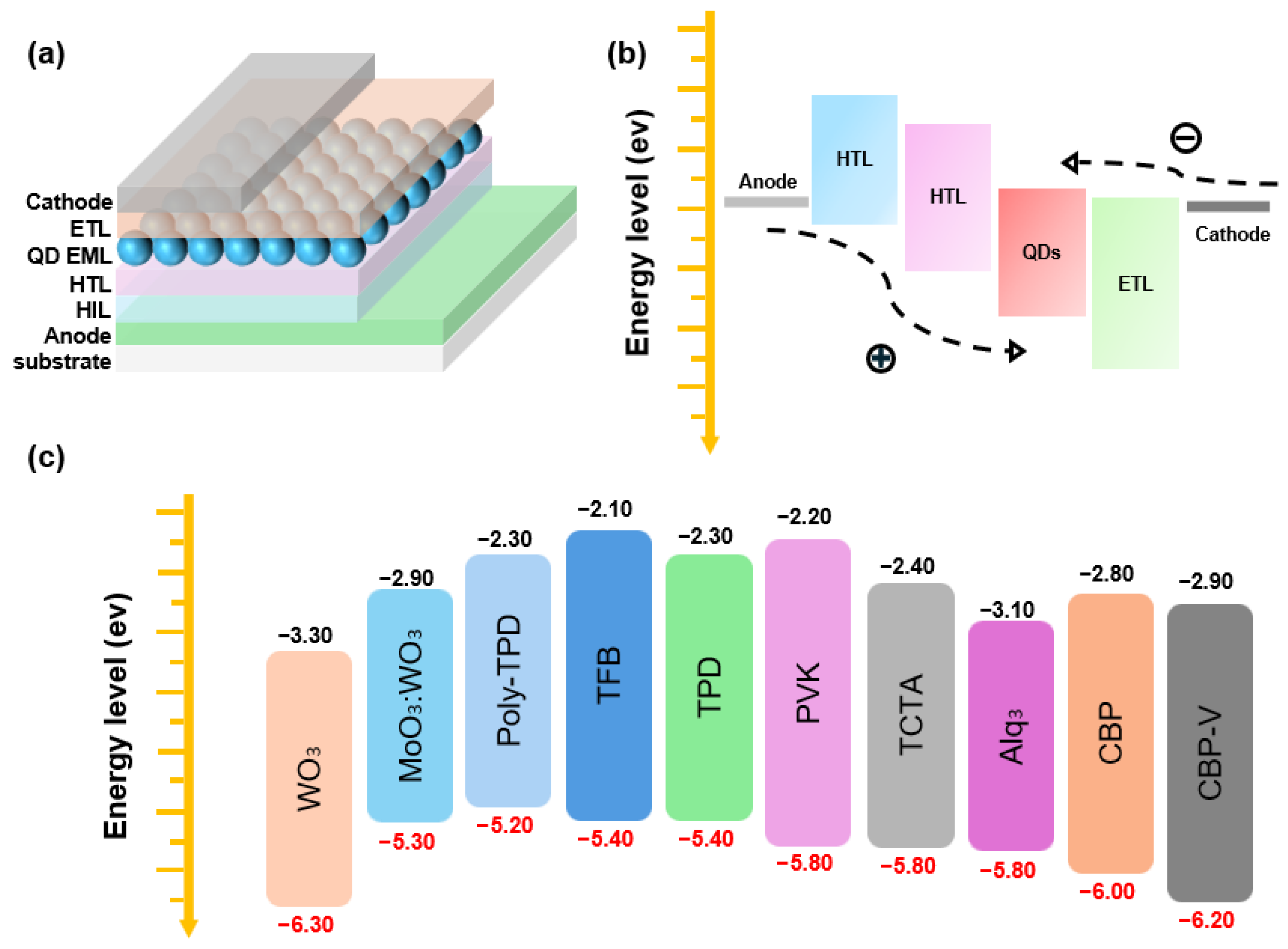
Typically, QLEDs feature a multilayer architecture comprising a substrate, anode, HIL, HTL, QD EML, ETL, and cathode. Under bias, electrons and holes are injected from the cathode and anode, respectively, and transport to the QD EML, where they recombine to generate light (Figure 1a). However, QLEDs inherently suffer from charge transport imbalance arising from the distinct transport characteristics of electrons and holes, which critically determine efficiency and operational stability (Figure 1b) [1,2,7,10].
A significant challenge lies in the energy-level mismatch between the highest occupied molecular orbital (HOMO) of the HTL/HIL and the valence band of the QD EML, which creates a substantial hole injection barrier (Figure 1c) [3,5,6,11]. This barrier necessitates a higher driving voltage to achieve effective hole injection, thereby increasing the turn-on voltage [1,5,11]. As a result, the elevated internal electric field induces thermal and electrical stress within the device, accelerating degradation and shortening the operational lifetime [4,5,10].
Furthermore, the disparity in carrier mobility, where electron mobility in the ETL typically far exceeds hole mobility in the HTL, exacerbates this imbalance [1,7,10]. This transport asymmetry leads to localized electron accumulation, which significantly reduces external quantum efficiency (EQE) and aggravates efficiency roll-off at the high-luminance regime [4,7,12].
Another critical issue arises from the solution-based fabrication process. Since HTLs are predominantly formed via solution-based processes, they often lack sufficient resistance to aromatic solvents (e.g., toluene and octane) used for depositing the subsequent QD layer. This solvent vulnerability can lead to interfacial erosion, increased surface roughness, and localized electric-field concentration, which in turn result in increased leakage current and degraded device reliability [6,8,10]. Therefore, optimizing energy-level alignment, charge transport properties, and interfacial solvent stability is paramount for enhancing the performance and lifetime of QLEDs [1,5,10].

3. HOMO Level Alignment at the Interface Between HTL and QD

One of the primary factors limiting device efficiency and operational stability in QLEDs is the hole injection barrier at the HTL/QD interface. Typically, the valence band of CdSe-based quantum dots, which are widely used, lies in the range of −6.0 to −7.0 eV. In contrast, representative polymeric HTLs, such as (poly(N,N′-bis(4-butylphenyl)-N,N′-bis(phenyl)benzidine)) (poly-TPD) and poly(9,9-dioctylfluorene-co-N-(4-butylphenyl)diphenylamine) (TFB), exhibit HOMO levels at approximately −5.2 eV and −5.3 eV, respectively. This mismatch in energy offset forms a hole injection barrier on the order of 1 eV, resulting in suppressed hole injection relative to electron injection [13,14,15,16,17].
Under such charge-imbalanced conditions, excess electrons accumulate within the QD EML, leading to the formation of charged QDs and the activation of Auger non-radiative recombination [15,17]. These loss mechanisms not only accelerate efficiency roll-off at high current densities but also induce localized heating and interfacial degradation, directly shortening the operational lifetime. Therefore, alleviating this injection bottleneck via HOMO-level engineering is a fundamental requirement for high-performance QLEDs [16].
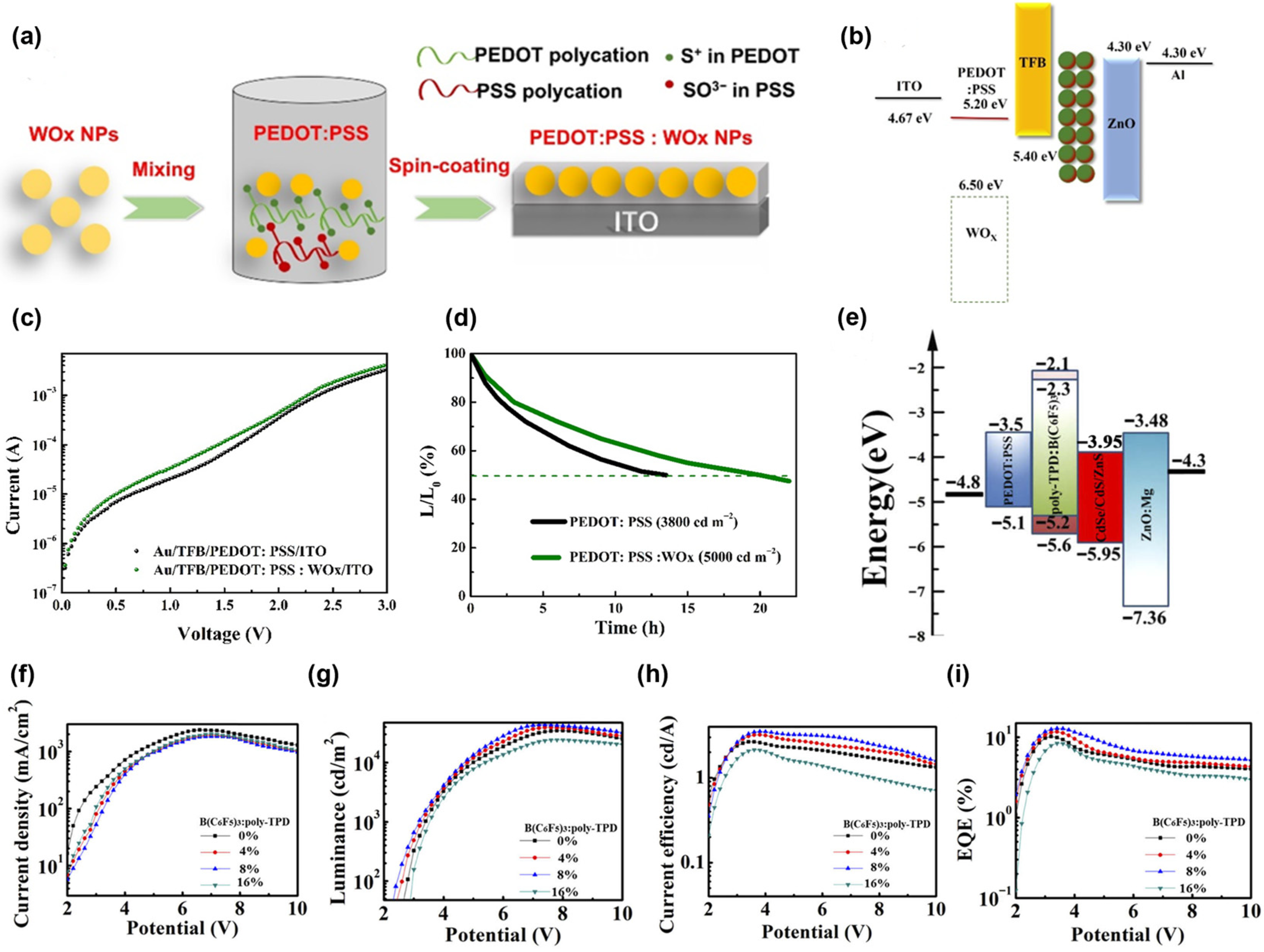
To address these issues, Chen et al. introduced an organic–inorganic hybrid HTL by incorporating solution-processed WOx nanoparticles into poly(3,4-ethylenedioxythiophene):polystyrene sulfonate (PEDOT:PSS), forming a WOx:PEDOT:PSS mixed hole injection and hole transport layer. From an energy-level perspective, the use of WOx leads to more favorable interfacial conditions for hole injection at the PEDOT:PSS (HOMO ≈ −5.20 eV) and TFB (HOMO ≈ −5.40 eV) interfaces. The deep-lying energy level of WOx at approximately −6.5 eV induces an interfacial dipole, which effectively reduces the hole injection barrier (Figure 2b).
Hole-only devices based on TFB/PEDOT:PSS:WOx exhibited increased current density at high voltages, confirming improved hole injection and transport capability in the HTL. As a result, QLEDs employing the optimized WOx:PEDOT:PSS HTL demonstrated significantly enhanced device performance, with the maximum current efficiency increasing from 9.8 to 13.1 cd A−1 and the maximum luminance improving from 46,000 to 62,000 cd m−2. In addition, the operational lifetime was nearly doubled, reaching an extrapolated T50 lifetime of approximately 7071 h at an initial luminance of 100 cd m−2, compared to 3162 h for conventional PEDOT:PSS-based HTL devices (Figure 2c,d). These results demonstrate that improved hole injection through hybrid inorganic–organic HTL engineering can simultaneously alleviate charge imbalance and enhance device efficiency and operational stability [13].
In a parallel approach, Yang et al. employed a p-type doping-based HTL by introducing B(C6F5)3—a strong Lewis acid—into poly-TPD, which deepened the HOMO level from −5.2 eV to −5.6 eV, thereby enabling optimized HOMO alignment at the HTL/QD interface (Figure 2e). Owing to this optimized alignment at an optimal doping concentration of 8%, the maximum luminance, current efficiency, and external quantum efficiency (EQE) of the QLEDs were improved by approximately 26.1%, 35.4%, and 26.4%, respectively, while the turn-on voltage was reduced from 2.6 V to 2.3 V (Figure 2f–i). Furthermore, as the charge injection imbalance was mitigated, the operational stability of the devices was enhanced, resulting in a delayed onset of efficiency degradation [14].

4. HTL with Enhanced Hole Mobility

While energy-level alignment addresses the injection barrier, the intrinsically low hole mobility of organic HTLs remains a fundamental bottleneck limiting QLED performance. Therefore, strategies that accelerate hole transport kinetics to match the robust electron transport are crucial for balancing charge flux and maximizing device efficiency [18,19,20,21].
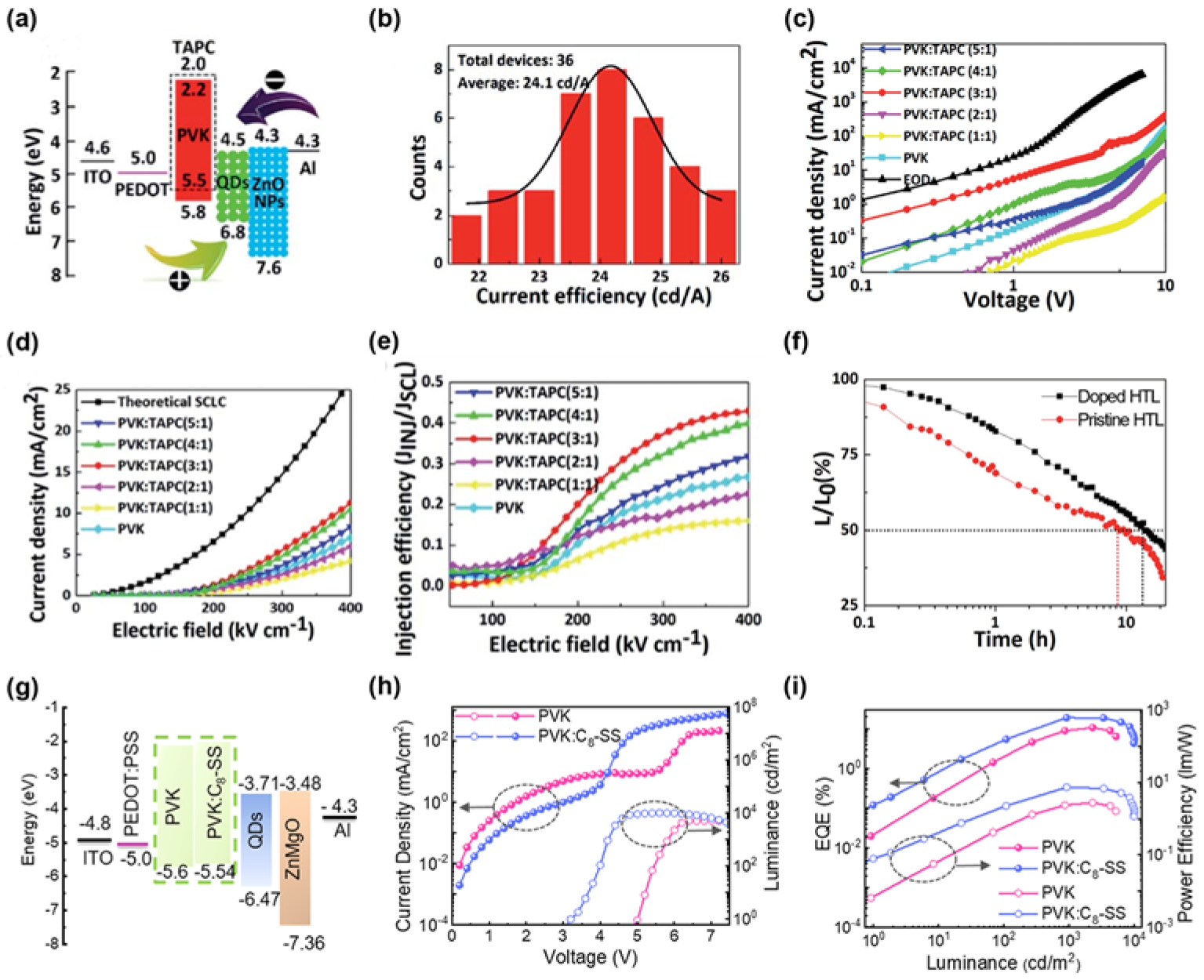
Pan et al. proposed a strategy to enhance hole mobility by creating a composite HTL, blending high-mobility small molecules—di-[4-(N,N-ditolyl-amino)-phenyl]cyclohexane (TAPC, hole mobility ~10−2 cm2 V−1 s−1)—into a PVK (hole mobility, ~10−6 cm2 V−1 s−1) host (Figure 3a). By optimizing the PVK:TAPC volume ratio to 3:1, they significantly enhanced the hole transporting capability of the layer while maintaining favorable energy alignment (Figure 3b). Hole-only device (HOD) analysis revealed that the composite HTL achieved exhibited hole current densities comparable to those of electron-only devices, exhibited a low turn-on voltage of 3.3 V and approximately 60% enhancement in operational stability (Figure 3c–f) [18].
Moving beyond physical blending, Cai et al. reported a mobility enhancement strategy based on molecular modification of the polymer. They introduced an angular-shaped heteroarene based on cyclopentane[b]thiopyran (C8–SS) into PVK to form a PVK:C8–SS HTL (Figure 3g). In this system, mobility increase was driven not by increased carrier concentration (as in p-type doping) but by improved charge transport arising from strong π···π and S···π intermolecular interactions. Space-charge-limited current (SCLC) analysis showed that the hole mobility increased by two orders of magnitude, from 2.44 × 10⁻⁶ cm2 V−1 s−1 (pristine PVK) to 1.73 × 10⁻⁴ cm2 V−1 s−1 (PVK:C8–SS). This high hole mobility facilitated efficient injection into QDs, improving charge balance (Figure 3h). As a result, the PVK:C8–SS-based QLED exhibited a low turn-on voltage of 3.2 V and achieved a peak EQE of 19.02% and a peak power efficiency of 7.31 lm W−1, which were enhanced by 78% and 165%, respectively, compared with the control PVK-based device (Figure 3i). The enhancement was attributed to accelerated hole transport and suppressed Auger recombination in the QD EML [19].
Crucially, this mobility-centered HTL design strategy is conceptually distinct from conventional p-type doping approaches that rely on increasing hole concentration. This strategy directly mitigates the fundamental issue of electron–hole transport imbalance by accelerating hole transport kinetics while avoiding issues associated with heavy doping, such as trap formation, energetic disorder, and interfacial instability [20,22]. Enhanced hole mobility facilitates hole transfer from the HTL to the EML, thereby reducing the injection mismatch and effectively suppressing electron accumulation within the QD EML. The suppression of charge accumulation reduces non-radiative loss pathways, including Auger recombination, which directly translates into mitigated efficiency roll-off and improved operational stability [21,22]. Accordingly, mobility-centered HTL design has emerged as a core design paradigm for overcoming the intrinsic performance limitations of QLEDs [18,19,20,21,22].

5. Solvent Stability Engineering of HTL

The re-dissolution of the HTL and interfacial mixing during the formation of multilayer structures are primary causes of device degradation. Since the QD EML is typically deposited using aromatic solvents such as toluene, solvent-induced erosion and morphological degradation can occur on top of conventional polymeric HTLs. Conventional organic HTLs are susceptible to solvent-induced erosion and morphological damage; therefore, securing the solvent resistance of the HTL is a critical design requirement for ensuring the interfacial integrity and operational stability of QLEDs [23,24,25,26,27,28,29,30,31]. Accordingly, strategies to secure the solvent stability of HTLs have emerged as a crucial design element for improving the efficiency and operational stability of QLEDs.
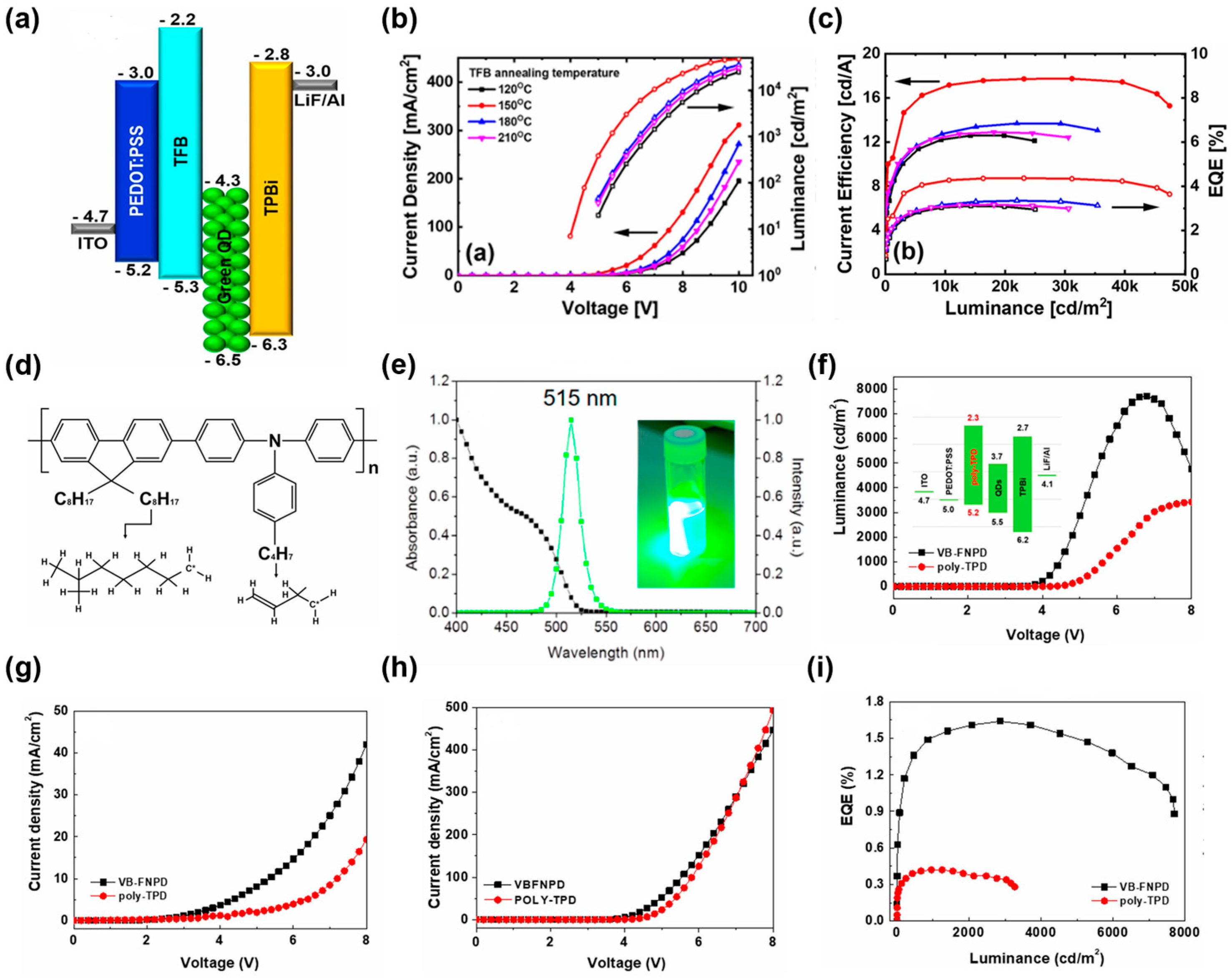
Han et al. mitigated this issue by optimizing the thermal annealing conditions of a high-molecular-weight TFB film (Figure 4a). They demonstrated that increasing the annealing temperature to 150 °C sufficiently densified the TFB layer, thereby suppressing dissolution and interfacial intermixing between the HTL during subsequent QD deposition. Optical microscopy and Focused Ion Beam–Scanning Electron Microscopy (FIB-SEM) analyses confirmed that the optimized TFB film maintained its thickness and surface integrity after QD spin-coating. This robust solvent resistance enabled the formation of uniform QD films without dewetting defects. As a result, QLEDs employing the optimally annealed TFB HTL achieved a maximum luminance of 47,410 cd m−2, a current efficiency of 17.69 cd A−1, and a maximum EQE of 4.36%, representing a clear enhancement compared to devices fabricated with insufficiently hardened HTLs (Figure 4b,c) [23].
Alternatively, Lin et al. developed a chemical approach using a thermally crosslinkable HTL material, molecule 4,4′-bis(N-(1-naphthyl)-N-phenylamino)biphenyl-4-yl vinyl benzene (VB-FNPD) (Figure 4d,e). Upon thermal treatment at 170 °C, VB-FNPD forms a robust three-dimensional crosslinked network that exhibits near-complete insolubility against organic solvents. QLEDs employing this crosslinked HTL exhibited a maximum luminance of 7702 cd m−2 and a maximum EQE of 1.64%, substantially higher than reference devices using conventional poly-TPD HTLs (luminance 3426 cd m−2 and EQE 0.42%) (Figure 4f–i). Time-Resolved Photoluminescence (TRPL) and hole-only device analyses revealed these enhancements improved interfacial quality and reduced non-radiative recombination sites [24].
Collectively, securing solvent stability, whether through thermal optimization or molecular crosslinking, yields a threefold benefit: (i) suppression of HTL/QD interfacial mixing; (ii) improved uniformity of the QD active layer; and (iii) enhanced effective charge recombination. These improvements directly translate into a higher EQE and extended operational lifetime, establishing solvent stability as a prerequisite for high-performance solution-processed QLEDs [32,33,34,35,36].

6. Double-HTL Architectures for Energy-Level Alignment

Energy-level alignment engineering can improve hole injection by lowering the interfacial energy barrier; however, this approach has limitations in addressing the intrinsically low hole mobility of HTLs and the transport asymmetry relative to the ETL [13,14]. Similarly, approaches aimed at increasing the hole mobility can accelerate hole injection, thereby improving electron–hole balance. Nevertheless, when excessive doping or mixing is applied, film non-uniformity and increased roughness often occur, leading to increased leakage current and reduced device reliability [18,19]. Finally, solvent-stability engineering can suppress solvent-induced erosion and interfacial mixing, improving charge injection balance and the EQE. Yet, since thermal treatment is typically required to achieve solvent resistance, the resulting performance becomes strongly dependent on the annealing temperature and time, which can potentially damage the pre-deposited layers [23,24].
As a structural approach to overcome these collective limitations, a double-layer HTL strategy has been proposed. The double-HTL structure aims to reduce the hole injection barrier by sequentially stacking two HTLs with different HOMO levels and hole mobilities, forming a cascading energy-level alignment within the HTL [37,38,39,40].
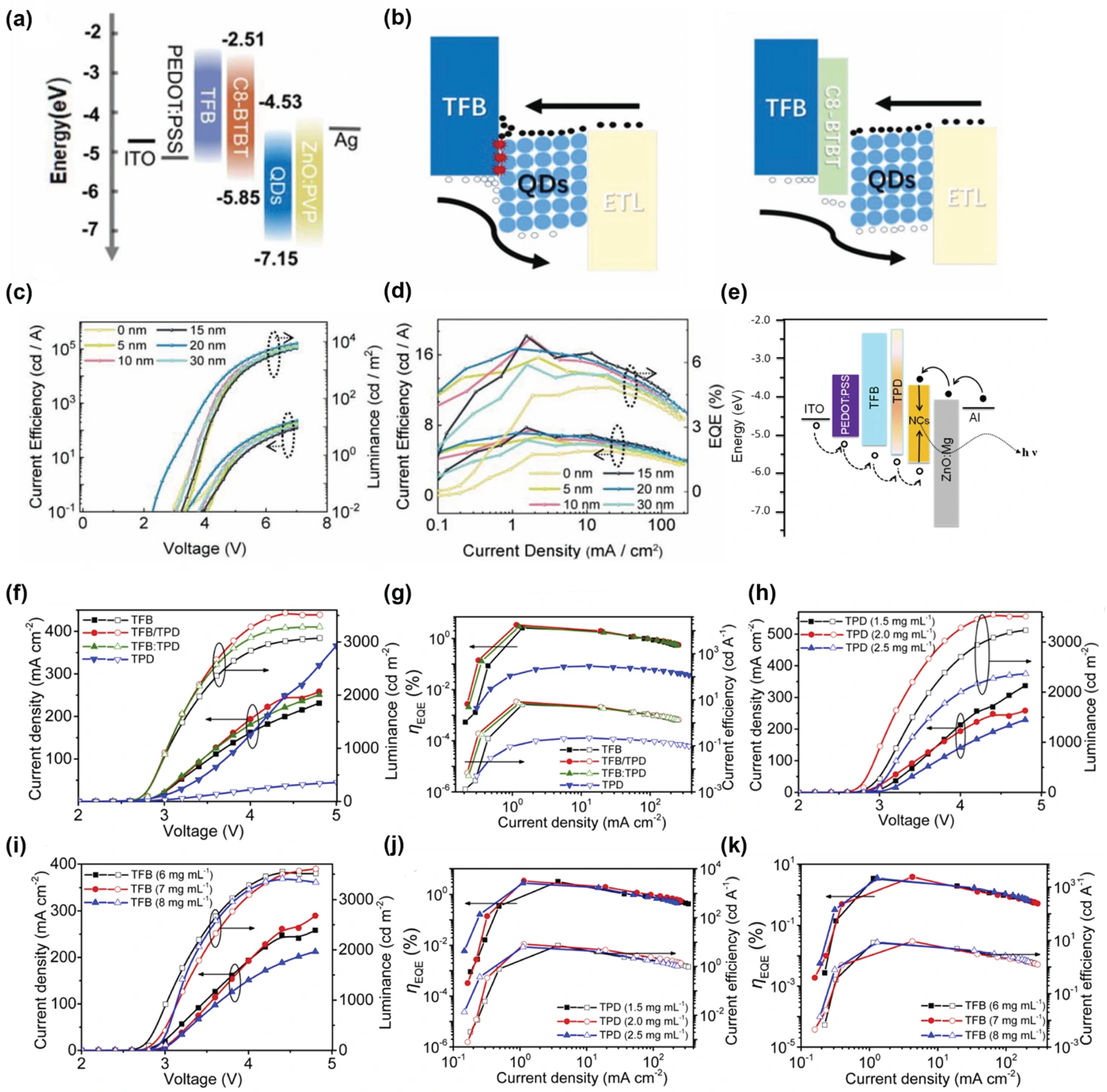
The effectiveness of this strategy is evident in recent studies on solution-processed QLEDs (Figure 5a,b). Luo et al. implemented a cascade HTL architecture by stacking a TFB/2,7-dioctyl [1]benzothieno [3,2-b][1]benzothiophene (C8-BTBT) layer on a TFB layer in cadmium-free blue QLEDs. This double-HTL structure created a stepwise energy alignment that significantly reduced the hole injection barrier. Consequently, the device achieved a remarkable improvement in EQE, rising from 4.84% (single TFB) to 7.23% (double HTL), attributed to suppressed electron leakage and balanced charge injection (Figure 5c,d) [37].
Validating the universality of this approach, Chen et al. (Figure 5e) applied a similar TFB/TPD double-HTL structure to a cadmium-free Cu-In-Zn-S (CIZS)-based QLED. A double-HTL structure combining polymeric TFB and small-molecule TPD was introduced, enabling simultaneous improvement in energy-level alignment and hole transport characteristics compared to single-HTL devices (Figure 5f,g). Consequently, the EQE increased from 2.58% to 3.87%, and through optimization of processing conditions, a maximum efficiency of up to 5.61% was achieved (Figure 5h–k). These findings indicate that the double-HTL strategy represents a generally applicable structural design principle, independent of specific emission colors or QD materials [38].
Overall, the double-HTL structure has emerged as a core design strategy for precise control of energy-level alignment in QLEDs, transcending a simple increase in layer number or material combination. This approach provides structural degrees of freedom that allow hole injection and charge transport requirements to be optimized separately, paving the way for the realization of high-efficiency and high-stability QLEDs [39,41,42,43,44,45,46].

7. Double-HTL Architectures with Buffer Layer

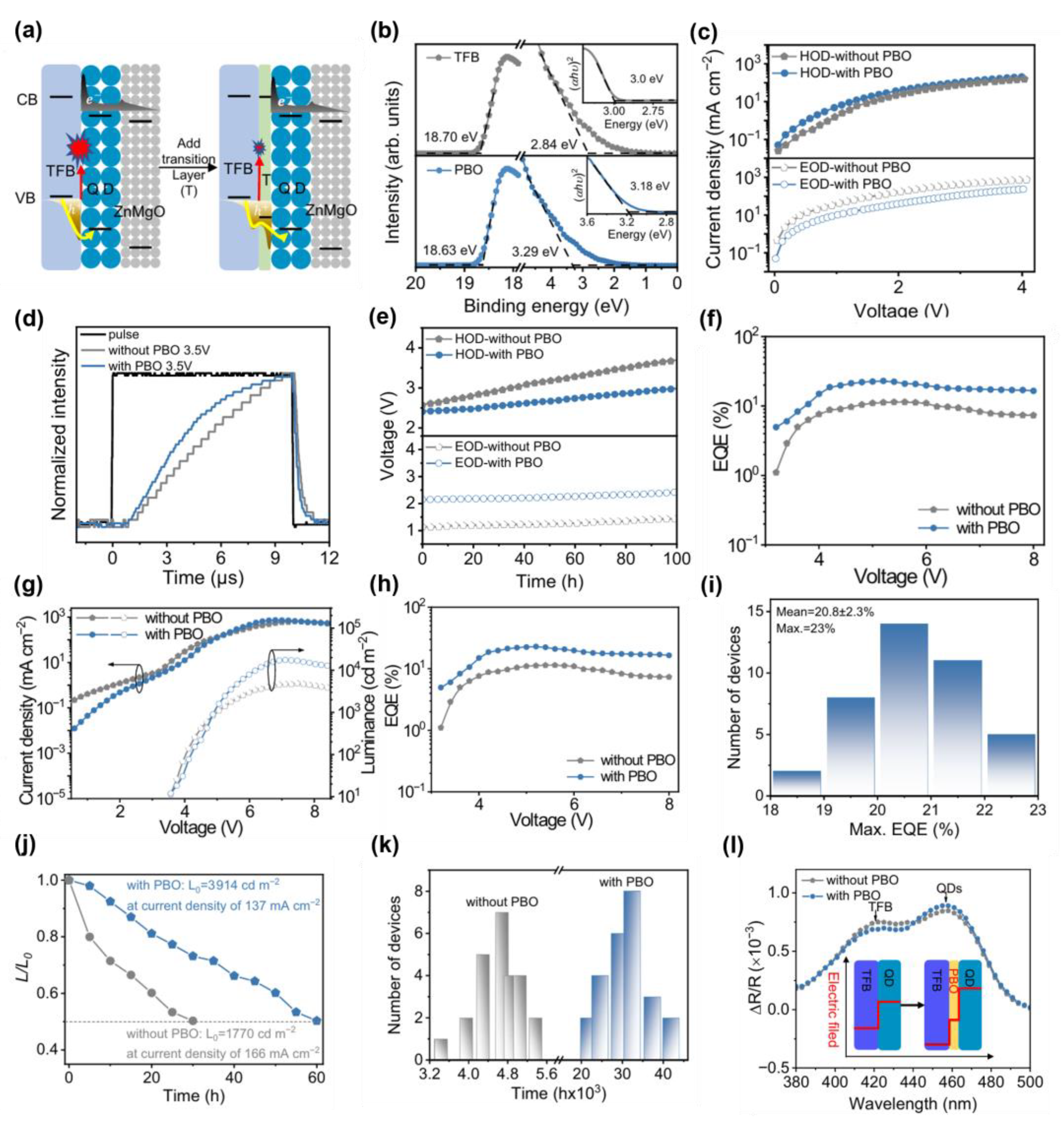
More recently, buffer or transition-layer-based double-HTL strategies have been proposed to mitigate charge-accumulation-induced degradation [47]. Unlike conventional alignment strategies, this approach focuses on structurally suppressing charge accumulation at the HTL/QD interface to prevent HTL oxidation (Figure 1 and Figure 6a).
This strategy is particularly critical for blue QLEDs. Due to the deep valence band level of the QDs, a large hole injection barrier typically forms at the HTL/QD interface, leading to excessive hole accumulation within the HTL. Such hole accumulation accelerates the electrochemical oxidation of the HTL material, serving as a primary degradation mechanism that increases driving voltage and shortens device lifetime (Figure 6b) [47]. In contrast, green and red QLEDs are less susceptible to these injection limitations due to their relatively smaller interfacial energy barriers [47].
Addressing this issue, Zhang et al. reported a buffer-layer-based architecture by inserting a thin layer of poly(p-phenylene benzobisoxazole) (PBO), a polymer material with high oxidation stability, between the TFB HTL and the QD EML. The PBO transition layer effectively suppressed hole pile-up at the interface, resulting in a reduction in the electrical stress and prevention of HTL oxidation (Figure 6c–e) [47].
The introduction of this buffer layer directly translated into significant performance enhancement. Pure blue QLEDs employing the PBO-based double-HTL structure achieved an EQE exceeding 20% and an operational lifetime (T50) at 100 cd m−2 reaching up to 41,000 h (an average value > 31,000 h) (Figure 6f–l). These results indicate that controlling interfacial accumulation and mitigating electrical stress are just as vital as energy-level alignment for prolonging device lifetime [47].
By directly controlling charge accumulation and degradation mechanisms at the HTL–QD interface, this strategy provides structural flexibility to simultaneously achieve high efficiency and extended operational lifetime. This capability is particularly critical for blue QLEDs, where achieving both remains a significant challenge [48]. Accordingly, double-HTL design strategies are evolving beyond simple energy-level alignment to encompass interfacial charge management and stability enhancement [48,49,50,51].
However, despite these district advantages, double-HTL architecture faces inherent limitations. Employment of an additional HTL or buffer layer increases process complexity, complicating thickness control and reproducibility. Furthermore, the requirement for extra materials and deposition steps inevitably leads to higher fabrication costs.

8. Hybrid HTL Architectures with Multiple Strategies

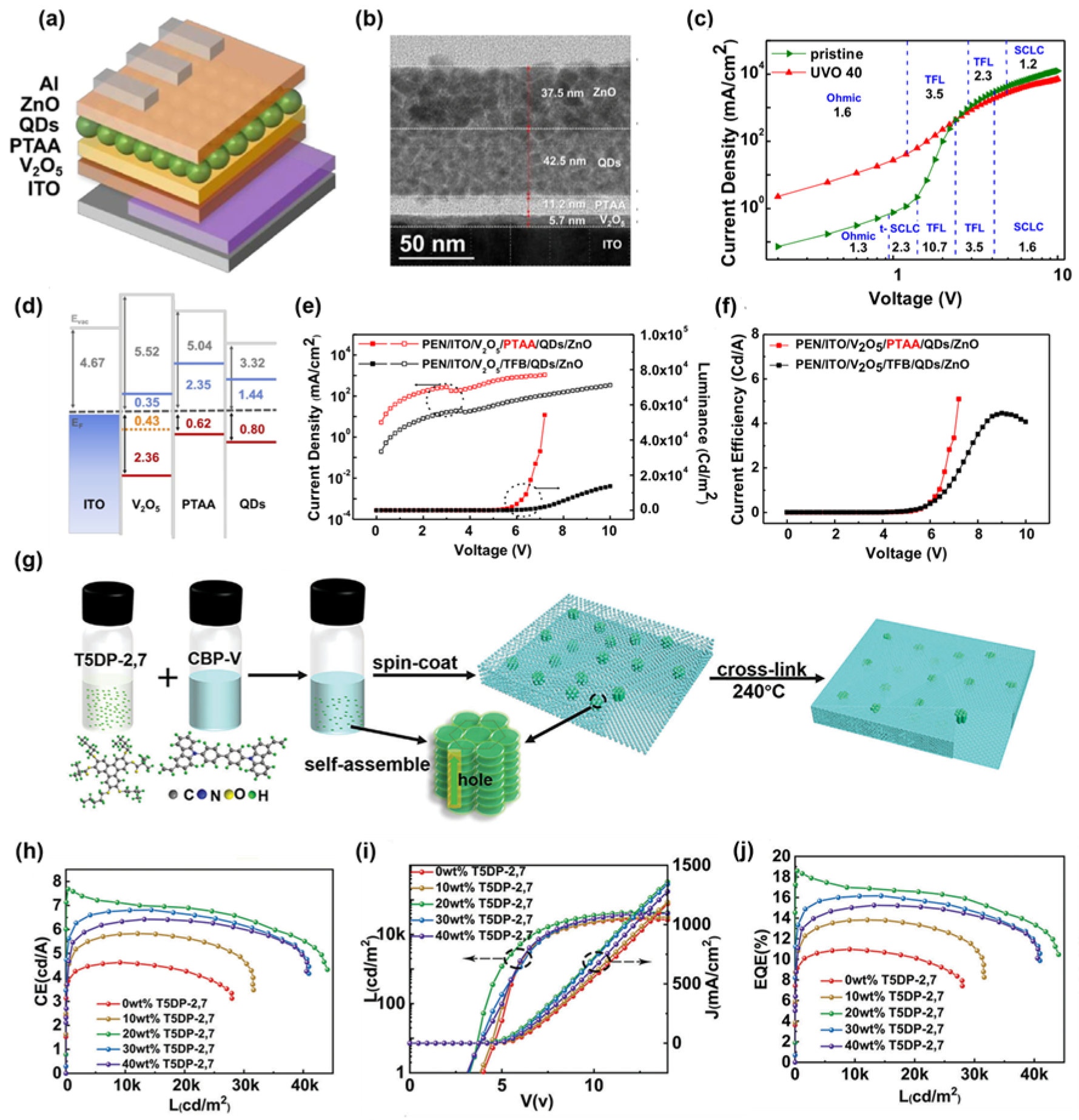
Various strategies—ranging from energy-level modulation, solvent resistance, hole mobility enhancement, and double-layer stacking—have addressed specific performance bottlenecks in HTL. However, relying on a single strategy often necessitates trade-offs, making it challenging to simultaneously optimize efficiency, luminance, and long-term stability under practical operating conditions. To overcome these limitations, hybrid HTL architecture that integrates multiple design rationales into a single cohesive framework has garnered significant attention (Figure 7a,b,g) [52,53,54,55].
Demonstrating the efficacy of this integrated approach, Ha et al. reported a hybrid HTL based on a low-temperature processed PTAA layer combined with UV–ozone surface treatment to improve hole injection and electrical stability in flexible QLEDs (Figure 7c,d). In this work, the corresponding QLED exhibited a maximum luminance of approximately 8.9 × 10⁴ cd m−2 on a glass substrate and approximately 5.4 × 10⁴ cd m−2 on a flexible PEN substrate, with a maximum EQE of approximately 3.5% (Figure 7e,f). These results indicate that integrating band alignment engineering, hole concentration control, and a low-temperature processed multilayer HTL can effectively enhance device efficiency and operational stability [52].
Further advancing this concept, Zhang et al. reported a hybrid HTL that combines crosslinking and blending strategies to secure solvent stability and charge transport properties. They constructed a composite HTL by blending a discotic molecule, 3,6,10,11-tetrakis(pentyloxy)triphenylene-2,7-diyl bis(2,2-dimethylpropanoate) (T5DP-2,7), with a cross-linked CBP-V host, forming robust hole-transport channels and a solvent-resistant cross-linked network (Figure 7g). With the optimized HTL, the turn-on voltage decreased from 3.91 V to 3.42 V, and this optimization significantly improved device performance by enhancing hole injection and achieving more balanced carrier transport within the device (Figure 7h–j) [53].
Hybrid HTL strategies represent a holistic evolution in device engineering, moving beyond a single material parameter optimization to simultaneously address energy level alignment, transport kinetics, interfacial stability, and process stability. Such integrated strategies are poised to play an important role in the development of next-generation QLEDs, particularly for blue-emitting devices where multiple stability and efficiency challenges intersect [52,53,54,55].

9. Conclusions

The HTL is increasingly recognized as a crucial layer that governs not only hole injection and charge transport balance but also device operational stability. Due to the intrinsically electron-dominant nature of QLEDs and their vulnerability to interfacial degradation, performance limitations originating from the hole transport characteristics remain a significant challenge. Recent research suggests that the role of the HTL extends beyond simple energy-level alignment to include the regulation of charge transport, control of interfacial charge accumulation, and securing of process-related and chemical stability. This indicates that the HTL is not a secondary auxiliary element but a key player for the realization of high-performance QLEDs.
For future improvements in QLED performance, it is necessary to adopt an integrated approach that considers energy-level alignment, hole mobility, device stability, and structural design. Conventional energy-level engineering based on HOMO level tuning has been effective in alleviating the hole injection barrier; however, it has been insufficient to completely resolve the fundamental limitations of HTLs, namely, the intrinsically low hole mobility and charge transport asymmetry relative to the ETL. To overcome these limitations, mobility optimization strategies that can practically enhance hole transport are essential, in addition to improving hole injection.
However, conventional mobility enhancement methods based on doping or blending are often accompanied by issues such as film inhomogeneity, increased surface roughness, and leakage currents, which in turn deteriorate device reliability. Therefore, structural approaches utilizing the control of molecular orientation, enhancement of crystallinity, or inorganic and organic–inorganic hybrid HTL materials that intrinsically possess high hole mobility are expected to play an important role. At the same time, the thermal and chemical stability of the HTL should be considered as a key design factor; solvent-stable HTLs, cross-linkable HTLs, or inorganic HTLs can serve as effective alternatives for suppressing interfacial degradation and improving long-term operational lifetime.
In particular, multilayer and hybrid HTL structures provide the advantage of integrating hole injection, hole transport, and interfacial stabilization functions. They offer a realistic design direction for simultaneously achieving energy-level alignment, enhanced mobility, and improved stability. In this context, multilayer and hybrid HTL structures should be regarded as practical solutions that structurally overcome the limitations of single-HTL strategies and as a key research direction for future QLED HTL design.
As QLED technology advances, the strategic importance of the HTL is paramount, particularly for blue QLEDs, which face severe stability bottlenecks due to deep valence bands and high interfacial stress. Since relying solely on emissive layer improvements is insufficient to overcome these hurdles, holistic HTL designs that simultaneously master energy alignment, transport kinetics, and interfacial stability are imperative. Such systematic engineering will be the cornerstone for realizing next-generation high-performance QLEDs with both high efficiency and extended operational lifetimes.

Author Contributions

T.K. and H.K. equally contributed. T.K. and H.K. wrote the main contents of this manuscript under the supervision of S.L. This study was conducted based on the contributions of all authors. All authors have read and agreed to the published version of the manuscript.

Funding

This research was supported by Kumoh National Institute of Technology (2023–2025).

Data Availability Statement

No new data were created in this study.

Conflicts of Interest

The authors declare no conflicts of interest.

References

  1. Mashford, B.S.; Stevenson, M.; Popovic, Z.; Hamilton, C.; Zhou, Z.; Breen, C.; Steckel, J.; Bulović, V.; Bawendi, M.; Coe-Sullivan, S.; et al. High-Efficiency Quantum-Dot Light-Emitting Devices with Enhanced Charge Injection. Nat. Photonics 2013, 7, 407–412. [Google Scholar] [CrossRef]
  2. Shirasaki, Y.; Supran, G.J.; Bawendi, M.G.; Bulović, V. Emergence of Colloidal Quantum-Dot Light-Emitting Technologies. Nat. Photonics 2013, 7, 13–23. [Google Scholar] [CrossRef]
  3. Lim, J.; Jun, S.; Jang, E.; Baik, H.; Kim, H.; Cho, J. Preparation of Highly Luminescent Nanocrystals and Their Application to Light-Emitting Diodes. Adv. Mater. 2007, 19, 1927–1932. [Google Scholar] [CrossRef]
  4. Dai, X.; Zhang, Z.; Jin, Y.; Niu, Y.; Cao, H.; Liang, X.; Chen, L.; Wang, J.; Peng, X. Solution-Processed, High-Performance Light-Emitting Diodes Based on Quantum Dots. Nature 2014, 515, 96–99. [Google Scholar] [CrossRef] [PubMed]
  5. Yang, Y.; Zheng, Y.; Cao, W.; Titov, A.; Hyvonen, J.; Manders, J.R.; Xue, J.; Holloway, P.H. High-Efficiency Light-Emitting Devices Based on Quantum Dots with Improved Charge Injection. Nat. Photonics 2015, 9, 259–266. [Google Scholar] [CrossRef]
  6. Kim, J.-H.; Park, J.-W. Designing an Electron-Transport Layer for Highly Efficient, Reliable, and Solution-Processed Organic Light-Emitting Diodes. J. Mater. Chem. C 2017, 5, 3097–3106. [Google Scholar] [CrossRef]
  7. Kwak, J.; Bae, W.K.; Lee, D.; Park, I.; Lim, J.; Park, M.; Cho, H.; Woo, H.; Yoon, D.Y.; Char, K.; et al. Bright and Efficient Full-Color Colloidal Quantum Dot Light-Emitting Diodes Using an Inverted Device Structure. Nano Lett. 2012, 12, 2362–2366. [Google Scholar] [CrossRef]
  8. Shen, H.; Cao, W.; Shewmon, N.T.; Yang, C.; Li, L.S.; Xue, J. High-Efficiency, Low Turn-on Voltage Blue-Violet Quantum-Dot-Based Light-Emitting Diodes. Nano Lett. 2015, 15, 1211–1216. [Google Scholar] [CrossRef] [PubMed]
  9. Yang, J.; Jo, J.-W.; Kim, Y.; Jung, S.-M.; Lee, S.; Kim, J.M. Smart Textile Display with Addressable Quantum Dot Light-Emitting Diode Based on Durable Ultrathin Metal Electrode. ACS Appl. Nano Mater. 2025, 8, 5961–5970. [Google Scholar] [CrossRef]
  10. Jang, E.; Kim, J.; Jang, H. Colloidal Quantum Dot Light-Emitting Diodes: Materials, Device Structures, and Operational Stability. Chem. Rev. 2023, 123, 4663–4703. [Google Scholar] [CrossRef]
  11. Bang, J.H.; Kamat, P.V. Quantum Dot Sensitized Solar Cells. A Tale of Two Semiconductor Nanocrystals: CdSe and CdTe. ACS Nano 2009, 3, 1467–1476. [Google Scholar] [CrossRef] [PubMed]
  12. Klimov, V.I. Spectral and Dynamical Properties of Multiexcitons in Semiconductor Nanocrystals. Annu. Rev. Phys. Chem. 2007, 58, 635–673. [Google Scholar] [CrossRef]
  13. Chen, L.; Jiang, D.; Du, W.; Shang, J.; Li, D.; Liu, S. Enhanced Performances of Quantum Dot Light-Emitting Diodes with an Organic–Inorganic Hybrid Hole Injection Layer. Crystals 2023, 13, 966. [Google Scholar] [CrossRef]
  14. Yang, M.; Cao, W.; Xue, J. Doping B(C6F5)3 into poly[N,N′-bis(4-butylphenyl)-N,N′-bis(phenyl)benzidine] for efficient quantum dot light-emitting diodes: Balancing electron–hole injection and diminishing parasitic resistance. Opt. Mater. Express 2020, 10, 1597–1606. [Google Scholar] [CrossRef]
  15. Klimov, V.I. Multicarrier Interactions in Semiconductor Nanocrystals in Relation to the Phenomena of Auger Recombination and Carrier Multiplication. Annu. Rev. Condens. Matter Phys. 2014, 5, 285–316. [Google Scholar] [CrossRef]
  16. Tseng, Y.-T.; Chen, T.-Y.; Chu, S.-Y. A Simple Hole Transport Composite Single-Layer for High-Efficiency Quantum Dot Light-Emitting Diodes and Exploring Its Feasibility for Flexible Applications. J. Alloys Compd. 2025, 1049, 185378. [Google Scholar] [CrossRef]
  17. Caruge, J.M.; Halpert, J.E.; Wood, V.; Bulović, V.; Bawendi, M.G. Colloidal Quantum-Dot Light-Emitting Diodes with Metal-Oxide Charge Transport Layers. Nat. Photonics 2008, 2, 247–250. [Google Scholar] [CrossRef]
  18. Pan, J.; Chen, J.; Huang, Q.; Wang, L.; Lei, W. A Highly Efficient Quantum Dot Light-Emitting Diode via Improving the Carrier Balance by Modulating the Hole Transport. RSC Adv. 2017, 7, 43366–43372. [Google Scholar] [CrossRef]
  19. Cai, F.; Zong, H.; Li, M.; Li, C.; Huang, G.; Pascual, J.; Liang, C.; Su, Z.; Li, Z.; Gao, X.; et al. Charge Carrier Regulation for Efficient Blue Quantum-Dot Light-Emitting Diodes Via a High-Mobility Coplanar Cyclopentane[b]thiopyran Derivative. Nano Lett. 2024, 24, 5284–5291. [Google Scholar] [CrossRef]
  20. Yang, X.; Ma, Y.; Mutlugun, E.; Zhao, Y.; Leck, K.S.; Tan, S.T.; Demir, H.V.; Zhang, Q.; Du, H.; Sun, X.W. Stable, Efficient, and All-Solution-Processed Quantum Dot Light-Emitting Diodes with Double-Sided Metal Oxide Nanoparticle Charge Transport Layers. ACS Appl. Mater. Interfaces 2014, 6, 495–499. [Google Scholar] [CrossRef]
  21. Shen, H.; Gao, Q.; Zhang, Y. Visible Quantum Dot Light-Emitting Diodes with Simultaneous High Brightness and Efficiency. Nat. Photonics 2019, 13, 192–197. [Google Scholar] [CrossRef]
  22. Yang, S.; Bi, C.; Dong, W. Electron Delocalization in CsPbI3 Quantum Dots Enables Efficient Light-Emitting Diodes with Improved Efficiency Roll-Off. Adv. Opt. Mater. 2022, 10, 2200189. [Google Scholar] [CrossRef]
  23. Han, Y.J.; An, K.; Kang, K.T.; Ju, B.-K.; Cho, K.H. Optical and Electrical Analysis of Annealing Temperature of High-Molecular Weight Hole Transport Layer for Quantum-dot Light-emitting Diodes. Sci. Rep. 2019, 9, 10385. [Google Scholar] [CrossRef]
  24. Lin, C.-C.; Yeh, S.-Y.; Huang, W.-L.; Xu, Y.-X.; Huang, Y.-S.; Yeh, T.-H.; Tien, C.-H.; Chen, L.-C.; Tseng, Z.-L. Using Thermally Crosslinkable Hole Transporting Layer to Improve Interface Characteristics for Perovskite CsPbBr3 Quantum-Dot Light-Emitting Diodes. Polymers 2020, 12, 2243. [Google Scholar] [CrossRef] [PubMed]
  25. Wang, M.-W.; Song, Y.-M.; Liu, H.; Ding, T.; Jiang, J.; Gao, P.-L.; Ng, K.W.; Wang, S.-P. Blended Hole-Transport Layer for Efficient and Stable Full-Color NiOx-Based QLEDs. J. Mater. Chem. C 2025, 13, 14624–14630. [Google Scholar] [CrossRef]
  26. Jia, N.; Huang, Y.; Gao, M.-Y.; Laishram, D.; Chu, D.; Zhang, Y.; Yang, H. Improved Performance of All-Inorganic Quantum-Dot Light-Emitting Diodes Using an All-Solution Process at Low Temperatures. J. Mater. Chem. C 2025, 13, 16460–16467. [Google Scholar] [CrossRef]
  27. Lee, S.; Kim, Y.; Kim, J. Solution-Processed NiO as a Hole Injection Layer for Stable Quantum Dot Light-Emitting Diodes. Appl. Sci. 2021, 11, 4422. [Google Scholar] [CrossRef]
  28. Yun, J.M.; Park, M.H.; Kim, Y.B.; Choi, M.J.; Kim, S.; Yi, Y.; Park, S.; Kang, S.J. Improvement of the Stability of Quantum-Dot Light Emitting Diodes Using Inorganic HfOx Hole Transport Layer. Materials 2024, 17, 4739. [Google Scholar] [CrossRef]
  29. Xu, S.-H.; Xu, J.-Z.; Tang, Y.-B.; Meng, S.-G.; Liu, W.-Z.; Zhou, D.-Y.; Liao, L.-S. Flexible Substrate-Compatible and Efficiency-Improved Quantum-Dot Light-Emitting Diodes with Reduced Annealing Temperature of NiOx Hole-Injecting Layer. Molecules 2024, 29, 2828. [Google Scholar] [CrossRef]
  30. Wen, M.-R.; Yang, S.-H.; Chen, W.-S. Solution-Processed Smooth Copper Thiocyanate Layer with Improved Hole Injection Ability for the Fabrication of Quantum Dot Light-Emitting Diodes. Nanomaterials 2022, 12, 154. [Google Scholar] [CrossRef]
  31. Yang, J.-H.; Jang, G.-P.; Kim, S.-Y.; Chae, Y.-B.; Lee, K.-H.; Moon, D.-G.; Kim, C.-K. Highly Efficient All-Solution-Processed Quantum Dot Light-Emitting Diodes Using MoOₓ Nanoparticle Hole Injection Layer. Nanomaterials 2023, 13, 2324. [Google Scholar] [CrossRef]
  32. Sun, W.; Deng, Y.; Jin, Y.; Guo, X.; Zhang, Q. Solvent Resistant Hole-Transporting Thin Films via Diacetylene Cross-Linking and Their Applications in Solution-Processed QLEDs. ACS Appl. Polym. Mater. 2020, 2, 3274–3281. [Google Scholar] [CrossRef]
  33. Xie, L.; Xiong, X.; Chang, Q.; Chen, X.; Wei, C.; Li, X.; Zhang, M.; Su, W.; Cui, Z. Inkjet-Printed High-Efficiency Multilayer QLEDs Based on a Novel Crosslinkable Small-Molecule Hole Transport Material. Small 2019, 15, 1900111. [Google Scholar] [CrossRef] [PubMed]
  34. Zhao, W.; Xie, L.; Yi, Y.Q.Q.; Chen, X.; Hu, J.; Su, W.; Cui, Z. Optimizing the central steric hindrance of cross-linkable hole transport materials for achieving highly efficient RGB QLEDs. Mater. Chem. Front. 2020, 4, 3368–3377. [Google Scholar] [CrossRef]
  35. Xie, L.; Yang, J.; Zhao, W.; Yi, Y.Q.Q.; Liu, Y.; Su, W.; Li, Q.; Lei, W.; Cui, Z. High-Performance Inkjet-Printed Blue QLED Enabled by Crosslinked and Intertwined Hole Transport Layer. Adv. Opt. Mater. 2022, 10, 2200935. [Google Scholar] [CrossRef]
  36. Yi, Y.Q.Q.; Qi, D.; Wei, H.; Xie, L.; Chen, Y.; Yang, J.; Hu, Z.; Liu, Y.; Meng, X.; Su, W.; et al. Molecular Design of Diazo Compound for Carbene-Mediated Cross-Linking of Hole-Transport Polymer in QLED with Reduced Energy Barrier and Improved Charge Balance. ACS Appl. Mater. Interfaces 2022, 14, 39149–39158. [Google Scholar] [CrossRef]
  37. Luo, Z.; Yu, Y.; Yang, K.; Lin, L.; Lin, J.; Guo, T.; Hu, H.; Li, F. High-Performance Cadmium-Free Blue Quantum Dot Light-Emitting Devices with Stepwise Double Hole-Transport Layers. Adv. Electron. Mater. 2023, 9, 2200970. [Google Scholar] [CrossRef]
  38. Chen, F.; Wang, L.-J.; Li, X.; Deng, Z.-B.; Teng, F.; Tang, A.-W. Solution-Processed Double-Layered Hole Transport Layers for Highly Efficient Cadmium-Free Quantum-Dot Light-Emitting Diodes. Opt. Express 2020, 28, 6134–6143. [Google Scholar] [CrossRef]
  39. Zhang, T.; Wang, L.; Jiang, R.; Bai, J. Well-Type Thick-Shell Quantum Dots Combined with Double Hole Transport Layers Device Structure Assisted Realization of High-Performance Quantum Dot Light-Emitting Diodes. Opt. Express 2024, 32, 20618–20629. [Google Scholar] [CrossRef]
  40. Chen, H.; Ding, K.; Fan, L.; Liu, W.; Zhang, R.; Xiang, S.; Zhang, Q.; Wang, L. All-Solution-Processed Quantum Dot Light-Emitting Diodes Based on Double Hole Transport Layers by Hot Spin-Coating with Highly Efficient and Low Turn-On Voltage. ACS Appl. Mater. Interfaces 2018, 10, 29076–29082. [Google Scholar] [CrossRef]
  41. Xu, R.; Lai, S.; Zhang, Y.; Zhang, X. Research Progress of Heavy-Metal-Free Quantum Dot Light-Emitting Diodes. Nanomaterials 2024, 14, 832. [Google Scholar] [CrossRef]
  42. Cheng, X.; Zhu, Y.; Li, L.; Basit, A.; Zaman, N.; Chen, X.L.; Xue, Q.; Xu, X.; Xu, G. Efficient Full-Color Quantum Dot-Based Light-Emitting Diodes via Hybrid Polymer-Tailored Hole Transport Engineering. J. Phys. Chem. C 2025, 129, 3975–3982. [Google Scholar] [CrossRef]
  43. Lee, J.; Jung, W.H.; Lee, K.; Bae, Y.; Choi, M.; Oh, J.; Lim, J.; Roh, J. Improved Performance of All-Solution-Processed Quantum Dot Light-Emitting Diodes with TFB/PVK Double-Hole Transport Layers Using 1,2-Dichloroethane. Nanoscale Adv. 2025, 7, 3449–3455. [Google Scholar] [CrossRef]
  44. Hwang, J.H.; Kim, J.; Kim, B.J.; Park, M.; Kwon, Y.W.; An, M.; Shin, D.Y.; Jeon, J.M.; Kim, J.Y.; Lee, W.; et al. Hole Injection of Quantum Dot Light-Emitting Diodes Facilitated by Multilayered Hole Transport Layer. Appl. Surf. Sci. 2021, 558, 149944. [Google Scholar] [CrossRef]
  45. Yang, X.; Mutlugun, E.; Zhao, Y.; Gao, Y.; Leck, K.S.; Ma, Y.; Ke, L.; Tan, S.T.; Demir, H.V.; Sun, X.W. Solution Processed Tungsten Oxide Interfacial Layer for Efficient Hole-Injection in Quantum Dot Light-Emitting Diodes. Small 2013, 10, 247–252. [Google Scholar] [CrossRef] [PubMed]
  46. Park, M.H.; Kim, M.G.; Ma, J.H.; Jeong, J.H.; Ha, H.J.; Kim, W.; Park, S.; Kang, S.J. Enhancing the Performance of Quantum Dot Light-Emitting Diodes Using Solution-Processable Highly Conductive Spinel Structure CuCo2O4 Hole Injection Layer. Materials 2023, 16, 972. [Google Scholar] [CrossRef] [PubMed]
  47. Zhang, W.; Li, B.; Chang, C.; Chen, F.; Zhang, Q.; Lin, Q.; Wang, L.; Yan, J.; Wang, F.; Chong, Y.; et al. Stable and Efficient Pure Blue Quantum-Dot LEDs Enabled by Inserting an Anti-Oxidation Layer. Nat. Commun. 2024, 15, 783. [Google Scholar] [CrossRef]
  48. Cao, W.; Xiang, C.; Yang, Y.; Chen, Q.; Chen, L.; Yan, X.; Qian, L. Highly Stable QLEDs with Improved Hole Injection via Quantum Dot Structure Tailoring. Nat. Commun. 2018, 9, 2608. [Google Scholar] [CrossRef]
  49. Kim, T.; Kim, K.-H.; Kim, S.; Choi, S.-M.; Jang, H.; Seo, H.-K.; Lee, H.; Chung, D.-Y.; Jang, E. Efficient and Stable Blue Quantum Dot Light-Emitting Diode. Nature 2020, 586, 385–389. [Google Scholar] [CrossRef]
  50. Pu, C.; Dai, X.; Shu, Y.; Zhu, M.; Deng, Y.; Jin, Y.; Peng, X. Electrochemically-Stable Ligands Bridge the Photoluminescence-Electroluminescence Gap of Quantum Dots. Nat. Commun. 2020, 11, 937. [Google Scholar] [CrossRef]
  51. Bao, H.; Chen, C.; Cao, Y.; Chang, S.; Wang, S.; Zhong, H. Quantitative Determination of Charge Accumulation and Recombination in Operational Quantum Dots Light Emitting Diodes via Time-Resolved Electroluminescence Spectroscopy. J. Phys. Chem. Lett. 2023, 14, 1777–1783. [Google Scholar] [CrossRef] [PubMed]
  52. Ha, H.J.; Kim, M.G.; Ma, J.H.; Jeong, J.H.; Park, M.H.; Kang, S.J.; Kim, W.; Park, S.; Kang, S.J. Enhanced Performance of Flexible Quantum Dot Light-Emitting Diodes Using a Low-Temperature Processed PTAA Hole Transport Layer. Sci. Rep. 2023, 13, 3780. [Google Scholar] [CrossRef] [PubMed]
  53. Zhang, X.; Li, D.; Zhang, Z.; Liu, H.; Wang, S. Constructing Effective Hole Transport Channels in Cross-Linked Hole Transport Layer by Stacking Discotic Molecules for High-Performance Deep Blue QLEDs. Adv. Sci. 2022, 9, 2200450. [Google Scholar] [CrossRef]
  54. Maheshwaran, A.; Mutlugun, E.; Zhao, Y.; Gao, Y.; Leck, K.S.; Ma, Y.; Ke, L.; Tan, S.T.; Demir, H.V.; Sun, X.W. Low-Temperature Cross-Linkable Hole Transport Materials for Solution-Processed Quantum Dot and Organic Light-Emitting Diodes. ACS Appl. Mater. Interfaces 2023, 15, 45167–45176. [Google Scholar] [CrossRef]
  55. Jiang, C.; Liu, H.; Liu, B.; Zhong, Z.; Zou, J.; Wang, J.; Wang, L.; Peng, J.; Cao, Y. Improved Performance of Inverted Quantum Dot Light-Emitting Devices by Introducing Double Hole Transport Layers. Org. Electron. 2016, 31, 51–57. [Google Scholar] [CrossRef]
Figure 1. (a) Schematic illustration of a typical quantum dot light-emitting diode (QLED) device architecture, consisting of an anode, hole injection layer (HIL), hole transport layer (HTL), quantum dot emissive layer (EML), electron transport layer (ETL), and cathode. (b) Energy band diagram illustrating the injection and transport of holes and electrons from the electrodes into the quantum dot emissive layer, as well as exciton formation within the QLED. (c) Comparison of the HOMO and LUMO energy-level alignment of representative HTL materials commonly employed in QLEDs.
Inorganics 14 00052 g001
Figure 2. (a) Schematic illustration of the fabrication process for the WOx:PEDOT:PSS hybrid hole injection layer [13]. (b) Energy-level diagram of the QLED device employing the hybrid HTL [13]. (c) Operational lifetime characteristics of QLEDs under identical driving conditions [13]. (d) Current density–voltage characteristics of hole-only devices [13]. (e) Comparison of the HOMO and LUMO energy levels of Poly-TPD-based HTLs before and after B(C6F5)3 doping [14]. (f) Current density–voltage (J–V) characteristics of QLEDs with different B(C6F5)3 doping concentrations [14]. (g) Luminance–voltage (L–V) characteristics of QLEDs as a function ofdoping concentration [14]. (h) Current efficiency–voltage characteristics of QLEDs as a function of doping concentrations [14]. (i) External quantum efficiency–voltage characteristics of QLEDs as a function of doping concentration [14]. Adapted from: [13] Chen et al., Crystals, 13, 966 (2023), CC BY 4.0; [14] Yang et al., Optical Materials Express, 10, 1597 (2020), under OSA Open Access Publishing Agreement.
Inorganics 14 00052 g002
Figure 3. (a) Schematic illustration of energy-level alignment in QLEDs as a function of PVK:TAPC doping [18]. (b) Histogram of current efficiency distribution for QLEDs with the optimized composition [18]. (c) Current density–voltage (J–V) characteristics of QLEDs as a function of the PVK:TAPC ratio [18]. (d) Comparison of hole current density as a function of electric field based on space-charge-limited current (SCLC) analysis [18]. (e) Variation in hole injection efficiency as a function of electric field [18]. (f) Comparison of operational stability (L/L0) of QLEDs employing doped HTLs [18]. (g) Comparison of energy-level alignment between PVK- and PVK:C8-SS-based devices [19]. (h) Current density–voltage–luminance (J–V–L) characteristics associated with enhanced hole mobility [19]. (i) Comparison of the luminance dependence of external quantum efficiency (EQE) and power efficiency [19]. The arrows in the figure indicate the y-axis corresponding to each graph. Adapted from: [18] Pan et al., RSC Adv., 2017, 7, 43366–43372, under CC BY 3.0; [19] Cai et al., Nano Lett., 2024, 24, 5284–5291, under CC BY 4.0.
Inorganics 14 00052 g003
Figure 4. (a) Schematic energy-level alignment of the QLED device (ITO/PEDOT:PSS/TFB/QD/TPBi/LiF/Al) [23]. (b) Current density–voltage (J–V) characteristics of QLEDs as a function of the annealing temperature of the TFB HTL [23]. (c) Luminance-dependent current efficiency and EQE at different annealing temperatures [23]. (d) Molecular structure of the polymer HTL (TFB) [24]. (e) Absorption (back dot line) and photoluminescence (PL, green dot line) spectra of CsPbBr3 QDs [24]. (f) Luminance–voltage characteristics of QLEDs incorporating VB-FNPD and poly-TPD HTLs [24]. (g) Current density–voltage characteristics of devices [24]. (h) Comparison of charge injection characteristics depending on the HTL [24]. (i) Enhanced EQE–luminance characteristics of QLEDs [24]. The arrows in the figure indicate the y-axis corresponding to each graph. Adapted from: [23] Han et al., Sci. Rep., 2019, 9, 10385, under CC BY 4.0; [24] Lin et al., Polymers, 2020, 12, 2243, under CC BY 4.0.
Inorganics 14 00052 g004
Figure 5. (a) Energy-level alignment diagram of a QLED employing a TFB/C8-BTBT double HTL [37]. (b) Schematic illustration of charge injection and transport mechanisms in devices with a single TFB HTL and a TFB/C8-BTBT double HTL [37]. (c) Current efficiency–voltage characteristics as a function of C8-BTBT thickness [37]. (d) Current efficiency as a function of current density with varying C8-BTBT thickness [37]. (e) Schematic illustration of electron and hole transport and the light-emission mechanism in the double-HTL structure [38]. (f) Comparison of current density–voltage–luminance (J–V–L) characteristics of devices with a single HTL (TFB) and a double HTL (TFB/TPD) [38]. (The arrows indicate the y-axis corresponding to each graph.) (g) External quantum efficiency (EQE) and current efficiency as a function of current [38]. (h) J–V–L characteristics as a function of TPD [38]. (i) J–V–L characteristics as a function of TFB concentration [38]. (j) EQE–current density characteristics as a function of TPD [38]. (k) Current efficiency–current density characteristics as a function of TFB concentration [38]. The arrows in the figure indicate the y-axis corresponding to each graph. Adapted from: [37] Luo et al., Adv. Electron. Mater., 2023, 9, 2200970, under CC BY 4.0; [38] Chen et al., Opt. Express, 2020, 28, 6134–6143, under OSA Open Access Publishing Agreement.
Inorganics 14 00052 g005
Figure 6. (a) Schematic illustration of charge accumulation and degradation mechanisms at the HTL/QD interface before and after insertion of a transition layer (PBO) [47]. (b) UPS spectra of TFB and PBO films, showing the binding energy regions and valence band edge analysis [47]. (c) Comparison of current density–voltage characteristics of hole-only devices and electron-only devices with and without PBO insertion [47]. (d) Transient electroluminescence responses measured at an operating voltage of 3.5 V, comparing emission dynamics with and without PBO insertion [47]. (e) Operating voltage evolution of hole-only devices and electron-only devices under constant current operation, demonstrating improved electrical stability upon PBO insertion [47]. (f) External quantum efficiency vs voltage characteristics of QLEDs with and without PBO insertion [47]. (g) Current density–voltage–luminance characteristics of QLEDs with and without PBO insertion [47]. (The arrows indicate the y-axis corresponding to each graph.) (h) EQE as a function of current density, comparing efficiency enhancement induced by PBO insertion [47]. (i) Statistical histogram of maximum EQE values, demonstrating the reproducibility of devices with PBO insertion [47]. (j) Normalized luminance (L/L0) as a function of time under constant current density operation, comparing device lifetimes with and without PBO insertion [47]. (k) Statistical histograms of device lifetime distributions for devices without and with PBO insertion [47]. (l) Electroabsorption spectra analysis and schematic illustration of interfacial electric field distribution, showing changes in charge distribution at the HTL/QD interface induced by PBO insertion [47]. Adapted from: [47] Zhang et al., Nat. Commun., 2024, 15, 783, under CC BY 4.0.
Inorganics 14 00052 g006
Figure 7. (a) Schematic illustration of a QLED device with an ITO/V2O5/PTAA/QDs/ZnO/Al architecture [52]. (b) Cross-sectional TEM image showing the multilayer structure with corresponding layer thicknesses [52]. (c) Analysis of voltage-dependent charge transport mechanisms in PTAA-based hole-only devices [52]. (d) Energy-level alignment of each layer derived from UPS analysis [52]. (e) Comparison of current density–luminance–voltage (J–V) characteristics of QLEDs employing TFB and PTAA HTLs (The arrows indicate the y-axis corresponding to each graph.) [52]. (f) Comparison of current efficiency–voltage characteristics of QLEDs employing TFB and PTAA HTLs [52]. (g) Schematic illustration of the formation and cross-linking process of the T5DP-2,7/CBP-V composite HTL [53]. (h) Current efficiency–luminance characteristics as a function of T5DP-2,7 content [53]. (i) Current density–voltage–luminance (J–V–L) characteristics.(The arrows indicate the y-axis corresponding to each graph.) [53]. (j) External quantum efficiency–luminance (EQE–L) characteristics [53]. Adapted from: [52] Ha et al., Scientific Reports, 2023, 13, 3780, under CC BY 4.0; [53] Zhang et al., Adv. Sci., 2022, 9, 2200450, CC BY 3.0.
Inorganics 14 00052 g007
Disclaimer/Publisher’s Note: The statements, opinions and data contained in all publications are solely those of the individual author(s) and contributor(s) and not of MDPI and/or the editor(s). MDPI and/or the editor(s) disclaim responsibility for any injury to people or property resulting from any ideas, methods, instructions or products referred to in the content.