Skip to Content
InorganicsInorganics
  • Article
  • Open Access

12 February 2026

Hydrothermally Constructed ZnIn2S4/SrSnO3 Type-II Heterojunction for Highly Efficient Photocatalytic Hydrogen Evolution


,
,
,
,
,
,
,
and
1
School of Materials Science and Engineering, Guilin University of Electronic Technology, Guilin 541004, China
2
Guangxi Key Laboratory of Information Materials, Guangxi Collaborative Innovation Center of Structure and Property for New Energy Materials, Guilin University of Electronic Technology, Guilin 541004, China
*
Author to whom correspondence should be addressed.
This article belongs to the Special Issue Mixed Metal Oxides, 3rd Edition

Abstract

To achieve high-performance photocatalysts, efficient separation of photogenerated charge carriers is critical to prolonging their lifetime and thereby enhancing the activity of the hydrogen evolution reaction. In this work, we rationally designed and synthesized a nanoflower-like SrSnO3/ZnIn2S4 heterostructure by in situ embedding SrSnO3 nanorods within the layered framework of ZnIn2S4. Experimental results demonstrate that the 0.8%-SrSnO3/ZnIn2S4 composite exhibits a hydrogen evolution rate 13.79 times higher than that of pure ZnIn2S4 under simulated solar irradiation. This dramatic enhancement stems from the formation of a Type-II heterojunction at the interface, where the staggered band alignment generates an internal electric field that drives spatial separation of electrons and holes, effectively suppressing recombination and promoting charge utilization. This study validates that the strategic incorporation of a small amount of SrSnO3 into ZnIn2S4 represents a highly effective approach to significantly boost photocatalytic hydrogen production performance.

1. Introduction

The excessive dependence on fossil fuels has precipitated a profound energy and environmental crisis, rendering the development of green, renewable energy sources an urgent global priority. Among these alternatives, hydrogen (H2) emerges as an ideal and highly promising substitute for fossil fuels, owing to its renewability, clean combustion characteristics, and high gravimetric energy density [1,2,3,4]. Consequently, the advancement of efficient, sustainable, and cost-effective hydrogen production technologies constitutes a fundamental prerequisite for realizing a viable hydrogen economy. Among the diverse hydrogen generation strategies, photocatalytic water splitting (H2O → H2 + 1/2 O2), which directly harnesses abundant solar energy, holds exceptional promise. This approach requires only sunlight and water as inputs, positioning it as a strategic pathway to simultaneously mitigate energy scarcity and environmental degradation [5,6,7]. However, the practical efficiency of this technology remains severely limited by the intrinsic properties of available photocatalyst materials. Conventional semiconductor photocatalysts typically suffer from multiple shortcomings: narrow spectral response to sunlight, low quantum efficiency, rapid recombination of photogenerated charge carriers, inadequate or misaligned redox potentials, and insufficient operational stability—often manifested as susceptibility to photo-corrosion or structural decomposition under reaction conditions [8,9,10,11]. Therefore, the rational design and development of novel photocatalysts that synergistically integrate broad light-harvesting capability, efficient charge separation and transport, appropriately aligned band structures, and robust chemical stability represent the central research thrust for overcoming current technological bottlenecks and enabling the scalable deployment of solar-driven hydrogen production [12,13].
ZnIn2S4 is a direct-bandgap semiconductor with a layered crystal structure. Owing to its polymorphic crystal phases and strong visible-light responsiveness, it has been widely employed in photocatalytic applications, including organic dye degradation, hydrogen evolution, and CO2 reduction [14,15,16], attracting considerable research interest. ZnIn2S4 crystallizes in three distinct phases: cubic, hexagonal, and trigonal, all of which exhibit photocatalytic activity under visible-light irradiation [17,18,19,20]. The cubic phase adopts a spinel-type structure, in which Zn atoms occupy tetrahedral sites and In atoms reside in octahedral coordination. Although its bandgap is slightly narrower (~2.3 eV), theoretically enabling broader solar spectrum absorption, its three-dimensional framework is less effective than the layered architecture of the hexagonal phase in facilitating charge separation. Consequently, the cubic phase demonstrates inferior photocatalytic performance—particularly in hydrogen evolution and pollutant degradation—compared to its hexagonal counterpart [21,22,23]. In contrast, hexagonal ZnIn2S4 possesses a layered structure stabilized by weak interlayer S-S van der Waals interactions, which critically promote the spatial separation of photogenerated electron–hole pairs [24]. This structural anisotropy enables the establishment of an interlayer potential gradient, allowing photogenerated electrons to migrate across layers via quantum tunneling, while holes remain confined within individual layers. Such directional charge transport enhances intralayer carrier mobility and suppresses interlayer recombination, thereby maximizing the utilization efficiency of photogenerated carriers [25]. The electronic band structure of hexagonal ZnIn2S4—engineered for visible-light harvesting—is governed by the tetrahedral coordination of Zn and the mixed tetrahedral/octahedral coordination of In, yielding a bandgap of approximately 2.5 eV. This value ensures effective absorption of a substantial portion of the solar spectrum while providing sufficient redox potential to drive photocatalytic reactions [20]. Nevertheless, the practical performance of pristine ZnIn2S4 is often hampered by rapid charge recombination and particle aggregation. Faced with the limitations of ZnIn2S4 in photocatalytic applications, researchers did not stand still. Instead, through continuous exploration, they gradually developed a series of targeted modification strategies. These ranged from constructing heterojunctions to optimize charge separation efficiency, to depositing co-catalysts to enhance reaction kinetics, to adjusting the band structure through elemental doping and improving the interfacial reaction environment via surface engineering. It is precisely the implementation of these modification strategies that has transformed ZnIn2S4 from a theoretical research material into a viable candidate with both practical utility and promising development prospects. It has steadily gained a foothold in fields such as environmental remediation (e.g., pollutant degradation) and solar-to-fuel conversion, providing robust research support for technological advancement in these domains [26,27,28].
SrSnO3 adopts a perovskite-type crystal structure (space group Pbnm), in which Sr2+ cations occupy the interstitial sites formed by corner-sharing SnO6 octahedra. This highly symmetric three-dimensional network endows the material with excellent physical and chemical stability, as well as favorable charge carrier mobility [29,30]. Consequently, SrSnO3 has been widely investigated in recent years for applications in gas sensors, ion batteries, and thermoelectric capacitors [31,32,33]. However, its utility in photocatalysis is severely constrained by its intrinsically wide bandgap (~4.24 eV), which limits light absorption predominantly to the ultraviolet region and renders it virtually inactive under visible-light irradiation [34,35]. When integrated with ZnIn2S4, SrSnO3 contributes to two critical enhancements in the composite system. First, the heterostructure broadens the overall light absorption range: whereas each component individually absorbs only a narrow portion of the solar spectrum, their combination enables synergistic harvesting across a significantly extended wavelength range, thereby improving solar energy utilization efficiency. Second, the composite exhibits markedly improved charge carrier dynamics. Leveraging the high intrinsic carrier mobility of SrSnO3 and coupling it with the rapid interlayer charge transport capability of layered ZnIn2S4, the heterojunction facilitates accelerated electron migration throughout the composite. Moreover, the rigid three-dimensional framework of SrSnO3 imparts enhanced structural robustness to the composite, effectively mitigating the risk of layer collapse or structural degradation commonly observed in pure ZnIn2S4 during prolonged photocatalytic operation. This structural reinforcement contributes to improved catalyst durability and extended service lifetime. Therefore, the construction of a heterojunction between ZnIn2S4 nanosheets and nanorod-structured SrSnO3 holds significant promise for advancing the performance and stability of photocatalytic hydrogen evolution systems.
In this study, we synthesized Type-II SrSnO3/ZnIn2S4 nanocomposite heterojunction photocatalysts via a hydrothermal method. The crystal structure, morphology, elemental chemical states, and optical absorption characteristics of the as-prepared samples were systematically characterized using a suite of analytical techniques. Furthermore, we evaluated the influence of varying SrSnO3 loading levels on the photocatalytic hydrogen evolution performance of the heterojunction under simulated solar irradiation. Comparative analysis of the experimental results revealed that the hydrogen production rate of the composite photocatalyst significantly outperformed that of pure SrSnO3 and ZnIn2S4 counterparts. Finally, the photocatalytic reaction pathways and underlying charge transfer mechanisms were elucidated based on band structure alignment and redox potential considerations.

2. Results and Discussion

2.1. Structural Characterization and Surface Properties

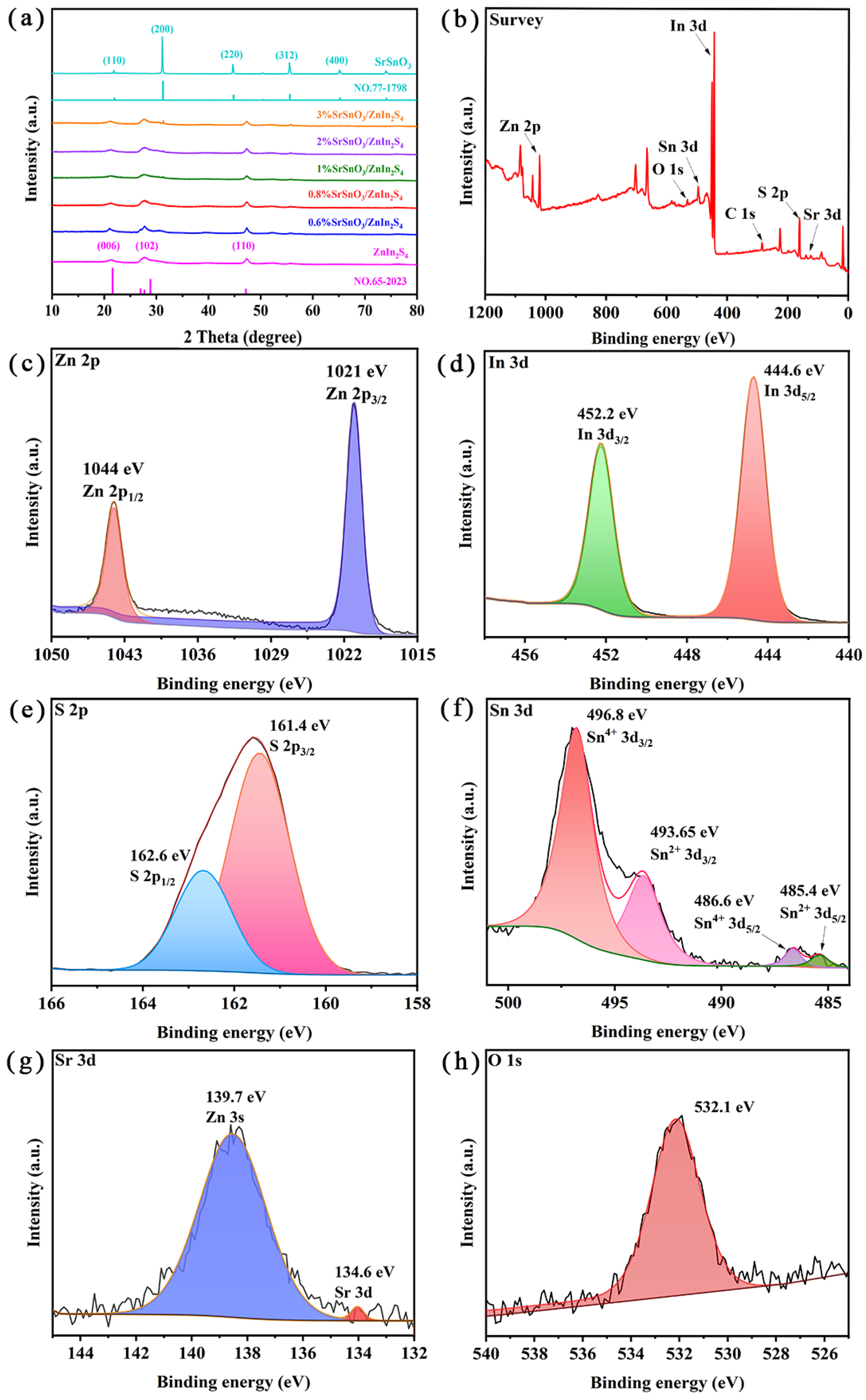
Figure 1a presents the XRD patterns of the as-synthesized ZnIn2S4, SrSnO3, and X-SrSnO3/ZnIn2S4 samples. The diffraction peaks of pure SrSnO3 appear at 2θ = 31.2°, 44.78°, and 55.64°, which can be indexed to the (200), (220), and (312) crystallographic planes, respectively, in agreement with JCPDS Card No. 77-1798 (orthorhombic, space group Pbnm) [36]. For pure ZnIn2S4, characteristic peaks located at 2θ = 21.48°, 27.65°, and 47.5° correspond to the (006), (102), and (110) planes, respectively, matching well with JCPDS Card No. 65-2023 (hexagonal, space group P63mc) [37]. In the X-SrSnO3/ZnIn2S4 composites, diffraction peaks corresponding to both ZnIn2S4 and SrSnO3 phases are clearly observed, confirming the successful formation of the heterostructured composites. With increasing SrSnO3 molar content, the intensity of the SrSnO3 (200) peak progressively increases, indicating a higher relative abundance of the SrSnO3 phase within the composite. Notably, no additional or impurity-related diffraction peaks are detected, suggesting the absence of secondary phases or chemical reactions between the constituents during synthesis.
Figure 1. (a) XRD patterns of as-synthesized SrSnO3, ZnIn2S4, and X-SrSnO3/ZnIn2S4; (b) XPS survey spectrum of 0.8%-SrSnO3/ZnIn2S4; high-resolution XPS spectra of (c) Zn 2p, (d) In 3d, (e) S 2p, (f) Sn 3d, (g) Sr 3d, and (h) O 1s.
XPS analysis was conducted on the 0.8%-SrSnO3/ZnIn2S4 composite to probe its surface composition and chemical states. As shown in Figure 1b–h, distinct photoelectron peaks corresponding to Zn, In, S, Sr, Sn, and O are clearly resolved. The carbon (C) signal detected in the survey spectrum originates from adventitious carbon adsorbed on the sample surface or from the instrument environment, as no carbon-containing precursors were introduced during synthesis. In Figure 1c, the Zn 2p doublet exhibits binding energies of 1044.1 eV (Zn 2p1/2) and 1021.1 eV (Zn 2p3/2), consistent with Zn2+ in a sulfide coordination environment [38]. In Figure 1d, the In 3d spectrum displays two peaks at 452.2 eV (In 3d3/2) and 444.6 eV (In 3d5/2), characteristic of In3+ in ZnIn2S4 [39]. The S 2p spectrum (Figure 1e) is deconvoluted into two spin–orbit components at 162.6 eV (S 2p1/2) and 161.4 eV (S 2p3/2), confirming the presence of S2− in the lattice. In Figure 1f, within the binding energy range of 130–140 eV, the peak at 139.7 eV is assigned to Zn 3s, while the weaker feature at 134.6 eV corresponds to Sr 3d. The low intensity of the Sr 3d signal is attributed to the minimal molar loading (0.8%) of SrSnO3 in the composite, resulting in a low surface concentration of Sr species—a trend consistent with prior reports [40]. As shown in Figure 1g, the Sn 3d spectrum reveals a doublet for each spin–orbit component: Sn 3d5/2 peaks at 485.4 eV and 486.6 eV, and Sn 3d3/2 peaks at 493.6 eV and 496.8 eV. These features indicate the coexistence of Sn2+ and Sn4+ oxidation states. Specifically, the lower binding energy peaks (485.3 eV for Sn 3d5/2 and 494.0 eV for Sn 3d3/2) are assigned to lattice Sn4+ in SrSnO3, while the higher binding energy components (486.4 eV and 496.8 eV) likely arise from surface-oxidized Sn species, possibly SnO2, formed due to ambient exposure [41]. In Figure 1h, the O 1s peak centered at 532.1 eV is attributed to lattice oxygen in SrSnO3 or surface-adsorbed oxygen species.
Based on the above XPS characterization results, the following conclusions can be drawn: First, the data clearly confirms the coexistence of SrSnO3 and ZnIn2S4 components within the composite material, highly consistent with prior XRD analysis conclusions, further validating the successful preparation of the composite material. Second, analysis of characteristic peaks for Sn and O elements clarifies the surface chemical environment and oxidation state distribution of constituent elements within the composite material. This provides crucial surface chemical data support for subsequent studies on the material’s photocatalytic performance and structure–property relationships.
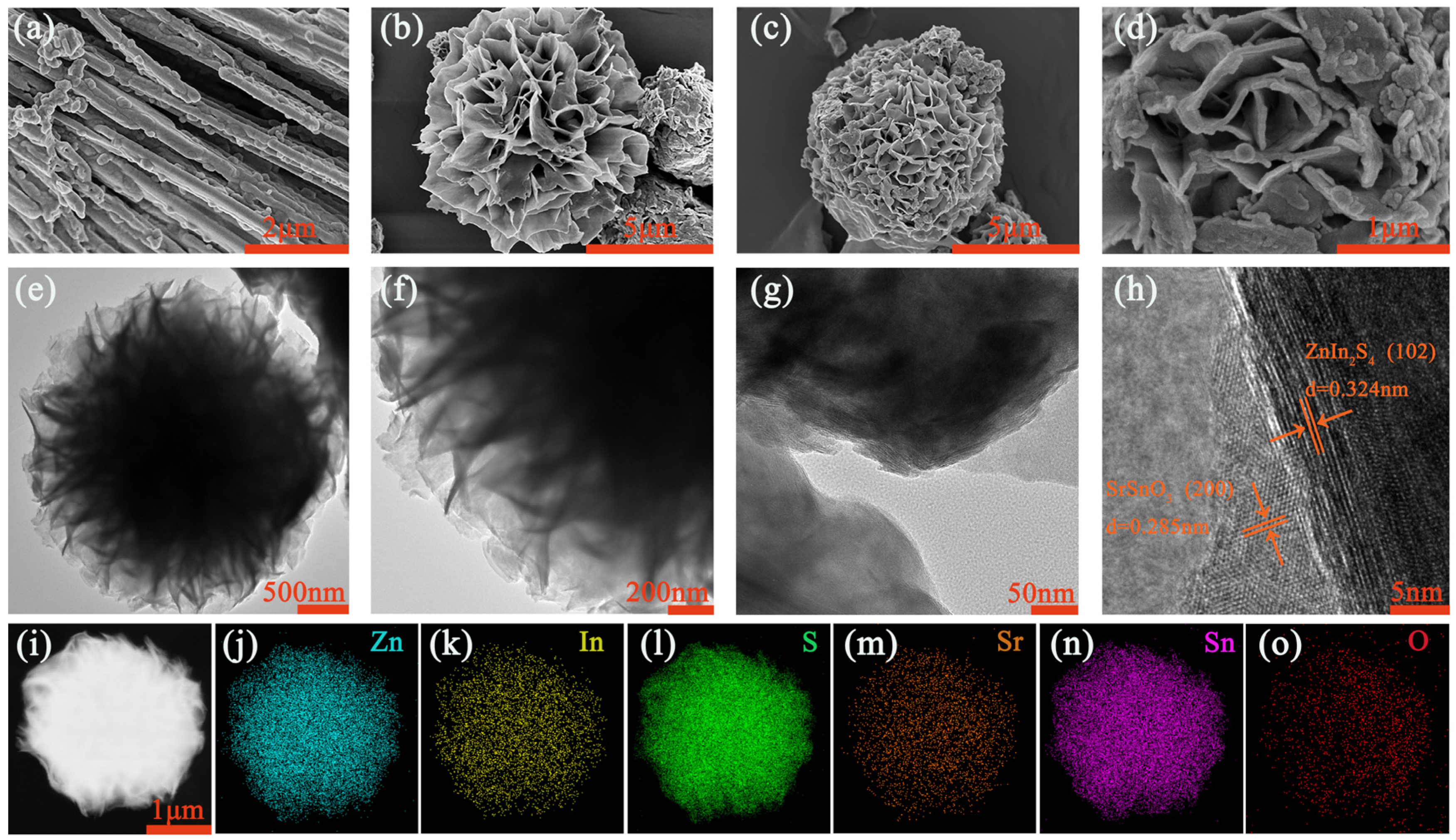
As shown in Figure 2a–d, SEM images of pure SrSnO3, pure ZnIn2S4, and the 0.8%-SrSnO3/ZnIn2S4 composite are presented. Figure 2a reveals that single-phase SrSnO3 consists predominantly of densely packed, micrometer-scale rod-like particles [42]. In contrast, pure ZnIn2S4 (Figure 2b) exhibits a characteristic hydrangea-like hierarchical morphology, composed of numerous ultrathin nanoflakes (1–10 μm in lateral dimension) radially assembled into spherical microstructures—consistent with prior observations by Zhou et al. [43]. This three-dimensional architecture offers a high specific surface area and abundant exposed edges, which are beneficial for enhancing reactant adsorption and providing abundant active sites for photocatalytic reactions. Figure 2c,d display the microstructure of the 0.8%-SrSnO3/ZnIn2S4 composite, revealing that smaller SrSnO3 nanorods are successfully anchored onto the surface of the ZnIn2S4 microspheres. Two primary interfacial configurations are observed: (i) SrSnO3 rods partially embedded within the interlayers of ZnIn2S4 nanosheets, and (ii) rods firmly attached to the external surfaces of the nanosheets. This close interface contact plays a crucial role in promoting charge transfer between the heterojunctions. To further validate the microstructural characteristics of the material, the composite was characterized using transmission electron microscopy (TEM) and high-resolution transmission electron microscopy (HRTEM) (Figure 2e–h). The results obtained were consistent with the conclusions drawn from scanning electron microscopy (SEM) observations, forming a complete chain of microstructural evidence. TEM images reveal that even after introducing the SrSnO3 component via hydrothermal synthesis, the original spherical framework of ZnIn2S4 remains structurally intact. This phenomenon indicates that the adopted synthesis process does not disrupt the morphology of the ZnIn2S4 matrix, providing structural support for subsequent studies on material stability. More importantly, the HRTEM image in Figure 2h clearly reveals two sets of lattice fringes: one with an interplanar spacing of 0.285 nm, identified as the (200) plane of the orthorhombic SrSnO3 phase [44], and another with a lattice spacing of 0.324 nm, which, according to literature data, corresponds to the (102) plane of the hexagonal ZnIn2S4 phase [45]. This direct microstructural evidence further confirms that SrSnO3 and ZnIn2S4 form distinct crystalline phases within the composite material, achieving effective compounding. This provides direct structural support for heterojunction construction and charge transfer mechanism analysis. The coexistence of these distinct lattice spacings at the interface provides direct evidence of the heterojunction formation. The EDS elemental mapping of the composite (Figure 2i–o) confirms the homogeneous spatial distribution of Zn, In, and S—elements constituting the ZnIn2S4 matrix—which collectively outline the spherical morphology with visible layered texture. Although the signals for Sr and O are relatively weak (attributable to the low 0.8% loading of SrSnO3), they exhibit a uniform spherical distribution that overlaps with the ZnIn2S4 framework. This confirms the successful and uniform dispersion of SrSnO3 nanorods across the hydrangea-like ZnIn2S4 structure. Collectively, these morphological and structural characterizations validate the successful fabrication of the SrSnO3/ZnIn2S4 heterostructured photocatalyst with intimate interfacial contact—a prerequisite for efficient charge separation and transfer in photocatalytic applications.
Figure 2. SEM images of (a) pure SrSnO3, (b) pure ZnIn2S4, (c,d) 0.8%-SrSnO3/ZnIn2S4, (eg) TEM images and (h) HRTEM images of 0.8%-SrSnO3/ZnIn2S4 composite, (io) the corresponding EDS mapping images of Zn, In, S, Sr, Sn and O elements in 0.8%-SrSnO3/ZnIn2S4 composite photocatalysts.

2.2. Photocatalytic Properties

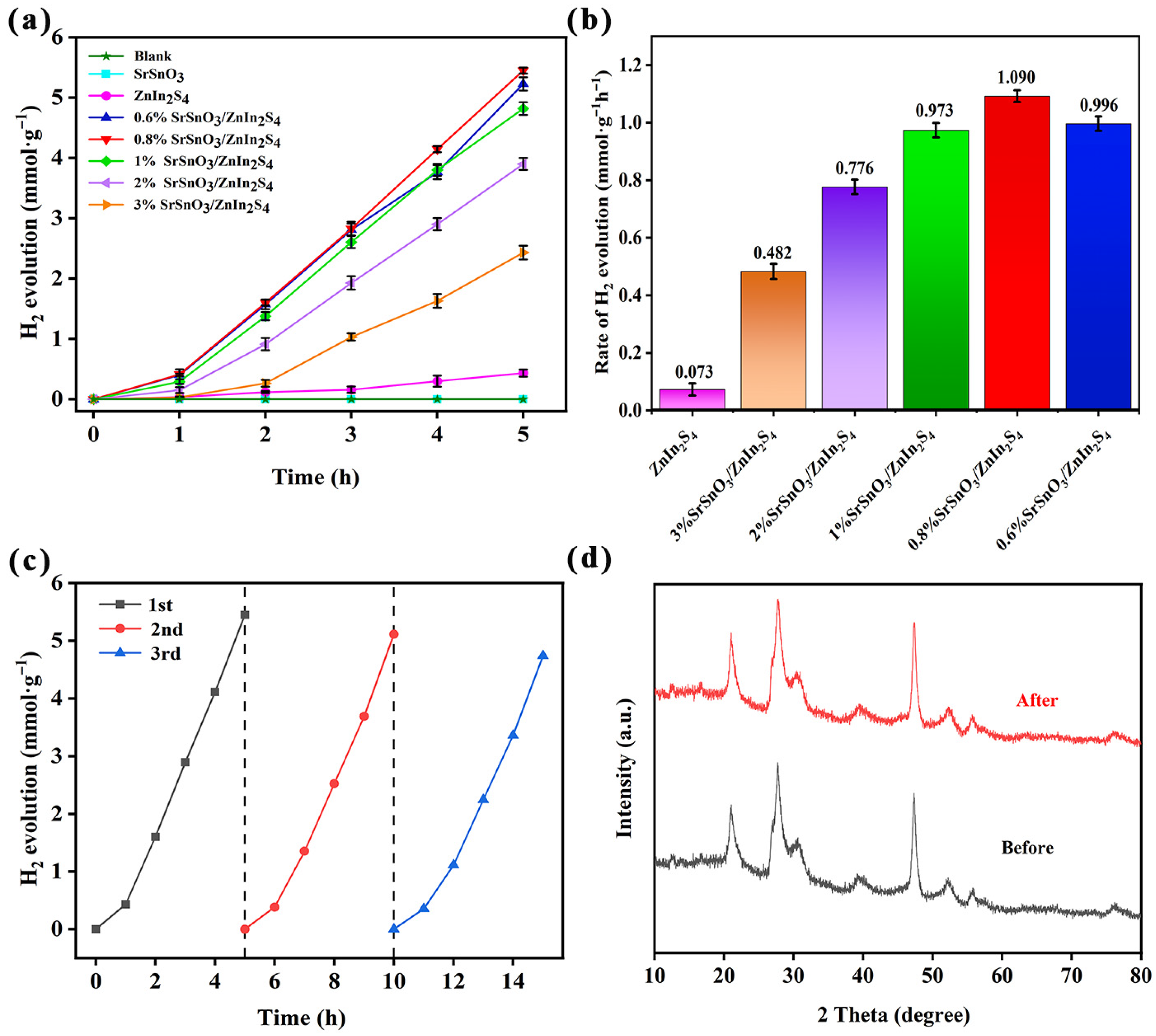
The photocatalytic hydrogen evolution performance and cycling stability of the synthesized materials were evaluated under simulated solar irradiation, as summarized in Figure 3a. Hydrogen production was monitored over a 5 h irradiation period at a constant reaction temperature of 6 °C, using Na2S/Na2SO3 as sacrificial electron donors. As expected, pure SrSnO3—owing to its wide bandgap (~4.24 eV)—exhibited negligible hydrogen evolution activity under visible-light illumination. In contrast, pure ZnIn2S4 achieved a cumulative hydrogen yield of 0.398 mmol·g−1 over 5 h. Remarkably, the introduction of SrSnO3 into the ZnIn2S4 matrix significantly enhanced photocatalytic performance. After 5 h of irradiation, the composite photocatalysts with SrSnO3 molar loadings of 3%, 2%, 1%, and 0.6% yielded hydrogen amounts of 2.493, 4.855, 3.902, and 5.282 mmol·g−1, respectively. Notably, the 0.8%-SrSnO3/ZnIn2S4 sample exhibited the highest hydrogen production, reaching 5.451 mmol·g−1. The corresponding hydrogen production rates (HPRs), calculated as average rates over the 5 h period, are presented in Figure 3b. The HPR of pure ZnIn2S4 was 0.079 mmol·g−1·h−1, whereas the 0.8%-SrSnO3/ZnIn2S4 composite achieved an HPR of 1.09 mmol·g−1·h−1, a 13.79-fold enhancement.
Figure 3. (a) Cumulative hydrogen evolution over 5 h under simulated solar irradiation; (b) average hydrogen production rate (HPR) of all samples; (c) cycling stability test of the 0.8%-SrSnO3/ZnIn2S4 composite photocatalyst over three consecutive 5 h runs; (d) XRD patterns of the 0.8%-SrSnO3/ZnIn2S4 composite before and after three photocatalytic cycles, confirming structural stability.
The dependence of HPR on SrSnO3 loading follows a volcano-shaped trend: activity initially increases with increasing dopant concentration, peaks at 0.8%, and then declines at higher loadings. This behavior reflects the delicate balance among charge separation efficiency, structural integrity, and surface active site density governed by the dopant concentration. When the load of SrSnO3 is too large (e.g., 3%), it is speculated that this may be due to the interface defects or lattice strains in the composite that are not conducive to charge separation, which hinder the carrier transmission, thus reducing the photocatalytic efficiency [46,47]. In addition, other potential factors, such as the ZnIn2S4 surface active site covered or blocked by excessive SrSnO3, may also have a negative impact on the catalytic efficiency [48]. At moderate loadings (e.g., 0.8%), defect density is optimized, enabling efficient spatial separation of photogenerated carriers, favorable band alignment, and sufficient catalytic sites—all while preserving lattice stability to support rapid charge migration. However, at very low loadings (e.g., 0.6%), insufficient heterojunction formation leads to inadequate charge separation and a scarcity of active interfaces, ultimately limiting overall photocatalytic activity [49,50,51].
Photocatalyst stability is critical for practical deployment. As shown in Figure 3c, the 0.8%-SrSnO3/ZnIn2S4 composite retained robust performance over three consecutive 5 h cycles (totaling 15 h), with a final hydrogen yield of 4.716 mmol·g−1—representing only a 13.5% decline relative to the initial cycle. The XRD spectrum after the reaction (Figure 3d) shows that the main diffraction peak positions and intensities of the composite material did not undergo significant changes after cycling, indicating that its crystal structure and phases remained basically stable during the photocatalytic reaction. Meanwhile, by analyzing and comparing the SEM morphology of the 0.8% SrSnO3/ZnIn2S4 sample before and after the reaction (Supplementary Materials S2, Figure S1) and the concentration of some elements (Zn, In, Sn, Sr) in the solution after the reaction (Supplementary Materials S2, Table S2), the results show that the overall morphology, layered structure and stability of the catalyst were well maintained after the reaction. These results indicate that the 0.8% SrSnO3/ZnIn2S4 heterojunction not only has higher photocatalytic hydrogen evolution activity than the single-phase components, but also has good operational stability under long-term irradiation. Compared with other catalysts reported in recent years (as shown in Table 1), the catalyst we studied still has obvious advantages [52,53,54,55,56,57].
Table 1. Performance comparison of 0.8% SrSnO3/ZnIn2S4 composites for photocatalytic H2 production.

2.3. Photoelectric Properties

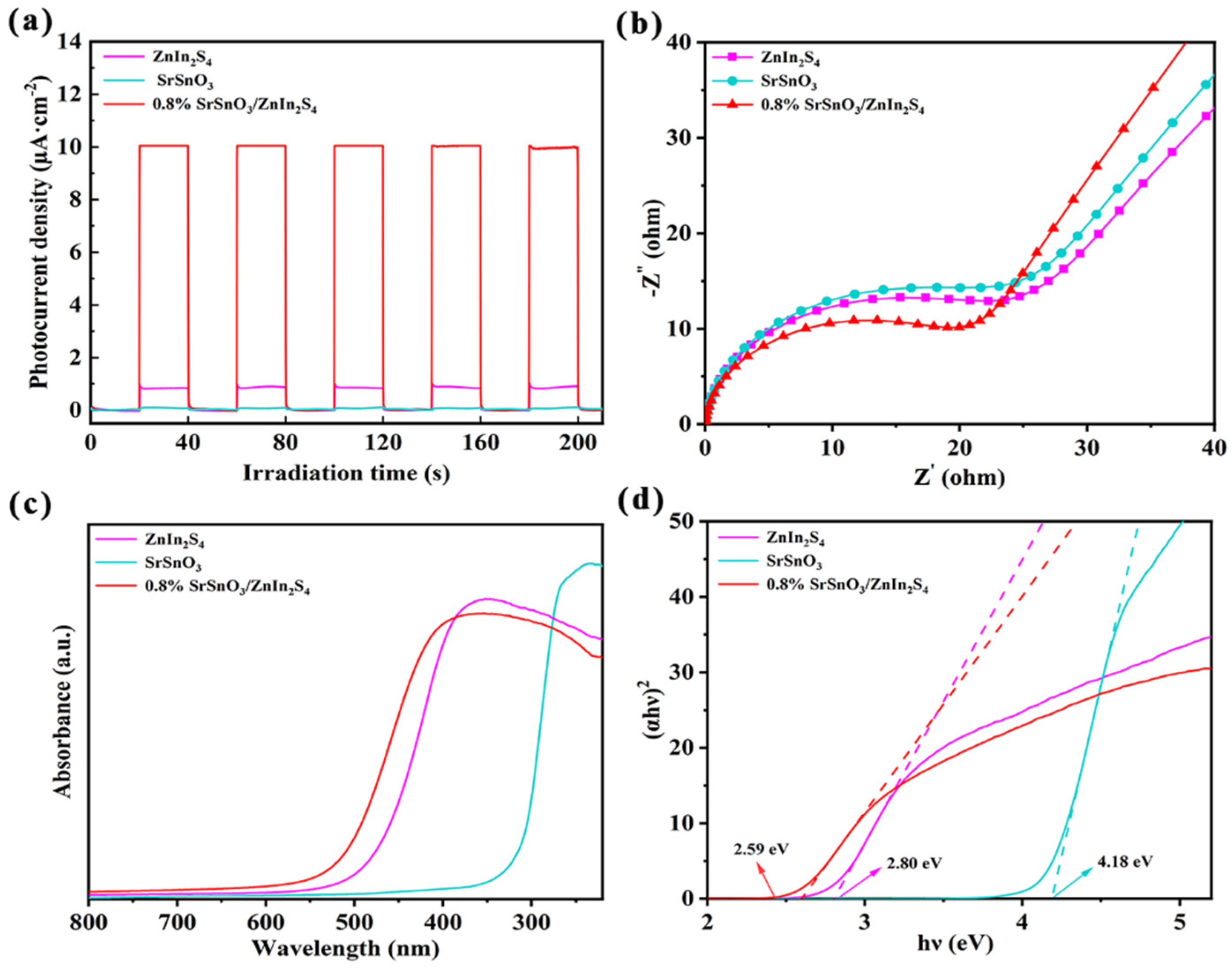
To gain deeper insight into the photoelectrochemical behavior of composite heterojunctions, we evaluated the separation and transport efficiency of their photogenerated carriers by characterizing the transient photocurrent response under illumination. As shown in Figure 4a, the photocurrent responses of SrSnO3, ZnIn2S4, and 0.8%-SrSnO3/ZnIn2S4 composite exhibit significant differences. Notably, the 0.8%-SrSnO3/ZnIn2S4 composite generates a significantly higher photocurrent density than either pure SrSnO3 or ZnIn2S4, indicating markedly improved charge separation efficiency. Over five consecutive on–off illumination cycles, the photocurrent generated by pure ZnIn2S4 progressively decays during each illumination period, suggesting rapid recombination of photogenerated carriers upon light exposure [58]. In contrast, the 0.8%-SrSnO3/ZnIn2S4 composite maintains a nearly stable photocurrent plateau during irradiation, with minimal decay—a clear indication of suppressed charge recombination and sustained carrier separation [59]. These results strongly suggest that the enhanced photocatalytic activity of the composite is, at least in part, attributable to its superior ability to separate and preserve photogenerated charge carriers.
Figure 4. (a) Transient photocurrent response under intermittent light irradiation; (b) Nyquist plots of electrochemical impedance spectra (EIS); (c) UV–vis diffuse reflectance spectra (DRS); and (d) plots of (αhν)2 versus photon energy (hν) for ZnIn2S4, SrSnO3, and 0.8%-SrSnO3/ZnIn2S4, used to determine optical bandgap energies.
Charge transport efficiency is another critical factor governing photocatalytic performance. Electrochemical impedance spectroscopy (EIS) was employed to assess the charge transfer resistance of the samples. The Nyquist plots presented in Figure 4b reveal that the arc radius—which correlates with interfacial charge transfer resistance—follows the order: 0.8%-SrSnO3/ZnIn2S4 < ZnIn2S4 < SrSnO3. The smallest arc radius observed for the 0.8% composite indicates the lowest charge transfer resistance and, consequently, the most efficient interfacial charge migration. This further corroborates that the heterojunction architecture significantly enhances both charge separation and transport kinetics, thereby underpinning the superior photocatalytic performance of the composite system.
As a fundamental property of photocatalysts, light absorption capability directly governs photocatalytic efficiency. The optical absorption characteristics of the as-prepared SrSnO3, ZnIn2S4, and 0.8%-SrSnO3/ZnIn2S4 samples were investigated using UV–vis diffuse reflectance spectroscopy (DRS). As shown in Figure 4c, the absorption edges of SrSnO3, ZnIn2S4, and 0.8%-SrSnO3/ZnIn2S4 are located at approximately 337 nm, 507 nm, and 552 nm, respectively [60]. This indicates that SrSnO3 absorbs primarily in the ultraviolet region, whereas the 0.8%-SrSnO3/ZnIn2S4 composite exhibits a broader absorption range extending further into the visible-light region compared to pure ZnIn2S4, accompanied by a distinct red shift. The enhanced visible-light absorption of the composite enables the generation of a greater number of photogenerated electron–hole pairs, thereby promoting more active participation in photocatalytic reactions. This study employs the Kubelka–Munk transformation combined with the Tauc plot method to estimate the bandgap width (Eg) of each sample. The calculation process follows the following formula [61]:
α h ν = A ( h ν E g ) n / 2
In Equation (1), α represents the optical absorption coefficient, h is Planck’s constant, ν denotes the incident light frequency, A is a constant related to the material’s intrinsic properties, Eg is the bandgap width to be determined, and n is an index related to the type of electronic transition: for direct bandgap semiconductors, n = 1; for indirect bandgap semiconductors, n = 4. Figure 4d displays the ultraviolet–visible diffuse reflectance spectroscopy (UV–vis DRS) spectra of the prepared samples. This spectral data not only clearly reflects the optical absorption characteristics of different samples but also provides direct evidence for analyzing the material’s band structure. In the specific calculation of the bandgap width, a relationship curve is constructed with (αhν)2 as the vertical axis and photon energy (hν) as the horizontal axis. The photon energy corresponding to the maximum slope of this curve can be directly used to determine the bandgap width of the sample. Using the above method, the calculated bandgap widths are 4.18 eV for pure SrSnO3 and 2.81 eV for pure ZnIn2S4 [62]. However, when SrSnO3 and ZnIn2S4 were combined to form a 0.8%-SrSnO3/ZnIn2S4 composite material, its bandgap width decreased to 2.5 eV, indicating that the formation of the heterojunction significantly modulates the material’s band structure.
Furthermore, to investigate the band edge positions of semiconductor materials (a critical factor for analyzing charge transfer directions and redox capabilities in heterojunction photocatalysts), the valence band maximum (VBM) and conduction band minimum (CBM) positions for each semiconductor were estimated using the empirical formula reported in [63]:
E VB = X E e + 0.5 E g
E CB = E VB E g
In this empirical formula, the parameter X represents the absolute electronegativity of the semiconductor, calculated as the geometric mean of the absolute electronegativities of its constituent elements; Ee denotes the hydrogen-scaled energy of a free electron, approximately 4.5 eV (relative to the vacuum level); while Eg represents the optical bandgap width determined through diffuse reflectance spectroscopy (DRS) measurements and calculations. This parameter directly corresponds to the bandgap width analysis results described earlier, ensuring data consistency throughout the entire band structure calculation process.
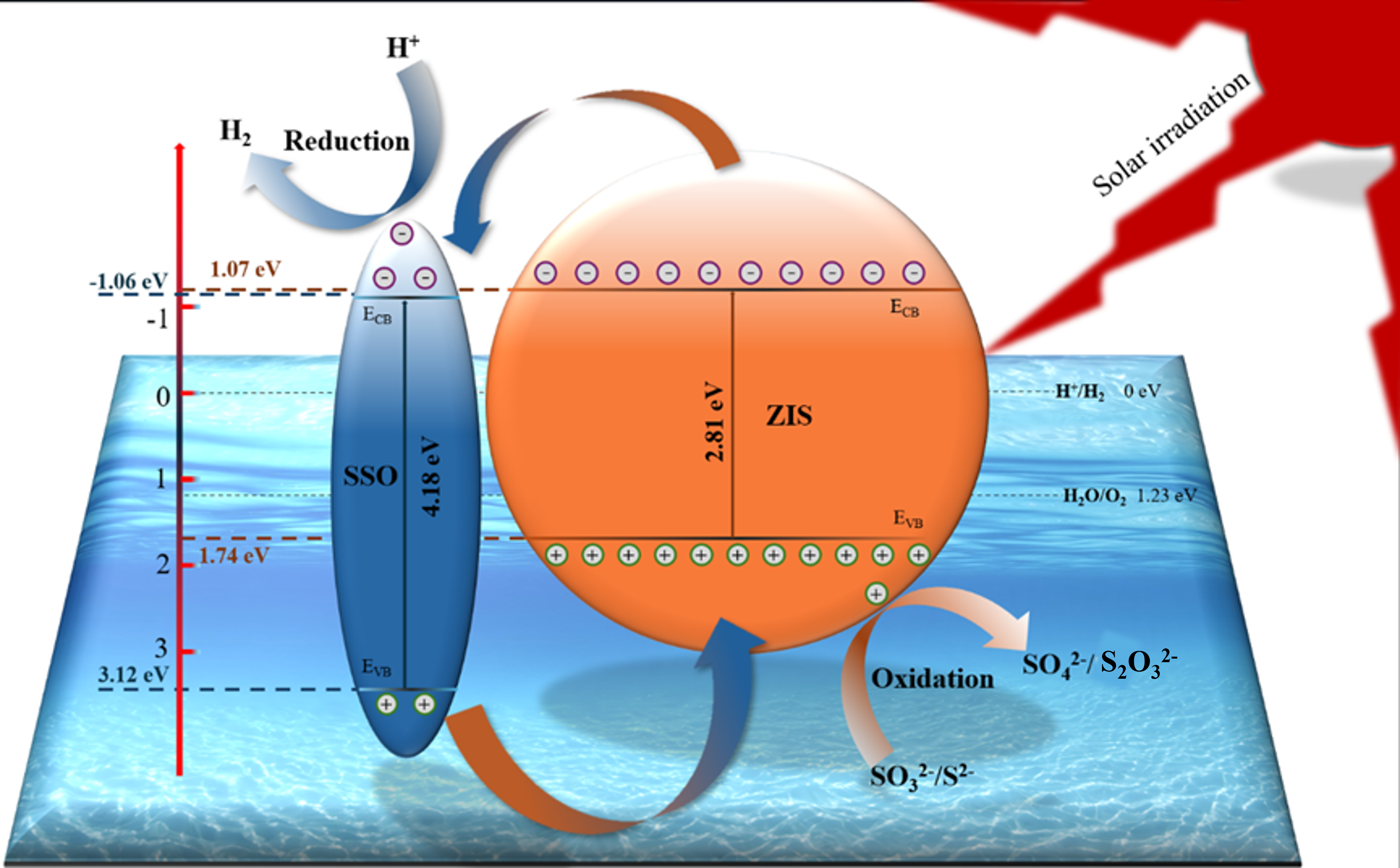
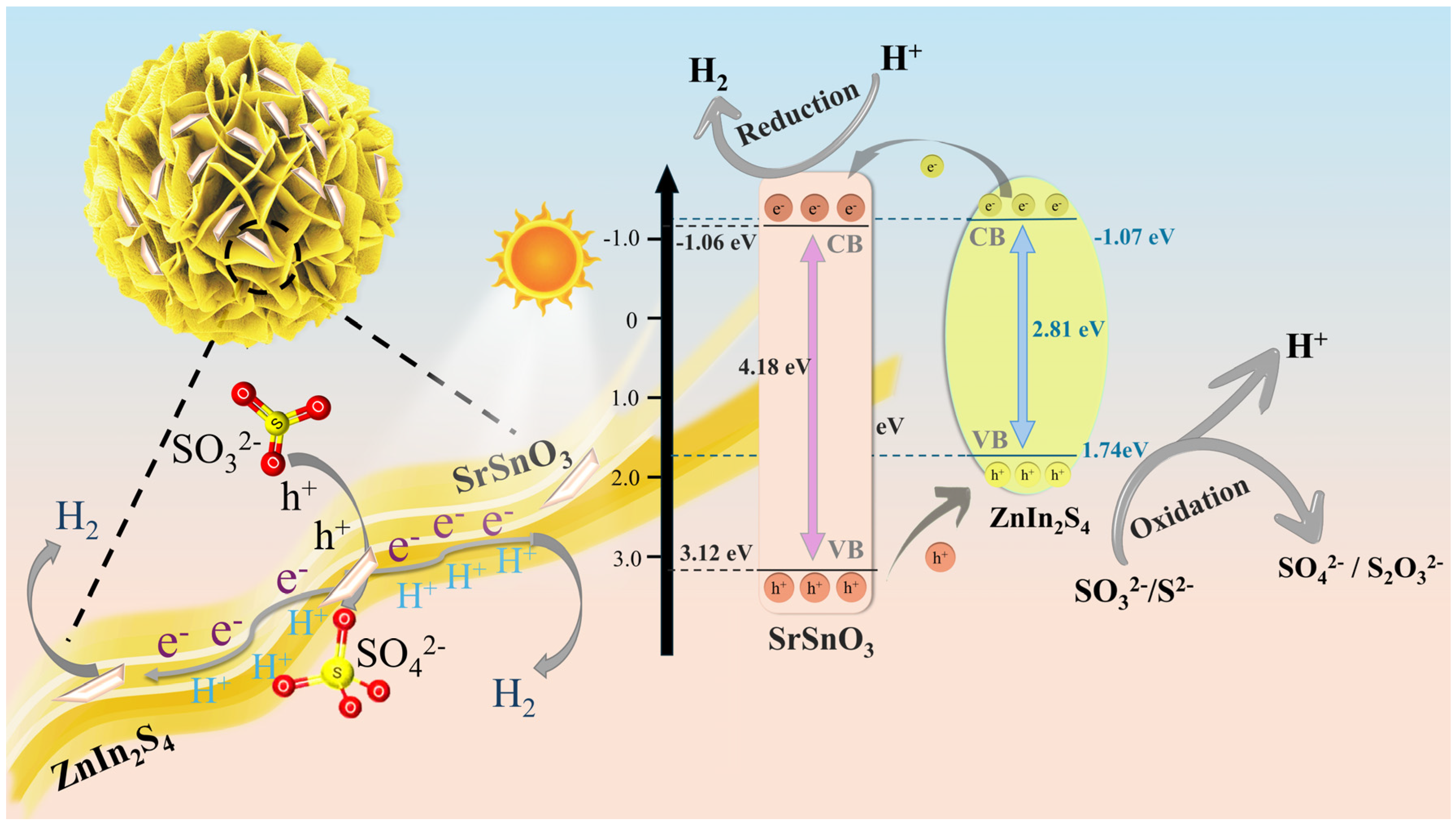
Using Pearson’s absolute electronegativity values, X = 5.53 eV for SrSnO3 and X = 4.84 eV for ZnIn2S4 [64,65,66]. Substituting these values along with their respective bandgap energies (Eg = 4.18 eV for SrSnO3 and 2.81 eV for ZnIn2S4) into Equations (2) and (3), the calculated band edge positions are as follows:
For SrSnO3: EVB = 3.12 eV (vs. NHE), ECB = −1.06 eV (vs. NHE);
For ZnIn2S4: EVB = 1.74 eV (vs. NHE), ECB = −1.07 eV (vs. NHE).
These calculated band positions provide the thermodynamic basis for constructing the Type-II heterojunction alignment and understanding the direction of photogenerated charge transfer at the SrSnO3/ZnIn2S4 interface.

2.4. Photocatalytic Reaction Mechanism

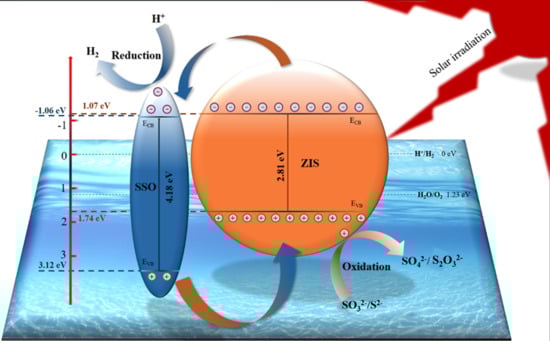
To achieve an efficient photocatalytic hydrogen evolution reaction, the energy band edges of the semiconductor materials must satisfy specific thermodynamic conditions. The heterogeneous catalytic process in this work is carried out through the active intermediates adsorbed on the surface of the catalyst. The interaction between the surface and the intermediates significantly alters the energy profile of the reaction, enabling this process to proceed efficiently within the existing energy band positions. For the hydrogen evolution reaction, the reduction of protons is carried out by hydrogen (H*) adsorbed on the active sites of the catalyst SrSnO3. Its reduction potential is much higher than that of free H∙ (−2.3 eV relative to NHE), significantly reducing the energy barrier [67,68,69,70]. The schematic of its charge transfer mechanism is shown in Figure 5. The electrons aggregated in the conduction band of SrSnO3 (−1.06 eV relative to NHE) provide sufficient overpotential to drive the formation of H*, which then undergoes recombination desorption to generate H2. This surface-mediated multi-step reaction mechanism has been widely confirmed in semiconductor electrochemistry [71]. For the oxidation side, since the valence band (VB) of ZnIn2S4 (+1.23 eV relative to NHE) is insufficient to generate free ∙OH (+2.73 eV relative to NHE) [72], in the system, holes are mainly consumed by the sacrificial agent (Na2S/Na2SO3) rather than oxidizing water to ∙OH, which is consistent with the rapid kinetics of sulfide oxidation [73]. The sacrificial agent (Na2S/Na2SO3) effectively inhibits the recombination of electron–hole pairs by rapidly removing photogenerated holes. Its preferential oxidation property also protects ZnIn2S4 from photodegradation, thereby enhancing the stability of the catalytic system. Under this effect, the utilization efficiency of photogenerated electrons is significantly improved, which in turn promotes the continuous participation of conduction band electrons of SrSnO3 in the proton reduction process for hydrogen production [74,75]. Combining the above reaction mechanism and the previously calculated band edge positions, it can be known that SrSnO3 and ZnIn2S4 form a type II heterojunction structure [76]. At the same time, to verify the main consumption path of photogenerated holes, we conducted a hydroxyl radical capture experiment (Supplementary Materials S2 Figure S2). In the presence of the efficient ∙OH capture agent isopropanol, the hydrogen production activity of the system was not affected. This strongly proves that in the conditions of this study, the Na2S/Na2SO3 sacrificial agent is the absolute dominant pathway for hole removal, and the water oxidation reaction (including the potential ∙OH generation path) can be neglected. Therefore, the process of hole oxidation by the sacrificial agent described in Equations (10)–(13) is the core step driving this photocatalytic hydrogen production cycle. In summary, the SrSnO3/ZnIn2S4 composite system establishes an efficient and self-sustaining charge separation–reaction cycle: light absorption → charge generation → spatial separation through the II-type heterojunction → hole removal by the sacrificial agent → electron-driven hydrogen production. This synergistic mechanism—combining the favorable band alignment with the reaction kinetics assisted by the sacrificial agent—makes the SrSnO3/ZnIn2S4 heterojunction highly active and operationally stable in photocatalytic hydrogen production. The main photocatalytic reactions occurring in the SrSnO3/ZnIn2S4 heterojunction system are summarized as follows:
SrSnO 3 + h ν e CB   ( SrSnO 3 ) + h + VB   ( SrSnO 3 )
ZnIn 2 S 4 + h ν e CB   ( ZnIn 2 S 4 ) + h + VB   ( ZnIn 2 S 4 )
ZnIn 2 S 4   ( e CB ) SrSnO 3   ( e CB )
SrSnO 3   ( h + VB ) ZnIn 2 S 4   ( h + VB )
H 2 O + SrSnO 3   ( e CB ) + * H * + OH
H * + SrSnO 3 ( e CB ) + H 2 O H 2 + OH
1 2 SO 3 2 + OH + ZnIn 2 S 4   ( h + VB ) 1 2 SO 4 2 + H +
S 2 + ZnIn 2 S 4   ( h + VB ) 1 2 S 2 2
SO 3 2 + S 2 2 S 2 O 3 2 + S 2
1 2 SO 3 2 + 1 2 S 2 + ZnIn 2 S 4   ( h + VB ) 1 2 S 2 O 3 2
Figure 5. Schematic illustration of the proposed photocatalytic hydrogen evolution mechanism over the X-SrSnO3/ZnIn2S4 Type-II heterojunction.

3. Experimental Section

3.1. Materials

Strontium nitrate (Sr(NO3)2, AR), sodium stannate trihydrate (Na2SnO3·3H2O, AR), zinc chloride (ZnCl2, AR), and thioacetamide (C2H5NS, AR) were purchased from Sinopharm Chemical Reagent Co., Ltd. (Shanghai, China). Indium chloride tetrahydrate (InCl3·4H2O, AR) was obtained from McLean Biochemical Technology Co., Ltd. (Shanghai, China). Anhydrous ethanol (C2H5OH, AR) was supplied by Xilong Scientific Co., Ltd. (Guangzhou, China). All aqueous solutions were prepared using deionized water of analytical reagent grade.

3.2. Synthesis of Photocatalysts

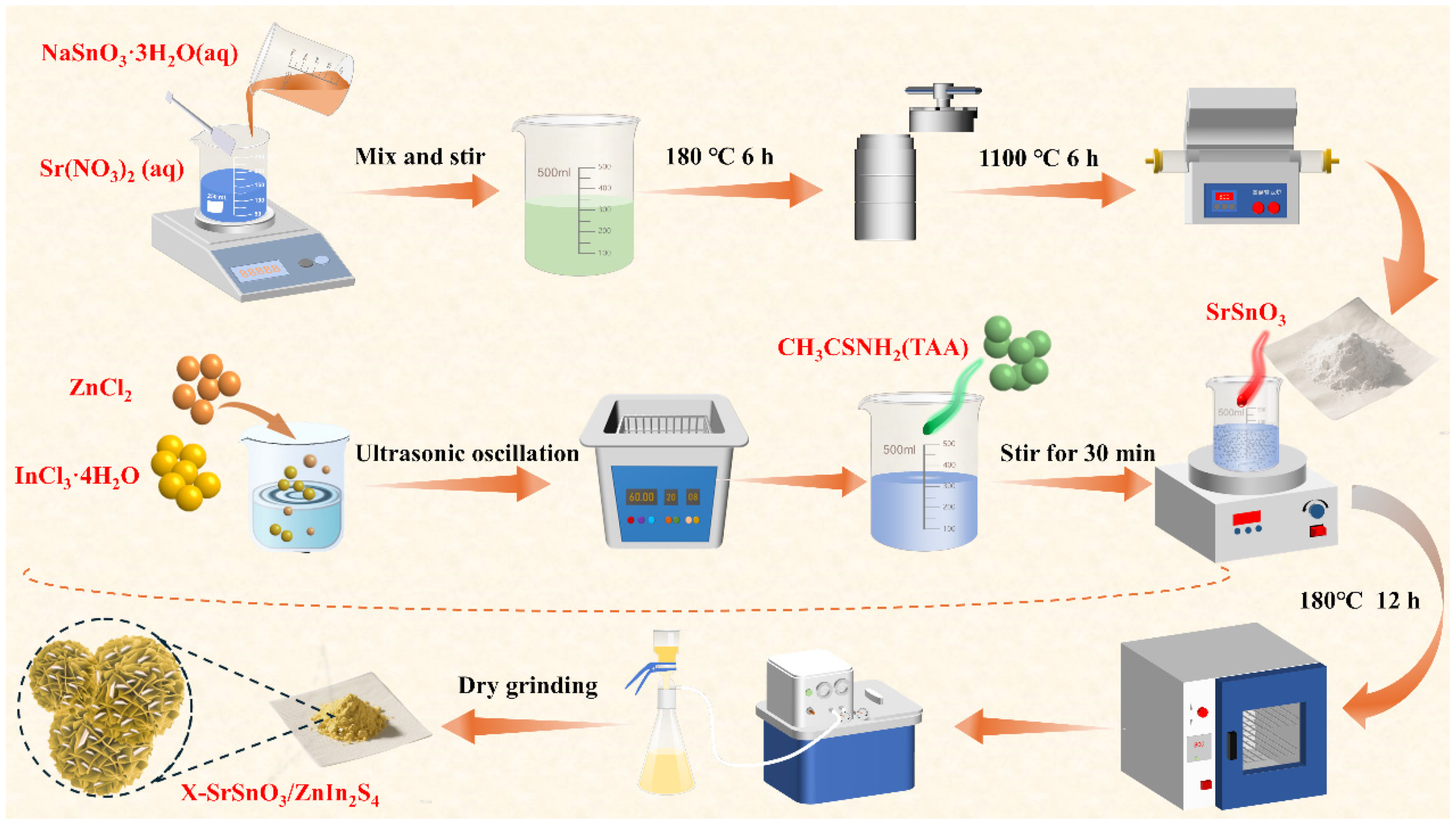
SrSnO3 was synthesized via a solvothermal method followed by high-temperature calcination. The specific operational steps are as follows: First, raw materials were weighed according to stoichiometric ratios: 0.02 mol each of Sr(NO3)2 and Na2SnO3·3H2O. Each was dissolved in 30 mL of deionized water and stirred continuously for 30 min under magnetic stirring to ensure complete dissolution of both components. After complete dissolution, the two solutions were combined and stirred for another 30 min. A significant amount of white precipitate formed during this process, serving as a clear visual indicator of the initial reaction. The resulting suspension was then transferred into a stainless steel autoclave lined with polytetrafluoroethylene (PTFE). The autoclave was maintained at 180 °C for 6 h to allow the reaction to proceed fully under high-temperature and high-pressure conditions. After the reaction concludes, the reactor was allowed to cool naturally to room temperature. The internal precipitate was removed, ground thoroughly to a fine consistency in an agate mortar, and then placed in a muffle furnace. Calcination was carried out at 1100 °C for 6 h to obtain crystalline SrSnO3 powder [77].
ZnIn2S4/SrSnO3 nanocomposites were synthesized via a solvothermal route. The standard experimental procedure was as follows: First, 1 mmol ZnCl2 and 2 mmol InCl3·4H2O were added to a mixed solvent comprising 20 mL deionized water and 40 mL ethanol. To ensure complete dissolution of the raw materials and uniformity of the solution, the mixture was subjected to ultrasonic treatment for 30 min. Following ultrasonication, 4 mmol of thioacetamide was added, and magnetic stirring was continued for 30 min to facilitate complete reaction of all components. Next, pre-prepared SrSnO3 powder was added according to the predetermined molar ratio of SrSnO3 to ZnIn2S4. Continuous stirring for 30 min ensured uniform dispersion of the SrSnO3 powder in the solution. The entire suspension was then transferred to a stainless steel high-pressure reactor lined with polytetrafluoroethylene (PTFE) and heated at 180 °C for 12 h [78]. After reaction completion and natural cooling to room temperature, the yellow precipitate was collected. It was repeatedly washed with deionized water and ethanol to remove surface impurities, followed by drying overnight at 60 °C to obtain the final composite material. We labeled the products with different SrSnO3 contents as X-SrSnO3/ZnIn2S4 (where X represents 3%, 2%, 1%, 0.8% and 0.6%, denoting the molar percentage of SrSnO3 relative to ZnIn2S4). A schematic of the entire synthesis process is shown in Figure 6.
Figure 6. Schematic illustration of the synthesis process for X-SrSnO3/ZnIn2S4 nanocomposites.

3.3. Characterizations of Photocatalysts

Detailed descriptions of the characterization techniques and corresponding instrumentation are provided in Table S1 (Supplementary Materials S1).

3.4. Photocatalytic H2 Production Test

Characterization information is detailed in Supplementary Materials S1.

3.5. Electrochemical Testing Experiment

Electrochemical testing information is detailed in Supplementary Materials S1.

4. Conclusions

In summary, this study successfully fabricated a highly efficient SrSnO3/ZnIn2S4 Type-II heterojunction photocatalyst via a hydrothermal coupling strategy. The composite exhibits markedly enhanced photocatalytic hydrogen evolution activity under simulated solar irradiation. Comprehensive characterization—including XRD, SEM/TEM, XPS, UV–vis DRS, and photoelectrochemical measurements—confirmed the preservation of crystalline phases, intimate interfacial contact, extended visible-light absorption, and improved charge dynamics in the heterostructure. The optimal composition, 0.8%-SrSnO3/ZnIn2S4, achieved a hydrogen evolution rate of 1.09 mmol·g−1·h−1—a 13.79-fold enhancement compared to pristine ZnIn2S4. Electrochemical impedance spectroscopy (EIS) and transient photocurrent response measurements further validated the superior charge separation efficiency and accelerated interfacial carrier transport within the heterojunction. The performance enhancement is primarily ascribed to the Type-II band alignment, which enables spatial separation of photogenerated electrons and holes: electrons migrate to the conduction band of SrSnO3 for H+ reduction, while holes transfer to the valence band of ZnIn2S4 and are scavenged by sacrificial agents (Na2S/Na2SO3), thereby suppressing recombination and sustaining catalytic turnover. Moreover, the hierarchical hydrangea-like microstructure not only provides abundant active sites but also enhances mechanical robustness and recyclability, with only a 13.5% activity loss after three consecutive cycles. These results establish a clear structure–property–performance relationship and offer a rational design strategy for high-efficiency heterojunction photocatalysts. This work advances the fundamental understanding of charge transfer mechanisms in composite photocatalytic systems and paves the way for scalable, solar-driven hydrogen production and broader applications in sustainable energy.

Supplementary Materials

The following supporting information can be downloaded at: https://www.mdpi.com/article/10.3390/inorganics14020057/s1, Supplementary Materials S1: Table S1: The equipment used in this study and the manufacturer model. Supplementary Materials S2: Figure S1: SEM image of 0.8%-SrSnO3/ZnIn2S4 after photocatalytic reaction; Figure S2: The influence of the capture agent IPA on the hydrogen production rate of 0.8%-SrSnO3/ZnIn2S4; Table S2: The concentration of metal elements in the solution before and after the reaction; Table S3: The concentration of anions in the solution after the photocatalytic reaction.

Author Contributions

Z.-Y.X.: Methodology, Formal analysis, Investigation, Writing—Original Draft. H.L.: Conceptualization, Writing the main manuscript text. Y.Z.: Conceptualization, Writing—Review and Editing, Funding acquisition. C.-H.H.: Writing—Review and Editing, Funding acquisition, Project administration. D.-H.W.: Writing—Review and Editing, Funding acquisition. T.S.: Resources. S.-M.L.: Resources. K.-W.C.: Resources. X.-F.P.: Resources. All authors have read and agreed to the published version of the manuscript.

Funding

This work was supported by the Science and Technology Project of Guangxi (Grant No. AA24263076), the Guangxi Key Laboratory of Information Materials & Guangxi Collaborative Innovation Center of Structure and Property for New Energy Materials (Grant No. 231067-Z), the College Students’ innovation and Entrepreneurship Competition (Grant No. 202310595054), the Guangxi Natural Science Foundation (Grant No. 2025GXNSFAA069270), the National Natural Science Foundation of China (Grant No. 52061006), the Guangxi Key Laboratory of Information Materials (Grant No. 231007-Z).

Data Availability Statement

The original contributions presented in this study are included in the article/Supplementary Materials S1 and Supplementary Materials S2. Further inquiries can be directed to the corresponding author.

Conflicts of Interest

The authors declare no conflict of interest.

References

  1. Liu, S.; Xiang, Y.; Liu, J.; Du, Z.; Fang, S.; Gao, L.; Fu, F.; Gao, X.; Jian, X. Hydrogen spillover in Pt/Ni(OH)2/Mo2TiC2Tx electrocatalyst improves pH-universal hydrogen evolution reaction. Int. J. Hydrogen Energy 2024, 63, 500–509. [Google Scholar] [CrossRef]
  2. Cavalcanti, M.H.C.; Pappalardo, J.R.; Barbosa, L.T.; Brasileiro, P.P.F.; Roque, B.A.C.; Da Rocha E Silva, N.M.P.; da Silva, M.F.; Converti, A.; Barbosa, C.M.B.d.M.; Sarubbo, L.A. Hydrogen in Burners: Economic and Environmental Implications. Processes 2024, 12, 2434. [Google Scholar] [CrossRef]
  3. Abifarin, J.K.; Torres, J.F.; Lu, Y. 2D materials for enabling hydrogen as an energy vector. Nano Energy 2024, 129, 109997. [Google Scholar] [CrossRef]
  4. Yan, Y.; Zhou, L.; Wang, H.; Song, Z.; Jing, L.; Hu, J. Photothermal ReO2/ReS2/Zn2In2S5 heterojunction for enhanced photocatalytic hydrogen evolution. Sep. Purif. Technol. 2024, 346, 127473. [Google Scholar] [CrossRef]
  5. Zhao, Y.; Sun, Y.; Chen, L.; Yang, X.; Yang, P.; Xie, X.; Qin, Z.; Ji, H.; Su, T. Boosting Photocatalytic Hydrogen Production over Mn0.4Cd0.6S/CuS p–n Heterojunction under Visible Light Irradiation. Energy Technol. 2025, 13, 2401858. [Google Scholar] [CrossRef]
  6. Zhang, W.; Xiong, J.; Li, S.; Li, W. 1D-2D Z-scheme junction by coupling CaTiO3 rectangular nanorods with CdS nanosheets enhances photocatalytic hydrogen evolution. Mol. Catal. 2025, 570, 114701. [Google Scholar] [CrossRef]
  7. Li, J.; Wang, S.; Jiang, Y.; Wang, S.; Sun, J.; Song, Y.; Liu, C.; Zhang, Q. 2D/2D NiPS3/g-C3N4 heterojunctions for photothermal-assisted photocatalytic hydrogen evolution. Sep. Purif. Technol. 2025, 369, 133121. [Google Scholar] [CrossRef]
  8. Chen, S.; Zhang, J.; Hu, Q.; Liu, H.; Chen, X. Research Progress in the Preparation and Application of BiOBr-Based Z-scheme Heterojunction Composite Photocatalysts. ChemistrySelect 2024, 9, e202404553. [Google Scholar] [CrossRef]
  9. Zhao, X.; Huang, F.; Li, D.; Yan, A.; Zhang, T.; Zhao, W.; Gao, Y.; Zhang, J. Nb, Se-codoped ZnIn2S4/NbSe2 composites with enhanced catalytic activity and photodegradation performance towards tetracycline. Nanotechnology 2023, 34, 205705. [Google Scholar] [CrossRef]
  10. Chen, S.; Yin, H.; Liu, P.; Wang, Y.; Zhao, H. Stabilization and Performance Enhancement Strategies for Halide Perovskite Photocatalysts. Adv. Mater. 2023, 35, 2203836. [Google Scholar] [CrossRef]
  11. Yang, Y.; Peng, S.; Han, Z.; Fu, M.; Wang, K.; Yu, H. CdS Nanorods with an Optimized ZnS Coating as Composite Photocatalysts for Enhanced Water Splitting under Solar Light Irradiation. ACS Appl. Nano Mater. 2022, 5, 9747–9753. [Google Scholar] [CrossRef]
  12. Yao, Q.; Liu, P.; Yang, F.; Zhu, Y.; Pan, Y.; Xue, H.; Mao, W.; Chu, L. Ferroelectric polarization in Bi0.9Dy0.1FeO3/g-C3N4 Z-scheme heterojunction boosts photocatalytic hydrogen evolution. Sci. China Mater. 2024, 67, 3160–3167. [Google Scholar] [CrossRef]
  13. Li, Q.; Tong, Y.; Zeng, Y.; Gu, X.-K.; Ding, M. Carbohydrate-regulated synthesis of ultrathin porous nitrogen-vacancy polymeric carbon nitride for highly efficient Visible-light hydrogen evolution. Chem. Eng. J. 2022, 450, 138010. [Google Scholar] [CrossRef]
  14. Imran, M.; Ashraf, W.; Hafiz, A.K.; Khanuja, M. Synthesis and Performance Analysis of Photocatalytic Activity of ZnIn2S4 Microspheres Synthesized Using a Low-Temperature Method. ACS Omega 2022, 7, 22987–22996. [Google Scholar] [CrossRef]
  15. Wu, K.; Jiang, R.; Zhao, Y.; Mao, L.; Gu, X.; Cai, X.; Zhu, M. Hierarchical NiCo2S4/ZnIn2S4 heterostructured prisms: High-efficient photocatalysts for hydrogen production under visible-light. J. Colloid Interface Sci. 2022, 619, 339–347. [Google Scholar] [CrossRef]
  16. Basyach, P.; Prajapati, P.K.; Rohman, S.S.; Sonowal, K.; Kalita, L.; Malik, A.; Guha, A.K.; Jain, S.L.; Saikia, L. Visible Light-Active Ternary Heterojunction Photocatalyst for Efficient CO2 Reduction with Simultaneous Amine Oxidation and Sustainable H2O2 Production. ACS Appl. Mater. Interfaces 2023, 15, 914–931. [Google Scholar] [CrossRef]
  17. Wang, J.; Sun, S.; Zhou, R.; Li, Y.; He, Z.; Ding, H.; Chen, D.; Ao, W. A review: Synthesis, modification and photocatalytic applications of ZnIn2S4. J. Mater. Sci. Technol. 2021, 78, 1–19. [Google Scholar] [CrossRef]
  18. Wang, X.; Damasco, J.; Shao, W.; Ke, Y.; Swihart, M.T. Synthesis of Zn–In–S Quantum Dots with Tunable Composition and Optical Properties. ChemPhysChem 2016, 17, 687–691. [Google Scholar] [CrossRef]
  19. Ding, X.; Xue, Y.; Wang, J.; Tian, J. Semimetal 1T’ phase molybdenum sulfide decorated on zinc indium sulfide with S-scheme heterojunction for enhanced photocatalytic hydrogen evolution. J. Colloid Interface Sci. 2024, 659, 225–234. [Google Scholar] [CrossRef]
  20. Zhang, X.-R.; Ye, H.; Liang, Y.; Han, C.; Sun, Y. Zinc Indium Sulfide-Based Photocatalysts for Selective Organic Transformations. ChemCatChem 2024, 16, e202301553. [Google Scholar] [CrossRef]
  21. Liao, C.; Li, J.; Zhang, Y.; Qu, Y.; Jiang, P.; Cong, R.; Yang, T. Visible light driven photocatalytic H2 generation property of trigonal ZnIn2S4 prepared by high temperature solid state reaction. Mater. Lett. 2019, 248, 52–54. [Google Scholar] [CrossRef]
  22. Shen, S.; Guo, P.; Zhao, L.; Du, Y.; Guo, L. Insights into photoluminescence property and photocatalytic activity of cubic and rhombohedral ZnIn2S4. J. Solid State Chem. 2011, 184, 2250–2256. [Google Scholar] [CrossRef]
  23. Dankawu, U.M.; Hafeez, H.Y.; Mohammed, J.; Shuaibu, A.S.; Gomari, K.A.; Ndikilar, C.E.; Suleiman, A.B.; Srivastava, A.K. Recent advancement and future modifications of ZnIn2S4 based materials for photocatalytic hydrogen generation via water splitting. Int. J. Hydrogen Energy 2025, 149, 149953. [Google Scholar] [CrossRef]
  24. Jo, W.-K.; Natarajan, T.S. Fabrication and efficient visible light photocatalytic properties of novel zinc indium sulfide (ZnIn2S4)—Graphitic carbon nitride (g-C3N4)/bismuth vanadate (BiVO4) nanorod-based ternary nanocomposites with enhanced charge separation via Z-scheme transfer. J. Colloid Interface Sci. 2016, 482, 58–72. [Google Scholar] [CrossRef]
  25. Yang, L.; Guo, J.; Chen, S.; Li, A.; Tang, J.; Guo, N.; Yang, J.; Zhang, Z.; Zhou, J. Tailoring the catalytic sites by regulating photogenerated electron/hole pairs separation spatially for simultaneous selective oxidation of benzyl alcohol and hydrogen evolution. J. Colloid Interface Sci. 2024, 659, 776–787. [Google Scholar] [CrossRef]
  26. Tang, Y.Y.; Yu, Y.F.; Zhang, Y.; Liu, P.F.; Yang, H.G. Hydrothermally Constructed MoS2/ZnIn2S4 Heterostructure for Promotion of Photocatalytic H2 Evolution. Chem.—Asian J. 2025, 20, e202401418. [Google Scholar] [CrossRef]
  27. Du, Z.; Pan, J.; Ma, C.; Guan, Y.; Sun, M.; Gao, Z.; Tang, H.; Yan, X. CdS nanorods embedded in ZnIn2S4 nanosheets to construct n-n heterojunction for ultrahigh photocatalytic H2 and H2O2 production. Colloids Surf. A Physicochem. Eng. Asp. 2025, 706, 135774. [Google Scholar] [CrossRef]
  28. Zhang, X.; Ye, H.; Zeng, Z.; Sa, K.; Jia, J.; Yang, Z.; Xu, S.; Han, C.; Liang, Y. Bridging the gap between metallic MoO2 and ZnIn2S4 for enhanced photocatalytic H2 production. Sep. Purif. Technol. 2024, 347, 127624. [Google Scholar] [CrossRef]
  29. Mohan, T.; Kuppusamy, S.; Michael, R.J.V. Tuning of Structural and Magnetic Properties of SrSnO3 Nanorods in Fabrication of Blocking Layers for Enhanced Performance of Dye-Sensitized Solar Cells. ACS Omega 2022, 7, 18531–18541. [Google Scholar] [CrossRef]
  30. Wang, T.; Prakash, A.; Dong, Y.; Truttmann, T.; Bucsek, A.; James, R.; Fong, D.D.; Kim, J.-W.; Ryan, P.J.; Zhou, H.; et al. Engineering SrSnO3 Phases and Electron Mobility at Room Temperature Using Epitaxial Strain. ACS Appl. Mater. Interfaces 2018, 10, 43802–43808. [Google Scholar] [CrossRef]
  31. Zulueta, Y.A.; Nguyen, M.T.; Pham-Ho, M.-P. Strontium stannate as an alternative anode for Na- and K-Ion batteries: A theoretical study. J. Phys. Chem. Solids 2022, 162, 110505. [Google Scholar] [CrossRef]
  32. Subhan, M.A.; Rifat, T.P.; Saha, P.C.; Alam, M.M.; Asiri, A.M.; Raihan, T.; Azad, A.K.; Ghann, W.; Uddin, J.; Rahman, M.M. Photocatalytic, anti-bacterial performance and development of 2,4-diaminophenylhydrazine chemical sensor probe based on ternary doped Ag·SrSnO3 nanorods. New J. Chem. 2021, 45, 1634–1650. [Google Scholar] [CrossRef]
  33. Ghubish, Z.; Kamal, R.; Mahmoud, H.R.; Saif, M.; Hafez, H.; El-Kemary, M. Novel fluorescent nano-sensor based on amino-functionalization of Eu3+: SrSnO3 for copper ion detection in food and real drink water samples. RSC Adv. 2021, 11, 18552–18564. [Google Scholar] [CrossRef] [PubMed]
  34. Lee, C.W.; Kim, D.W.; Cho, I.S.; Park, S.; Shin, S.S.; Seo, S.W.; Hong, K.S. Simple synthesis and characterization of SrSnO3 nanoparticles with enhanced photocatalytic activity. Int. J. Hydrogen Energy 2012, 37, 10557–10563. [Google Scholar] [CrossRef]
  35. Huang, Z.; Wang, D.; Niu, R.; Wang, W. Band-gap tailoring and third-order optical nonlinearity enhancement through B-site V doping in SrSnO3 films. Opt. Mater. 2024, 153, 115598. [Google Scholar] [CrossRef]
  36. Teixeira, A.R.F.A.; de Meireles Neris, A.; Longo, E.; de Carvalho Filho, J.R.; Hakki, A.; Macphee, D.; dos Santos, I.M.G. SrSnO3 perovskite obtained by the modified Pechini method—Insights about its photocatalytic activity. J. Photochem. Photobiol. A Chem. 2019, 369, 181–188. [Google Scholar] [CrossRef]
  37. Wan, S.; Zhong, Q.; Ou, M.; Zhang, S. Synthesis and characterization of direct Z-scheme Bi2MoO6/ZnIn2S4 composite photocatalyst with enhanced photocatalytic oxidation of NO under visible light. J. Mater. Sci. 2017, 52, 11453–11466. [Google Scholar] [CrossRef]
  38. Mohammed, R.Q.; Ahmed, B.M. Performance enhancement of ZnO/Zn nanostructure biosensor via cold atmosphere plasma. J. Nanoparticle Res. 2024, 27, 6. [Google Scholar] [CrossRef]
  39. Toumi, M.; Souissi, R.; Ventura, J.; Bouguila, N.; Dias, C. Structural, electrical and photoconductive properties of sprayed In2S3: Cl thin films. Opt. Quantum Electron. 2025, 57, 470. [Google Scholar] [CrossRef]
  40. Zhang, K.; Jing, D.; Chen, Q.; Guo, L. Influence of Sr-doping on the photocatalytic activities of CdS–ZnS solid solution photocatalysts. Int. J. Hydrogen Energy 2010, 35, 2048–2057. [Google Scholar] [CrossRef]
  41. Zhu, H.; Gu, S.; Zhang, C.; Gao, K.; Xia, J.; Cheng, C.; Wang, X. Regulating Electron-transfer over ZnIn2S4 by Sn(II)/Sn(IV) Co-Doping for Efficient Photocatalytic Hydrogen Production. Catal. Lett. 2022, 153, 2245–2259. [Google Scholar] [CrossRef]
  42. Chen, D.; Ye, J. SrSnO3 Nanostructures:  Synthesis, Characterization, and Photocatalytic Properties. Chem. Mater. 2007, 19, 4585–4591. [Google Scholar] [CrossRef]
  43. Liu, C.; Chai, B.; Wang, C.; Yan, J.; Ren, Z. Solvothermal fabrication of MoS2 anchored on ZnIn2S4 microspheres with boosted photocatalytic hydrogen evolution activity. Int. J. Hydrogen Energy 2018, 43, 6977–6986. [Google Scholar] [CrossRef]
  44. Alshammari, F.H. Synthesize and tuneable structure, optical, photoluminescence, and magnetic properties of novel SrSnO3/Fe3O4 nanocomposites for promising applications. Surf. Interfaces 2022, 35, 102443. [Google Scholar] [CrossRef]
  45. Wu, X.; Chen, G.; Li, L.; Wang, J.; Wang, G. ZnIn2S4-based S-scheme heterojunction photocatalyst. J. Mater. Sci. Technol. 2023, 167, 184–204. [Google Scholar] [CrossRef]
  46. Liu, Q.; Tian, H.; Dai, Z.; Sun, H.; Liu, J.; Ao, Z.; Wang, S.; Han, C.; Liu, S. Nitrogen-doped Carbon Nanospheres-Modified Graphitic Carbon Nitride with Outstanding Photocatalytic Activity. Nano-Micro Lett. 2020, 12, 24. [Google Scholar] [CrossRef]
  47. Luo, C.; Zheng, G.; Gao, F.; Wang, X.; Zhan, C.; Gao, X.; Zhao, Q. Engineering the buried interface in perovskite solar cells via lattice-matched electron transport layer. Nat. Photonics 2023, 17, 856–864. [Google Scholar] [CrossRef]
  48. Jiang, J.; Zhan, Y.; Li, B.; Li, Q.; Liu, Y.; Liu, J.; Li, L.; Sakata, Y. Rh,Sb-codoped SrTiO3 cubic nanoparticles encapsulated by ZnIn2S4 nanosheets for efficient visible-light-driven hydrogen evolution. Dalton Trans. 2025, 54, 17905–17913. [Google Scholar] [CrossRef]
  49. Li, C.; Che, H.; Huo, P.; Yan, Y.; Liu, C.; Dong, H. Confinement of ultrasmall CoFe2O4 nanoparticles in hierarchical ZnIn2S4 microspheres with enhanced interfacial charge separation for photocatalytic H2 evolution. J. Colloid Interface Sci. 2021, 581, 764–773. [Google Scholar] [CrossRef]
  50. Niu, Y.; Li, Y.-Y.; Wang, J.; Wang, H.; Wang, B.; Xu, J.; Tian, M.; Lin, H.; Wang, L. Synergy of Cd Doping and S Vacancies in Cdx Zn1–xIn2S4 Hierarchical Nanotubes for Highly Improved Visible-Light-Driven H2 Evolution. Inorg. Chem. 2023, 62, 5699. [Google Scholar] [CrossRef]
  51. Guo, Q.; Zhang, J.-D.; Liu, J.-M.; Chen, Y.-J.; Qin, B.; Xia, J.; Guo, L.-N.; Duan, X.-H.; Wu, L.-Z. Promoting Charge-Carriers Dynamics by Relaxed Lattice Strain in A-site-Doped Halide Perovskite for Photocatalytic H2 Evolution. Angew. Chem. Int. Ed. 2025, 64, e202419082. [Google Scholar] [CrossRef] [PubMed]
  52. Wang, Y.; Li, X.; Mei, T.; Chen, Y.; He, J.; Jiang, L.; Yan, Z.; Wang, J. Surface sulphur vacancies of CdS/MIL-68(In)–NH2 for Boosting Visible-Light photocatalytic hydrogen evolution. Inorg. Chem. Commun. 2024, 168, 112987. [Google Scholar] [CrossRef]
  53. Qian, A.; Han, X.; Liu, Q.; Fan, M.; Ye, L.; Pu, X.; Chen, Y.; Liu, J.; Sun, H.; Zhao, J.; et al. Photocatalytic Hydrogen Production from Pure Water Using a IEF-11/g-C3N4 S-Scheme Heterojunction. ChemSusChem 2024, 17, e202301538. [Google Scholar] [CrossRef] [PubMed]
  54. Gong, X.; Fan, Z.; Wang, Y.; Qiu, X.; Xie, Y.; Ling, Y.; Zhao, J. Construction of Cu2S/Nv-C3N4 p-n heterojunctions for enhanced photocatalytic hydrogen production under visible light. Appl. Catal. A Gen. 2023, 668, 119470. [Google Scholar] [CrossRef]
  55. Zhou, Y.; Pi, R.; Yu, T. Dual roles of corn straw derivatives in CdS/WO3/Biochar composite photocatalytic hydrogen production: Electron carrier and sacrificial agent. Ceram. Int. 2025, 51, 44666–44679. [Google Scholar] [CrossRef]
  56. Zhang, J.; Zhao, Y.; Qi, K.; Liu, S.-Y. CuInS2 quantum-dot-modified g-C3N4 S-scheme heterojunction photocatalyst for hydrogen production and tetracycline degradation. J. Mater. Sci. Technol. 2023, 172, 145–155. [Google Scholar] [CrossRef]
  57. Zhao, Z.; Ren, G.; Zhang, Z.; Meng, X.; Li, Z. Rapid Joule heating synthesis of Ni doped into porous honeycomb C3N4 with greatly improved photocatalytic H2 production. Inorg. Chem. Front. 2024, 11, 2634–2647. [Google Scholar] [CrossRef]
  58. Bi, K.; Qin, X.; Cheng, S.; Liu, S. ZnO/g-C3N4 S scheme photocatalytic material with visible light response and enhanced photocatalytic performance. Diam. Relat. Mater. 2023, 137, 110143. [Google Scholar] [CrossRef]
  59. Wang, R.; Hu, Y.; Du, J.; Xu, L.; Fu, Y. Boosting the visible-light activity of ZrO2/g-C3N4 by controlling the crystal structure of ZrO2. J. Mater. Res. 2021, 36, 3086–3095. [Google Scholar] [CrossRef]
  60. Shen, S.; Zhao, L.; Guo, L. Morphology, structure and photocatalytic performance of ZnIn2S4 synthesized via a solvothermal/hydrothermal route in different solvents. J. Phys. Chem. Solids 2008, 69, 2426–2432. [Google Scholar] [CrossRef]
  61. Sang, T.; Zhong, Y.; Wang, D.-H.; Hu, C.-H.; Ye, J.-C.; Wang, W.-Y.; Liu, H. Visible-light-driven reduction of hexavalent chromium ions by CdS/CaCO3 semiconductor–insulator photocatalytic heterojunction. J. Mol. Struct. 2023, 1275, 134686. [Google Scholar] [CrossRef]
  62. Zhang, D.; Yang, Z.; Hao, J.; Zhang, T.; Sun, Q.; Wang, Y. Boosted charge transfer in dual Z-scheme BiVO4@ZnIn2S4/Bi2Sn2O7 heterojunctions: Towards superior photocatalytic properties for organic pollutant degradation. Chemosphere 2021, 276, 130226. [Google Scholar] [CrossRef] [PubMed]
  63. Wang, S.; Yang, X.; Zhang, X.; Ding, X.; Yang, Z.; Dai, K.; Chen, H. A plate-on-plate sandwiched Z-scheme heterojunction photocatalyst: BiOBr-Bi2MoO6 with enhanced photocatalytic performance. Appl. Surf. Sci. 2017, 391, 194–201. [Google Scholar] [CrossRef]
  64. Wang, L.; Zhai, H.; Jin, G.; Li, X.; Dong, C.; Zhang, H.; Yang, B.; Xie, H.; Sun, H. 3D porous ZnO–SnS p–n heterojunction for visible light driven photocatalysis. Phys. Chem. Chem. Phys. 2017, 19, 16576–16585. [Google Scholar] [CrossRef]
  65. Alammar, T.; Slowing, I.I.; Anderegg, J.; Mudring, A.-V. Ionic-Liquid-Assisted Microwave Synthesis of Solid Solutions of Sr1−xBaxSnO3 Perovskite for Photocatalytic Applications. ChemSusChem 2017, 10, 3387–3401. [Google Scholar] [CrossRef]
  66. Lu, C.; Guo, F.; Yan, Q.; Zhang, Z.; Li, D.; Wang, L.; Zhou, Y. Hydrothermal synthesis of type II ZnIn2S4/BiPO4 heterojunction photocatalyst with dandelion-like microflower structure for enhanced photocatalytic degradation of tetracycline under simulated solar light. J. Alloys Compd. 2019, 811, 151976. [Google Scholar] [CrossRef]
  67. Dubouis, N.; Grimaud, A. The hydrogen evolution reaction: From material to interfacial descriptors. Chem. Sci. 2019, 10, 9165–9181. [Google Scholar] [CrossRef]
  68. Skúlason, E.; Tripkovic, V.; Björketun, M.E.; Gudmundsdóttir, S.; Karlberg, G.; Rossmeisl, J.; Bligaard, T.; Jónsson, H.; Nørskov, J.K. Modeling the Electrochemical Hydrogen Oxidation and Evolution Reactions on the Basis of Density Functional Theory Calculations. J. Phys. Chem. C 2010, 114, 18182–18197. [Google Scholar] [CrossRef]
  69. Seh, Z.W.; Kibsgaard, J.; Dickens, C.F.; Chorkendorff, I.; Nørskov, J.K.; Jaramillo, T.F. Combining theory and experiment in electrocatalysis: Insights into materials design. Science 2017, 355, eaad4998. [Google Scholar] [CrossRef]
  70. Armstrong, D.A.; Huie, R.E.; Koppenol, W.H.; Lymar, S.V.; Merényi, G.; Neta, P.; Ruscic, B.; Stanbury, D.M.; Steenken, S.; Wardman, P. Standard electrode potentials involving radicals in aqueous solution: Inorganic radicals (IUPAC Technical Report). Pure Appl. Chem. 2015, 87, 1139–1150. [Google Scholar] [CrossRef]
  71. Nørskov, J.K.; Bligaard, T.; Logadottir, A.; Kitchin, J.R.; Chen, J.G.; Pandelov, S.; Stimming, U. Trends in the Exchange Current for Hydrogen Evolution. J. Electrochem. Soc. 2005, 152, J23. [Google Scholar] [CrossRef]
  72. Nosaka, Y.; Nosaka, A.Y. Generation and Detection of Reactive Oxygen Species in Photocatalysis. Chem. Rev. 2017, 117, 11302–11336. [Google Scholar] [CrossRef]
  73. Wang, M.; Shen, S.; Li, L.; Tang, Z.; Yang, J. Effects of sacrificial reagents on photocatalytic hydrogen evolution over different photocatalysts. J. Mater. Sci. 2017, 52, 5155–5164. [Google Scholar] [CrossRef]
  74. Kudo, A.; Miseki, Y. Heterogeneous photocatalyst materials for water splitting. Chem. Soc. Rev. 2008, 38, 253–278. [Google Scholar] [CrossRef]
  75. Simon, T.; Bouchonville, N.; Berr, M.J.; Vaneski, A.; Adrović, A.; Volbers, D.; Wyrwich, R.; Döblinger, M.; Susha, A.S.; Rogach, A.L.; et al. Redox shuttle mechanism enhances photocatalytic H2 generation on Ni-decorated CdS nanorods. Nat. Mater. 2014, 13, 1013–1018. [Google Scholar] [CrossRef]
  76. Wen, X.-J.; Shen, C.-H.; Fei, Z.-H.; Fang, D.; Liu, Z.-T.; Dai, J.-T.; Niu, C.-G. Recent developments on AgI based heterojunction photocatalytic systems in photocatalytic application. Chem. Eng. J. 2020, 383, 123083. [Google Scholar] [CrossRef]
  77. Liu, H.; Sang, T.; Zhong, Y.; Hu, C.-H.; Wang, D.-H.; Xiong, Z.-Y.; Liu, S.-M.; Tian-Wu, S.-H.; Zeng, B.-S.; Zhang, Q. Highly Efficient TiO2/SrSnO3 Composite Photocatalysts via Simple Electrostatic-Ultrasonic Assembly for Photocatalytic Water Splitting. J. Mater. Eng. Perform. 2025, 1–11. [Google Scholar] [CrossRef]
  78. Lei, K.; Kou, M.; Ma, Z.; Deng, Y.; Ye, L.; Kong, Y. A Comparative Study on Photocatalytic Hydrogen Evolution Activity of Synthesis Methods of CDs/ZnIn2S4 Photocatalysts. Colloids Surf. A Physicochem. Eng. Asp. 2019, 574, 105–114. [Google Scholar] [CrossRef]
Disclaimer/Publisher’s Note: The statements, opinions and data contained in all publications are solely those of the individual author(s) and contributor(s) and not of MDPI and/or the editor(s). MDPI and/or the editor(s) disclaim responsibility for any injury to people or property resulting from any ideas, methods, instructions or products referred to in the content.

Article Metrics

Citations

Article Access Statistics

Multiple requests from the same IP address are counted as one view.