Article

Defect Repair and Valence Restoration: A Facile Hydrothermal Strategy for Regenerating High-Performance LiFePO4 Cathodes from Spent Batteries

1
College of Physics and Electronic Information, Inner Mongolia Normal University, Hohhot 010022, China
2
Inner Mongolia Key Laboratory of Applied Condensed Matter Physics, Hohhot 010022, China
3
Inner Mongolia Engineering Research Center for Rare Earth Functional and New Energy Storage Materials, Hohhot 010022, China
4
China Tower Corporation Inner Mongolia Autonomous Region Branch, Hohhot 010022, China
5
Inner Mongolia Shengfan Technology Co., Ltd., Hohhot 010022, China
*
Author to whom correspondence should be addressed.
Inorganics 2026, 14(2), 48; https://doi.org/10.3390/inorganics14020048
Submission received: 31 December 2025 / Revised: 22 January 2026 / Accepted: 26 January 2026 / Published: 4 February 2026
(This article belongs to the Section Inorganic Materials)

Abstract

With the increasing deployment of lithium iron phosphate (LiFePO4) batteries in electric vehicles and energy storage systems, the recycling of these materials has become an urgent necessity. Specifically, the reclamation of lithium iron phosphate cathode materials presents a significant challenge in the recycling process. In this study, we proposed an efficient low-temperature hydrothermal direct regeneration method aimed at repairing lithium vacancies and Fe/Li inversion defects in spent lithium iron phosphate resulting from prolonged cycling. By using this method, spent lithium iron phosphate was successfully regenerated through a hydrothermal process conducted at 80 °C for 6 h, utilizing hydrazine hydrate (N2H4·H2O) as a potent reducing agent and lithium hydroxide (LiOH·H2O) as the lithium source. X-ray diffraction (XRD) analysis, coupled with Rietveld refinement, revealed a substantial reduction in the concentration of Fe/Li anti-site defects in the spent material, decreasing from 8.8% to 3.3% following regeneration. Consequently, the electrochemical performance was significantly restored. The initial specific discharge capacity increased from 118.0 mAh·g−1 to 150.3 mAh·g−1, and the capacity retention after 100 cycles (at 1 C) improved from 67.5% to 90.7%. The hydrothermal regeneration process introduced in this work effectively repairs the material structure and restores the active valence state of iron, thereby significantly enhancing lithium-ion diffusion and electron transport capabilities. This approach constitutes a technically viable solution for the efficient, environmentally friendly, and cost-effective recycling of spent lithium-ion batteries.

1. Introduction

The global shift towards decarbonisation, driven by the pressing need to mitigate greenhouse gas emissions, particularly those originating from internal combustion engine vehicles, has precipitated the rapid expansion of the electric vehicle (EV) market. In response to the emissions primarily associated with fossil fuel-powered vehicles, the global scientific community has intensified its focus on low-carbon technologies. This concerted effort has prompted numerous countries to vigorously advance the development of electric vehicles, with the dual objectives of improving air quality and reducing reliance on fossil fuels, thereby directly contributing to the swift growth of the electric vehicle market [1,2,3]. Lithium iron phosphate (LiFePO4) batteries are steadily capturing an increasing market share, particularly in flexible and wearable energy storage systems where safety is paramount, driven by their inherent safety, superior high-temperature stability, and the economic advantage of omitting critical materials such as cobalt and nickel [4,5]. However, as these batteries inevitably reach the end of their life cycle, the resulting surge in waste necessitates the development of robust strategies for recycling spent LiFePO4 batteries [6]. Current recycling methods for spent lithium iron phosphate batteries primarily include pyrometallurgy, hydrometallurgy, and direct recycling [7,8]. Pyrometallurgy is often limited by significant drawbacks, including high energy consumption, low recovery rates of lithium and phosphorus, environmental concerns, and the complete destruction of the material’s structure [9,10]. Similarly, while hydrometallurgy facilitates the recovery of constituent elements (Li, Fe, P), it requires the decomposition of the lithium iron phosphate lattice into precursors for subsequent re-synthesis. Consequently, this method does not preserve the advantageous crystal structure and morphology of the original material [11,12,13]. In contrast, direct regeneration offers distinct advantages, including cost-effectiveness, environmental sustainability, and high use efficiency of material, while successfully restoring electrochemical performance and maintaining the intrinsic crystal structure and morphology of spent lithium iron phosphate [14,15].
Direct regeneration primarily encompasses solid-state sintering, hydrothermal treatment, electrochemical re-lithiation, and molten salt synthesis [16,17]. However, solid-state sintering is often limited by its dependence on solid–solid diffusion through “powder-to-powder” contact, which frequently fails to achieve homogeneous mixing between the lithium source and spent lithium iron phosphate particles. This can result in localized over-lithiation or insufficient lithium replenishment [18,19]. Similarly, while electrochemical re-lithiation operates under ambient conditions, it typically encounters challenges in addressing deep-seated structural degradation during the prolonged cycling, such as lattice collapse or Fe/Li anti-site defects [20,21]. Furthermore, the molten salt method requires extensive post-regeneration washing to remove residual salts. This process complicates the workflow, generating significant saline wastewater, and thereby increasing environmental remediation costs [22,23]. In contrast, hydrothermal regeneration enables “atomic-level homogeneous re-lithiation” and “deep structural restoration” in a liquid-phase environment, eliminating the need for complex post-processing [24,25].
Herein, we present a straightforward hydrothermal method for the effective regeneration of spent lithium iron phosphate, utilizing hydrazine hydrate (N2H4·H2O) as a reducing agent and lithium hydroxide (LiOH·H2O) as a lithium source. The hydrothermal environment promotes the dissolution of reactants into ionic or molecular forms, thereby ensuring homogeneous mixing at the atomic or molecular level. Moreover, hydrazine hydrate acts as a robust reducing agent, efficiently reducing Fe3+ species in the intermediate iron phosphate phase back to Fe2+. As depicted in Equation (1), this reduction process produces only nitrogen gas (N2) and water (H2O) as byproducts, effectively mitigating the risk of introducing secondary impurities.
4FePO4 + N2H4 + 4LiOH → 4LiFePO4 + N2 + 4H2O

2. Results and Discussion

2.1. XRD Analysis

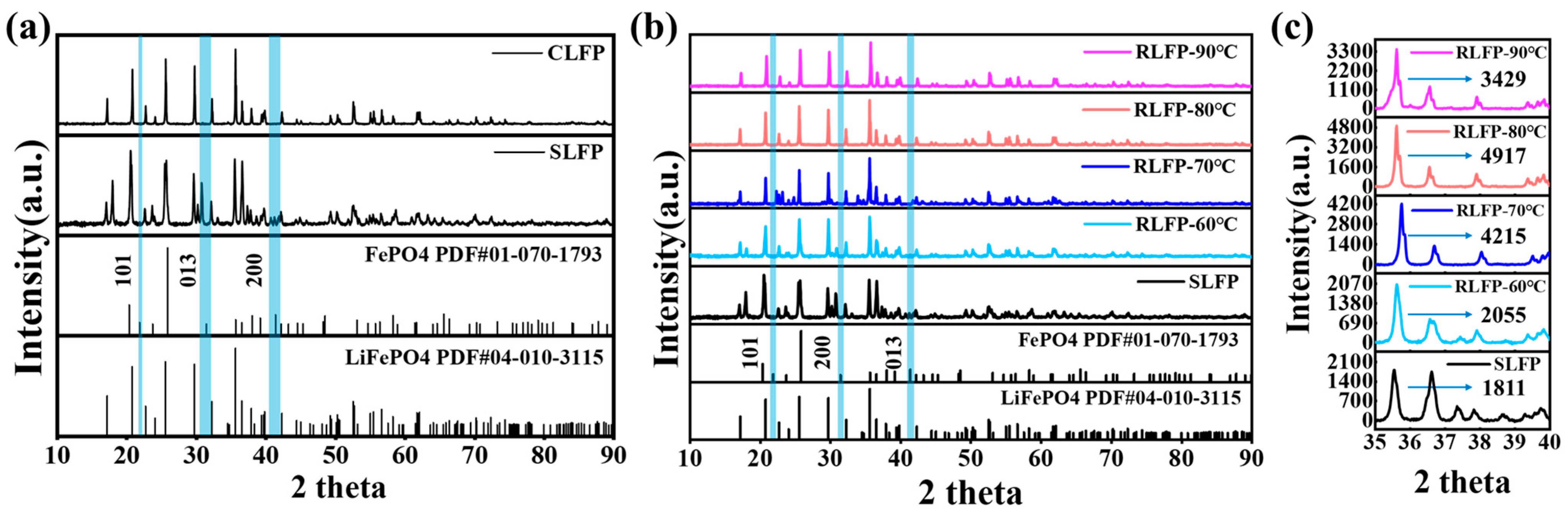
The influence of hydrothermal treatment on the crystal structure and phase purity of spent lithium iron phosphate (SLFP) was investigated using X-ray powder diffraction (XRD). Figure 1a displays the XRD patterns of SLFP and commercial lithium iron phosphate (CLFP) collected over the 2θ range of 10–90°. The majority of the diffraction peaks for both SLFP and CLFP can be indexed to the orthorhombic olivine structure of LiFePO4. However, additional peaks observed in the SLFP pattern at 21.8°, 31.4°, and 41.4° correspond to the (101), (013), and (200) planes of the FePO4 phase, respectively. The remaining reflections align well with the standard LiFePO4 pattern (PDF#04-010-3115), indicating that the olivine framework remains largely intact. The presence of the FePO4 impurity phase suggests a loss of active lithium, which is likely trapped in the anode, resulting in the formation of lithium vacancies (VLi+) and Li/Fe anti-site defects.
Figure 1b presents the X-ray diffraction (XRD) patterns of spent lithium iron phosphate (SLFP) and the regenerated lithium iron phosphate (RLFP) samples treated at various hydrothermal temperatures. Figure 1c offers a magnified view of the diffraction patterns in the range of 35–40°. Notably, the RLFP sample treated at 80 °C exhibits the highest relative intensity for the peak at 35.6°, corresponding to the (311) plane. This enhancement indicates that the RLFP-80 °C sample possesses superior crystallinity, a higher degree of long-range atomic ordering, and minimized lattice defects [26]. Such structural integrity suggests a more stable framework that is less susceptible to lattice collapse during prolonged cycling, thereby contributing to an improved cycle life [27].
Although the boiling point of hydrazine hydrate is 118 °C, its decomposition kinetics accelerate exponentially as temperatures approach 90 °C, particularly in an alkaline medium catalyzed by iron species. During the 6-h reaction, the premature depletion of hydrazine hydrate at 90 °C compromises the reducing atmosphere in the latter stages of synthesis. This diminished reducing environment facilitates the re-oxidation of Fe2+ to Fe3+ by trace amounts of oxygen or the hydrothermal medium. The resulting Fe3+ impurities induce lattice distortion and degrade the long-range ordering of the crystal structure, leading to the observed attenuation in the intensities of X-ray diffraction (XRD) peaks.

2.2. Rietveld Refinement of X-Ray Diffraction Data

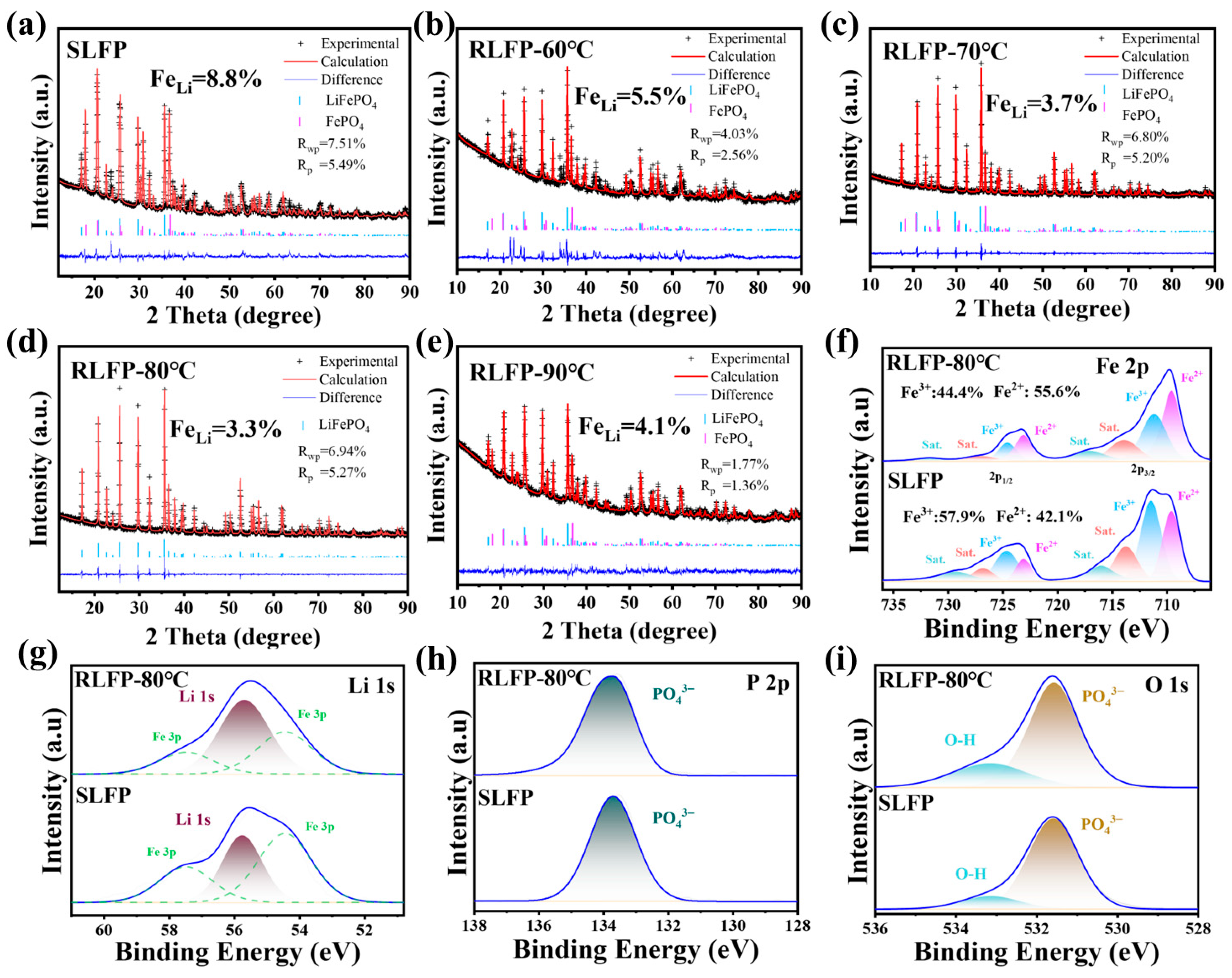
To quantitatively investigate the structural integrity and extent of Fe/Li anti-site defects, Rietveld refinement was conducted on the X-ray diffraction (XRD) patterns of both the spent lithium iron phosphate (SLFP) and regenerated lithium iron phosphate (RLFP) samples. The refinement plots are presented in Figure 2a–e. The analysis reveals that the SLFP sample exhibits a high concentration of Fe/Li anti-site defects at 8.8%. This indicates that approximately 9% of the iron atoms occupy lithium sites, thereby obstructing the one-dimensional diffusion channels and hindering the intercalation of active lithium ions. This kinetic obstruction is manifested macroscopically as a sharp increase in internal resistance and a degradation of electrochemical performance [28]. In comparison, the Fe/Li anti-site defect rates of RLFP samples treated at 60 °C, 70 °C, and 90 °C were calculated to be 5.5%, 3.7%, and 4.1%, respectively. Notably, all these values exceed 3.3% observed in the RLFP sample treated at 80 °C. The minimized defect density in the RLFP-80 °C sample implies a maximized availability of lithium sites for active lithium accommodation, confirming that the treatment at 80 °C yields the most effective structural restoration and, consequently, optimal electrochemical performance.

2.3. Analysis of Elemental Valence States

The elemental valence states of the spent lithium iron phosphate (SLFP) material and the optimally regenerated sample (RLFP-80 °C) were characterized using X-ray photoelectron spectroscopy (XPS, PHI5600, Physical Electronics, MN, USA), as illustrated in Figure 2f–i. The deconvolution of the high-resolution spectra reveals that the Li 1s, P 2p, and O 1s profiles remain virtually consistent across both samples, while a significant divergence is observed in the Fe 2p region. The quantitative analysis demonstrates that the proportion of Fe2+ in the RLFP-80 °C sample increased by 13.5% relative to the SLFP. The substantial presence of Fe3+ in the spent material is known to induce unit cell shrinkage and facilitate the formation of Fe/Li anti-site defects [29]. Consequently, as confirmed by XPS, the restoration of the iron valence state provides a fundamental chemical basis for the reduction in anti-site defects and the mitigation of lattice distortion, as was evidenced in the XRD analysis.

2.4. SEM and EDS Analysis

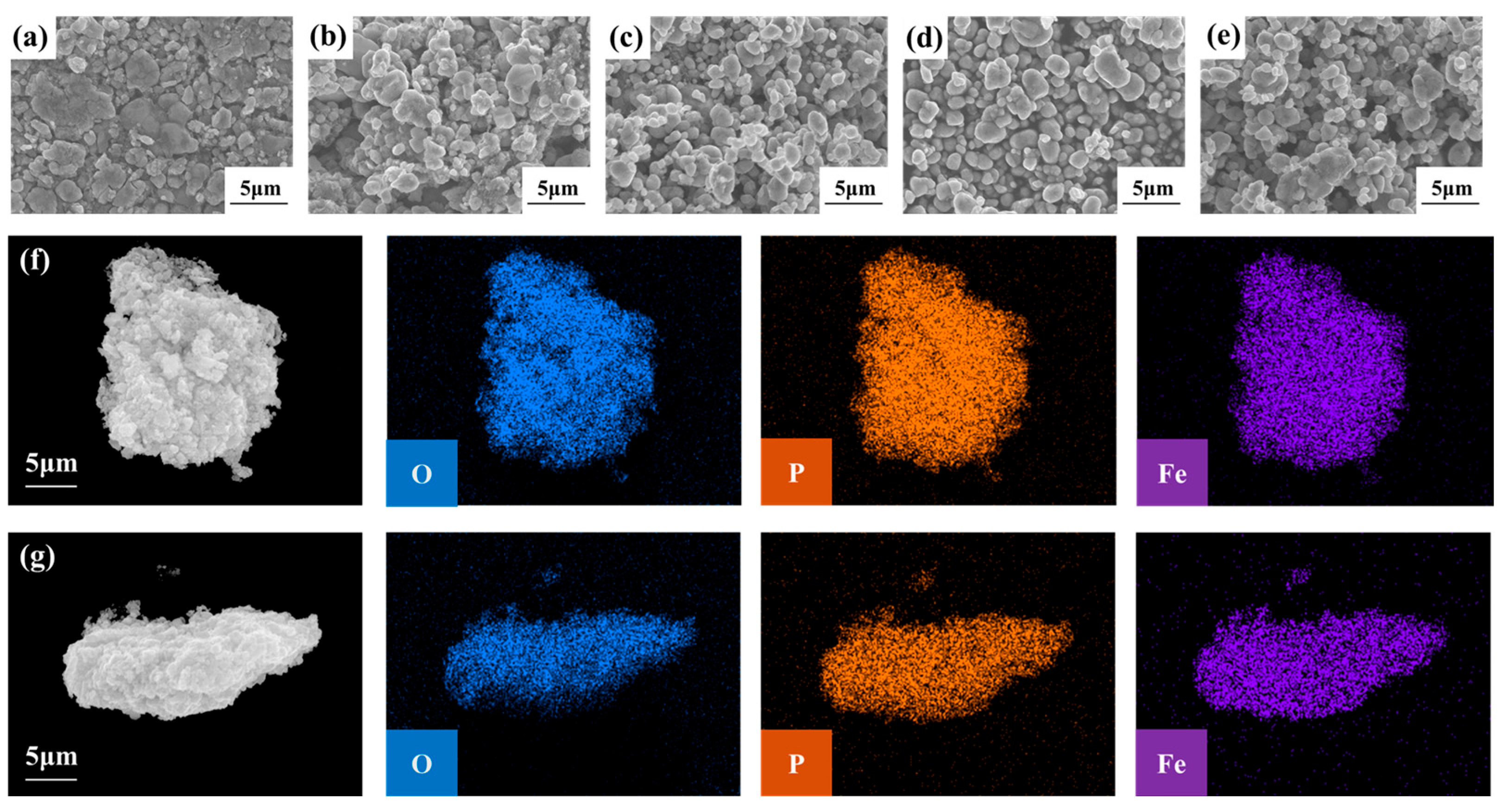
The surface morphology and microstructure of the spent lithium iron phosphate (SLFP) and regenerated lithium iron phosphate (RLFP) samples were characterized using scanning electron microscopy (SEM, SU 8010, Hitachi, Japan). Figure 3a presents the SEM image of the SLFP, revealing significant agglomeration and structural degradation inherent to the spent material. The particles exhibit irregular shapes with indistinct grain boundaries. Conversely, the morphology of the regenerated samples demonstrates a significant enhancement. The RLFP-80 °C sample (Figure 3d) displays the optimal microstructure, where severe agglomeration is effectively mitigated. These particles demonstrate a uniform size distribution and well-defined crystal facets, indicating the successful removal of impurity layers and aged passivation films during the regeneration process. The influence of regeneration temperature on morphology is evident. At lower temperatures of 60 °C and 70 °C (Figure 3b,c), the particles retain a degree of agglomeration, suggesting that the reaction kinetics are insufficient to fully disperse the aggregates. Conversely, at 90 °C (Figure 3e), although the particles are well-dispersed, minor grain overgrowth is observed, which may elongate lithium-ion diffusion pathways. Consequently, the SEM analysis confirms that the 80 °C regeneration condition achieves an optimal balance between particle dispersion and grain size control. The optimized morphology of the material under investigation has been shown to increase the specific surface area and shorten diffusion distances. Furthermore, the energy-dispersive X-ray spectroscopy (EDS) mapping (Figure 3f,g) confirms the homogeneous distribution of oxygen (O), iron (Fe), and phosphorus (P) within both the SLFP and RLFP-80 °C particles.

2.5. Cyclic Voltammetry and Electrochemical Impedance Spectroscopy Analysis

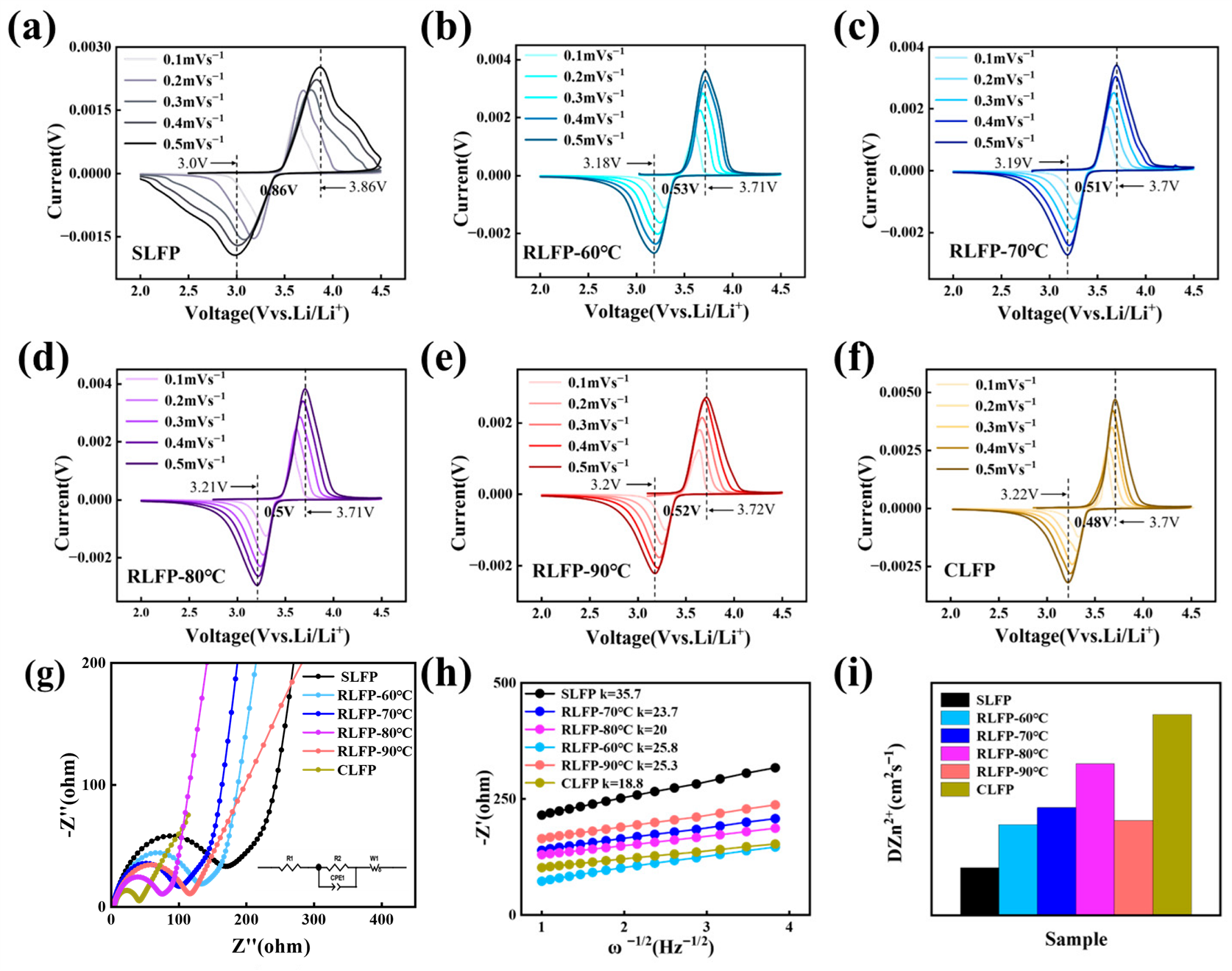
To elucidate the electrochemical kinetics and transport properties of the materials, cyclic voltammetry (CV) and electrochemical impedance spectroscopy (EIS) measurements were made. Figure 4a–f illustrate the CV curves of the spent lithium iron phosphate (SLFP) and regenerated lithium iron phosphate (RLFP) samples, obtained at various temperatures and recorded at scan rates of 0.1, 0.2, 0.3, 0.4, and 0.5 mV s−1. The SLFP sample exhibited a substantial potential separation (ΔEp) of 0.86 V, characterized by a significant shift in the anodic (delithiation) peak toward higher potentials and the cathodic (lithiation) peak toward lower potentials. The excessive potential separation (ΔEp) observed in SLFP reflects the reversibility of the electrode reaction, where a larger separation indicates greater polarization. Due to its long-term cycling, the spent material exhibits a drastic increase in the internal ohmic resistance. This results in a significant voltage drop, thereby widening the gap between the oxidation and reduction peaks [30]. In contrast, the hydrothermally regenerated RLFP samples demonstrated a marked reduction in ΔEp, reflecting decreased internal resistance. The impurity peak observed between 4 and 4.5 V in the CV curve of SLFP is attributed to the formation of impurity FePO4 resulting from the oxidation of Fe2+ to Fe3+ [31]. The elevated reaction temperature provided the thermodynamic driving force required to facilitate the reordering of Fe and Li atoms into their respective lattice sites, thereby eliminating anti-site defects that impede ion diffusion [32]. Consequently, the restoration of lattice integrity enhances lithium-ion diffusion kinetics, resulting in significantly reduced electrochemical polarization.
Figure 4g presents the Nyquist plots for the five samples, which exhibit a characteristic depressed semicircle in the high-frequency region and a linear tail in the low-frequency region. The relationship between the real part of the impedance (Z’) and ω−1/2 in the low-frequency region is depicted in Figure 4h. Correspondingly, the charge transfer resistance (Rct) and (Rs) values across the samples are compared in Table 1. The elevated Rct observed in the spent lithium iron phosphate (SLFP) is attributed to the accumulation of a thick, dense passivation layer with poor ionic conductivity at the electrode/electrolyte interface. In contrast, the reduced Rct in the regenerated lithium iron phosphate (RLFP) samples indicates the effective removal or reconstruction of this aged film, resulting in a thinner, more conductive interface that facilitates lithium-ion penetration. Finally, the calculated lithium-ion diffusion coefficients (DLi+) are summarized in Figure 4i.
The lithium-ion diffusion coefficients (DLi+) of the samples were calculated from the low-frequency impedance data using Equation (2):
D L i = R 2 T 2 2 A 2 n 4 F 4 C 2 σ 2
In this equation, DLi+ represents the lithium-ion diffusion coefficient (cm2·s−1), R is the ideal gas constant (8.314 J mol−1 K−1), T is the absolute temperature (K), and A denotes the effective surface area of the electrode (cm2). Furthermore, n indicates the number of electrons transferred per molecule (with n = 1 for LiFePO4), F is the Faraday constant (96,485 C mol−1), C is the molar concentration of lithium ions in the active material (mol cm−3), and σ corresponds to the Warburg coefficient, which is determined from the slope of the linear fit shown in Figure 4g [33].
The electrochemical parameters, including the peak potential separation (ΔEp) derived from cyclic voltammetry (CV), charge transfer resistance (Rct), and lithium-ion diffusion coefficients (DLi+), establish a robust structure–property relationship with the crystallographic analysis. These findings substantiate the previously discussed variations in X-ray diffraction (XRD) peak intensities and the reduction in Fe/Li anti-site defects, thereby forming a coherent and self-consistent logical framework.

2.6. BET Surface Area and Pore Structure Analysis

The specific surface area is a critical parameter influencing the electrochemical performance and processing characteristics of cathode materials. Table 1 presents the BET surface areas of the spent LFP (SLFP), regenerated LFP (RLFP), and commercial LFP (CLFP).The SLFP sample exhibited the largest surface area of 29 m2 g−1, which is significantly larger than that of the commercial counterpart (CLFP, 15 m2 g−1). This increase is primarily attributed to the particle pulverization and the formation of micro-cracks induced by the mechanical stress during long-term cycling. Additionally, the elevated BET value may also be attributed to residual binders and conductive agents that were not fully eliminated during the separation process.
For the regenerated samples, a temperature-dependent evolution of the surface area was observed. As the regeneration temperature increased from 60 °C to 80 °C, the BET surface area gradually decreased from 26 m2 g−1 to 18 m2 g−1. This trend suggests that higher temperatures facilitate the reconstruction of the crystal structure and the healing of surface defects. The decrease in surface area indicates the successful densification of the particles and the elimination of internal porosity, bringing the morphology closer to that of the commercial standard. Notably, the 80 °C-RLFP sample achieved a surface area of 18 m2 g−1, which is the closest to the CLFP (15 m2 g−1). A moderate surface area is desirable as it balances lithium-ion diffusion kinetics with tap density. However, when the temperature was further increased to 90 °C, the surface area unexpectedly rebounded to 24 m2 g−1. This anomaly implies that excessive temperature may lead to rapid nucleation or the formation of loose agglomerates with secondary porosity, rather than forming dense single crystals. Consequently, the 80 °C condition is considered optimal for restoring the microstructural integrity of the material, potentially minimizing side reactions with the electrolyte and ensuring the high volumetric energy density.

2.7. Electrochemical Performance Analysis

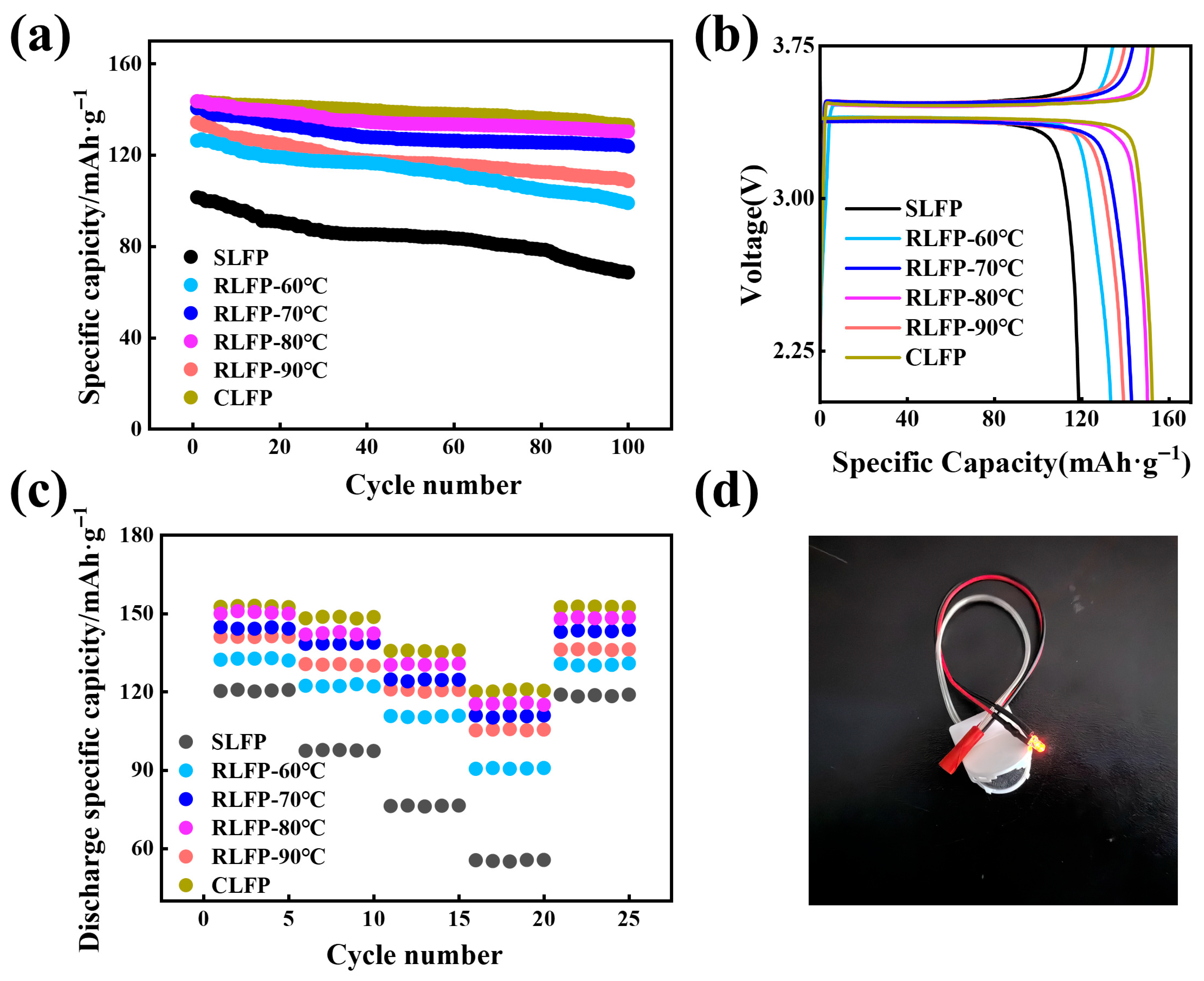
Figure 5b presents the galvanostatic charge–discharge profiles of all samples at 0.1 C. The initial specific capacities of discharge were measured at 118.8, 134.4, 143.6, 150.6, and 139.8 mAh·g−1, corresponding to initial Coulombic efficiency (ICE) of 97.2%, 99.3%, 99.6%, 99.8%, and 99.6%, respectively. The capacity retention was calculated to be 67.8%, 78.0%, 88.0%, 90.7%, and 80.9% (Table 2). Notably, the sample regenerated at 80 °C (RLFP-80) exhibited the highest specific capacity and optimal capacity retention after 100 cycles, significantly outperforming samples treated at other temperatures (Figure 5a). Furthermore, the rate capabilities of the five materials were assessed in a voltage window of 2.0–3.75 V, as depicted in Figure 5c. The results demonstrated that RLFP-80 exhibited superior specific capacity and exceptional rate performance across all tested current densities, reflecting a marked improvement over both the spent material and other regenerated counterparts. These enhanced electrochemical properties can be attributed to the effectiveness of the 80 °C hydrothermal regeneration process in repairing the crystal structure and restoring the active valence states of iron. Consequently, this process optimizes lithium-ion diffusion kinetics and electronic transport, establishing 80 °C as the optimal temperature for the direct regeneration of high-performance LFP cathodes. Figure 5d shows the practical application of the regenerated material. As shown in the CV curves (Figure 4d) and GCD profiles (Figure 5b), the material exhibits a pair of distinct redox peaks and a flat voltage plateau. This confirms that the diffusion-controlled lithium insertion/extraction reaction remains the dominant charge storage mechanism, indicating that the crystal structure has been effectively restored.
To highlight the superiority of the proposed regeneration strategy, the rate capability of the regenerated LFP was compared with other state-of-the-art regeneration methods reported in the literature, as summarized in Table 3. Remarkably, the regenerated LFP in this work delivers a discharge capacity of 115.3 mAh·g−1 at a high rate of 5C. Even when compared with optimized high-temperature sintering processes, our method demonstrates competitive or even superior capacity retention.

2.8. Economic Analysis

Economic feasibility is a prerequisite for industrial adoption. A preliminary techno-economic analysis (TEA) reveals that the proposed hydrothermal method offers a significant cost advantage over established technologies. Traditional high-temperature solid-state regeneration requires prolonged sintering (>600 °C), resulting in high energy consumption and an estimated cost of approximately $5600 per ton. Similarly, hydrometallurgical acid leaching involves expensive reagents and complex wastewater treatment, driving costs up to $7000 per ton [42].
In contrast, the proposed method operates under mild reaction conditions (80 °C) with a simplified process flow, drastically reducing energy input and equipment maintenance. Consequently, the estimated cost is only $5000 per ton. This represents a cost reduction of approximately 12% compared to the solid-state method. Coupled with a lower carbon footprint, this economic efficiency underscores the method’s potential for sustainable, large-scale battery recycling.

3. Materials and Methods

3.1. Separation of Cathode Materials from Aluminum Foil

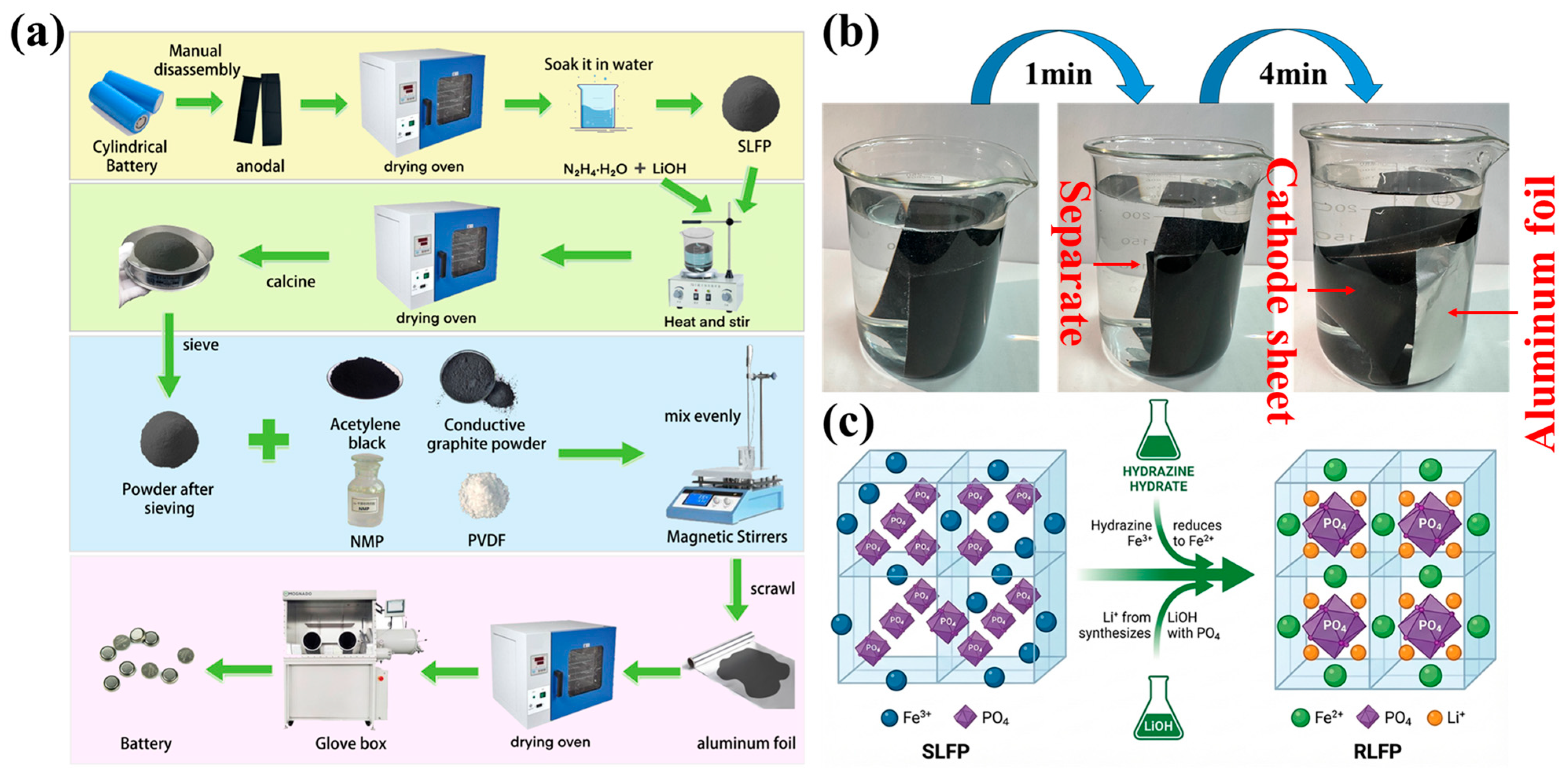
Spent cylindrical batteries were discharged to a voltage below 2.5 V at a rate of 0.1C and subsequently manually dismantled to retrieve the cathode sheets. These sheets were then cut into rectangular pieces and dried in an oven at 80 °C for 48 h. Following this, the dried electrodes were immersed in deionized water for 5 min to facilitate the detachment of the cathode material from the current collector (Figure 6b). The separation mechanism is based on thermal shock. After the heated electrodes (80 °C) are immersed into ambient water (20 °C), an instantaneous temperature differential of approximately 60 °C is created. Aluminum foil, which is metallic, has a high coefficient of thermal expansion (CTE) and contracts rapidly upon cooling. In contrast, the cathode coating, composed of LFP powder and binder, behaves as a polymer composite, exhibiting distinct shrinkage characteristics compared to the metal. This thermal mismatch generates significant shear stress at the aluminum–coating interface, leading to the physical delamination of the active material. The detached material is subsequently dried and ground to yield spent LiFePO4 powder (SLFP). As shown in Table 3, the aluminum content in the SLFP remains within the normal range, confirming the efficacy of this separation method.

3.2. Regeneration of SLFP

As indicated in Table 4, elemental analysis reveals that spent LiFePO4 (SLFP) is specifically deficient in lithium compared to commercial LiFePO4 (CLFP). Therefore, the required amount of supplementary lithium was calculated stoichiometrically to achieve a target lithium content with a Li/Fe molar ratio of approximately 1. Figure 6c illustrates the low-temperature hydrothermal regeneration strategy, employing hydrazine hydrate (N2H4·H2O) as the reducing agent and lithium hydroxide monohydrate (LiOH·H2O) as the lithium source. In a typical procedure, a suspension was prepared by mixing 1 g of SLFP powder, 0.12 g of LiOH·H2O, and 1 mL of N2H4·H2O (The initial concentration of hydrazine hydrate is 0.1 g/mL) in deionized water in a sealed beaker. The mixture was subjected to continuous stirring and heated at various temperatures for 6 h. Subsequently, the resulting slurry was dried in an oven to yield the regenerated LiFePO4 (RLFP).

3.3. Material Characterization

The crystal structures of the samples were characterized using X-ray diffraction (XRD) with a PANalytical Empyrean diffractometer (Emprean, Almelo, The Netherlands) equipped with Cu Kα radiation (λ = 0.154 nm). Data were collected over a 2θ range of 10–90°with a step size of 0.01°, operating at a voltage of 40 kV and a current of 40 mA. Rietveld refinement of the XRD patterns was conducted using the GSAS-II software package (GSAS2). Surface morphologies were examined via scanning electron microscopy (SEM; SU-8010, Hitachi, Tokyo, Japan). Elemental compositions were determined using inductively coupled plasma optical emission spectroscopy (ICP-OES; Agilent 720es, Santa Clara, CA, USA). The chemical valence states of the elements were analyzed using X-ray photoelectron spectroscopy (XPS; Thermo Fisher Scientific, Waltham, MA, USA).

3.4. Electrochemical Measurements

The electrochemical performance of the synthesized materials was evaluated using LIR2032-type coin cells. The working electrodes were prepared by dispersing the cathode active material, conductive agent, and polyvinylidene fluoride (PVDF) in an appropriate amount of N-methyl-2-pyrrolidone (NMP) at a weight ratio of 8:1:1. The resulting slurry was magnetically stirred for over 2 h to ensure homogeneity and then uniformly coated onto an aluminum foil current collector. After drying for a minimum of 8 h, the electrode sheets were punched into discs of suitable dimensions. The average mass loading of the active material was controlled at approximately 1.9 mg cm−2, and the corresponding electrode thickness was about 41 μm (excluding the Al foil).
Cell assembly was conducted in an argon-filled glove box, with moisture and oxygen levels maintained below 0.1 ppm. A microporous polypropylene membrane (Celgard 3501, Celgard, LLC, Charlotte, NC, USA) was employed as the separator. The electrolyte used was a commercial standard electrolyte for LFP batteries supplied by Kunlun Materials (Jinan, China). Galvanostatic charge–discharge (GCD) measurements were made within a voltage range of 2.5–3.75 V using a LAND CT2001A battery testing system. Cyclic voltammetry (CV) and electrochemical impedance spectroscopy (EIS) were conducted using a CHI760E electrochemical workstation (Shanghai Chenhua Instrument Co., Ltd., Shanghai, China).

4. Conclusions

This study addresses the efficient recycling and regeneration of spent lithium iron phosphate (LiFePO4) cathode materials. We developed a low-temperature hydrothermal direct regeneration method that employs hydrazine hydrate as the reducing agent and lithium hydroxide as the lithium source, facilitating comprehensive structural restoration of the spent LiFePO4. This approach effectively mitigates Fe/Li anti-site defects, reducing their prevalence from 8.8% to 3.3%, while simultaneously restoring the active oxidation state of iron, enhancing both Li-ion diffusion kinetics, and improving electron transport. At the optimal hydrothermal reaction temperature of 80 °C, the regenerated material (RLFP-80 °C) exhibited superior electrochemical performance, delivering an initial discharge capacity of 150.3 mAh·g−1 and a capacity retention of 90.7% after 100 cycles at 1 C, significantly surpassing that of untreated spent LiFePO4. These results indicate that the low-temperature hydrothermal regeneration method can achieve uniform mixing at the atomic or molecular level in a liquid-phase environment, effectively overcoming the limitations of traditional solid-phase and wet methods. It provides a reliable technical solution for the efficient, economical, and environmentally friendly recycling of spent lithium iron phosphate batteries.

Author Contributions

Methodology, W.L.; Validation, S.S., J.C. and Y.L.; Investigation, Y.C.; Resources, W.L., Y.Z. (Yidan Zhang) and C.H.; Writing—original draft, J.T.; Writing—review & editing, X.W. and Y.Z. (Yidan Zhang); Visualization, Y.Z. (Yukun Zhang) and Y.Z. (Yuan Zhao); Supervision, W.L.; Project administration, W.L.; Funding acquisition, W.L. and C.H. All authors have read and agreed to the published version of the manuscript.

Funding

The work is supported by the National Natural Science Foundation of China (No. 21865021), the Inner Mongolia Key Technology Project (No. 2020GG0166), the Major Science and Technology Project of Hohhot (2023-Winning the leaderboard-High-3), Inner Mongolia Autonomous Region Science and Technology Plan Project (2023YFHH0059), Inner Mongolia Association for Science and Technology’s Young Talent Support Program for Doctoral Students (QTBS2509).

Institutional Review Board Statement

Not applicable.

Informed Consent Statement

Not applicable.

Data Availability Statement

The original contributions presented in this study are included in the article. Further inquiries can be directed to the corresponding author.

Conflicts of Interest

Author Yan Cao was employed by the company China Tower Corporation Inner Mongolia Autonomous Region Branch. Author Chao Huang was employed by the company Inner Mongolia Shengfan Technology Co., Ltd. The remaining authors declare that the research was conducted in the absence of any commercial or financial relationships that could be construed as a potential conflict of interest.

References

  1. Wang, W.; Wu, Y.F. An overview of recycling and treatment of spent LiFePO4 batteries in China. Resour. Conserv. Recycl. 2017, 127, 233–243. [Google Scholar] [CrossRef]
  2. Wang, M.M.; Liu, K.; Dutta, S.; Alessi, D.S.; Rinklebe, J.; Ok, Y.S.; Tsang, D.C.W. Recycling of lithium iron phosphate batteries: Status, technologies, challenges, and prospects. Renew. Sustain. Energy Rev. 2022, 163, 112515. [Google Scholar] [CrossRef]
  3. Wang, S.Y.; Yu, J. Evaluating the electric vehicle popularization trend in China after 2020 and its challenges in the recycling industry. Waste Manag. Res. 2021, 39, 818–827. [Google Scholar] [CrossRef]
  4. Yan, J.; Qian, J.; Li, Y.; Li, L.; Wu, F.; Chen, R.J. Toward Sustainable Lithium Iron Phosphate in Lithium-Ion Batteries: Regeneration Strategies and Their Challenges. Adv. Funct. Mater. 2024, 34, 2405055. [Google Scholar] [CrossRef]
  5. Ojeda, L.; Oliva, J.; Garcés-Patiño, L.A.; Velazquez-Galvan, Y.; Perez-Chavez, M.; Quintero, J.P. Facile processing of graphite recycled from spent AA/Lithium-ion batteries for the fabrication of highly efficient supercapacitors. J. Energy Storage 2025, 140, 118942. [Google Scholar] [CrossRef]
  6. Kityk, A.; Pavlik, V.; Hnatko, M. Reshaping the future of battery waste: Deep eutectic solvents in Li-ion battery recycling. J. Energy Storage 2024, 97, 112990. [Google Scholar] [CrossRef]
  7. Lv, W.G.; Wang, Z.H.; Cao, H.B.; Sun, Y.; Zhang, Y.; Sun, Z. A critical review and analysis on the recycling of spent lithium-ion batteries. ACS Sustain. Chem. Eng. 2018, 6, 1504–1521. [Google Scholar] [CrossRef]
  8. Harper, G.; Sommerville, R.; Kendrick, E.; Driscoll, L.; Slater, P.; Stolkin, R.; Walton, A.; Christensen, P.; Heidrich, O.; Lambert, S.; et al. Recycling lithium-ion batteries from electric vehicles. Nature 2019, 575, 75–86. [Google Scholar] [CrossRef] [PubMed]
  9. Mossali, E.; Picone, N.; Gentilini, L.; Rodrìguez, O.; Pérez, J.M.; Colledani, M. Lithium-ion batteries towards circular economy: A literature review of opportunities and issues of recycling treatments. J. Environ. Manag. 2020, 264, 110500. [Google Scholar] [CrossRef]
  10. Huanga, B.; Pan, Z.F.; Su, X.Y.; An, L. Recycling of lithium-ion batteries: Recent advances and perspectives. J. Power Sources 2018, 399, 274–286. [Google Scholar] [CrossRef]
  11. Ciez, R.E.; Whitacre, J.F. Examining different recycling processes for lithium-ion batteries. Nat. Sustain. 2019, 2, 148–156. [Google Scholar] [CrossRef]
  12. Fan, E.; Li, L.; Wang, Z.P.; Lin, J.; Huang, Y.X.; Yao, Y.; Chen, R.J.; Wu, F. Sustainable Recycling Technology for Li-Ion Batteries and Beyond: Challenges and Future Prospects. Chem. Rev. 2020, 120, 7020–7063. [Google Scholar] [CrossRef]
  13. Gaines, L. Lithium-ion battery recycling processes: Research towards a sustainable course. Sustain. Mater. Technol. 2018, 17, e00068. [Google Scholar] [CrossRef]
  14. Xu, P.P.; Dai, Q.; Gao, H.P.; Liu, H.D.; Zhang, M.H.; Li, M.Q.; Chen, Y.; An, K.; Meng, Y.S.; Liu, P.; et al. Efficient Direct Recycling of Lithium-Ion Battery Cathodes by Targeted Healing. Joule 2020, 4, 2609–2626. [Google Scholar] [CrossRef]
  15. Tang, X.; Wang, R.; Ren, Y.F.; Duan, J.D.; Li, J.; Li, P.Y. Effective regeneration of scrapped LiFePO4 material from spent lithium-ion batteries. J. Mater. Sci. 2020, 55, 13036–13048. [Google Scholar] [CrossRef]
  16. Liu, P.W.; Zhang, Y.N.; Dong, P.; Zhang, Y.J.; Meng, Q.; Zhou, S.Y.; Yang, X.; Zhang, M.Y.; Yang, X. Direct regeneration of spent LiFePO4 cathode materials with pre oxidation and V-doping. J. Alloys Compd. 2021, 860, 157909. [Google Scholar] [CrossRef]
  17. Lan, Y.Q.; Li, X.K.; Zhou, G.M.; Yao, W.J.; Chen, H.M.; Tang, Y.B. Direct Regenerating Cathode Materials from Spent Lithium-Ion Batteries. Adv. Sci. 2024, 11, 2304425. [Google Scholar] [CrossRef]
  18. Qi, C.; Wang, S.H.; Zhu, X.K.; Zhang, T.; Guo, Y.J.; Xie, Z.X.; Jin, Y.C.; Wang, Y.; Song, L.; Zhang, M.D. Environmental-Friendly Low-Cost Direct Regeneration of Cathode Material from Spent LiFePO4. J. Alloys Compd. 2022, 924, 166612. [Google Scholar]
  19. Ji, G.J.; Wang, J.X.; Liang, Z.; Jia, K.; Ma, J.; Zhuang, Z.F.; Zhou, G.M.; Cheng, H.M. Direct regeneration of degraded lithium-ion battery cathodes with a multifunctional organic lithium salt. Nat. Commun. 2023, 14, 584. [Google Scholar] [CrossRef]
  20. Sloop, S.E.; Crandon, L.; Allen, M.; Lerner, M.M.; Zhang, H.Y.; Sirisaksoontorn, W.; Gaines, L.; Kim, J.; Lee, M. Cathode healing methods for recycling of lithium-ion batteries. Sustain. Mater. Technol. 2019, 22, e00113. [Google Scholar] [CrossRef]
  21. Wu, J.; Xiao, L.; Liu, P.C.; Zhu, Y.R.; Li, J. Direct regeneration and upcycling of cathode material from spent lithium ion batteries: Recent advances and perspectives. Sep. Purif. Technol. 2025, 355, 129574. [Google Scholar] [CrossRef]
  22. Li, C.C.; Gong, R.; Zhang, Y.J.; Meng, Q.; Dong, P. Direct Regeneration of Degraded LiFePO4 Cathode via Reductive Solution Relithiation Regeneration Process. Molecules 2024, 29, 3340. [Google Scholar] [CrossRef]
  23. Cheng, C.; Cao, X.; Xing, Z.Q.; Tang, S.C. Direct regeneration of severely damaged spent LiFePO4 cathodes. J. Mater. Sci. Technol. 2026, 241, 262–269. [Google Scholar] [CrossRef]
  24. Yang, T.Z.; Luo, D.; Yu, A.P.; Chen, Z.W. Enabling future closed-loop recycling of spent Lithium-ion batteries: Direct cathode regeneration. Adv. Mater. 2023, 35, 2203218. [Google Scholar] [CrossRef]
  25. Gao, H.P.; Tran, D.; Chen, Z. Seeking direct cathode regeneration for more efficient lithium-ion battery recycling. Curr. Opin. Electrochem. 2022, 31, 100875. [Google Scholar] [CrossRef]
  26. Wang, Y.X.; Yang, Y.P.; Zhang, J.L.; Chen, Y.Q.; Wang, C.Y. Residue carbon removal for the high-quality and sustainable direct regeneration of spent LiFePO4 materials. Appl. Surf. Sci. 2025, 689, 162512. [Google Scholar] [CrossRef]
  27. Tian, K.J.; Zhang, J.L.; Bai, J.X.; Liang, Y.; Shen, W.Z.; Zhong, M.; Guo, S.W. A Green Chemical Protocol for Separation of Spent LiFePO4 Cathode Material from Al Foil and Regeneration. Green Chem. 2025, 27, 15271–15282. [Google Scholar] [CrossRef]
  28. Yang, Y.P.; Liu, Z.X.; Zhang, J.L.; Chen, Y.Q.; Wang, C.Y. Economical and low-carbon regeneration of spent LiFePO4 materials by hydrothermal relithiation. J. Alloys Compd. 2023, 947, 169660. [Google Scholar] [CrossRef]
  29. Birkl, C.R.; Roberts, M.R.; McTurk, E.; Bruce, P.G.; Howey, D.A. Degradation diagnostics for lithium ion cells. J. Power Sources 2017, 341, 373–386. [Google Scholar] [CrossRef]
  30. Cui, K.; Zhao, M.C.; Li, Y.R.; Atrens, A.; Zhang, F. Recycling of spent lithium iron phosphate batteries: Research progress based on environmental protection and sustainable development technology. Sep. Purif. Technol. 2025, 354, 128982. [Google Scholar] [CrossRef]
  31. Cheng, C.; Mao, W.; Cao, X.; Xu, K.J.; Tang, S.C. Sustainable transformation of spent LiFePO4 cathodes into high-voltage olivine LiMnxFe1-xPO4 via solvothermal upcycling strategy for next-generation cathode material. Energy Storage Mater. 2025, 80, 104402. [Google Scholar] [CrossRef]
  32. Zhou, H.X.; Hu, Q.; Li, L.Q.; Ma, X.; Cao, Z.F. Endogenous advanced oxidation process with peracetic acid for recycling spent LiFePO4 batteries. Chem. Eng. Sci. 2024, 295, 120202. [Google Scholar] [CrossRef]
  33. Chen, B.B.; Liu, M.; Cao, S.; Hu, H.; Chen, G.R.; Guo, X.W.; Wang, X.Y. Direct regeneration and performance of spent LiFePO4 efficient hydrothermal technique. J. Alloys Compd. 2022, 924, 166487. [Google Scholar] [CrossRef]
  34. Abdelaal, M.M.; Alkhedher, M. Dual optimization of LiFePO4 cathode performance using manganese substitution and a hybrid lithiated Nafion-modified PEDOT:PSS coating layer for lithium-ionbatteries. Electrochim. Acta 2024, 506, 145050. [Google Scholar] [CrossRef]
  35. Bui, Q.T.; Haufe, L.A.; Zhang, J.F.; Wenzel, M.; Kremer, T.; Urbano, J.L.G.; Balducci, A.; Du, H.; Weigand, J.J. A closed process for recycling and re-synthesis of spent LiFePO4 cathode material. Resour. Conserv. Recycl. 2025, 223, 108519. [Google Scholar] [CrossRef]
  36. Chen, J.P.; Li, Q.W.; Song, J.S.; Song, D.W.; Zhang, L.Q.; Shi, X.X. Environmentally friendly recycling and effective repairing of cathode powders from spent LiFePO4 batteries. Green Chem. 2016, 18, 2500. [Google Scholar] [CrossRef]
  37. Yang, L.; Zhang, B.C.; Chen, S.; Pan, Q.; Li, W.Y.; Gan, C.L.; Deng, W.T.; Zou, G.Q.; Hou, H.S.; Yang, L.; et al. Direct regeneration of spent LiFePO4 cathode materials assisted with a bifunctional organic lithium salt. Chem. Commun. 2024, 60, 9384–9387. [Google Scholar] [CrossRef]
  38. Qin, Z.J.; Li, X.H.; Shen, X.J.; Cheng, Y.; Wu, F.X.; Li, Y.J.; He, Z.J. Electrochemical selective lithium extraction and regeneration of spent lithium iron phosphate. Waste Manag. 2024, 174, 106–113. [Google Scholar] [CrossRef]
  39. Teng, J.H.; Tang, X.; Tang, M.Q.; Wu, Q.; Li, J. Failure mechanism and voltage regulation strategy of low N/P ratio lithium iron phosphate battery. J. Energy Storage 2022, 51, 104588. [Google Scholar] [CrossRef]
  40. Liu, J.X.; Wan, W.; Nie, Q.; Zhang, C.; Chen, X.L.; Lin, W.H.; Wei, X.Z.; Huang, Y.H.; Li, J.; Wang, C. Controllable long-term lithium replenishment for enhancing energy density and cycle life of lithium-ion batteries. Energy Environ. Sci. 2024, 17, 1163. [Google Scholar] [CrossRef]
  41. Zhang, L.Q.; Gao, H.P.; Zhu, Y.W.; Tran, I.; Tang, W.; Lin, J.; Mu, A.U.; Wu, J.L.; Li, W.; Nordlund, D.; et al. Unveiling the Role of Critical Impurities in Spent LiFePO4 Cathodes for Scalable Direct Regeneration. Adv. Energy Mater. 2025, 46, 15. [Google Scholar] [CrossRef]
  42. Zhao, T.Y.; Li, W.L.; Traversy, M.; Choi, Y.; Ghahreman, A.; Zhao, Z.W.; Zhang, C.; Zhao, W.D.; Song, Y.F. A review on the recycling of spent lithium iron phosphate batteries. J. Environ. Manag. 2024, 351, 119670. [Google Scholar] [CrossRef] [PubMed]
Figure 1. (a) X-ray diffraction (XRD) patterns of spent LiFePO4 (SLFP) and commercial LiFePO4; (b) XRD patterns of SLFP and regenerated LiFePO4 (RLFP) processed at various hydrothermal temperatures; (c) Magnified view of the diffraction patterns in the 2θ range of 35–40° for the SLFP and RLFP samples.
Inorganics 14 00048 g001
Figure 2. (ae) Rietveld refinement of XRD patterns for SLFP and RLFP samples regenerated at different hydrothermal temperatures; (fi) XPS spectra of SLFP and RLFP-80 °C.
Inorganics 14 00048 g002
Figure 3. SEM images of (a) SLFP; (b) RLFP-60 °C; (c) RLFP-70 °C; (d) RLFP-80 °C; and (e) RLFP-90 °C; (f,g) EDS elemental mapping of SLFP and RLFP-80 °C, respectively.
Inorganics 14 00048 g003
Figure 4. (a) Cyclic voltammetry (CV) curves of SLFP at scan rates from 0.1 to 0.5 mV·s−1; (b) CV curves of RLFP at 60 °C at scan rates from 0.1 to 0.5 mV·s−1; (c) CV curves of RLFP at 70 °C at scan rates from 0.1 to 0.5 mV·s−1; (d) CV curves of RLFP at 80 °C at scan rates from 0.1 to 0.5 mV·s−1; (e) CV curves of RLFP at 90 °C at scan rates from 0.1 to 0.5 mV·s−1; (f) CV curves of CLFP at scan rates from 0.1 to 0.5 mV·s−1; (g) electrochemical impedance spectroscopy (EIS) Nyquist plots for the various samples; (h) linear fitting of Z’ versus ω−1/2 in the low-frequency region for the corresponding electrodes; (i) calculated lithium-ion diffusion coefficients (DLi+) for different samples.
Inorganics 14 00048 g004
Figure 5. (a) long-term cycling stability curves; (b) Initial charge–discharge profiles of different samples; (c) rate capability performance; (d) practical application picture.
Inorganics 14 00048 g005
Figure 6. (a) Schematic illustration of the experimental workflow; (b) separation process of the cathode material from the current collector; and (c) schematic diagram of the regeneration process.
Inorganics 14 00048 g006
Table 1. Fitting parameters of electrochemical impedance spectroscopy (EIS) and BET analysis results of different samples.
SampleSLFP60 °C-RLFP70 °C-RLFP80 °C-RLFP90 °C-RLFPCLFP
Rs (Ω)2.14.91.993.862.654.79
Rct (Ω)147.7115.687.664.6111.634.4
Surface area (m2·g−1)292620182415
Table 2. Specific capacities and coulombic efficiencies of SLFP and RLFP samples obtained at various temperatures.
SampleSLFP60 °C-RLFP70 °C-RLFP80 °C-RLFP90 °C-RLFP
Charge specific capacity (mAh·g−1)122.2134.4143.6150.6139.8
Discharge specific capacity (mAh·g−1)118.8133.5143150.3139.3
Coulombic efficiency (CE)97.2%99.3%99.6%99.8%99.6%
Table 3. Comparative Analysis.
Preparation MethodRate CapabilityRef.
This work115.3 mAhg−1 at 5C 
Hybrid Sintering90 mAhg−1 at 5C[34]
Drying Sputtering50 mAhg−1 at 5C[35]
High-temperature sintering115 mAhg−1 at 5C[36]
Low-temperature sintering110 mAhg−1 at 5C[37]
High-temperature sintering90 mAhg−1 at 5C[38]
High-temperature sintering103 mAhg−1 at 5C[39]
High-temperature sintering90 mAhg−1 at 5C[40]
Low-temperature sintering60 mAhg−1 at 5C[41]
Table 4. Comparison of the elemental composition of SLFP determined by ICP analysis with the elemental content of CLFP.
SampleChemical ElementElemental Composition (%)
Commercial Lithium Iron PhosphateAl<0.1
 Li3.9~5
 P18~20
 Fe33~36
Spent Lithium Iron PhosphateAl0.06
 Li2.7
 P19.3
 Fe33.3
Disclaimer/Publisher’s Note: The statements, opinions and data contained in all publications are solely those of the individual author(s) and contributor(s) and not of MDPI and/or the editor(s). MDPI and/or the editor(s) disclaim responsibility for any injury to people or property resulting from any ideas, methods, instructions or products referred to in the content.