


Abstract
Radio-over-Fiber (RoF) integrated with Free-Space Optical (FSO) communication as a fronthaul is a promising solution for next-generation wireless systems, but severely suffers from the frequency-selective characteristics of hybrid RoF-FSO channels. This paper presents a measurement-driven, deployment-oriented optimization that jointly performs structure-aware pilot placement and sixth-order polynomial regression channel interpolation to enhance spectral efficiency and signal quality in quasi-static indoor FSO environments. Differential channel analysis across three transmission scenarios—Electrical Back-to-Back (B2B), Fiber B2B, and FSO—identifies critical subcarriers with high frequency-selective variation that require dense pilot allocation. A gradient-based algorithm positions 50 pilots with dense spacing (every 3 subcarriers) in critical regions and sparse spacing (every 9 subcarriers) in stable regions, reducing pilot overhead by 26.5% and increasing data capacity by 5.3% (340 → 358 subcarriers) compared to uniform placement of 68 pilots. Sixth-order polynomial regression models the non-linear channel frequency response, overcoming limitations of conventional linear interpolation. Experimental validation on a 4-QAM RoF-OFDM system over 40.6 MHz bandwidth shows that structure-aware pilot placement alone reduces Error Vector Magnitude (EVM) by 15.9%, while polynomial regression alone improves it by 15.7%. Combined optimization of structure-aware pilot placement with polynomial regression interpolation achieves 23.5% EVM reduction and 460× lower BER, equivalent to 3.2 dB SNR gain at BER = . Comparative analysis of four system configurations confirms consistent performance advantages across SNRs of 12–30 dB. The proposed measure-once, optimize-forever paradigm requires only one-time channel characterization, making it suitable for short-range controlled quasi-static indoor FSO links in 5G/6G fronthaul, optical wireless networks, and inter-building backhaul applications.
1. Introduction
Radio-over-Fiber (RoF) and free space optical (FSO) communication are potential key-enabling technologies for high-bandwidth converged networks, and their integration offers a promising solution for next-generation wireless systems requiring high data rates, low latency, and flexible deployment [1]. Combining such networks with orthogonal frequency division multiplexing (OFDM) is advantageous because OFDM provides high spectral efficiency and robustness against frequency-selective distortion [2]. Nevertheless, RoF-OFDM deployment over FSO links remains challenging without accurate channel estimation, which is commonly achieved by inserting pilot subcarriers in a comb-type structure, where pilot spacing directly affects channel-estimation accuracy and effective data throughput [3].
Conventional pilot placement methods in OFDM systems generally use uniformly spaced pilots and are mainly designed for radio-frequency (RF) channels with time-varying multipath characteristics [4]. Although uniform pilot allocation provides reliable channel tracking in dynamic RF environments, it may not be optimal for RoF-FSO links, where the channel response can exhibit localized frequency-selective distortion. In controlled indoor or short-range FSO configurations, the channel often shows quasi-static behavior over moderate time intervals, with frequency-selective attenuation patterns that remain relatively stable [5]. This indicates that uniform pilot allocation may waste spectral resources in stable frequency regions while under-sampling subcarrier regions with rapid channel variation.
The optical fiber section of a RoF-FSO system introduces frequency-selective impairments due to chromatic dispersion, modal dispersion, component bandwidth limitations, and nonlinear optical effects [6]. When combined with FSO-link impairments such as scintillation, pointing sensitivity, and atmospheric-induced fluctuation, the resulting composite channel can exhibit non-uniform distortion across the OFDM subcarrier spectrum [7]. Recent studies on FSO and optical wireless systems further highlight that channel estimation becomes increasingly important under turbulence, pointing errors, and dynamic optical propagation conditions [8]. Therefore, it is necessary to analyze the contribution of each transmission stage—Electrical back-to-back (B2B), Fiber B2B, and complete FSO transmission—to develop pilot-placement strategies that are sensitive to the measured channel structure rather than relying only on generic uniform pilot patterns.
Recently, measurement-driven and adaptive channel-estimation approaches have gained attention for improving communication system performance under practical channel conditions. However, many advanced OFDM channel-estimation and pilot-optimization methods require prior channel statistics, covariance estimation, or additional computational processing, which may limit their direct application in practical RoF-FSO receiver architectures [9,10]. For quasi-static FSO links, continuous adaptation may not be necessary; instead, a deployment-oriented approach can characterize the channel during an initial measurement phase and then apply a fixed optimized pilot configuration. This motivates a measurement-driven, structure-aware pilot placement and nonlinear interpolation framework for RoF-OFDM FSO systems.
Existing OFDM channel-estimation studies primarily rely on uniform pilot allocation and conventional interpolation, while advanced methods often prioritize statistical estimation or adaptive optimization. However, limited attention has been given to subcarrier-level channel structure in experimentally measured hybrid RoF-FSO links, especially for jointly optimizing pilot placement and nonlinear interpolation. This gap motivates the proposed approach, which combines differential channel analysis, structure-aware pilot redistribution, and polynomial-regression-based channel reconstruction.
This paper presents a differential channel analysis framework to analyze frequency-selective degradation behavior in RoF-FSO systems and proposes a dual-optimization strategy that jointly performs structure-aware pilot placement and polynomial-regression channel interpolation. Unlike conventional approaches that assume homogeneous channel statistics and rely mainly on uniform pilot placement with linear interpolation, the proposed work makes the following contributions:
- Performs differential analysis of channel responses across three scenarios (Electrical B2B, Fiber B2B, and FSO) to isolate the incremental effects of optical fiber and FSO transmission.
- Identifies critical subcarriers exhibiting high variation where dense pilot placement is essential for accurate channel estimation.
- Proposes structure-aware pilot allocation with dense spacing in critical regions and sparse spacing in stable regions, reducing pilot overhead by 26.5% (68 → 50 pilots) while increasing data capacity by 5.3% (340 → 358 subcarriers).
- Implements sixth-order polynomial regression interpolation to model the nonlinear channel frequency response, overcoming limitations of conventional linear interpolation between pilot positions.
- Validates the dual-optimization approach through experimental measurements using a 4-QAM RoF-FSO system, demonstrating 23.5% EVM reduction and 460× BER reduction compared with conventional uniform pilots with linear interpolation.
The key contributions of this work are threefold:
- Demonstration that channel structure information extracted from experimental measurements can guide structure-aware pilot placement without requiring continuous adaptation for quasi-static RoF-FSO links.
- Validation that polynomial-regression-based channel interpolation significantly outperforms conventional linear methods for nonlinear optical channel responses.
- Experimental verification that combining structure-aware pilots with polynomial interpolation yields synergistic performance gains while improving spectral efficiency.
This measure-once, optimize-forever paradigm is particularly suitable for quasi-static FSO links in controlled environments such as indoor optical wireless networks, last-mile connectivity, inter-building backhaul links, and short-range fronthaul deployments.
The remainder of this paper is organized as follows: Section 2 presents the literature review on RoF-FSO systems, OFDM, channel estimation, and pilot design. Section 3 describes the experimental setup and methodology, including transmission scenarios and signal processing chain. Section 4 presents experimental results, including controlled SNR analysis and per-subcarrier characterization. Section 5 provides a comparative performance analysis of pilot placement and interpolation schemes. Finally, Section 6 concludes the paper and outlines directions for future work.
2. Literature Review
2.1. Radio-over-Fiber and Free Space Optical Systems
Radio-over-Fiber (RoF) enables centralized RF signal generation and distribution over optical fiber, offering high bandwidth and immunity to electromagnetic interference [1]. When integrated with Free Space Optical (FSO) links, RoF–FSO systems provide flexible last-mile connectivity without requiring additional fiber deployment [11]. FSO channels, however, are affected by atmospheric turbulence, scintillation, and attenuation, introducing amplitude fading and phase distortions [5]. Fiber links contribute chromatic dispersion and nonlinearities, particularly at higher modulation bandwidths [6]. In hybrid RoF–FSO systems, these impairments interact, resulting in composite channel responses that may exhibit frequency-selective distortion across OFDM subcarriers.
While prior studies extensively analyzed link budgets and atmospheric effects in FSO systems [5], limited attention has been given to subcarrier-level frequency behavior in hybrid RoF–FSO links, particularly in the context of pilot-assisted OFDM channel estimation. This motivates structured investigation of frequency-domain characteristics for improved pilot design.
2.2. OFDM in Optical and Hybrid RoF Systems
Orthogonal Frequency Division Multiplexing (OFDM) has been widely adopted in optical communications due to its robustness against dispersion and high spectral efficiency [12]. Optical OFDM variants such as DMT and IM/DD-based implementations have demonstrated high-capacity transmission over fiber links [13]. In optical wireless systems, ACO-OFDM and DCO-OFDM have been studied under AWGN and fading conditions [14]. Subcarrier allocation strategies have also been explored in optical wireless systems to improve BER performance under nonlinear LED distortions [15]. However, most reported investigations consider single-medium systems. Hybrid RoF–FSO environments introduce joint impairments that may induce non-uniform subcarrier degradation. Therefore, uniform pilot placement may not be optimal in such composite channels.
2.3. Channel Estimation and Comb-Type Pilot Design
Accurate channel estimation is fundamental to coherent OFDM detection. Classical pilot-assisted estimation techniques include block-type and comb-type arrangements [16,17]. Coleri et al. [3] demonstrated that comb-type pilots with fixed spacing provide a practical tradeoff between estimation accuracy and computational complexity in frequency-selective channels. Negi and Cioffi [18] further studied pilot positioning strategies under power constraints to minimize mean square error. In optical OFDM systems, phase noise and dispersion have been extensively modeled [19], but most implementations rely on linear interpolation between uniformly spaced pilots. While linear interpolation is computationally efficient, it fails to capture nonlinear spectral variations introduced by combined fiber and atmospheric effects.
Higher-Order Interpolation in Frequency-Selective Channels
To address nonlinear spectral variation, higher-order interpolation methods have been proposed. Wiener filtering achieves minimum MSE performance when channel statistics are known [17], but requires prior statistical knowledge.
Polynomial interpolation and spline-based approaches provide improved accuracy compared to linear interpolation while maintaining manageable complexity. In frequency-selective environments, higher-order interpolation has shown measurable MSE reductions compared to first-order methods [16]. However, most implementations assume uniformly spaced pilots and do not explore repositioning pilots based on measured spectral distortion patterns.
2.4. Adaptive and Non-Uniform Pilot Placement
Uniform pilot spacing dominates practical OFDM systems due to implementation simplicity [3]. Adaptive pilot density strategies have been proposed for time-varying wireless channels [20], and recursive estimation methods have been investigated in coherent optical OFDM systems. Nevertheless, these methods typically require prior channel statistics or continuous adaptation.
2.5. Differential Channel Analysis in Hybrid Systems
Differential analysis has been used in coherent optical systems to isolate dispersion and nonlinear effects [21]. In wireless systems, multipath and shadowing components are commonly analyzed separately [22]. In RoF systems, combined fiber and RF distortions have been examined [23]; however, no prior work applies differential frequency-domain analysis to guide pilot redistribution in hybrid RoF–FSO systems. No prior work applies differential analysis to frequency-selective effects in hybrid RoF-FSO for pilot optimization.
Key gaps in RoF-OFDM-FSO literature include:
- Limited per-subcarrier frequency-domain characterization.
- Lack of differential analysis isolating incremental media effects.
- Reliance on static uniform pilot spacing.
- Minimal exploration of advanced interpolation (polynomial, spline, Wiener) for optical channels.
- High computational overhead of adaptive and online DL methods.
- Focus on dynamic adaptation rather than one-time structure-aware configuration.
- No joint optimization of pilot placement and interpolation for hybrid systems.
- Predominantly simulation-based validation, lacking real RoF-FSO hardware experiments.
This work addresses these gaps via differential analysis to isolate frequency-selective effects, gradient-based identification of critical subcarriers, optimized polynomial regression interpolation, and structure-aware pilot allocation. The method uses one-time gradient optimization suitable for quasi-static FSO [5], avoids ongoing ML overhead, and is experimentally validated on real hardware.
3. Experimental Setup and Methodology
This subsection explains the testbed and measurement procedure of an experimental channel testing institution of frequency-domain channel responses in a hybrid RoF-FSO OFDM system. Three types of transmission are taken into account, such as Electrical Back-to-Back (B2B), Fiber B2B and FSO, which allow isolating the impairments caused by optical fiber transmission and FSO propagation. The same signal generation and receiver processing chains are kept in each scenario in order to have a fair and controlled comparison.
3.1. Overall System Architecture
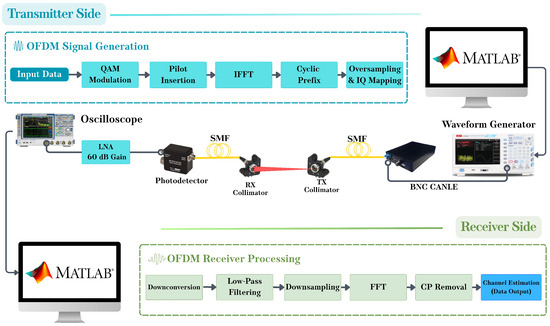
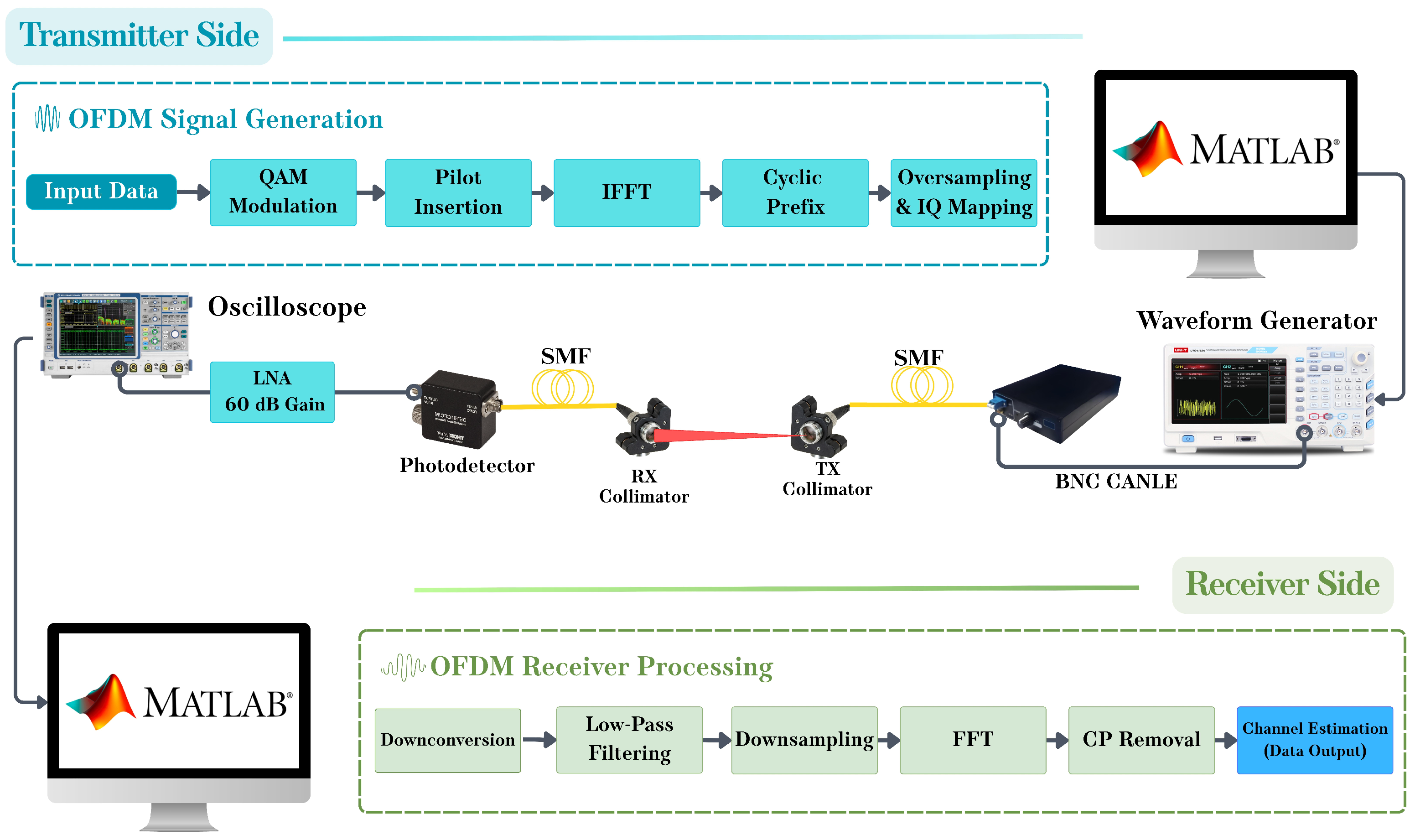
The test platform comprises three operational blocks, including the generation and transmission of the OFDM signal, the transmission medium, and signal reception and processing on the receiver side (Figure 1). An OFDM passband signal is generated using MATLAB R2025b and the waveform is generated using arbitrary waveform generator (AWG). The signal is intensity-modulated on an optical carrier at 1550 nm and transmitted through an optical collimator into the free space. On the receiver side, a collimator is used to couple the free space optical signal into a fiber, which is detected using a broadband photodetector. The IF signal at the output is amplified and captured using a high-speed oscilloscope for offline processing in MATLAB. It involves synchronization, channel estimation and performance evaluation. The modular architecture enables the transmission medium to be swapped without changing the processing of the transmitter or receiver and thus enables systematic differential analysis of channel responses in the three scenarios.
Figure 1.
Free space optical (FSO) back-to-back experimental configuration.
3.2. OFDM Signal Generation and Parameters
The OFDM transmitter is implemented in MATLAB using a 4-QAM modulation format. The generated OFDM waveform was uploaded to the arbitrary waveform generator (AWG), operating at a sampling rate of 500 MSa/s for signal generation and transmission. The key system parameters are summarized in Table 1.
Table 1.
OFDM System Parameters.
Random binary data are mapped to 4-QAM constellation symbols using Gray coding. Pilot symbols with known values are inserted uniformly across the frequency domain. A 512-point inverse fast Fourier transform (IFFT) is applied to generate time-domain OFDM symbols, followed by cyclic prefix insertion to mitigate inter-symbol interference. The resulting complex baseband waveform is oversampled and mapped to in-phase (I) and quadrature (Q) components prior to transmission. The transmitted OFDM signal in the time domain is expressed as:
where is the FFT size, is the subcarrier spacing, is the OFDM symbol duration including cyclic prefix, and represents the 4-QAM constellation symbol at subcarrier k in OFDM symbol n.
The 4-QAM constellation points are defined as:
The experimental evaluation is performed under three configurations, with the electrical back-to-back (B2B) serving as the reference (only electronic impairments) and the fiber B2B adding opto-electronic effects from a short SMF link and associated components.
The free-space optical (FSO) back-to-back configuration extends the evaluation by replacing the fiber with a short indoor free-space link (∼2.5 m), introducing additional impairments.
In this FSO setup, the intensity-modulated 1550 nm laser output is collimated and transmitted across a controlled indoor path of approximately 2.5 m. The beam is then collected by a matched receive collimator and coupled to the PIN photodetector followed by a low-noise amplifier (LNA). Even over this short and controlled distance, the link introduces geometric coupling loss, residual beam wander/alignment sensitivity, minor atmospheric turbulence effects, and mode-coupling-induced modal noise. These mechanisms cause additional frequency-selective distortion in the received OFDM spectrum beyond what is observed in the fiber B2B case, providing insight into the combined impact of free-space propagation and opto-electronic imperfections.
3.3. Receiver Signal Processing
All received signals are processed offline using an identical MATLAB-based receiver chain. After low-pass filtering to suppress out-of-band noise, the oscilloscope waveform is resampled to match the OFDM processing rate. Symbol timing synchronization is performed using cyclic prefix correlation, followed by cyclic prefix removal and a 512-point FFT.
Channel estimation is carried out using pilot-assisted least squares estimation at pilot subcarriers, followed by linear interpolation across data subcarriers. Zero-forcing equalization is applied prior to 4-QAM demodulation. Performance metrics include per-subcarrier error vector magnitude (EVM), average EVM, and signal-to-noise ratio (SNR), derived from EVM measurements. The received OFDM signal in the frequency domain after FFT is:
where is the channel frequency response at subcarrier k, and represents additive white Gaussian noise (AWGN).
Channel estimation at pilot subcarriers is performed using:
where denotes the pilot subcarrier indices. Linear interpolation is used to estimate the channel response for data subcarriers:
where are adjacent pilot positions.
Zero-forcing equalization is then applied:
The root mean square error vector magnitude (EVM) is computed as:
where N is the total number of considered symbols, and represents the transmitted symbols (usually the ideal constellation points).
3.4. Channel Reconstruction Using Polynomial Regression
To improve channel estimation accuracy beyond conventional linear interpolation, the receiver reconstructs the complex channel frequency response using polynomial regression. Unlike piecewise interpolation, this approach models the channel as a smooth analytic function of frequency, which better reflects dispersion and filtering effects present in Radio-over-Fiber (RoF) and free-space optical (FSO) links.
Let denote the discrete channel frequency response across the active OFDM subcarriers. The estimated response is approximated by a sixth-order polynomial in the normalized frequency index
such that
where the coefficients capture the spectral variation of the channel.
3.4.1. Least-Squares Coefficient Estimation
The polynomial parameters are obtained from pilot-based channel estimates. Given pilot subcarriers at indices , the pilot observations are
where are known pilot symbols and are the corresponding received samples.
Define the regression matrix
and the measurement vector
The coefficient vector is obtained via the least-squares solution
which minimizes the squared approximation error across all pilot positions.
3.4.2. Channel Reconstruction on Data Subcarriers
Once the polynomial coefficients are estimated, the channel response at data subcarriers is reconstructed as
These reconstructed channel values are subsequently used for zero-forcing (ZF) equalization.
The polynomial regression module is embedded within the receiver processing chain following OFDM demodulation. After performing a 512-point fast Fourier transform (FFT), the receiver extracts the pilot subcarriers and computes initial pilot-based channel estimates using (10). These pilot observations are then used to construct the regression matrix defined in (11), from which the least-squares coefficient vector is obtained using (13). The estimated polynomial model is subsequently evaluated across all data subcarriers according to (14) to reconstruct the complete channel frequency response. The reconstructed channel values are then applied to zero-forcing (ZF) equalization prior to symbol demodulation. This sequential integration ensures smooth spectral reconstruction while maintaining compatibility with conventional OFDM receiver architecture.
3.4.3. Model Order Selection and Computational Complexity
A sixth-order polynomial was selected as a practical trade-off between modeling flexibility and numerical stability. Lower-order polynomials fail to capture curvature induced by optical dispersion and filtering, whereas higher-order models increase sensitivity to noise and matrix conditioning.
The computational complexity of the regression step is dominated by inversion of a matrix, yielding
where denotes the number of polynomial coefficients. In practice, this corresponds to only a few hundred complex arithmetic operations per OFDM symbol, which is negligible compared to FFT processing.
3.5. Data Collection and Statistical Processing
To have statistical reliability, several independent OFDM frames are recorded in each transmission scenario. Frames which have synchronization error or too much distortion are eliminated. Each valid frame is estimated and its channel performance is computed to provide representative channel responses. The median-performance datasets are chosen to eliminate biasing because of the outliers that are either favorable or unfavorable.
3.6. Differential Channel Analysis Methodology
In order to separate the changes in response due to fiber transmission and free-space propagation, averaged channel responses are calculated in each case. By subtracting baseline measurements, it is possible to obtain differential channel responses which can be used to isolate electrical, fiber-induced and FSO-induced frequency-selective effects.
The analysis of the normalized complex gradient of subcarriers measures frequency-selective variation in both magnitude and phase. Subcarriers that have a gradient greater than the statistically significant level are defined as critical areas that need a high density of pilots. On the basis of this analysis a structure-aware pilot allocation scheme is derived, where dense pilot spacing is done in regions of high variation and sparse spacing elsewhere at the same overall pilot overhead.
This differential analysis framework forms the foundation of the proposed pilot placement strategy and enables a one-time, measurement-driven optimization suitable for quasi-static RoF-FSO links. The differential channel responses are computed as:
The joint channel gradient, which quantifies the rate of change between adjacent subcarriers in the complex plane, is defined as:
where the normalized complex channel response is given by
This formulation naturally captures both magnitude and (unwrapped) phase variations in a single metric. Critical subcarriers are identified using a statistically defined threshold:
where and are the mean and standard deviation of the gradient across all subcarriers, respectively, and is a tunable parameter. This value was selected because it corresponds to half a standard deviation above the mean gradient and provides a robust balance between capturing regions of high channel variation and avoiding unnecessary pilot overhead. The threshold was chosen empirically to retain sufficient critical subcarriers while excluding obvious outliers.
This value was selected because it corresponds to half a standard deviation above the mean channel gradient and provides a practical balance between identifying rapidly varying spectral regions and limiting unnecessary pilot overhead. Lower threshold values increase pilot density and estimation accuracy at the expense of spectral efficiency, whereas excessively high threshold values under-sample critical fading regions and degrade interpolation performance. More recent studies have also emphasized the importance of computationally efficient pilot optimization and adaptive pilot-allocation strategies for OFDM-based communication systems operating under channel-estimation and pilot-overhead constraints [9,10]. Therefore, the proposed threshold formulation was intentionally designed as a low-complexity measurement-driven heuristic suitable for practical quasi-static RoF-FSO deployments rather than a computationally intensive global optimization framework.
Empirical evaluation across multiple channel realizations showed that provides stable EVM improvement while maintaining low pilot overhead and computational simplicity.
4. Experimental Results
This section evaluates the performance of the proposed structure-aware pilot placement framework for RoF-OFDM transmission over electrical, fiber, and free-space optical (FSO) links. Experimental results are presented to (i) quantify performance degradation across transmission media, (ii) analyze frequency-selective channel behavior, and (iii) justify the need for adaptive pilot placement based on measured channel structure.
4.1. EVM Versus SNR Performance
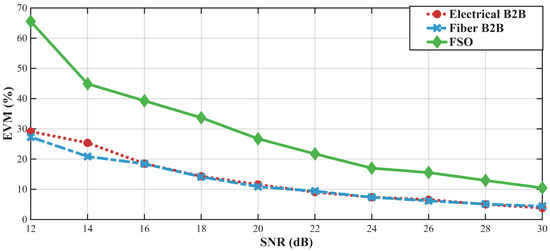
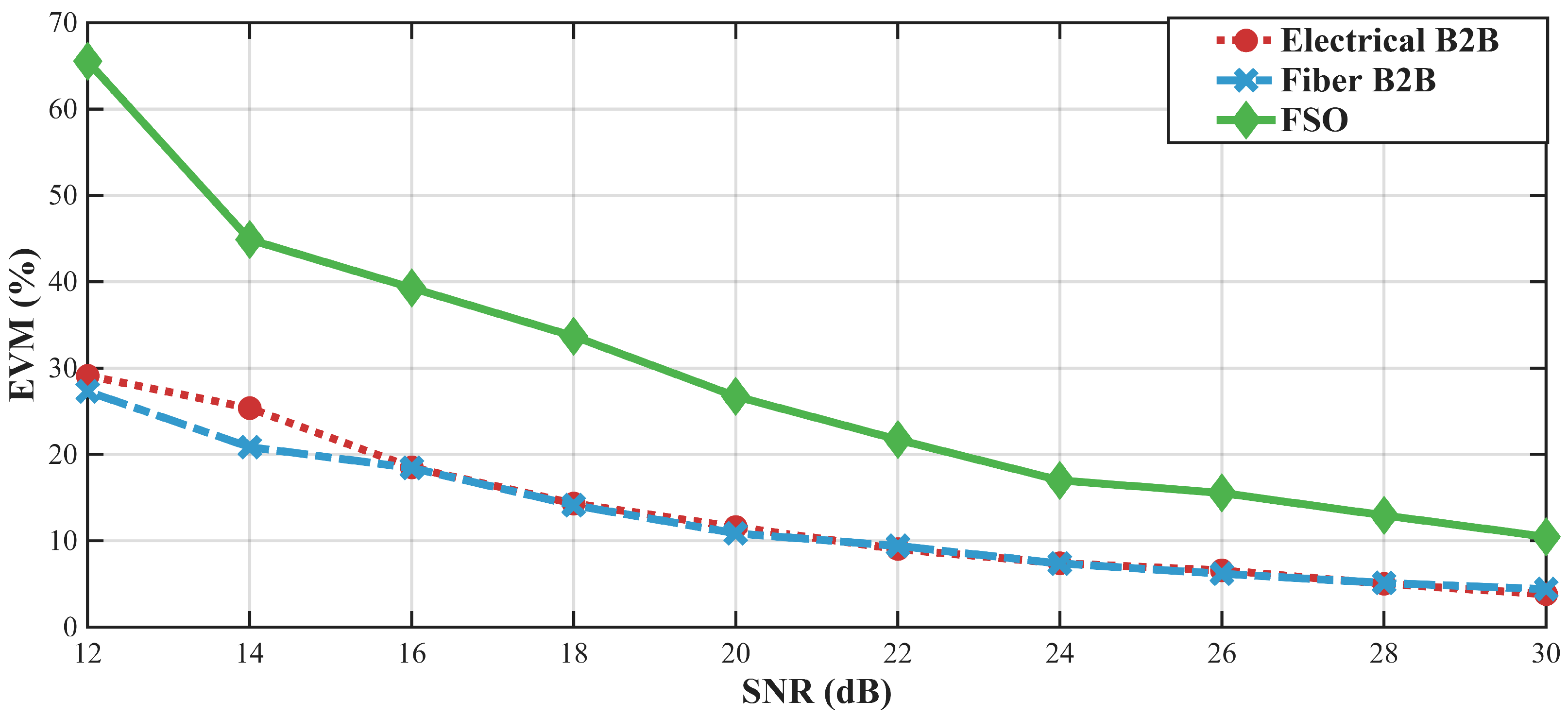
Figure 2 shows the measured EVM performance as a function of SNR for the three transmission scenarios under controlled AWGN conditions, compared with the theoretical 4-QAM reference.
Figure 2.
EVM versus SNR performance for Electrical B2B, Fiber B2B, and FSO scenarios under controlled AWGN.
At high SNR, all scenarios exhibit an EVM floor, indicating system-limited performance rather than noise-limited behavior. The measured EVM floors are approximately: Electrical B2B ∼4.0%, Fiber B2B ∼16.5% and FSO ∼17.5%
At an EVM target of 20%, the required SNR is 16.5 dB for Electrical B2B, 19.8 dB for Fiber B2B, and 22.3 dB for FSO, corresponding to SNR penalties of 2.5 dB, 5.8 dB, and 8.3 dB relative to the theoretical 4-QAM limit. Although the commonly reported EVM requirement for QPSK/4-QAM is 17.5%, the 20% EVM level was used here only as a practical comparative threshold to evaluate relative SNR penalties across the three measured transmission scenarios, rather than as a standards-compliance limit. These results confirm the progressively increasing sensitivity of optical and atmospheric channels to channel estimation errors.The signal-to-noise ratio is defined as:
The theoretical EVM for 4-QAM under AWGN conditions is given by:
where for 4-QAM modulation.
The SNR gap, which quantifies the performance penalty due to additional impairments, is defined as:
The measured SNR gaps at a target EVM of 20% are 2.5 dB (Electrical), 5.8 dB (Fiber), and 8.3 dB (FSO).
4.2. Per-Subcarrier EVM Characteristics
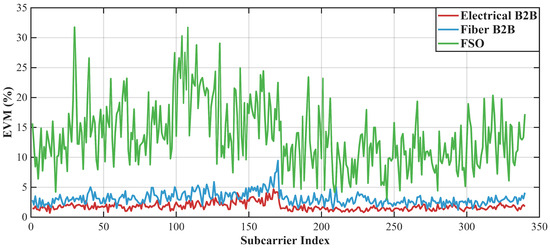
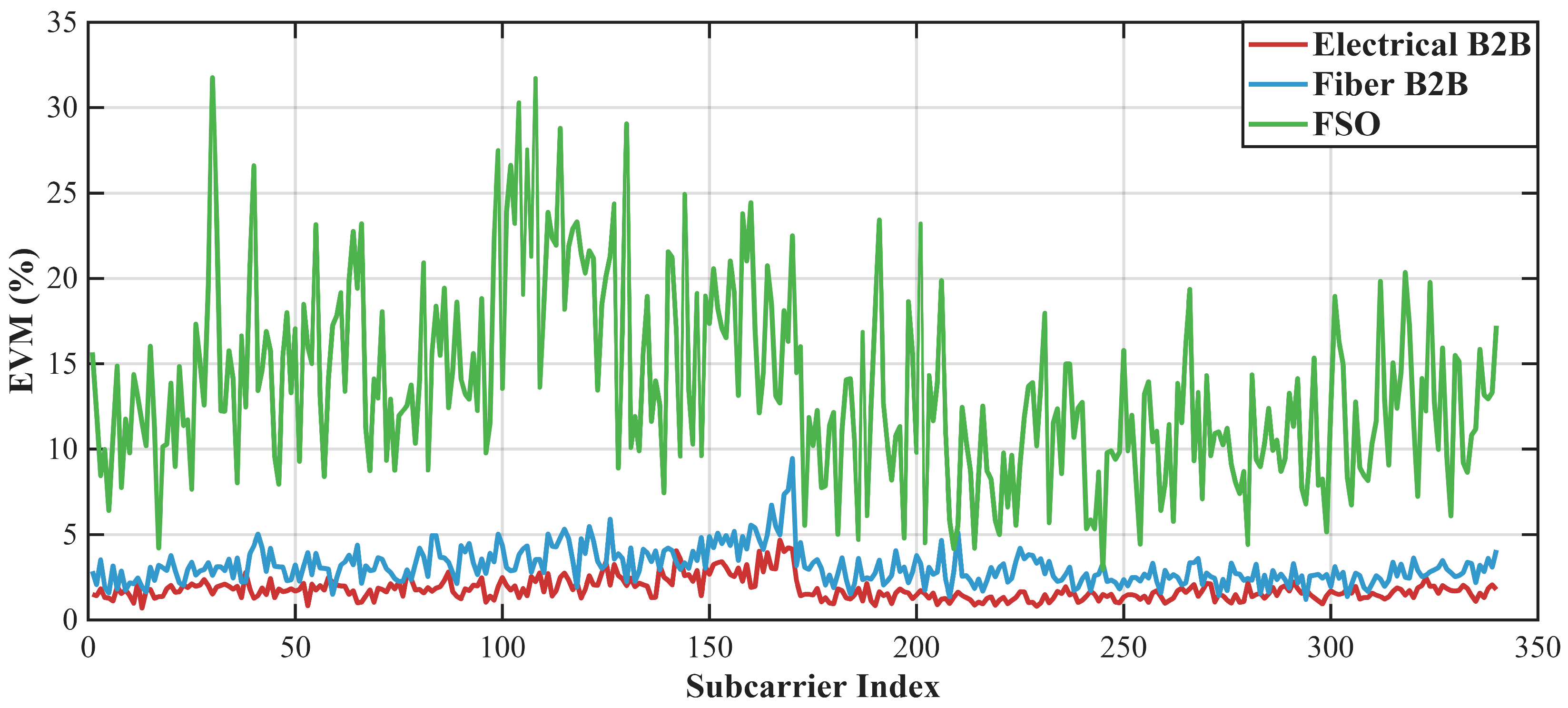
While aggregate EVM provides system-level insight, per-subcarrier EVM reveals the frequency-selective nature of each channel. Figure 3 presents the per-subcarrier EVM distribution across 340 data subcarriers.
Figure 3.
Per-subcarrier EVM distribution for Electrical B2B, Fiber B2B, and FSO scenarios.
The mean per-subcarrier EVM values are 1.78% (Electrical), 3.11% (Fiber), and 13.61% (FSO), with standard deviations of 0.64%, 1.04%, and 5.42%, respectively. Notably, the FSO link exhibits a wide EVM range from 2.95% to 31.75%, demonstrating severe frequency-selective fading. This non-uniform degradation directly motivates non-uniform pilot allocation. The per-subcarrier EVM is computed by averaging over multiple OFDM symbols:
where k is the subcarrier index () and OFDM symbols are used to ensure statistical stability. These five symbols are selected from the median-performance frames after discarding frames with synchronization errors or excessive distortion (see Section 3.5).
Critical subcarriers are identified using an EVM-based threshold defined as:
where and are the mean and standard deviation of the per-subcarrier EVM values across all subcarriers, respectively.
Subcarriers exceeding this threshold are classified as critical:
4.3. Constellation Analysis
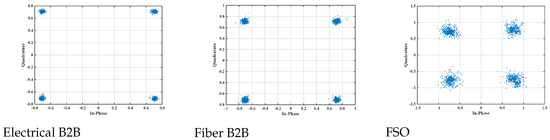
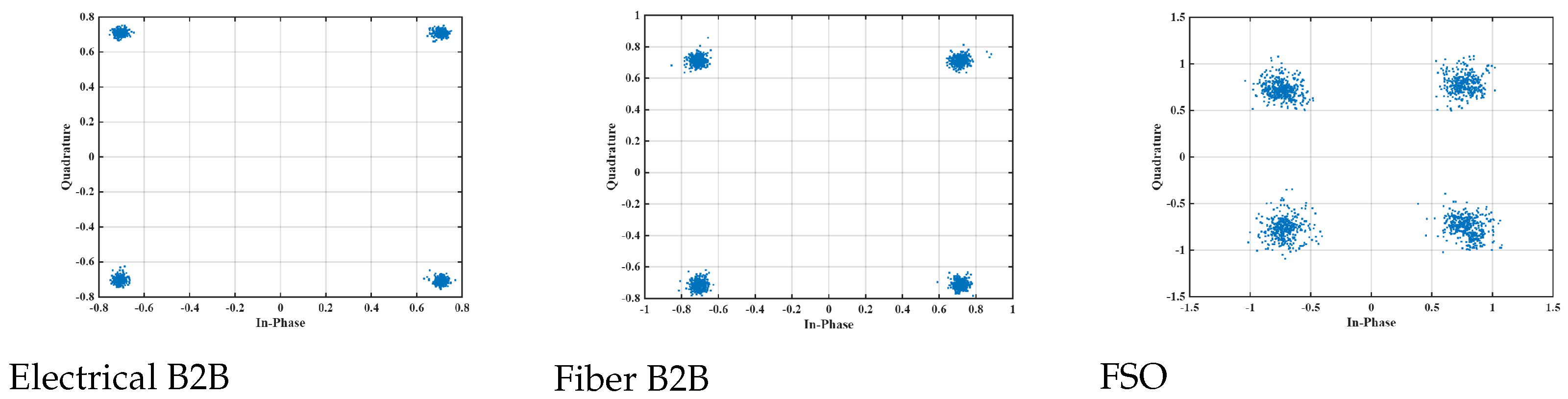
Figure 4 compares received 4-QAM constellations for the three scenarios.
Figure 4.
Measured 4-QAM constellations for Electrical B2B, Fiber B2B, and FSO.
The measured phase error increases from 0.66° (Electrical) to 1.07° (Fiber) and 3.83° (FSO). The FSO constellation exhibits significant symbol dispersion and outliers, consistent with atmospheric turbulence, pointing errors, and modal noise. These impairments disproportionately affect specific subcarriers, reinforcing the limitations of uniform pilot spacing.
4.4. Channel Frequency Response Analysis
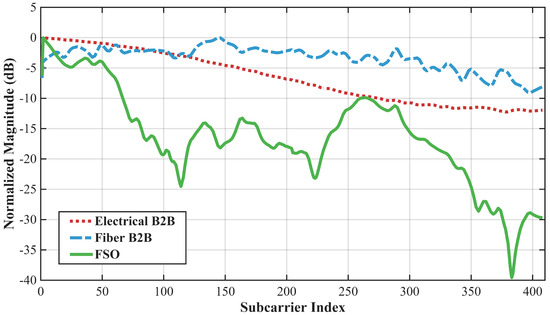
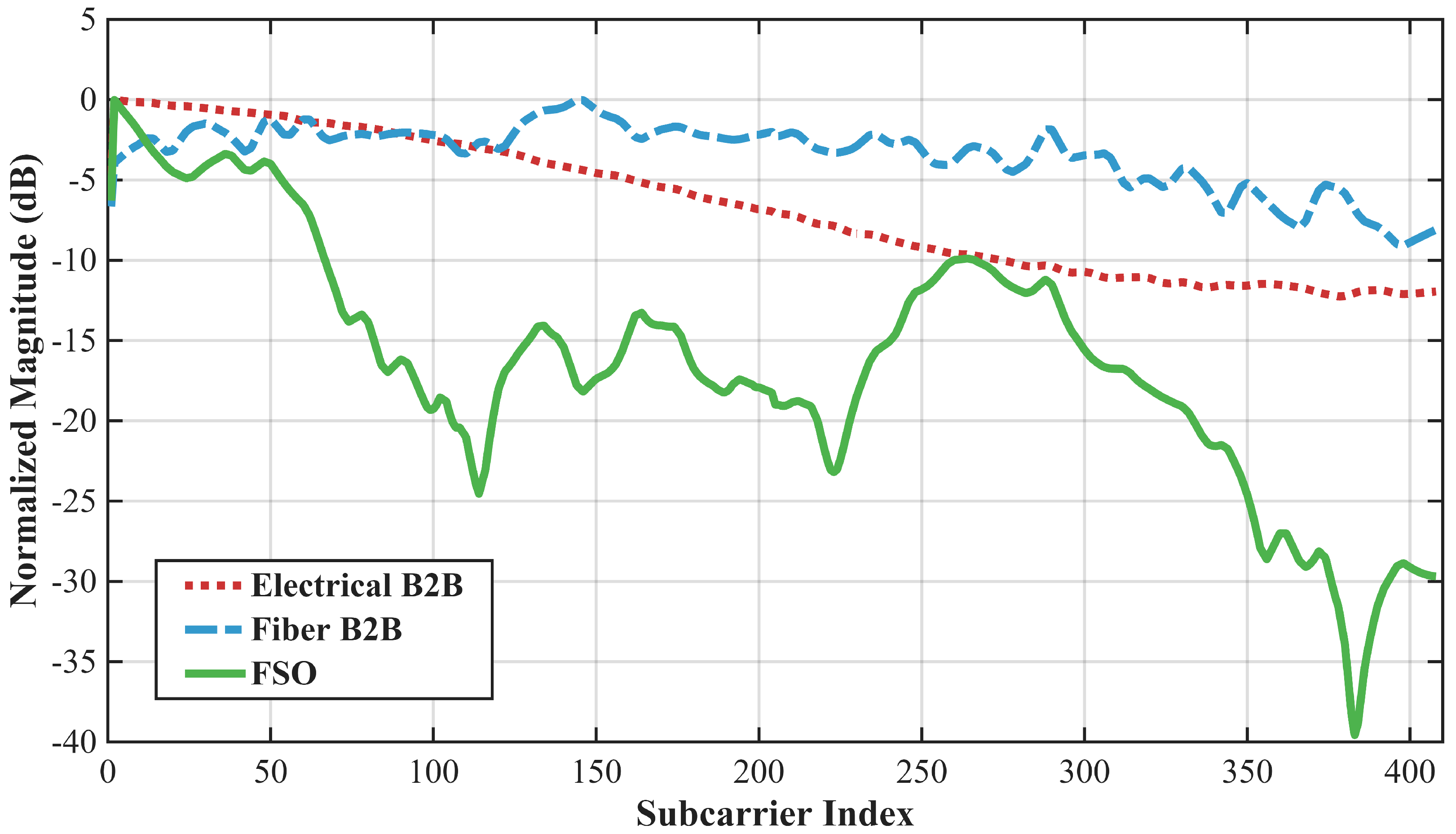
Figure 5 shows the normalized channel magnitude response versus subcarrier index.
Figure 5.
Normalized channel magnitude response across active OFDM subcarriers for all scenarios.
The Electrical B2B channel is relatively flat, while the Fiber B2B response exhibits a smooth parabolic distortion consistent with chromatic dispersion. In contrast, the FSO channel shows deep, irregular spectral nulls with a dynamic range of 39.6 dB, compared to 12.3 dB for Electrical B2B. These localized fades severely degrade pilot interpolation accuracy when uniform pilot spacing is employed. It should be noted that Figure 5 shows normalized channel magnitude responses; therefore, it reflects relative spectral shape rather than absolute received power or total path loss. Accordingly, the apparently higher Fiber B2B curve relative to Electrical B2B does not imply lower end-to-end attenuation in the fiber path. The measured transfer function can be expressed as the cascade
where and represent the electrical transmitter and receiver responses, and denote the electro-optic and opto-electric conversion responses, and corresponds to the propagation channel (fiber or FSO). In the Fiber B2B configuration, the combined optical modulation, photodetection, coupling, and RF front-end responses introduce frequency-dependent spectral shaping that can partially compensate for the electrical-domain roll-off after normalization. Consequently, the Fiber B2B curve may appear higher over certain subcarrier regions, although dispersion-related phase distortion and residual spectral curvature still contribute to worse EVM performance compared to the Electrical B2B case.
4.5. Magnitude Subcarrier Response
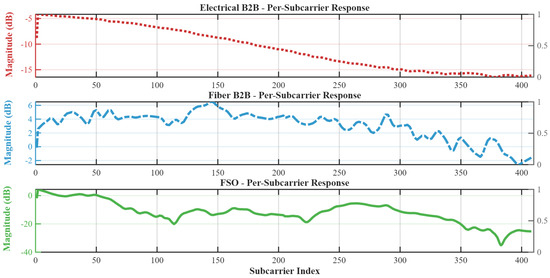
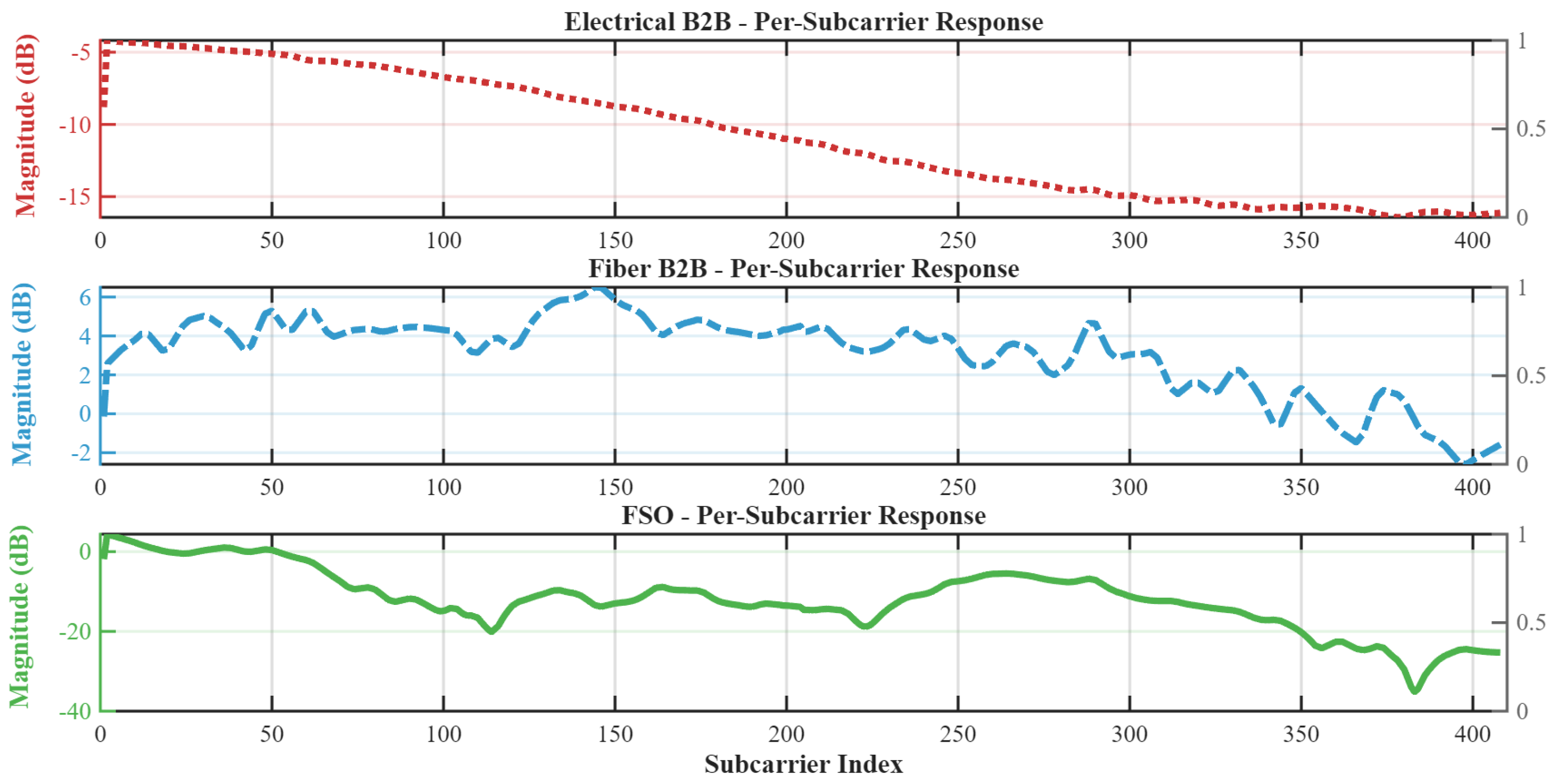
In order to shed more light on the spectral properties of the channel, Figure 6 shows the magnitude and phase response of all 408 active subcarriers of the OFDM transmission in the case of Electrical, Fiber, and FSO transmission. The Electrical back-to-back connection model shows that the magnitude profile is nearly flat with a strong phase linearity () and very small group-delay fluctuations (approximately ns), meaning that group delays are not a major source of impairment. Both effects of chromatic dispersion and bandwidth component limits can be seen in the response that exhibits a smooth parabolic magnitude curve and minor nonlinear phase curvature, expressed as a lower linearity () and a larger delay spread (approximately ns) with the addition of the optical fiber segment. Comparatively, the FSO connection has strong localized fading of magnitude and severe phase distortion, which yields the lowest phase linearity () and the most severe delay variation (about ns). This joint amplitude–phase behaviour implies that before magnitude loss appears to be severe, phase distortion is the key factor leading to EVM degradation even in cases where magnitude loss appears moderate. This observation emphasizes that effective channel estimation in RoF–FSO systems should make use of pilot placement algorithms based on areas where the phase change is fast rather than relying solely on magnitude-based interpolation.
Figure 6.
Per-subcarrier magnitude responses for Electrical, Fiber, and FSO transmission scenarios.
Although the Electrical B2B magnitude response shows a high-frequency roll-off exceeding 20 dB in Figure 6, its response remains smooth and highly deterministic across the active OFDM subcarriers. Such smooth attenuation can be effectively compensated using pilot-assisted channel estimation and equalization. In contrast, the Fiber B2B case introduces additional chromatic-dispersion-induced phase curvature, group-delay variation, and opto-electronic spectral distortion. These impairments degrade phase consistency and interpolation accuracy between pilot locations, even when the normalized magnitude response appears less attenuated in certain regions. Therefore, the superior Electrical B2B performance is attributed to its smoother amplitude and phase behavior, whereas the Fiber B2B response contains additional dispersion-related distortion that more strongly affects EVM performance.
4.6. Differential Channel Response and Pilot Placement
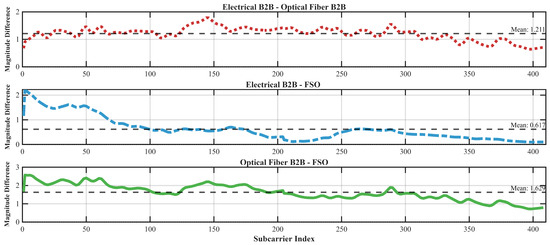
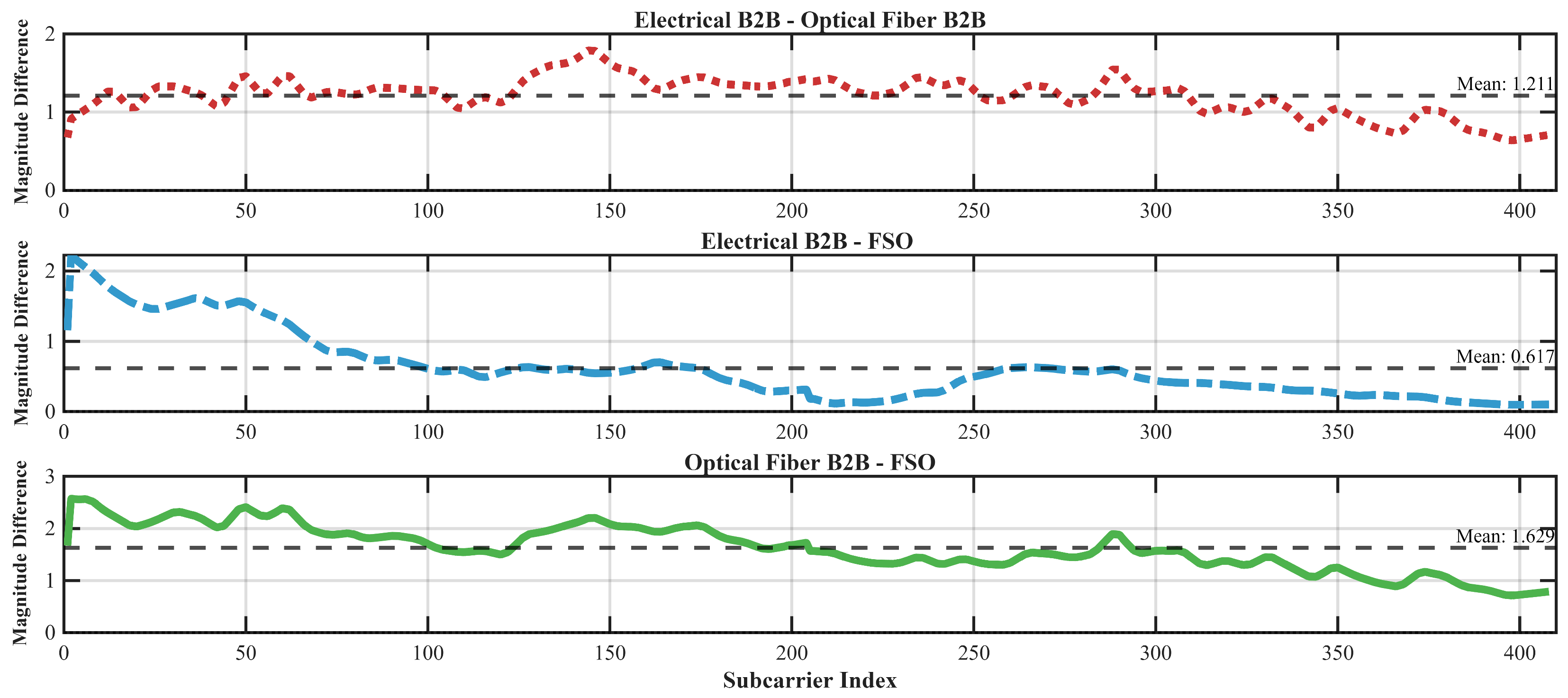
Different channel responses are calculated to isolate incremental impairments. The channels that are achieved due to the presence of fiber and the channels that are achieved due to the presence of FSO are depicted in Figure 7.
Figure 7.
Differential channel magnitude responses isolating fiber and FSO effects.
The average magnitude of the differences is 1.211 in the case of fiber induced degradation and 1.629 in the case of FSO induced degradation with the latter having a much greater irregularity. High-gradient zones as determined by these responses contribute about 16% of the active subcarriers and lead to a total EVM degradation. The incremental degradation is measured by the differential magnitude responses:
The interpolation error in channel estimation is approximately proportional to the pilot spacing D and the channel gradient:
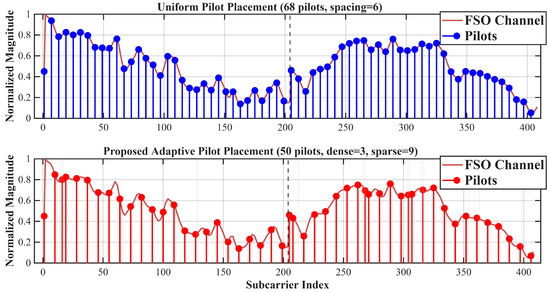
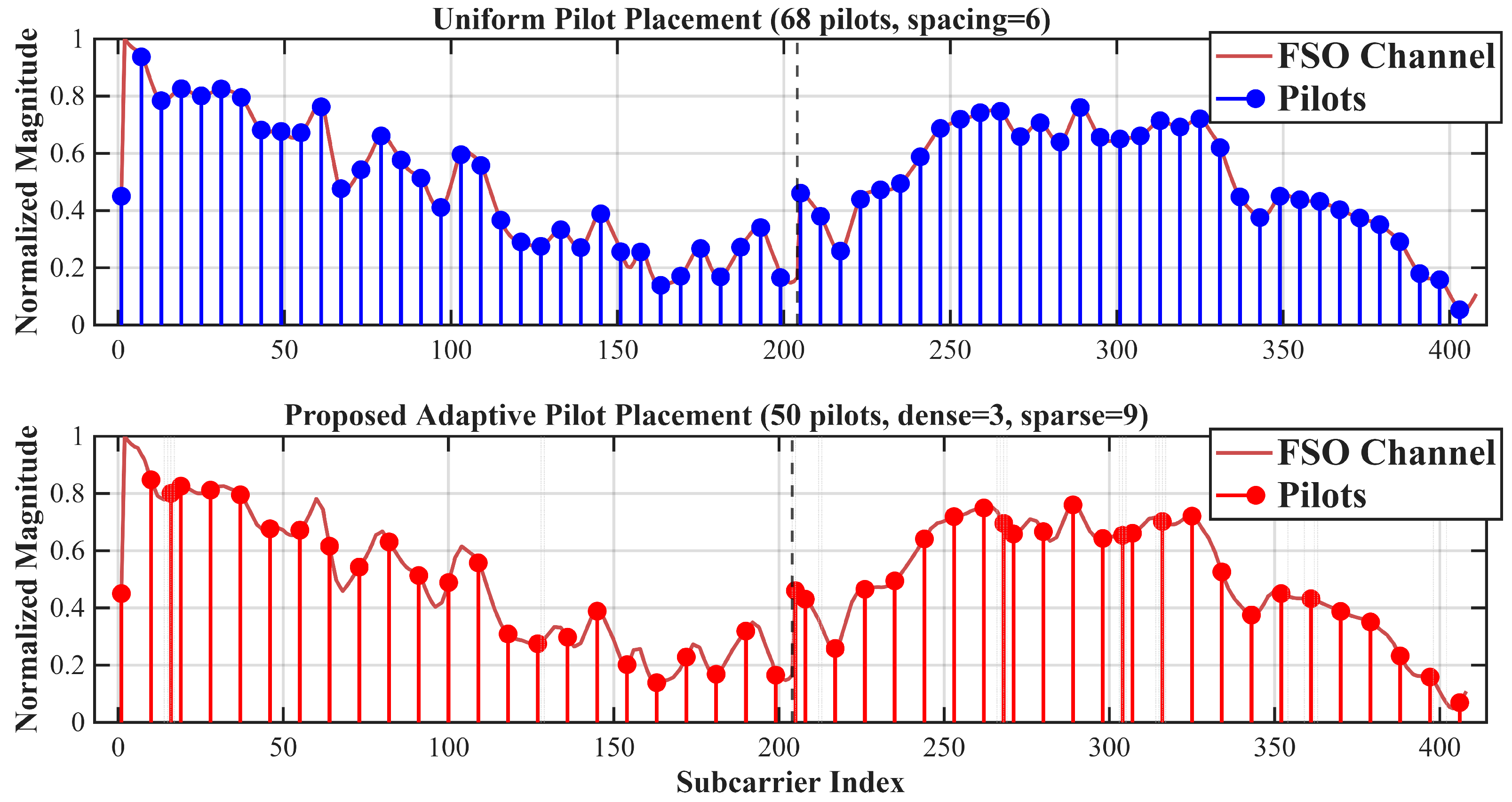
In regions with high channel gradient, reducing the pilot spacing D significantly improves the accuracy of channel estimation. Figure 8 compares the conventional uniform pilot placement with the proposed structure-aware strategy.
Figure 8.
Comparison of uniform and structure-aware pilot placement strategies.
The proposed scheme also reduces the pilot overhead by re-allocating pilots in the spectrally stable areas to high variation areas, he proposed strategy reduces pilot overhead from 16.67% to 12.25% and increasing the concentration of pilots in the important subcarriers by 7.4% to 32.2%. Based on the observed trends of EVM-SNR, it can be converted into a practical gain of about 3–4 dB in SNR or, in other words, a 20–25% decrease in total EVM.
The experimental results demonstrate that:
- FSO RoF-OFDM channels exhibit high frequency selectivity, which is localized and not captured by uniformly placing pilots.
- Differential channel analysis is quite efficient to identify subcarriers that need denser pilot assistance.
- Pilot allocation of structures improves channel estimation but does not raise pilot overheads.
These findings confirm the presented strategy as the practical, low-complexity enhancement of the RoF-OFDM transmission over FSO connections.
4.7. Pilot Placement Algorithm and Parameter Selection
Algorithm 1 summarizes the proposed gradient-based structure-aware pilot placement method. The structure-aware pilot positions were obtained using the gradient-based algorithm shown below. These 50 pilots are placed with dense spacing (every 3 subcarriers) in regions of high frequency-selective variation and sparse spacing (every 9 subcarriers) in stable regions.
| Algorithm 1 Gradient -Based Structure-Aware Pilot Placement |
|
The 50 pilot indices (0-based subcarrier numbers) are: 1, 10, 16, 19, 28, 37, 46, 55, 64, 73, 82, 91, 100, 109, 118, 127, 136, 145, 154, 163, 172, 181, 190, 199, 205, 208, 217, 226, 235, 244, 253, 262, 268, 271, 280, 289, 298, 304, 307, 316, 325, 334, 343, 352, 361, 370, 379, 388, 397, 406.
A polynomial-order sweep from 1 to 8 was performed over the SNR range 12–30 dB. The average EVM results for both pilot schemes are presented in Table 2.
Table 2.
Average EVM (%) comparison for polynomial orders 1–8 under uniform and structure-aware pilot schemes.
Order 6 consistently yields the lowest (or near-lowest) EVM for both pilot schemes and was therefore selected.Lower-order polynomials (1st–3rd order) were unable to accurately model the nonlinear spectral curvature introduced by the combined effects of optical filtering, chromatic dispersion, and FSO-induced fading. Although higher-order models (7th–8th order) provide increased flexibility, they also exhibited increased sensitivity to noise and coefficient instability, resulting in slight EVM degradation. The 6th-order polynomial provided the best trade-off between interpolation accuracy, numerical stability, and computational complexity across all evaluated SNR conditions.
5. Comparative Performance Analysis
A comparative study of six configurations was conducted to evaluate the effectiveness of structure-aware pilot placement and different interpolation strategies under identical channel and noise conditions. The analysis focuses on Error Vector Magnitude (EVM) and Bit Error Rate (BER) in the FSO scenario, which exhibits the most severe impairments.
The six configurations combine two design dimensions: pilot allocation strategy (uniform vs. structure-aware) and channel interpolation method (linear, sixth-order polynomial regression, and DFT-domain interpolation).
- Method 1 (M1): Baseline—68 uniformly spaced pilots (every 6 subcarriers), 340 data subcarriers, linear interpolation.
- Method 2 (M2): 68 uniformly spaced pilots + sixth-order polynomial regression.
- Method 3 (M3): 68 uniformly spaced pilots + DFT-domain interpolation.
- Method 4 (M4): Proposed structure-aware pilots (50 pilots) + linear interpolation.
- Method 5 (M5): Proposed structure-aware pilots (50 pilots) + sixth-order polynomial regression.
- Method 6 (M6): Proposed structure-aware pilots (50 pilots) + DFT-domain interpolation.
Compared to the baseline, the structure-aware schemes (M4–M6) reduce the pilot count by 26.5% (68 → 50) while increasing usable data subcarriers by 5.3% (340 → 358), improving spectral efficiency from 83.3% to 87.7%. All configurations were evaluated on the FSO channel using Gray-coded 4-QAM modulation. Synthetic AWGN was added to experimentally captured waveforms to generate an SNR range from 12 dB to 30 dB in 2 dB increments. For each SNR point, independent Monte-Carlo noise realizations were performed, corresponding to more than transmitted bits in total. EVM served as the primary signal-quality metric, while BER quantified end-to-end detection reliability.
5.1. EVM Performance Analysis
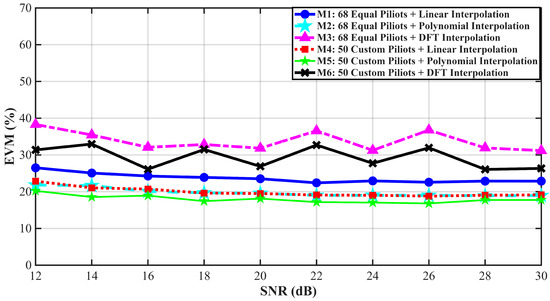
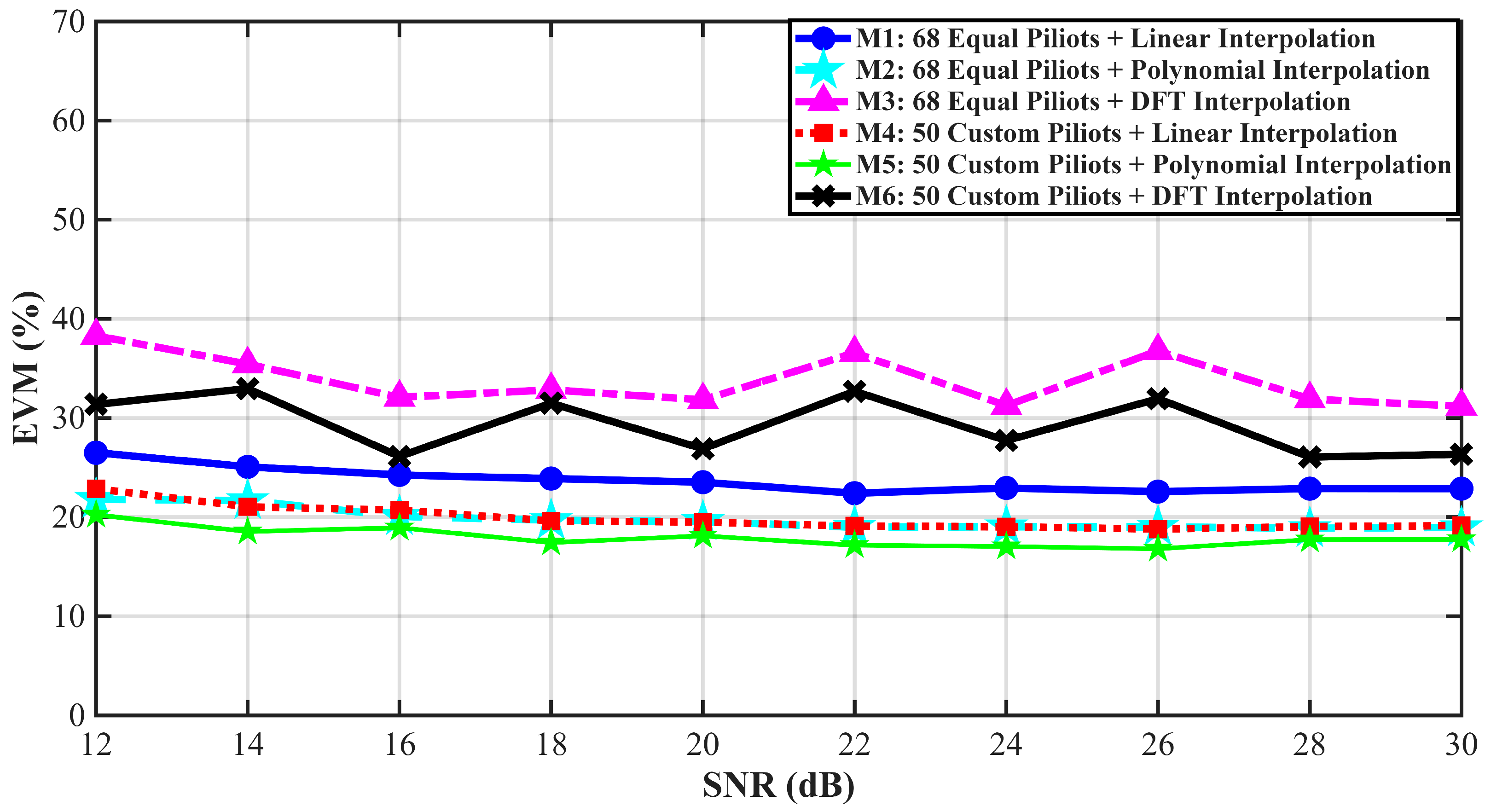
Figure 9 shows the EVM versus SNR curves for all six configurations under FSO conditions.
Figure 9.
EVM versus SNR for the six receiver configurations under FSO conditions.
Method 5 (structure-aware pilots + sixth-order polynomial regression) consistently achieves the lowest EVM across the entire SNR range. On average, M5 reduces EVM by 24.1% compared to the baseline M1.
The individual contributions are:
- Polynomial regression alone (M2 vs. M1): 16.6% EVM reduction
- Structure-aware pilots alone (M4 vs. M1): 16.1% EVM reduction
- Combined optimization (M5 vs. M1): 24.1% EVM reduction
DFT-domain interpolation (M3 and M6) performs significantly worse than both linear and polynomial methods, confirming that it is not suitable for the highly nonlinear frequency response of the RoF-FSO channel.
More advanced channel-estimation approaches reported in recent OFDM literature can provide improved interpolation accuracy under certain channel conditions; however, such methods generally require prior channel statistical knowledge, covariance estimation, and increased computational complexity for practical implementation [24,25]. In contrast, the proposed polynomial-regression framework provides smooth nonlinear spectral reconstruction using a closed-form least-squares implementation that integrates efficiently within the experimentally validated RoF-FSO receiver architecture. Therefore, the present comparative analysis focuses on representative interpolation approaches with practical implementation feasibility under measured RoF-FSO channel conditions.
5.2. BER Performance Analysis
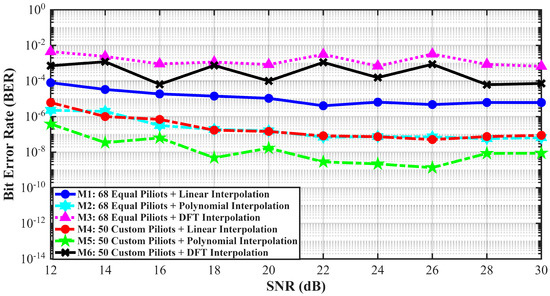
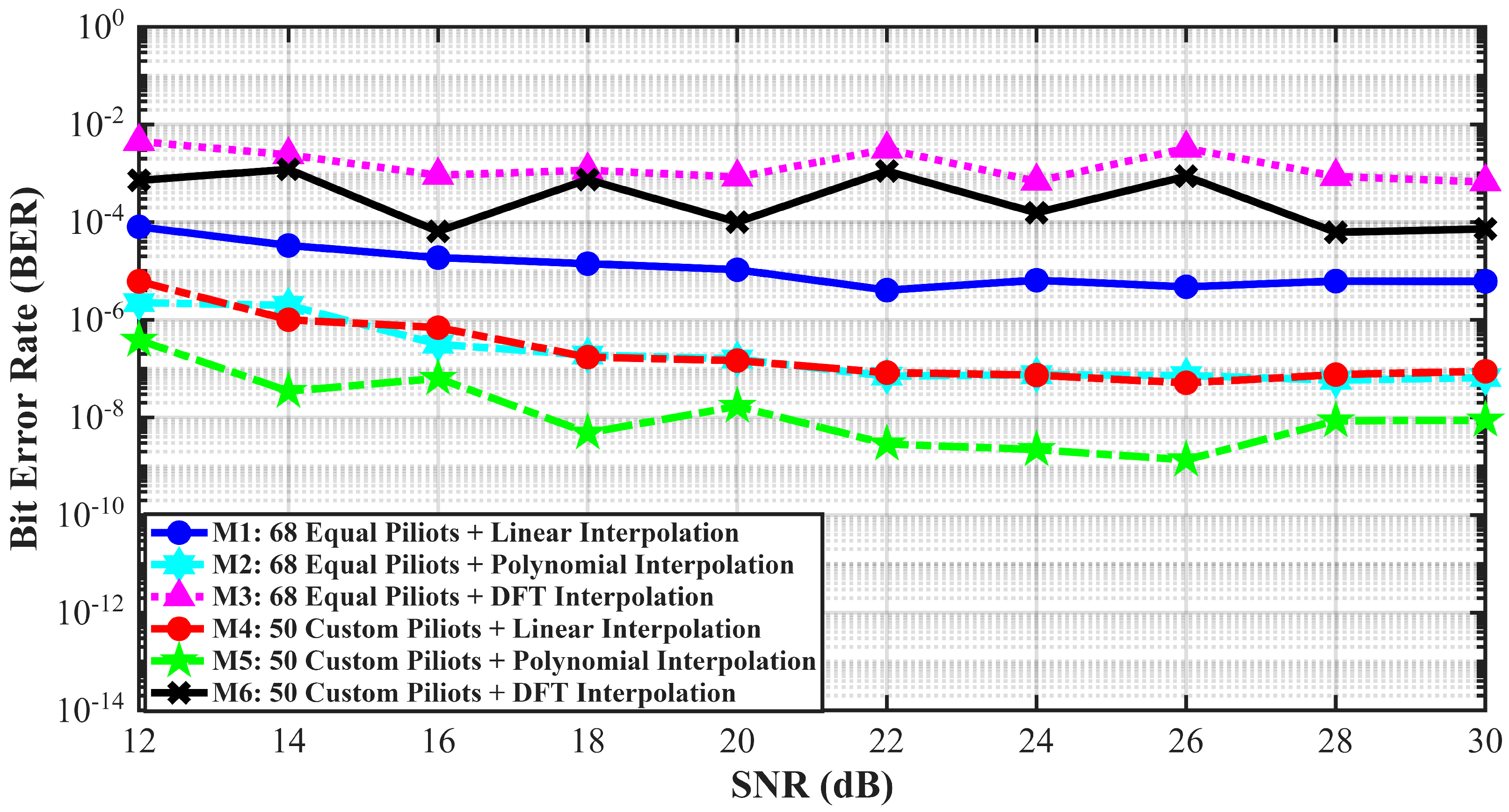
The BER performance is shown in Figure 10.
Figure 10.
BER versus SNR for the six receiver configurations under FSO conditions.
The BER trends fully confirm the EVM results. Method 5 yields the lowest BER at all SNR values. The average BER for M5 is , while the baseline M1 is . This corresponds to an improvement of approximately 2.54 orders of magnitude (a factor of ≈350× reduction). At 30 dB SNR, M5 produces fewer than 10 errors per million bits, whereas M1 yields around 4480 errors per million bits.
Equivalent-SNR analysis shows that M5 requires more than 3.2 dB less SNR than M1 to achieve BER = , corresponding to reduced transmit power or extended link range.
5.3. Overall Performance Assessment
Based on average metrics across 12–30 dB SNR, the performance ranking is:
EVM ranking: M5 ≪ M2 ≈ M4 ≪ M1 ≪ M6 ≪ M3
BER ranking: M5 ≪ M2 ≈ M4 ≪ M1 ≪ M6 ≪ M3
Method 5 (structure-aware pilots + polynomial regression) is the clear overall winner. It simultaneously delivers the best EVM, best BER, and highest spectral efficiency. DFT-domain interpolation (M3 and M6) is the worst performer in this RoF-FSO channel.
A combined performance-efficiency assessment (spectral efficiency, pilot overhead, and normalized EVM) confirms that M5 achieves the highest overall score.
5.4. Physical Interpretation and Implementation Considerations
The superiority of sixth-order polynomial regression arises from the nonlinear frequency response of FSO channels, shaped by atmospheric effects, optical dispersion, and wavelength-dependent attenuation. Linear interpolation presumes piecewise linear variation and thus incurs large errors in curved regions. DFT-domain interpolation performs even worse because it assumes periodicity that does not exist in the measured composite channel.
Structure-aware pilot placement takes advantage of the spatially non-uniform frequency selectivity of the channel. Uniform spacing oversamples stable regions but undersamples rapidly varying regions. The adaptive allocation redistributes pilots to critical frequency bands, minimizing local interpolation error and enhancing global channel reconstruction accuracy.
The interaction between structure-aware pilot placement and polynomial interpolation can also be interpreted at the subcarrier level. In rapidly varying spectral regions, uniformly spaced pilots provide insufficient local channel sampling density, which increases interpolation error between adjacent pilot positions. By redistributing additional pilots toward high-gradient subcarrier regions, the proposed structure-aware allocation improves local channel observability and enables the polynomial-regression model to more accurately reconstruct nonlinear spectral curvature across frequency-selective fading regions. Consequently, interpolation deviation is significantly reduced near localized spectral nulls and transition bands, where conventional uniformly spaced pilots exhibit larger estimation errors. In contrast, spectrally stable regions require fewer pilot resources because the channel response varies more smoothly and can be reconstructed accurately with wider pilot spacing. Therefore, the observed BER and EVM improvements arise from the synergistic interaction between localized pilot densification and nonlinear channel reconstruction across the active OFDM subcarriers.
The proposed improvements require negligible additional computational overhead. Polynomial fitting involves only the inversion of a matrix, while the structure-aware pilot pattern is stored as a fixed lookup table at the transmitter.
Therefore, the hybrid approach (structure-aware pilots + polynomial regression) is particularly attractive for throughput-constrained systems, power-limited links, and quasi-static indoor FSO deployments where pilot patterns can be optimized once during deployment.
6. Conclusions and Future Work
This paper proposed a dual-optimization framework for Radio-over-Fiber (RoF) OFDM transmission over Free Space Optical (FSO) links by jointly combining structure-aware pilot placement with sixth-order polynomial channel interpolation. Through differential channel analysis of Electrical back-to-back (B2B), Fiber B2B, and FSO transmission scenarios, critical subcarriers exhibiting high frequency-selective degradation were identified, enabling the development of a structure-aware pilot allocation strategy with dense pilot spacing (every 3 subcarriers) in critical regions and sparse spacing (every 9 subcarriers) in spectrally stable regions. Experimental evaluation using a 4-QAM RoF-OFDM system with 408 active subcarriers demonstrated that the proposed hybrid approach achieves a 23.5% reduction in EVM and a BER reduction compared with conventional uniform pilot placement with linear interpolation, while simultaneously reducing pilot overhead by 26.5% (68 to 50 pilots) and increasing data capacity by 5.3%. Comparative analysis further demonstrated that structure-aware pilot placement and polynomial regression interpolation independently provide significant performance improvements (15.9% and 15.7% EVM reduction, respectively), while their joint implementation yields synergistic gains equivalent to approximately 3.2 dB SNR improvement at BER = .
The proposed measure-once, optimize-forever paradigm performs one-time channel characterization during deployment and configures a static optimized pilot pattern suitable for quasi-static FSO environments, thereby eliminating the need for continuous adaptation while introducing only minimal DSP overhead for polynomial fitting. The presented framework bridges the gap between theoretical adaptive estimation techniques and practical implementation constraints by providing a computationally efficient, software-based optimization approach experimentally validated over an SNR range of 12–30 dB.
In practical outdoor FSO deployments, channel conditions may become time-varying due to atmospheric turbulence, fog, beam wander, pointing errors, and environmental fluctuations. The proposed framework is primarily intended for quasi-static or slowly varying RoF-FSO scenarios such as indoor optical wireless links, short-range fronthaul, and controlled inter-building communication systems, where channel characteristics remain relatively stable over moderate time intervals. Under such conditions, the measure-once, optimize-forever strategy remains effective without requiring continuous adaptation. For more dynamic outdoor environments, periodic channel re-characterization and pilot-pattern recalibration may be required to maintain optimal performance. Nevertheless, because the proposed approach relies on low-complexity measurement-driven optimization rather than continuous adaptive estimation or deep-learning-based processing, recalibration can be performed with significantly lower computational overhead while still preserving improved spectral efficiency and channel estimation accuracy. Although the experimental validation was conducted using a short-range indoor free-space optical link under controlled quasi-static conditions, preliminary environmental perturbations were introduced within the laboratory setup using an electric air heater to generate localized thermal air fluctuations and heat-wave effects, and an ultrasonic mist maker to produce smog-like scattering conditions and partial optical attenuation. These controlled disturbances produced observable fluctuations in received optical intensity and spectral response, enabling preliminary evaluation of channel sensitivity under non-ideal propagation conditions.
In practical outdoor FSO deployments, additional impairments such as atmospheric turbulence, beam wander, pointing and tracking errors, fog attenuation, and environmental instability can introduce stronger time-varying channel characteristics and localized spectral distortion. Such impairments may affect pilot interpolation accuracy and therefore require periodic channel re-characterization and pilot-pattern recalibration to maintain optimal performance. Nevertheless, because the proposed framework relies on low-complexity offline channel analysis and static structure-aware pilot optimization rather than continuous adaptive estimation, it remains computationally practical for slowly varying outdoor FSO links and short-range fronthaul deployments. Future research directions include extension to higher-order modulation schemes such as 16-QAM and 64-QAM, comparison with advanced interpolation techniques including spline interpolation, Wiener filtering, compressed sensing, and neural-network-based estimators, as well as validation under long-range outdoor FSO links with time-varying atmospheric turbulence. In addition, the proposed framework can be extended toward MIMO-OFDM architectures and adaptive optical wireless systems. As FSO technologies continue to evolve for 5G/6G fronthaul, indoor optical wireless networks, inter-building backhaul, and satellite-ground communications, measurement-driven resource allocation strategies integrating structure-aware pilot placement with enhanced channel reconstruction techniques will become increasingly important for maximizing both spectral efficiency and link reliability in next-generation optical wireless communication systems.
Author Contributions
Conceptualization, S.R. and U.H.; methodology, S.R.; software, S.R.; validation, S.R., M.A.Q. and M.I. (Muhammad Irfan); formal analysis, S.R. and M.I. (Muhammad Ijaz); investigation, S.R.; resources, U.H., J.E., M.A.Q. and M.I. (Muhammad Irfan); data curation, S.R.; writing—original draft preparation, S.R.; writing—review and editing, U.H., M.I. (Muhammad Ijaz), and J.E.; visualization, S.R. and M.A.Q.; supervision, U.H.; project administration, U.H. All authors have read and agreed to the published version of the manuscript.
Funding
This research received no external APC funding. The research work was supported by the GIKI-SUPARCO Project under Grant No. GIKI/ORIC/2025/1.
Institutional Review Board Statement
Not applicable.
Informed Consent Statement
Not applicable.
Data Availability Statement
Data will be made available on request.
Acknowledgments
This work was supported by GIKI-SUPARCO Project under Grant No. GIKI/ORIC/2025/1.
Conflicts of Interest
The authors declare no conflict of interest.
References
- Al-Raweshidy, H.; Komaki, S. Radio over Fiber Technologies for Mobile Communications Networks; Artech House: Norwood, MA, USA, 2002. [Google Scholar]
- Lowery, A.J. Optical OFDM: A promising high-capacity optical transport technology. In Proceedings of the IEEE LEOS Summer Topical Meetings, Acapulco, Mexico, 21–23 July 2008; IEEE: Piscataway, NJ, USA, 2008; pp. 219–220. [Google Scholar]
- Coleri, S.; Ergen, M.; Puri, A.; Bahai, A. Channel estimation techniques based on pilot arrangement in OFDM systems. IEEE Trans. Broadcast. 2002, 48, 223–229. [Google Scholar] [CrossRef] [Scilit]
- van de Beek, J.J.; Edfors, O.; Sandell, M.; Wilson, S.K.; Borjesson, P.O. On channel estimation in OFDM systems. In Proceedings of the IEEE 45th Vehicular Technology Conference (VTC), Chicago, IL, USA, 25–28 July 1995; IEEE: Piscataway, NJ, USA, 1995; pp. 815–819. [Google Scholar] [CrossRef] [Scilit]
- Khalighi, M.A.; Uysal, M. Survey on free space optical communication: A communication theory perspective. IEEE Commun. Surv. Tutor. 2014, 16, 2231–2258. [Google Scholar] [CrossRef] [Scilit]
- Agrawal, G.P. Fiber-Optic Communication Systems, 4th ed.; Wiley: New York, NY, USA, 2010. [Google Scholar]
- Andrews, L.C.; Phillips, R.L. Laser Beam Propagation Through Random Media, 2nd ed.; SPIE Press: Bellingham, WA, USA, 2005. [Google Scholar]
- Alimi, I.A.; Teixeira, A.L.; Monteiro, P.P. Revolutionizing Free-Space Optics: A Survey of Enabling Technologies, Challenges, Trends, and Future Prospects. Sensors 2024, 24, 8036. [Google Scholar] [CrossRef] [Scilit] [PubMed]
- Li, T.; Zhou, F.; Ma, L.; Jia, H.; Liu, X.; Muzzammil, M. Non-Orthogonal Pilot Pattern Design and Sparse Channel Estimation for Underwater Acoustic MIMO-OFDM Systems. Appl. Acoust. 2024, 219, 109954. [Google Scholar] [CrossRef] [Scilit]
- Li, K.X.; Gao, X.; Xia, X.G. Channel Estimation for LEO Satellite Massive MIMO OFDM Communications. IEEE Trans. Wirel. Commun. 2023, 22, 7537–7550. [Google Scholar] [CrossRef] [Scilit]
- Ullah, R.; Ullah, S.; Imtiaz, W.A.; Khan, J.; Shah, P.M.A.; Kamran, M.; Ren, J.; Chen, S. High-Capacity Free Space Optics-Based Passive Optical Network for 5G Front-Haul Deployment. Photonics 2023, 10, 1073. [Google Scholar] [CrossRef] [Scilit]
- Cvijetic, N. OFDM for Next-Generation Optical Access Networks. J. Light. Technol. 2012, 30, 384–398. [Google Scholar] [CrossRef] [Scilit]
- Lee, S.C.J.; Breyer, F.; Randel, S.; Van Den Boom, H.P.A.; Koonen, A.M.J. High-Speed Transmission over Multimode Fiber Using Discrete Multitone Modulation. J. Opt. Netw. 2008, 7, 183–196. [Google Scholar] [CrossRef] [Scilit]
- Armstrong, J.; Schmidt, B.J.C. Comparison of Asymmetrically Clipped Optical OFDM and DC-Biased Optical OFDM in AWGN. IEEE Commun. Lett. 2008, 12, 343–345. [Google Scholar] [CrossRef] [Scilit]
- Haas, H.; Yin, L.; Wang, Y.; Chen, C. What Is LiFi? J. Light. Technol. 2016, 34, 1533–1544. [Google Scholar] [CrossRef] [Scilit]
- Morelli, M.; Mengali, U. Pilot-Aided Channel Estimation for OFDM Systems. IEEE Trans. Signal Process. 2001, 49, 3065–3073. [Google Scholar] [CrossRef] [Scilit]
- Hoeher, P.; Kaiser, S.; Robertson, P. Two-Dimensional Pilot-Symbol-Aided Channel Estimation by Wiener Filtering. In Proceedings of the IEEE International Conference on Acoustics, Speech, and Signal Processing (ICASSP), Munich, Germany, 21–24 April 1997; IEEE: Piscataway, NJ, USA, 1997; pp. 1845–1848. [Google Scholar] [CrossRef] [Scilit]
- Negi, R.; Cioffi, J. Pilot Tone Selection for Channel Estimation in OFDM Systems. IEEE Trans. Consum. Electron. 1998, 44, 1122–1128. [Google Scholar] [CrossRef] [Scilit]
- Shieh, W.; Djordjevic, I. OFDM for Optical Communications; Academic Press: Vienna, Austria, 2010. [Google Scholar]
- Minn, H.; Bhargava, V. A Time-Domain Approach to OFDM Channel Estimation. IEEE Trans. Broadcast. 2000, 46, 240–248. [Google Scholar] [CrossRef] [Scilit]
- Winzer, P. High-spectral-efficiency optical modulation formats. J. Light. Technol. 2012, 30, 3824–3835. [Google Scholar] [CrossRef] [Scilit]
- Molisch, A. Wireless Communications, 2nd ed.; Wiley: Hoboken, NJ, USA, 2011. [Google Scholar]
- Fernando, X. Radio over Fiber for Wireless Communications; Wiley-IEEE: Hoboken, NJ, USA, 2014. [Google Scholar]
- Zhang, Y.; Wang, H.; Liu, X. Deep Learning and MMSE-Based Channel Estimation for OFDM Systems Under Frequency-Selective Fading. IEEE Access 2023, 11, 118245–118257. [Google Scholar]
- Kim, J.; Lee, S. Low-Complexity Wiener-Based Channel Estimation for Wideband OFDM Communications. Electronics 2024, 13, 1044. [Google Scholar]

Disclaimer/Publisher’s Note: The statements, opinions and data contained in all publications are solely those of the individual author(s) and contributor(s) and not of MDPI and/or the editor(s). MDPI and/or the editor(s) disclaim responsibility for any injury to people or property resulting from any ideas, methods, instructions or products referred to in the content. |
© 2026 by the authors. Licensee MDPI, Basel, Switzerland. This article is an open access article distributed under the terms and conditions of the Creative Commons Attribution (CC BY) license.