Recent Progress in Development of Hollow-Core Fibers for Telecommunications and Data Transmission Applications


Abstract
1. Introduction
- Multi-core fibers (MCFs), with several (2, 4, 7, 8, etc.) single-mode cores packed into a common cladding with a spacing of approx. 40–45 μm [5];
2. Latency in HCF-NANF and Other Transmission Media
- Effective refractive index (neff)—applicable to optical fibers only;
- Absolute latency per unit of length, e.g., μs/km;
- Velocity of propagation (VP), related to the speed of light in vacuum (c);
- Absolute velocity of propagation (VP), usually in m/μs.
- Fiber overlength in the cable (0.15–4%);
- Extra lengths of cable due to sag and vertical lengths (3–6%) in aerial networks;
- Spare lengths of cables adjacent to joint closures (1–2%), etc.
3. Reduction in HCF Attenuation and New Fiber Designs
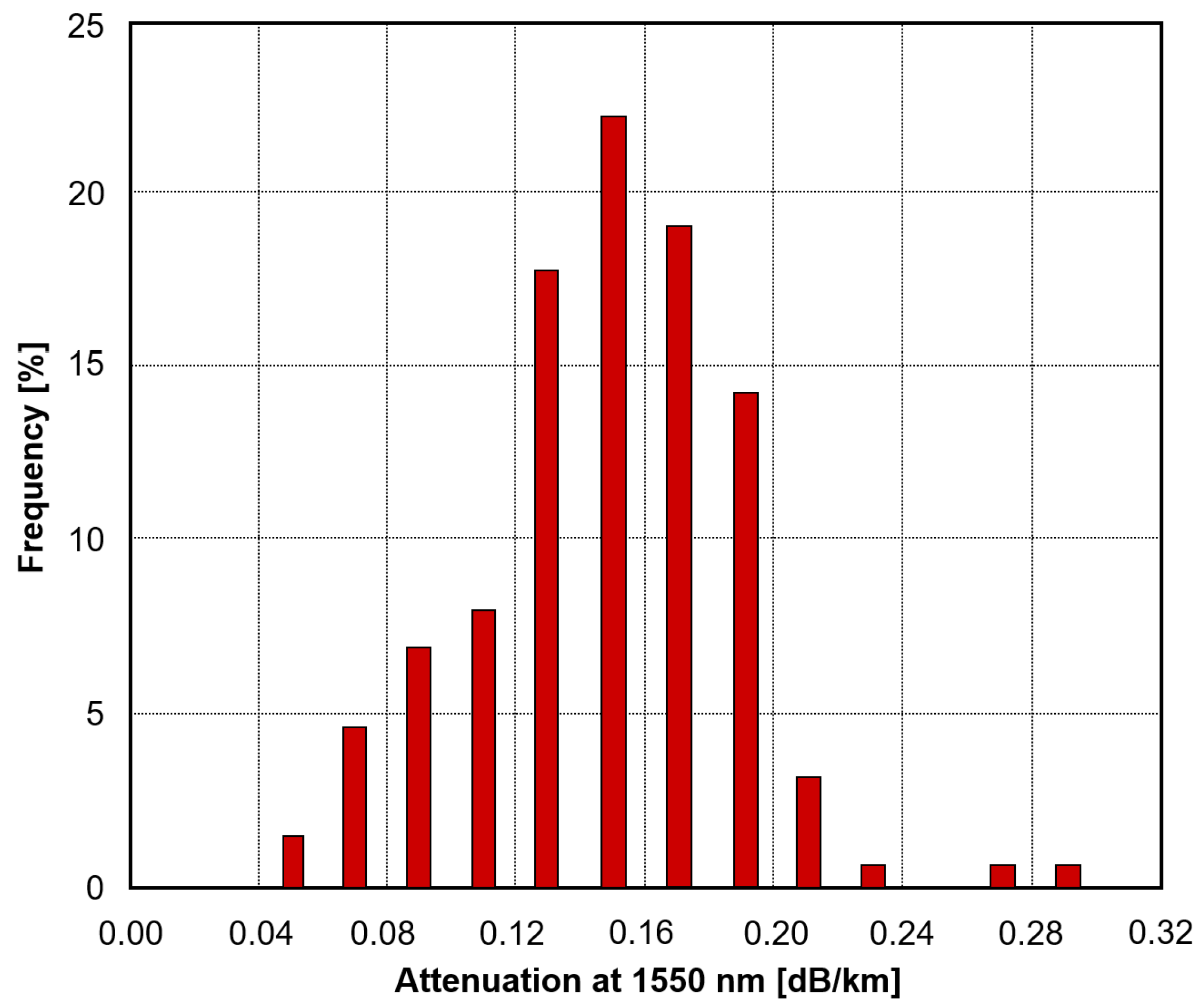
3.1. Ultra-Low-Loss DNANF Fibers for Operation at 1550 nm: 2024
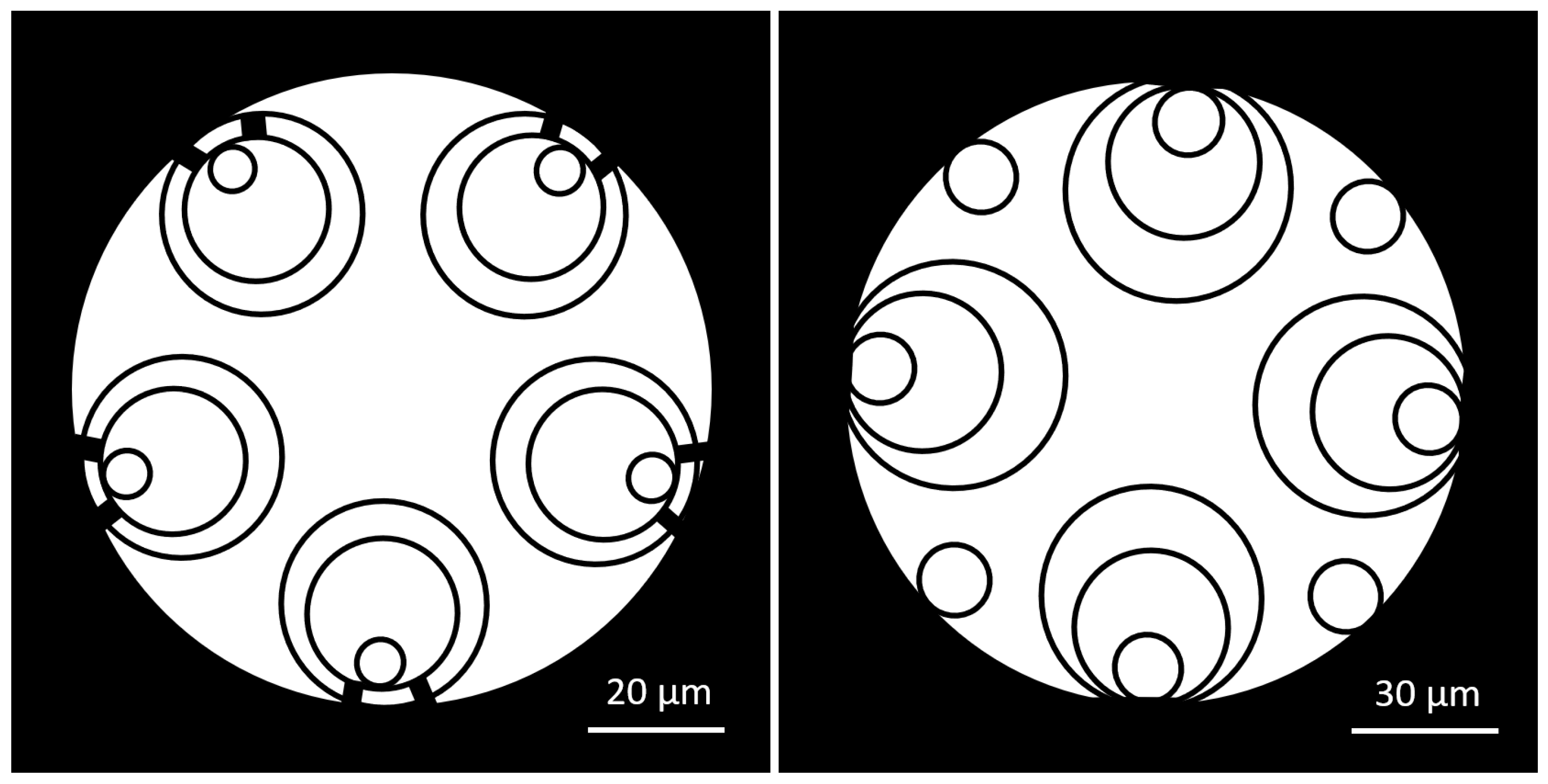
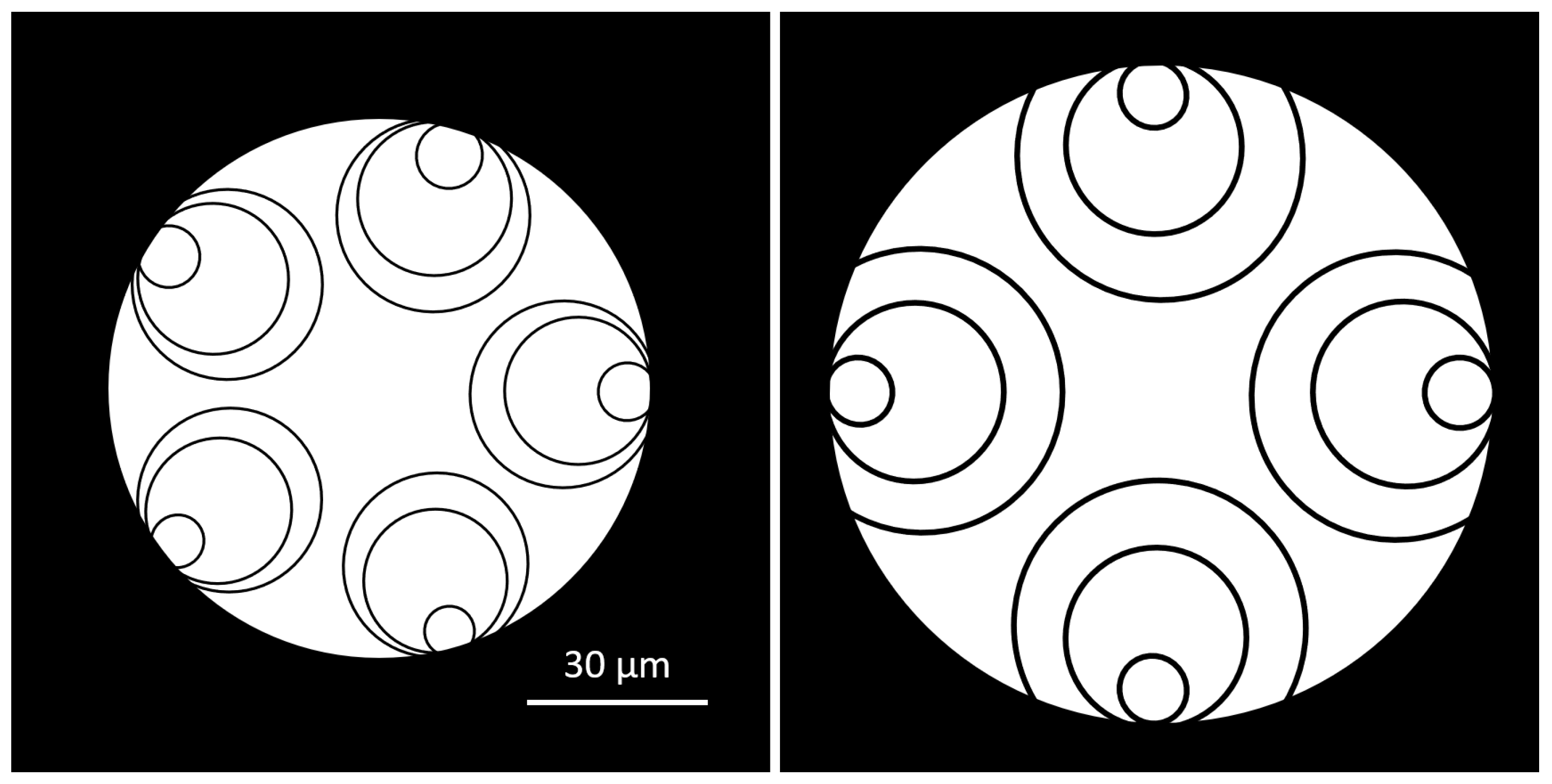
3.2. Truncated Nested Tubes
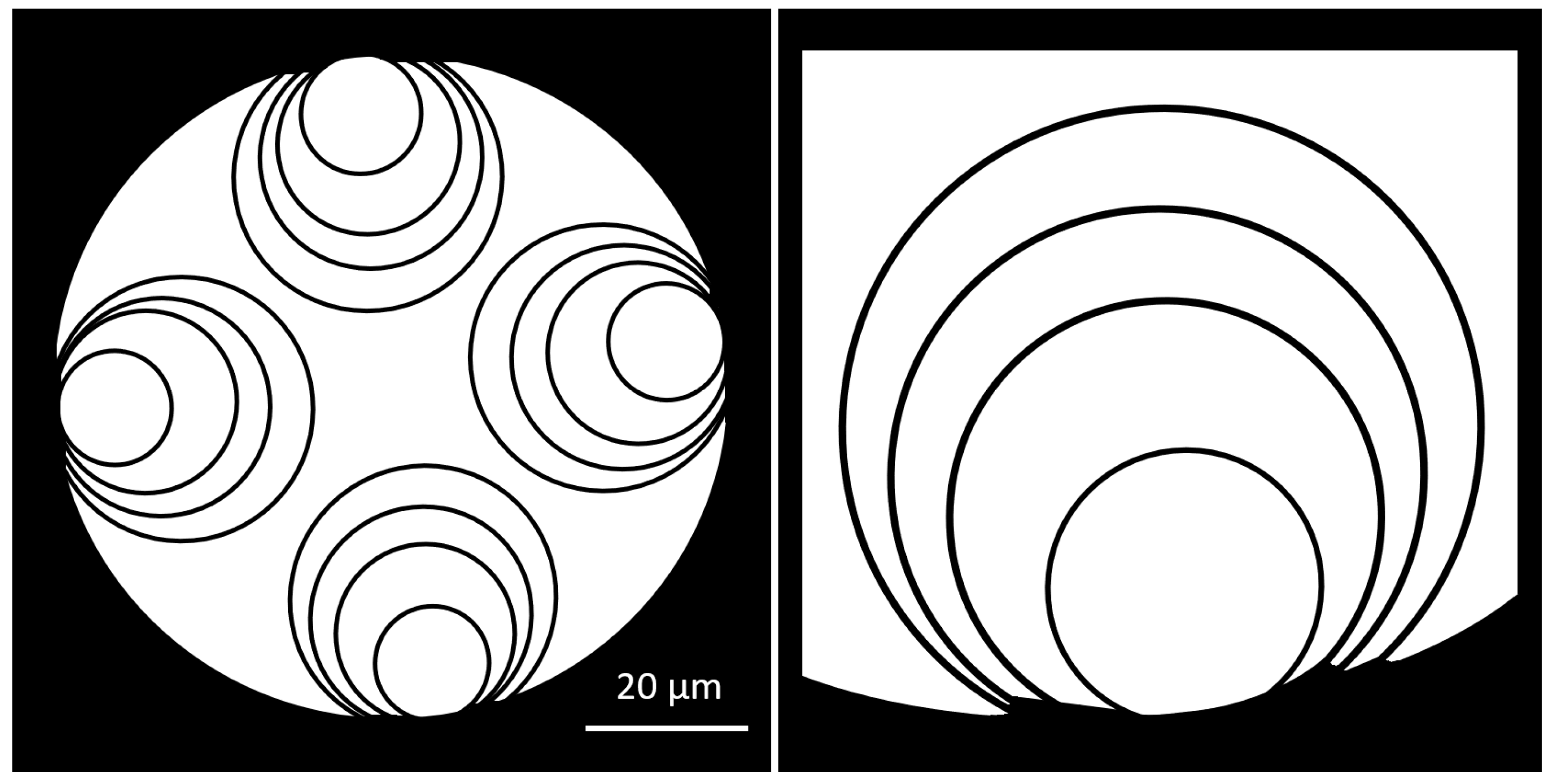
3.3. Ultra-Low-Loss DNANF Fibers for Operation at 1550 nm: 2025
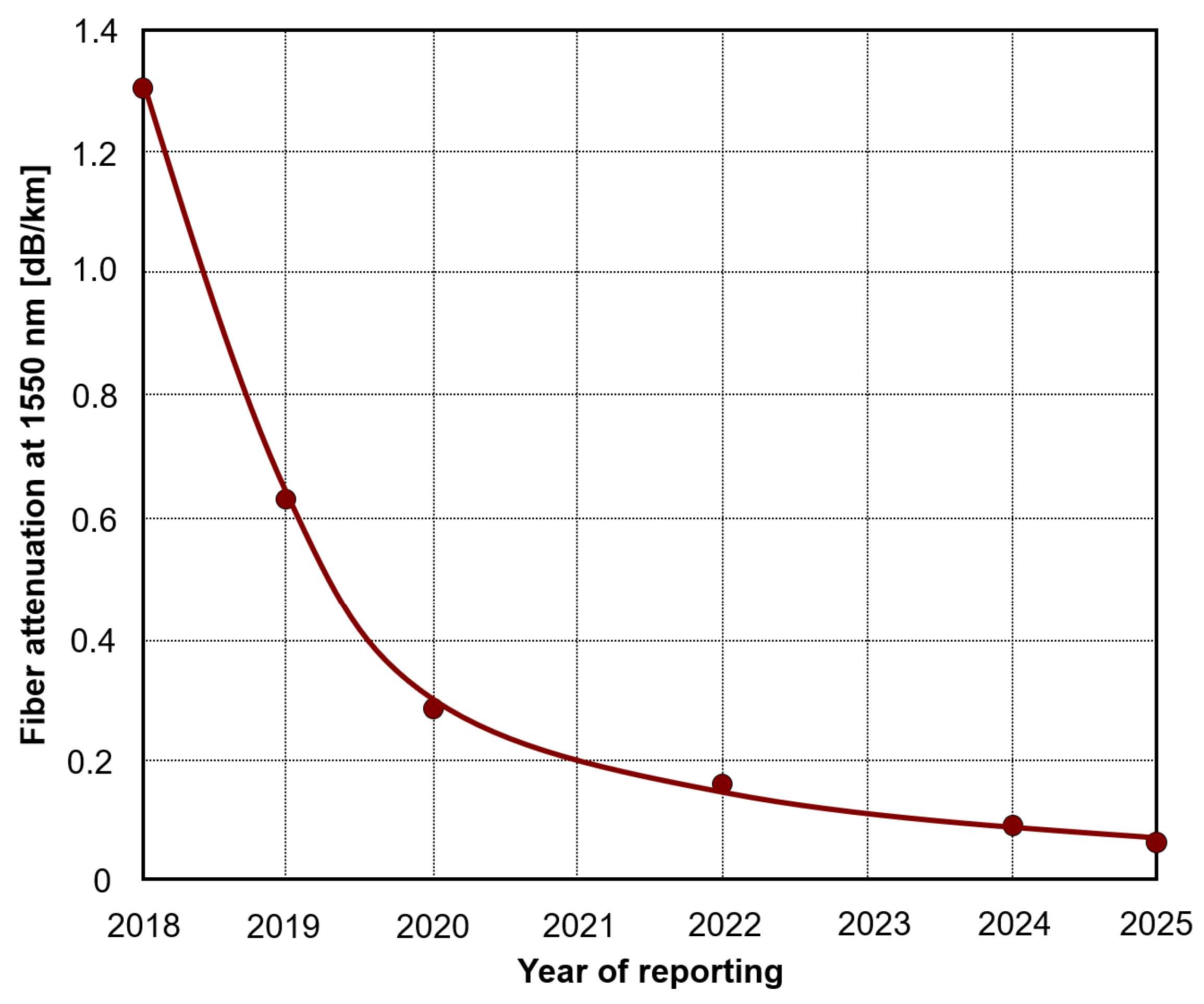
3.4. History of Loss Reduction in NANF/DNANF Fibers
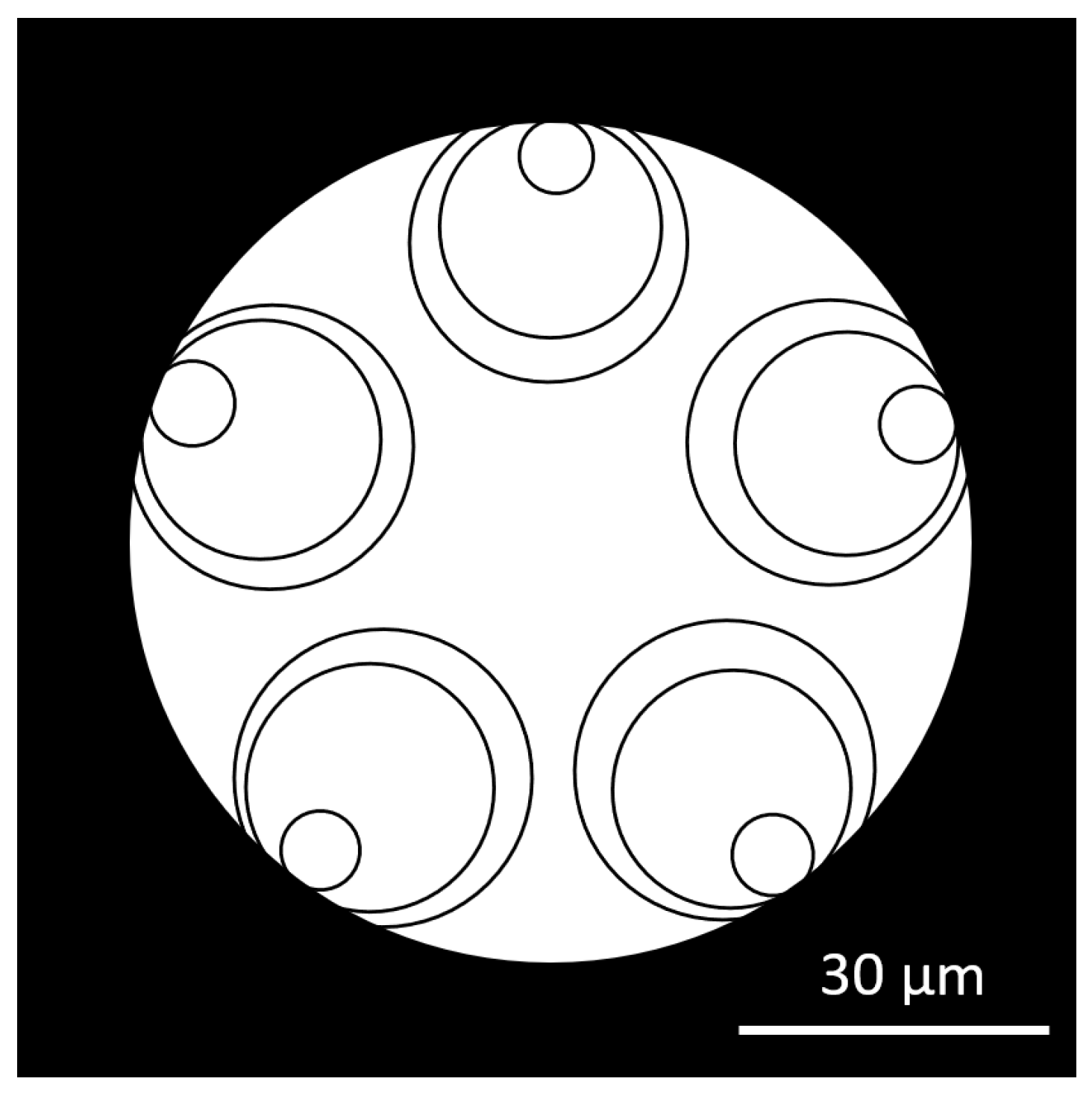
3.5. Compact TNANF Fibers for Use at 1550 nm
- Decreased fiber density in a cable (by up to 4×);
- Incompatibility with current fiber connectors (larger hole required), hardware (larger bending diameter of fiber) and tools (e.g., non-standard fiber adapters);
- Limitations in tight cable bending, e.g., in data centers;
- Delayed standardization of HCFs until (hopefully) a 125 μm version appears.
- SMF-compatible HCF with 125 μm cladding and 250 μm coating diameter;
- Similar fiber with 20 μm core and 145 μm cladding but lower loss.
3.6. Ultra-Low-Loss DNANF Fibers for Operation at 850 nm
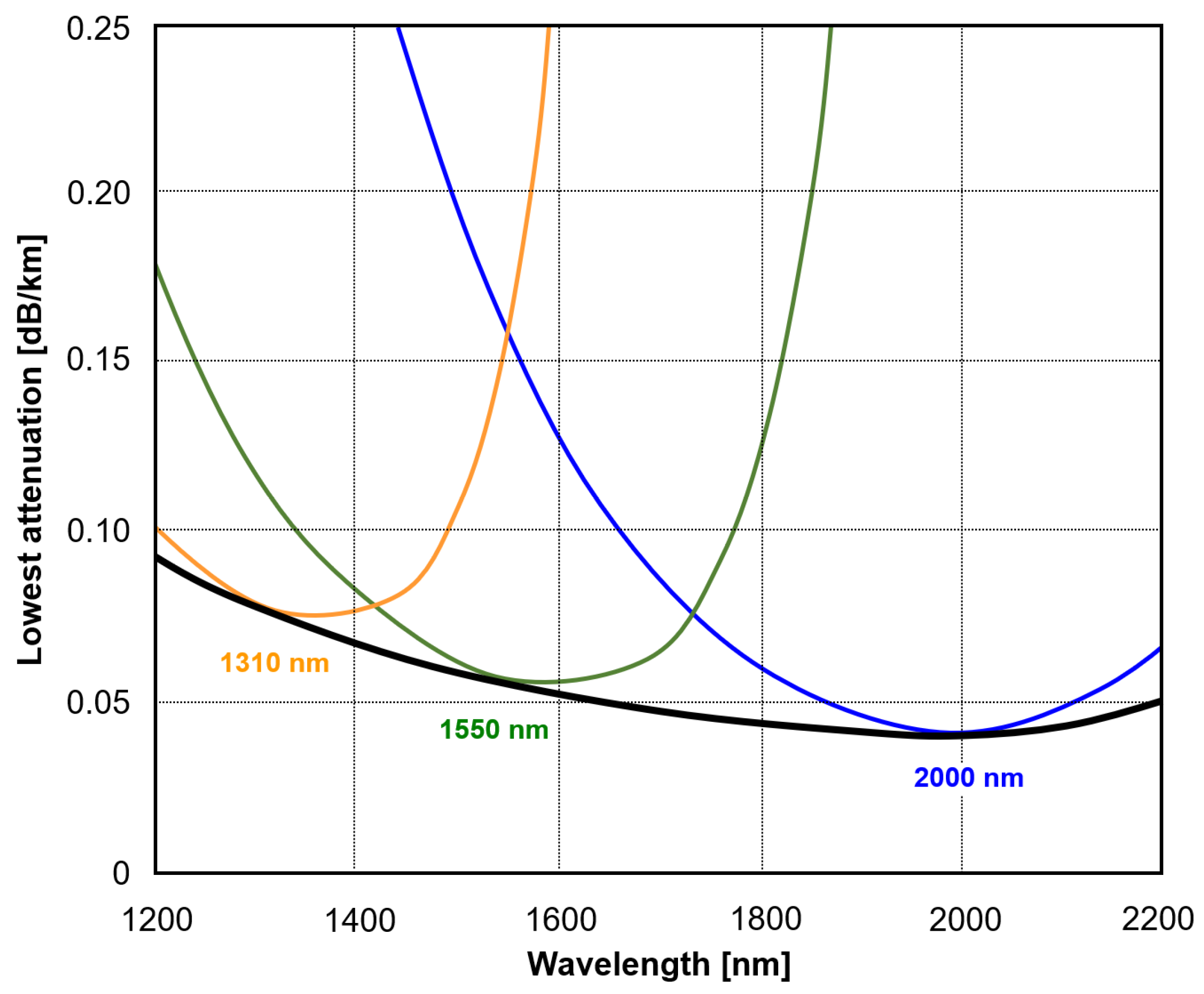
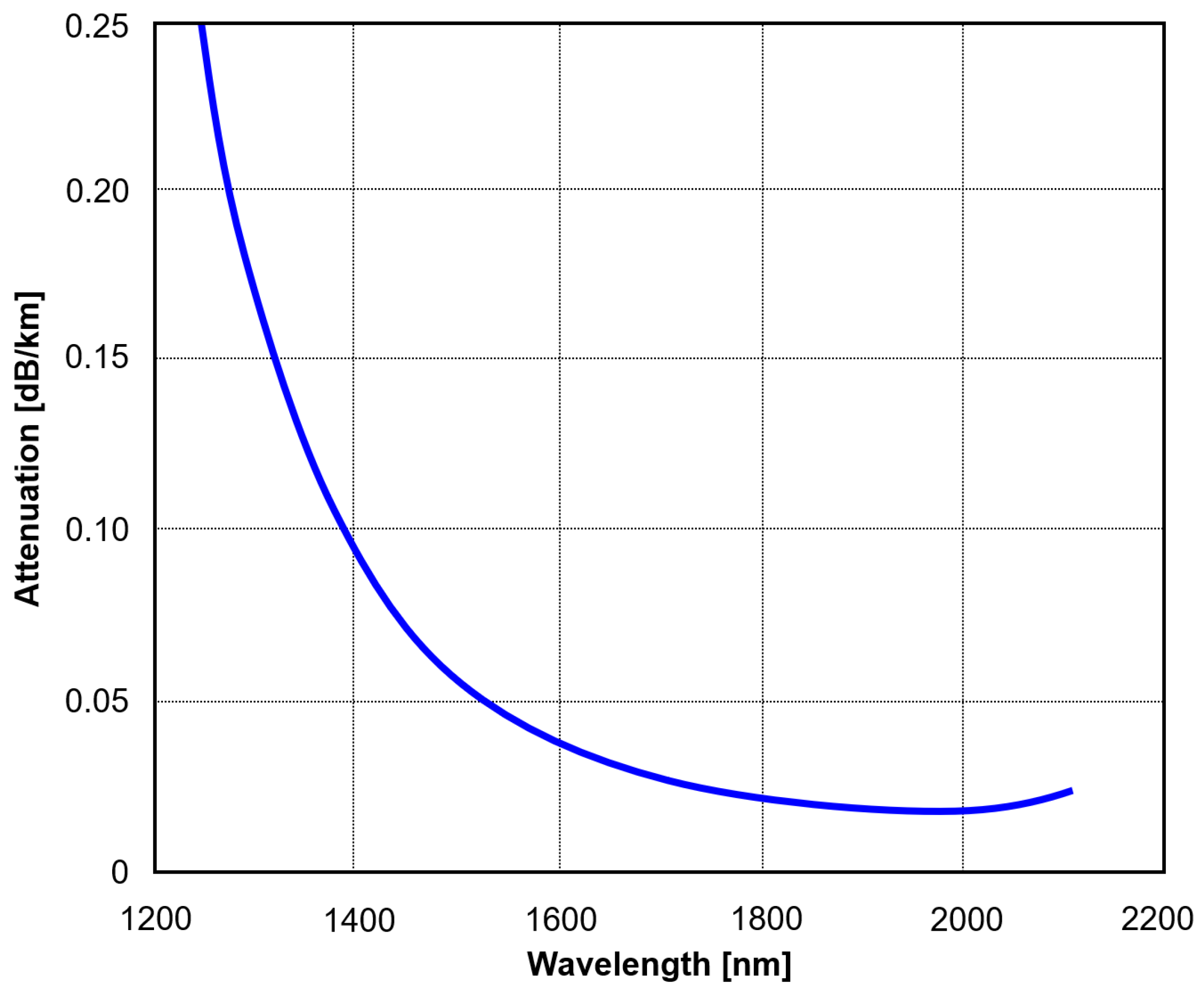
3.7. Estimation of Lowest HCF Loss
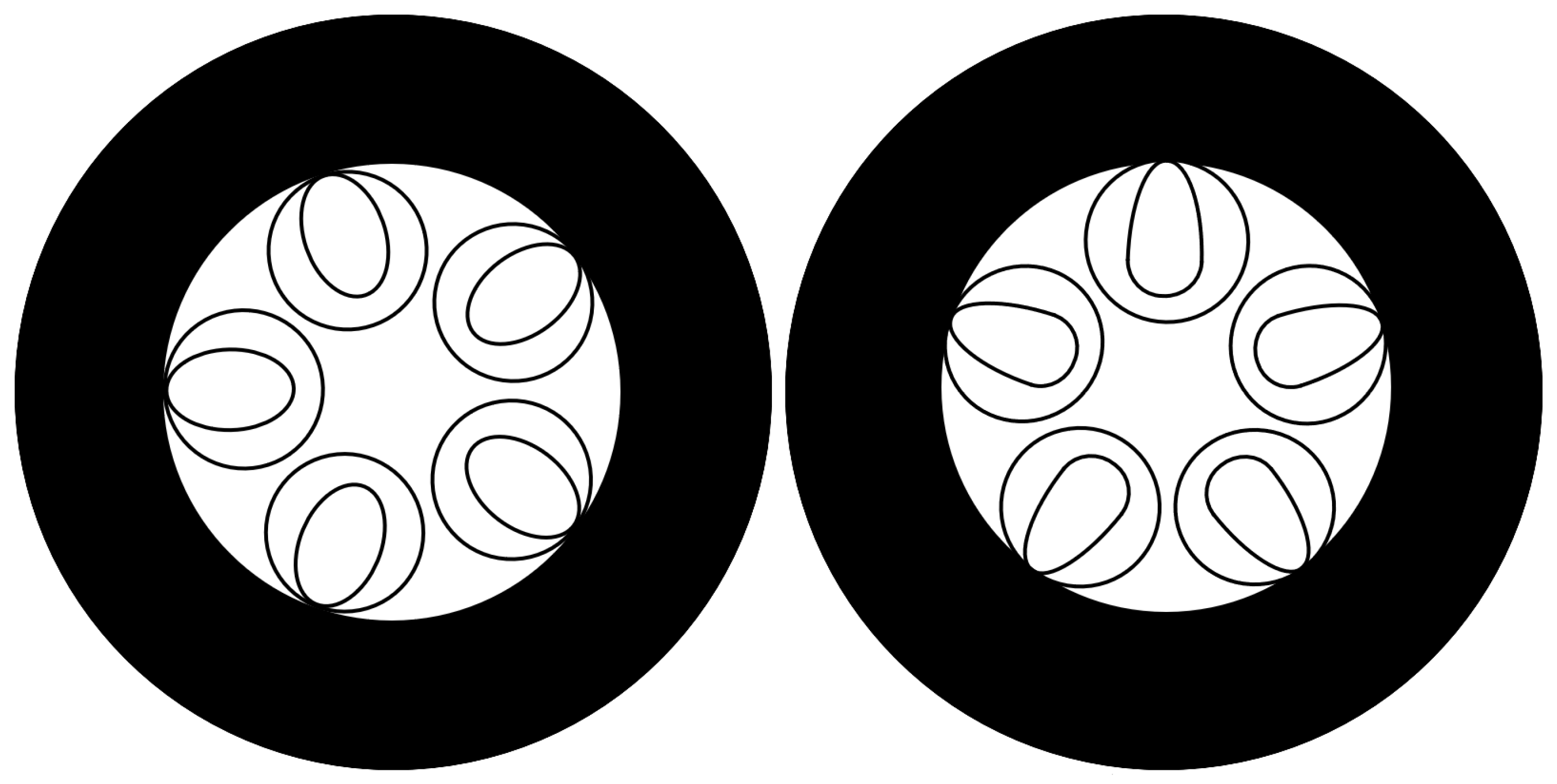
- (a)
- Insertion of additional membrane(s) within or close to nested tubes to increase reflection in the transmission band. Unfortunately, most such structures are complicated to make and must be made to tight dimensional tolerances to be effective.
- (b)
- Changing the shape of nested tubes (or only one of them) to elliptical or waterdrop-like for reduced interaction of light with the jacket tube. This design is fairly simple to implement by blowing fused silica tubes of standardized non-circular shape and assembling the preform using the stack-and-draw method.
4. Fiber Manufacturing Issues
4.1. General
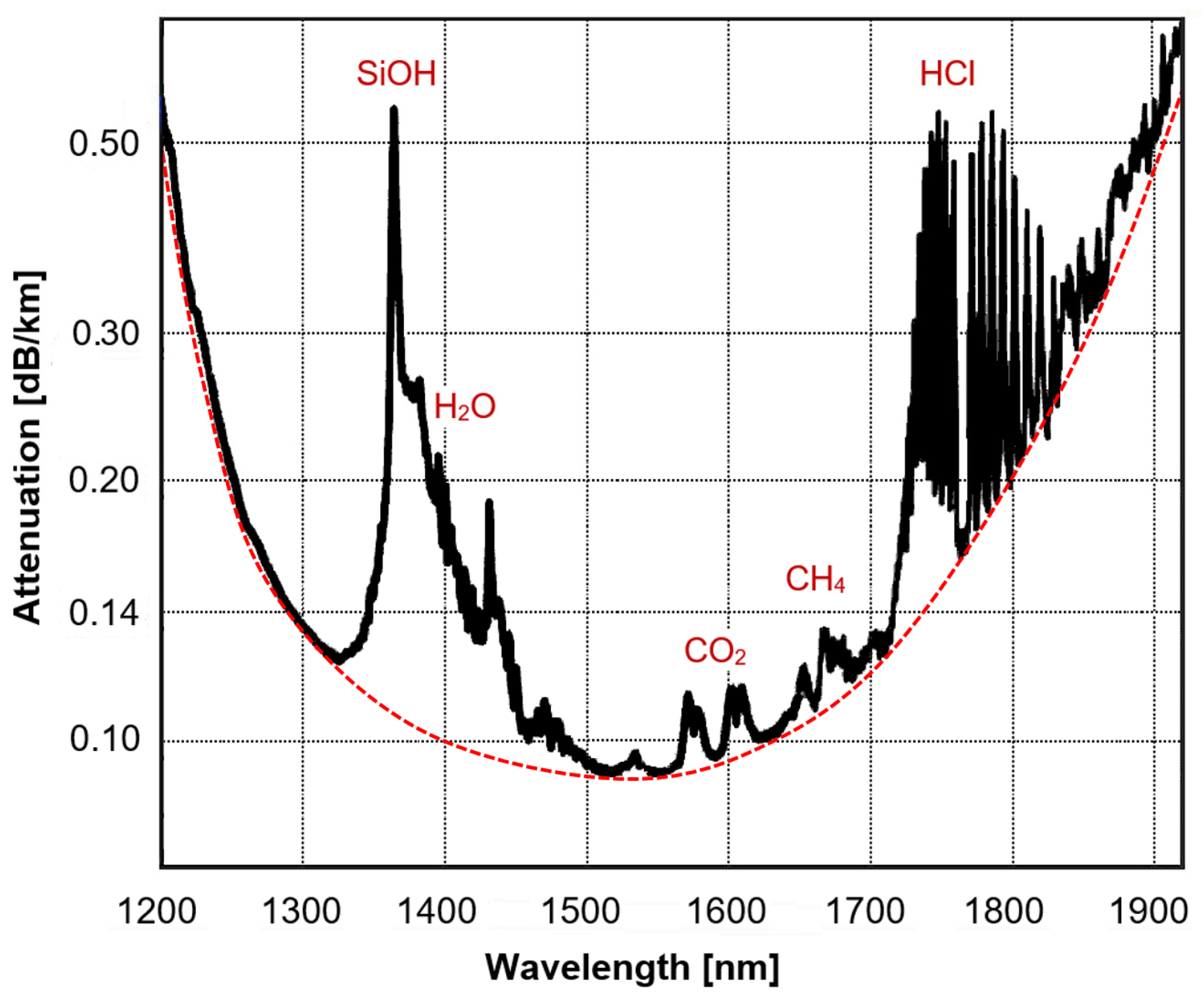
4.2. Absorption by Contaminants in the Fiber
- Light hydrocarbons: methane (CH4), ethane (C2H6), propane (C3H8), and butane (C4H10) used as fuels for gas burners in glass processing;
- Fluorine, chlorine and hydrogen chloride (HCl) outgassing from hot fused silica tubes, where Cl2 and F2 are used to remove traces of hydroxyl ions from fused silica;
- Carbon dioxide (CO2).
5. Role and Standardization of Hollow-Core Fibers
5.1. SMF, MCF, and HCF Market Segments
- SMF: low-cost, established technology for most networks, especially when applications are cost-sensitive, e.g., in fiber access networks (FTTH).
- MCF: fibers compatible with SMFs for high-density applications and parallel transmission; splicing MCF to a bunch of SMFs requires an expensive “fanout”.
- HCF: fibers with unique properties for applications with special requirements (low latency, low loss, low non-linearity, wide bandwidth, high power transmission) but incompatible with other fibers.
5.2. Standardization and Fusion Splicing of Fibers
- Different mode field diameters of SMF (9–13 μm) and HCF (18–32 μm);
- Collapse of fine anti-resonant tubes having membranes which are only 0.4–1.2 μm thick.
5.3. Demise of HC-PBGF Fibers
- Complicated, labor intensive, and expensive preform manufacturing involving 250–300 glass tubes instead of less than 20 in a 4-DNANF or 5-DNANF;
- High attenuation, typically 2.5–5 dB/km in (some parts of the) 1550 nm band;
- Narrow low-loss band, usually made of several sub-bands 10–30 nm wide [47];
- High polarization mode dispersion (PMD) despite spinning at 100 rev/m rate [36].
6. Optical Amplifiers for Use with HCFs
6.1. New Fibers—New Wavelength Bands
- Very low overlap of guided radiation with glass (2 × 10⁻⁵ … 1 × 10⁻⁴);
- Bismuth (BDFA, ≈1300–1500 nm);
- Thulium (TDFA, ≈1900–2020 nm);
- Holmium (HDFA, ≈2000–2130 nm).
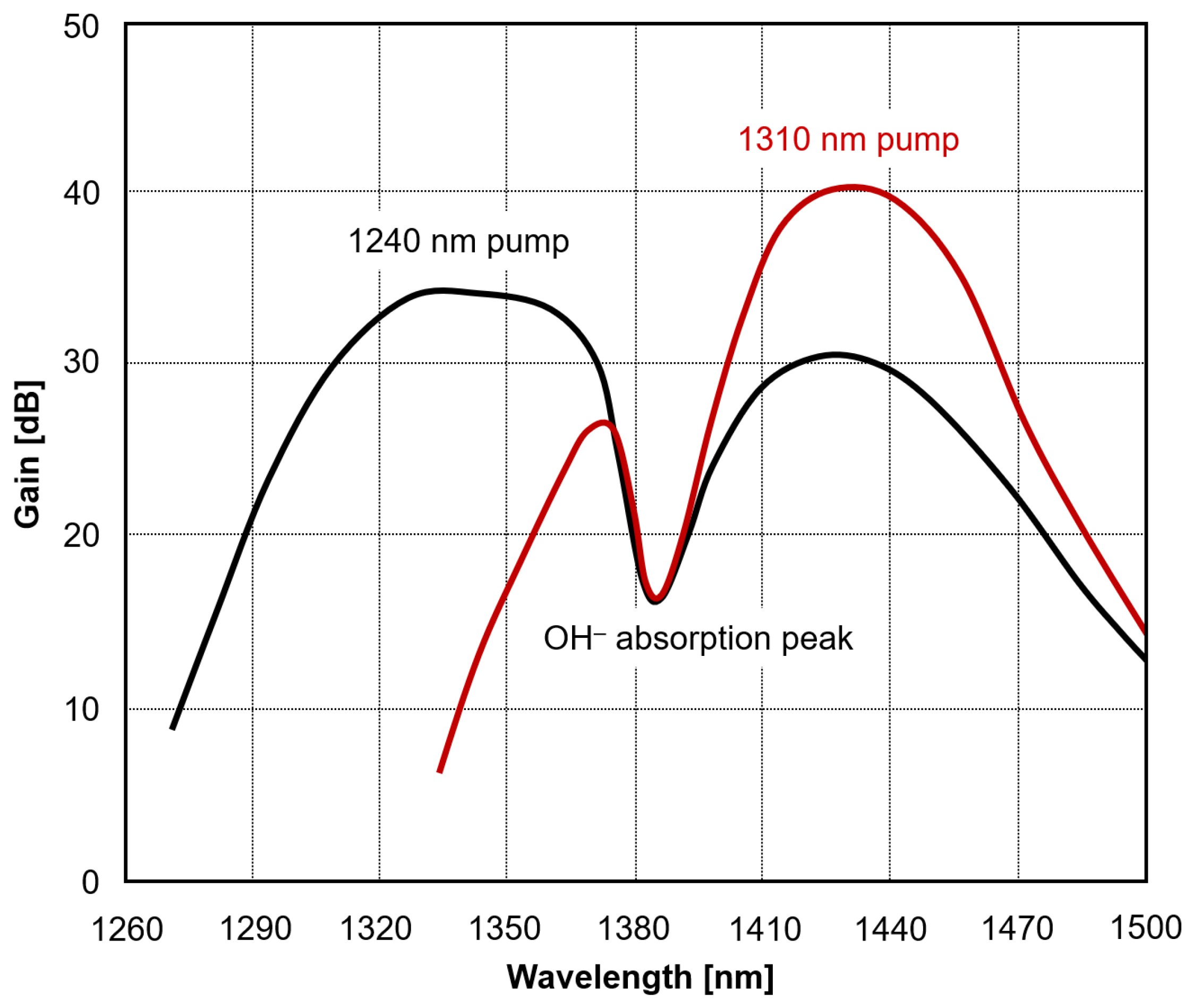
6.2. Bismuth-Doped Fiber Amplifiers for Short Wavelengths
- Active fiber has a limited Bi content (≈100 ppm) and must be long: 90–500 m;
- OH− ions in active fibers produce non-negligible absorption at ≈1383 nm, splitting gain spectrum into two parts. Careful drying of the preform with hot chlorine before consolidation will be required to eliminate it.
6.3. Thulium-Doped Fiber Amplifiers for Long Wavelengths
7. Deployment of HCFs in Microsoft Azure Data Centers and Links
- Low latency;
- Bending tolerance,
- Small core diameter and MFD for splicing to SMFs.
8. HCF-Related Future Technologies
- Passive components for HCFs: DWDM multiplexers, filters, splitters, optical switches and circulators for the 1700–2100 nm band.
- Low-noise photodiodes and DFB lasers for transmitters and receivers operating at wavelengths of up to 2100 nm. “Extended InGaAs” photodiodes with indium content exceeding the standard 53% ratio and lasers on InP substrate covering this band are manufactured on a small scale and are expensive. Because of reduced bandgap, extended InGaAs photodiodes exhibit larger dark current and may need thermoelectric coolers to reduce noise.
- Complete optical transponders for the 1700–2100 nm band.
- OTDRs, power meters, and portable light sources for the 1700–2100 nm band.
- Portable TV cameras, offering sensitivity of up to 2100 nm, for inspection of radiation leakage in facilities with high power transmission/amplification.
- These networks are operating at established wavelengths, e.g., 1550 nm or (maybe) 850 nm, for compatibility with existing SMF or MMF “ecosystems”, respectively;
- Microsoft, the dominant HCF user for now (Section 7), is able to custom order components and test equipment without this information making news in professional media.
9. Discussion
- Loss in the 1550 nm band (the main benchmark) is not affected;
- Improvements to anti-resonance structures and drawing are more important.
- Variable diameter of core and nested tubes along the fiber, with locally increased confinement loss;
- Various light-absorbing and -scattering contaminants (dust, glass particles), both contained in the air (Figure 10) and deposited on glass surfaces inside the fiber.
10. Materials and Methods
- Scientific and technical publications, standards and product data sheets;
- Copies of press releases and company publications, usually with photos and other graphics saved as separate files;
- Drawings and photographs extracted from publications in PDF format or saved from websites for further analysis, particularly of fiber geometry. Note: Figures included in this paper were created anew to look like ones in References but are not their direct copies.
Funding
Institutional Review Board Statement
Informed Consent Statement
Data Availability Statement
Conflicts of Interest
Abbreviations
| 4-DNANF | Double Nested Anti-Resonant Nodeless Fiber with 4 non-truncated tube sets |
| 5-DNANF | Double Nested Anti-Resonant Nodeless Fiber with 5 non-truncated tube sets |
| 4T-DNANF | Double Nested Anti-Resonant Nodeless Fiber with 4 truncated tube sets |
| 5T-DNANF | Double Nested Anti-Resonant Nodeless Fiber with 5 truncated tube sets |
| AI | Artificial Intelligence |
| ARF | Anti-Resonant Fiber |
| ARROW | Anti-Resonant Reflecting Optical Waveguide |
| BDFA | Bismuth-Doped Fiber Amplifier |
| C band | 1530–1565 nm optical band (Conventional Band) |
| CAPEX | Capital Expenses |
| CD | Chromatic Dispersion |
| CL | Confinement Loss |
| DNANF | Double-Nested Anti-Resonant Nodeless Fiber |
| DWDM | Dense Wavelength Division Multiplexing |
| E band | 1360–1460 nm optical band (Extended Wavelength Band) |
| EDFA | Erbium-Doped Fiber Amplifier |
| FOG | Fiber Optic Gyroscope |
| FTTH | Fiber to the Home (fully fiber optic broadband access network) |
| HST | High-Speed Trading |
| HCF | Hollow-Core Fiber |
| HC-PBGF | Hollow-Core Photonic Bandgap Fiber |
| HDFA | Holmium-Doped Fiber Amplifier |
| HOM | Higher-Order Mode |
| HOMER | Higher-Order Mode Extinction Ratio |
| IT-DNANF | Interstitial-Tube-assisted Double-Nested Anti-Resonant Nodeless Fiber |
| ITU-T | International Telecommunication Union–Technical Standardization Sector |
| MCF | Multi-Core Fiber |
| L band | 1565–1625 nm optical band (Longwave Band) |
| MFD | Mode Field Diameter |
| MMF | Multimode Fiber (with solid core) |
| NA | Numerical Aperture |
| MSD | Microstructure Diameter (diameter of HCF without solid jacket tube) |
| NANF | Nested Anti-Resonant Nodeless Fiber |
| O band | 1260–1360 nm optical band (Old Band—the first one used with SMF) |
| OPEX | Operating Expenses |
| OTDR | Optical Time Domain Reflectometer |
| OTN | Optical Transport Network |
| PBGF | Photonic Bandgap Fiber |
| PMD | Polarization Mode Dispersion |
| PSCF | Pure Silica Core Fiber |
| S Band | 1460–1530 nm optical band (Shortwave Band) |
| SMF | Single-Mode Fiber (with solid core and cladding) |
| SPM | Self-Phase Mixing |
| SSL | Surface Scattering Loss |
| TDFA | Thulium-Doped Fiber Amplifier |
| U band | 1625–1675 nm optical band (Ultralong Wavelength Band) |
References
- Borzycki, K.; Osuch, T. Hollow-Core Optical Fibers for Telecommunications and Data Transmission. Appl. Sci. 2023, 13, 10699. [Google Scholar] [CrossRef]
- ITU-T Recommendation G.652: Characteristics of a Single-Mode Optical Fibre Cable. CCITT (The International Telegraph and Telephone Consultative Committee), Geneva, Switzerland, October 1984. (Published in Printed Version Only). Available online: https://www.itu.int/itu-t/recommendations/rec.aspx?rec=4091&lang=en (accessed on 25 November 2025).
- Zhang, E. Why Is Hollow-Core Fiber So Popular? LinkedIn. 13 January 2025. Available online: https://www.linkedin.com/pulse/why-hollow-core-fiber-so-popular-evelyn-zhang-cwx4c (accessed on 2 December 2025).
- Wang, C. 2025/2026 China Mobile Optical Cable Tender Awards Released. CRU Group. 11 June 2025. Available online: https://www.crugroup.com/en/communities/thought-leadership/2025/2025-2026-China-Mobile-optical-cable-tender-awards-released/ (accessed on 12 December 2025).
- Saitoh, K.; Matsuo, S. Multicore Fiber Technology. J. Light. Technol. 2015, 1, 55–66. [Google Scholar] [CrossRef]
- Pryamikov, A.D.; Biriukov, A.S.; Kosolapov, A.F.; Plotnichenko, V.G.; Semjonov, S.L.; Dianov, E.M. Demonstration of a waveguide regime for a silica hollow-core microstructured optical fiber with a negative curvature of the core boundary in the spectral region > 3.5 μm. Opt. Express 2011, 19, 1441–1448. [Google Scholar] [CrossRef]
- ITU-T Recommendation G.652; Characteristics of a Single-Mode Optical Fibre and Cable. International Telecommunication Union: Geneva, Switzerland, 2024. Available online: https://www.itu.int/myworkspace/t-rec/item?id=16060&lang=en (accessed on 22 April 2026).
- ITU-T Recommendation G.654; Characteristics of a Cut-Off Shifted Single-Mode Optical Fibre and Cable. International Telecommunication Union: Geneva, Switzerland, 2024. Available online: https://www.itu.int/myworkspace/t-rec/item?id=16061&lang=en (accessed on 22 April 2026).
- ITU-T Recommendation G.657; Characteristics of a Bending-Loss Insensitive Single-Mode Optical Fibre and Cable. International Telecommunication Union: Geneva, Switzerland, 2024. Available online: https://www.itu.int/myworkspace/t-rec/item?id=16037&lang=en (accessed on 22 April 2026).
- TIA-492AAAE; Detail Specification for 50-um Core Diameter/125-um Cladding Diameter Class 1a Graded-Index Multimode Optical Fibers with Laser-Optimized Bandwidth Characteristics Specified for Wavelength Division Multiplexing. Telecommunications Industry Association: Arlington, Virginia, USA, 2016. Available online: https://store.accuristech.com/standards/tia-tia-492aaae?product_id=2592718 (accessed on 22 April 2026).
- IEC 60793-2-10; Optical Fibres—Part 2-10: Product Specifications-Sectional Specification for Category A1 Multimode Fibres. International Electrotechnical Commission: Geneva, Switzerland, 2019. Available online: https://webstore.iec.ch/en/publication/62020 (accessed on 22 April 2026).
- Ciddor, P.E. Refractive Index of Air: New Equations for the Visible and Near Infrared. Appl. Opt. 1996, 35, 1566–1573. [Google Scholar] [CrossRef]
- Jasion, G.T.; Sakr, H.; Hayes, J.R.; Sandoghchi, S.R.; Hooper, L.; Fokoua, E.N.; Saljoghei, A.; Mulvad, H.C.; Alonso, M.; Taranta, A. 0.174 dB/km Hollow Core Double Nested Antiresonant Nodeless Fiber (DNANF). In Proceedings of the 2022 Optical Fiber Communications Conference and Exhibition (OFC), San Diego, CA, USA, 6–10 March 2022. Paper Th4C.7. [Google Scholar] [CrossRef]
- FarBand Ultra Low Loss and Large Effective Area Single-mode Fibre. Yangtze Optical Fibre and Cable. 2019. Available online: https://yofc-oss.oss-cn-beijing.aliyuncs.com/en/upload/20190702/1deoels8o13po8kkr.pdf (accessed on 29 January 2026).
- Corning TXF Optical Fiber Product Information PI1433. Corning Inc.. November 2022. Available online: https://www.corning.com/media/worldwide/coc/documents/Fiber/product-information-sheets/PI-1433-AEN.pdf (accessed on 24 January 2026).
- Corning Vascade EX2000 Optical Fiber Product Information PI-1440. Corning Inc.. March 2023. Available online: https://www.corning.com/media/worldwide/coc/documents/Fiber/product-information-sheets/PI-1440.pdf (accessed on 29 January 2026).
- Corning® SMF-28® ULL S+ Optical Fiber Product Information PI-1471. Corning Inc.. March 2023. Available online: https://www.corning.com/media/worldwide/coc/documents/Fiber/product-information-sheets/PI-1471.pdf (accessed on 29 January 2026).
- Z-PLUS Fiber 150 Advanced Pure Silica Core Single Mode Optical Fiber TR-21268A. Sumitomo Electric. 2021. Available online: https://sumitomoelectriceurope.com/wp-content/uploads/2022/08/Datasheet-for-TR-21268A_Z-PLUS_Fiber_150.pdf (accessed on 29 January 2026).
- Sato, S.; Kawaguchi, Y.; Sakuma, H.; Haruna, T.; Hasegawa, T. Record Low Loss Optical Fiber with 0.1397 dB/km. In Proceedings of the 2024 Optical Fiber Communications Conference and Exhibition (OFC), San Diego, CA, USA, 24–28 March 2024. Paper Tu2E.1. [Google Scholar]
- Sato, S.; Kawaguchi, Y.; Sakuma, H.; Haruna, T.; Hasegawa, T. Ultra-low Loss 0.1397dB/km Silica-core Single-mode Fiber. In Optical Fiber Communication Conference (OFC) 2025; Paper M1F.4; Technical Digest Series; Optica Publishing Group: Washington, DC, USA, 2025. [Google Scholar] [CrossRef]
- Tamura, Y.; Sakuma, H.; Morita, K.; Suzuki, M.; Yamamoto, Y.; Shimada, K.; Honma, Y.; Sohma, K.; Fuji, T.; Hasegawa, T. The First 0.14-dB/km Loss Optical Fiber and its Impact on Submarine Transmission. J. Light. Technol. 2018, 36, 44–49. [Google Scholar] [CrossRef]
- Petrovich, M.; Numkam Fokoua, E.; Chen, Y.; Sakr, H.; Adamu, A.I.; Hassan, R.; Wu, D.; Ando, R.F.; Papadimopoulos, A.; Sandoghchi, S.R.; et al. Broadband optical fibre with an attenuation lower than 0.1 decibel per kilometre. Nat. Photonics 2025, 19, 1203–1208. [Google Scholar] [CrossRef]
- Chen, Y.; Petrovich, M.N.; Numkam Fokoua, E.; Adamu, A.I.; Hassan, M.R.A.; Sakr, H.; Slavík, R.; Bakhtiari Gorajoobi, S.; Alonso, M.; Fatobene Ando, R.; et al. Hollow Core DNANF Optical Fiber with <0.11 dB/km Loss. In Proceedings of the 2024 Optical Fiber Communications Conference (OFC), San Diego, CA, USA, 24–28 March 2024. Paper Th4A.8. [Google Scholar] [CrossRef]
- Gao, S.; Chen, H.; Sun, Y.; Xiong, Y.; Yang, Z.; Zhao, R.; Ding, W.; Wang, Y. Fourfold truncated double-nested antiresonant hollow-core fiber with ultralow loss and ultrahigh mode purity. Optica 2025, 12, 56–61. [Google Scholar] [CrossRef]
- Gao, S.; Chen, H.; Sun, Y.; Ding, W.; Wang, Y. Truncated anti-resonant hollow-core fiber for reduced microstructure diameter. J. Light. Technol. 2024, 42, 6077–6082. [Google Scholar] [CrossRef]
- Gao, S.; Chen, H.; Xiong, Y.; Sun, Y.; Ding, W.; Wang, Y. 40 km, 0.052 dB/km and 83 Km, 0.076 dB/km in Interstitial-Tube-Assisted Hollow-Core Fibre. In Proceedings of the 2025 European Conference on Optical Communications (ECOC), Copenhagen, Denmark, 28 September–2 October 2025. Paper Th.03.01.1. [Google Scholar] [CrossRef]
- Ding, Y.; Li, P.; Chen, G.; Chu, J.; Jia, A.; Zhang, L.; Luo, J. Support Tube Hollow-Core Fiber with 0.05 dB/km Attenuation. In Proceedings of the 2025 European Conference on Optical Communications (ECOC), Copenhagen, Denmark, 28 September–2 October 2025. Paper Tu.04.01.2. [Google Scholar] [CrossRef]
- Bradley, T.D.; Hayes, J.R.; Chen, Y.; Jasion, G.T.; Sandoghchi, S.R.; Slavik, R.; Numkam Fokoua, E.; Bawn, S.; Sakr, H.; Davidson, I.A.; et al. Record Low-Loss 1.3dB/km Data Transmitting Antiresonant Hollow Core Fibre. In Proceedings of the 2018 European Conference on Optical Communication (ECOC 2018), Rome, Italy, 23–27 September 2018. [Google Scholar] [CrossRef]
- Bradley, T.; Jasion, G.; Hayes, J.; Chen, Y.; Hooper, L.; Sakr, H.; Alonso, M.; Taranta, A.; Saljoghei, A.; Mulvad, H.C.; et al. Antiresonant Hollow Core Fibre with 0.65 dB/km Attenuation across the C and L Telecommunication bands. In Proceedings of the European Conference on Optical Communication (ECOC 2019), Dublin, Ireland, 22–26 September 2019. [Google Scholar] [CrossRef]
- Jasion, G.T.; Bradley, T.D.; Harrington, K.; Sakr, H.; Chen, Y.; Numkam Fokoua, E.; Davidson, I.A.; Taranta, A.; Hayes, J.R.; Richardson, D.J.; et al. Hollow Core NANF with 0.28 dB/km Attenuation in the C and L Bands. In Proceedings of the 2020 Optical Fiber Communications Conference and Exhibition (OFC), San Diego, CA, USA, 8–12 March 2020. Paper Th4B.4. [Google Scholar]
- Mahdiraji, G.A.; Jackson, G.; Abokhamis Mousavi, S.M.; Baddela, N.K.; Rzegocki, J.; Guerra, G.; Rahman, M.; Saw, C.P.; Davidson, I.A.; Jasion, G.T.; et al. First Triple Nested Antiresonant Nodeless Hollow Core Fiber (TNANF) Achieving 0.25 dB/km Loss with Small 145/250 μm Glass/Coating Diameters. In Proceedings of the 2025 European Conference on Optical Communications (ECOC), Copenhagen, Denmark, 28 September–2 October 2025. [Google Scholar] [CrossRef]
- Adamu, A.I.; Hassan, M.R.A.; Chen, Y.; Fokoua, E.N.; Alonso, M.; Sakr, H.; Richardson, D.J.; Poletti, F.; Petrovich, M.N. 10.9km Hollow Core Double Nested Antiresonant Nodeless Fiber (DNANF) with 0.33dB/km loss at 850nm. In Proceedings of the 2024 Optical Fiber Communications Conference (OFC), San Diego, CA, USA, 24–28 March 2024. Paper M3J.1. [Google Scholar] [CrossRef]
- Numkam Fokoua, E.; Abokhamis Mousavi, S.; Jasion, G.T.; Richardson, D.J.; Poletti, F. Loss in hollow-core optical fibers: Mechanisms, scaling rules, and limits (Tutorial). Adv. Opt. Photonics 2023, 15, 1–85. [Google Scholar] [CrossRef]
- Sumi Rani Shaha, K.; Khaleque, A.; Hosen, S. Wideband Low Loss Hollow Core Fiber with Nested Hybrid Cladding Elements. J. Light. Technol. 2021, 39, 6585–6591. [Google Scholar] [CrossRef]
- Zhang, H.; He, J.M.; Wang, J.Q.; Zhang, X.; Xi, L.X.; Zhang, X. Ultralow loss and broadband hollow core anti-resonant fiber with nested waterdrop-shaped tube. Opt. Express 2025, 33, 26812–26825. [Google Scholar] [CrossRef] [PubMed]
- Mangan, B.J.; Zhu, B.; Puc, G.S.; Kremp, T.; Irid, M. Low latency transmission in a hollow core fiber cable. In Proceedings of the CLEO 2021, Virtual Event, 9–14 May 2021. STu1Q.1. [Google Scholar] [CrossRef]
- Hou, C.; Chen, G.; Wang, X.; Mao, M.; Zhang, L.; Li, P.; Zhang, L.; Luo, J.; Ding, J.; Duan, Z.; et al. Hollow-core Double Nested Antiresonant Nodeless Fiber Cable with Polarization Mode Dispersion < 0.1 ps/km1/2. In Proceedings of the Optical Fiber Communication Conference (OFC) 2025, San Francisco, CA, USA, 30 March–3 April 2025. Paper M1F.2. [Google Scholar] [CrossRef]
- Borzycki, K.; Jaworski, M. Temperature Dependence of PMD in Optical Fibres and Cables—Part II. In Proceedings of the 2006 International Conference on Transparent Optical Networks (ICTON), Nottingham, UK, 18–22 June 2006; Paper Tu.P.34. Volume 4, pp. 209–212. [Google Scholar] [CrossRef]
- Jasion, G.T.; Hayes, J.R.; Wheeler, N.V.; Chen, Y.; Bradley, T.D.; Richardson, D.J.; Poletti, F. Fabrication of tubular anti-resonant hollow core fibers: Modelling, draw dynamics and process optimization. Opt. Express 2019, 27, 20567–20582. [Google Scholar] [CrossRef]
- Nadella, S. Microsoft Ignite Keynote. 19 November 2024. Available online: https://pub-c2c1d9230f0b4abb9b0d2d95e06fd4ef.r2.dev/2024/11/11192024-Ignite-KEY01-Satya-Nadella2.pdf (accessed on 24 November 2025).
- Forster, C.; Gaudette, J.; Rey, F.; Pearson, T.; Ellis, R.; Badgley, C.; Saljoghei, A. The Deployment of Hollow Core Fiber (HCF) in Azure’s Network. Microsoft Community Hub—Azure Networking Blog, 20 March 2025 (Updated 28 May 2025). Available online: https://techcommunity.microsoft.com/blog/azurenetworkingblog/the-deployment-of-hollow-core-fiber-hcf-in-azure%e2%80%99s-network/4395340 (accessed on 24 November 2025).
- Sumitomo Electric Launches World’s First Mass-Produced Ultra-Low Loss, Multi-Core Fiber. Sumitomo Electric Press Release. 22 September 2023. Available online: https://sumitomoelectric.com/press/2023/09/prs049 (accessed on 10 December 2025).
- ITU-T G Suppl. 87: Standardization Framework for Optical Fibres for Space Division Multiplexing (03/2025). Available online: https://www.itu.int/epublications/fr/publication/itu-t-g-suppl-87-2025-03-standardization-framework-for-optical-fibres-for-space-division-multiplexing (accessed on 9 December 2025).
- Zhang, C.; Zhen, Y.; Wu, X.; Li, J.; Qin, Y.; Fu, S. Fusion Splicing Performance Evaluation of Hollow-Core Fiber to Hollow-Core Fiber with Different Structural Parameters. J. Light. Technol. 2026, 44, 659–664. [Google Scholar] [CrossRef]
- Suslov, D.; Komanec, M.; Fokoua, E.R.N.; Dousek, D.; Zhong, A.; Zvánovec, S.; Bradley, T.D.; Poletti, F.; Richardson, D.J.; Slavík, R. Low loss and high performance interconnection between standard single-mode fiber and antiresonant hollow-core fiber. Sci. Rep. 2021, 11, 8799. [Google Scholar] [CrossRef]
- Mukasa, K. Hollow Core Fiber Cable. Furukawa Electr. Rev. 2021, 52, 36–43. [Google Scholar]
- Mukasa, K. Recent progress of hollow core fibers. JSAP Rev. 2025, 250301. [Google Scholar] [CrossRef]
- ITU-T G Supplement 39–Optical System Design and Engineering Considerations (2025-10). Available online: https://www.itu.int/itu-t/recommendations/rec.aspx?rec=16678 (accessed on 30 March 2026).
- Liu, M.; Cui, Y.; Hua, X.; Ni, W.; Shum, P.P.; Huang, L. Simultaneous Achievement of Low Loss, Large Effective Mode Area and Wide Transmission Band Hollow-Core Anti-Resonant Optical Fibers. Sensors 2025, 25, 3003. [Google Scholar] [CrossRef]
- Yang, Y.; Wen, J.; Wang, W.; Fan, X.; Dong, Y.; Luo, Y.; Huang, C.; Shang, Y.; Pang, F.; Zhang, X.; et al. Covering a 1280–1495 nm (215 nm) wideband high-gain bismuth-doped fiber amplifier with only 1240 nm pumping. Opt. Lett. 2024, 49, 6853. [Google Scholar] [CrossRef]
- Wang, W.; Wen, J.; Dong, Y.; Luo, Y.; Shang, Y.; Pang, F.; Zhang, X.; Buczynski, R.; Trippenbach, M.; Wang, T. Ultra-Wideband and Flat Gain Bismuth-Doped Fiber Amplifier Based on Double Pass Configuration. IEEE Photonics Technol. Lett. 2026, 38, 49–52. [Google Scholar] [CrossRef]
- Qi, J.; Liao, Z.; Zheng, J.; Wang, D.; Huang, X.; Zhou, S.; Wang, L.; Shen, L.; Zhang, L.; Pei, L.; et al. Ultra-wideband hybrid fiber amplifier achieves 215 nm net gain amplification in the E+S+C+L band. Opt. Laser Technol. 2025, 192, 113758. [Google Scholar] [CrossRef]
- Firstov, S.V.; Alyshev, S.V.; Riumkin, K.E.; Khopin, V.F.; Guryanov, A.N.; Melkumov, M.A.; Dianov, E.M. A 23-dB bismuth-doped optical fiber amplifier for a 1700-nm band. Sci. Rep. 2016, 6, 28939. [Google Scholar] [CrossRef]
- Li, Z.; Heidt, A.M.; Daniel, J.M.O.; Jung, Y.; Alam, S.U.; Richardson, D.J. Thulium-doped fiber amplifier for optical communications at 2 μm. Opt. Express 2013, 21, 9289–9297. [Google Scholar] [CrossRef]
- Chen, S.; Jung, Y.; Alam, S.U.; Richardson, D.J.; Sidhrthan, R.; Ho, D.; Yoo, S.; Daniel, J.M.O. Ultra-short wavelength operation of thulium-doped fiber amplifiers and lasers. Opt. Express 2019, 27, 36699–36707. [Google Scholar] [CrossRef] [PubMed]
- Jose, A.; Guasoni, M.; Coillet, A.; Dinda, P.T.; Grelu, P.; Nithyanandan, K. Towards a broadband gain-flattened thulium doped fiber amplifier. Opt. Commun. 2025, 578, 131452. [Google Scholar] [CrossRef]
- Simakov, N.; Li, Z.; Jung, Y.; Daniel, J.M.O.; Barua, P.; Shardlow, P.C.; Liang, S.; Sahu, J.K.; Hemming, A.; Clarkson, W.A.; et al. High gain holmium-doped fibre amplifiers. Opt. Express 2016, 24, 13946–13956. [Google Scholar] [CrossRef]
- Holmen, L.G.; Fonnum, H. Holmium-doped fiber amplifier for pumping a ZnGeP2 optical parametric oscillator. Opt. Express 2021, 29, 8477–8489. [Google Scholar] [CrossRef]
- Swain, G. Microsoft’s hollow core fiber delivers the lowest signal loss ever. NetworkWorld. 2 September 2025. Available online: https://www.networkworld.com/article/4049666/microsofts-hollow-core-fiber-delivers-the-lowest-signal-loss-ever.html (accessed on 12 February 2026).
- Frey, F. Microsoft Azure scales Hollow Core Fiber (HCF) production through outsourced manufacturing. Microsoft Community Hub—Azure Networking Blog. 23 September 2025. Available online: https://techcommunity.microsoft.com/blog/azurenetworkingblog/microsoft-azure-scales-hollow-core-fiber-hcf-production-through-outsourced-manuf/4455953 (accessed on 12 February 2026).
- Snider, S. AWS Networking Boss on Hollow-Core Fiber, AI, and Data Center Innovations. Informa Data Center Knowledge. 9 February 2026. Available online: https://www.datacenterknowledge.com/networking/aws-networking-boss-on-hollow-core-fiber-ai-and-data-center-innovations (accessed on 28 March 2026).





| Transmission medium | Air | NANF | SMF G.652 | MMF OM4 | Cat. 7 FTP 1 |
|---|---|---|---|---|---|
| Effective refractive index (neff) | 1.000274 | 1.002 | 1.468 | 1.482 | 2 |
| Velocity of propagation (VP) [c] 3,4 | 0.99972 | 0.9980 | 0.6812 | 0.6748 | 0.7900 5 |
| Velocity of propagation (VP) [%c] | 99.972 | 99.80 | 68.12 | 67.48 | 79.00 |
| Absolute VP [m/μs] | 299.71 | 299.19 | 204.22 | 202.29 | 236.84 |
| Absolute unit latency [μs/km] | 3.3367 | 3.3423 | 4.8967 | 4.9434 | 4.2223 |
| Place of Development | U. of Southampton and Microsoft Azure Fiber | U. of Jinan and Linfiber Technology |
|---|---|---|
| Fiber design | 5T-DNANF | 4T-DNANF |
| Length of fiber [km] | 15.0 | 4.2 |
| Angle of truncation [°] 1 | ≈100 | ≈120 |
| Transmission window | first | second |
| Effective refractive index (neff) | (no data) | 1.001 |
| Attenuation at 1550 nm [dB/km] 2 | 0.091 ± 0.01 | 0.10 ± 0.02 |
| Low-loss band [nm] 3 | 1292–1716 | ≈1504–1654 4 |
| Attenuation at 1320 nm [dB/km] | 0.122 | (no data) |
| Low-loss bandwidth [THz] | 54.3 + 9.5 | 18.1 |
| CD at 1550 nm [ps/nm × km] | 3.2 (simulated) | 3 (measured) |
| HOMER | (no data) | 4300 |
| PMD [ps/√km] | 0.10 | (no data) |
| Main absorption bands [nm] | 1340–1450, 1720–1850 | 1570–1585, 1600–1620 3 |
| Core diameter [μm] | 29.4 | 30.6 |
| MSD [μm] 1 | 92 | 114 |
| Cladding (jacket) diameter [μm] | (no data) | 240 |
| Place of Development | Univ. of Jinan and Linfiber Technology | YOFC and Optics Valley Laboratory |
|---|---|---|
| Fiber design | IT-4DNANF | ST-HCF |
| Length of fiber [km] | 40 | 9.1 |
| Angle of truncation [°] 1 | ≈70 | none |
| Transmission window | second | second |
| Attenuation at 1550 nm [dB/km] | 0.052 ± 0.004 | 0.050 ± 0.01 |
| Attenuation at 1590 nm [dB/km] | 0.050 ± 0.004 | ≈0.050 |
| Low-loss band [nm] 2 | ≈1450–1650 3 | 1450–1660 |
| Low-loss bandwidth [THz] | ≥25 | 26 |
| CD at 1550 nm [ps/nm × km] | ≤5 | no data |
| PMD [ps/√km] | ≤0.20 | no data |
| Core diameter [μm] | 38 | 30 |
| MSD [μm] 3 | 133 | 94 1 |
| Cladding (jacket) diameter [μm] | 260 | no data |
| Year of Publication | Ref. | Loss @ 1550 nm [dB/km] | Fiber Design |
|---|---|---|---|
| 2018 | [28] | 1.30 * | 6-NANF |
| 2019 | [29] | 0.63 | 6-NANF |
| 2020 | [30] | 0.28 | 6-NANF |
| 2022 | [13] | 0.174 | 5T-DNANF |
| 2024 | [22] | 0.09 | 5T-DNANF |
| 2025 | [26] | 0.052 | IT-4DNANF |
| 2025 | [27] | 0.050 | ST-HCF |
| Place of Development | Microsoft Azure Fiber, UK | Microsoft Azure Fiber, UK |
|---|---|---|
| Fiber design | 5T-TNANF | 5T-TNANF |
| Sample designation | TNANF A | TNANF B |
| Angle of truncation [°] 1 | (no data) | ≈100 |
| Transmission window | first | first |
| Attenuation at 1550 nm [dB/km] | 0.54 | 0.25 |
| Low-loss band(s) with 1:2 ratio [nm] 2 | 1480–1700, 1290–1330 | 1440–1700 |
| Lowest attenuation [dB/km] | 0.40 ± 0.02 (1660 nm) | 0.25 (1500–1550 nm) |
| HOMER | 190 | 380 |
| Absorption bands [nm] | 1340–1490 nm | 1340–1500 nm |
| Core diameter [μm] | 14.8 | 20.2 |
| MSD [μm] 1 | (no data) | 88 |
| Cladding diameter [μm] | 125 | 145 |
| Coating diameter [μm] | 250 | 250 |
| Place of Development | Microsoft Azure Fiber, UK |
|---|---|
| Fiber design | 5T-DNANF |
| Length of fiber [km] | 10.9 |
| Angle of truncation [°] * | ≈80 |
| Transmission window | first |
| Attenuation at 850 nm [dB/km] | 0.33 |
| Low-loss band (≤0.5 dB/km) [nm] | 803–897 |
| Lowest attenuation [dB/km] | 0.30 ± 0.02 at 860 nm |
| Low-loss bandwidth [THz] | 39.2 |
| CD at 850 nm [ps/nm × km] | 2.3 (simulated) |
| Absorption bands [nm] | None (770–900 nm) |
| Core diameter [μm] * | 24.5 |
| MSD [μm] * | 81 |
| Designation | Full Name | Wavelength Range [nm] |
|---|---|---|
| O | Old | 1260–1360 |
| E | Extended | 1360–1460 |
| S | Short wavelength | 1460–1530 |
| C | Conventional | 1530–1565 |
| L | Long Wavelength | 1565–1625 |
| U | Ultra long wavelength | 1625–1675 |
Disclaimer/Publisher’s Note: The statements, opinions and data contained in all publications are solely those of the individual author(s) and contributor(s) and not of MDPI and/or the editor(s). MDPI and/or the editor(s) disclaim responsibility for any injury to people or property resulting from any ideas, methods, instructions or products referred to in the content. |
© 2026 by the author. Licensee MDPI, Basel, Switzerland. This article is an open access article distributed under the terms and conditions of the Creative Commons Attribution (CC BY) license.
Share and Cite
Borzycki, K. Recent Progress in Development of Hollow-Core Fibers for Telecommunications and Data Transmission Applications. Photonics 2026, 13, 494. https://doi.org/10.3390/photonics13050494
Borzycki K. Recent Progress in Development of Hollow-Core Fibers for Telecommunications and Data Transmission Applications. Photonics. 2026; 13(5):494. https://doi.org/10.3390/photonics13050494
Chicago/Turabian StyleBorzycki, Krzysztof. 2026. "Recent Progress in Development of Hollow-Core Fibers for Telecommunications and Data Transmission Applications" Photonics 13, no. 5: 494. https://doi.org/10.3390/photonics13050494
APA StyleBorzycki, K. (2026). Recent Progress in Development of Hollow-Core Fibers for Telecommunications and Data Transmission Applications. Photonics, 13(5), 494. https://doi.org/10.3390/photonics13050494