1. Introduction
It is a well-known fact that the scattering of light waves is a universal physical phenomenon in nature [
1]. Light scattering by various shaped objects is a vigorous subject of research for researchers of optics and electromagnetics, with numerous applied applications, like optical manipulation, remote sensing, quantum information systems, and particle measurement technologies [
2,
3]. In the past, the scattering characteristics of plane wave incidence by various-shaped particles have been explored broadly. The optical characteristics such as scattering and propagation by wave incidence from various-shaped objects have been explored extensively [
4,
5,
6,
7].
There has been increasing interest in representing the interactions between electromagnetic fields and anisotropic materials in recent years due to their potential uses in the design and analysis of various innovative microwave devices [
8,
9,
10]. Ferrite is a significant anisotropic material. Ferromagnetic materials are important because of their wide-ranging applications in various fields like telecommunication, microwave devices, recording media, transformers, and inductors [
11]. Ferrites are categorized into two types of magnetic materials, i.e., soft and hard. Soft ferrites display low coercivity, low magnetic hysteresis loss, and high permeability at high frequencies. This means that they can be magnetized and demagnetized explicitly and work efficiently in transformer and inductor cores. At microwave frequencies, the response of ferrite materials becomes anisotropic. Such behavior may be observed in the permeability tensor [
12], which has a direct impact on Maxwell’s curl field equations in electromagnetic problems.
Electromagnetic scattering for ferrite coating objects has gained much consideration in electromagnetics and optics. The following is a summary of some of the published literature works that analyze electromagnetic scattering in ferrite materials or from ferrite-based objects. The scattering characteristics of metamaterials such as perfect electromagnetic conductor (PEMC) [
13,
14], conducting circular cylinder [
15], and conducting sphere [
16] coated with a layer of ferrite material were explored. The electromagnetic scattering of ferrite cylinders was discussed in [
17]. The scattering response of a conducting cylinder subjected to a nonuniform magnetized ferrite coating has been analyzed [
18]. Furthermore, scattering features from an anisotropic conducting sphere covered with a ferrite material were analyzed [
16]. Nevertheless, published works mainly treat TIs and magnetized ferrite coatings under simplified assumptions (omitting the complex interactions). On the other hand, the present work establishes an integrated framework that summarizes the combined impacts of axion electrodynamics and ferrite-mediated anisotropy, which have not been collectively discussed in former scattering studies.
TIs are optimistic semiconducting quantum materials with unique electronic characteristics [
19,
20]. TIs have explored a unique TME response, in addition to their many unusual electronic and transport characteristics. This means dissimilar electric and magnetic fields can cause different effects: electric fields can generate parallel magnetization, whereas magnetic fields can result in parallel electric polarization. TIs are also notable for their distinctive optical features. In optical research, the interest in TIs has increased significantly. Their topological characteristics make them unique from other materials [
21]. The vast band gaps and surface-secured conducting states boost the electrical characteristics of TIs. Furthermore, spin–orbit interactions and time-reversal symmetry contribute toward these states [
22], which results in several exciting optical features, such as enhanced light absorption and cross-polarized scattering, that are strictly forbidden in conventional materials.
TIs embrace the characteristics of cross-polarization. The TI materials also scatter light, but the exclusive axion-mediated interaction between plane electromagnetic waves and the surface states of TIs has fabricated these materials into a promising area of cutting-edge optical research. TIs have drawn interest from the theoretical and experimental communities because of their unusual metallic surface states caused by topological features [
23]. The proposed work explains the axion-mediated magnetized ferrite interface response for TIs, including the θ-term in the Lagrangian and modifying the constitutive relations that assist the analytical modeling [
24]. The relevant studies on TIs, such as those explained in cylindrical configurations for three-dimensional TI cylinder nanowires [
25] and the unusual quantum states in quantum dots generated in a HgTe semiconductor material [
26], establish the basics of robust surface-dependent phenomena like spin currents and helical states. The aforementioned published works highlight the significant role of topology in tuning the response of the system. The proposed work enhances the axion-mediated boundary to explore new magnetoelectric insights.
Considering TIs, the enhanced constitutive relations can be written analytically in terms of electric displacement
and magnetic field strength
as follows:
and
[
27]. The terms ϵ and μ represent the material’s (TIs) permittivity and permeability (unless declared otherwise, vacuum values are ε
0 and μ
0), respectively, whereas θ and α indicate the axion parameter and fine structure constant, respectively. The system remains invariant at θ = 0 and/or θ = π. Nonetheless, when the time reversal symmetry is disrupted, then the axion term undertakes odd integral values of π, namely, θ = (2n + 1)π [
28]. The axion angle θ characterizes a TME coupling that connects electric and magnetic fields via the E·B term in the electromagnetic response, resulting in polarization-induced scattering absent in conventional dielectric materials [
29].
There have been some works on the optical characteristics of TIs. TIs have attracted consideration of optical researchers because of their exceptional metallic surface states following topological characteristics [
23], which can result in enhanced exceptional optical responses. The scattering of a polarized Laguerre-Gaussian beam by a TI cylinder has been studied [
30]. The potential applications of TIs considering light and vortex beams are discussed [
31]. Recent research [
32,
33,
34,
35,
36,
37] establishes that TIs possess robust magnetoelectric coupling, enhanced transport of edge states, and flexible electromagnetic responses through magnetic doping, emphasizing their relevance in wave manipulation, scattering characteristics, communication channels, light–matter interaction, and topological photonics.
The following is the outline of the work: The second section deals with the analytical calculations for the scattering problem, focusing on a TI cylinder illuminated by plane waves. The third section displays the simulation results and discussion of the proposed work. The last, fourth section concludes the outcomes of the paper.
Unlike previous research, the proposed work establishes a framework of electromagnetic scattering for a magnetized ferrite-coated TI cylinder incorporating the formulation of axion electrodynamics. The present configuration permits a direct analysis of the TME response when subjected to gyrotropy, resulting in axion-mediated TME scattering signatures. The overall interaction of axion-mediated surface characteristics and ferrite coating characterizes the present work from existing schemes of TI-based electromagnetic scattering and coated cylinders.
Nevertheless, published works mainly treat TIs and magnetized ferrite coatings under simplified assumptions. On the other hand, the present work establishes an integrated framework that summarizes the combined impacts of axion electrodynamics and ferrite-mediated anisotropy, which have not been collectively discussed in former scattering studies.
2. Methods
It is noteworthy that unlike typical frameworks, the present study integrates both the axion-induced response of the TI and the anisotropic magneto-optical interaction of the ferrite medium inside a single scattering analysis.
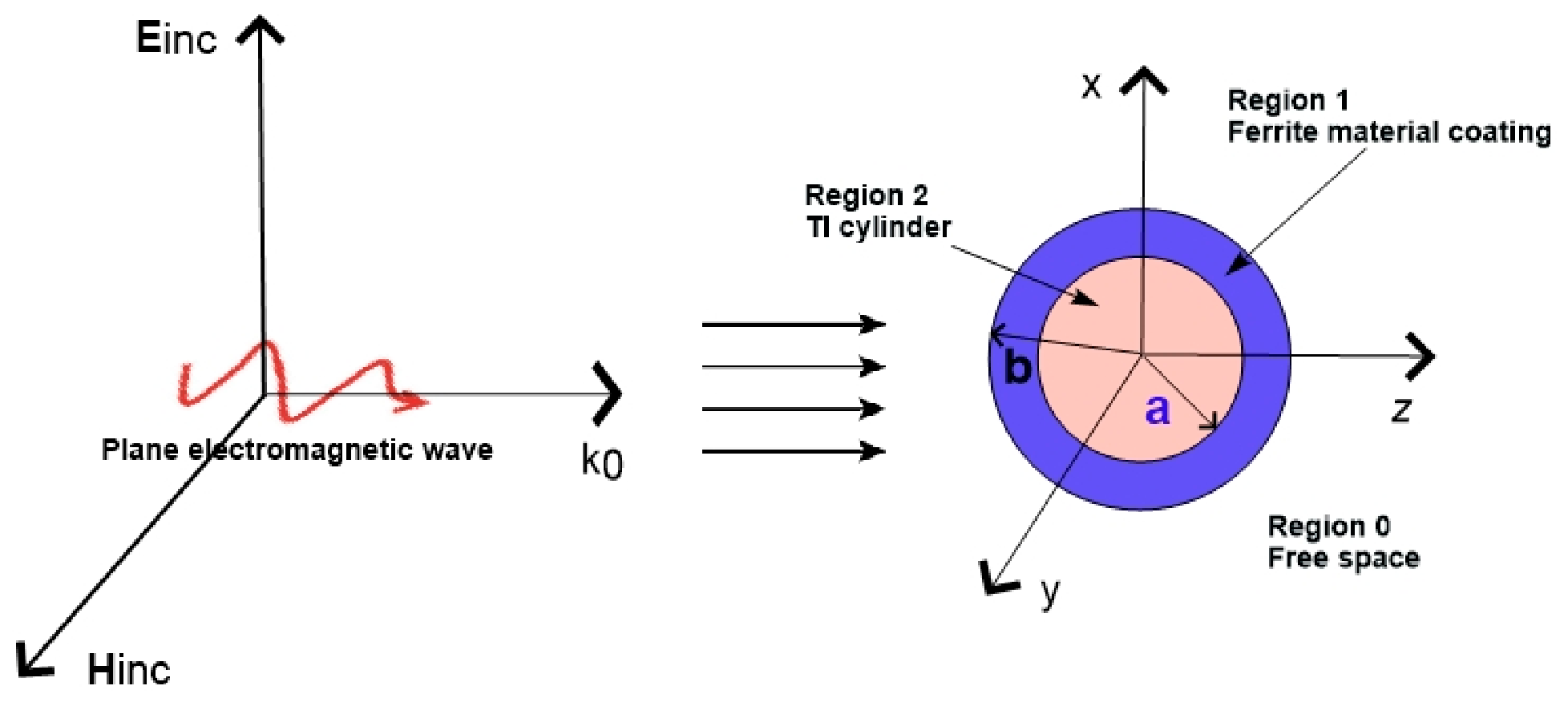
Figure 1 displays the configuration of the scattering problem. An infinitely long TI circular cylinder of radius a is considered, surrounded by a layer of magnetized ferrite coating extending to radius b. The whole structure is stimulated by a plane electromagnetic wave propagating along the x-axis with its field oriented in the z-direction. The coating layer is homogeneous and surrounds the region a < r < b. The entire domain of the problem is divided into three regions: region 0 (r > b) characterizes free space, region 1 represents the ferrite coating medium, and region 2 designates the TI cylindrical core. In free space, the wave number is
, where
and
are the permittivity and permeability, respectively. Within the frame of the coating layer, the wave number is
, where
represents relative permittivity, while
. The permeability corresponding to region 1 is anisotropic and represented by a tensor form
, where
and
, while
and
. The parameters
,
,
, and
characterize the damping factor, gyromagnetic ratio, applied magnetic field strength, and saturation magnetization, respectively. Furthermore, the wavenumber in region 2 is represented as
. The common time-harmonic factor
associated with all electromagnetic field components is suppressed throughout the scattering analysis.
For TM illumination, the incident electric field for the ferrite-coated TI cylinder can be expressed as [
38]
The corresponding magnetic flux density can be written as
The cross-polarized field component is involved in the scattered field expressions alongside the co-polarized component because of the TME response of TI. Therefore, the scattered field component when considering free space can be expressed as
There are two interfaces located at
(TI cylinder) and
(ferrite material), and thus, the total field in this region can be expressed as
The total field components in region 3 can be expressed as
where
,
and
signify the Bessel function of the
kind and the Hankel functions of the
kind and
kind, respectively, whereas
represents the argument of the each respective function. Furthermore, prime designates their derivatives with respect to the whole argument.
, and
stand for unknown scattering field coefficients. The BCs for electromagnetic fields at
and
can be expressed as
The axion term improves the BCs at the TI interface, incorporating a topological surface involvement with the continuity relations of electromagnetic field components. Combined with the cylindrical arrangement of TI and the gyrotropic comeback of the magnetized ferrite coating, the whole system displays a nontrivial field coupling between the axion-mediated magnetoelectric response and diverse scattering channels, which is an optical fingerprint of the topological surface states themselves. Furthermore, these scattering channels are strictly forbidden in conventional dielectric materials. The model represents a direct interaction approach to investigate topology-based electromagnetic responses.
The BCs, including the axion term, are not introduced but can be taken directly from established analytical calculations derived from Maxwell’s electromagnetic field equations with the topological induced θ-term [
38]. These BCs are extensively employed in the literature, and thus, these are not re-established here in full detail. However, for simplicity, we indicate how they modify the standard constitutive relations over magnetoelectric coupling factors. As given in one of the paragraphs of the introductory part, the enhanced constitutive relations are
and
. If these modified relations are applied in Maxwell’s equations, the corresponding master equation retains the same form as the one for the topologically trivial case with the term αθ/π=0. This shows that TME is only the surface phenomena, and it is different from the chirality term that incorporates the corresponding dispersion relation. Therefore, the unique characteristics of TI should benefit from the defined BCs. The coupling between various electric and magnetic field components through the θ-factor is a recognized outcome of axion electrodynamics.
The Transfer Matrix Method (TMM) is standard for analyzing multilayer systems, and here it is utilized to incorporate the axion-mediated BCs in the calculation of scattering field coefficients. The proposed structure comprised a layer of a magnetically biased ferrite medium showing gyrotropic and dispersive response, combined with a TI cylinder considered as axion-mediated magnetoelectric coupling. The whole model is characterized as time-harmonic and linear, with materials assumed to be weakly lossy.
TME corresponds to the surface effect, and thus, the exotic optical characteristics of TIs contribute from the boundaries of TIs. The axion factor introduces magnetoelectric (
E&
B) coupling at the interface of the TI cylinder, changing the BCs. This coupling modifies the electromagnetic interaction between TM electric and magnetic modes, forming the basis for topology-induced scattering characteristics. The substitution of electromagnetic field components for the given BCs results in the known scattering coefficients, i.e.,
and
, and using those scattering field coefficients, the scattering cross-section can be expressed as
and also correspond to the various electric and magnetic multipoles with order n, respectively.
When a planar electromagnetic wave interacts with a TI scatterer, the amplitudes of the reflection R and transmission T can be calculated as follows:
Furthermore, the polarization conversion ratio (PCR) for a ferrite-coated TI cylinder can be given as
3. Results and Discussion
This work investigated the scattering of a plane electromagnetic wave by a TI circular cylinder coated with a homogeneous magnetized ferrite layer. The analysis focused on the scattered cross-section while varying important parameters such as the coating radius, axion angle, operating frequency, and external magnetic field strength. The numerical results establish that the TME coupling associated with the axion term significantly impacts the scattering response of the proposed structure. Specifically, the electromagnetic interaction between the magnetized ferrite coating layer and the TI-dependent BCs modifies the polarization-dependent scattering response. The effect of each influencing parameter on the scattering characteristics is analyzed and discussed in the corresponding figures.
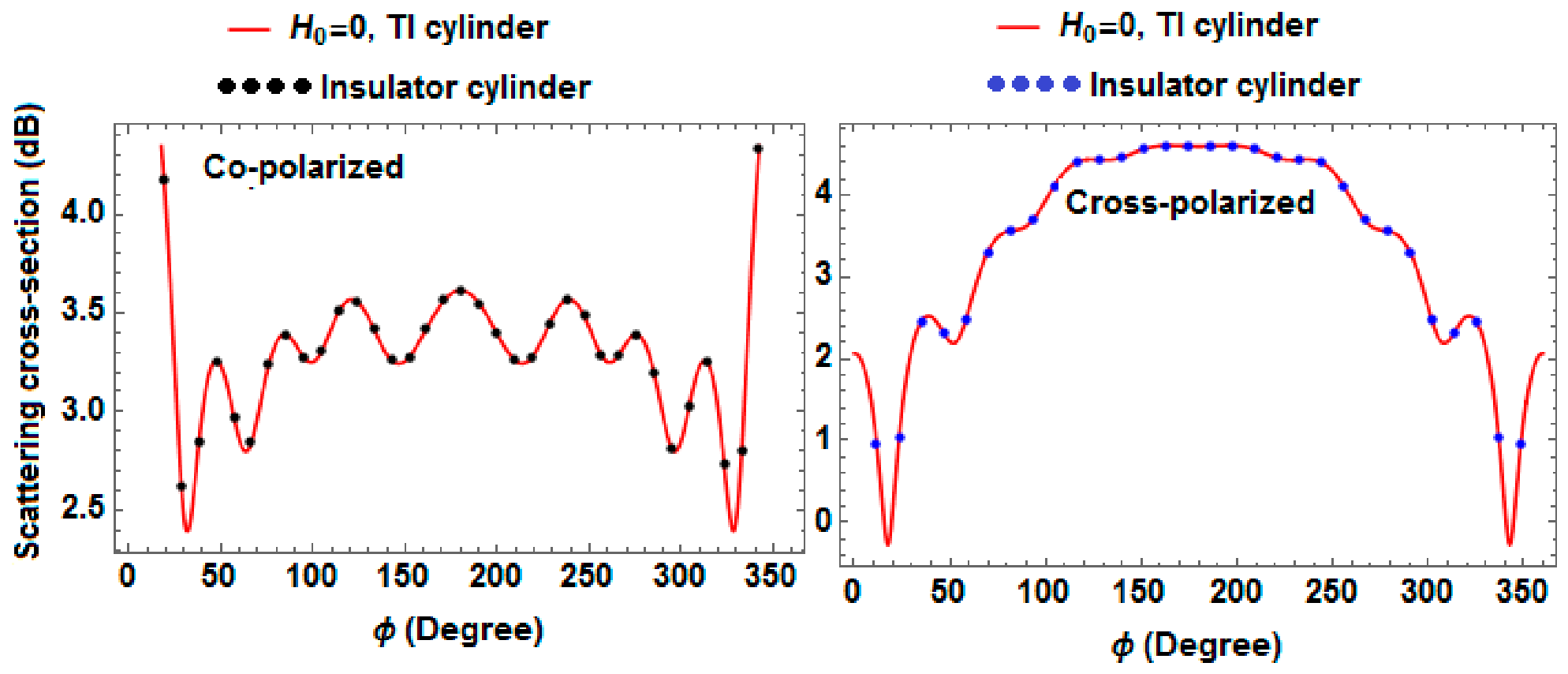
To verify the present formulation, the scattering cross-sections of co-polarized and cross-polarized components are computed and then compared for some limiting cases. Considering this, if the external magnetic field is removed, i.e.,
, then this influences the saturation magnetization and makes it null, i.e.,
. This results in the removal of the coating layer of ferrite material. Furthermore, for θ = 0, TIs correspond to trivial TIs, and the scattering field coefficients then reduce to the conventional insulator cylinders. Consequently, the results of the present scattering problem transform into an insulator cylinder. The validation for this can be seen in
Figure 2.
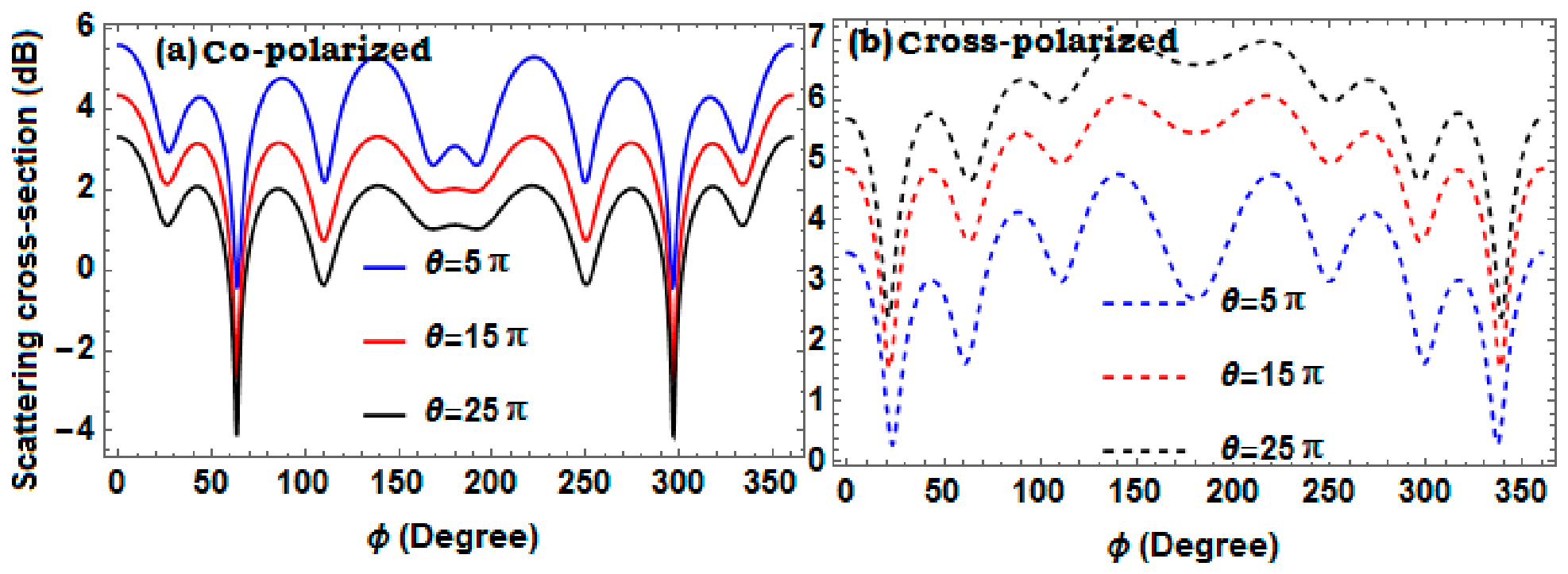
Figure 3a,b display the influence of the axion angle (θ) on the scattering field distribution of a magnetized ferrite-coated TI cylinder. The three curves in each panel, corresponding to θ = 5π, 15π, and 25π, reveal that increasing the axion parameter improves the scattering response. This happens due to the TME effect modifying the scattering field coefficients, introducing cross-polarized field components and electromagnetic coupling between different electric and magnetic modes. As θ increases, the induced magnetization currents at the surface of the TI interact more intensely with the incident wave field, enhancing optical characteristics such as absorption and scattering. Furthermore, the axion term incorporates surface responses corresponding to TME effects, yielding measurable polarization conversion absent in conventional dielectric materials. The axion angle assists as a precise tuning probe for directionality and polarization control. The larger values of axion angle permit highly tunable optical scattering characteristics via the TME response.
As the axion angle increases, some of the incident field energy is redistributed into the orthogonal polarization because of stronger axion-mediated electromagnetic coupling. Subsequently, the co-polarized scattering cross-section decreases. Furthermore, the axion-based term introduces nonreciprocal coupling and a TME response between different scattered electromagnetic fields, generating boosted polarization conversion. Consequently, the cross-polarized scattering cross-section shows stronger dominance. Furthermore, the gyrotropic nature of the ferrite material strengthens anisotropic characteristics, augmenting the axion-mediated effects. This enhanced the cross-polarized scattering. Increasing the axion angle causes the augmentation of the backscattering response, and this is because of the enhanced magnetoelectric field coupling, which excites the impedance inconsistency at the magnetized ferrite interface and boosts constructive interference between field-coupled scattering systems.
The cross-polarized scattering response is generated from axion-mediated magnetoelectric coupling at the surface of the TI boundary. For an axion angle θ = 0, the BCs reduce to that of a dielectric sphere, and the cross-polarized coefficients become zero. However, for θ ≠ 0, additional coupling terms mix electromagnetic field modes, yielding varied cross-polarized scattering amplitudes. The dependence on the axion angle (θ) persists regardless of the wave configuration parameters, verifying that the scaling evolves from intrinsic TME coupling instead of varying wave parameters.
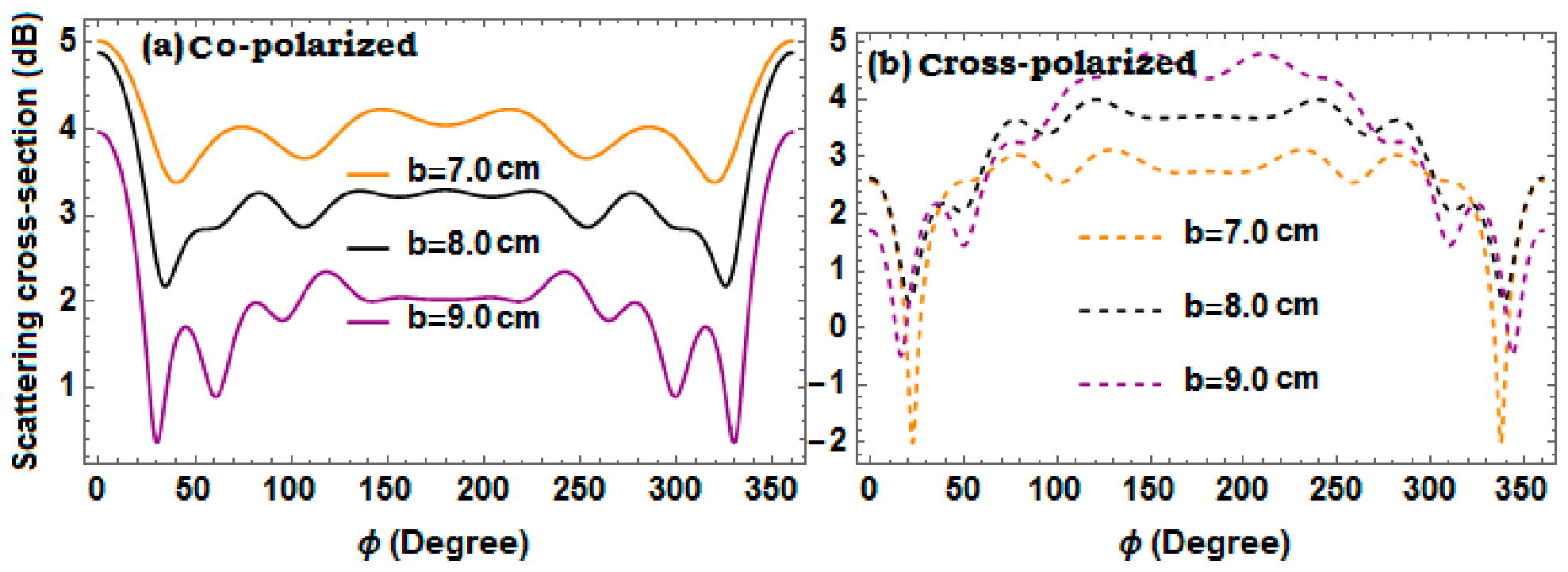
Figure 4a,b exhibit the impact of the magnetized ferrite coating thickness layer on the scattering response of the TI cylinder. The thickness controls the interaction length between the incident wave field and the gyrotropic ferrite medium. A thicker coating layer assists additional resonant field modes within the ferrite material, changing the multipolar contributions toward a scattered field response. This modifies the balance between forward and backward scattering because of the TME response. The increased thickness also permits greater phase accumulation within the layer of the ferrite, establishing the electromagnetic coupling between the incident wave field and the cylindrical modes. Therefore, contributions of higher-order multipolar modes become more prominent, resulting in visible variations toward the angular scattering distribution. The gyromagnetic nature of the ferrite medium further incorporates polarization-dependent response, manipulating the relative strength of scattered field coefficients.
Furthermore, the interface effect between the ferrite coating material and the TI surface permits TME-dependent polarization conversion. These combined effects yield measurable changes in both the scattering amplitude and polarization features. Thus, the coating thickness factor serves as a main structural parameter for tuning the resonance characteristics and directional scattering in magnetized ferrite-coated TI medium. The coating of magnetized ferrite material embraces gyrotropic anisotropy, resulting in polarization-based propagation characteristics. In combination with the axion-mediated coupling, this approach yields manipulation and strengthening of cross-polarized scattering field components.
Overall, increasing the thickness of the coating layer drives the whole system toward a resonance-based and anisotropic scattering response. For the co-polarized field component, the scattering cross-section displays attenuation as the coating thickness increases. Thicker ferrite coatings endorse manifold internal reflections, leading to a partial redistribution of energy. Furthermore, a larger ferrite layer strengthens gyrotropic anisotropy, thus improving cross-polarized contribution. The scattering response can also be represented in the context of the cylindrical multipole involvements. The axion term tunes the relative amplitudes of these multiple field modes, whereas the ferrite-based anisotropic features smash the polarization symmetry, permitting otherwise prohibited cross-polarized channels. Consequently, the observed scattering response characterizes signatures of topology-induced BCs instead of purely conventional electromagnetic interference phenomena.
The observed scattering response generates from the electromagnetic interaction between the axion-based TME coupling in the TI cylinder scatterer and the anisotropic behavior of the magnetized ferrite coating. The axion term (θ) incorporates cross-coupling between different electric and magnetic field components at the interface, resulting in a boosted backscattering response, whereas the magnetic ferrite coating tunes the permeability tensor factor and departs from symmetry, further manipulating the scattering features.
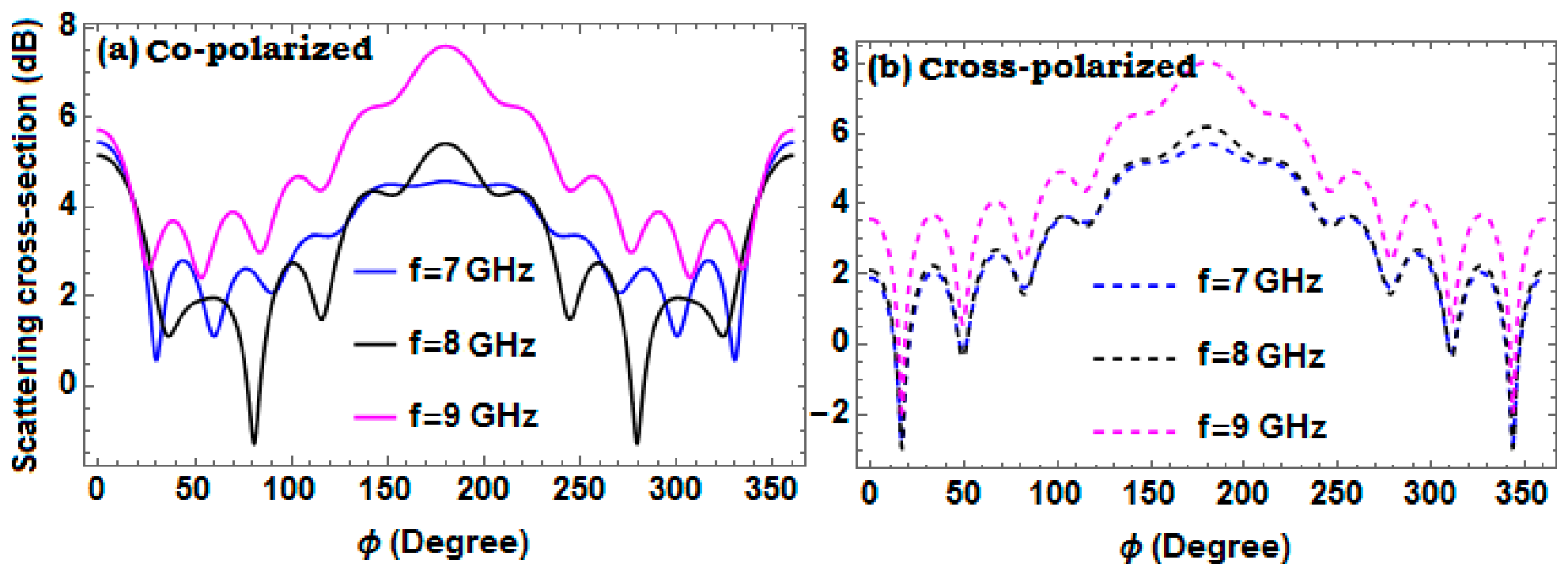
Figure 5 shows the impact of the wave’s frequency on the scattered field distribution. The incident wave operating frequency significantly influences the scattering response of a TI cylinder coated with a magnetized ferrite layer. Increasing the frequency results in increasing the size parameter ka of the coated TI cylinder, and this excites the higher-order multipolar modes. This modifies the scattering field coefficients and changes the angular distribution of the scattered field. The electromagnetic interaction between these resonant and vibrant modes and the TME surface response further impacts the scattering asymmetry. Furthermore, varying the frequency changes the constitutive parameters of electromagnetic fields, i.e., the permittivity and permeability of the magnetized ferrite tune based on its dispersive gyromagnetic response. This changes the electromagnetic coupling between the incident wave field and the cylindrical resonant modes, resulting in remarkable changes in the angular distribution and scattering response. Hence, the wave frequency serves as an important controlling parameter for tuning the complete scattering response of the coated TI cylinder. In conclusion, the wave frequency regulates the dispersive gyromagnetic response of the magnetized layer of the ferrite coating medium, the resonant excitation of various inner field modes, and the coupling capability of the topological surface.
Higher frequencies introduce a strongly anisotropic scattering domain. An increase in frequency relative to the ferrite-coated cylinder results in reshaping the TM-mode scattering response. Increasing frequency strengthens scattering intricacy, amplifies resonances, and cross-polarized effects become more significant at higher frequency ranges, such as at 9 GHz. The noticeable spectral oscillations owing to enhanced field penetration can be observed. The frequency-based results show that as the frequency increases, enhanced excitation and phase changes strengthen the axion-mediated magnetoelectric coupling, manipulating scattering cross-section. Furthermore, the magnetized ferrite coating response introduces frequency-based anisotropic characteristics, influencing the effective permeability parameter and, consequently, the angular scattering.
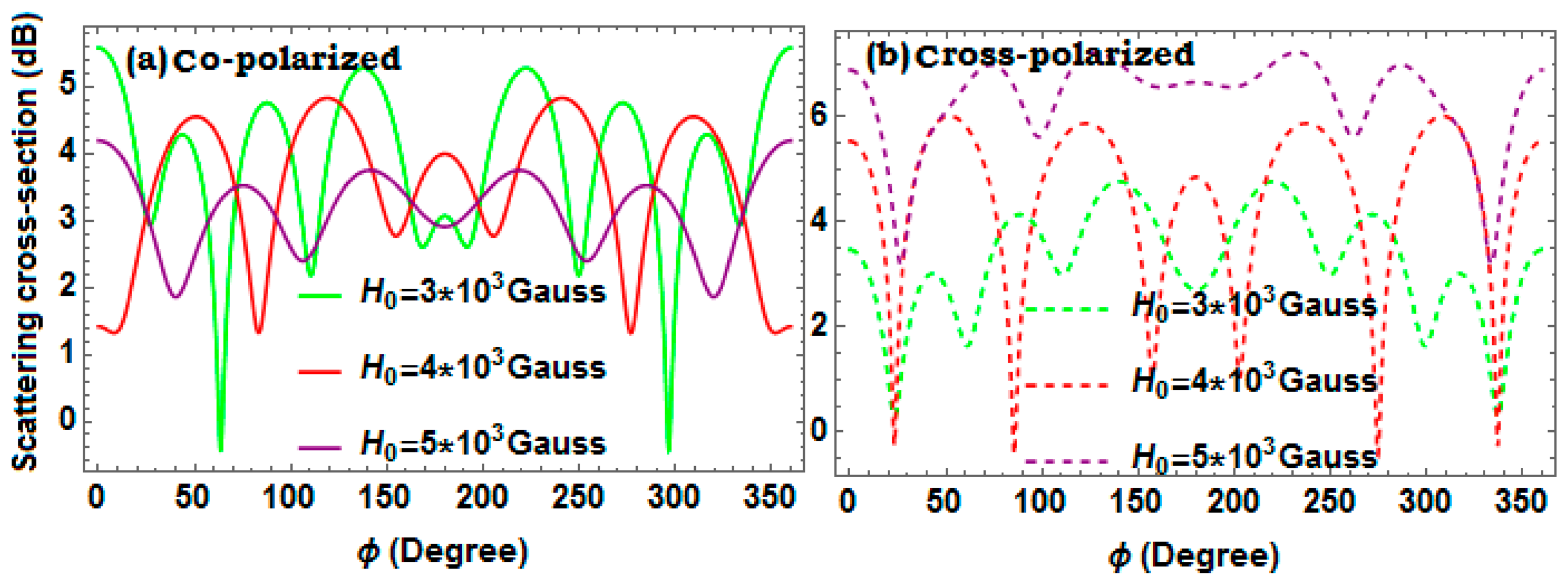
Figure 6 exhibits the impact of the applied external magnetic field on the scattering response. It significantly tunes the scattering characteristics because it incorporates tunable anisotropy and gyrotropy in the coating layer. The application of an applied external magnetic field magnetizes the layer of ferrite coating, thereby introducing non-reciprocal permeability that tunes the BCs at the interface of the TI. This magnetic bias also offers an additional tunable factor that modifies the scattering field coefficients, stimulates polarization conversion over enhanced TME coupling, and permits controllable modifications toward the resonance characteristics. Furthermore, the applied magnetic bias changes the dispersion characteristics of the ferrite coating medium, altering the electromagnetic coupling between the incident wave field and the resonant field modes. This yields a redistribution of multipolar scattering and allows a tunable forward–backward scattering response. Thus, the external field delivers a practical way to control efficiently the scattering characteristics of the coated TI scatterer.
The scattering cross-section for the co-polarized component shows suppression since the higher magnetic bias increases anisotropic features and redistributes the scattered field energy. Stronger magnetization influences the topology of the system by raising the off-diagonal permeability factors. Therefore, considering the cross-polarized component, the amplification can be seen.
The biasing through a magnetic field introduces a gyrotropy effect, yielding a nonreciprocal response and asymmetry characteristics in the scattering field distribution. When increasing the field strength, the anisotropic response of the permeability tensor increases more; this leads to a shift in angular distribution and improved cross-polarized scattering. This response shows the field-governed modification of electromagnetic scattering in the ferrite-coated structure.
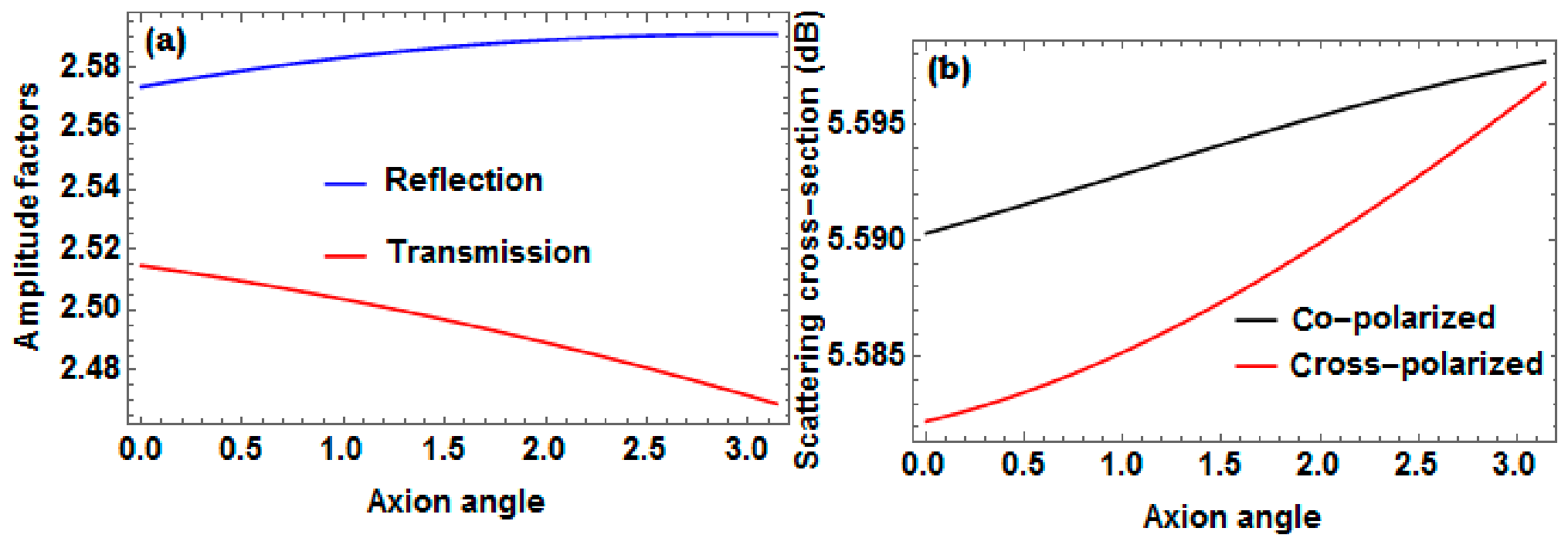
Figure 7 displays the scattering response versus the axion angle of the magnetized ferrite-coated TI cylinder.
Figure 7a establishes the variation in amplitudes (reflection and transmission) with the axion angle (θ). It can be seen that the reflection and transmission amplitudes from Equations (25) and (26) have a direct relation with the scattering coefficients, i.e.,
and
. The axion angle θ tunes the coupling between scattering field coefficients
and
. As the axion angle increases, the reflection amplitude slightly increases from ≈2.56 to 2.59 while the transmission decreases from ≈2.52 to 2.49. Increasing the axion angle results in strengthening the TME coupling, and this leads to higher reflection and lower transmission. Furthermore, energy redistribution occurs, resulting in more energy being reflected (backscattered) and less energy remaining in the forward transmission direction. These results favor the substantial contribution of topological effects in governing the wave propagation. TI cylinders show cross-polarized scattering directly generated by the TME phenomenon, which is not the case with regular dielectric spheres. This is a major difference, not a small one. The TME also significantly impacts the material’s constitutive relations. This mathematically links electromagnetic fields, which causes the cross-polarization response that is not allowed in normal, topologically simple dielectrics.
Figure 7b shows the scattering cross-section for both the co-polarized component and cross-polarized components. As θ increases from 0 to π, there occurs a slight modification for the co-polarized component (non-monotonic behavior), while the cross-polarized component increases monotonically. This behavior confirms that the axion-mediated TME coupling for the cross-polarized components for TIs. Increasing the axion angle yields to excite the TME phenomena, which connect scattered electromagnetic fields. For conventional dielectric materials, the cross-polarized scattered field coefficients are zero, whereas for TIs, the cross-polarized components are included due to the TME. The graphical results indicate axion-mediated effects due to TME coupling.
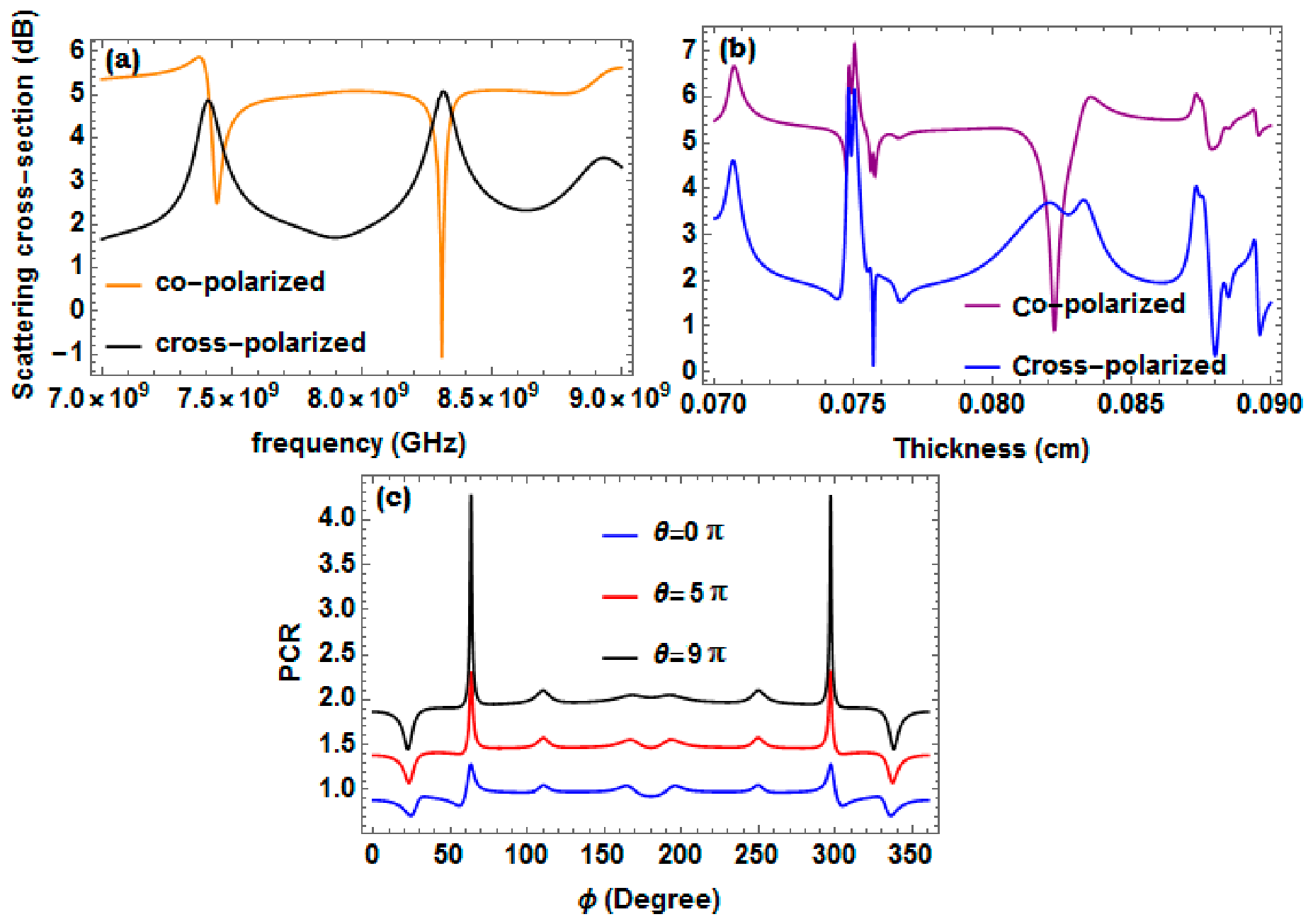
Figure 8 shows the scattering response and polarization conversion ratio (PCR) of the magnetized ferrite-coated TI cylinder. In
Figure 8a, the frequency-dependent behavior can be seen. The numerical results explore that increasing the wave field frequency from 7 to 9 GHz tunes the scattering field components. The co-polarized component displays sharp antiresonances at some specific frequencies. Contrary to this, for cross-polarized components, there occurs oscillatory field variations with moderate growth and decay. The resonant behavior can be seen at some particular frequencies. This is indicative of resonant (Mie-type) effects, as well as frequency-dependent resonances, and the result highlights stronger TME coupling at higher frequencies.
Figure 8b exhibits the influence of the thickness of the ferrite coating layer. The scattering response for the co-polarized component reveals fluctuations in scattering peaks that are generated from multiple internal reflections and interference phenomena within the ferrite coating layer. However, less sharp scattering peaks can be seen for ≈7.3–7.5 cm, while more sharp scattering peaks appear at ≈8.2–8.5 cm. The cross-polarized scattering component increases consistently as the interaction length increases and excites the gyrotropic response of the coated magnetized layer of ferrite. Here, many sharp scattering peaks appear at ≈7.5 cm.
The polarization conversion ratio (PCR) of magnetized ferrite-coated TI cylinders for different values of axion angle can be seen in
Figure 8c. There is a strong signature of a constitutive parameter of TI, i.e., θ, as well as gyroptropy coupling. The figure shows that increasing the axion angle (θ) significantly excites the amplitude of PCR and sharpens the peaks of scattering curves for resonance, representing robust cross-polarization conversion dependence. For θ = 0π, the response of PCR remains quite smooth and weak, indicating a very weak TME contribution. However, as θ increases for different values, such as at 5π and then at 9π, sharp and narrow scattering peaks appear. For example, sharp scattering peaks with the highest amplitude can be seen. The reason behind this resonant field enhancement is the combined effects of ferrite-induced gyrotropy and axion electrodynamics. For θ = 9π, the highest value of PCR can be observed. This confirms that higher axion coupling strengthens the competence of polarization conversion and angular selectivity. Electromagnetic scattering depends strongly on the optical characteristics of the constituent materials of the scattering objects. Owing to the TME phenomena, the scattering response by TIs becomes different from that by conventional materials. The scattering response results from the interaction between the wave-driven and TI-driven phenomena. The plane wave illumination modifies the scattering field coefficients, resulting in selective amplification of varied angular redistribution and specific multipole orders. This wave-based reshaping regulates which electromagnetic modes are selectively excited. In conclusion, the axion angle acts as a key factor in tuning the optical characteristics of light manipulation in TI-induced coated material structures.
The axion-mediated phenomena manifest the topological surface response controlled by the axion field coupling, which is comparable with the boundary-induced effect described in cylindrical TI configurations. Therefore, the scattering characteristics explored in the proposed work serve as a signature of topology in confined models. Topological-induced asymmetric scattering response and soundness of the TI axion coupling are the most significant findings of the work. Compared with other dielectric materials, the response of TI becomes distinct because of the involvement of cross-polarized field components.
The results represent that the scattering response of a TI cylinder coated with magnetized ferrite medium and illuminated by a plane electromagnetic wave is controlled by two key mechanisms. First, the incident plane wave stimulates a set of cylindrical multipole modes whose strengths depend on the polarization state and operating frequency, thus reshaping the angular distribution of the scattered electromagnetic fields. Second, the TME coupling at the TI interface introduces cross-polarized scattering field components that are absent in conventional dielectric materials and increase with the axion angle. The magnetized ferrite coating further modifies the BCs, manipulating the electromagnetic coupling between internal field modes and the external field. Consequently, the interaction between polarization-induced multipole excitation and axion-mediated cross-polarization controls the overall scattering response. These findings establish that the scattering characteristics of the proposed structure are strongly controlled by the axion angle and the incident polarization states, signifying that suitable tuning of these parameters can strengthen the noticeable topological scattering signatures.
To evaluate the experimental observability of predicted scattering characteristics, the established canonical three-dimensional Tis, such as Bi2Se3, Bi2Te3, and HgTe, are extensively used in experimental analysis of TME effects. These are marked by the axion angle (θ = π) response for preserving time-reversal symmetry. By employing magnetic doping or biasing of applied magnetic field with values of ≲0.1 T, the time-reversal symmetry is broken, and the axion angle can vary, permitting continuous modification of the TME response. Considering electromagnetic scattering, the predicted modifications like excited backscattering, asymmetry, and PCR can be detected by using standard far-field (far-zone) scattering setups, such as polarization-resolved measurements. For microwave frequencies, ferrite materials show robust magneto-optical response with reasonable losses, whereas the topological surfaces remain distinct. For the optical regime, thin-film implementations of the aforementioned TIs favor quantifiable axion-mediated effects despite dispersion and material losses.