1. Introduction
Laser frequency stabilization with both narrow linewidths and wide tunability is crucial for applications including Rydberg excitation [
1,
2,
3], ultracold molecule formation [
4,
5], precision spectroscopy [
6,
7,
8,
9], and gravitational wave detection [
10,
11]. The Pound–Drever–Hall (PDH) technique stabilizes the laser frequency by locking the carrier to discrete cavity resonances [
12,
13], but it inherently limits the frequency tunability.
Various approaches have been developed to overcome this limitation, including cavity-length tuning [
14,
15], beat-note locking to a reference laser or an optical frequency comb [
16,
17,
18,
19,
20,
21], and frequency shifting using acousto-optic (AOM) or electro-optic (EOM) modulators [
7,
18,
22,
23,
24,
25,
26,
27,
28,
29,
30]. However, these approaches typically introduce additional system complexity, rely on additional stable references, or compromise cavity stability. In particular, AOM-based schemes are further constrained by the modulation bandwidth. Among EOM-based methods, serrodyne phase modulation enables wideband frequency shifting using a sawtooth waveform generated by a nonlinear transmission line (NLTL) [
18,
24,
25] or a high-fidelity arbitrary waveform generator [
23], but its performance is limited by waveform fidelity, and fluctuations in the efficiency of NLTLs degrade tuning stability [
18]. These limitations motivate alternative approaches that combine wide tunability with stable locking.
In this work, we demonstrate an SPDH locking scheme based on a dual-modulation strategy, in which two modulation signals are combined via a diplexer and applied to a fiber EOM. This approach enables continuous broadband frequency tuning while maintaining stable locking to an ultra-stable cavity. We stabilize a 922 nm seed laser to the cavity, achieving a laser linewidth of approximately 85(1) kHz. Furthermore, continuous tuning of a 461 nm laser over 1.4 GHz is achieved with a scan rate up to . In contrast to serrodyne modulation techniques, the use of standard sinusoidal modulation eliminates the need for high-fidelity waveform generation and avoids the efficiency fluctuations associated with NLTLs, thereby simplifying electronic implementation. These results establish the SPDH locking scheme as a simple, robust, and scalable approach for broadband laser frequency control.
2. Principle of the SPDH Locking Scheme
The SPDH scheme extends conventional PDH locking by transferring the locking point from the carrier to a tunable modulation sideband [
22]. This is achieved using dual-frequency phase modulation, where high-frequency modulation generates offset sidebands and low-frequency modulation produces the PDH error signal.
The electric field of a laser beam under dual-phase modulation at frequencies
and
with modulation depths
and
is
where
and
are the amplitude and frequency of the laser field, respectively. Using the Jacobi–Anger expansion, the field becomes
where
denotes the
ith-order Bessel function of the first kind. The modulation frequency
(depth
) is usually chosen to be smaller, enabling the generation of a standard PDH error signal. When a selected sideband at
is tuned close to a cavity resonance, all other frequency components are far off-resonant and can be neglected. The system then reduces to a conventional PDH configuration centered at the sideband frequency
. This effectively shifts the locking point by
relative to the cavity resonance.
The resulting error signal arises from the interference between the components at
and
and can be written as
where
is the complex reflection coefficient of the cavity. Continuous tuning is achieved by varying
, which controls the frequency offset between the laser and the cavity resonance.
In practice, the first-order sidebands (
) are typically used due to their dominant power contribution. The power transfer efficiency to the first-order sideband is given by
, which reaches a maximum at
(refer to
Section 4). Under this condition, the frequency discriminator slope is
where
is the cavity linewidth and
is the frequency discriminator slope for the PDH locking. Therefore, the frequency discriminator slope is reduced by a factor of
compared to the PDH locking case, but it remains sufficient for stable frequency stabilization.
Table 1 summarizes the key differences between the two schemes, including the modulation type, error signal amplitude, discriminator slope, and tuning range. The reduced signal amplitude and slope in SPDH arise from the redistribution of optical power into the modulation sidebands, which correspondingly lowers the sensitivity of frequency noise detection and limits the achievable linewidth. In return, SPDH enables a substantially larger tuning range, allowing continuous frequency control over approximately
. This trade-off between locking performance and tunability highlights the suitability of SPDH locking for applications requiring both high frequency stability and a wide tuning range.
3. Experimental Setup
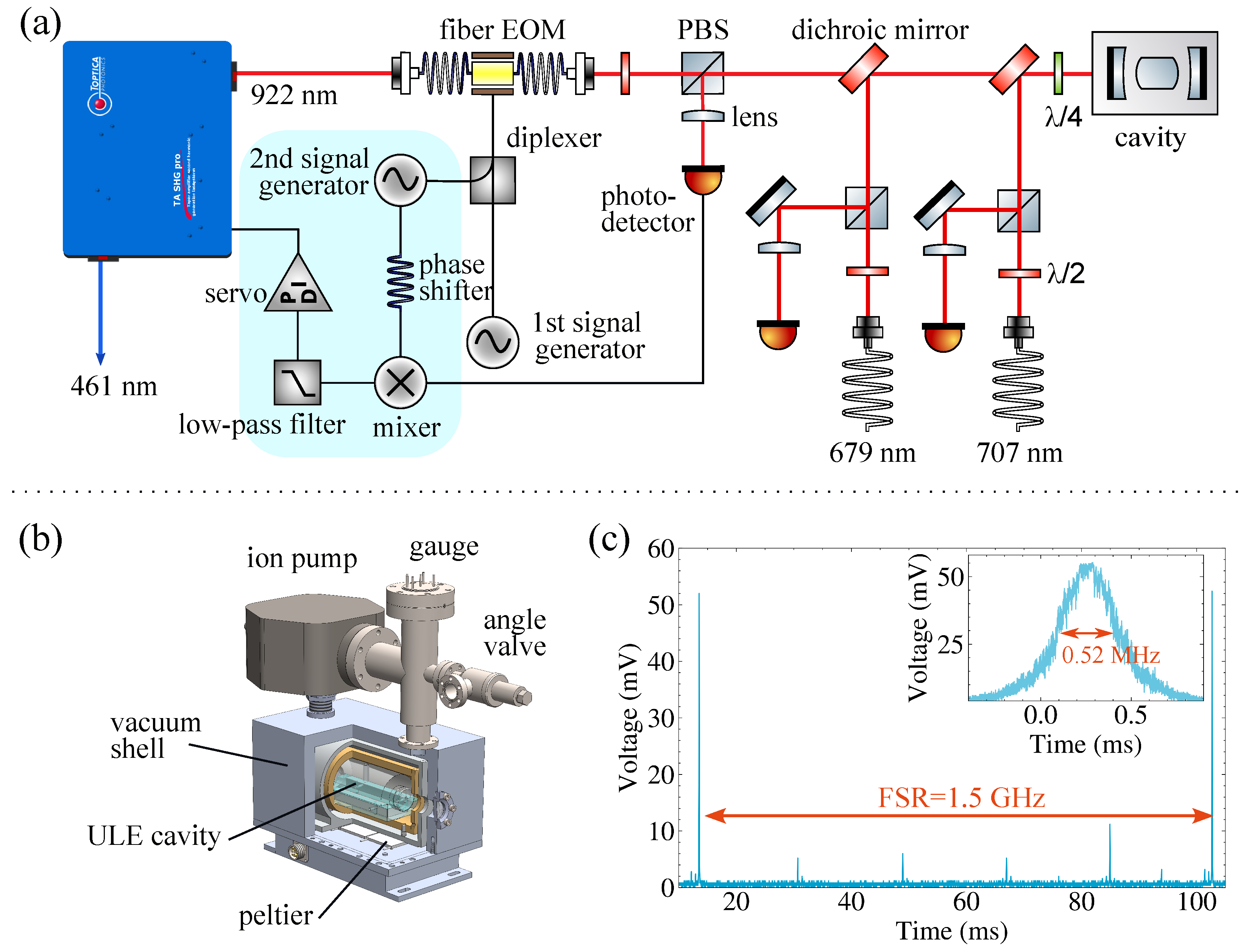
The experimental configuration of the SPDH locking system is shown in
Figure 1a. The system is based on a commercial second-harmonic generation (SHG) laser that provides a 461 nm output, with a 922 nm seed laser serving as the fundamental source for frequency stabilization. The seed laser is stabilized to an ultra-stable optical cavity, and its frequency control is transferred to the frequency-doubled output. In addition, the 679 nm and 707 nm repumping lasers are stabilized to the same cavity using the same SPDH locking technique.
The implementation of SPDH locking relies on dual-frequency phase modulation applied to a fiber EOM. Two radio-frequency (RF) signals are combined using a diplexer (Mini-Circuits ZDPLX-2105-S+) and applied simultaneously to the fiber EOM. The high-frequency signal at (50–2150 MHz) is used to generate tunable sidebands for offset locking, while the low-frequency modulation at MHz with modulation depth produces the PDH error signal. The diplexer enables the independent optimization of the two modulation channels over their respective frequency ranges.
The combined RF signals are applied to an integrated fiber-coupled lithium niobate EOM (conquer KG-PM-08-10GPP-FA), which provides a modulation bandwidth of up to 10 GHz and a half-wave voltage of V. The modulated 922 nm laser beam is coupled into the ultra-stable cavity. The reflected signal is detected by a fast photodetector and demodulated at using a mixer and a low-pass filter to generate the SPDH error signal. This error signal is processed by a digital proportional–integral–derivative (PID) controller, which feeds back to both the current and the piezoelectric transducer (PZT) of the laser, thereby stabilizing the laser frequency. Under locking conditions, the laser frequency is offset from the cavity resonance by , where the sign depends on the selected sideband.
A high-performance ultra-stable cavity is used as the frequency reference. As shown in
Figure 1b, the cavity consists of a 10 cm ultra-low-expansion (ULE) spacer mounted in a vibration-isolated vacuum chamber maintained at a pressure of
Pa. The cavity is enclosed within a multi-layer thermal shielding system and actively temperature-stabilized at 27 °C using Peltier elements, achieving temperature fluctuations below
. The measured transmission spectrum of the cavity is shown in
Figure 1c, indicating an FSR of
. The inset of
Figure 1c presents a close-up of the principal resonance peak, confirming the cavity linewidth of 520 kHz. The measured finesse is approximately 2900, which is consistent with the expected value based on the mirror specifications.
The wide FSR of the cavity, combined with the SPDH locking scheme, enables the continuous tuning of the laser frequency by varying the modulation frequency . In our system, the accessible tuning range spans from 50 to 750 MHz. The lower limit is set by the diplexer bandwidth, while the upper limit is determined by the onset of sideband overlap between adjacent cavity modes.
4. Results and Discussion
4.1. Modulation Depth and Transfer Efficiency
As discussed in
Section 2, the modulation depth
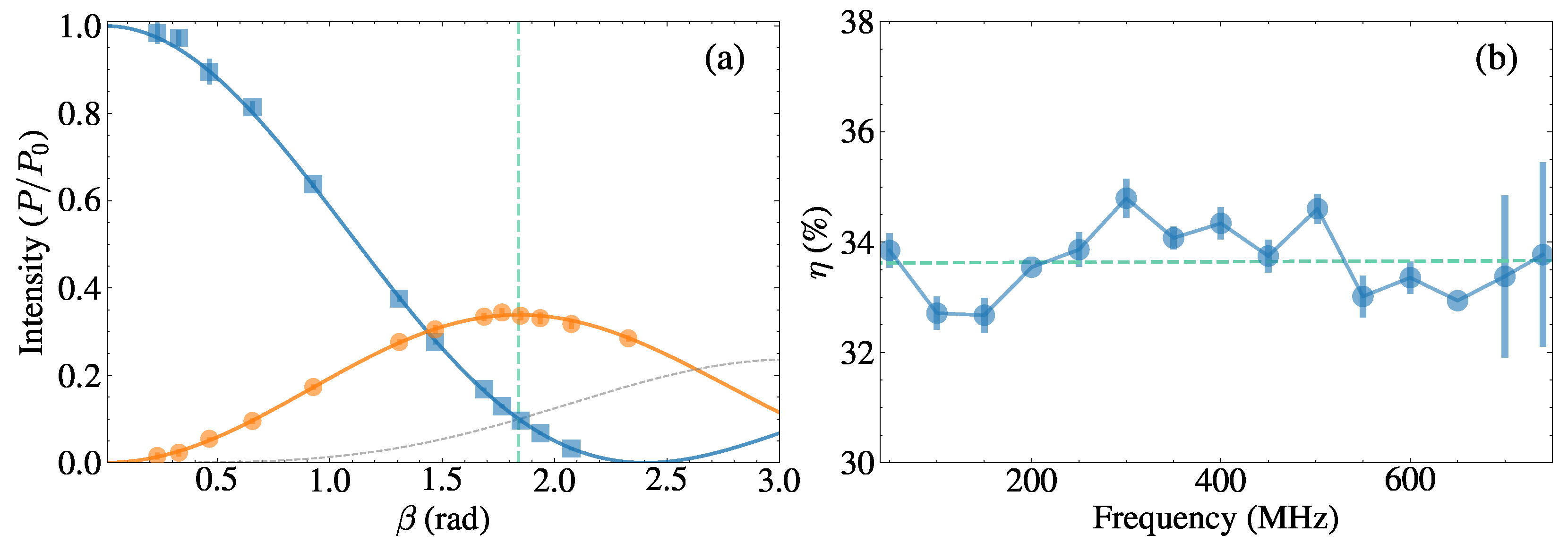
of the fiber EOM is a key parameter that determines the transfer efficiency and strongly influences the signal-to-noise ratio (SNR) of the error signal. To optimize the SPDH locking performance, we characterize the transfer efficiency by measuring the optical powers of the carrier and first-order sideband as a function of the modulation depth, with only the high-frequency modulation applied. As shown in
Figure 2a, the measurements exhibit excellent agreement with the theoretical predictions derived from Bessel functions. The optimal modulation depth is identified as
rad, at which the first-order sideband power is maximized, corresponding to transfer efficiency of
. At this operating point, both the carrier and higher-order sidebands are significantly suppressed (
), thereby maximizing the usable optical power in the locking sideband.
Figure 2b shows the transfer efficiency
over the frequency range of 50 to 750 MHz for a modulation depth of
. To quantitatively analyze the stability of the transfer efficiency, we apply a linear fit to the data. The result yields a slope of
%/MH, consistent with zero within uncertainty, thus confirming that the transfer efficiency is nearly frequency-independent. Furthermore, we calculate the average efficiency
and its variation, which shows
with a standard deviation of
. The absolute peak-to-peak variation is
, which can be attributed to polarization-dependent effects in the fiber EOM. These results indicate that the transfer efficiency is stable across the entire tuning range. In contrast to the irregular and strongly frequency-dependent efficiency reported for serrodyne modulation schemes employing NLTLs [
18], the observed flat response across a broad frequency span demonstrates that our system preserves stable performance over an extended tuning range, which is crucial for applications requiring dynamic frequency control.
4.2. The SPDH Error Signal and Locking Performance
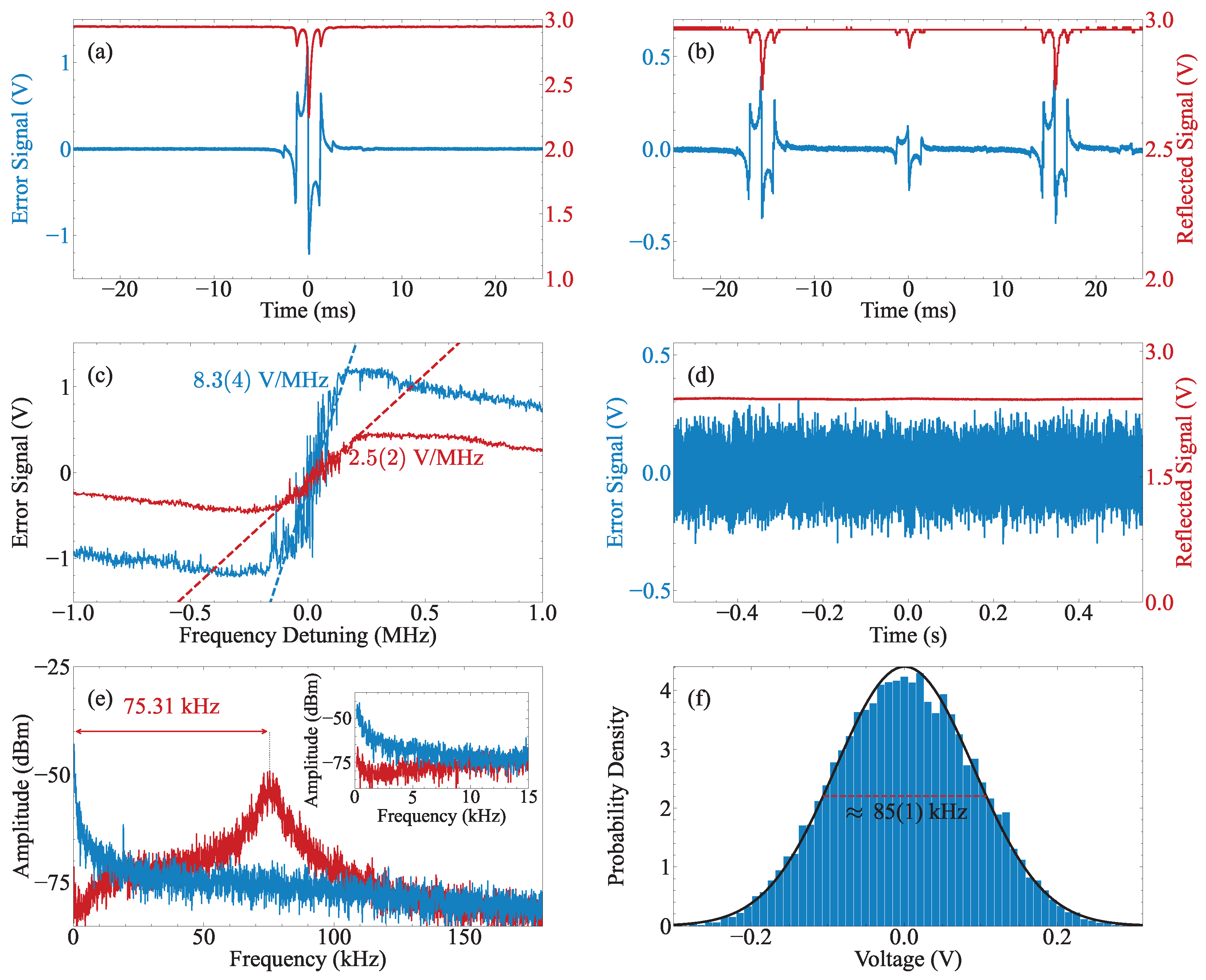
The error signals obtained using conventional PDH and SPDH locking are shown in
Figure 3a and
Figure 3b, respectively. In both cases, the error signal is generated by demodulating the light reflected from the cavity at the low-frequency modulation
MHz. In the absence of high-frequency modulation (
), a single error signal associated with the carrier frequency
is observed. When additional high-frequency phase modulation with
is applied, the error signal splits into two dominant components centered at
, while the residual contribution from the carrier becomes negligible. Stabilizing one of these sidebands to the cavity resonance effectively shifts the laser frequency by
relative to the cavity, thereby enabling continuous and controllable frequency tuning via adjustment of
.
Figure 3c presents a comparison between the conventional PDH and SPDH error signals. The experimentally measured peak-to-peak amplitudes are approximately 2.4 V and 0.8 V, respectively. From linear fits in the vicinity of the resonance, we obtain frequency discriminator slopes of
for PDH and
for SPDH. The observed reductions in both the amplitude and slope for SPDH are in quantitative agreement with Equations (
3) and (
4), scaling by a factor of
, which accounts for the reduced optical power in the first-order sideband.
Despite the reduced amplitude and slope, the SPDH error signal provides sufficient frequency discrimination to achieve stable frequency locking. By implementing PID feedback control, we successfully lock the laser to the cavity. The corresponding error and reflected signals in the locked state are displayed in
Figure 3d. The error signal exhibits stable zero-crossing, while the reflected power is strongly suppressed, thereby demonstrating stable cavity locking.
To further characterize the locking performance, we analyze the Fourier spectra of the error signal in both free-running and locked conditions, as shown in
Figure 3e. From the servo bump observed in the spectrum, we infer a feedback bandwidth of approximately 75 kHz. This bandwidth defines the upper frequency limit for effective noise suppression: only frequency components within the loop bandwidth can be efficiently corrected, while higher-frequency noise remains largely unaffected. In our system, the laser frequency noise under 15 kHz is significantly suppressed, with a maximum reduction of approximately 25 dB. Consequently, the finite bandwidth sets a fundamental limit on the achievable laser linewidth, as fast fluctuations cannot be fully compensated for. While the FFT spectrum provides qualitative insights into the laser frequency noise, the quantitative identification of individual noise sources requires the independent characterization of thermal noise, electronic noise, vibrations, and acoustic noise, which may be pursued in future work.
To estimate the laser linewidth after the implementation of the SPDH locking, we performed a statistical analysis of the error signal. The histogram of the locked error signal, shown in
Figure 3f, represents the probability distribution of the error signal around the lock point. By fitting this distribution with a Gaussian function of
, we extracted a mean value of
mV and
mV. The laser linewidth can be estimated from the full width at half maximum (FWHM) of the Gaussian fit together with the frequency discriminator slope
, obtained from the error signal characterization. This yields
kHz and
kHz for the 922 nm seed laser and the 461 nm laser, respectively. We emphasize that this approach provides only an approximate estimate of the laser linewidth, as it is inferred from the error signal rather than from a direct frequency-domain measurement, such as a beat-note with a reference laser.
4.3. The RAM and Tuning Capabilities
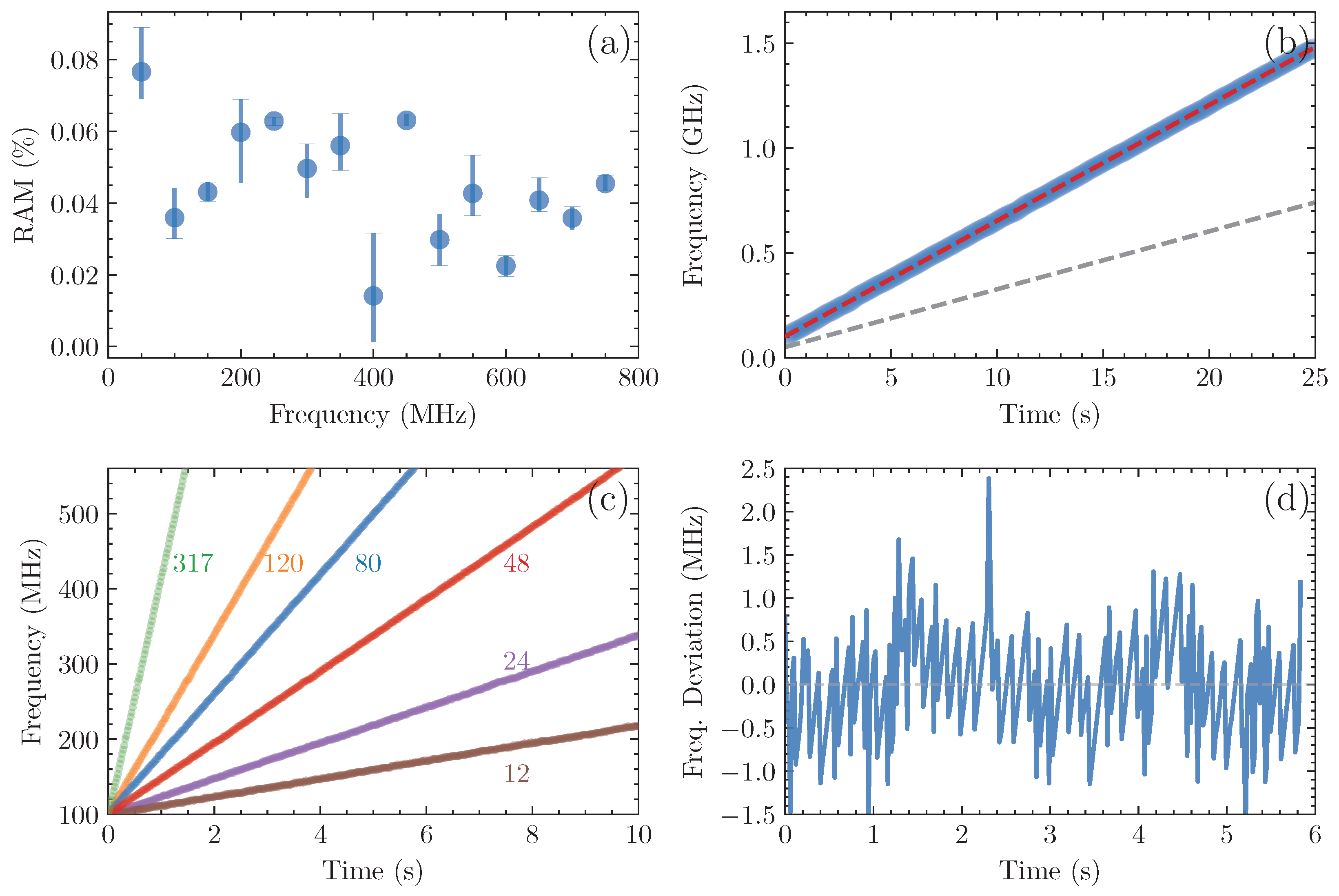
We further characterize the RAM of the SPDH error signal over the 50–750 MHz frequency range. RAM is a key parameter that can limit locking performance by introducing excess noise and degrading lock stability. By measuring the relative RAM, defined as the ratio of the RAM amplitude to the error signal amplitude, it is found that the RAM remains below 0.08% across the entire tuning range, as shown in
Figure 4a. Such a low level of RAM indicates that the employed modulation scheme effectively suppresses unwanted amplitude modulation and maintains a clean error signal, thereby enabling stable locking over a wide tuning range.
When the +1 sideband of the 922 nm seed laser is locked to the cavity, the frequency of the 461 nm output is shifted by
. We demonstrate the maximum tuning range of the SPDH system to be 50 to 745 MHz, corresponding to a frequency shift ranging from 100 to 1490 MHz for the 461 nm laser. In
Figure 4b, the gray dashed line indicates the applied linear ramping of the sideband frequency for the 922 nm seed laser, while the red dashed line shows the corresponding response of the 461 nm laser. A high-precision wavelength meter (HighFinesse WS7) was used to continuously monitor the laser frequency during tuning. The measured results, indicated by the blue trace, closely follow the expected linear curve, yielding a maximum tuning range of approximately 1.4 GHz. This tuning range is ultimately limited by the cavity free spectral range (FSR = 1.5 GHz). A further increase in the modulation frequency would lead to spectral overlap between the locking sideband and adjacent cavity modes, thereby degrading the error signal and destabilizing the lock.
To further characterize the tuning dynamics, we performed linear frequency scans over a 480 MHz range for the 461 nm laser at different scan rates (see
Figure 4c). The results show that the laser frequency can be tuned linearly from 100 to 580 MHz at scan rates ranging from
to
. The lock becomes unstable for scan rates exceeding
, likely limited by the bandwidth of the servo loop. At higher scan rates, the feedback loop cannot respond sufficiently quickly to track the frequency variation, leading to the loss of locking. Nevertheless, this scan rate is sufficient for many applications that require rapid frequency tuning, such as the dynamic control of atomic transitions and fast spectroscopy.
Finally, the frequency stability during tuning was evaluated by monitoring deviations from the setpoint at a scan rate of
, as shown in
Figure 4d. The observed frequency deviations of approximately ±2 MHz are consistent with the specified accuracy of the wavelength meter (HighFinesse WS8) and are therefore considered to be primarily measurement-limited. A more accurate evaluation of the frequency stability would require beat-note measurement with a reference laser. Nevertheless, these results are sufficient to demonstrate that the SPDH scheme enables wide-range, continuous frequency tuning while maintaining stable locking.
5. Conclusions
In this work, we present a SPDH locking scheme based on a dual-modulation strategy that enables simultaneous laser frequency stabilization and continuous broadband frequency tuning. High-frequency modulation is employed for optical sideband generation, whereas low-frequency modulation is used to derive the error signal. The two modulation signals are combined using a diplexer and applied to a fiber EOM. This configuration allows straightforward and versatile implementation with the independent optimization of each modulation channel. Moreover, the scheme relies solely on standard sinusoidal modulation and does not require complex waveforms, thereby improving its practicality and robustness.
We experimentally characterize the transfer efficiency and determine an optimal modulation index of , corresponding to maximum transfer efficiency of 33.86%. Although the SPDH error signal exhibits a reduced amplitude and a smaller frequency discriminator slope compared with the conventional PDH scheme, it nonetheless provides sufficient frequency discrimination for stable laser locking. Using a servo bandwidth of approximately 75 kHz acting on both the laser current and the PZT, the linewidth of the 922 nm seed laser is reduced to 85(1) kHz, with frequency noise suppression of up to 25 dB below 15 kHz. The RAM remains below 0.08% over the entire tuning range, ensuring a stable, low-noise error signal. By tuning the modulation frequency, continuous frequency control over a span of 1.4 GHz is achieved for the 461 nm laser, with scan rates up to while maintaining stable locking. These results demonstrate that SPDH locking effectively decouples frequency stabilization from the cavity resonance condition, thereby enabling wideband tunability without degrading the locking performance.
Compared with AOM-based frequency shifting techniques, which are typically limited to a few tens of MHz by the acoustic bandwidth and diffraction efficiency, the present SPDH scheme enables a significantly larger tuning range exceeding 1.4 GHz. While optical frequency beat-note locking schemes can provide a much wider tuning range, this requires a stable reference laser and an expensive frequency comb, which may not be practical for many applications. In contrast to serrodyne modulation approaches based on NLTLs or arbitrary waveform generators, our method relies exclusively on sinusoidal modulation, thereby avoiding the waveform distortion and efficiency fluctuations associated with NLTLs. This results in more stable and robust locking performance across a broad frequency range, while also simplifying the electronic implementation.
The capabilities of the SPDH locking scheme allow the flexible and precise addressing of frequency-shifted transitions, such as isotope-dependent resonances in atomic systems, without the need for additional lasers or modifications to the optical layout. Owing to its simple and robust architecture, the SPDH scheme can be straightforwardly adapted to other laser platforms and wavelength ranges. Furthermore, integration with complementary techniques, such as optical frequency combs or beat-note stabilization, may further enhance its performance and extend its applicability to precision spectroscopy, atomic physics, and quantum optics.
Author Contributions
Conceptualization and validation, Z.Y. and S.L.; formal analysis and data curation, Z.Y. and S.L.; writing—original draft preparation, Z.Y. and S.L.; writing—review and editing, Z.Y., S.L., M.H., J.F., M.S., Y.Z., L.C., Z.M., W.H., P.W. and L.H.; supervision, Z.Y.; funding acquisition, Z.Y., L.C., Z.M., W.H., P.W. and L.H. All authors have read and agreed to the published version of the manuscript.
Funding
This research was funded by the National Natural Science Foundation of China (Grants No. 12504336, No. 12034011, No. 92476001, No. U23A6004, No. 12488301, No. 12474266, No. 12474252, No. 12374245, No. 12322409, and No. 92576205); the National Key Research and Development Program of China (Grants No. 2022YFA1404101 and No. 2021YFA1401700); the Innovation Program for Quantum Science and Technology (Grant No. 2021ZD0302003); the Fundamental Research Program of Shanxi Province (Grant No. 202403021221001); and the Funding Program for the Scientific Activities of Selected Returned Overseas Professionals in Shanxi Province (Grant No. 20250004).
Institutional Review Board Statement
Not applicable.
Informed Consent Statement
Not applicable.
Data Availability Statement
Data underlying the results presented in this paper can be obtained from the authors upon reasonable request.
Acknowledgments
We acknowledge the use of large language models (Copilot and ChatGPT-5.3) for language editing assistance.
Conflicts of Interest
The authors declare no conflicts of interest.
References
- Spong, N.L.R.; Jiao, Y.; Hughes, O.D.W.; Weatherill, K.J.; Lesanovsky, I.; Adams, C.S. Collectively Encoded Rydberg Qubit. Phys. Rev. Lett. 2021, 127, 063604. [Google Scholar] [CrossRef] [Scilit]
- Legaie, R.; Picken, C.J.; Pritchard, J.D. Sub-kilohertz excitation lasers for quantum information processing with Rydberg atoms. J. Opt. Soc. Am. B 2018, 35, 892–898. [Google Scholar] [CrossRef] [Scilit]
- Bian, G.; Shan, B.; Huang, L.; Zhang, J. Rydberg electromagnetically induced transparency in 40K ultracold Fermi gases. Chin. Opt. Lett. 2023, 21, 100201. Available online: https://opg.optica.org/col/abstract.cfm?URI=col-21-10-100201 (accessed on 23 March 2026). [CrossRef] [Scilit]
- Gregory, P.D.; Molony, P.K.; Köppinger, M.P.; Kumar, A.; Ji, Z.; Lu, B.; Marchant, A.L.; Cornish, S.L. A simple, versatile laser system for the creation of ultracold ground state molecules. New J. Phys. 2015, 17, 055006. [Google Scholar] [CrossRef] [Scilit]
- Guttridge, A.; Frye, M.D.; Yang, B.C.; Hutson, J.M.; Cornish, S.L. Two-photon photoassociation spectroscopy of CsYb: Ground-state interaction potential and interspecies scattering lengths. Phys. Rev. A 2018, 98, 022707. [Google Scholar] [CrossRef] [Scilit]
- Miyake, H.; Pisenti, N.C.; Elgee, P.K.; Sitaram, A.; Campbell, G.K. Isotope-shift spectroscopy of the 1S0 →3 P1 and 1S0 →3 P0 transitions in strontium. Phys. Rev. Res. 2019, 1, 033113. [Google Scholar] [CrossRef] [Scilit] [PubMed]
- Rabga, T.; Bailey, K.G.; Bishof, M.; Booth, D.W.; Dietrich, M.R.; Greene, J.P.; Mueller, P.; O’Connor, T.P.; Singh, J.T. Implementing an electronic sideband offset lock for isotope shift spectroscopy in radium. Opt. Express 2023, 31, 41326–41338. [Google Scholar] [CrossRef] [Scilit]
- Bridge, E.M.; Keegan, N.C.; Bounds, A.D.; Boddy, D.; Sadler, D.P.; Jones, M.P.A. Tunable cwUV laserwith <35 kHz absolute frequency instability for precision spectroscopy of Sr Rydberg states. Opt. Express 2016, 24, 2281–2292. [Google Scholar] [CrossRef] [Scilit]
- Herd, M.T.; Cook, E.C.; Williams, W.D. Absolute frequency measurement of the 6D5/2 level of neutral 133Cs using two-photon spectroscopy. Phys. Rev. A 2021, 104, 042812. [Google Scholar] [CrossRef] [Scilit]
- Theron, F.; Carraz, O.; Renon, G.; Zahzam, N.; Bidel, Y.; Cadoret, M.; Bresson, A. Narrow linewidth single laser source system for onboard atom interferometry. Appl. Phys. B 2015, 118, 1–5. [Google Scholar] [CrossRef] [Scilit]
- Livas, J.C.; Thorpe, J.I.; Numata, K.; Mitryk, S.; Mueller, G.; Wand, V. Frequency-tunable pre-stabilized lasers for LISA via sideband locking. Class. Quantum Gravity 2009, 26, 094016. [Google Scholar] [CrossRef] [Scilit]
- Black, E.D. An introduction to Pound–Drever–Hall laser frequency stabilization. Am. J. Phys. 2001, 69, 79–87. [Google Scholar] [CrossRef] [Scilit]
- Drever, R.W.; Hall, J.L.; Kowalski, F.V.; Hough, J.; Ford, G.; Munley, A.; Ward, H. Laser phase and frequency stabilization using an optical resonator. Appl. Phys. B 1983, 31, 97–105. [Google Scholar] [CrossRef] [Scilit]
- Tonyushkin, A.A.; Light, A.D.; Di Rosa, M.D. Phase-locked scanning interferometer for frequency stabilization of multiple lasers. Rev. Sci. Instrum. 2007, 78, 123103. [Google Scholar] [CrossRef] [Scilit] [PubMed]
- Möhle, K.; Kovalchuk, E.V.; Döringshoff, K.; Nagel, M.; Peters, A. Highly stable piezoelectrically tunable optical cavities. Appl. Phys. B 2013, 111, 223–231. [Google Scholar] [CrossRef] [Scilit]
- Schünemann, U.; Engler, H.; Grimm, R.; Weidemüller, M.; Zielonkowski, M. Simple scheme for tunable frequency offset locking of two lasers. Rev. Sci. Instrum. 1999, 70, 242–243. [Google Scholar] [CrossRef] [Scilit]
- Cundiff, S.T.; Ye, J. Colloquium: Femtosecond optical frequency combs. Rev. Mod. Phys. 2003, 75, 325–342. [Google Scholar] [CrossRef] [Scilit]
- Barbiero, M.; Salvatierra, J.P.; Risaro, M.; Clivati, C.; Calonico, D.; Levi, F.; Tarallo, M.G. Broadband serrodyne phase modulation for optical frequency standards and spectral purity transfer. Opt. Lett. 2023, 48, 1958–1961. [Google Scholar] [CrossRef] [Scilit] [PubMed]
- Gatti, D.; Sala, T.; Gambetta, A.; Coluccelli, N.; Conti, G.N.; Galzerano, G.; Laporta, P.; Marangoni, M. Analysis of the feed-forward method for the referencing of a CW laser to a frequency comb. Opt. Express 2012, 20, 24880–24885. [Google Scholar] [CrossRef] [Scilit]
- Guo, C.; Favier, M.; Galland, N.; Cambier, V.; Álvarez Martínez, H.; Lours, M.; De Sarlo, L.; Andia, M.; Le Targat, R.; Bize, S. Accurate laser frequency locking to optical frequency combs under low-signal-to-noise-ratio conditions. Rev. Sci. Instrum. 2020, 91, 033202. [Google Scholar] [CrossRef] [Scilit]
- Shen, Z.M.; Zhou, X.L.; Huang, D.Y.; Pan, Y.H.; Li, L.; Wang, J.; Li, C.F.; Guo, G.C. Continuously and widely tunable frequency-stabilized laser based on an optical frequency comb. Rev. Sci. Instrum. 2023, 94, 023001. [Google Scholar] [CrossRef] [Scilit]
- Thorpe, J.I.; Numata, K.; Livas, J. Laser frequency stabilization and control through offset sideband locking to optical cavities. Opt. Express 2008, 16, 15980–15990. [Google Scholar] [CrossRef] [Scilit]
- Hildebrand, R.A.; Wang, W.; Goham, C.; Restelli, A.; Britton, J.W. Spectrally-pure optical serrodyne modulation for continuously-tunable laser offset locking. Opt. Express 2025, 33, 51842–51851. [Google Scholar] [CrossRef] [Scilit]
- Houtz, R.; Chan, C.; Müller, H. Wideband, Efficient Optical Serrodyne Frequency Shifting with a Phase Modulator and a Nonlinear Transmission Line. Opt. Express 2009, 17, 19235–19240. [Google Scholar] [CrossRef] [Scilit]
- Johnson, D.M.S.; Hogan, J.M.; Chiow, S.W.; Kasevich, M.A. Broadband optical serrodyne frequency shifting. Opt. Lett. 2010, 35, 745–747. [Google Scholar] [CrossRef] [Scilit]
- Kirilov, E.; Mark, M.J.; Segl, M.; Nägerl, H.C. Compact, robust, and spectrally pure diode-laser system with a filtered output and a tunable copy for absolute referencing. Appl. Phys. B 2015, 119, 233–240. [Google Scholar] [CrossRef] [Scilit]
- Pal, S.B.; Lam, M.M.; Dieckmann, K. Stability of a frequency-comb-based transfer-lock using a passive Fabry-Perot resonator. Opt. Lett. 2016, 41, 5527–5530. [Google Scholar] [CrossRef] [Scilit] [PubMed]
- Peng, W.; Zhou, L.; Long, S.; Wang, J.; Zhan, M. Locking laser frequency of up to 40 GHz offset to a reference with a 10 GHz electro-optic modulator. Opt. Lett. 2014, 39, 2998–3001. [Google Scholar] [CrossRef] [Scilit] [PubMed]
- Bai, J.; Wang, J.; He, J.; Wang, J. Electronic sideband locking of a broadly tunable 318.6 nm ultraviolet laser to an ultra-stable optical cavity. J. Opt. 2017, 19, 045501. [Google Scholar] [CrossRef] [Scilit]
- Nevsky, A.; Alighanbari, S.; Chen, Q.F.; Ernsting, I.; Vasilyev, S.; Schiller, S.; Barwood, G.; Gill, P.; Poli, N.; Tino, G.M. Robust frequency stabilization of multiple spectroscopy lasers with large and tunable offset frequencies. Opt. Lett. 2013, 38, 4903–4906. [Google Scholar] [CrossRef] [Scilit]
| Disclaimer/Publisher’s Note: The statements, opinions and data contained in all publications are solely those of the individual author(s) and contributor(s) and not of MDPI and/or the editor(s). MDPI and/or the editor(s) disclaim responsibility for any injury to people or property resulting from any ideas, methods, instructions or products referred to in the content. |



 ,
,