1. Introduction
Diode-pumped alkali vapor lasers (DPALs) are a class of optically pumped gas lasers in which a laser diode (LD) serves as the pump source and alkali metal vapor acts as the gain medium. Since their first experimental demonstration in 2003 [
1], DPALs have attracted considerable attention due to their high optical-to-optical efficiency, low quantum defect, and favorable thermal management characteristics [
2,
3]. Among the alkali metals, potassium (K), rubidium (Rb), and cesium (Cs) are the most commonly used gain media, giving rise to the three representative configurations of K-DPALs, Rb-DPALs, and Cs-DPALs.
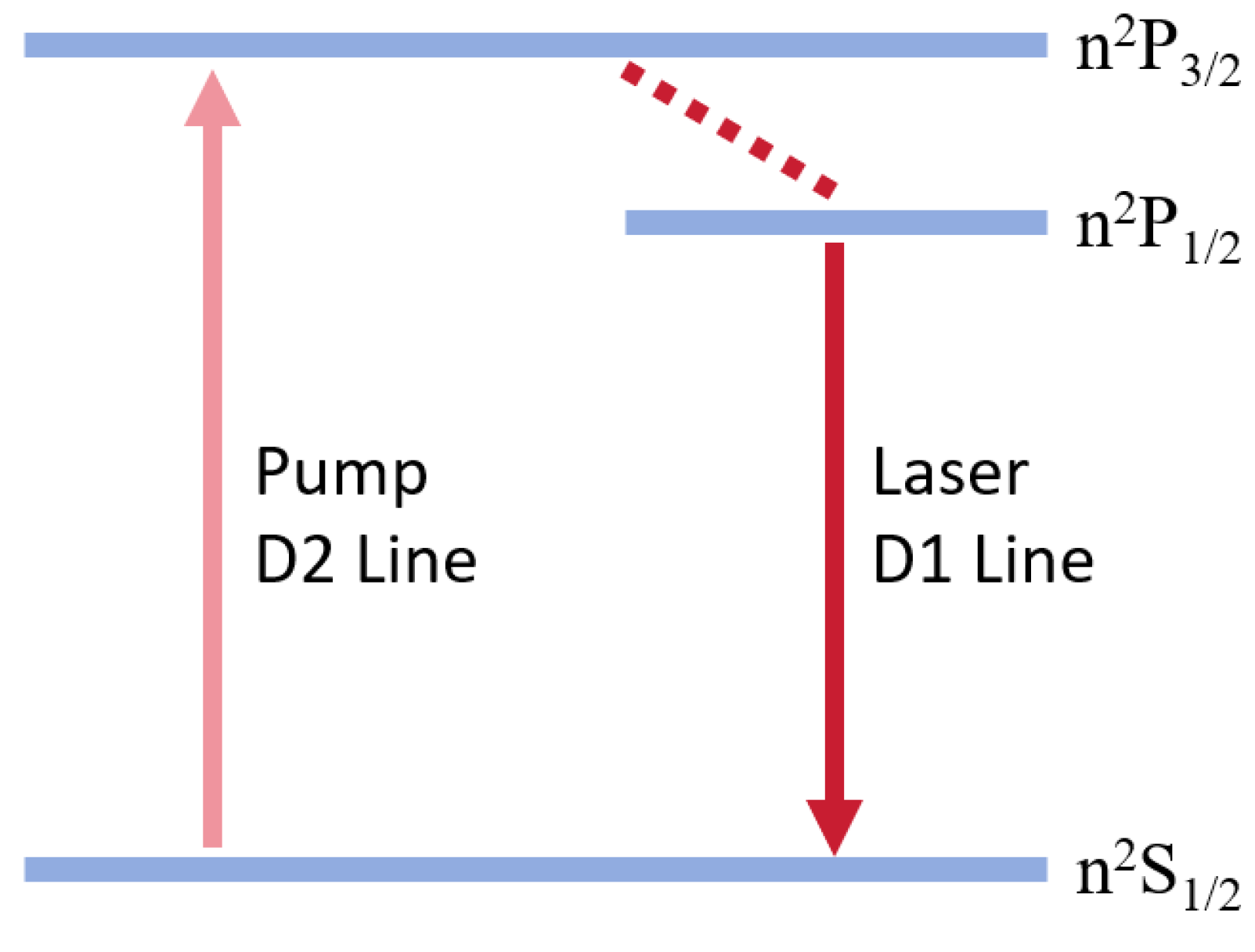
The operating principle of DPALs can be described by an effective three-level scheme, as shown in
Figure 1. Pump radiation drives alkali atoms from the ground state (
) to the upper fine-structure level (
) via the D
2 absorption transition. Subsequently, rapid spin–orbit collisional mixing, facilitated by buffer gases such as helium and hydrocarbons, transfers population to the lower fine-structure level (
), which serves as the upper laser level. Stimulated emission then occurs on the D
1 transition, returning atoms to the ground state. Owing to the small energy difference between pump and laser photons, DPALs exhibit an exceptionally low quantum defect, and quantum efficiencies exceeding 95% can be achieved, as shown in
Table 1. By comparison, near-infrared solid-state optically pumped systems, such as Nd:YAG (76%) and Yb:YAG (91%) lasers [
4], exhibit larger quantum defects, leading to increased intracavity heat loads. Therefore, the high quantum efficiency of DPALs effectively limits heat deposition in the gain region and provides a fundamental thermodynamic advantage for high average-power operation.
In addition, the D-line transitions in alkali atoms possess relatively large stimulated emission cross sections (
–
cm
2 under typical pressure broadening conditions [
7], several orders of magnitude larger than solid state lasers such as Nd:YAG,
cm
2 together with the nanosecond scale excited state lifetimes listed in
Table 1, which are three to four orders of magnitude shorter than those of Nd:YAG (∼230
s) and Yb:YAG (∼950
s) [
4]. The resulting saturation fluence
is therefore many orders of magnitude lower than that of typical solid-state gain media, placing DPALs in a regime where the gain can be readily saturated even at moderate pump intensities, and the population inversion is depleted on a correspondingly fast timescale once stimulated emission is established.
From an engineering perspective, DPALs have demonstrated stable high-power operation and possess a solid technological foundation for power scaling. First, the pump wavelengths of DPALs coincide with the emission bands of AlGaAs/InGaAs laser diodes [
6]. With the rapid development of laser diode technologies, external-cavity frequency stabilization and linewidth narrowing techniques have become increasingly mature. Meanwhile, the output power of individual diode modules continues to increase, and further power scaling can be achieved through beam combining techniques [
8,
9,
10]. These developments provide high-power, spectrally matched, and scalable pump sources for DPAL systems. Second, the vapor-phase gain medium exhibits intrinsic advantages in thermal management. Unlike solid-state crystalline materials, gas gain media do not suffer from thermomechanical stress or thermal fracture. Heat deposition can be effectively mitigated through convection and molecular diffusion. Furthermore, flowing-gas configurations enable continuous heat removal and efficient extraction of waste heat from the gain region, which significantly suppresses thermal effects in the vapor cell [
6,
11,
12,
13]. As a result, DPALs maintain strong thermal management capability and good beam quality even under high pump power densities.
By integrating semiconductor pumping technology with gas-phase gain mechanisms, DPALs form a laser platform with combined advantages distinct from conventional solid-state and gas lasers. Based on these physical and engineering characteristics, DPALs have been identified by the Missile Defense Agency (MDA) as a candidate technology for airborne high-energy laser systems, with the potential to achieve megawatt-class output from a single aperture [
14].
Beyond high-energy laser applications, DPALs also show strong potential in a range of scientific and engineering fields. The emission wavelengths of alkali atoms lie within atmospheric transmission windows, resulting in high transmittance and low propagation loss [
15]. This feature is advantageous for long-distance energy delivery and signal transmission. In addition, the emission wavelengths of K-, Rb-, and Cs-DPALs overlap well with the high-efficiency spectral response range of GaAs and silicon photovoltaic cells [
6,
16]. Moreover, DPALs typically exhibit good beam quality and low divergence, allowing high spatial energy density to be maintained during long-distance propagation. These characteristics make DPALs well suited for applications such as laser radar, wireless laser power transmission, and free-space optical communication.
Due to the relatively short emission wavelengths and higher photon energy of alkali lasers, higher photon flux density and smaller focal spot sizes can be achieved under the same output power, thereby improving processing resolution and energy deposition precision [
17]. This feature provides potential advantages in precision material processing, microfabrication, and high-accuracy manufacturing, especially in applications requiring strict control of the heat-affected zone and processing scale [
17].
However, the above applications cannot be fully realized under continuous-wave operation alone. In many practical systems, pulsed operation is required. For example, laser radar systems rely on short pulses to achieve high spatial resolution [
18,
19]; free-space optical communication typically employs pulsed modulation to enable high-speed data transmission and time-division multiplexing [
20]; in wireless laser power transmission, pulsed operation can enhance peak power and improve photovoltaic conversion efficiency [
21]; in precision laser processing, pulsed lasers reduce thermal loading by shortening the interaction time, thereby minimizing the heat-affected zone and improving processing quality [
17].
Accordingly, research attention in the DPAL community is progressively shifting from performance optimization toward pulsed operation. The capability to generate pulses with programmable repetition rates, tunable pulse durations, and high peak powers constitutes a key enabling factor for extending DPALs toward broader application scenarios. However, this transition introduces significant additional complexity.
This review provides a systematic account of the progress toward pulsed DPALs and identifies the main open challenges.
Section 2 reviews the enabling technologies, including narrow-linewidth pump sources, pump delivery architectures, resonator designs, gain cell engineering, and power-scaling strategies, which form the basis for DPALs.
Section 3 reviews the pulsed-generation techniques demonstrated to date, including pump modulation, Q-switching and cavity dumping, and mode-locking, and gives a comparison of performance metrics.
Section 4 discusses future directions, including research directions for mode-locked DPALs, burst-mode pulse generation, power scaling strategies for pulsed DPALs, and spectral extension and technology integration.
Section 5 presents the conclusions.
2. Foundations and Technological Maturity of DPALs
Over the past two decades, DPAL technology has progressed from milliwatt-level laboratory demonstrations to multi-kilowatt output systems, establishing a solid engineering foundation for further development. Several key technological components have played central roles in this progress. First, spectrally matched narrow-linewidth pump sources enable efficient coupling to the alkali D2 transition. Second, pump delivery and mode-matching architectures determine the absorption uniformity and the spatial distribution of gain. Third, resonator configurations ensure stable operation under conditions of high gain, thermal effects, and the presence of intracavity elements. Fourth, gain cells are designed to suppress parasitic oscillation and to manage thermal loading. Fifth, power-scaling approaches, including flowing-DPALs and MOPA architectures, provide effective routes toward higher output power.
2.1. Narrow-Linewidth Pump Sources
Linewidth narrowing of the pump source is essential for efficient DPAL operation, as the collisionally broadened D
2 absorption linewidth (∼0.05–0.1 nm) is far narrower than the 2–5 nm free-running linewidth of commercial laser diodes [
6,
11]. Three representative external-cavity approaches have been developed. Plane diffraction gratings in Littrow or Littman configurations provide flexible wavelength tuning [
22,
23] and have been scaled to the 1.5 kW level [
24]. Volume Bragg gratings (VBGs) offer compact structure and high feedback efficiency, and have become the dominant approach, with recent demonstrations reaching multi-kW output at sub-0.2 nm linewidths [
25,
26] and 2-D stack modules delivering up to 50 kW [
9]. Faraday anomalous dispersion optical filters (FADOFs) exploit atomic resonance for ultra-narrowband locking at the GHz level, achieving hundred-watt-class output [
27], and are particularly advantageous for low-pressure systems with narrow absorption bandwidths [
28]. These three techniques complement each other in tuning flexibility, power scalability, and locking precision.
2.2. Pump Delivery and Pump Structures
The pump delivery structure governs how efficiently the diode pump light is coupled into the alkali vapor gain medium, directly affecting absorption efficiency, gain uniformity, and thermal load distribution. End pumping, in which the pump beam enters through the cell window along the resonator axis, is the most widely adopted configuration due to its long axial overlap with the laser mode and straightforward optical layout [
29,
30,
31]. Dual-end and four-end pumping schemes using polarization beam combining have been developed to improve axial gain uniformity, achieving optical-to-optical efficiencies up to 49% [
32,
33]. This geometry also naturally extends to multi-stage master oscillator power amplifier (MOPA) chains for further power scaling [
34,
35].
Transverse (side) pumping decouples the pump and laser beam paths, reducing end-window thermal loading and relaxing pump brightness requirements [
36], and has enabled kilowatt-class output when combined with flowing-gas gain cells [
37,
38]. Theoretical studies on ring-shaped and trapezoidal side-pumping geometries have further shown improved radial gain homogeneity and reduced thermal lensing [
39,
40,
41]. Alternative configurations include oblique-incidence pumping, where multiple pump modules are arranged circumferentially around the cavity axis at small angles to enable multi-beam superposition with good rotational symmetry [
42], and V-pumping in a thin-disk cell geometry inspired by solid-state thin-disk lasers, which achieves spatial separation of pump and laser beams but remains at the theoretical modeling stage [
43].
Overall, these configurations involve trade-offs between overlap efficiency, thermal management, and scalability. End pumping provides high coupling efficiency and structural simplicity, and is suitable for moderate power scaling and well-controlled gain regions. Side-pumping geometries offer advantages in thermal management and are suitable for high-power operation, especially when combined with flowing-gas systems. More complex geometries, such as oblique-incidence and disk-like configurations, are developed to accommodate different structural requirements and provide additional flexibility in pump distribution and symmetry, offering diverse possibilities for DPAL systems.
2.3. Resonator Design
In early-stage research, stable cavities such as plano-concave or near-confocal configurations were predominantly employed owing to their simplicity, ease of alignment, and reliable fundamental-mode operation, and they remain the standard choice for most DPAL experiments. However, as power scaling advances toward large-aperture transverse-pumped systems, the limited mode volume of stable cavities leads to poor spatial overlap with the pumped gain region. To address this, Zhdanov et al. [
44] introduced a confocal unstable resonator into a transverse-pumped Cs-DPAL, using a concave–convex mirror pair to expand the intracavity mode diameter to nearly match the vapor cell aperture, yielding significantly higher slope efficiency and optical-to-optical efficiency than the corresponding stable-cavity configuration. More recently, Kim et al. [
45] demonstrated a hybrid cavity that combines a single-mode fiber (SMF) end-face as a low-reflectivity (∼4% Fresnel) output coupler with a macroscopic concave high-reflector, achieving over 92% spatial overlap between the pump and cavity fundamental mode via the fiber LP
01 mode, and obtaining 77% optical-to-optical efficiency and 86% slope efficiency at 589 mW pump power. This result highlights the potential of waveguide–free-space hybrid resonator concepts for maximizing mode-matching efficiency in low- to moderate-power DPALs.
These results indicate that resonator design plays a key role in determining mode-matching efficiency and power extraction capability. Stable cavities are suitable for systems requiring high beam quality and operational simplicity under well-controlled mode conditions. However, in large-aperture or transversely pumped DPAL systems, wide-aperture pumping excites high-order transverse modes, leading to increased beam divergence and degraded beam quality. In such cases, unstable resonators suppress high-order modes and help maintain good beam quality under wide-aperture conditions [
46]. Such developments offer viable pathways for enhancing efficiency and enabling further power scaling in DPAL systems.
2.4. Gain Cell Design
The gain cell houses the alkali vapor and buffer gas mixture where pump absorption, population inversion, and stimulated emission occur, and its design must be co-optimized with the pumping geometry, resonator mode, and thermal management subsystem. Sealed cylindrical glass cells are the simplest and most widely used configuration, but even small window reflectivities can form etalon-like parasitic feedback and induce parasitic lasing under the high-gain conditions typical of DPALs [
11,
47]. Common mitigation strategies include anti-reflection coatings, micro-structured window surfaces [
48], and Brewster-angle windows, the last being a cost-effective solution that has become standard in many experimental systems [
49,
50,
51]. At still higher average powers, sealed cells suffer from progressive thermal accumulation that degrades performance and can damage the cell. Flowing-gas cell architectures address this by circulating the buffer gas through the gain region to continuously remove waste heat; this approach has enabled kilowatt-class CW output in both potassium and cesium systems [
37,
52]. In addition, An et al. [
53] and Yamamoto et al. [
54] proposed compact flowing cells with integrated cross-flow fans inside the vapor cell, providing an attractive option for developing miniaturized flowing-DPAls. Overall, gain cell design focuses on suppressing parasitic effects and managing thermal loads. Sealed cells are suitable for moderate power operation with simple implementation, while flowing-gas configurations provide effective thermal control and support high-power operation.
2.5. Power Scaling
Power scaling of DPALs has followed two principal routes: flowing-gas architectures for single-aperture high-power CW extraction, and master oscillator power amplifier (MOPA) chains for multi-stage amplification.
In the flowing-gas approach, continuous circulation of the buffer-gas/alkali-vapor mixture through the gain region removes waste heat convectively and suppresses nonlinear parasitic effects that limit sealed-cell performance [
6,
35]. Bogachev et al. [
52] demonstrated the first kW-class flowing Cs-DPAL, producing ∼1 kW output under ∼2 kW pumping with a closed-cycle circulation system. The U.S. Air Force Research Laboratory subsequently scaled flowing K-DPALs to 1.5 kW using transverse pumping [
37], and Copper et al. [
38] further pushed the output to 3 kW with a slope efficiency of 66%, representing the highest reported CW DPAL output power to date. These results confirm that flowing-gas thermal management combined with transverse-pumped large-aperture gain cells provides a viable path toward multi-ten-kilowatt operation.
In the MOPA route, a low-power seed laser is progressively amplified through individually pumped alkali vapor gain stages, distributing the thermal load across multiple cells while preserving beam quality [
34,
55]. Zhdanov and Knize [
55] reported the first single-pass alkali vapor amplifier, achieving an amplification factor of 145 with 18 W pump power. Li et al. [
34] demonstrated a two-stage Rb MOPA chain delivering 11 W output from a 1.4 W seed with 64 W total pump power. For further power scaling, transversely pumped amplifiers with expanded signal beams have reached ∼25 W output [
44], and flowing-gas MOPA systems have delivered 571 W amplified output with 56% optical-to-optical conversion efficiency [
37]. In addition, Kim et al. reported highly efficient diode-pumped alkali-vapor amplification with a small-signal amplification factor 1168 under sub-watt pumping conditions [
56]. This result demonstrates the great potential of DPAL MOPA systems.
Together, these two strategies, flowing-gas cells for high CW output power and MOPA chains for scalable amplification with preserved beam quality, can be combined to achieve even higher output power, defining the current roadmap toward multi-ten-kilowatt and potentially megawatt-class DPAL systems.
3. Pulsed Operation Techniques in DPALs
3.1. Pump Modulation
The earliest and most straightforward route to pulsed DPAL output is direct modulation of the pump source. Three variants have been experimentally demonstrated: temporal modulation of pump power, spectral modulation of pump wavelength, and passive modulation driven by fiber nonlinear effects.
3.1.1. Temporal Modulation
Temporal modulation of the pump source is the most straightforward route to pulsed DPAL operation and was historically motivated by two goals: suppressing thermal accumulation in sealed cells and achieving higher peak powers than available in CW mode. By driving the pump diode with a pulsed current or inserting a mechanical chopper, the duty cycle is reduced so that the gain medium cools between pulses while still delivering high instantaneous output during each pump-on interval.
Early work by Wang et al. [
57] demonstrated quasi-CW (QCW) pumped Cs-DPAL at 1 kHz repetition rate with 50
s pulse width, obtaining a maximum pulse energy of 13.45
J. Zhdanov et al. [
33] subsequently employed 100 ms pump pulses at 1 Hz repetition rate in a four-end-pumped Cs-DPAL and observed that pulsed operation avoided the thermal roll-over seen under CW pumping: while the CW output saturated and declined above ∼30 W pump power, the pulsed output continued to increase linearly, reaching 48 W with a slope efficiency of 52% at 96 W pump power. The same group later reported 28 W output using 500
s pulses at 20 Hz [
58], and demonstrated pulsed pumping of a hydrocarbon-free K-DPAL at 100 Hz with 30
s pulses, achieving 16 W peak output from 50 W peak pump power [
59].
To access shorter pulse durations, alternative pump sources have been explored. Liu et al. [
60] used a pulsed Ti:sapphire laser (pumped by a Q-switched Nd:YAG via LBO frequency doubling) to deliver 100 ns, 3 kHz pump pulses at 780 nm to a Rb vapor cell, obtaining 693 W peak power—the highest reported for temporally modulated pulsed DPALs. However, the cascaded solid-state pump chain is complex and bulky, serving primarily as a physics testbed rather than a scalable engineering solution.
In summary, temporal pump modulation provides a simple and effective means to obtain pulsed DPAL output ranging from millisecond to sub-microsecond durations, with the primary advantage of mitigating thermal degradation at high pump powers. However, the achievable pulse width is fundamentally limited by the pump source modulation bandwidth, and reaching the nanosecond regime requires either alternative pump lasers at the cost of system complexity or intracavity pulse-shaping techniques such as cavity dumping.
3.1.2. Spectral Modulation
An alternative pump modulation strategy exploits the sharp spectral selectivity of alkali absorption lines: by periodically sweeping the pump wavelength across and away from the alkali D
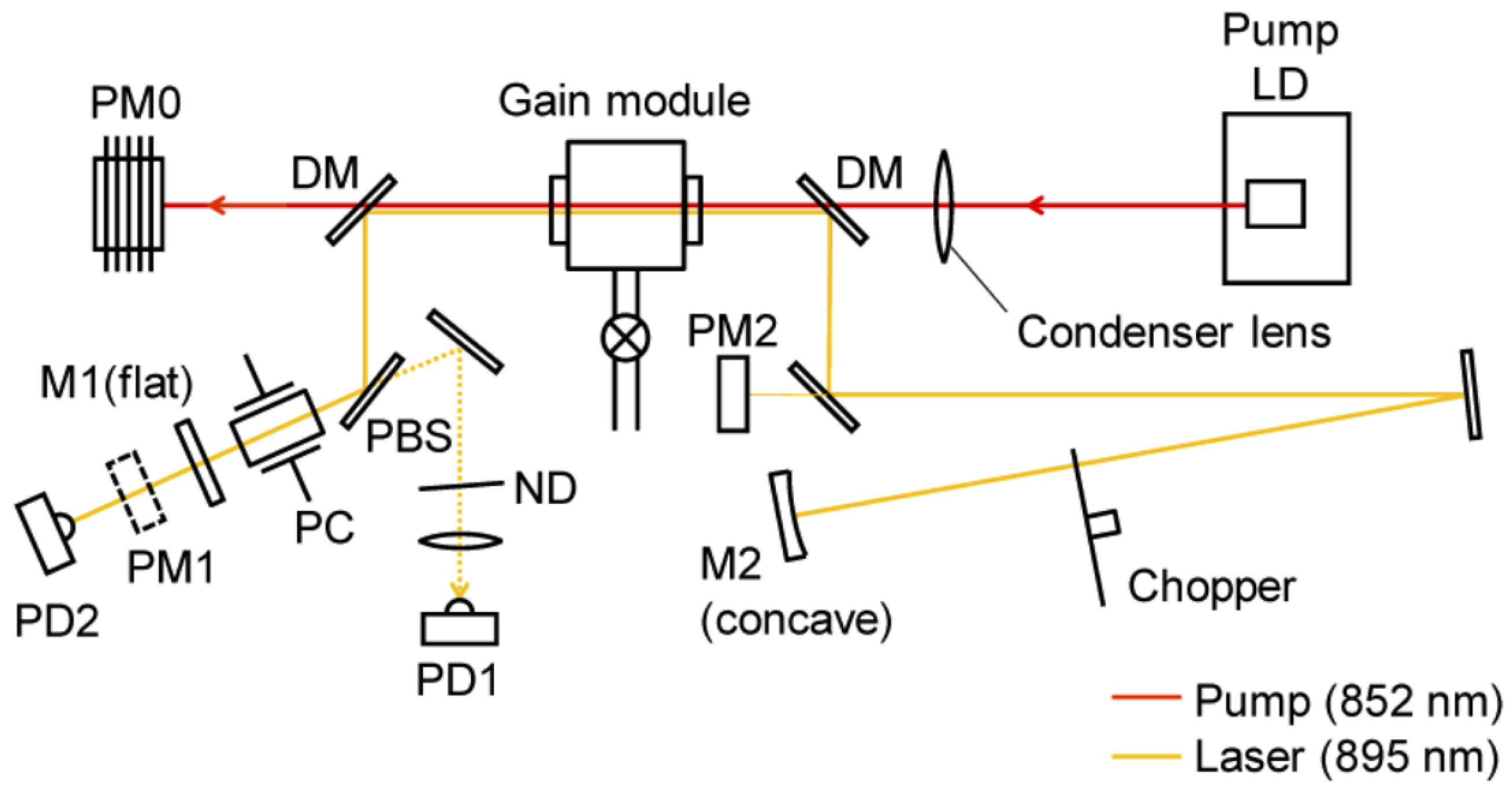
2 transition, the gain medium can be switched on and off without modifying the pump power waveform. Hong et al. [
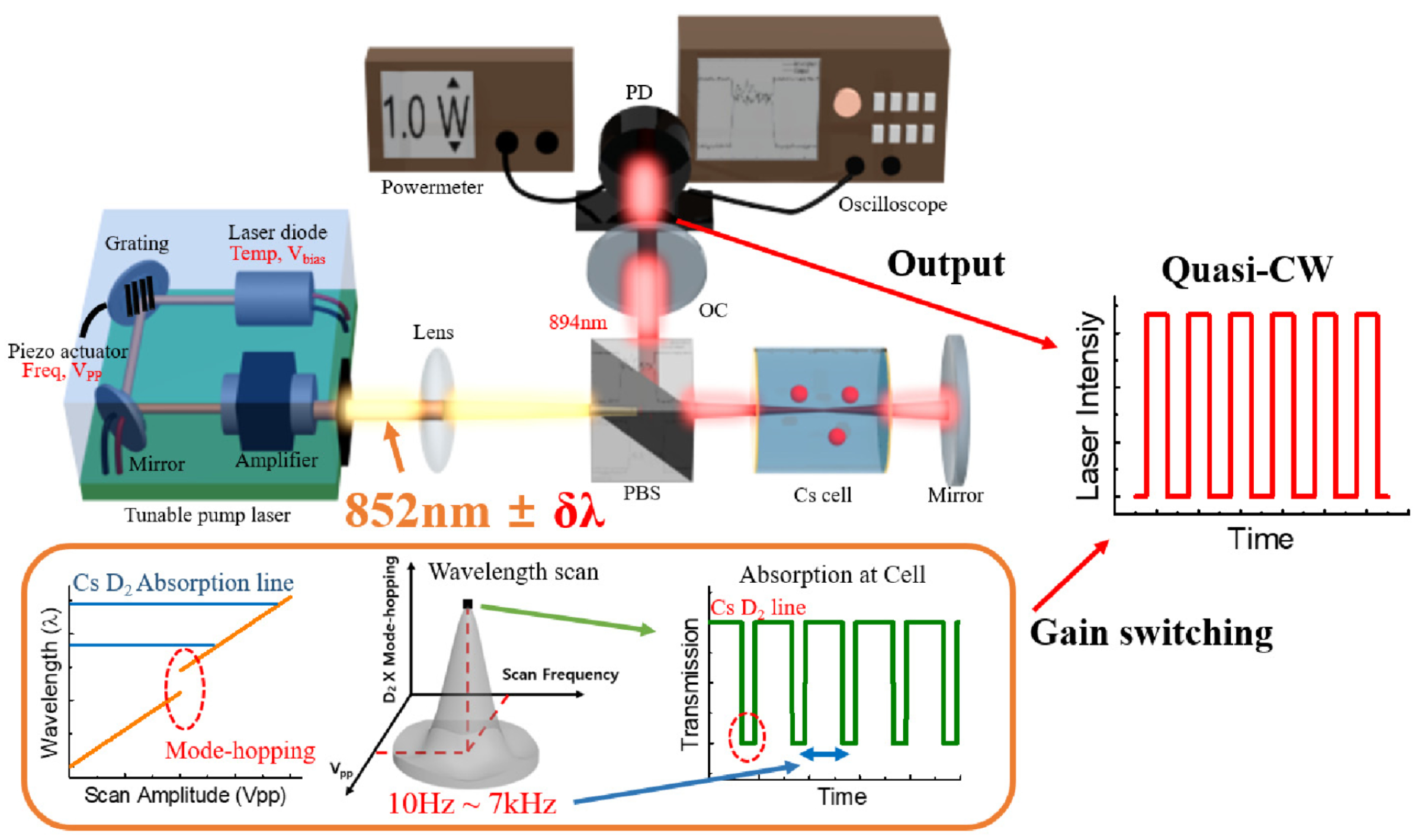
61] proposed and demonstrated this spectral-domain modulation scheme in a Cs-DPAL in 2018 (
Figure 2). An external-cavity diode laser (ECDL) served as the narrow-linewidth pump source, and a piezoelectric actuator attached to the Littrow-type grating was driven with a periodic voltage, inducing rapid mode-hopping that swept the pump wavelength periodically across the Cs D
2 absorption line. This wavelength switching modulated the pump absorption and population inversion to produce QCW output without any modulation of pump current or intracavity elements. The scheme demonstrated a tunable repetition-rate range from 10 Hz to 7 kHz, with adjustable pulse durations between 26
s and 3.5 ms. The maximum peak power was 1.66 W at 797 mW average output power (6.7 kHz, 71.6
s).
Spectral-domain modulation provides a simple and compact approach to realize QCW operation by exploiting the intrinsic spectral selectivity of alkali absorption, enabling continuous tuning of both repetition rate (10 Hz–kHz) and pulse duration (
s–ms). However, its performance is fundamentally constrained by the characteristics of piezoelectric tuning and the underlying gain-switching mechanism. Although the modulation frequency of the piezoelectric actuator can, in principle, be increased toward higher (tens to hundreds of kHz) ranges, a bandwidth–range trade-off exists: the achievable displacement decreases with increasing driving frequency, which limits the effective wavelength tuning span and may prevent reliable mode-hopping across the alkali resonance [
62]. In addition, higher-frequency operation imposes stricter requirements on mechanical stability, hysteresis control, and repeatability of the piezoelectric system. As a result, the repetition rate is practically limited to the kHz regime, and the pulse duration remains in the
s–ms range, with no significant enhancement in peak power. Therefore, this approach is best suited for moderate repetition-rate QCW operation requiring flexible temporal control, particularly in scenarios where system simplicity and reduced thermal load are prioritized, rather than for high-frequency or high-peak-power pulsed applications.
3.1.3. Passive Modulation via Fiber Nonlinearities
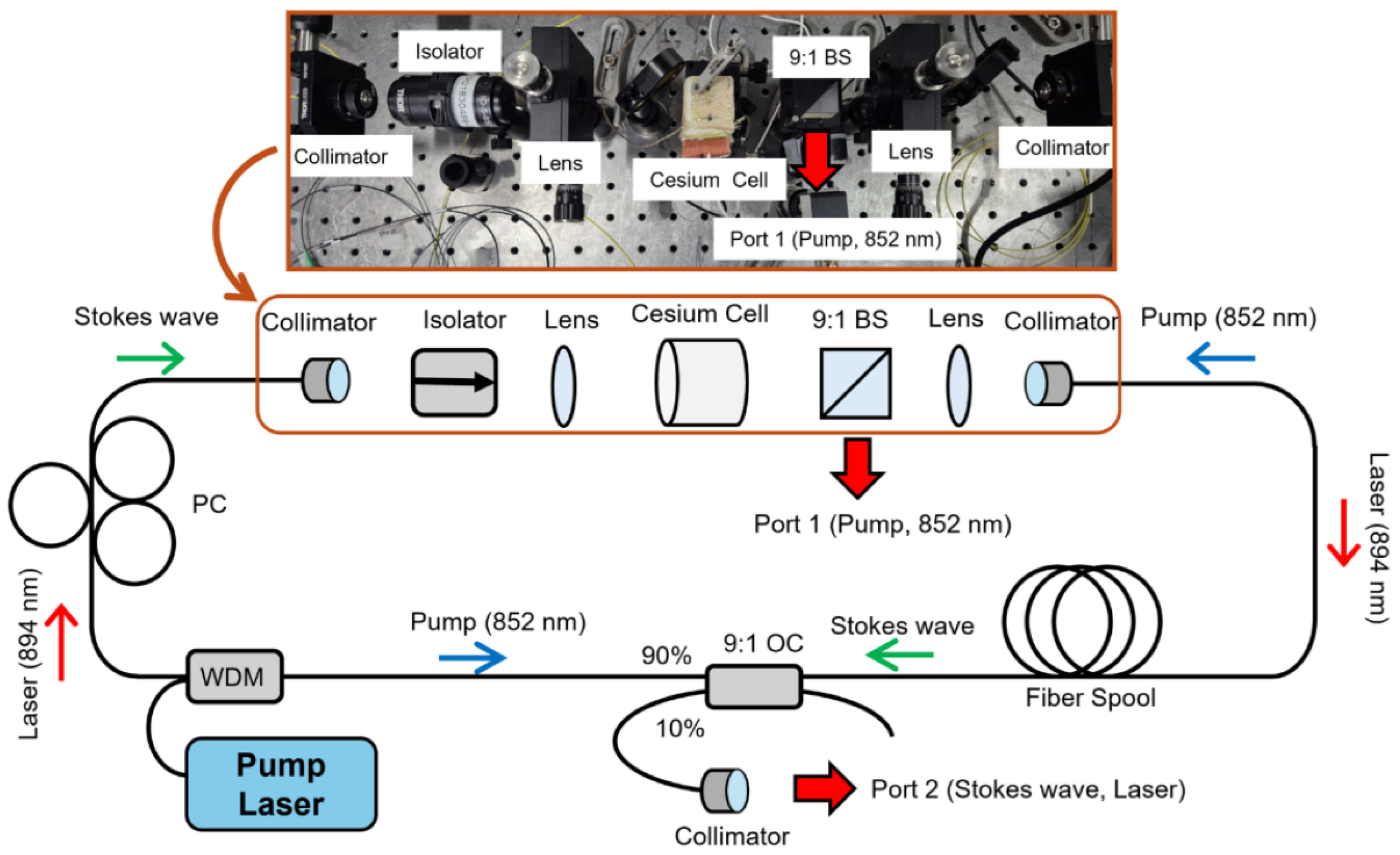
A fully passive pump modulation scheme requiring no external drive electronics was reported by Ryu et al. [
63] in 2025, who integrated a fiber ring cavity into the pump delivery path of a Cs-DPAL (
Figure 3). Stimulated Brillouin scattering (SBS) within the optical fiber generates a counter-propagating Stokes wave frequency-shifted by approximately 20 GHz relative to the pump wavelength. Because the Stokes frequency partially falls outside the Cs D
2 absorption profile, the Stokes wave is incompletely absorbed and feeds back into the fiber ring, triggering spontaneous self-pulsation above a threshold pump power. The pulsated Stokes wave periodically depletes the transmitted pump power, converting the CW pump input into a time-modulated excitation that drives pulsed Cs laser output without any active modulator. The repetition rate was governed by the fiber ring length: fiber lengths of 50, 75, 100, and 125 m yielded repetition rates of 3.4, 2.4, 1.9, and 1.5 MHz, respectively. The Cs laser pulse duration was approximately 123 ns, and the duty cycle ranged from 51% down to 20% with increasing fiber length. Peak output power decreased from 5.8 mW at 50 m to 1.4 mW at 125 m due to stronger SBS amplification and pump depletion at longer fiber lengths. Pulsation onset occurred at 156 mW pump power. This work represents the highest repetition rate reported to date for any pump-modulated DPAL, and the all-passive fiber-integrated architecture offers a promising route toward miniaturized, fieldable pulsed DPAL sources, pending further work to increase peak power to practically useful levels.
This approach enables passive pulse generation with a simple and compact architecture by exploiting fiber nonlinearities, without requiring active modulation elements. Its main advantage lies in achieving high repetition rates at the MHz level (up to 3.4 MHz demonstrated), which can be further increased by reducing the cavity length, potentially extending toward the tens of MHz regime. In addition, it offers nanosecond-scale pulse durations and good beam quality, making it well suited as a high-repetition-rate seed source for MOPA systems, as well as for applications such as optical sensing and short-range ranging. However, the pulse characteristics are intrinsically governed by the cavity length and nonlinear dynamics, leading to limited flexibility in independently controlling repetition rate, pulse width, and energy, while the output power remains relatively low. Future work should focus on further increasing the repetition rate, as well as investigating mechanisms for pulse-width control to enable tunability within a certain range, thereby improving the flexibility and applicability of this passive modulation scheme.
3.2. Q-Switching and Cavity Dumping
In conventional Q-switching, the cavity Q is initially held low to suppress oscillation and allow population inversion to accumulate in the upper level over a duration comparable to the upper-level lifetime. When the Q is rapidly switched high, the stored energy is released as a giant pulse. For alkali atoms with nanosecond-scale excited-state lifetimes, this storage mechanism is ineffective: atoms in the upper lasing level decay by spontaneous emission before Q-switching can extract a coherent giant pulse, and the pump energy is largely dissipated as spontaneous radiation and heat rather than being converted to a high-peak-power output [
64].
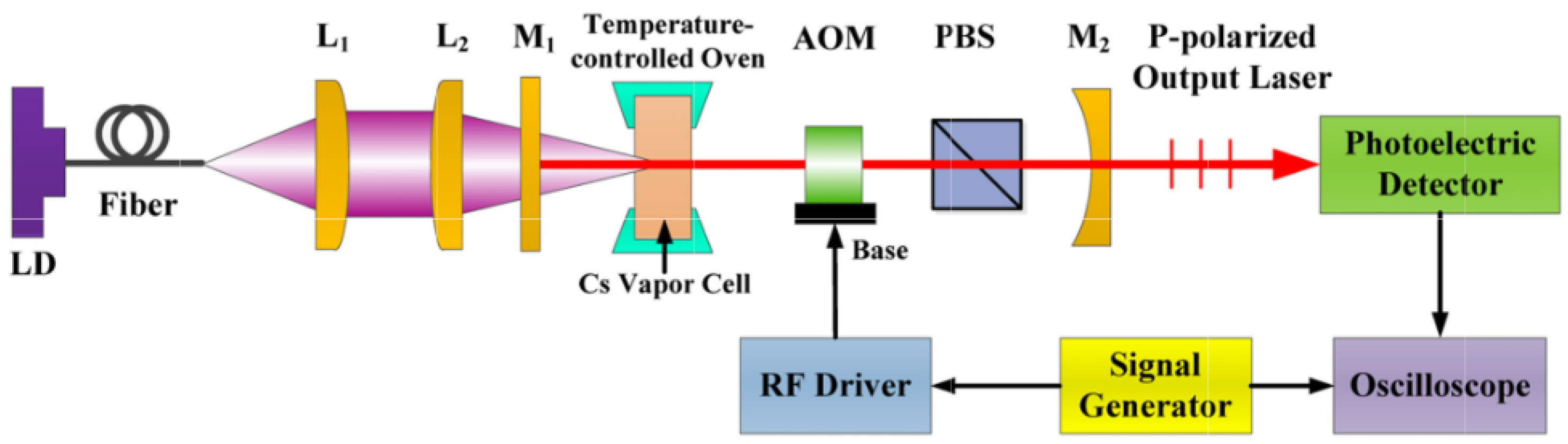
He et al. [
65] experimentally confirmed this limitation in a Cs-DPAL in which an acousto-optic modulator (AOM) was inserted inside the laser cavity (
Figure 4). In CW operation, the laser produced 1.055 W average power. With the AOM operated as a Q-switch, the peak power reached only 0.95 W actually lower than the CW output directly demonstrating that conventional Q-switching cannot enhance peak power in a DPAL system. The AOM was however found to be useful as an intracavity temporal modulator: driving it as a pulse picker rather than a Q-switch, the system produced pulse trains with repetition rates from 10 kHz to 1 MHz and pulse durations as short as 238 ns. Although this scheme cannot effectively enhance the peak power, it enables continuous tunability of pulse duration from the hundred-nanosecond to microsecond range. Moreover, the modulation frequency of AOMs can reach up to the hundreds of MHz, providing a flexible and programmable pulsed output scheme for DPALs.
Unlike conventional Q-switching, cavity dumping stores energy within the optical cavity, thereby avoiding the limitation imposed by the short upper-level lifetime of alkali atoms [
64]. Endo performed the pioneering series of experiments on cavity-dumped Cs-DPALs. In 2019, Endo [
66] demonstrated the first cavity-dumped DPAL, employing a BBO Pockels cell combined with a polarizing beam splitter as the intracavity electro-optic switch (
Figure 5). Starting from a CW average power of 3.1 W, cavity dumping produced pulses with a duration of 14 ns and a peak power of 77 W, a 25-fold peak power enhancement over the CW baseline. The pulse waveform exhibited structured sub-features related to multi-longitudinal-mode beating within the cavity, indicating that the coherence properties of the intracavity field play a non-trivial role during the dumping process.
In 2020, Endo [
67] investigated how longitudinal mode dynamics influence cavity-dumped peak power. Spatial hole burning (SHB) in the gain medium was found to promote dual- or multi-longitudinal-mode oscillation during the intracavity buildup phase. Coherent beating between two longitudinal modes generates periodic intensity modulation within the pulse envelope; when the cavity length and gain cell position are tuned to favor a two-mode configuration with approximately equal amplitudes, the constructive interference at the beating maxima is maximized, significantly boosting the instantaneous peak power. Under these optimized conditions, a peak power of 250 W was obtained a 38-fold enhancement over the CW output demonstrating that deliberate exploitation of multi-mode coherence is an effective strategy for maximizing cavity-dumped peak power in DPALs.
These studies demonstrate that cavity dumping can effectively enhance the peak power of pulsed output while enabling nanosecond-scale pulse durations. Previous work by Endo has primarily focused on peak power scaling. For DPALs with inherently high gain, the intracavity energy can recover rapidly after each dumping event, suggesting the potential for operation at higher repetition rates. In addition, electro-optic modulators can support repetition rates up to the tens of MHz range. Future research may therefore focus on increasing the repetition rate, as well as combining cavity dumping with MOPA architectures to further scale the peak power.
3.3. Mode-Locking
Mode-locking imposes a fixed phase relationship among the longitudinal modes of the laser cavity, causing their coherent superposition to form a periodic train of ultrashort pulses. The repetition rate equals the cavity free spectral range (round-trip frequency), and the pulse duration is inversely proportional to the phase-locked spectral bandwidth. Mode-locking thereby accesses pulse parameters from sub-nanosecond to picosecond durations at megahertz repetition rates that are unattainable through pump modulation or cavity dumping alone. Mode-locking techniques can be broadly classified into active and passive schemes.
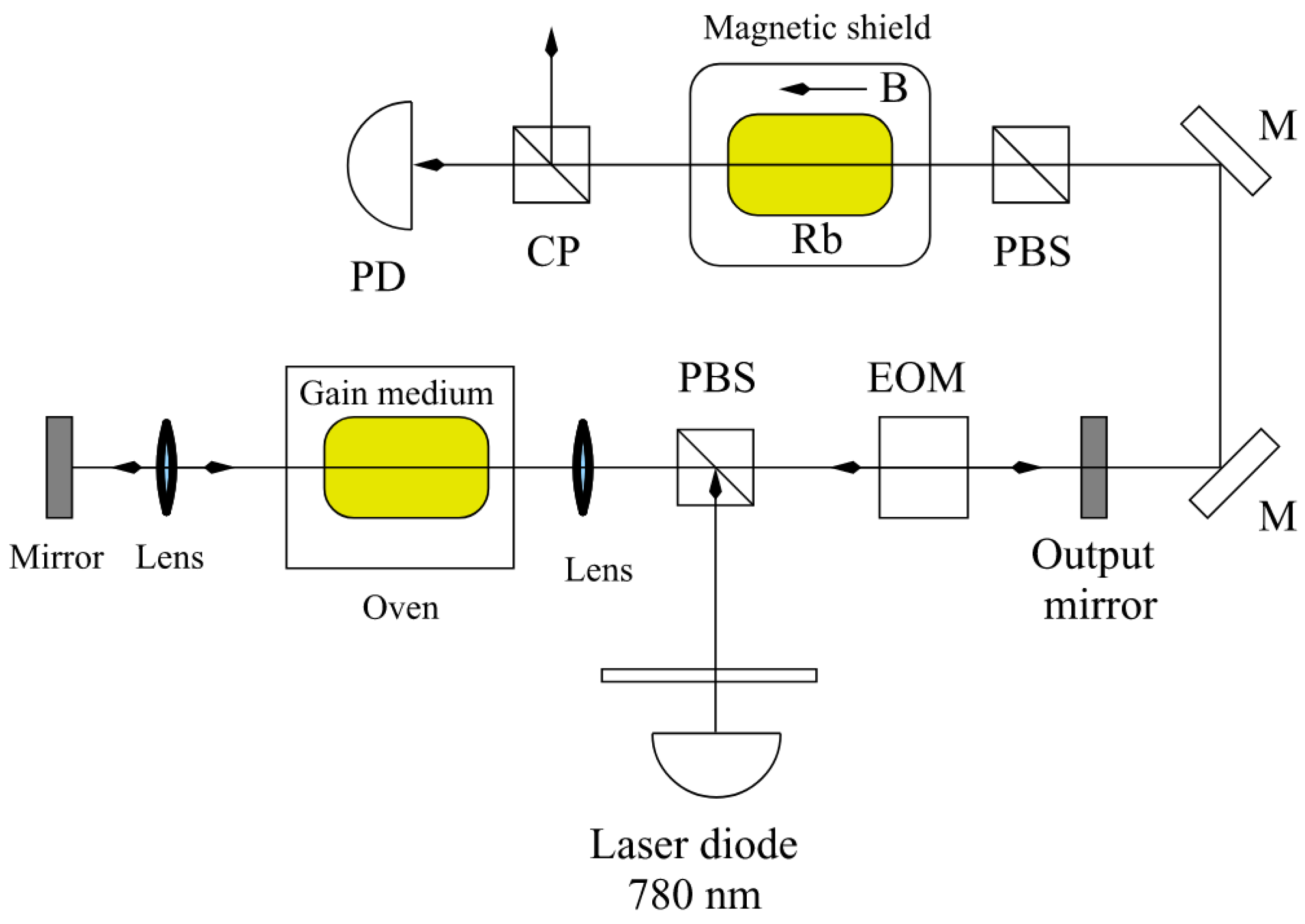
In active mode-locking, a periodic modulation phase or amplitude is applied to the intracavity field at a frequency matched to the longitudinal mode spacing, coupling adjacent modes and progressively establishing phase-locked pulses. Zhang et al. [
68] demonstrated the first mode-locked DPAL in 2017, using a Rb-DPAL with an intracavity electro-optic modulator (EOM) driven at a frequency matched to the cavity’s longitudinal mode spacing of approximately 55 MHz (
Figure 6). Mode-locking was confirmed through the radio-frequency beat spectrum: the multi-mode beat linewidth narrowed from a broad free-running profile to approximately 2 kHz after EOM activation, indicating stable phase coherence among the oscillating modes. The primary scientific objective of this work was to employ the mode-locked Rb-DPAL as a coherent source for demonstrating electromagnetically induced transparency and nonlinear Faraday rotation in atomic rubidium, rather than to characterize the pulsed output parameters directly. Nevertheless, the demonstration established the feasibility of active mode-locking in an alkali vapor gain medium and highlighted the potential of mode-locked DPALs as narrow linewidth, high-repetition-rate sources for atomic physics and precision spectroscopy.
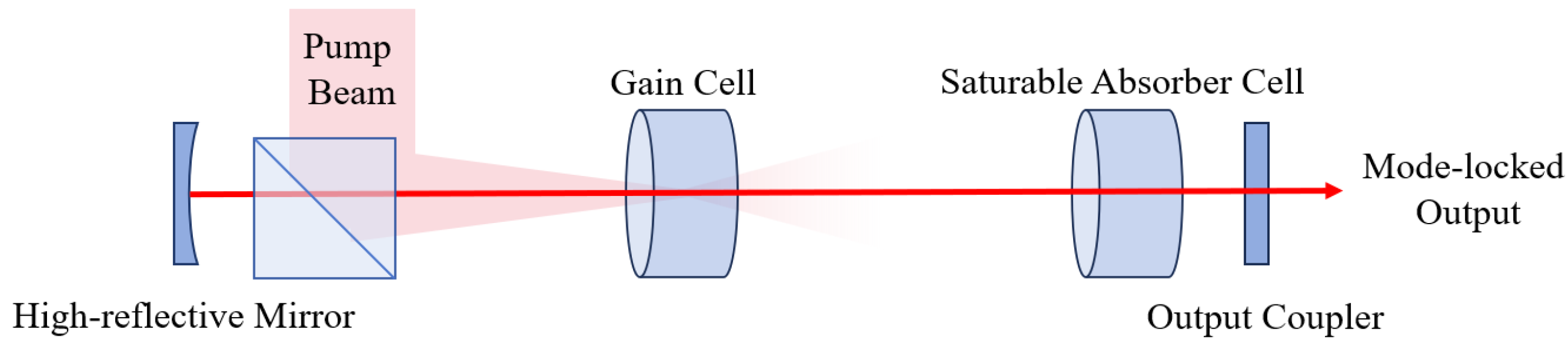
Passive mode-locking employs a nonlinear saturable absorber (SA) element that preferentially transmits high-intensity bursts and attenuates low-intensity fields, shaping the intracavity light into ultrashort pulses without external modulation electronics. Rotondaro et al. [
69] demonstrated the first passively mode-locked DPAL in 2023, using a second alkali vapor cell as the intracavity saturable absorber an approach intrinsic to the alkali vapor system (
Figure 7). In this Cs-DPAL configuration, the gain cell was maintained at 105 °C while the SA cell was held at a lower temperature (∼60 °C), yielding a lower Cs vapor density that provided intensity-dependent absorption. At high intracavity intensity, the SA cell was bleached and contributed small round-trip loss; at low intensity, it imposed high loss, providing the differential absorption necessary to sustain mode-locked pulsation. Adjusting the SA cell temperature tuned the small-signal absorption and thus the mode-locking operating point. A stable mode-locked pulse train was obtained at a repetition rate of 157 MHz (pulse period 6.4 ns), with a detector-limited measured pulse duration below 460 ps and a theoretically estimated minimum pulse duration of 57 ps based on the supported intracavity bandwidth.
Figure 7 illustrates a representative configuration of a passively mode-locked DPAL employing a vapor-cell-based saturable absorber.
This work is important for two reasons. First, the saturable absorber is a gaseous element that is fully compatible with the alkali vapor environment. Compared with solid-state saturable absorbers, a gaseous saturable absorber has a much higher optical damage threshold. This makes it well suited for high-peak-power operation. Because of this advantage, mode-locked DPALs using gaseous saturable absorbers could potentially reach megawatt-level peak powers, which would be very difficult to achieve with solid-state saturable absorber technologies. Second, the nonlinear response of gaseous alkali media can be tailored through parameters such as temperature, buffer gas composition, and pressure. This provides an additional degree of freedom for engineering the saturable absorption characteristics, offering tunability that is not readily available in solid-state saturable absorbers.
However, research on passively mode-locked DPALs is still at an early stage, and several important questions remain. To begin with, the saturable absorption properties of alkali vapors need to be studied in detail. Key parameters include the saturation intensity, modulation depth, and recovery time, as well as how these parameters depend on buffer-gas composition, pressure, and temperature. Such data are essential for guiding the design of mode-locked DPAL systems. In addition, the quantitative relationship between these absorber parameters and the output pulse characteristics (such as pulse duration, pulse energy, temporal stability, and spectral purity) has not yet been established. Understanding this relationship is critical for optimizing pulse performance. Finally, a systematic study of the mode-locking dynamics is needed. This should cover pulse formation, steady-state pulse evolution, and the effects of gain saturation in the alkali vapor medium. Such studies would help build predictive models and identify the fundamental performance limits of passively mode-locked DPALs.
3.4. Cross-Technique Comparison
Table 2 summarizes the representative pulsed DPAL performance metrics across the techniques reviewed in this section, organized by pulsing method.
These pulsed operation techniques exhibit distinct temporal characteristics and operating regimes. Pump modulation typically provides repetition rates from a few Hz to several kHz, with pulse durations down to tens of microseconds, while further shortening of the pulse duration is limited by the response of the pump source. When AOMs are used as optical switches, repetition rates are expected to reach the hundred-megahertz range, with pulse durations from hundreds of nanoseconds to microseconds; however, this approach mainly redistributes the intracavity power in time and does not significantly increase the extractable peak power. In contrast, cavity dumping enables nanosecond-scale pulses (on the order of ∼10 ns) with enhanced peak power through rapid extraction of the stored intracavity energy, with repetition rates expected to reach the MHz regime. Mode-locking further extends the accessible parameter space to the picosecond domain, with repetition rates determined by the cavity round-trip frequency in the tens to hundreds of MHz, while also enabling high peak power through coherent pulse formation.
From a physical perspective, these techniques can be categorized by their energy-handling mechanisms: pump modulation controls the gain build-up process, AOM-based modulation gates the output without modifying intracavity energy storage, cavity dumping actively extracts stored energy, and mode-locking redistributes energy into ultrashort pulses through phase coherence. As a result, only cavity dumping and mode-locking provide intrinsic routes to peak power enhancement, whereas pump and AOM modulation mainly define temporal envelopes and repetition structures. Together, these techniques span pulse durations from picoseconds to milliseconds and repetition rates from Hz to hundreds of MHz, forming a hierarchical temporal control framework. This broad coverage enables DPAL systems to access both energy-dominated and repetition-rate-dominated operating regimes, providing flexibility for different application requirements.
4. Outlook and Future Directions of Pulsed DPALs
The experimental demonstrations reviewed in
Section 3 show that pulsed operation is achievable across several technique categories in all three alkali systems. However, the field is still at an early stage. Pulse parameters have been explored only within a limited range, theoretical models for transient dynamics are incomplete, and several important operating regimes have not yet been studied. This section discusses four research directions that are likely to shape the near-term development of pulsed DPALs.
4.1. Research Directions for Mode-Locked DPALs
Mode-locking is the most recently demonstrated pulsed modality in DPALs, and characterization of the output remains incomplete. Three aspects require focused attention. First, the existing mode-locking demonstrations [
68,
69] reported neither peak power nor direct temporal measurements of pulse duration. The 57 ps value cited by Rotondaro et al. [
69] is an estimate based on the supported intracavity bandwidth, rather than a measurement obtained from standard techniques such as intensity autocorrelation. Rigorous characterization is therefore required, including intensity autocorrelation, radio-frequency (RF) spectral analysis, and optical spectral measurements. Second, the saturable absorption properties of gaseous alkali media can be significantly influenced by parameters such as temperature, buffer gas composition, and pressure. Systematic characterization of how these parameters affect the nonlinear response of the gaseous saturable absorber is essential, as it provides a means to tailor the absorber dynamics and thereby influence the performance and stability of mode-locked pulse generation. Third, the development of a comprehensive dynamical model for mode-locking in DPALs is equally important. Such a model should incorporate gain dynamics, collisional processes, and saturable absorption effects, enabling a deeper understanding of pulse formation mechanisms, stability conditions, and performance limits. These efforts will provide a solid foundation for achieving stable, controllable, and high-performance mode-locking in DPALs.
In addition to these considerations, the laser architecture itself presents an important direction for further development, particularly toward integrated configurations. The conventional two-cell design requires independent temperature control for the gain cell and the absorber cell, which adds mechanical complexity and increases the number of alignment variables. An alternative is to realize both gain and saturable absorption within a single cell by creating a longitudinal temperature gradient. If the end closer to the pump is kept at a high temperature to provide net gain, and the opposite end is held at a lower temperature where alkali vapor density is sufficient for saturable absorption but not for net gain, both functions can coexist within one sealed envelope. In a flowing-cell geometry, gas circulation can sustain the temperature gradient. This approach would remove the need for a second cell, reduce the resonator footprint, and simplify alignment. The concept has not been demonstrated experimentally and represents a practical near-term design target.
The choice of saturable absorber material remains another key direction. Although gaseous saturable absorbers have been demonstrated, their relatively slow recovery dynamics, typically on the order of tens of nanoseconds, limit the achievable pulse duration and repetition rate. In contrast, solid-state saturable absorbers, such as semiconductor saturable absorber mirrors (SESAMs), have operating wavelength ranges that can cover the emission wavelengths of DPALs. They exhibit modulation depths of several percent, saturation fluences on the order of 50–100
J/cm
2, and recovery times from a few hundred femtoseconds to a few picoseconds [
70], making them well suited for ultrashort pulse generation. In addition, a variety of emerging saturable absorber materials have recently been applied in solid-state and fiber lasers [
71,
72,
73]. Whether these novel materials can be adapted to DPAL systems for mode-locking is an open research question, particularly in terms of whether they can enable distinct pulse characteristics or improved output performance. Two-dimensional materials such as graphene and MoS
2 offer broadband saturable absorption with similarly fast recovery dynamics and are representative candidates in this direction [
71,
74]. These studies will facilitate the development of a broader range of mode-locked DPAL systems, expanding the accessible design space in pulse dynamics and output performance.
4.2. Burst-Mode Pulse Generation
Burst-mode output is useful in a wide range of laser applications and has therefore become an active research topic in the laser community [
75,
76]. For example, in laser ranging and LiDAR, transmitting a burst of pulses within a single measurement cycle can improve the echo signal-to-noise ratio through pulse accumulation and help resolve range ambiguity through pulse-interval encoding [
77,
78]; in laser material processing, distributing the pulse energy into a burst enables higher material removal rates with reduced thermal damage [
79,
80]; and in high-speed flow diagnostics, burst-mode lasers provide kHz–MHz-rate pulse sequences that capture the full temporal evolution of transient phenomena [
76,
81]. Given the advantages discussed above, DPAL systems are well suited to these applications. Developing burst-mode operation in DPALs is therefore of considerable interest, as it enables the combination of high peak power with flexible temporal structures while mitigating thermal loading in the gain medium, offering a practical path to high pulse energy at high intra-burst repetition rates.
Burst-mode operation refers to a two-level temporal emission regime in which groups of closely spaced pulses, referred to as bursts, are generated at a programmable burst repetition rate
. Each burst consists of a sequence of
N short pulses with pulse duration
, confined within a finite temporal envelope characterized by a burst width
. This hierarchical time structure enables high intra-burst repetition rates and peak powers while maintaining a relatively low average power. Depending on the intra-burst repetition rate, burst-mode operation can be broadly classified into two regimes [
79]. In the kHz–MHz regime, the intra-burst pulse structure is defined by external modulators or intracavity switches operating on nanosecond to microsecond timescales. In the GHz regime, a mode-locked oscillator generates ultrashort pulses at a repetition rate set by the cavity round-trip time, with pulse separations on the sub-nanosecond scale. For DPAL systems, three implementation approaches can be identified corresponding to these two regimes.
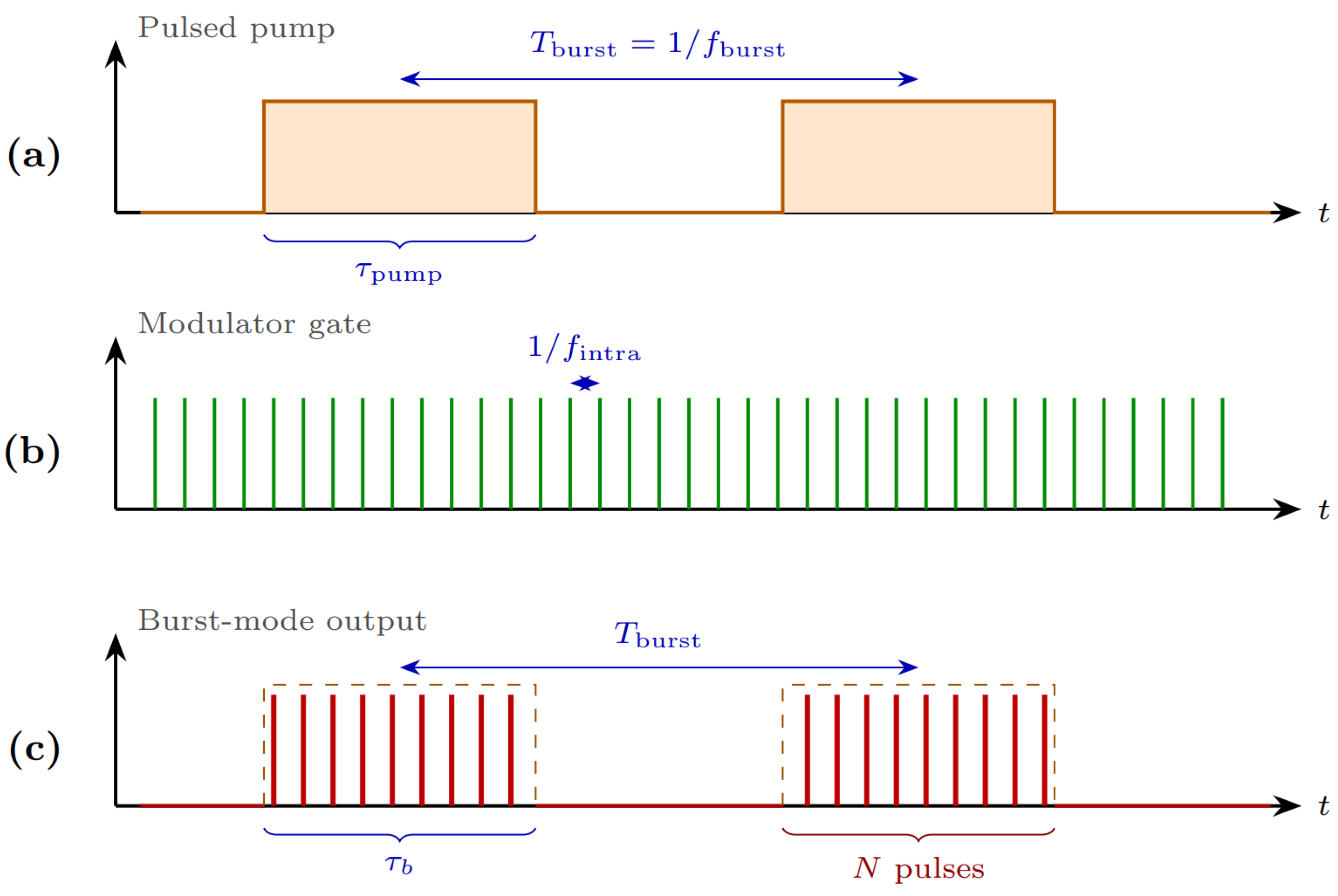
The first approach uses an extracavity modulator, such as an acousto-optic modulator (AOM) or an electro-optic modulator (EOM), to carve individual pulses from the DPAL output. The working principle is illustrated in
Figure 8. A pulsed pump source defines the burst envelope with a pump duration
and a burst period
[
Figure 8a], while the extracavity modulator generates a continuous train of narrow gate pulses at the intra-burst repetition rate
[
Figure 8b]. The burst-mode output is the temporal product of these two waveforms: laser emission is transmitted only when the pump window and the modulator gate overlap, producing a finite packet of
N pulses with a burst width
and an intra-burst pulse spacing of
[
Figure 8c]. Alternatively, the extracavity modulator can also be used to select pulses from a continuously running DPAL, imposing a burst structure without requiring pulsed pumping. The extracavity approach avoids intracavity loss between pulses and is straightforward to implement, but the peak power of each carved pulse is limited to the instantaneous power of the DPAL output. Alternatively, the extracavity modulator can also be used to select pulses from a continuously running DPAL, imposing a burst structure without requiring pulsed pumping. A key advantage of this approach is its programmability: both the pulse duration and the intra-burst repetition rate can be freely adjusted through the modulator driving signal, enabling flexible adaptation to different application requirements. However, the peak power of each carved pulse is limited to the instantaneous power of the DPAL output.
The second approach combines pulsed pumping with intracavity cavity dumping. A pulsed pump defines the burst envelope, while a fast intracavity switch periodically dumps the stored intracavity energy to produce individual high-peak-power pulses within each burst. Since the intracavity field builds up between successive dump events, this scheme can deliver significantly higher peak powers than the extracavity modulation approach. However, the pulse duration is governed by the cavity round-trip time and is therefore determined by the resonator length, offering limited tunability compared with the first approach.
The third approach targets the GHz burst regime by employing a mode-locked oscillator as the pulse source. Access to this regime requires intra-burst pulse separations on the sub-nanosecond scale, which is naturally provided by a mode-locked cavity whose repetition rate is set by the round-trip time. Two configurations can be envisioned for a DPAL system: a mode-locked DPAL oscillator combined with an intracavity cavity-dumping switch that periodically extracts a group of mode-locked pulses, or a freely running mode-locked DPAL with an extracavity pulse picker that selects the desired number of pulses per burst. In both cases the intra-burst repetition rate is fixed by the cavity length, and the number of pulses per burst is controlled by the switching or gating window duration. GHz bursts have attracted considerable attention in laser material processing, where the ablation-cooling effect has been demonstrated: at GHz intra-burst rates, successive pulses remove material before residual heat diffuses into the bulk [
80,
82]. Realizing this regime in a DPAL, however, requires stable mode-locked operation of the alkali gain medium, whose bandwidth and dispersion characteristics differ substantially from those of solid-state and fiber lasers, as discussed in
Section 2. GHz burst-mode DPAL operation therefore remains a longer-term prospect.
None of the three approaches has yet been demonstrated in a DPAL system. It should be noted that the schemes described above address only the generation of burst-mode seed pulses at the oscillator level. For practical applications requiring high pulse energy, one or more DPAL-based power amplifier stages would be needed to scale the burst output to useful energy levels, following the master-oscillator power-amplifier (MOPA) architecture that is standard in existing burst-mode laser systems [
76,
83]. Beyond power scaling, several system-level issues warrant investigation, including pulse-to-pulse energy uniformity within a burst, gain saturation dynamics across the burst envelope, thermal management under low-duty-cycle pumping, and long-term operational stability. Numerical modeling that addresses these aspects would provide valuable guidance for future experimental efforts.
4.3. Power Scaling Strategies for Pulsed DPALs
Reaching high average or peak power in pulsed DPALs requires progress in the gain medium, pump architecture, and resonator design. Three main strategies are outlined here.
The most direct strategy is to increase the pump power while managing the associated thermal load through a flowing-cell gain medium. In static sealed cells, heat deposited by successive pulses accumulates and builds a growing thermal lens that degrades beam quality. Flowing-cell designs [
37], in which a continuous gas flow refreshes the gain volume and removes deposited heat, prevent this accumulation. As a result, flowing cells maintain a stable thermal profile across pulse trains, which is important for consistent pulse parameters at high repetition rates. The key design parameters are the flow velocity, which must be fast enough to replace the gain volume between pulses, and the cell geometry, which affects the coupling between gas-flow turbulence and intracavity beam quality. Scaling CW flowing-cell DPAL designs to pulsed operation under high-power diode pump stacks is a natural development step.
A second strategy is the master oscillator-power amplifier (MOPA) configuration, in which a pulsed oscillator defines the seed pulse properties and one or more independently pumped amplifier stages boost the pulse energy. This approach separates pulse generation from power amplification, allowing each stage to be optimized independently. As noted in
Section 4.2, the burst-mode schemes discussed there produce seed-level pulse trains that would require MOPA-based power scaling for practical applications. The MOPA scheme has already been demonstrated for CW DPAL power scaling [
65], and extending it to pulsed seeds is straightforward in principle.
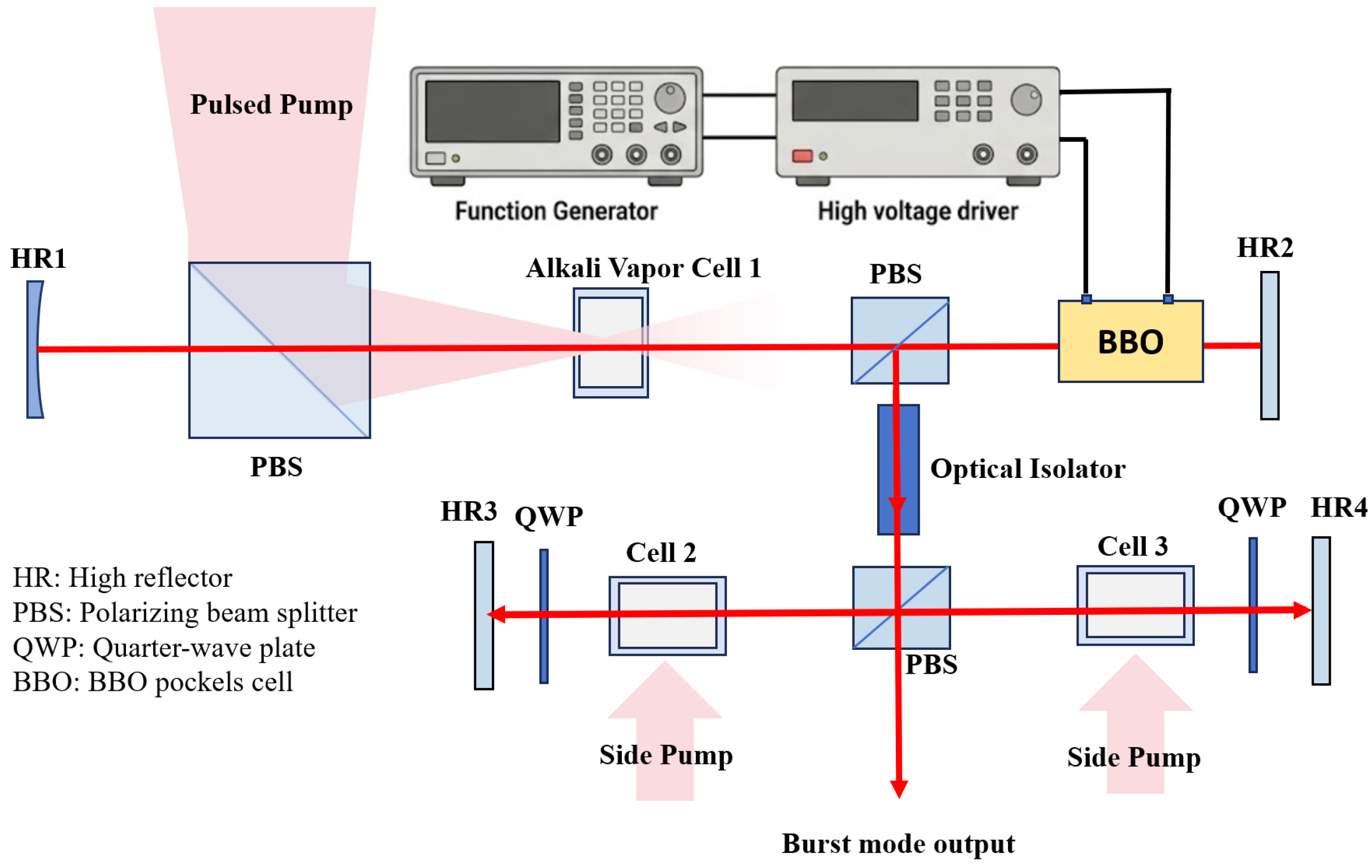
Figure 9 illustrates a possible burst-mode DPAL MOPA layout. The master oscillator is a pulsed-pump DPAL cavity formed by HR1 and HR2, with a BBO Pockels cell and a polarizing beam splitter (PBS) serving as the cavity-dumping switch. Burst-mode seed pulses are dumped from the oscillator and directed through an optical isolator into the power amplifier stage. The amplifier employs two double-pass alkali vapor cells (Cell 2 and Cell 3) arranged in a serial configuration. In the first arm, the s-polarized seed beam is reflected by the lower PBS into Cell 2, passes through a quarter-wave plate (QWP), reflects off HR3, and passes through the QWP a second time, rotating the polarization from s to p. The now p-polarized beam transmits through the PBS into the second arm, double-passes Cell 3 in the same QWP–HR4 arrangement, and returns as s-polarized light, which is reflected downward by the PBS as the amplified burst-mode output. Each cell is side-pumped independently, providing a total of four amplification passes.
The main technical challenges are matching the amplifier gain bandwidth and saturation fluence to the seed pulse parameters to avoid pulse distortion, suppressing amplified spontaneous emission (ASE) between stages, and maintaining uniform pulse energy throughout the burst envelope in the amplifier chain.
A third, more advanced option is regenerative amplification. In this approach, a seed pulse is injected into a high-gain resonator, circulates and amplifies over many round trips until gain saturation, and is then extracted by an intracavity switch. Effective power scaling through these strategies would bring pulsed DPALs closer to practical deployment in applications.
4.4. Spectral Extension and Technology Integration
Pulsed operation not only extends DPALs from continuous or quasi-continuous emission to richer temporal formats, but also creates new opportunities for functional integration with other laser technologies. In particular, the combination of pulsed DPALs with dual-wavelength generation, second-harmonic generation, sum-frequency generation, and related nonlinear or multi-wavelength schemes could substantially broaden the application scope of DPALs. On the one hand, pulsed operation provides higher peak power, which is more favorable for nonlinear frequency conversion than continuous-wave output. On the other hand, multi-wavelength and frequency-converted outputs can overcome the intrinsic wavelength limitation of alkali vapor lasers and enable their use in a wider range of scenarios. Therefore, the integration of pulsed DPALs with wavelength conversion and multi-band output technologies represents a promising direction for future development.
The first direction is dual-wavelength emission. Dual-wavelength laser sources that can deliver two independently controllable wavelengths from a single system are valuable for differential-absorption lidar (DIAL), multi-wavelength ranging, and optical communication. DPALs are uniquely suited to this purpose: because different alkali species (K, Rb, Cs) lase on chemically independent D1 transitions within the same resonator, their gain processes do not interfere with each other, overcoming a long-standing limitation of dual-wavelength solid-state lasers [
84]. Wang et al. first demonstrated a dual-wavelength Rb–Cs DPAL using two separated vapor cells in a common resonator, achieving simultaneous CW output at 794.7 nm (Rb D1) and 894.3 nm (Cs D1) with independent power control via cell temperature [
85]. Hybrid CW-modulated output was subsequently realized by chopping one pump branch at up to 800 Hz while the other remained in CW mode, confirming that the two wavelength channels operate without mutual disturbance [
84]. The system was later simplified by replacing the two discrete cells with a single mixed Rb–Cs vapor cell [
86]. More recently, the concept was extended to the K–Rb combination, with theoretical modeling of output properties at 770 nm (K D1) and 795 nm (Rb D1) from a mixed K–Rb vapor cell, including cross-relaxation energy transfer between the two species [
87]. Combining dual-wavelength DPAL operation with the pulsed techniques discussed in
Section 3 and
Section 4 would add further capability. In a pulsed dual-wavelength DPAL, each wavelength channel could be independently modulated, enabling pulse-by-pulse wavelength alternation for DPAL or synchronized two-color pulses for spectroscopic applications. The key open question is whether pulsed operation of one alkali species perturbs the gain dynamics of the other through shared thermal or optical effects within the resonator.
Frequency doubling of DPAL output can extend the accessible wavelength range into the blue-violet spectral region. The D1 lines of Cs, Rb, and K correspond to second-harmonic wavelengths of approximately 447 nm, 398 nm, and 385 nm, respectively. This spectral range is of interest for underwater communication, fluorescence excitation, photochemistry, and laser display [
88]. SHG of both Cs-DPAL and Rb-DPAL output has been demonstrated using nonlinear crystals including PPKTP, BIBO, and LBO in intracavity and extracavity configurations [
88,
89,
90,
91,
92]. Among these, PPKTP provided the highest conversion efficiency, yielding up to 2.5 W of 447 nm output from a pulsed Cs-DPAL [
90]. However, the overall second-harmonic powers reported to date remain modest, primarily limited by the low peak intensities available from CW or quasi-CW fundamental sources.
The pulsed DPAL techniques with high peak power could substantially improve SHG performance. Since the single-pass conversion efficiency scales with the square of the fundamental peak power, cavity-dumped and mode-locking DPAL pulses with peak powers of kilowatts or above would yield conversion efficiencies orders of magnitude higher than those achievable with CW operation. This advantage is particularly significant for extracavity single-pass SHG, which avoids the complexity of intracavity crystal placement and the associated risk of chemical degradation in the alkali vapor environment. Burst-mode operation would further enable high-average power blue-violet output while keeping the peak power high within each burst.
Beyond SHG, broader wavelength coverage can be obtained through sum-frequency generation (SFG), difference-frequency generation (DFG), and optical parametric oscillation (OPO) or amplification (OPA), as summarized in
Table 3. Hu et al. demonstrated intracavity DFG by combining a Rb-DPAL (795 nm) with a tandem-pumped Nd:YVO
4 laser (1064 nm) in a MgO:PPLN crystal, generating 3141 nm mid-infrared output with a power of 3.47 mW [
93]. Although the conversion efficiency was low, this result established the first nonlinear frequency mixing scheme driven by a DPAL source and confirmed the feasibility of extending DPAL wavelength coverage into the mid-infrared. In an SFG scheme, the DPAL output could be combined with a second source to access wavelengths in the ultraviolet. In an OPO or OPA scheme, the DPAL output serves as the pump for a parametric device, generating tunable signal and idler wavelengths from the visible to the mid-infrared. The high beam quality and narrow linewidth characteristic of DPAL output are favorable for efficient nonlinear conversion. Pulsed operation, as discussed in
Section 3, would further enhance the peak power available for these processes, potentially enabling practical tunable sources across a wide spectral range.
5. Conclusions
This review has provided a comprehensive survey of pulsed DPALs, covering both the mature CW enabling technologies and the emerging pulsed-generation techniques. The five key subsystems—narrow-linewidth pump sources, pump delivery and mode-matching architectures, resonator designs, gain cell engineering, and power-scaling strategies based on flowing-gas cells and MOPA chains—have reached sufficient maturity to support the transition from CW to pulsed operation. On this foundation, a diverse set of pulsed techniques has been demonstrated, spanning pump modulation, cavity dumping, and mode-locking, which collectively cover pulse durations from sub-nanosecond to millisecond and repetition rates from Hz to hundreds of MHz.
Beyond these existing demonstrations, we have discussed several forward-looking directions. First, the feasibility of mode-locked DPALs requires further investigation, including the underlying physical mechanisms, the integration of saturable absorber and gain regions, and the exploration of new types of saturable absorbers. Second, burst-mode operation provides a promising approach for generating hierarchical temporal structures with flexible energy distribution. Third, the combination of pulsed operation with power-scaling strategies, such as flowing-gas architectures and MOPA configurations, offers a pathway toward simultaneously increasing peak and average power. Fourth, the integration of pulsed DPALs with wavelength-conversion techniques may enable access to new spectral regions. Although the field remains at an early stage and many of these concepts await experimental validation, the convergence of well-established CW technologies with the growing variety of pulsed techniques positions DPALs as a versatile and scalable laser platform with broad application potential across directed energy, remote sensing, precision manufacturing, and atomic physics.