1. Introduction
Direct observation of micro- or nanostructures typically relies on optical or electron microscopy, where higher resolution often comes at increased cost. As an alternative, coherent measurement techniques, such as digital holography [
1], digital holographic microscopy [
2], and coherent diffraction imaging methods [
3,
4] including ptychography [
5], provide non-contact solutions that have been extensively applied. With rapid advances in laser technology, these methods [
6,
7,
8,
9] offer notable advantages such as enhanced resolution, quantitative phase retrieval, and three-dimensional imaging capabilities.
Phase retrieval is a fundamental challenge in coherent diffraction imaging. Conventional approaches recover the phase of the diffraction field from measured intensities using iterative algorithms, such as the Gerchberg–Saxton [
10] and modified Fienup [
11] methods. These approaches alternate between the object and diffraction planes, applying known constraints to refine the estimated phase, and have been widely adopted for their robustness and versatility. More recently, physics-driven deep learning networks [
12,
13] have been developed to accelerate phase retrieval, enabling faster reconstruction and improved handling of noisy or incomplete data while incorporating physical constraints into the network architecture.
Phase retrieval can also be performed using interference patterns, where the diffraction field’s phase is encoded in the fringe structure. Phase-shifting interferometry [
14,
15,
16] typically requires two or more patterns and provides high precision. Alternatively, the Fourier transform method [
17,
18,
19] allows phase retrieval from a single interference pattern, enabling high-speed and dynamic measurements in conventional digital holography [
20]. Once retrieved, the object can be numerically reconstructed using either the angular spectrum or Fresnel propagation method [
21,
22]. Notably, deep learning frameworks have been proposed for phase retrieval from single-shot interferograms [
23].
These approaches—including deep learning [
24], iterative algorithms [
25], and the angular spectrum method [
26]—can also be applied to object reconstruction in the far-field diffraction regime. Digital holography is particularly suited to this regime, where the Fourier transform of the recorded hologram provides the spatial frequency components of the object wave, enabling reconstruction via spectral filtering and inverse Fourier transform [
27]. For visible light, satisfying the Fraunhofer condition typically requires propagation distances of several tens of centimeters. To reduce this distance and minimize system size, a lens can be employed to record the diffraction pattern at its focal plane, effectively capturing the far-field diffraction pattern of the object. In this configuration, iterative algorithms [
28] or Fourier-series-based exponential filters [
29] can retrieve the phase from far-field intensity measurements.
Introducing a lens not only relaxes the stringent far-field condition but also allows for smaller CCD sensors and shorter system length while preserving the essential phase information. Compared with image-plane holography [
30], which typically requires the object–image distance to be greater than four times the focal length of the convex lens, our configuration does not impose this requirement and thus significantly reduces the system size. This configuration enables object reconstruction via simple inverse Fourier transform without iterative computations, making lens-based setups attractive for compact, high-speed, and real-time imaging, and providing a practical alternative to conventional far-field diffraction systems. Moreover, the lens introduces known pupil functions and controllable aberrations, adding physical constraints that can improve convergence, robustness, and uniqueness of the solution. However, incorporating a lens also increases reconstruction complexity. In a recent work [
31], two interference patterns were used to determine the phase factor of the diffraction field in a lens-based holographic system, which adds experimental complexity. This raises the question: is it possible to reconstruct the object from a single-shot interferogram within the same framework, enabling real-time imaging? In this work, we answer affirmatively, introducing a strategy for single-shot reconstruction that addresses a key limitation of previous methods.
2. Methods
In this work, we present a simple method to directly reconstruct objects from a single interference pattern, which is generated due to interference between the diffraction field of an object and a reference plane wave.
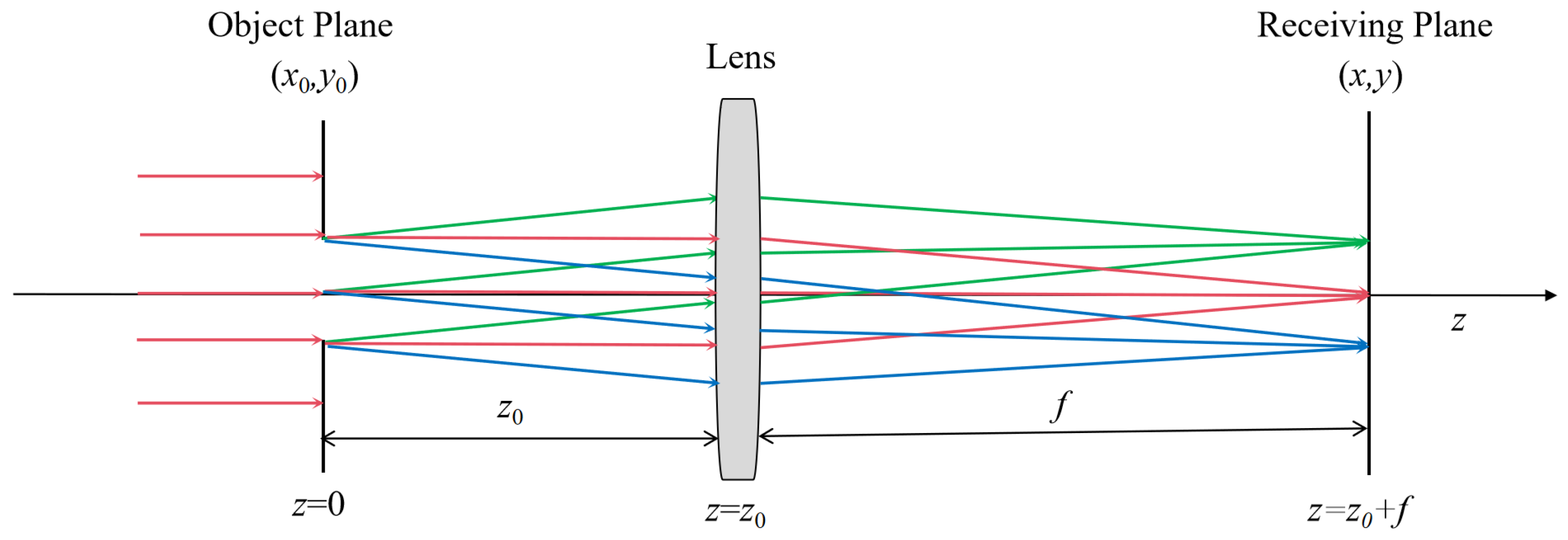
Figure 1 shows the schematic of collecting the Fraunhofer diffraction pattern by using a convex lens. The optical axis of the system is along the
z axis, with the object plane located at
. The coordinates in the object plane and the focal plane of the lens (the receiving plane) are denoted by
and
, respectively. The propagation from the object to the lens and then to the focal plane is modeled under the paraxial approximation. An object with a complex amplitude
locating at the object plane is illuminated by a plane wave of wavelength
. The resulting diffraction wave propagates to a lens of focal length
f positioned at
. According to the scalar diffraction theory [
30], the diffraction field at the focal plane of the lens can be expressed as
where
is a universal spherical phase factor given by
Equation (
2) shows that this phase factor arises solely from propagation and is independent of the object, where
P denotes the corresponding quadratic coefficient and
is the wave number. The presence of this phase factor prevents direct reconstruction of the object by applying an inverse Fourier transform to the diffraction field. To ensure the validity of Equation (
2), the paraxial approximation must hold. This means that the object size should be significantly smaller than both the object-lens distance and the focal length of the lens. In addition, it should also be much smaller than the lens aperture. These conditions are satisfied in our experiments. When the object is placed precisely at the front focal plane of the lens (i.e.,
), the phase factor in Equation (
1) vanishes, allowing the object to be retrieved through the conventional holographic reconstruction process. For more general cases where
, this phase factor is embedded in the phase of the diffraction field. The object can be reconstructed by applying an inverse Fourier transform to the diffraction field, after dividing out the phase factor according to Equation (
1). To obtain the phase of the diffraction field, various phase retrieval methods can be employed, among which the Fourier transform phase retrieval method [
17] is a particularly suitable choice. When the object–lens distance
is known, the phase factor can be readily obtained from Equation (
2). In this work, however, we present a novel approach for determining the phase factor without requiring prior knowledge of this distance.
In a recent work [
31], we presented a strategy that employs an additional interferogram of a reference object with known geometry for extracting the phase factor. In this work, to simplify the process, we leverage the distinctive form of the phase factor, as given in Equation (
2), and consequently propose a improved strategy to extract the phase factor directly from the diffraction field of the target object. The basis of this strategy is that the quadratic phase of the diffraction field primarily arises from the phase factor, whereas the contribution from the Fourier transform of the object is negligible. This approximation is particularly valid when the object plane is located away from the front focal plane of the lens, as indicated by Equation (
2), and will be confirmed by our experimental results. Unlike image plane digital holography, where the object plane and the CCD plane are optically conjugated through a lens, the proposed lens-based Fourier transform method records the diffraction field at the lens focal plane. This eliminates the need for precise object–lens–sensor alignment, and reduces the overall system length.
3. Results and Discussion
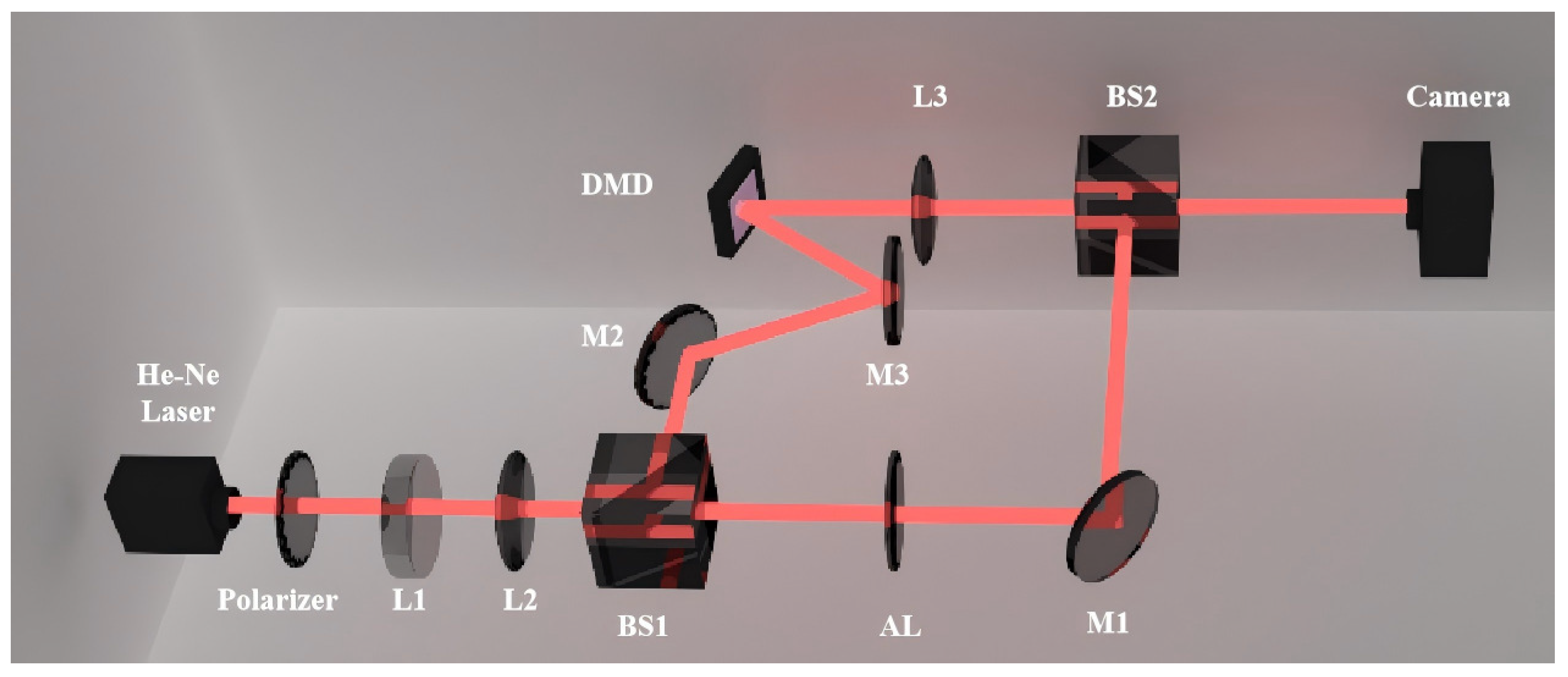
The experimental setup used to record the required interferogram is shown in
Figure 2. It is a modified Mach–Zehnder interferometer using a He–Ne laser source (DH-HN250, Daheng Optics, Beijing, China), in which a digital micromirror device (DMD, DLP6500, Texas Instruments, Dallas, TX, USA) replaces one of the reflective mirrors in the conventional configuration. The DMD has a pixel pitch of 7.56 µm and a resolution of
pixels. To align the optical axis of the diffraction field with the
z-axis (the horizontal direction in
Figure 2), two additional reflective mirrors, M2 and M3, are introduced. The DMD is employed to generate objects of arbitrary shape, and when illuminated by the laser beam, it produces diffraction from the displayed object. A convex lens (L3) with a focal length of 150 mm is placed after the DMD, and a CCD camera (HD-R2000C-GigE, Daheng Optics, Beijing, China) is positioned at its focal plane to record the interference pattern arising from the diffraction field of the object and the reference plane wave. The CCD has a pixel pitch of 2.4 µm and a resolution of
pixels.
We first validate our method using simulation results. Assume that the quadratic phase coefficient in the phase factor is
m
−2, and that the direction cosines of the reference plane wave along the
x and
y axes are both 0.1. The diffraction field of the object is calculated according to Equation (
1), with the amplitude of the reference light field set to
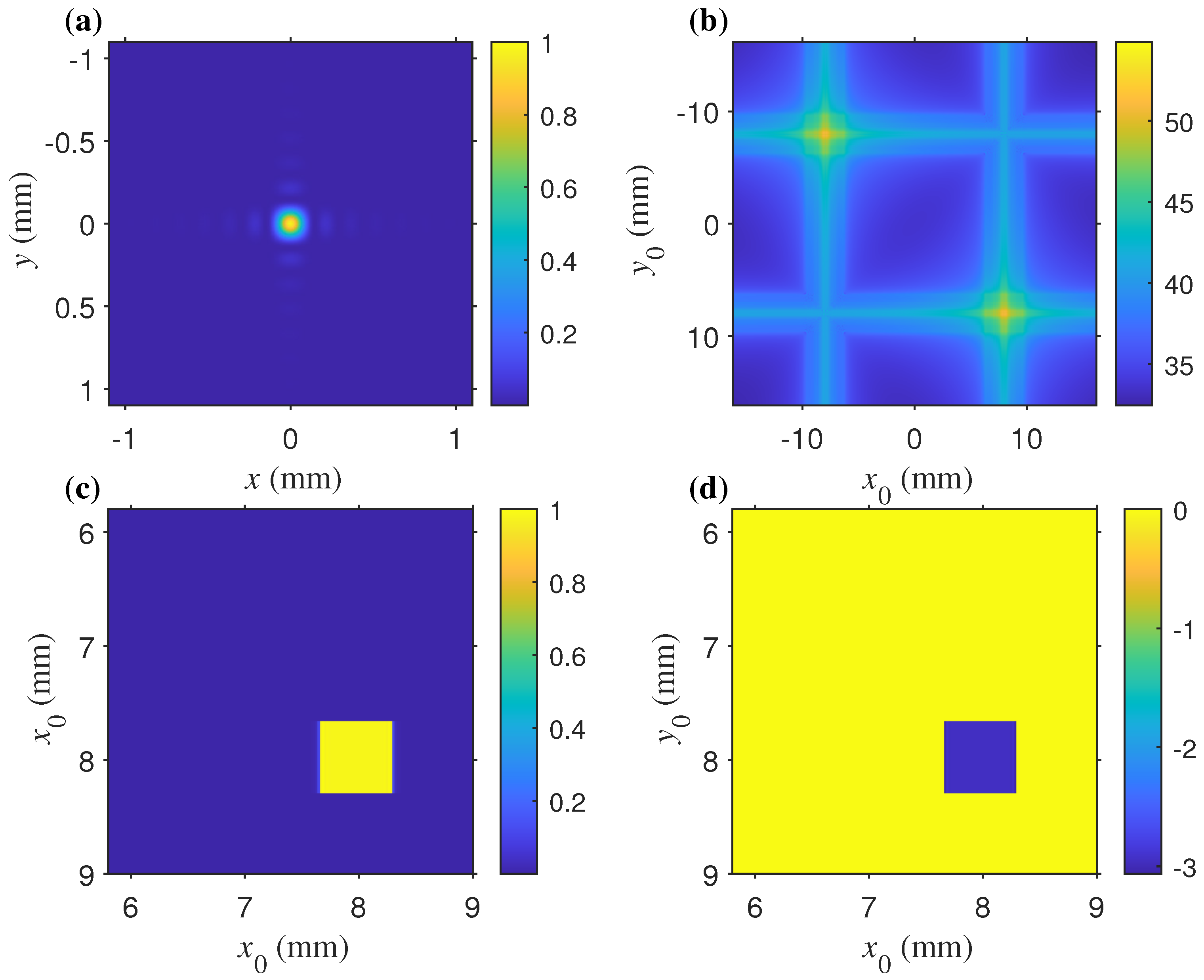
. The corresponding interference pattern for a square object with a side length of 600 µm is shown in
Figure 3a. Following the procedures illustrated in
Figure 4, the inverse Fourier transform of the interference pattern, along with the amplitude and phase of the reconstructed object, are shown in
Figure 3c,d. The reconstruction demonstrates excellent accuracy, as expected, with the extracted quadratic phase coefficients along the
x and
y axes being
and
m
−2, respectively, in close agreement with the set values. In addition, it is verified through simulations that the proposed phase factor retrieval method performs well when the signal-to-noise ratio of the captured interference patterns exceeds 50 dB. The signal-to-noise ratio of our experimental data should satisfy this requirement.
The correct extraction of the propagation factor relies on the assumption that the quadratic phase in the diffraction field arising from the Fourier transform of the object is relatively small. To examine the validity limits of the proposed method for objects with slowly varying phase, particularly for objects exhibiting quadratic phase profiles, i.e., a spherical phase object
, such as microlenses, we present in
Table 1 the extracted quadratic coefficients for the diffraction fields of objects with different phase curvatures
Q.
and
denote the quadratic coefficients in the horizontal and vertical directions, respectively. The quadratic phase coefficients in the phase factors remain the same as those shown in
Figure 3. It can be observed that the errors remain relatively small for object phase curvatures below
. However, for object phase curvatures exceeding this range, the proposed method fails to yield accurate reconstruction, and alternative approaches are required. In addition, the results for a random phase object are presented in the last row of
Table 1, demonstrating the effectiveness of the proposed method in handling the reconstruction of such objects.
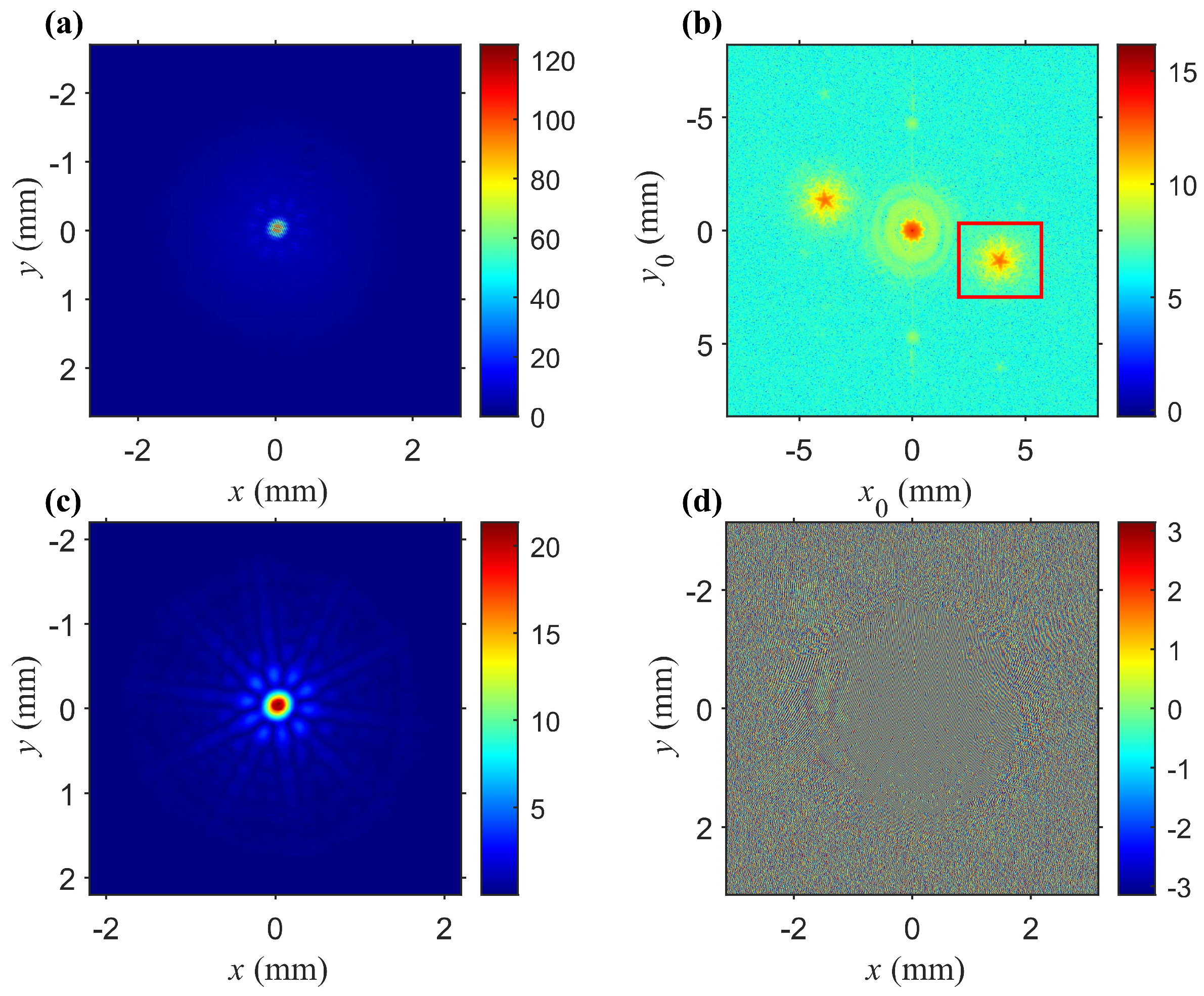
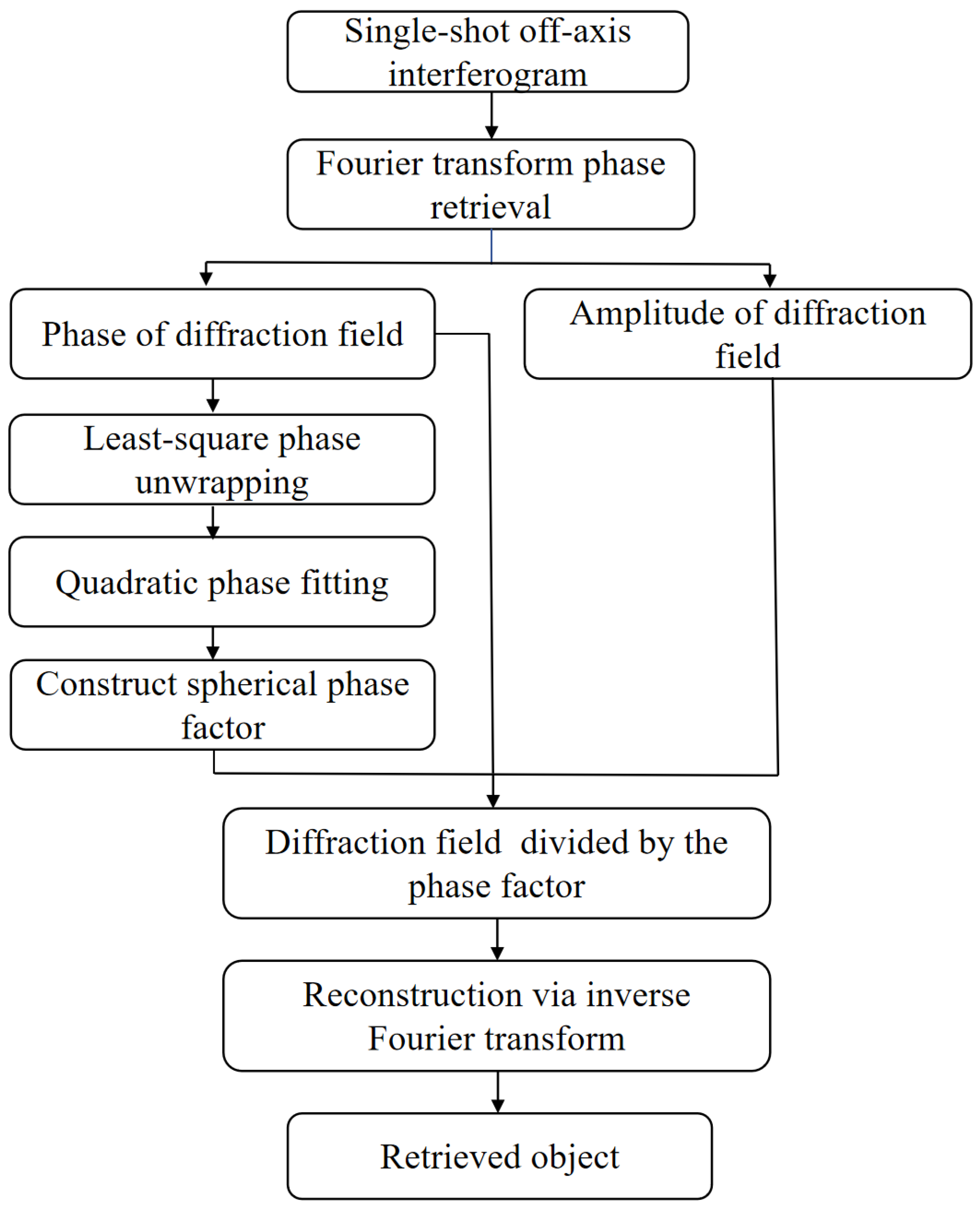
Next, we apply the proposed method to several examples to verify its validity in experiments, with the procedure illustrated in
Figure 4. To begin, we present the results obtained for a five-pointed star as the first example, with a size of approximately 500 µm. The Fourier transform phase retrieval method [
17] is then applied to obtain the diffraction field of this object. The Fourier transform of the interference pattern in
Figure 5a is shown in
Figure 5b. The zero-order and
-order terms are well separated by finely adjusting the inclination of the reference plane wave. By applying an inverse Fourier transform to the selected first-order term in
Figure 5b, the amplitude and phase of the object are obtained, as shown in
Figure 5c,d. Here, the phase represents the difference between the diffraction field and the reference plane wave. It can be interpreted as the phase of the diffraction field, since when reconstructing the object via an inverse Fourier transform, the phase of the plane wave only affects the position of the reconstructed object.
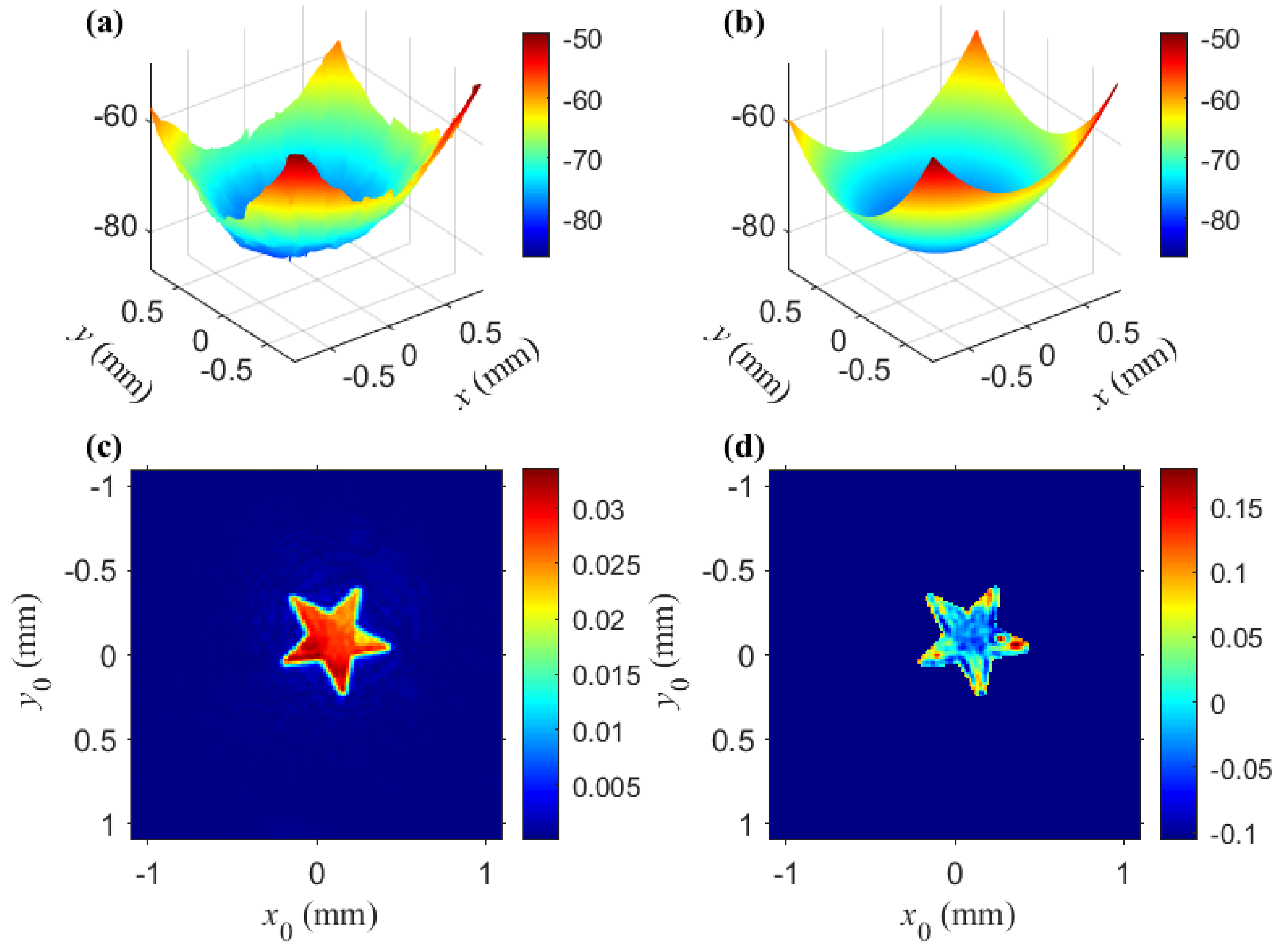
Once the phase of the diffraction field is obtained, we proceed to isolate the phase factor. We first apply a least square phase unwrapping method [
32] to the phase in
Figure 5d to obtain the unwrapped phase of the diffraction field. The reason for selecting this method is that it is highly efficient, robust to noise, and delivers superior performance in reconstructing complex objects compared with other phase unwrapping approaches, such as the branch-cut [
33] and quality-guided [
34] methods. The corresponding result is shown in
Figure 6a. Then, a quadratic fitting is applied to the unwrapped phase in
Figure 6a. The fitting result is shown in
Figure 6b, with the corresponding quadratic coefficients
m
−2 and
m
−2. Consistent with the theoretical prediction, they are in close agreement. The reconstructed phase factor is
. The object is retrieved by applying an inverse Fourier transform of the diffraction field after dividing out this phase factor. The reconstructed five-pointed star is plotted in
Figure 6c,d. It is evident that the reconstruction accurately reproduces the structure, with a multi-scale structural similarity index measure (SSIM) value exceeding 0.91. The observed phase of the object in
Figure 6d mainly arises from the edge effects due to spectrum truncation, edge amplitude discontinuities or the intrinsic micromirror characteristics of the DMD. In
Figure 6d, the average of the reconstructed phase is approximately 0.05 rad, confirming that the DMD structure behaves as a non-phase object.
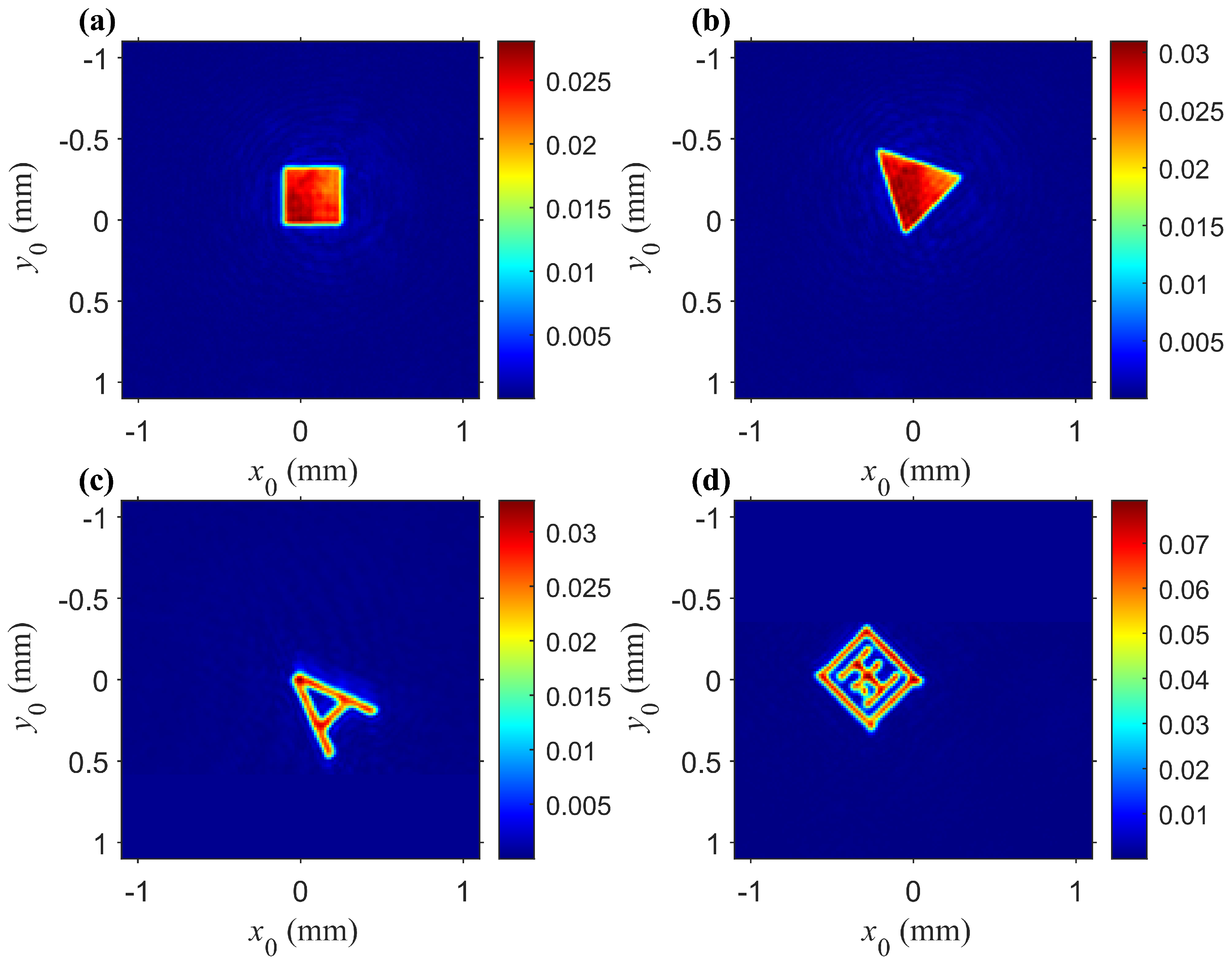
To further demonstrate the validity of our reconstruction method, we apply it to retrieve several additional objects from their corresponding interferograms acquired with the same setup. All of these structures are approximately 500 µm in size. The amplitudes of the reconstructed square, triangle, letter “A”, and character “国” are shown in
Figure 7. Due to the DMD’s reflective properties, the reconstructed images appear as mirror images of the objects displayed on the DMD. Clearly, all the structures are reconstructed with high precision. The fitted quadratic coefficients of the phase factors for the diffraction fields of the objects shown in
Figure 7 are listed in
Table 2, together with the corresponding SSIM values and the phase errors
. The SSIM values for all reconstructed objects in
Figure 7 are above 0.91, demonstrating with numerical evidence the high reconstruction accuracy of our method. Both the efficiency and precision of our method are improved compared with the approach reported in the previous work [
31]. The parameter
in the last column of
Table 2 denotes the measured average phase errors of the reconstructed object phases. These values fall within the accuracy range of the Fourier transform phase retrieval algorithm, i.e., 0.01–0.1 rad.
Similar to the previous star example, the fitted quadratic coefficients
and
in
Table 2 are very close in all cases. Moreover, all the quadratic coefficients are around
m
−2, indicating that the diffraction fields of all objects exhibit the same phase factor, as predicted. The slight difference mainly arises from phase unwrapping errors or from the choice of frequency domain used for phase retrieval. Thus, the phase factor of the diffraction field is identical for all objects situated in the same object plane, provided that the object plane, the lens, and the receiving plane remain unchanged in the optical setup. The parameter
P in the fourth column of
Table 2 is not the average value of
and
; rather, it denotes the quadratic coefficient obtained by fitting the second-order components of the unwrapped phase surface with
. We find that the variation of the
P coefficients across all cases is smaller than that of
and
, indicating that the physical constraint of
on the phase factor provides a more accurate description.
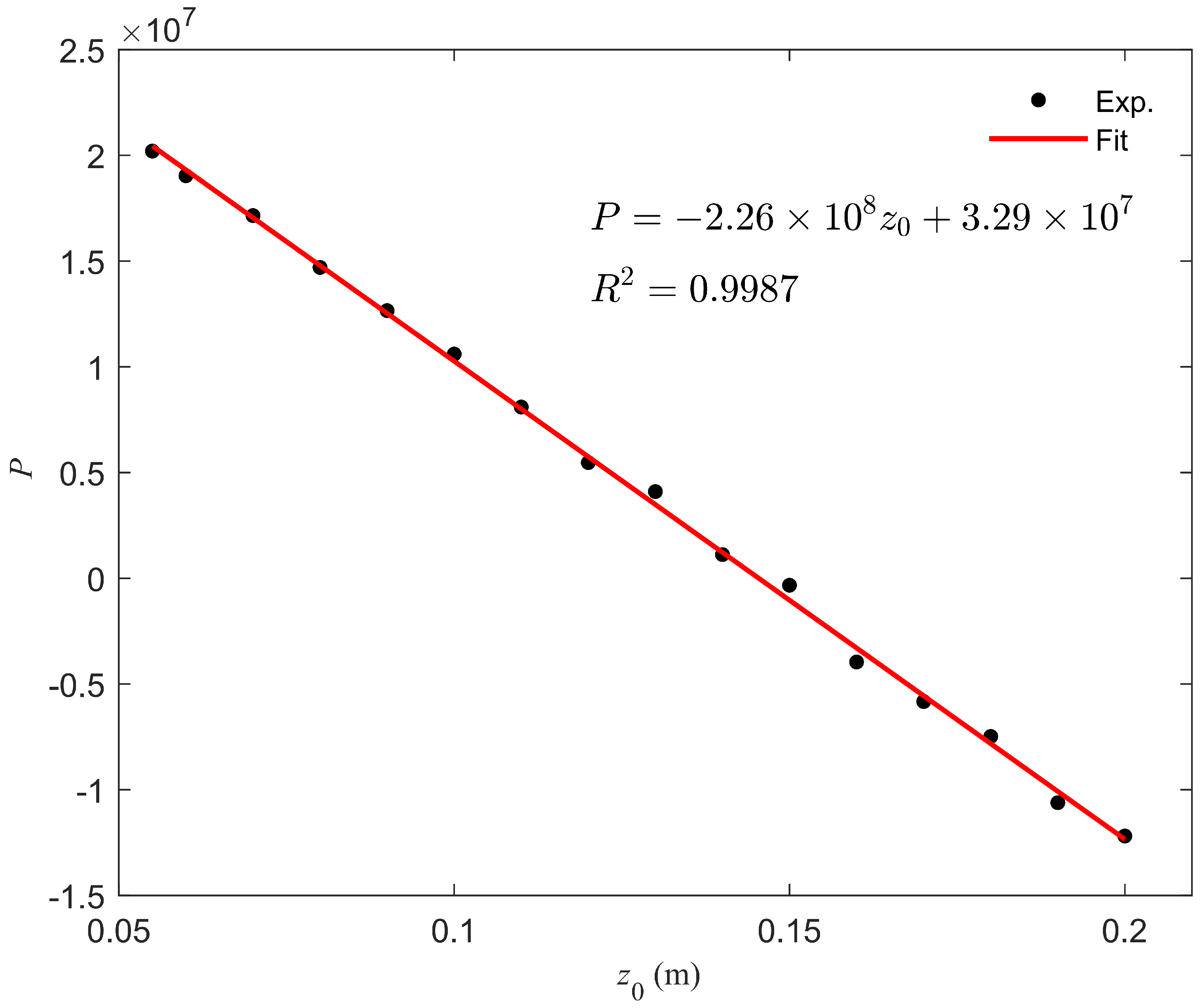
To elucidate and validate the relationship between the quadratic coefficients
P and the object-to-lens distance
, a series of experiments were conducted to capture the interference patterns of the triangle object, which is the same as that shown in
Figure 7, with
ranging from 5.5 to 20 cm. The proposed reconstruction method was applied to these interference patterns to retrieve the triangular objects, and the fitted quadratic coefficients
P are plotted as discrete points in
Figure 8 as a function of the distance
. It is clear that these data points lie along a straight line, and the corresponding linear fit (shown as the straight line in
Figure 8) is given by
m
−2. The slope and intercept of this line are in close agreement with the theoretical values
m
−3 and
m
−2, as predicted by Equation (
2). The small discrepancy between the experimental measurements and theoretical predictions may arise from several factors, such as a non-ideal (non-plane) source, lens aberrations, or limited phase unwrapping accuracy.
The explicit form of the phase factor in the diffraction field facilitates object reconstruction from its interference pattern. In experimental setups where lens aberrations such as defocus, field curvature, and astigmatism are significant, accurate extraction of the phase factor from the interference pattern is crucial to eliminate their effects in the reconstructed object. Furthermore, to minimize the effect of the quadratic phase in the object’s Fourier transform, one can adjust the object plane position so that the P coefficient in the phase factor becomes relatively large.
In addition, the proposed method simplifies the object reconstruction process after phase retrieval. Unlike the angular spectrum method, it does not require measuring the propagation distance, and unlike coherent diffraction imaging techniques, it avoids the need for iterative algorithms. In the far-field approximation, for objects with sizes on the order of several hundred micrometers, the distance between the object and the image plane typically exceeds several tens of centimeters. When a lens is employed, this distance can be reduced to the lens’s focal length, thereby potentially reducing the overall size of the diffraction or interferometric setup in the far-field regime. Moreover, the error reduction and hybrid input–output phase retrieval algorithms [
28,
35] were primarily developed for far-field coherent diffraction imaging and are generally not readily applicable to lens-based systems where the detector is positioned at the lens’s back focal plane. In contrast to these iterative algorithms, which typically require spatial constraints for ensuring iterative convergence, our reconstruction method does not rely on such constraints.