Article

Toward Robust Sampling Frequency Offset Recovery for Single-Carrier Signals in Photon-Assisted THz Transmission System


College of Photonic and Electronic Engineering, Fujian Normal University, Fuzhou 350117, China
*
Author to whom correspondence should be addressed.
Photonics 2026, 13(4), 397; https://doi.org/10.3390/photonics13040397
Submission received: 5 March 2026 / Revised: 12 April 2026 / Accepted: 16 April 2026 / Published: 21 April 2026
(This article belongs to the Special Issue Terahertz Communications in Photonics)

Abstract

The rapid development of 6G wireless networks requires ultra-high data rates that traditional microwave frequencies cannot support. Photonics-assisted terahertz (THz) technologies offer a promising solution by combining high-capacity optical fibers with wideband wireless transmission. However, as bandwidth expands, sampling frequency offset (SFO) becomes a critical issue that degrades signal quality in single-carrier systems. This paper evaluates the performance of two main compensation methods within a photonics-assisted THz system operating at 320 GHz. We compare the Gardner clock recovery algorithm and the Digital Interpolation Compensation Algorithm (DICA) across various modulation formats and offset levels. Our findings indicate that the Gardner algorithm is effective for low-order modulation when the SFO is below 100 ppm, but its performance fails outside this range. Conversely, the DICA provides robust compensation up to 1000 ppm regardless of the modulation format, provided that the exact offset value is known. Without proper compensation, the system BER increases significantly as the SFO grows. These results demonstrate the complementary nature of these two algorithms and provide a practical guide for selecting compensation strategies in future high-speed THz communication links.

1. Introduction

The rapid evolution of wireless communication technologies, from fifth-generation (5G) to the emerging sixth-generation (6G) and beyond, has triggered an unprecedented surge in global data traffic and connectivity demands [1,2,3,4]. This exponential growth is primarily driven by bandwidth-intensive applications including immersive virtual reality (VR), augmented reality (AR), digital twins, and ultra-high-definition video streaming [5,6,7,8,9]. According to recent projections, global mobile data traffic is expected to increase by nearly tenfold over the next decade, with peak data rates anticipated to reach terabits per second (Tbps) for future wireless networks [10,11,12]. Such demanding requirements impose stringent constraints on both the transmission capacity and spectral efficiency of wireless communication systems, necessitating the exploration of novel technological paradigms and previously underutilized frequency bands [10,13,14,15,16]. In response to these escalating challenges, photonics-aided radio-over-fiber (RoF) architectures have emerged as a promising solution, offering seamless integration between high-capacity optical fiber networks and flexible wireless access points [17,18,19,20,21,22,23]. These hybrid fiber-wireless systems leverage the maturity and bandwidth abundance of optical fiber infrastructure for long-haul transmission while exploiting wireless links for last-mile connectivity, thereby combining the advantages of both domains [24,25,26,27,28,29,30,31]. Photon-assisted millimeter-wave (mmWave) and terahertz (THz) technologies, in particular, have demonstrated exceptional promise for delivering multi-gigabit-per-second data rates to end users, effectively addressing the capacity bottlenecks imposed by conventional microwave-based wireless systems [32,33,34,35,36,37,38].
Moving toward higher carrier frequencies marks a basic change in wireless communication system design [39,40,41,42]. The mmWave band, from 30 to 300 GHz, and the THz band, from 0.3 to 10 THz, have attracted significant research interest [34,43,44,45]. They are seen as main candidates for next-generation ultra-high-speed wireless transmission. Compared with conventional microwave frequencies below 6 GHz, these higher frequency bands provide much larger continuous bandwidth resources [46,47,48,49]. This bandwidth can extend to tens or hundreds of GHz [50,51,52,53]. According to Shannon’s capacity theorem, larger bandwidth directly enables higher achievable data rates. For mmWave generation and transmission, two main technical methods have been widely studied. These are purely electrical frequency multiplication techniques and photonics-assisted heterodyning methods [54,55,56]. Traditional purely electrical methods use cascaded frequency multipliers, mixers, and power amplifiers to convert baseband or intermediate frequency signals to the desired mmWave or THz carrier frequencies [57]. However, these fully electronic solutions face basic limits caused by the unity-gain bandwidth and maximum oscillation frequency of semiconductor devices [58]. These limits typically restrict usable signal bandwidth to several GHz at mmWave frequencies. At THz frequencies, bandwidth restrictions are even more severe. In addition, purely electrical systems have high phase noise, high power consumption, limited frequency tunability, and increasing complexity as the operating frequency rises.
In clear contrast, photonics-assisted methods use the inherently broadband nature of optical components [59,60,61,62]. These components include external cavity lasers, intensity modulators, photodetectors, and optical fibers. They generate and transmit mmWave and THz signals through optical heterodyning or frequency mixing in high-speed photodiodes [29,63]. The photonics-assisted approach offers several important advantages. First, it provides ultra-wide modulation bandwidth exceeding 100 GHz, enabled by advanced optical modulators and uni-traveling-carrier photodiodes. Second, it achieves high frequency agility simply by adjusting the wavelength spacing between optical carriers, without changing hardware [64,65,66]. Third, it maintains low phase noise, inherited from narrow-linewidth optical sources. Fourth, it remains immune to electromagnetic interference during fiber transmission. Fifth, it allows simplified remote antenna unit architecture by centralizing signal processing at the central office. Sixth, it integrates smoothly with existing optical fiber infrastructure for cost-effective deployment. These built-in advantages make photonics-assisted technologies a highly promising solution for future ultra-high-speed wireless communication systems that operate at mmWave and THz frequencies.
Within the high-frequency spectrum, the THz band shows unique properties that set it apart from lower mmWave frequencies. This makes it especially attractive for certain applications, although it also introduces specific technical difficulties. While both mmWave and THz bands provide much larger bandwidth than conventional microwave frequencies, the THz spectrum offers access to even larger continuous frequency resources. Several atmospheric transmission windows in the THz range have relatively low signal loss. Notable examples are the windows around 300 GHz, 350 GHz, 410 GHz, and 670 GHz, where absorption by oxygen and water vapor is reduced. The relationship between carrier frequency, atmospheric attenuation, and achievable transmission distance creates a natural differentiation in application areas. mmWave frequencies, especially the D-band and W-band, are suitable for outdoor long-range wireless backhaul and fronthaul links over several kilometers. In comparison, THz frequencies perform well in short-range, ultra-high-capacity applications. These include indoor wireless personal area networks, wireless local area networks, connections within data centers, kiosk downloading, and device-to-device communications over distances from a few meters to several hundred meters.
The higher atmospheric attenuation at THz frequencies, typically between 10 and 100 decibels per kilometer depending on exact frequency and atmospheric conditions, offers a built-in benefit for dense spatial reuse and interference reduction in indoor environments. This enables intensive frequency reuse patterns that can significantly raise total system capacity. Furthermore, the shorter wavelengths at THz frequencies allow more compact antenna designs and higher-gain antenna arrays within the same physical size. This supports the use of massive multiple-input multiple-output and beamforming techniques with hundreds or thousands of antenna elements. Recent experiments have successfully achieved data rates over 100 Gbps per wavelength in THz-over-fiber systems operating above 300 GHz [67,68,69]. These results confirm the strong potential of photonics-assisted THz technologies for meeting the capacity needs of future 6G networks and beyond [70]. Considering these complementary features, an optimal next-generation communication infrastructure will likely use a heterogeneous architecture. It will combine kilometer-scale mmWave links for outdoor coverage with meter-scale THz hotspots for ultra-high-capacity indoor access. All these elements can be seamlessly integrated through photonics-assisted radio-over-fiber technology.
However, as the bandwidth and speed of THz systems increase, the hardware faces new challenges [71]. Specifically, the analog to digital converters and digital to analog converters must work very fast [72,73]. When these devices operate at high speeds, their actual sampling rate can differ from the theoretical rate. This problem is called sampling frequency offset (SFO) [74,75]. This offset can hurt the quality of the signal. As the signal travels or continues over time, the performance gets worse.
The problem of SFO is well known in multi carrier systems [76,77]. In those systems, each sample represents a different frequency component. Because of this, it is hard to fix the offset by changing other settings. Specific compensation techniques are required. However, multi carrier signals are not always the best choice for point to point THz links. In many cases, a single carrier format using QAM modulation is better [78,79]. These single carrier systems are often simpler and more efficient for high speed transmission [80,81].
Single carrier systems are also affected by SFO. To fix this, engineers usually use clock recovery methods like the Gardner algorithms [82,83]. These methods look for the best time to sample the signal to recover the original data. However, these traditional methods have limits. If the frequency offset is too large, the Gardner algorithm may become unstable or fail to work [84]. Also, if the signal uses a very complex modulation format, these methods might not be able to track the clock correctly. Therefore, it is important to study and design stable algorithms that can handle large offsets and high level modulation formats.
Past research shows that the Gardner algorithm works well for small offsets. However, a systematic investigation of its performance under the high-bandwidth and high-modulation-order conditions typical of photonics-assisted THz systems remains absent in the literature. This motivates a detailed comparison to clarify its practical utility and operational boundaries in such scenarios. Other research has suggested using Digital Interpolation Compensation Algorithm (DICA) to fix the offset in these systems [85]. This method works well but it requires the system to know the exact value of the offset. If the offset value is unknown or wrong, the compensation will be poor. Therefore, it is useful to compare these two methods. These two methods actually complement each other, but there is very little research comparing them in THz systems.
In this paper, we focus on photonics-assisted THz single-carrier communication systems and compare two different algorithms for the compensation of SFO. We performed a comprehensive evaluation through numerical simulations in a photonics-assisted THz single-carrier system with a center frequency of 320 GHz to analyze the specific application conditions for both methods in detail. The simulation results show that the Gardner algorithm maintains good performance when using low-order modulation formats and when the SFO remains below 100 ppm, but its performance worsens rapidly once the offset exceeds this range. In contrast, the DICA effectively compensates for SFO within a wide range of plus or minus 1000 ppm and is not sensitive to different modulation formats, though it requires the exact value of the SFO to be known. If no compensation is applied, the bit error rate (BER) performance of the system gradually declines as the SFO increases. The simulation results obtained in scenarios using long payloads are consistent with these findings. This consistency validates the robustness of our analysis and provides a reliable performance benchmark for the design and deployment of photonics-assisted THz single-carrier communication systems under practical payload constraints.

2. Fundamental Principles

2.1. Characterization of Sampling Frequency Offset

In the domain of digital signal processing, the SFO associated with a hardware sampling device is quantitatively defined by the normalized deviation ratio:
Δ = f a f n f n
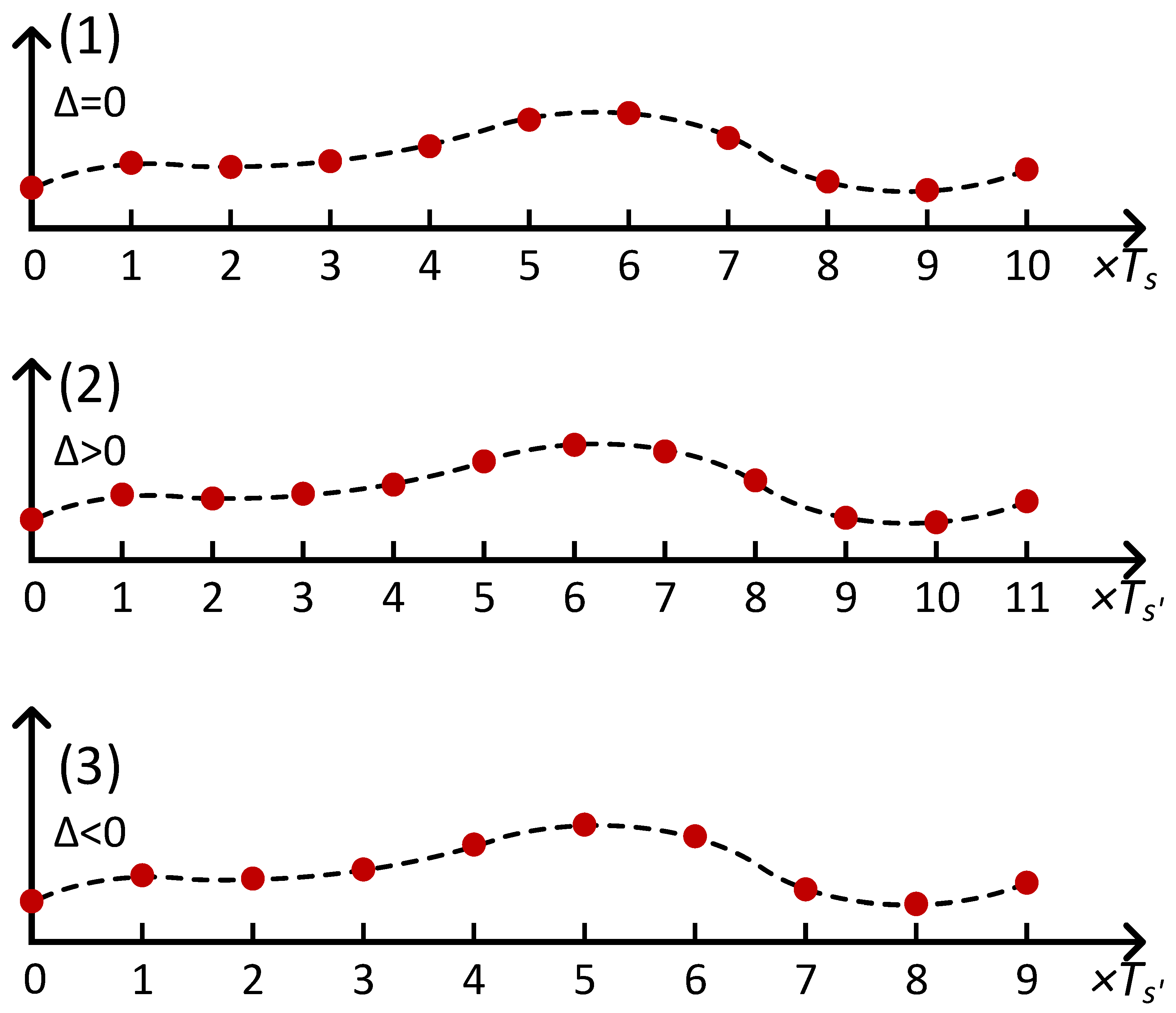
In this formulation, f a denotes the actual physical sampling rate exhibited by the hardware, whereas f n corresponds to the theoretical nominal sampling rate. In practical communication systems, the ideal nominal rate f n serves as an abstract reference and is not directly observable as a physical quantity. Figure 1 shows the SFO effect. Consequently, our analysis concentrates on the relative SFO existing between the DAC at the transmitter and the ADC at the receiver. For brevity in subsequent discussions, this relative discrepancy is referred to simply as SFO. As detailed in the literature [86], this relative SFO can be mathematically articulated as:
Δ = Δ ADC Δ DAC 1 + Δ DAC = 1 + Δ ADC 1 + Δ DAC 1
Regarding the receiver-side ADC, in an idealized scenario devoid of timing imperfections, the discrete-time sample sequence s [ n ] is obtained by digitizing the continuous analog waveform s ( t ) = l x t l T s h l ( l T s ) at fixed, uniform intervals. This process is described by:
s [ n ] = s ( t ) | t = n T s = l = 0 L h 1 x [ n l ] h l [ l ] + v [ n ]
Here, T s = 1 / f n signifies the nominal sampling period mandated by the system design. The term x ( t ) represents the transmitted continuous-time analog waveform corresponding to the Quadrature Amplitude Modulation (QAM) signal, which is associated with a digital sequence x [ n ] possessing a period of T s . Furthermore, h l ( t ) characterizes the channel impulse response with a finite duration of length L h , while v ( t ) accounts for the additive noise component present in the channel.
However, in the presence of a non-zero SFO denoted by Δ , the actual sampling instants deviate from the nominal grid, resulting in the following expression for the sampled signal:
s [ m ] = s ( t ) | t = m T s = l = 0 L h 1 x m Δ + 1 T s l T s h l ( l T s ) + v m Δ + 1 T s
where T s = 1 / f a defines the actual sampling period dictated by the hardware clock.
If the sequence s [ m ] is erroneously processed as if it were sampled at the nominal rate, the system suffers from Inter-Symbol Interference (ISI). Under these conditions, the accumulated timing deviations render the accurate recovery of the transmitted symbols impossible.

2.2. Gardner-Based Clock Recovery Method

Let us define y [ m ] as the received waveform sequence sampled at a rate of two samples per symbol (2-sps). Traditional timing recovery techniques utilizing the Gardner detector are designed to mitigate timing errors by identifying the optimal symbol decision points and interpolating between adjacent samples. The corrected signal is obtained via:
y ^ [ m ] = y m T s / 2 τ = interp _ cubic ( y [ m 2 ] , y [ m 1 ] , y [ m ] , y [ m + 1 ] , τ )
where the estimated timing error τ for QAM or PAM signal is given by [87]:
τ = Re ( y [ m ] ) * ( y [ m + 1 ] y [ m 1 ] )
where ( · ) * is conjugate operation.
However, when the SFO is large or the QAM modulation order is high, the performance of the Gardner algorithm drops sharply and may even reach an un-converged state. The Gardner clock recovery algorithm, while incorporating a certain degree of SFO compensation, is not specialized in SFO compensation.

2.3. DICA for SFO Compensation

To effectively mitigate the signal distortion arising from sampling rate mismatches, one can employ a compensation strategy rooted in digital interpolation techniques. Fundamentally, the artifact induced by SFO can be modeled as a resampling mismatch. Consequently, a piecewise polynomial interpolator implemented via a Farrow structure can be utilized to reconstruct a resampled signal that aligns with the desired temporal grid, thereby correcting the specific SFO.
s n T s = m s m T s h I n T s m T s
In the equation above, h I represents the impulse response characterizing the digital interpolation filter. By adopting a polynomial interpolator configuration based on the Farrow structure, the resampled signal s [ n ] can be expressed as:
s [ n ] = s m n + μ n T s = i = I 1 I 2 s m n i q = 0 Q c q ( i ) μ n q
The temporal indices are derived as follows:
m n = int n T s T s μ n = n T s T s m n
Here, m n denotes the base integer index, while μ n represents the fractional interval. The terms c q ( i ) correspond to the specific coefficients of the interpolation filter. The operator int[·] signifies the floor function, yielding the largest integer less than or equal to the argument. For this implementation, we utilize a fourth-order piecewise polynomial interpolator (i.e., Q = 4 ) constructed within the Farrow framework.
To iteratively compute the requisite integer index m n and the fractional delay parameter μ n for the interpolator input relative to T s , the following recursive relationships are applied:
m n + 1 = m n + int μ n + T s T s μ n + 1 = μ n + T s T s int μ n + T s T s
Alternatively, these parameters can be calculated explicitly as:
m n = int ( 1 + Δ ) n μ n = ( 1 + Δ ) n m
By leveraging the formulations presented in Equations (8) and (11), the distortions attributable to SFO can be precisely compensated for any given SFO magnitude. This approach stands in distinct contrast to the Gardner method, which relies on feedback-based timing recovery and local sample proximity. The digital interpolation-based SFO compensation technique tackles the problem from a fundamental perspective, directly rectifying the linearly accumulating timing offset inherent to sampling rate mismatches.

3. Simulation Setup

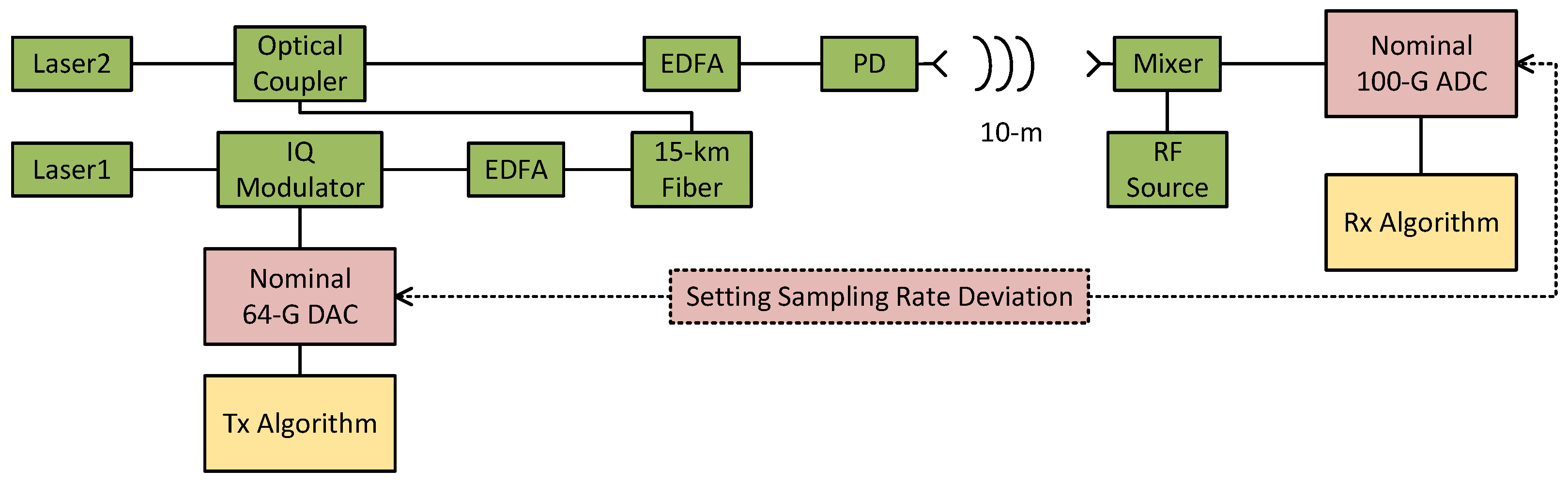
The structure of the system is shown in Figure 2, and the parameters for the key instruments are listed in Table 1. At the transmitter side, Laser1 outputs a continuous wave with a wavelength of 193.4 THz and a linewidth of 100 kHz. This light acts as the optical carrier and is injected into an IQ modulator. The baseband signal is generated by a DAC with a nominal sampling rate of 64 GSa/s. This signal enters the IQ modulator to complete the electrical to optical modulation process. An EDFA amplifies the modulated optical signal before it travels through 15 km of SSMF. After the fiber transmission, the signal is combined with the output of Laser2 using a 1×2 optical coupler. Laser2 has an output frequency of 193.72 THz and a linewidth of 100 kHz. The combined optical signal is amplified by another EDFA and sent into a high speed PD for beating. Because there is a 320 GHz frequency difference between the two optical carriers, the PD outputs a THz carrier with a center frequency of 320 GHz. This THz signal is radiated by an antenna and travels through a wireless channel of about 10 m.
At the receiver side, the signal captured by the antenna is sent to a mixer for down conversion. The other input of the mixer is connected to a local oscillator radio frequency source set to 337 GHz. For the received signal with a center frequency of 320 GHz, the mixing process creates an intermediate frequency signal at 17 GHz. This signal is sampled and digitized by an ADC with a nominal sampling rate of 100 GSa/s. The resulting data is then sent to the digital signal processing stages.
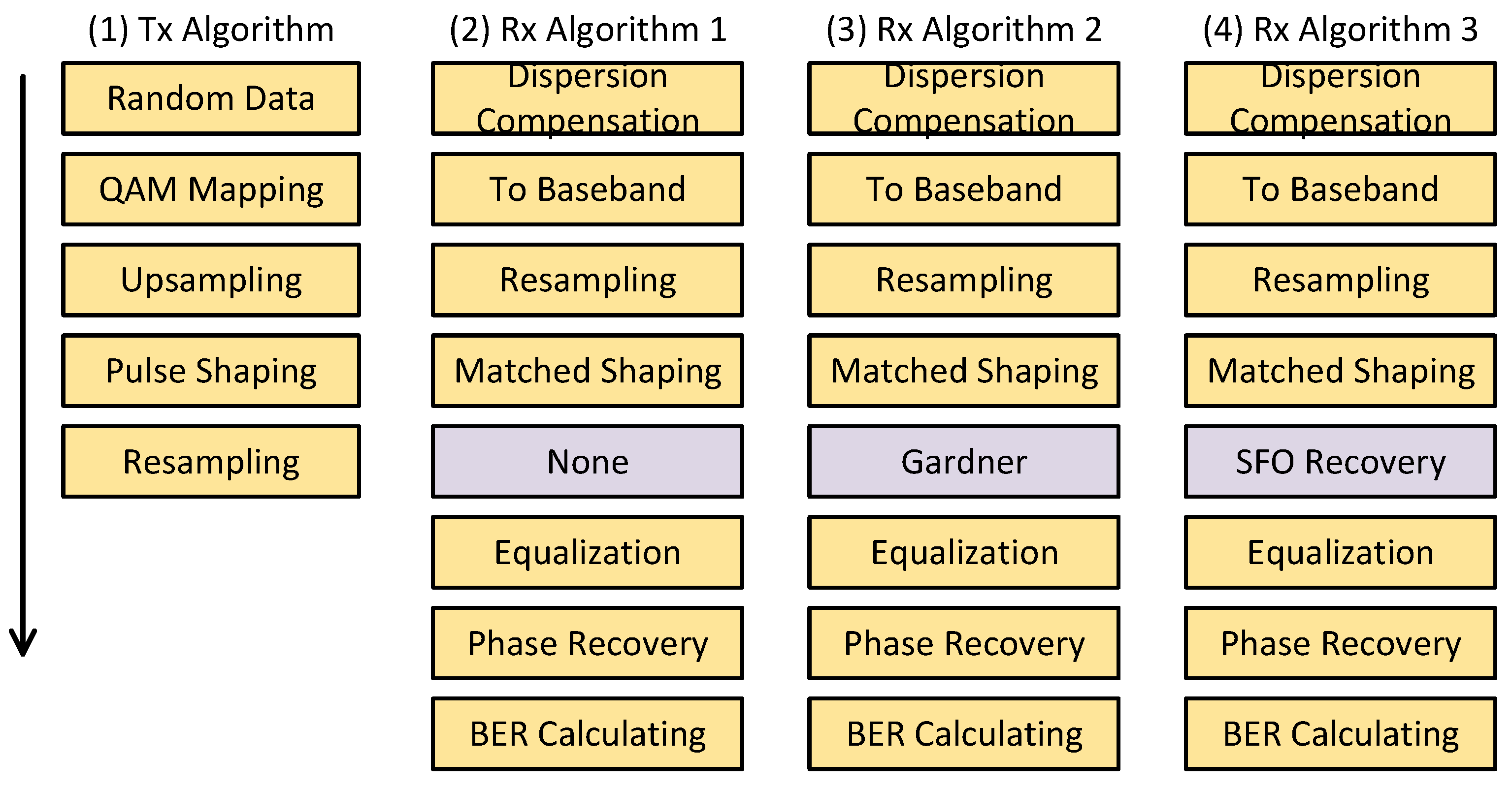
The signal processing steps at the transmitter are shown in Figure 3. First, a random binary sequence is generated as the source data and then mapped using QAM modulation. The modulated symbols undergo two times upsampling to reach 2 sps. These symbols are then shaped by an RRC pulse shaping filter with a roll off factor of 0.01. After shaping, the signal is resampled to match the nominal sampling rate of the DAC at 64 GSa/s for the subsequent digital to analog conversion.
The digital signal processing flow at the receiver is also shown in Figure 3. The signal from the ADC first undergoes chromatic dispersion compensation to suppress effects from the fiber link. Digital down conversion then moves the signal to baseband and it is resampled to a symbol rate of 2 sps. Next, a matched RRC filter with a roll off factor of 0.01 is used. After this step, the process follows one of three different paths depending on the compensation strategy. The first scheme involves no SFO compensation at all. The second scheme uses the Gardner clock recovery algorithm to estimate and fix the SFO. The third scheme uses DICA based on a known SFO value. After the SFO stage, the signal goes through equalization and carrier phase recovery. Finally, a decision is made to calculate the BER so that the performance of the three schemes can be compared under different channel conditions.
In the simulation, we create different SFO conditions by adjusting the actual sampling rates of the DAC and the ADC. Specifically, the actual sampling rates for the DAC and ADC are set as shown in the column titled Actual sampling rate in Table 1. By making these rates deviate from the nominal values of 64 GSa/s for the DAC and 100 GSa/s for the ADC, and calculating from Equation (2), we introduce the required SFO into the system. This allows us to evaluate how each compensation algorithm performs under different levels of frequency offset.

4. Results and Discussion

4.1. SFO Compensation Analysis

This section analyzes the impact of SFO on the bit error rate (BER) for different modulation formats including 4-QAM, 16-QAM, and 64-QAM at a transmission rate of 32 GBaud. We compare the performance of three specific scenarios: no compensation, compensation using the Gardner algorithm, and compensation using the DICA.

4.1.1. Performance Under 4-QAM Modulation

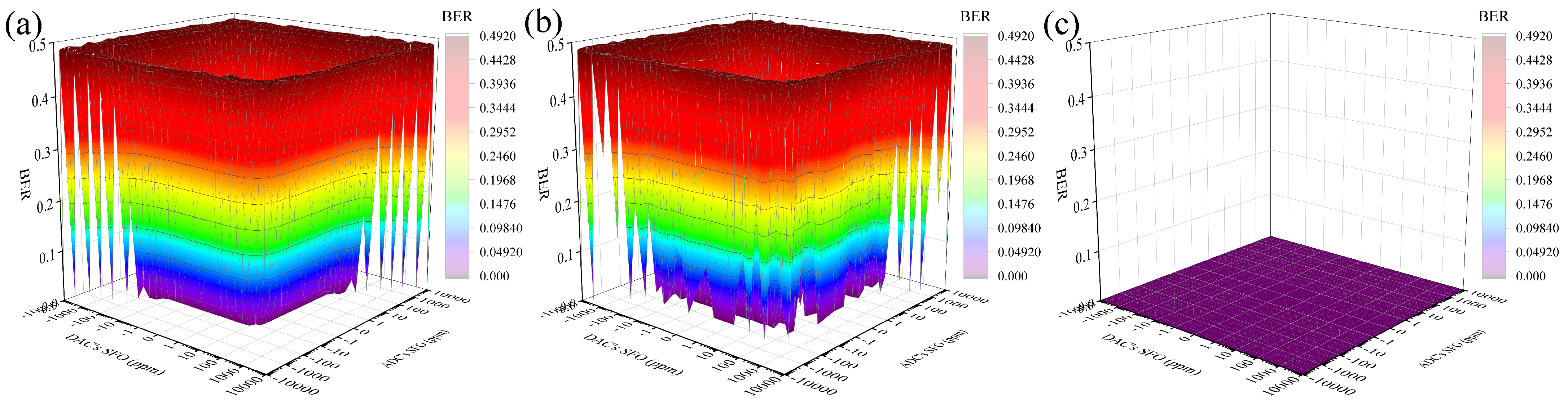
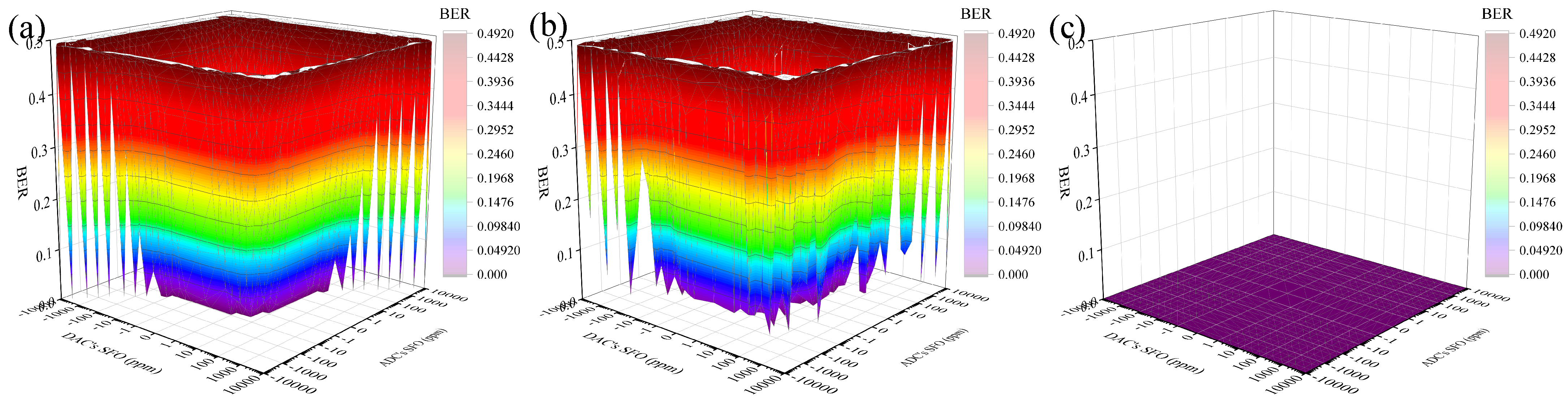
Figure 4 illustrates the performance surfaces of the system BER as a function of SFO under 32 GBaud 4-QAM modulation. In these plots, the X-axis represents the SFO of the DAC, the Y-axis represents the SFO of the ADC, and the Z-axis shows the resulting BER. Figure 4a displays the BER performance when no SFO compensation is used. Figure 4b shows the results after applying SFO compensation with the Gardner clock recovery algorithm. Figure 4c provides the performance after using the DICA scheme.
From Figure 4a, it is clear that without any SFO compensation, the system can only maintain an acceptable BER when the absolute SFO values for both the ADC and DAC are very small, specifically within a range of about ±1 ppm. Once the SFO exceeds this small area, the BER rises sharply and system performance degrades quickly. It is important to note that when the SFO of the ADC and DAC are equal (X = Y), the relative offset between the transmitter and receiver clocks is zero. In this case, the system acts as if there is no SFO effect and the BER remains consistently low.
After applying the Gardner algorithm in Figure 4b, the low BER region expands compared to the case with no compensation. The system can maintain stable performance when the absolute SFO is generally below 50 ppm. However, when the SFO goes beyond this threshold, the compensation ability of the Gardner algorithm drops significantly and the BER increases rapidly. This shows that its effective operating range is limited.
In contrast, the DICA scheme shown in Figure 4c demonstrates superior correction capability over a much wider range of SFO. The system BER remains at a low level regardless of the SFO values for the ADC or DAC. This proves that the algorithm is highly robust against SFO and is suitable for situations where the sampling clock offset is large or changes quickly.
In summary, these simulation results indicate that the Gardner algorithm is effective and has low complexity when the SFO is small (less than 50 ppm). However, when the SFO is large or covers a wide range, the DICA scheme is better at ensuring system performance. The DICA scheme requires accurate SFO estimation or an extra control loop. In actual system design, the choice should be based on the expected SFO range, algorithm complexity, and available hardware resources.

4.1.2. Performance Under 16-QAM Modulation

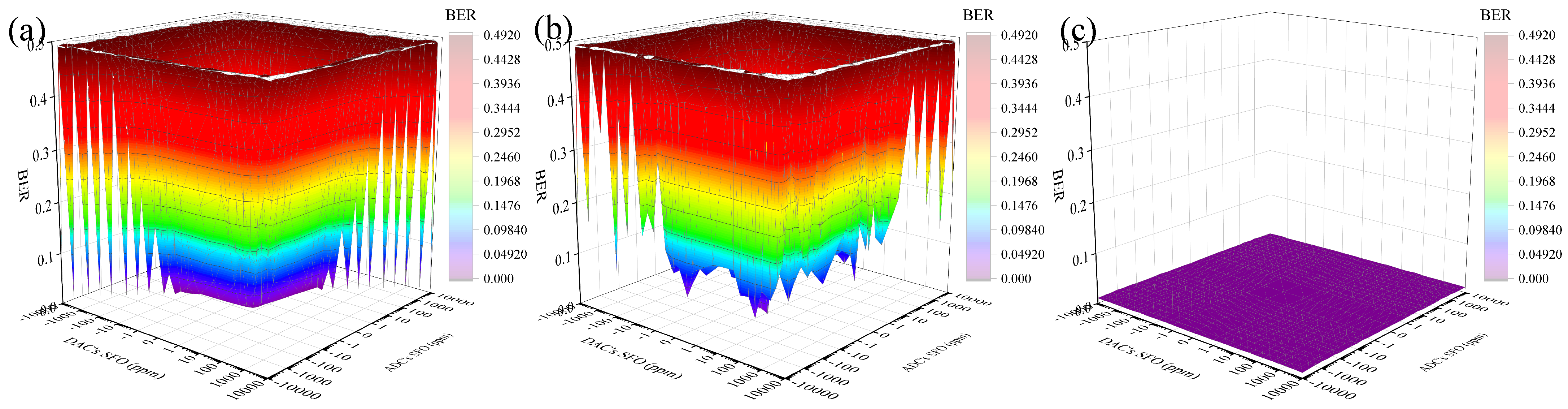
Figure 5 shows the BER performance surfaces under 32 GBaud 16-QAM modulation with the same coordinate definitions as Figure 4. Figure 5a represents the case without SFO compensation, Figure 5b shows the results using the Gardner algorithm, and Figure 5c shows the results using DICA.
As seen in Figure 5a, without compensation, the system only maintains an acceptable BER in a very tiny range where the SFO of the ADC and DAC are both less than about 1 ppm. Once the offset leaves this range, the BER rises sharply. This demonstrates that higher order modulation is more sensitive to errors in sampling clock synchronization.
When using the Gardner algorithm in Figure 5b, the effective working range is smaller than in the 4-QAM scenario. Specifically, the SFO tolerance for maintaining a low BER is less than 50 ppm for 16-QAM. This happens because the distance between symbol points decreases as the modulation order increases from 4-QAM to 16-QAM. This makes the timing error detection in the Gardner algorithm more sensitive to noise and interference, which reduces estimation accuracy and limits the compensation effect. Meanwhile, the DICA scheme in Figure 5c still maintains a stable low BER over a wide SFO range. This further proves its robustness at higher modulation orders.

4.1.3. Performance Under 64-QAM Modulation

Figure 6 shows the BER performance surfaces under 32 GBaud 64-QAM modulation. Figure 6a is the scheme without SFO compensation, Figure 6b uses the Gardner algorithm, and Figure 6c uses DICA.
In Figure 6a, the tolerable SFO range shrinks even further without compensation. The BER only stays at an acceptable level when the absolute SFO values are extremely small. Even a slight increase in offset leads to a rapid drop in performance. This shows that the requirements for sampling clock synchronization become much stricter as the modulation order increases.
For the Gardner algorithm in Figure 6b, the compensation capability drops significantly under high-order modulation. In the 64-QAM scenario, the Gardner algorithm struggles to correct the SFO effectively. Its low BER working range is much smaller than it was for 16-QAM. This is mainly because the smaller symbol distance in 64-QAM limits the accuracy of timing error detection under low signal to noise ratio conditions. This makes it difficult for the loop to converge or causes it to fail entirely.
On the other hand, the DICA scheme in Figure 6c still shows excellent robustness under 64-QAM modulation. This scheme can maintain a stable low BER over a wide range of SFO. This indicates that the performance of this compensation method is not sensitive to changes in the modulation order, making it more suitable for high-order modulation systems.

4.1.4. Comprehensive Comparison and Discussion

By comparing Figure 4 through Figure 6, it is clear that the sensitivity of the system to SFO increases significantly as the modulation format moves from 4-QAM to 64-QAM. The Gardner algorithm provides effective low complexity compensation for lower modulation orders and small SFO ranges below 50 ppm, but its performance drops quickly as the modulation order rises. The DICA scheme displays a broad compensation range and strong robustness across all tested modulation orders. However, implementing DICA usually requires accurate SFO estimation or additional control overhead.
In the design of an actual photonics assisted THz communication system, the low complexity Gardner algorithm can be used for clock recovery if the SFO is small and the modulation order is low. If the system uses high-order modulation such as 16-QAM or 64-QAM, or if there is a large sampling clock offset, the digital interpolation compensation scheme should be prioritized to ensure the reliability of the link.

4.2. Long Payload Analysis

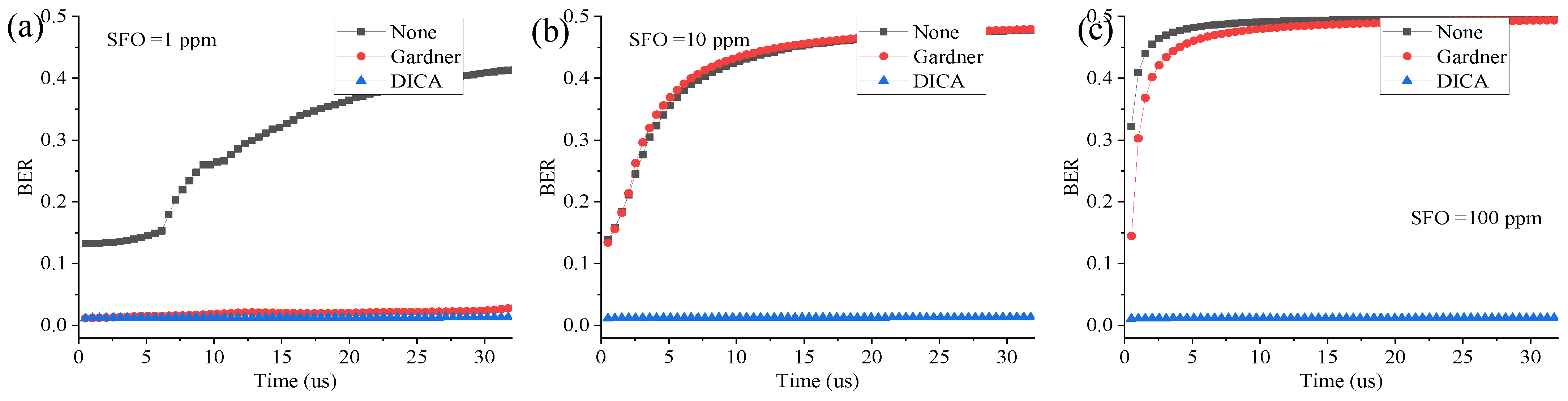
This section evaluates the stability of the algorithms in a realistic long frame transmission scenario. We used simulation to analyze the evolution of the system BER over an ultra long signal frame of 30 μs. We tested preset SFO values of 1 ppm, 10 ppm, and 100 ppm. We compared the performance of three schemes: no compensation, the Gardner algorithm, and DICA across different modulation formats.

4.2.1. Performance Under 4-QAM Modulation

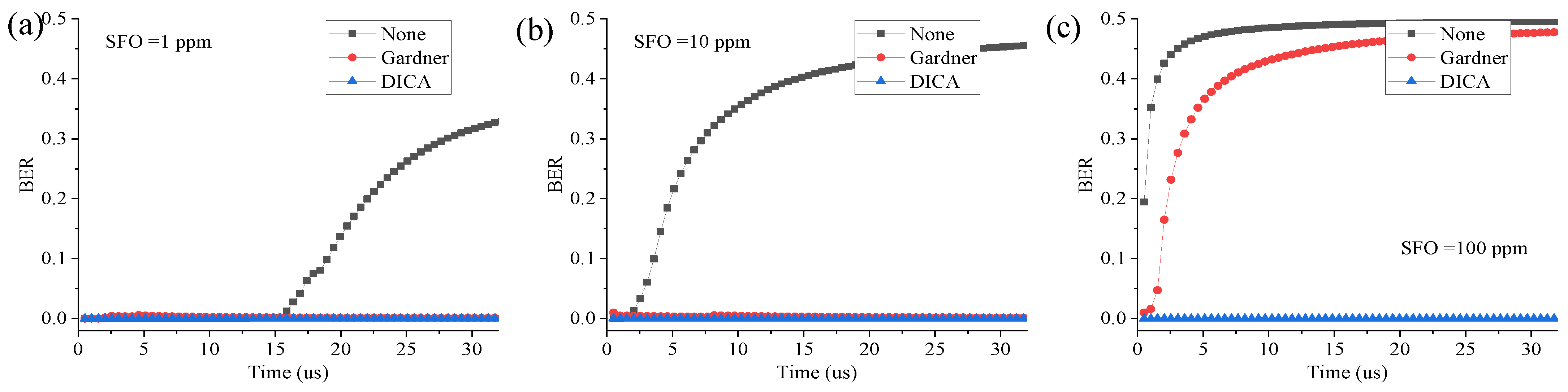
Figure 7 shows the change in system BER over the preset SFO values for a long frame of 30 μs. The results in this section are based on 4-QAM modulation.
As shown in Figure 7a, when the SFO is 1 ppm, the scheme without any compensation maintains a low BER during the initial phase of transmission. However, the BER begins to rise gradually after about 15 μs and eventually worsens to over 30 percent. This happens because the timing error caused by the SFO accumulates over time. This leads to symbol timing drift or jumps which causes severe signal damage. This result indicates that effective compensation is necessary for long frame transmission even with small SFO conditions. In contrast, the system maintains a low BER throughout the entire 30 μs frame when using the Gardner algorithm or DICA. This shows that both methods can effectively track and compensate for slow clock offsets in 4-QAM systems with an SFO around 1 ppm.
Figure 7b shows the BER evolution for the three schemes when the SFO is 10 ppm. Without compensation, the BER starts to rise after approximately 2 μs. It continues to worsen over time and reaches a level of about 50 percent. This is because the rate of timing drift at 10 ppm is ten times faster than at 1 ppm. Therefore, the symbol jumps and performance degradation occur much earlier. This confirms that the system fails quickly without compensation under moderate SFO conditions. In contrast, the Gardner algorithm and DICA maintain a stable and low BER throughout the 30 μs frame. Both algorithms demonstrate good tracking ability within the 10 ppm range.
Figure 7c shows the results when the SFO is 100 ppm. Without compensation, the BER rises sharply right at the beginning of transmission and quickly settles at around 50 percent. The fast drift rate at this large SFO causes severe misalignment between symbols in a very short time. This proves that the system will completely fail in high speed THz systems with large SFO if no measures are taken.

4.2.2. Performance Under 16-QAM Modulation

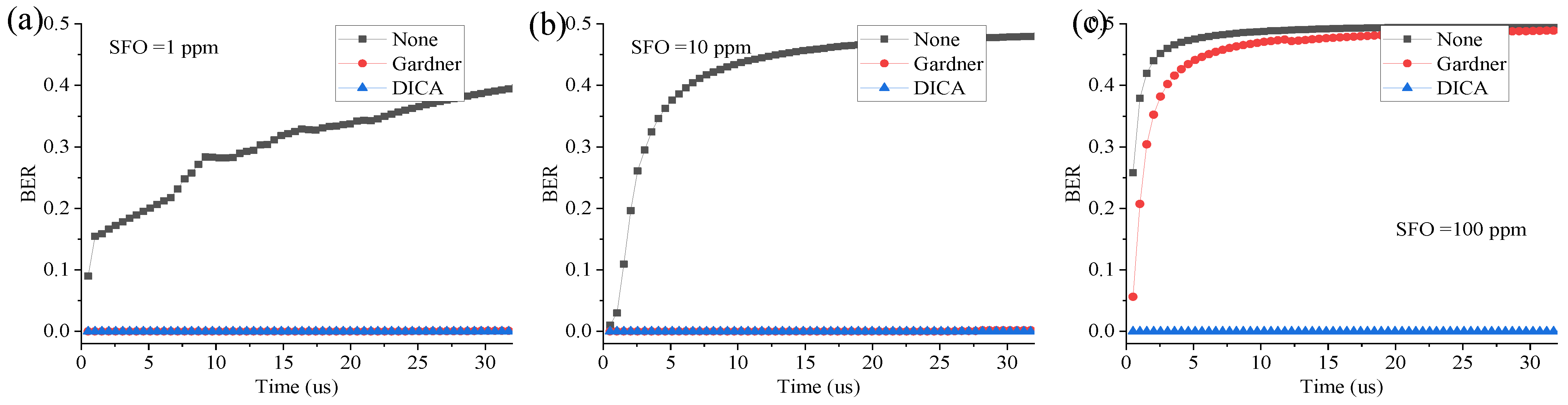
Figure 8 illustrates the BER evolution under 16-QAM modulation with a frame length of 30 μs. This section focuses on the increased sensitivity of high-order modulation to SFO and the effectiveness of the compensation algorithms.
As shown in Figure 8a, without compensation, the BER rises sharply at the start of transmission when the SFO is 1 ppm. This is very different from the 4-QAM case where degradation appeared only after 15 μs. This indicates that high order modulation has a much lower tolerance for SFO. Even a small absolute SFO value causes inter symbol interference and phase noise that lead to decision errors because the constellation points are closer together. However, both the Gardner algorithm and DICA keep the BER extremely low throughout the frame. This shows they can still handle the higher sensitivity of 16-QAM at 1 ppm.
Figure 8b shows the performance at 10 ppm. Similar to the 4-QAM case, the uncompensated error rate starts rising at about 2 μs. However, the rate of increase is significantly faster for 16-QAM. This confirms that high-order modulation is more sensitive to inter symbol interference. The Gardner algorithm and DICA still maintain a stable low BER. This proves they are effective for 16-QAM signals within the 10 ppm range.
Figure 8c shows the results at 100 ppm. Without compensation, the error rate hits 50 percent almost immediately. The Gardner algorithm provides partial compensation for a brief moment but eventually fails as the error rate rises to 50 percent. The rise is faster than in the 4-QAM case. This means the Gardner algorithm exceeds its effective tracking range at 100 ppm for high-order modulation. In contrast, DICA maintains a very low and stable BER even under these harsh conditions. This confirms the strong robustness of DICA against large SFO and modulation changes.

4.2.3. Performance Under 64-QAM Modulation

Figure 9 shows the BER evolution for 64-QAM modulation over a 30 μs frame. This section analyzes the extreme sensitivity of very high-order modulation.
As shown in Figure 9a, the uncompensated scheme fails immediately even at 1 ppm. This degradation is more rapid and severe than for 16-QAM. It shows that the tolerance for SFO is further reduced for 64-QAM. Even tiny timing errors cause severe overlapping of constellation points. However, the Gardner algorithm and DICA still maintain a low and stable BER. They remain effective for 64-QAM at 1 ppm.
Figure 9b shows the results at 10 ppm. The curves for the uncompensated scheme and the Gardner algorithm are almost identical. Both deteriorate rapidly from the start and reach a 50 percent error rate. This result indicates that the Gardner algorithm has lost its ability to compensate for 64-QAM signals at 10 ppm. The main reason is that the timing error detector cannot accurately extract information due to the very small distance between constellation points. Meanwhile, the larger SFO increases the speed of timing drift. In sharp contrast, DICA maintains a very low BER. This demonstrates its good robustness even with high-order modulation and moderate SFO.
Figure 9c shows the results at 100 ppm. Both the uncompensated scheme and the Gardner algorithm fail completely. The error rates rise rapidly to 50 percent. This confirms that the Gardner algorithm is ineffective under the combined conditions of extreme SFO and very high-order modulation. Conversely, DICA maintains a stable and very low BER. This shows that DICA is robust across a wide range of SFO from 1 to 100 ppm and for all tested modulation formats.

4.2.4. Comprehensive Discussion and Summary

A comprehensive analysis of Figure 7 through Figure 9 shows that modulation order, SFO magnitude, and frame length jointly determine system performance. The tolerance of the system to SFO drops sharply as the modulation order increases from 4-QAM to 64-QAM. The Gardner algorithm provides effective low complexity compensation for low order modulation and small SFO values. However, its performance drops significantly as the modulation order rises. It fails for 64-QAM even when the SFO is only 10 ppm. In contrast, DICA demonstrates excellent robustness and stability across a wide SFO range of 1 to 100 ppm and for all modulation formats. However, its high performance usually depends on accurate SFO estimation. Therefore, the Gardner algorithm is a suitable choice for systems with small SFO and low modulation orders. For systems using high-order modulation, large SFO, or long frame transmission, DICA should be the preferred solution.

4.3. Comprehensive Discussion and Design Guidelines

This section summarizes the performance boundaries of different SFO processing schemes based on the simulation results. It also provides guidelines for selecting algorithms from a system design perspective.

4.3.1. Scope of the Scheme Without Compensation

The simulation results show that the system can only maintain performance without any SFO compensation under very limited conditions. Specifically, the system maintains an acceptable bit error rate only when the absolute value of SFO is not greater than 1 ppm, the modulation format is 4-QAM, and the transmission frame length does not exceed about 15 μs for a 32 GBaud signal. Once the SFO exceeds this threshold, or if the modulation order increases or the frame length becomes longer, the accumulated timing error causes performance to deteriorate rapidly. Therefore, effective SFO compensation mechanisms are necessary in most practical systems, especially those using high-order modulation or long frame transmission.

4.3.2. Scope and Limitations of the Gardner Algorithm

The Gardner algorithm can effectively compensate for SFO under certain conditions, but its performance is significantly affected by the modulation order and the SFO magnitude. When the modulation order is 16-QAM or lower and the SFO does not exceed 100 ppm, the Gardner algorithm achieves stable compensation for any frame length. However, when the modulation order rises to 64-QAM, its effective compensation range shrinks sharply. It only works normally when the SFO is below about 10 ppm. If the SFO exceeds 10 ppm, its performance is similar to the scheme without compensation. This is mainly because the smaller distance between constellation points in high-order modulation reduces the accuracy of timing error detection. At the same time, a larger SFO increases timing drift, making it impossible for the algorithm to track stably in long frames. Therefore, the Gardner algorithm is suitable for low complexity scenarios where the SFO is small and the modulation order is low, specifically 16-QAM or lower.

4.3.3. Scope and Conditions of DICA

DICA demonstrates superior robustness under all conditions. It achieves effective compensation for any modulation format including 4-QAM, 16-QAM, and 64-QAM, as well as for long frame signals of at least 30 μs, within a wide SFO range not exceeding 1000 ppm. Its performance is not sensitive to the modulation order. However, achieving this high performance depends on a key prerequisite. The specific SFO value must be known or estimated with high precision. This usually requires an additional estimation module or control loop, which introduces a certain amount of complexity and overhead.

4.3.4. System Design Guidelines

Based on the above analysis, we propose the following guidelines for the clock recovery design in photonics assisted THz communication systems. If the expected SFO of the system is below 10 ppm and the modulation is not higher than 16-QAM, the Gardner algorithm should be the preferred choice to reduce implementation complexity while ensuring performance. If the system uses high-order modulation such as 64-QAM, or if the SFO might exceed 10 ppm, or if continuous long frame transmission is required, the DICA scheme should be selected. This scheme should be equipped with a high precision SFO estimation mechanism, such as pilot based or data aided estimation algorithms. When selecting an algorithm, one must comprehensively consider SFO estimation accuracy, computing resources, power consumption, and frame structure to achieve a reasonable balance between performance and complexity. Through systematic simulation analysis, this study clarifies the performance boundaries of different compensation schemes and provides a theoretical basis and engineering reference for the robust clock recovery design of high speed THz systems. The results are also summarized and listed in Table 2.

5. Conclusions

In conclusion, this study demonstrates the critical impact of SFO on the performance of photonics-assisted THz single-carrier transmission systems operating at 320 GHz. Through comprehensive numerical evaluations, we established that while the Gardner algorithm remains effective for low-order modulation formats with SFO levels below 100 ppm, its compensation capability diminishes rapidly beyond this threshold. Conversely, the DICA provides robust and modulation-independent performance across a wide offset range of up to ±1000 ppm, contingent upon precise knowledge of the offset value. These findings highlight the complementary characteristics of both algorithms and offer a strategic framework for selecting SFO compensation techniques in future ultra-high-speed 6G terahertz communication.

Author Contributions

Conceptualization, methodology, software, validation, formal analysis, investigation, resources, data curation, writing—original draft preparation, writing—review and editing, visualization, H.Y.; supervision, Y.Y.; writing—review and editing (final), L.S. All authors have read and agreed to the published version of the manuscript.

Funding

This research received no external funding.

Institutional Review Board Statement

Not applicable.

Informed Consent Statement

Not applicable.

Data Availability Statement

The raw/processed data required to reproduce these findings cannot be shared at this time, as the data form part of another ongoing study.

Conflicts of Interest

The authors declare no conflicts of interest.

References

  1. Wang, Y.; Li, W.; Ding, J.; Zhang, J.; Zhu, M.; Zhao, F.; Wang, M.; Yu, J. Integrated High-Resolution Radar and Long-Distance Communication Based-on Photonic in Terahertz Band. J. Light. Technol. 2022, 40, 2731–2738. [Google Scholar] [CrossRef]
  2. Wang, Y.; Du, D.; Song, Y.; Li, Z.; Ye, N.; Zhang, Q.; Zhang, J.; Chen, J.; Cao, B.; Yu, J. Integrated Radar Jamming Signal Generation and Secure Wireless Communication Based on Photonics at Ka-Band. IEEE Trans. Microw. Theory Tech. 2024, 72, 6010–6019. [Google Scholar] [CrossRef]
  3. Nagatsuma, T. Terahertz communications: Past, present and future. In Proceedings of the 2015 40th International Conference on Infrared, Millimeter, and Terahertz Waves (IRMMW-THz), Hong Kong, China, 23–28 August 2015; pp. 1–2. [Google Scholar] [CrossRef]
  4. Wang, Y.; Zhou, W.; Ding, J.; Tan, Y.; Sang, B.; Liu, C.; Zhao, F.; Yu, J. QAM Vector Mm-Wave Signal Generation Based on Optical Orthogonal Polarization SSB Scheme By a Single Modulator. J. Light. Technol. 2021, 39, 7628–7635. [Google Scholar] [CrossRef]
  5. Wang, Y.; Di, S.; Du, D.; Song, Y.; Zhang, Q.; Zhang, J.; Wang, M.; Yu, J. Photonics-Assisted Millimeter-Wave Integrated Sensing and Communication Based on OTFS. J. Light. Technol. 2025, 43, 10512–10520. [Google Scholar] [CrossRef]
  6. Li, X.; Yu, J.; Chang, G.K. Photonics-Assisted Technologies for Extreme Broadband 5G Wireless Communications. J. Light. Technol. 2019, 37, 2851–2865. [Google Scholar] [CrossRef]
  7. Song, H.J. Terahertz Wireless Communications: Recent Developments Including a Prototype System for Short-Range Data Downloading. IEEE Microw. Mag. 2021, 22, 88–99. [Google Scholar] [CrossRef]
  8. Li, X.; Yu, J.; Chang, G.K. Photonics-Aided Millimeter-Wave Technologies for Extreme Mobile Broadband Communications in 5G. J. Light. Technol. 2020, 38, 366–378. [Google Scholar] [CrossRef]
  9. Wang, Y.; Lu, W.; Song, Y.; Yu, J. Photonics-Assisted mmWave Integrated Sensing and Communication System Enabled by ODDM Waveform. IEEE Trans. Microw. Theory Tech. 2025, 74, 2833–2842. [Google Scholar] [CrossRef]
  10. Zhao, L.; Wang, Y.; Du, D.; Song, Y.; Li, Z.; Ye, N.; Zhang, Q.; Zhang, J.; Zhu, M.; Zhang, J.; et al. A Low-Complexity Neural Equalizer for Nonlinear Compensation in Photonics-Assisted Terahertz Wireless Links Beyond 500 GHz. In IEEE Transactions on Terahertz Science and Technology; IEEE: Piscataway, NJ, USA, 2025; pp. 1–13. [Google Scholar] [CrossRef]
  11. Wang, Y.; Du, D.; Song, Y.; Li, Z.; Ye, N.; Zhang, Q.; Zhang, J.; Chen, J.; Cao, B. Photonics-Based Integrated Radar Jamming and Secure Communication System at Ka-Band. J. Light. Technol. 2024, 42, 3621–3630. [Google Scholar] [CrossRef]
  12. Du, D.; Wang, Y.; Song, Y.; Liao, M.; Yu, J. Highly Secure Hybrid FSO-mmWave System Based on Key Accompanying Transmission in Pilot Subcarriers. J. Light. Technol. 2026, 44, 87–94. [Google Scholar] [CrossRef]
  13. Li, W.; Yu, J.; Zhu, B.; Wang, F.; Ding, J.; Zhang, J.; Zhu, M.; Zhao, F.; Xie, T.; Wang, K.; et al. Photonic Terahertz Wireless Communication: Towards the Goal of High-Speed Kilometer-Level Transmission. J. Light. Technol. 2024, 42, 1159–1172. [Google Scholar] [CrossRef]
  14. Nagatsuma, T. Generating millimeter and terahertz waves. IEEE Microw. Mag. 2009, 10, 64–74. [Google Scholar] [CrossRef]
  15. Song, H.J.; Nagatsuma, T. Present and Future of Terahertz Communications. IEEE Trans. Terahertz Sci. Technol. 2011, 1, 256–263. [Google Scholar] [CrossRef]
  16. Kong, A.; Ren, J.; Wang, K.; Yu, Y.; Lin, R.; Wang, C.; Long, J.; Pang, F.; Chen, X.; Yan, X.; et al. Ultra-Wideband Optical Diffractive Network for Mode Multiplexing across the Entire Telecommunication Range. Nat. Commun. 2025, 17, 233. [Google Scholar] [CrossRef] [PubMed]
  17. Long, J.; Zhou, W.; Yu, J.; Wang, C.; Zhang, L.; Sang, B.; Wu, Y.; Yang, X.; Chen, Y.; Wei, Y.; et al. Net 562.5-Gbps/λ 2 × 2 MIMO Optical Wireless Transmission System at 322 GHz with Sampling Frequency Offset Compensation. J. Light. Technol. 2025, 43, 6120–6127. [Google Scholar] [CrossRef]
  18. Chen, Y.; Wang, C.; Yu, J.; Long, J.; Sang, B.; Li, F. An Efficient Phase Noise Elimination Method to Facilitate Cost-Effective 100/200G Coherent PON. J. Light. Technol. 2025, 43, 7075–7082. [Google Scholar] [CrossRef]
  19. Zhang, L.; Yu, J.; Wang, K.; Zhu, Z.; Yang, X.; Jiang, L.; Liu, J.; Sang, B.; Wang, C.; Long, J.; et al. Real-Time Intra-Symbol Two-Stage Bit-Class Distribution Matcher-Based PS-64QAM DMT Transceiver for W-Band Wireless Transmission. J. Light. Technol. 2025, 43, 1759–1772. [Google Scholar] [CrossRef]
  20. Zhao, L.; Sang, B.; Tan, Y.; Wang, K.; Zhou, W.; Wang, Y.; Ding, J.; Xiao, J.; Yu, J. Transmission of 1024-QAM OFDM at 28 GHz Radio Frequency Using 5G Millimeter Wave Phased Array Antenna. IEEE Trans. Microw. Theory Tech. 2022, 70, 4211–4217. [Google Scholar] [CrossRef]
  21. Chen, Y.; Yu, J.; Wang, C.; Long, J.; Sang, B.; Li, F. Low-Cost 100 G PON Based on a Residual Optical Carrier for Carrier Recovery. Opt. Lett. 2025, 50, 181–184. [Google Scholar] [CrossRef]
  22. Long, J.; Wang, C.; Wu, Y.; Sang, B.; Bian, C.; Yang, X.; Zhang, L.; Chen, Y.; Zhang, Q.; Wang, Y.; et al. Digital Frequency-Domain MIMO Equalizer Enabling Six-LP-Mode Strong-Coupling IM/DD MDM Optical Transmission System. Sensors 2025, 25, 2562. [Google Scholar] [CrossRef]
  23. Wang, C.; Long, J.; Wang, K.; Yang, X. Low-Complexity MIMO Neural Network Equalization Integrated with Batch-Wise Phase Recovery for Coherent Transmission. Opt. Laser Technol. 2025, 188, 112942. [Google Scholar] [CrossRef]
  24. Chen, Y.; Yu, J.; Wang, C.; Long, J.; Sang, B.; Zhou, W.; Wang, K.; Li, F. Cost-Effective 200-Gbps/λ Coherent PON Enabled by DFB Lasers and a Pilot-Based Carrier Recovery. Sci. China Inf. Sci. 2025, 68, 179301. [Google Scholar] [CrossRef]
  25. Li, K.; Xu, S.; Chen, Y.; Long, J.; Yu, J. 2 × 2 MIMO Mm-Wave Wireless Signal Transmission Based on a Novel ROF Architecture via Dual Hollow-Core Fibers. Opt. Fiber Technol. 2026, 98, 104555. [Google Scholar] [CrossRef]
  26. Long, J.; Yu, J.; Wang, C.; Zhang, L.; Sang, B.; Wu, Y.; Yang, X.; Wei, Y.; Wang, K.; Zhou, W.; et al. 510-Gbps 322-GHz Photonics-Aided Terahertz Wireless Transmission System With MIMO Embedded Adaptive Phase Recovery Equalizer. IEEE Trans. Microw. Theory Tech. 2025, 73, 3597–3607. [Google Scholar] [CrossRef]
  27. Zhang, Q.; Yu, J.; Long, J.; Wang, C.; Chen, J.; Lu, X. A Hybrid RF/FSO Transmission System Based on a Shared Transmitter. Sensors 2025, 25, 2021. [Google Scholar] [CrossRef]
  28. Nagatsuma, T.; Ohtake, H.; Kato, K.; Yumoto, J.; Ito, H. Photonics-empowered Terahertz Wireless Communications. In Proceedings of the 2023 24th International Conference on Applied Electromagnetics and Communications (ICECOM); IEEE: Piscataway, NJ, USA, 2023; pp. 1–3. [Google Scholar] [CrossRef]
  29. Zhang, L.; Yu, J.; Zhu, M.; Zhang, J.; Ma, H.; Cai, Y.; Lei, M.; Chen, X.; Ding, J.; Wang, Y.; et al. Real-Time Simplified Coherent Photon-Assisted Fiber-Terahertz Integrated System Using Parallel Kramers–Kronig Receiver and FPGA Operation. J. Light. Technol. 2025, 44, 1367–1378. [Google Scholar] [CrossRef]
  30. Zhao, L.; Xu, S.; Wang, M.; Sang, B.; Long, J.; Zhang, L.; Zhou, W.; Wang, K.; Yu, J. Probabilistic Shaping-Based Delta Sigma Modulation. Opt. Lett. 2023, 48, 1450–1453. [Google Scholar] [CrossRef]
  31. Xu, S.; Yu, J.; Zhang, Q.; Wu, Y.; Jiang, L.; Wang, Y.; Chen, Y.; Long, J.; Zhou, W. Hybrid Optoelectronic I/Q Integrated down-Conversion System for Terahertz Wireless–Fiber Communications. Opt. Lett. 2026, 51, 1005–1008. [Google Scholar] [CrossRef]
  32. Song, H.J.; Lee, N. Terahertz Communications: Challenges in the Next Decade. IEEE Trans. Terahertz Sci. Technol. 2022, 12, 105–117. [Google Scholar] [CrossRef]
  33. Wang, S.; Zhou, W.; Wang, Q.; Xu, S.; Long, J.; Yang, X.; Zhang, J.; Ge, J.; Lin, J.; Ou, Z.; et al. Reinforcement Learning-Based Complex-Valued Space-Time MIMO 2D-LSTM Nonlinear Equalizer for Photonics-Assisted THz Indoor Optical Wireless Access Networks. J. Opt. Commun. Netw. 2025, 17, D144–D155. [Google Scholar] [CrossRef]
  34. Sung, M.; Moon, S.R.; Kim, E.S.; Cho, S.; Lee, J.K.; Cho, S.H.; Kawanishi, T.; Song, H.J. Design Considerations of Photonic THz Communications for 6G Networks. IEEE Wirel. Commun. 2021, 28, 185–191. [Google Scholar] [CrossRef]
  35. Zhang, L.; Yu, J.; Yang, X.; Long, J.; Bian, C.; Ge, J.; Zhu, M.; Zhang, J.; Wang, K.; Zhou, W. Beyond 60G SSB-FBMC Signals Transmission for Fiber-THz Integrated System Using Simplified Parallel Kramers-Kronig Receiver. Opt. Laser Technol. 2025, 191, 113362. [Google Scholar] [CrossRef]
  36. Do, H.; Cho, S.; Park, J.; Song, H.J.; Lee, N.; Lozano, A. Terahertz Line-of-Sight MIMO Communication: Theory and Practical Challenges. IEEE Commun. Mag. 2021, 59, 104–109. [Google Scholar] [CrossRef]
  37. Tan, J.; Long, J.; Yu, J.; Yang, X.; Liu, J.; Tian, P.; Xu, S.; Han, Y.; Zhang, B.; Zhang, Y. 4096-QAM Signal Transmission by an IM/DD System at THz Band Using Delta-Sigma Modulation. IEEE Photonics Technol. Lett. 2024, 36, 917–920. [Google Scholar] [CrossRef]
  38. Lee, S.; Hara, S.; Yoshida, T.; Amakawa, S.; Dong, R.; Kasamatsu, A.; Sato, J.; Fujishima, M. An 80-Gb/s 300-GHz-Band Single-Chip CMOS Transceiver. IEEE J. Solid-State Circuits 2019, 54, 3577–3588. [Google Scholar] [CrossRef]
  39. Wang, Y.; Lin, H.; Song, Y.; Yu, J. Performance-enhanced orthogonal time frequency space system based on probabilistic shaping. Opt. Commun. 2025, 596, 132498. [Google Scholar] [CrossRef]
  40. Wang, Y.; Chen, B.; Song, Y.; Li, Z.; Ye, N.; Zhang, Q.; Zhang, J.; Cao, B.; Yu, J. One-time pad scheme based on OFDM and image for MMW-RoF system. Opt. Commun. 2025, 592, 132231. [Google Scholar] [CrossRef]
  41. Wang, Y.; Du, D.; Song, Y.; Li, Z.; Ye, N.; Zhang, Q.; Zhang, J.; Chen, J.; Cao, B.; Yu, J. Integrated Radar Jamming and Secure Wireless Communication Based-on Photonics at Ka-Band. In Proceedings of the 2023 Asia Communications and Photonics Conference/2023 International Photonics and Optoelectronics Meetings (ACP/POEM); IEEE: Piscataway, NJ, USA, 2023; pp. 1–5. [Google Scholar] [CrossRef]
  42. Wang, Y.; Ding, J.; Wang, M.; Dong, Z.; Zhao, F.; Yu, J. W-band simultaneous vector signal generation and radar detection based on photonic frequency quadrupling. Opt. Lett. 2022, 47, 537–540. [Google Scholar] [CrossRef]
  43. Liu, J.; Yu, J.; Long, J.; Wang, M.; Bian, C.; Wang, K.; Li, W.; Zhang, J.; Zhu, M.; Xie, T.; et al. 8192QAM Signal Transmission Over 20-m Wireless Distance at W-Band Using Delta-Sigma Modulation. In Proceedings of the Optical Fiber Communication Conference (OFC), San Diego, CA, USA, 5–9 March 2023; p. Tu3J.5. [Google Scholar] [CrossRef]
  44. Nagatsuma, T. THz Communication Systems. In Proceedings of the Optical Fiber Communication Conference, Los Angeles, CA, USA, 19–23 March 2017; p. Tu3B.1. [Google Scholar] [CrossRef]
  45. Deng, K.; Liu, J.; Lu, X.; Chen, J.; Zhou, Y.; Li, W.; Deng, K.; Liu, J.; Lu, X.; Chen, J.; et al. A Unified OFDM-ISAC Signal Generation Architecture in W-Band via Photonics-Aided Frequency Multiplication and Phase Noise Mitigation. Photonics 2025, 12, 1052. [Google Scholar] [CrossRef]
  46. Kawanishi, T. THz and Photonic Seamless Communications. J. Light. Technol. 2019, 37, 1671–1679. [Google Scholar] [CrossRef]
  47. Zhao, L.; Long, J.; Ding, J.; Yu, J. Demonstration of 5.12-Tbps THz-over-fiber Transmission in 80 Channel WDM System. Sci. China Technol. Sci. 2023, 66, 1480–1482. [Google Scholar] [CrossRef]
  48. Moon, S.R.; Sung, M.; Lee, J.K.; Cho, S.H. Cost-Effective Photonics-Based THz Wireless Transmission Using PAM-N Signals in the 0.3 THz Band. J. Light. Technol. 2021, 39, 357–362. [Google Scholar] [CrossRef]
  49. Kaide, R.; Mikami, Y.; Kamiura, Y.; Kawano, M.; Iwamoto, S.; Ye, S.; Kato, K.; Kaide, R.; Mikami, Y.; Kamiura, Y.; et al. Photonic Terahertz Wireless Communication Enabled by a Blazed Grating for Frequency-Selective Beam Separation. Photonics 2025, 12, 1212. [Google Scholar] [CrossRef]
  50. Wang, C.; Long, J.; Sang, B.; Zhu, B.; Li, P.; Wang, K.; Zhou, W.; Shen, L.; Yu, J. Broadband Hollow-Core NANF Transmission Utilizing Optimal Carrier Phase Estimation for Probabilistic Shaping Constellation. Chin. Opt. Lett. 2025, 23, 020604. [Google Scholar] [CrossRef]
  51. Long, J.; Wang, C.; Sang, B.; Ding, J.; Wang, K.; Zhu, B.; Zheng, T.; Zhou, W.; Ye, B.; Chen, W.; et al. SNR-enhanced Signal Delivery Scheme with Delta–Sigma Modulation in a Four-Mode Fiber System. Opt. Lett. 2023, 48, 6287–6290. [Google Scholar] [CrossRef]
  52. Wang, K.; Wang, C.; Zheng, T.; Long, J.; Sang, B.; Zhou, W.; Yu, J. A MIMO Neural Network Integrated With Maximum Likelihood Phase Recovery for Transoceanic Coherent Transmission. J. Light. Technol. 2025, 43, 5536–5544. [Google Scholar] [CrossRef]
  53. Wang, C.; Wang, K.; Long, J.; Zhou, W.; Zhao, F.; Shen, L.; Li, P.; Yu, J. High-Order QAM NANF Transmission Utilizing MIMO Equalizer Integrated with Low-Complexity Decision-Directed Carrier Phase Estimation. Opt. Lett. 2024, 49, 2293–2296. [Google Scholar] [CrossRef]
  54. Yu, J.; Wang, Y.; Ding, J.; Zhang, J.; Li, W.; Wang, F.; Wang, C.; Wang, K.; Tan, Y.; Zhu, M.; et al. Broadband Photon-Assisted Terahertz Communication and Sensing. J. Light. Technol. 2023, 41, 3332–3349. [Google Scholar] [CrossRef]
  55. Li, K.; Yu, J. Photonics-Aided Terahertz-Wave Wireless Communication. J. Light. Technol. 2022, 40, 4186–4195. [Google Scholar] [CrossRef]
  56. Xie, X.; Mao, Y.; Song, C.; Lu, Z.; Poole, P.J.; Liu, J.; Toreja, M.; Qi, Y.; Liu, G.; Poitras, D.; et al. Quantum-Dash Semiconductor Optical Amplifier for Millimeter-Wave over Fibre Wireless Fronthaul Systems. Photonics 2024, 11, 826. [Google Scholar] [CrossRef]
  57. Long, J.; Yu, J.; Wang, C.; Sang, B.; Shi, J.; Zhang, L.; Chen, Y.; Yang, X.; Zhang, Q.; Zhou, Y.; et al. Neural Network Embedded With Maximum Likelihood Phase Retrieval for Photonics-Aided Wireless Transmission System at 0.33–0.52 THz. IEEE Trans. Microw. Theory Tech. 2026, 74, 2869–2879. [Google Scholar] [CrossRef]
  58. Wang, C.; Long, J.; Sang, B.; Wang, K.; Zhou, W.; Yang, X.; Zhang, L.; Zhao, F.; Yu, J. One-Shot Pre-Equalization Scheme Based on Frequency Pilot Tones for Bandwidth-Limited IM/DD DCI Transmission. Opt. Lett. 2024, 49, 7040–7043. [Google Scholar] [CrossRef] [PubMed]
  59. Wang, Y.; Liu, J.; Ding, J.; Wang, M.; Zhao, F.; Yu, J. Joint communication and radar sensing functions system based on photonics at the W-band. Opt. Express 2022, 30, 13404–13415. [Google Scholar] [CrossRef] [PubMed]
  60. Wang, Y.; Dong, Z.; Ding, J.; Li, W.; Wang, M.; Zhao, F.; Yu, J. Photonics-assisted joint high-speed communication and high-resolution radar detection system. Opt. Lett. 2021, 46, 6103–6106. [Google Scholar] [CrossRef] [PubMed]
  61. Wang, Y.; Wang, K.; Zhou, W.; Yu, J. Photonic aided vector millimeter-wave signal generation without digital-to-analog converter. Chin. Opt. Lett. 2021, 19, 11101. [Google Scholar] [CrossRef]
  62. Wang, Y.; Zhao, F.; Wang, K.; Zhang, J.; Lei, M.; Zhu, M.; Liu, C.; Zhao, L.; Ding, J.; Zhou, W.; et al. Integrated Terahertz High-Speed Data Communication and High-Resolution Radar Sensing System Based-on Photonics. In Proceedings of the 2021 European Conference on Optical Communication (ECOC); IEEE: Piscataway, NJ, USA, 2021; pp. 1–4. [Google Scholar] [CrossRef]
  63. Kaide, R.; Ye, S.; Wang, Y.; Mikami, Y.; Ueda, Y.; Kato, K.; Kaide, R.; Ye, S.; Wang, Y.; Mikami, Y.; et al. Integrated Terahertz FMCW Radar and FSK Communication Enabled by High-Speed Wavelength Tunable Lasers. Photonics 2025, 12, 977. [Google Scholar] [CrossRef]
  64. Wang, Y.; Liu, C.; Yu, J. Dispersion-tolerant millimeter-wave signal generation by a single modulator. Opt. Commun. 2020, 475, 126204. [Google Scholar] [CrossRef]
  65. Wang, Y.; Yang, C.; Chi, N.; Yu, J. Photonic frequency-quadrupling and balanced pre-coding technologies for W-band QPSK vector mm-wave signal generation based on a single DML. Opt. Commun. 2016, 367, 239–243. [Google Scholar] [CrossRef]
  66. Wang, Y.; Li, W.; Ding, J.; Zhang, J.; Wang, F.; Wang, C.; Zhao, L.; Liu, C.; Zhou, W.; Yu, J.; et al. Integrated 1.58 cm range Resolution Radar and 60 Gbit/s 50m Wireless Communication Based-on Photonics technology in Terahertz Band. In Proceedings of the Optical Fiber Communication Conference (OFC), San Diego, CA, USA, 6–10 March 2022; p. Th3G.4. [Google Scholar] [CrossRef]
  67. Long, J.; Yu, J.; Yang, X.; Wu, Y. Demonstration of 104-GBaud/λ Digital Subcarrier Multiplexing 317-GHz THz Signal Wireless Delivery Based on Photonics-aided Technologies. In Proceedings of the Optical Fiber Communication Conference (OFC); Optica Publishing Group: Washington, DC, USA, 2026; p. M4H.1. [Google Scholar]
  68. Chen, Y.; Yu, J.; Long, J.; Wu, Y.; Wang, Y.; Jiang, L.; Ou, Z.; Zhang, Y.; Li, K.; Yang, X.; et al. Experimental Demonstration of a THz-to-photonics Converter Facilitated by Electronic IQ Mixers and a Polarization-Multiplexed Intensity Modulator. Opt. Lett. 2026, 51, 1720–1723. [Google Scholar] [CrossRef]
  69. Long, J.; Yu, J.; Yang, X.; Wu, Y.; Wang, Y.; Zhang, Q.; Chen, Y.; Li, W.; Wang, K.; Zhou, W.; et al. 104-GBaud/λ Photonics-Assisted Fiber-Wireless Transmission System at 0.317-THz With Digital Subcarrier Multiplexing. Sci. China Inf. Sci. 2026. [Google Scholar] [CrossRef]
  70. Long, J.; Tan, J.; Yu, J.; Liu, J.; Yang, X.; Wei, Y.; Wang, K.; Zhou, W.; Zhao, X.; Ding, J.; et al. 40-GHz Bandwidth Envelope Detector Used in 0.3-THz IM/DD System for 4096-QAM DSM Signal Transmission. In Proceedings of the Optical Fiber Communication Conference (OFC), San Diego, CA, USA, 24–28 March 2024; p. Th3F.2. [Google Scholar] [CrossRef]
  71. Zhao, L.; Hao, W.; Long, J.; Xun, W.; Liu, M.; Chen, S.; Sun, J.; Shi, Y.; Zhao, H.; Yu, J. Frequency Comb Pre-Equalizer Enabling 110-GBaud Coherent DCI Transmission by 35-GHz-Class Bandwidth-Limited Transceiver. Chin. Opt. Lett. 2026. [Google Scholar] [CrossRef]
  72. Wu, Y.; Yu, J.; Long, J.; Wang, Y.; Jiang, L.; Chen, Y.; Zhou, W.; Wang, K. Fixed Short-FFT-size Chromatic Dispersion Compensation for Long-Haul High-Speed Coherent Optical Transmission. Opt. Laser Technol. 2026, 199, 115010. [Google Scholar] [CrossRef]
  73. Liu, J.; Yu, J.; Zhao, X.; Bian, C.; Yang, X.; Zhang, L.; He, W.; Long, J.; Zhang, Y.; Zhang, Y.; et al. W-Band Photonics-aided ISAC Wireless System Sharing OFDM Signal as Communication and Sensing. In Proceedings of the Optical Fiber Communication Conference (OFC), San Diego, CA, USA, 24–28 March 2024; p. Tu3K.4. [Google Scholar] [CrossRef]
  74. Gao, X.; Chen, M.; Zhou, J.; Xu, J.; Li, H.; Cai, Y.; Wang, D. Sampling Frequency Offset Estimation and Compensation for Asynchronous Optical IMDD FBMC Systems. J. Light. Technol. 2024, 42, 3099–3106. [Google Scholar] [CrossRef]
  75. Ma, J.; He, J.; Chen, M.; Zhou, Z.; Liu, Y.; Xiao, Y.; Cheng, Y. Cost-Effective SFO Compensation Scheme Based on TSs for OFDM-PON. J. Opt. Commun. Netw. 2019, 11, 299–306. [Google Scholar] [CrossRef]
  76. Chen, M.; Liu, G.; Zhou, H.; Chen, Q.; He, J. Inter-Symbol Differential Detection-Enabled Sampling Frequency Offset Compensation for DDO-OFDM. IEEE Photonics Technol. Lett. 2018, 30, 2095–2098. [Google Scholar] [CrossRef]
  77. Luo, Z.; Chen, M.; Chen, Q.; Wen, H. Simple blind estimation of sampling frequency offset for real-time asynchronous DDO-OFDM system. Opt. Commun. 2021, 490, 126890. [Google Scholar] [CrossRef]
  78. Long, J.; Yang, X.; Wang, M.; Zhang, L.; Wang, C.; Sang, B.; Bian, C.; Wang, K.; Zhou, W.; Zhao, F.; et al. Cross-Reference-Based Sampling Frequency Offset Estimation Method for 60-Gbps 50-m Photonics-Aided D-band IM/DD Wireless Transmission System. Opt. Laser Technol. 2025, 184, 112434. [Google Scholar] [CrossRef]
  79. Zhao, L.; Xun, W.; Zhang, T.; Wang, S. Sampling frequency offset compensation scheme for single-carrier signals in coherent systems. Opt. Fiber Technol. 2024, 88, 103960. [Google Scholar] [CrossRef]
  80. Zhao, L.; Long, J.; Yu, J. Sampling Frequency Offset in IM/DD DCI Systems: Analysis and Compensation for PAM Signals. Opt. Fiber Technol. 2026, 98, 104547. [Google Scholar] [CrossRef]
  81. Long, J.; Wang, C.; Yu, J.; Sang, B.; Yang, X.; Chen, Y.; Zhang, L.; Wu, Y.; Wang, Y.; Li, Y.; et al. Single-Wavelength 100-Gbps PAM-4 TDM-ZR-PON Supporting 80-Km Downstream Transmission with Over 31-dB Power Budget Enabled by BDFA and SFO Compensation. Opt. Laser Technol. 2025, 189, 113025. [Google Scholar] [CrossRef]
  82. Erup, L.; Gardner, F.; Harris, R. Interpolation in Digital Modems. II. Implementation and Performance. IEEE Trans. Commun. 1993, 41, 998–1008. [Google Scholar] [CrossRef]
  83. Gardner, F. Interpolation in Digital Modems. I. Fundamentals. IEEE Trans. Commun. 1993, 41, 501–507. [Google Scholar] [CrossRef]
  84. Long, J.; Wang, C.; Yu, J.; Zhang, L.; Sang, B.; Wu, Y.; Yang, X.; Wei, Y.; Wang, K.; Zhou, W.; et al. Demonstration of 562.5-Gbps 2 × 2 MIMO Terahertz-Wave Signal Transmission at 322 GHz with SFO Compensation. In Proceedings of the ECOC 2024, 50th European Conference on Optical Communication; Optica Publishing Group: Washington, DC, USA, 2024; p. Tu3F.1. [Google Scholar]
  85. Long, J.; Wang, C.; Sang, B.; Yang, X.; Wang, M.; Wu, Y.; Zhang, L.; Chen, Y.; Bian, C.; Zhang, Q.; et al. Photonics-Assisted mmWave Wireless Transmission System With Sampling Frequency Offset-Based Channel Estimation. IEEE Trans. Microw. Theory Tech. 2025, 73, 8000–8012. [Google Scholar] [CrossRef]
  86. Long, J.; Wang, C.; Yu, J.; Wu, Y.; Zhang, L.; Sang, B.; Chen, Y.; Yang, X.; Zhou, W.; Wang, K.; et al. Equivalent Sampling Frequency Offset in Transceivers: Minimization and Compensation for Broadband Photonics-Aided THz Wireless Transmission Systems. IEEE Trans. Terahertz Sci. Technol. 2025, 16, 90–102. [Google Scholar] [CrossRef]
  87. Gardner, F. A BPSK/QPSK Timing-Error Detector for Sampled Receivers. IEEE Trans. Commun. 1986, 34, 423–429. [Google Scholar] [CrossRef]
Figure 1. Schematic diagram illustrating the principle of Sampling Frequency Offset (SFO) and the timing mismatch between the actual sampling points and nominal sampling grid. (1) without SFO; (2) with positive SFO, where extra points are sampled; (3) with negative SFO, where less points are sampled.
Photonics 13 00397 g001
Figure 2. Simulation setup of the photonics-assisted THz single-carrier communication system operating at a center frequency of 320 GHz.
Photonics 13 00397 g002
Figure 3. Block diagram of the digital signal processing (DSP) flow: (1) Transmitter (Tx) side processing; (2–4) Receiver (Rx) side processing including different SFO compensation paths.
Photonics 13 00397 g003
Figure 4. BER performance surfaces of the 32 GBaud 4-QAM signal versus DAC and ADC SFO: (a) without compensation; (b) with Gardner clock recovery algorithm; (c) with Digital Interpolation Compensation Algorithm (DICA).
Photonics 13 00397 g004
Figure 5. BER performance surfaces of the 32 GBaud 16-QAM signal versus DAC and ADC SFO: (a) without compensation; (b) with Gardner clock recovery algorithm; (c) with Digital Interpolation Compensation Algorithm (DICA).
Photonics 13 00397 g005
Figure 6. BER performance surfaces of the 32 GBaud 64-QAM signal versus DAC and ADC SFO: (a) without compensation; (b) with Gardner clock recovery algorithm; (c) with Digital Interpolation Compensation Algorithm (DICA).
Photonics 13 00397 g006
Figure 7. BER of recovered 4-QAM signals under a large SFO (e.g., 500 ppm): (a) without compensation; (b) using Gardner algorithm (showing divergence); (c) using DICA (showing clear convergence).
Photonics 13 00397 g007
Figure 8. BER of recovered 16-QAM signals under a large SFO: (a) without compensation; (b) using Gardner algorithm; (c) using DICA.
Photonics 13 00397 g008
Figure 9. BER of recovered 64-QAM signals under a large SFO: (a) without compensation; (b) using Gardner algorithm; (c) using DICA.
Photonics 13 00397 g009
Table 1. Key Parameters of the Photonics-assisted THz Transmission System.
DeviceParameterValue
Laser1Linewidth100 kHz
Frequency193.4 THz
Laser2Linewidth100 kHz
Frequency193.72 THz
RF SourceFrequency337 GHz
DACResolution6
Nominal Sampling Rate64 GHz
Actual Sampling RateTo be set
Jitter≤20 fs RMS
ADCResolution6
Nominal Sampling Rate100 GHz
Actual Sampling RateTo be set
Jitter≤20 fs RMS
-Wireless Channel ModelFree-space path loss
Table 2. Performance Boundaries and Applicable Scopes of Three SFO Handling Schemes.
SchemeQAM OrderGuaranteed
SFO Range 1
Max. Frame
Length
(32 GBaud)
Condition/Limitation
None4≤1 ppm∼15 μsSuitable only in near-ideal scenarios.
Gardner≤16
64
<100 ppm
<10 ppm
ArbitraryEffective range shrinks drastically for higher-order modulation.
DICAArbitrary≤1000 ppmArbitraryRequires accurate knowledge or estimation of the SFO value.
1 Denotes the most conservative range where performance is reliably guaranteed.
Disclaimer/Publisher’s Note: The statements, opinions and data contained in all publications are solely those of the individual author(s) and contributor(s) and not of MDPI and/or the editor(s). MDPI and/or the editor(s) disclaim responsibility for any injury to people or property resulting from any ideas, methods, instructions or products referred to in the content.