1. Introduction
Biosensors capable of rapid response, high precision, and real-time on-site detection are increasingly demanded in biochemical analysis and related monitoring scenarios [
1,
2]. Optical sensing platforms are particularly attractive because subtle environmental perturbations can be directly transduced into measurable spectral signatures, enabling compact and label-free detection. However, practical plasmonic sensors often face a fundamental tension between strong near-field enhancement for boosted light–matter interaction and sufficiently narrow linewidths for high-resolution readout, motivating resonant micro-/nano-photonic designs that can simultaneously enhance confinement and spectral sharpness.
Metasurfaces—two-dimensional planar materials composed of subwavelength artificial atoms—have emerged as a frontier in modern photonics due to their exceptional capability to manipulate the amplitude, phase, and polarization of electromagnetic waves at the nanoscale [
3,
4,
5]. These engineered structures have demonstrated profound versatility across a wide spectrum of electromagnetic applications. For instance, metasurfaces have been extensively developed for broadband perfect absorption and efficient solar energy harvesting using refractory metals and cavity-based architectures [
6,
7]. Furthermore, by integrating active media such as vanadium dioxide (
) or graphene, dynamically reconfigurable metasurfaces have been successfully realized for tunable thermal emission and dual-band camouflage [
8,
9]. While these energy-harvesting and active-modulation applications typically exploit strong, broadband optical absorption, practical optical biochemical sensing operates on a fundamentally different requirement: it strictly demands extremely narrow spectral linewidths (i.e., high Quality factors) to achieve high-resolution readout of subtle environmental perturbations.
Among various material systems, plasmonic metasurfaces have attracted significant attention because they can excite Surface Plasmon Polaritons (SPPs) and Localized Surface Plasmon Resonances (LSPRs), enabling sub-diffraction light localization and strong near-field enhancement [
10,
11]. These advantages underpin applications such as Surface-Enhanced Raman Scattering (SERS) [
12], biochemical sensing [
13], and nonlinear optics [
14]. Nevertheless, metallic resonators in the visible band suffer from severe intrinsic losses, including non-radiative ohmic dissipation and radiative scattering into free space, which typically lead to low Q-factors and broadened resonance linewidths [
15]. This loss-induced spectral broadening limits further improvement of plasmonic devices that require high precision.
To suppress radiative leakage and obtain sharper resonances, bound states in the continuum (BICs) have recently garnered widespread interest [
16]. First proposed by von Neumann and Wigner [
17], BICs are non-radiating eigenstates embedded in the radiation continuum. In optical metasurfaces, symmetry-protected or momentum-matched BIC modes can be realized through appropriate unit-cell parameter tuning, theoretically yielding vanishing radiative loss and infinite Q-factors [
18]. In practical devices, perturbations (e.g., symmetry breaking) convert ideal BICs into quasi-BIC resonances with finite but ultrahigh Q, often manifested as sharp Fano lineshapes [
19,
20].
Current high-Q BIC studies are dominated by all-dielectric metasurfaces (e.g., silicon, silicon nitride) because dielectric materials exhibit negligible absorption in the visible and near-infrared regimes [
21,
22,
23]. Koshelev et al. established an inverse-square dependence of Q on the asymmetry parameter in asymmetric dielectric metasurfaces, providing important guidance for high-Q device design [
24]. In contrast, BIC research in metallic systems remains relatively limited and is largely concentrated in the microwave or terahertz regimes [
25,
26]. Although ohmic losses in metals impose an upper bound on Q, plasmonic BIC architectures can offer a distinct advantage by tightly confining fields at metal surfaces or within nanogaps, yielding exceptionally high local enhancement factors [
27,
28] that are valuable for strong light–matter interactions.
Realizing metallic BICs in the visible range is challenging due to strong interband-transition absorption and ohmic losses in noble metals (e.g., Au, Ag) [
29]. Existing attempts typically employ hybrid plasmonic–photonic schemes assisted by high-index dielectric layers [
30] or metallic grating platforms; for instance, visible-range BICs and their strong coupling with lattice modes have been reported in 1D MIM gratings using even-parity modes [
31]. Moreover, quasi-BIC excitation in plasmonic metasurfaces most commonly relies on intrinsic symmetry breaking by designing geometrically asymmetric unit cells (e.g., asymmetric split rings, deformed dimers) [
32,
33]. By comparison, extrinsic symmetry breaking (e.g., oblique incidence) in simple, in-plane symmetric two-dimensional (2D) metallic nanohole arrays has been less explored despite their mechanical robustness and richer lattice-resonance modal landscape.
Fundamentally, the formation of the symmetry-protected BIC (SP-BIC) in such symmetric structures can be understood through the lens of multipolar resonances. At strictly normal incidence, the incident electromagnetic field excites anti-parallel displacement currents within the metallic unit cell. Due to the rigorous in-plane structural symmetry, these currents induce strongly confined multipolar modes—predominantly an out-of-plane Magnetic Dipole (MD)—whose far-field radiation perfectly cancels out due to exact destructive interference. This renders the mode completely uncoupled from the free-space radiation continuum, forming a non-radiative “dark” SP-BIC state. However, by introducing extrinsic symmetry breaking via oblique incidence, a spatial retardation phase is established across the unit cell. This phase gradient disrupts the perfect balance of the multipolar radiation, opening a controlled radiative leakage channel. Consequently, the non-radiative SP-BIC is transformed into an observable, high-Q quasi-BIC Fano resonance that is fundamentally driven by the highly localized MD excitation.
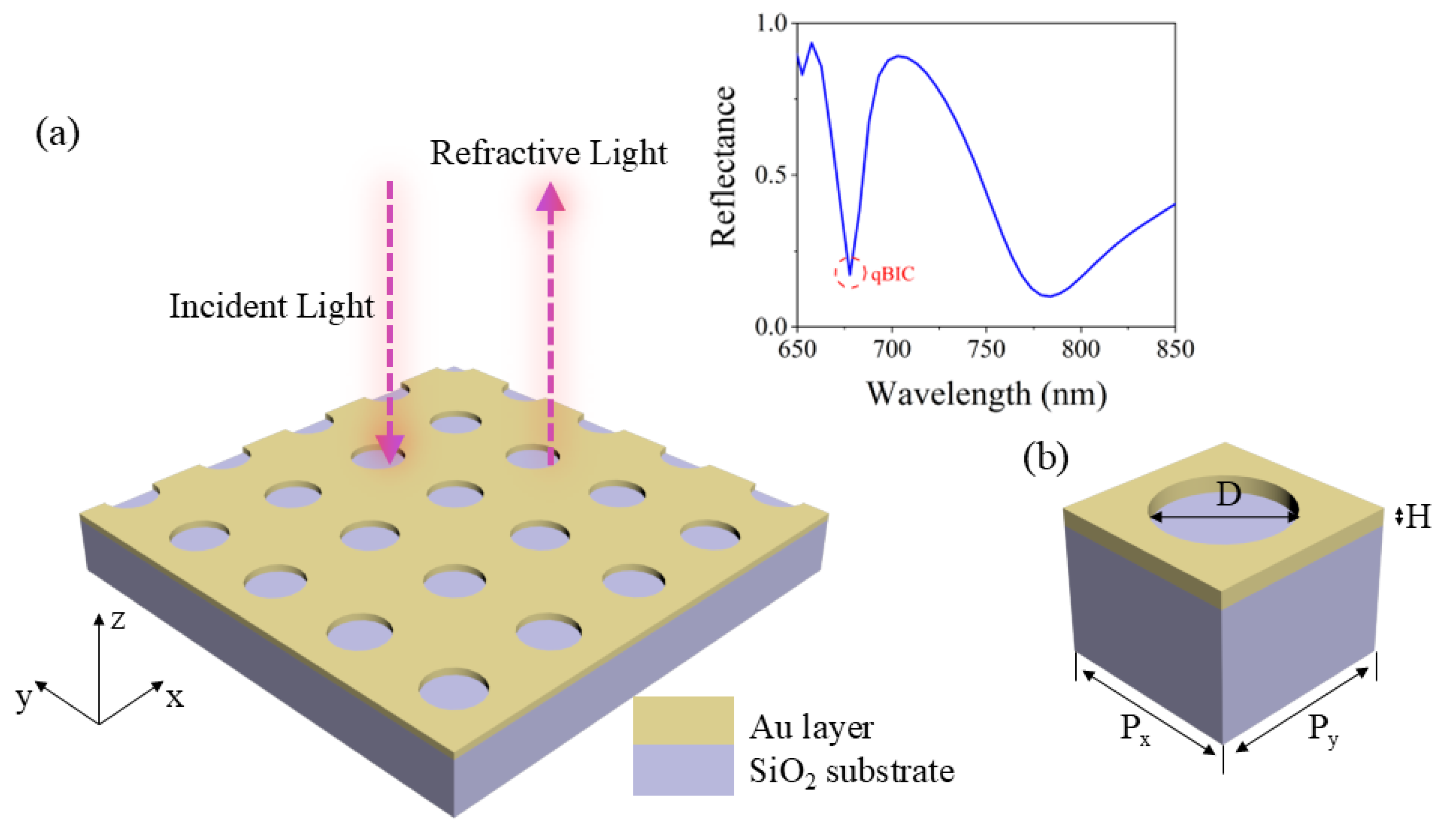
Guided by this underlying multipolar mechanism, in this work, we propose and numerically investigate a periodic gold nanohole-array metasurface on a silica substrate. Unlike intrinsic symmetry-breaking designs, our structure preserves in-plane symmetry and exploits angular modulation, along with environmental refractive-index tuning, to study the coexistence and spectral evolution of broadband LSPR and narrowband quasi-BIC resonances in the visible regime. The results show that the symmetric nanohole array simultaneously supports both resonances with clearly differentiated refractive index responses: the LSPR mode exhibits pronounced spectral shifts, whereas the quasi-BIC mode maintains a high Q-factor with characteristic linewidth evolution. This dual-mode behavior—combining strong LSPR field intensity and quasi-BIC spectral sharpness within a unified architecture—clarifies the interplay between distinct plasmonic mechanisms in metallic nanohole arrays and suggests a promising route toward high-performance refractive-index sensing.
3. Results and Discussion
3.1. Angle-Resolved Spectra and Verification of BIC Mechanism
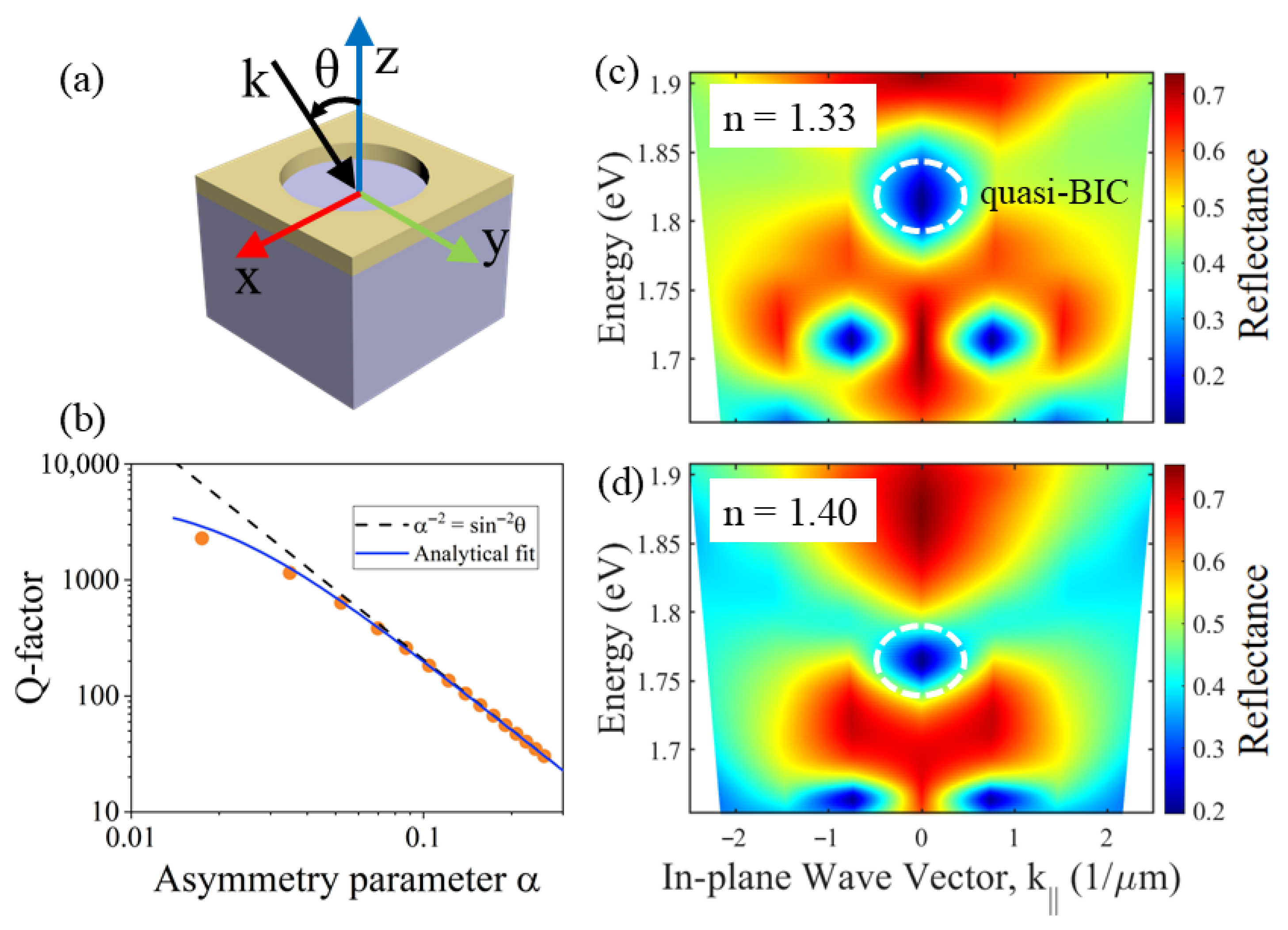
To reveal the existence and physical origin of the BIC mode in this symmetric structure, we first investigated the optical properties of the gold nanohole array in momentum space. The angle-resolved reflectance spectra calculated by FDTD are presented in
Figure 2c,d. The incident angle
is related to the in-plane wave vector
via the relation:
where
is the wavelength, and
is the incident angle.
From
Figure 2c, it can be clearly observed that for
, a flat resonance band exists around the wavelength of 688 nm. Notably, at the
point (i.e.,
, marked by the white dashed line), this mode disappears completely from the spectrum. This implies that the mode cannot be excited by a normally incident plane wave, indicating that it is perfectly decoupled from the far-field radiation continuum, corresponding to a typical symmetry-protected BIC (SP-BIC) state. Similarly, in
Figure 2d, when
, the resonance peak appears at 705 nm due to the red-shift induced by the increased environmental refractive index, while the ideal BIC state persists at the
point.
To quantitatively validate this characteristic BIC behavior, we extracted the evolution of the quality factor (Q-factor) as the system transitions from the ideal SP-BIC to the quasi-BIC state with increasing incidence angle
, as shown in
Figure 2a,b. At strictly normal incidence (
), the Q-factor theoretically diverges to infinity, representing a bound state with zero radiation leakage. By introducing extrinsic symmetry breaking via oblique incidence (
), a radiative channel is opened, transforming the dark state into an observable high-Q quasi-BIC Fano resonance. Crucially, the extracted Q-factor decays rapidly as the incidence angle increases, perfectly following the inverse quadratic relationship (
) that represents a universal theoretical hallmark of symmetry-protected BICs. This angle-dependent evolution unambiguously confirms the physical origin of the resonance and provides a robust mechanism to achieve highly tunable, high-Q resonances in the visible regime by simply manipulating the incident angle.
As the incident angle gradually increases from 0°, the symmetry of the excitation source is broken, and the original dark mode transforms into a bright mode with a finite line width. As shown in the dispersion diagram, the quasi-BIC mode exhibits a distinct evolution: The resonance dip becomes sharper and shallower as decreases. The decreasing line width and deep modulation depth at the -point confirm that the mode completely decouples from the free-space radiation, a signature of ideal BIC. This phenomenon is caused by the gradual closing of the radiation channel as symmetry is restored. It should be pointed out that due to the unavoidable intrinsic ohmic losses of metals in the visible range, even in the ideal BIC state where radiative loss is fully suppressed, the absorption loss of the system remains. Therefore, the observed resonance manifests as a plasmonic quasi-BIC mode with a remarkably high Q-factor under normal incidence. This configuration is particularly advantageous for practical applications, as it significantly simplifies optical alignment and the experimental setup compared to oblique-incidence schemes.
3.2. Multipole Decomposition and Physical Mechanism
To gain deeper insight into the microscopic physical origins and the underlying light-matter interaction mechanisms of the quasi-BIC mode, we performed a Cartesian multipole decomposition based on the induced current density distribution
within the unit cell.
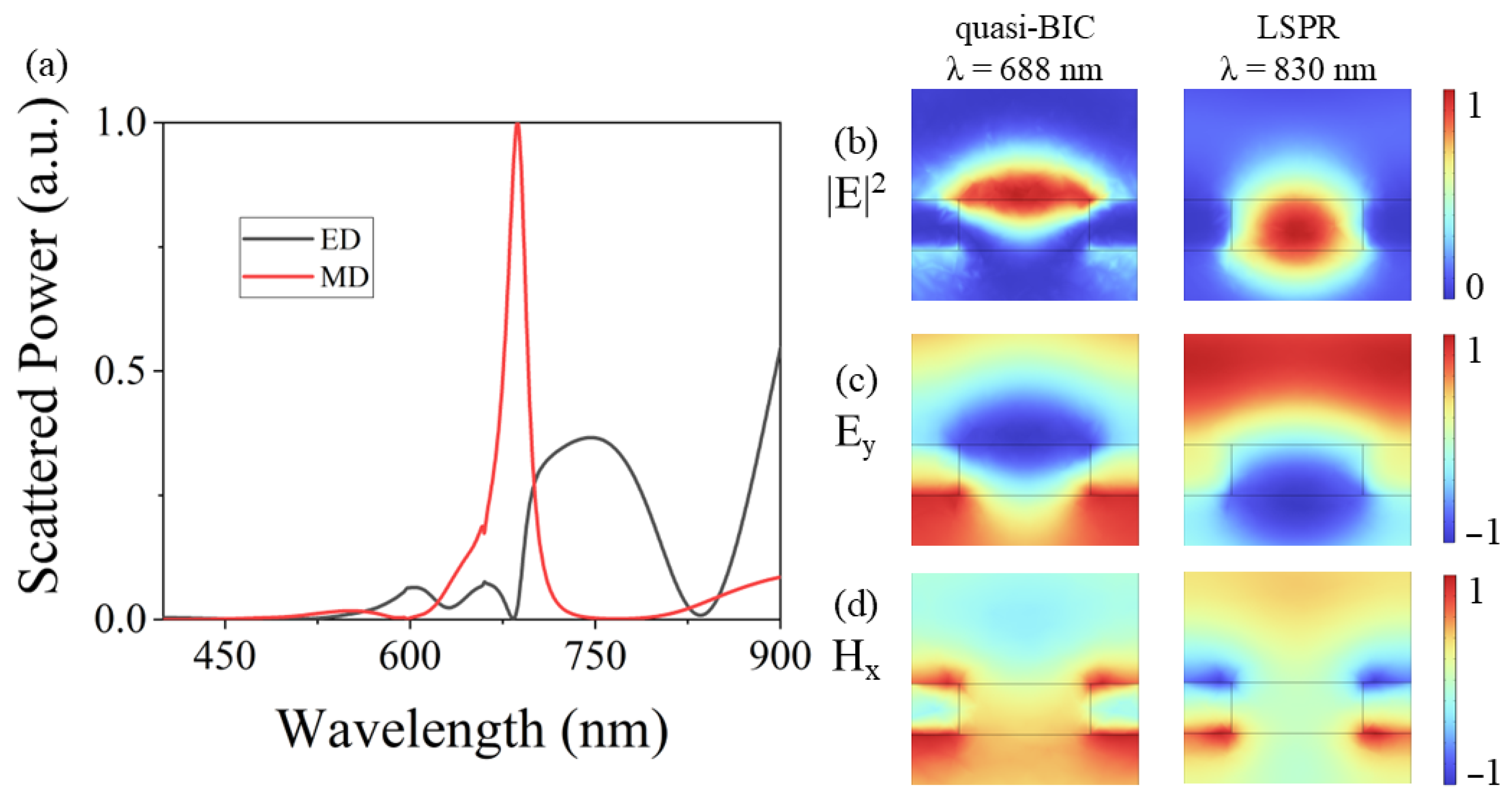
Figure 3a illustrates the scattered power contributions from the dominant fundamental multipole moments—namely, the electric dipole (ED) and magnetic dipole (MD)—as a function of wavelength. Note that the contributions from higher-order multipoles (such as quadrupoles) are intrinsically negligible in this subwavelength regime and are therefore excluded for clarity.
At the extremely sharp quasi-BIC resonance ( nm), the scattering spectrum is unambiguously dominated by the Magnetic Dipole (MD, red curve) excitation. The MD scattered power exhibits a prominent peak that significantly surpasses the broad background radiation of the Electric Dipole (ED, black curve). Physically, this originates from the formation of strong anti-parallel circulating displacement currents driven by the extrinsic symmetry breaking, which induces a robust magnetic moment perpendicular to the structural plane. This strong magnetic light-matter confinement directly contributes to the ultra-high Q-factor and drastically suppresses radiative leakage.
In contrast, around the LSPR wavelength ( nm), the multipole scattering spectrum exhibits no sharp enhancement. Instead, the optical response merges into a broad, heavily damped background predominantly sustained by the ED component. Without the strong local confinement provided by the MD excitation, the energy of the LSPR mode is severely depleted by intrinsic radiative scattering and non-radiative ohmic dissipation. This lack of strong resonant scattering enhancement perfectly explains its highly diffuse near-field distribution, extremely low Q-factor, and excessively broad spectral linewidth.
To visualize the local field enhancement capability, which is vital for high-resolution sensing, we extracted the cross-sectional near-field distributions for both the quasi-BIC and LSPR modes, as shown in
Figure 3b–d. For a rigorous and direct comparison, the electromagnetic fields of both modes are strictly normalized to the absolute maximum value of the quasi-BIC state. As clearly depicted in the normalized electric field intensity profiles (
) [
Figure 3b], the quasi-BIC mode achieves the maximum normalized intensity of 1, tightly confined within and near the edges of the gold nanohole. Under the exact same color scale, the maximum intensity of the LSPR mode is remarkably lower. Furthermore, the instantaneous field components
and
[
Figure 3c,d], normalized to
, demonstrate that the quasi-BIC mode supports a highly localized and symmetric field profile bound to the metallic surface, effectively avoiding radiation into free space. Conversely, the LSPR fields are highly diffuse, further corroborating their heavily damped radiative nature and inherently lower sensing Figure of Merit.
3.3. Refractive Comparison of Index Sensing Performance
Based on the robust local field enhancement of the quasi-BIC mode, we comprehensively investigated its performance as a refractive-index sensor and benchmarked it against the traditional LSPR mode.
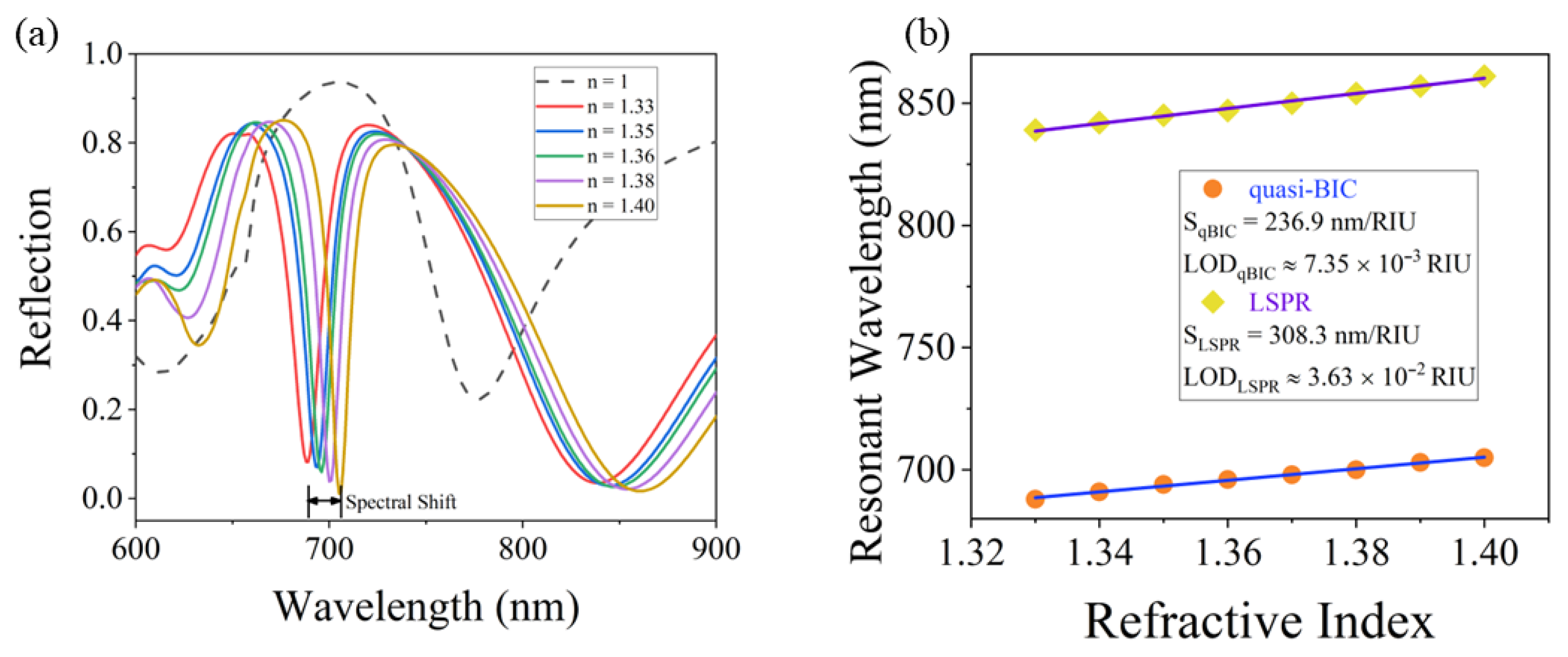
Figure 4a illustrates the simulated reflectance spectra under a specific oblique incidence angle of
as the environmental refractive index (
n) increases from 1.33 to 1.40. A pronounced and highly regular red-shift of the extremely sharp resonance dip is observed, shifting smoothly from 688 nm to 705 nm. This excellent linearity is crucial for reliable biosensor calibration.
To quantitatively evaluate the sensing capabilities, we extracted the resonance wavelengths and performed linear fitting to determine the bulk sensitivity (
), as shown in
Figure 4b. The LSPR mode exhibits a bulk sensitivity of 308.3 nm/RIU (where RIU stands for Refractive Index Unit), which is slightly higher than that of the quasi-BIC mode (236.9 nm/RIU). Nevertheless, as Altug et al. have comprehensively emphasized [
34], relying exclusively on bulk sensitivity to evaluate advanced optical biosensors provides an incomplete picture. The true performance and practical resolution of a sensor are determined by the Limit of Detection (LOD), which inherently depends on the interplay between the sensitivity and the resonance linewidth (FWHM). For a theoretical analysis without specific experimental system noise, the LOD is a theoretical estimate based on an assumed spectral resolution, which is generally approximated as
.
Thanks to its ultra-narrow linewidth ( nm), the quasi-BIC mode achieves a remarkably low LOD of RIU. In stark contrast, despite its higher sensitivity, the LSPR mode suffers from severe radiative damping, resulting in an excessively broad linewidth ( nm) and a significantly poorer LOD of RIU. This nearly five-fold improvement in the LOD rigorously demonstrates that the sharp quasi-BIC resonance provides an overwhelming advantage in detecting minute refractive index variations, easily compensating for its slightly lower bulk sensitivity.
3.4. Analysis of Quality Factor and Figure of Merit
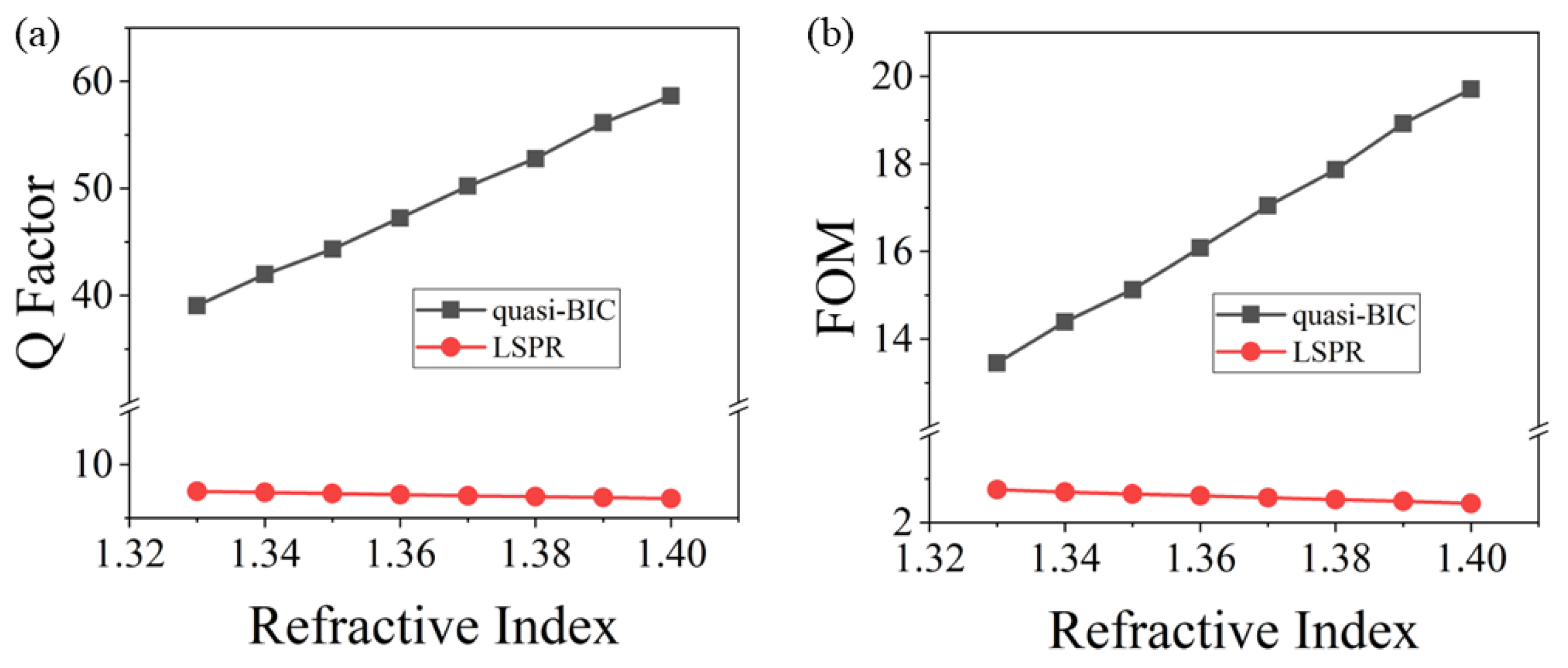
To further establish the superiority of the quasi-BIC mode across the entire sensing range, we calculated the Quality factor (Q-factor) and the Figure of Merit (
), as summarized in
Figure 5.
As depicted in
Figure 5b, the quasi-BIC mode exhibits significantly higher Q-factors (ranging from ∼39 to ∼59) that remarkably increase with the environmental refractive index. This trend reflects the robust light-matter confinement of the magnetic dipole-dominated mode. Conversely, the Q-factor of the LSPR mode remains clamped at a very low value (∼7) across the entire index range due to its intrinsic radiative losses. Consequently, as shown in
Figure 5a, the FOM of the quasi-BIC mode spans from 13.5 to 19.7
, massively outperforming the LSPR mode (
). These decisive metrics confirm that the proposed quasi-BIC metasurface offers dramatically enhanced spectral resolution and sensing fidelity, proving its immense potential for high-performance, label-free biochemical sensing.
4. Conclusions
In summary, we have numerically demonstrated a highly sensitive metasurface refractive-index sensor based on a simple, symmetric gold nanohole array operating in the visible regime. Our angle-resolved spectral analysis strictly confirms that the structure supports a symmetry-protected BIC (SP-BIC) at normal incidence. By simply introducing an oblique incidence angle to induce extrinsic symmetry breaking, this non-radiative dark state is successfully transformed into a high-Q quasi-BIC Fano resonance. Cartesian multipole decomposition reveals that this sharp resonance is fundamentally driven by a tightly confined Magnetic Dipole (MD) excitation, which drastically suppresses radiative leakage compared to the highly damped Electric Dipole (ED)-dominated LSPR mode.
Consequently, the quasi-BIC mode exhibits an ultra-narrow spectral linewidth ( nm) and an exceptionally strong normalized local field enhancement. Sensing performance evaluations demonstrate that while the quasi-BIC mode possesses a slightly lower bulk sensitivity ( nm/RIU) than the LSPR mode, its exceptionally narrow linewidth yields a remarkable Limit of Detection (LOD) of RIU—an improvement of nearly a factor of five over the traditional LSPR mode. Furthermore, the quasi-BIC mode maintains a high Q-factor (up to ∼59) and an outstanding Figure of Merit (FOM up to ∼19.7 ) across the entire testing range, massively outperforming the heavily degraded LSPR. Crucially, this design completely eliminates the necessity for complex nanofabrication of asymmetric unit cells. By achieving high-resolution reliable sensing solely through the tuning of the incident angle, this simple yet robust strategy offers a highly promising platform for the development of next-generation, low-cost optical biosensors and active plasmonic devices.