1. Introduction
Nonuniformity in IRFPAs mainly arises from pixel-to-pixel variations in gain and offset, together with fixed-pattern noise (FPN) introduced by the readout circuitry. In uniform-field imaging, these effects appear as stationary spatial textures whose characteristics drift with ambient temperature and detector operating conditions. This problem is particularly important in platforms such as unmanned aerial vehicles and satellite payloads, where long-duration operation and environmental variation are common. Conventional two-point NUC, implemented using blackbody or flat-field references, estimates gain and offset independently for each pixel. However, it does not explicitly model system-level structured residuals induced by shared row-driving and column-readout circuits. As a result, residual column striping, row-wise baseline offsets, and low-frequency structured drift often remain after correction.
A broad range of NUC methods has been developed for IRFPA imaging. Among them, calibration-based approaches, especially conventional two-point NUC, remain widely used because they are compatible with real-time implementation and hardware deployment [
1,
2]. These methods estimate pixel-wise gain and offset parameters from two flat-field reference images acquired at known radiometric levels. They are effective for compensating intrinsic pixel-to-pixel response variation, but they are built on an implicit pixel-wise independence assumption. Consequently, they do not account for structured residuals induced by shared circuitry, such as column–channel grouping and row–driver coupling. Under temperature drift or time-varying readout conditions, column–group striping and row-wise baseline drift therefore often persist after correction [
3,
4,
5]. To improve flexibility, some studies have introduced multi-point calibration or higher-order polynomial fitting [
6,
7]. However, these approaches still rely on static parameter models and do not explicitly describe how structured residuals evolve under changing temperature conditions.
Another major research direction is scene-based or adaptive NUC. Representative methods update correction parameters online from temporal image statistics [
8,
9,
10], or impose spatiotemporal consistency through temporal filtering, total-variation regularization, and related constraints [
11,
12,
13]. These approaches provide a degree of adaptivity without dedicated calibration and can suppress some low-frequency nonuniform artifacts in dynamic scenes. However, their effectiveness often depends on assumptions about scene motion, temporal variation, or mean-drift behavior. In many cases, the correction terms are estimated in the image domain rather than in the original NUC parameter space, which makes them difficult to integrate consistently with calibration-based correction and reduces interpretability for deployment. Related image-domain post-processing methods, including wavelet filtering, principal component analysis, and frequency-domain stripe suppression, have also been used to reduce structured column noise [
14,
15,
16]. Although such methods may improve image appearance, they do not directly model the physical source of the residuals and are therefore less suitable for embedded IRFPA applications that require rapid and accurate target energy measurement, parameter consistency, and stable real-time operation.
Deep learning and data-driven methods that have emerged in recent years attempt to formulate infrared NUC as an end-to-end mapping problem, leveraging convolutional networks, Transformer architectures, or generative adversarial networks to model and restore images [
17,
18]. These methods can improve image quality in some cases, but they usually require large training datasets and do not explicitly represent physical factors such as temperature drift or readout-chain structure. In addition, their limited interpretability makes parameter deployment and cross-device generalization more challenging. Against this background, a gap remains between physically interpretable calibration-based correction and adaptive suppression of structured residuals. In particular, there is still a need for a method that introduces column-related periodic residuals and row-wise baseline drift into the NUC framework in a parametric and deployment-consistent manner.
A method is therefore needed that introduces dominant structured residuals into the NUC parameter space in a physically interpretable and deployment-consistent manner. Here, “digital twin” does not denote a full-system-level digital twin of the entire infrared payload. Instead, it denotes a detector-side virtual representation of dominant readout-induced structured residual states associated with shared readout structures. The proposed method is therefore more appropriately described as a digital-twin-inspired detector-side structured correction framework, in which a small number of virtual state variables are linked to physically interpretable residual modes and are estimated and updated from calibration data.
The proposed framework is most directly applicable to IRFPAs whose residuals are dominated by grouped column-end sharing effects and row-scanning-related correlated drift. For detectors with different readout architectures, the same modeling principle can still be used, but the structural parameterization, basis representation, and common-mode formulation should be adapted to the specific hardware topology. Compared with representative scene-based temporal correction methods, the present method operates directly in the NUC parameter space and explicitly targets readout-structure-induced residuals with clear physical interpretation.
2. Materials and Methods
Conventional IRFPA nonuniformity correction is commonly described by a linear two-point model. For pixel
in frame
acquired at operating condition temperature
, the raw detector response is written as
Here, is the detector output, is the equivalent ideal signal, and are the pixel gain and offset, respectively, and collects random noise and unmodeled effects.
Let
and
denote the two calibration radiometric levels, and let
and
denote the corresponding mean calibration frames. The conventional two-point estimates are then
The corresponding corrected output is:
The above formulation implicitly assumes pixel-wise independence, meaning that the gain and offset of each detector element are estimated independently. However, in large-format IRFPAs, the readout chain often contains shared structures, such as grouped column–channel amplification and reused row-driving, reset, or sampling paths. As a result, system-level residuals that are correlated with the hardware architecture may remain even after conventional correction, including grouped column steps, column striping, and row-wise baseline offsets. These residuals are not purely random. Instead, they persist as structured fixed patterns and drift gradually with temperature. Therefore, pixel-wise two-point parameters alone are insufficient to describe such shared-structure-induced residuals, especially in cross-temperature operating conditions.
Consider
uniform-field frames acquired at temperature point
. Because the scene is spatially uniform, the desired corrected signal can be approximated by a spatially constant scalar
. After conventional two-point correction, the corrected output can therefore be written as
where
denotes the residual nonuniformity together with random perturbations.
Because the structured residual is relatively stable over frames while the random component is approximately zero-mean, a steady residual map is estimated by temporal averaging after removing the per-frame global level:
Here, denotes the frame mean or the region-of-interest mean of the corrected frame at temperature point . This subtraction removes the global constant component and retains the spatially structured residual.
As shown in
Figure 1, significant structured residuals persist after conventional two-point NUC. This indicates that the remaining error cannot be fully described by independent pixel-wise gain and offset mismatches alone, but is instead related to correlated structures in the readout chain. Since conventional two-point NUC estimates gain and offset independently for each pixel, it is effective for correcting static pixel-level nonuniformity but lacks explicit terms to capture group-correlated column residuals and row-correlated baseline drift. These observations motivate the introduction of additional structured bias components into the parameter model.
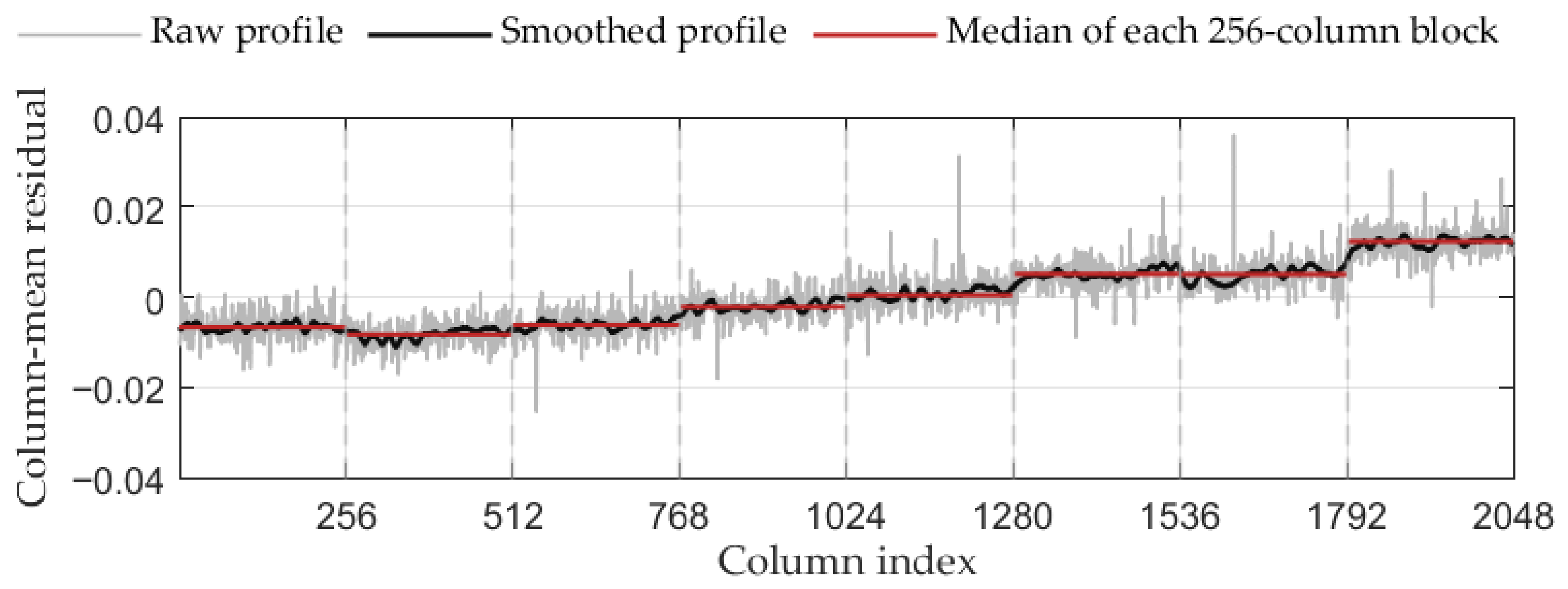
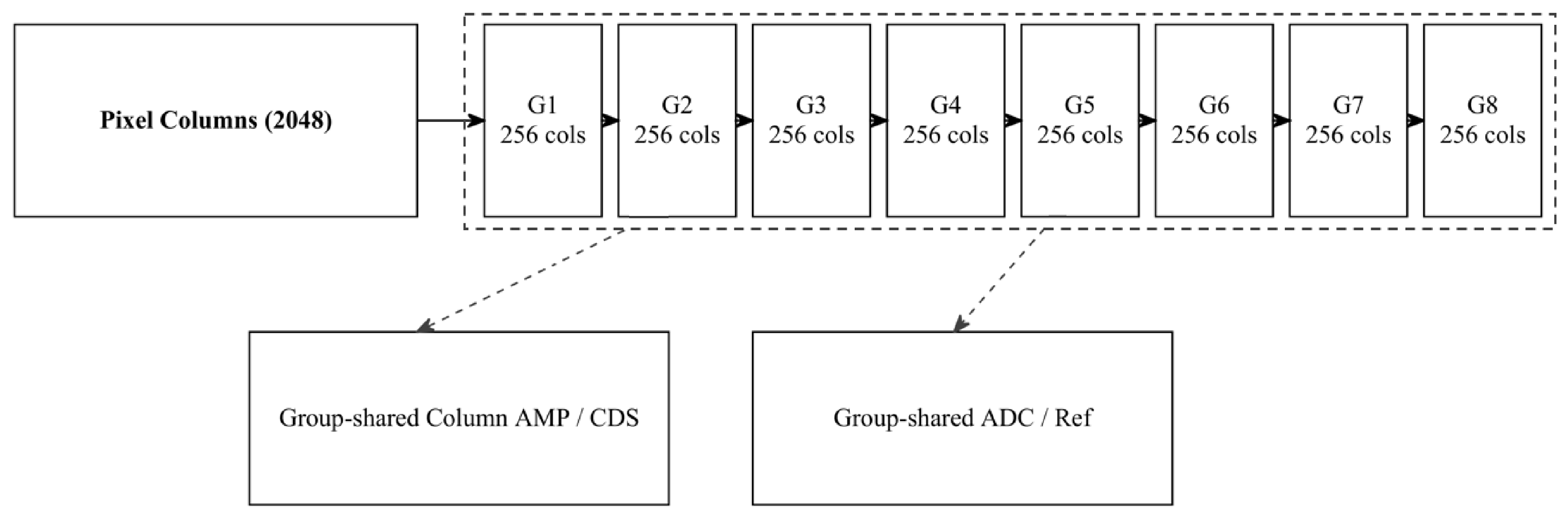
Figure 2 shows the column-mean profile of the corrected residual and reveals clear group-wise inconsistency along the column direction, with step-like changes or repeating textures appearing approximately every 256 columns. This pattern is consistent with grouped sharing in the column-end readout architecture. As illustrated in
Figure 3, large-format readout circuits often divide the columns into fixed groups that share column amplifiers, sample-and-hold stages, correlated double-sampling stages, multiplexing resources, and part of the reference or analog-to-digital conversion chain in order to satisfy bandwidth, power, and area constraints. Because different column groups exhibit different device mismatch, reference-distribution drop, bias-settling behavior, and temperature-drift coefficients, each group introduces a different common bias component. After conventional two-point NUC, this effect appears as systematic inter-group column residuals, which motivates the introduction of a static column bias term.
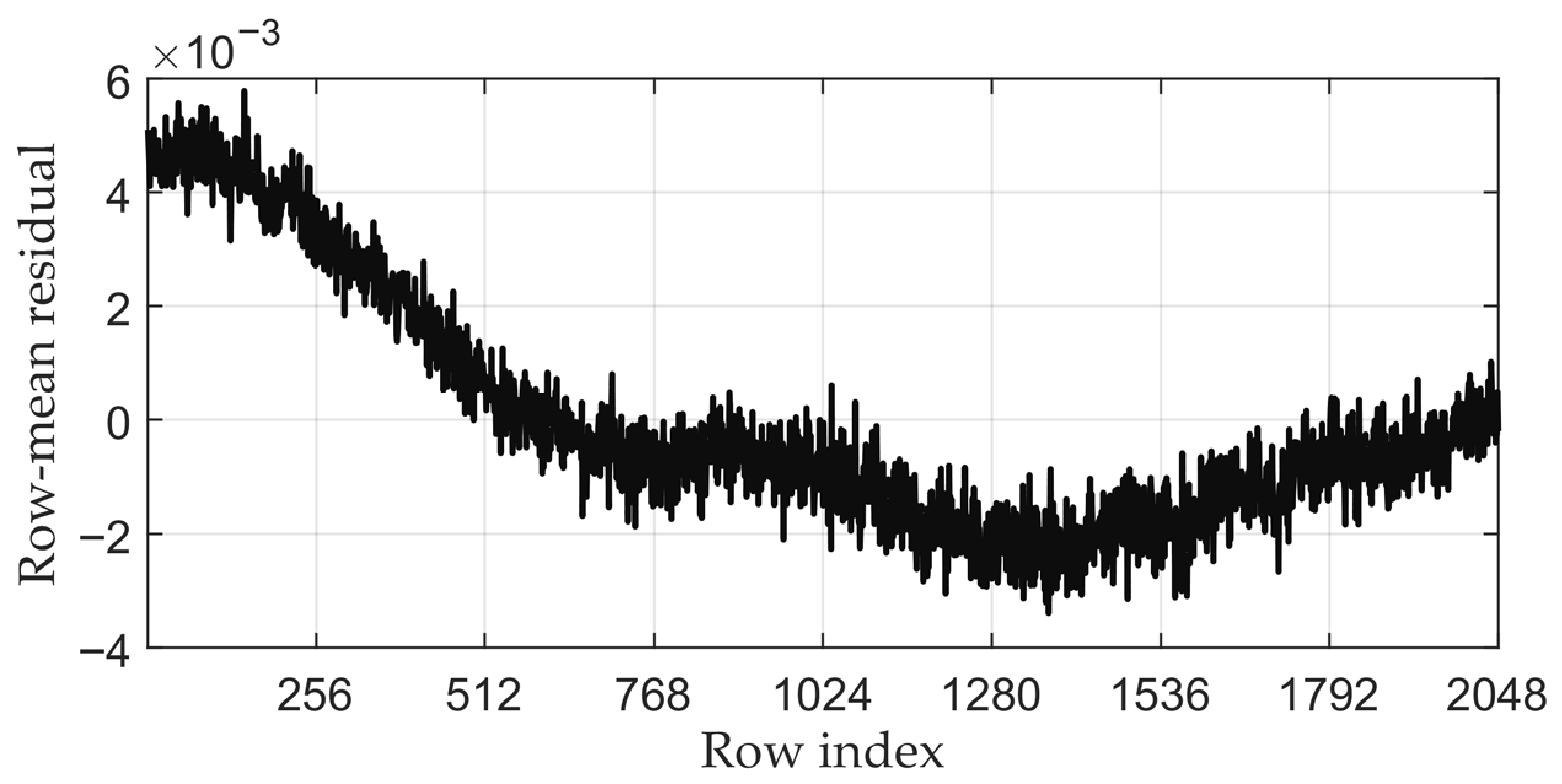
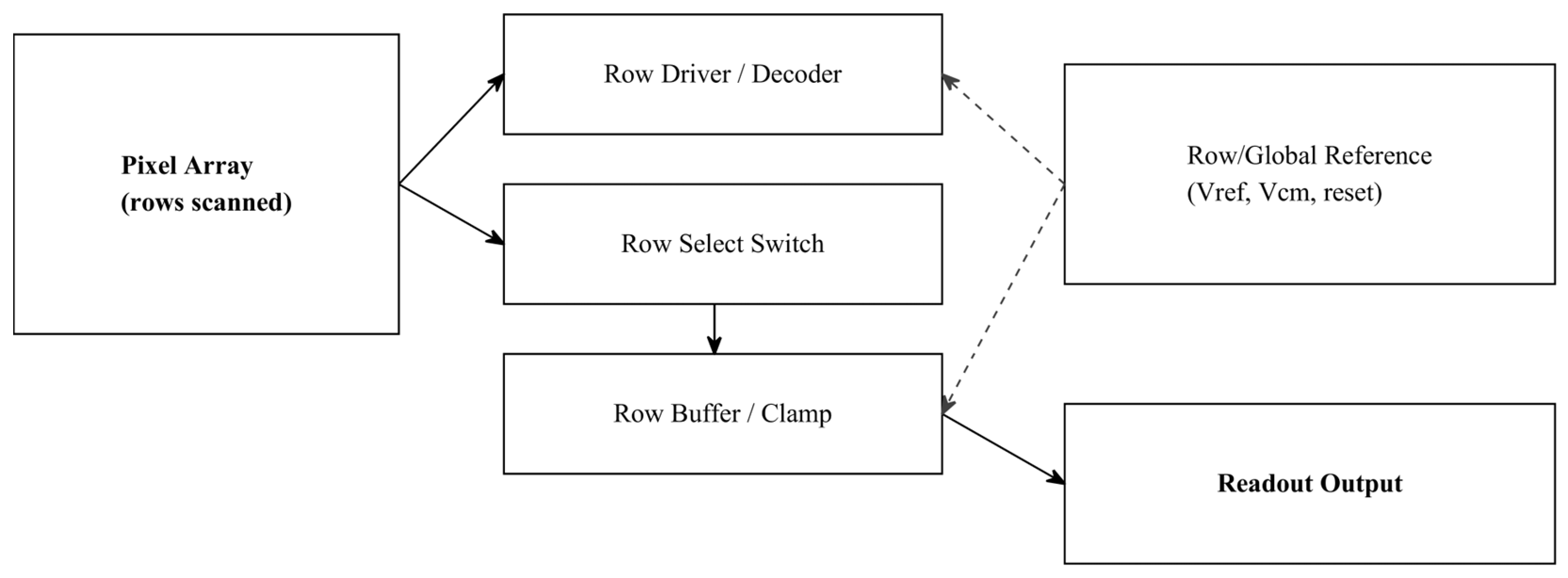
Figure 4 shows that the corrected residual exhibits pronounced baseline inconsistency along the row direction, meaning that different rows have different mean residual levels. Such row-correlated structure is consistent with the row-scanning and row-level readout process illustrated in
Figure 5. During sequential row activation, the row driver and decoder, row-selection switches, reset and clamping operations, row-buffer stages, and reference-settling procedures are affected by row-line parasitic, charge injection, residual reset noise, settling-time differences, and row-buffer mismatch. As a result, the floor level or baseline bias varies from row to row. This observation motivates the introduction of a static row baseline term in the structured bias model.
Figure 6 shows that the row-mean values vary coherently across the frame sequence rather than remaining constant in time. This behavior indicates that the row residual contains not only a static baseline term but also a time-varying common-mode component that evolves synchronously from frame to frame. This observation motivates the introduction of a row-related structured term in the model.
Figure 2,
Figure 3,
Figure 4,
Figure 5 and
Figure 6 indicate that the dominant residual after conventional two-point NUC is not purely pixel-wise random noise but is mainly composed of two structured modes: (i) a quasi-static column-related component associated with shared column-end circuitry, and (ii) a row-related structured component consisting of a static row baseline plus a frame-synchronous common-mode component. Accordingly, we keep the conventional two-point estimates
and
unchanged and augment only the offset branch with three additional low-dimensional terms: a static column bias
, a static row baseline
, and a dynamic row term
. This decomposition preserves the original two-point backbone while explicitly modeling the dominant structured residuals observed in the calibration data.
These additional components are incorporated directly into the NUC parameter model so that the correction remains consistent with the readout architecture. Let the region of interest have size
. To represent column-correlated fixed-pattern residuals caused by shared column-end resources, such as column amplifiers or analog-to-digital conversion channels, we define a static column bias vector
and expand it to the two-dimensional detector grid
,
To model the row-related residual, we decompose it into a static row baseline and a frame-synchronous temporal component. Specifically, let
denote the time-invariant row baseline, let
denote the frame-synchronous common-mode scalar, and let
denote the row-dependent sensitivity to that common mode. The resulting row-related structured term is written as
In this formulation, captures the static row-to-row baseline difference, represents the frame-dependent common disturbance shared across rows, and describes how strongly each row couples to that disturbance. The column term is independent of time and represents the static column-related residual associated with the shared column-end circuitry. To make the decomposition identifiable, is defined as the time-invariant part of the row residual, whereas describes only the temporal fluctuation around that baseline.
With the original two-point calibration estimates
and
kept fixed, the proposed method modifies only the offset branch. The effective time-dependent offset is defined as
The corresponding structured two-point correction is then
This formulation keeps the original two-point gain term unchanged while explicitly compensating the dominant column-related and row-related residual modes in the offset branch.
The key idea of this model is that column-related and row-related structured residuals are not treated as image-domain post-processing targets. Instead, they are introduced explicitly into the NUC parameter space and participate directly in the correction formula, thereby preserving physical interpretability and deployment consistency. Unlike multi-point calibration methods with explicit temperature-function fitting, the present formulation does not impose a direct temperature-dependent bias function . Rather, it captures the dominant structured residuals across different temperatures and frame sequences through a combination of a static column term and a row-related structured term, while preserving the main parameter backbone and implementation simplicity of conventional two-point NUC.
The parameter estimation is performed in a sequential manner. First, the static column term
is estimated from the steady residual map. Second, after subtracting the column term, the static row baseline
is estimated from the temporally averaged row residual. Third, the row-sensitivity vector
is treated as a fixed calibration quantity. Finally, for each frame, the frame-synchronous common-mode scalar
is estimated from the column- and baseline-corrected row residual by a sensitivity-weighted least-squares projection:
where
is a small positive constant for numerical stability. This projection isolates the frame-synchronous row-mode amplitude while reducing leakage from the static column and row components.
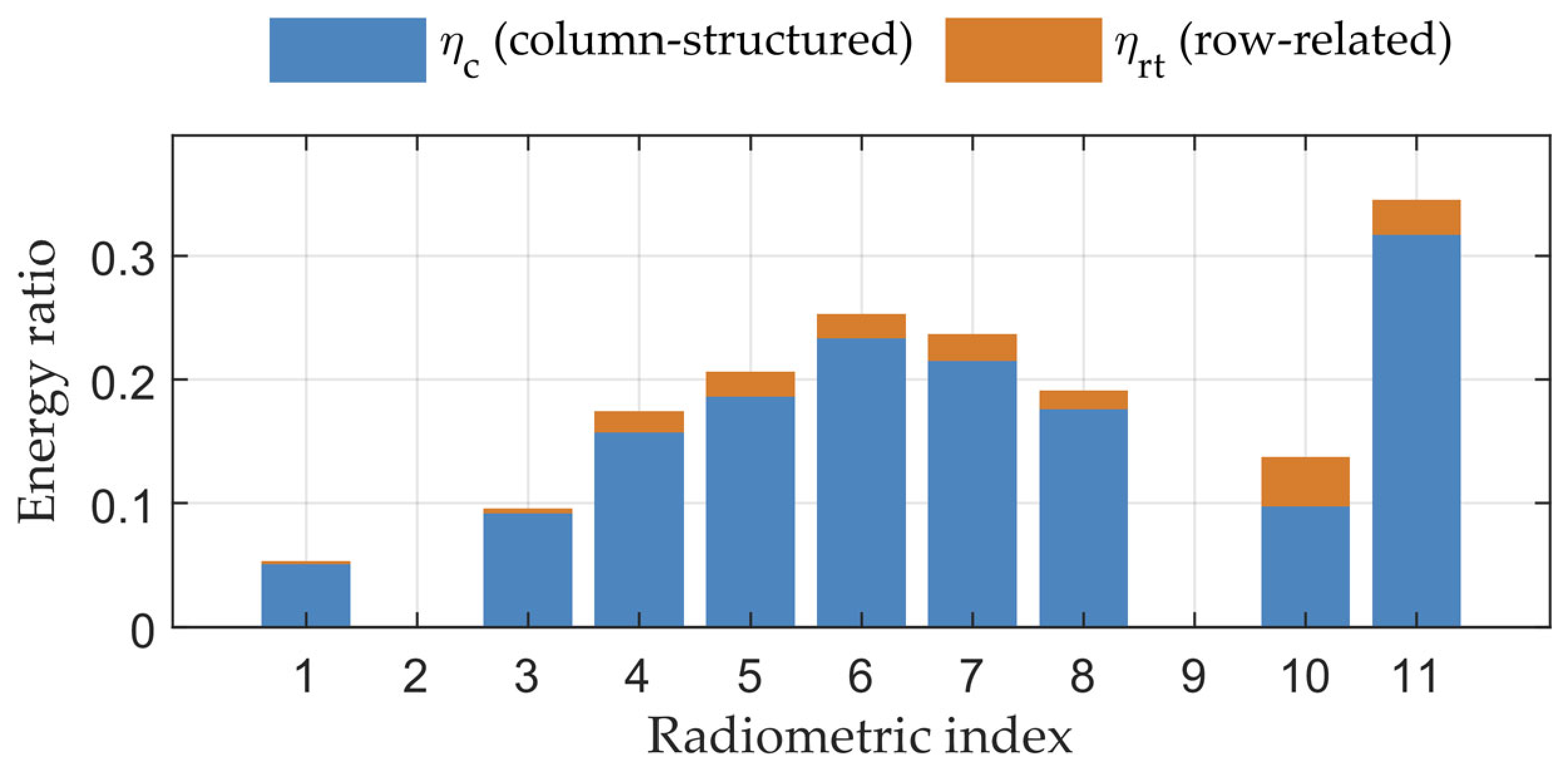
On this basis, we define two energy-ratio metrics to quantify the relative contributions of the column-related structured component and the row-related structured component at temperature point
:
where
denotes the steady residual map at temperature point
,
denotes the column-related structured component, and
with
where
is the number of frames acquired at temperature point
. Here,
represents the row-related structured component constructed using the average common-mode level at that temperature point.
3. Results
The experimental data were obtained from a blackbody-based uniform-field calibration sequence. At each temperature point, 30 raw frames were acquired. The temperature points were selected according to equal-step spacing in radiant exitance derived from the blackbody radiation law. To prevent defective pixels from biasing the statistics, all frames were preprocessed by bad-pixel correction before quantitative evaluation. Defective pixels and outliers were detected using a robust thresholding rule and replaced by the corresponding frame mean.
For two-point calibration, the third and tenth temperature points were selected in order to avoid possible nonlinearity or saturation near the ends of the temperature range. The detailed partition of temperature points is provided in
Supplementary Table S1. The gain and offset parameters of the two-point NUC model were estimated from the mean images of the 30 frames acquired at these two calibration points. In the figures, the horizontal axis is displayed using a mapped temperature obtained from equal-step radiant-exitance reparameterization. This mapping is used only for visualization and alignment and does not alter the original temperature grouping or the acquisition sequence.
Figure 7 shows that the column-related structured component accounts for a substantial fraction of the post-correction residual across multiple temperature points. This result indicates that the dominant column-wise residual after conventional two-point NUC is largely associated with bias introduced by the shared column-end readout chain. The row-related structured component also contributes consistently across temperatures, indicating that time-varying row drift is a systematic residual mode rather than an incidental pixel-level fluctuation.
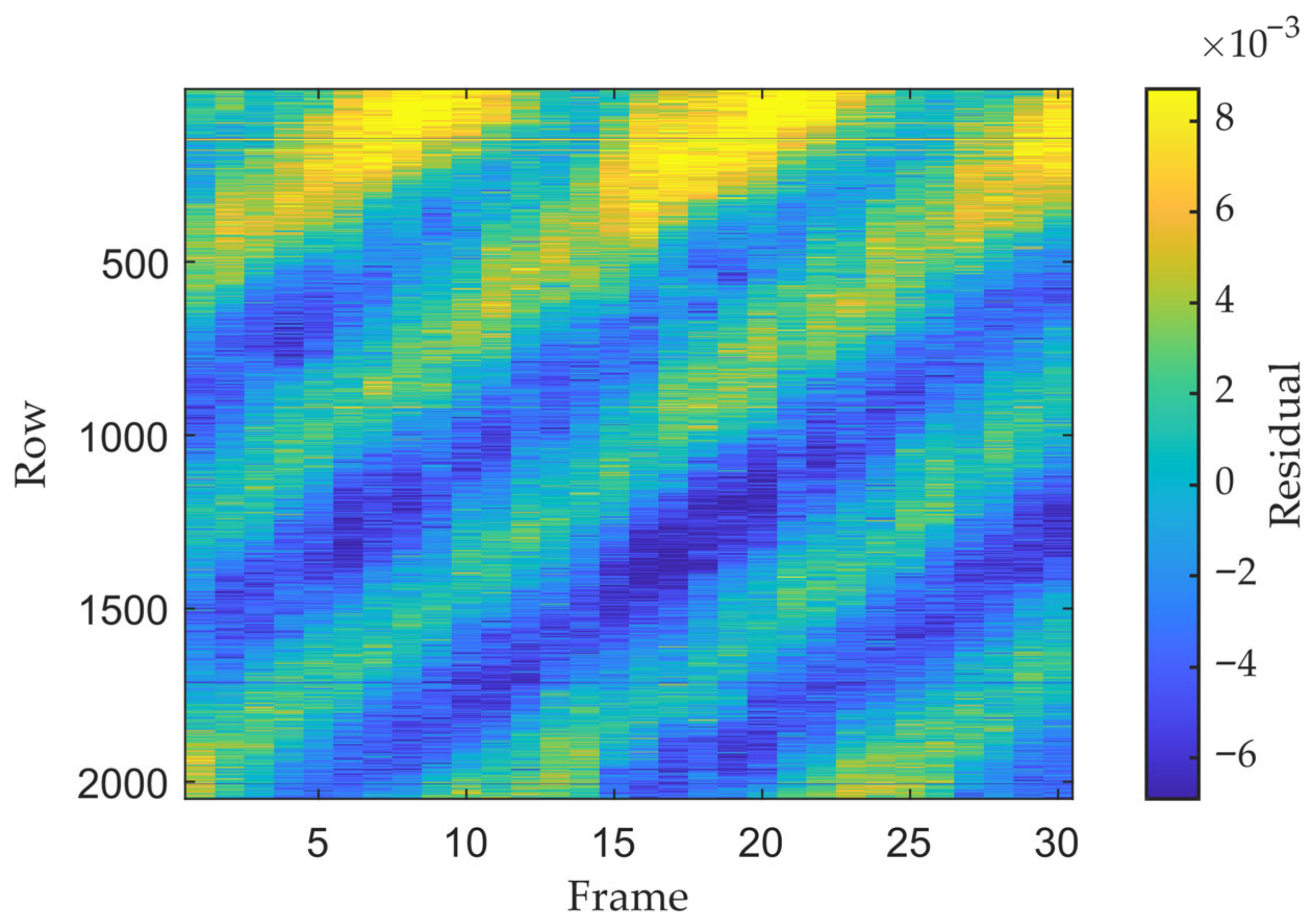
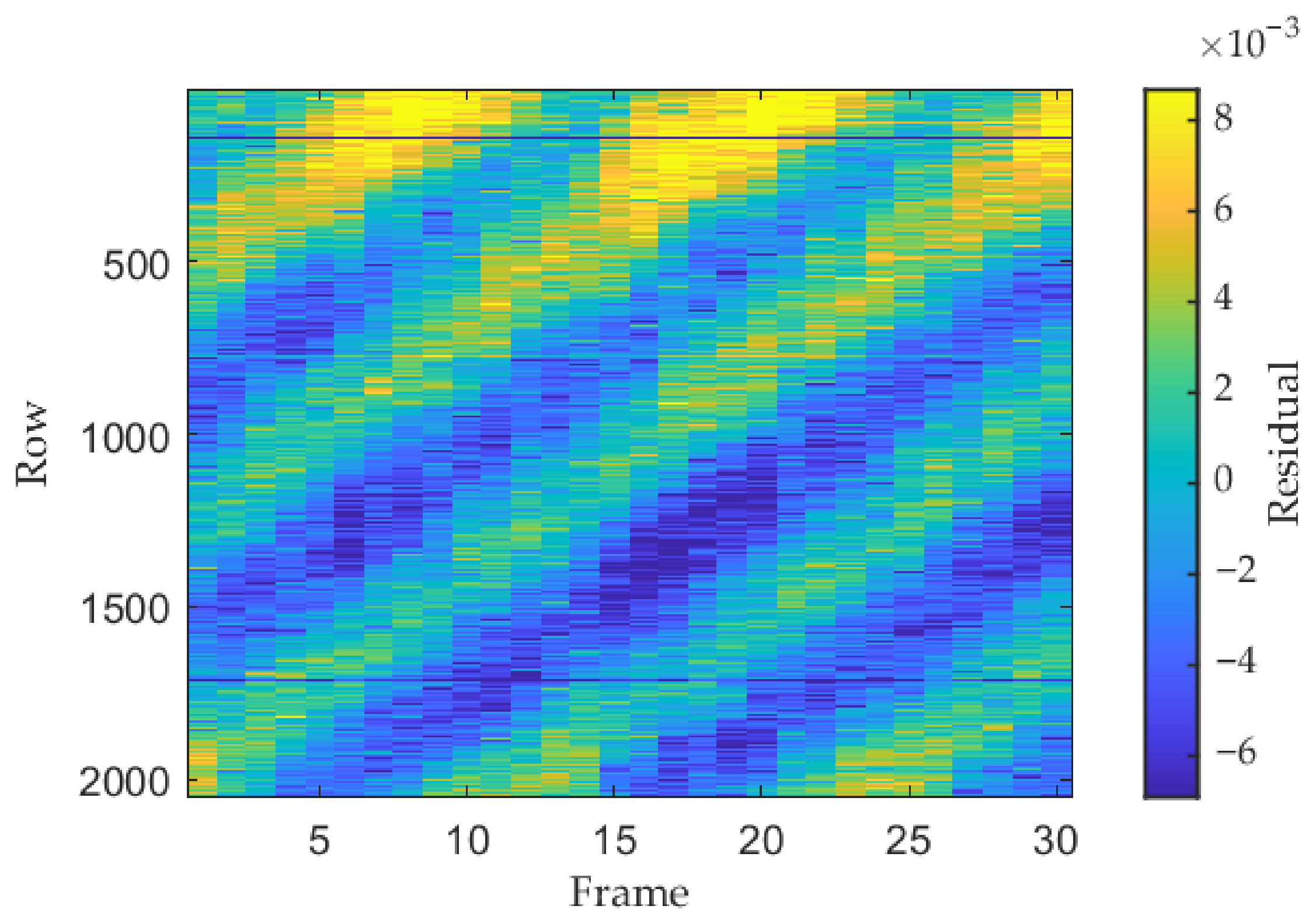
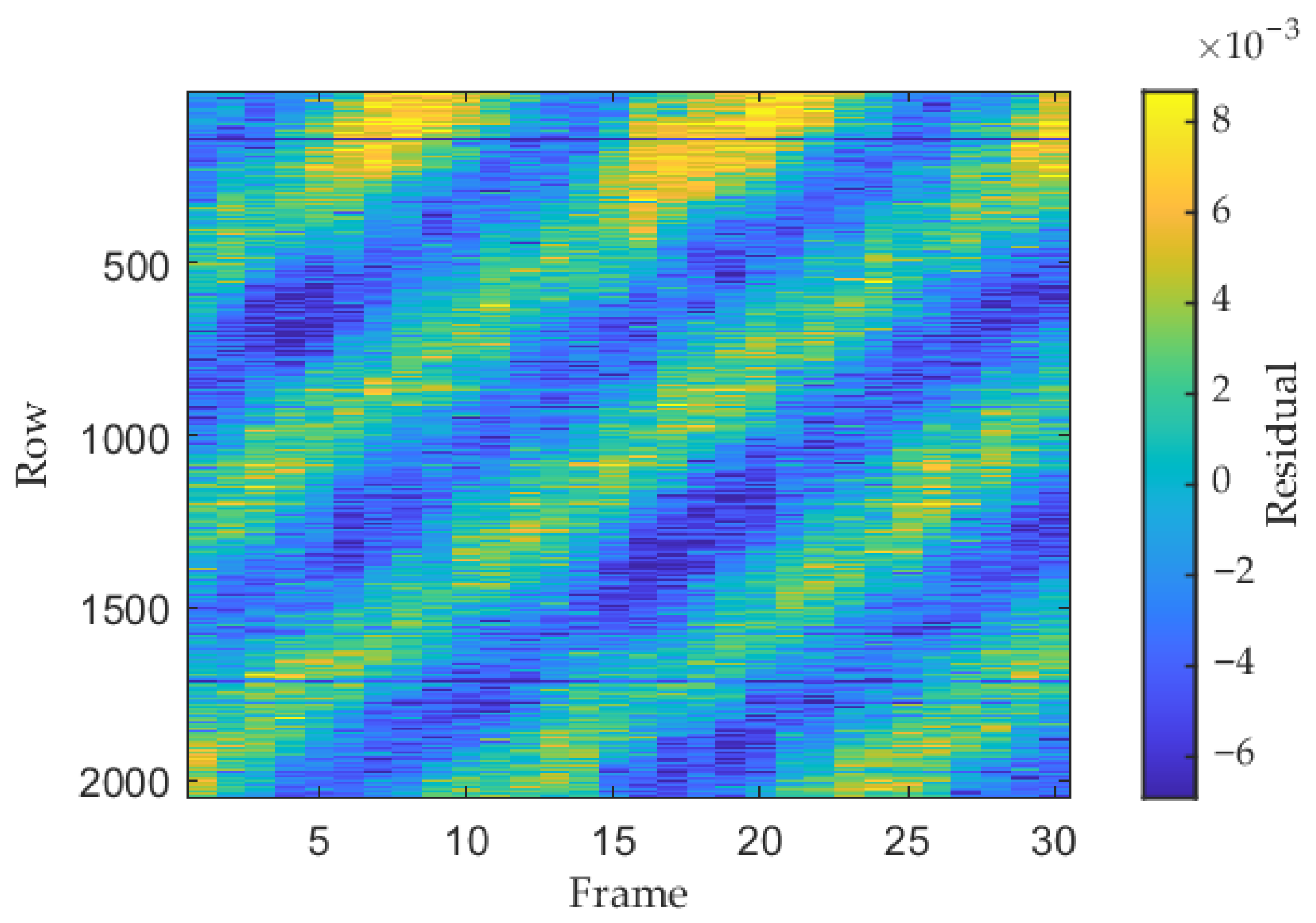
To further verify the existence of time-varying row-direction residual drift and evaluate its effect on correction, two-dimensional heatmaps are presented at the validation temperature points to show the evolution of the row-mean residual with frame index. The per-frame row-mean residual is defined as
Under Baseline, that is, conventional two-point correction only, the row-mean residual exhibits clear stripe-like temporal structures. After the row-related structured correction is introduced, these structures are substantially weakened, and the overall temporal fluctuation amplitude of the row-mean residual is significantly reduced, as shown in
Figure 8 and
Figure 9. In addition, the estimated frame-synchronous common-mode scalar exhibits stable periodic oscillations under Baseline, whereas its amplitude is effectively suppressed after correction. This result indicates that the proposed row model captures and removes the dominant temporal drift using only a very small number of additional parameters.
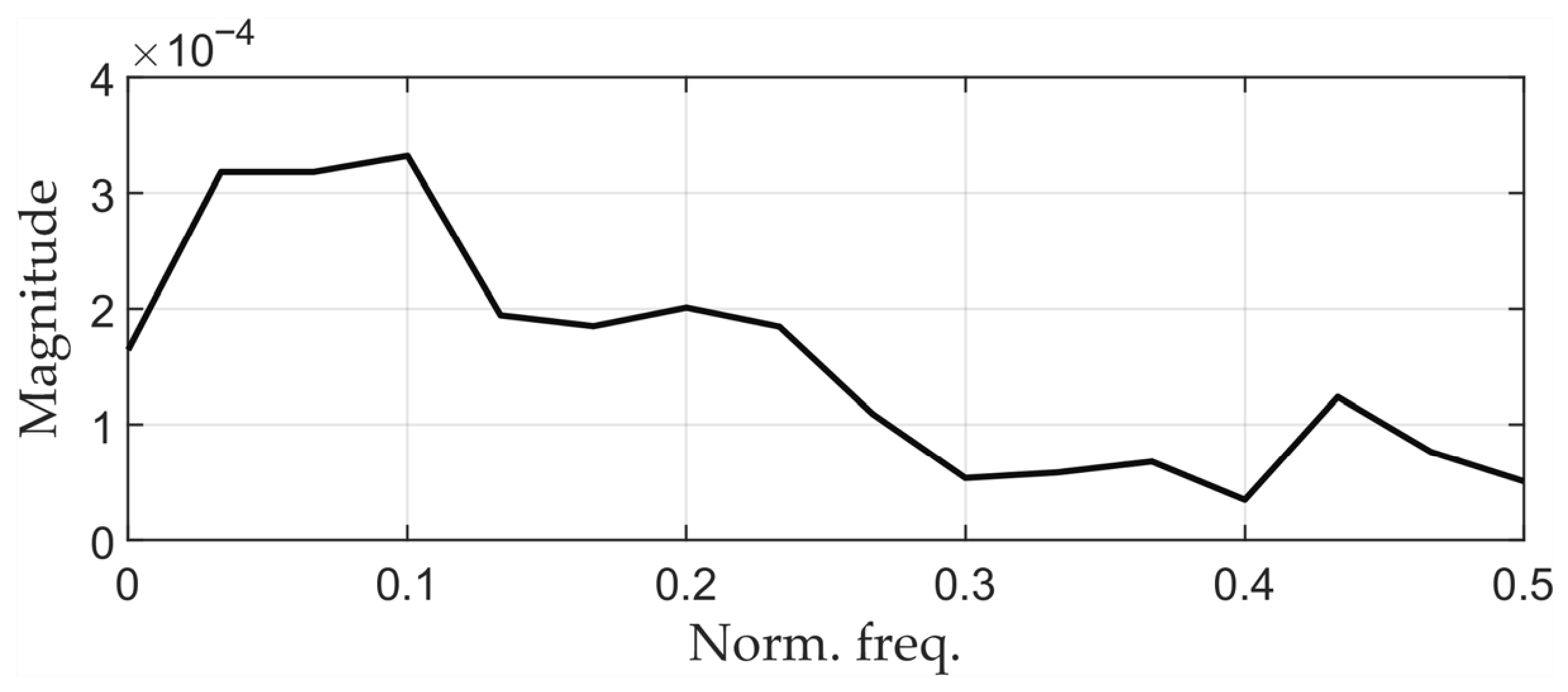
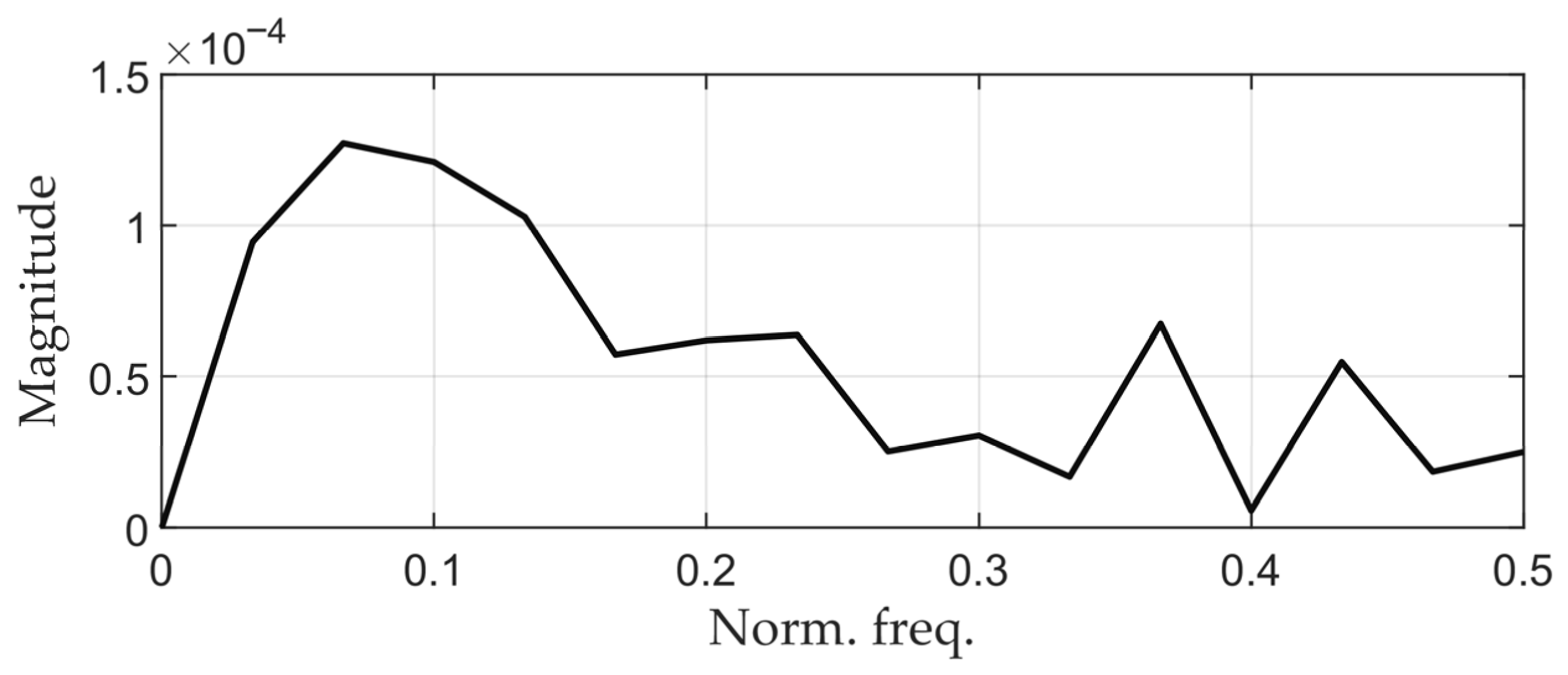
Figure 10 and
Figure 11 compare the spectra of the frame-synchronous common-mode scalar
before and after the row-related structured correction, showing that the high-frequency components and the overall fluctuation amplitude of
are effectively suppressed after correction.
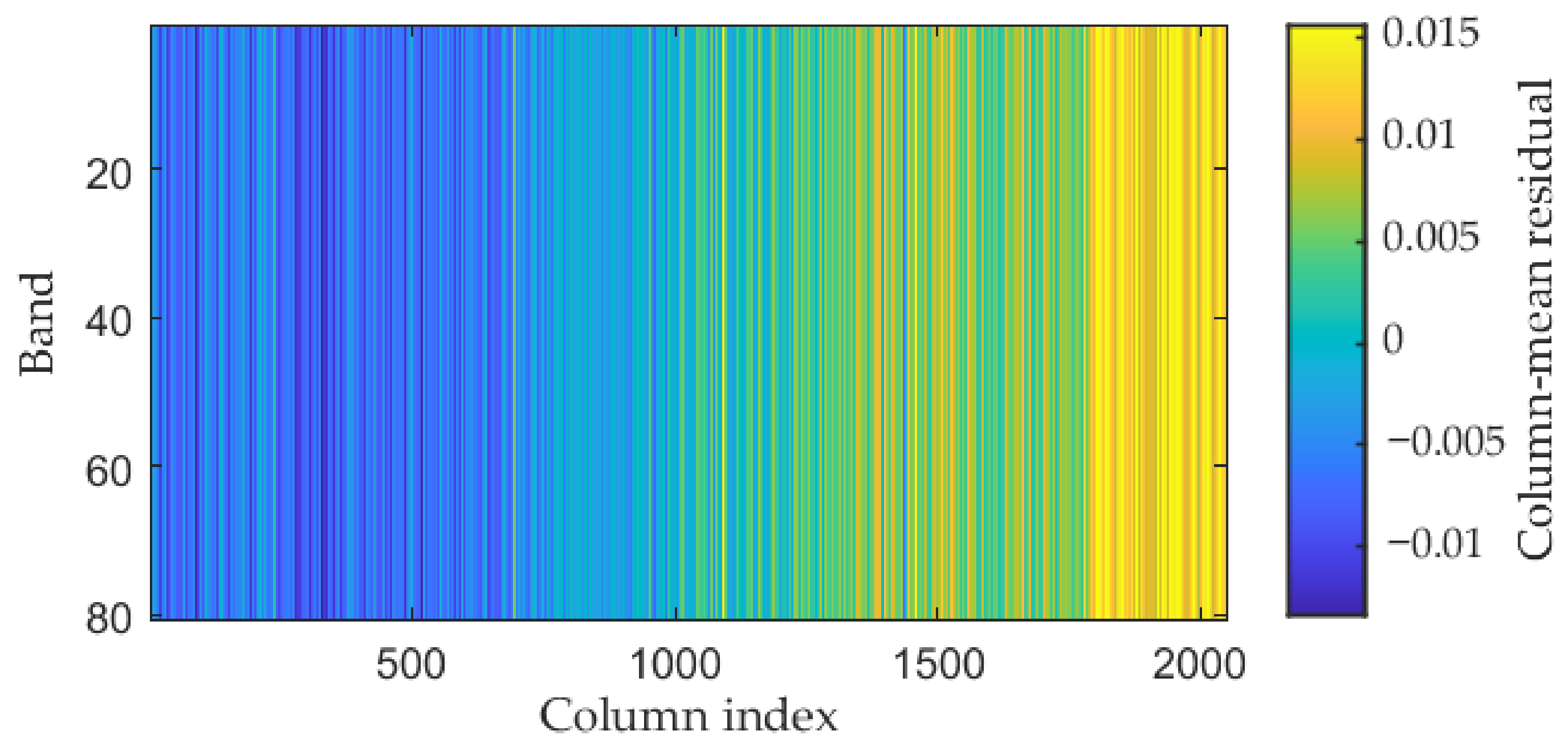
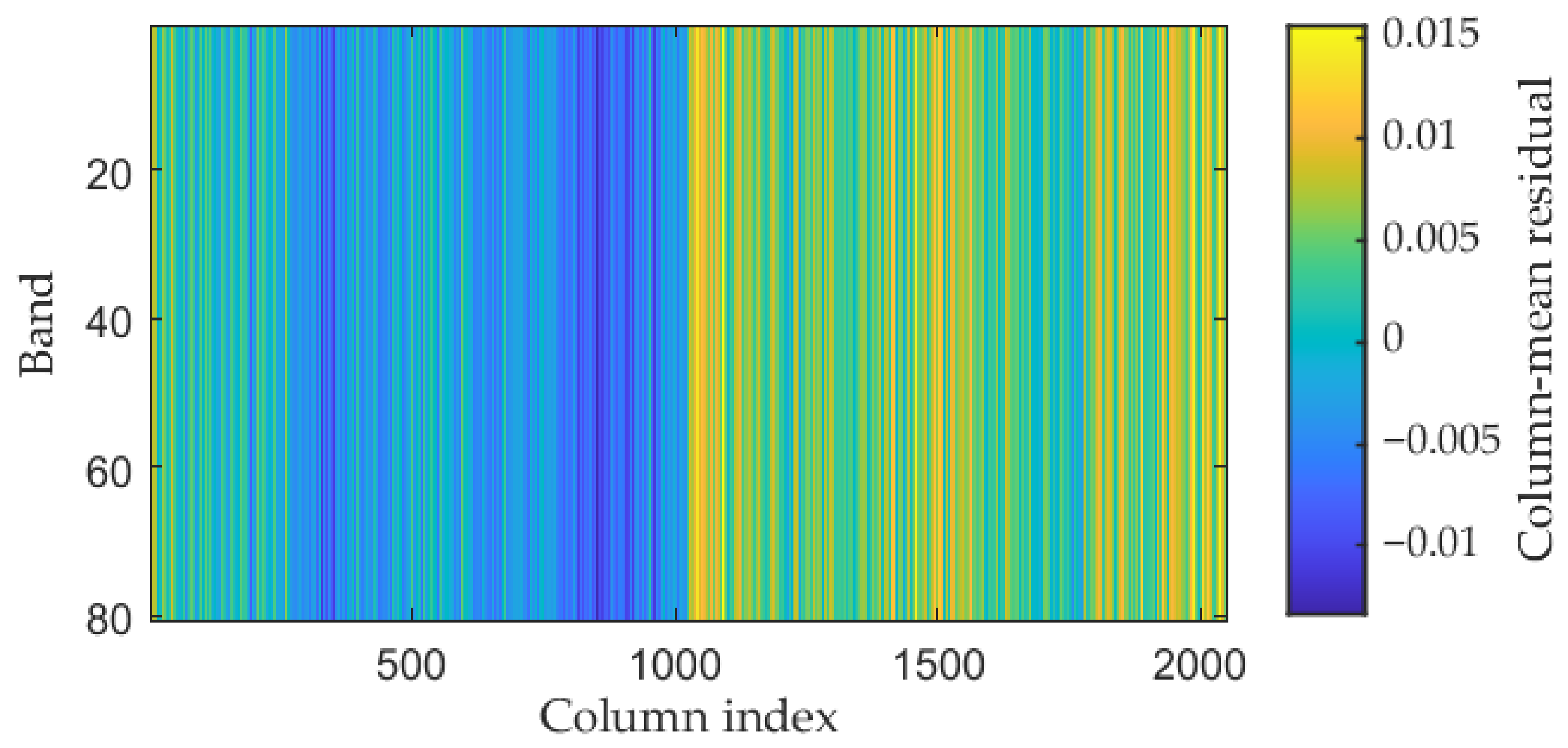
To further evaluate the effect of the static column bias term,
Figure 12 and
Figure 13 compare the column-mean residual bands before and after column correction at a representative validation temperature point. Under the Baseline, the residual band exhibits clear group-wise oscillation and within-group fluctuation, indicating that the dominant column-direction residual remains strongly correlated with the grouped column-end readout structure. After introducing the static column bias term, the periodic banding is substantially weakened and the inter-group step variation is reduced. This result shows that the proposed column model effectively absorbs the dominant structured residual associated with shared column-end resources.
To isolate the role of each structural term, four correction settings were compared: Baseline, corresponding to conventional two-point NUC; column bias correction only; row-related structured correction only; and the combined correction. At the validation temperature points, the Baseline column-mean curve exhibits pronounced within-group fluctuations. After the static column bias term is introduced, the overall oscillation of the column-mean curve is significantly reduced, showing that this term effectively absorbs the dominant column-wise structured residual induced by the shared column-end readout chain. By contrast, the row-related structured term has only a limited effect on the column-mean curve, which is consistent with the expectation that the row model has weak projection onto column statistics. For the row-mean curve, the Baseline result shows evident row-wise baseline offsets and low-frequency disturbances induced by temporal drift. After introducing the row-related structured term, the standard-deviation metric of the row-mean curve decreases significantly, and the temporal stripe patterns in the heatmap are suppressed. Finally, the combined correction suppresses both column-wise structured residuals and row-wise temporal drift, yielding more consistent performance across validation temperatures.
The static column bias term mainly improves the column-direction metrics, whereas the row-related structured term mainly improves the row-direction metrics. The combined correction yields consistent improvements in both directions. The curve-based evaluation metrics used in this study are defined as follows:
The standard-deviation-based metrics and are more robust to global fluctuations, whereas the spike-sensitive metrics and respond more strongly to a small number of abnormal column or row outliers. Slight inconsistencies may therefore appear at individual validation points. Nevertheless, both the standard-deviation metrics and the time-varying heatmaps consistently show that the row-related structured term suppresses systematic drift in a clear and reproducible manner.
Quantitative results are summarized in
Table 1. At both validation temperatures, the combined correction method consistently reduces the residual nonuniformity in both the column and row directions. At 39.4 °C, the column-direction metric decreases from 0.0054 to 0.0047 and the row-direction metric decreases from 0.0021 to 0.0013, corresponding to improvements of 13.2% and 37.3%, respectively. At 50.7 °C, the column-direction metric decreases from 0.0073 to 0.0060 and the row-direction metric decreases from 0.0021 to 0.0012, corresponding to improvements of 17.2% and 40.8%, respectively. Overall, the results show that the proposed method remains effective across different temperature points and is particularly advantageous in suppressing row-direction residual fluctuations.
4. Discussion
The proposed framework is most directly applicable to IRFPAs whose residuals are dominated by grouped column-end sharing effects and row-scanning-related correlated drift. For detectors with different readout architectures, the same modeling principle can still be used, but the structural parameterization, basis representation, and common-mode formulation should be adapted to the specific hardware topology and dominant residual modes.
The experimental results show that conventional two-point NUC still leaves significant structured residuals under uniform-field conditions. These residuals are manifested mainly as group-periodic patterns along the column direction and baseline inconsistency along the row direction. When interpreted in the context of the readout-chain architecture, these phenomena are consistent with system-level errors introduced by shared readout paths. At the column end, sharing the analog front-end, reference distribution, and conversion resources across fixed column groups leads to group-correlated bias drift. Along the row direction, row scanning and the reuse of row buffering, clamping, reset, and sampling paths introduce row-by-row floor-level differences. Under frame-synchronous disturbances, such as reference-level fluctuation, supply ripple, or timing coupling, these row-related offsets further exhibit a time-varying common-mode component.
Conventional two-point NUC estimates gain and offset independently for each pixel and therefore compensates pixel-level static nonuniformity only. It does not explicitly absorb the correlated bias terms generated by shared readout structures and is therefore prone to residual striping and low-frequency baseline drift under temperature drift or operating-point variation. This interpretation is consistent with the established view that column- and row-correlated fixed-pattern noise originates from readout-structure sharing. It also implies that purely image-domain destriping methods, although they may improve image appearance, cannot be integrated consistently into the NUC parameter space and are less suitable for embedded real-time deployment.
Compared with representative scene-based temporal correction methods, the proposed method has a different objective and operating regime. Scene-based methods usually estimate correction terms from scene motion or temporal image statistics and are therefore strongly influenced by assumptions about scene content and temporal behavior. By contrast, the present method introduces structural residual terms directly into the NUC parameter space and uses calibration-consistent low-dimensional variables that are explicitly tied to the readout architecture. Here, “digital twin” does not denote a full system-level digital twin of the entire infrared payload. Instead, it denotes a detector-side virtual representation of dominant readout-induced structured residual states. This formulation improves interpretability and deployment consistency because the added parameters retain direct physical correspondence to shared readout structures. Beyond correction performance, the proposed method is also intended to improve the radiometric accuracy of high-precision infrared detectors, providing a physically interpretable and calibration-consistent detector-level output. This makes the corrected signal more reliable as a preliminary input for downstream photonics-related processing, such as precise radiometric analysis, optical system characterization, and other tasks that depend on accurate detector-level calibration.
The proposed method is also deployment-friendly because it does not replace the existing two-point NUC pipeline. Instead, it augments the offset term with only a small number of structural parameters. For an array of size
H ×
W, the additional model parameters scale linearly as
W + 2
H, rather than requiring full-frame iterative optimization or large end-to-end models. During online operation, only a lightweight common-mode statistic and the corresponding low-dimensional compensation need to be updated. The framework is therefore computationally efficient, memory-efficient, and scalable to larger-format infrared detectors. To further evaluate deployability,
Table 2 compares the proposed method with representative NUC strategies in terms of parameter count, online computation, and residual nonuniformity from the experimental data. The comparison shows that the proposed method preserves the original two-point NUC backbone, adds only a small number of low-dimensional parameters, and achieves low extra online cost while maintaining residual performance close to that of more complex approaches. All residual nonuniformity values in
Table 2 were obtained by evaluating each method on the same blackbody calibration dataset used throughout this study. For the four-point fitting NUC baseline, the four calibration temperature points were selected as those that yielded the lowest residual nonuniformity among all available temperature points, so as to provide a favorable comparison for this method. The proposed method nonetheless achieves lower residual nonuniformity than the four-point fitting baseline while requiring far fewer additional parameters and negligible extra online computation. Under an ideal fully pipelined FPGA implementation with sufficient resources, the three methods can all reach one output pixel per clock. Therefore, the more meaningful comparison is resource-normalized throughput. In this sense, conventional two-point NUC and the proposed method require one per-pixel multiplication, whereas a typical four-point polynomial fitting implementation requires approximately three per-pixel multiplications. Hence, under the same DSP budget, the four-point fitting method would support about one-third of the parallel pixel lanes and approximately three times the frame time. For a 2048 × 2048 array at 200 MHz, if 12 lanes are available for two-point NUC, the estimated frame time is about 1.75 ms/frame for both two-point NUC and the proposed method, versus about 5.24 ms/frame for four-point fitting.
Although the proposed framework has clear advantages in interpretability and deployability, several limitations and extensions deserve further study. First, higher-order within-group column residual shapes may still appear under some conditions. Such behavior may be associated with higher-level reference-settling effects, interleaved sampling, odd-even column phase differences, or multi-channel interleaved readout. Future work may therefore introduce intra-group basis expansions, such as low-order orthogonal bases or piecewise polynomials, while preserving low-dimensional and deployable parameterization.
Second, the present study performs structured fine-tuning mainly on the bias term in order to remain consistent with two-point NUC deployment. For some detectors, however, temperature dependence in the gain term may also be non-negligible. An important extension would therefore be to incorporate temperature- or operating-point-driven gain fine-tuning under conditions of stability and identifiability, and to study its coupling with the bias-related structural terms.
Finally, the current validation is based primarily on uniform-field calibration sequences. Future studies should incorporate a wider range of operating-condition variations and dynamic-scene data in order to evaluate the generalization ability of the digital-twin-inspired framework across multiple operating domains. Such studies may also support more robust abnormal row and column detection and more reliable online fine-tuning strategies.