Article

Effect of 635 nm Photobiomodulation on Orthodontic Tooth Movement: A Randomized Split-Mouth Clinical Trial


1
Dental Surgery Department, Wroclaw Medical University, Krakowska 26, 50-425 Wroclaw, Poland
2
DentiMed, Nacławska 11A, 64-000 Kościan, Poland
3
Department of Orthodontics and Temporomandibular Disorders, Poznan University of Medical Sciences, 61-701 Poznan, Poland
4
Laser Laboratory, Department of Integrated Dentistry, Faculty of Medicine and Dentistry, Wroclaw Medical University, 50-425 Wroclaw, Poland
5
Department of Periodontics, School of Dentistry, Virginia Commonwealth University, VCU, Richmond, VA 23298-0566, USA
6
Division of Ultrastructural Research, Wroclaw Medical University, Chałubińskiego 6a, 50-368 Wroclaw, Poland
7
Department of Dentofacial Orthopedics and Orthodontics, Division of Facial Abnormalities, Wroclaw Medical University, Krakowska 26, 50-425 Wroclaw, Poland
*
Author to whom correspondence should be addressed.
Photonics 2026, 13(4), 321; https://doi.org/10.3390/photonics13040321
Submission received: 8 February 2026 / Revised: 19 March 2026 / Accepted: 24 March 2026 / Published: 26 March 2026
(This article belongs to the Special Issue Light as a Cure: Photobiomodulation and Photodynamic Therapy)

Abstract

Objectives: The objective of this study is to evaluate the effect of 635 nm photobiomodulation on the rate and magnitude of maxillary canine distalization following extraction of the maxillary first premolars in adult patients. Materials and Methods: This randomized, controlled, split-mouth clinical trial included 18 adult patients undergoing extraction-based orthodontic treatment for Class II malocclusion. Maxillary first premolars were extracted, and canine distalization was performed using nickel–titanium closed-coil springs delivering a constant force of 150 g, supported by orthodontic mini-implants providing absolute anchorage. Photobiomodulation was applied on one randomized side using a 635 nm diode laser operating at 100 mW in continuous-wave mode, with an 8 mm handpiece diameter. Laser irradiation was delivered in contact mode to two application sites per session corresponding to the buccal and palatal aspects of the maxillary canine root, with an exposure time of 60 s per site. Irradiation was performed according to a predefined schedule over a 45-day observation period, while the contralateral side served as a sham-treated control. Tooth movement was assessed by repeated measurements of inter-bracket distance. A linear mixed-effects model was used to analyze the effects of treatment, time, and their interaction on tooth movement dynamics. Results: The linear mixed-effects model revealed a significant interaction between treatment and time (p < 0.001), indicating a greater rate of canine distalization on the photobiomodulation-treated side compared with the control side. Treatment and time also demonstrated significant main effects. After 45 days, the mean cumulative canine displacement was approximately 1.6 mm greater on the photobiomodulation side than on the control side. Age and sex did not significantly influence tooth movement. Conclusions: Photobiomodulation at a wavelength of 635 nm significantly increased the rate of maxillary canine distalization in adult extraction cases over a 45-day observation period.

1. Introduction

Class II malocclusion is among the most prevalent malocclusions in Caucasian populations [1]. In adult patients who have completed pubertal growth and present with severe maxillary arch crowding, correction of Class II malocclusion becomes particularly challenging [1]. Many adult patients are unwilling to undergo orthognathic surgery and therefore opt for conventional orthodontic treatment approaches, which may involve certain compromises. A commonly employed strategy in such cases is extraction of the maxillary first premolars followed by canine distalization to improve facial esthetics and establish canine-guided occlusion [2]. However, achieving bodily (translational) tooth movement under these conditions is technically demanding and often requires prolonged treatment time [3]. In contemporary orthodontics, increasing emphasis is placed on treatment esthetics, comfort, and efficiency. Fixed orthodontic appliances may cause discomfort, complicate oral hygiene, and increase the risk of dental caries and gingival inflammation [1]. Treatment duration is a major concern for adult patients, as prolonged therapy may negatively affect motivation, adherence, and overall satisfaction. In addition, extended visibility of extraction spaces may further compromise patient acceptance of treatment. Consequently, approaches that safely increase the rate of orthodontic tooth movement have the potential to reduce treatment-related complications and improve patient experience [4,5,6,7].
It has been known orthodontic tooth movement can be accelerated using several approaches, including pharmacologic agents, light-based therapies, and physical modalities such as pulsed electromagnetic fields (PEMF) [4,8,9]. Surgical methods are generally reserved for situations in which conservative approaches are inadequate. Micro-osteoperforation, which creates small perforations in the alveolar bone adjacent to the tooth, has been reported to successfully increase tooth movement [10]. The regional acceleratory phenomenon (RAP) can also be induced by corticotomy [11] or more recently by piezocision [12]. Nevertheless, surgical interventions are associated with postoperative discomfort and may increase the risk of complications such as infection or paresthesia [7].
Accordingly, recent research has increasingly focused on minimally invasive alternatives for tooth movement acceleration [13,14,15]. Pharmacologic agents including corticosteroids, salmon calcitonin, and doxycycline have been investigated for their effects on bone metabolism and the rate of tooth movement [13,16]. Non-systemic physical stimuli are particularly attractive because they can be applied locally with limited invasiveness. PEMF has been reported to stimulate bone remodeling and potentially increase the rate of tooth movement [8]. Vibration-based devices have also been associated with reduced treatment duration through enhanced remodeling and bone formation [17,18]. In addition, photonic approaches such as low-level laser/light therapy have been proposed as adjuncts to accelerate orthodontic tooth movement [14,19,20,21].
Photobiomodulation (PBM) is a non-invasive technique that uses non-ionizing light, typically in the red to near-infrared range (approximately 600–1200 nm), to modulate cellular activity [2,22,23,24,25]. Proposed mechanisms of PBM action include increased adenosine triphosphate (ATP) production and controlled generation of reactive oxygen species, which may influence inflammation, pain perception, and bone remodeling [26,27]. Light-emitting diode (LED)–based PBM has been reported to enhance osteoclastic activity, potentially facilitating more rapid orthodontic tooth movement [28]. Despite the growing availability and use of photobiomodulation therapy during orthodontic treatment, existing guidance on irradiation parameters remains highly inconsistent and heterogeneous, particularly with respect to wavelength, energy density, power output, application frequency, and treatment duration [21,29,30,31].
Therefore, this randomized split-mouth clinical trial evaluated the effects of 635 nm photobiomodulation on maxillary canine movement following extraction of the maxillary first premolars in adult patients. A standardized photobiomodulation protocol was applied. The primary outcomes were the magnitude and rate of maxillary canine distalization. The null hypothesis was that photobiomodulation would have no effect on the rate or magnitude of canine movement compared with the untreated control side, whereas the alternative hypothesis was that 635 nm photobiomodulation would increase the rate and/or magnitude of maxillary canine distalization during orthodontic treatment.

2. Materials and Methods

2.1. Study Design and Ethical Approval

The study was designed as a randomized, controlled, split-mouth clinical trial. The research protocol was reviewed and approved by the Local Ethics Committee of Wroclaw Medical University (approval No. KB-278/2018). All participants provided written informed consent before enrolment, in accordance with the principles of the Declaration of Helsinki. The study was registered on ClinicalTrials.gov (Identifier: NCT07390357).
An a priori sample size calculation was performed for paired comparisons, consistent with the split-mouth design, using a two-sided significance level (α) of 0.05 and a statistical power of 90%. Based on an expected mean paired difference of 1.53 mm and a standard deviation of paired differences of 1.27 mm, derived from pilot data, the minimum required sample size was 8 participants. Therefore, the inclusion of 18 patients provided an adequate margin of statistical power to detect clinically meaningful differences between the laser-treated and control sites.

2.2. Subjects

Eighteen patients (12 women and 6 men; mean age: 31.6 ± 6.9 years) undergoing extraction-based orthodontic treatment for Class II malocclusion were enrolled in the study. All patients required extraction of the maxillary first premolars followed by canine distalization supported by orthodontic mini-implants providing absolute anchorage.
Inclusion criteria:
  • Class II malocclusion requiring extraction of maxillary first premolars;
  • Indication for canine distalization with absolute anchorage;
  • Fixed orthodontic treatment for the first time;
  • Good general health;
  • Non-smokers;
  • No systemic diseases affecting bone metabolism;
  • No history of radiotherapy or bisphosphonate therapy;
  • No use of anti-inflammatory drugs or antibiotics within the previous 12 months;
  • Good periodontal health.
Exclusion criteria:
  • Uncontrolled periodontal disease;
  • Diabetes mellitus or other metabolic disorders;
  • Pregnancy;
  • Poor oral hygiene.

2.3. Orthodontic Treatment Protocol

All patients were treated using a straight-wire technique with fixed orthodontic appliances (MBT prescription, 0.022″ slot). Maxillary first premolars were extracted for orthodontic indications prior to the initiation of canine distalization. Orthodontic mini-implants made of titanium alloy (grade V), with a diameter of 1.4 mm and a length of 10 mm, were inserted into the alveolar process between the roots of teeth 15 and 16, and between teeth 25 and 26, to provide absolute anchorage for canine distalization. All mini-implants were placed by the same experienced clinician using a direct transgingival (flapless) insertion technique, without bone decortication or soft tissue de-epithelialization, and were inserted immediately using a hand driver. Following insertion, the mini-implants on both sides were passively connected to the orthodontic brackets bonded to teeth 15 and 25 using a lace-back ligature to ensure absolute anchorage.
Canine distalization was achieved using nickel–titanium (NiTi) closed-coil springs attached between the brackets on the maxillary canines and the second premolars. A constant orthodontic force of 150 g was applied on both sides. To ensure equal force delivery, springs of appropriate length were selected according to the manufacturer’s force–deflection chart based on the width of the post-extraction space. The applied force was verified clinically at placement to ensure symmetry between the laser-treated and control sides.

2.4. Photobiomodulation Protocol

Photobiomodulation therapy was applied using a red diode laser (SmartM, Lasotronix, Poland) operating at 635 nm, with an output power of 100 mW in continuous-wave mode. The handpiece diameter was 8 mm, corresponding to a spot area of 0.5024 cm2 and an average power density of 199.04 mW/cm2. Laser irradiation was delivered in contact mode to two application sites per session, corresponding to the buccal and palatal aspects of the canine root adjacent to the post-extraction space. The total irradiation time per session was approximately 120 s, and the cumulative energy density per session was 24 J/cm2.
Laser irradiation was applied according to the following schedule: immediately after initiation of canine distalization (day 0), day 3, day 7, day 14, day 30, and day 45.
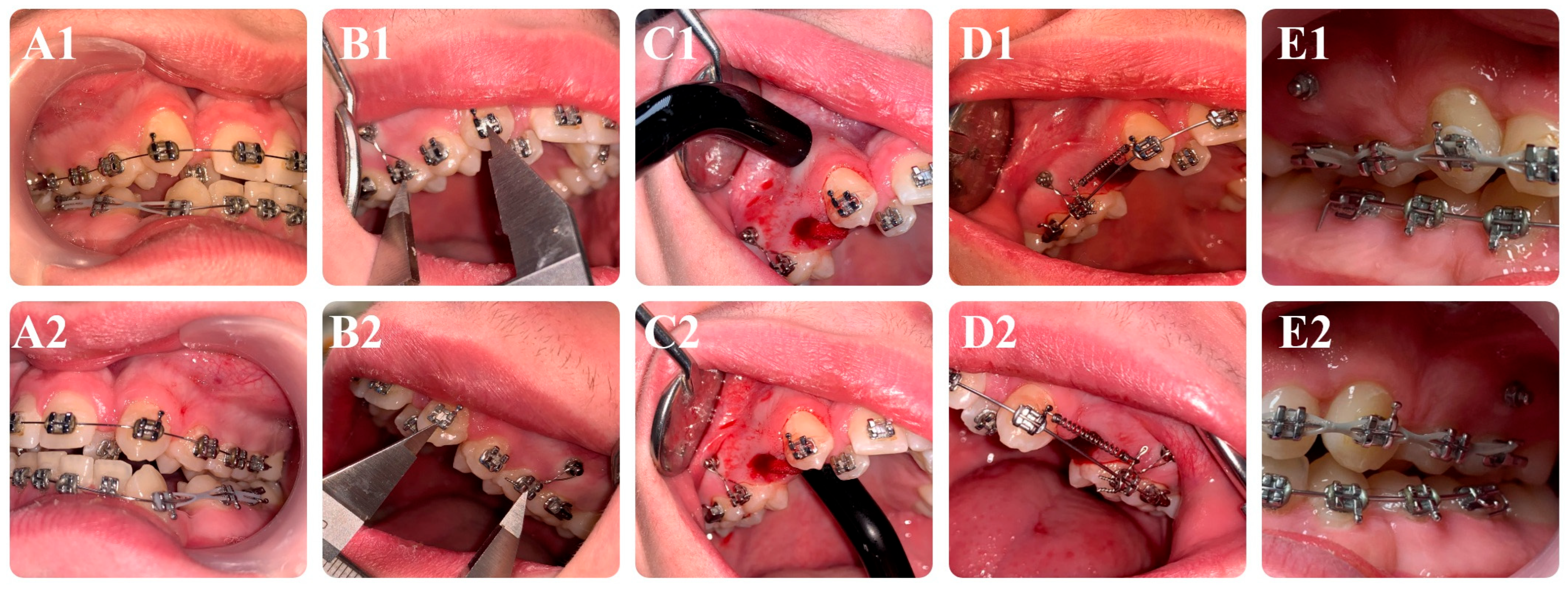
Randomization was performed using a coin toss to determine the side of the maxilla assigned to active photobiomodulation therapy. On the contralateral side, a sham photobiomodulation procedure was performed, in which the laser handpiece was placed in contact with the tissues according to the same schedule and application protocol as on the experimental side, but without laser emission. Thus, the contralateral side served as the control, and the participants were blinded to treatment allocation, whereas the operator performing the irradiation was not. (see Figure 1(C1,C2)).

2.5. Measurement of Tooth Movement

Tooth movement was assessed by measuring the distance between the central points of the bracket slots bonded to the maxillary canines and second premolars using the same calibrated orthodontic caliper under standardized conditions. All measurements were performed by an examiner who was not involved in the PBM application. Before the start of the study, the examiner was calibrated by repeated measurements performed under standardized conditions. Measurements were obtained at baseline (day 0) and on days 3, 7, 14, 30, and 45. The amount of tooth movement was calculated as the difference between the baseline and follow-up measurements. (see Figure 1(B1,B2))

2.6. Statistical Analysis

Statistical analysis was performed to evaluate whether photobiomodulation had a statistically significant effect on the rate of orthodontic tooth movement. A linear mixed-effects model was constructed, with the change in measurement from day 0 as the dependent variable. Time and treatment (photobiomodulation vs. control) were included as fixed effects, along with their interaction, to assess differences in movement dynamics. Age and sex were included as covariates. Patient ID was treated as a random effect to account for paired and repeated measurements within individuals. Model parameters were estimated using restricted maximum likelihood (REML). The significance of fixed effects and their interactions was assessed using t-tests with Satterthwaite’s approximation for degrees of freedom. Statistical analysis and data visualization were performed in the R statistical environment (version 4.4.2; R Core Team, 2024) using additional libraries [32,33].

3. Results

3.1. Linear Mixed-Effects Model of Tooth Movement

The results of the linear mixed-effects model are presented in Table 1. The analysis revealed a statistically significant interaction between treatment and time (p < 0.001), indicating that photobiomodulation significantly modified the rate of orthodontic tooth movement over the observation period. Significant main effects were also observed for treatment (estimate = 0.40, p = 0.0088) and time (estimate = 0.06, p < 0.001), confirming greater overall tooth movement on the laser-treated side and a progressive increase in displacement over time. Age and sex were included as covariates in the model but did not show a statistically significant influence on tooth movement (p > 0.05). (see Table 1).

3.2. Dynamics of Canine Distalization over Time

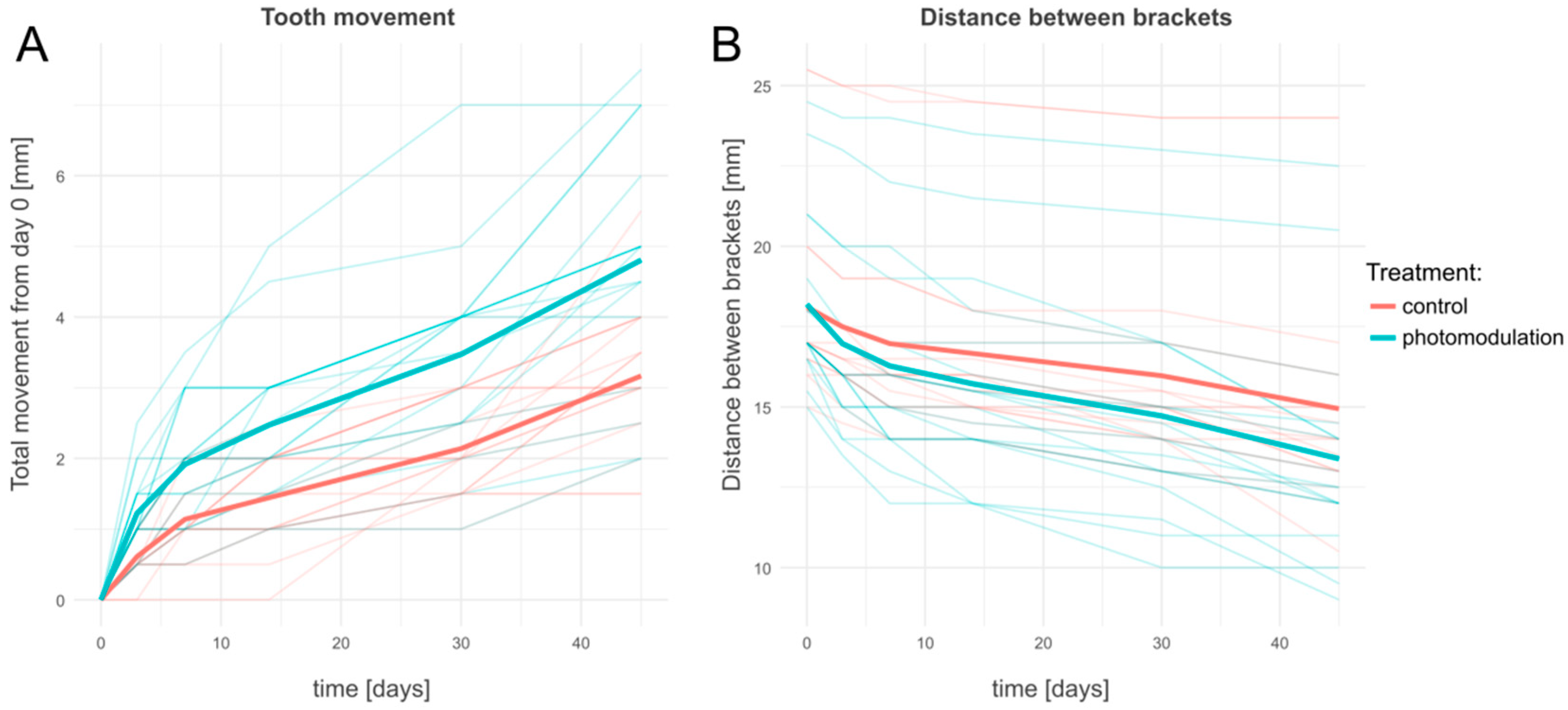
Figure 2 illustrates the dynamics of canine distalization on the photobiomodulation-treated and control sides. Panel A presents cumulative tooth movement relative to baseline, while Panel B shows changes in the absolute distance between the central points of the bracket slots over time.
As shown in Figure 2A, canine movement progressed more rapidly on the photobiomodulation side compared with the control side throughout the observation period. Although individual patient trajectories demonstrated variability, the average trend indicated a consistently greater rate of tooth movement in laser-treated teeth.
Consistent with these findings, Figure 2B demonstrates a greater reduction in the inter-bracket distance on the photobiomodulation side compared to the control side. After 45 days, the mean absolute distance was 14.9 ± 3.63 mm on the control side and 13.4 ± 3.46 mm on the photobiomodulation side, corresponding to a greater total displacement of the canine on the laser-treated side.

4. Discussion

The aim of this randomized split-mouth clinical trial was to evaluate the effect of a 635 nm photobiomodulation (PBM) on orthodontic tooth movement in adult extraction cases. The results demonstrated a significantly greater rate of maxillary canine distalization on the PBM-treated side compared with the untreated control side, as evidenced by the significant interaction between treatment and time in the linear mixed-effects model. This finding indicates that photobiomodulation modified the dynamics of tooth movement over time rather than merely influencing the final displacement. Within the 45-day observation period, a clinically meaningful difference in canine movement was observed between the photobiomodulation-treated and control sides. The mean total displacement of the maxillary canine was approximately 1.6 mm greater on the PBM-treated side compared with the untreated control side, reflecting a substantially higher rate of tooth movement over time. This difference was achieved under controlled conditions with absolute anchorage and without the use of any surgical acceleration techniques, supporting the potential clinical relevance of photobiomodulation as an adjunctive method for accelerating orthodontic tooth movement in adult extraction cases.
Previous experimental and clinical studies suggest that photobiomodulation may enhance orthodontic tooth movement by modulating bone remodeling. Yang et al. [34] demonstrated increased alveolar bone remodeling with 660 nm and 830 nm PBM, with stronger early osteoclastic activity at 660 nm, while Keklikci et al. [35] reported the greatest tooth displacement near 650 nm. The acceleration observed in the present study with 635 nm PBM is consistent with these findings. The selection of the 635 nm wavelength was based on biological considerations. Although near-infrared wavelengths are more commonly used in the literature because of their presumed deeper tissue penetration, red-light wavelengths in the range of approximately 630–660 nm have also been reported to exert biologically relevant effects on bone remodeling and orthodontic tooth movement [29,34,35]. Since the biological target in this study was the periodontal and alveolar tissue adjacent to the moving tooth rather than deeper anatomical structures, the use of red-spectrum PBM was considered justified. Clinical studies and reviews have likewise reported accelerated tooth movement or reduced treatment time after PBM application [36,37,38,39,40,41]. In our study, cumulative canine displacement was greater on the PBM-treated side than on the control side (4.81 mm vs. 3.2 mm) over 45 days, corresponding to an approximately 50.3% greater displacement during the observation period. However, because the present study assessed tooth movement over a limited 45-day interval rather than the full orthodontic treatment course, no direct conclusion can be drawn regarding the reduction in total treatment time. Furthermore, considerable heterogeneity remains across studies with respect to wavelength, energy density, and irradiation intervals. Faster tooth movement has been associated with energy density values below 5.3 J/cm2 and wavelengths below 810 nm [21], while effective protocols have also been reported for 640 ± 25 nm, 830 ± 20 nm, and 960 ± 20 nm, with suggested energy ranges of 5–70 J/cm2 [29]. Umbrella reviews confirmed substantial variability in PBM protocols, although wavelengths around 730–830 nm and regular application schedules appear promising [30,31]. Irradiation frequency itself may be of limited importance [42], whereas four-week intervals may be insufficient [43]. PBM has also been proposed as a minimally invasive adjunct in younger patients [26].
Beyond accelerating tooth movement, PBM may also support post-extraction alveolar bone remodeling, reduce inflammatory responses, and alleviate pain. These effects may be related, at least in part, to the modulation of biochemical mediators involved in orthodontic tooth movement [3]. Recent literature indicates that OTM is regulated by a complex cytokine network within the periodontal ligament and alveolar bone, including IL-1β, IL-6, IL-8, TNF-α, M-CSF, RANKL, and OPG, which coordinate inflammatory signaling, osteoclastogenesis, and alveolar bone remodeling [16]. Although these mediators were not directly assessed in the present study, PBM has been associated with changes in selected inflammatory mediators, particularly IL-1β and IL-8, which may contribute to the enhanced tooth movement observed after irradiation [16]. A systematic review and meta-analysis by Zhang et al. [44], consistent with other studies [45], suggested a reduction in orthodontically induced inflammatory root resorption, although Farah Y. Eid et al. [46] found no significant differences with 980 nm PBM in a randomized clinical trial. This may indicate wavelength-dependent effects, as supported by findings by Lin Kong et al. [47], who reported a protective effect of a 650 nm diode laser together with accelerated tooth movement. In an animal model, Okazaki et al. [48] demonstrated reduced pain-related neuropeptide markers after near-infrared irradiation, while PBM, including LED-based devices, may also improve the stability and longevity of temporary anchorage devices [49]. Compared with other acceleration methods, PBM appears less invasive, although not always the most potent. Ferreira Botelho et al. [50] found greater acceleration with corticopuncture than with PBM alone, but the combined approach produced the most favorable results, whereas corticotomy remains the most invasive option despite its high acceleration potential [51]. Gökhan Türker et al. [52] reported a stronger short-term effect of LLLT than piezocision, and although both LED and LLLT may increase canine retraction, greater acceleration has been reported with an 810 nm Ga-Al-As laser than with a 640 nm LED device [53]. El-Angbawi et al. [4] identified statistically significant acceleration only for low-level laser therapy, while Lalnunpuii et al. [54] found no significant difference between self-ligating and conventional brackets when adjunctive LLLT was used.
The present findings support a significant acceleration of orthodontic tooth movement with PBM. Nevertheless, several limitations of the present study should be acknowledged. First, the study was conducted in a relatively small group of patients, although the sample size was adequate according to the a priori calculation. Second, the observation period was limited to 45 days; therefore, the results reflect only the short-term effect of PBM on canine movement and do not allow direct conclusions regarding the overall duration of orthodontic treatment. In addition, photobiomodulation remains difficult to standardize due to the marked heterogeneity of published protocols. Current evidence is inconsistent regarding the most influential variables, including wavelength, output power, energy density, application duration, and treatment frequency. Moreover, a shortage of high-quality comparative studies directly evaluating different parameter sets, alongside numerous confounding clinical variables, limits the ability to propose a routine PBM protocol for everyday practice. Despite promising results in recent years, further well-designed trials with larger samples and longer follow-up periods are required to establish reproducible, evidence-based guidelines for PBM use in orthodontics.

5. Conclusions

Within the limitations of this randomized split-mouth clinical trial, photobiomodulation at a wavelength of 635 nm significantly increased the rate of maxillary canine distalization compared with an untreated control side in adult patients undergoing extraction-based orthodontic treatment. A greater cumulative canine displacement was observed on the photobiomodulation-treated side over a 45-day observation period. These findings suggest that 635 nm photobiomodulation may serve as a minimally invasive adjunct to accelerate orthodontic tooth movement under controlled clinical conditions. Further well-designed randomized clinical trials with longer follow-up periods are required to determine the long-term effects and to establish standardized, evidence-based protocols for photobiomodulation use in orthodontic practice.

Author Contributions

Conceptualization, J.M. and R.F.; methodology, R.F. and J.M.; software, M.K.; formal analysis, K.G.-L., W.D. and J.M.; investigation, R.F. and J.M.; writing—original draft preparation, J.M., M.W., M.K. and A.O.; writing—review and editing, R.F., K.G.-L. and W.D.; supervision, J.M.; funding acquisition, W.D. and J.M. All authors have read and agreed to the published version of the manuscript.

Funding

This research received no external funding.

Institutional Review Board Statement

The research protocol was reviewed and approved by the Local Ethics Committee of Wroclaw Medical University (approval number: KB-278/2018).

Informed Consent Statement

All participants provided written informed consent prior to inclusion in the study, in accordance with the principles of the Declaration of Helsinki. The study was registered at ClinicalTrials.gov (Identifier: NCT07390357).

Data Availability Statement

Data are available from the corresponding author upon request.

Conflicts of Interest

The authors declare no conflicts of interest.

References

  1. Flieger, R.; Matys, J.; Dominiak, M. The Best Time for Orthodontic Treatment for Polish Children Based on Skeletal Age Analysis in Accordance to Refund Policy of the Polish National Health Fund (NFZ). Adv. Clin. Exp. Med. 2018, 27, 1377–1382. [Google Scholar] [CrossRef]
  2. Flieger, R.; Gedrange, T.; Grzech-Leśniak, K.; Dominiak, M.; Matys, J. Low-Level Laser Therapy with a 635 Nm Diode Laser Affects Orthodontic Mini-Implants Stability: A Randomized Clinical Split-Mouth Trial. J. Clin. Med. 2020, 9, 112. [Google Scholar] [CrossRef] [PubMed]
  3. Li, Y.; Zhan, Q.; Bao, M.; Yi, J.; Li, Y. Biomechanical and Biological Responses of Periodontium in Orthodontic Tooth Movement: Up-Date in a New Decade. Int. J. Oral Sci. 2021, 13, 20. [Google Scholar] [CrossRef]
  4. El-Angbawi, A.; McIntyre, G.; Fleming, P.S.; Bearn, D. Non-Surgical Adjunctive Interventions for Accelerating Tooth Movement in Patients Undergoing Orthodontic Treatment. Cochrane Database Syst. Rev. 2023, 2023, CD010887. [Google Scholar] [CrossRef]
  5. Sonesson, M.; De Geer, E.; Subraian, J.; Petrén, S. Efficacy of Low-Level Laser Therapy in Accelerating Tooth Movement, Preventing Relapse and Managing Acute Pain during Orthodontic Treatment in Humans: A Systematic Review. BMC Oral Health 2016, 17, 11. [Google Scholar] [CrossRef]
  6. Bakdach, W.M.M.; Hadad, R. Effectiveness of Low-Level Laser Therapy in Accelerating the Orthodontic Tooth Movement: A Systematic Review and Meta-Analysis. Dent. Med. Probl. 2020, 57, 73–94. [Google Scholar] [CrossRef]
  7. Alfailany, D.T.; Hajeer, M.Y.; Aljabban, O.; Mahaini, L. The Effectiveness of Repetition or Multiplicity of Different Surgical and Non-Surgical Procedures Compared to a Single Procedure Application in Accelerating Orthodontic Tooth Movement: A Systematic Review and Meta-Analysis. Cureus 2022, 14, e23105. [Google Scholar] [CrossRef]
  8. Showkatbakhsh, R.; Jamilian, A.; Showkatbakhsh, M. The Effect of Pulsed Electromagnetic Fields on the Acceleration of Tooth Movement. World J. Orthod. 2010, 11, e52–e56. [Google Scholar] [PubMed]
  9. AlShahrani, I.; Togoo, R.A.; Hosmani, J.; Alhaizaey, A. Photobiomodulation in Acceleration of Orthodontic Tooth Movement: A Systematic Review and Meta Analysis. Complement. Ther. Med. 2019, 47, 102220. [Google Scholar] [CrossRef]
  10. Pobanz, J.M.; Nicozisis, J.; Storino, D. Orthodontic Acceleration; Propel Alveolar Micro-Osteoperforation. Ortotown 2013, 5, 22–25. [Google Scholar]
  11. Murphy, K.G.; Wilcko, M.T.; Wilcko, W.M.; Ferguson, D.J. Periodontal Accelerated Osteogenic Orthodontics: A Description of the Surgical Technique. J. Oral Maxillofac. Surg. 2009, 67, 2160–2166. [Google Scholar] [CrossRef] [PubMed]
  12. Dibart, S.; Keser, E.I. Piezocision; John Wiley & Sons: Hoboken, NJ, USA, 2014. [Google Scholar]
  13. Ciobotaru, C.D.; Feștilă, D.; Dinte, E.; Muntean, A.; Boșca, B.A.; Ionel, A.; Ilea, A. Enhancement of Orthodontic Tooth Movement by Local Administration of Biofunctional Molecules: A Comprehensive Systematic Review. Pharmaceutics 2024, 16, 984. [Google Scholar] [CrossRef]
  14. Li, J.; Ge, X.; Guan, H.; Jia, L.; Chang, W.; Ma, W. The Effectiveness of Photobiomodulation on Accelerating Tooth Movement in Orthodontics: A Systematic Review and Meta-Analysis. Photobiomodulation Photomed. Laser Surg. 2021, 39, 232–244. [Google Scholar] [CrossRef]
  15. de Almeida, V.L.; de Andrade Gois, V.L.; Andrade, R.N.M.; Cesar, C.P.H.A.R.; de Albuquerque-Junior, R.L.C.; de Mello Rode, S.; Paranhos, L.R. Efficiency of Low-Level Laser Therapy within Induced Dental Movement: A Systematic Review and Meta-Analysis. J. Photochem. Photobiol. B Biol. 2016, 158, 258–266. [Google Scholar] [CrossRef]
  16. Kitaura, H.; Ohori, F.; Marahleh, A.; Ma, J.; Lin, A.; Fan, Z.; Narita, K.; Murakami, K.; Kanetaka, H. The Role of Cytokines in Orthodontic Tooth Movement. Int. J. Mol. Sci. 2025, 26, 6688. [Google Scholar] [CrossRef]
  17. Pavlin, D.; Anthony, R.; Raj, V.; Gakunga, P.T. Cyclic Loading (Vibration) Accelerates Tooth Movement in Orthodontic Patients: A Double-Blind, Randomized Controlled Trial. Semin. Orthod. 2015, 21, 187–194. [Google Scholar] [CrossRef]
  18. Leethanakul, C.; Suamphan, S.; Jitpukdeebodintra, S.; Thongudomporn, U.; Charoemratrote, C. Vibratory Stimulation Increases Interleukin-1 Beta Secretion during Orthodontic Tooth Movement. Angle Orthod. 2016, 86, 74–80. [Google Scholar] [CrossRef]
  19. Youssef, M.; Ashkar, S.; Hamade, E.; Gutknecht, N.; Lampert, F.; Mir, M. The Effect of Low-Level Laser Therapy during Orthodontic Movement: A Preliminary Study. Lasers Med. Sci. 2008, 23, 27–33. [Google Scholar] [CrossRef] [PubMed]
  20. Olmedo-Hernández, O.L.; Mota-Rodríguez, A.N.; Torres-Rosas, R.; Argueta-Figueroa, L. Effect of the Photobiomodulation for Acceleration of the Orthodontic Tooth Movement: A Systematic Review and Meta-Analysis. Lasers Med. Sci. 2022, 37, 2323–2341. [Google Scholar] [CrossRef]
  21. Grajales, M.; Ríos-Osorio, N.; Jimenez-Peña, O.; Mendez-Sanchez, J.; Sanchez-Fajardo, K.; García-Perdomo, H.A. Effectiveness of Photobiomodulation with Low-Level Lasers on the Acceleration of Orthodontic Tooth Movement: A Systematic Review and Meta-Analysis of Split-Mouth Randomised Clinical Trials. Lasers Med. Sci. 2023, 38, 387–401. [Google Scholar] [CrossRef] [PubMed]
  22. Vladimirov, Y.A.; Osipov, A.N.; Klebanov, G.I. Photobiological Principles of Therapeutic Applications of Laser Radiation. Biochemistry 2004, 69, 81–90. [Google Scholar] [CrossRef]
  23. Eells, J.T.; Henry, M.M.; Summerfelt, P.; Wong-Riley, M.T.T.; Buchmann, E.V.; Kane, M.; Whelan, N.T.; Whelan, H.T. Therapeutic Photobiomodulation for Methanol-Induced Retinal Toxicity. Proc. Natl. Acad. Sci. USA 2003, 100, 3439–3444. [Google Scholar] [CrossRef]
  24. Matys, J.; Flieger, R.; Gedrange, T.; Janowicz, K.; Kempisty, B.; Grzech-Leśniak, K.; Dominiak, M. Effect of 808 Nm Semiconductor Laser on the Stability of Orthodontic Micro-Implants: A Split-Mouth Study. Materials 2020, 13, 2265. [Google Scholar] [CrossRef]
  25. Matys, J.; Jaszczak, E.; Flieger, R.; Kostrzewska-Kaminiarz, K.; Grzech-Leśniak, K.; Dominiak, M. Effect of Ozone and Diode Laser (635 Nm) in Reducing Orthodontic Pain in the Maxillary Arch—A Randomized Clinical Controlled Trial. Lasers Med. Sci. 2020, 35, 487–496. [Google Scholar] [CrossRef] [PubMed]
  26. Yavagal, C.M.; Matondkar, S.P.; Yavagal, P.C. Efficacy of Laser Photobiomodulation in Accelerating Orthodontic Tooth Movement in Children: A Systematic Review with Meta-Analysis. Int. J. Clin. Pediatr. Dent. 2021, 14, S91–S97. [Google Scholar] [CrossRef]
  27. Reis, C.L.B.; de Souza Furtado, T.C.; Mendes, W.D.; Matsumoto, M.A.N.; Alves, S.Y.F.; Stuani, M.B.S.; Borsatto, M.C.; Corona, S.A.M. Photobiomodulation Impacts the Levels of Inflammatory Mediators during Orthodontic Tooth Movement? A Systematic Review with Meta-Analysis. Lasers Med. Sci. 2022, 37, 771–787. [Google Scholar] [CrossRef] [PubMed]
  28. Zheng, J.; Yang, K. Clinical Research: Low-Level Laser Therapy in Accelerating Orthodontic Tooth Movement. BMC Oral Health 2021, 21, 324. [Google Scholar] [CrossRef] [PubMed]
  29. Gonçalves, A.; Monteiro, F.; Brantuas, S.; Basset, P.; Estevez, A.; Silva, F.S.; Pinho, T. Clinical and Preclinical Evidence on the Bioeffects and Movement-Related Implications of Photobiomodulation in the Orthodontic Tooth Movement: A Systematic Review. Orthod. Craniofacial Res. 2025, 28, 12–53. [Google Scholar] [CrossRef]
  30. Jiménez-Peña, O.M.; Ríos-Osorio, N.; Velandia-Palacio, L.A.; Gómez-Moreno, G.; Grajales, M. Effectiveness of Photobiomodulation with Low-Level Lasers on the Acceleration of Orthodontic Tooth Movement: An Umbrella Review. Evid. Based Dent. 2025, 26, 113–114. [Google Scholar] [CrossRef]
  31. Domínguez, A.; Muñoz-Alvear, H.D.; Oviedo-Toro, D.; Suárez-Quenguán, X.; Lopez-Portilla, E. Effective Parameters for Orthodontic Tooth Movement Acceleration with Photobiomodulation: An Umbrella Review. Photobiomodulation Photomed. Laser Surg. 2024, 42, 449–462. [Google Scholar] [CrossRef]
  32. Bates, D.; Mächler, M.; Bolker, B.; Walker, S. Fitting Linear Mixed-Effects Models Using Lme4. J. Stat. Softw. 2015, 67, 1–48. [Google Scholar] [CrossRef]
  33. Kuznetsova, A.; Brockhoff, P.B.; Christensen, R.H.B. LmerTest Package: Tests in Linear Mixed Effects Models. J. Stat. Softw. 2017, 82, 1–26. [Google Scholar] [CrossRef]
  34. Yang, H.; Liu, J.; Yang, K. Comparative Study of 660 and 830 Nm Photobiomodulation in Promoting Orthodontic Tooth Movement. Photobiomodulation Photomed. Laser Surg. 2019, 37, 349–355. [Google Scholar] [CrossRef]
  35. Baser Keklikci, H.; Yagci, A.; Yay, A.H.; Goktepe, O. Effects of 405-, 532-, 650-, and 940-Nm Wavelengths of Low-Level Laser Therapies on Orthodontic Tooth Movement in Rats. Prog. Orthod. 2020, 21, 43. [Google Scholar] [CrossRef] [PubMed]
  36. Camacho, A.D.; Montoya Guzmán, D.; Velásquez Cujar, S.A. Effective Wavelength Range in Photobiomodulation for Tooth Movement Acceleration in Orthodontics: A Systematic Review. Photobiomodulation Photomed. Laser Surg. 2020, 38, 581–590. [Google Scholar] [CrossRef]
  37. AlSayed Hasan, M.M.A.; Sultan, K.; Hamadah, O. Low-Level Laser Therapy Effectiveness in Accelerating Orthodontic Tooth Movement: A Randomized Controlled Clinical Trial. Angle Orthod. 2017, 87, 499–504. [Google Scholar] [CrossRef]
  38. Doshi-Mehta, G.; Bhad-Patil, W.A. Efficacy of Low-Intensity Laser Therapy in Reducing Treatment Time and Orthodontic Pain: A Clinical Investigation. Am. J. Orthod. Dentofac. Orthop. 2012, 141, 289–297. [Google Scholar] [CrossRef]
  39. Üretürk, S.E.; Saraç, M.; Fıratlı, S.; Can, Ş.B.; Güven, Y.; Fıratlı, E. The Effect of Low-Level Laser Therapy on Tooth Movement during Canine Distalization. Lasers Med. Sci. 2017, 32, 757–764. [Google Scholar] [CrossRef]
  40. Caccianiga, G.; Paiusco, A.; Perillo, L.; Nucera, R.; Pinsino, A.; Maddalone, M.; Cordasco, G.; Lo Giudice, A. Does Low-Level Laser Therapy Enhance the Efficiency of Orthodontic Dental Alignment? Results from a Randomized Pilot Study. Photomed. Laser Surg. 2017, 35, 421–426. [Google Scholar] [CrossRef]
  41. Guram, G.; Reddy, R.; Dharamsi, A.; Syed Ismail, P.; Mishra, S.; Prakashkumar, M. Evaluation of Low-Level Laser Therapy on Orthodontic Tooth Movement: A Randomized Control Study. Contemp. Clin. Dent. 2018, 9, 105–109. [Google Scholar] [CrossRef] [PubMed]
  42. Eid, F.Y.; El-Kenany, W.A.; Mowafy, M.I.; El-Kalza, A.R.; Guindi, M.A. A Randomized Controlled Trial Evaluating the Effect of Two Low-Level Laser Irradiation Protocols on the Rate of Canine Retraction. Sci. Rep. 2022, 12, 10074. [Google Scholar] [CrossRef] [PubMed]
  43. Mistry, D.; Dalci, O.; Papageorgiou, S.N.; Darendeliler, M.A.; Papadopoulou, A.K. The Effects of a Clinically Feasible Application of Low-Level Laser Therapy on the Rate of Orthodontic Tooth Movement: A Triple-Blind, Split-Mouth, Randomized Controlled Trial. Am. J. Orthod. Dentofac. Orthop. 2020, 157, 444–453. [Google Scholar] [CrossRef]
  44. Zhang, G.; Li, Z.; McGrath, C.; Yang, Y.; Shan, Z. Effects of Photobiomodulation Therapy on Orthodontically Induced Inflammatory Root Resorption: A Systematic Review and Meta-Analysis. BMC Oral Health 2025, 26, 162. [Google Scholar] [CrossRef] [PubMed]
  45. Nayyer, N.; Tripathi, T.; Ganesh, G.; Rai, P. Impact of Photobiomodulation on External Root Resorption during Orthodontic Tooth Movement in Humans—A Systematic Review and Meta-Analysis. J. Oral Biol. Craniofacial Res. 2022, 12, 469–480. [Google Scholar] [CrossRef] [PubMed]
  46. Eid, F.Y.; El-Kenany, W.A.; Mowafy, M.I.; El-Kalza, A.R. The Influence of Two Photobiomodulation Protocols on Orthodontically Induced Inflammatory Root Resorption (a Randomized Controlled Clinical Trial). BMC Oral Health 2022, 22, 221. [Google Scholar] [CrossRef] [PubMed]
  47. Kong, L.; Zhang, K.; Liu, F.; Zhao, Y. The Simultaneous Protective Effect of Photobiomodulation on Root Resorption While Accelerating Orthodontic Tooth Movement in Rats. Lasers Med. Sci. 2025, 40, 394. [Google Scholar] [CrossRef]
  48. Okazaki, K.; Nakatani, A.; Kunimatsu, R.; Kado, I.; Sakata, S.; Kiridoshi, H.; Tanimoto, K. Effects of Near-Infrared Diode Laser Irradiation on Pain Relief and Neuropeptide Markers During Experimental Tooth Movement in the Periodontal Ligament Tissues of Rats: A Pilot Study. Int. J. Mol. Sci. 2025, 26, 7404. [Google Scholar] [CrossRef]
  49. Ekizer, A.; Türker, G.; Uysal, T.; Güray, E.; Taşdemir, Z. Light Emitting Diode Mediated Photobiomodulation Therapy Improves Orthodontic Tooth Movement and Miniscrew Stability: A Randomized Controlled Clinical Trial. Lasers Surg. Med. 2016, 48, 936–943. [Google Scholar] [CrossRef]
  50. Botelho, B.F.; Torres, M.C.; Paredes, N.; Garcez, A.S.; Moon, W.; Suzuki, S.S. Biomodulation of Induced Tooth Movement by Three Methods, Corticopuncture, Photobiomodulation, and Their Combination: An Animal Study. Photobiomodulation Photomed. Laser Surg. 2023, 41, 328–342. [Google Scholar] [CrossRef]
  51. Kacprzak, A.; Strzecki, A. Methods of Accelerating Orthodontic Tooth Movement: A Review of Contemporary Literature. Dent. Med. Probl. 2018, 55, 197–206. [Google Scholar] [CrossRef]
  52. Türker, G.; Yavuz, İ.; Gönen, Z.B. Which Method Is More Effective for Accelerating Canine Distalization Short Term, Low-Level Laser Therapy or Piezocision? A Split-Mouth Study. J. Orofac. Orthop. 2021, 82, 236–245. [Google Scholar] [CrossRef] [PubMed]
  53. Farhadian, N.; Miresmaeili, A.; Borjali, M.; Salehisaheb, H.; Farhadian, M.; Rezaei-Soufi, L.; Alijani, S.; Soheilifar, S.; Farhadifard, H. The Effect of Intra-Oral LED Device and Low-Level Laser Therapy on Orthodontic Tooth Movement in Young Adults: A Randomized Controlled Trial. Int. Orthod. 2021, 19, 612–621. [Google Scholar] [CrossRef] [PubMed]
  54. Lalnunpuii, H.; Batra, P.; Sharma, K.; Srivastava, A.; Raghavan, S. Comparison of Rate of Orthodontic Tooth Movement in Adolescent Patients Undergoing Treatment by First Bicuspid Extraction and En-Mass Retraction, Associated with Low Level Laser Therapy in Passive Self-Ligating and Conventional Brackets: A Randomized Controlled Trial. Int. Orthod. 2020, 18, 412–423. [Google Scholar] [CrossRef] [PubMed]
Figure 1. Clinical sequence of maxillary canine distalization following premolar extraction. (A1,A2) show the initial clinical situation before canine distalization on the right and left sides of the maxilla, respectively; (B1,B2) illustrate measurement of the distance between the maxillary canine and second premolar using a caliper on the right and left sides; (C1,C2) depict photobiomodulation applied to the buccal and palatal aspects of the canine root, respectively; (D1,D2) show closed-coil springs attached between the brackets on the maxillary canine and second premolar during canine distalization on the right and left sides; (E1,E2) present the final clinical outcome after completion of canine distalization on the right and left sides of the maxilla.
Photonics 13 00321 g001
Figure 2. Dynamics of canine distalization on photobiomodulation-treated and control sides. Thin lines represent individual patient trajectories, while bold lines indicate group means. (A) Cumulative canine movement relative to baseline over time. (B) Absolute distance between the central points of the bracket slots during treatment.
Photonics 13 00321 g002
Table 1. Linear mixed-effects model assessing the effects of treatment, time, and their interaction on orthodontic tooth movement. Treatment (photobiomodulation vs. control), time, and their interaction were included as fixed effects, with age and sex as covariates. Covariates (sex and age) did not influenced significantly the final outcome. p-value was calculated with t-tests with Satterthwaite’s approximation for degrees of freedom.
VariableEstimateStd. Errordft Valuep-Value
(Intercept)0.530.6615.620.8050.43288
treatment0.400.15195.002.6450.00884
time0.060.00195.0013.375<0.001
age0.000.0215.000.0090.99278
sex−0.540.2815.00−1.9090.07554
treatment*time0.030.01195.004.56<0.001
Std. Error, standard error of the estimate; df, degrees of freedom; t value, t-statistic; p-value, probability value, *, interaction between treatment and time.
Disclaimer/Publisher’s Note: The statements, opinions and data contained in all publications are solely those of the individual author(s) and contributor(s) and not of MDPI and/or the editor(s). MDPI and/or the editor(s) disclaim responsibility for any injury to people or property resulting from any ideas, methods, instructions or products referred to in the content.