Next Article in Journal
The Design of a Superchiral-Sensitive MCT Photodetector Based on Silicon Metasurfaces with Truncated Corners
Previous Article in Journal
Effect of 635 nm Photobiomodulation on Orthodontic Tooth Movement: A Randomized Split-Mouth Clinical Trial
 
 
Due to scheduled maintenance work on our servers, there may be short service disruptions on this website between 11:00 and 12:00 CEST on March 28th.
Article

Effects of Device and Contact Dimension Scaling on the Performance of InGaN/GaN Quantum Dot Light-Emitting Diodes


1
Faculty of Basic Sciences, Ghulam Ishaq Khan Institute of Engineering Sciences and Technology, Topi 23460, Pakistan
2
Biomedical and Instrument Engineering Program, College of Engineering and Energy, Abdullah Al Salem University, Khaldiya, Kuwait City 72303, Kuwait
*
Authors to whom correspondence should be addressed.
Photonics 2026, 13(4), 320; https://doi.org/10.3390/photonics13040320
Submission received: 7 February 2026 / Revised: 16 March 2026 / Accepted: 24 March 2026 / Published: 26 March 2026

Abstract

Inspired by the growing demand for small and effective optoelectronic devices, this paper presents a simulation-based analysis of InGaN/GaN quantum dot light-emitting diode, focusing on the effects of systematic variation in both anode and cathode contact regions, as well as overall device size. Two-dimensional simulations using APSYS software were used to examine the impact of scaling the device dimensions as well as the individual contact dimensions on significant performance parameters like internal quantum efficiency (IQE), optical output power, and current-voltage (IV) response. We simulated five LED device sizes that is 50 × 50 µm2, 100 × 100 µm2, 200 × 200 µm2, 300 × 300 µm2, and 400 × 400 µm2. As device size grows, so does the total current at each voltage. The highest current measurement is achieved by the device with dimensions 400 × 400 µm2 while the lowest is observed on the device with dimensions 50 × 50 µm2. In addition to changing the device dimensions, we ran extensive simulations on the sizes of p-type and n-type contacts. Notable changes were seen in the efficiency, optical power, and emission profile of the p-contact. The behavior of p-side contacts from 0 to 50 µm was the same, while contacts between 60 and 100 µm showed significant differences. The significant performance parameters were unaffected by changes to n-contact dimensions. The results of this study illustrate how the configuration of contacts and dimensions greatly influences the electrical and optical performance of quantum dot light-emitting diode. The results are believed to be helpful to researchers working on the design of next-generation compact and efficient solid-state lighting devices.

1. Introduction

Self-emissive quantum dot (QD) displays make use of electroluminescent QDs, known as QDLEDs (or QD-LEDs), that are integrated into an active-matrix structure. QDLEDs are especially promising for next-generation lighting and display technologies due to their remarkable color purity, stability, and an emission spectrum with numerous wavelengths. Compared to traditional organic LEDs, QDLEDs are more suited for high-definition displays as they offer better brightness, color, longevity, and especially outperform traditional organic light-emitting diodes (OLEDs). The main distinguishing factor is an InGaN based QD using light-emitting center which provides effective radiative recombination with good spectral tunability and color purity [1,2]. Their brightness, emission control, and quantum confinement effects at the nanoscale make them the primary focus of emerging lighting and display technologies. The quantum confinement effect, which is characteristic of quantum dots, changes the density of electronic states at the material’s band edges. The distribution of energy levels in these nanoscale structures is like that of individual atoms and bulk semiconductors, resulting in unique electronic behavior. Quantum confinement is relevant when the QD’s dimensions are tiny enough that the distance between its energy levels exceeds the thermal energy, which is defined by the product of Boltzmann’s constant and temperature. This results in the development of distinct energy levels, allowing precise control over the optical and electrical properties of the material [3,4]. Aleksey Ekimov discovered QDs in the early 1980s when he demonstrated that copper chloride nanocrystals embedded in a glass matrix exhibited size-dependent optical alterations, indicating quantum confinement effects [5]. Shortly after, Louis Brus extended these findings to colloidal systems, exhibiting similar behavior in solution-based semiconductor nanoparticles [6]. These early breakthroughs established the basis for modern QD science, and Yekimov, Brus, and Bawendi received the 2023 Nobel Prize in Chemistry for their landmark work in discovering and synthesizing these nanomaterials [7,8]. QDs are used in many revolutionary technologies, including light-emitting diodes (LEDs), micro-LEDs, resonance cavity (RC) LEDs, solar cells, photodetectors, sensors, quantum computing components, and other emerging optoelectronic systems [9,10,11,12,13,14,15]. This research focuses on III-V QDLEDs, with a particular emphasis on InGaN-based QDLEDs, because of their significant potential in modern optoelectronics. In contrast to typical QDs such as CdSe or PbS, which frequently cause environmental and health concerns due to hazardous components, InGaN provides a safer, more thermally stable alternative with great optical efficiency thanks to its straight bandgap. These materials are also highly compatible with current semiconductor manufacturing technologies, which increase their usefulness in practical systems. While III-V QDLEDs have evident advantages, they are underexplored in the existing research. This study attempts to close that gap by giving a fresh analysis of how device scale and contact dimensions affect InGaN QDLED performance [16,17].
The InGaN-based multiquantum well (MQW) LEDs display high brightness performance despite their threading dislocation density which reaches approximately 109 cm−2 according to the findings in ref. [18]. The presence of such extreme structural defects should stop semiconductor materials from emitting light because nonradiative Shockley–Read–Hall recombination takes place. The inherent defect tolerance mechanism exists in InGaN alloys. The experimental results from cathodoluminescence investigations showed that nanoscale indium composition variations develop during growth and create spatial patterns that link to improved luminescence which happens outside of dislocation core areas [19]. The regions that exist in these areas create potential minima which function as carriers’ confinement zones analogous to QDs. The first-principles research demonstrated that the In clusters with multiple atoms create strong localization effects which keep the valence band maximum point fixed in position and especially affect hole movements because this process limits carriers from reaching nonradiative defect areas; strain in quantum wells intensifies this localization process. The researchers established that nanoscale compositional inhomogeneity stops carrier movement while maintaining high internal quantum efficiency through better carrier confinement compared to large-scale phase separation. The presence of localized indium fluctuations protects optimal radiative recombination which allows intense light emission to occur despite the existence of numerous defects [20,21]. The Krastanov growth mechanism enables quantum dot formation at indium-rich zones when additional indium is added. The natural formation of these indium-rich areas creates QD-like localization centers which establish the physical foundation for defect-tolerant behavior and assist with carrier confinement in the QD-in-QW structure [22,23]. This paper shows a two-dimensional simulation of InGaN/GaN QDLEDs built using a dot-in-well configuration. The study is divided into two sections. The first examines how changes in overall device dimensions affect performance parameters like current flow, emission behavior, and efficiency. The second section investigates how p- and n-contact size variations affect carrier dynamics, recombination processes, and light output in III-V MQW-based QDLEDs.

2. Device Design and Physical Simulation Models

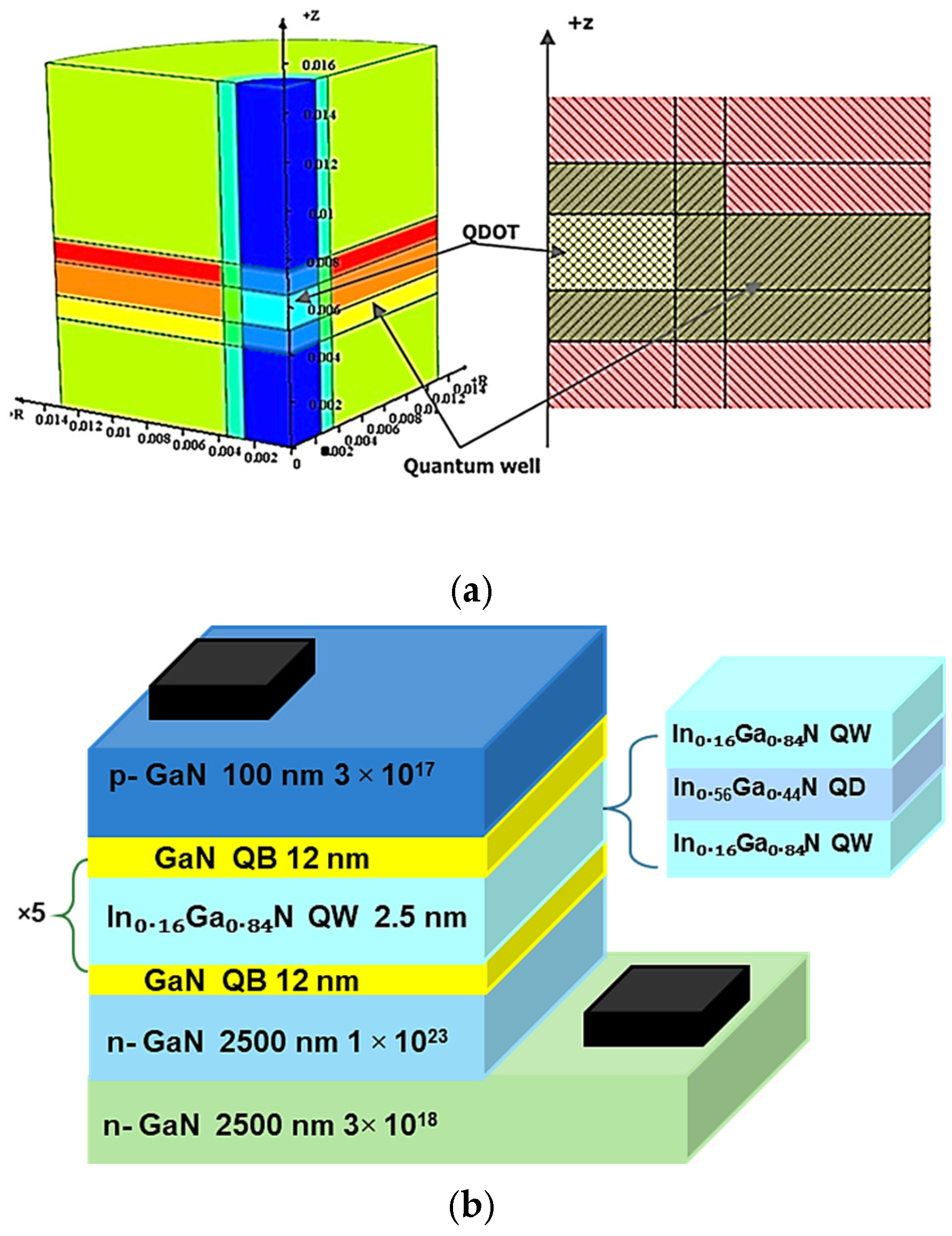
The simulated QDLEDs structure as in Figure 1a,b features a precisely designed sequence of epitaxial layers to promote efficient carrier transport and light emission. The simulations in this study are conducted using APSYS (https://crosslight.com/), a finite-element simulation tool specifically designed for the analysis of III-V optoelectronic devices. This platform integrates a wide range of physical models that are essential for the accurate representation of semiconductor heterostructures. Key features include the drift-diffusion approach for modeling carrier transport under applied bias, along with self-consistent solutions to the Poisson–Schrödinger equations. Additionally, the software employs k . p band structure models, which are particularly important in multiquantum well regions of III-V semiconductors, where phenomena such as quantum confinement and band mixing have a substantial influence on device behavior. It also features quantum tunneling models to simulate carrier movement across heterojunction interfaces, along with polarization effects both spontaneous and piezoelectric that are especially significant in GaN/InGaN-based materials due to their wurtzite crystal structure; but the effect of polarization on the QDs is neglected in the simulations because the QDs are extremely small, resulting in deep potential wells where polarization-induced distortions have a minimal impact on the confined energy levels. It numerically computes the emission spectrum, IQE, the concentrations of electrons and holes at various current densities, band energies, radiative recombination profiles within the heterostructure, current density for specified voltages as well as the spatial distribution of carrier currents throughout the device. IQE is determined by three main carrier recombination processes, i.e., radiative recombination ( R rad = B ( n p n i 2 ) , Auger recombination ( R Auger = ( C n n + C p p ) ( n p n i 2 ) and Shockley–Read–Hall (SRH) non-radiative recombination ( R SRH = n p n i 2 τ p S R H n + n 1 + τ n S R H p + p 1 ) [24,25] where n = N c e x p F n E c k B T , p = N v e x p E v F p k B T , n 1 = n i e x p E t E i k T and p 1 = n i e x p E i E t k T . Here, τ n S R H and τ p S R H denote the Shockley–Read–Hall (SRH) carrier lifetimes for electrons and holes, respectively, with both often assumed equal in simplified models. n i is the intrinsic carrier concentration. The Auger recombination constants for electron- and hole-related processes are given by C n and C p , respectively. E c and E c refer to the conduction band minimum and valence band maxima. F n , p is the quasi-Fermi level for electrons and holes. k is the Boltzmann constant, and N c and N v represent the effective density of states in the conduction and valence bands, respectively. For a mid-gap trap ( E t = E i ) n 1 = p 1 = n i .
The epitaxial layers consist of a 2500 nm thick n-type GaN layer doped with concentration of 3 × 1018 cm−3, followed by an active region comprising five periods of 2.5 nm thick In0.16Ga0.84N quantum wells and 12 nm GaN quantum barriers. A 100 nm thick p-type GaN layer doped with 3 × 1017 cm−3 allows for effective hole injection. Because of QDs’ unique carrier confinement features, quantum well (QW) LED models are insufficient for LEDs that incorporate them. To overcome this issue, a dot-in-well (DWELL) model [26] is employed to describe the active region of InGaN-based LEDs. The dot-in-well model is described by a cylindrical coordinate system which serves as a reasonable approximation method to model the QDs used in InGaN-based LEDs developed by Krestnikov [22,26]. In the present simulation, QDs are assumed to be uniformly distributed in the lateral direction within the quantum well plane, with a fixed surface density of 4.5 × 1011 cm−2. Each QD is modeled as a cylinder with a height of 2 nm, consistent with experimentally reported values. To reflect the experimentally observed size range of InGaN QDs (2–5 nm in diameter), two representative diameters of 3.6 nm and 5 nm were employed as shown in Figure 1 [27].
These discrete sizes were selected to approximate realistic size variation and to evaluate the influence of QD dimensions on carrier confinement and recombination characteristics. A continuous size distribution was not explicitly implemented; instead, representative geometries were used to maintain computational efficiency while preserving physical accuracy [19,28]. The QD model was first constructed and solved independently to determine the quantized energy levels and confinement properties. The resulting electronic parameters were then incorporated into the complete LED structure by embedding the QD region within the DWELL framework. Subsequently, the calculated quantized states and confinement effects were coupled with the carrier transport and recombination equations of the full device model to analyze their impact on carrier dynamics and QDLED performance. To fully comprehend the impact of lateral device dimensions on the performance of InGaN/GaN QDLEDs, we first performed a detailed set of two-dimensional simulations over five lateral sizes: 50 × 50 µm2, 100 × 100 µm2, 200 × 200 µm2, 300 × 300 µm2, and 400 × 400 µm2. The goal was to look at how differences in device footprint affect important optoelectronic metrics such as I-V characteristics, IQE, and radiative output power. Understanding scaling effects is critical as device miniaturization grows in importance for high-resolution display technologies, optical interconnects, and wearable photonics. Larger III-V LEDs support improved current spreading due to reduced series resistance and a wider active surface, potentially increasing overall light output, whereas smaller III-V LEDs may suffer from limited carrier injection and edge effects. This section provides a thorough examination of these dependencies, revealing how lateral scaling affects carrier transport, recombination kinetics, and emission uniformity in QDLEDs. In the second section of this study, we investigated how the geometry of the contacts, specifically the lateral dimensions of the p- and n-type electrodes, affected the performance of InGaN/GaN QDLEDs. Using a fixed device size of 300 × 300 µm2, contact sizes were varied to study their impact on carrier injection, distribution, and electroluminescence characteristics. When the p-contact size exceeded a particular limit, considerable fluctuations in output power, IQE, and emission patterns were detected. Sizes ranging from 0 to 50 µm had minimal effect. However, contact sizes between 60 and 100 µm significantly improved performance, likely due to improved hole injection and lower series resistance. Changes in n-contact size, on the other hand, had only negligible effects on optical output and efficiency, with minor variances mostly evident in I-V behavior. These findings underscore the critical significance of p-contact design in supporting effective current spreading and recombination within QDLEDs, whereas the n-contact dimension appears to have a minor impact under the conditions investigated.

3. Results and Discussion

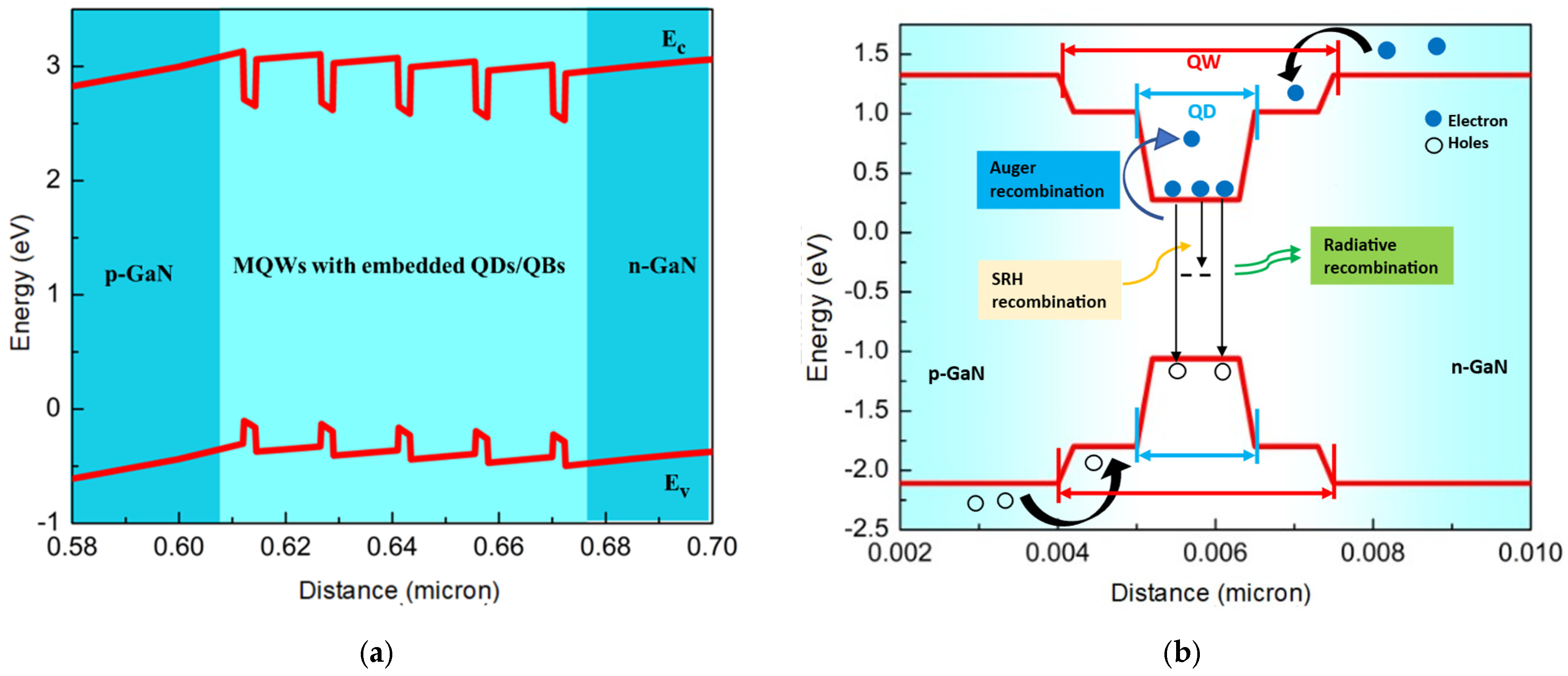
This section provides a comprehensive discussion of the simulation outcomes for InGaN/GaN QDLEDs. The analysis is structured into two core areas: the impact of varying the lateral dimensions of the device and the effect of modifying the sizes of the electrical contacts. Key performance parameters I-V response, IQE, and optical output power are examined in detail. Through this systematic approach, we aim to uncover how geometric design influences the electrical and optical behavior of III-V QDLEDs. Energy band diagram of quantum dots (QDs)/quantum barriers (QBs) is shown in Figure 2a. Light is released when recombination takes place inside QDs due to the confinement of electrons and holes in QDs. The mechanism is shown in Figure 2b.

3.1. Impact of Device Dimensions on InGaN QDLED Performance

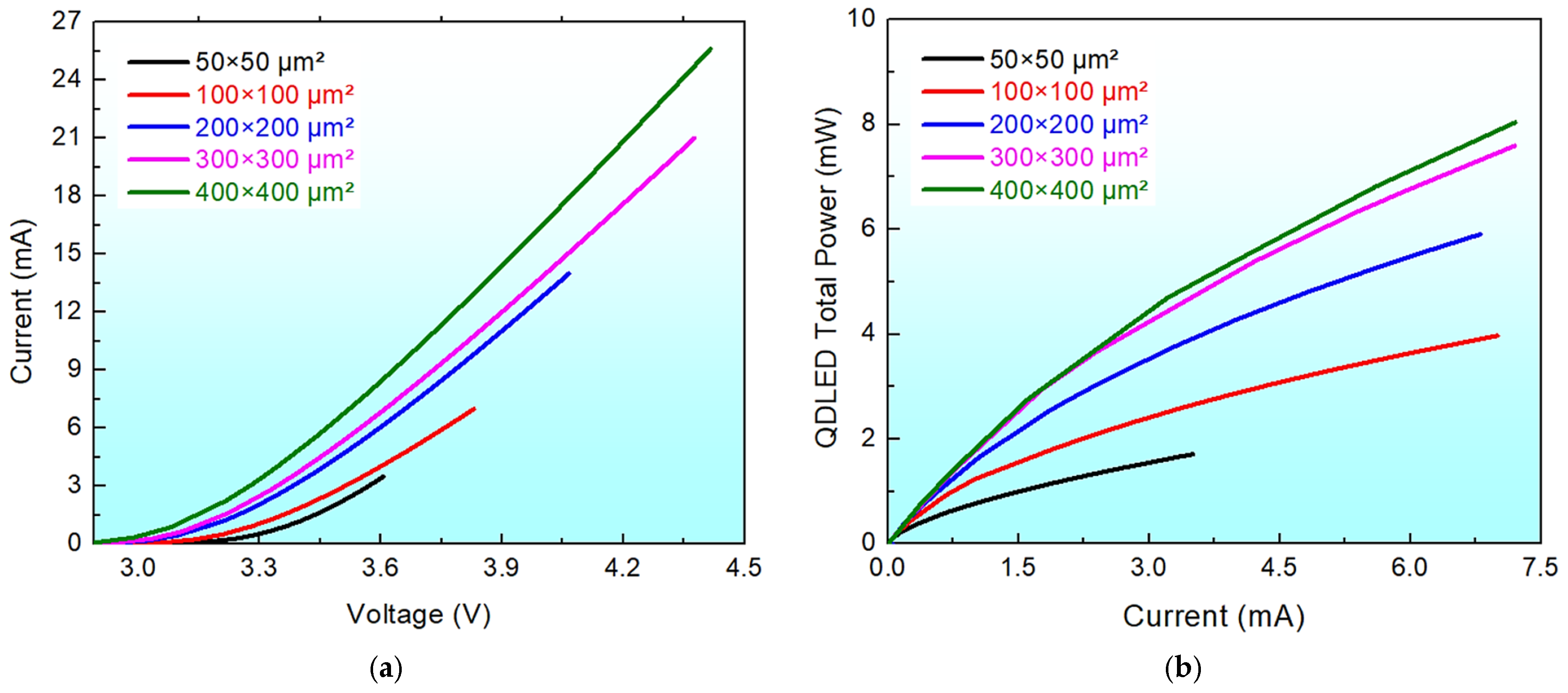
The I-V characteristics of QDLEDs as shown in Figure 3a,b with chip sizes ranging from 50 × 50 μm2 to 400 × 400 μm2. The results clearly illustrate size-dependent behavior, i.e., larger chip areas produce much stronger forward currents at the same applied voltage. This trend is due to increased current spreading and lower sidewall recombination effects in larger III-V QDLEDs [29]. In contrast, smaller chips have slightly higher turn-on voltages and lower forward currents, which could be due to etching-induced sidewall damage or increased contact resistance [30]. QDLEDs’ optical output power grows as chip size increases, demonstrating a significant size-dependent performance. Smaller III-V QDLEDs produce less output power, which can be ascribed to increased surface recombination due to a higher sidewall-to-volume ratio [31,32]. The proximity of the p-contact to the chip edge in smaller QDLEDs may potentially result in higher leakage current or poor carrier injection, lowering radiative recombination efficiency.
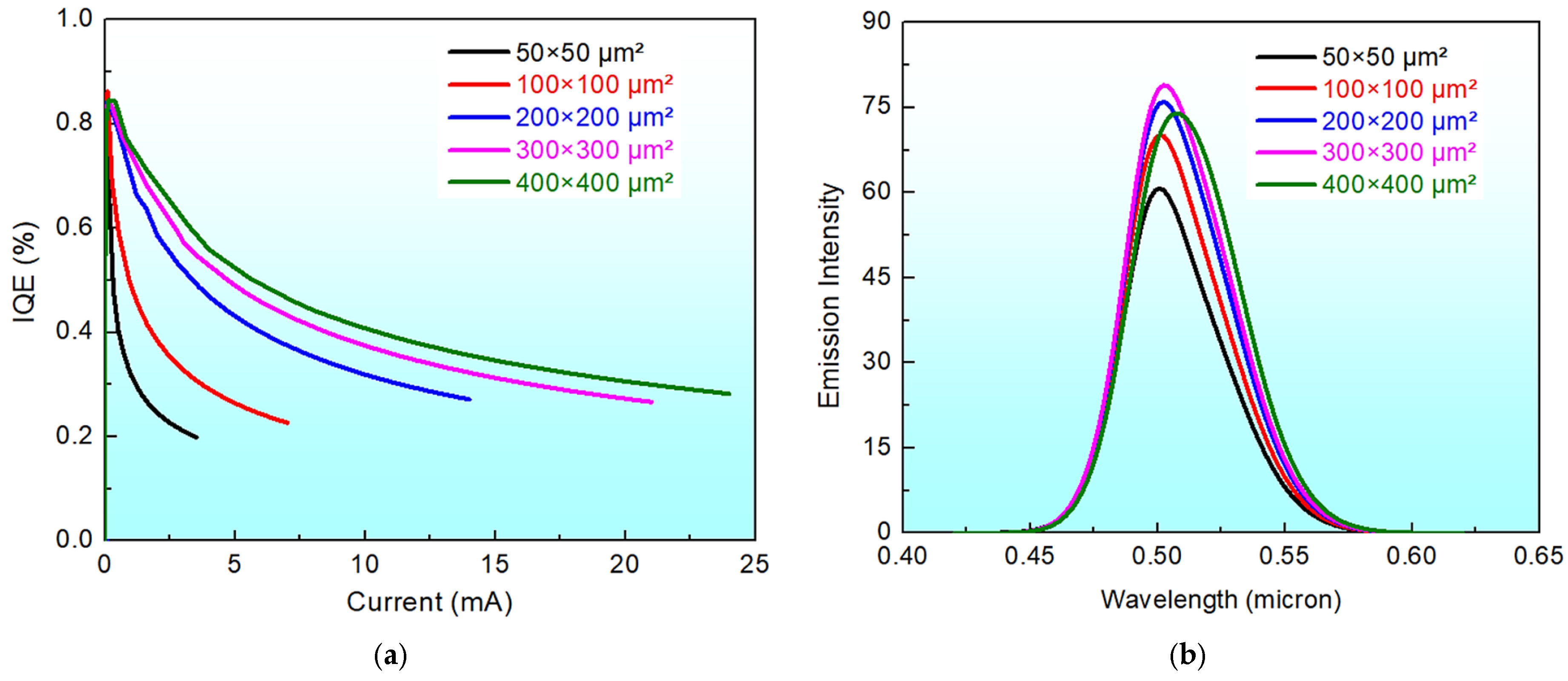
In contrast, larger chips have lower edge-related losses and perhaps better current dispersion, allowing more carriers to recombine radiatively and hence generate more light [28]. The IQE of QDLEDs varies with device size, especially at varied current injection levels. Although the peak IQE is nearly constant across chip sizes, smaller QDLEDs exhibit more severe efficiency decline. This can be attributable mostly to increasing surface-to-volume ratios, which improve non-radiative recombination (SRH) due to sidewall flaws [29]. Even with passivation, the effectiveness may be reduced at the nanoscale. Furthermore, when the device area diminishes, current congestion increases, resulting in localized heating and non-uniform carrier distribution, which can further inhibit radiative recombination. In contrast, larger QDLEDs distribute current more uniformly (with engineered electrodes) and have a smaller fraction of surface area where non-radiative losses occur, resulting in less droop [29]. In small-size QDLEDs (e.g., 50 × 50 µm2), the surface-to-volume ratio is higher, so a larger fraction of injected carriers can reach the sidewalls. This enhances non-radiative recombination at the surface, leading to increased current loss, reduced internal quantum efficiency (IQE), and possible deviation from ideal ABC recombination assumptions. Although peak efficiency stays similar due to ongoing material quality and recombination dynamics, the higher current density required to reach this peak in smaller QDLEDs demonstrates the impact of scaling on non-radiative mechanisms. These effects explain why smaller QDLEDs experience more noticeable efficiency degradation at higher injection levels, despite achieving a same maximum IQE [30,32]. The results are shown in Figure 4a,b.

3.2. Impact of Contacts Scaling on InGaN QDLED Performance

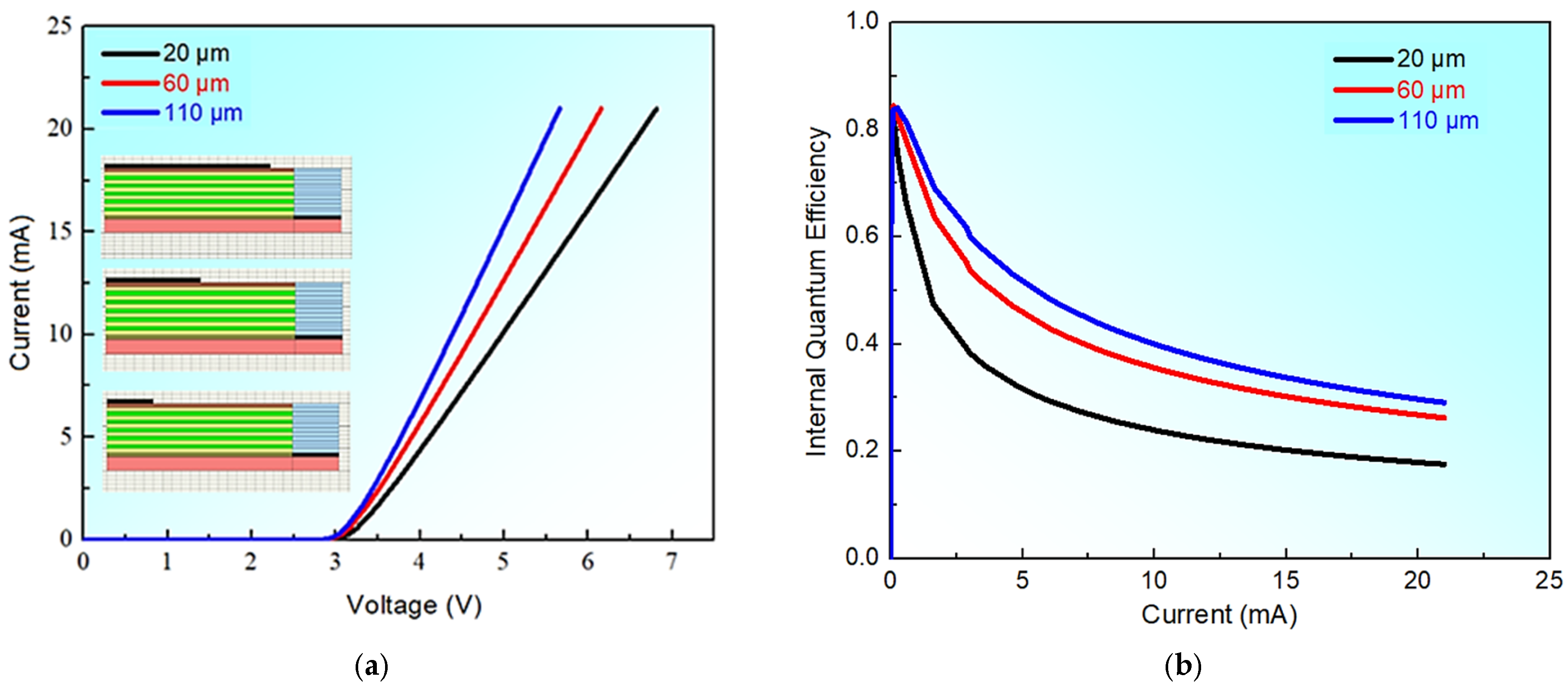
In the second part of the current study, the effect of contact geometry, specifically, the lateral dimensions of the p-type and n-type electrodes on the performance of InGaN/GaN QDLEDs were examined. The device size was kept constant at 300 × 300 µm2 and p/n-contact sizes were systematically altered to investigate their impact on carrier injection, current spreading, and electroluminescence behavior. As the p-contact size increases, the device behavior improves comparatively significantly. The systematic modification of the p-contact size reveals three distinct performance regimes in terms of I-V characteristics, IQE, and emission spectra. In the first regime, which corresponds to contact sizes between 10 and 50 µm, hole injection is limited and current crowding effects dominate. This results in overlapping electrical and optical responses. As p-contact size increases to 60–100 µm, current spreading and carrier injection improve significantly, resulting in the second regime with improved device performance. Enlarging the p-contact to 110–150 µm results in the third regime with comparable performance enhancements to the prior one (i.e., second regime). These results highlight the critical role that p-contact geometry plays in determining the electrical and optical efficiency of QDLEDs in relation to the current spreading length [31,32]. The results are shown in Figure 5a,b. Representative devices of the three regimes are shown in the inset of Figure 5a.
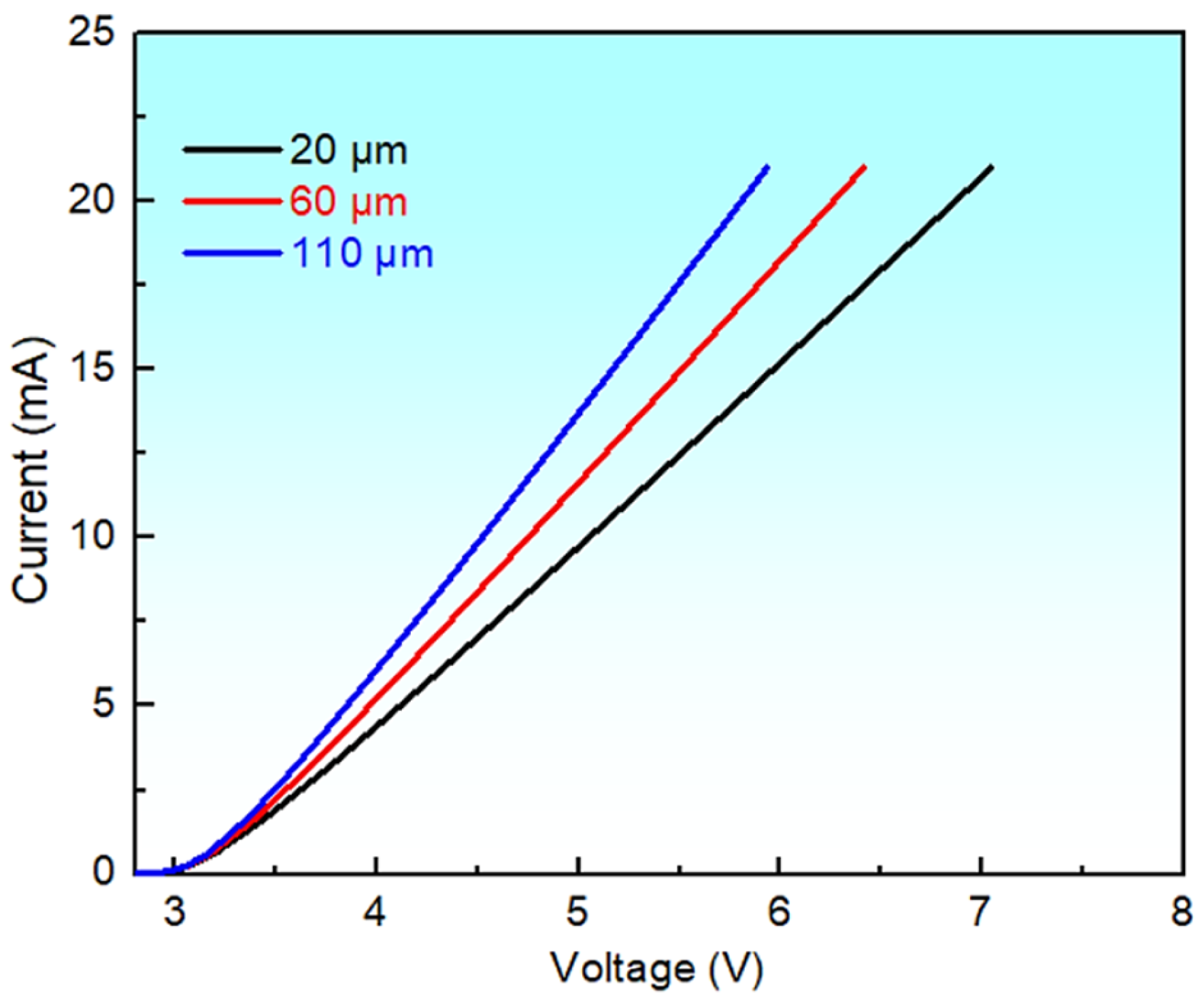
The impact of changing the n-type contact size on the performance of the 300 × 300 µm2 QDLED was thoroughly studied. The variations in n-contact size resulted in observable changes in I-V characteristics, primarily due to changes in series resistance and current injection pathways. However, no significant differences were found in IQE or electroluminescence spectra across the contact size range studied. The results are shown in Figure 6. As a result, n-contact size adjustments have no significant effect on carrier recombination kinetics or light emission uniformity, indicating that the n-contact dimension is less important than the p-contact in determining QDLED optical performance under the current conditions [30]. N-type GaN layer’s inherent greater conductivity relative to the p-type layer allows for efficient electron injection and uniform current spreading even in smaller n-contact areas [28,29].

4. Conclusions

The simulation findings clearly show how device size and contact dimension scaling affect the performance of InGaN/GaN QDLEDs. Increasing the lateral device size from 50 × 50 µm2 to 300 × 300 µm2 resulted in higher emission intensity, IQE, and spectrum power. However, too large QDLEDs may present issues like current crowding around the contacts, limiting uniform carrier injection and affecting overall performance and stability. The impact of contact dimensions was explored using a 300 × 300 µm2 QDLED structure. Variation in p-contact size indicated three unique performance regimes, each with a stepwise improvement in I-V behavior, IQE, and luminescence spectrum. This emphasizes the important significance of hole injection and current propagation as influenced by the p-contact area. In contrast, varying the n-contact size resulted in minimal changes in the I-V characteristics while leaving the IQE and spectral response unchanged, demonstrating that the n-contact had a limited impact under the measured conditions. These findings shed light on the complex interaction between geometrical scaling and optoelectronic behavior in QDLEDs, highlighting the crucial need of carefully tuning both device and contact dimensions for improved efficiency and performance. This emphasizes essential design techniques for producing next-generation, high-resolution screens and energy-efficient QD-based solid-state lighting technologies.

Author Contributions

Conceptualization, M.U.; methodology, M.G., M.U. and S.A.; software, M.G. and S.A.; validation, M.G., M.U. and S.A.; formal analysis, M.G., M.U. and S.A.; investigation, M.G., M.U. and S.A.; resources, M.G., M.U. and S.A.; data curation, M.G.; writing—original draft preparation, M.G.; writing—review and editing, M.G., M.U. and S.A.; visualization, M.U.; supervision, M.U.; project administration, M.U. and A.A.; funding acquisition, M.U. and A.A. All authors have read and agreed to the published version of the manuscript.

Funding

This research received no external funding.

Data Availability Statement

The data supporting the findings of this research are accessible from the corresponding author upon reasonable request.

Acknowledgments

The authors are obliged to Ghulam Ishaq Khan Institute of Engineering Sciences and Technology (Pakistan) for providing the needed resources for this research.

Conflicts of Interest

The authors declare that they have no known competing financial interest or personal relationships that could have appeared to influence the work reported in this paper.

References

  1. Nwogu, U.; Oji-Dike, I. OLED and QLED TV Comparative Analysis. J. Electron. Commun. Eng. Res. 2021, 7, 6–10. [Google Scholar]
  2. Tassone, G. Display Technology: From LCD to QLED. Master’s Thesis, Politecnico di Torino, Turin, Italy, 2021. [Google Scholar]
  3. Yoffe, A.D. Semiconductor quantum dots and related systems: Electronic, optical, luminescence and related properties of low dimensional systems. Adv. Phys. 2001, 50, 1–208. [Google Scholar] [CrossRef]
  4. Bera, D.; Qian, L.; Tseng, T.-K.; Holloway, P.H. Quantum dots and their multimodal applications: A review. Materials 2010, 3, 2260–2345. [Google Scholar] [CrossRef]
  5. Ekimov, A.; Onushchenko, A. Quantum size effect in three-dimensional microscopic semiconductor crystals. JETP Lett. 2023, 118, S15–S17. [Google Scholar] [CrossRef]
  6. Brus, L.E. Electron–electron and electron-hole interactions in small semiconductor crystallites: The size dependence of the lowest excited electronic state. J. Chem. Phys. 1984, 80, 4403–4409. [Google Scholar]
  7. Sarma, D.; Kamat, P.V. 2023 Nobel Prize in chemistry: A mega recognition for nanosized quantum dots. ACS Energy Lett. 2023, 8, 5149–5151. [Google Scholar] [CrossRef]
  8. Wegner, K.D.; Resch-Genger, U. The 2023 nobel prize in chemistry: Quantum dots. Anal. Bioanal. Chem. 2024, 416, 3283–3293. [Google Scholar] [CrossRef]
  9. Gong, T.; Xuan, T.; Bai, W.; Dong, H.; Huang, K.; Xie, R. Quantum Dot Luminescence Microspheres Enable Ultra-Efficient and Bright Micro-LEDs. Adv. Mater. 2025, 37, 2411999. [Google Scholar] [CrossRef]
  10. Song, H.; Lin, Y.; Zhang, Z.; Rao, H.; Wang, W.; Fang, Y.; Pan, Z.; Zhong, X. Improving the efficiency of quantum dot sensitized solar cells beyond 15% via secondary deposition. J. Am. Chem. Soc. 2021, 143, 4790–4800. [Google Scholar] [CrossRef]
  11. Vafaie, M.; Fan, J.Z.; Najarian, A.M.; Ouellette, O.; Sagar, L.K.; Bertens, K.; Sun, B.; de Arquer, F.P.G.; Sargent, E.H. Colloidal quantum dot photodetectors with 10-ns response time and 80% quantum efficiency at 1,550 nm. Matter 2021, 4, 1042–1053. [Google Scholar] [CrossRef]
  12. Zhou, R.; Xu, J.; Luo, P.; Hu, L.; Pan, X.; Xu, J.; Jiang, Y.; Wang, L. Near-infrared photoactive semiconductor quantum dots for solar cells. Adv. Energy Mater. 2021, 11, 2101923. [Google Scholar] [CrossRef]
  13. Münnix, M.C.; Lochmann, A.; Bimberg, D.; Haisler, V.A. Modeling highly efficient RCLED-type quantum-dot-based single photon emitters. IEEE J. Quantum Electron. 2009, 45, 1084–1088. [Google Scholar] [CrossRef]
  14. Schulz, W.-M.; Eichfelder, M.; Reischle, M.; Kessler, C.; Roßbach, R.; Jetter, M.; Michler, P. Pulsed single-photon resonant-cavity quantum dot LED. J. Cryst. Growth 2011, 315, 127–130. [Google Scholar]
  15. Vajner, D.A.; Rickert, L.; Gao, T.; Kaymazlar, K.; Heindel, T. Quantum communication using semiconductor quantum dots. Adv. Quantum Technol. 2022, 5, 2100116. [Google Scholar] [CrossRef]
  16. Chen, H.; Feenstra, R.M.; Northrup, J.E.; Zywietz, T.; Neugebauer, J. Spontaneous formation of indium-rich nanostructures on InGaN (0001) surfaces. Phys. Rev. Lett. 2000, 85, 1902. [Google Scholar]
  17. Chang, H.; Chen, C.H.; Chen, Y.F.; Lin, T.Y.; Chen, L.C.; Chen, K.H.; Lan, Z.H. Direct evidence of nanocluster-induced luminescence in InGaN epifilms. Appl. Phys. Lett. 2005, 86, 021911. [Google Scholar]
  18. Humphreys, C.J. Does In form In-rich clusters in InGaN quantum wells? Philos. Mag. 2007, 87, 1971–1982. [Google Scholar]
  19. Shi, J.-J.; Zhang, S.; Yang, M.; Zhu, S.-G.; Zhang, M. Light emission from several-atom In–N clusters in wurtzite Ga-rich InGaN alloys and InGaN/GaN strained quantum wells. Acta Mater. 2011, 59, 2773–2782. [Google Scholar] [CrossRef]
  20. Monavarian, M.; Rashidi, A.; Aragon, A.; Oh, S.H.; Nami, M.; DenBaars, S.P.; Feezell, D. Explanation of low efficiency droop in semipolar (20 2 ¯ 1 ¯ InGaN/GaN LEDs through evaluation of carrier recombination coefficients. Opt. Express 2017, 25, 19343–19353. [Google Scholar]
  21. Bochkareva, N.; Rebane, Y.T.; Shreter, Y.G. Increase in the Shockley–Read–Hall recombination rate in InGaN/GaN QWs as the main mechanism of the efficiency droop in LEDs at high injection levels. Semiconductors 2015, 49, 1665–1670. [Google Scholar]
  22. Krestnikov, I.; Ledentsov, N.N.; Hoffmann, A.; Bimberg, D.; Sakharov, A.V.; Lundin, W.V.; Tsatsul’nIkov, A.F.; Usikov, A.S.; Alferov, Z.I.; Musikhin, Y.G.; et al. Quantum dot origin of luminescence in InGaN-GaN structures. Phys. Rev. B 2002, 66, 155310. [Google Scholar] [CrossRef]
  23. Xia, C.; Hu, W.D.; Wang, C.; Li, Z.F.; Chen, X.S.; Lu, W.; Li, Z.M.S.; Li, Z.Q. Simulation of InGaN/GaN multiple quantum well light-emitting diodes with quantum dot model for electrical and optical effects. Opt. Quantum Electron. 2006, 38, 1077–1089. [Google Scholar] [CrossRef]
  24. Ali, S.; Usman, M. Dimensional downscaling and quantum engineering: A path to high-performance micro-LEDs. J. Lumin. 2025, 277, 120951. [Google Scholar] [CrossRef]
  25. Gong, Z.; Jin, S.; Chen, Y.; McKendry, J.; Massoubre, D.; Watson, I.M.; Gu, E.; Dawson, M.D. Size-dependent light output, spectral shift, and self-heating of 400 nm InGaN light-emitting diodes. J. Appl. Phys. 2010, 107, 013103. [Google Scholar] [CrossRef]
  26. Dai, Y.; Wang, Z.; Dou, S.; Yang, S.; Chen, J.; Zhu, H.; Gu, Y.; Wang, J.; Zhang, H.; Liu, Y.; et al. Size-dependent characteristics of GaN-based micro-LEDs for simultaneous display and wireless optical communication. Chin. Opt. Lett. 2025, 23, 082501. [Google Scholar] [CrossRef]
  27. Konoplev, S.S.; Bulashevich, K.A.; Karpov, S.Y. From large-size to micro-LEDs: Scaling trends revealed by modeling. Phys. Status Solidi A 2018, 215, 1700508. [Google Scholar] [CrossRef]
  28. Olivier, F.; Tirano, S.; Dupré, L.; Aventurier, B.; Largeron, C.; Templier, F. Influence of size-reduction on the performances of GaN-based micro-LEDs for display application. J. Lumin. 2017, 191, 112–116. [Google Scholar] [CrossRef]
  29. Horng, R.-H.; Ye, C.-X.; Chen, P.-W.; Iida, D.; Ohkawa, K.; Wu, Y.-R.; Wuu, D.-S. Study on the effect of size on InGaN red micro-LEDs. Sci. Rep. 2022, 12, 1324. [Google Scholar] [CrossRef]
  30. Liu, Y.; Feng, F.; Zhang, K.; Jiang, F.; Chan, K.-W.; Kwok, H.-S.; Liu, Z. Analysis of size dependence and the behavior under ultrahigh current density injection condition of GaN-based Micro-LEDs with pixel size down to 3 μm. J. Phys. D Appl. Phys. 2022, 55, 315107. [Google Scholar] [CrossRef]
  31. Hsu, Y.-H.; Lo, Y.-Y.; Lin, Y.-H.; Zan, H.-W.; Horng, R.-H. Effects of ITO contact sizes on performance of blue light microLEDs. Nanoscale Res. Lett. 2022, 17, 113. [Google Scholar] [CrossRef]
  32. Zhou, S.; Wang, S.; Liu, S.; Ding, H. High power GaN-based LEDs with low optical loss electrode structure. Opt. Laser Technol. 2013, 54, 321–325. [Google Scholar] [CrossRef]
Figure 1. (a) A QDOT is approximated by a disk-like high indium cylinder surrounded like high indium cylinder, surrounded by quantum well material with lower indium composition to form a QDOT/QW complex. (b) Conventional structure of InGaN/GaN QDLED with the embedded InGaN QDs inside the QWs (DWELL).
Photonics 13 00320 g001
Figure 2. (a) Energy band diagram of InGaN/GaN QDLED and (b) dot embedded in quantum well.
Photonics 13 00320 g002
Figure 3. (a) I-V characteristics and (b) Output power of different chip sizes of QDLED.
Photonics 13 00320 g003
Figure 4. (a) IQE and (b) electroluminescence spectra of QDLEDs.
Photonics 13 00320 g004
Figure 5. (a) I-V characteristics and (b) IQE of 300 × 300 µm2 QDLEDs with varying p-contact size.
Photonics 13 00320 g005
Figure 6. I-V of 300 × 300 µm2 QDLED with varying n-contact size.
Photonics 13 00320 g006
Disclaimer/Publisher’s Note: The statements, opinions and data contained in all publications are solely those of the individual author(s) and contributor(s) and not of MDPI and/or the editor(s). MDPI and/or the editor(s) disclaim responsibility for any injury to people or property resulting from any ideas, methods, instructions or products referred to in the content.